

Yesterday marked the 72nd anniversary of the Pearl Harbor attack, which from today’s perspective can be viewed as the template on which 9/11 was modeled after. In both cases, documentation exists implicating the U.S. government. In the case of Pearl Harbor, there’s the McCollum Memo which describes in detail the strategy used to successfully provoke the Japanese government into attacking. Shortly before the Pearl Harbor attack, Secretary of State Hull presented “peace terms” to the Japanese government that all but guaranteed an inevitable attack.
In the case of 9/11, there’s a policy document from Project for a New American Century called Rebuilding America’s Defenses, which provides a clear motive to create a “catastrophic and catalyzing event – like a new Pearl Harbor”. It’s not conclusive proof they were behind the attacks, but it’s suspicious to say the least that the people with established motives for conducting an event like 9/11 were responsible for national security at the time multiple unlikely and implausible coincidences made such a successful attack possible.
A number of other dubious aspects of the Pearl Harbor attack were compiled at Washington’s Blog last year, including:
Active Interference with Military’s Ability to Defend
It has also recently been discovered that the FDR administration took numerous affirmative steps to ensure that the Japanese attack would be successful. These steps included taking extraordinary measures to hide information from the commanders in Hawaii about the location of Japanese war ships (information of which they would normally be informed), denying their requests to allow them to scout for Japanese ships, and other actions to blind the commanders in Hawaii so that the attacks would succeed. See, for example, this book (page 186).
Key Military Players Incommunicado
In addition, the heads of the Army and Navy suddenly disappeared and remained unreachable on the night before Pearl Harbor. And they would later testify over and over that they “couldn’t remember” where they were (pages 320 and 335).
Gagging Whistleblowers
Two weeks after Pearl Harbor, the Navy classified all documents top secret, and the Navy Director of Communications sent a memo ordering all commanders to “destroy all notes or anything in writing” related to the attacks. More importantly, all radio operators and cryptographers were gagged on threat of imprisonment and loss of all benefits. (page 256).
Media Complicity
Amazingly, the Army’s Chief of Staff informed the Washington bureau chiefs of the major newspapers and magazines of the impending attacks before they occurred, and swore them to an oath of secrecy, which the media honored (page 361); and listen to interview here (we personally spent an hour speaking with Stinnett, and find him to be a highly credible and patriotic American.)
Postscript: Coincidentally, Philip Zelikow – the Executive Director of the 9/11 Commission, the administration insider whose area of expertise is the creation and maintenance of “public myths” thought to be true, even if not actually true, who controlled what the 9/11 Commission did and did not analyze, then limited the scope of the Commission’s inquiry so that the overwhelming majority of questions about 9/11 remained unasked – also happened to be the main guy defending the alleged unforeseeablity of the Pearl Harbor attack, who wrote a hit piece on Pearl Harbor historians like Stinnett.
Just like 9/11, Pearl Harbor was used as a tool to focus mass hatred on a race demonized by propaganda. The attack created a culture of fear allowing for suspension of civil liberties while crushing opposition to the war. Most importantly (for powerful interests pushing for war) the attacks were a pretense for pursuing and expanding global political and economic hegemony.
For a comprehensive compilation of evidence of U.S. government involvement in the Pearl Harbor conspiracy, see: http://whatreallyhappened.com/WRHARTICLES/pearl/www.geocities.com/Pentagon/6315/pearl.html
You can give a gift in honor of a loved one and on behalf of dignity, human rights and equality for Israelis and Palestinians at Jewish Voice for Peace.

With the recent release of the Hunger Games sequel, it seems fitting to feature a cult classic that may have been the inspiration for that series: “Battle Royale”. Released in 2000, it was Kinji Fukasaku’s final film, a director previously best known for his “Battles Without Honor and Humanity” series of Yakuza films. Kinji died of cancer shortly after filming the first scene of the sequel, “Battle Royale 2: Requiem”, which was completed by his son Kenta in 2003. Battle Royale takes place in a dystopian society whose government regularly forces a class of high school students to participate in a deathmatch on a small island until just one survivor is left. Each student is given a bag containing food, water, a compass, a map of the island, and a randomly selected weapon. The students are also outfitted with surveillance collars that can track their movements and detonate if they wander into “danger zones” or refuse to cooperate.
Though the film is at times physically and emotionally brutal, it works effectively as a parable for the way youth are cynically manipulated by society and the different approaches people take dealing with tyranny. When Kinji Fukasaku first read the novel his film was based on, it resonated with him because of traumatic personal experiences. As he related in a Director’s statement for Battle Royale:
I immediately identified with the 9th graders in the novel, Battle Royale. I was fifteen when World War II came to an end. By then, my class had been drafted and was working in a munitions factory.
In July 1945, we were caught up in artillery fire. Up until then, the attacks had been air raids and you had a chance of escaping from those. But with artillery, there was no way out. It was impossible to run or hide from the shells that rained down. We survived by diving for cover under our friends.
After the attacks, my class had to dispose of the corpses. It was the first time in my life I’d seen so many dead bodies. As I lifted severed arms and legs, I had a fundamental awakening … everything we’d been taught in school about how Japan was fighting the war to win world peace, was a pack of lies. Adults could not be trusted.
The emotions I experienced then–an irrational hatred for the unseen forces that drove us into those circumstances, a poisonous hostility towards adults, and a gentle sentimentality for my friends–were a starting point for everything since. This is why, when I hear reports about recent outbreaks of teenage violence and crimes, I cannot easily judge or dismiss them.
This is the point of departure for all my films. Lots of people die in my films. They die terrible deaths. But I make them this way because I don’t believe anyone would ever love or trust the films I make, any other way.
BATTLE ROYALE, my 60th film, returns irrevocably to my own adolescence. I had a great deal of fun working with the 42 teenagers making this film, even though it recalled my own teenage battleground.
Watch the full film here.
Via: Anonymous

The modern paradigm may still seem insurmountable “because it possesses an outward front, the work of a long past, but is in reality an edifice crumbling to ruin and destined to fall in at the first storm.”
— Gustave Le Bon, The Crowd: A Study of the Popular Mind
The decentralized movement toward freedom is raging across the world. It cannot be stopped. The tipping point is near. Despite the lack of coverage in the mainstream media, actions are springing up on an increasing basis. A wave of transformation is rising. The zeitgeist is shifting in our direction.
At this point, given all the nonviolent direct actions that are currently being planned, it makes strategic sense for us to organize them, in a decentralized way, in a way that the mainstream media cannot ignore. A slightly more coordinated approach is all it will take.
The Awakening Wave
The last time we all rallied together in a loosely knit collective fashion, the Occupy movement was born and the 99% meme brought the corruption of our political and economic system, along with the grotesque inequality of wealth, into mass consciousness in a profound and lasting way. It was the opening act, the awakening wave.
Since the Occupy camps were crushed by brutal police state force, the movement has splintered in many different directions. This is now proving to have been a blessing in disguise. It gave us time to learn from our mistakes, figure out what worked best and forced us back into the autonomous actions that built the movement in the first place. We have now experimented with different tactics and thought through longer-term strategies.
Meanwhile, the repressive conditions that inspired Occupy in the first place have become even more oppressive. Now more than ever, governments no longer have the consent of the governed. A critical mass has lost faith and trust in our existing institutions. The present paradigm has outlived its usefulness. It has been overrun with corruption and rendered obsolete. Our political, economic and legal systems are doing much more to limit our potential than enhance it.
It’s Time For A Worldwide Wave of Transformation
Let’s pick a three-month span, perhaps throughout this coming spring, and unite our collective actions into an unprecedented Worldwide Wave that cannot be ignored by anyone.
Let’s crowdsource a relentless global wave of action that protests the corrupt, while also rallying around and celebrating effective alternatives and solutions to the vast problems we are confronted by. Imagine thousands of nonviolent guerrilla armies swarming corrupt targets and rallying for viable solutions for a sustained three-month cycle. If we begin preparing now, a massive spring offensive can lead to a summer of transformation.
Staying true to the vital nature of the movement, you lead, in your own way. Pick whatever issues concern you most and run with them, knowing that likeminded people throughout the world will also be fighting in solidarity, in whatever way they can, at the same time you are.
Not Focused Enough?
In an attempt to dismiss and undermine us, status quo propagandists will once again criticize us by saying that our message of systemic change is not focused enough or lacks coherent goals. This feeble attempt to keep people from joining in with us will be overcome by our widespread and consistent actions, which will lead by example and inspire the cultural shift in mass consciousness that we urgently need. Our diverse crowdsourced actions will boldly demonstrate our will to expose, fight and overcome tyrannical systems. By rallying around viable solutions and protesting what we are against, the goals and freedoms that we aspire to will organically become self-evident to all.
Throughout history, when people have fought against tyranny and oppression, they didn’t have one perfect utopian model outcome agreed upon beforehand. They just knew that the invading and old systems were detrimental to their wellbeing and had to go. We are now in that position.
Don’t let the propagandists fool you. We do not need corrupt corporations or aristocratic government rulers anymore. They are obsolete. People throughout this interconnected technological world have already come up with much more effective systems to replace the tyrannical one that is currently dominating our lives. There are already many effective solutions to our problems, solutions that are held back by the entrenched forces of shortsighted greed. Once a small percentage of us withdraw our participation from corrupt entities and opt out of tyranny, the old and obsolete systems of rule will quickly fall away.
Extensive empirical evidence demonstrates that nonviolent movements toward freedom result in positive outcomes. Research has proven that it only takes approximately 3% of the population engaging in various forms of nonviolent action to create significant meaningful change, for the betterment of society. We now have the necessary critical mass of aware people who are ready, willing and capable.
Guerrilla Tactics
This time the police state will not be able to crush us. We will not have stationary targets. We will be everywhere, fluid and evasive. The movement will be an unstoppable crowdsourced, decentralized and autonomous revolutionary force.
We will engage in a diversity of nonviolent tactics, from large-scale mobilizations to small daily acts. Most of you already know the actions and tactics that are needed. Without revealing too much strategic information, here are a few basic actions to get a fire going in your mind:
-Mass gatherings, demonstrations;
-Marches, parades;
-Flash mobs, swarms;
-Shutdown harmful corporate and governmental operations;
-Worker Strikes;
-Hunger strikes;
-Sit-ins;
-Strategic defaults, debt strikes;
-Foreclosure prevention;
-Boycotting corrupt corporations;
-Monkeywrench corrupt corporations;
-Move your money out of the big banks and the stock market;
-Use alternative currencies and economic systems;
-Cancel your cable television and support independent media;
-Use independent online tools that don’t sell your info and protect your privacy;
-Online civil disobedience, Anonymous operations;
-Leak information on corruption;
-Use alternative energy;
-Build your own urban and hydroponic farms, or get your food from them;
-Support local businesses;
-Join local community organizations;
-Take part in food banks and help develop community support systems;
-Start or join intentional and autonomous communities;
-Experiment with new governing systems, Liquid Democracy;
-Create Temporary Autonomous Zones
-Host teach-ins;
-Organize socially conscious events;
-Make conscious media;
-Guerrilla theater;
-Guerrilla gardening;
-Guerrilla postering, messages on money;
-Help inspiring groups and organizations spread their message;
-Random acts of kindness and compassion;
-Mass meditations, prayer sessions and spiritual actions.
The list goes on and on. You know what you can do to play a part. Do whatever you feel inspired to do. Amplify what you are already doing. Think about what you are willing to do to be the change that we urgently need to see in the world, and then do it.
Don’t get bogged down in infighting and caught up in negativity. Ignore the saboteurs. Collaborate with people who inspire you. Keep moving forward with an indomitable will, a compassionate spirit and radiate a positive attitude. Moods are contagious. Be passionate and have fun!
Our ability to take part in civil disobedience is multiplied by our ability to easily record the actions on video and spread them throughout the Internet. By flooding social media with these inspiring videos, we will create a positive feedback loop that translates into more action on the ground.
Radical change is urgently needed, so let’s make transforming the world the cool thing to do. Let’s create a culture of transformation. Let’s blaze a contagious nonviolent wave of action through mass consciousness, signaling the end of the old world, ushering in a new paradigm.
Now is the time.
Ride the Worldwide Wave of Transformation
001101000010111000110100001011100011000100110100
#www
Tweak this meme! This is a draft call to action, a work in progress. Feel free to make changes to it and spread it around however you see fit.

View of Typhoon Haiyan from the International Space Station. PHOTO: AP
While I mean no disrespect towards veterans, I feel Veterans Day has become so archaic and obsolete it should no longer be observed. Veterans Day is an artifact of simpler times, when America was seen by the world as an honorable and benevolent country and when many still believed in “good wars”. However, the more historical truths are revealed over time, the more apparent it becomes that all wars are based on deception. This fact in no way diminishes the sacrifice and courage of those who enlisted and fought, though it adds a dimension of tragedy to realize the ideals many believed in were not necessarily those of the government and corporate interests that put them in jeopardy.
Because of the National Defense Authorization Act (NDAA), anyone including U.S. citizens can potentially be declared an “enemy combatant”, tortured, detained indefinitely or killed. Everyone is now spied on by intelligence agencies such as the FBI, CIA and NSA. Because we are all treated by government as potential “enemy combatants” does that not also make everyone of a certain age “veterans” of a perpetual war?
The main reason I don’t feel a need to celebrate Veterans Day nor Memorial Day and the Fourth of July, is because I don’t believe in American exceptionalism. Every government would like their people to believe their country is exceptional in some way. Some might be better in some respects than others, but the danger of believing one’s country to be exceptional and superior is that it often misleads people to believe the lives of citizens of one particular nation to be of more inherent value than others. In this day and age, we need to understand that those who facilitate military-industrial agendas by killing or dominating others are objectively no better than armies and civilians of other countries. It’s true that veterans do deserve more appreciation from systems that benefit most from their actions (ie. government and corporations), but it makes little sense for average Americans, who are in many ways oppressed by those systems and treated similarly to enemies of the state, to applaud and celebrate the military. The true heroes are those who value all life and do the most to put a stop to the insanity: war resisters (including some current and former soldiers), whistleblowers, activists, independent journalists, freethinkers, etc.
That being said, the people we should be paying our respects to today are the ~10,000 dead and hundreds of thousands displaced by Typhoon Haiyan. When Haiyan first hit the Philippines last Friday it was a maximum category 5 storm. Fortunately it has been weakening as it went over Vietnam earlier today and continues towards China. The following images from the UK’s Daily Mail online convey the scope of the devastation and suffering:

City of the dead: Dazed survivors survey the damaged houses in Tacloban city, Leyte province. At least 10,000 people are believed to have died there

Force of nature: One of the many ships which have been swept into the Tacloban by the power of the typhoon

Desperate measures: A Filipino father and his children wait for food relief outside their makeshift tent. Survivors have foraged for food as supplies dwindled, with some uncovering the bodies of the dead

Trail of destruction: Those who escaped the awesome power of Haiyan now face a grim battle to rebuild their lives among the sprawling wreckages

Survivors in Tacloban told reporters they are so desperate for food that they have been forced to loot shops and steal from the dead

Action: President Benigno Aquino has deployed troops to the area in a bid to restore calm after Philipine Red Cross aid trucks were attacked by hungry mobs

Aftermath: Resident gather in the remains of a structure in Tacloban. Those left homeless have been forced to plunder the houses belonging to the dead. One local councillor admitted he has stepped on corpses in a desperate bid to find food saying: ‘If you have not eaten in three days, you do shameful things to survive’

Remains: Survivors have begun find corpses as they rummage through the wreckages of houses in a bid to find food to feed their starving families

Making do: Survivors have been forced to forage for food and supplies after many homes were submerged by flood water and landslides

The Philippines president is considering introducing martial law in Tacloban city (pictured), where up to 10,000 people are feared dead

Holy house: Churches in the storm torn city have become temporary aid centres offering washing facilities and handing out emergency food supplies

Shelter from the storm: While the Catholic church in Tacloban has welcomed victims, many buildings have been broken into by desperate looters

This image taken by astronaut Karen L. Nyberg and released by NASA shows Super Typhoon Haiyan from the International Space Station yesterday
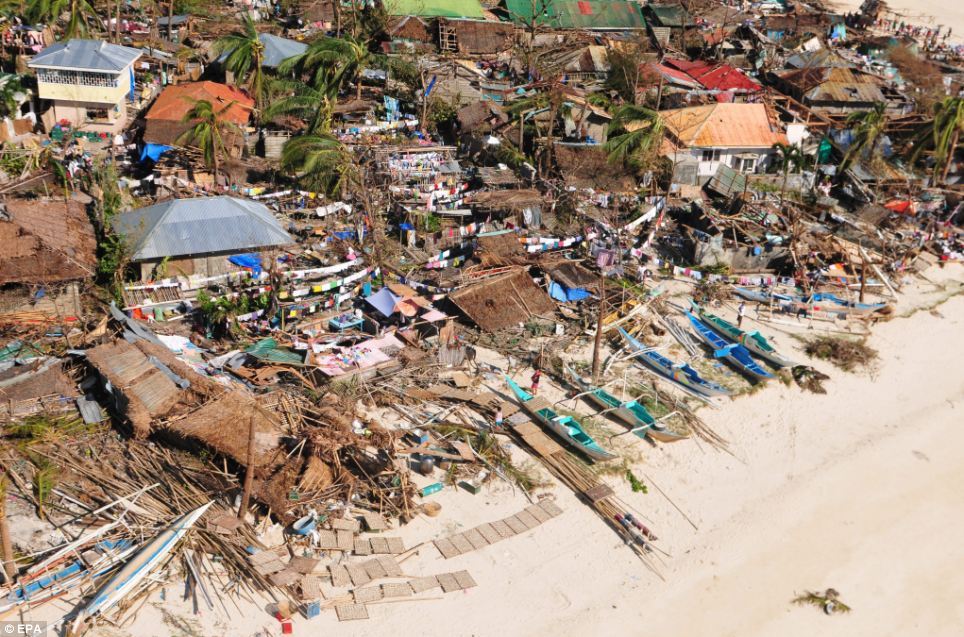
Washing still hangs on the lines but dozens of bamboo houses have been flattened by the storm in Baladian in the municipality of Concepcion, Iloilo Province

Loss: A mother weeps beside the dead body of her son at a chapel in the aftermath of Typhoon Haiyan in Tacloban

A ship was washed ashore in the huge storm. Surging sea water strewed debris for miles and survivors said the devastation was like a tsunami

The storm is one of the most powerful ever recorded and huge waves swept away entire coastal villages and destroyed up to 80 per cent of the area in its path

More than 330,900 people were displaced and 4.3million ‘affected’ by the typhoon in 36 provinces, the U.N. has said

Residents try to salvage belongings in Tacloban city, Leyte province. Rescuers have not even been able to contact some towns on the coast where the storm first hit

Villagers walk past a body of victim laying on a pier in the super typhoon devastated city of Tacloban, Leyte province

This afternoon, Typhoon Haiyan – believed to be the strongest storm to ever hit land – made landfall in Sanya in south China’s Hainan province

Workers remove a tree that fell onto a car during the deadly storm, which is the 30th typhoon to strike China this year

The typhoon is now making its way towards Vietnam and mainland China – with locals bracing themselves for the onslaught of the deadly typhoon

Heavy winds had already caused damage to China’s Hainan island before the super typhoon made landfall. Above, a billboard is blown over by the strong winds

A man carries boxes of milk as he passes by ships washed ashore by enormous waves in Tacloban city, Leyte province

One survivor said the scenes of utter devastation caused by the typhoon was ‘like the end of the world’

Aid agencies have made emergency appeals for funds and are trying to reach survivors who are in desperate need of clean water and shelter

Bodies still lie in the roads and thousands of homes lie destroyed near the fish port after super Typhoon Haiyan battered Tacloban city

This NASA MODIS Aqua satellite image shows what is possibly the strongest storm ever – Super Typhoon Haiyan

Local and foreign medical teams prepare to board a Philippines air force C-130 transport plane in Manila

Survivors walk towards the evacuation center to get relief goods after super Typhoon Haiyan battered Tacloban city, central Philippines

City administrators in Tacloban said about 400 bodies have been collected so far but said the death toll in the city alone could be 10,000

A girl looks out from a makeshift shelter in Tacloban. The World Food Programme said it was airlifting 40 tonnes of high-energy biscuits to the region

A woman holds her umbrella stands on debris of houses in Tacloban. Millions of people are believed to have been ‘affected’ by the storm, including hundreds of thousands who have lost their homes

Children pull sacks of goods they recovered from abandoned stores as they go past the rubble of houses in Tacloban

A woman mourns in front of her husband’s dead body, which lies no the street under tarpaulin alongside other bodies

An injured Filipino boy stand in front of the rubble of houses in Tacloban – destroyed by the typhoon that has left thousands of people dead

A man with an injured leg is carried through the devastation of former residential roads in Tacloban

Operation: A Vietnamese soldier carries a young girl from a lorry as villagers are evacuated to a safe place by the military

Desolation: This picture shows an flattened area of the destroyed Tacloban city covered by debris and flood water

Flattened: A Filipino boy stands among the debris in Tacloban, Leyte – one of the worst areas hit by category five storm Typhoon Haiyan

Death: It has been estimated by the Red Cross that 1,000 of the 1,200 people killed by the typhoon were residents of Tacloban

Widespread: This picture shows acres of flooded rice fields in the Iloilo Province, another area devastated by the typhoon


Plans: An elderly woman is taken from her home in Danang, Vietnam, as the government begins to evacuate 100,000 people lying in the path of typhoon Haiyan

From above: An aerial view shows badly damaged houses, including many without a roof, and blocked roads in the Philippine province of Iloilo


Recovery: A child is lifted to safety from a house in Tacloban, left, and two residents sit on the pavement in front of their home in the same city, right

Flattened: The typhoon has ravaged most of the city of Tacloban and destroyed the airport

Ruins: A resident sifts through rubbish inside his ruined home, flattened by 235mph winds in the devastated city of Tacloban

Scale: This image shows the enormous Typhoon Haiyan taken by Astronaut Karen L. Nyberg aboard the Internatioal Space Station

Satellite: A picture posted on Twitter by NASA at 8.00pm GMT shows the centre of the moving across the South China Sea towards the coast of Vietnam

Path: Once the typhoon has reached the coast of Vietnam it is expected to moved towards the capital, Hanoi, with parts of Laos and Cambodia also likely to be affected

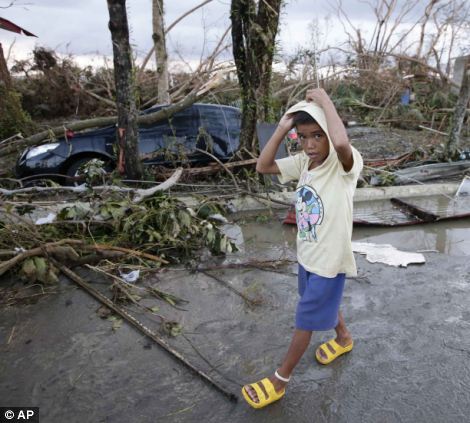
Loss: A pregnant woman, left, walks around the remains of her home while a young boy, right, walks past a crushed car in the destroyed town of Tacloban


Temporary: Bodies of victims lay in a deserted chapel in Tacloban. A woman and child, right, view the distressing scene

Flooding: Locals in Coron, Palawan, walk among damaged buildings and flooded streets after the typhoon – one of the most powerful to ever hit land

Terrifying: Filipino children are seen in the city of Tacloban, Leyte. Behind them is a scene of devastation with homes flattened and debris lying in the street

Picking up the pieces: Some residents try to go about their daily business despite the large-scale destruction
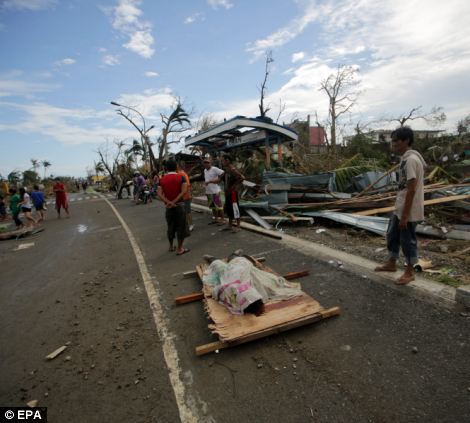

Tragedy: Bodies of residents can be seen in the streets of Tacloban, while one local is forced to transport a body in a wheelbarrow

Collapsed: A resident walks past her destroyed home – flattened by piles of wood and branches from nearby trees – in Tacloban city

Workers: Local Red Cross staff place sand bags on the roof of a house in Danang, Vietnam

Debris: Helicopters hover over the damaged area of Tacloban city, which was battered with strong winds yesterday

Victim: A resident walks past dead bodies that lie on the street in Tacloban city, Leyte province

Under water: Residents wade through a flooded street in Mindoro, Philippines this morning following the typoon

Pile up: Vehicles and rubbish are pictured strewn across a flooded street in Tacloban, Leyte

Upside down: A devastated airport in Tacloban city, Leyte province – where roofs were ripped on hundreds of houses


Shock: These two pictures show the devastation in Coron, Palawan where buildings have been flattened, left and right, leaving residents helplessly walking the streets.

Space: A digital composite of Typhoon Haiyan approaching the Philippines, made using images captured geostationary satellites of the Japan Meteorological Agency

Rebuilding their lives: Two men in Iloilo move some of their belongings through flood waters covering the streets

Devastation: Debris which was washed in by the storm litters the road by the coastal village in Legazpi city. Residents now face a long clean up operation


Hanging on: A fisherman in Manila is forced to cling on to his equipment, left, while there was little hope for other less stable buildings in the storm’s path, right

Higher ground: Residents of Legaspi, Albay province, south of Manila resident, were forced to flee the coast as Haiyan continued to pound the sea wall today

Downpour: As well as strong winds, the typhoon brought with it torrential rain which caused landslides in rural parts of the country

Terrifying: Residents run for their lives as the terrible gusts of the typhoon buffet the popular tourist city of Cebu. Trees and roofs were torn off by the storm

Blocked: Residents clear the road in the island province of Cebu after a tree was toppled by strong winds during typhoon Haiyan

Aid effort: Volunteers pack relief goods inside a Department of Social Welfare and Development warehouse before shipping out to devastated provinces

Shelter: Filipino residents sleep on the floor of a gymnasium turned into an evacuation center in Sorsogon City in the Bicol region

On a recent episode of PBS Newshour, Jeffrey Brown hosted a roundtable discussion exploring the dangers of polarized politics for American Governance. The guests were Eric Liu, Steven Hayward and Beverly Gage. Most of the discussion was an analysis of the recent government shutdown from a typical left vs. right perspective, but I thought their view of reactions of average citizens was interesting:
JEFFREY BROWN: And so, Eric Liu, let me ask you, because I know you’re very — you’re trying to engage people in the act of citizenship. What do you see the effect of all of this? Are they more engaged? Are they just more disgusted and turned off?
ERIC LIU: Well, I don’t think those are mutually exclusive. There is disgust.
(LAUGHTER)
ERIC LIU: But, because of the disgust, there’s actually more engagement.
And that’s true on both the left and the right. Look, I think the reality is, when Steven was speaking a moment ago about the kind of encroachment of ever-growing and ever-larger government, we can have reasonable debates in this country about what the proper size and scope of government ought to be, but we ought to regard those debates not as “on/off, yes/no, my way or we shut the whole thing down” kind of debates.
…so people from both left and right watching these last two weeks are ready for something different.
They’re ready to actually hear each other and see one another and not the caricatures of one another, and try to figure out, well, where is it that we can manage to agree on the role of government, and where we can’t agree, how can we recognize that to be a citizen isn’t just a single-shot sudden death game. It’s infinite repeat play, and you’re going to win some, and I’m going to win some.
JEFFREY BROWN: All right, let me ask Steven Hayward to respond to this.
Do you see the result of this as people ready to work together or more divisions that ever more polarizes?
STEVEN HAYWARD: Well, I think there’s two things to think about here.
One is, is we have divided government once again. The voters, God bless them, have a lot of cognitive dissonance. Right? In the last week, what you saw is people say, I don’t like Obamacare, but I don’t want the government shut down. I don’t want it to be a matter of a budget fight the way it’s become. And that’s why Republicans lost this proximate battle.
But if you look at some of the poll numbers right now, I think they ought to be very worrying for everybody, but I think more worrying ultimately for liberals, for this reason. You have seen record high numbers of people who now say — I think 65 percent in one poll — that government is a threat to their rights.
You have seen a long-term trend going back really to the 1960s of the number of people saying they have confidence that the federal government will do the right thing down in 15 percent, 20 percent, when it used to be in the ’50s up around 60 to 70 percent. And to the extent that if you’re liberal and that you believe in political solutions to our social problems or government engagement with our problems, you want the public to have confidence in the federal government’s capacities.
And so it seems to me that, as much as this might have been a train wreck for Republicans, the long-term effect of this might not necessarily play out that way.
JEFFREY BROWN: Well, Beverly, when you look back at political — what could be called political crises of the past, what does it — what happens in terms of public response to those?
BEVERLY GAGE: Well, I think to some degree, Steven’s quite right, in that I would kind of like to subscribe to Eric’s view that we’re going to have a much more serious conversation, a much more bipartisan conversation.
But I think it’s equally possible that you’re actually going to see people throw their hands up and say, oh, it’s all such a mess. I don’t really want to make sense of it. I don’t want to deal with it. And, in that way, it sort of serves an anti-government message, and in some ways, even serves sort of the Tea Party message in ways that maybe were intended and maybe weren’t.
But I think there’s also a danger for the Republican Party in all of this, which is to say that these divisions that we’re seeing right now within the Republican Party between moderates and Tea Party conservatives and also between a sort of establishment business class, which is very, very alarmed about what’s happening, and this more right-wing part of the party, that actually may in fact spell destruction for the Republican Party.
Those are divisions that have been there for a long time. They have often been papered over. But when you’re on the brink of financial catastrophe in the way that we were, we may not see them be papered over, and we may in fact see some sort of political realignment coming out of this.
You can read the complete transcript here: http://www.pbs.org/newshour/bb/politics/july-dec13/governing_10-17.html
All three guests made good points, though the views of conservatives and liberals are typically generalized in such discussions and I think issues of most concern to citizens on a grassroots level are often not the ones being debated enough in Washington D.C. There definitely needs to be more political discussion between left and right not just within government but among the general public. Increased communication and education is the best defense against “divide and conquer” tactics but of course this is easier said than done because politics has become a taboo subject for many, mainly due to fear of getting into heated arguments. But perhaps this fear is unwarranted because there’s many issues that the left and right can agree on (though motives and priorities may differ). These are just some of the more topical examples:

One solution is to stop the war machine. At Boiling Frogs there’s a great recent post from Sibel Edmonds called “What National Debt? US Taxpayer Dollars Continue to Flow to the World’s Despots, Torturers & Human Target Practice Fields”. Among her findings:
Afghanistan gets around $7 Billion= $7,000,000,000. Now, don’t mistake this for our money spent on our war in Afghanistan. That’s in the trillions of dollars. That’s a separate deal. No, this money goes to Afghanistan’s government – known for being crooks, criminals, heroin dealers, and terrorist breeders. They take the money, and misplace it- so the money, some of it, ends up with the guys we are supposedly bombing and waging war against. Then we point at those guys and say, hey, you see these armed terrorists, and then we go bomb the hell out of them. They take the money and invest it in some highly lucrative poppy fields and heroin production, so that we can spend billions of dollars pretending to destroy those poppy fields and production centers. And then we give more money to these government guys, so that we can go and bomb them some more, and target more poppy fields … and the cycle continues, and continues. Trust me, it makes sense …Not necessarily to you and me, but it makes lots of sense to our fat war-profiteers here at home. After all, who gives a damn if things make sense to the people-since when have they counted?
Of course Israel gets quite a lion’s share. That goes without saying. They get nearly $3 billion=$3,000,000,000, in military aid and another large sum as financial aid for …well, let’s put aside all the diplomacy and political correctness and call a duck a duck: They get all the military and foreign aid so that they can turn around and spend those dollars through their powerful network and lobby here, to make sure we are all screwed up in developing and implementing our foreign policy. Does that make sense? Just think about the billions of dollars, directly or indirectly, spent by the Israel lobby to form and control our foreign policy, aka war-war and more war. They get all those billions of dollars in foreign and military aid, come over here, get us into wars so that we go spend trillions of additional dollars in wars and screwing up the world … and ourselves… and then give Israel more in foreign and military aid. It doesn’t make sense, does it? Of course not, It’s not supposed to make sense, dude!
Egypt gets its $1 billion of our tax money for … for what? Thank God it’s been in the news lately so even the mass ignoramus population in our nation is able to have an idea: guns and bullets to kill political dissenters, tanks and tear gas to be used against civilians, helicopters to fire at civilians below … bring about a coup de tat, and then bring about another one …Okay, so that one we get. We know what they use our money and military equipment for. No brainer. As to why we would shower Egypt with all this money and military power? Why in the world do we end up giving all these dollars to the side that gets in via a coup, and to the side who takes out those who brought about the coup and gets in with its own coup … and another coup after that, and many dead … Why? Well, duh. It’s because that’s what we do. Since when has our government been in the business of providing reasons and justification to its people? Since when do they worry about having to make sense to their lowly people? Maybe, referring to the paragraph above, maybe it’s because of the billions of dollars we gave Israel, which came back here and were spent so that our government would put together this policy of giving billions of dollars to many different sides in Egypt – so that they would continue coups and butcher their people.
Pakistan gets more or less $1 Billion. They get military aid to make sure they create desirable conditions so that our military can send its drones out there and bomb the hell out of them every day. Makes sense. No? All right, try this: How else do we give these drones and our other killing machines a real-life test run? See! Like shooting ranges, our government needs to go out there, pick countries (and their inhabitants), and make them viable war-practice fields. Call them Human Target Practice Fields. You haven’t heard?! Nothing like a real test drive. Of course these things ain’t free, so of course the money has to be spent, thus, our foreign aid to countries like Pakistan. Why is the price so high? Because Pakistan is dangerous, and it has nuclear weapons that we made sure they would get, and that makes Pakistan kinda expensive.
Those are just the largest recipients. For the complete list read the full article here: http://www.boilingfrogspost.com/2013/10/08/what-national-debt-us-taxpayer-dollars-continue-to-flow-to-the-worlds-despots-torturers-human-target-practice-fields/#more-24922
Another way to end the national debt is to switch to government issued debt-free money. Michael Snyder of The Economic Collapse Blog describes what the process might look like:
#1) The U.S. Congress votes to take back all of the functions that it has delegated to the Federal Reserve and begins to issue debt-free United States Notes. These United States Notes would have the exact same value as existing Federal Reserve Notes, and over time all existing Federal Reserve Notes would be taken out of circulation.
#2) The U.S. Congress nationalizes all debt held by the Federal Reserve. That would instantly reduce the national debt by 1.6 trillion dollars. In fact, there are a few members of Congress that have already proposed this.
#3) A Constitutional amendment is passed limiting future U.S. government deficits to a reasonable percentage of GDP. Any future deficits would not be funded by borrowing. Rather, future deficits would be funded by newly created United States Notes. Therefore, the federal government would never again accumulate another penny of debt.
And it would be important to inject new money into the economy from time to time. When existing money is destroyed or when the population grows it is important to inject a certain amount of new money into the system in order to avoid deflation.
#4) The existing national debt would be very slowly paid off with newly created United States Notes. The U.S. government spent over 454 billion dollars on interest on the national debt during fiscal year 2011, and over time this expense would go to zero.
If the national debt is paid off slowly enough, it would not create too much inflation. I believe that it could be paid off gradually over 50 years without shocking the economy too much.
Read the full article here: http://theeconomiccollapseblog.com/archives/debt-free-united-states-notes-were-once-issued-under-jfk-and-the-u-s-government-still-has-the-power-to-issue-debt-free-money
Such a solution may seem simple, but the obvious obstacle would be overcoming the immense political and economic influence of the central banks. The only U.S. presidents who challenged the central banking scheme were John F. Kennedy, James Garfield, Abraham Lincoln and Andrew Jackson. Kennedy, Garfield and Lincoln were assassinated in office. Jackson would have been assassinated in an attempt in 1835 were it not for two guns miraculously misfiring. Jackson later famously stated:
The Bank is trying to kill me – but I will kill it!
…If the American people only understood the rank injustice of our money and banking system – there would be a revolution before morning.
INDIAN COUNTRY NEWS
"It is the duty of every man, as far as his ability extends, to detect and expose delusion and error"..Thomas Paine
Human in Algorithms
From the Roof Top
I See This
blog of the post capitalist transition.. Read or download the novel here + latest relevant posts
अध्ययन-अनुसन्धानको सार


 After the Crash