Confronting Industrialism

cost-of-coal_detail

By Derrick Jensen

Source: Counterpunch.org

Some of the most important questions confronting us are: what should we do about this culture’s industrial wastes, from greenhouse gases to pesticides to ocean microplastics?

Can the capitalists clean up the messes they create? Or is the whole industrial system beyond reform? The answers become clear with a little context.

Let’s start the discussion of context with two riddles that aren’t very funny.

Q: What do you get when a cross a long drug habit, a quick temper, and a gun?

A: Two life terms for murder, with earliest release date 2026.

And,

Q: What do you get when you cross a large corporation, two nation states, 40 tons of poison, and at least 8,000 dead human beings?

A: Retirement with full pay and benefits. Warren Anderson, CEO of Union Carbide. Bhopal.

The point of these riddles is not merely that when it comes to murder and many other atrocities, different rules apply to the poor than to the rich. And it’s not merely that ‘economic production’ is a get-out-of-jail free card for whatever atrocities the ‘producers’ commit, whether it’s genocide, gynocide, ecocide, slaving, mass murder, mass poisoning, and so on.

Do we even care? We already know they don’t …

The point here is that this culture is clearly not particularly interested in cleaning up its toxic messes. Obviously, or it wouldn’t keep making them. It wouldn’t allow those who make these messes to do so with impunity. It certainly wouldn’t socially reward those who make them.

This may or may not be the appropriate time to mention that this culture has created, for example, 14 quadrillion (yes, quadrillion) lethal doses of Plutonium 239, which has a half-life of over 24,000 years, which means that in a mere 100,000 years that number will be all the way down to only about 3.5 quadrillion lethal doses: Yay!

And socially reward them it does. I could have used a whole host of examples other than Warren Anderson, who was playing on the back nine long after he should have been hanging by the neck (he was sentenced to death in absentia, but the US refused to extradite him).

There’s Tony Hayward, who oversaw BP’s devastation of the Gulf of Mexico and who was ‘punished’ for this with a severance package worth well over $30 million. Or we could throw another couple of riddles at you, which are really the same riddles:

Q: What do you call someone who puts poison in the subways of Tokyo?

A: A terrorist.

Q: What do you call someone who puts poison (cyanide) into groundwater?

A: A capitalist: CEO of a gold mining corporation.

We could talk about frackers, who make money as they poison groundwater. We could talk about anyone associated with Monsanto. You can add your own examples. I’d say you can ‘choose your poison’ but of course you can’t. Those are chosen for you by those doing the poisoning.

Civilization’s ability to overcome our native common sense

I keep thinking about one of the most fundamentally sound (and fundamentally disregarded) statements I’ve ever read. After Bhopal, one of the doctors trying to help survivors stated that corporations (and by extension, all organizations and individuals) “shouldn’t be permitted to make poison for which there is no antidote.”

Please note, by the way, that far from having antidotes, nine out of ten chemicals used in pesticides in the US haven’t even been thoroughly tested for (human) toxicity.

Isn’t that something we were all supposed to learn by the time we were three? Isn’t it one of the first lessons our parents are supposed to teach us? Don’t make a mess you can’t clean up!

Yet that is precisely the foundational motivator of this culture. Sure, we can use fancy phrases to describe the processes of creating messes we have no intention of cleaning up, and in many cases cannot clean up.

And so we get phrases like ‘developing natural resources’, or ‘sustainable development’, or ‘technological progress’ (like the invention and production of plastics, the bathing of the world in endocrine disruptors, and so on), or ‘mining’, or ‘agriculture’, or ‘the Green Revolution’, or ‘fueling growth’, or ‘creating jobs’, or ‘building empire’, or ‘global trade’.

But physical reality is always more important than what we call it or how we rationalize it. And the truth is that this culture has been based from the beginning to the present on privatizing benefits and externalizing costs. In other words, on exploiting others and leaving messes behind.

Hell, they call them ‘limited liability corporations’ because a primary purpose is to limit the legal and financial liability of those who benefit from the actions of corporations for the harm these actions cause.

Internalizing insanity

This is no way to run a childhood, and it’s an even worse way to run a culture. It’s killing the planet. Part of the problem is that most of us are insane, having been made so by this culture. We should never forget what RD Laing wrote about this insanity:

“In order to rationalize our industrial-military complex [and I would say this entire way of life, including the creation of messes we have neither the interest nor capacity to clean up], we have to destroy our capacity to see clearly any more what is in front of, and to imagine what is beyond, our noses. Long before a thermonuclear war can come about, we have had to lay waste to our own sanity.

“We begin with the children. It is imperative to catch them in time. Without the most thorough and rapid brainwashing their dirty minds would see through our dirty tricks. Children are not yet fools, but we shall turn them into imbeciles like ourselves, with high IQs, if possible.”

We’ve all seen this too many times. If you ask any reasonably intelligent seven-year-old how to stop global warming caused in great measure by the burning of oil and gas and by the destruction of forests and prairies and wetlands, this child might well say, “Stop burning oil and gas, and stop destroying forests and prairies and wetlands!”

If you ask a reasonably intelligent thirty-year-old who works for a ‘green’ high tech industry, you’ll probably get an answer that primarily helps the industry that pays his or her salary.

Part of the brainwashing process of turning us into imbeciles consists of getting us to identify more closely with-and care more about the fate of-this culture rather than the real physical world. We are taught that the economy is the ‘real world’, and the real world is merely a place from which to steal and on which to dump externalities.

Does nature have to adapt to us? Or us to nature?

Most of us internalize this lesson so completely that it becomes entirely transparent to us. Even most environmentalists internalize this. What do most mainstream solutions to global warming have in common? They all take industrialism as a given, and the natural world as having to conform to industrialism.

They all take empire as a given. They all take overshoot as a given. All of this is literally insane, in terms of being out of touch with physical reality. The real world must always be more important than our social system, in part because without a real world you can’t have any social system whatsoever. It’s embarrassing to have to write this.

Upton Sinclair famously said that it’s hard to make a man understand something, when his job depends on him not understanding it.

I would add that it’s hard to make people understand something when the benefits they accrue through their exploitative and destructive way of life depend on it. So we suddenly get really stupid about the waste products produced by this culture.

When people ask how we can stop polluting the oceans with plastic, they don’t really mean, “How can we stop polluting the oceans with plastic?” They mean, “How can we stop polluting the oceans with plastic and still have this way of life?”

And when they ask how we can stop global warming, they really mean, “How can we stop global warming without stopping this level of energy usage?”. When they ask how we can have clean groundwater, they really mean, “How can we have clean groundwater while we continue to use and spread all over the environment thousands of useful but toxic chemicals that end up in groundwater?”

The answer to all of these is: you can’t.

First we must recover our sanity. Then we must act

As I’ve been writing this essay about the messes caused by this culture, there’s an allegorical image I can’t get out of my mind. It’s of a half-dozen Emergency Medical Technicians putting bandages on a person who has been assaulted by a knife-wielding psychopath.

The EMTs are trying desperately to stop this person from bleeding out. It’s all very tense and suspenseful as to whether they’ll be able to staunch the flow of blood before the person dies.

But here’s the problem: as these EMTs are applying bandages as fast as they can, the psychopath is continuing to stab the victim. Worse, the psychopath is making wounds faster than the EMTs are able to bandage them. And the psychopath is paid very well for stabbing the victim, while most of the EMTs are bandaging in their spare time.

And in fact the health of the economy is based on how much blood the victim loses – as in this culture, where economic production is measured by the conversion of living landbase into raw materials, e.g., living forests into two-by-fours, living mountains into coal.

How do we stop the victim from bleeding out? Any child can tell you. And any sane person who cares more about the health of the victim than the health of the economy that is based on dismembering the victim can tell you. The first thing you need to do is stop the stabbing. No amount of bandages will make up for an assault that is ongoing, indeed, one that is accelerating.

What do we do about this culture’s fabrication of industrial wastes? The first step is stop their production. Actually the first step is that we regain our sanity, that is, we transfer our loyalty away from the psychopaths, and toward the victim, toward, in this case, the planet that is our only home.

Once we do that, everything else is technical. How do we stop them? We stop them.

Derrick Jensen is Member of the Steering Committee of Deep Green Resistance. See more details. Read Derrick Jensen’s blog.
 

Gates Foundation’s Seed Agenda in Africa ‘Another Form of Colonialism,’ Warns Protesters

Screen-Shot-2015-03-24-at-8.27.09-AM

‘This neoliberal agenda of deregulation and privatization poses a serious threat to food sovereignty and the ability of food producers and consumers to define their own food systems and policies,’ says campaigners

By Lauren McCauley

Source: CommonDreams.org

Food sovereignty activists are shining a light on a closed-door meeting between the Bill and Melinda Gates Foundation (BMGF) and the United States Agency for International Development (USAID), which are meeting in London on Monday with representatives of the biotechnology industry to discuss how to privatize the seed and agricultural markets of Africa.

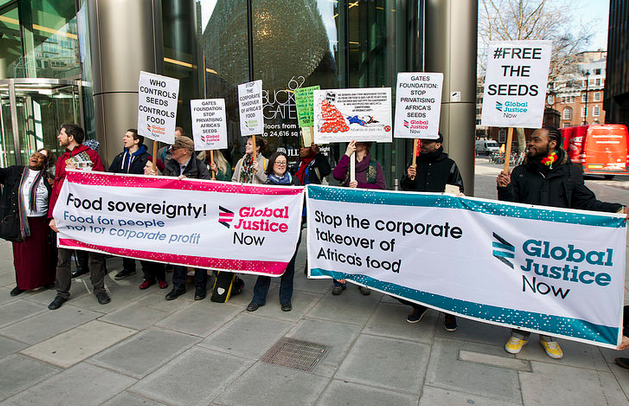
Early Monday, protesters picketed outside the Gates Foundation’s London offices holding signs that called on the foundation to “free the seeds.” Some demonstrators handed out packets of open-pollinated seeds, which served as symbol of the “alternative to the corporate model promoted by USAID and BMGF.” Others smashed a piñata, which they said represented the “commercial control of seed systems;” thousands of the seeds which filled the pinata spilled across the office steps. A similar protest is expected later Monday in Seattle, Washington, where BMGF is headquartered.

The meeting was convened to discuss a report put forth by Monitor-Deloitte, which was commissioned by BMGF and USAID to develop models for the commercialization of seed production in Africa, especially “early generation seed,” and to identify ways in which the African governmental sectors could facilitate private involvement in African seed systems. The study was conducted in Ethiopia, Ghana, Nigeria, Tanzania and Zambia on maize, rice, sorghum, cowpea, common beans, cassava and sweet potato.

However, food sovereignty activists are sounding the alarm over the secret meeting. Heidi Chow, food sovereignty campaigner with Global Justice Now, which organized Monday’s protest, warned that the agenda being promoted by these stakeholders will only increase corporate control over seeds.

“This is not ‘aid’ – it’s another form of colonialism,” said Chow. “We need to ensure that the control of seeds and other agricultural resources stay firmly in the hands of small farmers who feed the majority of the population in Africa, rather than allowing big agribusiness to dominate even more aspects of the food system.”

In a blog post, Chow further explained:

For generations, small farmers have been able to save and swap seeds. This vital practice enables farmers to keep a wide range of seeds which helps maintain biodiversity and helps them to adapt to climate change and protect from plant disease. However, this system of seed saving is under threat by corporations who want to take more control over seeds. Big seed companies are keen to grow their market share of commercial seeds in Africa and alongside philanthropic organizations like the Gates Foundation and aid donors, they are discussing new ways to increase their market penetration of commercial seeds and displacing farmers own seed systems.

Corporate-produced hybrid seeds often produce higher yields when first planted, but the second generation seeds will produce low yields and unpredictable crop traits, making them unsuitable for saving and storing. This means that instead of saving seeds from their own crops, farmers who use hybrid seeds become completely dependent on the seed companies that sell them.

Further, many of the seeds produced by these biotechnology giants are sold alongside chemical fertilizer and pesticides, manufactured by the very same companies, the use of which often leads to widespread environmental destruction and other health problems.

As others noted, while the meeting attendees included representatives from the World Bank and Syngenta, the world’s third biggest seed and biotechnology company, no farmers or farming organizations were represented at the talks.

“Seeds are vital for our food system and our small farmers have always been able to save and swap seeds freely,” Ali-Masmadi Jehu-Appiah, chair of Food Sovereignty Ghana, said in a press statement. “Now our seed systems are increasingly under threat by corporations who are looking to take more control over seeds in their pursuit of profit. This meeting will push this corporate agenda to hand more control away from our small farmers and into the hands of big seed companies.”

Reporting on the Monitor-Deloitte study, Ian Fitzpatrick, a food sovereignty researcher for Global Justice Now, said that documents circulated ahead of the meeting revealed a neo-liberal agenda “laid bare.”

Fitzpatrick writes:

The report recommends that in countries where demand for patented seeds is weaker (i.e. where farmers are using their own seed saving networks), public-private partnerships should be developed so that private companies are protected from ‘investment risk’. It also recommends that that NGOs and aid donors should encourage governments to introduce intellectual property rights for seed breeders and help to persuade farmers to buy commercial, patented seeds rather than relying on their own traditional varieties.

Finally, in line with the broader neoliberal agenda of agribusiness companies across the world, the report suggests that governments should remove regulations (like export restrictions) so that the seed sector is opened up to the global market.

“This neoliberal agenda of deregulation and privatization, currently promoted in almost every sphere of human activity—from food production to health and education—poses a serious threat to food sovereignty and the ability of food producers and consumers to define their own food systems and policies,” Fitzpatrick adds.

AGRA Watch, a program of the grassroots group Community Alliance for Global Justice, notes that the BMGF-USAID commercial seed agenda further “extends U.S. foreign policy into Africa on behalf of corporate interests.”

Phil Bereano, food sovereignty campaigner with AGRA Watch and an Emeritus Professor at the University of Washington added: “This is an extension of what the Gates Foundation has been doing for several years—working with the US government and agribusiness giants like Monsanto to corporatize Africa’s genetic riches for the benefit of outsiders. Don’t Bill and Melinda realize that such colonialism is no longer in fashion? It’s time to support African farmers’ self-determination.”

5 Things Busy People Can Do to Fight the Rising Control System

maxresdefault

By Bernie Suarez

Source: Truth and Art TV

Want to implement small-scale, realistic tasks in your own life to strike back at the control system? Have you been seeing the daily headlines, the lies, the deceit and the global enslavement agenda in full swing and feeling that you aren’t doing enough to fight back because of your busy schedule? Feeling helpless and overwhelmed by the idea that a small group of psychopaths at the very top would push for a global order that involves their full enjoyment of life while you and the rest of humanity live as miserable slaves forever? Don’t have time to be a full-time activist, be involved in marches, or downright challenge the court system? Wondering what small things you can do to fight back as you deal with the hustle and bustle of your own life working to pay bills, obtain an education, or raising children?

Here are five subtle actions you can incorporate into your busy schedule to start pushing back and start making a difference. If you think any of these simple steps is too difficult then give yourself time to adapt. Work on weaning yourself off of your usual habits and slowly changing the hard-to-break habits keeping you from maximally fighting back while continuing your busy life.

1- Turn off your TV and shut off mindless entertainment

This is for some people a difficult thing to do so for those people it may be more realistic to wean down how much entertainment and TV you absorb. A key to this commitment is realizing that TV watching is a medical-physiological issue. Realize that when you watch TV there is a real physical reaction going on in your brain and that addiction to TV and entertainment (like gambling and alcohol) is one problem among many others associated with TV watching.

When someone is an addict they are taught that overcoming denial is a big part of the recovery process and you can’t recover if you deny that you have a problem to begin with. Likewise being addicted to TV and entertainment must not be underestimated as just another incidental habit. It is a real addiction and TV flicker rates have a lot to do with it. I recall for year I watched TV and during that time of my life whenever I was in a room without TV it felt very uncomfortable. I couldn’t understand why it felt so uncomfortable but I knew it was. I now realize that was because there is a physiological addiction involved in TV watching.

As you can imagine, successfully committing to watching less or no TV while living a busy life will free up a lot of time which can then be used for doing creative things, improving relationships, starting a group, picking up a book, doing research, and a lot of other pro-active things you thought you didn’t have time for.

2- Optimize your online privacy

Another subtle thing you can do to strike back at the control system while managing a busy schedule is to learn a few things about online privacy. Start cleaning up your computer and unplugging some of the links put in place for private corporations and even government to potentially spy on you. Learn about what an IP address is. Realize that an IP address can be used to track where you are. Go to your browser and type in the address ‘myipaddress.com’ and this website will read back to you your own IP address.

Become familiar with this concept then become familiar with the concept of ‘Proxy Servers’ and Tor browsers. Do some basic research on the issue and decide for yourself if you want to occasionally (or always) go online using a privacy optimized server. This may not be for everyone but at least be familiar with what it is in case you want or feel you need to use one some day. A proxy server or Tor browser will allow you to browse online without your IP address being traced or tracked.

Also, here’s something you should be doing every day. Depending on which browser you are using, become familiar on how to delete cookies from you computer. Cookies are like tiny robot programs installed on your computer by sites you visit. These robots are installed without your permission and are used to track you. For many browsers (Firefox, Google Chrome) it will be under ‘privacy’ options and/or ‘clear browsing data’. Then look for a link or option for deleting cookies. As I said, know that these cookies are installed on your private computer every single time you go a website. Get in the habit of clearing these cookies unless you want every site you visit to also know what other sites you are visiting. By using cookies many corporations are able to monitor your shopping habits and many other things about you. They rely on the fact that you don’t know how to clear your cookies or perhaps are too lazy to delete them every time you go online. Why not become familiar with cookies and what they do? Still not sure? Just do an online search for “how to clear cookies” then specify the browser you are using.

The point is to start doing little things that will make surveillance more difficult and to educate yourself about some small things that add up and can make a difference later on.

3- Use technology strategically

This topic in some ways is a continuation of the online privacy. Start doing small things to make the police surveillance state a bit more difficult for them to carry out. Be smart about how you use your smart phone. If possible, consider reverting back to a not-so-smart phone. If your phone company allows you to use an older phone it’s something you MAY want to consider.

Remember the time when we all bought small cameras to take pictures and we purchased video cameras to make videos? Why can’t we go back to using individual electronics again? Why do we need to use our phones for everything we do? Why have we become conditioned to living our entire lives using our phones? Have you considered this may have been planned to help enslave humanity? Studies now show smart phones are proven to have a negative impact on human relationships making people more selfish, more easily distracted and more stressed out among other things.

Furthermore, have you read the ‘Terms and Conditions‘ of the license agreements you agree to every time you download a cell phone (or any) app? Do you realize that for many of these redundant and often useless apps you sign away your privacy? Read the agreements very carefully, that is exactly what you are doing almost every time you download a cell phone app. Is this lifestyle really necessary? No it isn’t, and it’s one of the small things you can do to fight back. Take back your privacy and commit to a smart life instead of a smart phone.

Also, you can stop taking “selfies” and broadcasting your image all over your own cell phone. Realize the control system has mastered the facial recognition technology and these self produced images only help the opposition keep track of your facial features and what you look like recently, information that can be added to whatever information the system may already have about you. Remember every bit of content you pack your smart phone with can be legally stolen from your phone and given to anyone including law enforcement or even a fusion center that may have created a file for you without you knowing. Since the revelations of Edward Snowden we all know how NSA is violating the privacy of average Americans and although these measures may not entirely prevent NSA from doing what it does, at least you are doing something to fight back and you are making it more difficult for them to get your information. Imagine if everyone does their part to resist in some way how much harder it becomes for NSA.

Other things you can do is periodically change your contact information like your phone number(s), emails, and addresses. There is no law that says you can’t have multiple emails, addresses and phone numbers if for no other reason than to make yourself harder to track. Be creative instead of being predictable. It’s not about being paranoid it’s about smartly preparing for the worse case scenario, being a tiny bit smarter than the next person, being creative, and being vigilant about the world we now factually live in. Not all of these measures are for everyone but again, these are subtle things some of us can do while living a busy hectic life.

4- Be mindful where you spend your money

This is an issue that everyone can and should do something about. Each of us makes decisions every day about where we spend our money and who we give our money to. If you know a corporation is a part of the problem stop giving them your money. Is a decision like this not practical to implement immediately? Then decrease how much money you spend with that store. Here are a few other suggestions:

Buy only what you need. Resist mindless advertisements that try to get you to spend money on things you don’t need. Realize that like TV, shopping is another subtle addiction that you may need to break. Break away from the habit of going shopping as a form of entertainment and instead practice saving and smartly investing your money.

So where should you spend your money? Support alternative media with donations and online purchases. Support organizations and stores that share your values. Identify those entities that support the freedom and liberty we all wish to see come to fruition and then support those platforms. Invest in your own health and survival. Instead of spending money on things you don’t need buy things that empower you and your ability to survive free from government. Do your part to buy smartly, and if everyone does this we can greatly contribute to a shift in paradigm even as we live our busy lives.

5- Don’t give government a reason to arrest or fine you

Finally, regardless of what you do, know that government (City, State and Federal) needs your money badly and they pay a lot of people to look for reasons to take your money (or your freedom which is worth money to them) away from you. We’ve all seen the big city parking police scouring neighborhoods looking for any car parked in front of a meter that is one minute over the limit. We’ve seen throughout the U.S. how police often set up hidden speed traps so they can pull you over for a speeding ticket. Realize that police are rewarded for giving out tickets and the cities have quotas for tickets. The control system NEEDS your money or your freedom to fund its very own control over you. This is why they set up traffic light cameras, create stringent rules and DUI checkpoints throughout the city in hopes of catching violators. Realize this and stay focused every day being careful to not give the control system an excuse to transfer any of your hard earned money into their pockets. Do what you can to not be arrested, not get a ticket and not be harassed for money by the control system.

If none of this works, if you end up with tickets or arrested, or if you simply want to become a more effective change agent while living a busy life then educate yourself about the legal system and how it is rigged against you. Take time on your off days to learn some of the basics of how the system tricks each and every one of us from the time of birth into consenting to be ruled, robbed and controlled. Again, some may feel they don’t have time to learn about the legal system but, like learning about online privacy, learning how to legally take control of your own life is a priceless piece of knowledge to obtain in your spare time.

So there it is. All of these things can be done by someone caught up in a busy hectic lifestyle. All of us have spare time, some of us have more spare time than others. Ultimately, you choose your road and what kind of life you want to live. These ideas are for those you really care and really want to make a difference but realize that time is precious. Go ahead, start making your list and put some of things into action. Don’t worry about not being able to do all of this, just start somewhere. This is a guideline not a set of rules. Peace and love.

Podcast Roundup

3/11: Srini Rao has an interesting conversation with animal rights activist Peter Young covering community activism, communication, survival tips, and his former life as a fugitive on the “Unmistakable Creative” podcast.

https://sitebuilderio.s3.amazonaws.com/unmistakablecreative/audios/012b5fac-3695-42b3-9a2d-ffd7d4d7f213/lessons-in-communication-from-a-fugitive-peter-young.mp3

3/11: On the latest “Guns and Butter”, Bonnie Faulkner interviews John Whitehead of  the Rutherford Institute. They discuss aspects of  “Police State America” including the Corporate State, American Legislative Exchange Council (ALEC), Offices of Inspector General (OIG), SWAT Teams, No-Knock Raids, the Schoolhouse to Jailhouse Track, the New York Prototype, MRAPs, Operation Vigilant Eagle, Atlas Four Androids, TSA and VIPR Teams, the Google/NSA connection and Fusion Centers.

http://archives.kpfa.org/data/20150311-Wed1300.mp3

3/11: Host Dave Lindorff discusses the recent coup plan disrupted by police in Venezuela with veteran journalist Alfredo Lopez — a story largely blacked out or mocked as bogus by the US corporate media despite solid evidence of a plot, and of US involvement in that plot on “This Can’t Be Happening”. Lindorff and Lopez, who are colleagues on the news site thiscantbehappening.net, also talk about why President Obama on Tuesday declared Venezuela an “unusual and extraordinary national security threat” to the US, and what that declaration means to Venezuela and Latin America.

http://s36.podbean.com/pb/0c1337348a3a2a92b0bdb73308121756/5503328c/data1/blogs18/661545/uploads/ThisCantBeHappening_031115.mp3

3/12: On the first of their recent “Media Roots” podcasts, Robbie and Abby Martin discuss the ending of the RT program “Breaking the Set”, the establishment’s Cold War resurrection, and the splintering of the left over Obama’s military policies. The second program features an interview with Mark Weisbrot, co-director of the Center for Economic and Policy Research, on current U.S. government actions against Venezuela.

People as Livestock: The Cult of Fundamentalist Materialism and the Cheapening Life

Farm to Fork

I first encountered the term “Fundamentalist-Materialism” in the work of Robert Anton Wilson; it appears in several of his non-fiction works, including “The Cosmic Triggger” series. As far as I know R.A.W. was the originator of this philosophical designation.”

Is there any inherent value to an individual human life? 

By Dan Mage

Source: OpEdNews.com

Authoritarians of the left, libertarians of the right, objectivists, conservatives and even liberals and progressives fixated on “jobs” and “rehabilitation” of the socioeconomically dysfunctional give the answer “no; ” sometimes directly (as in the case of the Stalinist and the American conservative) and other times through actions, policies, and preferences (as in the case of elements of the “occupation” movement distancing themselves from “homeless bums,” “drug users,” and “ex-cons”).

Most of all, those with the power to set wages, prices, working conditions and societal expectation for those who have nothing left but their time and “docile bodies”*(Foucault) to sell, control and trade in human lives as commodities. While most of the supposedly civilized world frowns on chattel slavery (although a good bit of it goes on, especially in the sex trade, where prosecution of traffickers is the exception rather than the rule), the legal technicality of ownership is superfluous to the trade in human lives, time, labor, and in Reichian terms orgones.

What do Stalinism, objectivism, authoritarian capitalism, and global corporatism all have in common ? They are in my opinion fundamentalist-materialist cults that value the inanimate over the living, the concrete over the abstract and have effectively reduced the vast majority of the human race to livestock, or wild beasts to be hunted down, captured, contained, broken, or in the alternative, simply slaughtered and destroyed.

I have been told that it has always been thus, and perhaps in terms of humanity’s historical failings this is true. There is however no historical precedent for the establishment of a global value system through electronic multi-sensory media. Even the best efforts of the Catholic Church, Protestant missionaries and Islamic holy-warriors do not equal the technology and level of sophistication in the application of “industrial psychology.”

The message remains the same though, as it has been throughout history: “Obey or suffer.” Individual disobedience or even mere failure to “produce” in spite of the individual’s best efforts will result in stigmatization, marginalization, a degrading dependency on the state and, as state support for the economically disengaged is cut back and removed, starvation, homelessness and imprisonment; even the fact of homelessness is defined as a criminal offense by more local jurisdictions with each passing year.

The fact is that life is cheap; the idealistic visions of humanitarians are swept aside by those advocates of “austerity” and “tough choices,” whose calculations in service of usury on a global scale will determine the level of human suffering in each nation up to and including death by starvation, disease, and the inevitable outcome of manufactured scarcity, war.

The blurry and dim imagery of the concretes of suffering fades from vision in the glare of the deadly abstractions; political ideologies, religions, money that does not exist anywhere other than in the record keeping of the money lenders remains in clear focus. The conclusion returns stark, glaring and obvious: human life is a commodity, the value of which is consistently decreasing. The devaluation of an individual human life to a unit of production and consumption, which therefore can be discarded if determined to have no economic value, is all that is required for the machinery of mass exterminations and genocide to be set in motion.

Arguing about wages, prices, social systems and ways of arranging economies, even in cases where “progress” is made, will be useless. The dominance of the fundamentalist-materialist cults, as well as the authoritarian religions that create legitimacy for them in the eyes of the masses (and even Stalin, the ultimate fundamentalist-materialist, allowed for the return of religion as an adjunct of the state when he realized its value) will continue to crush and compress human life, until the perverted and inverted values themselves are overthrown, shattered, burned and buried.

When will the biocentric (life centered) ethos replace the thanatocentric (death centered) ethos as the dominant culture’s value system? I cannot answer even the “if” of this question, let alone the question itself. The fact that the power to collect interest on nonexistent money and the lifestyles that such usury on a global scale supports is presented, and apparently accepted, as an immutable law of nature rather than as an imposition of culture’s order on the true nature of humanity seems by way of this very acceptance to be a “natural law.” Images of vultures waiting for starving children to crawl to their deaths and mothers weeping over infants at the bottoms of pits do not move the master manipulators of numbers. If anything, only the fact that the die-offs are not more extensive is cause for lamentation.

Do we care anymore? I’m not speaking of our little “jobs” and “futures,” and relative degree of comfort/discomfort in oppression that seems to be everyone’s primary concern. I’m demanding of myself, of you and above all of those who have declared themselves to be “leaders;” what is it that matters to you? Do you feel anything at all? Can we set aside all calculations save for those needed to ease human suffering? The primary demand of all protests, occupations, strikes, boycotts and further actions of increasing effect and extremity will be “Life First!”

The life of one human being hanging on the edge of death, in suffering, is too high a price to pay, for all the glorious achievements of the fundamentalist-materialist cults, their leaders and their adherents. The cult of power, authority, war, and property as a weapon of coercion has, for all its trillions of dollars and stockpiled weapons of mass destruction, a single and fatal vulnerability; to function it depends on obedience. For obedience to be guaranteed, the “obey or suffer” directive must be enforceable. This directive is only enforceable if the doctrine of fundamentalist-materialism enjoys continued acceptance as a “fact of life,” rather than the monstrous fraud that it is.

*The term “docile bodies” is a chapter title in Michel Foucault’s “Discipline and Punish: The Birth of the Prison” 1977, Random House, NY, NY.


Chicago’s Abu Ghraib

Chicago-Homan-Square-police-torture-2

By Andre Damon

Source: WSWS.org

In April 2004, the world was shocked and horrified by the release of photographs of sadistic torture carried out by US military personnel at the Abu Ghraib prison in Iraq. Detainees at the prison, most of them locked up for opposing the US military occupation, were beaten, tortured, sexually assaulted and killed.

At the time, the World Socialist Web Site explained that the crimes revealed in the photos and the psychology underlying them could be understood only in relation to the brutality of social relations in the United States, together with the dirty colonial aims of the war itself.

The WSWS further warned that “such a military, accompanied by a growing army of professional ‘civilian’ mercenaries, represents a danger not only to oppressed peoples in the Middle East, Central Asia and elsewhere, but to the democratic rights of the population in the US.”

A decade later, this assessment has been fully borne out. On Tuesday, the Guardian newspaper revealed the existence of what it describes as a “black site” on the West Side of Chicago, where police detain, beat and torture prisoners, while keeping their whereabouts secret from their families and attorneys.

The newspaper writes: “The Chicago police department operates an off-the-books interrogation compound, rendering Americans unable to be found by family or attorneys while locked inside what lawyers say is the domestic equivalent of a CIA black site.”

Among those detained at the facility was Brian Jacob Church, one of the “NATO 3” who were entrapped by Chicago police in 2012 in connection with protests against the US-led military alliance, which was meeting in Chicago.

Church was taken to the secret facility and handcuffed to a bench for 17 hours. Along with two other protestors, he was set up by police on terrorism charges and subsequently sentenced to five years in prison.

Vic Suter, another participant in the protests, said that she was taken to the facility and interrogated while shackled to a bench for eighteen hours before she was allowed to see a lawyer.

The Guardian writes that detainees taken to the facility report having been beaten and otherwise tortured by police. In 2013, one detainee was found unconscious in an interview room at the facility. He later died.

On Thursday, the Intercept corroborated the Guardian’s account, interviewing another torture victim at the facility who was handcuffed across a bench and hit in the face and groin until he agreed to provide false testimony to police.

The revelations follow the report last week by the Guardian that Richard Zuley, one of the lead torturers at the Guantanamo detention center, used similar techniques to secure false confessions from murder suspects when he was a detective with the Chicago Police Department.

Chicago has a long history of police violence. It is also the political home of Barack Obama and has been run since 2011 by Rahm Emanuel, Obama’s former White House chief of staff.

The Obama administration, far from repudiating the horrific and criminal actions of its predecessor, has deployed the apparatus of police violence ever more directly against the American people. A series of events has marked the increasingly open application within the borders of the United States of the murderous methods of the “war on terror” tested out and perfected in Afghanistan, Pakistan, Iraq, Libya, Syria, Somalia and Yemen.

· In September 2010, the Obama administration ordered raids on the homes of leaders of the Anti-War Committee and the Freedom Road Socialist Organization in Minneapolis and Chicago on charges of “providing material support to terrorism.”

· In May 2012, Chicago police arrested the “NATO 3,” charging them with conspiracy to commit terrorism.

· In March 2013, US Attorney General Eric Holder declared that the president had the right to kill American citizens without a trial or any legal due process, including within the borders of the United States.

· Just one month later, in April 2013, the city of Boston was placed under de facto martial law following the Boston Marathon bombings, with residents told to “shelter in place” while armored vehicles and helicopters patrolled the streets and police carried out warrantless house-to-house searches.

· In June 2014, the American Civil Liberties Union released a report entitled “War Comes Home: The Excessive Militarization of American Policing.” The ACLU reported that the Defense Department had transferred $4.3 billion in military hardware, including armored vehicles, helicopters, and belt-fed machine guns, to local police departments.

· In August 2014, the authorities responded to protests against the police murder of unarmed teenager Michael Brown with a military/police crackdown. Hundreds of peaceful protesters were arrested, shot with rubber bullets or exposed to tear gas, and over a dozen members of the press were detained.

The Obama administration is presently seeking a new Authorization for Use of Military Force, nominally to fight the Islamic State of Iraq and Syria (ISIS), but with no geographical boundaries defined. On Wednesday, three Brooklyn residents were arrested in connection with this new war on ISIS, clearly raising the potential for this second “war on terror” to become an occasion for police-military operations within the US “homeland.”

These developments express the growing convergence of militarism abroad with the attack on democratic rights within the US. What ties these two processes together are the class interests of the financial aristocracy and the criminal methods it employs in the defense of its wealth and power.

In pursuit of these aims, the ruling class seeks to mobilize the most backward and reactionary sections of the population, including sadistic prison guards and fascist-minded police detectives. But the ultimate responsibility for these crimes rests with forces at the highest levels of the state.

It is worth recalling that late last year the Senate released a report implicating the Bush administration in a brutal torture regime carried out at Guantanamo and CIA “black site” torture centers throughout the world. Far from anyone being held accountable for these crimes, those who ordered and carried them out have defended their actions, while the Obama administration has sought to block any prosecution of those responsible.

The actions of the ruling class express the character of American capitalism, which is based on parasitism, fraud, criminality and an economic order in deep decline. The American ruling class has no response to the crisis of its system and the inevitable growth of social opposition other than violence and repression.

Related Article:

Total Mainstream Media Blackout of Chicago Secret ‘Black Site’ at Homan Square (By Nick Bernabe, Antimedia.org)

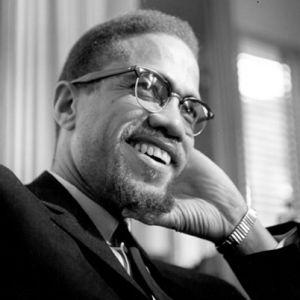
Malcolm X Was Right About America

MalcolmX

(Editors note: Tomorrow marks the 50th anniversary of the passing of Malcolm X. The venerated activist would surely have approved of Hedges’ radical appraisal of his philosophy and principles.)

By Chris Hedges

Source: Axis of Logic

Malcolm X, unlike Martin Luther King Jr., did not believe America had a conscience. For him there was no great tension between the lofty ideals of the nation—which he said were a sham—and the failure to deliver justice to blacks. He, perhaps better than King, understood the inner workings of empire. He had no hope that those who managed empire would ever get in touch with their better selves to build a country free of exploitation and injustice. He argued that from the arrival of the first slave ship to the appearance of our vast archipelago of prisons and our squalid, urban internal colonies where the poor are trapped and abused, the American empire was unrelentingly hostile to those Frantz Fanon called “the wretched of the earth.” This, Malcolm knew, would not change until the empire was destroyed.

“It is impossible for capitalism to survive, primarily because the system of capitalism needs some blood to suck,” Malcolm said. “Capitalism used to be like an eagle, but now it’s more like a vulture. It used to be strong enough to go and suck anybody’s blood whether they were strong or not. But now it has become more cowardly, like the vulture, and it can only suck the blood of the helpless. As the nations of the world free themselves, then capitalism has less victims, less to suck, and it becomes weaker and weaker. It’s only a matter of time in my opinion before it will collapse completely.”

King was able to achieve a legal victory through the civil rights movement, portrayed in the new film “Selma.” But he failed to bring about economic justice and thwart the rapacious appetite of the war machine that he was acutely aware was responsible for empire’s abuse of the oppressed at home and abroad. And 50 years after Malcolm X was assassinated in the Audubon Ballroom in Harlem by hit men from the Nation of Islam, it is clear that he, not King, was right. We are the nation Malcolm knew us to be. Human beings can be redeemed. Empires cannot. Our refusal to face the truth about empire, our refusal to defy the multitudinous crimes and atrocities of empire, has brought about the nightmare Malcolm predicted. And as the Digital Age and our post-literate society implant a terrifying historical amnesia, these crimes are erased as swiftly as they are committed.

“Sometimes, I have dared to dream … that one day, history may even say that my voice—which disturbed the white man’s smugness, and his arrogance, and his complacency—that my voice helped to save America from a grave, possibly even fatal catastrophe,” Malcolm wrote.

The integration of elites of color, including Barack Obama, into the upper echelons of institutional and political structures has done nothing to blunt the predatory nature of empire. Identity and gender politics—we are about to be sold a woman president in the form of Hillary Clinton—have fostered, as Malcolm understood, fraud and theft by Wall Street, the evisceration of our civil liberties, the misery of an underclass in which half of all public school children live in poverty, the expansion of our imperial wars and the deep and perhaps fatal exploitation of the ecosystem. And until we heed Malcolm X, until we grapple with the truth about the self-destruction that lies at the heart of empire, the victims, at home and abroad, will mount. Malcolm, like James Baldwin, understood that only by facing the truth about who we are as members of an imperial power can people of color, along with whites, be liberated. This truth is bitter and painful. It requires an acknowledgment of our capacity for evil, injustice and exploitation, and it demands repentance. But we cling like giddy children to the lies we tell ourselves about ourselves. We refuse to grow up. And because of these lies, perpetrated across the cultural and political spectrum, liberation has not taken place. Empire devours us all.

“We’re anti-evil, anti-oppression, anti-lynching,” Malcolm said. “You can’t be anti- those things unless you’re also anti- the oppressor and the lyncher. You can’t be anti-slavery and pro-slavemaster; you can’t be anti-crime and pro-criminal. In fact, Mr. Muhammad teaches that if the present generation of whites would study their own race in the light of true history, they would be anti-white themselves.”

Malcolm once said that, had he been a middle-class black who was encouraged to go to law school, rather than a poor child in a detention home who dropped out of school at 15, “I would today probably be among some city’s professional black bourgeoisie, sipping cocktails and palming myself off as a community spokesman for and leader of the suffering black masses, while my primary concern would be to grab a few more crumbs from the groaning board of the two-faced whites with whom they’re begging to ‘integrate.’ ”

Malcolm’s family, struggling and poor, was callously ripped apart by state agencies in a pattern that remains unchanged. The courts, substandard schooling, roach-filled apartments, fear, humiliation, despair, poverty, greedy bankers, abusive employers, police, jails and probation officers did their work then as they do it now. Malcolm saw racial integration as a politically sterile game, one played by a black middle class anxious to sell its soul as an enabler of empire and capitalism. “The man who tosses worms in the river,” Malcolm said, “isn’t necessarily a friend of the fish. All the fish who take him for a friend, who think the worm’s got no hook on it, usually end up in the frying pan.” He related to the apocalyptic battles in the Book of Revelation where the persecuted rise up in revolt against the wicked.

“Martin [Luther King Jr.] doesn’t have the revolutionary fire that Malcolm had until the very end of his life,” Cornel West says in his book with Christa Buschendorf, “Black Prophetic Fire.” “And by revolutionary fire I mean understanding the system under which we live, the capitalist system, the imperial tentacles, the American empire, the disregard for life, the willingness to violate law, be it international law or domestic law. Malcolm understood that from very early on, and it hit Martin so hard that he does become a revolutionary in his own moral way later in his short life, whereas Malcolm had the revolutionary fire so early in his life.”

There are three great books on Malcolm X: “The Autobiography of Malcolm X: As Told to Alex Haley,” “The Death and Life of Malcolm X” by Peter Goldman and “Martin & Malcolm & America: A Dream or a Nightmare” by James H. Cone.

On Friday I met Goldman—who as a reporter for a St. Louis newspaper and later for Newsweek knew and covered Malcolm—in a New York City cafe. Goldman was part of a tiny circle of white reporters Malcolm respected, including Charles Silberman of Fortune and M.S. “Mike” Handler of The New York Times, who Malcolm once said had “none of the usual prejudices or sentimentalities about black people.”

Goldman and his wife, Helen Dudar, who also was a reporter, first met Malcolm in 1962 at the Shabazz Frosti Kreem, a Black Muslim luncheonette in St. Louis’ north-side ghetto. At that meeting Malcolm poured some cream into his coffee. “Coffee is the only thing I liked integrated,” he commented. He went on: “The average Negro doesn’t even let another Negro know what he thinks, he’s so mistrusting. He’s an acrobat. He had to be to survive in this civilization. But by me being a Muslim, I’m black first—my sympathies are black, my allegiance is black, my whole objectives are black. By me being a Muslim, I’m not interested in being American, because America has never been interested in me.”

He told Goldman and Dudar: “We don’t hate. The white man has a guilt complex—he knows he’s done wrong. He knows that if he had undergone at our hands what we have undergone at his, he would hate us.” When Goldman told Malcolm he believed in a single society in which race did not matter Malcolm said sharply: “You’re dealing in fantasy. You’ve got to deal in facts.”

Goldman remembered, “He was the messenger who brought us the bad news, and nobody wanted to hear it.” Despite the “bad news” at that first meeting, Goldman would go on to have several more interviews with him, interviews that often lasted two or three hours. The writer now credits Malcolm for his “re-education.”

Goldman was struck from the beginning by Malcolm’s unfailing courtesy, his dazzling smile, his moral probity, his courage and, surprisingly, his gentleness. Goldman mentions the day that psychologist and writer Kenneth B. Clark and his wife escorted a group of high school students, most of them white, to meet Malcolm. They arrived to find him surrounded by reporters. Mrs. Clark, feeling that meeting with reporters was probably more important, told Malcolm the teenagers would wait. “The important thing is these kids,” Malcolm said to the Clarks as he called the students forward. “He didn’t see a difference between white kids and kids,” Kenneth Clark is quoted as saying in Goldman’s book.

James Baldwin too wrote of Malcolm’s deep sensitivity. He and Malcolm were on a radio program in 1961 with a young civil rights activist who had just returned from the South. “If you are an American citizen,” Baldwin remembered Malcolm asking the young man, “why have you got to fight for your rights as a citizen? To be a citizen means that you have the rights of a citizen. If you haven’t got the rights of a citizen, then you’re not a citizen.” “It’s not as simple as that,” the young man answered. “Why not?” Malcolm asked.

During the exchange, Baldwin wrote, “Malcolm understood that child and talked to him as though he was talking to a younger brother, and with that same watchful attention. What most struck me was that he was not at all trying to proselytize the child: he was trying to make him think. … I will never forget Malcolm and that child facing each other, and Malcolm’s extraordinary gentleness. And that’s the truth about Malcolm: he was one of the gentlest people I have ever met.”

“One of Malcolm’s many lines that I liked was ‘I am the man you think you are,’ ” Goldman said. “What he meant by that was if you hit me I would hit you back. But over the period of my acquaintance with him I came to believe it also meant if you respect me I will respect you back.”

Cone amplifies this point in “Martin & Malcolm & America”:

Malcolm X is the best medicine against genocide. He showed us by example and prophetic preaching that one does not have to stay in the mud. We can wake up; we can stand up; and we can take that long walk toward freedom. Freedom is first and foremost an inner recognition of self-respect, a knowledge that one was not put on this earth to be a nobody. Using drugs and killing each other are the worst forms of nobodyness. Our forefathers fought against great odds (slavery, lynching, and segregation), but they did not self-destruct. Some died fighting, and others, inspired by their example, kept moving toward the promised land of freedom, singing ‘we ain’t gonna let nobody turn us around.’ African-Americans can do the same today. We can fight for our dignity and self-respect. To be proud to be black does not mean being against white people, unless whites are against respecting the humanity of blacks. Malcolm was not against whites; he was for blacks and against their exploitation.

Goldman lamented the loss of voices such as Malcolm’s, voices steeped in an understanding of our historical and cultural truths and endowed with the courage to speak these truths in public.

“We don’t read anymore,” Goldman said. “We don’t learn anymore. History is disappearing. People talk about living in the moment as if it is a virtue. It is a horrible vice. Between the twitterverse and the 24-hour cable news cycle our history keeps disappearing. History is something boring that you had to endure in high school and then you are rid of it. Then you go to college and study finance, accounting, business management or computer science. There are damn few liberal arts majors left. And this has erased our history. The larger figure in the ’60s was, of course, King. But what the huge majority of Americans know about King is [only] that he made a speech where he said ‘I have a dream’ and that his name is attached to a day off.”

Malcolm, like King, understood the cost of being a prophet. The two men daily faced down this cost.

Malcolm, as Goldman writes, met with the reporter Claude Lewis not long before his Feb. 21, 1965, murder. He had already experienced several attempts on his life.

“This is an era of hypocrisy,” he told Lewis. “When white folks pretend that they want Negroes to be free, and Negroes pretend to white folks that they really believe that white folks want ’em to be free, it’s an era of hypocrisy, brother. You fool me and I fool you. You pretend that you’re my brother, and I pretend that I really believe you believe you’re my brother.”

He told Lewis he would never reach old age. “If you read, you’ll find that very few people who think like I think live long enough to get old. When I say by any means necessary, I mean it with all my heart, my mind and my soul. A black man should give his life to be free, and he should also be able, be willing to take the life of those who want to take his. When you really think like that, you don’t live long.”

Lewis asked him how he wanted to be remembered. “Sincere,” Malcolm said. “In whatever I did or do. Even if I made mistakes, they were made in sincerity. If I’m wrong, I’m wrong in sincerity. I think that the best thing that a person can be is sincere.”

“The price of freedom,” Malcolm said shortly before he was killed, “is death.”