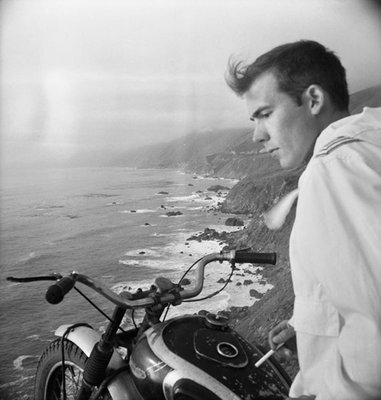
Today marks the ninth anniversary of the death of Hunter S. Thompson. As a tribute to the legendary Gonzo journalist I’d like to share an article on a rather philosophical and motivational letter he wrote to his friend Hume Logan in 1958. Cynics may question the worth of Thompson’s advice given he was only 20 at the time, his notoriety as a drug abuser later in life and his alleged suicide. In Thompson’s defense, the letter shows he developed a sense of intellectual adventurousness and sophistication of thought at a relatively early age. Though he did partake in recreational drugs, it was probably at far below the levels described in his Gonzo essays in which he adopted a public persona and exaggerated details of events, blurring the lines between fact and fiction. And it is arguable if Hunter S. Thompson actually killed himself because there remains suspicions that he may have been murdered.
From Brain Pickings:
20-Year-Old Hunter S. Thompson’s Superb Advice on How to Find Your Purpose and Live a Meaningful Life
by Maria Popova
“It is not necessary to accept the choices handed down to you by life as you know it.”
As a hopeless lover of both letters and famous advice, I was delighted to discover a letter 20-year-old Hunter S. Thompson — gonzo journalism godfather, pundit of media politics, dark philosopher — penned to his friend Hume Logan in 1958. Found in Letters of Note: Correspondence Deserving of a Wider Audience (public library) — the aptly titled, superb collection based on Shaun Usher’s indispensable website of the same name — the letter is an exquisite addition to luminaries’ reflections on the meaning of life, speaking to what it really means to find your purpose.
Cautious that “all advice can only be a product of the man who gives it” — a caveat other literary legends have stressed with varying degrees of irreverence — Thompson begins with a necessary disclaimer about the very notion of advice-giving:
To give advice to a man who asks what to do with his life implies something very close to egomania. To presume to point a man to the right and ultimate goal — to point with a trembling finger in the RIGHT direction is something only a fool would take upon himself.

And yet he honors his friend’s request, turning to Shakespeare for an anchor of his own advice:
“To be, or not to be: that is the question: Whether ’tis nobler in the mind to suffer the slings and arrows of outrageous fortune, or to take arms against a sea of troubles…”
And indeed, that IS the question: whether to float with the tide, or to swim for a goal. It is a choice we must all make consciously or unconsciously at one time in our lives. So few people understand this! Think of any decision you’ve ever made which had a bearing on your future: I may be wrong, but I don’t see how it could have been anything but a choice however indirect — between the two things I’ve mentioned: the floating or the swimming.
He acknowledges the obvious question of why not take the path of least resistance and float aimlessly, then counters it:
The answer — and, in a sense, the tragedy of life — is that we seek to understand the goal and not the man. We set up a goal which demands of us certain things: and we do these things. We adjust to the demands of a concept which CANNOT be valid. When you were young, let us say that you wanted to be a fireman. I feel reasonably safe in saying that you no longer want to be a fireman. Why? Because your perspective has changed. It’s not the fireman who has changed, but you.
Touching on the same notion that William Gibson termed “personal micro-culture,” Austin Kleon captured in asserting that “you are the mashup of what you let into your life,” and Paula Scher articulated so succinctly in speaking of the combinatorial nature of our creativity, Thompson writes:
Every man is the sum total of his reactions to experience. As your experiences differ and multiply, you become a different man, and hence your perspective changes. This goes on and on. Every reaction is a learning process; every significant experience alters your perspective.
So it would seem foolish, would it not, to adjust our lives to the demands of a goal we see from a different angle every day? How could we ever hope to accomplish anything other than galloping neurosis?
The answer, then, must not deal with goals at all, or not with tangible goals, anyway. It would take reams of paper to develop this subject to fulfillment. God only knows how many books have been written on “the meaning of man” and that sort of thing, and god only knows how many people have pondered the subject. (I use the term “god only knows” purely as an expression.)* There’s very little sense in my trying to give it up to you in the proverbial nutshell, because I’m the first to admit my absolute lack of qualifications for reducing the meaning of life to one or two paragraphs.
Resolving to steer clear of the word “existentialism,” Thompson nonetheless strongly urges his friend to read Sartre’s Nothingness and the anthology Existentialism: From Dostoyevsky to Sartre, then admonishes against succumbing to faulty definitions of success at the expense of finding one’s own purpose:
To put our faith in tangible goals would seem to be, at best, unwise. So we do not strive to be firemen, we do not strive to be bankers, nor policemen, nor doctors. WE STRIVE TO BE OURSELVES.
But don’t misunderstand me. I don’t mean that we can’t BE firemen, bankers, or doctors—but that we must make the goal conform to the individual, rather than make the individual conform to the goal. In every man, heredity and environment have combined to produce a creature of certain abilities and desires—including a deeply ingrained need to function in such a way that his life will be MEANINGFUL. A man has to BE something; he has to matter.
As I see it then, the formula runs something like this: a man must choose a path which will let his ABILITIES function at maximum efficiency toward the gratification of his DESIRES. In doing this, he is fulfilling a need (giving himself identity by functioning in a set pattern toward a set goal) he avoids frustrating his potential (choosing a path which puts no limit on his self-development), and he avoids the terror of seeing his goal wilt or lose its charm as he draws closer to it (rather than bending himself to meet the demands of that which he seeks, he has bent his goal to conform to his own abilities and desires).
In short, he has not dedicated his life to reaching a pre-defined goal, but he has rather chosen a way of life he KNOWS he will enjoy. The goal is absolutely secondary: it is the functioning toward the goal which is important. And it seems almost ridiculous to say that a man MUST function in a pattern of his own choosing; for to let another man define your own goals is to give up one of the most meaningful aspects of life — the definitive act of will which makes a man an individual.
Noting that his friend had thus far lived “a vertical rather than horizontal existence,” Thompson acknowledges the challenge of this choice but admonishes that however difficult, the choice must be made or else it melts away into those default modes of society:
A man who procrastinates in his CHOOSING will inevitably have his choice made for him by circumstance. So if you now number yourself among the disenchanted, then you have no choice but to accept things as they are, or to seriously seek something else. But beware of looking for goals: look for a way of life. Decide how you want to live and then see what you can do to make a living WITHIN that way of life. But you say, “I don’t know where to look; I don’t know what to look for.”
And there’s the crux. Is it worth giving up what I have to look for something better? I don’t know—is it? Who can make that decision but you? But even by DECIDING TO LOOK, you go a long way toward making the choice.
He ends by returning to his original disclaimer by reiterating that rather than a prescription for living, his “advice” is merely a reminder that how and what we choose — choices we’re in danger of forgetting even exist — shapes the course and experience of our lives:
I’m not trying to send you out “on the road” in search of Valhalla, but merely pointing out that it is not necessary to accept the choices handed down to you by life as you know it. There is more to it than that — no one HAS to do something he doesn’t want to do for the rest of his life.
Both reflecting and supporting Usher’s heartening echelon of independent online scholarship and journalism at the intersection of the editorial and the curatorial, Letters of Note is brimming with other such timeless treasures from such diverse icons and Brain Pickings favorites as E. B. White, Virginia Woolf, Ursula Nordstrom, Nick Cave, Ray Bradbury, Amelia Earhart, Galileo Galilei, and more.