The Man in the High Castle: When a Nazi-Run World Isn’t So Dystopian

MV5BMTUxODUxOTY5NV5BMl5BanBnXkFtZTgwMzIyMjk5MzE@._V1_SX214_AL_

(Editor’s note: I recently viewed the pilot for the new “The Man in the High Castle” series and was disappointed for the same reasons mentioned in the article. For a PKD adaptation more faithful to the source material see Radio Free Albemuth.)

By Noah Berlatsky

Source: The Atlantic

Amazon’s new television adaptation The Man In the High Castle—part of the streaming service’s 2015 pilot season—opens in a conquered New York. The Nazis won World War II, and the American flag now bears a swastika. A few freedom fighters struggle on—we see one in particular brutally tortured and beaten to death—and the police are everywhere. Life in this alternate dystopia is a thing of fear and hardship, as in 1984, or The Handmaid’s Tale, or The Hunger Games. The familiar forces of freedom struggle against the familiar totalitarian forces of dystopia, epitomized, in the usual way, by a cruel, sadistic supervillain (here portrayed by Rufus Sewell as SS officer John Smith). If the Nazis had won the war, the TV series warns us, the world would have been much, much worse.

This message, as it happens, is a complete inversion of Philip K. Dick’s 1962 novel of the same name, on which the series is based. As such, it betrays the source material’s difficult and conflicted message in the interest of the banal genre default of plucky Americans fighting for freedom against the evil invaders; as Adi Robertson of The Verge suggests, it might as well be Red Dawn.

Superficially, perhaps, the novel isn’t all that different. Dick also imagines that the Nazis have won World War II, and the world under the Nazis is certainly horrible enough: The novel mentions several times that after their victory in the war, the Germans set about murdering everyone in Africa. Slavery has been reinstituted in the southern United States (an uncomfortable detail that isn’t mentioned in the pilot episode), and American Jews in Nazi-controlled areas have been systematically gassed. One of the Jewish main characters, Frank Frink (née Fink) is arrested on the Japanese-controlled west coast and scheduled for deportation to Germany. Meanwhile, in the TV series, Frink (Rupert Evans) only has a Jewish grandparent, which seems a bizarre alteration.

But while life in the novel’s alternate reality is certainly awful in many ways, it’s not exactly a dystopia, which is precisely why it’s so chilling. Dick’s book has little of the pulp melodrama of the TV pilot; there are no torture scenes, no supervillains, and not even a single scene set in the repressive Nazi-controlled region of the former U.S. Instead, the action occurs in the independent Mountain States or on the Japanese-controlled Pacific areas, and most of the characters go about their daily lives just as most of us do now. They have small problems and worries and cares, they adapt to quotidian injustices. But they do so without great urgency about the genocidal violence being inflicted on people on the other side of the world, continent, or neighborhood. The frightening thing isn’t the dystopia. It’s that the dystopia is so familiar it doesn’t really feel dystopian at all.

This is nowhere more clear than in the novel’s treatment of race. In the TV pilot, the bad guys are racists, and the good guys are not. Frank’s wife, Juliana Frink (Alexa Davalos), makes it clear that she opposes the racial laws that threaten her husband and that she harbors no racist feelings toward the Japanese conquerors. But in the book, things are a lot murkier. Juliana and Frank are estranged, and in her internal monologue she sneers at him for liking “Japs” and for being “ugly” with “large pores” and a “big nose.” Another character who doesn’t appear in the pilot, the salesman R. Childan, vacillates between obsequious paeans to Japanese racial superiority and resentful, vicious Orientalist stereotyping. Even Mr. Tagomi, the Japanese official who is the moral center of the book in most respects, lapses occasionally into racist invective—”white barbarian. Neanderthalyank. That subhuman …”— although he regrets it almost immediately.

It makes sense that a world in which the Axis won the war would be, in just about every way, more racist. But the uncomfortable question is, just how much more racist is it? Again, the Nazis seem to have created a protectorate of sorts in the southern U.S., the implication being that whites who supported Jim Crow there would find the Nazi racial doctrines quite congenial. And when Mr. Tagomi, in a quintessential Dickian moment, stumbles out of his alternate reality into the “real” 1962, his own racist preconceptions (as he orders whites around) are met in turn with the simmering racist antipathy of the world in which America won the war. (“Watch it, Tojo,” one man says to him.) The racism in Dick’s alternate universe isn’t alien. It’s homey.

The imagined and the real fit together in a number of other ways as well. One of Dick’s characters muses, for example, that the basic insanity of the Nazis is that “They want to be the agents, not the victims, of history. They identify with God’s power and believe they are godlike … Man has not eaten God; God has eaten man.” That’s a reasonable analysis of Nazi obsessions. But it’s also a reasonable analysis of American obsessions, as Carl Freedman points out in his book Critical Theory and Science Fiction. Dick, Freedman says, is linking “the quintessential Western will to domination with the horrors of genocidal Nazism.” And that Western will to domination is shown most clearly in the book through the Nazi plan to drop a bomb on the Japanese home islands. But in the real world the Nazis didn’t drop a bomb on the home islands. America did.

In the TV pilot, Juliana finds a banned newsreel called The Grasshopper Lies Heavy, which portrays a world in which the Allies won the war. The idea that this might be true fills her with an almost religious, tearful enthusiasm. In Dick’s version, The Grasshopper Lies Heavy is a book. Juliana discovers that that book is true—but her reaction is not exactly fervor. Instead, it’s a mixture of hope, bafflement, and a kind of displaced, distant fear. “Truth, she thought. As terrible as death.” That truth, or at least one possible truth suggested by Dick, is that there is no radical disjunction between his alternate history and our own. The TV show encourages us to congratulate ourselves on our horror at the Nazis, and our distance from them. But Dick’s novel suggests, disturbingly, that the defeat of the Nazis did not, in fact, truly transform the world. Their evil was not banished; it’s still here with us, a dystopia we can choose, and that many of us do choose, every day.

Saturday Matinee: Lost in Thailand

lost-in-Thailand“Lost in Thailand” (2012) is arguably not a “cult film” since it’s one of the highest grossing films in China, though it might be considered one in the U.S. where it’s relatively obscure. The film was written, produced, and directed by Xu Zheng, who also starred in the film as Xu Lang, the inventor of a miraculous new energy source. In order to get added funding to develop his innovation he needs to get a signature from his company’s largest shareholder who happens to be in Thailand. Xu’s quest is made more difficult than expected due to the antics of Wang, a comically annoying character he meets on the flight to Thailand, and Gao, a rival scientist secretly tailing them.

French comedian convicted of ‘supporting terror’

ENQUETE-JUIFS-HISTOIRE-CULTURE

By Ramin Mazaheri

Source: PressTV

Popular French humorist Dieudonné Mbala Mbala has been convicted and fined 30,000 euros for “supporting terrorism speech” in a decision which many say exemplifies the often discriminatory and two-tiered nature of France’s legal system. 

Following the recent terrorist attacks in France, Dieudonné, as he is widely known, posted on Facebook that “Je me sens Charlie Coulibaly” (I feel like Charlie Coulibaly), an apparent reworking of the global “Je suis Charlie” campaign. Coulibaly refers to Amedy Coulibaly, the terrorist responsible for four deaths at a Kosher supermarket in Paris.

The court rejected Dieudonné’s claim that he is a satirist in the same vein as Charlie Hebdo, the French weekly which has sparked worldwide protests on multiple occasions by publishing sacrilegious pictures of Prophet Mohammed.

Both Dieudonné and Charlie Hebdo defend their actions by saying they insult any and all religions, ethnicities and politicians, with plenty of evidence available on the Internet to support their claims.

While Charlie Hebdo has been exonerated for its previous cartoons of Prophet Mohammed, as well as for insulting  former French President Nicolas Sarkozy and the neo-fascist National Front Party, Dieudonné has been repeatedly fined for remarks deemed to incite racial hatred and anti-Semitism, both of which are explicitly banned by French law. Dieudonné and his entourage have been taken to court some 80 times in recent years, and just this week Dieudonné was convicted and forced to pay a fine of 4,000 euros for calling current Prime Minster Manuel Valls a “Mussolini with half Down’s Syndrome”.

Many claim that the lack of a law to ban Islamophobic speeches or the insulting of Islam reflects a state-sanctioned double-standard, and there is little political support apparent to create such laws. That has led to widespread complaints from France’s Muslim community, estimated at 5 to 10 percent of the overall population.

Where Dieudonné and Charlie Hebdo differ greatly is in their favored target: For more than a decade Charlie Hebdo has been openly anti-Palestinian and Islamophobic, while Dieudonné is openly anti-Zionist. Many also believe that Dieudonné satirizes France’s politicians much more forcefully, as Charlie Hebdo’s editors have increased their ties to the conservative UMP party in recent years.

This helps explain Dieudonné’s vast popularity among the youth, Muslim and immigrant communities, as reflected by the hundreds of Dieudonné supporters present at the Palais de Justice in Paris.

“Dieudonné is the same as Charlie Hebdo, except that Dieudonné attacks our society’s ‘untouchables’,” said Enzo Columba, 23, outside Dieudonné’s trial. “In France, you can attack the Blacks, the Arabs, the Muslims, but not the ‘untouchables’, and that’s why Dieudonné is treated differently by the media and the law,’” said Columba.

“He is so popular because he is like us: He is the son of immigrants, he grew up around Paris, and, like so many French youth, he is anti-Zionist,” added Columba.

France has not released updated arrest totals for “supporting terrorism speech” since January 20, when 117 arrests were acknowledged. People have been accused, tried, convicted and sentenced to multi-year prison terms in just 3 days, causing widespread accusations of “hysteria” and “witch-hunts”.

Among the convicted have been alcoholics, homeless people and the mentally ill. Critics contend that the wave of arrests is intended to have a “chilling effect” on all criticism of the government’s policies, as well as to intimidate the Muslim community.

“I’m here to support the liberty of expression, like we had in the past,” said Madame Lamarque, an interested citizen who also awaited the verdict outside the courtroom.

“I think we are losing this freedom, and I don’t understand why,” said Lamarque. “I do not think Dieudonné has been treated like other humorists.”

France made global news this week when an 8-year-old boy was interrogated for 30 minutes by police for allegedly making remarks supporting terrorism. Ahmed, whose last name has not been released, could not even explain what “terrorism” was, and his teachers and school principal have been sharply criticized for involving the police.

“The manner in which this was handled and became so overblown is totally unbelievable,” the head of the French Communist Party, Pierre Laurent, told Press TV.

“We cannot expose a child of 8 years to such a trauma,” said Laurent. “It’s the opposite of the mission of education: To care for and protect children, not to place them under the media’s glare and render them fodder for the public’s judgment.”

Ahmed is in the third grade in the southeastern city of Nice, an affluent region which is also a stronghold of the neo-fascist National Front party.

Related article: https://desultoryheroics.com/2014/01/14/comedian-dieudonne-censored-throughout-france/

State Department Discusses Banning Alternative Media Outlet

Abby_Martin_RT_correspondent

By Justin King

Source: AntiMedia.org

The US State Department has openly discussed shutting down RT, the Russian news network. Assistant Secretary of State Victoria Nuland was asked about the idea of shutting the company down at a meeting at the Brookings Institute. She said no, paying lip service to the Freedom of Speech, but citing RT’s limited reach as the real reason.

The incident goes to demonstrate exactly how much censorship exists in the United States. RT broadcasts a narrative that is undoubtedly pro-Russian. Now that the pro-Russian narrative is at odds with the Pro-US narrative, the government is willing to openly discuss simply shutting off American access to the network.

This isn’t the first time that RT was targeted by government officials. The Chair of the US Broadcasting Board of Governors equated RT to terrorist groups when he said:

“We are facing a number of challenges from entities like Russia Today which is out there pushing a point of view, the Islamic State in the Middle East and groups like Boko Haram.”

Why would such a question be asked of a State Department official to begin with? Because the US State Department is responsible for large portions of America’s propaganda efforts.

This is the United States of America. We are supposed to have a free press, but if you push a point of view contrary to the government’s, you’re likely to lose your broadcasting license. Regimes in the past held book burnings to remove unfavorable opinions from circulation. The US government doesn’t need to be so boorish. They simply remove the book from libraries or revoke the broadcasting license of the outlet that won’t read the government’s script.

Former CIA Official Lied in Boston Bombing Cover-Up

index

By Daniel Hopsicker

Source: MadCowNews

Former top CIA official Graham Fuller lied in a press interview about his former son-in-law, Ruslan Tsarni, the uncle of “The Brothers Tsarnaev,” Tamerlan, now dead, and Dzhokhar, soon to go on trial in Boston for allegedly planting a homemade pressure-cooker bomb packed with shrapnel near the finish line of the Boston Marathon. 

“A story on the Internet implying possible connections between Ruslan (Tsarni) and the Agency through me is absurd,” Fuller said in an Apr 27 2013 story headlined “Former CIA officer: ‘Absurd’ to link uncle of Boston suspects, Agency,” in Washington-D.C.-based Al-Monitor, which bills itself as the “Pulse of the Middle East.”

Fuller was responding to an exclusive report published here headlined “Was Boston Bombers ‘Uncle Ruslan’ with the CIA?”,which he and reporter Laura Rosen churlishly refused to credit, calling it merely a “story on the Internet” even as they labored to debunk it. Yet it was reported and re-published so widely in the aftermath of the Boston Marathon terror attack that Fuller felt compelled to respond.

Well,  compelled to respond may be a little strong. Still, respond he did, in an interview which marshalled arguments to indicate questioning whether Ruslan Tsarni’s connection with the CIA had been through his famous former father-in-law were not just an exercise in futility. They were absurd. 

Just to be clear, there is zero evidence to indicate either Uncle Ruslan Tsarni or the CIA hired the Tsarnaev Brothers to blow up Boston.  There is, however, abundant evidence that elements of the U.S. Government have been playing footsie with Chechen terrorists, presumably to divert Russia from committing the kind of rash Neo-Communist Gangster stuff they’d be doing already unless we’re very very  careful.

Here’s a troubling question: If it was blow-back from that campaign which blew up in Boston—throwing covert U.S. support at Chechen terrorists—do you think anyone in the U.S. Government is eager to let the American people in on that no-doubt classified-for-reasons-of-national-security secret?

Why, the very idea seems—to use Mr. Fuller’s word—absurd.

Uncle Ruslan meets ‘the boys’

In his interview, Graham Fuller admitted that a second bombshell disclosure in an exclusive Apr 26, 2013, report headlined Boston bombers’ uncle married daughter of top CIA official, also was true: The Tsarnaev Brothers’ uncle, Ruslan Tsarni, was his former son-in-law.

Tsarni was married to Graham Fuller’s daughter Samantha between 1994 and sometime near the dawn of the millenium, Fuller grudgingly admitted.  Still, he insisted,without explanation, that suggestions that law enforcement should be checking to see if Ruslan Tsarni had “hooked up” with the CIA through Fuller were “absurd.”

It was an odd assertion. At the very moment he was making it, investigators with the FBI—who remained convinced the Tsarnaev Brothers had outside help and support—were in an intensive manhunt to find foreign connections to the case.  Asking questions about links between Ruslan, the CIA, and the bombers would not be seen as out of bounds. Or would they?

Of course, statements by former top CIA officials should be taken with a large grain of salt. Double the salt allowance if the “former” official is still engaged in intrigue in Central Asia.

Hannibal crosses the Alps; Fuller fords his Rubicon

And that’s before discounting fstill further for being widely and infamously known as the man who convinced the Reagan Administration that it would be a neat idea to send a callow Marine Lt. Col. named Oliver North with a cake under one arm and some TOW missiles under the other to a meet-and-greet in Tehran with the Ayatollah.

But back to the body blows being thrown against the credibility of anyone with the temerity of reporting the obvious…

“Fuller retired from the agency almost a decade before the brief marriage,” sniffed Laura Rosen, the reporter  selected to give him a sympathetic hearing.

“I, of course, retired from CIA in 1987,” Fuller offered helpfully, suggesting his Agency past had receded into the far reaches of recorded history, a dimly-remembered time located somewhere just this side of Hannibal crossing the Alps.

If Fuller retired, moved to Florida, and taken up golf while decked out in the vibrant hues of lime-green and canary-yellow sweater-slack combinations favored in the Florida golfing fraternity, he might have a point.

That was not, alas, how Fuller chose to spend his dwindling years. Even today he keeps stirring the pot in Central Asia, a long-time player in what previous generations called the Great Game.

He’s a consultant at Rand Corp; and he’s written a prodigious number of books with Great-Game-y titles: “Turkey & the Arab Spring;” “The Arab Shia’a;” “The Future of Political Islam;” “Turkey’s Kurdish Question;” “The Geopolitics of Islam & the West. “

Kazakh-style crony capitalism, illustrated

Ruslan Tsarni’s former father-in-law isn’t his only link to the CIA. There’s also his decades-long work history, discovered in a press release from a dodgy oil-related company with no assets and a ridiculous name whose President had been somehow lured away from a life-long career with Halliburton.

It reveals that Tsarni had worked in Central Asia for the Agency for International Development (USAID)—a U.S. Government Agency often used for cover by the CIA, including a two-year stint in the former Soviet Republic of Kazakhstan during the “Wild West” days of the early 1990’s, when anything that wasn’t nailed down in that country was up for grabs.

At a time when vast natural resources and enormous fortunes were ‘in play’ during the economic free-for-all in the “Stans” after the collapse of the Soviet Union, 24-year old Ruslan Tsarni was already a ‘player.’

Ruslan Tsarni is once again working (since 2010) working for USAID. Oddly enough, Russia, the country competing with the US for influence in the region, unceremoniously kicked USAID out of the country just months before the Boston Bombing terror attack, for, according to a Putin spokesmen, encouraging his political opposition.

Ruslan Tsarni & the Congress of Chechen International Organizations

In his interview with Laura Rosen, Fuller uncorked a whopper. Said Fuller,“Like all Chechens, Ruslan was very concerned about his native land, but I saw no particular involvement in politics [although] he did try to contact other Chechens around.”

Perhaps Fuller felt that no one would notice. Perhaps he felt immune to fact-checking, a sentiment common among Reagan-era CIA officials. But whatever his motivation, he has been caught in a provable lie.  Ruslan Tsarni, as Fuller well knows, has been up to his neck in Central Asian political intrigue for decades. 

On August 17,1995, while Ruslan Tsarni and Graham Fuller’s daughter Samantha were still virtual newlyweds, Tsarni incorporated a company in Maryland called the “Congress of Chechen International Organizations.” 

Ruslan Tsarni was listed as the company’s resident agent. The group sent aid to Islamic terrorists in Chechnya, including thousands of pairs of combat boots, coordinating its efforts with another so-called “charity,” Benevolence International, designated “financiers of terrorism” by the Treasury Department before being shut down by US Attorney Patrick Fitzgerald.

The company’s listed address, 11114 Whisperwood Ln. Rockville MD., was the home address of former top CIA official s Graham Fuller.

Today, the home remains listed in his wife’s name.

“An impromptu press conference aired live on network television”

With worldwide attention on the upcoming trial of Boston Marathon bombing suspect Dzhokhar Tsarnaev, what facts could possibly be being deliberately de-selected and hidden from view?

In “Long Mile Home” a book about the Boston Marathon Bombing by two Boston Globe reporters,  everything they have to say about Ruslan Tsarni isn’t much:

“On the Friday morning after Tamerlan was  killed, with police still hunting for Dzhokhar, investigators and reporters found their uncle, Ruslan Tsarni, a corporate attorney living outside Washington D.C.

When he emerged after speaking to FBI agents inside his home, he walked up to television cameras and reporters gathered outside looking for the latest in what had become the biggest story in the world. In an impromptu press conference aired live on network television, Tsarni offered condolences to the bombing victims, denounced his nephews, and ordered Dzhokhar to turn himself in.

Asked to explain what provoked the brothers to attack, Tsarni said, “Being losers. Hatred for those who were able to settles themselves. These are the only reasons I can imagine. Anything else—anything to do with religion, with Islam –that’s a fraud. It’s a fake.”

Asked how he felt about the United States, Tsarni said, “I respect this country. I love this country.”

An opinion writer for the Washington Post called his words “inspiring,” and said his press conference was “a moment we all needed.”

The New Yorker said he “looked like he might hunt his nephew down himself.”

That’s it. That’s everything they wrote about Ruslan Tsarni. Nothing about his work overseas for USAID. Nothing about being the former son-in-law of a top CIA official, or about running an organization out of his house that was sending aid to Chechen terrorists. Most of all nothing about his being—at the same time he was calling his nephews “losers”— a guy involved, according to the London Telegraph, in the biggest bank fraud in history.

By anyone’s standards, that’s a lot not to report. The authors must be proud.

“Uncle” Ruslan Tsarni is the elephant in the living room

“News,” someone once wrote, “is selection.”

And selection is always  based on an ideology and an agenda. Just something to remember the next time you’re reading, or watching, the ‘news.’

As jury selection proceeds in Boston in the upcoming trial of Dzhokhar Tsarnaev, the most pressing question about the attack remains one which is so obvious even Time Magazine is asking it: Did They Really Act On Their Own? 

The logical place to start would be with Uncle Ruslan, who’s been married to the daughter of a former top CIA official who remains a”player” in Central Asia’s Great Game.  But, of course, it ain’t gonna happen.

Whether by accident or design, Ruslan Tsarni played the same role in the aftermath of the Boston terror attack played after the 9/11 terror attack by Rudi Dekkers,  manager of Mohamed Atta’s flight school in Venice. And just like Rudi Dekkers before him, his pronouncements were received uncritically.

The mainstream media fawned all over him. He was soon being called “Uncle Ruslan. He  became the primary go-to source on the suspects, peddling his brief about the perfidy and all-around loser nature of his two nephews, one of whom, who he’d helped raise and bring to America, had just been killed in a hail of gunfire with police.

There were no tears for Uncle Ruslan. He was “protected,” and no doubt glad for it.

When Graham Fuller fibbed about Ruslan’s political activities, was it out of personal loyalty, or in support of a larger operation which had Ruslan Tsarni leading every 24-hour news cycle for more than a week during the biggest story of the year? Is there anyone in America who still thinks this happens by accident?

What does this say about the CIA’s ability to mold news coverage of a major event?

Already a valuable asset, Uncle Ruslan hadn’t even executed his most valuable task yet. Tsarni would soon be single-handedly responsible for leading the entire mainstream media of the Western World on a two-week long wild goose chase. Like a Pied Piper for the electronic age, he led the world away from whoever had actually punched the Tsarnaev Brothers ticket to jihad, towards something that didn’t even exist, “a chubby red-haired Armenian Muslim exorcist named Misha.”

More on this in our next story.

Uncle Ruslan’s  network for “international corruption”

When he was pontificating daily on live network television, why had no one thought to ask him about his contemporaneous  involvement in what London newspapers had begun calling “the biggest bank fraud in history?”

That’s the other side, the well-connected oil executive-side, of Ruslan Tsarni, that remains hidden. When one reporter had the bad manners to ask him what he did, Tsarni got touchy, and would say only, “I work for a living.”

End-of-story,CIA-style.

Tsarni is implicated in an international criminal investigation that oddly enough also involves another name currently in the news: Britain’s Prince Andrew, who sold his run-down estate to a Kazakh billionaire banker-turned-fugitive looking for asylum in London who paid Andrew $10 million more than it was worth.

Before he left Almaty for a more exciting life in London, the banker, with Tsarni’s help, had made off with a cool six billion dollars. Six billion. With a “B.”

More on this in our next story too.

When Graham Fuller was caught lying, it confirmed growing suspicions that huge chunks of the truth about the Boston Marathon Bombing—the biggest act of terrorism in America since the 9/11 attack— are deliberately being hidden from view.

In truth, news that another cover-up is underway comes as no great surprise. What is surprising is how much of cover-up, both in the 9/11 and the Boston Marathon terror attacks, was first identified here, in The MadCow Morning News, whose very name points out the surrealistic absurdity of contemporary American journalism.

Novelist Thomas Pynchon put it best: “If they can get you to ask the wrong questions, they don’t have to worry about the answers.”

Who’s the “Low Life Scum:” Kissinger or CODEPINK?

kissinger-wanted

By Medea Benjamin

Source: Information Clearing House

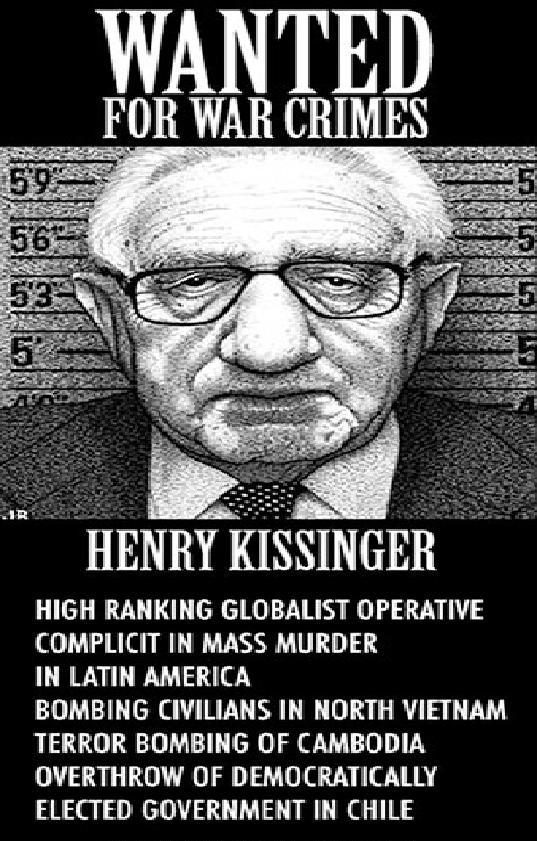
A very angry Senator John McCain denounced CodePink activists as “low-life scum” for holding up signs reading “Arrest Kissinger for War Crimes” and dangling handcuffs next to Henry Kissinger’s head during a Senate hearing on January 29. McCain called the demonstration “disgraceful, outrageous and despicable,” accused the protesters of “physically intimidating” Kissinger and apologized profusely to his friend for this “deeply troubling incident.”

But if Senator McCain was really concerned about physical intimidation, perhaps he should have conjured up the memory of the gentle Chilean singer/songwriter Victor Jara. After Kissinger facilitated the September 11, 1973 coup against Salvador Allende that brought the ruthless Augusto Pinochet to power, Victor Jara and 5,000 others were rounded up in Chile’s National Stadium. Jara’s hands were smashed and his nails torn off; the sadistic guards then ordered him to play his guitar. Jara was later found dumped on the street, his dead body riddled with gunshot wounds and signs of torture.

Despite warnings by senior US officials that thousands of Chileans were being tortured and slaughtered, then Secretary of State Kissinger told Pinochet, “You did a great service to the West in overthrowing Allende.”

Rather than calling peaceful protesters “despicable,” perhaps Senator McCain should have used that term to describe Kissinger’s role in the brutal 1975 Indonesian invasion of East Timor, which took place just hours after Kissinger and President Ford visited Indonesia. They had given the Indonesian strongman the US green light—and the weapons—for an invasion that led to a 25-year occupation in which over 100,000 soldiers and civilians were killed or starved to death. The UN’s Commission for Reception, Truth and Reconciliation in East Timor (CAVR) stated that U.S. “political and military support were fundamental to the Indonesian invasion and occupation” of East Timor.

If McCain could stomach it, he could have read the report by the UN Commission on Human Rights describing the horrific consequences of that invasion. It includes gang rape of female detainees following periods of prolonged sexual torture; placing women in tanks of water for prolonged periods, including submerging their heads, before being raped; the use of snakes to instill terror during sexual torture; and the mutilation of women’s sexual organs, including insertion of batteries into vaginas and burning nipples and genitals with cigarettes. Talk about physical intimidation, Senator McCain!

You might think that McCain, who suffered tremendously in Vietnam, might be more sensitive to Kissinger’s role in prolonging that war. From 1969 through 1973, it was Kissinger, along with President Nixon, who oversaw the slaughter in Vietnam, Cambodia and Laos—killing perhaps one million during this period. He gave the order for the secret bombing of Cambodia. Kissinger is heard on tape saying, “[Nixon] wants a massive bombing campaign in Cambodia. He doesn’t want to hear anything about it. It’s an order, to be done. Anything that flies or anything that moves.”

Senator McCain could have taken the easy route by simply reading the meticulously researched book by the late Christopher Hitchens, The Trial of Henry Kissinger. Writing as a prosecutor before an international court of law, Hitchens skewers Kissinger for ordering or sanctioning the destruction of civilian populations, the assassination of “unfriendly” politicians and the kidnapping and disappearance of soldiers, journalists and clerics who got in his way. He holds Kissinger responsible for war crimes that range from the deliberate mass killings of civilian populations in Indochina, to collusion in mass murder and assassination in Bangladesh, the overthrow of the democratically elected government in Chile, and the incitement and enabling of genocide in East Timor.

McCain could have also perused the warrant issued by French Judge Roger Le Loire to have Kissinger appear before his court. When the French served Kissinger with summons in 2001 at the Ritz Hotel in Paris, Kissinger fled the country. More indictments followed from Spain, Argentina, Uruguay—even a civil suit in Washington DC.

Hitchens was disgusted by the way Henry Kissinger was treated as a respected statesman. He would have been appalled by Senator McCain’s obsequious attitude. “Kissinger should have the door shut in his face by every decent person and should be shamed, ostracized, and excluded,” Hitchens said. “No more dinners in his honor; no more respectful audiences for his absurdly overpriced public appearances; no more smirking photographs with hostesses and celebrities; no more soliciting of his worthless opinions by sycophantic editors and producers.”

Rather than fawning on him, Hitchens suggested, “why don’t you arrest him?”

Hitchens’ words were lost on Senator McCain, who preferred fawning to accountability. That’s where CodePink comes in. If we can’t get Kissinger before a court of law, at least we can show—with words and banners—that there are Americans who remember, Americans who empathize with the man’s many victims, Americans who have a conscience.

While McCain called us disgraceful, what is really disgraceful is the Senate calling in a tired old war criminal to testify about “Global Challenges and the U.S. National Security Strategy.” After horribly tragic failed wars, not just in Vietnam but over the last decade in Iraq and Afghanistan, it’s time for the US leaders like John McCain to bring in fresh faces and fresh ideas. We owe it to the next generation that will be cleaning up the bloody legacy left behind by Kissinger for years to come.