Killing Democracy in America

By William J. Astore

Source: Strategic Culture Foundation

The phrase “thinking about the unthinkable” has always been associated with the unthinkable cataclysm of a nuclear war, and rightly so. Lately, though, I’ve been pondering another kind of unthinkable scenario, nearly as nightmarish (at least for a democracy) as a thermonuclear Armageddon, but one that’s been rolling out in far slower motion: that America’s war on terror never ends because it’s far more convenient for America’s leaders to keep it going — until, that is, it tears apart anything we ever imagined as democracy.

I fear that it either can’t or won’t end because, as Martin Luther King, Jr., pointed out in 1967 during the Vietnam War, the United States remains the world’s greatest purveyor of violence — and nothing in this century, the one he didn’t live to see, has faintly proved him wrong. Considered another way, Washington should be classified as the planet’s most committed arsonist, regularly setting or fanning the flames of fires globally from Libya to Iraq, Somalia to Afghanistan, Syria to — dare I say it — in some quite imaginable future Iran, even as our leaders invariably boast of having the world’s greatest firefighters (also known as the U.S. military).

Scenarios of perpetual war haunt my thoughts. For a healthy democracy, there should be few things more unthinkable than never-ending conflict, that steady drip-drip of death and destruction that drives militarism, reinforces authoritarianism, and facilitates disaster capitalism. In 1795, James Madison warned Americans that war of that sort would presage the slow death of freedom and representative government. His prediction seems all too relevant in a world in which, year after year, this country continues to engage in needless wars that have nothing to do with national defense.

You Wage War Long, You Wage It Wrong

To cite one example of needless war from the last century, consider America’s horrendous years of fighting in Vietnam and a critical lesson drawn firsthand from that conflict by reporter Jonathan Schell. “In Vietnam,” he noted, “I learned about the capacity of the human mind to build a model of experience that screens out even very dramatic and obvious realities.” As a young journalist covering the war, Schell saw that the U.S. was losing, even as its military was destroying startlingly large areas of South Vietnam in the name of saving it from communism. Yet America’s leaders, the “best and brightest” of the era, almost to a man refused to see that all of what passed for realism in their world, when it came to that war, was nothing short of a first-class lie.

Why? Because believing is seeing and they desperately wanted to believe that they were the good guys, as well as the most powerful guys on the planet. America was winning, it practically went without saying, because it had to be. They were infected by their own version of an all-American victory culture, blinded by a sense of this country’s obvious destiny: to be the most exceptional and exceptionally triumphant nation on this planet.

As it happened, it was far more difficult for grunts on the ground to deny the reality of what was happening — that they were fighting and dying in a senseless war. As a result, especially after the shock of the enemy’s Tet Offensive early in 1968, escalating protests within the military (and among veterans at home) together with massive antiwar demonstrations finally helped put the brakes on that war. Not before, however, more than 58,000 American troops died, along with millions of Vietnamese, Cambodians, and Laotians.

In the end, the war in Indochina was arguably too costly, messy, and futile to continue. But never underestimate the military-industrial complex, especially when it comes to editing or denying reality, while being eternally over-funded for that very reality. It’s a trait the complex has shared with politicians of both parties. Don’t forget, for instance, the way President Ronald Reagan reedited that disastrous conflict into a “noble cause” in the 1980s. And give him credit! That was no small thing to sell to an American public that had already lived through such a war. By the way, tell me something about that Reaganesque moment doesn’t sound vaguely familiar almost four decades later when our very own “wartime president” long ago declared victory in the “war” on Covid-19, even as the death toll from that virus approaches 150,000 in the homeland.

In the meantime, the military-industrial complex has mastered the long con of the no-win forever war in a genuinely impressive fashion. Consider the war in Afghanistan. In 2021 it will enter its third decade without an end in sight. Even when President Trump makes noises about withdrawing troops from that country, Congress approves an amendment to another massive, record-setting military budget with broad bipartisan support that effectively obstructs any efforts to do so (while the Pentagon continues to bargain Trump down on the subject).

The Vietnam War, which was destroying the U.S. military, finally ended in an ignominious withdrawal. Almost two decades later, after the 2001 invasion, the war in Afghanistan can now be — the dream of the Vietnam era — fought in a “limited” fashion, at least from the point of view of Congress, the Pentagon, and most Americans (who ignore it), even if not the Afghans. The number of American troops being killed is, at this point, acceptably low, almost imperceptible in fact (even if not to Americans who have lost loved ones over there).

More and more, the U.S. military is relying on air power, unmanned drones, mercenaries, local militias, paramilitaries, and private contractors. Minimizing American casualties is an effective way of minimizing negative media coverage here; so, too, are efforts by the Trump administration to classify nearly everything related to that war while denying or downplaying “collateral damage” — that is, dead civilians — from it.

Their efforts boil down to a harsh truth: America just plain lies about its forever wars, so that it can keep on killing in lands far from home.

When we as Americans refuse to take in the destruction we cause, we come to passively accept the belief system of the ruling class that what’s still bizarrely called “defense” is a “must have” and that we collectively must spend significantly more than a trillion dollars a year on the Pentagon, the Department of Homeland Security, and a sprawling network of intelligence agencies, all justified as necessary defenders of America’s freedom. Rarely does the public put much thought into the dangers inherent in a sprawling “defense” network that increasingly invades and dominates our lives.

Meanwhile, it’s clear that low-cost wars, at least in terms of U.S. troops killed and wounded in action, can essentially be prolonged indefinitely, even when they never result in anything faintly like victory or fulfill any faintly useful American goal. The Afghan War remains the case in point. “Progress” is a concept that only ever fits the enemy — the Taliban continues to gain ground — yet, in these years, figures like retired general and former CIA director David Petraeus have continued to call for a “generational” commitment of troops and resources there, akin to U.S. support for South Korea.

Who says the Pentagon leadership learned nothing from Vietnam? They learned how to wage open-ended wars basically forever, which has proved useful indeed when it comes to justifying and sustaining epic military budgets and the political authority that goes with them. But here’s the thing: in a democracy, if you wage war long, you wage it wrong. Athens and the historian Thucydides learned this the hard way in the struggle against Sparta more than two millennia ago. Why do we insist on forgetting such an obvious lesson?

“We Have Met the Enemy and He Is Us”

World War II was arguably the last war Americans truly had to fight. My Uncle Freddie was in the Army and stationed at Pearl Harbor when it was attacked on December 7, 1941. The country then came together and won a global conflict (with lots of help) in 44 months, emerging as the planetary superpower to boot. Now, that superpower is very much on the wane, as Donald Trump recognized in running successfully as a declinist candidate for president in 2016. (Make America Great Again!) And yet, though he ran against this country’s forever wars and is now president, we’re approaching the third decade of a war on terror that has yielded little, spread radical Islamic terror outfits across an expanse of the planet, and still seemingly has no end.

“Great nations do not fight endless wars,” Trump himself claimed only last year. Yet that’s exactly what this country has been doing, regardless of which party ruled the roost in Washington. And here’s where, to give him credit, Trump actually had a certain insight. America is no longer great precisely because of the endless wars we wage and all the largely hidden but associated costs that go with them, including the recently much publicized militarization of the police here at home. Yet, in promising to make America great again, President Trump has failed to end those wars, even as he’s fed the military-industrial complex with even greater piles of cash.

There’s a twisted logic to all this. As the leading purveyor of violence and terror, with its leaders committed to fighting Islamic terrorism across the planet until the phenomenon is vanquished, the U.S. inevitably becomes its own opponent, conducting a perpetual war on itself. Of course, in the process, Afghans, Iraqis, Libyans, Syrians, Somalis, and Yemenis, among other peoples on this embattled planet of ours, pay big time, but Americans pay, too. (Have you even noticed that high-speed railroad that’s unbuilt, that dam in increasing disrepair, those bridges that need fixing, while money continues to pour into the national security state?) As the cartoon possum Pogo once so classically said, “We have met the enemy and he is us.”

Early in the Iraq War, General Petraeus asked a question that was relevant indeed: “Tell me how this [war] ends.” The answer, obvious to so many who had protested in the global streets over the invasion to come in 2003, was “not well.” Today, another answer should be obvious: never, if the Pentagon and America’s political and national security elite have anything to do with it. In thermodynamics class, I learned that a perpetual motion machine is impossible to create due to entropy. The Pentagon never took that in and has instead been hard at work proving that a perpetual military machine is possible… until, that is, the empire it feeds off of collapses and takes us with it.

America’s Military Complex as a Cytokine Storm

In the era of Covid-19, as cases and deaths from the pandemic continue to soar in America, it’s astonishing that military spending is also soaring to record levels despite a medical emergency and a major recession.

The reality is that, in the summer of 2020, America faces two deadly viruses. The first is Covid-19. With hard work and some luck, scientists may be able to mass-produce an effective vaccine for it, perhaps by as early as next spring. In the meantime, scientists do have a sense of how to control it, contain it, even neutralize it, as countries from South Korea and New Zealand to Denmark have shown, even if some Americans, encouraged by our president, insist on throwing all caution to the winds in the name of living free. The second virus, however, could prove even more difficult to control, contain, and neutralize: forever war, a pandemic that U.S. military forces, with their global strike missions, continue to spread across the globe.

Sadly, it’s a reasonable bet that in the long run, even with Donald Trump as president, America has a better chance of defeating Covid-19 than the virus of forever war. At least, the first is generally seen as a serious threat (even if not by a president blind to anything but his chances for reelection); the second is, however, still largely seen as evidence of our strength and exceptionalism. Indeed, Americans tend to imagine “our” military not as a dangerous virus but as a set of benevolent antibodies, defending us from global evildoers.

When it comes to America’s many wars, perhaps there’s something to be learned from the way certain people’s immune systems respond to Covid-19. In some cases, the virus sparks an exaggerated immune response that drives the body into a severe inflammatory state known as a cytokine storm. That “storm” can lead to multiple organ failure followed by death, yet it occurs in the cause of defending the body from a viral attack.

In a similar fashion, America’s exaggerated response to 19 hijackers on 9/11 and then to perceived threats around the globe, especially the nebulous threat of terror, has led to an analogous (if little noticed) cytokine storm in the American system. Military (and militarized police) antibodies have been sapping our resources, inflaming our body politic, and slowly strangling the vital organs of democracy. Left unchecked, this “storm” of inflammatory militarism will be the death of democracy in America.

To put this country right, what’s needed is not only an effective vaccine for Covid-19 but a way to control the “antibodies” produced by America’s forever wars abroad and, as the years have gone by, at home — and the ways they’ve attacked and inflamed the collective U.S. political, social, and economic body. Only when we find ways to vaccinate ourselves against the destructive violence of those wars, whether on foreign streets or our own, can we begin to heal as a democratic society.

To survive, the human body needs a healthy immune system, so when it goes haywire, becomes wildly inflamed, and ends up attacking and degrading our vital organs, we’re in trouble deep. It’s a reasonable guess that, in analogous terms, American democracy is already on a ventilator and beginning to feel the effects of multiple organ failure.

Unlike a human patient, doctors can’t put our democracy into a medically induced coma. But collectively we should be working to suppress our overactive immune system before it kills us. In other words, it’s truly time to defund that military machine of ours, as well as the militarized version of the police, and rethink how actual threats can be neutralized without turning every response into an endless war.

So many years later, it’s time to think the unthinkable. For the U.S. government that means — gasp! — peace. Such a peace would start with imperial retrenchment (bring our troops home!), much reduced military (and police) budgets, and complete withdrawal from Afghanistan and any other place associated with that “generational” war on terror. The alternative is a cytokine storm that will, in the end, tear us apart from within.


Stories Of Economic Despair From America’s Worst Economic Downturn Since The Great Depression Of The 1930s

By Michael Snyder

Source: End of the American Dream

The economic pain that we are witnessing right now is far greater than anything that we witnessed during the last recession.  U.S. GDP declined by 32.9 percent on an annualized basis last quarter, more than 100,000 businesses have permanently shut down since the COVID-19 pandemic first hit the United States, and more than 54 million Americans have filed new claims for unemployment benefits over the last 19 weeks.  Up until just recently, a $600 weekly unemployment “supplement” and a federal moratorium that prevented many evictions had helped to ease the suffering for millions of American families, but both of those measures have now expired.  As a result, a tremendous amount of economic pain which had previously been deferred will now come rushing back with a vengeance.  Millions of American families are no longer going to be able to pay their bills, and experts are warning that we could soon see an “eviction crisis” that is absolutely unprecedented in American history.

48-year-old Thomas Darnell of West Point, Mississippi never thought that he would be in this position.  He had been a factory worker for over 20 years until he lost his job in May, and since then he hasn’t been able to find another.  And then on top of everything else, everyone in his house caught COVID-19…

First, he was furloughed for three weeks in April and then laid off in May. Then things got worse: His entire household of seven, including himself, his wife, three kids and daughter-in-law, along with his baby grandson, contracted coronavirus after they saw their immediate family over the Independence Day weekend.

“I’m tired and shaky. Even after a few weeks, I’m still trying to recover,” Darnell says, who has since been cleared of the virus but still has lingering symptoms.

He is concerned that employers will be scared away by his recent illness, and he is becoming desperate because he is running out of money.

With no health insurance and no paychecks coming in, Darnell and his wife have gotten to the point where they have to make a choice between buying insulin or buying groceries

He can’t afford health insurance, which has added to his anxiety because he and his wife are both diabetic, he says. Like Bolei, Darnell and his wife have been forced to make a grueling decision between either paying for their medications or keeping food on the table.

“Do we buy insulin or groceries? It’s a hard juggle,” Darnell says. “I’m willing to make less money and start working again to get health insurance, but no one is hiring.”

The weekly $600 unemployment supplements from the federal government had helped to keep them going for a while, but now those payments have ended, and the immediate future is looking quite bleak.

In Richmond, Virginia, a mother of eight named Shamika Rollins wasn’t sure how she was going to make it when her hours as a home health aid were reduced.  Unpaid bills started piling up, and then she got an eviction notice a few weeks ago.  The following comes from CBS News

Shamika Rollins’ eight children share two bedrooms in Richmond, Virginia. But she’s worried about losing their home after she says she received an eviction notice in June.

“First thing, I panic, and then next thing, I look, and I’m like, I got my kids. And it’s like, okay, now you gotta figure this out,” she told CBS News correspondent Adriana Diaz.

If a miracle does not happen, Rollins and her eight children will soon be out in the street, and this is causing her to have “a lot of sleepless nights”

“I have a lot of sleepless nights,” Rollins said. “My mind is constantly racing, you know, what’s your next move?”

Sadly, there are millions of other Americans in the exact same position.

In fact, experts are projecting that up to 40 million Americans could be evicted from their homes during this pandemic.

Many small business owners are also facing heartbreaking choices during this downturn.  A restaurant owner in Delaware named Alex Heidenberger “hasn’t paid the mortgage on his home the past four months” as he desperately tries to keep his once profitable restaurants alive…

Heidenberger, who typically draws about $20,000 a month in profit from the restaurant, now receives nothing. He says he hasn’t paid the mortgage on his home the past four months. He served lifeguard duty for a couple of weeks, mostly to help a beach crew depleted by COVID-19 quarantines but also to make some cash.

“I’m working harder than I have ever worked in my life,” he says, adding that he puts in about 80 hours a week at the two restaurants. Yet, “I have no money… This is all I think about. I don’t sleep.”

The COVID-19 pandemic has hit the restaurant industry particularly hard.  Americans are not eating out as regularly as they once did because of the virus, and it is probably going to remain that way for the foreseeable future.

In Massachusetts, a restaurant owner named John Pepper once had eight thriving locations, but at this point only two of them remain open

John Pepper used a PPP loan to pay employees and reopen four of his eight Boloco restaurants when Massachusetts lifted its shutdown order in early May. But with the money spent and business at the restaurants down as much as 70%, Pepper had to again close two locations. The staff of 125 he had before the virus outbreak is down to 50.

“A lot of this is out of our hands at this point,” Pepper says. “At this moment, I don’t see getting my full payroll back.”

Overall, we are facing a “restaurant apocalypse” in the U.S. that is unprecedented in size and scope.

According to one estimate, we could lose more than a third of all of our restaurants by the end of this calendar year

As many as 231,000 of the nation’s roughly 660,000 eateries will likely shut down this year, according to an estimate from restaurant consultancy Aaron Allen & Associates provided to Bloomberg News. This will bring the industry’s steady growth to a halt and mark the first time in two decades that U.S. restaurant counts don’t climb. Restaurants have already shed millions of jobs this year, economic data show.

What we are watching is truly horrifying.  So many hopes and dreams went into each one of those restaurants that are shutting down, and countless restaurant owners are going to be completely financially ruined by all of this.

For other Americans, this economic downturn has put their very lives at risk.  In Colorado, 70-year-old Catherine Azar was already dealing with heart problems and diabetes, and now she is in danger of being thrown out into the street

“It’s hard for me to conceive of someone being willing to put another person out in the street in the middle of a deadly pandemic, and I’m high risk. I’m 70. I have heart issues and I’m diabetic,” Azar said.

Rollins and Azar are just two of the 43 million Americans at risk of eviction in the coming months. For context, about 1 million Americans were evicted in 2010, the year after the Great Recession.

How long do you think that a 70-year-old woman with heart problems and diabetes would last on the street or in a shelter?

And as millions upon millions of Americans get evicted during the months ahead, the shelters are all going to fill up really fast.

America simply was not prepared for an economic downturn of this nature, and the truth is that much bigger challenges are still ahead.

So please do not look down on anyone that needs help right now, because soon you may find yourself in the exact same position.

COVID19, The Great Reset & The New Normal

By Derrick Broze

Source: Activist Post

Clearly, 2020 has been unlike any previous year in the last century or so. The world is currently battling against an infodemic of propaganda spewing from the corporate media and official health authorities. Yes, people are sick and dying. However, the statistics make it clear that COVID-19 simply does not warrant a total lockdown of the planet and further destruction of the economy. 

Regardless, nations around the world are using COVID-19 as an opportunity to grab more surveillance and police state powers, institute mask and vaccine mandates, accelerate the push towards a completely digital world, enact more corporate bailouts, and generally, extreme control and involvement in citizens lives. The sheer magnitude of the COVID-19 operation is unparalleled, with the most recent similar event being the attacks of September 11, 2001. As with the 9/11 attacks, the predator class is using COVID-19 as the excuse to push plans and agendas which predate the spread of the novel coronavirus.

Even so, the COVID-19 operation is unlike any other event to take place in modern history because the results of this event are affecting people in every single nation on the planet and will continue to for years to come. Also, unlike 9/11 – which took place over the course of one morning – the COVID-19 operation is taking place daily for months on end. The effects of this constant bombardment with fear and panic are taking a toll on the hearts and minds of free people all around the world. Quite simply, the people are ready for this to end and they will do almost anything to achieve this goal. It is within this space of fear and uncertainty which the predator class has now begun to insert themselves, ready to present the “solution” to our ills.

The Great Reset

As every student of power and deception knows, the easiest way to achieve victory over your opponent is to guide them to a predetermined destination which benefits your agenda. If you can do this while convincing your opponent that they are consciously making their own choices and the path is for their own good – well, you are all but guaranteed success. I believe the evidence indicates this is the strategy we are seeing unfold during the COVID-19 operation.

The predetermined path we are being led down is known as “The Great Reset” and was announced in early June by the World Economic Forum. Regular readers will remember that on October 18, 2019, the Bill and Melinda Gates Foundation partnered with the Johns Hopkins Center for Health Security and the WEF on a high-level pandemic exercise known as Event 201. Event 201 simulated how the world would respond to a coronavirus pandemic which swept around the planet. The simulation imagined 65 million people dying, mass lock downs, quarantines, censorship of alternative viewpoints under the guise of fighting “disinformation,” and even floated the idea of arresting people who question the pandemic narrative.

The launch of The Great Reset was supported by Klaus Schwab, the founder and executive chairman of the World Economic Forum; England’s Prince Charles; Antonio Guterres, Secretary-General of the UN; and Kristalina Georgieva of the International Monetary Fund. The kick-off was truly an international event with the participation of Ma Jun, the chairman of the Green Finance Committee at the China Society for Finance and Banking and a member of the Monetary Policy Committee of the People’s Bank of China. The event was also supported by Bernard Looney, CEO of BP; Ajay Banga, CEO of Mastercard; and Bradford Smith, president of Microsoft.

During the launch of The Great ResetPrince Charles stated that humanity cannot waste time because we need to put nature at the heart of how we operate.” UN Secretary-General Guterres called for “more equal, inclusive and sustainable economies and societies” that can face pandemics, climate change, and other global challenges.

In an opinion piece published in The Globe and Mail, Klaus Schwab provided more details on the goals of The Great Reset (emphasis added):

COVID-19 lockdowns may be gradually easing, but anxiety about the world’s social and economic prospects is only intensifying. There is good reason to worry: a sharp economic downturn has already begun, and we could be facing the worst depression since the 1930s. But, while this outcome is likely, it is not unavoidable.

To achieve a better outcome, the world must act jointly and swiftly to revamp all aspects of our societies and economies, from education to social contracts and working conditions. Every country, from the United States to China, must participate, and every industry, from oil and gas to tech, must be transformed. In short, we need a “Great Reset” of capitalism.

Schwab goes on to describe several crises facing humanity, including rising government debt, unemployment, and increasing social unrest. Combined with COVID-19, these crises will leave the world less sustainable, less equal and more fragile. “We must build entirely new foundations for our economic and social systems,” Schwab writes. He details the 3 main components of TGR agenda, specifically fairer market outcomes, investments in “equality and sustainability,” and harnessing the innovations of the Fourth Industrial Revolution.

When it comes to producing “fairer market outcomes,” Schwab calls for governments to improve coordination in tax, regulatory, and fiscal policy. He also calls for upgrading trade agreements and moving towards a “stakeholder economy.” When he speaks of equality and sustainability, Schwab means that current and future government stimulus and relief packages should be used to create a new system that is “more resilient, equitable and sustainable.”  He also calls for more “green” urban infrastructure and incentivizing industries to improve their environmental record.

Finally, Schwab calls for utilizing the innovations of “the Fourth Industrial Revolution” to support public good. The 4IR is another pet project of Schwab which was first announced in December 2015. To put it simply, the 4IR is the digital panopticon of the future, where digital surveillance is omnipresent and humanity uses digital technology to alter and, hopefully, improve our lives. Sometimes known as “The Internet of Things,” this world will be powered by 5G and 6G technology.

“Ubiquitous, mobile supercomputing. Intelligent robots. Self-driving cars. Neuro-technological brain enhancements. Genetic editing. The evidence of dramatic change is all around us and it’s happening at exponential speed,” Schwab wrote for the announcement of the 4IR.

Of course, for Schwab and other globalists, the 4IR also lends itself towards more central planning and top-down control. The goal is a track and trace society where all transactions are logged, every person has a digital ID that can be tracked, and social malcontents are locked out of society via social credit scores.

In fact, much of this call for a Great Reset is already playing out. For example, Mastercard and the Bill and Melinda Gates Foundation-funded GAVI recently announced a partnership with AI-powered “identity authentication” company, Trust Stamp. As MintPress News reported, “The program, which was first launched in late 2018, will see Trust Stamp’s digital identity platform integrated into the GAVI-Mastercard “Wellness Pass,” a digital vaccination record and identity system that is also linked to Mastercard’s click-to-play system that powered by its AI and machine learning technology called NuData.

This is why astute readers are skeptical when they hear Schwab say, “the pandemic represents a rare but narrow window of opportunity to reflect, reimagine, and reset our world to create a healthier, more equitable and more prosperous future.”

Who exactly is Schwab speaking to when he speaks of a more prosperous future? How long has this Great Reset been in the works? The answers to these questions can help us understand the true goals of this agenda.

As researcher Brandon Smith reportedChristine Lagardeformer head of the IMF, discussed a global reset as far back as 2014. “The reset is often mentioned in the same breath as ideas like “the New Multilateralism” or “the Multipolar World Order” or “the New World Order.” All of these phrases mean essentially the same thing,” Smith writes.

Smith correctly notes that the Great Reset is not a response to the pandemic, but rather, “the global reset as implemented by central banks and the BIS/IMF is the cause of the collapse. The collapse is a tool, a flamethrower burning a great hole in the forest to make way for the foundations of the globalist Ziggurat to be built.”

New Normal, Same World Order

In early July, Schwab and French author Thierry Malleret released a book outlining the vision of The Great Reset. The book, Covid-19: The Great Reset, explores what the post-pandemic world might look like. “Will there be enough collective will to take advantage of this unprecedented opportunity to reimagine our world, in a bid to make it a better and more resilient one as it emerges on the other side of this crisis?,” Schwab and Malleret pondered at the release of the book. The two men believe COVID-19 triggered “momentous changes and magnified the fault lines that already beset our economies and societies.” They also predict that falling oil prices and a freeze in tourism could lead to a wave of massive anti-government demonstrations.

“One path will take us to a better world: more inclusive, more equitable and more respectful of Mother Nature. The other will take us to a world that resembles the one we just left behind – but worse and constantly dogged by nasty surprises,” the authors argue.

In the book, Schwab expands upon the initial announcement of The Great Reset. Once again he calls for the 4th Industrial Revolution and the digitalization of everything, powered by 5G technology. However, Schwab goes even further in his book, calling for rethinking the “social contract” society has with governments.

Schwab also calls for a nature based or green economy. In January 2020, the WEF released their report, Nature Risk Rising: Why the Crisis Engulfing Nature Matters for Business and the Economy, as part of their New Nature Economy series of reports. The report is “the first of a series of New Nature Economy reports, prepared through the Nature Action Agenda, a platform that aims to encourage a movement of businesses, governments, civil society, academics, innovators and youth to disrupt business-as-usual approaches.”

A second report, The Future of Nature and Business, was released in July. Once again, the WEF states that COVID-19 presents an “opportunity, to change the way we eat, live, grow, build and power our lives to achieve a carbon-neutral, ‘nature-positive’ economy and halt biodiversity loss by 2030. Business as usual is no longer an option.

In a companion report, the WEF provides some detail on what it means to change the way we eat. Another set of policy measures that would stimulate more resource-efficient food systems entail directing stimulus packages towards R&D to support the diversification away from diets based on resource intensive animal proteins, and towards four main categories of alternatives – aquatic, plant-based, insect-based and laboratory-cultured,” the report states. This push for alternatives to animal proteins has coincided with a rise in laboratory created fake meat, including products funded by the Bill and Melinda Gates Foundation. 

Interestingly, the companion report also calls for “corporate bailout packages for the meat sector” which “could accelerate these developments.” Coincidentally, because of COVID-19, the Trump administration awarded $15.5 billion in relief aid for the meat and dairy industry. Once again, the predictions and declarations of these global institutions appear to play out in reality as perfect as any scripted TV show.

The calls for a Great Reset greatly mimic previous programs and initiatives put forward by other globalist organizations, including the United Nations. Researcher F. William Engdahl provided much-needed clarity in a recent piece on the announcement of The Great Reset. Engdahl notes that, “the declaration by the World Economic Forum to make a Great Reset is to all indications a thinly-veiled attempt to advance the Agenda 2030 “sustainable” dystopian model, a global “Green New Deal” in the wake of the covid19 pandemic measures. Their close ties with Gates Foundation projects, with the WHO, and with the UN suggest we may soon face a far more sinister world after the covid19 pandemic fades.”

Strategic Intelligence, Strategic Partners, and Event 201

In March, the WEF launched the COVID Action Platform which is essentially a call for global government in response to COVID-19. The answer, WEF believes, is to have greater global cooperation, move away from the nation-state, and tackle the world’s problems as one international community.

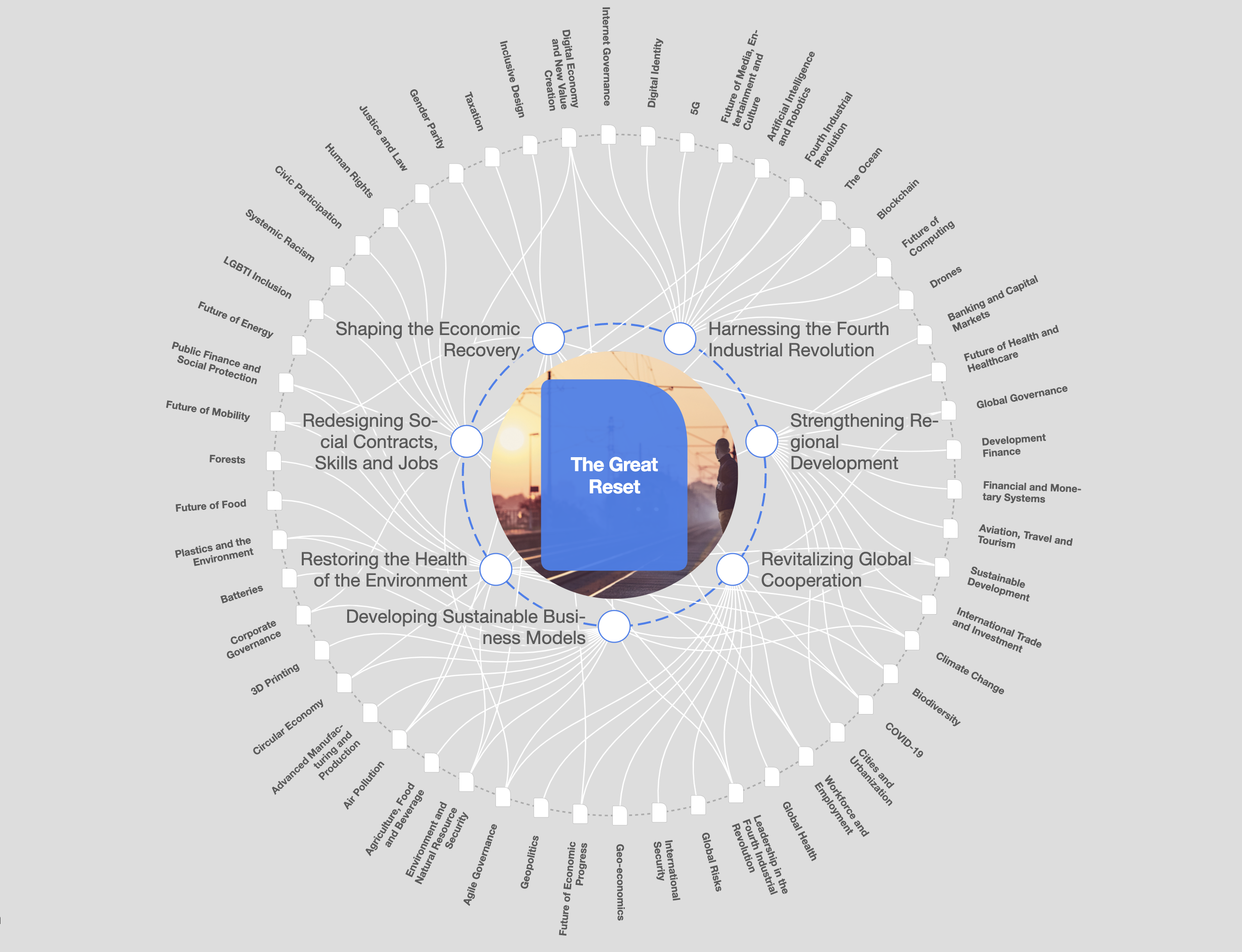
Along with the launch of the Action Platform, the WEF released an impressive graphic as part of their “Strategic Intelligence” platform, which outlines the wide ranging ways their plans will effect and shape the world of the 21st century and beyond. From the media’s role in the pandemic to finding a vaccine, the graphic attempts to provide details on this centrally planned future being promoted by the WEF. I encourage all readers to spend an evening going down the rabbit hole that is the COVID Action Platform for a better understanding of where we are headed.

With the launch of The Great Reset, the WEF also launched a Strategic Intelligence graphic detailing how their plans will unfold. The Great Reset graphic details how everything from drones, blockchain, the future of energy, LGBTI inclusion, and 3D printing will play a role in the New Normal. Once again, I encourage readers to take a dive into this graphic to gain clarity on what the WEF and their partners have planned for the coming decade.

The WEF promotes itself as the “International Organization for Public-Private Cooperation.” They partner with a variety of private companies, philanthropic outlets, and governments to achieve their goals. Researcher Steven Guinness recently outlined how the WEF partners with various institutions to accomplish their stated aims and how the Strategic Intelligence platform is “co-curated with leading topic experts from academia, think tanks, and international organizations.”

“‘Co-curators‘ are perhaps the most important aspect to consider here, given that they have the ability to ‘share their expertise with the Forum’s extensive network of members, partners and constituents, as well as a growing public audience,’” Guinness writes. “It is safe to assume then that when co-curators speak, members and partners of the World Economic Forum listen. This in part is how the WEF’s agenda takes shape.”

As Guinness notes, the co-curators of the Strategic Intelligence road map of the globalist vision include Harvard university, the Massachusetts Institute of Technology, Imperial College London, Oxford University, Yale and the European Council on Foreign Relations. Several of these institutions continue to play an influential role in shaping the narrative around COVID-19.

The WEF’s highest level of partnership is known as Strategic Partners. There are only 100 international companies listed as Strategic Partners. Each partner receives an invitation if they have “alignment with forum values.” These partners “shape the future through extensive contribution to developing and implementing Forum projects and championing public-private dialogue.”

The WEF’s Strategic Partners include Johnson & Johnson, and the Bill and Melinda Gates Foundation. Bill Gates is also a long time “Agenda Contributor” for the WEF.  As mentioned above, the Bill and Melinda Gates Foundation partnered with the Johns Hopkins Center for Health Security and the WEF on the Event 201 pandemic exercise in October 2019. Johnson & Johnson were also partners in the exercise.

As TLAV has previously documented, the Bill and Melinda Gates Foundation operates in a similar fashion to the WEF: their publicly stated goals mask a global control agenda. Thus, it should come as no surprise that Klaus Schwab, founder of the WEF, is a former attendee and member of the Steering Committee for the secretive Bilderberg Group.

The WEF itself is akin to a more public Bilderberg Group which brings together around 3,000 business leaders, international political leaders, economists, celebrities, and journalists for a five day conference to discuss global issues. The WEF meets every January in Davos, Switzerland, to discuss their agenda. The elitism of the WEF has resulted in Schwab and his cohorts being nicknamed The Davos Class.

In January 2021 the theme of the WEF meeting will be “The Great Reset.” It’s important that we keep an eye on the WEF and their push for the Great Reset as we draw closer to election 2020 and a potential Dark Winter. Klaus Schwab, Bill Gates, and their ilk are determined to present themselves as the saviors of humanity. They are using the COVID-19 panic as an opportunity to push their agenda while selling it as the cure to our problems.

This predator class attempts to mask their true intentions with flowery language designed to lull the waking masses back to sleep. To be clear, our world is absolutely, without a doubt existing in an unsustainable paradigm. We do have growing income inequality, police violence, failing healthcare systems, and insufficient food production systems. These problems were apparent before COVID-19 and the fragility of these systems has indeed become more obvious in recent months. However, these psychopaths would prefer if we allowed them to stay in the driver’s seat as they careen us into a future of technocratic control and the end of individual liberty.

While Schwab and Gates would prefer that the people of the world submit to their vision, we must stand against this push for centralization of power and technology. The Great Reset is coming, and perhaps, it should come. We have many issues facing our species that need to be addressed. However, central planning, surveillance, and loss of individual liberty is not the answer. The answer is decentralization, opting out en masse, non-compliance, and non-participation in the systems which have brought us to this predicament.

We, as free people, must decide what path we intend to take. Will we stand by and allow the predators to seize control of all resources and power for the coming generations? Or, will we finally break free from their violent systems and initiate a Great Reset which benefits the people, from bottom to top?

The answer depends on you.

Question Everything, Come To Your Own Conclusions.

Undeclared Israeli War on Syria

By Stephen Lendman

Source: StephenLendman.org

In cahoots with the US and their ISIS, al-Nusra, and other terrorist proxies, Israel has been waging undeclared war on Syria for years.

Ruling regimes of both countries partner in each other’s high crimes of war and against humanity.

Obama’s war on Syria — now Trump’s, to be Biden’s war next year if he triumphs over DJT in November — is in its 9th year with no prospect for resolution because bipartisan US hardliners reject turning a page for peace and stability in all their active war theaters.

Pentagon and IDF warplanes terror-bomb Syria at their discretion, civilians harmed most.

The latest Netanyahu regime aggression occurred Monday night.

Israeli warplanes and attack helicopters struck Syrian targets in Quneitra province, a premeditated strike like all others.

According to the IDF, observation posts, intelligence collection systems, anti-aircraft artillery, and military command and control systems were targeted.

The Syrian Arab News Agency (SANA) reported that overnight Israeli aggression caused “material damages” with no further elaboration.

Citing state media, Southfront said “Syrian forces intercepted several missiles, while the impact of the rest of them caused” no casualties.

An IDF spokesman claimed Israel foiled an attempt by unnamed parties to plant bombs earlier on Monday along the border of Occupied Golan and Syria, adding:

The unidentified individuals were lethally shot. It’s unclear who was shot, how many individuals, or for what reason other than what Israel claimed that may not reflect reality.

Time and again, its explanations of hostile incidents later were exposed as disinformation to justify what’s unjustifiable.

Aggression is a US and Israeli specialty, not how Syria or Hezbollah operate. Claims otherwise by ruling US or Israeli regimes are falsified.

No nations, groups or individuals threaten their territory. Their imperial aims threaten humanity.

Separately, IDF warplanes preemptively terror-bombed Gaza, what’s gone on repeatedly since the Strip was unlawfully blockaded in 2007, an IDF statement, saying:

Its warplanes struck Hamas targets.

“During the attack, a concrete production site used to excavate underground infrastructure was attacked, and in addition, underground (Hamas) infrastructure.”

“The attack was carried out in response to (a) rocket fire(d) from the Gaza Strip into Israeli territory” by an unknown party — causing no damage or casualties, the incident unrelated to Hamas.

Yet the Netanyahu regime falsely blames its ruling authorities for whatever happens in the Strip or in its coastal waters, knowing they’re not responsible.

Time and again, Israel blames others for its own high crimes. The US operates by the same unlawful standard.

Separately, Israeli provocations heightened tensions along its border with Lebanon.

In late July, the IDF falsely claimed that “Hezbollah attempted to carry out an infiltration operation and that the Israeli army frustrated the attack and killed a number of its fighters.”

Hezbollah refuted the phony claim, explaining that Israeli forces preemptively carried out the border incident — stressing that gunfire occurred only from the Israeli side, adding:

Its aggression “will not remain unanswered.”

Israel lied about the late July incident. Its explanation of what occurred overnight along the border of Occupied Golan and Syria was also likely falsified.

The US and Israel are belligerent states, longstanding aggressors — threatening their own people and other nations in pursuit of their hegemonic aims.

Hiroshima Denial is Terror

By Finian Cunningham

Source: Information Clearing House

Those who deny history, or who are oblivious, are apt to repeat it. That is the frightening, perhaps most disturbing aspect of the 75th anniversary this week of the American atomic bombing of Hiroshima and Nagasaki.

The indiscriminate mass murder of 200,000 people on August 6 and 9, 1945, is beyond words in its horror and moral depravity. But what is equally condemning is the ostensible lack of remorse and the obfuscation to conceal the scale of such evil.

For if there were any remorse or realization about the crime there would surely be a commitment to never repeat it. The most solemn manifestation of commitment would be the pursuance of nuclear disarmament.

Seventy-five years on, yes, American news media run so-called commemorative articles on the historic events. However, there is a sense of glibness about the calamity, a sort of dull duty to mark the occasion as if it is a yearly chore of “regret”. There is also a sneaking awe at the destructive power unleashed on those Japanese cities, as well as the usual inclusion of official justification about how US leaders at the time were allegedly motivated by ending the Pacific War quickly. There are even in some media coverage brief mentions of acknowledgement that the dropping of the A-bombs was “unnecessary”.

But it’s all delivered in an insidious way to obscure the shocking, barbaric truth that the United States dropped weapons of mass destruction on civilians. How about going further and acknowledging it was a deliberate act of mass terror for political purpose to establish American hegemony in the postwar order?

No proper humane or moral lessons, it seems, have been drawn about the genocide that took place at Hiroshima and Nagasaki. Neither by the people in US government and media establishments nor, lamentably, by the wider American population. If lessons were truly learned then there would be a sense of revulsion and outrage demanding immediate nuclear disarmament and the end to all war machinery.

Just last month, the US Congress passed an annual military budget of $740 billion, including for the development of weapons of mass destruction. This is while 30 million American workers and their families are suffering from unemployment and deprivation due to the coronavirus pandemic and the government shutting off pittance welfare payments.

The anniversary of Hiroshima and Nagasaki comes as the Trump administration issues ever-more provocative slander against China over the pandemic and other matters that are really not Washington’s business nor remit, especially the subjects of alleged human rights violations or government espionage against citizens.

Washington continues to provoke both Russia and China with ever-expanding plans to deploy intermediate-range missiles near their territories. This only one year after Washington scrapped the Intermediate-range Nuclear Forces (INF) treaty with Moscow.

It is the US side which is threatening to collapse the New START accord, the last-remaining nuclear arms-control treaty with Moscow.

It is the US side which is pushing recklessly ahead with weaponizing outer space while falsely, cynically, accusing Russia and China of doing so, even though the latter have both repeatedly called for a United Nations-backed moratorium on militarizing this domain.

It is the US side which reserves the unilateral “right to first nuclear strike” while Russia and China have declared to only use such weapons as defensive response to attack.

The militarization by Washington and its bellicose policies towards Moscow and Beijing are proof that the criminality of Hiroshima and Nagasaki has never been accounted for.

The criminality of that genocide remains unacknowledged and ignored by the US ruling system because, evidently, it wants to use that horror as a psychological weapon against others. The psychological weapon being: “We did it before, and we can do it again”. The ultimate “terror card” was played and continues to be played, albeit tacitly.

Contemporary developments and indicators of geopolitical tensions with China and Russia show that Washington is not willing or indeed capable of engaging for mutual peace. It is hellbent on stoking cold war confrontation, even if that confrontation results in hot war. A war with Russia or China would inevitably escalate into a catastrophic nuclear end.

On August 6 and 9, 1945, 75 years ago, the world witnessed two cities despatched to the hell of nuclear annihilation. It is utterly shameful that the nation that perpetrated such an absolute crime remains unapologetic and in denial. But more than that, it is utterly nefarious because the unapologetic logic means it could happen again.

Saturday Matinee: Rogue Male

Gone to earth: Why Rogue Male belongs with the canon of cult 1970s British rural dramas

Peter O’Toole plays the huntsman who nearly shoots Hitler before the war and is forced on the run through rural Britain in the 70s TV film Rogue Male.

By Adam Scovell

Source: BFI

British TV films of the 1970s were obsessed with landscape. Getting their hands on 16mm cameras, directors gravitated towards rural realms in order to tell the most surreal and unusual of stories. Whether it be BBC Ghost Stories, Play for Today episodes or one-off films, the countryside never seemed so strange or omnipresent a setting as it did back then.

With a large part of its narrative set in the Dorset countryside, it’s unsurprising then to find Geoffrey Household’s tense 1939 novel, Rogue Male, adapted in this period. Clive Donner’s version, scripted by Frederic Raphael (Far from the Madding Crowd; Eyes Wide Shut) and now released on Blu-ray and DVD, is one of the strongest evocations of landscape of the time. The film shows how people must adapt to their role in an increasingly dangerous pre-war ecosystem, one that’s predicated on notions of survival of the fittest.

Broadcast on BBC2 on 22 November 1976, Rogue Male follows the misfortunes of sporting aristocrat Sir Robert Hunter (Peter O’Toole). On a suspiciously random trip to the continent, he is caught aiming his rifle at Adolf Hitler (Michael Sheard) and only misses by chance. Escaping the clutches of the Nazis after being caught and tortured by the Gestapo, Hunter makes his way slowly back to Britain, soon believing that he’s safe on his home turf. But, on finding that he has been followed by Nazi agents, and with little help from his politician uncle (Alastair Sim), he’s forced to flee from London to Dorset. Here he must confront his pursuers and the memories from his past that first motivated him to take aim at the Führer.

Household’s novel was first adapted by Fritz Lang as Man Hunt in 1941, with a screenplay by Dudley Nichols. But in Lang’s film, the landscape is less of a vital presence. Donner – known previously for the 1963 film of Harold Pinter’s The Caretaker and the swinging 60s romp Here We Go round the Mulberry Bush (1968) – is more aware of the inherent symbolism in Household’s original novel, and more concerned with the detail the author went into in describing the Dorset topography. His film matches this detail with a gritty but effective rendering of the hills and holloways where Hunter hides out, filling the scenes with sustained shots of the land: the only reliable constant in Hunter’s world.

Rogue Male’s script is filled with double entendres regarding the role of Hunter, who becomes more and more animalistic as the film progresses. His torment at the hands of the Gestapo turns him into a creature not unlike the animals he himself used to hunt. Even when he’s back in England, a country where we see walls scrawled with pro-fascist graffiti, he is “not out of the woods yet”. Later, he is described as having “gone to ground”, a fox-hunting term that implies he is no longer fleeing but in hiding.

All of these detail a subtle devolution in Hunter’s relationship with the land, from his mastery of it as a predator to scurrying with ingenuity as prey. He even wrote a book about the skill of hunting – much to his own misfortune, as it becomes the key that his chief pursuer, Quive-Smith (John Standing), uses to track him down.

With Hunter trapped underground in a warren of his own making, the imagery can’t help but remind us of the animated version of Richard Adams’ Watership Down (1978), with its equally subterranean battleground between the liberal and the totalitarian. Rogue Male’s very setting also recalls Mike Leigh’s Nuts in May, broadcast in January of the same year. Like a comedic inversion of Hunter, Leigh’s fastidious camper, Keith (Roger Sloman), also ends up foraging in the undergrowth after battling against ulterior – albeit antisocial – forces.

Unlike Keith, however, who never comes to terms with his lower placement in the Dorset landscape, Hunter adapts his way to freedom. Sir Robert knows, though, that for the next hunt he must be predator rather than prey, as the stakes will never be higher.


Watch the full film at the Anarchist Film Archive.

Military Escalation in the Middle East: Is Israel Planning a Multi-Front War against Its Arab Neighbors?

Top US and Israeli Military Officials Meet Unannounced in Southern Israel

By Timothy Alexander Guzman

Source: Silent Crow News

If you watch the US mainstream media’s 24 hour news coverage on recent events around the world no matter what time of the day it is, Covid-19 and China dominate the headlines while ignoring recent escalations in the Middle East involving Israel and its Arab neighbors as they come closer to another war in an already devastated region.  The Times of Israel reported that the Israeli government “sent a message to Hezbollah warning the Lebanese terror group against any retaliatory action in response to the killing of one of the organization’s fighters in an airstrike in Syria on Monday night, which was attributed to Israel.”  According to various reports, Israel has killed one of Hezbollah’s fighters Ali Kamel Mohsen Jawad in another cross-border attack in Syria last week and now fears that Hezbollah will retaliate, but Israel’s military and intelligence community has issued a statement aimed at Hezbollah, Lebanon and Syria warning them not to retaliate considering that Israel would most likely launch a multi-front attack on all entities involved.  The report said that “the airstrike attributed to Israel on Monday night hit weapons depots and military positions belonging to Syrian regime forces and Iran-backed militia fighters, according to the Syrian Observatory for Human Rights.”  For the record, The Syrian Observatory for Human Rights (SOHR) is a UK government funded pro-opposition group to the Assad Government.  In a statement by the Israeli army, “The IDF holds the Syrian regime responsible for the fire against Israel earlier today” and that “the IDF will continue operating with determination and will respond to any violation of Israeli sovereignty.”  What was revealing was an unannounced meeting between the US Chairman of the Joint Chiefs of Staff General Mark Milley and Israel’s top military leaders including Defense Minister Benny Gantz:

US Chairman of the Joint Chiefs of Staff Gen. Mark Milley, made an unannounced visit to Israel, meeting with Defense Minister Benny Gantz, IDF chief Lt. Gen. Aviv Kohavi and Mossad director Yossi Cohen, along with other top brass. 

Israeli television commentators speculated on the possible significance of the visit, particularly regarding the threat posed by Iran and its Lebanese ally Hezbollah. “In light of a situational assessment in the IDF and in accordance with the Northern Command’s defense plan, the IDF’s deployment will change in both the military and civilian arena. with the goal of strengthening defenses along the northern border,” the IDF said in the statement. In a tacit threat, the IDF preemptively warned Beirut that it sees the state of Lebanon as “responsible for all actions emanating from Lebanon”

Something big is about to take place as the IDF “cleared some troops out of positions directly along the border, moving them deeper into Israel, so that they would not represent a clear target for Hezbollah, while still allowing them to defend the frontier” according to the report.  However, Milley’s visit at the Nevatim Air Base in southern Israel is significant according to another report by the Times of Israel ‘US military chief visits Israel to talk regional threats, amid tensions in north’ stating that “the visit came at a time of heightened tensions with Iran and its allies across the Middle East.” General Milley was briefed by Israel’s Intelligence agencies including Mossad and Israel’s military intelligence unit, Aman on the threat they face from Iran and its allies.  After the briefing, Gantz declared that “the need to continue the pressure on Iran and its proxies that threaten regional and global stability” signaling to it’s neighboring enemies “not” to test Israel.

Lebanon has two major problems to deal with besides another catastrophic war, for starters it has a severe economic crisis with a collapsing currency.  The other problem is their newly discovered offshore oil and gas reserves which the US and Israel would love to get their hands on.  Lebanon’s offshore oil reserves is estimated to be at 865 million barrels and has gas reserves that range from 25 trillion cubic feet (an estimate published in 2018 by the Chatham House which is part of the Royal Institute of International Affairs, a think tank based in London) to 96 trillion cubic feet in 2013, an estimate claimed by the Lebanese Energy Minister at the time, Gebran Bassil.  Either way, Lebanon hosts Hezbollah on its territory and has discovered an abundance of natural resources in its offshore territories, its a prime target for Israel and the US.

War Will Begin in the Middle East, Not Asia?

The recent incident involving Iran’s Mahan air passenger plane traveling from Tehran to Beirut over Syria and a US F-14 fighter jet who apparently came dangerously close to the plane according to Iranian media is a sign of aggression that sends a message to Iran and its allies including Hezbollah that the US and Israel is prepared for war.  Israel does not want Washington to focus on China since the upcoming US elections are months away and Israel is not sure what is going to happen come this November with Trump and his pro-Israel administration.  Israel cannot afford to have Washington start a new war with China so for the time being tensions between the US and China will lead to a new Cold War 2.0.  The Middle East is an important region that remains a strategic part of the world’s economy with its valuable natural resources, a fact too important to ignore for western Big Oil interests and Israel.  The meeting between US and Israeli military officials is significant and should be taken seriously, but the world is consumed with news on Covid-19 and China. Another Middle East war can happen either before or after the November elections and that depends on how desperate Israel becomes.  Israel can pull Washington’s strings and ignite a war between the US and Iran before the situation intensifies in the South China Sea.

War is inevitable and it will begin in the Middle East and end on the US mainland with an already declining economy and a society that is falling apart.  Non-stop protests continue to destroy many US cities with the possibility of more riots to to come if the never-Trump crowd or the Democrats lose the elections in November.  However, while the world is occupied by a virus and the tensions in the South China Sea continue between the US and China and an upcoming Presidential election, a new conflict between Israel and its Arab neighbors is a real possibility, making it one of the most dangerous periods in human history.