We wink to them, Good Night!

Liberation-Through-Lucid-Living-Creating-Your-Lucid-Reality

By The Raqs Media Collective

Source: Adbusters

For the past few decades, globally, many well-meaning but demoralized people, especially artists and intellectuals, but also activists, have been losing sleep. They suffer from a peculiarly debilitating activist insomnia consisting of relentless Facebook posting, forwarded petitions and other rituals of narrowing particularity that have taken the place of heretical, insurrectionary and transcendental visions.

We are restless, exhausted through the operation of the worst, most damaging technique available to torturers: sleep deprivation. We could all do with a “sleep in” on the long night shifts. It appears as if there has been a generalized forgetting of the arts and sciences of dreaming, especially lucid dreaming.

This makes it sobering, and even mildly therapeutic, to undertake a close reading of a different account of sleep, and of awakening — the one that opens this essay, from Faridabad Workers News (FMS), a workers’ newspaper.

During our regular night shifts, the general manager used to be abrasive with any worker he saw dozing. He used to take punitive action against them. One night, one hundred and eight of us went to sleep, all together, on the shop floor. Managers, one after the other, who came to check on us, saw us all sleeping in one place, and returned quietly. We carried on like this for three nights. They didn’t misbehave with us, didn’t take any action against us. Workers in other sections of the factory followed suit. It became a tradition of sorts.

We have been reading FMS — which is produced by some friends in Faridabad, a major industrial suburb of Delhi and one of the largest manufacturing hubs of Asia — for the past 25 years. The paper has a print run of 12 thousand, is distributed at regular intervals by workers, students, and itinerant fellow travellers at various traffic intersections, and is read on average by two hundred thousand workers all over the restless industrial hinterland of Delhi.

Over the years, this four-page, A1-size paper full of news and reports of what working people are doing and thinking in one of the biggest industrial concentrations of Asia has acted as a kind of reality check, especially against the echolalia — manic or melancholic, laudatory or lachrymose — that issues forth at regular intervals from the protagonists as well as the antagonists of the new world order. In these circumstances, the paper acts as a kind of weather vane, a device which helps us scent the wind, sense undercurrents and keep from losing our head either in the din of the ecstatic overture for capital and the state, or in the paralyzing grief over their attempts to strengthen their sway.

The issue of FMS, published a week before the results of India’s elections unleashed a frenzy of mourning and celebration, talks about questions coming to shore. It says,

While distributing the paper, we were stopped twice and advised: “Don’t distribute the paper here. Workers here are very happy. Are you trying to get factories closed?” That reading, writing, thinking and exchange can lead to factory closures — where does this thought come from?

Perhaps this fear is a result of messages that circulate between the mobile phones of tailors. Or perhaps this fear emerges because workers on the assembly line are humming!

The industrial belt that surrounds Delhi has been going through a deep churning over the last few years. Hundreds of thousands of young men and women are gathering enormous experience and thought at an early age. They are giving force to waves of innovative self-activity, finding new ways of speaking and thinking about life and work, creating new forms of relationships. In the gathering whirlwind of this milieu, many long-held assumptions have been swept away, and fresh, unfamiliar possibilities have been inaugurated. Here we are presenting some of the questions that have coursed through our conversations and which continue to murmur around us.

Why should anyone be a worker at all?

This question has gained such currency in these industrial areas that some readers may find it strange that it is being mentioned here at all. But still, we find it pertinent to underscore the rising perplexity at the demand that one should surrender one’s life to that which has no future. And again, why should one surrender one’s life to something that offers little dignity?

If we put aside the fear, resentment, rage and disappointment in the statement “What is to be gained through wage work after all?” we can begin to see outlines of a different imagination of life. This different imagination of life knocks at our doors today, and we know that we have between us the capacity, capability and intelligence to experiment with ways that can shape a diversity of ways of living.

Do the constantly emerging desires and multiple steps of self-activity not bring into question every existing partition and boundary?

In this sprawling industrial zone, at every work station, in each work break — whether it’s a tea break or a lunch break — conversations gather storm. Intervals are generative. They bring desires into the open, and become occasions to invent steps and actions. No one is any longer invested in agreements that claim that they might be able to bring forth a better future in three years, or maybe five. Instead, workers are assessing constantly, negotiating continually; examining the self and examining the strength of the collective, ceaselessly. And with it, a wink and a smile: “Let’s see how a manager manages this!” The borders drawn up by agreements are breached, the game of concession wobbles, middlemen disaggregate.

When we do — and can do — everything on our own, why then do we need the mediation of leaders?

“Whether or not to return to work after a break, and across how many factories should we act together — we decide these things on our own, between ourselves,” said a seamstress. Others concurred: “When we act like this, on our own, results are rapid, and our self-confidence grows,” and elaborated, “on the other hand, when a leader steps in, things fall apart; it’s disheartening. When we are capable of doing everything on our own, why should we go about seeking disappointment?”

Are these various actions that are being taken today breaking the stronghold of demand-based thinking?

The most remarkable and influential tendency that has emerged in this extensive industrial belt cannot be wrapped up, contained in, or explained via the language of conditions, demands and concessions. Why? Over the years, the dominant trend has been to portray workers as “poor things,” which effectively traps them in a language that makes them seem like victims of their condition and dependent on concessions. And then they are declared as being in thrall to the language of conditions, demands and concessions. This is a vicious cycle. In the last few years, the workers of Maruti Suzuki (Manesar) have ripped through this encirclement.

“What is it that workers want? What in the world do workers want?”

The company, the local government, the central government were clueless in 2011, they stayed clueless through 2012 and they are still clueless. This makes them nervous. That is why, when workers exploded despite the substantial concessions being offered by management, it resulted in six hundred paramilitary commandos being deputed to restore “normalcy.” One hundred and forty seven workers are political prisoners even today.

Do these questions hold for everyone, everywhere in the world?

The April 2014 issue of FMS featured a categorical statement.

Today we can say with full confidence that an unsettling courses through seven billion people. It is inspired by the desire for an assertion of the overflowing of the surplus of life. It is an expression of creative, boundless astonishment.

Today we can say with full confidence that an unsettling courses through seven billion people. And relatedly, a crisis-laden astonishment: What happens to the colossal wealth that is being produced? Where does it go? How is it that such a tiny sliver from it reaches daily life?

Astonishment is an interesting emotion. It can signal a profound delight alloyed with surprise, as well as the kind of deep anger that borders on puzzled rage. In dreams, we are far more comfortable with astonishment than we are when we are awake and distracted. This double-edged astonishment features both a joy at the self-discovery of the multitude’s own capacities as a planetary force, as well as a recognition of how life itself is being drained of worth and value. This takes us to a new ground — a place of radical uncertainty. Here, both the perils and the potentials of a new global subjectivity lie in wait. Why can we not see them? Why can we not hear them call out? Perhaps they are feigning sleep, restoring themselves with an unauthorized midshift siesta that could break, if they wanted it to, any moment.

Perhaps, in places, it has already broken.

Emergence of factory rebels. Attack on factories by congregations of workers. Frightened management. Industrial areas turn into war zones. Rising numbers of workers as political prisoners. Courts that keep refusing bail. A mounting rebuttal on shop floors of the unsavory behavior of managers and supervisors. The dismantling of the managerial game of concessions. Irrelevance of middlemen. An acceleration of linkages and exchanges between workers.

“This,” says the paper, “is the general condition of today.”

The one thing that we can say with certainty is that management no longer knows what workers are thinking. They do not know what happens next.

Ebullitions all around, the unshackling of factories. Workers refuse to leave the factory. The undoing of the occupation of factories by management. Making factories unfettered spaces for collective gathering. Creating environments that invite the self, others, the entire world to be seen anew. Ceaseless conversation, deep sleep, thinking, the exchange of ideas. The joining together of everyone in extended relays of singing. The invention of new relationships. Whirling currents of possibility opened up by the making of collective claims on life.

This too is the general condition of today.

So how will the sinking ship of the state keep sailing? How will orders be given and obeyed if so few are even speaking the language of the captain anymore? For the ship not to sink, at least not yet, these orders must at least appear to be given and obeyed. Someone must semaphore.

Perhaps the rise of nationalism of the far right across the world is not as much a sign of the increasing power of capital and the state as it is a recognition, by those at the helm of affairs, of their own besieged situation. They are under siege. Once again the rulers do not know what is going on in the minds of those they rule. For all practical purposes, the subjects are opaque, oblivious to every command. Management does not even know whether the workers are asleep or awake. When they are asleep, they seem to be animated by the current of vivid dreams. When they are awake, they doze at the machine. Is this why every leader asks his nation to awaken? So that he can be reassured that they are at least listening to him? The more they sleep, the louder is the call to rise.

This is the time to dream lucidly. To envision and realize the things that one cannot do when one is awake, distracted, bored, busy. This is the time for hearing voices, to become open to the murmur of the universe, for heresy, for audacious conversations, for acts to turn factories into orchards and a laughter that makes standing armies into brass bands.

Let them who rule risk fatigue with their watchfulness.

We wink to them, good night!

— The Raqs Media Collective plays a plurality of roles, appearing as artists, curators and philosophical agent provocateurs in India. This piece appeared in the e-flux journal No. 56, June 2014.

Related Video:

300

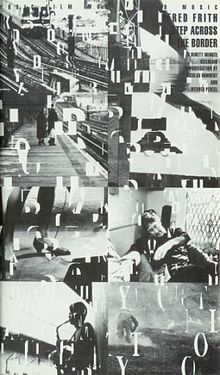
Saturday Matinee: Step Across the Border

220px-FredFrith_VHScover_StepAcrossTheBorder

Synopsis from CineNomad:

In “Step Across the Border” two forms of artistic expression, improvised music and cinema direct, are interrelated. In both forms it is the moment that counts, the intuitive sense for what is happening in a space. Music and film come into existence out of an intense perception of the moment, not from the transformation of a preordained plan. In improvisation the plan is revealed only at the end. One finds it. The other connection concerns the work method: the film team as band. Much as musicians communicate via the music, our work, too, was realized within a very small and flexible team of equals. What mattered was exchange. And movement. Sometimes we started filming in the middle of the night, responding to a new idea that had arisen only minutes before. We had a fundamental feeling for what we wanted to do, for what kind of film this should be. And we followed that feeling. It was all very instinctive…


Do you know a white rabbit who, playing trumpet, circles the world on his flying carpet?
May be you have met him somewhere already, in Zurich, London, Leipzig, Tokyo or New York. That at least was about the route we took and what resulted from it was the black-and-white wink of an eye at the symphonic connection between subways, storms and electric guitars.
An American critic wrote: ‘Fred Frith’s music makes your jaw drop, your feet dance, and your neighbours move.’
Also starring: several telephones, puddles, scarecrows, saxophones, orchestrated cities and motors.
A music film.

Legalizing Marijuana Now More Popular Than All Political Candidates

yes-we-cannabis-marijuana-poster

By John Vibes

Source: TheAntiMedia.org

It is no secret that Americans are losing faith in the US political system. With the potential of a choice between a Clinton and a Bush in 2016, it is likely that even more people will stop participating.

Now that there have been states where people have been allowed to vote for the legalization of marijuana, that topic has actually become more popular than the candidates themselves.

According to a Quinnipiac University poll conducted in March, in the key swing states of Ohio, Pennsylvania and Florida, marijuana is far more popular than all the major political candidates. The survey found that over 80% of people in all states supported medical marijuana, with over 50% also supporting full legalized recreational marijuana.

Meanwhile, all of the major political candidates have the approval of less than 50% of the people polled.

In some ways marijuana policy is the perfect issue for a presidential campaign. It has far reaching consequences that both parties have reason to engage,” John Hudak of the Brookings Institution told the Washington Post, in response to the poll.

Prohibition of any kind should be opposed for the reasons I have laid out in the past. However, marijuana is of specific immediate importance because of its ability to heal sick people and create environmentally friendly industrial products. It is also one of the safest drugs known to our species.

A recent Gallup poll found that major political parties in the United States are seeing their lowest popularity levels in recent memory.

Both the Democrats and the Republicans fall well below 50% in terms of approval, with 39% viewing the Democratic party favorable and 37% viewing the Republican party favorable.


John Vibes is an author, researcher and investigative journalist who takes a special interest in the counter culture and the drug war. In addition to his writing and activist work he organizes a number of large events including the Free Your Mind Conference, which features top caliber speakers and whistle-blowers from all over the world. You can contact him and stay connected to his work at his Facebook page. You can find his 65 chapter Book entitled “Alchemy of the Timeless Renaissance” at bookpatch.com.


How America Became an Oligarchy

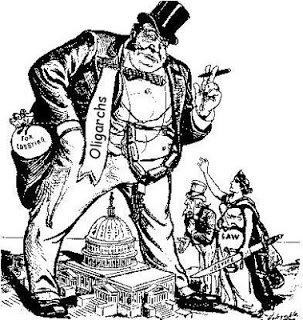
OLIGARCHY

By Ellen Brown

Source: Counterpunch

“The politicians are put there to give you the idea that you have freedom of choice. You don’t. . . . You have owners.”

— George Carlin, The American Dream

According to a new study from Princeton University, American democracy no longer exists. Using data from over 1,800 policy initiatives from 1981 to 2002, researchers Martin Gilens and Benjamin Page concluded that rich, well-connected individuals on the political scene now steer the direction of the country, regardless of – or even against – the will of the majority of voters. America’s political system has transformed from a democracy into an oligarchy, where power is wielded by wealthy elites.

“Making the world safe for democracy” was President Woodrow Wilson’s rationale for World War I, and it has been used to justify American military intervention ever since. Can we justify sending troops into other countries to spread a political system we cannot maintain at home?

The Magna Carta, considered the first Bill of Rights in the Western world, established the rights of nobles as against the king. But the doctrine that “all men are created equal” – that all people have “certain inalienable rights,” including “life, liberty and the pursuit of happiness” – is an American original. And those rights, supposedly insured by the Bill of Rights, have the right to vote at their core. We have the right to vote but the voters’ collective will no longer prevails.

In Greece, the left-wing populist Syriza Party came out of nowhere to take the presidential election by storm; and in Spain, the populist Podemos Party appears poised to do the same. But for over a century, no third-party candidate has had any chance of winning a US presidential election. We have a two-party winner-take-all system, in which our choice is between two candidates, both of whom necessarily cater to big money. It takes big money just to put on the mass media campaigns required to win an election involving 240 million people of voting age.

In state and local elections, third party candidates have sometimes won. In a modest-sized city, candidates can actually influence the vote by going door to door, passing out flyers and bumper stickers, giving local presentations, and getting on local radio and TV. But in a national election, those efforts are easily trumped by the mass media. And local governments too are beholden to big money.

When governments of any size need to borrow money, the megabanks in a position to supply it can generally dictate the terms. Even in Greece, where the populist Syriza Party managed to prevail in January, the anti-austerity platform of the new government is being throttled by the moneylenders who have the government in a chokehold.

How did we lose our democracy? Were the Founding Fathers remiss in leaving something out of the Constitution? Or have we simply gotten too big to be governed by majority vote?

Democracy’s Rise and Fall

The stages of the capture of democracy by big money are traced in a paper called “The Collapse of Democratic Nation States” by theologian and environmentalist Dr. John Cobb. Going back several centuries, he points to the rise of private banking, which usurped the power to create money from governments:

The influence of money was greatly enhanced by the emergence of private banking. The banks are able to create money and so to lend amounts far in excess of their actual wealth. This control of money-creation . . . has given banks overwhelming control over human affairs. In the United States, Wall Street makes most of the truly important decisions that are directly attributed to Washington.

Today the vast majority of the money supply in Western countries is created by private bankers. That tradition goes back to the 17th century, when the privately-owned Bank of England, the mother of all central banks, negotiated the right to print England’s money after Parliament stripped that power from the Crown. When King William needed money to fight a war, he had to borrow. The government as borrower then became servant of the lender.

In America, however, the colonists defied the Bank of England and issued their own paper scrip; and they thrived. When King George forbade that practice, the colonists rebelled.

They won the Revolution but lost the power to create their own money supply, when they opted for gold rather than paper money as their official means of exchange. Gold was in limited supply and was controlled by the bankers, who surreptitiously expanded the money supply by issuing multiple banknotes against a limited supply of gold.

This was the system euphemistically called “fractional reserve” banking, meaning only a fraction of the gold necessary to back the banks’ privately-issued notes was actually held in their vaults. These notes were lent at interest, putting citizens and the government in debt to bankers who created the notes with a printing press. It was something the government could have done itself debt-free, and the American colonies had done with great success until England went to war to stop them.

President Abraham Lincoln revived the colonists’ paper money system when he issued the Treasury notes called “Greenbacks” that helped the Union win the Civil War. But Lincoln was assassinated, and the Greenback issues were discontinued.

In every presidential election between 1872 and 1896, there was a third national party running on a platform of financial reform. Typically organized under the auspices of labor or farmer organizations, these were parties of the people rather than the banks. They included the Populist Party, the Greenback and Greenback Labor Parties, the Labor Reform Party, the Antimonopolist Party, and the Union Labor Party. They advocated expanding the national currency to meet the needs of trade, reform of the banking system, and democratic control of the financial system.

The Populist movement of the 1890s represented the last serious challenge to the bankers’ monopoly over the right to create the nation’s money. According to monetary historian Murray Rothbard, politics after the turn of the century became a struggle between two competing banking giants, the Morgans and the Rockefellers. The parties sometimes changed hands, but the puppeteers pulling the strings were always one of these two big-money players.

In All the Presidents’ Bankers, Nomi Prins names six banking giants and associated banking families that have dominated politics for over a century. No popular third party candidates have a real chance of prevailing, because they have to compete with two entrenched parties funded by these massively powerful Wall Street banks.

Democracy Succumbs to Globalization

In an earlier era, notes Dr. Cobb, wealthy landowners were able to control democracies by restricting government participation to the propertied class. When those restrictions were removed, big money controlled elections by other means:

First, running for office became expensive, so that those who seek office require wealthy sponsors to whom they are then beholden. Second, the great majority of voters have little independent knowledge of those for whom they vote or of the issues to be dealt with. Their judgments are, accordingly, dependent on what they learn from the mass media. These media, in turn, are controlled by moneyed interests.

Control of the media and financial leverage over elected officials then enabled those other curbs on democracy we know today, including high barriers to ballot placement for third parties and their elimination from presidential debates, vote suppression, registration restrictions, identification laws, voter roll purges, gerrymandering, computer voting, and secrecy in government.

The final blow to democracy, says Dr. Cobb, was “globalization” – an expanding global market that overrides national interests:

[T]oday’s global economy is fully transnational. The money power is not much interested in boundaries between states and generally works to reduce their influence on markets and investments. . . . Thus transnational corporations inherently work to undermine nation states, whether they are democratic or not.

The most glaring example today is the secret twelve-country trade agreement called the Trans-Pacific Partnership. If it goes through, the TPP will dramatically expand the power of multinational corporations to use closed-door tribunals to challenge and supersede domestic laws, including environmental, labor, health and other protections.

Looking at Alternatives

Some critics ask whether our system of making decisions by a mass popular vote easily manipulated by the paid-for media is the most effective way of governing on behalf of the people. In an interesting Ted Talk, political scientist Eric Li makes a compelling case for the system of “meritocracy” that has been quite successful in China.

In America Beyond Capitalism, Prof. Gar Alperovitz argues that the US is simply too big to operate as a democracy at the national level. Excluding Canada and Australia, which have large empty landmasses, the United States is larger geographically than all the other advanced industrial countries of the OECD (Organization for Economic Cooperation and Development) combined. He proposes what he calls “The Pluralist Commonwealth”: a system anchored in the reconstruction of communities and the democratization of wealth. It involves plural forms of cooperative and common ownership beginning with decentralization and moving to higher levels of regional and national coordination when necessary.

Dr. Alperovitz is co-founder of an initiative called The Next System Project, aimed at defining the issues in a national political debate as a first step to realizing the possible. He quotes Prof. Donald Livingston, who asked in 2002:

What value is there in continuing to prop up a union of this monstrous size? . . . [T]here are ample resources in the American federal tradition to justify states’ and local communities’ recalling, out of their own sovereignty, powers they have allowed the central government to usurp.

Taking Back Our Power

If governments are recalling their sovereign powers, they might start with the power to create money, which was usurped by private interests while the people were asleep at the wheel. State and local governments are not allowed to print their own currencies; but they can own banks, and all depository banks create money when they make loans, as the Bank of England recently acknowledged.

The federal government could take back the power to create the national money supply by issuing its own Treasury notes as Abraham Lincoln did. Alternatively, it could issue some very large denomination coins as authorized in the Constitution; or it could nationalize the central bank and use quantitative easing to fund infrastructure, education, job creation, and social services, responding to the needs of the people rather than the banks.

The freedom to vote carries little weight without economic freedom – the freedom to work and to have food, shelter, education, medical care and a decent retirement. President Franklin Roosevelt maintained that we need an Economic Bill of Rights. If our elected representatives were not beholden to the moneylenders, they might be able both to pass such a bill and to come up with the money to fund it.

Ellen Brown is an attorney, founder of the Public Banking Institute, and author of twelve books including the best-selling Web of Debt. Her latest book, The Public Bank Solution, explores successful public banking models historically and globally. Her 300+ blog articles are at EllenBrown.com. Listen to “It’s Our Money with Ellen Brown” on PRN.fm.


Garland Shooter Elton Simpson ‘Handled’ By Paid FBI Informant

indexSource: 21st Century Wire

In our story released late last night, we posed this question to our readers:

“Were these supposed ‘dead gunmen’ part of the drill, or were they patsies handled by a counter-terrorism federal ‘informant’?

We didn’t know it at the time, but it turns out that we were right.

Last night in the Dallas suburb of Garland, Texas, at Pam Geller’s “Muhammad Art Exhibit and Cartoon Contest”, two alleged “gunmen” were shot and killed by a Special Ops paramilitary ‘SWAT’ unit hired by the city of Garland to provide security for the controversial event.

It’s now been revealed that “gunman”, Elton Simpson, was already under surveillance by the FBI and was even the subject of a terror investigation. More importantly, we can also confirm Simpson was being handled by an FBI informant. Court papers filed in Arizona name the FBI undercover informant as Mr. Daba Deng, a Kenyan and who, from 2007, was paid $132,000 by the FBI to “become friends with Mr. Simpson”, and who appears to have groomed Simpson through a local mosque, and helped to develop Simpson’s ideas about “jihad”. Deng also helped to catch ‘Islamic convert’ Simpson on tape saying he wanted to travel to Somalia to join the terror orgaization al Shabaab. That recording was made on May 29, 2009, which shows Simpson telling his handler Deng, “It’s time to go to Somalia, brother… we gonna make it to the battlefield… it’s time to roll.” This recording was the basis for Simpson’s later FBI arrest, after which time he was ‘let off’ with 3 years probation.

The official misdirect device for this story can be found in a recent article from the Israeli-owned soft propaganda outlet, Vocativ, whose headline reads, “How Texas Terror Shooter Elton Simpson Avoided Prison In 2011″, which appears to be designed to pollute any inquiry by attempting to rationalize that Elton Simpson had avoided jail because a Judge was too lenient on this potential terrorist, furthering the popular talking point that somehow “the Feds dropped the ball.”

It is unknown exactly how far Deng had led Simpson in relation to yesterday’s attack, or if Simpson was assigned a new handler, but the revelation clearly demonstrates that not only have the FBI been aware of Simpson’s activities and movements for many years, but that the FBI has also had a hand in ‘managing’ Simpson. This fact should cast serious doubts on the official narrative being constructed about the Garland event being carried out by a bonafide and organic “home-gown jihadist” in America.

Authorities in Texas have identified the second “gunman” as Nadir Hamid Soofi (photo, above). It’s claimed that Soofi was Elton Simpson’s roommate and that they both shared an apartment in Phoenix, Arizona, and also attended the same mosque – the Islamic Center of North Phoenix. It is fairly certain that FBI informant Deng also knew and was interacting with Soofi as well.
We’re also meant to believe that just minutes before Simpson and Soofi launched their failed “terror attack”, they both posted Twitter messages and that ISIS Tweeters then joined-in to cheer them on, albeit, virtually.

SEE ALSO: Hebdo Redux in Garland, TX? ‘Mohammed Cartoon’ Shooting Reeks of a Staged False Flag

Not coincidentally, this is nearly the identical M.O. to the two dead ‘gunmen’ in the Charlie Hebdo shooting incident that took place in Paris earlier this year. 21WIRE reported back in January:

“At least one of the suspects was already “under surveillance” by French anti-terror authorities, and that his file was “shared with US security officials” as well. If this is indeed the case, then it’s highly improbable that the suspect would have staged his attack so easily. Once again, official admissions practically cancel out the official narrative.”

In addition to similarities to the Hebdo attack, it’s worth pointing out that in every high-profile US ‘terror bust’, the assailants had some connection beforehand to federal authorities. Only days after the media was beginning to close-out their round-the-clock Hebdo coverage, FBI agents concluded the frame-up of 20 year old Christopher Lee Cornell from Cincinnati, Ohio, claiming the youth was planning a “pipe bomb attack” against the nation’s Capitol in Washington DC, and that he was “linked to ISIS”, and that this was somehow an “ISIS-inspired attack”, only no attack actually took place.

The Guardian reported on the scale and scope of this trend in 2014:

“In some cases the FBI may have created terrorists out of law-abiding individuals by suggesting the idea of taking terrorist action or encouraging the target to act.”

The list of FBI-related ‘terrorist’ incidents inside the US is a long one. The formula for creating a ‘terror icon’ required a confidential informant to guide and manage the future “suspect” right up to the point of arrest, or in some cases, like the World Trade Center Bombing in 1993, the FBI have even allowed the terrorist incident to take place.

Other high-profile terror icons with informant and patsy stories include the other ‘Paris Shooter’, Amedi Coulibaby (see his compelling patsy-informant case here), ‘Ottawa Shooter’ Zehaf-Bibeau (see his patsy story here), ‘Boston Bomber’ Tamerlan Tsarnaev (see his FBI recruitment story here), ‘The Underwear Bomber’ Umar Farouk Abdulmutallab (see his patsy story here), Buford Rogers (read his patsy-informant story here), Jerad Miller (read his patsy-informant story here), Naji Mansour (read his informant story here), Quazi Mohammad Nafis (read his informant story here), Mohamed Osman Mohamud (read his informant story here), ‘OKC Bomber’ Timothy McVeigh (read his informant story here).

In addition to these examples, we could also include last month’s ‘Queens of Brooklyn’ terror plot, Washington Metro bomb plot, the New York City subway bomb plot, as well as the Sears Tower bomb plot in Chicago, and last but certainly not least – the attacks of 9/11… where the alleged hijackers lived with an FBI informant.

Just a few reasons to question the official narrative in Garland, Texas.

The Public Execution of Mumia Abu-Jamal?

By Linn Washington Jr.

Source: This Can’t Be Happening

In August 1936 nearly 20,000 people filled a vacant lot next to a municipal building in a small Kentucky town to watch the hanging of a man convicted of rape. This hanging, conducted by two executioners retained by that town, would be the last official ‘public execution’ in America.

Although states across this country have banned executions where the public can freely attend, some contend that the American public is again witnessing the spectacle of a public execution – more precisely: the spectacle of a killing occurring in plain sight administered by governmental authorities.

This current spectacle of governmental killing involves a high-profile inmate in Pennsylvania that evidence indicates is quite possibly experiencing a ‘slow execution’ through calculated medical mistreatment.

Author/activist Mumia Abu-Jamal, perhaps the most widely known prison inmate in America, is gravely ill, hardly able to walk or talk because of severe complications related largely to the diabetes which medical personnel inside a Pennsylvania prison failed to diagnose for months. Prison medical personnel either did not detect the diabetes earlier this year while giving Abu-Jamal numerous blood tests that easily identify the elevated blood sugar levels of diabetes or did not inform Abu-Jamal of the blood test results.

That failure to find his raging diabetes led to Abu-Jamal’s emergency hospitalization at the end of March, after he collapsed, unconscious and in sugar shock. When authorities finally transported Abu-Jamal from the SCI Mahanoy prison to the hospital, he was on the verge of a potentially fatal diabetic coma. Weeks before that emergency hospitalization, Abu-Jamal’s blood pressure spiked to a level that required hospitalization that he did not receive, stated persons working with Abu-Jamal.

Despite Abu-Jamal’s obvious painful and deteriorating medical condition, Pennsylvania prison authorities have barred Abu-Jamal from receiving access to or consultation from medical experts assembled by his supporters.

Those experts could provide the quality of care unavailable at either the demonstrably incompetent infirmary inside SCI Mahanoy or that non-prison hospital authorities utilized. (Abu-Jamal has had adverse reactions to medications he has received from the Mahanoy prison infirmary, his supporters said.)

The refusal of Pennsylvania prison authorities to properly treat Abu-Jamal or permit him access to non-prison medical personnel who could effectively treat his conditions fuel understandable fears among Abu-Jamal’s far-flung supporters that anti-Abu-Jamal forces are trying to effectuate the death sentence that once hung over Abu-Jamal.

The ‘fear’ that foul play could be apart of Abu-Jamal’s poor medical care arises from the fact that police, politicians and others had vigorously campaigned for Abu-Jamal’s execution for 28-years. Abu-Jamal received a death sentence following his controversial 1982 conviction for killing a Philadelphia policeman. That campaign for execution included many forms of harassment. The extraordinary punishments from that campaign provide proof for many that Abu-Jamal is a political prisoner.

“They are outright killing him in front of us,” Pam Africa said. Africa, a close associate of Abu-Jamal and head of International Concerned Friends and Family of Mumia Abu-Jamal, visits him regularly.
(Abu-Jamal’s death sentence was converted to life in prison after federal courts repeatedly upheld the dismissal of the death sentence citing constitutional violations.)

“He is in pain. His skin is so bad from that rash that he looks like a burn victim,” Africa said. “The is F*%king horrible …”

When prison authorities returned Abu-Jamal to SCI Mahanoy from that hospital, following a few days care in the ICU, he was still seriously ill.

Yet, prison authorities ordered him returned to his prison cell after a brief stay in the Mahanoy infirmary following his return from the ICU. Authorities returned him to his cell despite his visibly weakened condition, dramatic 70-lb.weight loss, labored breathing, swelling of his body parts and open sores on his skin from a festering rash.

Prison authorities certainly knew that Abu-Jamal’s weakened condition would make it difficult for him to walk back to the infirmary for help since the distance from his cell to the infirmary is the distance of about three-city-blocks. Certainly authorities knew the difficulties facing Abu-Jamal even in obtaining meals from the dining hall, a nearly two-block distance from his cell.

Prison Radio, the San Francisco-based media entity that has broadcast Abu-Jamal’s prison commentaries for decades, recently issued an update on his medical condition utilizing information provided by Abu-Jamal’s wife, Wadiya following her latest visit.

According to that report Abu-Jamal “is extremely swollen in his neck, chest, legs and his skin is worse than ever, with open sores. He was not in a wheelchair, but can only take baby steps. He is very weak. He was nodding off during the visit. He was not able to eat – he was fed with a spoon. These are symptoms that could be associated with hyper glucose levels, diabetic shock, diabetic coma, and with kidney stress and failure.”

Prison Radio, a few days before that updated report on Abu-Jamal’s condition, had released information that Pennsylvania prison authorities were refusing proposals to address Abu-Jamal’s worsening medical condition.

Prison Radio revealed that prison authorities had notified Bret Grote, a lawyer for Abu-Jamal, that they would not allow Abu-Jamal to be examined by his own doctor, and would not allow his doctor to speak with prison medical staff to assist or direct Abu-Jamal’s care. Prison officials are also refusing to allow regular phone calls between Abu-Jamal and his doctor and they said they would not allow Abu-Jamal to be examined by an endocrinologist (a diabetes specialist).

Proposals for Abu-Jamal receiving medical care from personnel outside the prison system are not out of line. Authorities allowed millionaire John DuPont to have his medical issues treated by his own private physician at his expense while he served a life sentence for murder before dying in a Pennsylvania prison. Authorities denying Abu-Jamal allowances that authorities have extended to other inmates is a part of the pattern of punishments that target Abu-Jamal.

Charges that prison authorities are deliberating mistreating Abu-Jamal are routinely dismissed as hyperbole by authorities despite abundant examples of mistreatment directed at Abu-Jamal and other inmates.

For example, in 2010 an inmate serving a life sentence like Abu-Jamal filed a lawsuit against Pennsylvania prison authorities challenging their refusal to provide him with medical treatment for acute kidney stones despite a previous court settlement where authorities had agreed to provide that inmate with his needed treatment.

That inmate, Walter Chruby, secured an injunction from a trial court judge ordering immediate treatment. Chruby’s lawsuit, according to a court ruling on that injunction, stated that immediately after Chruby won that first court order for treatment, prison authorities “began withholding or intentionally delaying adequate medical care…”

The medical mistreatment of Mumia Abu-Jamal comes at a time when callous law enforcement, particularly brutality and fatal shootings by police, is in the national spotlight. Abu-Jamal, in his books and commentaries produced in prison, has been a strident critic of inequities in the criminal justice system. The medical mistreatment of Abu-Jamal is rife with callousness and inhumanity.
Call and write these people and demand that Abu-Jamal be provided with appropriate medical care for this eminently treatable disease!:

Gov. Tom Wolf, PA Governor: 717-787-2500 • governor@PA.gov 508 Main Capitol Building, Harrisburg PA 17120

John Wetzel Secretary of the Deparment of Corrections ra-crpadocsecretary@pa.gov 717-728-4109 • 717-728-4178 Fax 1920 Technology Pkwy, Mechanicsburg PA 17050

John Kerestes, Superintendent SCI Mahanoy: 570-773-2158 x8102 570-783-2008 Fax 301 Morea Road, Frackville PA 17932

Susan McNaughton, Public Information Office PA DOC DOC Press secretary: 717-728-4025 PA DOC smcnaughton@pa.gov
Public Information Officer, SCI Mahanoy

Jane Hinman 570-773-2158; then dial zero SCI Mahanoy: 570-773-2158 x8102 • 570-783-2008 Fax 301 Morea Road, Frackville PA 17932

The Trans-Pacific Partnership and the Death of the Republic

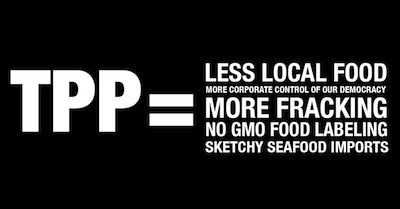
TPPequals

By Ellen Brown

Source: Washington’s Blog

The United States shall guarantee to every State in this Union a Republican Form of Government.    — Article IV, Section 4, US Constitution

A republican form of government is one in which power resides in elected officials representing the citizens, and government leaders exercise power according to the rule of law. In The Federalist Papers, James Madison defined a republic as “a government which derives all its powers directly or indirectly from the great body of the people . . . .”

On April 22, 2015, the Senate Finance Committee approved a bill to fast-track the Trans-Pacific Partnership (TPP), a massive trade agreement that would override our republican form of government and hand judicial and legislative authority to a foreign three-person panel of corporate lawyers.

The secretive TPP is an agreement with Mexico, Canada, Japan, Singapore and seven other countries that affects 40% of global markets. Fast-track authority could now go to the full Senate for a vote as early as next week. Fast-track means Congress will be prohibited from amending the trade deal, which will be put to a simple up or down majority vote. Negotiating the TPP in secret and fast-tracking it through Congress is considered necessary to secure its passage, since if the public had time to review its onerous provisions, opposition would mount and defeat it.

Abdicating the Judicial Function to Corporate Lawyers

James Madison wrote in The Federalist Papers:

The accumulation of all powers, legislative, executive, and judiciary, in the same hands, . . . may justly be pronounced the very definition of tyranny. . . . “Were the power of judging joined with the legislative, the life and liberty of the subject would be exposed to arbitrary control, for the judge would then be the legislator. . . .”

And that, from what we now know of the TPP’s secret provisions, will be its dire effect.

The most controversial provision of the TPP is the Investor-State Dispute Settlement (ISDS) section, which strengthens existing ISDS  procedures. ISDS first appeared in a bilateral trade agreement in 1959. According to The Economist, ISDS gives foreign firms a special right to apply to a secretive tribunal of highly paid corporate lawyers for compensation whenever the government passes a law to do things that hurt corporate profits — such things as discouraging smoking, protecting the environment or preventing a nuclear catastrophe.

Arbitrators are paid $600-700 an hour, giving them little incentive to dismiss cases; and the secretive nature of the arbitration process and the lack of any requirement to consider precedent gives wide scope for creative judgments.

To date, the highest ISDS award has been for $2.3 billion to Occidental Oil Company against the government of Ecuador over its termination of an oil-concession contract, this although the termination was apparently legal. Still in arbitration is a demand by Vattenfall, a Swedish utility that operates two nuclear plants in Germany, for compensation of €3.7 billion ($4.7 billion) under the ISDS clause of a treaty on energy investments, after the German government decided to shut down its nuclear power industry following the Fukushima disaster in Japan in 2011.

Under the TPP, however, even larger judgments can be anticipated, since the sort of “investment” it protects includes not just “the commitment of capital or other resources” but “the expectation of gain or profit.” That means the rights of corporations in other countries extend not just to their factories and other “capital” but to the profits they expect to receive there.

In an article posted by Yves Smith, Joe Firestone poses some interesting hypotheticals:

Under the TPP, could the US government be sued and be held liable if it decided to stop issuing Treasury debt and financed deficit spending in some other way (perhaps by quantitative easing or by issuing trillion dollar coins)? Why not, since some private companies would lose profits as a result?

Under the TPP or the TTIP (the Transatlantic Trade and Investment Partnership under negotiation with the European Union), would the Federal Reserve be sued if it failed to bail out banks that were too big to fail?

Firestone notes that under the Netherlands-Czech trade agreement, the Czech Republic was sued in an investor-state dispute for failing to bail out an insolvent bank in which the complainant had an interest. The investor company was awarded $236 million in the dispute settlement. What might the damages be, asks Firestone, if the Fed decided to let the Bank of America fail, and a Saudi-based investment company decided to sue?

Abdicating the Legislative Function to Multinational Corporations

Just the threat of this sort of massive damage award could be enough to block prospective legislation. But the TPP goes further and takes on the legislative function directly, by forbidding specific forms of regulation.

Public Citizen observes that the TPP would provide big banks with a backdoor means of watering down efforts to re-regulate Wall Street, after deregulation triggered the worst financial crisis since the Great Depression:

The TPP would forbid countries from banning particularly risky financial products, such as the toxic derivatives that led to the $183 billion government bailout of AIG. It would prohibit policies to prevent banks from becoming “too big to fail,” and threaten the use of “firewalls” to prevent banks that keep our savings accounts from taking hedge-fund-style bets.

The TPP would also restrict capital controls, an essential policy tool to counter destabilizing flows of speculative money. . . . And the deal would prohibit taxes on Wall Street speculation, such as the proposed Robin Hood Tax that would generate billions of dollars’ worth of revenue for social, health, or environmental causes.

Clauses on dispute settlement in earlier free trade agreements have been invoked to challenge efforts to regulate big business. The fossil fuel industry is seeking to overturn Quebec’s ban on the ecologically destructive practice of fracking. Veolia, the French behemoth known for building a tram network to serve Israeli settlements in occupied East Jerusalem, is contesting increases in Egypt’s minimum wage. The tobacco maker Philip Morris is suing against anti-smoking initiatives in Uruguay and Australia.

The TPP would empower not just foreign manufacturers but foreign financial firms to attack financial policies in foreign tribunals, demanding taxpayer compensation for regulations that they claim frustrate their expectations and inhibit their profits.

Preempting Government Sovereignty

What is the justification for this encroachment on the sovereign rights of government? Allegedly, ISDS is necessary in order to increase foreign investment. But as noted in The Economist, investors can protect themselves by purchasing political-risk insurance. Moreover, Brazil continues to receive sizable foreign investment despite its long-standing refusal to sign any treaty with an ISDS mechanism. Other countries are beginning to follow Brazil’s lead.

In an April 22nd report from the Center for Economic and Policy Research, gains from multilateral trade liberalization were shown to be very small, equal to only about 0.014% of consumption, or about $.43 per person per month. And that assumes that any benefits are distributed uniformly across the economic spectrum. In fact, transnational corporations get the bulk of the benefits, at the expense of most of the world’s population.

Something else besides attracting investment money and encouraging foreign trade seems to be going on. The TPP would destroy our republican form of government under the rule of law, by elevating the rights of investors – also called the rights of “capital” – above the rights of the citizens.

That means that TPP is blatantly unconstitutional. But as Joe Firestone observes, neo-liberalism and corporate contributions seem to have blinded the deal’s proponents so much that they cannot see they are selling out the sovereignty of the United States to foreign and multinational corporations.

For more information and to get involved, visit:

Flush the TPP

The Citizens Trade Campaign

Public Citizen’s Global Trade Watch

Eyes on Trade

__________________

Ellen Brown is an attorney, founder of the Public Banking Institute, and author of twelve books including the best-selling Web of Debt. Her latest book, The Public Bank Solution, explores successful public banking models historically and globally. Her 300+ blog articles are at EllenBrown.com.