P Is for Predator State: The Building Blocks of Tyranny from A to Z

By John W. Whitehead

Source: The Rutherford Institute

“When a population becomes distracted by trivia, when cultural life is redefined as a perpetual round of entertainments, when serious public conversation becomes a form of baby-talk, when, in short, a people become an audience and their public business a vaudeville act, then a nation finds itself at risk; a culture-death is a clear possibility.” — Professor Neil Postman, Amusing Ourselves to Death: Discourse in the Age of Show Business

While America continues to fixate on the drama-filled reality show scripted by the powers-that-be, directed from the nation’s capital, and played out in high definition across the country, the American Police State has moved steadily forward.

Nothing has changed.

The COVID-19 pandemic has been a convenient, traumatic, devastating distraction.

The American people, the permanent underclass in America, have allowed themselves to be so distracted and divided that they have failed to notice the building blocks of tyranny being laid down right under their noses by the architects of the Deep State.

Trump, Obama, Bush, Clinton: they have all been complicit in carrying out the Deep State’s agenda. Unless something changes to restore the balance of power, the next president—the new boss—will be the same as the old boss.

Frankly, it really doesn’t matter what you call the old/new boss—the Deep State, the Controllers, the masterminds, the shadow government, the corporate elite, the police state, the surveillance state, the military industrial complex—so long as you understand that no matter who occupies the White House, it is a profit-driven, an unelected bureaucracy that is actually calling the shots.

If our losses are mounting with every passing day—and they are—it is a calculated siege intended to ensure our defeat at the hands of a totalitarian regime.

Free speech, the right to protest, the right to challenge government wrongdoing, due process, a presumption of innocence, the right to self-defense, accountability and transparency in government, privacy, media, sovereignty, assembly, bodily integrity, representative government: all of these and more are casualties in the government’s war on the American people.

Set against a backdrop of government surveillance, militarized federal police, SWAT team raids, asset forfeiture, overcriminalization, armed surveillance drones, whole body scanners, stop and frisk searches, and the like—all of which have been sanctioned by Congress, the White House and the courts—our constitutional freedoms are being steadily chipped away at, undermined, eroded, whittled down, and generally discarded.

As a result, the American people have been treated like enemy combatants, to be spied on, tracked, scanned, frisked, searched, subjected to all manner of intrusions, intimidated, invaded, raided, manhandled, censored, silenced, shot at, locked up, and denied due process.

None of these dangers have dissipated in any way.

They have merely disappeared from our televised news streams.

It’s time to get educated on what’s really going on. Thus, in the interest of liberty and truth, here’s an A-to-Z primer that spells out the grim realities of life in the American Police State that no one seems to be talking about anymore.

A is for the AMERICAN POLICE STATE. A police state “is characterized by bureaucracy, secrecy, perpetual wars, a nation of suspects, militarization, surveillance, widespread police presence, and a citizenry with little recourse against police actions.”

B is for our battered BILL OF RIGHTS. In the militarized police culture that is America today, where you can be kicked, punched, tasered, shot, intimidated, harassed, stripped, searched, brutalized, terrorized, wrongfully arrested, and even killed by a police officer, and that officer is rarely held accountable for violating your rights, the Bill of Rights doesn’t amount to much.

C is for CIVIL ASSET FORFEITURE. This governmental scheme to deprive Americans of their liberties—namely, the right to property—is being carried out under the guise of civil asset forfeiture, a government practice wherein government agents (usually the police and now TSA agents) seize private property they “suspect” may be connected to criminal activity. Then, whether or not any crime is actually proven to have taken place, the government keeps the citizen’s property and it’s virtually impossible to get it back.

D is for DRONES. It was estimated that at least 30,000 drones would be airborne in American airspace by 2020, part of an $80 billion industry. Although some drones will be used for benevolent purposes, many will also be equipped with lasers, tasers and scanning devices, among other weapons—all aimed at “we the people.”

E is for EMERGENCY STATE. From 9/11 to COVID-19, we have been the subjected to an “emergency state” that justifies all manner of government tyranny and power grabs in the so-called name of national security. The government’s ongoing attempts to declare so-called national emergencies in order to circumvent the Constitution’s system of checks and balances constitutes yet another expansion of presidential power that exposes the nation to further constitutional peril.

F is for FASCISM. A study conducted by Princeton and Northwestern University concluded that the U.S. government does not represent the majority of American citizens. Instead, the study found that the government is ruled by the rich and powerful, or the so-called “economic elite.” Moreover, the researchers concluded that policies enacted by this governmental elite nearly always favor special interests and lobbying groups. In other words, we are being ruled by an oligarchy disguised as a democracy, and arguably on our way towards fascism—a form of government where private corporate interests rule, money calls the shots, and the people are seen as mere economic units or databits.

G is for GRENADE LAUNCHERS and GLOBAL POLICE. The federal government has distributed more than $18 billion worth of battlefield-appropriate military weapons, vehicles and equipment such as drones, tanks, and grenade launchers to domestic police departments across the country. As a result, most small-town police forces now have enough firepower to render any citizen resistance futile. Now take those small-town police forces, train them to look and act like the military, and then enlist them to be part of the United Nations’ Strong Cities Network program, and you not only have a standing army that operates beyond the reach of the Constitution but one that is part of a global police force.

H is for HOLLOW-POINT BULLETS. The government’s efforts to militarize and weaponize its agencies and employees is reaching epic proportions, with federal agencies as varied as the Department of Homeland Security and the Social Security Administration stockpiling millions of lethal hollow-point bullets, which violate international law. Ironically, while the government continues to push for stricter gun laws for the general populace, the U.S. military’s arsenal of weapons makes the average American’s handgun look like a Tinker Toy.

I is for the INTERNET OF THINGS, in which internet-connected “things” monitor your home, your health and your habits in order to keep your pantry stocked, your utilities regulated and your life under control and relatively worry-free. The key word here, however, is control. This “connected” industry propels us closer to a future where police agencies apprehend virtually anyone if the government “thinks” they may commit a crime, driverless cars populate the highways, and a person’s biometrics are constantly scanned and used to track their movements, target them for advertising, and keep them under perpetual surveillance.

J is for JAILING FOR PROFIT. Having outsourced their inmate population to private prisons run by private corporations, this profit-driven form of mass punishment has given rise to a $70 billion private prison industry that relies on the complicity of state governments to keep their privately run prisons full by jailing large numbers of Americans for petty crimes.

K is for KENTUCKY V. KING. In an 8-1 ruling, the Supreme Court ruled that police officers can break into homes, without a warrant, even if it’s the wrong home as long as they think they may have a reason to do so. Despite the fact that the police in question ended up pursuing the wrong suspect, invaded the wrong apartment and violated just about every tenet that stands between the citizenry and a police state, the Court sanctioned the warrantless raid, leaving Americans with little real protection in the face of all manner of abuses by law enforcement officials.

L is for LICENSE PLATE READERS, which enable law enforcement and private agencies to track the whereabouts of vehicles, and their occupants, all across the country. This data collected on tens of thousands of innocent people is also being shared between police agencies, as well as with government fusion centers and private companies. This puts Big Brother in the driver’s seat.

M is for MAIN CORE. Since the 1980s, the U.S. government has acquired and maintained, without warrant or court order, a database of names and information on Americans considered to be threats to the nation. As Salon reports, this database, reportedly dubbed “Main Core,” is to be used by the Army and FEMA in times of national emergency or under martial law to locate and round up Americans seen as threats to national security. There are at least 8 million Americans in the Main Core database.

N is for NO-KNOCK RAIDS. Owing to the militarization of the nation’s police forces, SWAT teams are now increasingly being deployed for routine police matters. In fact, more than 80,000 of these paramilitary raids are carried out every year. That translates to more than 200 SWAT team raids every day in which police crash through doors, damage private property, terrorize adults and children alike, kill family pets, assault or shoot anyone that is perceived as threatening—and all in the pursuit of someone merely suspected of a crime, usually possession of some small amount of drugs.

O is for OVERCRIMINALIZATION and OVERREGULATION. Thanks to an overabundance of 4500-plus federal crimes and 400,000 plus rules and regulations, it’s estimated that the average American actually commits three felonies a day without knowing it. As a result of this overcriminalization, we’re seeing an uptick in Americans being arrested and jailed for such absurd “violations” as letting their kids play at a park unsupervised, collecting rainwater and snow runoff on their own property, growing vegetables in their yard, and holding Bible studies in their living room.

P is for PATHOCRACY and PRECRIME. When our own government treats us as things to be manipulated, maneuvered, mined for data, manhandled by police and other government agents, mistreated, and then jailed in profit-driven private prisons if we dare step out of line, we are no longer operating under a constitutional republic. Instead, what we are experiencing is a pathocracy: tyranny at the hands of a psychopathic government, which “operates against the interests of its own people except for favoring certain groups.” Couple that with the government’s burgeoning precrime programs, which will use fusion centers, data collection agencies, behavioral scientists, corporations, social media, and community organizers and by relying on cutting-edge technology for surveillance, facial recognition, predictive policing, biometrics, and behavioral epigenetics in order to identify and deter so-called potential “extremists,” dissidents or rabble-rousers. Bear in mind that anyone seen as opposing the government—whether they’re Left, Right or somewhere in between—is now viewed as an extremist.

Q is for QUALIFIED IMMUNITY. Qualified immunity allows police officers to walk away without paying a dime for their wrongdoing. Conveniently, those deciding whether a cop should be immune from having to personally pay for misbehavior on the job all belong to the same system, all cronies with a vested interest in protecting the police and their infamous code of silence: city and county attorneys, police commissioners, city councils and judges.

R is for ROADSIDE STRIP SEARCHES and BLOOD DRAWS. The courts have increasingly erred on the side of giving government officials—especially the police—vast discretion in carrying out strip searches, blood draws and even anal and vaginal probes for a broad range of violations, no matter how minor the offense. In the past, strip searches were resorted to only in exceptional circumstances where police were confident that a serious crime was in progress. In recent years, however, strip searches have become routine operating procedures in which everyone is rendered a suspect and, as such, is subjected to treatment once reserved for only the most serious of criminals.

S is for the SURVEILLANCE STATE. On any given day, the average American going about his daily business will be monitored, surveilled, spied on and tracked in more than 20 different ways, by both government and corporate eyes and ears. A byproduct of the electronic concentration camp in which we live, whether you’re walking through a store, driving your car, checking email, or talking to friends and family on the phone, you can be sure that some government agency, whether the NSA or some other entity, is listening in and tracking your behavior. This doesn’t even begin to touch on the corporate trackers that monitor your purchases, web browsing, Facebook posts and other activities taking place in the cyber sphere.

T is for TASERS. Nonlethal weapons such as tasers, stun guns, rubber pellets and the like have been used by police as weapons of compliance more often and with less restraint—even against women and children—and in some instances, even causing death. These “nonlethal” weapons also enable police to aggress with the push of a button, making the potential for overblown confrontations over minor incidents that much more likely. A Taser Shockwave, for instance, can electrocute a crowd of people at the touch of a button

U is for UNARMED CITIZENS SHOT BY POLICE. No longer is it unusual to hear about incidents in which police shoot unarmed individuals first and ask questions later, often attributed to a fear for their safety. Yet the fatality rate of on-duty patrol officers is reportedly far lower than many other professions, including construction, logging, fishing, truck driving, and even trash collection.

V is for VIRUSES AND FORCED VACCINATIONS. What started out as an apparent effort to prevent a novel coronavirus from sickening the nation (and the world) has become yet another means by which world governments (including the U.S.) can expand their powers, abuse their authority, and further oppress their constituents. With millions of dollars in stimulus funds being directed towards policing agencies across the country, the federal government plans to fight this COVID-19 virus with riot gear, gas masks, ballistic helmets, drones, and hi-tech surveillance technology. The road we are traveling is paved with lockdowns, SWAT team raids, mass surveillance and forced vaccinations. Now there’s talk of mobilizing the military to deliver forced vaccinations, mass surveillance in order to carry out contact tracing, and heavy fines and jail time for those who dare to venture out without a mask, congregate in worship without the government’s blessing, or re-open their  businesses without the government’s say-so.

W is for WHOLE-BODY SCANNERS. Using either x-ray radiation or radio waves, scanning devices and government mobile units are being used not only to “see” through your clothes but to spy on you within the privacy of your home. While these mobile scanners are being sold to the American public as necessary security and safety measures, we can ill afford to forget that such systems are rife with the potential for abuse, not only by government bureaucrats but by the technicians employed to operate them.

X is for X-KEYSCORE, one of the many spying programs carried out by the National Security Agency that targets every person in the United States who uses a computer or phone. This top-secret program “allows analysts to search with no prior authorization through vast databases containing emails, online chats and the browsing histories of millions of individuals.”

Y is for YOU-NESS. Using your face, mannerisms, social media and “you-ness” against you, you are now be tracked based on what you buy, where you go, what you do in public, and how you do what you do. Facial recognition software promises to create a society in which every individual who steps out into public is tracked and recorded as they go about their daily business. The goal is for government agents to be able to scan a crowd of people and instantaneously identify all of the individuals present. Facial recognition programs are being rolled out in states all across the country.

Z is for ZERO TOLERANCE. We have moved into a new paradigm in which young people are increasingly viewed as suspects and treated as criminals by school officials and law enforcement alike, often for engaging in little more than childish behavior or for saying the “wrong” word. In some jurisdictions, students have also been penalized under school zero tolerance policies for such inane “crimes” as carrying cough drops, wearing black lipstick, bringing nail clippers to school, using Listerine or Scope, and carrying fold-out combs that resemble switchblades. The lesson being taught to our youngest—and most impressionable—citizens is this: in the American police state, you’re either a prisoner (shackled, controlled, monitored, ordered about, limited in what you can do and say, your life not your own) or a prison bureaucrat (politician, police officer, judge, jailer, spy, profiteer, etc.).

As I make clear in my book Battlefield America: The War on the American People, the reality we must come to terms with is that in the post-9/11 America we live in today, the government does whatever it wants, freedom be damned.

We have moved beyond the era of representative government and entered a new age.

You can call it the age of authoritarianism. Or fascism. Or oligarchy. Or the American police state.

Whatever label you want to put on it, the end result is the same: tyranny.

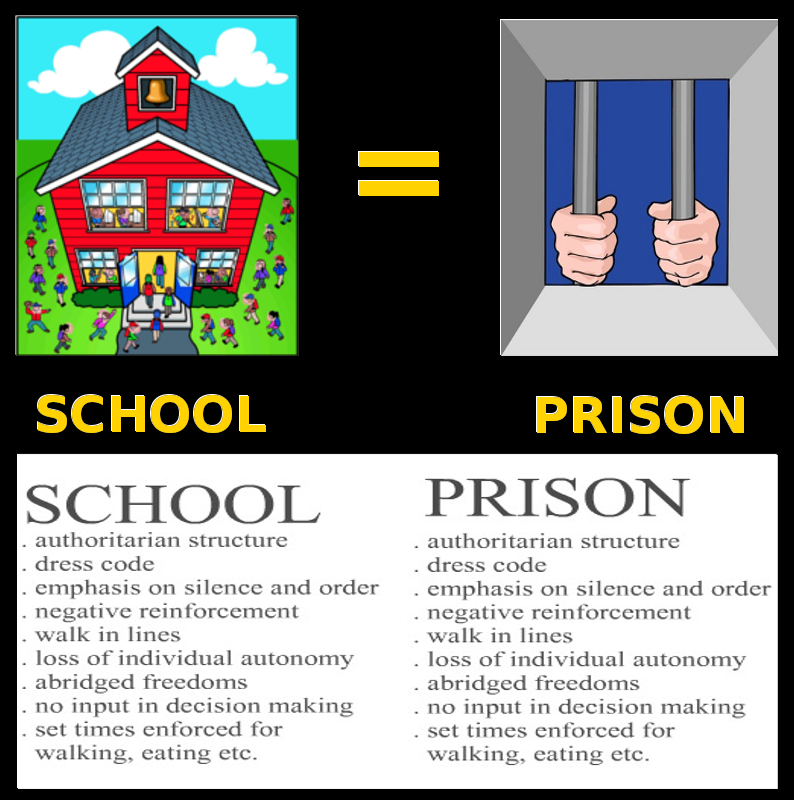
Public School or Prison? Here Are 10 Ways It’s Hard To Tell

sprongg-700x466

By Alice Jones Webb

Source: The Mind Unleashed

Every weekday morning, from September through June, parents across the country get up earlier than they want to, rush like crazy, wrangle kids into appropriate clothing, and wait in exhausting drop-off lines to get their children to school on time. Why? Because punctuality is a virtue? Or because they are afraid of getting in trouble?

In big cities and small communities, the same routine is repeated with minor variations. Small children and near adult adolescents will spend the majority of their waking hours somewhere they would rather not be. But few people question the set-up. Parents send their kids to school with the best of intentions, wanting to produce happy, healthy, productive adults. Public school is supposed to be for their own good. Very few question its necessity and virtue. No one questions the fact that our country’s public schools are looking less and less like places of learning and more and more like places of detention (and I don’t mean The Breakfast Club type either).

When you stop and think about it (which few people actually do), our public schools have more in common with our prison system than any parent would care to admit. Most of us are products of the system and will defend its honor and integrity like sufferers of severe Stockholm Syndrome. So let me break it down into a list of glaring similarities that even those of us who went to public school can easily understand.

1. Both School and Prison Take Away Freedom. To get into prison, a person has to be convicted of a crime (although all of us know that prisons are full of people convicted of pretty bogus crimes… just stick with me). Children in school are only guilty of the crime of being children. Since school attendance is compulsory, children, much like criminal prisoners, don’t get to choose whether they get locked up for seven or more hours a day. They are forced to go to school by strict truancy laws until they are at least 16, at which point their youth has already been squandered inside constrictive cinder block walls.

2. Both School and Prison use Security as a Means of Control. Prisons and public schools both use metal detectors, surveillance cameras, police patrols, drug-sniffing dogs, and lock downs to create a facade of greater security. In most elementary schools, there is an emphasis on moving students from location to location in a rigidly ordered manner. The straight line of silent children walking with hands behind their backs look frighteningly like lines of prisoners. The strict codes of conduct used in the majority of schools, as well as the consistent use of handcuffs and pepper spray on unruly high school students, work together to condition young people to the cultural normalcy of over-policing.

Stay in line. Do as you’re told. Don’t make trouble. These are the messages we send to both our prisoners and our school children. But it’s okay. It’s for their own good.

3. Both Schools and Prisons Serve Undesirable Food. The cafeterias in public schools are scarily similar to prison cafeterias, often even sharing the same menus. Unappetizing, bland, processed meals with little nutritional value are the norm in both institutions. And bringing a lunch from home is banned in many school districts. Add in the armed security guards that patrol most public school lunch rooms and a casual observer might not be able to tell the difference.

4. Both Schools and Prisons Enforce Strict Dress Codes. Like prisons, some schools obligate their students to wear uniforms, limiting self-expression, and encouraging a herd mentality that makes control easier (for safety’s sake, of course). But even in schools without required uniforms, strict dress codes are generally in place. Failure to tuck in a shirt tail can land a student in detention. Donning a blouse that doesn’t adequately cover a girl’s shoulders could get her sent home. Sometimes the dress code guidelines are so arbitrary and so strictly detailed, it seems like they are in place just to get students in trouble. In 2008, Gonzales High School in Texas made the national news for requiring dress code violators to wear actual prison jumpsuits. It’s like officials want the students to seem like criminals. Perhaps it makes the policing of students at their own hands seem more justified.

5. Both Students and Prisoners are Tracked. Many prisons use electronic bracelets or other tracking devices to keep track of prisoners’ locations. Many schools are doing the same thing. ID badges with built-in RFID chips can track the location of a child wherever they are wearing it, and many schools require ID badges to be worn during school hours. Some schools have even started using fingerprints and iris scanners to keep track of their prisoners… I mean students.

6. Both Schools and Prisons Have Armed Guards. Often referred to as SROs (school resource officers), most school buildings are patrolled by armed police officers. They are generally uniformed and carry pepper spray, tasers, and batons that they can use on students should the need arise. These officers police hallways and lunchrooms, administer searches of children’s lockers and school bags, and man the TSA-style checkpoints at the entrances to the buildings our children enter to learn.

7. Both Schools And Prisons do not Allow Anger. Although anger is a justifiable emotion toward constrictive and oppressive political structures, neither students nor prisoners have the power to express their emotions. In prison, angry convicts are locked away in solitary confinement, their movements and small remaining freedoms restricted for safety’s sake. In public school, anger is interpreted as a failing of the individual rather than the system that creates it. There, anger is seen as “disruptive behavior” or “cognitive impairment” or a “social or learning disability”. Often the angry student is marginalized by placement in special education classes, enrolled in “alternative schools”, or medicated to control their disruptions, all of which are just differing forms of confinement.

8. Both Students and Prisoners are Forced to Work. The scene of the prison chain gang in striped clothing, hacking away at rocks and debris is one that most people have seen in old films. Today’s prisoner work force looks a little different, with prisoners wearing orange jumpsuits and doing highway clean-up minus the bulky steel chains. Students are often forced to work, too. Sometimes they are forced to work cleaning up school grounds as a disciplinary action. But in some school systems, volunteer work or “community service” is required each year for a passing grade. Interesting to note that “community service” is frequently doled out as punishment to citizens convicted of minor crimes, but our children are only guilty of being kids.

9. Both Schools and Prisons Follow Strict Schedules. A rigid schedule of walking, eating, learning, exercise, and bathroom use is followed in both institutions. It doesn’t matter when you have to pee, or need to stretch your legs, or want a breath of fresh air. Those things can only be done during allotted times defined by those in authority.

10. Both Schools and Prisons Have Zero-Tolerance Policies. Most public schools now have policies of zero-tolerance when it comes to violence, bullying, drug possession, etc. Interestingly, much of the verbiage in our schools’ disciplinary policies come straight from the nation’s “War on Drugs” (which is directly responsible for the vast majority of our country’s prisoners). Zero-tolerance policies require harsher penalties for sometimes minor classroom offenses and often result in law enforcement being called in to handle school disciplinary actions. The result has been what many refer to as the “School-to-prison pipeline”. The policies make criminals out of students, pushing kids out of the classroom and into the criminal justice system at alarming rates. At least the transition will be easy. Those school children have already spent the majority of their lives in a system that matches the penitentiary where they’ll be spending most of the rest of it.

With such dark and intimidating surroundings, focusing on learning becomes difficult. It’s no wonder most kids don’t want to go to school. When you’re treated like a prisoner, it’s easy to feel like one.

About the Author

Alice Jones Webb is a writer, homeschooling mother of four, black belt, autodidact, free-thinker, avid reader, obsessive recycler, closet goth, a bit of a rebel, but definitely not your typical soccer mom. You can usually find her buried under the laundry and also on Facebook, Twitter, and her blog, DifferentThanAverage.com, where she blogs about bucking the status quo.

How Do You Prepare a Child for Life in the American Police State?

index

By John W. Whitehead

Source: The Rutherford Institute

“Fear isn’t so difficult to understand. After all, weren’t we all frightened as children? Nothing has changed since Little Red Riding Hood faced the big bad wolf. What frightens us today is exactly the same sort of thing that frightened us yesterday. It’s just a different wolf.” ― Alfred Hitchcock

In an age dominated with news of school shootings, school lockdowns, police shootings of unarmed citizens (including children), SWAT team raids gone awry (leaving children devastated and damaged), reports of school resource officers tasering and shackling unruly students, and public schools undergoing lockdowns and active drills, I find myself wrestling with the question: how do you prepare a child for life in the American police state?

Every parent lives with a fear of the dangers that prey on young children: the predators who lurk at bus stops and playgrounds, the traffickers who make a living by selling young bodies, the peddlers who push drugs that ensnare and addict, the gangs that deal in violence and bullets, the drunk drivers, the school bullies, the madmen with guns, the diseases that can end a life before it’s truly begun, the cynicism of a modern age that can tarnish innocence, and the greed of a corporate age that makes its living by trading on young consumers.

It’s difficult enough raising a child in a world ravaged by war, disease, poverty and hate, but when you add the police state into the mix—with its battlefield mindset, weaponry, rigidity, surveillance, fascism, indoctrination, violence, etc.—it becomes near impossible to guard against the toxic stress of police shootings, SWAT team raids, students being tasered and shackled, lockdown drills, and a growing unease that some of the monsters of our age come dressed in government uniforms.

Children are taught from an early age that there are consequences for their actions. Hurt somebody, lie, steal, cheat, etc., and you will get punished. But how do you explain to a child that a police officer can shoot someone who was doing nothing wrong and get away with it? That a cop can lie, steal, cheat, or kill and still not be punished?

Kids understand accidents: sometimes drinks get spilled, dishes get broken, people slip and fall and hurt themselves, or you bump into someone without meaning to, and they get hurt. As long as it wasn’t intentional and done with malice, you forgive them and you move on. Police shootings of unarmed people—of children and old people and disabled people—can’t just be shrugged off as accidents, however.

Tamir Rice was no accident. Cleveland police shot and killed the 12-year-old, who was seen playing on a playground with a pellet gun. Surveillance footage shows police shooting the boy two seconds after getting out of a moving patrol car. Incredibly, the shooting was deemed “reasonable” and “justified” by two law enforcement experts who concluded that the police use of force “did not violate Tamir’s constitutional rights.”

Aiyana Jones was also no accident. The 7-year-old was killed after a Detroit SWAT team launched a flash-bang grenade into her family’s apartment, broke through the door and opened fire, hitting the little girl who was asleep on the living room couch. The cops weren’t even in the right apartment. Ironically, on the same day that President Obama refused to stop equipping police with the very same kinds of military weapons and gear used to raid Aiyana’s home, it was reported that the police officer who shot and killed the little girl would not face involuntary manslaughter charges.

Obama insists that $263 million to purchase body cameras for police will prevent any further erosions of trust, but a body camera would not have prevented Aiyana from being shot in the head. Indeed, the entire sorry affair was captured on camera: a TV crew was filming the raid for an episode of The First 48, a true-crime reality show in which homicide detectives have 48 hours to crack a case.

While that $263 million will make Taser International, the manufacturer of the body cameras, a whole lot richer, it’s doubtful it would have prevented a SWAT team from shooting 14-month-old Sincere in the shoulder and hand and killing his mother.

No body camera could have stopped a Georgia SWAT team from launching a flash-bang grenade into the house in which Baby Bou Bou, his three sisters and his parents were staying. The grenade landed in the 2-year-old’s crib, burning a hole in his chest and leaving him with scarring that a lifetime of surgeries will not be able to easily undo.

No body camera could have prevented 10-year-old Dakota Corbitt from being shot by a Georgia police officer who tried to shoot an inquisitive dog, missed, and hit the young boy, instead.

When police shot 4-year-old Ava Ellis in the leg, shattering the bone, it actually was an accident, but it was an accident that could have been prevented. Police reported to Ava’s house after being told that Ava’s mother, who had cut her arm, was in need of a paramedic. Cops claimed that the family pet charged the officer who was approaching the house, causing him to fire his gun and hit the little girl.

Alberto Sepulveda, 11, died from one “accidental” shotgun round to the back, after a SWAT team raided his parents’ home. Thirteen-year-old Andy Lopez Cruz was shot 7 times in 10 seconds by a California police officer who mistook the boy’s toy gun for an assault rifle. Christopher Roupe, 17, was shot and killed after opening the door to a police officer. The officer, mistaking the Wii remote control in Roupe’s hand for a gun, shot him in the chest.

These children are more than grim statistics on a police blotter. They are the heartbreaking casualties of the government’s endless, deadly wars on terror, on drugs, and on the American people themselves.

Not even the children who survive their encounters with police escape unscathed. Increasingly, their lives are daily lessons in compliance and terror, meted out with every SWAT team raid, roadside strip search, and school drill.

Who is calculating the damage being done to the young people forced to watch as their homes are trashed and their dogs are shot during SWAT team raids? A Minnesota SWAT team actually burst into one family’s house, shot the family’s dog, handcuffed the children and forced them to “sit next to the carcass of their dead and bloody pet for more than an hour.” They later claimed it was the wrong house.

More than 80% of American communities have their own SWAT teams, with more than 80,000 of these paramilitary raids are carried out every year. That translates to more than 200 SWAT team raids every day in which police crash through doors, damage private property, terrorize adults and children alike, kill family pets, assault or shoot anyone that is perceived as threatening—and all in the pursuit of someone merely suspected of a crime, usually some small amount of drugs.

What are we to tell our nation’s children about the role of police in their lives? Do you parrot the government line thatpolice officers are community helpers who are to be trusted and obeyed at all times? Do you caution them to steer clear of a police officer, warning them that any interactions could have disastrous consequences? Or is there some happy medium between the two that, while being neither fairy tale nor horror story, can serve as a cautionary tale for young people who will encounter police at virtually every turn?

No matter what you say, there can be no avoiding the hands-on lessons being taught in the schools about the role of police in our lives, ranging from active shooter drills and school-wide lockdowns to incidents in which children engaging in typically childlike behavior are suspended (for shooting an imaginary “arrow” at a fellow classmate), handcuffed (for being disruptive at school), arrested (for throwing water balloons as part of a school prank), and even tasered (for not obeying instructions).

For example, a middle school in Washington State went on lockdown after a student brought a toy gun to class. A Boston high school went into lockdown for four hours after a bullet was discovered in a classroom. A North Carolina elementary school locked down and called in police after a fifth grader reported seeing an unfamiliar man in the school (it turned out to be a parent).

Better safe than sorry is the rationale offered to those who worry that these drills are terrorizing and traumatizing young children. As journalist Dahlia Lithwick points out: “I don’t recall any serious national public dialogue about lockdown protocols or how they became the norm. It seems simply to have begun, modeling itself on the lockdowns that occur during prison riots, and then spread until school lockdowns and lockdown drills are as common for our children as fire drills, and as routine as duck-and-cover drills were in the 1950s.”

These drills have, indeed, become routine.

As the New York Times reports: “Most states have passed laws requiring schools to devise safety plans, and several states, including Michigan, Kentucky and North Dakota, specifically require lockdown drills. Some drills are as simple as a principal making an announcement and students sitting quietly in a darkened classroom. At other schools, police officers and school officials playact a shooting, stalking through the halls like gunmen and testing whether doors have been locked.”

Police officers at a Florida middle school carried out an active shooter drill in an effort to educate students about how to respond in the event of an actual shooting crisis. Two armed officers, guns loaded and drawn, burst into classrooms, terrorizing the students and placing the school into lockdown mode.

What is particularly chilling is how effective these lessons in compliance are in indoctrinating young people to accept their role in the police state, either as criminals or prison guards. If these exercises are intended to instill fear and compliance into young people, they’re working.

Sociologist Alice Goffman understands how far-reaching the impact of such “exercises” can be on young people. For six years, Goffman lived in a low-income urban neighborhood, documenting the impact such an environment—a microcosm of the police state—on its residents. Her account of neighborhood children playing cops and robbers speaks volumes about how constant exposure to pat downs, strip searches, surveillance and arrests can result in a populace that meekly allows itself to be prodded, poked and stripped.

As journalist Malcolm Gladwell writing for the New Yorker reports:

Goffman sometimes saw young children playing the age-old game of cops and robbers in the street, only the child acting the part of the robber wouldn’t even bother to run away: I saw children give up running and simply stick their hands behind their back, as if in handcuffs; push their body up against a car without being asked; or lie flat on the ground and put their hands over their head. The children yelled, “I’m going to lock you up! I’m going to lock you up, and you ain’t never coming home!” I once saw a six-year-old pull another child’s pants down to do a “cavity search.”

Clearly, our children are getting the message, but it’s not the message that was intended by those who fomented a revolution and wrote our founding documents. Their philosophy was that the police work for us, and “we the people” are the masters, and they are to be our servants. Now that has been turned on its head, fueled by our fears (some legitimate, some hyped along by the government and its media mouthpieces) about the terrors and terrorists that lurk among us.

It’s getting harder by the day to tell young people that we live in a nation that values freedom and which is governed by the rule of law without feeling like a teller of tall tales. Yet as I point out in my book Battlefield America: The War on the American People, unless something changes and soon for the young people growing up, there will be nothing left of freedom as we have known it but a fairy tale without a happy ending.

Public School Students Are the New Inmates in the American Police State

school_is_prison_by_twarrior-d4atw5g

By John W. Whitehead

Source: The Rutherford Institute

In the American police state, you’re either a prisoner (shackled, controlled, monitored, ordered about, limited in what you can do and say, your life not your own) or a prison bureaucrat (police officer, judge, jailer, spy, profiteer, etc.).

When you’re a child in the American police state, life is that much worse.

Microcosms of the police state, America’s public schools contain almost every aspect of the militarized, intolerant, senseless, overcriminalized, legalistic, surveillance-riddled, totalitarian landscape that plagues those of us on the “outside.”

From the moment a child enters one of the nation’s 98,000 public schools to the moment she graduates, she will be exposed to a steady diet of draconian zero tolerance policies that criminalize childish behavior, overreaching anti-bullying statutes that criminalize speech, school resource officers (police) tasked with disciplining and/or arresting so-called “disorderly” students, standardized testing that emphasizes rote answers over critical thinking, politically correct mindsets that teach young people to censor themselves and those around them, and extensive biometric and surveillance systems that, coupled with the rest, acclimate young people to a world in which they have no freedom of thought, speech or movement.

If your child is fortunate enough to survive his encounter with the public schools, you should count yourself fortunate.

Most students are not so lucky.

By the time the average young person in America finishes their public school education, nearly one out of every three of them will have been arrested.

More than 3 million students are suspended or expelled from schools every year, often for minor misbehavior, such as “disruptive behavior” or “insubordination.”

For instance, a Virginia sixth grader, the son of two school teachers and a member of the school’s gifted program, was suspended for a year after school officials found a leaf (likely a maple leaf) in his backpack that they suspected was marijuana. Despite the fact that the leaf in question was not marijuana (a fact that officials knew almost immediately), the 11-year-old was still kicked out of school, charged with marijuana possession in juvenile court, enrolled in an alternative school away from his friends, subjected to twice-daily searches for drugs, and forced to be evaluated for substance abuse problems.

Under similarly misguided school zero tolerance policies, students have been suspended for bringing to school household spices such as oregano, breath mints, birth control pills and powdered sugar. Look-alike weapons (toy guns—even Lego-sized ones, hand-drawn pictures of guns, pencils twirled in a “threatening” manner, imaginary bows and arrows, even fingers positioned like guns) can also get a student kicked out.

Acts of kindness, concern or basic manners can also result in suspensions. One 13-year-old was given detention for exposing the school to “liability” by sharing his lunch with a hungry friend. A third grader was suspended for shaving her head in sympathy for a friend who had lost her hair to chemotherapy. And then there was the high school senior who was suspended for saying “bless you” after a fellow classmate sneezed.

Unfortunately, these incidents are indicative of a nationwide phenomenon in which children are treated like suspects and criminals, especially within the public schools.

When you bring the police into the picture, after-school detention and visits to the principal’s office are transformed into punishments such as misdemeanor tickets, juvenile court, handcuffs, tasers and even prison terms.

More and more, police are “stepping in to deal with minor rulebreaking—sagging pants, disrespectful comments, brief physical skirmishes. What previously might have resulted in a detention or a visit to the principal’s office was replaced with excruciating pain and temporary blindness, often followed by a trip to the courthouse.”

Thanks to a combination of media hype, political pandering and financial incentives, the use of armed police officers to patrol school hallways has risen dramatically in the years since the Columbine school shooting.

Funded by government grants, these school resource officers have become de facto wardens in the elementary, middle and high schools, doling out their own brand of justice to the so-called “criminals” in their midst with the help of tasers, pepperspray, batons and brute force.

Now advocates for such harsh police tactics and weaponry will tell you that school safety should be our first priority lest we find ourselves with another Sandy Hook. What they will not tell you is that such shootings are rare. As one congressional report found, the schools are, generally speaking, safe places for children.

In their zeal to crack down on guns and lock down the schools, these cheerleaders for police state tactics in the schools might also fail to mention the lucrative, multi-million dollar deals being cut with military contractors such as Taser International to equip these school cops with tasers, tanks, rifles and $100,000 shooting detection systems.

Indeed, the transformation of hometown police departments into extensions of the military has been mirrored in the public schools, where school police have been gifted with high-powered M16 rifles, MRAP armored vehicles, grenade launchers, and other military gear. One Texas school district even boasts its own 12-member SWAT team.

As if it weren’t bad enough that the nation’s schools have come to resemble prisons—complete with surveillance cameras, metal detectors, drug-sniffing dogs, random locker searches and active shooter drills—the government is also contracting with private prisons to lock up young people for behavior that once would have merited a stern lecture. Nearly 40 percent of those young people who are arrested will serve time in a private prison, where the emphasis is on making profits for large megacorporations above all else.

Young people have become easy targets for the private prison industry. For instance, two Pennsylvania judges made headlines when it was revealed that they had been conspiring with two businessmen in a $2.6 million “kids for cash” scandal that resulted in more than 2500 children being found guilty and jailed in for-profit private prisons.

It has been said that America’s schools are the training ground for future generations. Yet as I point out in my book Battlefield America: The War on the American People, instead of raising up a generation of freedom fighters, however, we seem to be busy churning out newly minted citizens of the American police state who are being taught the hard way what it means to comply, fear and march in lockstep with the government’s dictates.

The lesson is this: you not only get what you pay for, but you reap what you sow.

If you want a nation of criminals, treat the citizenry like criminals.

If you want young people who grow up seeing themselves as prisoners, run the schools like prisons.

But if you want to raise up a generation of freedom fighters, who will actually operate with justice, fairness, accountability and equality towards each other and their government, then run the schools like freedom forums. Remove the metal detectors and surveillance cameras, re-assign the cops elsewhere, and start treating our nation’s young people like citizens of a republic and not inmates in a police state.