Gates, Fauci, and Daszak charged with Genocide in Court Filing

International Criminal Court

By Justus R. Hope, MD

Source: The Desert Review

In a stunning 46-page legal filing to the International Criminal Court on December 6, an intrepid attorney and seven applicants accused Anthony Fauci, Peter Daszak, Melinda Gates, William Gates III, and twelve others of numerous violations of the Nuremberg Code. These included various crimes against humanity and war crimes as defined by the Rome Statutes, Articles 6, 7, 8, 15, 21, and 53.

Besides the four kingpins, twelve others were named, including the CEOs of the leading vaccine corporations and the health leaders held accountable for the United Kingdom.

  • Albert Bourla, CEO of Pfizer
  • Stephane Bancel, CEO of AstraZeneca
  • Pascal Soriot, CEO of Moderna
  • Alex Gorsky, CEO of Johnson and Johnson 
  • Tedros Adhanhom Ghebreyesus, Director-General of the WHO
  • Boris Johnson, UK Prime Minister
  • Christopher Whitty, UK Chief Medical Adviser 
  • Matthew Hancock, former UK Secretary of State for Health and Social Care
  • Sajid Javid, current UK Secretary of State for Health and Social Care 
  • June Raine, UK Chief Executive of Medicines and Healthcare products 
  • Dr. Ravid Shah, President of the Rockefeller Foundation
  • Klaus Schwab, President of the World Economic Forum

Dr. Ravid Shah, having worked for the Gates Foundation since 2001, was named a World Economic Forum “Young Global Leader” in 2007. He now presides over the Rockefeller Foundation, a group funding ID2020 along with the Gates Foundation.

Klaus Schwab, a wickedly intelligent, perhaps diabolical German with double doctorate degrees in Economics and Engineering, is the founder of the World Economic Forum, a club for the wealthiest percentile of the world’s corporate and political elite. He is a power broker who has groomed many presidents, prime ministers, and tech CEOs who now view him with reverence and unswerving loyalty.

Schwab, an economist, and technocrat has befriended many nations, most significantly China’s Xi Jinping, who delivered a key speech at Davos. He praised his vision of a New World Order. On January 25, 2021, Klaus Schwab vowed his support for Xi Jinping with these words, “Mr. President (Xi Jinping) I believe this is the best time to reset our policies and to work, jointly, for a peaceful and prosperous world. We all welcome now, his excellency, Xi Jinping, President of the People’s Republic of China.” See mark 2:26.

Many consider Schwab the mastermind behind the current movement towards cryptocurrency, universal identification, and a one-world (fascist) government to be run jointly, in totalitarian fashion, with China.

https://conservapedia.com/Klaus_Schwab

Attorney Hannah Rose and seven applicants brought the Nuremberg action on behalf of the victims, the entire population of the United Kingdom. She filed the legal proceeding with the International Criminal Court located at The Hague. The Hague is notable for its long history in helping victims seek redress for war crimes and defining appropriate ethical guidelines for conduct during war.

Following the Nazi atrocities committed during World War II, the war crime trials were held in Nuremberg, Germany. Following these, a set of principles was developed, which ultimately led to the development of the Nuremberg Code.

These principles essentially meant that anyone, no matter how wealthy or powerful, even a head of state, was not above the law. The fact that the law of their home nation would permit their action would not relieve the person from justice under international law.

In particular, the medical experiments conducted by the Nazi doctors led to strict rules and ethical principles regarding future human scientific trials, including the doctrine of necessary informed consent and freedom from coercion or threat in submitting to experimental drugs.

As we all know, before receiving a surgical procedure, there is a legal and ethical requirement that the patient be apprised of any significant potential risks, including infection, bleeding, nerve damage, or even death. The patient usually signs the consent form following this explanation. And as we all know, whenever we receive prescription medication, we are notified of the potential risks on a package insert and usually a discussion with the Pharmacist.

The vaccines should be no different, yet they are. A person about to receive the jab is rarely told that there are risks of blood clots, bleeding, cerebral thrombosis, myocarditis, and death, yet those risks exist. See mark 12:58 to 17:40.

https://www.thedesertreview.com/opinion/columnists/beyond-ivermectin-censoring-medical-journals/article_b1089af2-4279-11ec-b491-5bcaf600d33c.html

https://www.totalhealth.co.uk/blog/are-people-getting-full-facts-covid-vaccine-risks

Attorney Hannah Rose notes in Point 40 of her brief that the ethical standards of the Nuremberg Code amount to an obligation on physicians and pharmaceutical manufacturers to abide by its principles. Accordingly, any physician or research scientist found to have breached any of the ten principles of the Nuremberg Code would face criminal liability.

She notes in Point 42, “The first principle of the Nuremberg Code is a willingness and informed consent by the person to receive treatment and participate in an experiment. The person is supposed to activate freedom of choice without the intervention, either through force, deceit, fraud, threat, solicitation, or any other type of binding or coercion.” 

In Point 43 she argues, “When the heads of the Ministry of Health as well as the Prime Minister presented the vaccine in the United Kingdom and began the vaccination of United Kingdom residents, the vaccinated  were not advised, that in practice, they would be taking part in a medical experiment and that their consent is required under the Nuremberg Code. This as a matter of fact is a genetic medical experiment on human beings performed without informed consent under a severe and blatant offense of the Nuremberg Code.”

In addition, Rose argues under Point 44 that there is an obligation for alternative treatments to be discussed, including the risks and benefits of such alternatives.  She notes that these were never discussed despite the fact alternative treatments have been proven to be safe and effective “with up to a 100% success rate.” 

https://www.zerohedge.com/covid-19/indias-ivermectin-blackout-secret-revealed

A key principle of the Nuremberg Code requires that a scientist must be prepared to terminate the experiment at any stage, if he has probable cause to believe, in the exercise of the good faith, superior skill, and careful judgment required of him that a continuation of the experiment is likely to result in injury, disability, or death to the experimental subject.

https://encyclopedia.ushmm.org/content/en/article/the-nuremberg-code#permissible-medical-experiments-1

In Point 46, she argues, “It is known that the mRNA ‘vaccination’ treatments have caused the death of many as well as injury and severe damage (including disablement and paralysis) after the ‘vaccine’ was administered. Despite this fact, the government did not instruct the initiation of an investigation into the matter. It is also questionable that given the experimental nature of these vaccinations, that there are not any full reports available of the numbers of dead or injured, as may be expected in such a medical process for the benefit of the public participating in the experiment.”

The reader is reminded that Nazi physicians conducted experiments on human beings in concentration camps without informed consent, leading to horrific suffering and death. 

https://encyclopedia.ushmm.org/content/en/article/nazi-medical-experiments

https://www.pbs.org/wgbh/nova/holocaust/experiside.html

To dramatically underscore the relevance of Nuremberg to the horrific deaths we now see related to the experimental mRNA ‘vaccination’ program, Rose, in Point 34a, included a statement from a group of Holocaust survivors, those who experienced first-hand both the Nazi experiments and today the vaccine experiment. This is an excerpt from their unique perspective: 

We, the survivors of the atrocities committed against humanity during the Second World War, feel bound to follow our conscience…Another holocaust of greater magnitude is taking place before our eyes. We call upon you to stop this ungodly medical experiment on humankind immediately. It is a medical experiment to which the Nuremberg Code must be applied.

Holocaust survivor Vera Sharav issued a statement in Points 34b and 34c:

The stark lesson of the Holocaust is that whenever doctors join forces with government and deviate from their personal, professional, clinical commitment to do no harm to the individual, medicine can then be perverted from a healing, humanitarian profession to a murderous apparatus…What sets the Holocaust apart from all other mass genocides is the pivotal role played by the medical establishment, the entire medical establishment. Every step of the murderous process was endorsed by the academic, professional medical establishment.

As a direct result of the Nuremberg World War II experience, the United Nations asked the International Law Commission to develop the Nuremberg Principles, the key standards  to avoid the Nazi doctors’ atrocities. Unfortunately, as Hannah Rose pointed out, many of these ten principles of the Nuremberg Code were systematically violated by the United Kingdom and many other countries during the COVID-19 pandemic.

https://encyclopedia.ushmm.org/content/en/article/the-nuremberg-code#permissible-medical-experiments-1

In addition, a permanent international criminal court was established for investigation and enforcement – known as The International Criminal Court. The ICC began full-time operations in 2002 and currently has 123 member nations that have explicitly agreed to be bound by the Rome Statutes. 

The United Kingdom is a member while the United States is not. However, under article 12(3) of the Rome Statute of the International Criminal Court, even a state that is NOT a member may exercise jurisdiction “by declaration lodged with the Registrar,” meaning that any nation may be subject to the ICC depending upon the circumstances, member nation or not. Keep in mind that Nazi Germany had not consented to jurisdiction.

The ICC bills itself as a “court of last resort” meaning that claims should be decided in the perpetrator’s home nation whenever possible. However, the core principle of impunity drives the ICC, the belief that no one who commits war crimes should enjoy freedom from criminal responsibility. Therefore, the ICC operates as an impartial and omnipotent arbiter of world human rights and will aggressively step in when it sees flagrant Nuremberg-type atrocities without consequence.

That is precisely what Hannah Rose has identified in her legal brief in Point 2,

“We have tried to raise this case through the English police and the English Court system without success, we have been unable even to get the case registered either with the police or with the court after several attempts…This is such a case which is why we are addressing the ICC directly.”

Attorney Rose relied partly upon the expertise of Dr. Michael Yeadon, a research-based PhD in respiratory pharmacology and former Vice President and Chief Scientist at Pfizer.

In the background section of the brief, she writes in Point 5:

“The Covid-19 ‘vaccines’ do not meet the requirement to be categorized as vaccines and are in fact gene therapy (Appendix 8)…Dr. Mike Yeadon, a joint applicant on this request, asserts that claims calling the Covid-19 injections a ‘vaccine’ is public manipulation and misrepresentation of clinical treatment.

It’s not a vaccination. It’s not prohibiting infection. It’s not a prohibiting transmission device. It’s a means by which your body is conscripted to make the toxin that then allegedly your body somehow gets used to dealing with it, but unlike a vaccine, which is to trigger the immune response, this is to trigger the creation of the toxin.’ 

MRNA uses the cell’s machinery to synthesize proteins that are supposed to resemble the SPIKE protein of the virus, which is what it uses to enter cells via the ACE2 receptor. These proteins are then identified by the immune system, which builds antibodies against them. The real concern is that these proteins could accumulate in the body, especially in regions of high concentration of ACE2 receptors, such as the gonads. If the immune system then attacks the location where they accumulate, then you could be dealing with an auto-immune condition.”

Dr. Yeadon mentions, in an interview, that our governments have grossly exaggerated the entire threat of COVID-19. He notes that COVID-19 represents a slightly greater risk than influenza if you are older than age 70 but a much lower risk than the seasonal flu if you are younger. See mark 31:00.

“So it’s just absurd that you should be happy or willing to let your economy and civil society be smashed for something which represents for almost everyone working a lower risk than influenza – but that’s true. 

Given this virus represents at worst a slightly bigger risk to the old and ill than does influenza, and a less risk than for almost everyone else who’s younger and fit, it was NEVER NECESSARY for us to have done anything.

We didn’t need to do anything, lockdowns, masks, mass testing, vaccines – there are multiple therapeutic drugs that are at least as effective as vaccines are…an off-patent drug called Ivermectin, one of the most widely used drugs in the world, is also able to reduce symptoms at any stage of the disease including lethality by about 90%. 

So you don’t need vaccines and you don’t need any of the measures that have been introduced at all.” See mark 31:15. 

For any reader still under the illusion that these mRNA covid vaccines have helped, please read the following article comparing the countries without vaccination to those with it. The most vaccinated nations have deaths per million up to 100 x greater than the least. Always question what the government tells you.

https://www.thedesertreview.com/opinion/columnists/vaccines-work—for-smallpox-and-measles/article_978543f2-56c2-11ec-af20-5ff179ad7b93.html

Yeadon goes on to explain that people need not worry about variants. He explains that our immune system is easily able to deal with ALL mutations of SARS-CoV-2 and explains that 18 years after the first SARS, those people are still protected by their immunity – and this immunity even extends to immunity against SARS-CoV-2, a virus 80% similar but 20% different than the original SARS.

Yeadon’s major point is that if survivors of SARS some 18 years later have immunity against the new virus, which is 20% different, why would we believe that a current viral mutant only 0.3% different would be a threat? See mark 35:40.

“So when your government scientists say that a variant that’s 0.3% different from SARS could masquerade as a new virus and be a threat to your health, you should know, and I’m telling you, THEY ARE LYING. If they’re lying and they are, why is the pharmaceutical industry making top-up vaccines? They are making them.” See mark 35:55 

“You should be terrified at this point. I am, because there is absolutely no possible justification for their manufacture. But they’re being made, and the world’s medicine regulators have said…we won’t be asking them to do any clinical safety studies. Let me just say again, the variants are not different enough to represent a threat to you so you do not need top-up vaccines…

The regulators have waved them through. I’m very frightened of that – there’s no possible benign interpretation of this. I believe they are going to be used to damage your health and possibly kill you. Seriously. I can see no sensible interpretation other than a serious attempt at mass depopulation.

This will provide the tools to do it and plausible deniability – because they will create another story about some sort of biological threat, you’ll line up and get your top-up vaccines, and a few months or a year or so later, you’ll die of some peculiar, inexplicable syndrome, and they won’t be able to associate it with the top-up vaccines.” See mark 36:05 to 37:15.

Yeadon follows this up with his conclusion, “This system (mandatory vaccine passports) is being put in place using lies, and it’s being put in place for some purpose, and I believe that purpose is complete totalitarian control, and I think the purpose of that is going to be mass depopulation.” See mark 45:40.

“Do not allow it to be an interoperable global fixed-format database because that will be the end of human freedom, and I see no way of recovering from that once the system’s up and running.” See mark 46:30

Yeadon explained that few people will hear his words and that this fraud was perpetrated on the world’s population through censorship, fear and propaganda. Dr. Yeadon, an insightful man, notes that the perpetrators have exhaustively planned this all, and they have considered how people might respond. Yeadon notes that if we all respond as expected, we will lose.

“Collectively, we need to do something unexpected.” See mark 48:43.

However, it is likely they didn’t plan on the International Criminal Court coming after them. They also didn’t plan on Dr. Reiner Fuellmich, an experienced trial lawyer licensed in Germany and California who founded the Berlin Corona Committee, which heads a group of attorneys with global reach dedicated to dragging this deadly conspiracy into the open and suing it into oblivion.

https://odysee.com/$/download/Reiner-Fuellmich-Introduction-English_BestCut/ef71f74bed4c1a9e26d47e5aeb4478ec1519a1f3

Fuellmich does an excellent job in this interview of exposing the actions of Klaus Schwab and the World Economic Forum, WEF, also known as Davos. The WEF has as its goal the establishment of a New World Order, with the globe to be run by self-selected technocrats like Bill Gates, himself, and other members of Davos.

In 1971 Schwab founded what was to become the WEF in 1987. It has 1,000 members. In general, qualification requires a business to have more than 5 billion dollars per year in revenue. The theme of WEF and Klaus Schwab has recently been “The Great Reset,” which essentially means a new world order. In the following video, Klaus Schwab can be heard discussing this with Henry Kissinger. We hear Dr. Kissinger praising China’s Xi Jinping’s speech and the formation of a new international order. See mark 2:50 to 4:00.

Schwab himself sums up the 2017 Davos Meeting with the following statement, “What  a wonderful opportunity to conclude our week here with such concrete proposals and ideas of how we can really create a New World Order.” See mark 26:40.

Professor Andreas Oehler aptly describes the agenda of Schwab and the WEF, “The World Economic Forum seems to be the driver behind and organizer of the global population control operations, be it pandemics, biometric IDs, Great Reset, or public-private partnerships in name of the “common good” (fascist corporatism).” See the following article,  “The Four Horseman of the Apocalypse identified, along with the Apocalypse itself.”

https://live2fightanotherday.substack.com/

Professor Oehler of the University of Bamberg is widely published in credit, banking, finance, and investor protection. He believes that Klaus Schwab and his WEF members, including Bill Gates, planned the COVID-19 pandemic by sponsoring Event 201, a coronavirus pandemic simulation exercise held in New York City on October 18, 2019. WEF has been a proponent of digital biometric identity systems to make societies “more efficient and productive” (and easier to control).

https://www.centerforhealthsecurity.org/event201/

Oehler wrote, “WEF collaborates with the ID2020 alliance, funded by the Gates and Rockefeller foundations to run a program to ‘provide digital ID with vaccines.’ In particular, ID2020 sees the vaccination of children as ‘an entry point for digital identity.’ In reality, this means that anything a person does or is allowed to do (employment, travel, commerce, health care…) will be linked to the person’s digital ID. This will remove any privacy and take total control over each and every activity of any individual on earth.”

https://live2fightanotherday.substack.com/

For readers who may doubt this, read Klaus Schwab’s book, The Great Reset. One of his chief goals is to have perfect monitoring ability of every human being and to be able to regulate all behavior, even to the point of complete totalitarian control.

The WEF sees times of great turmoil or catastrophes as ideal opportunities to implement this reset, such as during the financial crisis of 2008, and now the COVID-19 pandemic, which Dr. Reiner Fuellmich feels created a perfect opportunity for the WEF to execute its plan. Fuellmich, a world-renowned trial attorney, refers to Schwab and his henchmen collectively as “Mr. Global.”

“Klaus Schwab spells this out in his book, The Great Reset, and demands… a World Government under the UN, which has been brought under control by the WEF. This is to be achieved by creating as much worldwide chaos as possible in the form of pandemics, wars including civil wars and natural disasters so that the world population becomes convinced that the national governments are overwhelmed, and only a world government can help. 

At the same time, Schwab calls for the shifting of all wealth to Mr. Global so that in 2030, no one, except Mr. Global, will still own anything, and we will supposedly be happy with that. Cash is to be abolished and replaced by a digital currency.  This will be allocated to or taken away from every person in the world who can then also be found anywhere and at any time by various tracking systems. This is to be done by a single central world bank.” See mark 32:45 to 33:56.

https://odysee.com/$/download/Reiner-Fuellmich-Introduction-English_BestCut/ef71f74bed4c1a9e26d47e5aeb4478ec1519a1f3

Fuellmich and Oehler both describe a series of puppets that the WEF has trained to help carry out these missions under the WEF “Young Global Leader” program, which started in 1993. Such people have gone on to become Presidents, Prime Ministers, and CEOs. These include some of the key players in this pandemic and vaccination effort: 

  • Microsoft founder Bill Gates (1993)
  • California Governor Gavin Newsom (selected in 2005)
  • Pete Buttigieg (selected in 2019, candidate for US President in 2020, US secretary of transportation since 2021)
  • Stéphane Bancel (Moderna CEO; selected in 2009)
  • Facebook founder and CEO Mark Zuckerberg (2009)
  • Facebook COO Sheryl Sandberg (2007)
  • Google co-founders Sergey Brin and Larry Page (2002/2005)
  • Covid Twitter personality Eric Feigl-Ding (a ‘WEF Global Shaper‘ since 2013)
  • New Zealand Prime Minister Jacinda Ardern (since 2017, selected in 2014)
  • Australian Health Minister Greg Hunt (selected in 2003; former WEF strategy director)
  • Canadian Deputy Prime Minister Chrystia Freeland (selected in 2001; former managing director of Reuters)
  • Canadian Prime Minister Justin Trudeau is a WEF participant but is not a confirmed Young Global Leader 
  • German Chancellor Angela Merkel (selected in 1993, 12 years before becoming Chancellor)
  • Current German Health Minister Jens Spahn and former Health Ministers Philipp Roesler and Daniel Bahr
  • EU Commission Presidents Jose Manuel Barroso (2004-2014, selected in 1993) and Jean-Claude Juncker (2014-2019, selected in 1995)
  • French President Emanuel Macron (since 2017, selected in 2016), 
  • Former French President Nicolas Sarkozy (2007-2012, selected in 1993), 
  • Austrian Chancellor Sebastian Kurz
  • Former Italian Prime Minister Matteo Renzi (2014-2016, selected in 2012), 
  • Former Spanish Prime Minister Jose Maria Aznar (1996-2004, selected in 1993)
  • Dr. Ravid Shah, President of the Rockefeller Foundation

https://live2fightanotherday.substack.com/

When we notice the harsh authoritarian and mandatory lockdowns of Australia, Austria, and Canada, perhaps it begins to make better sense when we factor in the names of those in the WEF Young Global Leadership program. See mark 34:25 to 34:58.

https://odysee.com/$/download/Reiner-Fuellmich-Introduction-English_BestCut/ef71f74bed4c1a9e26d47e5aeb4478ec1519a1f3

Now, against our seemingly hopeless situation, Reiner Fuellmich gives us all every reason to be optimistic:

“Against this background, which increasingly more people are recognizing, very large legal disputes have been set in motion in India, South Africa, the US, Canada, and France. Their goal is to hold those responsible accountable under both civil and criminal law. This also includes that the assets that have been taken away by Mr. Global from the world’s population…are returned…In particular, Anglo-American Law with its powerful tools of class action, pre-trial discovery, punitive damages…provides the tools for very effective justice.” See mark 35:00.

https://odysee.com/$/download/Reiner-Fuellmich-Introduction-English_BestCut/ef71f74bed4c1a9e26d47e5aeb4478ec1519a1f3

Reiner mentions that he has developed very good evidence that the PCR test was fraudulently used to grossly exaggerate the number of true COVID cases and the courts in Portugal, Austria and Germany, have set excellent precedents in their rulings to that effect.

Fuellmich concludes, “The Berlin Corona Committee already now has extremely incriminating  evidence proving that this Corona ‘plandemic’ NEVER had anything to do with health; rather Mr. Global’s actions are aimed solely at these goals:

#1. Destruction of regional economies to make the population dependent on Mr. Global’s global supply chains.

#2. Shifting the wealth of the world’s populations from the bottom to the top – to the super-rich – to Mr. Global.

#3. Population reduction – you can call it genocide.

#4. The installation of a World Government under the UN which is now under the control of the WEF.” See mark 36:13 to 36:56.

https://odysee.com/$/download/Reiner-Fuellmich-Introduction-English_BestCut/ef71f74bed4c1a9e26d47e5aeb4478ec1519a1f3

He reminds us that we are dealing with megalomaniacs and sociopaths, those who lack a conscience. Fuellmich reminds us that while the mainstream media may censor, hundreds of thousands of people hear the message anyway; they are taking to the streets in protest in England, Germany, Australia, Brazil, etc. Civil servants, medical doctors, lawyers, politicians, nurses, and police officers are refusing the jab. 

Key elements include those of compassion and spirituality, as this has indeed become an epic struggle between right versus wrong. Reiner tells the story of a doctor who walked into a bank and was accosted by a person afraid because he was not wearing a mask. He hugged the individual who began to weep because they had not been held in more than a year. Fuellmich reminds us that we can all laugh, cry, and feel while they (the sociopaths) cannot.

Attorney Rose, now a heroic icon, asked the ICC to take immediate action by way of legal injunction in Points 128 and 153: 

It is of the utmost urgency, that ICC take immediate action, taking all of this into account, to stop the rollout of covid vaccinations, introduction of unlawful vaccination passports and all other types of illegal warfare mentioned herein currently being waged against the people of the United Kingdom by way of a court injunction.

In closing, Reiner Fuellmich asked us to remember spirituality. We must celebrate our humanity. Like those in the Nazi concentration camps, who remembered to sing and praise God in the face of the most extreme adversity, we too must cling to our roots in religion and love for one another. 

Fuellmich is confident that we will prevail. See mark 38:40.

https://odysee.com/$/download/Reiner-Fuellmich-Introduction-English_BestCut/ef71f74bed4c1a9e26d47e5aeb4478ec1519a1f3

That’s what this is all about, humanity versus inhumanity. We are human. We can laugh, cry, sing, dance and hug. The other side, Mr. Global and his puppets can’t do that. They can only fake feelings and have no empathy at all. This is because the other side has no access to the spiritual side. The US Constitution starts with the words, ‘We the People.’ And when the wall came down between East and West Berlin, 33 years ago, it was the East German people chanting – We the people – that brought it down. Mr. Global’s house of cards will come crashing down the very same way. Without a doubt in my mind, Mr. Global and his puppets will lose this war of good against evil – they will lose their insane war against life and creation itselfThere is no other way.

After hearing him speak, I am confident as well. Dr. Pierre Kory once told me, “This situation seems backward. The doctors were the corrupt people who caused this mess, but the lawyers are those with ethics who will save us.”

Pierre Kory, as usual, is correct. Someday, today’s youth will become senior citizens. They will remind their society of today’s Nuremberg II trials, and how they helped stop the largest con job ever perpetrated on the world. It is time to end the lockdowns, the vaccination mandates, the censorship, and the propaganda.

The media will resume reporting real news and cease fear-mongering. Then, journalists will return to what they do best – proper investigative reporting. And the International Criminal Court will most assuredly continue what it does best – bringing cold-blooded mass murderers to justice.

https://famous-trials.com/nuremberg/1903-doctortrial

Dr. Justus R. Hope, writer’s pseudonym, graduated summa cum laude from Wabash College where he was named a Lilly Scholar. He attended Baylor College of Medicine where he was awarded the M.D. degree. He completed a residency in Physical Medicine & Rehabilitation at The University of California Irvine Medical Center. He is board-certified and has taught at The University of California Davis Medical Center in the departments of Family Practice and Physical Medicine & Rehabilitation. He has practiced medicine for over 35 years and maintains a private practice in Northern California.
Win-Win vs Lose-Lose: The Time Has Come for the World to Choose

By Matthew Ehret

Source: Strategic Culture Foundation

It is a tragedy of our age that society has been locked in a zero-sum operating system for so long that many people living in the west cannot even imagine a world order designed in any other way… even if that zero sum system can ultimately do nothing but kill everyone holding onto it.

Is this statement too cynical?

It is a provable fact that if one chooses to organize their society around the concept that all players of a “great game” must exist in a finite world of tension as all zero-sum systems presume, then we find ourselves in a relatively deterministic trajectory to hell.

You see, this world of tension which game masters require in today’s world are generated by increasing rates of scarcity (food, fuel, resources, space, etc). As this scarcity increases due to population increases tied to heavy doses of arson, it naturally follows that war, famine, and other conflict will rise across all categories of divisions (ethnic, religious, linguistic, gender, racial etc). Showcasing this ugly misanthropic philosophy during a December 21, 1981 People Magazine Interview, Prince Philip described the necessity of reducing the world population stating:

“We’re in for a major disaster if it isn’t curbed-not just for the natural world, but for the human world. The more people there are, the more resources they’ll consume, the more pollution they’ll create, the more fighting they will do. We have no option. If it isn’t controlled voluntarily, it will be controlled involuntarily by an increase in disease, starvation, and war.”

When such a system is imposed upon a world possessing atomic weapons, as occurred in the wake of FDR’s death and the sabotage of the great president’s anti-colonial vision, the predictably increased rates of conflict, starvation and ignorance can only spill over into a global war if nuclear superpowers chose to disobey the limits and “norms” of this game at any time.

Perhaps some utopian theoreticians sitting in their ivory towers at Oxford, Cambridge or the many Randian think tanks peppering foreign policy landscape believed that this game could be won if only all nation states relinquished their sovereignty to a global government… but that hasn’t really happened, has it?

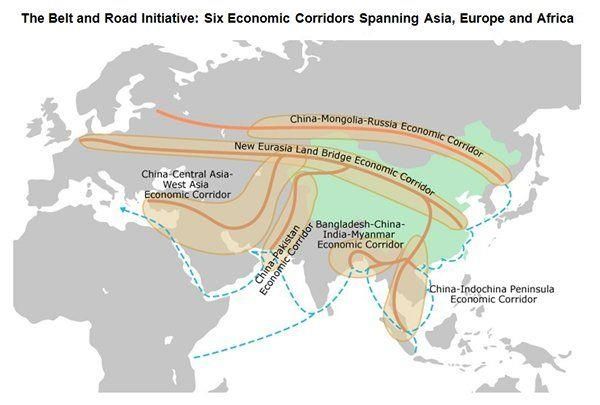
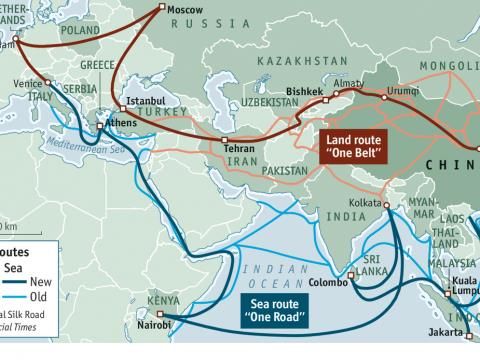
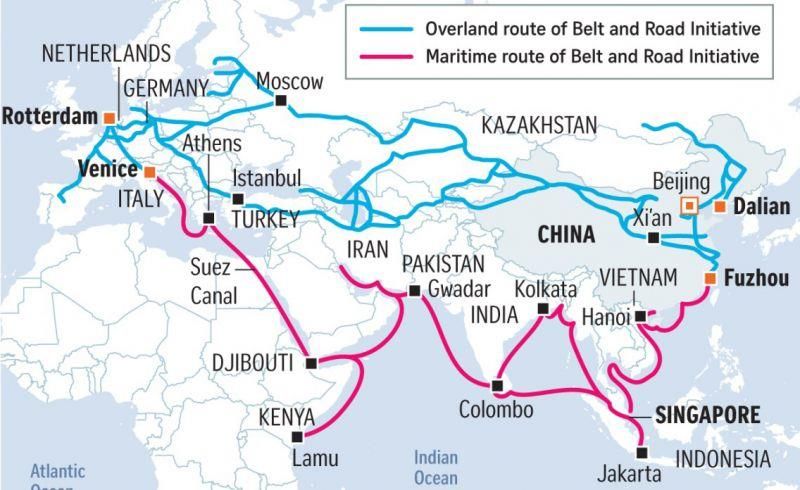
Instead of the relinquishing of sovereignty, the past decade has seen a vast rise of nationalism across all corners of the earth which have been given new life by the rise of China’s Belt and Road Initiative and broader multipolar alliance. While these impulses have taken on many shapes and forms, they are united in the common belief that nation states must not become a thing of the past but rather must become determining forces of the world’s economic and political destinies.

The Case of the Bi-Polar USA

Unfortunately, within the USA itself where nationalism has seen an explosive rise in popularity under President Trump, the old uni-polar geopolitical paradigm has continued to hold tight under such neocon carryovers as Mike Pompeo, Defense Secretary Esper, CIA director Gina Haspel and the large caste of Deep State characters still operating among the highest positions of influence on both sides of the aisle.

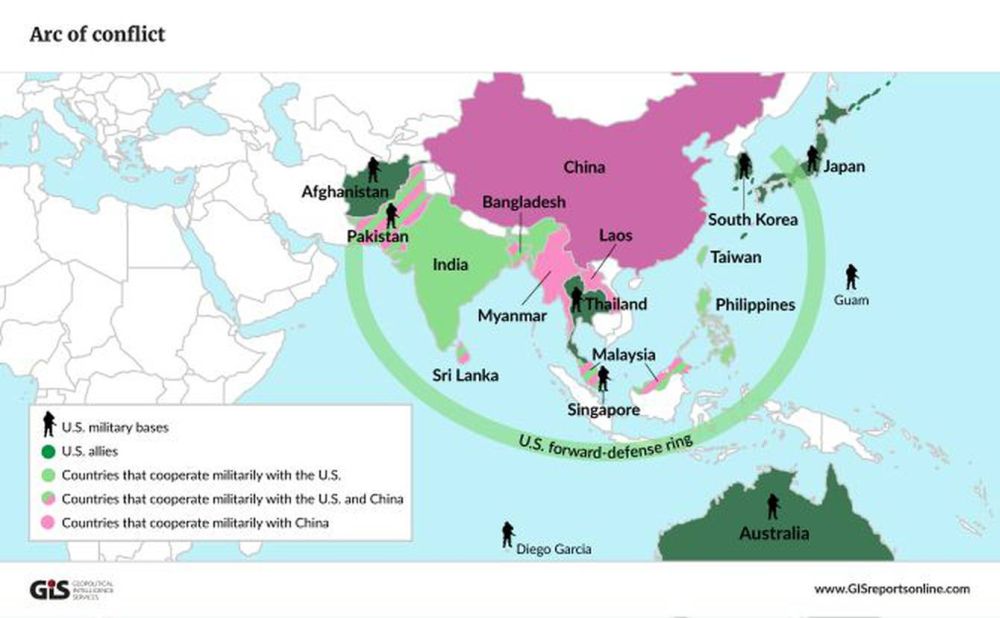
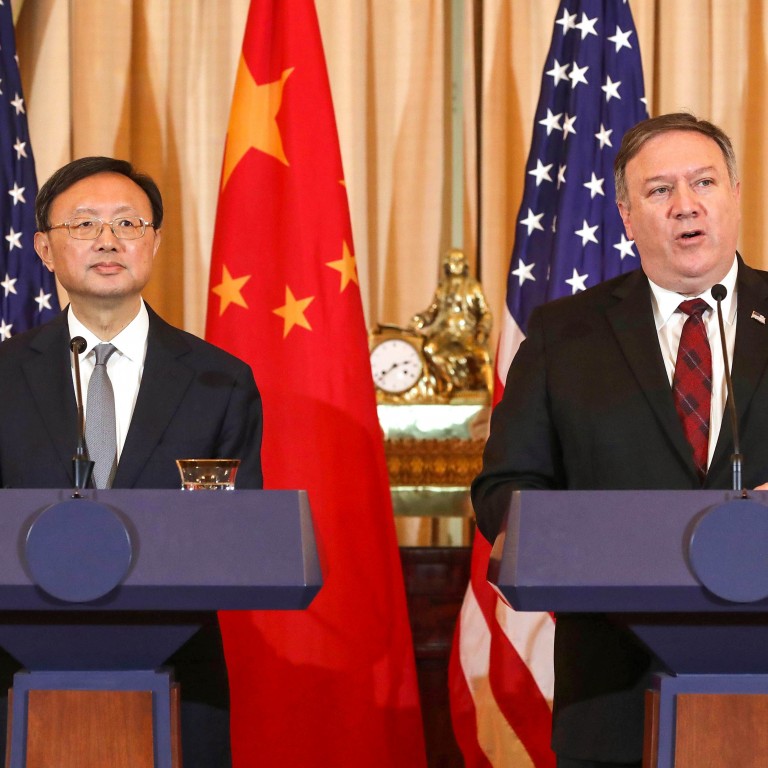
While I genuinely believe that Trump would much rather work with both Russia, China and other nations of the multipolar alliance in lieu of blowing up the world, these aforementioned neocons think otherwise evidenced by Pompeo’s October 6 speech in Japan. In this speech, Pompeo attempted to rally other Pacific nations to an anti-Chinese security complex known as the Quad (USA, Australia, Japan and India). With his typically self-righteous tone, Pompeo stated that “this is not a rivalry between the United States and China. This is for the soul of the world”. Earlier Pompeo stated “If the free world doesn’t change Communist China, Communist China will change us.”

Pompeo’s efforts to break China’s neighbours away from the Belt and Road Initiative have accelerated relentlessly in recent months, with territorial tensions between China and Japan, Vietnam, South Korea, Malaysia, Taiwan, Indonesia, Philippines, Indonesia and Brunei being used by the USA to enflame conflict whenever possible. It is no secret that the USA has many financial and military tentacles stretching deep into all of those Pacific nations listed.

Where resistance to this anti-China tension is found, CIA-funded “democracy movements” have been used as in the current case of Thailand, or outright threats and sanctions as in the case of Cambodia where over 24 Chinese companies have been sanctioned for the crime of building infrastructure in a nation which the USA wishes to control.

Pompeo’s delusional efforts to consolidate a Pacific Military bloc among the QUAD states floundered fairly quickly as no joint military agreement was generated creating no foundation upon which a larger alliance could be built.

China’s Foreign Minister Wang Yi accurately called out this regressive agenda on October 13 saying:

“In essence [the Indo-Pacific Strategy] aims to build a so-called Indo-Pacific NATO underpinned by the quadrilateral mechanism involving the United States, Japan, India and Australia. What it pursues is to trumpet the Cold War mentality and to stir up confrontation among different groups and blocs and to stoke geopolitical competition. What it maintains is the dominance and hegemonic system of the United States. In this sense, this strategy is itself an underlying security risk. If it is forced forward it will wind back the clock of history.”

China Responds with Class

China’s response to this pompous threat to peace was classy to say the least with Wang Yi teaming up with Yang Jiechi (Director of China’s Central Foreign Affairs Commission) who jointly embarked on simultaneous foreign tours that demonstrated the superior world view of “right-makes-might” diplomacy. Where Wang Yi focused his efforts on Southeast Asia with visits to the Philippines, Indonesia, Cambodia, Malaysia, Laos, Thailand and Singapore, Yang Jiechi embarked on a four-legged tour of Sri Lanka, the UAE, Algeria and Serbia.

While COVID assistance was a unifying theme throughout all meetings, concrete economic development driven by the Belt and Road Initiative was relentlessly advanced by both diplomats. In all bilateral agreements reached over this past week, opportunities for cooperation and development were created with a focus on diminishing the points of tension which geopolticians require in order for their perverse “game” to function.

In Malaysia, the $10 billion, 640 Km East Coast Rail link was advanced that will be completed with China’s financial and technical help by 2026 providing a key gateway in the BRI, as well as two major industrial parks that will service high tech products to China and beyond over the coming decades.

After meeting with Wang Yi on October 9, Indonesia’s Special Presidential Envoy announced that “Indonesia is willing to sign cooperation documents on the Belt and Road Initiative and Global Maritime Fulcrum at an early date, enlarge its cooperation with China on trade and investment, actively put in place currency swap arrangements and settlements in local currency, step up the joint efforts in human resources and disaster mitigation, and learn from China’s fight against poverty.”

In Cambodia, a major Free Trade Agreement was begun which will end tariffs on hundreds of products and create new markets for both nations. On the BRI, the New International Land-Sea Trade corridor and Lancang-Mekong Cooperation plans were advanced.

In the Philippines, Wang Yi and Foreign Minister Locsin discussed Duterte’s synergistic Build Build Build program which reflects the sort of long term infrastructure orientation characteristic of the BRI which are both complete breaks with the decades-long practices of usurious IMF loans which have created development bottlenecks across the entire developing sector.

In Thailand Wang Yi met with the Thai Prime Minister where the two accelerated the building of the 252 km Bangkok-Korat high speed rail line which will then connect to Laos and thence to China’s Kunmin Province providing a vital artery for the New Silk Road.

In the past few years, the USA has been able to do little to counter China’s lucrative offers while at best offering cash under the rubric of the Lower Mekong Initiative established under the Hillary-Obama administration in preparation for the Asia Pivot encirclement of China that was unleashed in 2012. This was done as part of a desperate effort to keep China’s neighbors loyal to the USA and was meant to re-enforce Obama’s Trans-Pacific Partnership which Trump thankfully destroyed during his first minutes in office.

Yang Jiechi’s Four-Legged Tour

In Sri Lanka, a $90 million grant was offered by China which will be devoted to medical resources, water supplies and education and which the Chinese embassy website stated “will contribute to the well being of Sri Lankans in a post-COVID era”. Another $989 million loan was delivered for the completion of a massive expressway stretching from Central Sri Lanka’s tea growing district to the Port of Hambanota. While this port is repeatedly used by detractors of the BRI like Pompeo as proof of the “Chinese debt trap”, recent studies have proven otherwise.

In the UAE, the Chinese delegation released a press release after meeting with Prince Zayed al-Nahyan stating: “Under the strategic guidance of President Xi and the Abu Dhabi crown prince, China will enrich the connotation of its comprehensive strategic partnership with UAE, cement the political trust and support, promote alignment of development strategies, and advance high-quality joint construction of the Belt and Road.”

In Algeria, Yang offered China’s full support for the New Economic Revival Plan which parallels the Philippines’ Build Build Build strategy by focusing on long term industrial growth rather than IMF-demands for privatization and austerity that have kept North Africa and other nations backward for years.

Finally in Serbia which is a vital component of the BRI, the Chinese delegation gave its full support to the Belgrade-Budapest railway, and other long term investments centered on transport, energy and soft infrastructure, including the expansion of the Chinese-owned Smederevo Steel Plant which employs over 12 000 Serbians and which was saved from bankruptcy by China in 2016. By the end of the trip, Prime Minister Brnabic announced: “Serbia strongly supports China both bilaterally and multilaterally, including President Xi Jinping’s Access and Roads Initiative and the 17+1 Cooperation Mechanism, in the context of which most of Serbia’s infrastructure and strategy projects will be realized”

The Spirit of Win-Win Must Not Be Sabotaged

Overall, the spirit of the growing New Silk Road is fast moving from a simple east-south trade route towards a global program stretching across all of Africa, to the Middle East, to the High Arctic and Latin America. While this program is driven by a longer view of the past and future than most westerners realize, it is quickly becoming evident that it is the only game in town with a future worth living in.

While China has committed to the enlightened idea that human society is more than a “sum of parts”, the Cold Warriors of the west have chosen to hold onto obsolete notions of human nature that suppose we live in a world of “each vs. all”. These obsolete notions are premised on the bestial idea that our species is destined to do little more than fight for diminishing returns of scraps in a closed -system struggle for survival where only a small technocratic elite of game masters calling themselves “alphas” control the levers of production and consumption from above.

Thus far, President Trump has distinguished himself from other dark age war hawks in his administration by promoting a foreign policy outlook centered on economic development. This has been seen in his recent victories in achieving economic normalization between Serbia and Kosovo, and endorsing the Alaska-Canada railway last month. With the elections just around the corner and the war hawks flying in full force, it is clear that these piecemeal projects, though sane and welcomed are still not nearly enough to break the USA away from its course of war with China and towards a new age of win-win cooperation required for the ultimate survival of our species.

Putin, Xi Message To Trump: US Unipolar World Is Over

By Finian Cunningham

Source: Information Clearing House

The US’ strategy has been to isolate Russia internationally. Evidently, it is Washington that is becoming more isolated on the global stage. This week in the run-up to the G20 summit in Germany, the reverse in fortunes could not be more glaring.

While North Korea was openly defying Washington with a breakthrough ballistic missile test, and US President Donald Trump was embroiled in his usual juvenile tweeting antics, Russia and China’s leaders were proudly consolidating their strategic alliance for a new multipolar global order.

Western media won’t acknowledge as much, but the meeting this week in Moscow between Putin and Xi Jinping was of historical importance. We are witnessing a global transition in power. And for the common good.

Russian President Vladimir Putin and his Chinese counterpart Xi Jinping bond through an apparent deep sense of mutual respect and wisdom about the political challenges facing today’s world. The two leaders have met on more than 20 occasions over the past four years. President Xi referred to Russia as China’s foremost ally and said that in a topsy-turvy world the friendship between the two was a source of countervailing stability.

On the breaking news of North Korea’s successful test launch of its first Intercontinental Ballistic Missile (ICBM), both Putin and Xi called for calm restraint. By contrast, US President Trump took to Twitter to taunt Kim Jong-Un. “Does this guy not have anything better to do with his life?” said Trump in words that could apply more pertinently to the American president.

Then the US and its South Korea ally also launched their ballistic missiles in a military drill aimed as a show of strength to Pyongyang. Kim Jung-Un responded that the ICBM was a “gift for the American bastards” on their Fourth of July Independence Day holiday and that there would more such gifts on the way.

Rather than escalating tensions, Putin and Xi put forward the eminently reasonable proposal that North Korea should freeze its missile tests and the US should likewise halt its military exercises on the Korean peninsula. All sides must convene in negotiations with a commitment to non-violence and without preconditions to strive for a comprehensive settlement to the decades-old dispute.

The contrast in Putin and Xi’s dignified, intelligent response with that of Trump’s petulance is clear proof of Russia and China showing real global leadership, whereas the Americans are just part of the problem.

But the Korean drama was only one illustration this week of how American ambitions of unipolar dominance have become redundant.

The G20 summit prelude of Putin hosting Xi in Moscow was followed by the Chinese president making a state visit to Germany on Wednesday two days before the gathering in Hamburg. Xi and German Chancellor Angela Merkel reportedly signed new trade deals between the world’s two leading export economies.

“Relations between China and Germany are at their historic best,”said Michael Clauss, Germany’s ambassador to Beijing. “The economic and political dynamic from a German perspective is moving toward the east.”

Of significance too was news this week the European Union is preparing to finalize a major trade pact with Japan.

It is also significant that Japan’s Prime Minister Shinzo Abe called on China and Russia to help mediate the Korean crisis immediately following Pyongyang’s ICMB test launch.

Evidently, Japan, despite being an ally of Washington, is reaching out to a multilateral solution as proposed by Moscow and Beijing.

In so many ways, therefore, whether on matters of security or trade and economy, the world appears to be moving inexorably toward a multipolar format as the most appropriate response to challenges.

Not so from the American point of view, especially under Donald Trump’s leadership. All nations seem to be nothing more than a footstool for the “exceptional” Americans who feel entitled to hector and browbeat everyone else to get what they want.

America’s isolation in the world was glimpsed at the G7 summit earlier this year in May when the other nations awkwardly diverged from Trump on his decision to withdraw the US from the global climate accord. Two months on, the isolation of Washington is even more vivid on the world stage as G20 leaders gather in Hamburg this weekend.

A Bloomberg News headline put it succinctly: ‘Trump risks uniting Cold War allies and foes against him’.

Trump’s quest for “America First” through trade protectionism and his narrow-minded unilateralism toward issues of global security have put America out on a limb as far as the rest of the world is concerned.

Where is the American “team player”, the supposed “leader of the free world”? All the self-proclaimed virtues are being seen for what they always were: overblown, pretentious and vainglorious bombast.

America is seen as nothing more than a selfish, hulking giant. Its trade imbalances with the rest of the world are not because of “rotten deals”, as Trump would have it, but rather because the American economy has ruined itself over many decades. The off-shoring of jobs by American corporations and gutting of American workers with poverty wages are part of it.

When America now talks about upholding international law and security, the rest of the world just laughs with bitter irony. The wars across the Middle East and the sponsoring of terrorism are largely US products of criminal regime-change intrigues. Who is this deluded head-case in Washington?

The same deluded head-case that has “beautiful chocolate cake” with China’s president in a Florida beach resort, and then proceeds to slap sanctions on China and make provocative military incursions on its territory. It’s not just Trump. It’s the whole American political leadership. The American ruling class has become so blinded by hubris that it can’t even see how the world it claims to dominate is collectively shutting the door on it and walking away.

Washington has no answers for today’s world challenges. Because simply put, Washington is the source of many of today’s problems. It has not even the modesty to acknowledge its responsibility. The only thing the US seems capable of is to make current problems fiendishly worse. The Korean crisis is an object lesson.

Presidents Putin and Xi are not scheming to usurp world domination, as Washington would have us believe. Only in Washington would a vision for a multipolar, more democratic global order be construed as something threatening and sinister. That’s because American ambitions of unipolar “full spectrum dominance” are actually threatening and sinister.

The world can be thankful it has genuine leaders in Putin and Xi who are forging ahead to create a multipolar global order. Fortunately, the strategic alliance between Russia and China is underpinned by a formidable military capability. Joint naval exercises this month carried out in the Baltic Sea are a vital insurance policy to back up what Moscow and Beijing are increasingly bold enough to say to the Americans.

That message, as Putin and Xi effectively gave to Trump this week, is that American ambitions of world domination are no longer acceptable and no longer tenable. Washington’s days of bullying the world with its moralizing hypocrisy and military aggression are over.

Syria: Where the Rubber Meets the Road

By Mike Whitney

Source: Unz Review

“Our U.S. Army contacts in the area have told us this is not what happened. There was no Syrian ‘chemical weapons attack.’ Instead, a Syrian aircraft bombed an al-Qaeda-in-Syria ammunition depot that turned out to be full of noxious chemicals and a strong wind blew the chemical-laden cloud over a nearby village where many consequently died…..This is what the Russians and Syrians have been saying and – more important –what they appear to believe happened.”

— Veteran Intelligence Professionals for Sanity, 20 former members of the US Intelligence Community 

You don’t have to be a genius to figure out that the case against Syrian President Bashar al Assad is extremely weak. The chemical weapons attack in Khan Shaykhun, has produced no smoking gun, no damning evidence, in fact, no evidence at all. Similar to the Russia hacking fiasco, (not a shred of evidence so far) the western media and the entire political class has made the case for attacking a sovereign country on the thin gruel of a few videos of an incident that took place in a location that is currently under the control of militant groups connected to al Qaida. That’s pretty shaky grounds for a conviction, don’t you think?

And it’s not up to Assad to prove his innocence either. That’s baloney. The burden of proof rests with the prosecution. If Trump and his lieutenants have evidence that the Syrian President used chemical weapons, then– by all means– let’s see it and be done with it. If not, we have to assume that Assad is innocent, not because we like Assad, but because these are the legal precedents that one follows to establish the truth. And that’s what we want, we want to know what really happened.

Neither Trump nor the media care about the truth, what they care about is regime change, which is the driving force behind Washington’s six year-long war on Syria. The fact that Washington has concealed its support by secretly arming-and-training Sunni militias, does not absolve it from responsibility. The US is totally responsible for the mess in Syria. Without Washington’s support none of this would have happened. 7 million Syrians wouldn’t have fled their homes, 400,000 Syrians wouldn’t have been killed, and the country would not be the anarchic wastelands it is today. The United States is entirely is responsible for the death and destruction of Syria. These are Washington’s killing fields.

As we said earlier, there is no evidence that Assad used chemical weapons against his people nor has there been any investigation to substantiate the claims. The Trump administration launched its Tomahawk missile barrage before consulting with the Organization for the Prohibition of Chemical Weapons which essentially preempted the organization from doing its job. The administration’s rejection of the normal investigative procedures and rush to judgement reinforces the belief that they know they have no case and are just peddling pro-war BS in the mad pursuit of their geopolitical objectives.

Since we don’t have an organization like the OPCW to conduct an investigation, we should at least consider the informed opinions of professionals who have some background in intelligence. This doesn’t provide us with iron-clad proof one way or another, but at least it gives us an idea of some probable scenarios. Here’s a quote from former CIA officer and Director of the Council for the National Interest, Philip Giraldi, who stated last week on the Scott Horton show:

“I am hearing from sources on the ground, in the Middle East, the people who are intimately familiar with the intelligence available are saying that the essential narrative we are all hearing about the Syrian government or the Russians using chemical weapons on innocent civilians is a sham. The intelligence confirms pretty much the account the Russians have been giving since last night which is that they hit a warehouse where al Qaida rebels were storing chemicals of their own and it basically caused an explosion that resulted in the casualties. Apparently the intelligence on this is very clear, and people both in the Agency and in the military who are aware of the intelligence are freaking out about this because essentially Trump completely misrepresented what he should already have known — but maybe didn’t–and they’re afraid this is moving towards a situation that could easily turn into an armed conflict.” (The Impending Clash Between the U.S. and Russia, Counterpunch)

We hear a very similar account from retired Colonel Lawrence Wilkerson, who was former chief of Staff to General Colin Powell. Here’s what he said in a recent interview on the Real News Network:

“I personally think the provocation was a Tonkin Gulf incident….. Most of my sources are telling me, including members of the team that monitors global chemical weapons –including people in Syria, including people in the US Intelligence Community–that what most likely happened …was that they hit a warehouse that they had intended to hit…and this warehouse was alleged to have to ISIS supplies in it, and… some of those supplies were precursors for chemicals….. conventional bombs hit the warehouse, and due to a strong wind, and the explosive power of the bombs, they dispersed these ingredients and killed some people.” (“Lawrence Wilkerson: Trump Attack on Syria Driven by Domestic Politics“, Real News Network)

Finally, we have the collective judgement of 20 former members of the US Intelligence Community, the so-called Steering Group of the Veteran Intelligence Professionals for Sanity. Here’s what they say:

“Our U.S. Army contacts in the area have told us this is not what happened. There was no Syrian “chemical weapons attack.” Instead, a Syrian aircraft bombed an al-Qaeda-in-Syria ammunition depot that turned out to be full of noxious chemicals and a strong wind blew the chemical-laden cloud over a nearby village where many consequently died…..This is what the Russians and Syrians have been saying and – more important –what they appear to believe happened.”

So, why is the administration so eager to jump to conclusions? Why do they want to use such a sketchy incident to justify an attack on sovereign nation that poses no threat to US national security? What’s really going on here?

To answer that, we need to review an interview with President Trump’s new National Security Advisor, Lt. General H.R. McMaster, that took on place on Sunday on Fox News. McMaster– you may recall– recently replaced General Michael Flynn at the same position. Flynn’s failing was that he wanted to “normalize” relations with Russia which the behind-the-scenes powerbrokers rejected out-of-hand and worked to have him replaced with far-right wing militarist-neocon McMaster. Now, McMaster is part of the one-two combo that decides US foreign policy around the world. Trump has essentially dumped Syria in the laps of his two favorite generals, McMaster and James “Mad Dog” Mattis who have decided to deepen Washington’s military commitment in Syria and intensify the conflict even if it means a direct confrontation with Russia.

In the Fox interview, McMaster was asked a number of questions about Trump’s missile attack. Here’s part of what he said:

“The objective (of the strikes) was to send a very strong political message to Assad. And this is very significant because…. this is the first time the United States has acted directly against the Assad regime, and that should be a strong message to Assad and to his sponsors….

He added,

“Russia should ask themselves, what are we doing here? Why are we supporting this murderous regime that is committing mass murder of its own population and using the most heinous weapons available….Right now, I think everyone in the world sees Russia as part of the problem.” (Fox News with Chris Wallace)

Can you see what’s going on? Trump’s missile attack was not retaliatory, not really. It was a message to Putin. McMaster was saying as clearly as possible, that ‘the US military is coming for Assad, and you’d better stay out of the way if you know what’s good for you.’ That’s the message. It has nothing to do with chemical weapons or the suffering of innocent people. McMaster was delivering a threat. He was putting Putin ‘on notice’.

Like McMaster said, “this is the first time the United States has acted directly against the Assad regime, and that should be a strong message to Assad and to his sponsors….”

In other words, McMaster wants Putin to know that he’s prepared to attack the Syrian government and its assets directly and, that, if Putin continues to defend Assad, Russian forces will be targeted as well.

There was some confusion about this in the media because UN ambassador Nikki Haley and Secretary of State Rex Tillerson got their talking-points mixed up and botched their interviews. But the Washington Post clarified the policy the next day by stating bluntly:

“Officials in the Trump administration on Sunday demanded that Russia stop supporting the Syrian government or face a further deterioration in its relations with the United States.”

Bingo. That’s the policy in a nutshell. The issue isn’t chemical weapons. The issue is Russia’s support for Assad, the leader who remains the target of US regime change plans. We are seeing a fundamental shift in the policy from mainly covert support for CIA-backed Sunni militias to overt military intervention. This is just the first volley in that new war.

The media wants the American people to believe that President Trump impulsively ordered the missile attacks in response to the use of chemical weapons. But there’s reason to suspect that the attacks had been planned for some time in advance. As one blogger pointed out:

“In the weeks before the missile strikes, Trump met with the Saudis, the president of Egypt, and the King of Jordan, while Secretary of State met with Turkish President Erdogan. In other words, the administration met with the entire Middle East ‘Sunni alliance’ just days before ordering the missile strikes. Coincidence?

Probably not. They were probably tipped off and asked for their continued support.

Also, Trump waited until the evening that he was having dinner with President Xi Jinping to launch the attacks. How’s that for timing?

Do you think that the announcement that Trump just attacked Syria would have an impact on the two leaders’ conversation about North Korea? Do you think Xi might have seen the announcement as a not-so-subtle threat of violence against the North unless China forces its ally to make concessions?

Of course, he did. The man wasn’t born yesterday.

It seems unlikely that Trump’s attack was a snap decision made by an impulsive man. Instead, it looks like there was a significant amount of planning that went on beforehand, including the deploying of 400 additional Special Ops to Syria and 2,500 combat troops to nearby Kuwait. It appears as though Washington had been building up its troop-strength for some time before it settled on the right pretext for taking things to the next level. As journalist Bill Van Auken noted at the World Socialist Web Site:

“We have been here so many times before that it is hardly worth wasting the time required to refute the official story. It is now 14 years since the US launched its invasion of Iraq over similar lies about weapons of mass destruction, setting into motion a vast slaughter that has claimed the lives of over one million people and turned millions more into refugees……..

Once again, as in the air war against Serbia in 1999, the invasion of Afghanistan in 2001 and Iraq in 2003, and the attack on Libya in 2011, the United States has concocted a pretext to justify the violation of another country’s sovereignty…” (“The Bombing of Syria, Bill Van Auken, World Socialist Web Site)

I have no way of knowing whether Assad used chemical weapons or not, but I found Russian President Vladimir Putin’s analysis particularly interesting. Reporters asked Putin — “What is your view about the use of chemical weapons in Syria?”

Putin answered-:

“You all know that the Syrian government has repeatedly asked the international community to come and inspect the sites where the rebels used chemical weapons. But they always ignored those requests. The only time the international community has responded, was to this last incident. So, what do I think?

I think we can figure out what’s going on by just using a little common sense. The Syrian army was winning the war, in some places they had the rebels completely surrounded. For them to throw it all away and give their trump card to the people who have been calling for regime change is, frankly, a crock of shit.”. (Russian President Vladimir Putin.)

Putin’s response to Trump’s missile attack has been subdued to say the least. He did issue a perfunctory presidential press statement on the incident, but the tone of the statement was neither incendiary or belligerent. If anything, it sounded like he found the whole matter irritating, like the man who sits down to a picnic lunch and finds he has to deal with pesky mosquito before he can eat. But, of course, this is the way that Putin handles most matters. He’s a master of understatement who is not easily given to emotional outbursts or displays of rage. He’s more apt to scratch himself, roll his eyes and give a shrug of the shoulders, than wave his fist and issue threats.

But from a strategic point of view, Putin’s measured response makes perfect sense, after all, the real battle isn’t going to be won or lost in Syria. It’s much bigger than that. Putin is challenging the present world order in which a disproportionate amount of political and economic power has accrued to one unipolar center of authority, a global hegemon that imposes its economic model wherever it goes and topples sovereign states with a wave of the hand. Putin’s task is to build resistance among the vassals, form new alliances, and strengthen the collective resolve for a different world where national sovereignty and borders are guaranteed under an impartial set of international laws that protect the weak as well as the strong.

That’s Putin’s real objective, to rebuild the system of global security based on a solid foundation of respect for the vital interests of each and every country. To accomplish that, Putin must seem like a reasonable and trustworthy ally who honors his commitments and stands by his friends even when they are under attack. That’s why Putin won’t abandon Assad. It’s because he can’t.

Syria is the battlefield where competing visions of the future meet head on. It’s where the rubber meets the road.


MIKE WHITNEY lives in Washington state. He is a contributor to Hopeless: Barack Obama and the Politics of Illusion (AK Press). Hopeless is also available in a Kindle edition. He can be reached at fergiewhitney@msn.com.

Wonderland

By James Howard Kunstler

Source: Kunstler.com

There are times in the course of events when a society cannot tell what the fuck is going on, or what to do about it, and this is one of those moments in history here in the USA. The quandaries of life on the home front — how to make a living, how to care for ourselves and loved ones — get shoved aside by misadventures in foreign lands with their own quandaries. One delusion leads to another until you enter a zero gravity of the mind. Case in point du jour: Syria.

The persistent hyperRussomania of the US Dem-Prog alliance and its sob-sisters in the media seeks to make a bad situation worse in Syria and probably for the worst reasons. How many Americans have even the dimmest idea what’s going on in Syria, who the cast of characters there represent, and where the USA fits into all of it?

There is the head of government, one Bashar al Assad (son of the previous president, Hafez al Assad). The Assads had run Syria as a mostly secular Arab state until the civil war within Islam, Sunni against Shia, spilled out of Iraq. The Assads belonged to the tiny Alawite sect of the Shia. They comprise only 13 percent of the Syrian population, which has a Sunni majority. Under the Assads, Syria has tilted toward Iran, the Shia home state, and away from the Sunni Arabs elsewhere in the neighborhood. Russia has cultivated Iran and support its “friends,” the Assads.

A mash-up of Sunni jihad armies fights the Assad government in Syria’s civil war. These are Isis, al Qaeda, and Jabhat al Nusra. The US government had made official noise about supporting the more “moderate rebels” in the Syrian conflict. Who are they exactly? Do you have a clue? Which army among those three rebel groups are “moderates?” And what is their moderate goal under jihad? To topple Assad. And then what? To set up a new theocratic government perhaps? How is it in America’s interests to promote Islamic jihadi theocracy?

One hypothesis is that the struggle is over who gets to run gas and oil pipelines through Syria to get easier access to the Mediterranean Sea and the European energy market. Iran would very badly like to do that. But they are in competition with the Kingdom of Saudi Arabia and Qatar, the little giant emirate of natural gas. So, you have the Iran/Shia gang on one side and the KSA/Qatar/Sunni on the other side. Anybody who had scanned the news since 1979 can probably tell whose side the US is on. By the way, this hypothesis has had no airing among the mainstream media triumvirate: The New York Times, CNN, and The WashPo. These news orgs won’t even entertain that angle of the story… but as I said, it’s only a hypothesis.

It was not so many weeks ago that President Trump met with the crown prince of KSA at the White House to give assurances of American friendship and support. KSA is supposedly America’s chief ally against Isis in Syria. Yet, KSA and the USA are dedicated to getting rid of the Assad government as well as Isis. That is, we are against both sides in the Syrian civil war. Still wondering why the American public is confused by all this? Do you know who our choice is to replace Assad? Can you name an opposition figure? Of course you can’t. There is nobody. What the White House, the Pentagon, the State Department, and the NSA seem to have in mind is the familiar failed state policy that has worked so well in the past (not).

Which brings us to the curious case of Bashar Assad’s recent supposed poison gas bombing of civilians in Khan Sheikhoun. The media triumvirate was avid to play along with the story. I don’t know about you, but I have to ask myself: what would Assad’s strategic goal be in gas bombing women and children? To gin up worldwide positive PR? To get the Syrian people on his side against Isis and other jihadis? What advantage could Assad possibly gain? In warfare generally, the tacticians strike against military targets. There’s a hypothesis that Assad’s air force sought to strike a rebel arms depot in Idlib province — a military target. The hypothesis goes further, saying that the depot contained phosgene and chlorine gas, but not Sarin. The wind carried these released gases among civilian homes and streets in Khan Sheikhoun. People suffered and died. Evidence for the absence of Sarin gas is that the gassing victims were handled manually by doctors and aid workers in street clothes. Sarin can kill on skin contact and doctors have to treat it in protective gear. So, maybe the gas wasn’t Sarin and maybe it wasn’t dropped in bombs from Assad’s planes. But, like the pipeline angle of the story, this hypothesis is missing in the media triumvirate’s pages.

President Trump was lauded mostly for the missile strike against the Syrian air force base that followed. The Dem/Progs and The New York Times gave him brownie points, if only for it being a swipe against Russia. It seemed so clever, what with Chinese President Xi Jinping at the Mar-a-Lago dinner table where, presumably, the subject of the maniac in North Korea came up. Days later, a US aircraft carrier group steamed to the waters off Kim Jong Un’s fortress state. Which brings forth another hypothesis: that the Syria missile strike was solely a demonstration of US military will vis-a-vis the more ominous threat over in Asia — an attempt to get Xi to do something about the Kim Jong Un before we do.

It’ll be interesting to see how that plays out. The big fear is that in the event of a rumble, Kim will turn Seoul into an ashtray. The South Korean capital is only a few miles from the DMZ between the two states. The US couldn’t find a jucier enemy than Kim Jong Un, a character so improbable he might have been dreamed up in a Batman comic. Hence, he’s comprehensible to an American public that more and more looks like the ever-present crowd of perplexed bystanders in a Batman movie.

*

I was quite surprised to hear that a podcast called “S-Town,” about the dark doings in an Alabama backwater, had become a huge hit on the Web-waves. Back around 2012-2013, I had some email correspondence from John B. McLemore, the tragic figure at the center of the series. He was a real person, referred to by various people in the series as “brilliant,” “a genius,” “a real character,” and he was for sure.

Apparently, he was also a fan of my books. He got my phone number off my website and took to calling me on the phone. I probably had a dozen long phone conversations with him. Hours. It is well-known now that he called his home of Woodstock, Alabama, “Shit-town.” He regaled me with many a sordid tale of the home-folk, and even of himself. The place sounded like Hieronymus Bosch meets Dogpatch. Since John B seemed so unhappy under his mask of hilarity and mirth, I tried to encourage him to think about moving. He always had an excuse for not doing that, but clearly John B and the neighbors he disdained, fought with, looked for love with, had a synergistic thing going. They needed each other to play out their never-ending crazy scripts of cracker mischief, vengeance, and failure. After a while, John B went dark. I thought he’d just gotten tired of me telling him to move.

I was startled to hear in the second episode of the “S-Town” podcast that John B had made good on his constant intimations of suicide. Startled, but not especially surprised. He was more than a fish out of water. He was like a Martian suffocating in an atmosphere too heavy for him. I suspect the truth is there are thousands of places like “S-Town” all over America, places devastated by the poor choices of the last several generations — most particularly the way they threw away their livelihoods and surrendered to one vice after another in boredom, defeat, and self-loathing. It’s a very sad story and it’s not over yet by a long shot.

The IMF Changes its Rules to Isolate China and Russia

Related Podcast: Michael Hudson on “Guns and Butter” 2/3/16:
index

By Michael Hudson

Source: Michael-Hudson.com

A nightmare scenario of U.S. geopolitical strategists is coming true: foreign independence from U.S.-centered financial and diplomatic control. China and Russia are investing in neighboring economies on terms that cement Eurasian integration on the basis of financing in their own currencies and favoring their own exports. They also have created the Shanghai Cooperation Organization (SCO) as an alternative military alliance to NATO.[1] And the Asian Infrastructure Investment Bank (AIIB) threatens to replace the IMF and World Bank tandem in which the United States holds unique veto power.

More than just a disparity of voting rights in the IMF and World Bank is at stake. At issue is a philosophy of development. U.S. and other foreign investment in infrastructure (or buyouts and takeovers on credit) adds interest rates and other financial charges to the cost structure, while charging prices as high as the market can bear (think of Carlos Slim’s telephone monopoly in Mexico, or the high costs of America’s health care system), and making their profits and monopoly rents tax-exempt by paying them out as interest.

By contrast, government-owned infrastructure provides basic services at low cost, on a subsidized basis, or freely. That is what has made the United States, Germany and other industrial lead nations so competitive over the past few centuries. But this positive role of government is no longer possible under World Bank/IMF policy. The U.S. promotion of neoliberalism and austerity is a major reason propelling China, Russia and other nations out of the U.S. diplomatic and banking orbit.

On December 3, 2015, Prime Minister Putin proposed that Russia “and other Eurasian Economic Union countries should kick-off consultations with members of the SCO and the Association of Southeast Asian Nations (ASEAN) on a possible economic partnership.”[2] Russia also is seeking to build pipelines to Europe through friendly secular countries instead of Sunni jihadist U.S.-backed countries locked into America’s increasingly confrontational orbit.

Russian finance minister Anton Siluanov points out that when Russia’s 2013 loan to Ukraine was made, at the request of Ukraine’s elected government, Ukraine’s “international reserves were barely enough to cover three months’ imports, and no other creditor was prepared to lend on terms acceptable to Kiev. Yet Russia provided $3 billion of much-needed funding at a 5 per cent interest rate, when Ukraine’s bonds were yielding nearly 12 per cent.”[3]

What especially annoys U.S. financial strategists is that this loan by Russia’s National Wealth Fund was protected by IMF lending practice, which at that time ensured collectability by withholding credit from countries in default of foreign official debts, or at least not bargaining in good faith to pay. To cap matters, the bonds are registered under London’s creditor-oriented rules and courts.

Most worrisome to U.S. strategists is that China and Russia are denominating their trade and investment in their own currencies instead of dollars. After U.S. officials threatened to derange Russia’s banking linkages by cutting it off from the SWIFT interbank clearing system, China accelerated its creation of the alternative China International Payments System (CIPS), and its own credit card system to protect Eurasian economies from the threats made by U.S. unilateralists.

Russia and China are simply doing what the United States has long done: using trade and credit linkages to cement their diplomacy. This tectonic geopolitical shift is a Copernican threat to New Cold War ideology: Instead of the world economy revolving around the United States (the Ptolemaic idea of America as “the indispensible nation”), it may revolve around Eurasia. As long as global financial control remains grounded in Washington at the offices of the IMF and World Bank, such a shift in the center of gravity will be fought with all the power of an American Century (and would-be American Millennium) inquisition.

Any inquisition needs a court system and enforcement vehicles. So does resistance to such a system. That is what today’s global financial, legal and trade maneuvering is all about. And that is why today’s world system is in the process of breaking apart. Differences in economic philosophy call for different institutions.

To U.S. neocons the specter of AIIB government-to-government investment creates fear of nations minting their own money and holding each other’s debt in their international reserves instead of borrowing dollars, paying interest in dollars and subordinating their financial planning to the U.S. Treasury and IMF. Foreign governments would have less need to finance their budget deficits by selling off key infrastructure. And instead of dismantling public spending, a broad Eurasian economic union would do what the United States itself practices, and seek self-sufficiency in banking and monetary policy.

Imagine the following scenario five years from now. China will have spent half a decade building high-speed railroads, ports, power systems and other construction for Asian and African countries, enabling them to grow and export more. These exports will be coming online to repay the infrastructure loans. Also, suppose that Russia has been supplying the oil and gas energy for these projects on credit.

To avert this prospect, suppose an American diplomat makes the following proposal to the leaders of countries in debt to China, Russia and the AIIB: “Now that you’ve got your increased production in place, why repay? We’ll make you rich if you stiff our adversaries and turn back to the West. We and our European allies will support your assigning your nations’ public infrastructure to yourselves and your supporters at insider prices, and then give these assets market value by selling shares in New York and London. Then, you can keep the money and spend it in the West.”

How can China or Russia collect in such a situation? They can sue. But what court in the West will accept their jurisdiction?

That is the kind of scenario U.S. State Department and Treasury officials have been discussing for more than a year. Implementing it became more pressing in light of Ukraine’s $3 billion debt to Russia falling due by December 20, 2015. Ukraine’s U.S.-backed regime has announced its intention to default. To support their position, the IMF has just changed its rules to remove a critical lever on which Russia and other governments have long relied to ensure payment of their loans.

The IMF’s role as enforcer of inter-government debts
When it comes to enforcing nations to pay inter-government debts, the IMF is able to withhold not only its own credit but also that of governments and global bank consortia participating when debtor countries need “stabilization” loans (the neoliberal euphemism for imposing austerity and destabilizing debtor economies, as in Greece this year). Countries that do not privatize their infrastructure and sell it to Western buyers are threatened with sanctions, backed by U.S.-sponsored “regime change” and “democracy promotion” Maidan-style. The Fund’s creditor leverage has been that if a nation is in financial arrears to any government, it cannot qualify for an IMF loan – and hence, for packages involving other governments. That is how the dollarized global financial system has worked for half a century. But until now, the beneficiaries have been U.S. and NATO lenders, not been China or Russia.

The focus on a mixed public/private economy sets the AIIB at odds with the Trans-Pacific Partnership’s aim of relinquishing government planning power to the financial and corporate sector, and the neoliberal aim of blocking governments from creating their own money and implementing their own financial, economic and environmental regulation. Chief Nomura economist Richard Koo, explained the logic of viewing the AIIB as a threat to the U.S.-controlled IMF: “If the IMF’s rival is heavily under China’s influence, countries receiving its support will rebuild their economies under what is effectively Chinese guidance, increasing the likelihood they will fall directly or indirectly under that country’s influence.”[4]

This was the setting on December 8, when Chief IMF Spokesman Gerry Rice announced: “The IMF’s Executive Board met today and agreed to change the current policy on non-toleration of arrears to official creditors.” Russian Finance Minister Anton Siluanov accused the IMF decision of being “hasty and biased.”[5] But it had been discussed all year long, calculating a range of scenarios for a sea change in international law. Anders Aslund, senior fellow at the NATO-oriented Atlantic Council, points out:

The IMF staff started contemplating a rule change in the spring of 2013 because nontraditional creditors, such as China, had started providing developing countries with large loans. One issue was that these loans were issued on conditions out of line with IMF practice. China wasn’t a member of the Paris Club, where loan restructuring is usually discussed, so it was time to update the rules.
The IMF intended to adopt a new policy in the spring of 2016, but the dispute over Russia’s $3 billion loan to Ukraine has accelerated an otherwise slow decision-making process.[6]

The target was not only Russia and its ability to collect on its sovereign loan to Ukraine, but China even more, in its prospective role as creditor to African countries and prospective AIIB borrowers, planning for a New Silk Road to integrate a Eurasian economy independent of U.S. financial and trade control. The Wall Street Journal concurred that the main motive for changing the rules was the threat that China would provide an alternative to IMF lending and its demands for crushing austerity. “IMF-watchers said the fund was originally thinking of ensuring China wouldn’t be able to foil IMF lending to member countries seeking bailouts as Beijing ramped up loans to developing economies around the world.”[7] So U.S. officials walked into the IMF headquarters in Washington with the legal equivalent of suicide vests. Their aim was a last-ditch attempt to block trade and financial agreements organized outside of U.S. control and that of the IMF and World Bank.

The plan is simple enough. Trade follows finance, and the creditor usually calls the tune. That is how the United States has used the Dollar Standard to steer Third World trade and investment since World War II along lines benefiting the U.S. economy. The cement of trade credit and bank lending is the ability of creditors to collect on the international debts being negotiated. That is why the United States and other creditor nations have used the IMF as an intermediary to act as “honest broker” for loan consortia. (“Honest broker” means being subject to U.S. veto power.) To enforce its financial leverage, the IMF has long followed the rule that it will not sponsor any loan agreement or refinancing for governments that are in default of debts owed to other governments. However, as the afore-mentioned Aslund explains, the IMF could easily

change its practice of not lending into [countries in official] arrears … because it is not incorporated into the IMF Articles of Agreement, that is, the IMF statutes. The IMF Executive Board can decide to change this policy with a simple board majority. The IMF has lent to Afghanistan, Georgia, and Iraq in the midst of war, and Russia has no veto right, holding only 2.39 percent of the votes in the IMF. When the IMF has lent to Georgia and Ukraine, the other members of its Executive Board have overruled Russia.[8]

After the rules change, Aslund later noted, “the IMF can continue to give Ukraine loans regardless of what Ukraine does about its credit from Russia, which falls due on December 20.[9]

The IMF rule that no country can borrow if it is in default to a foreign government was created in the post-1945 world. Since then, the U.S. Government, Treasury and/or U.S. bank consortia have been party to nearly every major loan agreement. But inasmuch as Ukraine’s official debt to Russia’s National Wealth Fund was not to the U.S. Government, the IMF announced its rules change simply as a “clarification.” What its rule really meant was that it would not provide credit to countries in arrears to the U.S. government, not that of Russia or China.

It remains up to the IMF board – and in the end, its managing director – whether or not to deem a country creditworthy. The U.S. representative can block any foreign leaders not beholden to the United States. Mikhail Delyagin, Director of the Institute of Globalization Problems, explained the double standard at work: “The Fund will give Kiev a new loan tranche on one condition: that Ukraine should not pay Russia a dollar under its $3 billion debt. … they will oblige Ukraine to pay only to western creditors for political reasons.”[10]

The post-2010 loan packages to Greece are a case in point. The IMF staff saw that Greece could not possibly pay the sums needed to bail out French, German and other foreign banks and bondholders. Many Board members agreed, and have gone public with their whistle blowing. Their protests didn’t matter. President Barack Obama and Treasury Secretary Tim Geithner pointed out that U.S. banks had written credit default swaps betting that Greece could pay, and would lose money if there were a debt writedown). Dominique Strauss-Kahn backed the hard line US- European Central Bank position. So did Christine Lagarde in 2015, overriding staff protests.[11]

Regarding Ukraine, IMF executive board member Otaviano Canuto, representing Brazil, noted that the logic that “conditions on IMF lending to a country that fell behind on payments [was to] make sure it kept negotiating in good faith to reach agreement with creditors.”[12] Dropping this condition, he said, would open the door for other countries to insist on a similar waiver and avoid making serious and sincere efforts to reach payment agreement with creditor governments.

A more binding IMF rule is Article I of its 1944-45 founding charter, prohibiting the Fund from lending to a member state engaged in civil war or at war with another member state, or for military purposes in general. But when IMF head Lagarde made the last loan to Ukraine, in spring 2015, she merely expressed a vapid token hope there might be peace. Withholding IMF credit could have been a lever to force peace and adherence to the Minsk agreements, but U.S. diplomatic pressure led that opportunity to be rejected. President Porochenko immediately announced that he would step up the civil war with the Russian-speaking population in the eastern Donbass region.

The most important IMF condition being violated is that continued warfare with the East prevents a realistic prospect of Ukraine paying back new loans. The Donbas is where most Ukrainian exports were made, mainly to Russia. That market is being lost by the junta’s belligerence toward Russia. This should have blocked Ukraine from receiving IMF aid. Aslund himself points to the internal contradiction at work: Ukraine has achieved budget balance because the inflation and steep currency depreciation has drastically eroded its pension costs. But the resulting decline in the purchasing power of pension benefits has led to growing opposition to Ukraine’s post-Maidan junta. So how can the IMF’s austerity budget be followed without a political backlash? “Leading representatives from President Petro Poroshenko’s Bloc are insisting on massive tax cuts, but no more expenditure cuts; that would cause a vast budget deficit that the IMF assesses at 9-10 percent of GDP, that could not possibly be financed.”[13]

By welcoming and financing Ukraine instead of treating as an outcast, the IMF thus is breaking four of its rules:

  1. Not to lend to a country that has no visible means to pay back the loan. This breaks the “No More Argentinas” rule, adopted after the IMF’s disastrous 2001 loan.
  2. Not to lend to a country that repudiates its debt to official creditors. This goes against the IMF’s role as enforcer for the global creditor cartel.
  3. Not to lend to a borrower at war – and indeed, to one that is destroying its export capacity and hence its balance-of-payments ability to pay back the loan.
  4. Finally, not to lend to a country that is not likely to carry out the IMF’s austerity “conditionalities,” at least without crushing democratic opposition in a totalitarian manner.

The upshot – and new basic guideline for IMF lending – is to split the world into pro-U.S. economies going neoliberal, and economies maintaining public investment in infrastructure n and what used to be viewed as progressive capitalism. Russia and China may lend as much as they want to other governments, but there is no global vehicle to help secure their ability to be paid back under international law. Having refused to roll back its own (and ECB) claims on Greece, the IMF is willing to see countries not on the list approved by U.S. neocons repudiate their official debts to Russia or China. Changing its rules to clear the path for making loans to Ukraine is rightly seen as an escalation of America’s New Cold War against Russia and China.

Timing is everything in such ploys. Georgetown University Law professor and Treasury consultant Anna Gelpern warned that before the “IMF staff and executive board [had] enough time to change the policy on arrears to official creditors,” Russia might use “its notorious debt/GDP clause to accelerate the bonds at any time before December, or simply gum up the process of reforming the IMF’s arrears policy.”[14] According to this clause, if Ukraine’s foreign debt rose above 60 percent of GDP, Russia’s government would have the right to demand immediate payment. But President Putin, no doubt anticipating the bitter fight to come over its attempts to collect on its loan, refrained from exercising this option. He is playing the long game, bending over backward to behave in a way that cannot be criticized as “odious.”

A more immediate reason deterring the United States from pressing earlier to change IMF rules was the need to use the old set of rules against Greece before changing them for Ukraine. A waiver for Ukraine would have provided a precedent for Greece to ask for a similar waiver on paying the “troika” – the European Central Bank (ECB), EU commission and the IMF itself – for the post-2010 loans that have pushed it into a worse depression than the 1930s. Only after Greece capitulated to eurozone austerity was the path clear for U.S. officials to change the IMF rules to isolate Russia. But their victory has come at the cost of changing the IMF’s rules and those of the global financial system irreversibly. Other countries henceforth may reject conditionalities, as Ukraine has done, as well as asking for write-downs on foreign official debts.

That was the great fear of neoliberal U.S. and Eurozone strategists last summer, after all. The reason for smashing Greece’s economy was to deter Podemos in Spain and similar movements in Italy and Portugal from pursuing national prosperity instead of eurozone austerity. “Imagine the Greek government had insisted that EU institutions accept the same haircut as the country’s private creditors,” Russian finance minister Anton Siluanov asked. “The reaction in European capitals would have been frosty. Yet this is the position now taken by Kiev with respect to Ukraine’s $3 billion eurobond held by Russia.”[15]

The consequences of America’s tactics to make a financial hit on Russia while its balance of payments is down (as a result of collapsing oil and gas prices) go far beyond just the IMF. These tactics are driving other countries to defend their own economies in the legal and political spheres, in ways that are breaking apart the post-1945 global order.

Countering Russia’s ability to collect in Britain’s law courts
Over the past year the U.S. Treasury and State Departments have discussed ploys to block Russia from collecting by suing in the London Court of International Arbitration, under whose rules Russia’s bonds issued to Ukraine are registered. Reviewing the excuses Ukraine might use to avoid paying Russia, Prof. Gelpern noted that it might declare the debt “odious,” made under duress or corruptly. In a paper for the Peterson Institute of International Economics (the banking lobby in Washington) she suggested that Britain should deny Russia the use of its courts as a means of reinforcing the financial, energy and trade sanctions passed after Crimea voted to join Russia as protection against the ethnic cleansing from the Right Sector, Azov Battalion and other paramilitary groups descending on the region.[16]

A kindred ploy might be for Ukraine to countersue Russia for reparations for “invading” it and taking Crimea. Such a claim would seem to have little chance of success (without showing the court to be an arm of NATO politics), but it might delay Russia’ ability to collect by tying the loan up in a long nuisance lawsuit. But the British court would lose credibility if it permits frivolous legal claims (called barratry in English) such as President Poroshenko and Prime Minister Yatsenyuk have threatened.

To claim that Ukraine’s debt to Russia was “odious” or otherwise illegitimate, “President Petro Poroshenko said the money was intended to ensure Yanukovych’s loyalty to Moscow, and called the payment a ‘bribe,’ according to an interview with Bloomberg in June this year.”[17] The legal and moral problem with such arguments is that they would apply equally to IMF and U.S. loans. They would open the floodgates for other countries to repudiate debts taken on by dictatorships supported by IMF and U.S. lenders.

As Foreign Minister Sergei Lavrov noted, the IMF’s change of rules, “designed to suit Ukraine only, could plant a time bomb under all other IMF programs.” The new rules showed the extent to which the IMF is subordinate to U.S. aggressive New Cold Warriors: “since Ukraine is politically important – and it is only important because it is opposed to Russia – the IMF is ready to do for Ukraine everything it has not done for anyone else.”[18]

In a similar vein, Andrei Klimov, deputy chairman of the Committee for International Affairs at the Federation Council (the upper house of Russia’s parliament) accused the United States of playing “the role of the main violin in the IMF while the role of the second violin is played by the European Union, [the] two basic sponsors of the Maidan – the … coup d’état in Ukraine in 2014.”[19]

Putin’s counter-strategy and the blowback on U.S.-European relations
Having anticipated that Ukraine would seek excuses to not pay Russia, President Putin refrained from exercising Russia’s right to demand immediate payment when Ukraine’s foreign debt rose above 60 percent of GDP. In November he even offered to defer any payment at all this year, stretching payments out to “$1 billion next year, $1 billion in 2017, and $1 billion in 2018,” if “the United States government, the European Union, or one of the big international financial institutions” guaranteed payment.[20] Based on their assurances “that Ukraine’s solvency will grow,” he added, they should be willing to put their money where their mouth was. If they did not provide guarantees, Putin pointed out, “this means that they do not believe in the Ukrainian economy’s future.”

Implicit was that if the West continued encouraging Ukraine to fight against the East, its government would not be in a position to pay. The Minsk agreement was expiring and Ukraine was receiving new arms support from the United States, Canada and other NATO members to intensify hostilities against Donbas and Crimea.

But the IMF, European Union and United States refused to back up the Fund’s optimistic forecast of Ukraine’s ability to pay in the face of its continued civil war against the East. Foreign Minister Lavrov concluded that, “By having refused to guarantee Ukraine’s debt as part of Russia’s proposal to restructure it, the United States effectively admitted the absence of prospects of restoring its solvency.”[21]

In an exasperated tone, Prime Minister Dmitry Medvedev said on Russian television: “I have a feeling that they won’t give us the money back because they are crooks … and our Western partners not only refuse to help, but they also make it difficult for us.” Accusing that “the international financial system is unjustly structured,” he nonetheless promised to “go to court. We’ll push for default on the loan and we’ll push for default on all Ukrainian debts,” based on the fact that the loan

was a request from the Ukrainian Government to the Russian Government. If two governments reach an agreement this is obviously a sovereign loan…. Surprisingly, however, international financial organisations started saying that this is not exactly a sovereign loan. This is utter bull. Evidently, it’s just an absolutely brazen, cynical lie. … This seriously erodes trust in IMF decisions. I believe that now there will be a lot of pleas from different borrower states to the IMF to grant them the same terms as Ukraine. How will the IMF possibly refuse them?[22]

And there the matter stands. On December 16, 2015, the IMF’s Executive Board ruled that “the bond should be treated as official debt, rather than a commercial bond.”[23] Forbes quipped: “Russia apparently is not always blowing smoke. Sometimes they’re actually telling it like it is.”[24]

Reflecting the degree of hatred fanned by U.S. diplomacy, U.S.-backed Ukrainian Finance Minister Natalie A. Jaresko expressed an arrogant confidence that the IMF would back the Ukrainian cabinet’s announcement on Friday, December 18, of its intention to default on the debt to Russia falling due two days later. “If we were to repay this bond in full, it would mean we failed to meet the terms of the I.M.F. and the obligations we made under our restructuring.”[25]

Adding his own bluster, Prime Minister Arseny Yatsenyuk announced his intention to tie up Russia’s claim for payment by filing a multibillion-dollar counter claim “over Russia’s occupation of Crimea and intervention in east Ukraine.” To cap matters, he added that “several hundred million dollars of debt owed by two state enterprises to Russian banks would also not be paid.”[26] This makes trade between Ukraine and Russia impossible to continue. Evidently Ukraine’s authorities had received assurance from IMF and U.S. officials that no real “good faith” bargaining would be required to gain ongoing support. Ukraine’s Parliament did not even find it necessary to enact the new tax code and budget conditionalities that the IMF loan had demanded.

The world is now at war financially, and all that seems to matter is whether, as U.S. Defense Secretary Donald Rumsfeld had put matters, “you are for us or against us.” As President Putin remarked at the 70th session of the UN General Assembly regarding America’s support of Al Qaeda, Al Nusra and other allegedly “moderate” ISIS allies in Syria: “I cannot help asking those who have caused this situation: Do you realize now what you have done? … I am afraid the question will hang in the air, because policies based on self-confidence and belief in one’s exceptionality and impunity have never been abandoned.”[27]

The blowback
America’s unilateralist geopolitics are tearing up the world’s economic linkages that were put in place in the heady days after World War II, when Europe and other countries were so disillusioned that they believed the United States was acting out of idealism rather than national self-interest. Today the question is how long Western Europe will be willing to forego its trade and investment interests by accepting U.S.-sponsored sanctions against Russia, Iran and other economies. Germany, Italy and France already are feeling the strains.

The oil and pipeline war designed to bypass Russian energy exports is flooding Europe with refugees, as well as spreading terrorism. Although the leading issue in America’s Republican presidential debate on December 15, 2015, was safety from Islamic jihadists, no candidate thought to explain the source of this terrorism in America’s alliance with Wahabist Saudi Arabia and Qatar, and hence with Al Qaeda and ISIS/Daish as a means of destabilizing secular regimes in Libya, Iraq, Syria, and earlier in Afghanistan. Going back to the original sin of CIA hubris – overthrowing the secular Iranian Prime Minister leader Mohammad Mosaddegh in 1953 – U.S. foreign policy has been based on the assumption that secular regimes tend to be nationalist and resist privatization and neoliberal austerity.

Based on this assumption, U.S. Cold Warriors have aligned themselves against democratic regimes seeking to promote their own prosperity and resist neoliberalism in favor of maintaining their own traditional mixed public/private economies. That is the back-story of the U.S. fight to control the rest of the world. Tearing apart the IMF’s rules is only the most recent chapter. Arena by arena, the core values of what used to be American and European social democratic ideology are being uprooted by the tactics being used to hurt Russia, China and their prospective Eurasian allies.

The Enlightenment’s ideals were of secular democracy and the rule of international law applied equally to all nations, classical free market theory (of markets free from unearned income and rent extraction by special interests), and public investment in infrastructure to hold down the cost of living and doing business. These are all now to be sacrificed to a militant U.S. unilateralism. Putting their “indispensable nation” above the rule of law and parity of national interests (the 1648 Westphalia treaty, not to mention the Geneva Convention and Nuremburg laws), U.S. neocons proclaim that America’s destiny is to prevent foreign secular democracy from acting in ways other than in submission to U.S. diplomacy. Behind this lie the special U.S. financial and corporate interests that control American foreign policy.

This is not how the Enlightenment was supposed to turn out. Industrial capitalism a century ago was expected to evolve into an economy of abundance worldwide. Instead, we have American Pentagon capitalism, with financial bubbles deteriorating into a polarized rentier economy and a resurgence of old-fashioned imperialism. If and when a break comes, it will not be marginal but a seismic geopolitical shift.

The Dollar Bloc’s Financial Curtain
By treating Ukraine’s repudiation of its official debt to Russia’s National Wealth Fund as the new norm, the IMF has blessed its default. President Putin and foreign minister Lavrov have said that they will sue in British courts. The open question is whether any court exist in the West not under the thumb of U.S. veto?

America’s New Cold War maneuvering has shown that the two Bretton Woods institutions are unreformable. It is easier to create new institutions such as the AIIB than to retrofit the IMF and World Bank, NATO and behind it, the dollar standard – all burdened with the legacy of their vested interests.

U.S. geostrategists evidently thought that excluding Russia, China and other Eurasian countries from the U.S.-based financial and trade system would isolate them in a similar economic box to Cuba, Iran and other sanctioned adversaries. The idea was to force countries to choose between being impoverished by such exclusion, or acquiescing in U.S. neoliberal drives to financialize their economies under U.S. control.

What is lacking here is the idea of critical mass. The United States may arm-twist Europe to impose trade and financial sanctions on Russia, and may use the IMF and World Bank to exclude countries not under U.S. hegemony from participating in dollarized global trade and finance. But this diplomatic action is producing an equal and opposite reaction. That is the Newtonian law of geopolitics. It is propelling other countries to survive by avoiding demands to impose austerity on their government budgets and labor, by creating their own international financial organization as an alternative to the IMF, and by juxtaposing their own “aid” lending to that of the U.S.-centered World Bank.

This blowback requires an international court to handle disputes free from U.S. arm-twisting. The Eurasian Economic Union accordingly has created its own court to adjudicate disputes. This may provide an alternative to Judge Griesa’s New York federal kangaroo court ruling in favor of vulture funds derailing Argentina’s debt settlements and excluding that country from world financial markets.

The more nakedly self-serving U.S. policy is – from backing radical fundamentalist outgrowths of Al Qaeda throughout the Near East to right-wing nationalists in Ukraine and the Baltics – then the greater the pressure will grow for the Shanghai Cooperation Organization, AIIB and related institutions to break free of the post-1945 Bretton Woods system run by the U.S. State, Defense and Treasury Departments and their NATO superstructure of coercive military bases. As Paul Craig Roberts recently summarized the dynamic, we are back with George Orwell’s 1984 global fracture between Oceania (the United States, Britain and its northern European NATO allies as the sea and air power) vs. Eurasia as the consolidated land power.

Footnotes:

[1] The SCO was created in 2001 in Shanghai by the leaders of China, Russia, Kazakhstan, Kyrgyzstan, Tajikistan, and Uzbekistan. India and Pakistan are scheduled to join, along with Iran, Afghanistan and Belarus as observers, and other east and Central Asian countries as “dialogue partners.”

[2] “Putin Seeks Alliance to Rival TPP,” RT.com (December 04 2015). The Eurasian Economic Union was created in 2014 by Russia, Belarus and Kazakhstan, soon joined by Kyrgyzstan and Armenia. ASEAN was formed in 1967, originally by Indonesia, Malaysia the Philippines, Singapore and Thailand. It subsequently has been expanded. China and the AIIB are reaching out to replace World Bank. The U.S. refused to join the AIIB, opposing it from the outset.

[3] Anton Siluanov, “Russia wants fair rules on sovereign debt,” Financial Times, December 10, 2015.

[4] Richard Koo, “EU refuses to acknowledge mistakes made in Greek bailout,” Nomura, July 14, 2015.

[5] Ian Talley, “IMF Tweaks Lending Rules in Boost for Ukraine,” Wall Street Journal, December 9, 2015.

[6] Anders Aslund, “The IMF Outfoxes Putin: Policy Change Means Ukraine Can Receive More Loans,” Atlantic Council, December 8, 2015. On Johnson’s Russia List, December 9, 2015, #13. Aslund was a major defender of neoliberal shock treatment and austerity in Russia, and has held up Latvian austerity as a success story rather than a disaster.

[7] Ian Talley, op. cit.

[8] Anders Åslund, “Ukraine Must Not Pay Russia Back,” Atlantic Council, November 2, 2015 (from Johnson’s Russia List, November 3, 2015, #50).

[9] Anders Aslund, “The IMF Outfoxes Putin,” op. cit.

[10] Quoted in Tamara Zamyantina, “IMF’s dilemma: to help or not to help Ukraine, if Kiev defaults,” TASS, translated on Johnson’s Russia List, December 9, 2015, #9.

[11] I provide a narrative of the Greek disaster in Killing the Host (2015).

[12] Reuters, “IMF rule change keeps Ukraine support; Russia complains,” December 8, 2015.

[13] Anders Aslund, “The IMF Outfoxes Putin,” op. cit.

[14] Anna Gelpern, “Russia’s Bond: It’s Official! (… and Private … and Anything Else It Wants to Be …),” Credit Slips, April 17, 2015.

[15] Anton Siluanov, “Russia wants fair rules on sovereign debt,” Financial Times, op. cit.. He added: “Russia’s financing was not made for commercial gain. Just as America and Britain regularly do, it provided assistance to a country whose policies it supported. The US is now supporting the current Ukrainian government through its USAID guarantee programme.”

[16] John Helmer, “IMF Makes Ukraine War-Fighting Loan, Allows US to Fund Military Operations Against Russia, May Repay Gazprom Bill,” Naked Capitalism, March 16, 2015 (from his site Dances with Bears).

[17] “Ukraine Rebuffs Putin’s Offer to Restructure Russian Debt,” Moscow Times, November 20, 2015, from Johnson’s Russia List, November 20, 2015, #32.

[18] “Lavrov: U.S. admits lack of prospects of restoring Ukrainian solvency,” Interfax, November 7, 2015, translated on Johnson’s Russia List, December 7, 2015, #38.

[19] Quoted by Tamara Zamyantina, “IMF’s dilemma,” op. cit.

[20] Vladimir Putin, “Responses to journalists’ questions following the G20 summit,” Kremlin.ru, November 16, 2015. From Johnson’s Russia List, November 17, 2015,  #7.

“Lavrov: U.S. admits lack of prospects of restoring Ukrainian solvency,” November 7, 2015, translated on Johnson’s Russia List, December 7, 2015, #38.[21]

In Conversation with Dmitry Medvedev: Interview with five television channels,” Government.ru, December 9, 2015, from Johnson’s Russia List, December 10, 2015,  #2[22]

[23] Andrew Mayeda, “IMF Says Ukraine Bond Owned by Russia Is Official Sovereign Debt,” Bloomberg, December 17, 2015.

[24] Kenneth Rapoza, “IMF Says Russia Right About Ukraine $3 Billion Loan,” Forbes.com, December 16, 2015. The article added: “the Russian government confirmed to Euroclear, at the request of the Ukrainian authorities at the time, that the Eurobond was fully owned by the Russian government.”

[25] Andrew E. Kramer, “Ukraine Halts Repayments on $3.5 Billion It Owes Russia,” The New York Times, December 19, 2015.

[26] Roman Olearchyk, “Ukraine tensions with Russia mount after debt moratorium,” Financial Times, December 19, 2015.

[27] “Violence instead of democracy: Putin slams ‘policies of exceptionalism and impunity’ in UN speech,” http://www.rt.com, September 29, 2015. From Johnson’s Russia List, September 29, 2015, #2.

The Eurasian Big Bang

0-6-brics-staaten-wollen-in-ufa-engere-partnerschaft-vereinbaren.bffa6cfe

How China and Russia Are Running Rings Around Washington

By Pepe Escobar

Source: TomDispatch.com

The several hundred Republicans who have thrown their hats into the ring for the 2016 presidential race and the war hawks in Congress (mainly but hardly only Republicans) have already been in full howl about the Vienna nuclear deal with Iran. Jeb Bush took about two seconds to label it “appeasement,” instantly summoning up the image of British Prime Minister Neville Chamberlain giving in to Hitler before World War II; former Arkansas Governor Mike Huckabee spared no metaphor in labeling the agreement “a deal that empowers an evil Iranian regime to carry out its threat to ‘wipe Israel off the map’ and bring ‘death to America’”; Senator Lindsey Graham called it a “possible death sentence for Israel”; this year’s leading billionaire candidate, Donald Trump, summed up his opinion of the deal in one you’re-fired-style word, “ridiculous”; Senator John McCain described Secretary of State John Kerry, who negotiated the deal, as “delusional”; and Senator… I mean, Israeli Prime Minister Benjamin Netanyahu mockingly turned Chamberlain’s infamous “peace in our time” into “peace at any price,” dismissed the deal as a catastrophe filled with “absurdities,” and then appeared on every American media venue imaginable to denounce it.  And that’s just to start down the usual list of suspects. Even Senator Rand Paul swore he would vote against the agreement (though his father called it “to the benefit of world peace”), while Wisconsin Governor Scott Walker was typical of Republican presidential candidates in swearing that he would personally scuttle the deal on his first day in the Oval Office.

This, in short, is the mad version of international policy that makes Washington a claustrophobic echo chamber.  After all, the choice isn’t actually between Iran having no nuclear “breakout” capacity or regaining that capacity 15 years from now (as the present deal seems to offer); the choice is between an agreement for 15 verifiably non-weaponized years and a guarantee of nothing whatsoever.  And if you’ve just checked off that nothing-whatsoever column, the alternative is to somehow crush the Iranians, to force them into submission.  It is, in other words, some version of war.  Two questions on that: How successful has war in the Greater Middle East been as an American policy weapon these last 13 years?  And what makes anyone think that, when even Dick Cheney and crew couldn’t bring themselves to pull the trigger on Iran, Jeb B. or any of the other candidates will be likely to do so in an ISIS-enriched world in 2017?

When you’ve satisfied yourself on those two questions, consider the seldom-discussed larger context within which twenty-first-century nuclear politics has taken place.  In these last years, the Pakistanis, the Indians, the Russians, and the Americans, to name just four nuclear powers, have either been expanding or “modernizing” their nuclear stockpiles in significant ways.  And god knows what the Israelis were doing with their super-secret, never officially acknowledged, but potentially civilization-busting atomic arsenal of 80 or more weapons, while the North Koreans were turning themselves into a nuclear mini-power.  Nonetheless, the focus of nuclear attention and the question of “disarmament” has remained almost exclusively on a country that had no such weapons, has officially disavowed them, and at this point, at least, doesn’t even have a weapons program.  And note that no one who is anyone in Washington considers any of this the least bit strange.

In this context, that irrepressible TomDispatch regular Pepe Escobar offers another kind of lens-widening exercise when it comes to the Iranian deal.  He focuses on a subject that Washington has yet to fully absorb: changing relations in Eurasia.  Few here have noticed, but while the Vienna deal was being negotiated, Russia and China, countries the Pentagon has just officially labeled as “threats,” have been moving mountains (quite literally in some cases) to integrate ever larger parts of that crucial land mass, that “world island,” into a vast economic zone that, if all goes as they wish, will be beyond Washington’s power and control.  This is a remarkable development that, despite the coming two months of sound and fury about Iran, won’t be at the top of any news report, which is why you need a website like TomDispatch to keep up with the times. Tom

The Eurasian Big Bang 
How China and Russia Are Running Rings Around Washington
By Pepe Escobar

Let’s start with the geopolitical Big Bang you know nothing about, the one that occurred just two weeks ago. Here are its results: from now on, any possible future attack on Iran threatened by the Pentagon (in conjunction with NATO) would essentially be an assault on the planning of an interlocking set of organizations — the BRICS nations (Brazil, Russia, India, China, and South Africa), the SCO (Shanghai Cooperation Organization), the EEU (Eurasian Economic Union), the AIIB (the new Chinese-founded Asian Infrastructure Investment Bank), and the NDB (the BRICS’ New Development Bank) — whose acronyms you’re unlikely to recognize either.  Still, they represent an emerging new order in Eurasia.

Tehran, Beijing, Moscow, Islamabad, and New Delhi have been actively establishing interlocking security guarantees. They have been simultaneously calling the Atlanticist bluff when it comes to the endless drumbeat of attention given to the flimsy meme of Iran’s “nuclear weapons program.”  And a few days before the Vienna nuclear negotiations finally culminated in an agreement, all of this came together at a twin BRICS/SCO summit in Ufa, Russia — a place you’ve undoubtedly never heard of and a meeting that got next to no attention in the U.S.  And yet sooner or later, these developments will ensure that the War Party in Washington and assorted neocons (as well as neoliberalcons) already breathing hard over the Iran deal will sweat bullets as their narratives about how the world works crumble.

The Eurasian Silk Road

With the Vienna deal, whose interminable build-up I had the dubious pleasure of following closely, Iranian Foreign Minister Javad Zarif and his diplomatic team have pulled the near-impossible out of an extremely crumpled magician’s hat: an agreement that might actually end sanctions against their country from an asymmetric, largely manufactured conflict.

Think of that meeting in Ufa, the capital of Russia’s Bashkortostan, as a preamble to the long-delayed agreement in Vienna. It caught the new dynamics of the Eurasian continent and signaled the future geopolitical Big Bangness of it all. At Ufa, from July 8th to 10th, the 7th BRICS summit and the 15th Shanghai Cooperation Organization summit overlapped just as a possible Vienna deal was devouring one deadline after another.

Consider it a diplomatic masterstroke of Vladmir Putin’s Russia to have merged those two summits with an informal meeting of the Eurasian Economic Union (EEU). Call it a soft power declaration of war against Washington’s imperial logic, one that would highlight the breadth and depth of an evolving Sino-Russian strategic partnership. Putting all those heads of state attending each of the meetings under one roof, Moscow offered a vision of an emerging, coordinated geopolitical structure anchored in Eurasian integration. Thus, the importance of Iran: no matter what happens post-Vienna, Iran will be a vital hub/node/crossroads in Eurasia for this new structure.

If you read the declaration that came out of the BRICS summit, one detail should strike you: the austerity-ridden European Union (EU) is barely mentioned. And that’s not an oversight. From the point of view of the leaders of key BRICS nations, they are offering a new approach to Eurasia, the very opposite of the language of sanctions.

Here are just a few examples of the dizzying activity that took place at Ufa, all of it ignored by the American mainstream media. In their meetings, President Putin, China’s President Xi Jinping, and Indian Prime Minister Narendra Modi worked in a practical way to advance what is essentially a Chinese vision of a future Eurasia knit together by a series of interlocking “new Silk Roads.” Modi approved more Chinese investment in his country, while Xi and Modi together pledged to work to solve the joint border issues that have dogged their countries and, in at least one case, led to war.

The NDB, the BRICS’ response to the World Bank, was officially launched with $50 billion in start-up capital. Focused on funding major infrastructure projects in the BRICS nations, it is capable of accumulating as much as $400 billion in capital, according to its president, Kundapur Vaman Kamath. Later, it plans to focus on funding such ventures in other developing nations across the Global South — all in their own currencies, which means bypassing the U.S. dollar.  Given its membership, the NDB’s money will clearly be closely linked to the new Silk Roads. As Brazilian Development Bank President Luciano Coutinhostressed, in the near future it may also assist European non-EU member states like Serbia and Macedonia. Think of this as the NDB’s attempt to break a Brussels monopoly on Greater Europe. Kamath even advanced the possibility of someday aidingin the reconstruction of Syria.

You won’t be surprised to learn that both the new Asian Infrastructure Investment Bank and the NDB are headquartered in China and will work to complement each other’s efforts. At the same time, Russia’s foreign investment arm, the Direct Investment Fund (RDIF), signed a memorandum of understanding with funds from other BRICS countries and so launched an informal investment consortium in which China’s Silk Road Fund and India’s Infrastructure Development Finance Company will be key partners.

Full Spectrum Transportation Dominance

On the ground level, this should be thought of as part of the New Great Game in Eurasia. Its flip side is the Trans-Pacific Partnership in the Pacific and the Atlantic version of the same, the Transatlantic Trade and Investment Partnership, both of which Washington is trying to advance to maintain U.S. global economic dominance. The question these conflicting plans raise is how to integrate trade and commerce across that vast region. From the Chinese and Russian perspectives, Eurasia is to be integrated via a complex network of superhighways, high-speed rail lines, ports, airports, pipelines, and fiber optic cables. By land, sea, and air, the resulting New Silk Roads are meant to create an economic version of the Pentagon’s doctrine of “Full Spectrum Dominance” — a vision that already has Chinese corporate executives crisscrossing Eurasia sealing infrastructure deals.

For Beijing — back to a 7% growth rate in the second quarter of 2015 despite a recent near-panic on the country’s stock markets — it makes perfect economic sense: as labor costs rise, production will be relocated from the country’s Eastern seaboard to its cheaper Western reaches, while the natural outlets for the production of just about everything will be those parallel and interlocking “belts” of the new Silk Roads.

Meanwhile, Russia is pushing to modernize and diversify its energy-exploitation-dependent economy. Among other things, its leaders hope that the mix of those developing Silk Roads and the tying together of the Eurasian Economic Union — Russia, Armenia, Belarus, Kazakhstan, and Kyrgyzstan — will translate into myriad transportation and construction projects for which the country’s industrial and engineering know-how will prove crucial.

As the EEU has begun establishing free trade zones with India, Iran, Vietnam, Egypt, and Latin America’s Mercosur bloc (Argentina, Brazil, Paraguay, Uruguay, and Venezuela), the initial stages of this integration process already reach beyond Eurasia. Meanwhile, the SCO, which began as little more than a security forum, is expanding and moving into the field of economic cooperation.  Its countries, especially four Central Asian “stans” (Kazakhstan, Kyrgyzstan, Uzbekistan, and Tajikistan) will rely ever more on the Chinese-driven Asia Infrastructure Investment Bank (AIIB) and the NDB. At Ufa, India and Pakistan finalized an upgrading process in which they have moved from observers to members of the SCO. This makes it an alternative G8.

In the meantime, when it comes to embattled Afghanistan, the BRICS nations and the SCO have now called upon “the armed opposition to disarm, accept the Constitution of Afghanistan, and cut ties with Al-Qaeda, ISIS, and other terrorist organizations.” Translation: within the framework of Afghan national unity, the organization would accept the Taliban as part of a future government. Their hopes, with the integration of the region in mind, would be for a future stable Afghanistan able to absorb more Chinese, Russian, Indian, and Iranian investment, and the construction — finally! — of a long-planned, $10 billion, 1,420-kilometer-long Turkmenistan-Afghanistan-Pakistan-India (TAPI) gas pipeline that would benefit those energy-hungry new SCO members, Pakistan and India. (They would each receive 42% of the gas, the remaining 16% going to Afghanistan.)

Central Asia is, at the moment, geographic ground zero for the convergence of the economic urges of China, Russia, and India. It was no happenstance that, on his way to Ufa, Prime Minister Modi stopped off in Central Asia.  Like the Chinese leadership in Beijing, Moscow looks forward (as a recent document puts it) to the “interpenetration and integration of the EEU and the Silk Road Economic Belt” into a “Greater Eurasia” and a “steady, developing, safe common neighborhood” for both Russia and China.

And don’t forget Iran. In early 2016, once economic sanctions are fully lifted, it is expected to join the SCO, turning it into a G9. As its foreign minister, Javad Zarif, made clear recently to Russia’s Channel 1 television, Tehran considers the two countries strategic partners. “Russia,” he said, “has been the most important participant in Iran’s nuclear program and it will continue under the current agreement to be Iran’s major nuclear partner.” The same will, he added, be true when it comes to “oil and gas cooperation,” given the shared interest of those two energy-rich nations in “maintaining stability in global market prices.”

Got Corridor, Will Travel

Across Eurasia, BRICS nations are moving on integration projects. A developing Bangladesh-China-India-Myanmar economic corridor is a typical example. It is now being reconfigured as a multilane highway between India and China. Meanwhile, Iran and Russia are developing a transportation corridor from the Persian Gulf and the Gulf of Oman to the Caspian Sea and the Volga River. Azerbaijan will be connected to the Caspian part of this corridor, while India is planning to use Iran’s southern ports to improve its access to Russia and Central Asia. Now, add in a maritime corridor that will stretch from the Indian city of Mumbai to the Iranian port of Bandar Abbas and then on to the southern Russian city of Astrakhan. And this just scratches the surface of the planning underway.

Years ago, Vladimir Putin suggested that there could be a “Greater Europe” stretching from Lisbon, Portugal, on the Atlantic to the Russian city of Vladivostok on the Pacific. The EU, under Washington’s thumb, ignored him. Then the Chinese started dreaming about and planning new Silk Roads that would, in reverse Marco Polo fashion, extend from Shanghai to Venice (and then on to Berlin).

Thanks to a set of cross-pollinating political institutions, investment funds, development banks, financial systems, and infrastructure projects that, to date, remain largely under Washington’s radar, a free-trade Eurasian heartland is being born. It will someday link China and Russia to Europe, Southwest Asia, and even Africa. It promises to be an astounding development. Keep your eyes, if you can, on the accumulating facts on the ground, even if they are rarely covered in the American media. They represent the New Great — emphasis on that word — Game in Eurasia.

Location, Location, Location

Tehran is now deeply invested in strengthening its connections to this new Eurasia and the man to watch on this score is Ali Akbar Velayati. He is the head of Iran’s Center for Strategic Research and senior foreign policy adviser to Supreme Leader Ayatollah Khamenei. Velayati stresses that security in Asia, the Middle East, North Africa, Central Asia, and the Caucasus hinges on the further enhancement of a Beijing-Moscow-Tehran triple entente.

As he knows, geo-strategically Iran is all about location, location, location. That country offers the best access to open seas in the region apart from Russia and is the only obvious east-west/north-south crossroads for trade from the Central Asian “stans.” Little wonder then that Iran will soon be an SCO member, even as its “partnership” with Russia is certain to evolve. Its energy resources are already crucial to and considered a matter of national security for China and, in the thinking of that country’s leadership, Iran also fulfills a key role as a hub in those Silk Roads they are planning.

That growing web of literal roads, rail lines, and energy pipelines, asTomDispatch has previously reported, represents Beijing’s response to the Obama administration’s announced “pivot to Asia” and the U.S. Navy’s urge to meddle in the South China Sea. Beijing is choosing to project power via a vast set of infrastructure projects, especially high-speed rail lines that will reach from its eastern seaboard deep into Eurasia. In this fashion, the Chinese-built railway from Urumqi in Xinjiang Province to Almaty in Kazakhstan will undoubtedly someday be extended to Iran and traverse that country on its way to the Persian Gulf.

A New World for Pentagon Planners

At the St. Petersburg International Economic Forum last month, Vladimir Putin told PBS’s Charlie Rose that Moscow and Beijing had always wanted a genuine partnership with the United States, but were spurned by Washington. Hats off, then, to the “leadership” of the Obama administration. Somehow, it has managed to bring together two former geopolitical rivals, while solidifying their pan-Eurasian grand strategy.

Even the recent deal with Iran in Vienna is unlikely — especially given the war hawks in Congress — to truly end Washington’s 36-year-long Great Wall of Mistrust with Iran. Instead, the odds are that Iran, freed from sanctions, will indeed be absorbed into the Sino-Russian project to integrate Eurasia, which leads us to the spectacle of Washington’s warriors, unable to act effectively, yet screaming like banshees.

NATO’s supreme commander Dr. Strangelove, sorry, American General Philip Breedlove, insists that the West must create a rapid-reaction force — online — to counteract Russia’s “false narratives.” Secretary of Defense Ashton Carter claims to be seriously considering unilaterally redeploying nuclear-capable missiles in Europe. The nominee to head the Joint Chiefs of Staff, Marine Commandant Joseph Dunford, recently directly labeled Russia America’s true “existential threat”; Air Force General Paul Selva, nominated to be the new vice chairman of the Joint Chiefs, seconded that assessment, using the same phrase and putting Russia, China and Iran, in that order, as more threatening than the Islamic State (ISIS). In the meantime, Republican presidential candidates and a bevy of congressional war hawks simply shout and fume when it comes to both the Iranian deal and the Russians.

In response to the Ukrainian situation and the “threat” of a resurgent Russia (behind which stands a resurgent China), a Washington-centric militarization of Europe is proceeding apace. NATO is now reportedly obsessed with what’s being called “strategy rethink” — as in drawing up detailed futuristic war scenarios on European soil. As economist Michael Hudson has pointed out, even financial politics are becoming militarized and linked to NATO’s new Cold War 2.0.

In its latest National Military Strategy, the Pentagon suggests that the risk of an American war with another nation (as opposed to terror outfits), while low, is “growing” and identifies four nations as “threats”: North Korea, a case apart, and predictably the three nations that form the new Eurasian core: Russia, China, and Iran. They are depicted in the document as “revisionist states,” openly defying what the Pentagon identifies as “international security and stability”; that is, the distinctly un-level playing field created by globalized, exclusionary, turbo-charged casino capitalism and Washington’s brand of militarism.

The Pentagon, of course, does not do diplomacy. Seemingly unaware of the Vienna negotiations, it continued to accuse Iran of pursuing nuclear weapons. And that “military option” against Iran is never off the table.

So consider it the Mother of All Blockbusters to watch how the Pentagon and the war hawks in Congress will react to the post-Vienna and — though it was barely noticed in Washington — the post-Ufa environment, especially under a new White House tenant in 2017.

It will be a spectacle.  Count on it.  Will the next version of Washington try to make it up to “lost” Russia or send in the troops? Will it contain China or the “caliphate” of ISIS? Will it work with Iran to fight ISIS or spurn it? Will it truly pivot to Asia for good and ditch the Middle East or vice-versa? Or might it try to contain Russia, China, and Iran simultaneously or find some way to play them against each other?

In the end, whatever Washington may do, it will certainly reflect a fear of the increasing strategic depth Russia and China are developing economically, a reality now becoming visible across Eurasia. At Ufa, Putin told Xi on the record: “Combining efforts, no doubt we [Russia and China] will overcome all the problems before us.”

Read “efforts” as new Silk Roads, that Eurasian Economic Union, the growing BRICS block, the expanding Shanghai Cooperation Organization, those China-based banks, and all the rest of what adds up to the beginning of a new integration of significant parts of the Eurasian land mass. As for Washington, fly like an eagle? Try instead: scream like a banshee.

Pepe Escobar is the roving correspondent for Asia Times, an analyst for RTand Sputnik, and a TomDispatch regular. His latest book is Empire of Chaos. Follow him on Facebook by clicking here.