China’s unexpected gains from the Red Sea crisis

Despite Beijing’s maritime security priority, Yemen’s Red Sea ban on Israeli-linked shipping has boosted China’s regional standing while miring its US adversary in an unwinnable crisis.

By Giorgio Cafiero

Source: The Cradle

The Gaza war’s expansion into the Red Sea has created an international maritime crisis involving a host of countries. Despite a US-led bombing campaign aimed at deterring Yemen’s Ansarallah-aligned navy from carrying out missile and drone strikes in the Red Sea, the armed forces continue to ramp up attacks and now are using “submarine weapons.” 

As these clashes escalate dangerously, one of the world’s busiest bodies of water is rapidly militarizing. This includes the recent arrival to the Gulf of Aden of a Chinese fleet, including the guided-missile destroyer Jiaozuo, the missile frigate Xuchang, a replenishment vessel, and more than 700 troops – including dozens of special forces personnel – as part of a counter-piracy mission. 

Beijing has voiced its determination to help restore stability to the Red Sea. “We should jointly uphold the security on the sea lanes of the Red Sea in accordance with the law and also respect the sovereignty and territorial integrity of the countries along the Red Sea coast, including Yemen,” Chinese Foreign Minister Wang Yi emphasized last month.

As the largest trading nation in the world, China depends on the Red Sea as its “maritime lifeline.” Most of the Asian giant’s exports to Europe go through the strategic waterway, and large quantities of oil and minerals that come to Chinese ports transit the body of water. 

The Chinese have also invested in industrial parks along Egypt and Saudi Arabia’s Red Sea coasts, including the TEDA–Suez Zone in Ain Sokhna and the Chinese Industrial Park in Saudi Arabia’s Jizan City for Primary and Downstream Industries. 

Chinese neutrality in West Asia

Prior to the sending of the 46th fleet of the Chinese People’s Liberation Army Navy, Beijing’s response to Ansarallah’s maritime attacks had been relatively muted. China has since condemned the US–UK airstrikes against Ansarallah’s military capabilities in Yemen, and refused to join the western-led naval coalition, Operation Prosperity Guardian (OPG).

China’s response to mounting tension and insecurity in the Red Sea is consistent with Beijing’s grander set of foreign policy strategies, which include respect for the sovereignty of nation-states and a doctrine of “non-interference.” 

In the Persian Gulf, China has pursued a balanced and geopolitically neutral agenda resting on a three-pronged approach: enemies of no one, allies of no one, and friends of everyone. 

China’s position vis-à-vis all Persian Gulf countries was best exemplified almost a year ago when Beijing brokered a surprise reconciliation agreement between Iran and Saudi Arabia, in which it played the role of guarantor. 

In Yemen, although China aligns with the international community’s non-recognition of the Ansarallah-led government in Sanaa, Beijing has nonetheless initiated dialogues with those officials and maintained a non-hostile stance – unlike many Arab and western states.

Understanding Beijing’s regional role 

Overall, China tries to leverage its influence in West Asian countries to mitigate regional tensions and advance stabilizing initiatives. Its main goal is ultimately to ensure the long-term success of President Xi Jinping’s multi-trillion dollar Belt and Road Initiative (BRI) and keep trade routes free of conflict. 

Often labeled by the west as a “free rider,” China is accused of opportunistically benefiting from US- and European-led security efforts in the Persian Gulf and the northwestern Indian Ocean without contributing to them. 

But given China’s anti-piracy task force in the Gulf of Aden and its military base in Djibouti, this accusation isn’t entirely justified.

Beijing’s motivations for staying out of OPG were easy to understand: first, China has no interest in bolstering US hegemony; second, joining the naval military coalition could upset its multi-vector diplomacy vis-à-vis Ansarallah and Iran; and third, the wider Arab–Islamic world and the rest of the Global South would interpret it as Chinese support for Israel’s war on Gaza. 

Rejecting the OPG mission has instead bolstered China’s regional image as a defender of the Palestinian cause.

Speaking to The Cradle, Javad Heiran-Nia, director of the Persian Gulf Studies Group at the Center for Scientific Research and Middle East Strategic Studies in Iran, said: 

[Beijing’s] cooperation with the West in securing the Red Sea will not be good for China’s relations with the Arabs and Iran. Therefore, China has adopted political and military restraint to avoid jeopardizing its economic and diplomatic interests in the region.

Dropping the blame on Washington’s doorstep

Beijing recognizes the Red Sea security crisis to be a direct “spillover” from Gaza, where China has called for an immediate ceasefire.

As Yun Sun, co-director of the China Program at the Washington-based Stimson Center, informed The Cradle:

The Chinese do see the crisis in the Red Sea as a challenge to regional peace and stability but see the Gaza crisis as the fundamental origin of the crisis. Therefore, the solution to the crisis in the Chinese view will have to be based on ceasefire, easing of the tension and returning to the two-state solution.

Jean-Loup Samaan, a senior research fellow at the National University of Singapore’s Middle East Institute, agrees, telling The Cradle:

Chinese diplomats have been carefully commenting on the events, but in Beijing’s narrative, the rise of attacks is a consequence of Israel’s war in Gaza – and perhaps more importantly the US policy in support [of] the Netanyahu government.

But in January, after the US and UK began their bombing campaign of Ansarallah targets in Yemen, China began to weigh in with serious concerns about the Red Sea crisis. Beijing noted that neither Washington nor London had received authorization for the use of force from the UN Security Council, and, therefore, as Sun explained it, the US–UK strikes “lack legitimacy in the Chinese view.”  

How the Red Sea Crisis benefits Beijing

China has capitalized on intensifying anger directed against the US from all over the Islamic world and Global South. The Gaza war and its spread into the Red Sea have delivered Beijing some easy soft-power gains and reinforced to Arab audiences the vital importance of multipolarity.
This point was drummed home by Victor Gao, vice president of the Center for China and Globalization, when he told the 2023 Doha Forum: 

The fact that there is only one single country which [on 8 December, 2023] vetoed the United Nations Security Council Resolution calling for ceasefire in the Israel-Palestine War should convince all of us that we should be very lucky living not in the unipolar World.

Certainly, China has experienced some economic repercussions from the Red Sea crisis, although the extent of this is difficult to calculate. Yet Beijing’s political gains appear to trump any associated financial losses. As Sun explained to The Cradle, “The crisis does affect China, but the loss has been mostly economic and minor, while the gains are primarily political as China stands with the Arab countries on Gaza.”

In some ways, China has actually gained economically from the Red Sea crisis. With Ansarallah making a point of only targeting Israel-linked vessels, there is a widespread view that Chinese ships operating in the area are immune from Yemeni attacks. 

After many international container shipping lines decided to reroute around South Africa to avoid Ansarallah’s missiles and drones, two ships operating under the Chinese flag – the Zhong Gu Ji Lin and Zhong Gu Shan Dong – continued transiting the Red Sea. 
As Bloomberg reported early this month:

Chinese-owned merchant ships are getting hefty discounts on their insurance when sailing through the Red Sea, another sign of how Houthi attacks in the area are punishing the commercial interests of vessels with ties to the West.

US officials have since implored Beijing to pressure Iran into ordering the de-facto Yemeni government to halt maritime attacks. Those entreaties have failed, however, largely because Washington incorrectly assumes that Beijing holds influence over Tehran and that Iran can make demands of Ansarallah. Regardless, the fact that the US would turn to China for such help amid escalating tensions in the Red Sea is a boost to Beijing’s status as a go-to power amid global security crises.

China also has much to gain from the White House’s disproportionate focus on Gaza and the Red Sea. Since October–November 2023, the US has had significantly less bandwidth for its South China Sea and Taiwan files. In turn, this frees Beijing to act more confidently in West Asia while the US remains distracted. According to Heiran-Nia:

The developments in the Red Sea will keep America’s focus on the region and not open America’s hand to expand its presence in the Indo–Pacific region, [where] America’s main priority is to contain China. The war in Ukraine has the same advantage for China. While the connectivity of the Euro–Atlantic region with the Indo–Pacific region is expanding to contain China and increase NATO cooperation with the Indo–Pacific, the tensions in [West Asia] and Ukraine will be a boon for China.

Ultimately, the Red Sea crisis and Washington’s failure to deter Ansarallah signal yet another blow to US hegemony. From the Chinese perspective, the growing Red Sea conflict serves to further isolate the US and highlight its limitations as a security guarantor – particularly in light of its unconditional support for Israel’s brutal military assault on Gaza.

It is reasonable to call China a winner in the Red Sea crisis.

BRICS 11 – Strategic Tour de Force

By Pepe Escobar

Source: The Unz Review

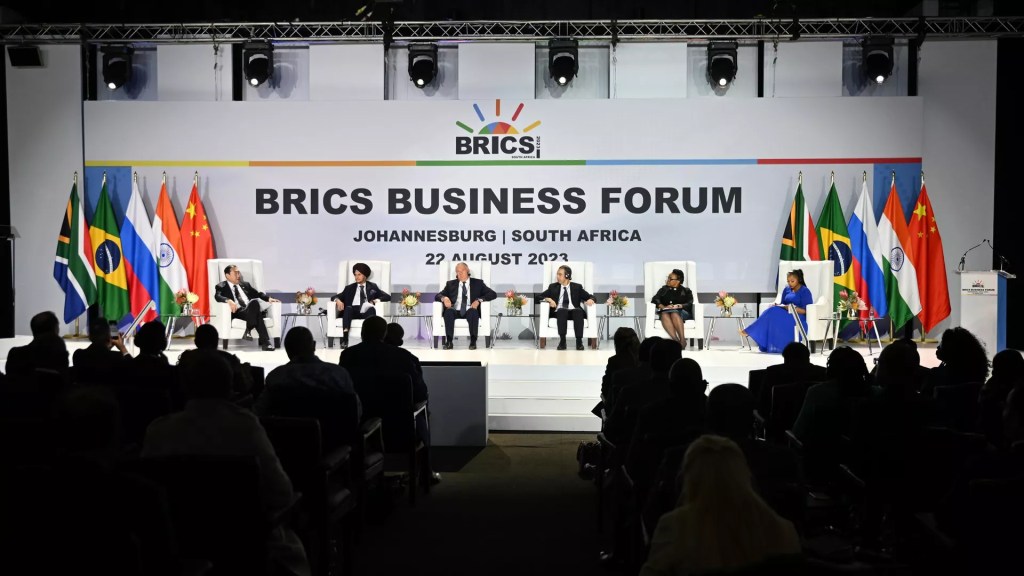
Chinese President Xi Jinping defined all the major decisions embedded in the 15th BRICS summit in South Africa as “historic”. That may be seen as an understatement.

It will take time for the Global South, or Global Majority, or “Global Globe” (copyright President Lukashenko), not to mention the stunned collective West, to fully grasp the enormity of the new strategic stakes.

President Putin, for his part, described the negotiations on BRICS expansion as quite difficult. By now a relatively accurate picture is emerging of what really went down on that table in Johannesburg.

India wanted 3 new members. China wanted as many as 10. A compromise was finally reached, with 6 members: Egypt, Iran, Saudi Arabia, United Arab Emirates (UAE), Argentina and Ethiopia.

So from now on it’s BRICS 11. And that’s just the beginning. Starting with the rotating Russian presidency of BRICS on January 1, 2024, more partners will be progressively included, and most certainly a new round of full members will be announced at the BRICS 11 summit in Kazan in October next year.

So we may soon progress to BRICS 20 – on the way to BRICS 40. The G7, for all practical purposes, is sliding towards oblivion.

Bur first things first. At that fateful table in Johannesburg, Russia supported Egypt. China went all out for Persian Gulf magic: Iran, UAE and the Saudis. Of course: Iran-China are already deep into a strategic partnership, and Riyadh is already accepting payment for energy in yuan.

Brazil and China supported Argentina, Brazil’s troubled neighbor, running the risk of having its economy fully dollarized, and also a key commodity provider to Beijing. South Africa supported Ethiopia. India, for a series of very complex reasons, was not exactly comfortable with 3 Arab/Muslim members (Saudi Arabia, UAE, Egypt). Russia assuaged New Delhi’s fears.

All of the above respects geographic principles and imprints the notion of BRICS representing the Global South. But it goes way beyond that, blending cunning strategy and no-nonsense realpolitik.

India was mollified because Russian Foreign Minister Sergey Lavrov, at the table in Johannesburg negotiating on behalf of President Putin, and highly respected by New Delhi, fully understood that a new, single BRICS currency is a long way away. What really matters, short and medium term, is expanding intra-BRICS trade in their national currencies.

That was stressed by New Development Bank (NDB) president Dilma Rousseff in her report to the South African summit hosts – even as Brazilian President Lula once again emphasized the importance of setting up a work group to discuss a BRICS currency.

Lavrov understood how New Delhi is absolutely terrified of secondary sanctions by the US, in case its BRICS role gets too ambitious. Prime Minister Modi is essentially hedging between BRICS and the completely artificial imperial obsession embedded in the terminology “Indo-Pacific” – which masks renewed containment of China. The Straussian neo-con psychos in charge of US foreign policy are already furious with India buying loads of discounted Russian oil.

New Delhi’s support for a new BRICS currency would be interpreted in Washington as all-out trade war – and sanctions dementia would follow. In contrast, Saudi Arabia’s MbS doesn’t care: he’s a top energy producer, not consumer like India, and one of his priorities is to fully court his top energy client, Beijing, and pave the way for the petroyuan.

It Takes Just a Single Strategic Move

Now let’s get into the strategic stakes. For all practical purposes, in Eurasian terms, BRICS 11 is now on the way to lord over the Arctic Sea Route; the International North South Transportation Corridor (INSTC); BRI’s East West Corridors; the Persian Gulf; the Red Sea; and the Suez Canal.

That blends several overland corridors with several nodes of the Maritime Silk Roads. Nearly total integration in the Heartland and the Rimland. All with just a single strategic move in the geopolitical/geoeconomic chessboard.

Much more than an increase of BRICS 11 collective GDP to 36% of the world’s total (already larger than the G7), with the group now encompassing 47% of the world’s population, the top geopolitical and geoeconomic breakthrough is how BRICS 11 is about to literally break the bank on the energy and commodities market fronts.

By incorporating Iran, Saudi Arabia and the UAE, BRICS 11 instantly shines on as an oil and gas powerhouse. BRICS 11 now controls 39% of global oil exports; 45.9% of proven reserves; and at least 47.6% of all oil produced globally, according to InfoTEK.

With BRICS 11 possibly including Venezuela, Algeria and Kazakhstan as new members as early as in 2024, it may control as much as 90% of all oil and gas traded globally.

Inevitable corollary: operations settled in local currencies bypassing the US dollar. And inevitable conclusion: petrodollar in a coma. The Empire of Chaos and Plunder will lose its free lunch menu: control of global oil prices and means to enforce “diplomacy” via a tsunami of unilateral sanctions.

Already in the horizon, direct BRICS 11-OPEC+ symbiosis is inevitable. OPEC+ is effectively run by Russia and Saudi Arabia.

A ground-shaking geoeconomic reorientation is at hand, involving everything from routes plied by global supply chains and new BRICS roads to the progressive interconnection of BRI, the Saudi Vision 2030 and massive port expansion in the UAE.

By choosing Ethiopia, BRICS expands its African reach on mining, minerals and metals. Ethiopia is rich in gold, platinum, tantalum, copper, niobium and offers vast potential in oil and natural gas exploration. Saudi Arabia and the UAE, incidentally, are also involved in mining.

This all spells out fast, progressive integration of North Africa and West Asia.

How Diplomacy Goes a Long Way

The BRICS 11 Shock of the New, in the energy sphere, is a sharp historical counterpoint to the 1973 oil shock, after which Riyadh started wallowing in petrodollars. Now Saudi Arabia under MbS is operating a tectonic shift, in the process of becoming strategically aligned with Russia-China-India-Iran.

Diplomatic coup does not even begin to describe it. This is the second stage of the Russian-initiated and Chinese-finalized rapprochement between Riyadh and Tehran, recently sealed in Beijing. The Russia-China strategic leadership, working patiently in synch, never lost sight of the ball.

Now compare it with collective West’s “strategies”, such as the G7-imposed oil price cap. Essentially the G7 “coalition of the willing” self-imposed a price cap on Russian crude imported by sea. The result is that they had to start buying way more oil products from Global South nations which ignored the price cap and duly increased their purchase of Russian crude.

Guess who are the top two: BRICS members China and India.

After wallowing in several stages of denial, the collective West may – or may not – realize it’s a fool’s dream to attempt to “de-couple” the West-ruled part of the global economy from China, whatever is spewed out by Washington.

BRICS 11 now shows, graphically, how the “Global South/Global Majority/”Global Globe” is more non-aligned with the West than anytime in recent history.

By the way, the president of the G77, Cuban leader Diaz-Canel, was at the BRICS summit representing the de-facto new Non-Aligned Movement (NAM): the G77 actually incorporates no less than 134 nations. Most are African. Xi Jinping in Johannesburg met in person with the leaders of most of them.

The collective West, in panic, regards all of the above as “dangerous”. So the last refuge is, predictably, rhetorical: “de-coupling”, “de-risking”, and similar idiocies.

Yet that may also get practically dangerous. As in the first ever trilateral summit in Camp David on August 18 between the Empire and two Asian vassals, Japan and South Korea. That may be interpreted as the first move towards a military-political Asian NATO even more toxic than Quad or AUKUS, obsessed to simultaneously contain China, Russia and the DPRK.

The Collective Outstripping of the Global North

The UN lists 152 nations in the world as “developing countries”. BRICS 11 is aiming at them – as they outstrip the Global North on everything from population growth to overall contribution to global GDP growth measured by PPP.

In the past 10 years since the announcement of BRI first in Astana and then in Jakarta, Chinese financial institutions have lent nearly $1 trillion for infrastructure connectivity projects across the Global South. The upcoming BRI forum in Beijing will signal a renewed drive. That’s the BRI-BRICS symbiosis.

In the G20 last year, China was the first nation to lobby for the inclusion of the 55-member African Union (AU). That may happen at the G20 summit next month in New Delhi; in that case, Global South representation will be close to parity with the Global North.

Claims that Beijing was organizing a malign conspiracy to turn BRICS into a weapon against the G7 are infantile. Realpolitik – and geoeconomic indicators – are dictating the terms, configuring the Shock of the New: the G7’s irreversible irrelevance with the rise of BRICS 11.

The BRICS Reshape the Global Geopolitical Map

By Manuel F. Diaz

Source: InfoBrics.org

Thirty years ago, pluripolarity was far from a reality in a world that had been under U.S. hegemony since the collapse of the Soviet Union in 1991. Today, however, humanity is taking important steps toward forming a plural geopolitics whose protagonists are the emerging countries that challenge Western power.

The turning point towards a new form of integration, which will generate a new world political balance, occurred in 2009 when Brazil, Russia, India, and China held the first BRIC summit.

After the incorporation of South Africa to this group in 2010, the BRICS has generated such real prospects that other nations with productive capacity and diversified economies have expressed interest in joining. Among them are Saudi Arabia, Algeria, Argentina, the United Arab Emirates, and Mexico.

In the article “Can the BRICS Trump the IMF and the World Bank?,” Palestinian-American journalist Ramzy Baroud noted that “one of the biggest opportunities and challenges” the BRICS now faces is expanding its membership while maintaining its current growth.

Recent financial reports revealed that the BRICS have the world’s largest gross domestic product (GDP) and that economic bloc contributes 31.5 percent of global GDP, while the Group of Seven (G7) stuck at 30.7 percent.

The International Monetary Fund (IMF) and the World Bank (WB) are known for providing financial support to developing countries under conditions that, under the pretext of defending human rights or democracy, seek to favor the privatization of public goods and the opening of domestic markets for Western foreign investors.

Due to these politically-driven conditionalities, the struggle for alternatives to the IMF-WB mechanisms becomes a political task. The Global South requires international institutions that are not interested in indirectly manipulating or controlling national economies.

That is the call for the BRICS to evolve towards integration schemes that go beyond the exclusively economic realm, although the basis of the fight against the U.S.-controlled institutions is the formation of an alternative economy.

Recently, the BRICS placed a capital of US$50 billion for the launch of their New Development Bank (NDB), which will be chaired by former Brazilian president Dilma Rousseff.

This happened at a time when presidents Xi Jinping (China) and Lula da Silva (Brazil) showed a shared interest in influencing the peaceful solution of the Ukrainian conflict.

Under these circumstances, to argue that the BRICS are a group with purely economic interests is to ignore much of the its history.

“The timing of the BRICS expansion, the stern political discourse of its members, potential members and allies, the repeated visits by top Russian and Chinese diplomats to Africa and other regions of the Global South, etc… indicate that the BRICS have become the new geopolitical, economic and diplomatic platform for the countries of the South,” said Baroud.

Meanwhile, the Western powers, whose economies are struggling to stay afloat, are closely and suspiciously watching the changes taking place in the Global South at the hands of the BRICS.

A Dollar Collapse Is Now In Motion – Saudi Arabia Signals The End Of Petro Status

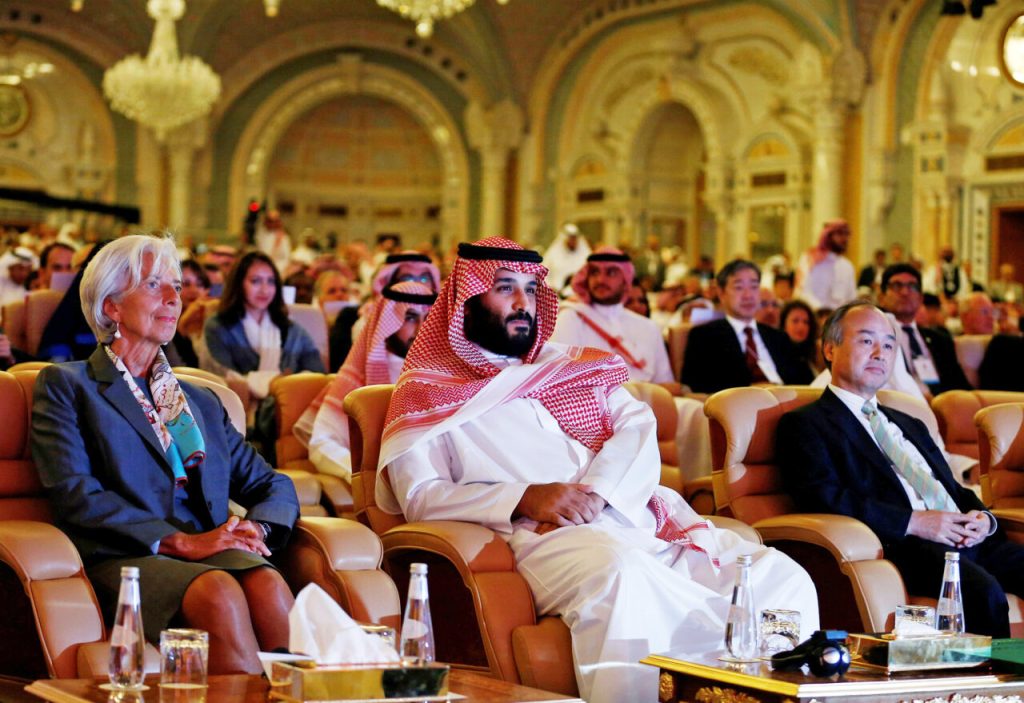
Saudi Crown Prince Mohammed bin Salman, Masayoshi Son, SoftBank Group Corp. Chairman and CEO, and Christine Lagarde, International Monetary Fund (IMF) Managing Director, attend the Future Investment Initiative conference in Riyadh, Saudi Arabia October 24, 2017. REUTERS/Faisal Al Nasser

By Brandon Smith

Source: Alt-Market.us

The decline of a currency’s world reserve status is often a long process rife with denials. There are numerous economic “experts” out there that have been dismissing any and all warnings of dollar collapse for years. They just don’t get it, or they don’t want to get it. The idea that the US currency could ever be dethroned as the defacto global trade mechanism is impossible in their minds.

One of the key pillars keeping the dollar in place as the world reserve is its petro-status, and this factor is often held up as the reason why the Greenback cannot fail. The other argument is that the dollar is backed by the full force of the US military, and the US military is backed by the US Treasury and the Federal Reserve – In other words, the dollar is backed by…the dollar; it’s a very circular and naive position.

These sentiments are not only pervasive among mainstream economists, they are also all over the place within the alternative media. I suspect the main hang-up for liberty movement analysts is the notion that the globalist establishment would ever allow the dollar or the US economy to fail. Isn’t the dollar system their “golden goose”?

The answer is no, it is NOT their golden goose. The dollar is just another stepping stone towards their goal of a one-world economy and a one-world currency. They have killed the world reserve status of other currencies in the past, why wouldn’t they do the same to the dollar?

Globalist white papers and essays specifically outline the need for a diminished role for the US currency as well as a decline in the American economy in order to make way for Central Bank Digital Currencies (CBDCs) and a new global currency system controlled by the IMF. I warned about this years go, and my position has always been that the derailment of the dollar would likely start with the end of its petro status.

In 2017 I published an article titled ‘Saudi Coup Signals War And The New World Order Reset’. I noted at the time that the sudden power shift over to crown prince Mohammed Bin Salman indicated a change in Saudi Arabia’s relationship to the US. I stated that:

To understand how drastic this coup has been, consider this — for decades Saudi Kings maintained political balance by doling out vital power positions to separate, carefully chosen successors. Positions such as Defense Minister, the Interior Ministry and the head of the National Guard. Today, Mohammed Bin Salman controls all three positions. Foreign policy, defense matters, oil and economic decisions and social changes are now all in the hands of one man.”

The rise of MBS was backed by the Public Investment Fund (PIF), a fund comprised of trillions of dollars supplied by globalists within Carlyle Group (Bush family, etc.), Goldman Sachs, Blackstone and Blackrock. MBS garnered the favor of the globalists for one specific reason – He openly supported their “Vision For 2030”, a plan for the dismantling of “fossil fuel” based energy and the implementation of carbon controls. Yes, that’s right, the head of Saudi Arabia is backing the eventual end of oil based energy, and part of that includes the end of the dollar as the petro currency.  

In exchange for their cooperation, the Saudis are being given access to ESG-like funding as well as access to AI advancements and the so-called “digital economy.”  It sounds crazy, but there is much talk of AI developments to cure numerous health problems and extend lifespan.  With those kinds of promises, it’s not surprising that Saudi elites would be willing to dump the dollar and even oil.

In 2017 I noted that:

I believe the next phase of the global economic reset will begin in part with the breaking of petrodollar dominance. An important element of my analysis on the strategic shift away from the petrodollar has been the symbiosis between the U.S. and Saudi Arabia. Saudi Arabia has been the single most important key to the dollar remaining as the petrocurrency from the very beginning.”

I believed that the threat to petro status would ultimately be spurred on by a proxy war between East and West:

World economic war is the real name of the game here, as the globalists play puppeteers to East and West. It is a geopolitical crisis they will have created to engineer public support for a solution they predetermined.”

Back then I thought that such a proxy war would be initiated in the Middle East, possibly in Iran. However, it’s clear that Ukraine is the powderkeg the globalists have chosen, at least for now, with Taiwan being the next shoe to drop.

In the years since I made these predictions the relationship between Saudi Arabia, Russia and China has grown very close. Arms deals and energy deals are becoming a mainstay of trade and this has led to a quiet but steady distancing of the Saudis from the dollar. This past week, the dominoes were set in motion for dollar collapse when Saudi Arabia announced at Davos that they are now willing to trade oil in alternative currencies.

In response, Xi Jinping pledged to ramp up efforts to promote the use of the Chinese yuan in energy deals. This falls in line with another article I wrote in 2017 titled ‘The Economic End Game Continues,’ in which I described how conflict with Eastern nations (China and Russia) would be exploited to create a catalyst for the end of the dollar’s petro status.

The importance of the Saudi announcement cannot be overstated; this is the beginning of the end of the dollar. The dollar’s world reserve status is largely dependent on its petro-status. Without one, you cannot have the other. This is almost the exact same dynamic that led to the implosion of the British Sterling decades ago as the global petro currency which resulted in the rise of the dollar to take its place.

This time, though, it will not be a single foreign currency that takes on the role of world reserve, it will be a basket currency system controlled by the IMF called Special Drawing Rights, along with a single global digital currency that is yet to be named but is now under development.

The consequences of the loss of reserve status will be devastating to the US economy. It is the only glue holding our system together – The ability to defer inflation by exporting it overseas is a superpower only the US enjoys. The Fed can print money perpetually if it wants to in order to fund the government or prop up US markets, as long as foreign central banks and corporate banks are willing to absorb dollars as a tool for global trade. If the dollar is no longer the primary international trade mechanism, the trillions upon trillions of dollars the Fed has created from thin air over the years will all come flooding back to the US through various avenues, and hyperinflation (or hyperstagflation) will be the result.

This dynamic is already in play, as foreign holders of US debt and dollars have been dumping them at record pace since 2017. The process continues at a time when the Federal Reserve is cutting it’s balance sheet and raising interest rates, which means there is no longer a buyer of last resort.

This may be why multiple foreign central banks have renewed their purchases of gold reserves and are once again stockpiling precious metals. They seem to be well aware of what is about to happen to the dollar, while the American public is kept in the dark.

The effects of the decline of the dollar may not be immediately felt, or become obvious for another year or two. What will happen is consistent inflation on top of the high prices we are already dealing with. Meaning, the Federal Reserve will continue to hold interest rates higher and prices will barely budge or they may climb in spite of monetary tightening. Even in the face of a major recessionary contraction, which I predict will be triggered starting in April, prices will STILL remain higher.

All the while the mainstream media and government economists will say they have “no idea” why inflation is so persistent, and that “nobody could have seen this coming.” Some of us saw it coming, but only because we accept the reality that the dollar’s days are numbered.

Goodbye G20, hello BRICS+

The increasingly irrelevant G20 Summit concluded with sure signs that BRICS+ will be the way forward for Global South cooperation.

By Pepe Escobar

Source: The Cradle

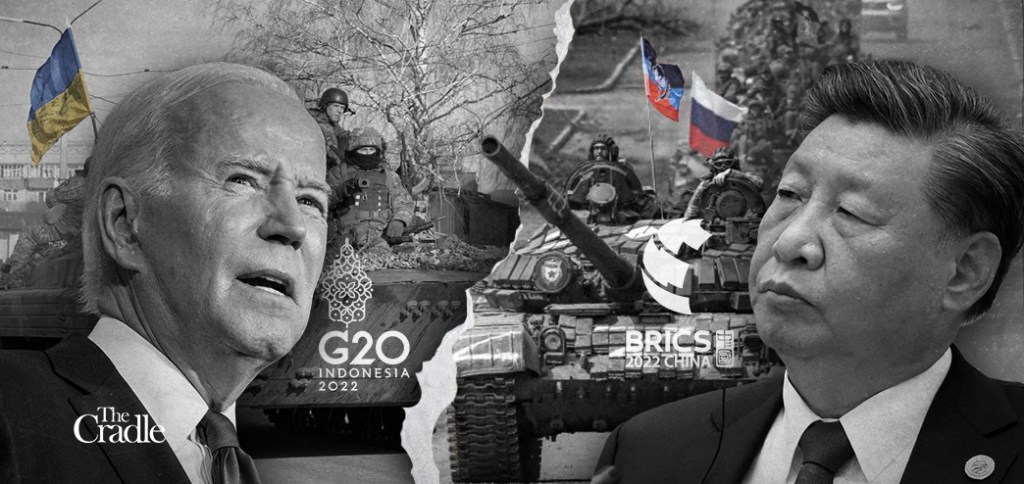
The redeeming quality of a tense G20 held in Bali – otherwise managed by laudable Indonesian graciousness – was to sharply define which way the geopolitical winds are blowing.

That was encapsulated in the Summit’s two highlights: the much anticipated China-US presidential meeting – representing the most important bilateral relationship of the 21st century – and the final G20 statement.

The 3-hour, 30-minute-long face-to-face meeting between Chinese President Xi Jinping and his US counterpart Joe Biden – requested by the White House – took place at the Chinese delegation’s residence in Bali, and not at the G20 venue at the luxury Apurva Kempinski in Nusa Dua.

The Chinese Ministry of Foreign Affairs concisely outlined what really mattered. Specifically, Xi told Biden that Taiwan independence is simply out of the question. Xi also expressed hope that NATO, the EU, and the US will engage in “comprehensive dialogue” with Russia. Instead of confrontation, the Chinese president chose to highlight the layers of common interest and cooperation.

Biden, according to the Chinese, made several points. The US does not seek a New Cold War; does not support “Taiwan independence;” does not support “two Chinas” or “one China, one Taiwan”; does not seek “decoupling” from China; and does not want to contain Beijing.

However, the recent record shows Xi has few reasons to take Biden at face value.

The final G20 statement was an even fuzzier matter: the result of arduous compromise.

As much as the G20 is self-described as “the premier forum for global economic cooperation,” engaged to “address the world’s major economic challenges,” the G7 inside the G20 in Bali had the summit de facto hijacked by war. “War” gets almost double the number of mentions in the statement compared to “food” after all.

The collective west, including the Japanese vassal state, was bent on including the war in Ukraine and its “economic impacts” – especially the food and energy crisis – in the statement. Yet without offering even a shade of context, related to NATO expansion. What mattered was to blame Russia – for everything.

The Global South effect

It was up to this year’s G20 host Indonesia – and the next host, India – to exercise trademark Asian politeness and consensus building. Jakarta and New Delhi worked extremely hard to find wording that would be acceptable to both Moscow and Beijing. Call it the Global South effect.

Still, China wanted changes in the wording. This was opposed by western states, while Russia did not review the last-minute wording because Foreign Minister Sergey Lavrov had already departed.

On point 3 out of 52, the statement “expresses its deepest regret over the aggression of the Russian Federation against Ukraine and demands the complete and unconditional withdrawal of armed forces from the territory of Ukraine.”

“Russian aggression” is the standard NATO mantra – not shared by virtually the whole Global South.

The statement draws a direct correlation between the war and a non-contextualized “aggravation of pressing problems in the global economy – slowing economic growth, rising inflation, disruption of supply chains, worsening energy, and food security, increased risks to financial stability.”

As for this passage, it could not be more self-evident: “The use or threat of use of nuclear weapons is inadmissible. The peaceful resolution of conflicts, efforts to address crises, as well as diplomacy and dialogue, are vital. Today’s era must not be of war.”

This is ironic given that NATO and its public relations department, the EU, “represented” by the unelected eurocrats of the European Commission, don’t do “diplomacy and dialogue.”

Fixated with war

Instead the US, which controls NATO, has been weaponizing Ukraine, since March, by a whopping $91.3 billion, including the latest presidential request, this month, of $37.7 billion. That happens to be 33 percent more than Russia’s total (italics mine) military spending for 2022.

Extra evidence of the Bali Summit being hijacked by “war” was provided by the emergency meeting, called by the US, to debate what ended up being a Ukrainian S-300 missile falling on a Polish farm, and not the start of WWIII like some tabloids hysterically suggested.

Tellingly, there was absolutely no one from the Global South in the meeting – the sole Asian nation being the Japanese vassal, part of the G7.

Compounding the picture, we had the sinister Davos master Klaus Schwab once again impersonating a Bond villain at the B20 business forum, selling his Great Reset agenda of “rebuilding the world” through pandemics, famines, climate change, cyber attacks, and – of course – wars.

As if this was not ominous enough, Davos and its World Economic Forum are now ordering Africa – completely excluded from the G20 – to pay $2.8 trillion to “meet its obligations” under the Paris Agreement to minimize greenhouse gas emissions.

The demise of the G20 as we know it

The serious fracture between Global North and Global South, so evident in Bali, had already been suggested in Phnom Penh, as Cambodia hosted the East Asia Summit this past weekend.

The 10 members of ASEAN had made it very clear they remain unwilling to follow the US and the G7 in their collective demonization of Russia and in many aspects China.

The Southeast Asians are also not exactly excited by the US-concocted IPEF (Indo-Pacific Economic Framework), which will be irrelevant in terms of slowing down China’s extensive trade and connectivity across Southeast Asia.

And it gets worse. The self-described “leader of the free world” is shunning the extremely important APEC (Asia-Pacific Economic Cooperation) summit in Bangkok at the end of this week.

For very sensitive and sophisticated Asian cultures, this is seen as an affront. APEC, established way back in 1990s to promote trade across the Pacific Rim, is about serious Asia-Pacific business, not Americanized “Indo-Pacific” militarization.

The snub follows Biden’s latest blunder when he erroneously addressed Cambodia’s Hun Sen as “prime minister of Colombia” at the summit in Phnom Penh.

Lining up to join BRICS

It is safe to say that the G20 may have plunged into an irretrievable path toward irrelevancy. Even before the current Southeast Asian summit wave – in Phnom Penh, Bali and Bangkok – Lavrov had already signaled what comes next when he noted that “over a dozen countries” have applied to join BRICS (Brazil, Russia, India, China, South Africa).

Iran, Argentina, and Algeria have formally applied: Iran, alongside Russia, India, and China, is already part of the Eurasian Quad that really matters.

Turkey, Saudi Arabia, Egypt, and Afghanistan are extremely interested in becoming members. Indonesia just applied, in Bali. And then there’s the next wave: Kazakhstan, UAE, Thailand (possibly applying this weekend in Bangkok), Nigeria, Senegal, and Nicaragua.

It’s crucial to note that all of the above sent their Finance Ministers to a BRICS Expansion dialogue in May. A short but serious appraisal of the candidates reveals an astonishing unity in diversity.

Lavrov himself noted that it will take time for the current five BRICS to analyze the immense geopolitical and geoeconomic implications of expanding to the point of virtually reaching the size of the G20 – and without the collective west.

What unites the candidates above all is the possession of massive natural resources: oil and gas, precious metals, rare earths, rare minerals, coal, solar power, timber, agricultural land, fisheries, and fresh water. That’s the imperative when it comes to designing a new resource-based reserve currency to bypass the US dollar.

Let’s assume that it may take up to 2025 to have this new BRICS+ configuration up and running. That would represent roughly 45 percent of confirmed global oil reserves and over 60 percent of confirmed global gas reserves (and that will balloon if gas republic Turkmenistan later joins the group).

The combined GDP – in today’s figures – would be roughly $29.35 trillion; much larger than the US ($23 trillion) and at least double the EU ($14.5 trillion, and falling).

As it stands, BRICS account for 40 percent of the global population and 25 percent of GDP. BRICS+ would congregate 4.257 billion people: over 50 percent of the total global population as it stands.

BRI embraces BRICS+

BRICS+ will be striving towards interconnection with a maze of institutions: the most important are the Shanghai Cooperation Organization (SCO), itself featuring a list of players itching to become full members; strategic OPEC+, de facto led by Russia and Saudi Arabia; and the Belt and Road Initiative (BRI), China’s overarching trade and foreign policy framework for the 21st century. It is worth pointing out that early all crucial Asian players have joined the BRI.

Then there are the close links of BRICS with a plethora of regional trade blocs: ASEAN, Mercosur, GCC (Gulf Cooperation Council), Eurasia Economic Union (EAEU), Arab Trade Zone, African Continental Free Trade Area, ALBA, SAARC, and last but not least the Regional Comprehensive Economic Partnership (RCEP), the largest trade deal on the planet, which includes a majority of BRI partners.

BRICS+ and BRI is a match everywhere you look at it – from West Asia and Central Asia to the Southeast Asians (especially Indonesia and Thailand). The multiplier effect will be key – as BRI members will be inevitably attracting more candidates for BRICS+.

This will inevitably lead to a second wave of BRICS+ hopefuls including, most certainly, Azerbaijan, Mongolia, three more Central Asians (Uzbekistan, Tajikistan, and gas republic Turkmenistan), Pakistan, Vietnam, and Sri Lanka, and in Latin America, a hefty contingent featuring Chile, Cuba, Ecuador, Peru, Uruguay, Bolivia, and Venezuela.

Meanwhile, the role of the BRICS’s New Development Bank (NDB) as well as the China-led Asia Infrastructure Investment Bank (AIIB) will be enhanced – coordinating infrastructure loans across the spectrum, as BRICS+ will be increasingly shunning dictates imposed by the US-dominated IMF and the World Bank.

All of the above barely sketches the width and depth of the geopolitical and geoeconomic realignments further on down the road – affecting every nook and cranny of global trade and supply chain networks. The G7’s obsession in isolating and/or containing the top Eurasian players is turning on itself in the framework of the G20. In the end, it’s the G7 that may be isolated by the BRICS+ irresistible force.

The Drumbeats of War and US-NATO Propaganda: “China is Bad” and “They are Coming to Enslave Us”

The Truth about China’s Imperial Ambitions, the Uyghurs and What the West Really Fears

By Timothy Alexander Guzman

Source: Silent Crow News

Western media outlets are playing the drumbeats of war by warning the public that a new Chinese empire is going to develop into an unstoppable force capable of ruling the world with an iron fist.  They claim that under the leadership of the Chinese Communist Party (CCP), they will control every country and human being on earth.  Overall, it’s an absurd claim.  It is fair to say that China under the leadership of the CCP has several issues that concerns the Chinese public with a social credit score system, Zero Covid policy rules and a nation-wide surveillance system that is Orwellian to say the least.  China also had a one child policy that has led to a decline in its population which was and still is problematic for its future when it comes to their labor force and economy, but they ended that policy in 2016.  Whatever faults China has, it is not looking to rule the world despite what Western countries claim especially the United States who say that Beijing’s policies reflect a growing appetite for imperial expansion.  On May 25th, 2017, Reuters published ‘China says new Silk Road not about military ambitions’ reported on what China’s Defense ministry had said about China’s future “China’s ambition to build a new Silk Road is not about seeking to expand its military role abroad nor about seeking to set up foreign bases.” The Chinese Defense Ministry spokesman Ren Guoqiang told a regular monthly news briefing conference that China’s Silk Road was not expanding militarily nor setting up bases in any sovereign country and that the accusations were “groundless.” Guoqiang said that “the new Silk Road is about cooperation and trade” and that “The Belt and Road initiative has no military or geostrategic intent. China is not seeking the right to guide global affairs, or spheres of influence, and will not interfere in the internal affairs of other countries.”

According to a report from September 23rd, 2020, by the National Herald India titled ‘China will never seek expansion, has no intention to fight either ‘Cold War’ or ‘hot war’, says Xi Jinping’ as Xi Jinping declared in a pre-recorded video sent to the United Nations meeting that “We will continue to narrow differences and resolve disputes with others through dialogue and negotiation” he continued “We will never seek hegemony, expansion, or sphere of influence. We have no intention to fight either a Cold War or a hot war with any country.”   The report also mentioned India’s Prime Minister Narendra Modi’s surprise visit to the Ladakh region a few months prior where he said that “the era of expansionism is over and that the history is proof that “expansionists” have either lost or perished” in what the report described as a “clear message” to China.  “Xi, also the General Secretary of the ruling Communist Party of China and the Commander-in-Chief of the Chinese military, said his country will not pursue development behind closed doors.” Xi made it clear that a new plan for development for growth domestically and internationally will create more opportunities for China’s economy.  Xi said the following:

Rather, we aim to foster, over time, a new development paradigm with domestic circulation as the mainstay and domestic and international circulations reinforcing each other. This will create more space for China’s economic development and add impetus to global economic recovery and growth

The report also mentioned that during the Covid-19 pandemic, US President, Donald Trump ramped up tensions with China and “demanded that China, where the coronavirus emerged, be held accountable for failure to control the virus and for allowing it to spread across the world” he continued, “As we pursue this bright future, we must hold accountable the nation which unleashed this plague onto the world: China”.  Trump’s rhetoric including his administration slapping tariffs on China’s goods surely increased tensions between Washington and Beijing.  The National Herald India quoted what Xi had said about China’s own decisions that will benefit its own economy and path of development and that it should be respected, “one should respect a country’s “independent choice of development path and model.”  Xi made a point that the world is diverse, and that it can inspire human advancements:

The world is diverse in nature, and we should turn this diversity into a constant source of inspiration driving human advancement. This will ensure that human civilisations remain colourful and diversified

Conflicts and Disagreements: China, India, and the Soviet Union

The history between China and India involved conflicts over border issues.  In 1962, China had a dispute with India over Aksai Chin and Arunachal Pradesh borders.  The conflict was mostly among ground troops of both sides which did not involve any Air force or Naval forces.  What started the conflict was China’s construction of a road that connected the Chinese regions of Tibet and Xinjiang.  However, Aksai Chin was claimed by India.  So, in the months of October and November the Sino-Indian War began.  Several violent conflicts also occurred between China and India after the 1959 Tibetan uprising due to India’s recognition of the Dalai Lama, or who is known as Gyalwa Rinpoche to the Tibetan people.  In an important note to consider, the Dalai Lama was supported by the CIA for many years.  The CIA financially supported the Dalai Lama from the late 1950s until the mid-1970s with more than $180,000 a year for the CIA’s Tibetan program to support anti-China activities and to create foreign offices within Tibet to lobby for international support which was a concern for China. 

In 1960, India had constructed a defensive policy to disrupt China’s military patrols and its logistics in what was called Forward Policy  that placed Indian outposts along the borders in the north of the McMahon Line, the eastern portion of the Line of Actual Control.   However, China did try to implement diplomatic settlements between 1960 and 1962, but India rejected the proposal allowing China to abandon diplomacy and became aggressive along the disputed borders. China defeated Indian forces in Rezang La in Chushul in the west and Tawang in the east.  China declared a ceasefire on November 20th, 1962.  The war ended as China withdrew to its areas claimed in the ‘Line of Actual Control.’  Matters became complicated when the Soviet Union sold MiG fighter aircrafts to India in a show of support since the US and the UK refused to sell arms to India.  However, tensions between China and the Soviet Union were also high during that time which was known as the ‘Sino-Soviet split’ over ideological differences in Marxist-Leninist theories during the Cold War.  There were various agreements between China and India with no progress for peace until 2006.   Although Indian officials were concerned with China’s growing military power and its relationship with Pakistan (India’s main rival), China’s Silk Road opened the doors for peace between both nations.  In October of 2011, China and India formulated border mechanisms regarding the Line of Actual Control as both resumed bilateral army exercises between China and Indian troops by early 2012.  In 2013, what was known as the Depsang standoff, India had agreed to demolish and remove several ‘live-in bunkers’ in the Chumar sector along with the removal of observation posts built along the border among other things that made the resolution of the dispute a success, so the Chinese military withdrew it forces, ending the dispute in May 2013.  Although there are some disagreements between both countries still exist over their borders policies, today China and India are part of the BRICS coalition.

The Sino-Vietnamese War of 1979

On December 21st, 1978, Vietnam launched an attack on the Khmer Rouge.  After more than 10 years of fighting, Vietnam had successfully defeated the Khmer Rouge ending Pol Pot’s reign of terror.  Then in February 1979, China had declared war with Vietnam over its borders.  Now Vietnam was facing a two-front war. China’s invasion was a surprise to the world because China supported Vietnam with its wars against France and the US.  From 1965 until 1969, China had more than 300,000 troops in the Vietnam war with more than 1,000 members from the People’s Liberation Army (PLA) who were killed with 4,300 wounded. 

However, it all changed due to China’s domination of Vietnam for centuries which created animosity among the Vietnamese government and its people towards Beijing thus creating tensions between both countries.  Conflicts on the border also developed between China and the Soviet Union in 1969 during the Sino-Soviet split, so Vietnam had a dilemma, it had to choose one of them as an ally.  On November 3, 1978, Vietnam signed the Treaty of Friendship and Cooperation with the Soviet Union that offered security assurances.  Since tensions were high at the time, more than 150,000 Chinese who were living in Vietnam had fled. Chinese leader Deng Xiaoping and CCP officials viewed Vietnam as ungrateful and traitorous.  The Chinese saw the treaty as a threat since the Soviets had a similar treaty with Mongolia which in a way allowed the Soviets to surround China.  On December 7, 1978, China’s Central Military Commission decided to launch a “limited war” along their borders and at the same time, Vietnam had invaded Cambodia to destroy the Khmer Rouge.

Since Vietnam had border clashes with the China-backed Khmer Rouge in Cambodia along with Beijing’s decision to cut aid to Hanoi, it decided to partner with Moscow.  On January 29th, 1979, for the first time, Chinese Vice-premier Deng Xiaoping went to the US and reportedly told President Jimmy Carter that “The child is getting naughty, it is time he got spanked.”   A couple of weeks later, on February 15th, China terminated the 1950 Sino-Soviet Treaty of Friendship, Alliance and Mutual Assistance and Xiaoping declared that China was going to attack Vietnam to support its ally, the Khmer Rouge of Cambodia among other reasons including the plan to reclaim the Vietnamese occupied Spratly Islands.  China wanted to prevent the Soviet Union from intervening on Vietnam’s behalf, so Xiaoping warned the Soviets that China’s forces were prepared for war.  Declaring an emergency, China deployed all of the PLA forces along the Sino-Soviet border and set up a military command station in Xinjiang, they also evacuated more than 300,000 civilians from the area.

China eventually suffered a defeat by the Vietcong since its military was not prepared to fight an experienced fighting force who previously defeated two Western powers, France, and the US.  It was reported that experienced Vietnamese ‘tank-killing teams’ destroyed or damaged more than 280 tanks and armored vehicles during the war.  China avoided the use of its Air Force and Navy since it promised the Soviets and Americans a limited war against Vietnam.  China also knew that Vietnam had an experienced military as well as having one of the best anti-air capabilities in the world.  After two short weeks of fighting, China began withdrawing its troops.  By March 16, Chinese troops had a ‘scorched-earth campaign’ in Vietnam destroying bridges, factories, mines, farms, and crops.  It is estimated that China had between 7,900 to 26,000 troops killed and between 23,000 to 37,000 wounded.  Vietnam had between 20,000 to 50,000 troops and civilians killed and wounded.  China clearly had a difficult time with Vietnam. 

China’s history with its neighbors shows that it may be difficult even today if they decided to become an imperialist power subjugating the world to its demands because it would face an uphill battle that will become economically and politically costly and that will collapse its economy and society.  Before the US became a global empire, they made sure they contained and controlled its own backyard and that was the Caribbean and Latin America after the Spanish-American War of 1898.  China would have to control its own backyard against several nations including Russia, India, Vietnam, and others.  China understands that imperial projects to dominate the world is a risk not worth taking. 

Remember, China was on the receiving end of Japanese Imperialism that practically destroyed its society.  In 1931, Imperial Japan had invaded the Chinese province of Manchuria for raw materials to fuel its industries, and by 1937 they controlled many areas of China.  The Imperial Japanese war crimes mounted against the Chinese people.  China understands the consequences of war because it sees what has happened to the US and its military adventures which has led to its decline.  It knows it will not benefit anyone, in fact wars can destabilize regions, destroy economies, and disrupt societal norms and China is not at all interested in any of that.  They want to rebuild their civilization.      

The age of empires is over.  A new multipolar world is needed now more than ever before where no single entity or centralized power could rule over any country who wants to remain sovereign.  That would start an era of lasting peace around the world.  Of course, there are no guarantees that total peace would prevail in a multipolar world because there will be bad actors who will prefer a globalized world order over countries who want sovereignty, but in a multipolar world order, wars can be avoided.  It would be a good start where sovereign countries would respect each other’s boundaries and work out their differences.  That’s the way it should be instead of a group of globalist psychopaths making geopolitical and economic decisions to change the social fabric of every country on the planet.         

Inside China: The Surveillance State

China’s internal problems is a stain on its reputation.  China’s surveillance state is indeed problematic.  In 2018, the CCP installed more than 200 million surveillance cameras with an increase in facial recognition technology nationwide.  Surveillance cameras and facial recognition networks would add to the social credit system already in place that gives Chinese citizens a score based on their “social behaviors.”  Going back to 2003, China began its Smart City pilot programs to track and analyze air quality, traffic, wastewater disposal systems, social behaviors of its residents and other areas of urban life.  We can fairly say that China’s surveillance state is rather extreme and unnecessary.  The Chinese people will increasingly voice their concerns to the CCP’s leadership in the future to scrap its surveillance capabilities because it can get out of control, but the question is, will it happen?  Only time will tell.   

The Uyghurs: China’s Problem with the East Turkestan Islamic Movement (ETIM)

One issue that has been mainly ignored in recent years by the Western mainstream media is the terrorism committed in China by the Uyghurs. Why? The Western view of China’s human rights abuses when it comes to the Uyghurs has two sides of the story.  First it benefits the Military-Industrial Complex and its future of selling arms to its allies throughout Asia including Taiwan, South Korea, and Japan.  Second, it’s the demonization of China to gain support among the American people for a future war with China because they are “bad.”  Former US President Barack Obama supported his Secretary of State Hillary Clinton and her ‘Pivot to Asia’ agenda that she had published in Foreign Policy magazine titled ‘America’s Pacific Century.’ Clinton made it clear that the US goal is to remain a global hegemonic power especially in the Asia-Pacific region:

As secretary of state, I broke with tradition and embarked on my first official overseas trip to Asia. In my seven trips since, I have had the privilege to see firsthand the rapid transformations taking place in the region, underscoring how much the future of the United States is intimately intertwined with the future of the Asia-Pacific. A strategic turn to the region fits logically into our overall global effort to secure and sustain America’s global leadership. The success of this turn requires maintaining and advancing a bipartisan consensus on the importance of the Asia-Pacific to our national interests; we seek to build upon a strong tradition of engagement by presidents and secretaries of state of both parties across many decades. It also requires smart execution of a coherent regional strategy that accounts for the global implications of our choices.

What does that regional strategy look like? For starters, it calls for a sustained commitment to what I have called “forward-deployed” diplomacy. That means continuing to dispatch the full range of our diplomatic assets — including our highest-ranking officials, our development experts, our interagency teams, and our permanent assets — to every country and corner of the Asia-Pacific region. Our strategy will have to keep accounting for and adapting to the rapid and dramatic shifts playing out across Asia. With this in mind, our work will proceed along six key lines of action: strengthening bilateral security alliances; deepening our working relationships with emerging powers, including with China; engaging with regional multilateral institutions; expanding trade and investment; forging a broad-based military presence; and advancing democracy and human rights

FOX News is one of the US mainstream media outlets that jumps into the defense of the Uyghurs when it comes to the CCP and its alleged abuses.  However, FOX News ignores the daily abuses of the Israeli regime against the Palestinians or the abuses by the Saudis against the people of Yemen who have been bombarded with US-made weapons since 2015.  To be fair, not only FOX News demonizes China, but so does the liberal media such as CNN, MSNBC, the New York Times that includes the BBC and others throughout Europe.   

One situation that is rarely discussed in the West is the terrorism incidents caused by certain groups and individuals in the Uyghur community not only against the CCP, but also against the Han Chinese, the largest ethnic majority in China.  In Violent Separatism in Xinjiang: A Critical Assessment by James Millward from the East-West Center based in Honolulu, Hawaii and Washington D.C. documented terrorist activities since the early 1990’s that accelerated after the September 11th attacks in New York City and Washington, D.C. Millward wrote the following concerning terror groups originating out of the Xinjiang region in China:

Since the 1990s, concerns about Uyghur separatism have received increasing official and media attention. These concerns have heightened since the events of 9-11 with the advent of a more robust U.S. presence in Central Asia and Chinese attempts to link Uyghur separatism to international jihadist groups. A steady flow of reports from the international media—as well as official PRC releases (a document on “East Turkistan” terrorism, a white paper on Xinjiang, and a list of terrorist groups)—have given the impression of an imminent separatist and terrorist crisis in the Xinjiang region

Some of the terror attacks that were documented occurred in as early as 1992: 

February 5, 1992: Urumqi Bus Bombs. Three were killed and twenty-three injured in two explosions on buses in Urumqi; the PRC’s 2002 document claims that other bombs were discovered and defused around the same time in a cinema and a residential building. Five men were later convicted in this case and reportedly executed in June 1995.

February 1992-September 1993: Bombings. During this period there were several explosions in Yining, Urumqi, Kashgar, and elsewhere; targets included department stores, markets, hotels, and centers of “cultural activity” in southern Xinjiang. One bomb in a building of the Nongji Company (apparently a firm concerned with agricultural equipment) in Kashgar on June 17, 1993, killed two and injured six. One bomb went off in a wing of the Seman Hotel in Kashgar, though no one was hurt in this explosion. The PRC’s 2002 document claims that in the 1993 explosions two people were killed and thirty-six injured overall

On March 9th, 2008, Reuters published an account on what took place during an attempted terrorist attack on a passenger jet on its way to Beijing China foils attempted terror attack on flight.’  The report said that “China foiled a bid to cause an air disaster on a passenger jet en route to Beijing and the plane made a safe emergency landing, an official said on Sunday, in what state media called an attempted terrorist attack.”  According to Reuters sources, “The China Southern flight originated in Urumqi, capital of the restive far western Chinese region of Xinjiang, where militant Uighurs have agitated for an independent “East Turkestan.”  On September 8th, 2011, the BBC reported that a militant Islamic group was behind a terrorist attack in the Xinjiang region that resulted in dozens of people dead.  The BBC report Islamic militant group ‘behind Xinjiang attacks said the following:

A militant Islamic group has released a video saying it was behind recent attacks in China’s Xinjiang region which left dozens of people dead, a US internet monitoring group says.  The video was made by a group calling itself the Turkistan Islamic Party.  The group, which is fighting against Chinese control of Xinjiang, says the attacks were revenge against the Beijing government.

One of the deadliest attacks experienced in China occurred on March 1st, 2014 in the Kunming Railway Station in Kunming which is located in the Yunnan province.  The BBC reported on the incident and said that ‘China separatists blamed for Kunming knife rampage’ and said that “Chinese officials have blamed separatists from the north-western Xinjiang region for a mass knife attack at a railway station that left 29 people dead and at least 130 wounded” and that “a group of attackers, dressed in black, burst into the station in the south-west city of Kunming and began stabbing people at random.”  The report also said that “Images from the scene posted online showed bodies lying in pools of blood” and that the “State news agency Xinhua said police shot at least four suspects dead.”  There were other terrorist attacks that involved the Uyghurs that only pushed the CCP to move forward with facial recognition and a social credit system associated with a criminal offending database.  By 2021, the CCP’s surveillance system expanded in the southern city of Guangzhou that allowed incoming passengers to walk through a biometric security checkpoint. 

In Xinjiang, security checkpoints and identification stations were in many places where people must show proof of ID with their faces being scanned at the same time by various cameras before they enter any supermarket, train stations or any other public place.  China’s security concerns do go beyond what is needed to protect themselves from terrorism. 

However, I do not justify any form of police state tactics against any population despite China’s extreme measures that resembles George Orwell’s 1984, however, at the same time, there are legitimate concerns involving the Uyghur population and their use of terrorism that has caused numerous deaths and injuries of innocent people.

From China to Syria: ETIM joins Al-Qaeda and the Syrian “Moderate” Rebels

One piece of information the Western media usually ignores is the fact that since 2013, there have been thousands of Uyghurs who have traveled to Syria and joined terrorist groups such as Al-Qaeda, the Syrian “Moderate Rebels” and others to fight against Bashar al-Assad’s Syrian army.  One western media news agency reported on the Uyghurs in Syria and their affiliation with US-backed terrorists who were trying to overthrow or kill Syria’s President Bashar al-Assad and that was the Associated Press (AP) who published an Exclusive story Uighurs fighting in Syria take aim at China admits a fact about the Uyghurs and their ties to terrorist groups from the Middle East and Africa and how they are using their experiences to fight China:

Since 2013, thousands of Uighurs, a Turkic-speaking Muslim minority from western China, have traveled to Syria to train with the Uighur militant group Turkistan Islamic Party and fight alongside al-Qaida, playing key roles in several battles. Syrian President Bashar Assad’s troops are now clashing with Uighur fighters as the six-year conflict nears its endgame

The AP mentioned a Uyghur by the name of Ali who said, “We didn’t care how the fighting went or who Assad was,” said Ali, “we just wanted to learn how to use the weapons and then go back to China.”  That’s what Chinese officials needed on their hands, Uyghurs traveling to Syria to learn how Al-Qaeda and others use terrorist tactics and techniques then bring that knowledge back to China.  The CCP had its hands full with the threat of terrorism on Chinese soil.  The AP outlined the facts that the Uyghurs have committed numerous crimes in China over the years: 

Uighur militants have killed hundreds, if not thousands, in attacks inside China in a decades-long insurgency that initially targeted police and other symbols of Chinese authority but in recent years also included civilians. Extremists with knives killed 33 people at a train station in 2014. Abroad, they bombed the Chinese embassy in Kyrgyzstan in September last year; in 2014, they killed 25 people in an attack on a Thai shrine popular with Chinese tourists

In a report from June 2016 by the U.S.-China Economic and Security Review Commission titled China’s Response to Terrorism’ by Murray Scot Tanner and James Bellacqua clarifies what China has been facing when it comes to terrorism:

While tracking the nature and magnitude of China’s terrorist challenges is difficult, it is clear that China faces some level of domestic terrorist threat, and that its citizens have been victims of terrorist attacks both at home and abroad.

Between 2012 and 2015, China suffered multiple domestic terrorist attacks. Reported incidents became more frequent during this period, and they also became more dispersed geographically, with major incidents occurring in Beijing and other eastern cities, in addition to China’s mostly Muslim western regions. Several of these incidents were also targeted at high-traffic urban areas, resulting in indiscriminate injury or death to civilians

In an unusual fashion, in what they call a backgrounder, the Council on Foreign Relations (CFR), a bi-partisan establishment think tank based in New York City published ‘The East Turkestan Islamic Movement (ETIM)’ explained who and what is ETIM and its longtime affiliations with terrorists: 

Reportedly founded by Hasan Mahsum, a Uighur from Xinjiang’s Kashgar region, ETIM has been listed by the State Department as one of the more extreme separatist groups. It seeks an independent state called East Turkestan that would cover an area including parts of Turkey, Kazakhstan, Kyrgyzstan, Uzbekistan, Pakistan, Afghanistan, and the Xinjiang Uighur Autonomous Region (XUAR). After Mahsum’s assassination by Pakistani troops in 2003 during a raid on a suspected al-Qaeda hideout near the Afghanistan border, the group was led by Abdul Haq, who was reportedly killed in Pakistan in 2010. In August 2014, Chinese state media released a report stating that Memetuhut Memetrozi, a co-founder of ETIM who is serving a life sentence in China for his involvement in terrorist attacks, had been indoctrinated in a madrassa in Pakistan. The report, which said Memetuhut had met Mahsum in 1997 and launched ETIM later that year, marked a rare public admission of Pakistani ties to Uighur militancy. 

Some experts say ETIM is an umbrella organization for many splinter groups, including ones that operate in Pakistan and central Asia. The Turkestan Islamic Party (TIP), for instance, is one of the most prominent groups, formed in 2006 by Uighurs who fled to Afghanistan and Pakistan in the 1990s. That group took credit for a series of attacks in several Chinese cities in 2008, including deadly bus explosions in Shanghai and Kunming. According to U.S.-based intelligence firm Stratfor, the TIP’s “claims of responsibility appear exaggerated, but the threat TIP poses cannot be ignored.” Stratfor also said that the TIP had expanded its presence on the Internet, issuing videos calling for a jihad by Uighurs in Xinjiang. Ben N. Venzke, head of the U.S.-based independent terrorism-monitoring firm IntelCenter, says it is unclear whether the TIP is separate from ETIM, but notes that the groups’ objectives are both Islamist and nationalist

In the last year of the Trump administration, despite the proof from various reports including those produced by the US and its think tanks that ETIM committed multiple terrorist attacks in mainland China, the US government removed ETIM from its terror list.  According to Germany’s Deutsche Welle (DW) US removes separatist group condemned by China from terror list reported that The United States said it would no longer designate a Chinese Uighur separatist group as a “terrorist organization” on Friday, sparking sharp condemnation from Beijing.”  This was a clear indication that Washington is doing everything it can to destabilize China.  It is a move that will allow newly trained Uyghurs to use their newly acquired skills to cause more chaos in China.  It’s basically a slap in the face:    

The East Turkestan Islamic Movement (ETIM) was removed from Washington’s terror list, US Secretary of State Mike Pompeo announced in a notice posted in the Federal Register.

“ETIM was removed from the list because, for more than a decade, there has been no credible evidence that ETIM continues to exist,” a State Department spokesperson said, news agency AFP reported

This is a typical turn of events for Washington and its long-term objective of destabilizing China by whatever means necessary to try stop its rise to power. The New World Order is becoming a multipolar world order with China, Russia and others who will compete with declining Western powers who are basically responsible for many of the wars, economic exploitation, and the colonization of the global south and that’s what Washington and its European allies are afraid of. 

US Government Propaganda on China’s Internment Camps for the Uyghurs

In an important investigation by Ben Norton and Ajit Singh of The Grayzone ‘No, the UN did not report China has ‘massive internment camps’ for Uighur Muslims starts off with an introduction on how mainstream media propaganda has claimed that China has imprisoned more than 1 million Uyghurs in designated “internment camps” but as the facts makes itself clear, it is a fabrication by the CIA and the National Endowment for Democracy (NED) that is funded by Washington’s armchair warriors:

A spokesperson from the UN Office of the High Commissioner for Human Rights (OHCHR) confirmed in a statement to The Grayzone that the allegation of Chinese “camps” was not made by the United Nations, but rather by a member of an independent committee that does not speak for the UN as a whole. That member happened to be the only American on the committee, and one with no background of scholarship or research on China.

Moreover, this accusation is based on the thinly sourced reports of a Chinese opposition group that is funded by the American government’s regime-change arm and is closely tied to exiled pro-US activists. There have been numerous reports of discrimination against Uighur Muslims in China. However, information about camps containing 1 million prisoners has originated almost exclusively from media outlets and organizations funded and weaponized by the US government to turn up the heat on Beijing

On August 10, 2018, the United Nations Committee on the Elimination of Racial Discrimination conducted a review for 179 countries who were signed on to the convention which is a process that takes place annually which also included a review for China’s compliance.  “On the day of the review, Reuters published a report with an explosive headline: “U.N. says it has credible reports that China holds million Uighurs in secret camps.”  From CNN, FOX News to the New York Times, all echoed the same propaganda that the UN had investigated China’s actions against the Uyghurs and accused Beijing of genocide, but it was all a lie.  The UN did conduct any investigation into the Uyghur internment camps “and this committee’s official website makes it clear that it is “a body of independent experts,” not UN officials.”  One individual that The Grayzone report focused on is Gay McDougall, a member of the Office of the United Nations High Commissioner for Human Rights (OHCHR):

What’s more, a look at the OHCHR’s official news release on the committee’s presentation of the report showed that the only mention of alleged re-education “camps” in China was made by its sole American member, Gay McDougall. This claim was then echoed by a Mauritanian member, Yemhelhe Mint Mohamed.

During the committee’s regular review of China, McDougall commented that she was “deeply concerned” about “credible reports” alleging mass detentions of millions of Uighurs Muslim minorities in “internment camps.” The Associated Press reported that McDougall “did not specify a source for that information in her remarks at the hearing.” (Note that the headline of the AP news wire is much weaker than that of Reuters: “UN panel concerned at reported Chinese detention of Uighurs”)

The Grayzone received an email from the OHCHR spokesperson Julia Gronnevet “confirmed that the CERD was not representative of the UN as a whole.”  She said that “You are correct that the Committee on the Elimination of Racial Discrimination is an independent body,” Gronnevet wrote. “Quoted comments were made during public sessions of the Committee when members were reviewing State parties.”  The report confirmed that McDougall’s claims were false:

Thus the OHCHR implicitly acknowledged that the comments by McDougall, the lone American member of an independent committee, were not representative of any finding by the UN as a whole. The report by Reuters is simply false

The mainstream media has tried to cover up McDougall’s lies with an “Activist group” called ‘Chinese Human Rights Defenders (CHRD), but the problem with this network is that it is supported by US regime-change operators based in, you guessed it, Washington D.C:

In addition to this irresponsible misreporting, Reuters and other Western outlets have attempted to fill in the gaps left by McDougall, referring to reports made by so-called “activist group” the Network of Chinese Human Rights Defenders (CHRD).

Conveniently left out of the story is that this organization is headquartered in Washington, DC and funded by the US government’s regime-change arm.  CHRD advocates full-time against the Chinese government, and has spent years campaigning on behalf of extreme right-wing opposition figures

CHRD is supported by one of the most notorious organizations involved in Regime-Change operations around the world, and that is the National Endowment for Democracy (NED):

However, tax documents uncovered by The Grayzone show that a significant portion of this group’s budget comes from the US government’s National Endowment for Democracy (NED), a CIA-linked soft-power group that was founded by the Ronald Reagan administration in the 1980s to push regime change against independent governments and support “free markets” around the world.

In 2012, the NED gave the Network of Chinese Human Rights Defenders $490,000. In 2013, it got a $520,000 grant from the NED

The list of funds given to CHRD from the NED continued in 2015 with $496,000, and another $412, 300 was added to its budget in 2016. 

Behind the CHRD is its international director, Renee Xia who is an anti-China activist who in the past has called upon Washington to impose sanctions on CCP officials.  She is an advocate for the release of a neoconservative Chinese dissident by the name of Liu Xiaobo:  

While Liu Xiaobo became a cause celebre of the Western liberal intelligensia, he was a staunch supporter of colonialism, a fan of the most blood-soaked US military campaigns, and a hardcore libertarian. 

As writers Barry Sautman and Yan Hairong reported in The Guardian in 2010, Liu led numerous US government-funded right-wing organizations that advocated mass privatization and the Westernization of China. He also expressed openly racist views against the Chinese. “To choose Westernisation is to choose to be human,” Liu insisted, lamenting that traditional Chinese culture had made its population “wimpy, spineless, and fucked up.”

While CHRD described Liu as an “advocate of non-violence,” he practically worshiped President George W. Bush and strongly supported the illegal US-led invasion of Iraq, as well as the war in Afghanistan. “Non-violence advocate” Liu was even a fan of America’s wars in Korea and Vietnam, which killed millions of civilians

The Grayzone mentioned an article published by The Guardian in 2010, Do supporters of Nobel winner Liu Xiaobo really know what he stands for?’ written by Barry Sautman and Yan Hairong state the fact that Liu supports Israel’s atrocities against the Palestinians and has claimed that they are the provocateurs:

Liu has also one-sidedly praised Israel’s stance in the Middle East conflict. He places the blame for the Israel/Palestine conflict on Palestinians, who he regards as “often the provocateurs”

Overall, the accusations by the CHRD against China and its imprisonment of the Uyghurs is brought to you by the CIA and its propaganda news networks from around the world:

A look at the sourcing of the Network of Chinese Human Rights Defenders’ research raises many doubts about its legitimacy. For one, the most-cited source in the CHRD report, accounting for more than one-fifth of the 101 references, is Radio Free Asia, a news agency created by the CIA during the Cold War pump out anti-China propaganda, and still today funded by the US government.

Even The New York Times has referred to Radio Free Asia as a “Worldwide Propaganda Network Built by the CIA.” Along with Voice of America, Radio Free Europe / Radio Liberty, Radio y Televisión Martí, and Middle East Broadcasting Networks, Radio Free Asia (RFA) is operated by the Broadcasting Board of Governors (BBG), a federal agency of the US government under the supervision of the State Department. Describing its work as “vital to U.S. national interests,” BBG’s primary broadcasting standard is to be “consistent with the broad foreign policy objectives of the United States.”  The near-total reliance on Washington-linked sources is characteristic of Western reporting on Uighurs Muslims in China, and on the country in general, which regularly features sensational headlines and allegations

China’s Threat to the ‘New World Order’ is the Multipolar World Order

The US and its European allies are afraid of China’s economic growth and of its political influence on the world stage, not of its supposed “imperial agenda” they consistently claim.  China is becoming part of a multipolar world where more than one country has the economic and diplomatic influence instead of the Old-World Order where a unified Western power structure led by the US and its European allies that has brought nothing more than death and destruction to most of the global south.  Their imperial expansion accelerated after World War II to become a global empire, but the world is tired of the same old political establishment from the West telling the rest of the world what to do and who they can become allies with.  China is a target of the West, but China will protect its sovereignty at all costs.  China is ready for a war. 

China will be a force economically for centuries to come with their Belt and Road Initiative (BRI) that was introduced in 2013 as a global investment project to develop an economic infrastructure strategy to invest and trade with more than 150 countries who participate in the project.  The US is worried about that, so, like spoiled children, the US House Speaker, Nancy Pelosi and then later on, fellow Democrat Senator, Ed Markey from Massachusetts and other Democrat Representatives including John Garamendi and Alan Lowenthal from California, and Don Beyer of Virginia with Aumua Amata Coleman Radewagen of American Samoa, who is a Republican with more politicians to follow suit in the future, all defiantly went to Taiwan in an effort to antagonize China to see how far will the CCP go knowing that the One-China Policy is what Beijing takes seriously, in fact, it’s the red line for them.  It was an insult, but China did not take any serious actions against the move that would have led to a world war.     

China has human rights issues and to be fair, so does the US government, for example, the US has more people in prison than any other country on the planet.  There is no doubt that the CCP has serious issues when it comes to its internal security policies, but hopefully the Chinese people and their government will work something out in the future when the threat of terrorism and other security issues are no longer a problem.  Perhaps a new beginning can emerge that will benefit China’s society.  But one thing is certain, China and its people will not be bullied by the West.  They experienced an invasion by Imperial Japan during World War II, so it is guaranteed that China will not allow something like that to happen again especially if the US planned to install a military base in Taiwan.    

China was and still is a great civilization.  China had periods of history where they flourished, for example under the Tang Dynasty (618-907), although not a perfect example because there were internal conflicts and rebellions for political reasons, but it was considered China’s golden age.  Under the Tang Dynasty, China had a rich, highly educated society that was well-governed. The Tang Dynasty has a rich history of poetry and numerous innovations with political and cultural influences throughout Asia.  China has the potential to become a great civilization once again.  

Today, China is not a threat to world peace.  What the West fears is China’s rise as an economic powerhouse along with its Russian counterpart and others who challenge US and European hegemony.  Now the rest of the world (especially the global south) can pick and choose who they trade with and who they choose as an ally.  In other words, most countries around the world will now have a choice.  They don’t have to listen to Washington anymore, they can choose whoever they want that will benefit them the most without giving up their sovereignty in doing so.  The US and Europe as a partner is risky, especially for smaller countries who in some cases, have natural resources but don’t have a formidable military that can protect themselves from western powers.  However, China, Russia and Iran have that power to challenge the West, and now the global south sees what is happening geopolitically and they feel more optimistic about the future.  A future without Uncle Sam waving his big stick and telling governments what to do will be a new start for the world.  The era of empires is over with a multipolar world order is on the horizon and that’s a fact the West is not willing to accept. 

We are closer to World War III than ever before, but the question is, where would it begin?  In the South China Sea, in the Middle East or in Eastern Europe? I believe that World War III will begin in the Middle East between Israel and Iran, but it’s hard to tell at this point, but one thing is guaranteed, China will be involved in the next world war.  They want China to become another puppet state that they can control and dominate economically and politically forever and that’s not an exaggeration.  The US and its European allies have been the dominant power on the global stage for centuries and they are not willing to give that up anytime soon, but there is a new multipolar world emerging and that would end the threat of Western hegemonic powers that has only brought misery and pain around the world.  

How a Missile in Kabul Connects to a Speaker in Taipei

By Pepe Escobar

Source: The Unz Review

This is the way the “Global War on Terror” (GWOT) ends, over and over again: not with a bang, but a whimper.

Two Hellfire R9-X missiles launched from a MQ9 Reaper drone on the balcony of a house in Kabul. The target was Ayman Al-Zawahiri with a $25 million bounty on his head. The once invisible leader of ‘historic’ Al-Qaeda since 2011, is finally terminated.

All of us who spent years of our lives, especially throughout the 2000s, writing about and tracking Al-Zawahiri know how US ‘intel’ played every trick in the book – and outside the book – to find him. Well, he never exposed himself on the balcony of a house, much less in Kabul.

Another disposable asset

Why now? Simple. Not useful anymore – and way past his expiration date. His fate was sealed as a tawdry foreign policy ‘victory’ – the remixed Obama ‘Osama bin Laden moment’ that won’t even register across most of the Global South. After all, a perception reigns that George W. Bush’s GWOT has long metastasized into the “rules-based,” actually “economic sanctions-based” international order.

Cue to 48 hours later, when hundreds of thousands across the west were glued to the screen of flighradar24.com (until the website was hacked), tracking “SPAR19” – the US Air Force jet carrying House Speaker Nancy Pelosi – as it slowly crossed Kalimantan from east to west, the Celebes Sea, went northward parallel to the eastern Philippines, and then made a sharp swing westwards towards Taiwan, in a spectacular waste of jet fuel to evade the South China Sea.

No “Pearl Harbor moment”

Now compare it with hundreds of millions of Chinese who are not on Twitter but on Weibo, and a leadership in Beijing that is impervious to western-manufactured pre-war, post-modern hysteria.

Anyone who understands Chinese culture knew there would never be a “missile on a Kabul balcony” moment over Taiwanese airspace. There would never be a replay of the perennial neocon wet dream: a “Pearl Harbor moment.” That’s simply not the Chinese way.

The day after, as the narcissist Speaker, so proud of accomplishing her stunt, was awarded the Order of Auspicious Clouds for her promotion of bilateral US-Taiwan relations, the Chinese Foreign Minister issued a sobering comment: the reunification of Taiwan with the mainland is a historical inevitability.

That’s how you focus, strategically, in the long game.

What happens next had already been telegraphed, somewhat hidden in a Global Times report. Here are the two key points:

Point 1: “China will see it as a provocative action permitted by the Biden administration rather than a personal decision made by Pelosi.”

That’s exactly what President Xi Jinping had personally told the teleprompt-reading White House tenant during a tense phone call last week. And that concerns the ultimate red line.

Xi is now reaching the exact same conclusion reached by Russian President Vladimir Putin earlier this year: the United States is “non-agreement capable,” and there’s no point in expecting it to respect diplomacy and/or rule of law in international relations.

Point 2 concerns the consequences, reflecting a consensus among top Chinese analysts that mirrors the consensus at the Politburo: “The Russia-Ukraine crisis has just let the world see the consequence of pushing a major power into a corner… China will steadily speed up its process of reunification and declare the end of US domination of the world order.”

Chess, not checkers

The Sinophobic matrix predictably dismissed Xi’s reaction to the fact on the ground – and in the skies – in Taiwan, complete with rhetoric exposing the “provocation by American reactionaries” and the “uncivilized campaign of the imperialists.”

This may be seen as Xi playing Chairman Mao. He may have a point, but the rhetoric is pro forma. The crucial fact is that Xi was personally humiliated by Washington and so was the Communist Party of China (CPC), a major loss of face – something that in Chinese culture is unforgivable. And all that compounded with a US tactical victory.

So the response will be inevitable, and it will be classic Sun Tzu: calculated, precise, tough, long-term and strategic – not tactical. That takes time because Beijing is not ready yet in an array of mostly technological domains. Putin had to wait years for Russia to act decisively. China’s time will come.

For now, what’s clear is that as much as with Russia-US relations last February, the Rubicon has been crossed in the US-China sphere.

The price of collateral damage

The Central Bank of Afghanistan bagged a paltry $40 million in cash as ‘humanitarian aid’ soon after that missile on a balcony in Kabul.

So that was the price of the Al-Zawahiri operation, intermediated by the currently US-aligned Pakistani intelligence agency, the Inter-Services Intelligence (ISI). So cheap.

The MQ-9 Reaper drone carrying the two Hellfire R9X that killed Al-Zawahiri had to fly over Pakistani airspace – taking off from a US base in the Persian Gulf, traversing the Arabian Sea, and flying over Balochistan to enter Afghanistan from the south. The Americans may have also got human intelligence as a bonus.

A 2003 deal, according to which Islamabad facilitates air corridors for US military flights, may have expired with the American withdrawal debacle last August, but could always be revived.

No one should expect a deep dive investigation on what exactly the ISI – historically very close to the Taliban – gave to Washington on a silver platter.

Dodgy dealings

Cue to an intriguing phone call last week between the all-powerful Chief of Staff of the Pakistani Army, Gen Qamar Javed Bajwa, and US deputy Secretary of State Wendy Sherman. Bajwa was lobbying for the International Monetary Fund (IMF) to release a crucial loan at the soonest, otherwise Pakistan will default on its foreign debt.

Were deposed former Prime Minister Imran Khan still in power, he would never have allowed that phone call.

The plot thickens, as Al-Zawahiri’s Kabul digs in a posh neighborhood is owned by a close advisor to Sirajuddin Haqqani, head of the “terrorist” (US-defined) Haqqani network and currently Taliban Interior Minister. The Haqqani network, needless to add, was always very cozy with the ISI.

And then, three months ago, we had the head of ISI, Lieutenant General Nadeem Anjum, meeting with Biden’s National Security Advisor Jake Sullivan in Washington – allegedly to get their former, joint, covert, counter-terrorism machinery back on track.

Once again, the only question revolves around the terms of the “offer you can’t refuse” – and that may be connected to IMF relief. Under these circumstances, Al-Zawahiri was just paltry collateral damage.

Sun Tzu deploys his six blades

Following Speaker Pelosi’s caper in Taiwan, collateral damage is bound to multiply like the blades of a R9-X missile.

The first stage is the People’s Liberation Army (PLA) already having engaged in live fire drills, with massive shelling in the direction of the Taiwan Strait out of Fujian province.

The first sanctions are on too, against two Taiwanese funds. Export of sable to Taiwan is forbidden; sable is an essential commodity for the electronics industry – so that will ratchet up the pain dial in high-tech sectors of the global economy.

Chinese CATL, the world’s largest fuel cell and lithium-ion battery maker, is indefinitely postponing the building of a massive $5 billion, 10,000-employee factory that would manufacture batteries for electric vehicles across North America, supplying Tesla and Ford among others.

So the Sun Tzu maneuvering ahead will essentially concentrate on a progressive economic blockade of Taiwan, the imposition of a partial no-fly zone, severe restrictions of maritime traffic, cyber warfare, and the Big Prize: inflicting pain on the US economy.

The War on Eurasia

For Beijing, playing the long game means the acceleration of the process involving an array of nations across Eurasia and beyond, trading in commodities and manufactured products in their own currencies. They will be progressively testing a new system that will see the advent of a BRICS+/SCO/Eurasia Economic Union (EAEU) basket of currencies, and in the near future, a new reserve currency.

The Speaker’s escapade was concomitant to the definitive burial of the “war on terror” cycle and its metastasis into the “war on Eurasia” era.

It may have unwittingly provided the last missing cog to turbo-charge the complex machinery of the Russia-China strategic partnership. That’s all there is to know about the ‘strategic’ capability of the US political ruling class. And this time no missile on a balcony will be able to erase the new era.

Creating New Enemies

SHANGHAI, CHINA – MAY 20: Russian President Vladimir Putin (L) and Chinese President Xi Jingping (R) attend a welcoming ceremony on May 20, 2014 in Shanghai, China. Putin is on a two day visit to China (Photo by Sasha Mordovets/Getty Images)

By Philip Giraldi

Source: The Unz Review

It should come as no surprise that many observers, from various political perspectives, are beginning to note that there is something seriously disconnected in the fumbling foreign policy of the United States. The evacuation failure in Afghanistan shattered the already waning self-confidence of the American political elite and the continuing on-again off-again negotiations that were by design intended to go nowhere with Iran and Russia provide no evidence that anyone in the White House is really focused on protecting American interests. Now we have an actual shooting war in Ukraine as a result, a conflict that might easily escalate if Washington continues to send the wrong signals to Moscow.

To cite only one example of how outside influences distort policy, in a phone call on February 9th, Israeli Prime Minister Naftali Bennett advised President Joe Biden not to enter into any non-proliferation agreement with Iran. Biden was non-committal even though it is an actual American interest to come to an agreement, but instead he indicated that as far as the US is concerned, Israel could exercise “freedom of action” when dealing with the Iranians. With that concession has ended in all probability the only possible diplomatic success that the Administration might have been able to point to.

The Biden Administration’s by default global security policy is currently reduced to what some critics have described as “encirclement and containment.” That is why an overstretched US military is being tasked with creating ever more bases worldwide in an effort to counter perceived “enemies” who often are only exercising their own national sovereignty and right to security within their own zones of influence. Ironically, when nations balk at submitting to Washington’s control, they are frequently described as “aggressors” and “anti-democratic,” the language that has most particularly been used relating to Russia. The Biden policy, such as it actually exists, appears to be a throwback to the playing field in 1991-2 when the Soviet empire collapsed. It is all about maintaining the old American dream of complete global dominance coupled with liberal interventionism, but this time around the US lacks both the resources and the national will to continue in the effort. Hopefully the White House will understand that to do nothing is better than to make empty threats.

Meanwhile, as the situation continues to erode, it is becoming more and more obvious that the twin crises that have been developing over Ukraine and Taiwan are “Made in Washington” and are somewhat inexplicable as the US does not have a compelling national interest that would justify threats to “leave on the table” military options as a possible response. The Administration has yet again responded to Russian moves by initiating devastating sanctions. But Russia also has unconventional weapons in its arsenal. It can, for starters, shift focus away from Ukraine by intervening much more actively in support of Syria and Iran in the Middle East, disrupting feeble American attempts to manage that region to benefit Israel.

According to economists, Russia has also been effectively sanction-proofing its economy and is capable of selective reverse-sanctioning of countries that support an American initiative with any enthusiasm. Such a response would likely hurt the Europeans much more than it would damage the leadership in the Kremlin. Barring Russian gas from Europe by shutting down Nord Stream 2 would, for example, permit increased sales to China and elsewhere in Asia and would inflict more pain on the Europeans than on Moscow. Shipping US supplied liquid gas to Europe would, for example, cost more than twice the going rate being offered by the Kremlin and would also be less reliable. The European NATO members are clearly nervous and not fully behind the US agenda on Ukraine, largely because there is the legitimate concern that any and possibly all options being considered by Washington could easily produce missteps that would escalate into a nuclear exchange that would be catastrophic for all parties involved.

Apart from the real immediate danger to be derived from the fighting currently taking place in Ukraine, the real long-term damage is strategic. The Joe Biden Administration has adroitly maneuvered itself into a corner while America’s two principal adversaries Russia and China have drawn closer together to form something like a defensive as well as economic relationship that will be dedicated to reducing and eventually eliminating Washington’s assumed role as the global hegemon and rules enforcer.

In a recent article in the New Yorker foreign affairs commentator Robin Wright, who might reasonably described as a “hawk,” declares the new development to be “Russia and China Unveil[ing] a Pact Against America and the West.” And she is not alone in ringing the alarm bell, with former Donald Trump National Security Council (NSC) Russia watcher Anita Hill warning that the Kremlin’s intention is to force the United States out of Europe while former NSC Ukrainian expert Alexander Vindman is advising that military force be used to deter Russia now before it is too late.

Wright provides the most serious analysis of the new developments. She argues that “Vladimir Putin and Xi Jinping, the two most powerful autocrats, challenge the current political and military order.” She describes how, in a meeting between the two leaders before the Beijing Olympics, they cited an “agreement that also challenges the United States as a global power, NATO as a cornerstone of international security, and liberal democracy as a model for the world.” They pledged that there would be “No ‘forbidden’ areas of cooperation” and a written statement that was subsequently produced declared that “Russia and China stand against attempts by external forces to undermine security and stability in their common adjacent regions, intend to counter interference by outside forces in the internal affairs of sovereign countries under any pretext, oppose color revolutions, and will increase cooperation.” Wright notes that there is considerable strength behind the agreement, “As two nuclear-armed countries that span Europe and Asia, the more muscular alignment between Russia and China could be a game changer militarily and diplomatically.” One might add that China now has the world’s largest economy and Russia has a highly developed military deploying new hypersonic missiles that would give it the advantage in any conflict with NATO and the US. Both Russia and China, if attacked, would also benefit because they would be fighting close to their bases on interior lines.

And, of course, not everyone agrees that nudging the United States out of its self-proclaimed hegemonic role would be a bad thing. Former British diplomat Alastair Crooke argues that there will be perpetual state of crisis in the international order until a new system emerges from the status quo that ended the Cold War, and it would be minus the United States as the semi-official transnational rules maker and arbiter. He observes that “The crux of Russia’s complaints about its eroding security have little to do with Ukraine per se but are rooted in the Washington hawks’ obsession with Russia, and their desire to cut Putin (and Russia) down to size – an aim which has been the hallmark of US policy since the Yeltsin years. The Victoria Nuland clique could never accept Russia rising to become a significant power in Europe – possibly eclipsing the US control over Europe.”

What is happening in Europe and Asia should all come down to a very simple realization about the limits of power: America has no business in risking a nuclear war with Russia over Ukraine or with China over Taiwan. The United States has been fighting much of the world for over two decades, impoverishing itself and killing millions in avoidable wars starting with Iraq and Afghanistan. The US government is cynically exploiting memories of old Cold War enemy Russia to create a false narrative that goes something like this: “If we don’t stop them over there, they will be in New Jersey next week.” It is all nonsense. And besides, who made the US the sole arbiter of international relations? It is past time Americans started asking what kind of international order is it that lets the United States determine what other nations can and cannot do.

Worst of all, the bloodshed in Ukraine has all been unnecessary. A little real diplomacy with honest negotiators weighing up real interests could easily have come to acceptable solutions for all parties involved. It is indeed ironic that the burning desire to go to war with Russia demonstrated in the New York Times and Washington Post as well as on Capitol Hill has in fact created a real formidable enemy, tying Russia and China together in an alliance due to their frustration at dealing with a Biden Administration that never seems to know what it is doing or where it wants to go.