Lessons From Washington’s GMO Labeling Campaign

ballot-box-money

As ballots in Washington state are still being counted, current results show that No votes for Ballot Initiative 522 (which would requiring labeling of foods containing GMOs) are leading the Yes votes 54.8% to 45.2%. Though at this point it’s still too close to call, no matter what the outcome there’s important lessons we can learn from the campaign.

Despite increasing awareness of the real dangers of GMOs, thanks largely to independent media and grass-roots organizations, huge influxes of corporate cash can cloud the issue and sway public opinion in an incredibly short period of time. As reported by Al Jazeera:

…in Washington, where television ads of varying levels of accuracy have been running since early September, pro-labeling sentiment has dropped roughly 41 percent in less than 60 days.

Obviously, biotech and processed food companies are extremely alarmed by the notion of people knowing what foods contain GMOs. They must realize there’s enough awareness of the dangers of GMOs for a significant percentage of the population to act on such information and hurt their profits. Why else would they spend a record amount of money in Washington state elections (over $21 million) to defeat I-522? The average donation against I-522 was more than 20,000 times larger than the average donation in support of it. Not surprisingly, the largest percentage was spent by Monsanto. Emma Goldman famously said: “If voting changed anything, they’d make it illegal”. There’s definitely some truth to that, but on the other hand if voting did nothing, corporations like Monsanto wouldn’t spend so much money to influence the outcome.

Not only do they not want the public to know what’s in their foods, they don’t want the public to know who’s spending the money to keep them in the dark. The Grocery Manufacturer’s Association refused to reveal the names of their anti-GMO labeling corporate donors until they were forced to by a lawsuit from the WA State Attorney General. Storylink.com published the following list with respective donation amounts and contact information links:

PepsiCo, Inc. – $1,620,899
Nestle USA Inc. – $1,052,743
The Coca-Cola Company – $1,047,332
General Mills Inc. – $598,819
ConAgra Foods – $285,281
Campbell Soup Company – $265,140
The Hershey Company – $248,305
The J.M. Smucker Company – $241,091
Kellogg Company – $221,852
Mondelez Global LLC – $144,895
Flowers Foods Inc. – $141,288
Abbott Nutrition – $127,459
Pinnacle Foods Group LLC – $120,846
Dean Foods Company – $120,245
McCormick & Company Inc – $102,208
Land O’Lakes, Inc. – $99,803
Cargill Inc. – $98,601
The Hillshire Brands Company – $97,398
Bunge North America, Inc. – $94,993
Bimbo Bakeries USA – $94,693
Del Monte Foods Company – $86,576
Ocean Spray Cranberries Inc. – $55,313
Hormel Foods Corporation – $52,908
Bumble Bee Foods LLC – $36,073
Welch Foods, Inc. $28,859
Shearer’s Foods, Inc. $25,251
Rich Products Corporation – $24,049
Clement Pappas & Company Inc. – $21,043
Sunny Delight Beverages Company – $21,043
Bush Brothers & Company – $16,233
Knouse Foods Cooperative Inc. – $14,429
The Clorox Company – $12,024
Bruce Foods Corporation – $3,006
Moody Dunbar Inc. – $1,804

As can be deduced from this list, there’s probably a lot more GMOs in supermarkets than most people realize. With or without GMO labeling, if one is concerned for personal and planetary health it’d be best to get into the practice of avoiding all processed foods as much as possible and look specifically for foods labeled as “non-GMO”.

As an alternative to the GMO labeling movement, activists such as Jon Rappoport, Mike Adams and others have suggested organizing around banning GMOs as 26 countries have already done and the Los Angeles City Council has recently proposed.

On the lighter side, this should come as no surprise to anyone, but corporate assholes apparently don’t know how to throw a party. While they should’ve been celebrating last night, this is what Seattle’s weekly alternative paper The Stranger reported:

·
MONSANTO DOES NOT KNOW HOW TO THROW A PARTY

8:16 PM
Screen_shot_2013-11-05_at_8.19.36_PM.png

The No on GMO labeling campaign is supposedly hosting a party at the Westin Hotel. They have burned some serious bucks opposing Initiative 522, almost all of it coming from out of state. As for the party? No one is here. There is bottled water, Coca Cola, and cookies on a table. No real food. Seriously, three people in the room—one from Seattle Times. It’s all very strange.

THE MONSANTO MORGUE
8:58 PM

Screen_shot_2013-11-05_at_8.19.36_PM.png

This is what it must feel like to be in a conference room in the Death Star. No one has anything to do. No one is around. But those checking names at the door have to wait and wait like something might happen. Power functions with no one. Power does not need people. People are democracy.

The Real Reason U.S. Government Targets Whistleblowers

BHO Prosecutes Whistleblowers_thumb[1]

I’ve mentioned in past posts such as this my thoughts on reasons behind the government’s war on whistleblowers, and it has nothing to do with protecting national security (except in the sense of protecting criminals working within the national security state). Recently, Washington’s Blog supported this view in greater detail with an abundance of documentation and the following commentary:

…Indeed, the worse the acts by officials, the more they say we it must be covered up … for “the good of the country”.

…Obviously, the government wants to stop whistleblowers because they interfere with the government’s ability to act in an unaccountable manner. As Glenn Greenwald writes:

It should not be difficult to understand why the Obama administration is so fixated on intimidating whistleblowers and going far beyond any prior administration – including those of the secrecy-obsessed Richard Nixon and George W Bush – to plug all leaks. It’s because those methods are the only ones preventing the US government from doing whatever it wants in complete secrecy and without any accountability of any kind.

But whistleblowers also interfere with the government’s ability to get away with hypocrisy. As two political science professors from George Washington University (Henry Farrell and Martha Finnemore) show, the government is so hell-bent to punish Manning and Snowden because their leaks are putting an end to the ability of the US to use hypocrisy as a weapon:

The U.S. establishment has often struggled to explain exactly why these leakers [Manning, Snowden, etc.] pose such an enormous threat.

The deeper threat that leakers such as Manning and Snowden pose is more subtle than a direct assault on U.S. national security: they undermine Washington’s ability to act hypocritically and get away with it. Their danger lies not in the new information that they reveal but in the documented confirmation they provide of what the United States is actually doing and why. When these deeds turn out to clash with the government’s public rhetoric, as they so often do, it becomes harder for U.S. allies to overlook Washington’s covert behavior and easier for U.S. adversaries to justify their own.

As the United States finds itself less able to deny the gaps between its actions and its words, it will face increasingly difficult choices — and may ultimately be compelled to start practicing what it preaches. Hypocrisy is central to Washington’s soft power — its ability to get other countries to accept the legitimacy of its actions — yet few Americans appreciate its role.

Manning’s and Snowden’s leaks mark the beginning of a new era in which the U.S. government can no longer count on keeping its secret behavior secret. Hundreds of thousands of Americans today have access to classified documents that would embarrass the country if they were publicly circulated. As the recent revelations show, in the age of the cell-phone camera and the flash drive, even the most draconian laws and reprisals will not prevent this information from leaking out. As a result, Washington faces what can be described as an accelerating hypocrisy collapse — a dramatic narrowing of the country’s room to maneuver between its stated aspirations and its sometimes sordid pursuit of self-interest. The U.S. government, its friends, and its foes can no longer plausibly deny the dark side of U.S. foreign policy and will have to address it head-on.

The era of easy hypocrisy is over.

Professors Farrell and Finnemore note that the government has several options for dealing with ongoing leaks. They conclude that the best would be for the government to actually do what it says.

What a novel idea …

As examples of the hypocrisy Farrell and Finnemore were talking about, Washington’s Blog listed the following:

  • Labeled indiscriminate killing of civilians as terrorism. Yet the American military indiscriminately kills innocent civilians (and see this), calling it “carefully targeted strikes”. For example, when Al Qaeda, Syrians or others target people attending funerals of those killed – or those attempting to rescue people who have been injured by – previous attacks, we rightfully label it terrorism. But the U.S. government does exactly the same thing (more), pretending that it is all okay
  • Scolded tyrants who launch aggressive wars to grab power or plunder resources. But we ourselves have launched a series of wars for oil (and here) and gas

Read the complete article here: http://www.washingtonsblog.com/2013/10/the-real-reason-u-s-targets-whistleblowers.html

Why ‘I Have Nothing to Hide’ Is the Wrong Way to Think About Surveillance

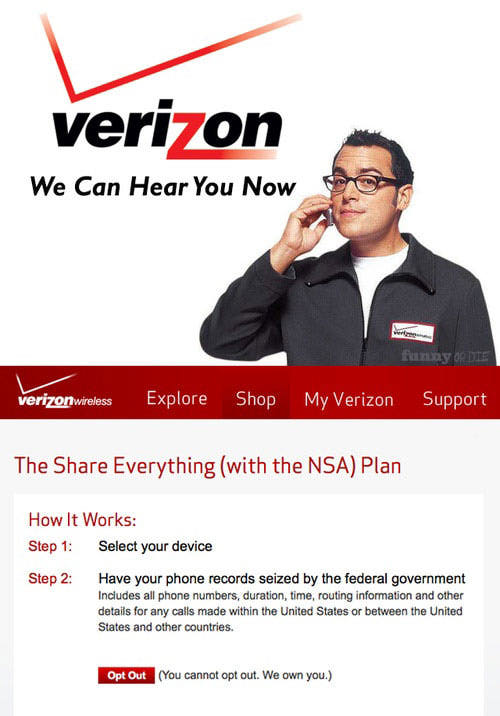
verizon-we-can-hear-you-now

A common defense of mass surveillance used by apologists is “if you have nothing to hide, why worry?” Nevermind that there’s many things that are perfectly legal that we might not “hide” but choose not to reveal indiscriminately (ie. credit card numbers, medical records, nakedness, etc.), we may in fact have something to hide but not even know it. As noted by Moxie Marlinspike of Wired.com:

If the federal government can’t even count how many laws there are, what chance does an individual have of being certain that they are not acting in violation of one of them?

For instance, did you know that it is a federal crime to be in possession of a lobster under a certain size? It doesn’t matter if you bought it at a grocery store, if someone else gave it to you, if it’s dead or alive, if you found it after it died of natural causes, or even if you killed it while acting in self defense. You can go to jail because of a lobster.

If the federal government had access to every email you’ve ever written and every phone call you’ve ever made, it’s almost certain that they could find something you’ve done which violates a provision in the 27,000 pages of federal statues or 10,000 administrative regulations. You probably do have something to hide, you just don’t know it yet.

He also makes a compelling argument for why we should have something to hide:

Over the past year, there have been a number of headline-grabbing legal changes in the U.S., such as the legalization of marijuana in Colorado and Washington, as well as the legalization of same-sex marriage in a growing number of U.S. states.

As a majority of people in these states apparently favor these changes, advocates for the U.S. democratic process cite these legal victories as examples of how the system can provide real freedoms to those who engage with it through lawful means. And it’s true, the bills did pass.

What’s often overlooked, however, is that these legal victories would probably not have been possible without the ability to break the law.

The state of Minnesota, for instance, legalized same-sex marriage this year, but sodomy laws had effectively made homosexuality itself completely illegal in that state until 2001. Likewise, before the recent changes making marijuana legal for personal use in Washington and Colorado, it was obviously not legal for personal use.

Imagine if there were an alternate dystopian reality where law enforcement was 100% effective, such that any potential law offenders knew they would be immediately identified, apprehended, and jailed. If perfect law enforcement had been a reality in Minnesota, Colorado, and Washington since their founding in the 1850s, it seems quite unlikely that these recent changes would have ever come to pass. How could people have decided that marijuana should be legal, if nobody had ever used it? How could states decide that same sex marriage should be permitted, if nobody had ever seen or participated in a same sex relationship?

…We can only desire based on what we know. It is our present experience of what we are and are not able to do that largely determines our sense for what is possible. This is why same sex relationships, in violation of sodomy laws, were a necessary precondition for the legalization of same sex marriage. This is also why those maintaining positions of power will always encourage the freedom to talk about ideas, but never to act.

Read the full article here: http://www.wired.com/opinion/2013/06/why-i-have-nothing-to-hide-is-the-wrong-way-to-think-about-surveillance/

The East German STASI regime also put their citizens under mass surveillance allegedly for their own good. The information collected was used as leverage by authorities to force informants to betray friends, neighbors and family members.  Trust throughout the society crumbled and eventually the government itself crumbled.