Baltimoreans Pushed to Their Limits

Suspect_Dies_Baltimore.JPEG-01b3c_c0-199-4709-2943_s561x327

By David S. D’Amato

Source: Center for a Stateless Society

We speak of the blowback that results from American foreign policy, the senseless, heinous acts of terror that represent an unfocused and irrational rebellion against American imperialism. We understand that calling it what it is, blowback — pointing out the causal relationship between American foreign policy and terrorism — is not an attempt to exculpate the people who commit these crimes. Looking for a motive that may aid in explaining these horrors is not looking for an excuse.

Similarly, the Baltimore rioters have found themselves on the losing end of a set of government policies that have consolidated wealth and foreclosed economic opportunities for independence and self-sufficiency. While so many Americans have been railing against welfare recipients, worried about the effects of food stamps on the federal budget, top American companies have worked closely with government for generations, guaranteeing the corporate welfare and special privileges that define the U.S. economic system.

The truth is that corporate capitalism has hung these rioting Baltimoreans out to dry, the American Dream being to them no more than a cruelly sarcastic joke, forever out of reach, mocking them. The prevailing story depicts the urban poor largely as the victims of “the free market,” dependent on a helping hand from government, be it education, job training, or just the bare necessities. In this story, government intervenes to file the sharp edges off of unbridled free market competition.

The problem with this story is that is recasts government in a role it has never actually played for poor and working class people — least of all black Americans. In real life, the state has intervened not to protect the economically powerless and penniless, but to serve to the needs of capital, to fence off resources and restrict opportunities in order to subject people to the control of a few giant employers. This coercive, state-driven process has nothing to do with a principled, libertarian free market today, and it never has in the past.

The result has been a permanent underclass, condemned to live in ghettos under quasi-military occupation, surrounded by violent crime that is the direct product of a failed war on drugs. And while the people who live in these communities are demonstrably no more likely to possess contraband than anyone else, they are far more likely to be stopped and frisked, arrested, and even murdered by increasingly militarized police officers.

The problems in Baltimore are historical and systemic. Everyone agrees that rioting, looting, and the wanton destruction of private property are senseless acts that ultimately can’t help anyone or create positive social change. We must nevertheless ask why these people in Baltimore feel so helpless, so abandoned and frustrated by the “proper channels,” that they find it is necessary to lash out and express themselves in this way.

Systematic state violence has left Baltimore communities barren, crying out for justice and opportunity. Anarchists believe that the dormant power of self-organization, cooperation and trade, once truly freed from aggression and meddling, is all the poor need to thrive. Through the anger and sadness coming out of Baltimore, it’s important not to lose sight of the larger, underlying issues.

Infuriating Video Shows City Official Calling Vietnam Vet “The Enemy” for His Use of Medical Pot

images

By Matt Agorist

Source: The Free Thought Project

Maricopa County, AZ — A video was submitted to the Free Thought Project Sunday, which illustrates the brutal insanity of the state’s War on Drugs.

The video was taken during a heated debate on whether or not to legalize marijuana in Arizona. Maricopa County Attorney, Bill Montgomery, and Attorney Marc Victor went head to head on the topic of prohibition. Victor advocated to end prohibition and Montgomery held the position to continue locking people in cages for a plant.

At the end of the nearly 2 hour long debate, the two debaters took questions from the audience. That is when Vietnam veteran Don Ream stood up to explain to Montgomery how calling people who use marijuana for medicine, “Pot Heads,” was offensive.

Ream explained how he has been a patient for four years, and he is off all of his pharmaceutical medicine. All he uses for his symptoms is his medical marijuana. He then politely invited Mr. Montgomery to come and learn about the benefits of the substance and how safe marijuana actually is.

As Ream began to close his statement, Montgomery took to the podium ready to fire back.

“There is a difference between medical application of marijuana and recreational use of the substance,” said Montgomery, who is an attorney, not a doctor.

Ream then admitted that he uses his marijuana recreationally as well.

“Well, then you’re violating the law, and I have no respect for you,” Montgomery said. “I have no respect for someone who would try to claim that you served this country and took an oath to uphold the Constitution and protect against all enemies foreign and domestic – because you’re an enemy.”

Montgomery was then met with several “Boos” from the audience.

How exactly does ingesting a plant make you an enemy?

The person who wants to ingest a substance for medical or recreational reasons is not the criminal. However, the person that would kidnap, cage, or kill someone because they have a different lifestyle is a villain on many fronts.

The only “enemy” in the interchange below is the person who would deprive someone of their freedom by using government violence to enforce their personal preference. Shame on you Bill Montgomery.

Never Before Has Our Approach to Drugs Improved So Much, So Fast

Hemp_for_victory_1942

We’re winning: More progress has been made toward enlightened drug policies and treatment in the past five years than in the previous 25. Here’s an advocacy agenda to take us even closer to the future we need.

By Maia Szalavitz

Source: Substance.com

There has never been a more exciting time to be writing and thinking about drugs and addiction. For most of the ‘80s through the ‘00s, policy and treatment debates were stagnant, with all sides taking hardened positions and often repeating the same tired talking points. But now change is in the air and those who would like to see reform have a chance to make a real difference. By looking at where we’ve come from, we can see where we need to go.

Until 2011 or 2012, the war on drugs, while much bemoaned, was simply a fact of life, with pretty much everyone agreeing both about its failure and, simultaneously, about the impossibility of doing anything significantly different because of the “tough on crime” arms race between the Republicans and Democrats.

The science didn’t matter: No one seemed to care that marijuana was objectively less harmful than alcohol or tobacco or that our drug laws originated both in the time of Jim Crow and, quite explicitly, as a way of oppressing people of color by other means. In fact, merely stating these facts, as I did many times, would often get me in trouble with editors who wanted to “balance” them with a prohibitionist claim to prove that the publication was “objective”! No one ever seemed to consider balance when a drug warrior made a demonstrably untrue statement.

It didn’t matter that the data on needle exchange was overwhelmingly in favor—and that no study had ever found that it encouraged drug use or prolonged addiction. A quote by someone who was ideologically opposed had to be obtained, even though they had no data to back their concerns about these programs to prevent infection with HIV and hepatitis C “sending the wrong message.”

The failure of drug enforcement either to prevent or to reduce “drug epidemics” and the ineffectiveness of incarceration at fighting addiction was irrelevant, too, even as the necessity of such punitive efforts was simply accepted without question.

Nor did it matter that harsh, confrontational treatment was known both to backfire and to be incredibly common—Dr. Drew, Intervention, Beyond Scared Straight and similar shows even portrayed it as exemplary.

At the same time, 12-step supporters were adamant that their way was the only way—or at least the best way. Drug warriors were convinced that criminalization of both possession and sales was the only way to avoid addiction Armageddon—and even many people in recovery bought into the idea that law enforcement must always play a role in policies related to illegal drugs.

In 2000, for instance, during the fight over California’s Proposition 36, which gives drug users three chances at treatment before jail becomes a sentencing option, the Betty Ford Center was among the opponents. Speaking for a coalition that included the rehab, actor and sobriety advocate Martin Sheen wrote in an op-ed, “Without accountability and consequences, drug abusers have little incentive to change their behavior or take treatment seriously.” (He didn’t explain how Betty Ford gets alcoholics, whose drug is legal, to comply with care.) But Prop 36 passed anyway, an early sign of the drug war’s waning hold.

And so, even when reforms would actually send patients to rehabs, treatment providers remained firmly aligned with drug warriors on the necessity of harsh criminalization, while they begged for crumbs of financing from the abundant table of law enforcement and argued that treatment is better than jail.

Now, though, the winds have shifted. Four states and Washington, DC, have legalized recreational use of marijuana. President Obama has directed the justice department not to interfere with these experiments and said last week, “My suspicion is that you are going to see other states start looking at this.” California, which rejected recreational legalization as recently as 2010, may pass it in an expected 2016 ballot initiative. National polls show majority support for legalization.

Neither Colorado nor Washington—the first two states to legalize—has seen anything near the predicted disaster in the first year after the passage of the law. In fact, in Colorado, crime is down, auto fatalities are down and teen use is stable or declining. (Because Washington took longer to implement its regime, good statistics aren’t yet available).

All of this is excellent news for reformers. So what should be next on the agenda? Here are a few things I’d like to see, which I think could build on the increased openness to more effective policy:

1. Over-the-counter naloxone

Naloxone, an opioid antagonist that can reverse opioid overdose, is now widely available to first responders and, through many harm reduction agencies, to friends and families of people at risk. No adverse effects have been reported; just more and more lives saved. The FDA should make naloxone available over the counter, and sales should be subsidized or prices capped to make it affordable. This safe, effective lifesaver should be in every first-aid kit.

2. Expand access to medication-assisted treatment

As I noted recently, it’s outrageous that any doctor who discovers that a patient has an opioid problem can’t simply prescribe the most effective treatment: maintenance with Suboxone or methadone. Federal limits on the number of patients a doctor can have on maintenance and laws that literally ghettoize methadone treatment should be repealed. Insurance limits on prescribing also should be challenged: These exist for no other medical condition.

3. Decriminalize personal possession of all drugs

Now that even once-staunch prohibitionists like Kevin Sabet no longer argue strongly for arrest and incarceration of those who possess marijuana, why does it still make sense for heroin, cocaine or other illegal drugs?

82% of all drug arrests are for possession, and half of these are for marijuana. According to the ACLU, the US spends $3.1 billion annually arresting and adjudicating marijuana possession cases, and at least as much is likely to be spent on the other half of possession arrests for all other drugs. And yet no data suggests that arresting drug users for possession fights addiction or reduces crime: In fact, addicted people often get worse due to incarceration, with very little treatment available in jail.

Moreover, Portugal’s 10-plus-year experience of complete decriminalization has found it to be associated with less crime, more treatment and less disease. What’s not to like? The World Health Organization recently came out in favor of decriminalization. Drug reformers should not make marijuana arrests the only focus of their abolition campaign. Arrests for use are expensive, harmful and ineffective: They need to stop.

5. Reform treatment

People with addiction and their loved ones are often shocked at what occurs in treatment: Evidence-based care is so hard to find that even leading addiction researcher and former deputy drug czar Tom McLellan didn’t know where to turn when his son needed help in 2009. Anne Fletcher’s Inside Rehab, David Sheff’s Clean and this 2012 report from the Center on Addiction and Substance Abuse all demonstrate the need for better accountability from treatment providers.

To start, private and public insurers should simply refuse to pay for treatment that is little more than indoctrination into 12-step groups, which can be had for free at many church basements. Instead, treatment time should be devoted to evidence-based therapies like motivational interviewing and cognitive behavioral therapy, which aren’t free—and provider reimbursement should be based on results, respectful and empathetic care and genuine fidelity to evidence-based therapies.

And this isn’t a change that only opponents of 12-step programs should favor. Even those who are helped by the steps know that such treatment clearly violates the Eighth Tradition, which states that AA should be “forever nonprofessional” and that the 12th-step work of trying to bring others into the program should be unpaid. Both 12-step groups and treatment will ultimately be better off disentangled.

5. Reframe addiction

As I’ve argued here before, addiction is better characterized as a learning or developmental disorder than as a brain disease. While those who support the brain disease concept see it as a way of reducing stigma, in actual fact, this idea can increase fear and hatred of addicts because the notion of “brain damage” suggests permanence and poor odds for recovery.

What addiction actually does in the brain is similar to what love does—it strongly wires in new memories and pushes us to seek certain experiences. This is not “damage” or “destruction.” When we understand addiction as one more type of neurodiversity—not always a disability, sometimes even a source of strength—we’ll really cut stigma.

Also, it’s impossible to fight stigma while the legal system enforces it: The whole point of criminalizing drug possession is to stigmatize it. Without changing both criminalization and the view of addiction as the only disease treated by prayer and repentance, stigma reduction won’t get very far.

There’s much more, of course, but these are areas where real progress can be made. Never before have I seen more openness in this area: Now people who used to blanch at the words “harm reduction” are singing its praises and those who were once horrified by needle exchange are calling for naloxone. We still have a long way to go—and there’s always the chance of backlash—but as Martin Luther King, Jr., put it, “The arc of the moral universe is long, but it bends towards justice.”

Maia Szalavitz is the nation’s leading neuroscience and addiction journalist, and a columnist at Substance.com. She has contributed to Time, The New York Times, Scientific American Mind, the Washington Post and many other publications. She has also published five books, including Help at Any Cost: How the Troubled-Teen Industry Cons Parents and Hurts Kids (Riverhead, 2006), and is currently finishing her sixth, Unbroken Brain, which examines why seeing addiction as a developmental or learning disorder can help us better understand, prevent and treat it. Her previous column for Substance.com was about how to treat people who need, but misuse, opiate painkillers in a more helpful and enlightened way.

Eleven countries studied, one inescapable conclusion – the drug laws don’t work

war-on-drugs

Eight month study shows legalisation policies do not result in wider use, and the US should be watched with interest

UK government’s drug laws survey was suppressed, Lib Dem minister says

By Alan Travis

Source: The Guardian

The UK government’s comparison of international drug laws, published on Wednesday, represents the first official recognition since the 1971 Misuse of Drugs Act that there is no direct link between being “tough on drugs” and tackling the problem.

The report, which has been signed off by both the Conservative home secretary, Theresa May, and the Liberal Democrat crime prevention minister, Norman Baker, is based on an in-depth study of drug laws in 11 countries ranging from the zero-tolerance of Japan to the legalisation of Uruguay.

The key finding of the report, written by Home Office civil servants, lies in a comparison of Portugal and the Czech Republic, both countries where personal use is decriminalised.

“We did not in our fact-finding observe any obvious relationship between the toughness of a country’s enforcement against drug possession, and levels of drug use in that country,” it says. “The Czech Republic and Portugal have similar approaches to possession, where possession of small amounts of any drug does not lead to criminal proceedings, but while levels of drug use in Portugal appear to be relatively low, reported levels of cannabis use in the Czech Republic are among the highest in Europe.

“Indicators of levels of drug use in Sweden, which has one of the toughest approaches we saw, point to relatively low levels of use, but not markedly lower than countries with different approaches.”

Endless coalition wrangling over the contents of the report, which has taken more than eight months to be published, has ensured that it does not include any conclusions.

However, reading the evidence it provides, it is hard to escape the conclusion that the Home Office civil servants who wrote it seem to have been impressed that a health-based rather than a criminal justice-based approach is where effective policies lie.

It also, rather remarkably, says that the experiments in legalisation now under way in the US states of Washington and Colorado, and in Uruguay, should be watched with interest. This is a world away from the “war on drugs” rhetoric that has formed the mainstay of the political debate on drugs in the past four decades.

The report, Drugs: International Comparators, documents in great detail the experience of Portugal, where personal use was decriminalised nearly 11 years ago and those arrested for drugs are given the choice of going before a health “dissuasion commission” or facing a criminal justice process.

“Trend data from Portugal shows how levels of drug use changed in the years following decriminalisation in 2001. Although levels of drug use rose between 2001 and 2007, use of drugs has since fallen to below 2001 levels. It is clear that there has not been a lasting and significant increase in drug use in Portugal since 2001,” the report says.

At the same time, it notes there have been significant reductions in the number of drug users diagnosed with HIV and Aids at a time when drug-related deaths have remained stable: “These outcomes cannot be attributed to decriminalisation alone, and are likely to have been influenced by increases in the use of treatment and harm reduction,” it says, stressing that it is difficult to disentangle the impact of decriminalisation from wider improvements in drug treatment and harm reduction over the same period.

Nevertheless, it firmly rejects claims that decriminalisation in Portugal has led to a spike in drug use. It goes on to contrast Portugal with the Czech Republic, where an evaluation found that there was no significant decline in the availability of drugs following an earlier implementation of stricter laws, prior to decriminalisation.

On the situation in Colorado, Washington and Uruguay, the Home Office says their experimental policies which legalise production, supply and recreational use of cannabis have the common aim of disrupting organised crime and exercising greater control over the use of cannabis.

“The American states have a market-driven approach, with lighter regulation than Uruguay and fewer limitations on consumption and use. Uruguay, which has growing concerns about organised crime, has a stronger role for the state, with limitations in size of the market, the strains and potency of cannabis, and the quantity that an individual can purchase in a month.”

Crucially, the report adds: “It is too early to know how these experiments will play out, but we will monitor the impacts of these new policies in the coming years.”

The report examines various harm reduction initiatives in 11 countries, including the use of drug consumption rooms, the prescription of heroin under medical supervision, and prison-based needle exchange programmes. In particular it found evidence that heroin prescribing, including in three limited trials in Britain, can be effective.

There is no overall conclusion to the report, but in its last paragraph the Home Office authors reflect that the lack of any clear correlation between “toughness” of approach and levels of drug use demonstrates the complexity of the issue: “Achieving better health outcomes for drug users cannot be shown to be a direct result of the enforcement approach.”

This article was amended on 31 October 2014. An earlier version said incorrectly that, in the Czech Republic, “criminal penalties for possession [of drugs] were introduced as recently as 2010”, and later referred incorrectly to “the implementation of stricter laws in 2010”.

5 Myths About Marijuana–Debunked

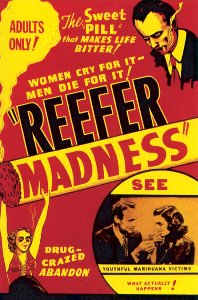
ReeferMadnessPoster

The more research is released, the more legalization makes sense.

By Owen Poindexter

Source: Alternet

Back in the 1930s, the arguments to criminalize cannabis were bizarre and openly racist. The anti-pot crusader Harry Anslinger made all sorts of over-the-top claims, such as, “Marihuana is a short cut to the insane asylum. Smoke marihuana cigarettes for a month and what was once your brain will be nothing but a storehouse of horrid specters.”

Nowadays more than 100 million Americans say they’ve smoke pot, millions use cannabis regularly to treat illnesses and it is as legal as alcohol in two U.S. states. However, it remains illegal under federal law largely due to scare tactics ingrained in our society, which date back even prior to Anslinger.

Today, pot legalization opponents try a little harder to sound reasonable, but their claims don’t do much better than Anslinger’s under scrutiny. Recent studies have picked apart the justifications for criminalizing marijuana. Here are five of the most popular arguments against cannabis legalization that are easily undermined by objective data.

1. Pot leads to crime. If alcohol prohibition taught us anything it’s that prohibition itself leads to crime, not what is prohibited. While cannabis has shaken the psychotic Reefer Madness reputation over the years, the association between weed and crime is still alive and well in certain realms of the media, which are happy to present data without appropriate statistical caveats.

As for the studies that carefully and objectively examine their data, they find no association between cannabis and crime. A recent study in the journal PLOS One found that in states that legalized medical marijuana between 1990 and 2006 the crime rate either remained the same or decreased.

Another study looked at the Lambeth borough of London, which depenalized cannabis for 13 months in 2001-2002. The study found that this actually reduced other types of crime, because Lambeth police could focus their energy elsewhere.

These results fit with common sense. Cannabis has a range of effects on mood and behavior, but they don’t include violence, impulsivity or other traits that would turn otherwise law-abiding citizens into criminals.

2. The gateway theory. The gateway theory has long been the stock response of marijuana opponents to the notion that cannabis itself isn’t that bad for you. They falsely claim it leads to harder stuff, and insist that what starts with a joint ends with a heroin needle.

While it’s true that most users of hard drugs used marijuana and alcohol first, that doesn’t prove that cannabis use leads to harder drugs. Correlation does not equal causality—most heroin users have worn jeans at some point in their lives, but it’s unlikely that one leads to another.

But is it at least plausible that cannabis use creates a bridge to experimenting with more dangerous chemicals? The research says no.

A RAND Institute study using data collected from 1982-1994 found that drug use patterns in American youths can be explained without resorting to a gateway effect. People who are interested in mind-altering substances are likely to have tried pot, as it is the most popular and available illicit drug. This and other circumstantial factors related to drug availability and how old someone was when they first used cannabis were sufficient to explain drug use patterns. Since then, numerous peer-reviewed studies have been published, supporting RAND’s basic conclusions.

Holland provides a good natural experiment in the effects of cannabis use, as marijuana has been legal there for citizens since 1976. A RAND Corporation study from 2011, titled What Can We Learn From The Dutch Coffee Shop Experience? found no causal relationship between using cannabis and harder drugs. In fact, because legalization meant that people went to a coffee shop, not a dealer, to get high, RAND found that legal cannabis likely reduced rates of harder drug use.

3. Cannabis has no medicinal purpose. Even though it has been slain many times over at this point, this idea is worth mentioning because cannabis is still listed as a Schedule I substance by the U.S. government, which implies that the official federal stance is that it has no medical use and is “dangerous.” However, just the opposite is true according to the actual facts. Almost half the states in the U.S. already have some kind of medical marijuana law (20 plus Washington D.C.) and many more are likely to legalize medical marijuana in this year’s elections.

Cannabis has been shown to effectively treat a slew of conditions including seizure disorders ( often quite dramatically), glaucoma, and symptoms related to chemotherapy. There is even evidence it can reduce certain types of cancerous tumors.

This is all well known and well documented, and yet cannabis remains a Schedule I drug. While it’s hard to find anyone who will still defend this policy, it remains the law of the land, and a major stumbling block on the path to reform.

4. Marijuana is addictive. The addiction claim has been contained over time, but never fully eradicated. Cannabis faces some guilt by association. How could alcohol, tobacco, heroin and cocaine all be clearly addictive and yet weed somehow isn’t?

Furthermore, with words like stoner and pothead in the lexicon, our culture has a firm grasp of the weed-dependent stereotype. When we think of marijuana addiction, an image comes to mind. He (usually a he), smokes pot and eats all day, is smelly and unshaven, watches too much TV and/or plays too many video games, and has a crappy job if he has a job at all. And sure, a lot of people actually do know someone like that, but the research show that, that someone is probably choosing their lifestyle rather than trapped in it by an actual addiction.

Regardless of how the addiction myth has stuck around, it is just that: a myth. The most commonly cited study on cannabis dependence declared that 4% of Americans 15-54 are dependent on cannabis. That’s compared to 24% who are dependent on tobacco and 14% on alcohol. Among users, they found that 9% of cannabis users who try it get hooked, as compared to 32% for tobacco and 15% for alcohol.

So cannabis seems to show some propensity for dependence, but for every dependent user, there are 10 who don’t develop that sort of issue, and this rate is better than that of popular legal drugs.

Furthermore, even the 9% figure is likely inflated. A subject in the oft-cited study was deemed “dependent” if they answered yes to at least three of seven questions. The survey included questions that would take a very different meaning with legal drugs than illegal, such as if “a great deal of time was spent in activities necessary to get the substance, taking the substance, or recovering from its effects.”

This study was conducted in the 1990s, before any state had recognized the medical use of cannabis, and acquiring it regularly involved considerable effort. Because of this, it’s not hard to imagine that users would experience “important social, occupational, or recreational activities given up or reduced because of use,” which was another criterion for dependence. It is quite possible the survey mistook habitual use for dependence in some cases.

We can be sure that cannabis is significantly less habit-forming than alcohol, and especially tobacco, and the degree to which people become dependent is probably overstated.

5. Pot makes users lazy. This idea is the most persistent: we rarely question the cultural belief that getting high saps one’s motivation. If there is any truth to that, it has been difficult to find in studies. What seems to be going on instead is that about 5-6% of the population has “amotivational syndrome,” and there is no significant difference in this between cannabis users and everyone else. One study looked at daily pot smokers and compared them to people who never touch pot. This found no significant difference between the two groups. There was a small difference in “subjective well-being” (how happy the subject says he or she is) favoring non-smokers, but the study authors ascribed much of this to medical conditions some of the subjects were taking cannabis to mitigate.

More than anything, the idea that stoners are lazy seems to be confirmation bias. We shrug off the examples that contradict that notion as special cases and nod sagely when our suspicions are confirmed. Furthermore, we fail to group unmotivated non-users with unmotivated users.

***

As the stigma against cannabis research has disappeared and more good data has been made available, the arguments against legalization have fallen. If cannabis is a plant with legitimate medical uses, does not lead to crime or harder drugs, is not addictive and doesn’t make you lazy, what argument for prohibition remains?

If there are still legitimate reasons to keep cannabis criminalized, let’s talk about them, but if not, let’s cut out a major revenue stream of Mexico’s vicious drug cartels, grant easy access to medicine for people who need it, provide a major boost to our economy, and legalize already.


Owen Poindexter is a freelance writer. See his work at owenpoindexter.com and follow him @owenpoindexter.

After Legalization, Why Can’t People’s Prior Pot Convictions Be Wiped Clean?

marijuana_legal_gavel_620x350

In states where marijuana is now legal, many people still have small-scale possession convictions on their records. Advocates for “expungement” face uphill battles, from Washington state to Washington, DC

By Jake Thomas

Source: Substance.com

Marijuana won in November’s midterm elections, with Oregon, Alaska and the District of Columbia joining Colorado and Washington in legalizing it. But it’s a bittersweet victory for people who have a prior cannabis conviction for doing something that is now legal in their state. For now, efforts to clear pot marks from people’s records in states that have legalized the drug are facing uphill battles.

“It’s pretty much ruined my life at this point,” Aaron Pickel (below), who was busted in Oregon for carrying two to three pounds of pot-infused edibles, told the Oregonian. “I’ve tried pretty hard to find work, and when you’re going against people who have nothing on their record and you do, you’re not going to get it.” Pickel’s California medical marijuana card didn’t get him out of the charges. Although he was slapped with only a $200 fine and no jail time, the 33-year-old now has a felony rap—and stays in his mother’s spare bedroom.

People who have been convicted of misdemeanor and lesser charges for possessing the drug often have a hard time securing housing, jobs and education. Proponents of “expungement”—wiping records clean—argue that the voters of these states made it clear that possessing small amounts of marijuana should not be illegal and therefore people who have prior convictions should get a second chance. Opponents argue that people should abide by laws until they are changed.

The expungement debate does not address the plight of people currently serving time for nonviolent cannabis crimes, however. The ballot measures that legalized pot allow people to carry only small amounts—in the case of Oregon’s Measure 91, up to an ounce. Before the passage of these measures, these amounts wouldn’t be cause to lock someone up in prison—in Oregon, it resulted in a violation and a fine. Someone would need to possess up to four ounces to be charged with a felony. Carrying four ounces is still illegal under Measure 91.

“I’ve tried pretty hard to find work, and when you’re going against people who have nothing on their record and you do, you’re not going to get it,” said Aaron Pickel, who was busted in Oregon for carrying several cookies and other pot-infused edibles.

There were 8 million marijuana-related arrests in the US between 2001 and 2010, according to a 2013 American Civil Liberties Union report. Nearly 36,000 people were arrested in 2010 alone in states and jurisdictions that have recently legalized pot. What’s worse, African-Americans, who already face discrimination in housing, employment and education, make up a disproportionate number of arrests. Nationally, they were 3.7 times as likely to be arrested for marijuana possession than whites in 2010, even though they used marijuana at similar rates.

“There are thousands of people in Washington state who have a misdemeanor marijuana conviction, and it hangs over their head when they apply for jobs or housing or education, and giving them a second chance will remove that obstacle,” says Washington state Rep. Joe Fitzgibbon, a Democrat, who introduced a bill in 2013 that would have cleared the records of people with misdemeanor marijuana convictions.

Fitzgibbon’s legislation ended up stuck in committee. He says that lawmakers apparently want to let the dust settle from pot becoming legal two years ago before further tinkering with marijuana laws. But he got pushback from the state prosecutors’ association, which opposes prior-conviction expungement.

A similar bill failed in the state legislature in Colorado, where pot was also legalized in 2012. But a ruling by the Colorado court of appeals in March could provide limited relief for people with pot convictions. The ruling stemmed from a 2010 court case that involved a woman who was charged with child abuse along with possessing methamphetamine and marijuana. Her lawyer, Brian Emeson, says that he was in the process of appealing her methamphetamine charge when the state legalized marijuana, so he appealed her pot charge as well. The court granted the appeal on the pot charge, removing it from her record.

“Thousands of people in Washington state have a misdemeanor marijuana conviction, and it hangs over their head when they apply for jobs or housing or education, and giving them a second chance will remove that obstacle,” said state Rep. Joe Fitzgibbon.

The ruling only affects people who have an active appeal for a pot possession charge, Emeson says. He estimates that number is anywhere from about a dozen to a hundred. He expects the Colorado supreme court to take up the issue next year and possibly reverse the appeals court ruling.

Emeson says that he was able to separate the marijuana charge from the others in his case, characterizing them as “relatively not that bad.” Emeson acknowledges that child abuse is a serious charge, but he says that courts often see much worse. “It’s impossible for people to ignore really, really bad facts in a case.”

Efforts to provide relief to people with prior pot convictions are likely to be complicated by other crimes on their records. “Most people convicted of marijuana are convicted of other things that are still illegal,” says Sam Kamin, a professor of constitutional law at the University of Denver and one of the nation’s leading experts in marijuana regulation. Their crimes, not surprisingly, often involve possession or trafficking of large amounts of pot or other drugs.

Oregon lawmakers will begin grappling with this problem when they meet in the new year to discuss the implementation of the state’s pot legalization measure, says state Sen. Floyd Prozanski, a Democrat who chairs the senate’s judiciary committee. Prozanski says he does not expect any “blanket bills” that will provide automatic expungement.

People convicted of certain felonies and misdemeanors in Oregon can already petition to have their records expunged after a certain period of time has lapsed. Prozanski says that any effort to provide relief to people with pot convictions will rely on the state’s existing expungement process. Lawmakers may update the expungement process in response to marijuana becoming legal.

However, as in Colorado and Washington state, lawmakers will be mainly focused on implementing legal marijuana, Prozanski says. “[Expungement] is sort of secondary issue to the implementation of Measure 91.”

The situation for people with prior convictions is different in Washington, DC, says Mason Tvert, communications director for the Marijuana Policy Project. In October, the city council passed a bill that would allow people convicted of all crimes and misdemeanors that have become legal to have their records sealed.

“It’s astonishing that some congressional members are so concerned about blocking DC from enacting [its legalization measure]. If cartels and gangs had lobbyists on the Hill, preventing marijuana regulation would be their top legislative priority,” said  the Marijuana Policy Project‘s Mason Tvert.

The District of Columbia had the highest overall marijuana possession arrest rate in the country in 2010. African-Americans are eight times more likely to be arrested for pot than their white counterparts, according to the ACLU.

However, both this bill and the measure that legalized marijuana require approval by the incoming Republican Congress, which has not been sympathetic to marijuana legalization or people convicted of pot crimes. Some have already said they will oppose DC’s legalization measure. “I will consider using all resources available to a member of Congress to stop this action,” Rep. Andy Harris, a Maryland Republican, told the Washington Post.

Making good on that threat, congressional Republicans and Democrats struck a deal on Tuesday to fund the federal government through September that includes provisions upending Initiative 71’s legalization of pot, according to the Washington Post. At press time, advocates were debating whether or not the language in the bill offers a loophole allowing the will of DC voters to go forward.

How this mess will ensnare efforts of people to expunge their prior pot convictions remains to be seen. “There’s some uncertainty surrounding the effect the provision will have on the measure. It could end up being a situation in which the courts will decide,” Tvert wrote in an email. “With all of the issues facing the country, it’s astonishing that some congressional members are so concerned about blocking DC from enacting a widely supported local policy. If cartels and gangs had lobbyists on the Hill, preventing marijuana regulation would be their top legislative priority.”

Pro-pot politicians in a few other states are already taking steps to expunge peoples’ old marijuana convictions should the drug be legalized. One Maryland lawmaker has proposed legislation that would erase any prior marijuana-related offense that becomes legal. A candidate in last year’s Democratic primary for Pennsylvania governor called for legalizing pot and expunging records of people convicted of possessing it.

But one of the biggest victories for advocates of expunging peoples’ past drug records came in the 2014 midterm election in a state where pot legalization wasn’t even on the ballot. California voters approved Measure 47, which automatically and retroactively downgraded some nonviolent felonies, many of them drug-related, to misdemeanors. Some 10,000 people are eligible for immediate release, including many who have been jailed for drug misdemeanors—and, once again, a disproportionate number are African-Americans.

Jake Thomas is a reporter in Spokane, Washington. He has written for the Portland MercuryStreet Roots and numerous other publications. His website is here. He tweets at @jakethomas2009. This is his first piece for Substance.com.

How the War on Drugs Advances Transnational Capitalism

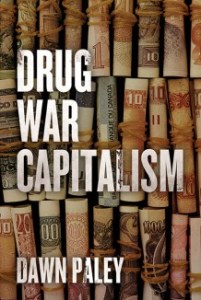
dwc-cvr-small_72web

How US drug policy in the Americas is a pretext for extending militarization and global capitalism south of the border.

By Mark Karlin

Source: Alternet

Dawn Paley, a Canadian journalist, offers a transformative view of the US war on drugs in the Western Hemisphere (with the exclusion of Canada as a targeted nation because it is a neoliberal partner of the United States in exploitation). Her just-released book,  Drug War Capitalism, is a sweeping, exhaustively detailed analysis that reveals the insidious actual goals of the US-led and funded militarization south of the border in the name of destroying drug cartels. As Paley writes, “This war is about control over territory and society [and market share, cheap labor, mineral rights and profits], much more so than it is about cocaine or marijuana.”

The following is the Truthout interview with Dawn Paley about  Drug War Capitalism:

Mark Karlin: You state the so-called war on drugs is really a war on people. This is a key point in your exhaustively documented and cogently threaded book. Can you expand on that – and of course you are talking about a certain class and background of person: the indigenous and the poor south of the US Border?

Dawn Paley: There is excellent work being done in the US examining and resisting the impacts of the drug war, specifically when it comes to the mass incarceration of young people from communities of color on that pretext.  Drug War Capitalism looks at how the drug war is deployed south of the US border, where the key mechanism for social control is the use of terror against the people/ el pueblo/los pueblos. Some activists and writers use words like social cleansing to describe the impacts of drug war militarization and paramilitarization, and how both primarily target poor young men in urban and rural environments. The case of Ayotzinapa, with the disappearance of 43 students and the murder of three others (one of the disappeared students is now confirmed to have been murdered) by municipal police in Iguala, Guerrero, is just the latest example of how often the victims of the drug war come from marginalized – and often well organized – communities and groups.

In the US, many people have been turned into frightened puppets who support any action in the name of the war on terrorism, even when such military and police action has to do with the goal of expanding transnational business opportunities. How is this analogous to the use of the war on drugs as a cover for US military intervention in Mexico, Central America, Colombia and the rest of most of the Western Hemisphere, with the exclusion of Canada? After all, doesn’t the US benefit by having a state of violence among the poor and socially marginal people keep them from considering populist political rebellion in these nations?

I’d like to approach this question a little differently, and ask instead why it is that the hundreds of thousands of people who mobilized throughout the United States against the unjust war in Iraq were able to make the connection between US invasions and oil extraction, and why it has been so difficult for folks to mobilize and make the same connections to resource extraction and capitalism in the case of the US-backed war on drugs in Colombia, Mexico and elsewhere.

Once we can start to make the connections between US-backed war agendas in the form of Plan Colombia or the Merida Initiative and the expansion of capitalism in Mexico and Colombia, a lot of things begin to make sense. In the immediate term, the militarization and the paramilitarization stemming from these plans to sow terror and strengthen the state repressive apparatus, which, as we are well aware, works to protect transnational capital, like mining companies or oil companies.

Over the longer term, the structural reforms that go hand in hand with Plan Colombia and the Merida Initiative deepen neoliberalism. With the privatization of Petroleos Mexicanos (Pemex), Mexico’s state oil company, for example, 70 percent of Mexico’s federal budget is at stake, something I argue could lead to a previously unknown level of austerity in Mexico. Already financially starved sectors like health and public education could be impacted, as could existing subsidies for transportation, basic goods and otherwise.

As the privatization of Pemex kicks in and the effects begin to be felt over the next decade, should people rise up in protest, the fact that police and military forces as well as nominally non-state armed actors were strengthened through the Merida Initiative will certainly come in handy in order to control dissent.

You bring up how narcotrafficking money laundering has been profitable for banks and even that the cash liquidity of such funds helped some large US banks survive the 2008 implosion of the economy. In addition, drug cartels invest a lot of their money – 85 percent of which you note is generated in the US, in the cocaine market – in legitimate businesses. Aren’t narcotraffickers often the shady cousins of neoliberal capitalists, who collaborate for mutual benefit at times?

I suppose you could say that, yes. The book doesn’t focus on the role of banks, as this is one of the areas of the drug war that has been extensively covered in the mainstream media. However, There’s a tendency towards showing images of Mexican traffickers with stacks of US dollars, but their proceeds represent a fraction of the overall cash generated because of prohibition. I think it’s important to point out that when we talk about the wealth generated by the drug trade it is essential to remember that the vast majority of that cash is generated in the United States and helps prop up the US economy in various ways.

Perhaps the linchpin to your investigative reporting is that the war on drugs is a cover, in many ways, for the expropriation of land for excavation and fossil fuel companies – as well as the creation of secure manufacturing, assembly and marketing environments for other international corporations. I know that specific alliances of corruption are often difficult to ascertain when it comes to the so-called war on drugs, but how do paramilitary groups (sometimes drug cartels), the military and the police play a role in securing land and providing security for transnational corporations. As you point out, large corporations and their employees are rarely victims of violence in the nations that have been targeted for drug war capitalism.

Colombia provides us with the strongest examples of this: paramilitaries hired to kill union organizers, or companies like BP and Drummond using paramilitaries to ensure they had access to lands for mining and pipeline building. These cases are extensively documented by court cases which have led to settlements for victims.

In a place like Ciudad Juarez we see how, for example, it is workers and their families who are terrorized by the drug war, and especially by state forces, while police go to great extents to protect the US-based owners of manufacturing plants when they visit the city. In the book I document how communal landowners dedicated to protecting their land from resource extraction are threatened by Federal Police deployed in the name of fighting the war on drugs, or how they are murdered by so called cartel hitmen, who I consider to be more akin to paramilitaries. And this is just the beginning. Unfortunately these trends are likely to become more obvious in Mexico, as they did in Colombia, as time goes on.

What role did NAFTA and other trade agreements play in having laid the groundwork for killing, kidnapping and displacing people to seize land for excavation and fossil fuel development? As a further note, you are a Canadian, and Canadian mining companies appear to play a large role in land seizures, hiring of enforcers (in many cases assassins and torturers), and cooperation with corrupt governments, police and even drug cartels. Is it safe to assume that this is with the full support of the Harper government?

Well, in Colombia it was actually Plan Colombia that paved the way for the Canada-Colombia Free Trade Agreement and the US-Colombia Free Trade Agreement. They didn’t advertise it at the time, but following Plan Colombia it was made clear by officials from both the US and Colombia that though the flow of drugs wasn’t reduced, Plan Colombia was a success because it created the conditions for the implementation of these new free trade agreements.

In some ways NAFTA, which became active in January 1994, happened too soon. Let me explain: While NAFTA went a long way towards destroying local economies especially in rural areas and impoverishing small farmers, by 2008 when the Merida Initiative kicked off, it left much to be desired in terms of how open the Mexican economy actually was to transnational capital. At that time, the Mexican government continued to be the full owner of the Federal Electricity Commission and the national oil company, Pemex.

Communal landowners were refusing to enter into privatization schemes made possible when Article 27 of the Mexican Constitution was changed prior to the signing of NAFTA in 1992. Elite Mexican families took control over certain sectors of the economy that were privatized, as NAFTA era privatizations did not include regulations that meant that US bidders would be considered on equal footing with national bidders. All of these elements, among others, meant that Mexico was ripe for a new round of neoliberalism and austerity that would open new areas for investment. That’s part of what the Merida Initiative has provided a platform to do.

NAFTA was a key ingredient in opening up Mexico’s mining sector. Large scale, modern mining, especially gold mining, provides us with a bit of a preview of the kinds of conflicts that could erupt if widespread private sector oil and gas exploration and exploitation goes ahead in Mexico. Gold mining in Mexico is dominated by companies based in Canada, which gives them a litany of financial as well as diplomatic and legal supports for their activities. In the book, I document cases where these Canadian mining companies take advantage of the conditions created by the Merida Initiative in order to push their projects forward.

It appears ironic that the free trade treaties squeeze out small business people and entrepreneurs, benefiting almost exclusively the large multinational corporations. After all, the promoters of the treaties claim that they stimulate the business environment for everyone. You provide evidence, however, on why that is just a sales point for free trade agreements, but hardly the reality.

Free trade agreements decimate local economies and small businesses. They allowed the US and other nations to dump their subsidized agricultural products, like corn, into a diverse national market that included many small holders, as in Mexico, who operate with very few subsidies. There are social classes that benefit greatly from these kinds of agreements, but they are the minority, in the US as well as in target countries like Mexico. Rendering small farms and family businesses unprofitable is more than an economic issue: It is a root cause of forced migration, of displacement, and in the destruction of social and community fabric. This, in turn, is beneficial in terms of increasing state and corporate control over peoples’ lives and lands.

You provide a good deal of clarity on how Plan Colombia was the model for the Mérida Initiative in Mexico. What was the real priority of Plan Colombia in terms of creating a nation that is structured to provide an accommodating and secure environment for transnational businesses?

I believe the real priority of Plan Colombia was just that: improving the conditions for investment throughout the country. Officially this takes a couple of forms, including regulatory and judicial reforms and the extension of police forces and soldiers throughout the national territory. Off the books, it is known that paramilitary groups work closely with police and soldiers throughout the country, and that this tends towards benefiting the activities of transnational companies.

One of the implications of the US working to graft its legal model on nations south of the border is that it appears likely to increase prison populations. Given that the United States has the highest percentage of its population incarcerated, that is an ominous portent, isn’t it?

It is indeed. The Merida Initiative also included funds for building and expanding Mexico’s prison facilities and training Mexican prison guards in the ways of US jailers.

That brings us back to the first question. Who is responsible for the social cleansing that is a significant component of the violence associated with the alleged war on drugs? Who gains from killing “disposable people”?

There are cases where we can talk about individuals responsible for killings, but the approach I take in the book is to try and present what I argue are structural elements which allow this kind of killing and terror to take place. Certainly US-funded militarization is a key component. There’s the media and the government, which blame victims for their own deaths by linking them with drug trafficking. Then there is the impunity, the fact that those responsible for criminal acts not only get away with their crimes, but that various levels of government are actively involved and thus also cover their tracks. That impunity exists at a national level in Mexico and elsewhere, but it is allowed to thrive because it is backed by the US State Department, which boasts that it has had closer relations with the Mexican government since the beginning of the Merida Initiative than at any previous juncture.

One of your key points is that the US State Department basically concedes that the flow of drugs into the US will never really significantly diminish. However, as you point out, by constantly militarizing nations south of the border, the US is able to – through its Northern and Southern Commands – gain large footholds in the militaries, police, paramilitaries (who not infrequently are at the service of global corporations) and even drug cartels that can cooperate to favor US financial interests. In that sense, we are really talking about drug war capitalism, aren’t we?

We are! I hope folks will be inspired to pick up  Drug War Capitalism and explore these issues. In the conclusion, I write that I consider the book to be an early attempt to articulate and make visible connections between the war on drugs and the expansion of capital. Sadly, as recent events in Ayotzinapa, Guerrero and Tlatlaya, Mexico State, have shown, it is likely to become increasingly obvious that the drug war is in fact a war on the people, waged in large part by US-backed state forces.