Wall Street’s Latest Scheme Is Monetizing Nature Itself

Just in time for the UN’s policy push for “30 x 30” – 30% of the earth to be “conserved” by 2030 – a new Wall Street asset class puts up for sale the processes underpinning all life.
By Ellen Brown

Source: ScheerPost.com

A month before the 2021 United Nations Climate Change Conference (known as COP26) kicked off in Scotland, a new asset class was launched by the New York Stock Exchange that will “open up a new feeding ground for predatory Wall Street banks and financial institutions that will allow them to dominate not just the human economy, but the entire natural world.” So writes Whitney Webb in an article titled “Wall Street’s Takeover of Nature Advances with Launch of New Asset Class”:

Called a natural asset company, or NAC, the vehicle will allow for the formation of specialized corporations “that hold the rights to the ecosystem services produced on a given chunk of land, services like carbon sequestration or clean water.” These NACs will then maintain, manage and grow the natural assets they commodify, with the end goal of maximizing the aspects of that natural asset that are deemed by the company to be profitable.

The vehicle is allegedly designed to preserve and restore Nature’s assets; but when Wall Street gets involved, profit and exploitation are not far behind. Webb writes:

[E]ven the creators of NACs admit that the ultimate goal is to extract near-infinite profits from the natural processes they seek to quantify and then monetize….

Framed with the lofty talk of “sustainability” and “conservation”, media reports on the move in outlets like Fortune couldn’t avoid noting that NACs open the doors to “a new form of sustainable investment” which “has enthralled the likes of BlackRock CEO Larry Fink over the past several years even though there remain big, unanswered questions about it.” 

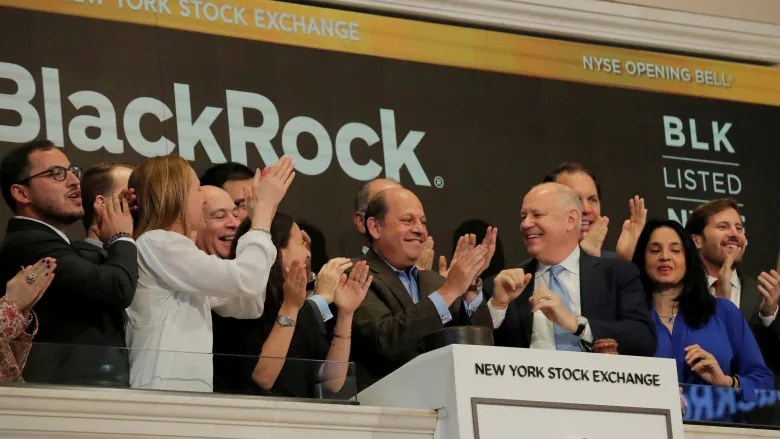
BlackRock is the world’s largest asset manager, with nearly $9.5 trillion under management. That is more than the gross domestic product of every country in the world except the U.S. and China. BlackRock also runs a massive technology platform that oversees at least $21.6 trillion in assets. It and two other megalithic asset managers, State Street and Vanguard (BlackRock’s largest shareholder), already effectively own much of the world. Adding “natural asset companies” to their portfolios could make them owners of the foundations of all life. 

A $4 Quadrillion Asset — The Earth Itself

Partnering with the New York Stock Exchange team launching the NAC is the Intrinsic Exchange Group (IEG), major investors in which are the Rockefeller Foundation and the Inter-American Development Bank, notorious for imposing neo-colonialist agendas through debt entrapment. According to IEG’s website:

We are pioneering a new asset class based on natural assets and the mechanism to convert them to financial capital. These assets are essential, making life on Earth possible and enjoyable. They include biological systems that provide clean air, water, foods, medicines, a stable climate, human health and societal potential.

The potential of this asset class is immense. Nature’s economy is larger than our current industrial economy ….

The immense potential of “Nature’s Economy” is estimated by IEG at $4,000 trillion ($4 quadrillion). 

Webb cites researcher and journalist Cory Morningstar, who maintains that one of the aims of creating “Nature’s Economy” and packaging it via NACs is to drastically advance massive land grab efforts made by Wall Street and the oligarch class in recent years, including those made by Wall Street firms and billionaires like Bill Gates during the COVID crisis. The land grabs facilitated through the development of NACs, however, will largely target indigenous communities in the developing world. Morningstar observes:

The public launch of NACs strategically preceded the fifteenth meeting of the Conference of the Parties to the Convention on Biological Diversity, the biggest biodiversity conference in a decade. Under the pretext of turning 30% of the globe into “protected areas”, the largest global land grab in history is underway. Built on a foundation of white supremacy, this proposal will displace hundreds of millions, furthering the ongoing genocide of Indigenous peoples.

The UN’s “30 x 30”

The land grab of which Morningstar speaks is embodied in a draft agreement called the “Post-2020 Global Biodiversity Framework,” currently being negotiated among the 186 governments that are signatories to the Convention for Biological Diversity. Part I of its 15th meeting (COP15) closed on October 15, just ahead of COP26 (the 26th UN Climate Change Conference of the Parties) hosted in Glasgow from October 31 through November 12. COP26 focuses on climate change, while COP 15 focuses on preserving diversity. Part II of COP15 will be held in 2022. The draft text for the COP 15 nature pact includes a core pledge to protect at least 30% of the planet’s land and oceans by 2030.

In September 2020, 128 environmental and human rights NGOs and experts warned that the 30 x 30 plan could result in severe human rights violations and irreversible social harm for some of the world’s poorest people. Based on figures from a paper published in the academic journal Nature, they argued that the new target could displace or dispossess as many as 300 million people. Stephen Corry of Survival International contended: 

The call to make 30% of the globe into “Protected Areas” is really a colossal land grab as big as Europe’s colonial era, and it’ll bring as much suffering and death. Let’s not be fooled by the hype from the conservation NGOs and their UN and government funders. This has nothing to do with climate change, protecting biodiversity or avoiding pandemics – in fact it’s more likely to make all of them worse. It’s really all about money, land and resource control, and an all out assault on human diversity. This planned dispossession of hundreds of millions of people risks eradicating human diversity and self-sufficiency – the real keys to our being able to slow climate change and protect biodiversity.

30 x 30 in the United States

The 30 x 30 target was incorporated in President Biden’s Executive Order on Tackling the Climate Crisis at Home and Abroad dated January 27, 2021, which includes at Sec. 219 “the goal of conserving at least 30 percent of our lands and waters by 2030.” 

How that is to be done is not clearly specified, but proponents insist it is not a “land grab.” Critics, however, contend there is no other way to pull it off. Only about 12% of land and water in the U.S. is now considered to be “in conservation,” including wilderness lands, national parks, national wildlife refuges, state parks, national monuments, and private lands with permanent conservation easements (contracts to surrender a portion of property rights to a land trust or the federal government). According to environmental expert Dr. Bonner Cohen, raising that figure to 30%, adding 600 million acres to the total, “means putting this land and water (mostly land) off limits to any productive use in perpetuity. To accomplish this goal, the federal government will have to buy up – through eminent domain or other pressures on landowners making them ‘willing sellers’ of their property – millions of acres of private land.”

In July 2021, 15 governors wrote to the Administration opposing the plan, led by Gov. Pete Ricketts of Nebraska. Ricketts said in a press release

This requires restricting a land area the size of the State of Nebraska every year, each year, for the next nine years, or in other words a landmass twice the size of Texas by 2030.

This goal is especially radical given that the President has no constitutional authority to take action to conserve 30% of the land and water. 

The Real Threat to Mother Nature

The federal government may have no constitutional authority to take the land, but a megalithic private firm such as BlackRock could do it simply by making farmers and local residents an offer they can’t refuse. This ploy has already been demonstrated in the housing market. 

According to a survey reported in The Guardian on October 12, 2021, nearly 40% of U.S. households are facing serious financial problems, including struggling to afford medical care and food; and 30% of lower income households (those earning under $50,000 per year) said they had lost all their savings during the coronavirus pandemic. In the first quarter of 2021, 15% of U.S. home sales went to large corporate investors including BlackRock, which beat out families in search of homes just by offering substantially more than the asking price. Sometimes whole neighborhoods were bought up at once for conversion into rental properties. 

BlackRock’s chairman Larry Fink is on the board of the World Economic Forum, which until recently featured a controversial promotional video declaring “You will own nothing, and you’ll be happy.”

We all want a clean environment, and we want to preserve species biodiversity. But that includes human biodiversity – acknowledging the rights of rural landowners and Indigenous peoples, the land’s natural stewards. The greatest threat to the land is not the people living on it but those well-heeled investors who swoop in to buy up the rights to it, financializing the earth for profit. 

Not just private property but those public lands and infrastructure once known as “the commons” are now under threat. We face an existential moment in our economic history, in which accumulated private wealth is acquiring carte blanche control of the essentials of life. Whether that juggernaut can be stopped remains to be seen, but the first step in any defensive action is to be aware of the threat at our doorsteps.
What’s REALLY behind the war on home ownership?

Becoming a “Nation of Renters” is clearly a big part of the New Normal.

By Kit Knightly

Source: Off-Guardian

The incipient “Great Reset” is a multi-faceted beast. We talk a lot about vaccine passports and lockdowns and the Covid-realated aspects – and we should – but there’s more to it than that.

Remember, they want you to “own nothing and be happy”. And right at the top of the list of things you definitely shouldn’t own, is your own home.

The headlines about this have been steady for the last few years, but it has picked up pace in the wake of the “pandemic” (as has so much else). An agenda hidden on back pages, behind by Covid’s meaningless big red numbers, but perhaps no less sinister.

You can find articles all over the net talking up renting over owning.

Last month, for example, Bloomberg ran an article headlined:

America Should Become a Nation of Renters”

Which praises what they call “the liquefaction of the housing market” and gleefully expounds on the idea that “The very features that made home buying an affordable and stable investment are coming to an end.”

The Atlantic published “Why Its Better To Rent Than Own” in March.

Financial pages from Business Insider to Forbes to Yahoo and Bloomberg again are filled with lists titled “9 Ways Renting is Better Than Buying”or similar.

Other publications go more personal with it, with anecdotal columns about ignoring financial advice and refusing to buy your home. Vox, never one to sell their agenda with any kind of subtlety, have a piece titled:

Homeownership can bring out the worst in you

Which literally argues that buying a house can make you a bad person:

It’s the biggest thing you might ever buy. And it could be turning you into a bad person.

So what exactly is the narrative here? What’s the story behind the story?

The short answer is fairly simple: It’s about greed, and it’s about control.

It almost always is, in the end.

The longer answer is rather more complicated. Major investment firms such as Vanguard and Blackrock, along with rental companies such as American Homes 4 Rent, are buying up single-family homes in record numbers – sometimes entire neighbourhoods at a time.

They pay well over market value, pricing families who want to own those homes out of the market, which forces the housing market up whilst the Lockdown-created recession is lowering wages and creating millions of newly unemployed.

Of course, this is motivating people to sell the houses they already own.

People all across America have been saddled with houses worth less than they bought them for since the 2008 economic crash, and are eager to take the cash from private investment firms paying 10-20% over market value. Combine an economic recession with a created housing boom and you have a huge population of motivated sellers.

Of course, many of these sellers don’t realise, until it’s too late, that even if they attempt to downsize or move to a cheaper area, they may be priced out of the market completely, and forced to rent.

As such, in the last year, the private investment share of single-family home purchases is estimated to have increased ten-fold, going from 2% in 2018 to over 20% this year.

As more and more people are forced to rent, of course, rental properties will be in higher and higher demand. This in turn will drive the cost of renting up.

Market Watch has already reported that, in the last year, rent has increased over 3x faster than the government predicted.

This problem is likely to get worse in the near future.

Last night [7/30/21], Congress “accidentally failed” to extend the Covid-related eviction ban.

Which means, this weekend, while Senators adjourn to the summer homes they probably don’t rent, the ban will officially end and a lot of people are likely to have their houses foreclosed or their landlords kick them out.

The newly empty buildings will be a feeding frenzy for the massive corporate landlords. Who will descend on the banks like starving hyenas to snap up the foreclosed properties for pennies on the dollar. Just like they did in 2008.

None of this is any secret, it’s been covered in the mainstream. Tucker Carlson even did a segment on it in early June.

The Wall Street Journal headlined, back in April, “If You Sell a House These Days, the Buyer Might Be a Pension Fund”, and reported:

Yield-chasing investors are snapping up single-family homes, competing with ordinary Americans and driving up prices

However, since then, something has clearly changed. The propaganda machine has kicked into gear to defend Wall Street from any backlash.

No better example of this shift can be found than The Atlantic, which ran this story in 2019:

WHEN WALL STREET IS YOUR LANDLORD
With help from the federal government, institutional investors became major players in the rental market. They promised to return profits to their investors and convenience to their tenants. Investors are happy. Tenants are not.

…and this story last month:

BLACKROCK IS NOT RUINING THE US HOUSING MARKET
The real villain isn’t a faceless Wall Street Goliath; it’s your neighbors and local governments stopping the construction of new units.

Going back to the Vox well we have:

Wall Street isn’t to blame for the chaotic housing market

Which ran just a few days after the Atlantic article, and is practically identical.

Both these (oddly similar) articles argue that Wall Street and private equity firms can’t be blamed for buying up houses, and that the real problem is the lack of supply to meet demand.

You see, all the “selfish” people who already own homes (they did say it makes you a bad person) are blocking the construction of new houses, and thus driving up the cost of property through scarcity.

This has been a logically flawed argument around the housing market for decades.

That there aren’t enough houses for people to buy is patently absurd when the US census data says that there are over 15 million houses currently standing empty. That’s enough to house all of America’s roughly 500,000 homeless people 30x over.

There’s plenty of houses, there’s just not enough money to buy them.

The reason for that is the same reason the California has massive “homeless camps” in its major cities, and that so many people are having to become renters instead of owners: wage stagnation.

For decades now, wage increases have lagged behind increases in the cost of living. In the 1960s one full-time job could afford a decent standard of living for a family of four or more. These days both parents work, sometimes multiple jobs each.

It was huge amounts of financial de-regulation which created this situation. So, whether you believe Vox’s BlackRock apologia or not, one way or another Wall Street very definitely is to blame.

But this isn’t just about money. It never is. Just as the war on cash isn’t just about efficiency, and the environmental push isn’t just about climate change. Ditto veganism. It’s about control. Just like vaccines, lockdowns and masks.

It always comes down to control.

It’s an oft-used cliche, but no less true for that, that homeowning “gives people a stake in society”. A family-owned house is a source of security for the future and something to leave your children. It is also sovereignty and privacy. Your own space that no one else can control or take away.

In short: A homeowner is independent. A renter is not. A renter can be controlled. A homeowner can not.

It’s the same reasoning behind the way working people were encouraged to take out loans and become debt slaves. If you limit people’s options, if you make them rely on you for a roof over their heads, you have control over them.

There’s a great article about this situation called “Your New Feudal Overlords”.

Under Feudalism, land wasn’t owned by the working class, but provided to them by landed barons, hence the term “Land Lord”. If you disrespected your Lord, or broke his rules, or he perceived another peasant/farm animal/crop would be a better use of the land, he could take it back.

Essentially, the behaviour of serfs was kept in check by their reliance on the nobility for a place to live. That’s very much the dynamic they’re going for here.

Rental agreements can be full of any terms and conditions the landlord wants, and the more desperate people get the more of their consumer rights they will sign over.

Maybe you’ll agree to smart meters which monitor your internet or power-usage habits, and then sell the data to behavioural modellers and viral marketers.

Maybe you’ll have to agree to certain power limitations or water shortages in order to “fight climate change”.

Maybe it will get worse than that.

Maybe they’ll go full Black Mirror style corporate dystopia. Maybe, through affiliation programs, the mega-equity firm which owns your rental house has ties to McDonald’s, and as such will require you to not eat at any competing fast-food franchises, or demand you observe at least ninety seconds of Disney advertisements per day.

Maybe it will be as simple as including vaccine status in the tenancy agreement, making it impossible for the unvaxxed to find a home.

Maybe they just want to make poor people miserable.

After all, the super-wealthy have got all the money they could ever need, and all the luxury they could ever use. Their living standards are as high as physically possible. So maybe the only way they can keep “winning”, is to start driving the living standards of us proles down.

No air travel. No vacations. No going out at all. Live in a tiny house, or a pod. Eat bugs. Get rid of your car. Rent your clothes. Or your furniture. Pay taxes on sugar. And alcohol. And red meat.

They’ve been very clear about this. They’ve told you about the Great Reset and the Internet of Things. That’s the plan.

You won’t own a house. And you’ll be happy…or else the mega-corporation you’re forced to rent from will kick you out.

The Number Of Billionaires In America Has Absolutely Exploded During The Pandemic

By Michael Snyder

Source: Investment Watch Blog

For the wealthy and the ultra-wealthy, happy days are here again.  Even though we have just been through one of the most difficult 12 months in our history, the number of billionaires has increased dramatically during this pandemic.  That seems rather odd, but there is no denying that the rich have gotten even richer during this crisis.  In fact, Forbes revealed this week that the number of billionaires has risen by about 30 percent over the past year…

The number of newly minted and reissued billionaires soared last year, Forbes reported Tuesday in its annual ranking, a staggering accumulation of personal wealth that stands in sharp contrast with the widespread economic struggles unleashed by the coronavirus pandemic.

The number of billionaires on Forbes’ 35th annual ranking swelled by 660 to 2,755 — a roughly 30 percent jump from a year ago — and 493 of them are first-timers. Seven of eight are richer than they were before the pandemic. Forbes calculates net worth by using stock prices and exchange rates from March 5.

Of course thanks to the reckless policies of our leaders, a billion dollars does not go nearly as far as it once did.

But still, a billion dollars is a whole lot of money.

Needless to say, the biggest reason why the number of billionaires has exploded is because we have been witnessing one of the greatest stock market rallies in history.

A year ago, the Dow Jones Industrial Average was sitting at about 23,000.

Today, it is above 33,000, and some analysts expect it to shoot quite a bit higher throughout the rest of 2021.

Stock prices have never been more detached from economic reality as they have been over the past 12 months, and they have only risen so high because of unprecedented intervention by the Federal Reserve and because of extremely wild spending by the federal government.

Many have warned that the party will inevitably come to a crashing end at some point, but it hasn’t happened yet.

So for now, the market optimists look like champions.

And now that Joe Biden is in the White House, the corporate media is telling us that we are on the verge of a grand new era of American prosperity.  The corporate media insists that the pandemic will soon be behind us thanks to the vaccines, and the talking heads on television envision a return to the good old days very quickly.

In fact, Barron’s is already declaring that the “U.S. economy might be stronger than it’s ever been”.

And CNN is trying to convince us that “America’s economy could be heading for a golden era of growth”.

Really?

If the U.S. economy is actually improving, then why are new claims for unemployment benefits going up?

The number of Americans filing first-time unemployment benefits unexpectedly rose last week, according to the Labor Department.

Data released Thursday showed 744,000 Americans filed first-time jobless claims in the week ended April 3. Analysts surveyed by Refinitiv were expecting 680,000 filings. The previous week’s total was revised higher by 9,000 to 728,000.

If economic conditions were getting better, that number should be going the other way.

Even I didn’t expect a number this bad.

Prior to 2020, the all-time record high for new unemployment claims in a single week was 695,000.  That record was established in October 1982, and it stood all the way until the COVID pandemic hit the U.S. early last year.

Sadly, we have been above 695,000 almost every single week since then.

The numbers compiled by the states tell us that nearly three-quarters of a million Americans filed new claims for unemployment benefits last week.  That is an absolutely catastrophic number.  Nobody should be talking about a “golden era of growth” or claiming that the “economy might be stronger than it’s ever been” until we get that number back down to pre-pandemic levels.

And right now, we are at a level that is about three times as high as pre-pandemic levels.

Look, the truth is that anyone that tells you that unemployment is low in the United States is lying to you.

According to John Williams of shadowstats.com, if honest numbers were being used the unemployment rate in the United States would be 25.7 percent right now.

That is the sort of number that we would expect to see during an economic depression, and the truth is that we are in an economic depression.

Over the past year, more than 70 million new claims for unemployment benefits have been filed, and approximately 4 million U.S. businesses have gone out of existence permanently.

But don’t worry, the stock market is hovering near all-time record highs and the corporate media is telling you that everything is going to be wonderful now that Joe Biden is in control.

Come on man!

You can’t really believe that stuff that they are shoveling.

With each passing day, more Americans are losing their jobs, more Americans are falling out of the middle class, and the cost of living just keeps going up even higher.

In fact, we just learned that global food prices have now gone up for 10 months in a row

The global food-price rally that’s stoking inflation worries and hitting consumers around the world shows little sign of slowing.

Even with grain prices taking a breather on good crop prospects, a United Nations gauge of global food costs rose for a 10th month in March to the highest since 2014. Last month’s advance was driven by a surge in vegetable oils amid stronger demand and tight inventories, according to Abdolreza Abbassian, a senior economist at the UN’s Food and Agriculture Organization.

I am going to continue to watch global food prices very carefully, because I believe that it will be a very important trend in the months and years ahead.

But for now, the good news is that at least economic conditions are relatively stable.

Yes, things are not nearly as good as they were before the pandemic, but at least they are not getting a whole lot worse.

So even though things are not great, we should enjoy this period of relative stability while we still can, because it definitely will not last.

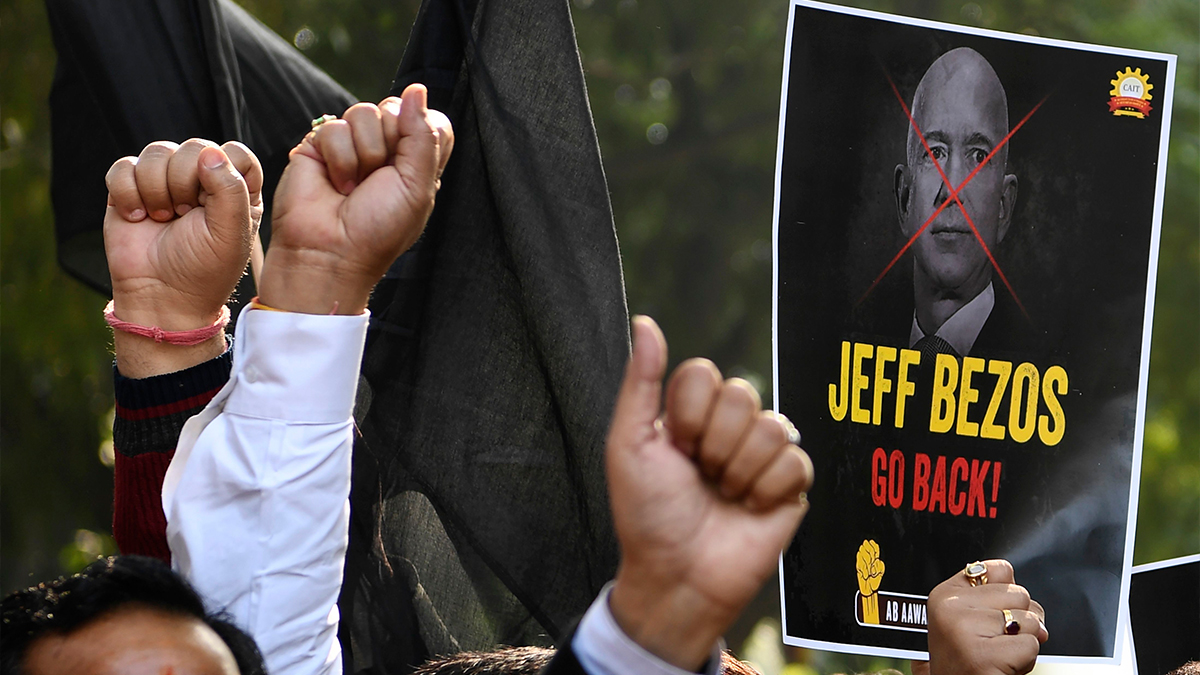
Viral Inequality: From Jeff Bezos to the struggle of Indian Farmers

Billionaires have profited enormously from lockdown, whilst mega corporations are buying out and shutting down independent stores and farms.

By Colin Todhunter

Source: OffGuardian

According to a new report by Oxfam, ‘The Inequality Virus’, the wealth of the world’s billionaires increased by $3.9tn (trillion) between 18 March and 31 December 2020. Their total wealth now stands at $11.95tn.

The world’s 10 richest billionaires have collectively seen their wealth increase by $540bn over this period. In September 2020, Jeff Bezos could have paid all 876,000 Amazon employees a $105,000 bonus and still be as wealthy as he was before COVID.

At the same time, hundreds of millions of people will lose (have lost) their jobs and face destitution and hunger. It is estimated that the total number of people living in poverty could have increased by between 200 million and 500 million in 2020. The number of people living in poverty might not return even to its pre-crisis level for over a decade.

Mukesh Ambani, India’s richest man and head of Reliance Industries, which specialises in petrol, retail and telecommunications, doubled his wealth between March and October 2020. He now has $78.3bn. The average increase in Ambani’s wealth in just over four days represented more than the combined annual wages of all of Reliance Industries’ 195,000 employees.

The Oxfam report states that lockdown in India resulted in the country’s billionaires increasing their wealth by around 35 per cent. At the same time, 84 per cent of households suffered varying degrees of income loss. Some 170,000 people lost their jobs every hour in April 2020 alone.

The authors also noted that income increases for India’s top 100 billionaires since March 2020 was enough to give each of the 138 million poorest people a cheque for 94,045 rupees.

The report went on to state:

…it would take an unskilled worker 10,000 years to make what Ambani made in an hour during the pandemic…and three years to make what Ambani made in a second.”

During lockdown and after, hundreds of thousands of migrant workers in the cities (who had no option but to escape the country’s avoidable but deepening agrarian crisis) were left without jobs, money, food or shelter.

It is clear that COVID has been used as cover for consolidating the power of the unimaginably rich. But plans for boosting their power and wealth will not stop there. One of the most lucrative sectors for these people is agrifood.

More than 60 per cent of India’s almost 1.4 billion population rely (directly or indirectly) on agriculture for their livelihood. Aside from foreign interests, Mukesh Ambani and fellow billionaire Gautam Adani (India’s second richest person with major agribusiness interests) are set to benefit most from the recently passed farm bills that will lead to the wholesale corporatisation of the agrifood sector.

CORPORATE CONSOLIDATION

A recent article on the grain.org website, ‘Digital control: how big tech moves into food and farming (and what it means)’, describes how Amazon, Google, Microsoft, Facebook and others are closing in on the global agrifood sector while the likes of Bayer, Syngenta, Corteva and Cargill are cementing their stranglehold.

The tech giants entry into the sector will increasingly lead to a mutually beneficial integration between the companies that supply products to farmers (pesticides, seeds, fertilisers, tractors, drones, etc) and those that control the flow of data and have access to digital (cloud) infrastructure and food consumers. This system is based on corporate centralisation and concentration (monopolisation).

Grain notes that in India global corporations are also colonising the retail space through e-commerce. Walmart entered into India in 2016 by a US$3.3 billion take-over of the online retail start-up Jet.com which, in 2018, was followed by a US$16 billion take-over of India’s largest online retail platform Flipkart. Today, Walmart and Amazon now control almost two-thirds of India’s digital retail sector.

Amazon and Walmart are using predatory pricing, deep discounts and other unfair business practices to lure customers towards their online platforms. According to Grain, when the two companies generated sales of over US$3 billion in just six days during a Diwali festival sales blitz, India’s small retailers called out in desperation for a boycott of online shopping.

In 2020, Facebook and the US-based private equity concern KKR committed over US$7 billion to Reliance Jio, the digital store of one of India’s biggest retail chains. Customers will soon be able to shop at Reliance Jio through Facebook’s chat application, WhatsApp.

The plan for retail is clear: the eradication of millions of small traders and retailers and neighbourhood mom and pop shops. It is similar in agriculture.

The aim is to buy up rural land, amalgamate it and roll out a system of chemically-drenched farmerless farms owned or controlled by financial speculators, the high-tech giants and traditional agribusiness concerns. The end-game is a system of contract farming that serves the interests of big tech, big agribusiness and big retail. Smallholder peasant agriculture is regarded as an impediment to be replaced by large industrial-scale farms.

This model will be based on driverless tractors, drones, genetically engineered/lab-produced food and all data pertaining to land, water, weather, seeds and soils patented and often pirated from peasant farmers.

Farmers possess centuries of accumulated knowledge that once gone will never be got back. Corporatisation of the sector has already destroyed or undermined functioning agrarian ecosystems that draw on centuries of traditional knowledge and are increasingly recognised as valid approaches to secure food security.

And what of the hundreds of millions to be displaced in order to fill the pockets of the billionaire owners of these corporations? Driven to cities to face a future of joblessness: mere ‘collateral damage’ resulting from a short-sighted system of dispossessive predatory capitalism that destroys the link between humans, ecology and nature to boost the bottom line of the immensely rich.

IMPERIAL INTENT

India’s agrifood sector has been on the radar of global corporations for decades. With deep market penetration and near saturation having been achieved by agribusiness in the US and elsewhere, India represents an opportunity for expansion and maintaining business viability and all-important profit growth. And by teaming up with the high-tech players in Silicon Valley, multi-billion dollar data management markets are being created. From data and knowledge to land, weather and seeds, capitalism is compelled to eventually commodify (patent and own) all aspects of life and nature.

Foreign agricapital is applying enormous pressure on India to scrap its meagre (in comparison to the richer nations) agricultural subsidies. The public distribution system and publicly held buffer stocks constitute an obstacle to the profit-driven requirements of global agribusiness interests.

Such interests require India to become dependent on imports (alleviating the overproduction problem of Western agricapital – the vast stocks of grains that it already dumps on the Global South) and to restructure its own agriculture for growing crops (fruit, vegetables) that consumers in the richer countries demand. Instead of holding physical buffer stocks for its own use, India would hold foreign exchange reserves and purchase food stocks from global traders.

Successive administrations have made the country dependent on volatile flows of foreign capital via foreign direct investment (and loans). The fear of capital flight is ever present. Policies are often governed by the drive to attract and retain these inflows. This financialisation of agriculture serves to undermine the nation’s food security, placing it at the mercy of unforeseen global events (conflict, oil prices, public health crises) international commodity speculators and unstable foreign investment.

Current agricultural ‘reforms’ are part of a broader process of imperialism’s increasing capture of the Indian economy, which has led to its recolonization by foreign corporations as a result of neoliberalisation which began in 1991. By reducing public sector buffer stocks and introducing corporate-dictated contract farming and full-scale neoliberal marketisation for the sale and procurement of produce, India will be sacrificing its farmers and its own food security for the benefit of a handful of unscrupulous billionaires.

As independent cultivators are bankrupted, the aim is that land will eventually be amalgamated to facilitate large-scale industrial cultivation. Indeed, a recent piece on the Research Unit for Political Economy site, ‘The Kisans Are Right: Their Land Is At Stake‘, describes how the Indian government is ascertaining which land is owned by whom with the ultimate aim of making it easier to eventually sell it off (to foreign investors and agribusiness). Other developments are also part of the plan (such as the Karnataka Land Reform Act), which will make it easier for business to purchase agricultural land.

India could eventually see institutional investors with no connection to farming (pension funds, sovereign wealth funds, endowment funds and investments from governments, banks, insurance companies and high net worth individuals) purchasing land. This is an increasing trend globally and, again, India represents a huge potential market. The funds have no connection to farming, have no interest in food security and are involved just to make profit from land.

The recent farm bills – if not repealed – will impose the neoliberal shock therapy of dispossession and dependency, finally clearing the way to restructure the agri-food sector. The massive inequalities and injustices that have resulted from the COVID-related lockdowns are a mere taste of what is to come.

The hundreds of thousands of farmers who have been on the streets protesting against these bills are at the vanguard of the pushback – they cannot afford to fail. There is too much at stake.

Imperial Overstretch Arrives: Americans Do Not Need the American Empire

By Philip Giraldi

Source: Strategic Culture Foundation

This piece is being written as voters are going to the polls on election day in the United States. While it has been useful to consider how things might change, possibly for the worse, one must also recognize that much of what happens in the U.S. and in its far-flung empire operates by virtue of its own internal dynamics and rules, something that is often referred to as the “Deep State” or perhaps more accurately as the Establishment.

Witness for example the occasional possibly sincere but unsuccessful White House attempts over the past four years to withdraw or reduce the numbers of U.S. troops embroiled in various armed conflicts worldwide. All of those initiatives have been frustrated or redirected in one way or another and it is not simply a question of bungling by a politically insensitive Donald Trump versus the result that might have been obtained by a more experienced and responsible Democrat. What drives the empire’s engine is essentially bipartisan, even in its own way, apolitical, existing as it does as a form of leaderless shadow government that functions as a community-of-interest rather than a bureaucracy. It is inclusive and reflective of the real centers of power in the country, namely the national security state and Wall Street.

In a recent article Pepe Escobar dispels any expectation that a kinder, gentler foreign policy might emerge from the election. He describes with some alarm how victory by Biden will mean that the national security “Blob” team that wrecked Syria, Yemen, Ukraine and Libya while also assassinating Americans overseas under President Barack Obama will be back. He cites former CIA presidential briefer Ray McGovern who persuasively describes the “Blob” as the MICIMATT (the Military-Industrial-Congressional-Intelligence-Media-Academia-Think-Tank complex). One might well add the Federal Reserve Bank to that list.

So, the engine keeps chugging on, driven my its own self-interests and completely oblivious to what is going on around it. The irony is that the crisis in confidence that simultaneously is besetting the United States in part reflects a very real, largely self-inflicted decline in America’s place in the world due to insistence that it maintain global hegemony. It comes at a time when the empire is entering into a phase of increasing irrelevancy which many of the key players involved are either unable or unwilling to recognize, no matter what their political affiliation might be. That means that the United States is locked into a pattern of behavior that it is incapable of changing. It is a nation that has become addicted to war for no good reason, and that addiction has brought neither security nor prosperity.

The signs are everywhere. The costs of empire continue to rise while real benefits to be derived from it are elusive. The United States government spends far more on a bloated defense budget than it can afford, adding to an unsustainable national debt that currently exceeds $27 trillion, which is 128% of the country’s entire gross domestic product. The debt will likely increase dramatically if there are any more coronavirus stimulus packages. The nation is becoming hollowed out as a result.

America’s “allies” have inevitably rightly become increasingly disengaged from Washington, reluctant to comply with Washington’s directions and demands, while the developing transition from the dollar as the world’s reserve currency is proceeding and will have catastrophic consequences. When the U.S. Treasury stops being able to print money at will, there will be national insolvency.

In terms of the United States’ interaction with the world, a country that not so long ago was widely respected is now regarded as the principal source of international instability, disliked everywhere but Israel, another rogue nation. And the internal damage inside the U.S. to core values and expectations is also evident, to include increasingly dysfunctional schools that focus on political correctness rather than education, crumbling infrastructure, a broken health care system, and a dying industrial and manufacturing base. Unique among all developed countries, life expectancy among working class Americans is declining.

At the root of it all is what Yale professor Paul Kennedy once described as “imperial overstretch,” which means projection of power in support of global commitments that are not essential to national well-being and bankrupting oneself in the process. The reality is that unless an “imperial” acquisition is done purely for exploitative reasons, as Belgium did in the Congo, having an empire operates at a considerable loss. Napoleon “overstretched” when he invaded Russia and both Russia and Austria-Hungary collapsed as a result of the First World War because the stress of external conflict made their obligations far exceed their resources. Great Britain’s Empire likewise became expendable after World War Two when the costs of maintaining outposts “east of Suez” became much larger than the benefits.

So, there are many good reasons for the United States to retrench and again become a “normal” nation, if that is at all possible, but the fact that no candidate but Tulsi Gabbard and Bernie Sanders even suggested that America’s global interventionism might be reconsidered or even reversed is telling. Both were eliminated by the Democratic party establishment. In the case of Gabbard, the executioner was no less than Hillary Clinton. Whoever is the new president, he will inherit the awful conceit that he is the “leader of the free world.” It is past time for a serious discussion of America’s proper place in the world, but that will require completely overturning the country’s Establishment and challenging the “exceptionalism” view that the U.S. must dominate as a “force for good.” Unfortunately, there is no politician anywhere on the horizon who is able and willing to take the lead on such an endeavor.

An Unprecedented 1,640 CEOs Departed in 2019; Now Execs Are Dumping Stock at Highest Pace Since 2006

By Pam Martens and Russ Martens

Source: Wall Street on Parade

A rather fascinating picture is emerging that suggests that things were not as rosy in the U.S. economic landscape prior to the pandemic as President Donald Trump and his Director of the National Economic Council, Larry Kudlow, would have the public believe.

Challenger, Gray & Christmas, Inc. has been tracking CEO departures for the past 12 years. Its Vice President, Andrew Challenger, called the numbers for 2019 “staggering.” It was the highest number since their surveys began in 2002. A total of 1,640 CEOs headed for the exits last year. That was 156 more CEOs than those who left their post in 2008 – the year that Wall Street blazed a scorched earth trail through the U.S. economy.

The number of CEOs that did not leave on their own accord last year was 101 out of the 1,640. According to the study, 15 CEOs left over allegations of professional misconduct; 20 left amid a scandal, “typically under investigations for financial wrongdoing or other legal issues”; 24 saw their positions terminated; 39 left due to a merger or acquisition; 3 left due to bankruptcy.

CEOs of old, established companies have the clearest view of what is happening in the overall economy. They can compare sales growth to prior years and prior decades. They can spot negative or positive trends in the economy far ahead of the economic reports that the federal government releases to the public.

When an outsized number of CEOs decide to cash out their stock options, grab their golden parachutes, and flee their corner offices – something smells.

On top of that fishy smell comes a report from TrimTabs Investment Research that corporate insiders have reaped more than $50 billion in stock sales since May, putting insider selling on a pace not seen since 2006 – two years before the stock market and economic crash of 2008.

The above two reports on corporate executive behavior are compatible with Wall Street On Parade’s reports that show that the current financial crisis began in the fall of 2019 – months before the first case of COVID-19 had emerged anywhere in the world. What triggered the financial crisis? The same kind of liquidity crisis on Wall Street that ushered in the crisis of 2008. (See Wall Street’s Financial Crisis Preceded COVID-19: Chart and Timeline and our archive of more than 100 articles on the financial crisis of 2019/2020 here.)

Why does it matter when the financial crisis began? It’s critically important for the following reasons.

First, the U.S. national debt has exploded to $26.69 trillion. To wrap your mind around this explosion of the national debt, you need some historical perspective. At the beginning of the Bill Clinton Presidency in January 1993, the U.S. national debt stood at $4 trillion. At that point, the United States was more than 200 years old. During that 200 years, the U.S. had financed the Revolutionary War, the Civil War, World Wars I and II and the Vietnam War. The country had also been through the greatest economic collapse in its history, the Great Depression, which required a multitude of fiscal spending programs.

It took more than two centuries for the U.S. national debt to reach $4 trillion but in just the past 27 years the national debt has grown by more than $22 trillion – more than a five-fold increase in less than three decades.

This staggering amount of debt puts the nation at risk of a future credit downgrade and cripples its ability to adequately deal with the financial struggles of its citizens during the worst health and financial crisis in a century.

One of the key reasons for this mushrooming debt was the Wall Street financial crisis of 2008 which required massive fiscal spending to keep the economy from sinking into a depression.

But no serious steps were taken by Congress to reform Wall Street. Derivatives remain largely unregulatedDark Pools are still trading in darkness. Wall Street continues to pay credit rating agencies to rate their toxic debt piles. Off balance sheet casinos run rampant at the largest Wall Street banks. Obscene pay for performance via stock options continues to incentive CEOs and CFOs to massage earnings.

The biggest unaddressed problem is the critical need to restore the Glass-Steagall Act. All of the dangers cited above can, and do, bring down an entire financial institution as we learned in 2008. But with the restoration of the Glass-Steagall Act, the giant, federally-insured, deposit-taking banks would be completely separated from the Wall Street casino investment banks.

This handful of mega banks that hold the majority of deposits in this country are too critical to keeping credit flowing to businesses and consumers to be run by the Wall Street bet-the-ranch mentality. These banks are simply too big to be bailed out again.

When Citigroup was disintegrating from all of the evils mentioned above from 2007 to 2010, this is what it took to resuscitate its sinking hull: $45 billion in capital infusions from the U.S. Treasury; over $300 billion in asset guarantees from the federal government; the Federal Deposit Insurance Corporation (FDIC) guaranteed $5.75 billion of its senior unsecured debt and $26 billion of its commercial paper and interbank deposits; and the Federal Reserve secretly, with no authorization or even awareness of Congress, made a cumulative $2.5 trillion in below-market rate loans to Citigroup from 2007 through at least the middle of 2010, according to an audit by the Government Accountability Office (GAO).

And, finally, acknowledging that this latest financial crisis began prior to the pandemic shines a bright light on the incompetency of the Federal Reserve to manage these Wall Street behemoth banks. It’s simply an insane regulatory model to have a bank regulator with the ability to create money out of thin air that can secretly create and spend $29 trillion bailing out the banks to cover up its own incompetency. That’s what happened from 2007 to 2010 and is in the process of happening again. (See The Fed Has Pumped $9 Trillion into Wall Street Over the Past Six Months, But Mnuchin Says “This Isn’t Like the Financial Crisis”.)


If the “Market” Never Goes Down, The System Is Doomed

By Charles Hugh Smith

Source: Of Two Minds

The reliance on “good news” narratives dooms our financial system and economy to a death spiral once reality breaks through the induced euphoria.

“Markets” that never go down aren’t markets, they’re signaling mechanisms of the Powers That Be. Markets are fundamentally clearing houses of information on price, demand, sentiment, expectations and so on–factual data on supply and demand, shipping costs, cost of credit, etc.–and reflections of trader and consumer emotions and psychology.

If markets are never allowed to go down, the information clearing house has been effectively shut down. Whatever information leaks out has been edited to fit the prevailing narrative, which in this moment is “central banks will never let markets go down ever again, so jump in and ride the guaranteed Bull to easy gains.”

The past 12 years offer ample evidence for this narrative: every dip draws a near-instantaneous monetary-policy response that reverse the dip and gooses markets higher.

That permanent monetary intervention distorts markets doesn’t matter to participants. Who cares if markets have become “markets,” simulacra of real markets that are now nothing but signaling mechanisms that all is well so buy, buy, buy? If gains are essentially guaranteed, who cares that markets are not longer information clearing houses?

Indeed. There’s no reason to care until the fatal spiral downward surprises us all. Here’s an analogy of what happens when real information gets edited to fit a convenient narrative.

Unfortunately, the patient has cancer which is starting to metastasize, i.e. spread to other organs in the body. But unbeknownst to the patient, this accurate information is considered “bad news,” so the test results and other information is carefully edited to show the cancer is actually shrinking–the exact opposite of what the actual facts reflect.

The patient is naturally delighted with this false data because it appears he’s on the mend and doesn’t need any surgery or other drastic treatments.

If participants don’t have information that reflects actual conditions, they cannot help but make disastrous decisions. Falsified or heavily edited information is misleading, and so all decisions made on the assumption this information is accurate will be fatally skewed.

Symptoms of the fatal spread of the disease are masked by stimulants that not only mask the spread but give the patient a sense of euphoric power and supreme confidence.

Imagine the patient’s terrible dismay when symptoms break through the euphoria and he learns his cancer is now terminal. Increasing the tragedy is his awareness that had the authorities in charge of his care given him the real-world data instead of the carefully edited “happy story” version, treatments could have been undertaken that might have extended his life. Now those options have been lost forever.

That’s the situation in our economy and financial system. The information cleared in markets has been suppressed, distorted and edited for 12 long years of permanent and ever-increasing monetary interventions, as the “doses” of intervention required to maintain the cocaine-like euphoria and supreme confidence in central bank manipulation of “markets” so they always signal the “good news” of guaranteed gains ratchets higher on every intrusion of reality.

The reliance on “good news” narratives dooms our financial system and economy to a death spiral once reality breaks through the induced euphoria. Our last chances to clear the financial cancers eating away at our economy are slipping away forever, masked by the “market’s” cocaine-like euphoria and supreme confidence in central-bank guaranteed gains.

If the stock market is never allowed to go down, this is the equivalent of telling the cancer-riddled patient that their cancer has disappeared, even as the disease is leading inexorably to the patient’s needless demise.

Meet BlackRock, the New Great Vampire Squid

By Ellen Brown

Source: Web of Debt

BlackRock is a global financial giant with customers in 100 countries and its tentacles in major asset classes all over the world; and it now manages the spigots to trillions of bailout dollars from the Federal Reserve. The fate of a large portion of the country’s corporations has been put in the hands of a megalithic private entity with the private capitalist mandate to make as much money as possible for its owners and investors; and that is what it has proceeded to do.

To most people, if they are familiar with it at all, BlackRock is an asset manager that helps pension funds and retirees manage their savings through “passive” investments that track the stock market. But working behind the scenes, it is much more than that. BlackRock has been called “the most powerful institution in the financial system,” “the most powerful company in the world” and the “secret power.” It is the world’s largest asset manager and “shadow bank,” larger than the world’s largest bank (which is in China), with over $7 trillion in assets under direct management  and another $20 trillion managed through its Aladdin risk-monitoring software. BlackRock has also been called “the fourth branch of government” and “almost a shadow government”, but no part of it actually belongs to the government. Despite its size and global power, BlackRock is not even regulated as a “Systemically Important Financial Institution” under the Dodd-Frank Act, thanks to pressure from its CEO Larry Fink, who has long had “cozy” relationships with government officials.

BlackRock’s strategic importance and political weight were evident when four BlackRock executives, led by former Swiss National Bank head Philipp Hildebrand, presented a proposal at the annual meeting of central bankers in Jackson Hole, Wyoming, in August 2019 for an economic reset that was actually put into effect in March 2020. Acknowledging that central bankers were running out of ammunition for controlling the money supply and the economy, the BlackRock group argued that it was time for the central bank to abandon its long-vaunted independence and join monetary policy (the usual province of the central bank) with fiscal policy (the usual province of the legislature). They proposed that the central bank maintain a “Standing Emergency Fiscal Facility” that would be activated when interest rate manipulation was no longer working to avoid deflation. The Facility would be deployed by an “independent expert” appointed by the central bank.

The COVID-19 crisis presented the perfect opportunity to execute this proposal in the US, with BlackRock itself appointed to administer it. In March 2020, it was awarded a no-bid contract under the Coronavirus Aid, Relief, and Economic Security Act (CARES Act) to deploy a $454 billion slush fund established by the Treasury in partnership with the Federal Reserve. This fund in turn could be leveraged to provide over $4 trillion in Federal Reserve credit. While the public was distracted with protests, riots and lockdowns, BlackRock suddenly emerged from the shadows to become the “fourth branch of government,” managing the controls to the central bank’s print-on-demand fiat money. How did that happen and what are the implications?

Rising from the Shadows

BlackRock was founded in 1988 in partnership with the Blackstone Group, a multinational private equity management firm that would become notorious after the 2008-09 banking crisis for snatching up foreclosed homes at firesale prices and renting them at inflated prices. BlackRock first grew its balance sheet in the 1990s and 2000s by promoting the mortgage-backed securities (MBS) that brought down the economy in 2008. Knowing the MBS business from the inside, it was then put in charge of the Federal Reserve’s “Maiden Lane” facilities. Called “special purpose vehicles,” these were used to buy “toxic” assets (largely unmarketable MBS) from Bear Stearns and American Insurance Group (AIG), something the Fed was not legally allowed to do itself.

BlackRock really made its fortunes, however, in “exchange traded funds” (ETFs). It gained trillions in investable assets after it acquired the iShares series of ETFs in a takeover of Barclays Global Investors in 2009. By 2020, the wildly successful iShares series included over 800 funds and $1.9 trillion in assets under management.

Exchange traded funds are bought and sold like shares but operate as index-tracking funds, passively following specific indices such as the S&P 500, the benchmark index of America’s largest corporations and the index in which most people invest. Today the fast-growing ETF sector controls nearly half of all investments in US stocks, and it is highly concentrated. The sector is dominated by just three giant American asset managers – BlackRock, Vanguard and State Street, the “Big Three” – with BlackRock the clear global leader. By 2017, the Big Three together had become the largest shareholder in almost 90% of S&P 500 firms, including Apple, Microsoft, ExxonMobil, General Electric and Coca-Cola. BlackRock also owns major interests in nearly every mega-bank and in major media.

In March 2020, based on its expertise with the Maiden Lane facilities and its sophisticated Aladdin risk-monitoring software, BlackRock got the job of dispensing Federal Reserve funds through eleven “special purpose vehicles” authorized under the CARES Act. Like the Maiden Lane facilities, these vehicles were designed to allow the Fed, which is legally limited to purchasing safe federally-guaranteed assets, to finance the purchase of riskier assets in the market.

Blackrock Bails Itself Out

The national lockdown left states, cities and local businesses in desperate need of federal government aid. But according to David Dayen in The American Prospect, as of May 30 (the Fed’s last monthly report), the only purchases made under the Fed’s new BlackRock-administered SPVs were ETFs, mainly owned by BlackRock itself. Between May 14 and May 20, about $1.58 billion in ETFs were bought through the Secondary Market Corporate Credit Facility (SMCCF), of which $746 million or about 47% came from BlackRock ETFs. The Fed continued to buy more ETFs after May 20, and investors piled in behind, resulting in huge inflows into BlackRock’s corporate bond ETFs.

In fact, these ETFs needed a bailout; and BlackRock used its very favorable position with the government to get one. The complicated mechanisms and risks underlying ETFs are explained in an April 3 article by business law professor Ryan Clements, who begins his post:

Exchange-Traded Funds (ETFs) are at the heart of the COVID-19 financial crisisOver forty percent of the trading volume during the mid-March selloff was in ETFs ….

The ETFs were trading well below the value of their underlying bonds, which were dropping like a rock. Some ETFs were failing altogether. The problem was something critics had long warned of: while ETFs are very liquid, trading on demand like stocks, the assets that make up their portfolios are not. When the market drops and investors flee, the ETFs can have trouble coming up with the funds to settle up without trading at a deep discount; and that is what was happening in March.

According to a May 3 article in The National, “The sector was ultimately saved by the US Federal Reserve’s pledge on March 23 to buy investment-grade credit and certain ETFs. This provided the liquidity needed to rescue bonds that had been floundering in a market with no buyers.”

Prof. Clements states that if the Fed had not stepped in, “a ‘doom loop’ could have materialized where continued selling pressure in the ETF market exacerbated a fire-sale in the underlying [bonds], and again vice-versa, in a procyclical pile-on with devastating consequences.” He observes:

There’s an unsettling form of market alchemy that takes place when illiquid, over-the-counter bonds are transformed into instantly liquid ETFs. ETF “liquidity transformation” is now being supported by the government, just like liquidity transformation in mortgage backed securities and shadow banking was supported in 2008.

Working for Whom?

BlackRock got a bailout with no debate in Congress, no “penalty” interest rate of the sort imposed on states and cities borrowing in the Fed’s Municipal Liquidity Facility, no complicated paperwork or waiting in line for scarce Small Business Administration loans, no strings attached. It just quietly bailed itself out.

It might be argued that this bailout was good and necessary, since the market was saved from a disastrous “doom loop,” and so were the pension funds and the savings of millions of investors. Although BlackRock has a controlling interest in all the major corporations in the S&P 500, it professes not to “own” the funds. It just acts as a kind of “custodian” for its investors — or so it claims. But BlackRock and the other Big 3 ETFs vote the corporations’ shares; so from the point of view of management, they are the owners. And as observed in a 2017 article from the University of Amsterdam titled “These Three Firms Own Corporate America,” they vote 90% of the time in favor of management. That means they tend to vote against shareholder initiatives, against labor, and against the public interest. BlackRock is not actually working for us, although we the American people have now become its largest client base.

In a 2018 review titled “Blackrock – The Company That Owns the World”, a multinational research group called Investigate Europe concluded that BlackRock “undermines competition through owning shares in competing companies, blurs boundaries between private capital and government affairs by working closely with regulators, and advocates for privatization of pension schemes in order to channel savings capital into its own funds.”

Daniela Gabor, Professor of Macroeconomics at the University of Western England in Bristol, concluded after following a number of regulatory debates in Brussels that it was no longer the banks that wielded the financial power; it was the asset managers. She said:

We are often told that a manager is there to invest our money for our old age. But it’s much more than that. In my opinion, BlackRock reflects the renunciation of the welfare state. Its rise in power goes hand-in-hand with ongoing structural changes; in finance, but also in the nature of the social contract that unites the citizen and the state.

That these structural changes are planned and deliberate is evident in BlackRock’s August 2019 white paper laying out an economic reset that has now been implemented with BlackRock at the helm.

Public policy is made today in ways that favor the stock market, which is considered the barometer of the economy, although it has little to do with the strength of the real, productive economy. Giant pension and other investment funds largely control the stock market, and the asset managers control the funds. That effectively puts BlackRock, the largest and most influential asset manager, in the driver’s seat in controlling the economy.

As Peter Ewart notes in a May 14 article on BlackRock titled “Foxes in the Henhouse,” today the economic system “is not classical capitalism but rather state monopoly capitalism, where giant enterprises are regularly backstopped with public funds and the boundaries between the state and the financial oligarchy are virtually non-existent.”

If the corporate oligarchs are too big and strategically important to be broken up under the antitrust laws, rather than bailing them out they should be nationalized and put directly into the service of the public. At the very least, BlackRock should be regulated as a too-big-to-fail Systemically Important Financial Institution. Better yet would be to regulate it as a public utility. No private, unelected entity should have the power over the economy that BlackRock has, without a legally enforceable fiduciary duty to wield it in the public interest.