The U.S. Is At The Center Of The Global Economic Meltdown

maxresdefault

By Brandon Smith

Source: Alt-Market.com

While the economic implosion progresses this year, there will be considerable misdirection and disinformation as to the true nature of what is taking place. As I have outlined in the past, the masses were so ill informed by the mainstream media during the Great Depression that most people had no idea they were actually in the midst of an “official” depression until years after it began. The chorus of economic journalists of the day made sure to argue consistently that recovery was “right around the corner.” Our current depression has been no different, but something is about to change.

Unlike the Great Depression, social crisis will eventually eclipse economic crisis in the U.S. That is to say, our society today is so unequipped to deal with a financial collapse that the event will inevitably trigger cultural upheaval and violent internal conflict. In the 1930s, nearly 50% of the American population was rural. Farmers made up 21% of the labor force. Today, only 20% of the population is rural. Less than 2% work in farming and agriculture. That’s a rather dramatic shift from a more independent and knowledgeable land-utilizing society to a far more helpless and hapless consumer-based system.

What’s the bottom line? About 80% of the current population in the U.S. is more than likely inexperienced in any meaningful form of food production and self-reliance.

The rationale for lying to the public is certainly there. Economic and political officials could argue that to reveal the truth of our fiscal situation would result in utter panic and immediate social breakdown. When 80% of the citizenry is completely unprepared for a decline in the mainstream grid, a loss of savings through falling equities and a loss of buying power through currency destruction, their first response to such dangers would be predictably uncivilized.

Of course, the powers-that-be are not really interested in protecting the American people from themselves. They are interested only in positioning their own finances and resources in the most advantageous investments while using our loss and fear to extract more centralization, more control and more consent. Thus, the hiding of economic decline is enacted because the decline itself is useful to the elites.

And just to be clear for those who buy into the propaganda, the U.S. is indeed in a speedy decline.

In ‘Lies You Will Hear As The Economic Collapse Progresses’, published in summer of last year, I predicted that “Chinese contagion” would be used as the scapegoat for the downturn in order to hide the true source: American wealth destruction. Today, as the Dow and other markets plummet and oil markets tank due to falling demand and glut inventories, all we seem to hear from the mainstream talking heads and the people who parrot them in various forums is that the U.S. is the “only stable economy by comparison” and the rest of the world (mainly China) is a poison to our otherwise exemplary financial health. This is delusional fiction.

The U.S. is the No. 1 consumer market in the world with a 29% overall share and a 21% share in energy usage, despite having only 5 percent of the world’s total population. If there is a global slowdown in consumption, manufacturing, exports and imports, then the first place to look should be America.

Trucking freight in the U.S. is in steep decline, with freight companies pointing to a “glut in inventories” and a fall in demand as the culprit.

Morgan Stanley’s freight transportation update indicates a collapse in freight demand worse than that seen during 2009.

The Baltic Dry Index, a measure of global freight rates and thus a measure of global demand for shipping of raw materials, has collapsed to even more dismal historic lows. Hucksters in the mainstream continue to push the lie that the fall in the BDI is due to an “overabundance of new ships.” However, the CEO of A.P. Moeller-Maersk, the world’s largest shipping line, put that nonsense to rest when he admitted in November that “global growth is slowing down” and “[t]rade is currently significantly weaker than it normally would be under the growth forecasts we see.”

Maersk ties the decline in global shipping to a FALL IN DEMAND, not an increase in shipping fleets.

This point is driven home when one examines the real-time MarineTraffic map, which tracks all cargo ships around the world. For the past few weeks, the map has remained almost completely inactive with the vast majority of the world’s cargo ships sitting idle in port, not traveling across oceans to deliver goods. The reality is, global demand has fallen down a black hole, and the U.S. is at the top of the list in terms of crashing consumer markets.

To drive the point home even further, the U.S. is by far the world’s largest petroleum consumer. Therefore, any sizable collapse in global oil demand would have to be predicated in large part on a fall in American consumption. Oil inventories are now overflowing, indicating an unheard-of crash in energy use and purchasing.

U.S. petroleum consumption was actually lower in 2014 than it was in 1997 and 25% lower than earlier projections predicted. A large part of this reduction in gas use has been attributed to fewer vehicle miles traveled. Though oil markets have seen massive price cuts, the lack of demand continued through 2015.

This collapse in consumption is reflected partially in newly adjusted 4th quarter GDP forecasts by the Federal Reserve, which are now slashed down to 0.7%.  And remember, Fed and government calculate GDP stats by counting government spending of taxpayer money as “production” or “commerce”.  They also count parasitic programs like Obamacare towards GDP as well.  If one were to remove government spending of taxpayer funds from the equation, real GDP would be far in the negative.  That is to say, if the fake numbers are this bad, then the real numbers must be horrendous.

And finally, let’s talk about Wal-Mart. There is a good reason why mainstream pundits are attempting to marginalize Wal-Mart’s sudden announcement of 269 store closures, 154 of them within the U.S. with at least 10,000 employees being laid off. Admitting weakness in Wal-Mart means admitting weakness in the U.S. economy, and they don’t want to do that.

Wal-Mart is America’s largest retailer and largest employer. In 2014, Wal-Mart announced a sweeping plan to essentially crush neighborhood grocery markets with its Wal-Mart Express stores, building hundreds within months. Today, those Wal-Mart Express stores are being shut down in droves, along with some supercenters. Their top business model lasted around a year before it was abandoned.

Some in the mainstream argue that this is not necessarily a sign of economic decline because Wal-Mart claims it will be building 200 to 240 new stores worldwide by 2017. This is interesting to me because Wal-Mart just suffered its steepest stock drop in 27 years on reports that projected sales will fall by 6% to 12% for the next two years.

It would seem to me highly unlikely that Wal-Mart would close 154 stores in the U.S. (269 stores worldwide) and then open 240 other stores during a projected steep crash in sales that caused the worst stock trend in the company’s history. I think it far more likely that Wal-Mart executives are attempting to appease shareholders with expansion promises they do not plan to keep.

I am going to call it here and now and predict that most of these store sites will never see construction and that Wal-Mart will continue to make cuts, either with store closings, employee layoffs or both.

As the above data indicates, global demand is disintegrating; and the U.S. is a core driver.

The best way to sweep all these negative indicators under the rug is to fabricate some grand idea of outside threats and fiscal dominoes. It is much easier for Americans to believe our country is being battered from without rather than destroyed from within.

Does China have considerable fiscal issues including debt bubble issues? Absolutely. Is this a catalyst for global collapse? No. China’s problems are many but if there is a first “domino” in the chain, then the U.S. economy claims that distinction.

China is the largest exporter in the world, not the largest consumer. If anything, a crash in China’s economy is only a REFLECTION of an underlying collapse in U.S. demand for Chinese goods (among others). That is to say, the mainstream dullards have it backward; a crash in China is a herald of a larger collapse in U.S. markets. A crash in China is a symptom of the greater fiscal disease in America. The U.S. is the primary cause; it is not the victim of Chinese contagion. And the crisis in the U.S. will ultimately be far worse by comparison.

I wrote in ‘What Fresh Horror Awaits The Economy After Fed Rate Hike?’, published before Christmas:

“Market turmoil is a guarantee given the fact that banks and corporations have been utterly reliant on near-zero interest rates and free overnight lending from the Fed. They have been using these no-cost and low-cost loans primarily for stock buybacks, purchasing back their own stocks and reducing the number of shares on the market, thereby artificially elevating the value of the remaining shares and driving up the market as a whole. Now that near-zero lending is over, these banks and corporations will not be able to afford constant overnight borrowing, and the buybacks will cease. Thus, stock markets will crash in the near term.

This process has already begun with increased volatility leading up to and after the Fed rate hike. Watch for far more erratic stock movements (300 to 500 points or more) up and down taking place more frequently, with the overall trend leading down into the 15,000-point range for the Dow in the first two quarters of 2016. Extraordinary but short lived positive increases in the markets will occur at times (Christmas and New Year’s tend to result in positive rallies), but shock rallies are just as much a sign of volatility and instability as shock crashes.”

Markets moved immediately into crash territory after the new year began. This was an easy prediction to make and one that I have been reiterating for months — just as the timing of the Fed rate hike was an easy prediction to make, based on the Fed’s history of deliberately increasing instability through bad policy as the economy moves into deflationary spirals. The Fed did it during the Great Depression and is doing it again today.

It is no coincidence that global markets began to tank after the first Fed rate hike; no-cost overnight lending to banks and corporations was the key to maintaining equities in a relatively static position.  As the U.S. loses momentum, the world loses momentum.  As the Fed ends outright stimulation and manipulation, the house of cards falls.

I have said it many times and I’ll say it yet again: If you think the Fed’s motivation is to prolong or protect the U.S. economy and currency, then you will never understand why it takes the policy actions it does. If you understand and accept the fact that the Fed is a saboteur working carefully and incrementally toward the destruction of the U.S. to make way for a new globally centralized system, everything falls into place.

To summarize, the U.S. economy as we know it is not slated to survive the next few years. Read my article ‘The Economic Endgame Explained’ for more in-depth information on why a collapse is being engineered and what the openly admitted goal is, including the referenced 1988 article from The Economist titled “Get Ready A World Currency In 2018,” which outlines the plan for a reduction of the dollar and the U.S. system in order to make way for a global basket reserve currency (Special Drawing Rights).

It is astonishingly foolish to assume that even though the U.S. has held the title of king of global consumption share for decades, that our economy is somehow not a primary faulty part in the sputtering global economic engine.  Economies are falling because demand is falling.   Demand is falling because Americans are not buying.  Americans are not buying because Americans are broke. Americans are broke because central bank policy has created an environment of wealth destruction. This wealth destruction in the U.S. has been ongoing, but only now is it becoming truly visible.  The volatility we see in developing nations is paltry compared to the financial chaos we now face.  Anyone who attempts to dismiss the dangers of a U.S. breakdown or the threat to the unprepared public is either an idiot, or they are trying to divert and distract you from reality. The coming months will undoubtedly verify this.

Big Corporations Have an Overwhelming Amount of Power Over Our Food Supply

By Michael Snyder

Source: The Economic Collapse

From our fields to our forks, huge corporations have an overwhelming amount of power over our food supply every step of the way.  Right now there are more than 313 million people living in the United States, and the job of feeding all of those people is almost entirely in the hands of just a few dozen monolithic companies.  If you do not like how our food is produced or you don’t believe that it is healthy enough, it isn’t very hard to figure out who is to blame.  These mammoth corporations are not in business to look out for the best interests of the American people.  Rather, the purpose of these corporations is to maximize wealth for their shareholders.  So the American people end up eating billions of pounds of extremely unhealthy food that is loaded with chemicals and additives each year, and we just keep getting sicker and sicker as a society.  But these big corporations are raking in big profits, so they don’t really care.

If we did actually have a capitalist system in this country, we would have a high level of competition in the food industry.  But instead, the U.S. food industry has become increasingly concentrated with each passing year.  Just consider the following numbers about the U.S. agricultural sector…

The U.S. agricultural sector suffers from abnormally high levels of concentration. Most economic sectors have concentration ratios around 40%, meaning that the top four firms in the industry control 40% of the market. If the concentration ratio is above 40%, experts believe competition can be threatened and market abuses are more likely to occur: the higher the number, the bigger the threat.

The concentration ratios in the agricultural sector are shocking.

-Four companies own 83.5% of the beef market.
-The top four firms own 66% of the hog industry.
-The top four firms control 58.5% of the broiler chicken industry.
-In the seed industry, four companies control 50% of the proprietary seed market and 43% of the commercial seed market worldwide.
-When it comes to genetically engineered (GE) crops, just one company, Monsanto, boasts control of over 85% of U.S. corn acreage and 91% of U.S. soybean acreage.

When so much power is concentrated in so few hands, it creates some tremendous dangers.

And many of these giant corporations (such as Monsanto) are extremely ruthless.  Small farmers all over America are being wiped out and forced out of the business by the predatory business practices of these huge companies

Because farmers rely on both buyers and sellers for their business, concentrated markets squeeze them at both ends. Sellers with high market power can inflate the prices of machinery, seeds, fertilizers and other goods that farmers need for their farms, while powerful buyers, such as processors, suppress the prices farmers are paid. The razor-thin profit margins on which farmers are forced to operate often push them to “get big or get out”—expanding into mega-operations or exiting the business altogether.

Of course the control that big corporations have over our food supply does not end at the farms.

The distribution of our food is also very highly concentrated.  The graphic shared below was created by Oxfam International, and it shows how just 10 gigantic corporations control almost everything that we buy at the grocery store…

10-Corporations-Control-What-We-Eat-425x265

And these food distributors are often not very good citizens either.

For example, it was recently reported that Nestle is running a massive bottled water operation on a drought-stricken Indian reservation in California

Among the windmills and creosote bushes of San Gorgonio Pass, a nondescript beige building stands flanked by water tanks. A sign at the entrance displays the logo of Arrowhead 100% Mountain Spring Water, with water flowing from a snowy mountain. Semi-trucks rumble in and out through the gates, carrying load after load of bottled water.

The plant, located on the Morongo Band of Mission Indians’ reservation, has been drawing water from wells alongside a spring in Millard Canyon for more than a decade. But as California’s drought deepens, some people in the area question how much water the plant is bottling and whether it’s right to sell water for profit in a desert region where springs are rare and underground aquifers have been declining.

Nestle doesn’t stop to ask whether it is right or wrong to bottle water in the middle of the worst drought in the recorded history of the state of California.

They have the legal right to do it and they are making large profits doing it, and so they are just going to keep on doing it.

Perhaps you are thinking that you can avoid all of these corporations by eating organic and by shopping at natural food stores.

Well, it isn’t necessarily that easy.

According to author Wenonah Hauter, the “health food industry” is also extremely concentrated

Over the past 20 years, Whole Foods Market has acquired its competition, including Wellspring Grocery, Bread of Life, Bread & Circus, Food for Thought, Fresh Fields, Wild Oats Markets and others. Today the chain dominates the market because it has no national competitor. Over the past five years its gross sales have increased by half (47 percent) to $11.7 billion, and its net profit quadrupled to $465.6 million. One of the ways it has achieved this profitability is by selling conventional foods under the false illusion that they are better than products sold at a regular grocery store. Consumers falsely conclude that these products have been screened and are better, and they are willing to pay a higher price.

The distribution of organic foods is also extremely concentrated. A little-known company, United Natural Foods, Inc. (UNFI) now controls the distribution of organic and natural products. Publically traded, the company has a contract with Whole Foods and it is the major source of these products for the remaining independent natural food stores. This relationship has resulted in increasingly high prices for these foods. Small manufacturers are dependent on contracts with UNFI to get their products to market and conversely, small retailers often have to pay a premium price for products because of their dependence on this major distributor. Over the past five years, UNFI’s net sales increased by more than half (55.6 percent) $5.2. billion. Its net profit margin increased by 88 percent to $91 million.

Everywhere you look, the corporations are in control.

And this is especially true when you look at big food retailers such as Wal-Mart.

Right now, grocery sales account for about half of all business at Wal-Mart, and approximately one out of every three dollars spent on groceries in the United States is spent at Wal-Mart.

That is absolutely astounding, and it obviously gives Wal-Mart an immense amount of power.

In fact, if you can believe it, Wal-Mart actually purchases a billion pounds of beef every single year.

So the next time someone asks you where the beef is, you can tell them that it is at Wal-Mart.

On the restaurant side, the ten largest fast food corporations account for 47 percent of all fast food sales, and the love affair that Americans have with fast food does not appear to be in danger of ending any time soon.

Personally, if you do not like how these corporate giants are behaving, you can always complain.

But you are just one person among 313 million, and most of these big corporations are not going to consider the ramblings of one person to be of any significance whatsoever.

Collectively, however, we have great power.  And the way that we are going to get these big corporations to change is by voting with our wallets.

Unfortunately, the vast majority of Americans seem quite satisfied with the status quo.  So the population as a whole is likely going to continue to get sicker, fatter and less healthy with each passing year, and the big food corporations are going to keep becoming even more powerful.

Always Low Wages, More Pollution: Why Barack & Michelle Obama Relentlessly Shill For Wal-Mart

walmart-obama-apmichelle_obama_walmart_030311-thumb-640xauto-2467

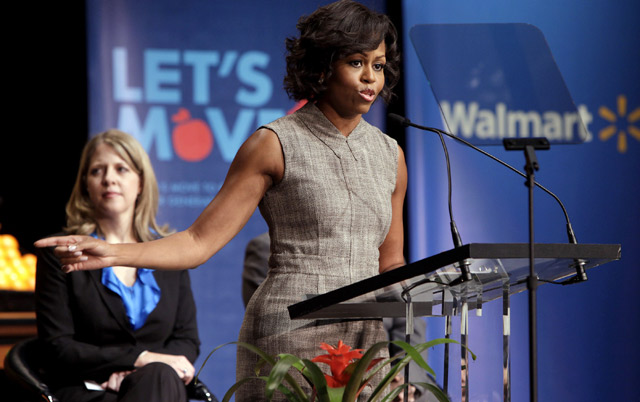
Democrats in labor unions and figures like former Labor Secretary Robert Reich and others were justly outraged at Barack Obama’s latest wet kiss to Wal-Mart earlier this month. But First Lady Michelle Obama has been in bed with the giant retailer for years. Is this a nasty bug in the Obama presidency, or a corrupt core feature?

By BAR managing editor Bruce A. Dixon

Source: Black Agenda Report

Low Wages, Always: Barack and Michelle Obama Bestow More Wet Kisses on Wal-Mart

“…the willingness of the Obama Administration to do the bidding of Wal-Mart shows just how hollow has become the pretense of elected black Democrats to representing the poor and oppressed…”

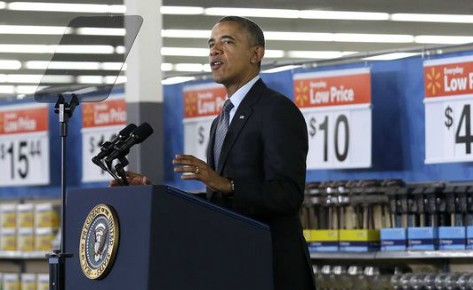
Earlier this month President Obama visited a Bay Area Wal-Mart to praise the world’s largest and most anti-union retailer for its supposed environmental responsibility. The fact is that Wal-Mart’s maintenance of diesel-fueled supply chains between its stores and wherever on the planet wages are lowest and environmental restrictions are totally absent make it a major ongoing contributor to runaway climate change. The president’s appearance therefore, was simply a hypocritical exercise in greenwashing for Wal-Mart.

Though it was an insult to working people and to many of his abject and fervent supporters, it should have been no surprise. It wasn’t President Obama’s first wet kiss to Wal-Mart and with almost three more years in office to go it won’t be his last. Still the willingness of the Obama Administration to do the bidding of Wal-Mart shows just how hollow has become the pretense of elected black Democrats to representing the poor and oppressed.

There was a time when Democrats in the White House did not dare openly shill for the giant retailer. Hillary Clinton served on Wal-Mart’s board of directors through most of the 1980s, while her husband Bill was governor of Arkansas. Even then, Wal-Mart was notorious for overworking and underpaying its workers, violating labor laws to thwart unions, and sopping up prodigious amounts of corporate welfare in the forms of tax breaks and subsidies of all kinds. Being in bed with those crooks wasn’t just an embarrassment, it was a hypocritical affront to Democratic voters, so somewhere on the 1992 road to the White House, Hillary resigned from Wal-Mart’s board. Similarly in 2007 with her husband on the way to the White House, Michelle Obama felt compelled to resign from the board of TreeHouse Foods, a major Wal-Mart vendor. “I won’t shop there,” said presidential candidate Barack Obama when questioned about Wal-Mart at an AFL-CIO labor forum.

Of course labor audiences in 2007 and 2008 were where Obama pledged to renegotiate NAFTA, and immediately raise the minimum wage as soon as he took office. The president never mentioned raising the minimum wage again till about 2012 when Republicans were safely in control of the House of Representatives, and instead of renegotiating NAFTA, President Obama is engaged in secret negotiations to extend it across the Atlantic and Pacific Oceans. Evidently the Obama that promises is a different guy, and far less powerful, than the Obama that acts.

“…The first lady allowed the unscrupulous retailer to leverage her personal image …”

Safely in office, Michelle and Barack Obama have enthusiastically embraced Wal-Mart. The first lady allowed the unscrupulous retailer to leverage her personal image as an advocate of exercise and healthy eating in her “Let’s Move” initiative, and spouting the company line that the best solution to urban “food deserts” is opening more Wal-Mart neighborhood grocery stores. Michelle Obama’s many appearances at and pronouncements around Wal-Mart have done the retailer more good than she and Hillary could ever have done in another decade or two apiece on its board of directors.

Right now Wal-Mart is approaching 30% of the US retail grocery market, with far lower wages, fewer hours, skimpier benefits, and longer and dirtier supply chains than its major competitors. As I said a couple years ago in an article about Michelle Obama’s cynical embrace of Wal-Mart:

Wal-Mart’s business model of corrupting public officials, lying about job creation numbers, rampant sex and race discrimination, relentlessly low wage and benefit levels, and aspirations to monopoly control of local markets across the country make it a bad neighbor, a worse boss, an unfair competitor and sometimes a criminal enterprise.

Wal-Mart has been a leader in the corporate practice of weaponizing its charitable giving, turning it into a lever to open new markets in urban America, to neutralize and isolate opposition, and to curry favor with local political figures. Wal-Mart made it rain on selected charities and ministries in areas like Newark and Chicago when it needed to colonize those new markets. President Obama recognized this “achievement” in the corruption of Democratic party politics in March 2014 by nominating Wal-Mart’s chief of charitable giving to head up his Office of Management and Budget.

Wal-Mart was even allowed, along with McDonalds and other large, low-wage employers, to shape the drafting of regulations governing Obamacare, in ways that exempted the retailer from having to ensure large numbers of its workers for the first several years.

The fiction that elected Democrats represent poor and working people and stand for safeguarding the environment is just that – a fiction. There is a new neoliberal paradigm that allows Democrats to mumble a few words about raising the minimum wage when the other party controls Congress, that claims the moment they took office was the day the oceans stopped rising. If these were curable bugs in the political system, votes and advocacy would wake enough people up to change them. But what if they’re not bugs in the system at all. What if these are its core and immutable features? What then? Isn’t it time to step outside their two-party, capitalist box, to dream and begin to build something else?

Bruce A. Dixon is managing editor at Black Agenda Report and a state committee member of the GA Green Party. He lives and works in Marietta GA and can be reached at bruce.dixon(at)blackagendareport.com.

Origin of the Wal-Mart Workers’ Movement

walmart black friday strike

Wal-Mart’s unfair labor policies have been a concern of workers’ rights activists for decades but they managed to avoid a retail strike until last year. On October 4th 2012, 60 Wal-Mart employees struck in Los Angeles followed by strikes at 28 stores in 12 states five days later. Shortly after on October 10th, pressure was increased when more than 200 workers protested at Wal-Mart’s global headquarters in Bentonville, Arkansas, as executives met for its annual financial analyst meeting. More than 400 Wal-Mart strikers, mostly coordinated by Organization United For Respect at Wal-Mart (OUR Wal-mart) with support from the United Food and Commercial Workers Union, walked out on Black Friday, the day after Thanksgiving and traditionally Wal-Mart’s most profitable (and chaotic) day of the year.

Wal-Mart’s intimidation tactics have long suppressed employees’ attempts to organize but previous incidents reflecting growing collective outrage and urgency served as catalyst to make the wave of strikes inevitable. On June 4th 2012, eight Mexican guest workers at Wal-Mart supplier CJ’s Seafood went on strike and filed a complaint with the Labor Department and the Equal Opportunity Labor Commission. Plant managers had forced them to work 24 hour shifts with no overtime, locked employees inside the plant, threatened them with beatings and threatened violence against their families in Mexico. As a result of the strike, Wal-Mart was pressured into suspending CJ’s Seafood as a supplier.

In early September of 2012, around 30 temp workers at a warehouse storing goods for Wal-Mart went on strike without union backing. Conditions of the freight containers they worked in were becoming dangerously hot in the Summer. In addition, the underpaid workers had no access to clean water, were forced to use malfunctioning equipment, denied work breaks, and threatened by supervisors. The following week another 30 employees at a Wal-Mart distribution center in northeastern Illinois walked out after being retaliated against by supervisors for delivering a list of grievances to management. Their petition shared many of the same concerns listed by the strikers in California: dangerous working conditions, unsafe or insufficient equipment, lack of living wages, no overtime pay, benefits and job security, irregular schedules, work speed-ups and wage theft.

While exploitation and unjust treatment of workers are not unique to Wal-Mart and companies they subcontract to, the wild growth of the Wal-Mart empire can be largely attributed to their business model. Besides maintaining strict anti-union policies, by keeping tight control over their supply chain they force costs and responsibilities onto suppliers, squeezing their margins. Predictably, this results in the lowest paid laborers getting hit the hardest while the highest paid CEOs make obscenely inflated profits. According to Federal Reserve data analyzed by Sylvia Allegretto and Josn Bivens, between 2007 and 2010, while the average American family’s wealth decreased 38.8%, wealth of Wal-Mart heirs rose 22% to nearly $90 billion, equivalent to the wealth of 41.5 percent of American families combined. An article for the Progressive Change Campaign Committee by Zaid Jilani highlighted the fact that Wal-Mart CEO Mike Duke received compensation worth $18.1 million in 2011 while the average sales associate at the company was paid $8.81 an hour according to independent market research group IBIS World. Thus, Duke earned 1,167 times as much as his company’s average worker (average CEO-to-worker compensation ratio was 209.4-to-1 in 2011). A 2008 SweatFree Communities report brought to light horrendous working conditions at a Wal-Mart supplier in Bangladesh where sweatshop factory workers were forced to work up to 19-hour shifts, frequently subjected to verbal and physical abuse and paid as little as $20 a month.

Societal harm caused by Wal-Mart is hardly limited to poverty and sub-poverty wage employees, subcontractors, and their families. In 2010 Public Advocate for the City of New York Bill de Blasio and Hunter College Center for Community Planning and Development released “Wal-Mart’s Economic Footprint”, a comprehensive review of over fifty studies on Wal-Mart’s economic impact across the country. Among their findings:
-For every two low wage jobs Wal-Mart creates, three local jobs are eliminated.
-Wal-Mart stores have a strongly negative impact on a community’s existing retailers.
-Large chain stores such as Wal-Mart send most of their revenues out of communities.
-Wal-Mart has thousands of employees who qualify for Medicaid and other publicly subsidized care.
-Wal-Mart likely avoided paying $245 million in taxes 2008 by paying rent to itself and then deducting that rent from its taxable income.
-Wal-Mart has admitted a failure to pay $2.95 billion in taxes for fiscal year 2009.
-Wal-Mart’s average annual pay of $20,774 is below the Federal Poverty Level for a family of four.

Because Wal-Mart is now the largest food seller in the US, it has an outsized impact on our food system influencing which foods are made available, market prices of food and methods used by food producers. Continuing Wal-Mart’s trend of prioritizing profits over people, last year the company made a deal with Monsanto to sell unlabeled GM corn. This decision was made despite protests of 463,000 signatories of a petition from Food and Water Watch urging Wal-Mart not to carry the potentially harmful product.

The National Labor Relations Board recently decided that it will prosecute Wal-Mart for labor rights violations for firing and retaliating against striking workers and those who have been outspoken about working conditions at Wal-Mart. This case shows that actions over the past year and a half have had a significant impact. Nearly a year after the Tazreen factory fire in Bangladesh that killed at least 117 people, Wal-Mart has refused to contribute to a compensation program for survivors and families (55% of the factory’s production was for Wal-Mart contractors). Wal-Mart has also been in the media spotlight for promoting a holiday food drive for its own employees, many of whom are paid under $9 an hour.

To keep the pressure on Wal-Mart, many workers will be walking off the job again for this year’s Black Friday. Learn more about this year’s action and/or participate by visiting the ActionNetwork.org site.

Sources:

http://www.democracynow.org/2012/10/10/walmart_workers_in_12_states_stage#transcript

http://www.huffingtonpost.com/2012/09/17/warehouse-workers-strike-illinois_n_1891499.html

http://www.guardian.co.uk/business/2012/oct/18/walmart-supply-chain-agencies-accused-wage-theft

http://thinkprogress.org/economy/2012/07/17/534591/walmart-heirs-wealth-combined/

http://boldprogressives.org/why-they-strike-wal-marts-ceo-earns-1167-times-as-much-as-an-average-worker-at-the-company/

https://docs.google.com/file/d/0BwH0nSyYMDxtNzZlYTBkN2UtNDQyMS00MzhkLTlkZTctMGQ4NjQ5NGNlZTRj/preview?hl=en

http://advocate.nyc.gov/files/Walmart.pdf

http://www.commondreams.org/headline/2012/08/04-0

http://www.foodandwaterwatch.org/pressreleases/national-community-labor-and-food-leaders-explain-why-walmart-cant-fix-new-york-citys-food-system/

Judging from footage such as this compilation video of various Black Friday sales last year at Wal-Mart and other stores, many employees may also want to skip work that day for personal safety reasons: