
Rigged

delegates

By David Swanson

Source: Let’s Try Democracy

The 2016 Republican presidential primary was rigged. It wasn’t rigged by the Republicans, the Democrats, Russians, space aliens, or voters. It was rigged by the owners of television networks who believed that giving one candidate far more coverage than others was good for their ratings. The CEO of CBS Leslie Moonves said of this decision: “It may not be good for America, but it’s damn good for CBS.” Justifying that choice based on polling gets the chronology backwards, ignores Moonves’ actual motivation, and avoids the problem, which is that there ought to be fair coverage for all qualified candidates (and a democratic way to determine who is qualified).

The 2016 Democratic presidential primary was rigged. It wasn’t rigged by bankers, misogynists, Russians, Republicans, or computer hackers. It was rigged by the Democratic National Committee and its co-conspirators in the media, many of whom have helpfully confessed (in case it wasn’t obvious) in emails leaked from the DNC and from John Podesta. The DNC chose Hillary Clinton and worked hard to make sure that she “won.” Nobody has produced a hint of evidence as to who leaked the emails that added unnecessary confirmation of this rigging, but they should be thanked for informing us, whoever they are.

The FBI investigation of Hillary Clinton’s misuse of email was as rigged as the non-prosecution of the CEO of Wells Fargo. The U.S. political system is bought and paid for. Without millions of dollars to funnel to television networks for advertising, any candidate is rigged right out of participating. This rigging of the system is not fixed by someone like Donald Trump pretending for a while that he won’t take bribes, that he’ll spend only his own money, because most people don’t have that kind of money to spend. This rigging is not fixed by making someone like Hillary Clinton take her bribes through her family foundation or requiring that her political action committees remain theoretically separate from the campaign they are collaborating hand-in-glove with, because money buys power.

The debates are rigged by a private entity with no official status that calls itself the Commission on Presidential Debates and transforms open debates among multiple candidates into exclusively bipartisan joint appearances with many large and fine points negotiated beforehand.

Actual governance of the United States is rigged. Congress plans to attempt to ram through a number of intensely unpopular measures just after the election, including a supplemental spending bill for more wars and including the Trans-Pacific Partnership. The hope is that most people will have tuned out after the election circus, and that most of them will forget what happened 2 or 4 years later.

The demonization of Vladimir Putin is rigged. Nobody has seen evidence that he or his government did us the favor of informing us of the DNC’s corruption. He proposed a ban on cyber “war” that was rejected by the United States, for goodness sake. There’s no evidence that Russia shot down an airplane in Ukraine or invaded Ukraine or seized Crimea or plotted attacks on the United States. The United States pulled out of the ABM treaty, expanded NATO to Russia’s border, built missile bases, arranged military “exercises,” facilitated a Ukrainian coup, and pushed a string of hostile lies. Russia has shown even more restraint than your typical U.S. voter (who usually sits home and does not vote, especially in primaries).

Military spending is rigged. Nobody knows it amounts to over half of U.S. discretionary spending.  Nobody knows it’s as much in the U.S. as in the rest of the world (allies and otherwise) combined. Nobody pays attention to the bribes from war profiteers, or to the threats held over Congress members to pull weapons jobs out of districts or states. Supporters of both big candidates claim their candidate plans to cut military spending. Both candidates have said the exact opposite. The debates and interviews steer clear of the whole topic.

The shapes of the districts are blatantly rigged by gerrymandering. The existence of the Senate, in which Rhode Island and Wyoming each have as much say as California is rigged against the popular will. The electoral college is rigged against the popular will and in favor of concentrating national campaigns in a handful of “swing states.”

Voter registration is rigged. A handful of states have now made it automatic, as most states have long-since done for military draft registration. In the rest of the country, thousands of young people run around registering voters, imagining they are engaged in “activism.” Meanwhile, the right to vote can be denied to anyone by claiming they aren’t registered.

People’s names are stripped from voting rolls through a so-called justice system that brands them as felons, and through the careful rigging of those rolls by corrupt and partisan state governments that intentionally strip out people likely to vote for a particular party. This includes racial profiling. Bob Fitrakis, Harvey Wasserman, Greg Palast and others have reported extensively on these practices.

Election day is rigged as well. It’s not a holiday. Most people have to work. Poor districts and racial minority districts tend to have fewer machines and longer lines. ID requirements are used to deny people the right to vote. Intimidation and racial profiling by partisan activists serve the same function of rigging the election. The myths and lies about the virtually nonexistent phenomenon of “voter fraud” also serve to rig the election.

The election machines are also rigged. That is to say: instead of verifiable paper ballots publicly hand-counted in front of observers from all interested parties in each polling place, we have a faith-based system of voting on black-box machines that can never, even in theory, be checked for accuracy. These machines have been very easily hacked in demonstrations. These machines have visibly flipped votes before the eyes (and cameras) of countless voters. These machines have almost certainly played a key role in flipping the results of numerous elections.

Now, the wider the margin of victory, the less likely an electronic flipping. And the fact that machines can easily be used to steal an election does not mean that they always will be. But it was very odd during the late summer of 2016 to watch the U.S. media announce that these machines were totally unreliable — just what many of us had been saying for years. But the media said this in order to accuse Russia of planning to sabotage the coming U.S. election, or in order to accuse Russia of exactly what these media reports themselves did: plant seeds of doubt in U.S. minds.

Those doubts should be there. People should watch for visible problems with machines and with partisan and racist intimidators, and report all such to 1-866-OUR-VOTE, to county clerks, to secretaries of state, and to corporate and independent media. Then we should work for necessary reforms, including a respectful cessation of the U.S. government’s routine practice of interfering in elections and overthrowing governments in other people’s countries — a practice that has clearly resulted in the U.S. media projecting such behavior on others.

Ultimately, an unrigging of the U.S. system might take the form of amending the U.S. Constitution to slip in words like these:

The rights protected by the Constitution of the United States are the rights of natural persons only.

Artificial entities, such as corporations, limited liability companies, and other entities, established by the laws of any State, the United States, or any foreign state shall have no rights under this Constitution and are subject to regulation by the People, through Federal, State, or local law. The privileges of artificial entities shall be determined by the People, through Federal, State, or local law.

The judiciary shall not construe the spending of money to influence elections to be speech under the First Amendment.

All elections for President and members of the United States House of Representatives and the United States Senate shall be entirely publicly financed. No political contributions shall be permitted to any federal candidate, from any other source, including the candidate. No political expenditures shall be permitted in support of any federal candidate, or in opposition to any federal candidate, from any other source, including the candidate. The Congress shall, by statute, provide limitations on the amounts and timing of the expenditures of such public funds and provide criminal penalties for any violation of this section.

State and local governments shall regulate, limit, or prohibit contributions and expenditures, including a candidate’s own contributions and expenditures, for the purpose of influencing in any way the election of any candidate for state or local public office or any state or local ballot measure.

The right of the individual U.S. citizen to vote and to directly elect all candidates by popular vote in all pertinent local, state, and federal elections shall not be violated. Citizens will be automatically registered to vote upon reaching the age of 18 or upon becoming citizens at an age above 18, and the right to vote shall not be taken away from them. Votes shall be recorded on paper ballots, which shall be publicly counted at the polling place. Election day shall be a national holiday.

Nothing contained in this amendment shall be construed to abridge the freedom of the press. During a designated campaign period of no longer than six months, free air time shall be provided in equal measure to all candidates for federal office on national, state, or district television and radio stations, provided that each candidate has, during the previous year, received the supporting signatures of at least five percent of their potential voting-age constituents. The same supporting signatures shall also place the candidate’s name on the ballot and require their invitation to participate in any public debate among the candidates for the same office.
The Media Can’t Get Its Story Straight on Election Hacking

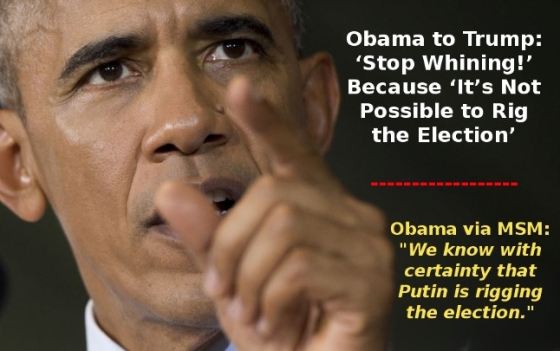
obamariggedelections

By Dan Engelke

Source: Who.What.Why.

In August, the corporate media was falling all over itself with breathless coverage on how Russia is interfering in the US election. Back then, stories citing experts suggested that voting machines were vulnerable to tampering that could change the outcome of the vote. A month later, something curious happened.

By September, government officials were doing all they could to tamp down those concerns, and the media duly reported their reassurances.

Should the public be comforted that election mischief will be homegrown?

The articles, usually citing active government officials, serve a dual purpose in reassuring the public: First, there is no way Russia can hack the election, despite cyber hacks in the Illinois and Arizona voter registration banks. Meanwhile, the message is also to insist Russian President Vladimir Putin is still giving orders to disrupt US cyberspace. This latter message culminated in the Obama administration publicly blaming the Russian government for trying to influence the election in early October.

Voter System vs Election System

The Washington Post began the trend on August 31 with the definitive headline “There’s Almost No Chance Our Elections Can Be Hacked by the Russians. Here’s why.”

The Post cites two major obstacles for potential (Russian) disruption of our election. One is the difference between the “voter system” and the “election system.” The voter system involves registered voter databases throughout the country, while the election system refers to voting machines and paper ballots.

According to executive director Merle King of the state-funded Center for Election Systems in Georgia, the public conflates these two issues about the election, and that leads to a lot of confusion.

The second hindrance for potential hackers is the decentralized voting process, the Post reported. A major positive for vote security, according to the Post, is that local jurisdictions set their own rules for how votes will be counted.

This claim is buttressed by a letter sent by state election officials to Florida voters which notes the public safeguards already in place for our voting process — including (1) layers of encryption for voting machines, (2) thumb drive backups of votes, (3) lack of internet connection to voting machines, and (4) a review of votes after an election.

The Los Angeles Times followed on September 8 with a report titled “Could Russian Hackers Mess with the US Election Results? It Wouldn’t Be Easy; Here’s Why.”

The Times also highlights the decentralized nature of the voting system as a safeguard against tampering. However, while the Post viewed the system as sophisticated, the Times saw the state-run and community-monitored systems as too cumbersome to be susceptible to any hacking.

Quoted again is Merle King, along with Connecticut Secretary of State Denise Merrill, and FBI Director James Comey. Pamela Smith of Verified Voting — an organization that highlights the susceptibility to election rigging — is also sourced to reassure readers that the upcoming election is safe, thanks to an uptick in paper ballot usage.

Russia’s Goal Not Hacking — But Scandal

On September 10, Washington, D.C.-based political newspaper The Hill worked the same dual agenda with “Hacking the Election is Nearly Impossible. But that’s not Russia’s Goal.”

Like the previous articles in the Washington Post and LA Times, The Hill presents the decentralized process of US elections as an impenetrable obstacle to Russian hacking. Bolstering the claims of election security in the piece are Florida’s Secretary of State Ken Detzner, Colorado’s Secretary of Wayne Williams, Pennsylvania Department of State spokesperson Wanda Murren, and Wisconsin’s Administrator of State Elections Division Michael Hass. The only non-governmental official quoted is Chris Porter, an administrator of strategic intelligence at cybersecurity firm FireEye Horizons.

Porter cited examples of Russian election tampering in the Ukraine and efforts to “create scandal,” despite their inability to hack the election.

The Chicago Tribune got its turn on September 14, quoting Assistant to the President for Homeland Security and Counterterrorism Lisa Monaco, who reiterated the safety of the election thanks to the decentralization of the voting process.

These assertions of election security and passive blame on Russia culminated in early October with the Obama administration publicly accusing “senior-most officials in Russia” of tampering with the election, despite their claimed inability to do so.

Taking a Screwdriver to the Election

Let’s go back to August to see why certain experts said that elections could indeed be tampered with.

Princeton professor Andrew Appel made headlines in August after hacking the Sequoia AVC Advantage electronic voting machine in seven minutes. Such machines are used in Louisiana, New Jersey, Virginia and Pennsylvania.

“[Appel] summoned a graduate student named Alex Halderman, who could pick the machine’s lock in seven seconds. Clutching a screwdriver, he deftly wedged out the four ROM chips — they weren’t soldered into the circuit board, as sense might dictate — making it simple to replace them with one of his own: A version of modified firmware that could throw off the machine’s results, subtly altering the tally of votes, never to betray a hint to the voter. The attack was concluded in minutes.”

Former government officials working in the cyber sphere have also warned of election tampering. Former White House counterterrorism czar Richard Clarke asserted: “Yes, It’s Possible to Hack the Election” on August 18.

“I have had three jobs that together [under Bill Clinton, George W. Bush, and Barack Obama] taught me at least one thing: If it’s a computer, it can be hacked.”

Special Interests and the Machines

Clarke sees the decentralized election system as the access point for potential tampering —rather than a potential safeguard. While there are safeguards, such as the voter tabulation through paper ballots, almost no state exclusively uses paper ballots. Instead, voting machines — even allowing votes from home — produce no paper ballot record and thus no way to ensure the “correct” vote was cast.

Furthermore, Clark argues paper ballot receipts from the voting machines are only used in the case of a recount — something today’s sophisticated hackers are aware of and would seek to avoid.

“My first reaction to all this government reassurance was ‘are you kidding me?’” Dr. Jonathan Simon of the Election Defense Alliance told WhoWhatWhy. “There is all this concern about outside hacking, but absolutely no talk of internal rigging.”

While Simon points out that there are many election safeguards, connections to special interests by those that control voting machines provides easy access to election rigging.

“Anyone who could stand to profit off certain policies — the Koch brothers, for example — have a better chance of rigging the election due to their connections to voting systems like Dominion, SES and their satellite companies,” Simon explained. “Russia, China, nor any terrorist group in the Middle East have a connection like that.”

Despite encryption and the lack of an Internet connection, Simon claims that there are other ways to change voting results.

“In a memory card, which is used in optical scanner-verified voting, three lines of code to flip votes one way or another can be entered into 7,000 or 8,000 lines of code virtually without detection. Multiple memory cards can be manipulated like this at the push of a button.”

Why Overlook Potential Domestic Hacking?

With articles by outside experts in August claiming the election could be hacked, followed in September with articles by government officials claiming it could not be — by Russia — it raises the question: why overlook domestic tampering?

“These are relatively unsophisticated and simple ways to rig the election,” Simon concluded.

Was Super Tuesday Rigged?

secret-win-V2-060416c_02_png__800×593_

By Jerry Kroth

Source: The Hampton Institute

Social scientists have long known that releasing poll information early, before polls have closed, has two effects: first it decreases voter turnout by about 12 percent,[1] and it increases the bandwagon effect, where people hop on and vote for the winner, by about 8 percent. [2]

On the morning of Super Tuesday, before anyone had voted, the Associated Press released a story that Hillary Clinton had already won. She was the “presumptive presidential nominee” and the victor. AP had made that announcement because of a super delegate count and decided she already beat Sanders.

Other media outlets then piggy-backed on this story, and virtually every American woke up that morning to headlines that Hillary had won-and remember, that is before anyone voted on Super Tuesday.

What a surprise! By the time you had your morning coffee and went off to the polls, you already knew Mrs. Clinton was the winner. Did that bias the election? Did it discourage people from voting? Did it create a “bandwagon effect?”

If one looks carefully at the percentage totals for Clinton versus Sanders totals for those primary states, it is clear the so-called “landslide” victory of Clinton on that day was fully within this margin of bias created by the bandwagon and voter turnout effects.

In other words, the AP story determined the outcome of this election.

Strong words? Well, let’s look at the data.

Three days before the election, a Yougov poll showed Clinton leading Sanders by two points in California. But after the Associated Press released its story, Clinton beat Sanders not by two points but by 13! Hillary got an 11 point “bump.”

From somewhere.

The same effect happened in New Mexico. Sanders was ahead of Clinton by a wide margin 54 to 40 percent. [3] By Super Tuesday, the situation reversed and Clinton beat Sanders 51.5 to 48.5. That surprising result gave Hillary an additional 13 points. Surprise! A 13 point “bump.”

In New Jersey, poll results just before Super Tuesday showed Clinton leading sanders 54 to 40 percent [4] but on election day she beat him 63 to 36, another unexpected 9 point “bump” in Hillary’s favor.

In South Dakota, a poll showed Sanders ahead of Clinton by 6 percentage points [5] just a few weeks before the primary, but on Super Tuesday Hillary pulled another rabbit out of her hat and beat Sanders by two points; an 8 point “bump” for Clinton.

Those are the only states where we can calculate pre-post results. Hillary got an unexpected 9 points in New Jersey, 8 points in South Dakota, 13 points in New Mexico, and 11 points in California. All unexpected. All unpredicted. All quite different from polls held just days before Super Tuesday.

And all very suspicious!

If one tries to rebut these findings alleging they all are within the margin of error for polls, then Sanders should have had just as many spurious bumps as Clinton. Didn’t happen! All went to Hillary. The skewing is not random! The statistical anomalies are consistently prejudiced toward Hillary.

Sixteen European countries ban reporting election results before voting occurs, and in the UK, reporting poll data on the day of the election is forbidden. [6]

All for good reason.

Serious attention should be paid to declaring these primaries invalid. Furthermore, the possibility of investigating media entities, in particular Gary Pruitt, CEO of the Associated Press, for any alleged collusion with the Clinton campaign should be aggressively pursued. Even if there is no corporate media complicity, it can still be argued that the AP’s desire for an early morning scoop determined, biased and corrupted this entire election.
Jerry Kroth, Ph.D. is Associate Professor Emeritus Santa Clara University. He may be contacted through his website, collectivepsych.com

Notes


Related Videos:

What is the Big Lesson of the UK ‘Brexit’ Vote for Americans? It Was Done With Paper Ballots

UKandUSvoting.preview

Voting in the UK is done on paper ballots, as her in the ‘Brexit’ referendum. In the US many vote on easily hacked computers that leave no paper trail.

By Dave Lindorff

Source: This Can’t Be Happening

The decision by a majority of UK voters to reject membership in the European Union in Wednesday’s hotly-contested referendum has been a devastating defeat for the corporatist domination of the European political and economic scene. It throws the corporate duopoly in the UK into turmoil, and also has the EU bureaucrats and the banking elite in Brussels and the financial capitals of Europe in a panic, lest other countries’ voters, as in Spain and Italy, or even France and the Netherlands, decide to follow suit. (Spain has a national election tomorrow which could be heavily influenced by the British referendum outcome, since if the united left wins, it could eventually lead to Spain’s exit from the EU.)

But for the US, which is not a party to the EU, there is also a huge lesson: ‘Brexit,’ despite being opposed by the political establishment — Conservative and Labor — and by the corporate elite of London’s City, the financial capital of Europe, won this vote. And the reason the opponents of UK membership in the EU were able to win against all that powerful opposition, has, in no small part, to do with the fact that all the voting was done on paper ballots.

Compare that to the US, where voting, for the vast majority of people, is done on machines, in many cases electronic machines that leave no paper trail of individual votes, or even of vote totals per machine. We are always hearing reports of faulty — or hacked — machines that are “flipping” votes, so that someone can cast a vote for a Democratic candidate or party slate and see it switched to Republican, reports of entire tallies for a day’s voting being simply lost, machines that don’t work, forcing would be voters to wait for hours to vote on a limited number of machines that supposedly are working, limited polling places because county or city governments claim they can’s afford to buy an adequate number of machines, a shortage of paper ballots when machines fail, etc.

The list of excuses goes on and on. And why, one might ask, does America vote by electronic machines instead of on readily verifiable paper ballots? The only possible reason is pressure from the corporate media, whose sole interest in our elections is the “horse race” leading to a meaningless competition to get the results out first. Why should it matter though, if you think about it, whether we learn the results of an election an hour or two after the voting ends, or the next day, or even several days after the voting? Why, in fact, do we allow news organizations like AP or the New York Times to “call” elections based on faulty algorithms that are based on extrapolations of early counts in specific targeted voting districts?

Most recently, we witnessed the outrage of AP calling the Democratic national presidential primary for Hillary Clinton the morning that California and six other states totaling 15% of the total delegate count in the nation were holding primaries and then announcing the victory in California that evening when less than half of the votes cast had actually been counted (the rest were paper ballots — both mailed-in ones, and over a million “provisional” ballots that were given to voters who had registered close to election day, and whose registrations had not been provided in time to local voting district officials. As those votes are counted — and they are still being counted today, some two and a half weeks after the voting! — it is becoming clear that far from a rout by Hillary Clinton, the vote between Clinton and Sanders was very close, as will be the delegate count for each candidate.

A number of analysts have pointed out that there is serious evidence of vote rigging in the Democratic primary in favor of Clinton, with most of the states that she won outside of the deep South which had electronic voting machines having exit polls that showed Sanders should have won. There is no way to check those votes, however, because the machines don’t have a paper trail.

And that’s not all. The primary, like elections in prior years, has been rife with other examples of interfering with the right of Americans to cast their votes. There was massive voter suppression in New York’s Democratic primary, for example, with entire neighborhoods in Brooklyn and other jurisdictions — all of them likely to have favored Bernie Sanders — finding that their voter registration records had been wiped, making them ineligible to vote. Other venues, in New York and other states, found that people who had registered as Democrats were recorded as “independents,” making them, in closed-primary states, ineligible to vote in the primaries.

The list of such abuses and frauds goes on and on and, like the many examples of voter suppression by both Republican and Democratic governments in the past, make it clear that voting in the US is as corrupted as it is in many third-world countries where elections are understood to be only for show.

The lesson of Britain’s ‘Brexit’ referendum, like the hotly contested presidential election I witnessed and covered in Taiwan in 2004, both of which contests were conducted using paper ballots, and the latter which was subjected to a recount that returned an almost identical result after tons of paper and millions of ballots were painstakingly inspected and hand-counted all over again, is that democracy can only work if voting is scrupulously honest and absolutely verifiable. On both those counts the US fails miserably, meaning that besides all the other problems that make American democracy a joke — the grotesquely biased (and inane) media coverage, the widespread voter apathy and ignorance, a stultifying two-party political system that limits candidate choices to two virtually identical candidates and to two political positions that only differ in meaningless, but emotionally powerful ways, and a campaign-funding system that in reality is nothing but legalized bribery — American voters cannot really expect their votes to be honestly counted in the end.

If a referendum like ‘Brexit’ were to be held in a US-type electoral system, involving a major issue affecting powerful economic interests, it would have predictably failed. Of this there is little or no doubt. What in the ’60s we called “The System” would simply not have allowed opponents of EU membership to win.


Related Article: Freedom Rider: The Good News of Brexit