When Yemen Does It It’s Terrorism, When The US Does It It’s “The Rules-Based Order”

We are ruled by murderous tyrants. By nuclear-armed thugs who would rather starve civilians to protect the continuation of an active genocide than allow peace to get a word in edgewise. 

By Caitlin Johnstone

Source: CaitlinJohnstone.com.au

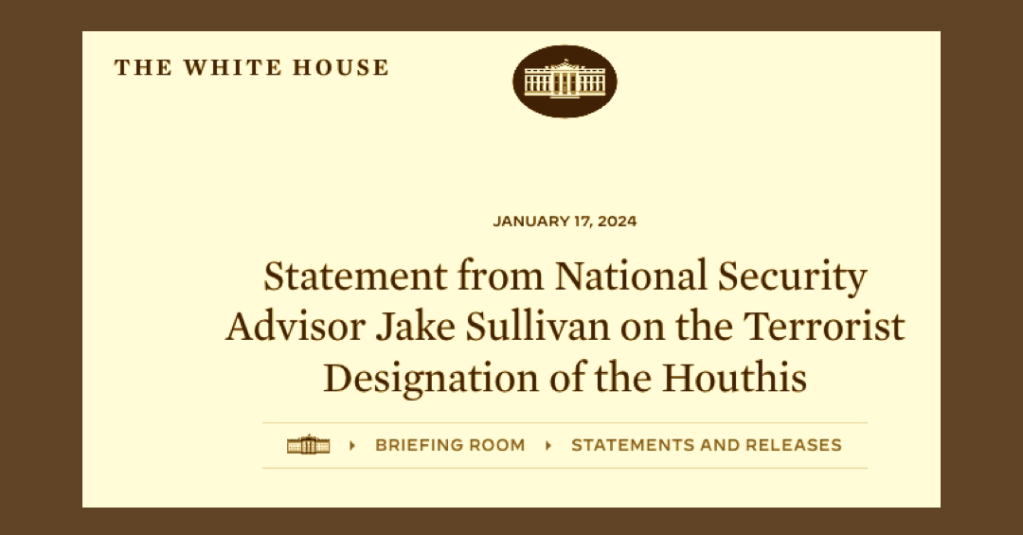
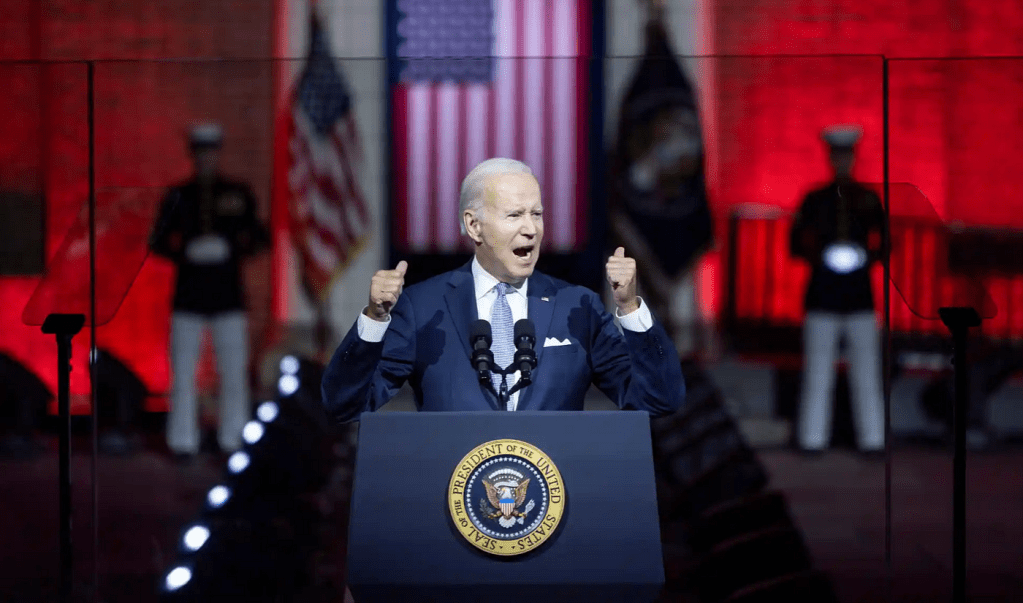
The Biden administration has officially re-designated Ansarallah — the dominant force in Yemen also known as the Houthis — as a Specially Designated Global Terrorist entity. 

The White House claims the designation is an appropriate response to the group’s attacks on US military vessels and commercial ships in the Red Sea and the Gulf of Aden, saying those attacks “fit the textbook definition of terrorism.” Ansarallah claims its actions “adhere to the provisions of Article 1 of the Convention on the Prevention and Punishment of the Crime of Genocide,” since it is only enforcing a blockade geared toward ceasing the ongoing Israeli destruction of Gaza.

One of the most heinous acts committed by the Trump administration was its designation of Ansarallah as a Foreign Terrorist Organization (FTO) and as Specially Designated Global Terrorists (SDGT), both of which imposed sanctions that critics warned would plunge Yemen’s aid-dependent population into even greater levels of starvation than they were already experiencing by restricting the aid that would be allowed in. One of the Biden administration’s only decent foreign policy decisions has been the reversal of that sadistic move, and now that reversal is being partially rolled back, though thankfully only with the SDGT listing and not the more deadly and consequential FTO designation.

In a new article for Antiwar about this latest development, Dave Decamp explains that as much as the Biden White House goes to great lengths insisting that it’s going to issue exemptions to ensure that its sanctions don’t harm the already struggling Yemeni people, “history has shown that sanctions scare away international companies and banks from doing business with the targeted nations or entities and cause shortages of medicine, food, and other basic goods.” DeCamp also notes that US and British airstrikes on Yemen have already forced some aid groups to suspend services to the country.

So the US empire is going to be imposing sanctions on a nation that’s still trying to recover from the devastation caused by the US-backed Saudi blockade that contributed to hundreds of thousands of deaths between 2015 and 2022. All in response to the de facto government of that very same country imposing its own blockade with the goal of preventing a genocide.

That’s right kids: when Yemen sets up a blockade to try and stop an active genocide, that’s terrorism, but when the US empire imposes a blockade to secure its geostrategic interests in the middle east, why that’s just the rules-based international order in action.

It just says so much about how the US empire sees itself that it can impose blockades and starvation sanctions at will upon nations like Yemen, Venezuela, Cuba, Iran, Syria and North Korea for refusing to bow to its dictates, but when Yemen imposes a blockade for infinitely more worthy and noble reasons it gets branded an act of terrorism. The managers of the globe-spanning empire loosely centralized around Washington literally believe the world is theirs to rule as they will, and that anyone who opposes its rulings is an outlaw.

What this shows us is that the “rules-based international order” the US and its allies claim to uphold is not based on rules at all; it’s based on power, which is the ability to control and impose your will on other people. The “rules” apply only to the enemies of the empire because they are not rules at all: they are narratives used to justify efforts to bend the global population to its will.

We are ruled by murderous tyrants. By nuclear-armed thugs who would rather starve civilians to protect the continuation of an active genocide than allow peace to get a word in edgewise. Our world can never know health as long as these monsters remain in charge.

The Transition

Many institutions have no convincing justification for their own existence.

By Robert Gore

Source: Straight Line Logic

Western civilization is characterized by its institutions. Its foundations have been government, organized religion, the military, science, technology, business, academia, media, art, and entertainment. Institutions have been bulwarks of order and have enabled Western civilization to reach unprecedented plateaus of achievement and prosperity. Now, they’re under assault and crumbling, which has been often noted and decried but usually not analyzed or understood as the outcome of an epochal transition.

Institutions have been the victim of their own success. The Industrial and Information Revolutions have put goods, services, wealth, data, and choices in billions of hands in what amounts to an historical blink of an eye, less than two centuries. The average American lives better and longer than royalty did back in monarchy’s heyday and has more personal power. Kings and emperors of yore could order people around and toss them in dungeons, but they couldn’t hop on the Internet and communicate with someone on the other side of the planet or hop on a freeway and journey five hundred miles in a day.

Institutions’ loss has been individuals’ gain, and many of the latter are questioning the necessity of the former. Institutions are staring into an abyss. Many, including governments, do not have convincing justifications for their own existence. They offer little to average people and in many cases they’re a net negative, imposing nothing but burdens. Their leaders are solely devoted to furthering their own prerogatives and power. Now, institutions are fighting a rearguard action to halt or slow a transition that at best will dramatically reduce their power and could mean their extinction.

COVID, climate change, foreign wars, censorship, woke, open borders, surveillance, and digital passports and currencies are Last Gasp efforts to preserve institutional status, wealth, and power. The institutions have responded to their own drum roll with what vigor they can muster, but those causes inspire vapid virtue signaling, not authentic passion. Their only wellspring of true passion is hatred for anyone who believes differently, who challenges their science, propaganda, and mendacity, and, more broadly, their right to dictate and coerce, and to cancel, punish or execute anyone not toeing their line.

Their objective failures—many of which count in their corrupt reckonings as successes—are manifest. The COVID response, particularly vaccines’ deaths and adverse events, completely discredited governments, public health, institutional medicine, the pharmaceutical companies, and social and mainstream media, while inflicting severe collateral damage on official “science,” big business, and central banks. The institutions are regrouping under the banner of climate change, but it’s clear from the pushback they’re already receiving that their agenda can only be implemented through violence and high-tech totalitarianism.

Repeated failures and ever-mounting resistance would seem to be enough to doom their totalitarian designs. Unfortunately, in their desperation and hatred, the willingness of the elite to wage actual, kinetic war on the rest of us shouldn’t be underestimated. While the COVID vaccine death toll numbers in the millions, war still has no rival for murderous effectiveness. However, offensive violence is no solution.

Nuclear weapons changed warfare in a way that’s not generally recognized. The threat that a global nuclear conflagration could eliminate humanity rendered their use a high-risk proposition. The Hiroshima and Nagasaki bombings in 1945 remain the only wartime use of nuclear weapons. Under the umbrella created by nuclear weapons’ unemployability, technological advances have fueled the development of a staggering array of armaments that has decisively shifted the military balance from offensive to defensive warfare.

World War II was the last major war in which an offensive, or, more correctly, a counter-offensive, won. The allied powers repelled the axis powers, but at huge cost. Industrial-scale, mechanized warfare’s awesome destructive power left all the major participants except the U.S. in ruins, their populations decimated.

Offensive military power has become enormously expensive relative to the defensive technologies and strategies that can be employed against it. Since World War II, there have been few successful invasions. Both sides were stymied in the Korean War. U.S. invasions have been a string of disasters since Vietnam. Afghan goat herders defeated both the Soviets and the U.S.

On the cusp of victory in Ukraine, the Russian Special Military Operation would seem to belie the trend of offensive failures. However, the Russians have actually won by playing defense. They moved through their major objective, the Donbass region of Eastern Ukraine, where the majority of the population speak Russian. Many of them want to be part of Russia and hate the Ukrainian government, which has waged war on them since the 2014 coup. Consequently, the Russians were supported by the local population.

This past year featured a Ukrainian counteroffensive that was supposed to drive the Russians back from Donbass and retake the Crimean peninsula. NATO and Ukrainian strategists refused to recognize that their offensive was akin to sending cavalry units against machine-gun and artillery emplacements. They were up against an opponent well-armed with land mines, state-of-the-art field artillery and long-range missiles, air cover, and surveillance and attack drones. The Russian military, which has a long tradition of waging defensive warfare, employed a complex three-layer defense. The Ukrainians rarely progressed through even the first layer, impaling themselves on the tip of the Russian spear and taking massive losses.

The successful Russian strategies and tactics will be, or should be, studied by military analysts in the U.S. However, what’s most important is that those tactics implicitly acknowledge a truism central to the transition in progress. High-cost offensive warfare can be stymied and often defeated with relatively low-cost defensive weaponry and asymmetric warfare.

It can be argued that an offensive against the world’s most powerful military was obviously doomed, although nobody in the Western brain trust made that argument before the Ukrainians attacked. What truly signals the dawning of a new age have been the repeated successes since World War II of guerrilla or insurgent warfare against ostensibly much more powerful forces.

The Russians learned their lesson from the Soviet failure in Afghanistan. The U.S. government hasn’t learned anything from its string of failures. In Washington, nothing succeeds like failure. Its unconditional backing of Israel’s attempted elimination of Palestinians in Gaza finds it doubling down on what hasn’t worked.

The Israelis recognize a grim reality of fighting an insurgency on insurgent territory: To win, it’s not enough to kill the guerrillas; the guerrilla-friendly local population must be eliminated as well. The Israelis’ campaign has been merciless: destroying structures, killing Palestinian civilians, and making life intolerable for the survivors. The Israeli aim is to drive the Palestinians from Gaza and Israel for good. This meets international-law definitions of genocide and has been rightly decried around the world.

What will it mean if Israel fails? The Israelis may well reduce Gaza to rubble, but that would not be mission accomplished. Rubble provides excellent cover for guerrilla strikes. Hamas’ extensive tunnels indicate that it has prepared for this war for years. In all probability, it launched the October 7 attack to get things going. Israel’s negligence detecting and responding to that attack may have been intentional, indicating that it, too, wanted the war it now has.

Hamas has a network of allies across the Middle East. Israeli and U.S. forces and maritime commerce are under attack in Iraq, Syria, Lebanon, Yemen, the Red Sea, the Indian Ocean, and the Mediterranean. Yemen’s Houthis have already bottled up the Red Sea. It would be an easy matter for Iran to do the same in the Persian Gulf. Control of maritime commerce at important choke points calls into question a plank as central to the American Empire as it was to the British Empire before it: control of the world’s seas and oceans.

What happens if an American-led flotilla tasked with keeping the Red Sea or the Persian Gulf open comes under a swarming missile and drone attack, plus electronic warfare that disrupts its command and control capabilities, and destroyers or aircraft carriers are sunk? Missiles, drones, and cyber disruption cost a pittance compared to battleships, and it would then be apparent that they make conventional surface naval power a paper shark. The vessels in their watery grave would send the same message as the tanks smoldering on Ukraine’s battlefields.

The power of governments rests on their ability to use violence to control populations. Yawning cost disparities, decentralized technologies, and asymmetric warfare have rendered much of conventional offensive power vulnerable or obsolete, marking an historic, tectonic transition in the relationships between governments and governed. This is no secret, particularly in the non-Western world.

Across the globe, insurgents are taking the measure of governments and finding them wanting. Governments that are not feared cannot govern. As they confront their limitations, they will, being governments, make their situations worse.

The American government has a problem not shared by many others. Its potential insurgents—urban, suburban, and rural—are armed to the teeth. They already control many of the cities (see “Ants at the Picnic, Part Two”). Heavily indebted Washington cannot command the resources necessary to subjugate the population. It gets stretched thinner with each new dollar of debt, each new tax, each new institutionalized corruption, each new illegal migrant, each new substitution of gobbledygook ideology for rationality, and each new foreign intervention. Recognition of Washington’s weakness is behind the talk of secession and some states’ defiance of its dictates.

Washington’s weakness is shared by many Western governments, although most of them don’t have to contend with armed opposition. They do have to contend with increasingly restive populations, which by sheer force of numbers can upend existing political arrangements. It is delusional to think that these beleaguered national governments can be replaced by a confederated or unitary global government that could then exercise effective control.

The imposition of global government would entail an invasion by an outside force of millions of globally dispersed localities. The global force would encounter the same problem Israel faces in Gaza. Overt and covert opposition could number in the billions.

The globalists would have to contend with organized insurrection, guerrilla warfare, sabotage, and terrorism, as well as random riots, criminality, and widespread disorder. They would have to resort to the Israeli “solution” in Gaza—mass extermination. While they are relying on propaganda, subversion, electronic control, and biological warfare, perhaps only nuclear weapons could achieve genocide at the necessary scale. Don’t put it past them. Don’t put it past the insurgents to acquire their own nukes.

Short of nuclear conflagration, the world will continue to devolve towards institutional failure, popular disillusionment, mounting rage, and chaotic fragmentation and balkanization. Today’s dinosaur governments are unable to exercise control, and many of them are slated for extinction. They will not be replaced by an even larger and more unwieldy dinosaur—global government—which is only the last, desperate hope of the fading regime. Instead, the vacuum created by failed governments will be filled by those proficient in decentralized violence. Those who have relied on centralized authority for their livelihoods, power, and status will find their worlds turned upside down. Many will not survive the transition.

Assume crash positions.

Ukraine and Palestine: A double threat to US hegemony

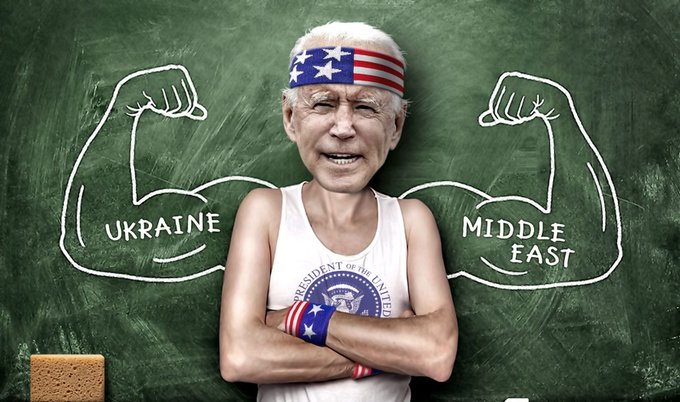
The outcome of US-led conflicts in Ukraine and West Asia will have a profound impact on the developing world order. Washington has already lost the former, and its major adversaries are vested in making sure it loses the latter too.

By MK Bhadrakumar

Source: The Cradle

Geopolitical analysts broadly agree that the war in Ukraine and the West Asian crisis will dictate the trajectory of world politics in 2024. But a reductionist thesis appears alongside that views the Israel-Palestine conflict narrowly in terms of what it entails for the resilience of the US proxy war in Ukraine – the assumption being that the locus of world politics lies in Eurasia.

The reality is more complex. Each of these two conflicts has a raison d’être and dynamics of its own, while at the same time also being intertwined.

Washington’s neck-deep involvement in the current phase of the West Asian crisis can turn into a quagmire, since it is also tangled up with domestic politics in a way that the Ukraine war never has been. But then, the outcome of the Ukraine war is already a foregone conclusion, and the US and its allies have realized that Russia cannot be defeated militarily; the endgame narrows down to an agreement to end the conflict on Russia’s terms.

To be sure, the outcome of the Ukraine war and the denouement of the Israel-Palestine conflict, which is at the root of the West Asian crisis, will have a profound impact on the new world order, and the two processes reinforce each other. 

Russia realizes this fully. President Vladimir Putin’s stunning ‘year-enders’ in the run-up to the New Year speak for themselves: daylong visits to Abu Dhabi and Riyadh (watched by a shell-shocked US President Joe Biden), followed by talks with Iran’s president and rounded off with a telephone conversation with the Egyptian president. 

In the space of 48 hours or so, Putin touched base with his Emirati, Saudi, Iranian, and Egyptian colleagues who officially entered the portals of the BRICS on 1 January.

The evolving US intervention in the West Asian crisis can be understood from a geopolitical perspective only by factoring in Biden’s visceral hostility toward Russia. BRICS is in Washington’s crosshairs. The US understands perfectly well that the extra large presence of West Asian and Arab nations in BRICS — four out of ten member states — is central to Putin’s grand project to re-structure the world order and bury US exceptionalism and hegemony.

Saudi Arabia, the UAE, and Iran are major oil producing countries. Russia has been rather explicit that during its 2024 chairmanship of BRICS, it will push for the creation of a currency to challenge the petrodollar. Without doubt, the BRICS currency will be at the center stage of the grouping’s summit due to be hosted by Putin in Kazan, Russia in October.

In a special address on 1 January, marking the start of Russia’s BRICS Chairmanship, Putin stated his commitment to “enhancing the role of BRICS in the international monetary system, expanding both interbank cooperation and the use of national currencies in mutual trade.”

If a BRICS currency is used instead of the dollar, there could be significant impact on several financial sectors of the US economy, such as energy and commodity markets, international trade and investment, capital markets, technology and fintech, consumer goods and retail, travel and tourism, and so on. 

The banking sector could take the first hit that might eventually spill over to the markets. And if Washington fails to fund its mammoth deficit, prices of all commodities could skyrocket or even reach hyperinflation triggering a crash of the US economy.

Meanwhile, the eruption of the Israel-Palestine conflict has given the US an alibi — ‘Israel’s self-defense’ — to claw its way back on the greasy pole of West Asian politics. Washington has multiple concerns, but at its core are the twin objectives of resuscitating the Abraham Accords (anchored on Saudi-Israeli proximity) and the concurrent sabotage of the Beijing-mediated Saudi-Iranian rapprochement.

The Biden administration was counting on the fact that an Israeli-Saudi deal would provide legitimacy to Tel Aviv and proclaim to the Islamic world that there was no religious justification for hostility towards Israel. But Washington senses that post-7 October it would not be able to secure a Saudi-Israel deal during this Biden term, and all that could be coaxed out of Riyadh is a door left ajar for future discussion on the topic. No doubt, it is a major blow to the US strategy to liquidate the Palestinian question.

In a medium term perspective, if the Russian-Saudi mechanism known as OPEC+ liberates the world oil market from US control, BRICS drives a dagger into the heart of US hegemony which is anchored on the dollar being the ‘world currency.’ 

Saudi Arabia recently signed a currency swap deal worth $7 billion with China in an attempt to shift more of their trade away from the dollar. The People’s Bank of China said in a statement that the swap arrangement will “help strengthen financial cooperation” and “facilitate more convenient trade and investment” between the countries.

Going forward, sensitive Saudi-Chinese transactions in strategic areas such as defense, nuclear technology, among others, will henceforth take place below the US radar. From a Chinese perspective, if its strategic trade is sufficiently insulated from any US-led program of anti-China sanctions, Beijing can position itself confidently to confront US power in the Indo-Pacific. This is a telling example of how the US strategy for the Indo-Pacific will lose traction as a result of its waning influence in West Asia.

The conventional wisdom is that preoccupation in volatile West Asia distracts Washington from paying attention to the Indo-Pacific and China. In reality, though, the waning influence in West Asia is complicating the capacity of the US to counter China both in the region as well as in the Indo-Pacific. The developments are moving in a direction where the credentials of the US as a great power are at an inflection point in West Asia – and that realization has leaked into other geographic regions around the world.

Way back in 2007, the distinguished political scientists John Mearsheimer of the University of Chicago and Stephen Walt of the John F. Kennedy School of Government at Harvard, wrote with great prescience in their famous 34,000-word essay entitled The Israel Lobby and US Foreign Policy that Israel has become a ‘strategic liability’ for the United States, but retains its strong support because of a wealthy, well-organized, and bewitching lobby that has a ‘stranglehold’ on Congress and US elites.

The authors warned that Israel and its lobby bear outsized their responsibility for persuading the Bush Administration to invade Iraq and, perhaps one day soon, to attack the nuclear facilities of Iran. 

Interestingly, on New Year’s Eve, in a special report based on extensive briefing by top US officials, the New York Times highlighted that “No other episode [as the war in Gaza] in the past half-century has tested the ties between the United States and Israel in such an intense and consequential way.”

Clearly, even as Israel’s barbaric actions in Gaza and its colonial project in the occupied West Bank are exposed and laid bare, and the Israeli state’s campaign to force Palestinian population migration are in full view, two of the US strategic objectives in the region are unravelling: first, the restoration of Israel’s military superiority in the balance of forces regionally and vis-a-vis the Axis of Resistance, in particular; and second, the resuscitation of the Abraham Accords where the crown jewels would have been a Saudi-Israeli treaty.

Viewed from another angle, the directions in which West Asia’s crisis unfolds are being keenly watched by the world community, especially those in the Asia-Pacific region. Most notable here is that Russia and China have given the US a free hand to navigate its military moves – unchallenged, so far, in the Red Sea. This means that any conflagration in the region will be synonymous with a catastrophic breakdown of US strategy.

Soon after the US defeat in Afghanistan in Central Asia, and coinciding with an ignominious ending of the US-led proxy war by NATO against Russia in Eurasia, a violent, grotesque setback in West Asia will send a resounding message across all of Asia that the US-led bandwagon has run out of steam. Among the end users of this startling message, the countries of ASEAN stand at the forefront. The bottom line is that the overlapping tumultuous events in Eurasia and West Asia are poised to coalesce into a climactic moment for world politics.

Fake Intellectuals Working For Think Tanks Funded By the Arms Industry Are Driving Support For War After War After War

By Jeremy Kuzmarov

Source: Covert Action

A few days after the October 7 attacks in northern Israel, The Atlantic Council ran an inflammatory article on its website by Jonathan Panikoff, a former deputy national intelligence officer, entitled “It doesn’t matter whether Iran planned the Hamas attack—Tehran is still to blame.”[1]

The article referenced a Wall Street Journal article that claimed unfoundedly that Iran was responsible for planning the attacks, and expressed belief that even if Iran didn’t directly plan it, Iran was still responsible because it had supported Hamas in the past.

The article went on to support an aggressive military response by the U.S. and Israel that could potentially entail bombing Iran. The latter was a long-held dream of neoconservatives who have wanted to overthrow the regime of the Ayatollahs since it took over from the Shah, a U.S. and Israeli client, in a 1979 revolution.

Glenn Diesen, The Think Tank Racket: Managing the Information War With Russia (Clarity Press, 2023) looks at the influence of think tanks like The Atlantic Council in driving gargantuan U.S. military budgets and endless wars that have no end in sight.

The Atlantic Council has been particularly hawkish with regards to Russia, helping to fuel a proxy war between the U.S. and Russia in Ukraine that has decimated a generation of Ukrainian and Russian youth and left us on the threshold of World War III.

Diesen is an associate professor at the University of Southeast Norway and an associate editor of the journal Russia in Global Affairs.

His book emphasizes the undue influence that think tank pseudo-intellectuals play because of their ubiquitous presence in the mainstream media as well as academia and because of their authorship of policy reports that often guide government policy.

Rather than being even-handed or in any way objective in their analysis, the think tank fellows follow a preordained narrative.

According to Diesen, their job is to manufacture consent for the goals of their paymasters—weapons manufacturers and oil companies who profit off of war along with foreign governments courting more U.S. military aid.

Diesen writes that “think-tanks have become a symptom of hyper-capitalism in which all aspects of society have become an appendage to the market. Even political influence is regulated by the free-market, in which think tanks are an important component.”

Diesen notes that a brilliant achievement of propaganda has been to convince the population that propaganda is only an instrument of authoritarian states—that the U.S. is supposedly combating—and not liberal democracies.

The think tanks help condition the public to fear foreign threats and support wars of aggression under the veneer of providing independent expert analysis.

Paul Craig Roberts, the Assistant Secretary of the Treasury for Economic Policy under Ronald Reagan, has called The Atlantic Council the “marketing arm of the military-security complex,” while Diesen calls it “NATO’s Propaganda Wing.”

The Atlantic Council’s financial report from 2019/2020 reveals that it received over $1 million from the United Arab Emirates (UAE), according to Diesen. It also received major contributions from the British Foreign and Commonwealth Office, Facebook, Goldman Sachs, The Rockefeller Foundation, the National Endowment for Democracy (NED), U.S. State Department, a Saudi oil billionaire (Bahaa Hariri), Ukrainian oligarch Viktor Pinchuk, Crescent Petroleum, and Burisma, an energy company owned by Ukrainian oligarchs which appointed Hunter Biden to its board along with former CIA counter-terrorism director Cofer Black.

The Atlantic Council’s close ties to the CIA were further evident when its former executive vice-president, Damon Wilson, was appointed CEO of the NED, a CIA offshoot that promotes propaganda and supports dissidents in countries whose governments have been targeted by the U.S. for regime change.

Former CIA Director James R. Woolsey is listed as a lifetime director of the Atlantic Council, while former CIA Directors Leon Panetta, Robert Gates and David Petraeus are listed on its Board, along with such war criminals as Henry Kissinger, and Condeleezza Rice.

Over the past decade, the Atlantic Council has published countless reports on Russia’s kleptocracy and disinformation being spread allegedly by Vladimir Putin, and has hosted anti-Russian dissidents and Belarusian opposition figures such as Svetlana Tikhanovskaya, who called for more aggressive intervention by the U.S. in Belarusian politics

One of The Atlantic Council’s fellows, Michael Weiss, spreads his anti-Russia invective as an editor at the popular online media outlet, The Daily Beast. He helps run a neo-McCarthyite website, PropOrNot that promotes the worst kind of fear mongering imaginable, attacking independent media outlets, including the Ron Paul Institute, for allegedly advancing Russian propaganda.

In 2015, the Atlantic Council helped prepare a proposal for arming the Ukrainian military with offensive weaponry like Javelin anti-tank missiles—the same year that it presented its Distinguished Leadership Award to Marillyn Adams Hewson, then the CEO of Lockheed Martin, which produces Javelin missiles and many other lethal weapons.

Since the commencement of Russia’s special military operation in Ukraine, The Atlantic Council has doubled down on its long-standing Russophobia, calling for bombing Russia and starting World War III.

Last February, Matthew Kroenig, the Deputy Director of the Atlantic Council’s Scowcroft Center for Strategy and Security, argued for consideration of the U.S. preemptive use of ’tactical’ nuclear weapons.[2] This would not only kill thousands of people directly but likely cause what scientists characterize as a “nuclear winter” by injecting so much smoke and debris into the air that it will block sunlight and cause a precipitous drop in global temperatures, affecting food production across the globe.

Triggering New Cold and Hot Wars

The Atlantic Council’s support for war with Russia is characteristic of think tanks which played a crucial role in pushing the decision to expand NATO after the Cold War.

George F. Kennan and other foreign policy experts had warned against this because NATO was perceived as a hostile military alliance by Russia and it would undermine new European security initiatives involving Russia. Vietnam War architect Robert S. McNamara at the time also called for a new “peace dividend” by which the U.S. would reduce its military budget and address social needs with taxpayer dollars.

The overriding imperative of the weapons industry, however, was to revitalize cold war thinking to ensure continuously high military budgets and the expansion of NATO and the think-tanks were enlisted to fulfill that end.

Diesen points out that the Brookings Institute, one of the oldest American think tanks, played an instrumental role in the Russia Gate hoax, which greatly contributed to the spread of Russophobia underlying the U.S. proxy war against Russia in Ukraine.

A primary researcher and contributor to the Steele dossier, the seminal document in Russia Gate which spread false information about Donald Trump being blackmailed because of an alleged encounter with Russian prostitutes, was an employee of the Brookings Institute named Igor Danchenko, who was indicted by Special Counsel John Durham for lying to the FBI.

Working under Fiona Hill, a senior fellow at the Brookings Institute and renowned anti-Russian hawk, Danchenko claimed to have accrued incriminating information against Trump from a meeting with Russian-American Chamber of Commerce President Sergey Millian, who said that this meeting never actually took place.[3]

The Atlantic Council was another false purveyor of Russia Gate whose revenues increased tenfold from 2006-2016 when it began demonizing Vladimir Putin and smearing politicians like Tulsi Gabbard who advocated for cooperative diplomacy between the U.S. and Russia.

Leaving out the fact that Putin revitalized Russia’s economy after the failed privatization and shock therapy initiatives of the 1990s, The Atlantic Council made people believe that Putin invaded Ukraine on a whim and would destabilize all of Europe if he was not stopped.

This kind of analysis obscures the true origins of the conflict in Ukraine and the Western role in supporting NATO expansion and a 2014 coup against Ukraine’s legally elected government led by Viktor Yanukovych, which led to the outbreak of civil war.

The Atlantic Council continues today along with other think-tanks to whitewash Ukrainian war crimes, corruption and close ties with the far-right and neo-Nazis.

Michael McFaul of the Hoover Institute even celebrates Ukrainian President Volodymyr Zelensky’s crackdown on opposition politicians and media, while hypocritically framing the struggle against Russia as one of authoritarianism versus democracy.

McFaul and others have made clear that a primary U.S. foreign policy goal is to try and delink Ukraine and the rest of Europe from Russia while expanding U.S. natural gas sales in Europe.

In 2019, the RAND Corporation, the think tank of the intelligence agencies, issued a report calling for threatening NATO expansion and the arming of Ukraine in order to draw Russia into a conflict that would facilitate its overextension militarily and economically and cause the Russian government to lose domestic and international support.

The same report advocated for intensifying the ideological and information war against Russia to weaken the legitimacy and stability of its government, and voiced support for the anti-corruption crusade of opposition leader Alexei Navalny, whom Diesen identifies as a British intelligence asset supportive of policies designed to weaken the Russian Federation.

RAND earlier had advocated for provoking civil war within Syria through covert action and informational warfare and by capitalizing on the sustained Shia-Sunni conflict in order to undermine the nationalist Assad regime and draw Russia into the conflict there.

RAND also advocated for the destabilization of the Caucuses in order to cause a fissure between Russia and its traditional ally, Armenia, hence weakening Russia.

This latter goal was achieved when Armenia’s Prime Minister Nikol Pashinyan expressed no-confidence in Russia’s ability to protect it after Azerbaijan—heavily armed by the U.S. and Israel—invaded the Armenian enclave of Nagorno-Karabakh.

RAND had also issued policy recommendations for reducing Russian influence in Moldova and undercutting Russian trade with Central Asia and promoted regime change in Belarus to destabilize a Russian ally and alter the country’s orientation westward.

Following this prescription, the NED and other U.S. agencies provoked an uprising in 2020 against Belarus’ socialist leader Alexander Lukashenko, who was demonized in western media though he helped curb inequality and poverty considerably while resisting the rapid privatization initiatives carried out by other post-Soviet leaders.

CNAS and Team Biden

One of the most influential think tanks today is the Center For a New American Security (CNAS), which received huge sums from oil companies like Chevron and BP, financial giants like Bank of America, and J.P. Morgan Chase, and Amazon and Google from Big Tech.

CNAS’s former CEO, Victoria Nuland, was a former adviser to Dick Cheney and a key architect behind the 2014 coup in Ukraine.[4]

CNAS’ founder, Michèle Flournoy, was a board member of the defense contractor Booz Allen Hamilton who as the Under Secretary of Defense for Policy helped develop counterinsurgency policy for Afghanistan and contributed to convincing Barack Obama to invade Libya. More recently, she has advocated for an aggressive military buildup in the South China Sea to counter a rising China.

When Joe Biden became president, at least 16 CNAS alumni were selected for foreign policy positions. CNAS had pushed heavily for making Kamala Harris Vice President as her foreign policy team consisted of an army of CNAS think-tankers—including Flournoy.

The appointment of CNAS alumni to prestigious positions and their lobbying influence epitomizes the so-called revolving door in which high level White House and Pentagon officials who serve corporate-military interests while in power are rewarded with lucrative paying jobs in which they continue to serve the same underlying interests.

Diesen emphasizes at the end of his book that think tanks in the modern U.S. have helped to subvert democracy and obstruct U.S. foreign policy in the interests of wealthy corporations that profit from endless wars. He sees as a solution more public disclosures about the sources of think tank funding and public pressures that could help reduce their influence.

Another more radical solution is a socialist revolution that would result in the nationalization of the weapons industry, taking profit out of war, and reorganizing research, development and production toward fulfilling human needs.


  1. Panikoff is the Atlantic Council’s Director of the Scowcroft Middle East Security Initiative. 
  2. In John Bellamy Foster, John Ross, and Deborah Veneziale, Washington’s New Cold War: A Socialist Perspective (New York: Monthly Review Press, 2023), 42. 
  3. The New Knowledge think-tank fabricated a story of Russian interference in the 2017 Alabama state election with the intent of causing the defeat of Republican candidate Roy Moore. 
  4. Nuland was also a fellow at the Brookings Institute. 

In Gaza genocide, US defends Israel’s ‘aura of power’

As South Africa accuses Israel of genocide, the Biden administration endorses Israel’s bid to sow “fear” in Gaza’s defenseless civilians.

By Aaron Maté

Source: Aaron Maté Substack

Days after South Africa filed a motion to the International Court of Justice accusing Israel of genocide against the Palestinians of Gaza, the Biden administration responded with indignation. The allegation, White House spokesperson John Kirby declared, is “meritless, counterproductive, and completely without any basis in fact whatsoever.”

South Africa’s 84-page submission is in fact exhaustive in its documentation of Israel’s mass murder campaign in Gaza and Israeli leaders’ open intention to carry it out. By contrast to this detailed intervention, Israel’s chief sponsor in Washington openly admits that it still refuses even minimal scrutiny of the extermination campaign that it is funding and arming.

Nearly three months into an Israeli assault that has relied on billions of dollars in US weaponry, the Biden administration has still “conducted no formal assessment of whether Israel is violating international humanitarian law,” Politico reports. While going out of its way to avoid this assessment, the Biden administration has gone around Congressional review to transfer $147.5 million in artillery shells and other gear to Israel – the second time it has invoked emergency powers to do so.

A senior administration official insists to Politico that there is nothing to worry about: “If you just look at what Israel is doing, they aren’t systematically targeting civilians.” Even if that were true, which it clearly is not, what is indisputable is that Israel is systematically killing civilians. As even President Biden blurted out last month, Israel is carrying out “indiscriminate bombing,” an unambiguous war crime. For this reason, the New York Times reports, when Biden offered that “not… scripted comment,” his blunder “sent aides scrambling to explain.”

How the White House is now scrambling to explain its view that Israel is not committing genocide or even violations of humanitarian law is even more revealing. According to Politico: “The U.S. came to that conclusion in part after looking at press reports and conversations with Israeli officials about their military operations.” Absent from the Biden administration’s list of source material is its own intelligence, which recently found that almost half of the munitions that Israel has dropped on Gaza have been indiscriminate “dumb” bombs that have predictably murdered countless civilians in their homes and shelters.

Instead, the US is only relying on “press reports” – but clearly not those documented in South Africa’s ICJ submission, which collects Israeli leaders’ genocidal rhetoric in nine pages of chilling detail (p. 59-67). That leaves “conversations with Israeli officials” – who, unsurprisingly, are not keen to admit that they are the 21st century’s worst war criminals.

Israel’s bombing campaign is accompanied by an unprecedented blockade that deprives Gaza of vital aid. According to Arif Husain, the chief economist at the United Nations World Food Program, “80% of the people [globally], or four out of five people, in famine or a catastrophic type of hunger are in Gaza right now.”

At the White House podium, Kirby said that he is “not aware of any kind of formal assessment being done by the United States government to analyze the compliance with international law by our partner Israel.” And given that Kirby has previously stated that the White House has “no red lines” when it comes to Israel’s conduct, that will remain the case. “We have not seen anything that would convince us that we need to take a different approach in terms of trying to help Israel defend itself,” he said.

But just as the US is fully aware that its partner Israel is committing genocide, the US is also aware that Israel’s professed “right to self-defense” against occupied territory has nothing to do with self-defense. Biden administration officials have admitted as much to one of their most reliable media mouthpiece since Oct. 7th, the New York Times. “The Americans say Israel’s forceful response… reflects the importance that it places on re-establishing deterrence against attacks from adversaries in the region,” the Times reported in November. “The Israeli military’s aura of power was shaken by the Oct. 7 attack, the officials say.”

To restore Israel’s shaken “aura of power,” therefore, the empathetic Americans have given Israel a free pass to slaughter more than 22,000 defenseless civilians, all while pushing the two million survivors into famine and desperation.

This imperative of “deterrence” – establishing a monopoly on violence against occupied Palestinians and regional neighbors – has guided Israeli strategy since its inception.

As a divisional military commander in 1967, future Israeli Prime Minister Ariel Sharon voiced concern that Israel was losing its “deterrence capability,” which he defined as “our main weapon – the fear of us.”

In 1988, one month into the first Intifada, Defense Minister Yitzhak Rabin boasted that his policy of brutalizing demonstrating Palestinians was successfully employing Israel’s main weapon of fear. “The use of force, including beatings, undoubtedly has brought about the impact we wanted—strengthening the population’s fear of the Israel Defense Forces,” Rabin said.

When Israel launched Operation Cast Lead in December 2008, a three-week long assault that killed 1,400 Palestinians, including more than 300 children, in the Gaza Strip, Israel wielded the same weapon. According the New York Times, Israeli officials were guided by a “larger concern”: that their “enemies are less afraid of it than they once were or should be.” Therefore, the Times reported, “Israeli leaders are calculating that a display of power in Gaza could fix that,” using slain Palestinians civilians to “re-establish Israeli deterrence.”

The same imperative applies to Israel’s current extermination campaign in Gaza. In calling for “a war of unprecedented magnitude” on Gaza, former Israeli Prime Minister Naftali Bennett explained in October that “Israel’s future depends not on pity from the world, but on fear in the hearts of our enemies.”

In a new account of the Biden administration’s dealings with Israel, the New York Times again confirms that Israel seeks to preserve its monopoly on state terror. In Gaza, the Times explains, “strategically, Israel does not mind too much if the rest of the world thinks it is willing to go overboard with overwhelming force.” After all, Israel has spent more than a “half century… fostering the image of invincibility, an image shattered on Oct. 7. Israeli leaders want to reestablish the deterrence that was lost.”

Israel indeed need not mind that the world opposes its genocidal campaign when the world’s top superpower gives it free rein to “go overboard with overwhelming force” – the Times’ artful euphemism for state terror.

The White House continues to make this endorsement clear, even as it occasionally feigns concern about the civilian toll. According to the Times, “there is no serious discussion within the Biden administration about cutting Israel off or putting conditions on security aid.” The only “real debate” concerns “the language to use and how hard to push,” on marginal tactical issues. But no matter how many more civilians die, “no one inside is really pressing for a dramatic policy shift like suspending weapons supplies to Israel — if for no other reason than they understand the president is not willing to do so.”

Israel undoubtedly appreciates Biden’s unwillingness to stop the genocide. As Israel’s former US ambassador Michael Oren explains, Israel was “dependent on the United States,” after Oct. 7th. “And that meant they have a say in things.” The White House’s main contribution, Oren adds, is that “Biden has not used the two most obvious tools available to him to force Israel’s hand, namely the flow of U.S. arms to Israel and the U.S. veto at the U.N. Security Council that protects Israel from international sanctions.” According to White House insiders, while Biden and Netanyahu “are not truly friends,” both “understand each other’s politics and their mutual dependence at this point.”

Biden and Netanyahu’s mutual dependence only means that Israel must occasionally temper its savagery to meet US public relations needs. According to Times, Netanyahu “agreed to let humanitarian aid into Gaza as a condition for Mr. Biden visiting” Israel after Oct. 7th. In other words, Netanyahu let a trickle of humanitarian aid into the besieged Gaza death camp solely for the political benefit that a Biden visit could offer him. The Times offers this revelation in passing without further comment. In the view of the Times and its Biden administration sources, it is perfectly reasonable for Israel to block vital supplies to Gaza just to extract a gesture of US political support for its extermination campaign there.

In a recent opinion article for The Wall Street Journal, Netanyahu described his “three prerequisites for peace between Israel and its Palestinian neighbors in Gaza” as follows: “Hamas must be destroyed, Gaza must be demilitarized, and Palestinian society must be deradicalized.”

But Netanyahu’s vision of “peace” is predicated on exterminating his Palestinian neighbors in Gaza. Along with its bombing campaign and starvation siege, Israeli officials have openly called for ethnic cleansing. “What needs to be done in the Gaza Strip is to encourage emigration,” Israeli finance minister Bezalel Smotrich recently told Israeli Army Radio. “If there are 100,000 or 200,000 Arabs in Gaza and not 2 million Arabs, the entire discussion on the day after will be totally different.” According to The Times of Israel, Netanyahu has informed cabinet members that: “Our problem is [finding] countries that are willing to absorb Gazans, and we are working on it.”

Any serious “prerequisite for peace” therefore requires the inverse of Netanyahu’s strategy: the Israeli government must be demilitarized and Israeli society must be deradicalized. The same applies for the Biden administration, which is so radicalized that it openly flaunts its support for what South Africa calls “the physical destruction of Palestinians in Gaza,” all to help defend Israel’s “aura of power.”

Western War Machine is in Panic Mode

By Salman Rafi Sheikh

Source: New Eastern Outlook

The sheer inability of the collective West to force Russia into submission in Ukraine plus the fast-changing global opinion about the West in the context of the latter’s support for Israel’s brutal war on the Gazans has put the so-called ‘liberal-democratic’ world into a panic mode. The White House has already said that it will run out of money to fund Ukraine into 2024 unless the US Congress gives approval for more funding. This has led the Western war machine – primarily led by the US – to anticipate a possible defeat. “There is no guarantee of success with us, but they are certain to fail without us”, a senior US military official told CNN recently. Without the military support, US officials now estimate, Ukraine would fall by the summer of 2024. But, in Western calculations, Ukraine’s fall does not just mean Russia’s victory; it also implies a possible collapse of NATO and the eventual downfall of the Western-dominated global political, economic, and security order.

recent piece in the Wall Street Journal said,

“Even more important, Russia’s success in Ukraine would increase a threat to NATO’s Eastern flank—in particular the Baltic states and Poland. Outside of Europe it would embolden Moscow’s allies Iran and North Korea and provide a template for China for the military solution of the Taiwan dispute. In all those cases, the U.S. and NATO troops could find themselves in the midst of a military conflict of the sort that Ukraine fights today without direct involvement of NATO”.

Such prospects are causing severe problems. Germany, for instance, is considering shelving voluntary force and making a return to conscription. “I believe that a nation that needs to become more resilient in times like these will have a higher level of awareness if it is mixed through with soldiers,” said Jan Christian Kaack, the chief of the German Navy. This is in addition to the fact that the German army is too small to defend itself against any threat; hence, the renewed emphasis on conscription.

But Germany is not an exceptional case. In fact, it mirrors developments in the rest of Europe.  The UK, otherwise known to possess one of the best fighting forces in the world, is running into some problems of a fundamental nature. The Sky News reported earlier in the year that, a senior US general “privately told Defence Secretary Ben Wallace the British Army is no longer regarded as a top-level fighting force”. It was further reported that the “The armed forces would run out of ammunition in a few days if called upon to fight” and that “The UK lacks the ability to defend its skies against the level of missile and drone strikes that Ukraine is enduring”.

On top of it is the fact that the Russian military position in Ukraine remains strong, making it a lot harder for the West to provide enough funding. The Biden administration is facing its own challenges vis-à-vis more funding for Ukraine. As far as Europe is concerned, a recent report showed that pledges for funding made in August 2023 fell by almost 90 percent compared to the same period last year.

This is war fatigue that is being compounded by a well-sustained Russian resolve to achieve its objectives. For the West, Vladimir Putin remains “stubborn”. As Putin recently reiterated, “There will be peace when we achieve our goals… Now let’s return to these goals – they have not changed. I would like to remind you how we formulated them: denazification, demilitarisation, and a neutral status for Ukraine.”

Speaking from a position of strength – and keeping in mind the war fatigue in the West – Putin further said that Russian forces are “improving their position almost along the entire line of contact. Almost all of them are engaged in active combat. And the position of our troops is improving along [the entire line of contact.]”. This being the case, Putin conveyed no ideas of making a compromise with the West over Ukraine. Speaking from the Russian perspective, it would make no sense to offer negotiations and, thus, turn Russian tactical victories into unsustainable settlements.

Clearly, Russia has no intention of withdrawing from its victories, which is why there is a panic, especially in Europe. If Russia continues to win and the US funding stalls, Europe will be left to fend for itself. Germany’s defence minister minced no words to express this fear last Saturday when he said that the US “was losing interest in European affairs and that security tensions in the Pacific would likely leave the European Union having to fend for itself”, adding that “One can assume that the USA will be more involved in the Pacific region in the next decade than it is today – regardless of who becomes the next president,” he said. His conclusion is: “This means that we Europeans must increase our commitment to ensure security on our continent.”

In a nutshell, for the US, if the war in Ukraine was to unify the West, it is beginning to have an exactly opposite effect. There lies a very strong reason for the US to reconsider its strategy. This reconsideration can go in two directions. First, the US can withdraw from its obsession with expanding NATO to include Ukraine. Second, the US can make one last push and make Ukraine fight for as long as it can, hoping that this might break Russia. The Biden administration favours the second option, which is why it is pushing for the US$61 billion aid package. But will a Republican victory allow this to happen? A Republican victory could not only end support for Ukraine but also leave Europe in a total lurch. Tough times ahead.

Righting a wrong: Burying decades of US-led wars

Today’s global conflicts – whether in Eastern Europe, West Asia, or East Asia – are spawned by a fading US hegemon desperately clinging to power.

By Mohamad Hasan Sweidan

Source: The Cradle

“One era is ending, a new one is beginning, and the decisions that we make now will shape the future for decades to come.”

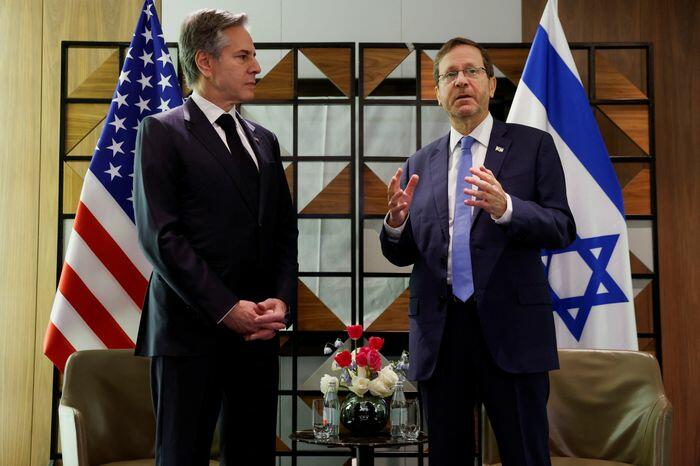
With these words, US Secretary of State Antony Blinken defined the “turning point” of the American era, the transition from one world order to another. 

“In this pivotal time, America’s global leadership is not a burden. It’s a necessity to safeguard our freedom, our democracy, and our security,” Blinken said in his address to the Johns Hopkins School of Advanced International Studies (SAIS) in September. 

Official US documents, including last year’s National Security Strategy, underscore Washington’s conviction that waiting is a luxury it cannot afford; that it “will act decisively” to maintain its global leadership. As such, the US involvement in conflicts in Ukraine and Gaza, as well as the militarization in Southeast Asia, must be seen through this lens of international dynamics.

Broadly, tensions in Africa and Asia are interconnected with the west’s frenzied initiatives to maintain a dominant position and decisive role in the new multipolar order.

From Eastern Europe to West Asia 

Since the outbreak of war in Ukraine, the US has strategically tied its support for Kyiv to the defense of the “rules-based order.”

With clichéd sound bites, President Joe Biden characterized the conflict as “a battle between democracy and autocracy, between liberty and repression, between a rules-based order and one governed by brute force.”

Many Atlanticist leaders echo the sentiment that unwavering support for Ukraine aims to deter Russia from challenging a world order where the west holds sway.

Most prominently, German Chancellor Olaf Scholz articulated this perspective in his Foreign Affairs article published in early 2023 titled The Global Zeitenwende, (“an epochal tectonic shift”) in which he posits that Russian President Vladimir Putin is challenging a world order where Washington is a decisive power.

Scholz emphasizes the need for collective action by those who believe in a rules-based world order, even cooperating with countries that do not embrace democratic institutions but endorse the US-led principles for global governance. That western rules-based paradigm, it should be noted, is one in which international law and the UN Charter have long been discarded in favor of power and advantage.

Today, those dueling visions are playing out in the Ukraine war: a confrontation between the west seeking to maintain its global superiority and Russia striving to disrupt this dominance. Moscow’s rationale for the war is to prevent NATO from expanding to Russia’s borders, as confirmed by the western military alliance’s Secretary-General Jens Stoltenberg.

Similarly, the war in Gaza must be seen through this international lens, with Israel representing western interests in West Asia and any harm to the occupation state viewed inherently as a blow to US influence in the region. 

As Washington stands at this crucial turning point, according to Blinken, the cost of a blow to Israel is deemed too high, underscoring the resolute US defense of its global influence in the devastated towns and cities of Gaza.

Neo-colonial maneuvers

There are important nuances between these two US-backed wars, however: Ukraine is seen as a tool used by Washington to achieve its interests, while Israel is considered an American interest in itself. That Biden once famously asserted that the US would need to create an Israel if it did not exist illustrates its status as a neo-colonial outpost, protecting western interests in the region. 

This also explains the noticeable shift in US interest away from Eastern Europe to West Asia after the Palestinian resistance breached the occupied territories on 7 October to target military personnel and take prisoners. The deliberate shift of American attention from one war zone to the other was neatly exemplified by the Washington Post’s swift removal of the ‘War in Ukraine’ tab from its homepage. 

As previously mentioned by The Cradle, “Israel’s ongoing war on the Gaza Strip is best understood to be a US-backed one,” one that is being fought to safeguard US influence and interests in West Asia. However, the maneuvering room for Washington’s allies is shrinking dramatically. Unlike the diverse strategic options West Asian countries explored during the Ukraine war, Gaza offers no such latitude. It is fundamentally Washington’s war, demanding collective mobilization to defend the US position.

It is also telling that the US-led multination task force, Operation Guardian of Prosperity in the Red Sea, is already facing major set-backs since its recent inception, with some members pulling out and others choosing to remain unnamed.

White House National Security Council Strategic Communications Coordinator John Kirby had to awkwardly caveat the secrecy like this: “There are some countries that have agreed to participate and be part of the operation in the Red Sea, but they have to decide how much they want that to be public. And I’m going to leave it to them so that they can describe it somehow, because not everyone wants to be public.”

For example, the role of NATO member Turkiye has transformed into that of an energy transmission station for Israel, while the UAE, Saudi Arabia and Jordan serve as a transit bridge for goods bound for the occupation state that Yemen prevents from passing through the Red Sea.

Notably, shipments from Turkiye to Israel surged to 355 after 7 October, with many linked to the Justice and Development Party (AKP) and individuals close to Turkish President Recep Tayyip Erdogan, including his son Buraq. Even Egypt, restricted to allowing aid trucks through the Rafah crossing, could not facilitate aid to Palestinians without US approval.

How conflict spreads

In international relations, there are two main theories that address the relationship between power and the spread of peace. The first is the hegemonic stability theory which posits that the international order is likely to remain stable when one country is the dominant global power. The proponents of this theory believe that the existence of a single hegemon deters all powers in the world and prevents them from spreading tension.

However, given the reality that the United States has dominated a conflict-ridden global order for four decades, it can be argued that the presence of the hegemon did not lead to global stability. Rather, the dominant was the major source and catalyst for spreading tension around the world. It is sufficient to look at the distribution of US bases in the world and the proliferation of military agreements signed by Washington to understand how the US consistently provokes rivals and challengers, and creates strife.

The second is the balance of power theory, in which states seek to protect themselves by preventing any country from acquiring enough military power to control all other nations. If one power dominates – such as the United States – the theory predicts that weaker countries will unite in a defense alliance. 

According to this theory, a balance of power between competing states or alliances raises the cost of tension for everyone and ensures stability in the world. Thus, achieving peace today requires a rise in the level of power among Washington’s rivals, power which will provide the deterrence required to limit the spread of tensions around the world. Increasing the capabilities of Washington’s rivals is now a key requirement for all peaceful peoples and nations. And according to the balance of power theory, uniting against Israel is the most successful way to stabilize West Asia and its environs today.

Post-unipolar realities 

As the war in Gaza is unequivocally an American war, a vertical division emerges in West Asia, dividing those siding with Palestine and the Resistance Axis from those aligning with Israel and the Zionist project. Washington’s allies cannot stay neutral as the US leads the battle directly. 

This clarifies the positions of Saudi Arabia, Jordan, the UAE, Egypt, Turkiye, and other West Asian countries choosing to align with the US at the expense of Palestinian interests.

Observing Washington’s policies reveals global tensions spurred on by the pursuit of US influence. From Eastern Europe to West Asia and Southeast Asia, the US works to counter Eurasian powers Russia and China, and other influential countries, such as Iran and North Korea.

Since the end of the Cold War, Washington’s unipolar moment has resulted in more wars and destruction imaginable in decades often characterized as ones marked by peace. A more stable world order necessitates the achievement of a global balance of power by weakening the US and empowering new rising powers. Thus, peace and stability in West Asia hinges on the weakening of Israel, a colonial project so intricately tied to Washington’s hegemonic agenda.

2023 – The Year the World Saw the U.S. Emperor as Naked… and Grotesque

Seeing the naked truth is usually the first step before we can go on to realize the truth of beauty and decency. We might hope that the world is taking that first step.

By SCF Editorial

Source: Strategic Culture Foundation

American President Joe Biden likes to talk about “inflexion points” when he is lecturing about world affairs and the supposed superiority of the United States. This year is indeed an inflexion point.

It was the year that the entire world saw the truly hideous and criminal nature of U.S. power.

Washington’s fuelling of the futile conflict in Ukraine and the despicable slaughter in Gaza is a wake-up call for the entire world. The United States stands barefaced and grotesque as the primary purveyor of war. There can be no doubt about that. For many it is shocking, scandalous and frightening.

Tragically, it seems, for the world, every year’s end is an occasion to witness and lament conflicts, wars and suffering over the preceding 12 months. Often the causes of wars and suffering are seemingly unfathomable.

However, this year seems to be unique. The year ends with a horrendous massacre in Gaza that is unprecedented and perpetrated by Israel with the full support of the United States. The scale of deliberate mass killing in Gaza makes it a genocide. The fact that this abomination is occurring at Christmas time when the world is supposed to celebrate the divine birth of Jesus Christ – the Prince of Peace – in the very place where he was born some 2,000 years ago makes the abomination all the more profane and damning.

What is particularly wretched is that the heinous destruction of children is happening in full view of the world. There is no remorse or pretence. It is full-blown premeditated murder done with cruelty and sickening impunity.

Virtually the whole world is horrified by the devastating, relentless violence and absolute violation of international law. The butchery by the Israeli regime cannot in any way be rationalized by the previous attack on Israel by Palestinian militants on October 7. Those killings by Hamas have been cynically used as a pretext for the subsequent and ongoing annihilation of Palestinian civilians.

This genocide could not happen without the crucial support of the United States for the Israeli regime. Financially, militarily and diplomatically, Washington is sponsoring the horror in Gaza as well as the Occupied West Bank.

This week saw the U.S. once again obstructing calls at the United Nations for a ceasefire and the urgent supply of humanitarian aid to more than two million people. The World Food Program has declared a catastrophic famine in the coastal enclave after more than 70 days of bombing and blockade by the Israeli regime. More than 20,000 people – mainly women and children – have been slaughtered with up to 7,000 more missing, presumably dead. Israeli troops are carrying out mass executions of terrified and traumatized human beings, according to UN rights monitors.

The United States is arming Israel to the hilt and enabling it. U.S. President Joe Biden has pointedly refused to join international demands for a ceasefire. The United Nations has voted by an overwhelming majority for a cessation of the violence. Washington has repeatedly rejected the world’s pleas because the Biden administration is obscenely amplifying Israeli lies and distortions. “Unwavering, unshakable support” is how the White House arrogantly boasts about it without a hint of shame that it is self-indicting.

Tens of thousands of tonnes of munitions have been flown to Israel to carry out “indiscriminate bombing” (Biden’s own admission). One-tonne bunker-buster bombs have been dropped deliberately on refugee camps and hospitals. And still, the Pentagon shamelessly refuses to impose any red lines on the use of its munitions.

This genocide has Israeli fingers on the triggers but it is ultimately an American-sponsored genocide. Based on Nuremberg principles, Joe Biden and Benjamin Netanyahu would be both in the dock, accompanied by Antony Blinken, Jake Sullivan, Lloyd Austin and their counterparts in Tel Aviv.

If there were previous international doubts about Washington’s systematic criminality, the whole world knows for certain now.

Significantly, too, American citizens are also repulsed by the barbarity and the fact that their government is an accomplice in a historic crime against humanity. Polls show that Biden is one of the most unpopular presidents ever, and his culpability for the genocide in Gaza is a primary reason for the widespread disgust, especially among younger Americans.

As things stand, there is a fair chance that 81-year-old incumbent Democrat will lose the presidential election in 2024 – less than 11 months away. Not that any of the Republican contenders are qualitatively better. American politics are in a crisis of chaos.

But this is not just about Biden or other individual U.S. politicians. The United States government and much of the corporate-controlled media stand full square behind Israel’s crimes. That has always been the case since the Israeli state was formed in 1948 through Washington’s skulduggery at the newly established United Nations, together with the old colonial power, Britain – the author of the infamous and treacherous Balfour Declaration that instigated Zionist dispossession of the indigenous people in the Holy Land, or what London called its Palestinian Mandate.

Decades of duplicity and dissembling as a peace broker in the Middle East have been blown away by the horrendous massacre that has culminated at the end of 2023. Israel is carrying out a Final Solution that is comparable to the atrocities of Nazi Germany. The Zionist regime has cynically used the Holocaust against Jews as a cover for its genocide against Palestinians. And many decent Jews around the world, including Holocaust survivors, are rightly mortified by the depraved association exploited by the Zionist regime.

What is happening in Gaza may be seen as a shocking revelation for the world of historic proportions. It is an eye-opener of the violence and lawlessness that the U.S. emperor has been systematically engaged in since it became the dominant world power almost a century ago. Following the Second World War and the defeat of European fascism – largely by the Soviet Union – the United States has taken up the fascist mantle, albeit unspoken and disguised with pretensions claims of democratic virtue. No other nation has waged as many wars and conflicts over the past eight decades as the U.S. The death toll from American imperialism runs to tens of millions of people with victims on every continent.

The conflict that erupted in Ukraine in February 2022 is another manifestation of Washington’s imperialist machinations. That war is approaching its third year and shows no sign of ending because the U.S. continues to weaponize the Neo-Nazi regime in Kiev, a regime that Washington and its European NATO allies installed in 2014 through a coup d’état. The hostilities in Ukraine – the biggest in Europe since the Second World War – were fomented by the United States as a proxy war to defeat Russia. The war could have been avoided if the U.S. and its European vassals had negotiated a diplomatic solution to NATO’s expansionist threat to Russia.

Russian President Vladimir Putin did not want a war in Ukraine. Respected American commentators like John Mearsheimer, Jeffrey Sachs and Scott Ritter have all confirmed with extensive analysis that Washington and its European allies are primarily responsible for creating the conflict – one that has cost the lives of as many as 400,000 Ukrainian soldiers and the displacement of 10 million civilians across Europe. Nearly $200 billion in Western public money has been wasted so far. Biden and the European Union want to donate another $100 billion to prolong this futile war.

America’s wars were always officially rationalized with some seeming plausible cause or mission. In the early decades of the Cold War, Washington claimed to be defending the “Free World” against Communist aggression in Korea, Vietnam, Africa and Latin America. When the Cold War supposedly ended in 1990-91 after the collapse of the Soviet Union due to its internal political problems, we then saw a spate of U.S. wars around the world against drugs, terrorism, weapons of mass destruction and – most absurdly – defense of human rights.

The latest war in Ukraine is purportedly to defend democracy and sovereignty (of a Nazi Waffen SS-adulating regime in Kiev installed by the CIA!).

Nonetheless, the genocide in Gaza is the culmination, the final act. This is where all the history of U.S. crimes and fraudulence as a “noble exceptional democratic leader” finally comes unstuck.

It is an infernal climax for a global power, arguably the world’s first and last imperialist global hegemon. The whole of humanity can now see that all the American rhetoric and vanity is nothing but an ugly lie. The emperor is naked in all his crimes. The blood of children on his hands, his mouth drooling with lies. It was always so, but now universally evident.

One might ask, where do we go from here? Despite the abominable cruelty, suffering and misery, one can still hope that humanity will eventually find a way to live in peaceful coexistence. By respecting all those who abide by international law and basic moral precepts. Arguably, most of humanity is willing and capable of living in peace.

But to achieve that peace there must be no illusions and lies. There must be accountability and genuine atonement.

U.S. imperial power is damned. There’s no going back or reform. The capitalist economic system – evolved as oligarchic fascism and its two-party puppet show – driving imperialist barbarism must be called out and overturned. Biden is doomed, and Trump and so on are just more false prophets.

Seeing the naked truth is usually the first step before we can go on to realize the truth of beauty and decency. We might hope – for the sake of peace and ending much of the suffering – that the world is taking that first step.