
The Four Pillars of Disaster Shamanism

By Gary Z McGee

Source: The Mind Unleashed

“We need shamans, and if society doesn’t provide them, the universe will.” ~Joe Lewels

In the article The Archetypal Path to Getting Your Shit Together, I wrote about the power of archetypes. A Disaster Shaman is an example of using an archetype to make the world a better place; to become the change we want to see in the world.

The Disaster Shaman recipe combines aspects of The Shadow with aspects of The Hero and then mixes in a little Trickster tomfoolery. The combination of these archetypes creates a particular flavor of nontraditional shamanism that spearheads healthy Cosmic Law through the heart of unhealthy lawfulness.

A Disaster Shaman is a force of nature first, a person second; sowing radical revolution in order to reap progressive evolution. Healthy balance is primary. Even if it comes at the expense of comfort and security. Disaster Shamanism (otherwise known as Apocalyptic Shamanism) is the interdependent shamanic response to apocalyptic times.

The primary tasks of a Disaster Shaman are as follows:

–Heal disaster situations through shamanic cosmology and ecopsychology.

–Listen to Universal Laws to discern the difference between healthy and unhealthy.

–Live moderately so that others may moderately live.

–Diagnose and heal Nature Deprivation.

–Transform weaponry into livingry.

–Bring “water” to the Wasteland.

The sub archetypes of the Disaster Shaman archetype are The New Hero, The Fifth Horseman of the Apocalypse, The Sacred Clown, and The New Oracle. The four pillars of Disaster Shamanism subsume these sub archetypes. Let’s break them down…

Hero-expiation (New Hero or Cosmic Hero):

“Our sole responsibility is to produce something smarter than we are; any problems beyond that are not ours to solve.” ~Ray Kurzweil

The average person is not heroic (courageous). Likewise, the average hero is not prestigious (provident). A New Hero, as opposed to a typical hero, is a hero with prestige. A New Hero has gone Meta with the concept of heroism itself.

The New Hero sub archetype is the first pillar of Disaster Shamanism. New heroism is gained through hero-expiation. Hero-expiation is the voluntary, wise, honorable, moral, and compassionate distribution of power so that power doesn’t get to the point that it corrupts.

It is through the wise distribution of power that a typical hero becomes a New-hero (cosmic hero, next-level hero) with skill, power, honor, and prestige, as opposed to just a typical hero with only skill and power.

Hero expiation is all about getting power over power. Whether one’s own power or the overreaching power of others. It’s about turning the tables on entrenched power by “counting coup” on it.

A Disaster Shaman as New Hero is a social leveling mechanism par excellence. They count coup on power through strategic humiliation (shaming) so that power never has the chance to become absolute.

When a New Hero comes to town, fear-filled blue pills are swapped with wisdom-filled red pills. The Disaster Shaman has come to set the record straight. To recondition the culture that has been conditioned into believing in competition over cooperation and narrow-minded one-upmanship over open-minded compassion. They teach that competition has always been secondary to cooperation; otherwise we wouldn’t have survived as a species (Darwin).

Eco-consciousness (Fifth Horseman of the Apocalypse):

“Extreme positions are not succeeded by moderate ones, but by contrary extreme positions.” ~Friedrich Nietzsche

Eco-consciousness is about uncontrolled order overcoming controlled chaos. Whether the culture (tribe) has become too obese, too greedy, too violent or some other unhealthy excess, the Disaster Shaman arrives to set the record straight; to plant a seed of overt moderation within the covert immoderation.

The Fifth Horseman is the one that cleans up after the original Four Horsemen (the Four Horsemen is a metaphor for anyone caught up (aware or not) in any kind of unsustainable, unhealthy, violent, immoral, or mass-destructive social system). The Fifth Horseman of the Apocalypse is an archetype representing rebirth and renewal in the face of conquest, war, famine, and death.

The Fifth Horseman is ruthless with her healing powers. Her name is Providence, Phoenix-like, she rises up from the ashes of war & decay to spread self-actualized love, open-mindedness, and progressive sustainability by digging up the decay and unsustainable residue of past and present civilizations and then using it all as compost in cultivating and growing a healthier more balanced future.

In that capacity she has devoted herself to planting gardens of eco-centric heroism in the humus of war, hate, close-mindedness and greed, and anything else left behind by the original four horsemen. She is dedicated to, as Buckminster Fuller said, transforming weaponry into livingry.

She subsumes the original four horsemen by teaching them that the new definition of right & wrong must be derived from the universal dictation of healthy & unhealthy rather than the human opinion of good & evil.

The Fifth Horseman is the Goddess of Recompense. She is the Verdant Force. She is the soft hammer of evolution. She has come to blur the false boundaries that have been erected between nature and the human soul.

She is Gaia. She is Lady Justice. She is the return of the Sacred Feminine. She is all of us, men and women, realizing that we are nature first and humans second, that we are soul first and ego second. She is weighing the worth of the human world with the Scales of Justice. With or without us, she will not fail to bring water to the wasteland.

High humor (Sacred Clown):

“What is a tragedy but a misunderstood comedy.” ~Shakespeare

Most of us are familiar with the prototypical clowns: red-nosed clowns, court jesters, and Tarot fools. But sacred clowns take clowning to a whole other level.

Almost all types of sacred clowns combine trickster spirit with shamanic wisdom to create a kind of sacred tomfoolery that keeps the zeitgeist in check. Their methods are unconventional and typically antithetical to the status quo, but extremely effective. They indirectly re-enforce societal customs by directly enforcing their own powerful sense of humor into the social dynamic.

The main function of a sacred clown is to deflate the ego of power by reminding those in power of their own fallibility, while also reminding those who are not in power that power has the potential to become corrupt if it’s not balanced with other forces, namely with humor. But sacred clowns don’t out-rightly derive things. They’re not comedians, per se. Though they can be. They are more like personified trickster gods, poking holes in things that people take too seriously.

Through acts of satire and showy displays of blasphemy, sacred clowns create a cultural dissonance born from their Crazy Wisdom, from which serious anxiety is free to collapse on itself into sincere laughter.

The high humor of Sacred Clowns leads to a higher courage and the audacity to speak truth to power. And they do so with silver-tongued proficiency. There exists no perceived construct of power that’s above their enlightened rebellion. No idol too golden. No high horse too high. No pedestal too revered. No “wizard” too disguised. No God too godly. No title too contrived.

Nothing is immune to the exactness of a Sacred Clown’s rebellion. It’s all merely procrastinating compost. It’s all just well-arranged armor waiting to rust. It’s all an illusion within a delusion. And the Sacred Clown has the enlightened sense of humor to reveal that absolute fact.

Lest we write our lives off to unhealthy stagnation and devolving inertia, we must become something that has the power to perpetually overcome itself. The sacred clown has this power. Paraphrasing William Blake, “If the fool (Sacred Clown) would persist in his folly, he would become wise (New Oracle).”

Self-overcoming (New Oracle):

“To attain knowledge, add things every day. To attain wisdom, remove things every day.” ~Lao Tzu

A Disaster Shaman is a New Oracle who has come to inform the old oracles that they have failed. The self-centered “culture” has been declared a wasteland, and the unhealthy surroundings dubbed unworthy for healthy humans attempting to evolve into a more robust species.

The New Oracle teaches this, above all: Pain should not be avoided at the expense of love. Love should be embraced at the risk of pain.

As such, a master with high humor is needed to resolve the disaster of the self; to usher in an eco-centric, as opposed to an ego-centric, perspective. This master lies dormant inside us all. It can only be found by having the out-of-mind experience of no-mind, in the courageous throes of self-overcoming. There, in the stillness, the master is meditating. The master is connected to the source of all things, his thousand-petalled lotus spinning like a galaxy above his head.

He is radiating inside of you, bursting with wisdom and nth-degree-questions. She pirouettes like Shakti. He foxtrots like Shiva. He/she is the all-dancing, all-laughing oracle of the primordial self, interconnected with all things. And it can only be found there in the silence, between inhale and exhale, between being and non-being, between mind and no-mind, between finitude and infinity.

After disaster, but just before mastery, the Disaster Shaman as New Oracle persistently self-actualizes toward enlightenment.

There, above thought, is the source of human creativity: the place where artists, poets, musicians, and even scientists have discovered the secrets of the universe. Like Leonard Cohen said, “You lose your grip, and then you slip into the masterpiece.”

The mind of Everything holds the heart of Nothingness; the void of Nothingness holds the core of Everything. The masterpiece is the working, self-overcoming, canvas of the New Oracle’s life. The New Oracle is forever in the process of seizing the moment in order to seize the day in order to seize the life.

In the end, the Disaster Shaman is a healthy response to our unhealthy times. Wielding the courage of the New Hero, brandishing the mettle of the Fifth Horseman, harnessing the humor of the Sacred Clown, and channeling the wisdom of the New Oracle, the Disaster Shaman is determined to tonalize an otherwise atonal world.
Crow’s God: Ego Dissolution and the Evolution of the Self

By Gary ‘Z’ McGee

Source: Waking Times

“To fall in love is to create a religion that has a fallible god.” ~Jorge Luis Borges

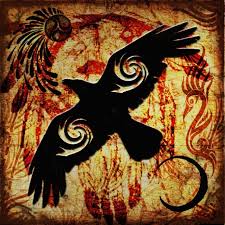
“Trickster god is god’s God,” Crow says, peering from behind The Branches of Lost Time. These branches are a metaphor for our misremembered synapses. They symbolize our having lost touch with both our own nature and with wild Nature, our forgotten link between cosmos and psyche, our misunderstanding of how we-the-microcosm makes up a vital aspect of We-the-macrocosm.

Crow is here to remind us. But Crow’s medicine is harsh. It is ruthless: a tearing apart, a torn off Band-Aid. For Crow is between worlds like no other creature. His moon-eye sees the light. His sun-eye sees the dark. And his shadow is the grayest thing in the universe: The Middle-gray, the Middle Way, casting itself over and above all things. Smearing out yin-yangs, he reveals how nothing is separate; how everything is connected to everything else in a glorious melting down of black and white, dark and light, life and death, finitude and infinity.

Crow is here to remind us that we need to get over ourselves. He is a black beacon in a room filled with blinding light. He’s the Dark Truth in the sugar-coated ointment. He is here to trick us out of unconsciousness. He is here to crucify the ego. But more importantly, he is here to resurrect it as a mighty tool for the self-actualized Soul.

Ego Dissolution

“Buddha is dead. God is dead. The path is littered with insufferable egos. Even your own ego has an enlightened sword penetrating through its self-righteous heart, and your soul is all the stronger for it.” ~Seven Signs You May Be Unfuckwithable

Don’t worry so much. Ego death doesn’t hurt. What hurts is realizing that you’ve been, as they say in Zen, “tied to a post without a rope.” What hurts is admitting that your ego is nothing more than a front for your multilayered self. What hurts is letting go of your expectations. What hurts is letting go –full stop.

Crow is here to help you let go. Crow’s medicine has just the right amount of humor disguised as honor and compassion disguised as courage to fill up the humble pie disguised as a red pill needed to get you past the blue-pill addiction of your un-mighty ego. Sure, Crow shoves it down your unwilling and reluctant throat with a beak blacker than dark matter and harder than God’s Femur, but he gets the job done with a humor of the most-high.

He’s a necessary amoral agent: Zeno’s Compass, Ockham’s hellraiser. He’s here to flip your worldview on its head, to vivisect the animal of your knowledge, to cut what you think you know about the way the world works in half and pluck out the organs of all the things you take for granted. He’s neither gentle nor comforting, but he is sincere in his exact fierceness. He must be, in order to reveal yourself to yourself. In order to transform your whiny, woe-is-me placation into a mighty self-overcoming revelation.

No easy feat, dissolving egos. But Crow does so with pluck and aplomb, with molten mettle and mercurial moxie. The letting go process is easier if you just give your ego over to him to chew-up (courage), to digest (cocoon) and eventually shit-out (rebirth), but he doesn’t mind stealing it from you like a thief in the night either. Actually, he would prefer pulling it out of you kicking and screaming and begging the gods to save you. He would rather stamp out the little light that blinds you so that you can finally see the bigger light that awakens you.

Don’t worry. On the other side of this beautiful annihilation is a soulful illumination: A Three-eyed Raven. He has come to carry you to a terribly exquisite juxtaposition: the gloriously painful journey of self-overcoming.

Evolution of the Self

“Life is a process of becoming, a combination of states we have to go through. Where people fail is that they wish to elect a state and remain in it. This is a kind of death.” ~Anais Nin

At the fork of in the path, at the crossroads, where yesterday’s you meets today’s you in bardo-perfect juxtaposition, there is a psychosocial reckoning at hand. There is an existential decision to make: get busy adapting and overcoming, or get busy stagnating and succumbing. The cliché phrasing is ‘get busy living or get busy dying,’ but on the Path of the Three-eyed Raven there is room for dying (rebirth) as a steppingstone for growth toward living life more profoundly, adventurously, and on-purpose.

So here you are, in a state of in-between, unmolded clay. You’ve been rocked to your foundations with the realization that you are not your ego, that you’ve only ever been unmolded clay. You’re no longer that, and not yetthis. You’ve emerged from your ego’s death with your soul bloody from a thousand and one cutting questions. Your ego is now a pulsing blister inside you, oozing indifference and apathy even as it begins filling itself with interdependence and empathy. It leaps and bounds inside you, a terribly beautiful wound turned primordial womb that purges pettiness and superfluity even as it begins impregnating itself with the world.

Crow is satisfied, perched up high, licking his razor-sharp beak, filled to bursting with the rigid invulnerability of your ego bulging inside him. But the Three-eyed Raven is anything but satisfied. He sees the Infinite Game being played out. He sees how you are an integral catalyst for the progressive evolution of your species. He is a symbol for your ego’s rebirth. The most wide-awake aspect of you that invulnerably and soulfully flexes out; that individuates and self-actualizes as it perpetually overcomes the vicissitudes of self, and thus the vicissitudes of life.

With Crow’s medicine in one hand and your wide-awake ego in the other; with Crow on one shoulder and the Three-eyed Raven on the other, you are ready to self-overcome. You are ready to existentially crush out. You are ready to bridge the gap between man and overman.

Don’t be afraid of this vulnerable power, though it is both the scariest and most powerful thing in the universe, save for the power of a good sense of humor. Embrace it. Be fearless with it. Use it as a tool to leverage wonder and numinous experience into your life. Use it as medicine for a profoundly sick society. You –the you not drowning in ego pettiness and woe-is-me religious placation– are the one the world has been waiting for.


The Path of the Sacred Clown: Where Trickster and Shaman Converge

1.200

By Gary Z McGee

Source: Fractal Enlightenment

“If the fool would persist in his folly, he would become wise.” –William Blake

Most of us are familiar with the prototypical clowns: red-nosed clowns, court jesters, and Tarot fools. But sacred clowns take clowning to a whole other level. The Ne’wekwe “mud-eaters” were the Zuni equivalent of a sacred clown. The Cherokee had sacred clowns known as Boogers who performed “Booger dances” around a community fire.

In Tibetan Buddhism it’s referred to as Crazy Wisdom, which the Guru adopts in order to shock their students out of fixed cultural and psychological patterns. But perhaps the most popular type of sacred clown is the Lakota equivalent of Heyoka, a contrary thunder shaman who taught through backwards humor.

Almost all types of sacred clowns combine trickster spirit with shamanic wisdom to create a kind of sacred tomfoolery that keeps the zeitgeist in check. Their methods are unconventional and typically antithetical to the status quo, but extremely effective. They indirectly re-enforce societal customs by directly enforcing their own powerful sense of humor into the social dynamic. They show by bad example how not to behave.

The main function of a sacred clown is to deflate the ego of power by reminding those in power of their own fallibility, while also reminding those who are not in power that power has the potential to corrupt if not balanced with other forces, namely with humor. But sacred clowns don’t out-rightly derive things. They’re not comedians, per se, though they can be. They are more like tricksters, poking holes in things that people take too seriously.

Through acts of satire and showy displays of blasphemy, sacred clowns create a cultural dissonance born from their Crazy Wisdom, from which anxiety is free to collapse on itself into laughter. Sacred seriousness becomes sacred anxiety which then becomes sacred laughter. But without the courageous satire of the sacred clown, there would only ever be the overly-serious, prescribed state of cultural conditioning.

Lest we write our lives off to such stagnated states, we must become something that has the power to perpetually overcome itself. The sacred clown has this power. Christ was a sacred clown, mocking the orthodoxy. Buddha was a sacred clown, mocking ego attachment. Even Gandhi was a sacred clown, mocking money and power.

Like Thomas Merton wrote, “In a world of tension and breakdown, it is necessary for there to be those who seek to integrate their inner lives not by avoiding anguish and running away from problems, but by facing them in their naked reality and in their ordinariness.” Sacred clowns are the epitome of such integration.

Heyokas, for example, remind their people that Wakan tanka, the great mystery, is beyond good and evil; that its primordial nature doesn’t correspond to human platitudes of right and wrong. Heyokas act as mirrors, reflecting the mysterious dualities of the cosmos back onto their people. They walk the Red Road, following in the bloody footprints left behind by their Heyoka fore-brothers.

They go forward, to that place where emptiness is full, and fullness empty. “As a representative of Thunderbird and Trickster,” writes Steve Mizrach, “the heyoka reminds his people that the primordial energy of nature is beyond good and evil. It doesn’t correspond to human categories of right and wrong. It doesn’t always follow our preconceptions of what is expected and proper. It doesn’t really care about our human woes and concerns. Like electricity, it can be deadly dangerous, or harnessed for great uses. If we’re too narrow or parochial in trying to understand it, it will zap us in the middle of the night.”

Sacred clowns are adept at uniting joy with pain, acting on the higher and more inscrutable imperatives of the Great Mystery. They tend to govern transition, introduce paradox, blur boundaries, and mix the sacred with the profane. They are called upon to reestablish the bridge between the physical and spiritual worlds. They dare to ask the questions that nobody wants answers to.

They are the uncontrollable avatars of the Trickster archetype, constant reminders of the contingency and arbitrariness of the social order, poking holes in anything taken too seriously, especially anything assuming the guise of power. They are a conduit to forces that defy comprehension, and by their absurd, backwards behavior, they are merely showing the ironic, mysterious dualities that exist within the universe itself.

Sacred clowns understand that humans fail, and failing means that sometimes we need to change. They remind us that the goal is not to stick to the same old path, but to embrace the vicissitudes of life and to discover new paths and the courage it takes to adapt and overcome. Taking the universe into deep consideration, letting it be, and then letting it go, is far superior to clinging to a “belief” and becoming stuck in a particular view. Sacred clowns realize that the highest wisdom lies in this type of counter-intuitive detachment, in accepting that nothing remains the same, and then being proactive about what it means to change.

Most importantly, they teach us that there is no such thing as an enlightened master. We’re all spiritually dumb. The closest we can ever get to being “enlightened” is simply to understand that we are naïve to it, and then to laugh about it together as a community. Sacred clowns have the ability to plant this seed of sacred humor. They are constantly in the throes of metanoia, disturbing the undisturbed, comforting the uncomfortable and freeing the unfree. They remind us, as Rumi did, that “the ego is merely a veil between humans and God.”