The Global Deep State: A Fascist World Order Funded by the American Taxpayer

By John & Nisha Whitehead

Source: The Rutherford Institute

“The madmen are in power.”— Philip K. Dick, The Man in the High Castle

The debate over U.S. foreign aid is a distraction.

That’s not to say that the amount of taxpayer money flowing to foreign countries in the form of military and economic assistance is insignificant. Even at less than 1% of the federal budget, the United States still spends more on foreign aid than any other nation.

The latest foreign aid spending bill includes $95 billion for Ukraine, Israel and Taiwan.

Since World War II, the U.S. has given more foreign aid to Israel than any other country ($318 billion), with the bulk of those funds designated for Israel’s military efforts.

Even so, more than 150 countries around the world receive U.S. taxpayer-funded assistance.

As Forbes reports, “U.S. foreign aid dwarfs the federal funds spent by 48 out of 50 state governments annually. Only the state governments of California and New York spent more federal funds than what the U.S. sent abroad each year to foreign countries.”

Whether or not that some of that foreign aid is used for legitimate purposes, the global welfare system itself is riddled with corruption and waste. As Adam Andrzejewski rightly asks, “Do taxpayers instinctively know that they are funding choir directors in Turkmenistan, filmmakers in Peru, aid for poultry farmers Tanzania, and sex education workshops for prostitutes in Ethiopia?”

The problem is not so much that taxpayers are unaware of how their hard-earned dollars are being spent. Rather, “we the people” continue to be told that we have no say in the matter.

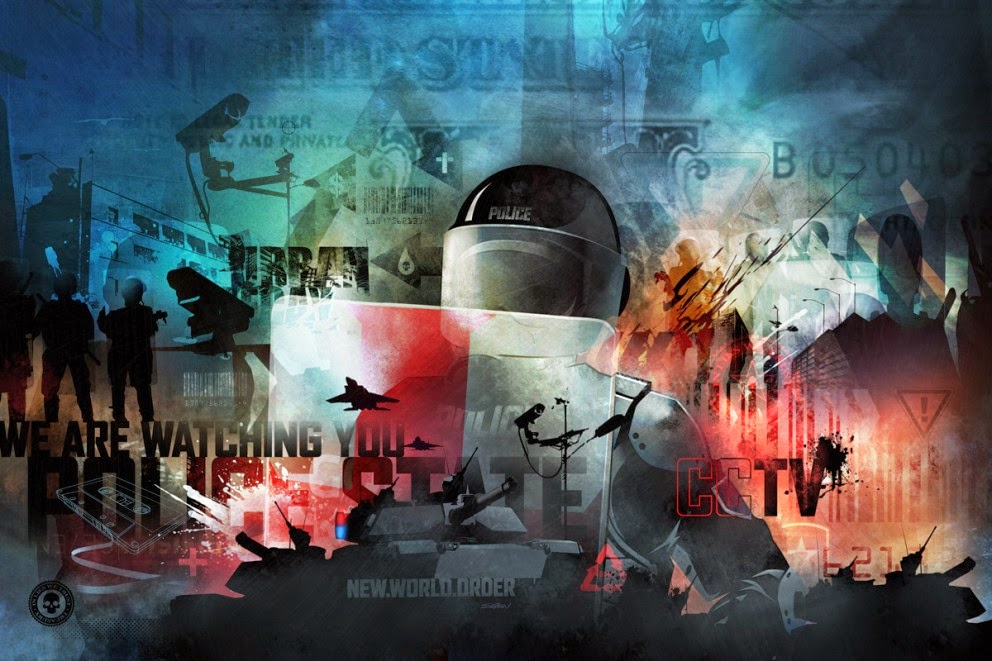
We have no real say in how the government runs, or how our taxpayer funds are used, but that doesn’t prevent the government from fleecing us at every turn and forcing us to pay for endless wars that do more to fund the military industrial complex than protect us, pork barrel projects that produce little to nothing, and a police state that serves only to imprison us within its walls.

This financial tyranny persists whether it’s a Democrat or Republican at the helm.

At a time when the government is spending money it doesn’t have on programs it can’t afford, the national debt continues to grow, our infrastructure continues to deteriorate, and our borders continue to be breached.

What is going on?

The “government of the people, by the people, for the people” has been overtaken by a shadow government—a corporatized, militarized, entrenched global bureaucracy—that is fully operational and running the country.

This powerful international cabal made up of international government agencies and corporations—let’s call it the Global Deep State—is just as real as the corporatized, militarized, industrialized American Deep State, and it poses just as great a threat to our rights as individuals under the U.S. Constitution, if not greater.

Clearly, we have entered into a new world order: fascism on a global scale.

It remains unclear whether the American Deep State (“a national-security apparatus that holds sway even over the elected leaders notionally in charge of it”) answers to the Global Deep State, or whether the Global Deep State merely empowers the American Deep State. However, there is no denying the extent to which they are intricately and symbiotically enmeshed and interlocked.

Consider the extent to which our lives and liberties are impacted by this international convergence of governmental and profit-driven corporate interests in the surveillance state, the military industrial complex, the private prison industry, the intelligence sector, the security sector, the technology sector, the telecommunications sector, the transportation sector, and in recent years, the pharmaceutical-health sector.

All of these sectors are dominated by mega-corporations operating on a global scale and working through government channels to increase their profit margins. The profit-driven policies of these global corporate giants influence everything from legislative policies to economics to environmental issues to medical care.

Global Disease

The COVID-19 pandemic propelled us into a whole new global frontier in which those hoping to navigate this interconnected and highly technological world of contact tracing, vaccine passports and digital passes find themselves grappling with issues that touch on deep-seated moral, political, religious and personal questions for which there may be no clear-cut answers.

Our ability to access, engage and move about in the world has now become dependent on which camp we fall into: those who have been vaccinated against whatever the powers-that-be deem to be the latest Disease X versus those who have not.

This is what M.I.T. professor Ramesh Raskar refers to as the new “currency for health,” an apt moniker given the potentially lucrative role that Big Business (Big Pharma and Big Tech, especially) will play in establishing this pay-to-play marketplace. The airline industry has been working on a Travel Pass. IBM is developing a Digital Health Pass. And the U.S. government has been all-too-happy to allow the corporate sector to take the lead.

“It is the latest status symbol. Flash it at the people, and you can get access to concerts, sports arenas or long-forbidden restaurant tables. Some day, it may even help you cross a border without having to quarantine,” writes Heather Murphy for the New York Times. “The new platinum card of the Covid age is the vaccine certificate.”

Global Surveillance

Spearheaded by the National Security Agency, which has shown itself to care little for constitutional limits or privacy, the surveillance state has come to dominate our government and our lives.

Yet the government does not operate alone. It cannot. It requires an accomplice. Thus, the increasingly complex security needs of our massive federal government, especially in the areas of defense, surveillance and data management, have been met within the corporate sector, which has shown itself to be a powerful ally that both depends on and feeds the growth of governmental bureaucracy.

Take AT&T, for instance. Through its vast telecommunications network that crisscrosses the globe, AT&T provides the U.S. government with the complex infrastructure it needs for its mass surveillance programs. According to The Intercept:

“The NSA considers AT&T to be one of its most trusted partners and has lauded the company’s ‘extreme willingness to help.’ It is a collaboration that dates back decades. Little known, however, is that its scope is not restricted to AT&T’s customers. According to the NSA’s documents, it values AT&T not only because it ‘has access to information that transits the nation,’ but also because it maintains unique relationships with other phone and internet providers. The NSA exploits these relationships for surveillance purposes, commandeering AT&T’s massive infrastructure and using it as a platform to covertly tap into communications processed by other companies.”

Now magnify what the U.S. government is doing through AT&T on a global scale, and you have the “14 Eyes Program,” also referred to as the “SIGINT Seniors.” This global spy agency is made up of members from around the world (United States, United Kingdom, Australia, Canada, New Zealand, Denmark, France, Netherlands, Norway, Germany, Belgium, Italy, Sweden, Spain, Israel, Singapore, South Korea, Japan, India and all British Overseas Territories).

Surveillance is just the tip of the iceberg when it comes to these global alliances, however.

Global War Profiteering

War has become a huge money-making venture, and America, with its vast military empire and its incestuous relationship with a host of international defense contractors, is one of its biggest buyers and sellers.

The American military-industrial complex has erected an empire unsurpassed in history in its breadth and scope, one dedicated to conducting perpetual warfare throughout the earth. For example, while erecting a security surveillance state in the U.S., the military-industrial complex has perpetuated a worldwide military empire with American troops stationed in 177 countries (over 70% of the countries worldwide).

Although the federal government obscures so much about its defense spending that accurate figures are difficult to procure, we do know that since 2001, the U.S. government has spent more than $1.8 trillion in the wars in Afghanistan and Iraq (that’s $8.3 million per hour). That doesn’t include wars and military exercises waged around the globe, which are expected to push the total bill upwards of $12 trillion by 2053.

The illicit merger of the global armaments industry and the Pentagon that President Dwight D. Eisenhower warned us against more than 50 years ago has come to represent perhaps the greatest threat to the nation’s fragile infrastructure today. America’s expanding military empire is bleeding the country dry at a rate of more than $15 billion a month (or $20 million an hour)—and that’s just what the government spends on foreign wars. That does not include the cost of maintaining and staffing the 1000-plus U.S. military bases spread around the globe.

Incredibly, although the U.S. constitutes only 5% of the world’s population, America boasts almost 50% of the world’s total military expenditure,  spending more on the military than the next 19 biggest spending nations combined. In fact, the Pentagon spends more on war than all 50 states combined spend on health, education, welfare, and safety. There’s a good reason why “bloated,” “corrupt” and “inefficient” are among the words most commonly applied to the government, especially the Department of Defense and its contractors. Price gouging has become an accepted form of corruption within the American military empire.

It’s not just the American economy that is being gouged, unfortunately.

Driven by a greedy defense sector, the American homeland has been transformed into a battlefield with militarized police and weapons better suited to a war zone. President Biden, marching in lockstep with his predecessors, has continued to expand America’s military empire abroad and domestically in a clear bid to pander to the powerful money interests (military, corporate and security) that run the Deep State and hold the government in its clutches.

Global Policing

Glance at pictures of international police forces and you will have a hard time distinguishing between American police and those belonging to other nations. There’s a reason they all look alike, garbed in the militarized, weaponized uniform of a standing army.

There’s a reason why they act alike, too, and speak a common language of force: they belong to a global police force.

For example, Israel—one of America’s closest international allies and one of the primary yearly recipients of more than $3 billion in U.S. foreign military aid—has been at the forefront of a little-publicized exchange program aimed at training American police to act as occupying forces in their communities. As The Intercept sums it up, American police are “essentially taking lessons from agencies that enforce military rule rather than civil law.”

This idea of global policing is reinforced by the Strong Cities Network program, which trains local police agencies across America in how to identify, fight and prevent extremism, as well as address intolerance within their communities, using all of the resources at their disposal. The cities included in the global network include New York City, Atlanta, Denver, Minneapolis, Paris, London, Montreal, Beirut and Oslo.

The objective is to prevent violent extremism by targeting its source: racism, bigotry, hatred, intolerance, etc. In other words, police—acting as extensions of the United Nations—will identify, monitor and deter individuals who exhibit, express or engage in anything that could be construed as extremist.

Of course, the concern with the government’s anti-extremism program is that it will, in many cases, be utilized to render otherwise lawful, nonviolent activities as potentially extremist.

Keep in mind that the government agencies involved in ferreting out American “extremists” will carry out their objectives—to identify and deter potential extremists—in concert with fusion centers (of which there are 78 nationwide, with partners in the private sector and globally), data collection agencies, behavioral scientists, corporations, social media, and community organizers and by relying on cutting-edge technology for surveillance, facial recognition, predictive policing, biometrics, and behavioral epigenetics (in which life experiences alter one’s genetic makeup).

This is pre-crime on an ideological scale and it’s been a long time coming.

Are you starting to get the picture now?

The government and its global partners have struck a deal that puts the American people on the losing end of the bargain.

On almost every front, whether it’s the war on drugs, or the sale of weapons, or regulating immigration, or establishing prisons, or advancing technology, or fighting a pandemic, if there is a profit to be made and power to be amassed, our freedoms are being eroded while the Global Deep State becomes more entrenched.

We’ve been losing our freedoms so incrementally for so long—sold to us in the name of national security and global peace, maintained by way of martial law disguised as law and order, and enforced by a standing army of militarized police and a political elite determined to maintain their powers at all costs—that it’s hard to pinpoint exactly when it all started going downhill, but we’re certainly on that downward slope now, and things are moving fast.

Given the dramatic expansion, globalization and merger of governmental and corporate powers, we’re not going to recognize this country 20 years from now.

As I make clear in my book Battlefield America: The War on the American People and in its fictional counterpart The Erik Blair Diaries, the U.S. government will not save us from the chains of the Global Deep State. It’s too busy selling us to the highest bidder.
US Seeks Plausible Deniability as it Lights Middle East on Fire

By Brian Berletic

Source: New Eastern Outlook

A surprising change of tone came from the Pentagon in early December. After weeks of devastating Israeli military operations inside Gaza, the US Secretary of Defense implored Israel to demonstrate restraint and concern for the civilian population.

The Hill in its early December 2023 article, “Israel risks ‘strategic defeat’ if civilians aren’t protected, Pentagon chief says,” would report:

Secretary of Defense Lloyd Austin said Israel risks a “strategic defeat” if it does not work to protect Palestinian civilians in Gaza amid its war on militant group Hamas in the region. “The center of gravity is the civilian population and if you drive them into the arms of the enemy, you replace a tactical victory with a strategic defeat…”

The article also noted:

The Biden administration has issued caution that a campaign in southern Gaza must be carried out more precisely than Israel did in the first leg of the war.

After a century of American military aggression killing millions (mostly civilians) around the globe, everywhere from Southeast Asia to North Africa, across the Middle East and deep into Central Asia, is Washington finally finding a sense of humanity?

No.

All while US Secretary of Defense Lloyd Austin attempted to convince the world that Washington cares about the Palestinian civilian population, the US continues flooding the Israeli arsenal with US-made weapons, enabling the campaign of indiscriminate brutality.

Bloomberg in its November 2023 article, “US Is Quietly Sending Israel More Ammunition, Missiles,” would report:

The Pentagon has quietly ramped up military aid to Israel, delivering on requests that include more laser-guided missiles for its Apache gunship fleet, as well as 155mm shells, night-vision devices, bunker-buster munitions and new army vehicles, according to an internal Defense Department list. 

The weapons pipeline to Israel is extending beyond the well-publicized provision of Iron Dome interceptors and Boeing Co. smart bombs. It continues even as Biden administration officials increasingly caution Israel about trying to avoid civilian casualties in the Gaza Strip.

Israel could not continue its military operations and the subsequent destruction of Gaza’s civilian population without this US military aid. Israel also continues to enjoy US political protection within the halls of the United Nations.

Washington cannot even say it didn’t know its weapons would be used by Israel to carry out this indiscriminate brutality because Israeli military representatives openly declared they would before their military operations into Gaza even began.

The Guardian in their October 10, 2023, article, “‘Emphasis is on damage, not accuracy’: ground offensive into Gaza seems imminent,” admitted:

IDF spokesperson R Adm Daniel Hagari made the startling admission that “hundreds of tons of bombs” had already been dropped on the tiny strip, adding that “the emphasis is on damage and not on accuracy…”

Why then does Washington want the world to believe it has growing concerns over the nature of Israel’s military operations in Gaza, and more specifically, concerns regarding the brutality Washington is admitting is being used against the civilian population?

Washington’s History of Pleading Peace While Pursuing War 

Washington wants plausible deniability. The US has for years followed a familiar pattern of attempting to covertly provoke nations and regions into conflict while publicly appearing to pursue reconciliation and peace.

For example, the US for years rhetorically supported the Minsk agreements regarding reconciliation within Ukraine, all while deliberately building up Ukraine’s military capabilities to empower and encourage the widening violence in eastern Ukraine and the eventual provocation of Russia to become directly involved in the conflict.

Likewise, the US officially maintains a “One China” policy in regards to the status of Taiwan, recognizing it as an integral part of Chinese territory, yet unofficially Washington has done everything in its power to undermine the policy and provoke war with China over its efforts to support separatism in Taipei.

Officially, the US supports the two-state solution regarding Israel and Palestine. Unofficially, and sometimes quite openly, the US has supported the most extreme elements within both Israel and among Palestinians to ensure no such peace agreement is ever possible.

Israel as the Eager Provocateur 

The intention by Washington to use Israel as a proxy and provocateur within the Middle East is well documented within US government and corporate-funded policy think tank papers. One such paper, published by the Brookings Institution in 2009 titled, “Which Path to Persia? Options for a New American Strategy Toward Iran,” focuses on containing Iran politically, militarily, and economically. It lays out options for disarming Iran and for overthrowing its government through US-sponsored sedition or US military intervention. Beyond the US and groups the paper sought to use as proxies within Iran, the paper also cited Israel as an eager regional proxy that could attack Iran, triggering a regional war that the US could then appear “reluctant” to join. The goal, of course, is to appear that the US sought peace, being left with no choice but war, all while a US-led war was the objective to begin with.

The paper notes:

…it would be far more preferable if the United States could cite an Iranian provocation as justification for the airstrikes before launching them. Clearly, the more outrageous, the more deadly, and the more unprovoked the Iranian action, the better off the United States would be. Of course, it would be very difficult for the United States to goad Iran into such a provocation without the rest of the world recognizing this game, which would then undermine it. (One method that would have some possibility of success would be to ratchet up covert regime change efforts in the hope that Tehran would retaliate overtly, or even semi-overtly, which could then be portrayed as an unprovoked act of Iranian aggression.)

It also says:

“In a similar vein, any military operation against Iran will likely be very unpopular around the world and require the proper international context—both to ensure the logistical support the operation would require and to minimize the blowback from it. The best way to minimize international opprobrium and maximize support (however, grudging or covert) is to strike only when there is a widespread conviction that the Iranians were given but then rejected a superb offer—one so good that only a regime determined to acquire nuclear weapons and acquire them for the wrong reasons would turn it down. Under those circumstances, the United States (or Israel) could portray its operations as taken in sorrow, not anger, and at least some in the international community would conclude that the Iranians “brought it on themselves” by refusing a very good deal.”

Here, the paper admits Iran does not seek war, but could be provoked into one anyway, and notes that the US, or Israel, could then carry out military aggression against Iran having convinced the world they did so reluctantly.

Israel factors so heavily in US plans to provoke war with Iran, it was given its own chapter in the paper. Chapter 5 of the paper is titled, “Leave it to Bibib: Allowing or Encouraging an Israeli Military Strike,” and notes how a war started by Israel could then be cited as a pretext for the US itself to join in afterwards, and most importantly, appear to do so “reluctantly.”

Thus, as Israel continues destroying Gaza, targeting the civilian population deliberately, knowingly triggering unrest across the region which in turn is placing pressure on Arab governments as well as Iran’s to respond, the stage is being set for the possibility of wider conflict.

As Israel attacks, invades, and erases Gaza, it is also targeting Hezbollah in Lebanon. Both the US and Israel have already carried out strikes in Syria. The goal is to trigger a conflict the US and Israel can portray as an act of aggression against either or both to then expand military operations across the whole region.

US Secretary of Defense Lloyd Austin posing as concerned for the Palestinian population all while arming Israel to continue indiscriminately brutalizing them, is being done to convince the world the US is pleading peace all while in actuality pursuing wider war.

The US used the proxy war in Ukraine to reorder Europe and reassert hegemony over the continent, rolling back European cooperation with both Russia and China. The US likely seeks to repeat a similar process in the Middle East where relations are improving within the region between Iran and Saudi Arabia, and between Syria and the rest of the Arab World. The region also collectively continues moving closer with Russia and China as well as toward multipolarism.

Only time will tell if the region continues successfully moving out from under generations of Western hegemony – first under the British Empire and now under the US – or if the US will successfully trigger regional conflict that can divide, destroy, and disrupt this process, just as it has in Europe.

House Passes $886 Billion National Defense Authorization Act

The bill extends Section 702 of FISA, which allows mass warrantless surveillance of Americans

By Dave DeCamp

Source: Antiwar.com

On Thursday, the House passed the $886 billion 2024 National Defense Authorization Act (NDAA), which funds the Pentagon and some military spending for other government agencies. The NDAA has already been passed by the Senate and now heads to President Biden’s desk.

The NDAA includes a provision to extend Section 702 of the Foreign Intelligence, which allows mass warrantless surveillance of Americans. US government agencies portray the law as designed to target foreigners outside of the US, but it allows the collection of any communications they have with Americans, including emails and text messages.

Section 702 was due to expire at the end of this year, but the NDAA extends it to April 19, 2024. According to Rep. Thomas Massie (R-KY), the House only needed 143 votes to strip the extension out of the NDAA, but only 118 House members voted “nay,” including 73 Republicans and 45 Democrats.

“Here are the 118 Representatives who voted to protect your right to privacy. (Nay to FISA warrantless surveillance as part of NDAA),” Massie wrote on X with a picture of the roll call. “We lost but it was close. We needed 143 votes (1/3) to stop FISA since they suspended the rules to bring it to the floor.”

The mammoth $886 billion NDAA is $28 billion more than what was approved last year. President Biden is seeking another $111 billion to fund military aid for Ukraine, Israel, and Taiwan on top of regular military spending, but Republicans are holding out until Democrats agree to a deal on significant changes to border policies.

The new NDAA includes several amendments to fund the US and allied military buildup in the Indo-Pacific that’s aimed at China. One amendment allows the Pentagon to transfer three nuclear-powered Virginia-class submarines to Australia as part of the AUKUS military pact the US, Britain, and Australia signed in 2021 to prepare for a future war with China.

The Grim Prospects of US Proxies: Ukraine, Israel, and Taiwan

By Brian Berletic

Source: New Eastern Outlook

As Russia’s special military operation (SMO) approaches two years of intense fighting, having parried Ukraine’s “spring counteroffensive” and with the initiative shifting to Russian forces, Western capitals are now admitting they are reaching the limits to remaining support for Kiev.

During the Ukrainian offensive alone, the Western media has admitted Ukrainian forces have suffered catastrophic losses in both manpower and material. The Ukrainian economy has all but been replaced by heavy subsidies from the United States, Europe, and the International Monetary Fund (IMF). Ukrainian infrastructure including its power grid and ports have suffered severe damage the collective West is unable to repair in a timely manner.

Ukraine’s territory has shrunk. Four oblasts, Lugansk, Donetsk, Zaporozhye, and Kherson are now considered by Moscow as part of the Russian Federation. Crimea had already joined the Russian Federation following a referendum conducted in 2014 after the US-backed overthrow of the elected Ukrainian government.

In fact, from 2014 onward, Ukraine’s sovereignty had been stripped away, with the resulting client regime installed into power by the US answering to Washington at the expense of Ukraine’s best interests. To say Ukraine’s status as a viable nation state hangs in the balance because of this arrangement would not be an understatement.

Ukraine, as a US proxy, has suffered irreversible losses economically, politically, socially, and militarily. In a wider sense, Europe is also politically captured, led by the European Union bureaucracy who, like the Ukrainian government, serves Washington’s interests entirely at the expense of Europe’s collective interests.

Germany stands out as a particularly poignant example, having ignored the destruction of the Nord Stream pipelines, imposing sanctions on Russia to restrict any remaining hydrocarbons required by Germany’s industry and public, beginning a process of recession and deindustrialization.

Europe’s wider economy is suffering from similar setbacks, setbacks that cannot be offset by alternatives such as US liquefied petroleum gas (LPG) moved by ship across the Atlantic Ocean which will always be more expensive than Russian hydrocarbons piped in directly to Europe.

The price of subordination to the United States is in reality the existential threat the US claims Russia poses to Europe in fiction.

It should be noted that the US had long-planned to use Ukraine as a proxy to overextend Russia. Laid out in a 2019 policy paper published by the US government and arms industry-funded think tank, RAND Corporation, titled, “Extending Russia: Competing from Advantageous Ground,” US policymakers would recommend providing lethal aid to Ukraine to draw Russia into the ongoing conflict between Kiev and militants in eastern Ukraine. The idea was to “increase the costs to Russia, in both blood and treasure,” as it dealt with the conflict between Kiev and eastern Ukraine along its borders.

The paper also noted, however, the strategy posed a high risk to Ukraine. Such a move, the paper warned, might:

…come at a significant cost to Ukraine and to U.S. prestige and credibility. This could produce disproportionately large Ukrainian casualties, territorial losses, and refugee flows. It might even lead Ukraine into a disadvantageous peace. 

Despite these acknowledged risks, the United States pressed ahead with the plan anyway. Today, we see that fears expressed by US policymakers proposing this strategy have been fully realized, if not entirely surpassed.

Taiwan is Next… 

As Ukraine is destroyed by a US-engineered proxy war against Russia, with members of the US Congress vowing to fight Russia to the “last Ukrainian,” a similar arrangement is being used to organize the Chinese island province of Taiwan as a heavily US-armed proxy against the rest of China.

Just as was the case with Ukraine, US policymakers acknowledge the existential threat Taiwan faces in its role as a US proxy.

The Center for Strategic and International Studies (CSIS), likewise funded by the US government and arms manufacturers, published a 2023 paper titled, “The First Battle of the Next War: Wargaming a Chinese Invasion of Taiwan.” In it, policymakers acknowledge that during any fighting between a US-backed Taiwan administration and the rest of China, heavy damage would be inflicted on the island.

The paper notes that any infrastructure the People’s Liberation Army (PLA) does not destroy in the fighting, because of its possible use to the PLA, the US itself would target and destroy it:

Ports and airfields enable the use of more varied ships and aircraft to accelerate the transport of troops ashore. The United States may attack these facilities to deny their use after Chinese capture. 

Beyond infrastructure useful to Chinese military forces, US policymakers have also explored the possibility of destroying economically useful infrastructure on Taiwan. An October 2022 Bloomberg article titled, “Taiwan Tensions Spark New Round of US War-Gaming on Risk to TSMC,” would report:

Contingency planning for a potential assault on Taiwan has been stepped up after Russia’s invasion of Ukraine, according to people familiar with the Biden administration’s deliberations. The scenarios attach heightened strategic significance to the island’s cutting-edge chip industry, led by Taiwan Semiconductor Manufacturing Co. In the worst case, they say, the US would consider evacuating Taiwan’s highly skilled chip engineers.

The article also stated:

At the extreme end of the spectrum, some advocate the US make clear to China that it would destroy TSMC facilities if the island was occupied, in an attempt to deter military action or, ultimately, deprive Beijing of the production plants. Such a “scorched-earth strategy” scenario was raised in a paper by two academics that appeared in the November 2021 issue of the US Army War College Quarterly.

CSIS’ paper would analyze the possible outcome of a conflict between China and the US-backed administration on Taiwan, surmising:

In most scenarios, the United States/Taiwan/Japan defeated a conventional amphibious invasion by China and maintained an autonomous Taiwan. However, this defense came at high cost. The United States and its allies lost dozens of ships, hundreds of aircraft, and tens of thousands of servicemembers. Taiwan saw its economy devastated. Further, the high losses damaged the U.S. global position for many years. 

In other words, even under the best-case scenario, following a US-backed defeat of any Chinese military operation aimed at reunification, the US would nonetheless have suffered heavy losses in terms of its military while Taiwan would have suffered catastrophic losses both militarily and economically.

Like Ukraine, Taiwan, in its capacity as a US proxy, would be destroyed.

Israel Will Not Be Spared Either 

US policy papers are also abounding with strategies employing Israel as an eager military proxy in the Middle East. Israel is elected to strike at nations across the region with impunity, freeing Washington of the political, military, economic, and diplomatic baggage of carrying out such military operations itself.

Of course, such military operations expose Israel to the same dangers that have threatened Ukraine’s self-preservation and threaten to undermine Taiwan’s.

With the US having demonstrated a fundamental inability to sponsor and win proxy wars against peer and near-peer adversaries in both Ukraine and Taiwan, there is little reason to believe that an already overstretched US military industrial base could somehow give Israel the ability to wage and win protracted proxy war in the Middle East.

Such a proxy war has already unfolded from 2011 onward both in Syria and Yemen with little success. Israel has already played a role in Syria, carrying out missile strikes across the country in an attempt to provoke Syria into a wider conflict.

Syria and its allies Iran and Russia have only strengthened their positions in the region and are driving a fundamental transformation across the Middle East. Even long-time US allies like Saudi Arabia and Turkey find themselves gradually divesting from a US-led regional order to one that better fits with the wider trend toward global multipolarism.

This has left the US and its remaining proxies in the region more isolated and vulnerable than ever. The US itself finds its own troops illegally occupying eastern Syria in an increasingly precarious position.

Israel, in many ways, finds itself likewise isolated. Should it lend itself to a major US proxy war more directly, it may find itself in a similar position as Ukraine – locked in intense, protracted combat with its US allies unable to provide the arms and ammunition necessary to win.

Unlike either Ukraine or Taiwan, Israel is believed to be in possession of between scores to hundreds of nuclear weapons. While Israel will thus never face the same sort of defeat Ukraine faces, a protracted military conflict will leave Israel exhausted economically and isolated diplomatically. Its Arab neighbors will move on with the multipolar world while Israel exhausts itself fighting to reassert US-led unipolarism.

Because of the deliberate, premeditated manner in which the US uses and then disposes of its proxies around the globe, there is little reason to believe it will spare Israel. While Israel has several advantages over other US proxies in terms of its economy, military capabilities, and diplomatic connections, these advantages will only prevent Israel’s use and disposal by US foreign policy if there is a conscious decision to pivot with the rest of the region away from US subordination and toward regional and global multipolarism.

US Stretched Thin as Ukraine Offensive Fails, Israelis Threaten Large-Scale Conflict

By Brian Berletic

Source: New Eastern Outlook

As Ukraine’s “spring counteroffensive” nears five months of intense fighting and equally intense losses achieving only negligible gains, Kiev’s sponsors in Washington, London, and Brussels find their military stockpiles nearing depletion and their military industrial base stretched far beyond capacity. This single conflict has tested the limits of US military power, diplomatic reach, and economic influence, exposing significant and growing weakness.

At the same time cracks begin to emerge militarily, diplomatically, and economically in the US and among its European allies, the rest of the globe continues its pivot away from the previous US-dominated global order, toward a broader balance of power under multipolarism, further undermining US foreign policy objectives.

Rather than reflect on this paradigm shift and find a rational place for the collective West in this emerging global order, the US and its allies are doubling down in an attempt to reassert their slipping international system and specifically through the use of proxy conflicts.

Just as the US-led collective West is using Ukraine as a focal point to confront, encircle, and contain Russia, the US has maintained Israel as a foothold in the Middle East for decades vis-à-vis Iran and its allies.

In East Asia, the US maintains a presence of tens of thousands of American troops in South Korea and Japan, while expanding its military presence in its former colony of The Philippines. It also has heavily invested in separatist elements on the Chinese island province of Taiwan, setting up the same sort of dynamics seen in Ukraine and Israel that have led to violent conflict in Eastern Europe and the Middle East.

It stands to reason that if Washington’s proxy war with Russia in Ukraine is unsustainable and a losing proposition, compounding the strain on US military, diplomatic, and economic power by investing in one or more additional proxy wars around the globe will only accelerate the collapse of US primacy around the globe and the rise of multipolarism.

Ukraine: A Failing Proxy War 

A recent New York Times article titled, “Has Support for Ukraine Peaked? Some Fear So,” highlights growing concern over Washington’s stretched global ambitions. It notes that with growing hostilities in the Middle East and US military aid now being divided between two US proxies, Ukraine and Israel, there is a growing realization that difficult decisions will be necessary.

The article also admits that even before conflict erupted in the Middle East between Israel and Hamas, expanding into a broader and large-scale Israeli military operation against the Palestinians, both support for and interest in Ukraine was already waning.

Beyond political will, the New York Times admits to technical limitations of Western support for its proxies globally.

The article admits:

European vows to supply one million artillery shells to Ukraine by March are falling short, with countries supplying only 250,000 shells from stocks — a little more than one month of Ukraine’s current rate of fire — and factories still gearing up for more production. 

Adm. Rob Bauer, who is the chairman of the NATO Military Committee, said in Warsaw that Europe’s military industry had geared up too slowly and still needed to pick up the pace.

It should be noted that a previous New York Times article revealed that Russia is currently producing as many artillery shells annually as the combined output of the US and Europe if production is expanded by 2025 at the earliest.

Even if the West could rally both political and public support for not only Ukraine, but also Israel, the limitations of the West’s combined military industrial base simply cannot deliver the material support needed to match it.

Israeli Military Gears Up For War, Diverts Military Support for Ukraine 

Following the October 7, 2023 Hamas raids into Israeli-held territory, the Israeli military has begun carrying out large-scale military operations against the inhabitants of Gaza as well as strikes on southern Lebanon and airports in Syria. A military incursion into Gaza alone will require huge amounts of artillery and aerial munitions, as well as small arms ammuniton.

While the US government claims it is capable of supplying both Israel and Ukraine, it is clear that if support was already falling far short of requirements in Ukraine, dividing it among Ukraine and now Israel means US military support will be stretched even thinner still.

In a Politico article titled, “Planes have already taken off’: U.S. sends Israel air defense, munitions after Hamas attack,” admits:

The needs of the Israelis and Ukrainians are different in some key respects. Israel will rely heavily on precision air-to-ground munitions fired from F-16 and F-35 fighter jets and Apache helicopters, none of which is in the Ukrainian arsenal. The issue of 155mm artillery shells, which both countries rely on heavily, will likely loom large, however.

The US has already transferred 300,000 rounds of 155mm artillery ammunition from stockpiles maintained in Israel for both US and Israeli use, to Ukraine. Now 155mm rounds will be flowing back into Israel.

It should be pointed out that Israel also operates M270 multiple launch rocket systems, which fire the same GPS-guided rockets as the HIMARS vehicles the US transferred to Ukraine. There has so far been no discussion of transferring such rockets to Israel and if this will impact shipments of this ammunition to Ukraine, but as CNN pointed out in a May 2023 article, Ukraine’s daily rate of fire was already a meager 18 rockets.

In 2006, Israel’s failed ground incursion into southern Lebanon was accompanied by an intense nation-wide aerial bombardment of Lebanon using a variety of aerial munitions including guided bombs. In less than a month of intense military operations, Israel’s stockpiles were depleted, and as the New York Times reported at the time, additional munitions were rushed from US stockpiles to Israel.

Protracted Israeli military operations will broaden the drain on US military stockpiles and military industrial output across even more weapons and munitions than Ukraine has.

And Taiwan Too… 

It cannot be forgotten that the third focal point of Washington’s Russia-China containment policy, Taiwan, also requires large amounts of munitions to prepare for a conflict the US is openly attempting to provoke with the rest of China.

Even as the US intensifies its pressure on China over Taiwan, America’s stretched military industrial base is struggling to meet even previously agreed upon arms sales.

Bloomberg in its September 2023 article, “Taiwan Arms Supply Is Hobbled by Slow Contractors, US Official Says,” admitted:

Delays in US delivery of promised weapons to Taiwan stem more from defense industry shortcomings than government inefficiency, according to a State Department official handling foreign arms sales. 

“We need to work together to encourage our partners in industry to take more risks, be more flexible, diversify their supply chains and act with deliberate speed to expand production capacity,” Mira Resnick, deputy assistant secretary in the Bureau of Political Military Affairs, said in prepared remarks for a hearing Tuesday by the House Armed Services Committee. 

Expanding physical production facilities, channeling larger amounts of raw materials and basic components into these facilities, and manning them with sufficient human resources depend on other prerequisite investments to be made, such as in construction, mining, upstream manufacturing, and education.

Thus, despite the ease with which US officials demand military industrial production be expanded, doing so is a resource and time-intensive process that will take years if and only if both the US government and Western arms manufacturers agree to significantly expand production. This takes place at the same time both Russia and China continue expanding their own industrial bases, including the production of military equipment, weapons, and ammunition.

For US, proxy wars to have succeeded, Ukraine, Israel, and Taiwan would have needed US military industrial production expanded years ago.

It is clear US geostrategic planning attempted to produce a strategy that achieved its objectives with what it had on hand. This strategy was swallowed up in Ukraine, with the remnants being divided between a depleted Ukrainian military and a nascent Israeli military operation that could escalate out of control.

This leaves US policymakers with two options; increasingly extreme and dangerous options including direct interventions in Ukraine, the Middle East, and against China in what could escalate into nuclear war or a pivot away from achieving global primacy and finding a proportional role for the US to play among, rather than above, all other nations.

The future of the United States will take the shape of either an overextended empire involuntarily retreating into irrelevance and destitution, or a powerful member of the multipolar world prioritizing the rebuilding of its industrial base, infrastructure, and its education system to trade with and contribute alongside the rest of the world. The longer the US invests in the former option, the longer and more difficult the transition will be to the latter.

Countering NATO’s Efforts to Destroy China

NATO’s efforts to destroy Russia’s Black Sea fleet is a practice run to destroy China’s, Declan Hayes writes.

By Declan Hayes

Source: Strategic Culture Foundation

NATO’s efforts to destroy Russia’s Black Sea fleet is a practice run to destroy China’s. Although some of the soldiers guiding those air and sea drones towards Crimea may be Ukrainians, most of them are undoubtedly British and American. As, of course, are the spy planes pinpointing their Russian targets.

Although Russia has adopted a softly softly approach to all this unprecedented aggression, our focus is on the longer game where NATO is trying to contain the Russian navy and coral the Russian army and air force. To NATO, Ukrainian sovereignty is of no account one way or the other. The main objective is to herd Russia’s Armed Forces into a strategic stockade from which they have no way to drive forward. That seems to be working a charm in this NATO naval guerilla campaign against Sevastopol where NATO has exploited the grain deal corridors in much the same way that the Israeli air force hides behind civilian planes to bomb civilian Syrian targets.

Having steadied their Russian front, NATO can then turn their attention to the Chinese front which they hope will play out in a similar fashion. Because the Chinese Army has no need to cross the Russian border, it is redundant to external calculations unless it once again crosses the Yalu River.

Should a token force of 100,000 crack CPLA advisors, with Pyongyang’s blessing, sweep southwards towards the 38th Parallel, that would considerably complicate matters for China’s American friends as more maritime waters than they could presently handle would then be in play. Given that North Korea has thrown its weight behind Russia, Pyongyang would undoubtedly welcome such military help as China could provide in upgrading their missile and related technologies.

As the war against China will undoubtedly be primarily a maritime war, the Korean peninsula may not be quite in the eye of the storm, which will zero in on breaking China’s main shipping routes. As things currently stand, North Korea is just a card China can keep in reserve until it is time to play it.

Josh Kozlov, the leader of the U.S. Army’s 350th Spectrum Warfare Wing, and the British Royal United Services Institute (RUSI) are amongst the NATO worthies who have opined on the crucial role advanced electronic warfare is playing in the Black Sea and will play in the South China Sea. Given that Hansard has British Defence Secretary Ben Wallace on record calling Ukraine a “battle lab”, a good try out for the best of British hardware and software, no doubt Wallace will enjoy a good stress test against Blighty’s North Korean and Chinese electronic warfare peers.

Unelected European Union dictator Ursula von der Leyen, meanwhile, is complaining that China produces cheap electric cars. Those Chinese cads! How dare they copy Japan’s economic growth tactics.

Japan, remember Japan, when the U.S. Occupation troops used to buy their imitation watches and battery radios as a joke during the Korean war. Seiko, Mitsubishi, Toshiba and Panasonic had the last laugh there.

As will the Chinese, unless von der Leyen’s American bosses implement a naval blockade on China and thereby cut China off from her shipping routes to protect obsolete European competitors and “the rules based order”.

Although the Yanks have proposed the alternative India-Middle East-Europe Economic Corridor (IMEC) with the backing of the United Arab Emirates, Saudi Arabia, Israel, and Jordan, the world and his mother know that is all hot air to pretend that NATO has a viable alternative to China’s various economic infrastructural initiatives and that all this shadow boxing is a repeat of the prelude to The Great War when the rise of the German Navy’s dreadnoughts and the proposed Berlin Baghdad railway were seen as fatal threats to the Royal Navy’s maritime dominance.

Saudi Arabia, the UAE and the CIA hub of Jordan, which are all signed up to Team BRIICS, can expect plenty of NATO threats to come their way if they do not play ball and abandon the Chinese and, in Saudi’s case, the Indians as well, who would also want to send cargo through Saudi waters as part of China’s BRI initiative.

And though therailroad infrastructure linking Greece with Central Europe is a part of the BRI and Pakistan’s Gwadar Port is part of the China-Pakistan Economic Corridor (CPEC), NATO would feel itself entitled to hijack them as part of their mercurial “rules-based order” just as, for the same Nordstream related reasons, the oil and gas pipes beneath the Black Sea are prime targets for NATO’s Ukrainian proxies.

This is no conjecture. Senator Tom Cotton’s report spells out in great detail that NATO need to decouple from China and the Cato Institute, the Bipartisan Policy Center and Australian nut job Dr Ross Babbage have all kindly informed us how this war with China will play out more or less as we previously outlined.

Writing for AsiaNikkei, Admiral James Stavridis, who was formerly the 16th Supreme Allied Commander of NATO, tells us that that, as in Ukraine, NATO’s key advantage is in its allies, in its Filipino, Taiwanese, Korean and Japanese cannon fodder, in other words, and Forbes tells us that the key to success would be, as we said, a naval blockade.

Assuming, of course, China was not bullied into making the same mistakes Admiral Yamamoto’s Imperial Japanese Navy were forced to make when they attacked Pearl Harbor and the American colony of the Philippines. All American bluster about their god-like omnipotence aside, the Chinese High Command has a full and comprehensive appreciation of the capabilities of America’s military industrial complex and how it has progressed since China defanged it during the Korean war.

But let’s also not forget the Indo China wars where the Viêt Minh had their HQ in a Hanoi ice cream bar and the Viêt Cong had their HQ in a Saigon noodle shop and where the great British travel writer Norman Lewis made some very pertinent comments about the Chinese, the Cambodians, the Laotians and particularly the Vietnamese when he documented his experiences in French Indo China at the start of the Second IndoChina war.

Advantage at Sea—Prevailing With Integrated All-Domain Naval Power spells out how the U.S. Navy, Marine Corps and Coast Guard will, like Britannia before Yamamoto showed up, rule the waves. Because NATO is making contingency plans to lace “the straits of Hormuz, Suez, Gibraltar, Malacca, Panama, and Dover” with mines to disrupt supply chains, so must China.

But, if we leave such primitively effective sabotage operations to one side, we can expect NATO to target the digital infrastructure which underwrites the movement of some six million containers transported in approximately 61,000 ships that comprise the world’s trade outside of oil, gas and raw materials. American puppet von der Leyen, as indicated above, has already hinted at that tactic which, given China’s disproportionate power over the infrastructure through which international trade flows, makes sense from the Pentagon’s viewpoint. As they have already run many such pilot programs in insurance and banking against Russia over Ukraine, such efforts must also be factored into China’s calculus which, given China’s geographic and economic size, will be monumentally global in nature.

But then, because all politics is local, China must entice rather than coerce North Korea and Vietnam into its orbit, leaving the Vietnamese in particular with as much ambiguity as those inscrutable masters of intrigue need to defend their own interests in the East (South China) Sea. And, after Vietnam comes the Philippines, which has suffered as much from the Americans as have the Vietnamese. As with Hanoi, so also must China quietly make major diplomatic and economic inroads with Manila, whilst going easy on the jingoism. More carrot, less stick, in other words.

As regards Taiwan, all major players know there is no Chinese hurry there and that it is America and America alone which is using Taiwan as a casus belli. Finally, as regards the long-suffering people of Okinawa and all of Japan Yamamoto, in case they have not heard, is dead, assassinated by the Yanks in 1943. Not only can Japan, with or without another Yamamoto, not prevail in another war but there is no need for Japan to engage in such adventurism as there are much easier ways to commit hara-kiri than picking an unwinnable war with China to the south and Russia to the north.

The Japanese, like the Chinese, should hone their diplomatic skills, perhaps with the help of their good friends in Hanoi and Bangkok and the good people of Taiwan, where Japan and the Japanese are both much admired.

The governments of China, Vietnam, Thailand, Korea, Japan, the Philippines and those close to them have much more important things to attend to than killing each other to enhance the bottom lines of Lockheed Martin, Northrop, and BAE Systems and ensure further kickbacks for the Capitol Hill war hawks those gangsters bribe. The way forward for all of them is to work together for mutual and mutually respectful economic development, to enhance their military capabilities as needed and to ignore, as much as they can, the tone deaf war drums the Yanks and their toadies are never done beating to death.

Neocons and Other Malignancies in the American Body Politic

They will never give up until we’re all dead

By Philip Giraldi

Source: The Unz Review

It is interesting to observe how, over the past twenty-five years, the United States has become not only a participant in wars in various places on the planet but has also evolved into being the prime initiator of most of the armed conflict. Going back to the Balkans in the nineteen-nineties and moving forward in Afghanistan, Iraq, Libya, Syria, Lebanon and Somalia there is almost always an American leading role where there is bombing and killing. And where there is no actual war, there are threats and sanctions intended to make other nations come to heel, be they in Latin America like Venezuela, or Iran in the Middle East, or North Korea in Asia. And then there is the completely senseless act of turning major competitors like Russia and China, as we are now seeing, into enemies, with a proxy war raging in Ukraine, threats over Taiwan, and the world moving one step closer to a nuclear disaster.

It seems to me that the transition from an America bumbling its way into war and the current situation where wars are pursued as a matter of course coincides with a certain political development in the United States, which is the rise of neoconservatives as the foreign and national security policy makers in both major parties. This has developed together with the evolution of the view that the United States can do no wrong by definition, indeed, that it has a unique and God-given right to establish and police the globe through something that it invented, exploits and has dubbed the “rules based international order.”

Who would have thought that a bunch of Jewish student-activists, mostly leftists, originally conspiring in a corner of the cafeteria in the City College of New York would create a cult type following that now aspires to rule the world? The neocons became politically most active in the 1960s and eventually some of them attached themselves to the Republican Party under Ronald Reagan, declaring their evolution had come about because they were “liberals mugged by reality.” The neoconservative label was first used to describe their political philosophy in 1973. Since that time, they have diversified and succeeded in selling their view to a bipartisan audience that the US should embrace an aggressive interventionist foreign policy and must be the world hegemon. To be sure their desire for overwhelming military power has been strongly shaped by their tribal cohesion which has fed a compulsion to have Washington serve as the eternal protector of Israel, but the hegemonistic approach has inevitably led to expanding conflict all over the world and a willingness to challenge, confront and defeat other existing great powers. Hence the support for a needless and pointless war in Ukraine to “weaken Russia” and a growing conflict with China over Taiwan to do the same in Asia. To make sure that the Republicans do not waver on that mission, leading neocon Bill Kristol has recently raised $2 million to do some heavy lobbying to make sure that they stay on track to confront the Kremlin in Europe.

One of the leading neocon families is the Kagans, who have successfully penetrated and come to dominate the establishment foreign policy centers in both the Republican and Democratic Parties. Victoria Nuland nee Nudelman, the wife of Robert Kagan, is entrenched at the State Department where she is now the Deputy Secretary, the number two position. Up until recently, she was one of the top three officials at State, all of whom were and are Jewish Zionists. Indeed, under Joe Biden Zionist Jews dominate the national security structure, to include the top level of the State Department, the head of Homeland Security, the Attorney General, the National Security Adviser, the Director of National Intelligence, the President’s Chief of Staff, and the Deputy Director of the Central Intelligence Agency. Nuland’s hawkish appeal is apparently bipartisan as she has served in senior positions under Bill Clinton, Dick Cheney, George W. Bush, Barack Obama and now Joe Biden. As adviser to Cheney, she was a leading advocate of war with Iraq, working with other Jewish neocons Doug Feith and Paul Wolfowitz at Defense and also Scooter Libby in the Vice President’s office. As there was no actual threat to the US from Saddam Hussein she and her colleagues invented one, the WMD that they sold to the media and to idiots like Secretary of State Condoleezza Rice. Nuland is also considered to be close to Hillary Clinton and the recently deceased ghastly former Secretary of State Madeleine Albright. All of her government assignments have included either invading or severely sanctioning some country considered by her and her colleagues to be unfriendly. She particularly hates the Russians and anyone who is hostile to Israel.

Apparently, Nuland’s record of being seriously wrong in the policies she promoted has only served to improve her resume in Washington’s hawkish foreign policy establishment and when Biden came into the presidency she found herself appointed to the number three position at the State Department as the Under Secretary of State for Political Affairs. Her return to power with the Democrats might also be due in part to the activism of her husband Robert, currently a senior fellow at the Brookings Institute, who was one of the first neocons to get on the NeverTrump band wagon back in 2016 when he endorsed Hillary Clinton for president and spoke at a Washington fundraiser for her, complaining about the “isolationist” tendency in the Republican Party exemplified by Trump. Robert famously has never seen a war he disapproved of and, while urging Europe to do more defense spending, commented that “When it comes to use of military force “Americans are from Mars, and Europeans are from Venus.” Robert’s brother Frederick, a Senior Fellow at the neocon American Enterprise Institute, and Frederick’s wife Kimberly, who heads the bizarrely named Institute for the Study of War, are also regarded as neocon royalty.

Nuland is particularly well known for her being the driving force behind the regime change in Ukraine in 2014 that replaced the fairly-elected but friendly-to-Russia President Viktor Yanukovych with a selected candidate more accommodating to the US and Western Europe. Ukraine, the most corrupt country in Europe, has been unstable ever since and the current war, also initiated by interference from the US and UK, has brought about the deaths and wounding of an estimated half million Ukrainians and Russians.

Nuland was recently in Africa, stirring up developments in Niger, which has experienced a recent military coup that removed a president who was corrupt but also a friend of the US and France, both of which have troops stationed in the country. As I write this, a number of African nations (ECOWAS) friendly to US and French interests in the region are gathering together their own military force to reverse the coup, but there is little enthusiasm for the project. We will see how that turns out, but predictably Nuland is advertising a possible intervention as a “restoration of democracy.”

And there is more over the horizon with neocons like Secretary of State Antony Blinken and Nuland in charge of US foreign policy and supported by most of congress and a Jewish dominated media and entertainment industry. Joe Biden is too weak and too much under the thumb of the Israel Lobby to pursue any policies that would be beneficial to the American people in general, so the course will be set by the current crop of zealots, just as Donald Trump was guided by his Christian Zionist advisers.

If you want to understand just how what remains of our republic is in a bus being driven over the cliff by a group that has no regard for most of the citizens of the country that they reside in, one only has to read some of what passes for neocon analysis of what must be done to make America “safe.” Not surprisingly, it also involves Israel and a war on behalf of the Jewish state.

One astonishingly audacious article that appeared on August 13th in The Hill entitled “If Israel strikes Iran over its nuclear program, the US must have its back,” gives Israel the option of starting a war for any or no reason with the United States compelled to join in in support. It was written Michael Makovsky, a well-known Jewish neocon, and Chuck Wald. Makovsky is President and CEO of the Jewish Institute for National Security of America (JINSA) while Wald is a former general who also is affiliated with that group as a “distinguished fellow,” which means he is getting paid generously to serve as a mouthpiece providing credibility for the group. For those unfamiliar with The Hill, it is an inside the beltway defense contractor funded online magazine that pretends to be serious but which is actually an integral part of the status quo Zionist and war-on-demand network. That the Jewish Institute for National Security is “of America” is, of course, a characteristically clever euphemism.

The article begins with “The Biden administration should learn from its unpreparedness for the Russia-Ukraine war and begin to prepare for a major Israel-Iran conflict. The administration needs to set aside its differences with the Israeli government, overcome its aversion to conflict with Iran, and begin to work closely with Jerusalem to prepare for the growing likelihood that Israel will feel it has no choice but to initiate a military campaign against Iran’s nuclear program. In ‘No Daylight,’ a new report from the Jewish Institute for National Security of America (JINSA)…retired senior military officers and national security experts explain that whatever differences the US might now have with Israel over Iran policy, our two countries’ interests will be aligned after an Israeli strike. Consequently, in preparing its response, the U.S. guiding principle should be ‘no daylight with Israel,’ to ensure Israeli military success, mitigate Iranian retaliation and limit the scope of the conflict — vital interests for both countries.”

That war with Iran is a “vital interest” for the United States is, of course, not really explained as the point is to let Israel to decide on the issue of war and peace for the United States. The article then trots out the old “credibility” argument, i.e. that if we don’t go to war no one will ever trust our security guarantees: “A US betrayal of its close Israeli ally, at a time of great peril for the Jewish state, would be ‘one of the greatest catastrophes ever,’ an Arab leader told us privately recently. Because Israel is widely perceived as a close American ally, the US stance as Israel risks thousands of casualties in defense of its very existence, will resound broadly. Strong American support will reassure allies from Warsaw to Abu Dhabi and Taipei; American equivocation will shred Washington’s credibility and embolden adversaries from Tehran to Moscow and Beijing.”

One would love to know who the anonymous Arab leader so concerned about Israel is and, of course, the Jewish state is not in fact an American ally apart from in the fertile imaginations of congressmen, the media and the White House. And Israel will, of course, need more weapons and money from the US taxpayer to include “expediting delivery to Israel of KC-46A tankers, precision-guided munitions, F-15 and F-35 aircraft, and air and missile defenses…. Washington should accelerate building integrated regional air, missile and maritime defenses against persistent Iranian threats.” And America must be prepared to expand the war: “Privately, Iranian and Hezbollah leadership should be warned that heavy retaliation against Israel…will prompt severe Israeli and/or American responses that could threaten their very grasp on power. Upon commencement of an Israeli strike, the United States should promptly resupply Israel with Iron Dome interceptors, precision-guided munitions, ammunition and spare parts, and deploy Patriot air defenses to Israel…”

So the United States must be prepared to turn over its national security to Israel in exchange for what gain for Americans? In part it would apparently involve “finding a permanent solution to Iran’s illegal nuclear weapons program” which is based on a lie even if Prime Minister Benjamin Netanyahu has been repeating for over 20 years that Iran is only six months away from a weapon. Both the CIA and Mossad have confirmed that Iran has no such program while Israel does have a secret illegal nuclear arsenal built using enriched uranium and nuclear triggers stolen from the US. The article concludes with another reference to the non-existing program, claiming “the most effective way to address Iran’s nuclear program already has been articulated by President Biden and communicated by America’s ambassador in Jerusalem: ‘Israel can and should do whatever they need to deal with it, and we’ve got their back.’”

Supporting Israeli war crimes is not the way to go. As Chris Hedges puts it correctly, there is no compelling American interest in damaging itself by supporting Israel blindly, quite the contrary: “The long nightmare of oppression of Palestinians is not a tangential issue. It is a black and white issue of a settler-colonial state imposing a military occupation, horrific violence and apartheidbacked by billions of US dollars, on the indigenous population of Palestine. It is the all powerful against the all powerless. Israel uses its modern weaponry against a captive population that has no army, no navy, no air force, no mechanized military units, no command and control and no heavy artillery, while pretending intermittent acts of wholesale slaughter are wars.”

And, of course, while Israel engages in slaughter and torture it always portrays itself as the victim only engaged in fighting against “terrorists.” I have a better idea for where we should go with all of this. President Joe Biden should be impeached for ignoring war powers legislation and indicating that he is willing to sacrifice US interests and kill American soldiers, few or plausibly none of whom will actually be Jewish since it is not an occupation that attracts them, to please and support a manifestly evil foreign government. And Donald Trump should also be punished for having done much the same type of pandering to a foreign country while in office. Meanwhile, haul Makovsky and Wald together with their buddies at the American-Israel Public Affairs Committee (AIPAC) and the Anti-Defamation League (ADL) down to the Justice Department and put them in jail for violation of the Foreign Agents Registration Act of 1938 (FARA) in that they are willfully acting as agents of a foreign government and are operating corruptly to serve the interests of that government. The criminals at AIPAC are already using their associated PACs to oust targeted members of Congress up for re-election in 2024 who have in any way been critical of Israel or pro-Palestinian. And while you’re at it Mr. Attorney General Merrick Garland nee Garfinkel, please have Mr. Blinken and Ms. Nuland pop by for a chat just for starters and see how far you can make the laws apply to those in power. There is some confusion evident here as Israel is not part of the United States, no matter how politically dominant and wealthy its lobby might be. Time to put an end to this nonsense and call it out for what it is – it is treason.

Geopolitical Chessboard Shifts Against US Empire

By Pepe Escobar

Source: The Unz Review

The geopolitical chessboard is in perpetual shift – and never more than in our current incandescent juncture.

A fascinating consensus in discussions among Chinese scholars – including those part of the Asian and American diasporas – is that not only Germany/EU lost Russia, perhaps irretrievably, but China gained Russia, with an economy highly complementary to China’s own and with solid ties with the Global South/Global Majority that can benefit and aid Beijing.

Meanwhile, a smatter of Atlanticist foreign policy analysts are now busy trying to change the narrative on NATO vs. Russia, applying the rudiments of realpolitik.

The new spin is that it’s “strategic insanity” for Washington to expect to defeat Moscow, and that NATO is experiencing “donor fatigue” as the sweatshirt warmonger in Kiev “loses credibility”.

Translation: it’s NATO as a whole that is completely losing credibility, as its humiliation in the Ukraine battlefield is now painfully graphic for all the Global Majority to see.

Additionally, “donor fatigue” means losing a major war, badly. As military analyst Andrei Martyanov has relentlessly stressed, “NATO ‘planning’ is a joke. And they are envious, painfully envious and jealous.”

A credible path ahead is that Moscow will not negotiate with NATO – a mere Pentagon add-on – but offer individual European nations a security pact with Russia that would make their need to belong to NATO redundant. That would assure security for any participating nation and relieve pressure on it from Washington.

Bets could be made that the most relevant European powers might accept it, but certainly not Poland – the hyena of Europe – and the Baltic chihuahuas.

In parallel, China could offer peace treaties to Japan, South Korea and the Philippines, and subsequently a significant part of the US Empire of Bases might vanish.

The problem, once again, is that vassal states don’t have the authority or power to comply with any agreement ensuring peace. German businessmen, off the record, are sure that sooner or later Berlin may defy Washington and do business with the Russia-China strategic partnership because it benefits Germany.

Yet the golden rule still has not been met: if a vassal state wants to be treated as a sovereign state, the first thing to do is to shut down key branches of the Empire of Bases and expel US troops.

Iraq is trying to do it for years now, with no success. One third of Syria remains US-occupied – even as the US lost its proxy war against Damascus due to Russian intervention.

The Ukraine Project as an existential conflict

Russia has been forced to fight against a neighbor and kin that it simply can’t afford to lose; and as a nuclear and hypersonic power, it won’t.

Even if Moscow will be somewhat strategically weakened, whatever the outcome, it’s the US – in the view of Chinese scholars – that may have committed its greatest strategic blunder since the establishment of the Empire: turning the Ukraine Project into an existential conflict, and committing the entire Empire and all its vassals to a Total War against Russia.

That’s why we have no peace negotiations, and the refusal even of a cease fire; the only possible outcome devised by the Straussian neocon psychos who run US foreign policy is unconditional Russian surrender.

In the recent past, Washington could afford to lose its wars of choice against Vietnam and Afghanistan. But it simply can’t afford to lose the war on Russia. When that happens, and it’s already on the horizon, the Revolt of the Vassals will be far reaching.

It’s quite clear that from now on China and BRICS+ – with expansion starting at the summit in South Africa next month – will turbo-charge the undermining of the US dollar. With or without India.

There will be no imminent BRICS currency – as noted by some excellent points in this discussion. The scope is huge, sherpas are only in the initial debating stages, and the broad outlines have not been defined yet.

The BRICS+ approach will evolve from improved cross border settlement mechanisms – something everyone from Putin to Central Bank head Elvira Nabiullina have stressed – to eventually a new currency way further down the road.

This would probably be a trade instrument rather than a sovereign currency like the euro. It will be designed to compete against the US dollar in trade, initially among BRICS+ nations, and capable of circumventing the hegemonic US dollar ecosystem.

The key question is how long the Empire’s fake economy – clinically deconstructed by Michael Hudson – can hold out in this wide spectrum geoeconomic war.

Everything is a ‘national security threat’

On the electronic technology front, the Empire has gone no holds barred to impose global economic dependency, monopolizing intellectual property rights and as Michael Hudson notes, “extracting economic rent from charging high prices for high-technology computer chips, communications, and arms production.”

In practice, not much is happening other than the prohibition for Taiwan to supply valuable chips to China, and asking TSMC to build, as soon as possible, a chip manufacturing complex in Arizona.

However, TSMC chairman Mark Liu has remarked that the plant faced a shortage of workers with the “specialized expertise required for equipment installation in a semiconductor-grade facility.” So the much lauded TSMC chip plant in Arizona won’t start production before 2025.

The top Empire/vassal NATO demand is that Germany and the EU must impose a Trade Iron Curtain against the Russia-China strategic partnership and their allies, thus ensuring “de-risk” trade.

Predictably, US Think Tankland has gone bonkers, with American Enterprise Institute hacks rabidly stating that even economic de-risking is not enough: what the US needs is a hard break with China.

In fact that dovetails with Washington smashing international free trade rules and international law, and treating any form of trade and SWIFT and financial exchanges as “national security threats” to US economic and military control.

So the pattern ahead is not China imposing trade sanctions on the EU – which remains a top trade partner for Beijing; it’s Washington imposing a tsunami of sanctions on nations daring to break the US-led trade boycott.

Russia-DPRK meets Russia-Africa

Only this week, the chessboard went through two game-changing moves: the high-profile visit by Russian Defense Minister Sergei Shoigu to the DPRK, and the Russia-Africa summit in St. Petersburg.

Shoigu was received in Pyongyang as a rock star. He had a personal meeting with Kim Jong-Un. The mutual goodwill leads to the strong possibility of North Korea eventually joining one of the multilateral organizations carving the path towards multipolarity.

That would be, arguably, an extended Eurasian Economic Union (EAEU). It could start with an EAEU-DPRK free trade agreement, such as the ones struck with Vietnam and Cuba.

Russia is the top power in the EAEU and it can ignore sanctions on the DPRK, while BRICS+, SCO or ASEAN have too many second thoughts. A key priority for Moscow is the development of the Far East, more integration with both Koreas, and the Northern Sea Route, or Arctic Silk Road. The DPRK is then a natural partner.

Getting the DPRK into the EAEU will do wonders for BRI investment: a sort of cover which Beijing does not enjoy for the moment when it invests in the DPRK. That could become a classic case of deeper BRI-EAEU integration.

Russian diplomacy at the highest levels is going all out to relieve the pressure over the DPRK. Strategically, that’s a real game-changer; imagine the huge and quite sophisticated North Korean industrial-military complex added to the Russia-China strategic partnership and turning the whole Asia-Pacific paradigm upside down.

The Russia-Africa summit in St. Petersburg, in itself, was another game-changer that left collective West mainstream media apoplectic. That was nothing less than Russia publicly announcing, in words and deeds, a comprehensive strategic partnership with the whole of Africa even as a hostile collective West wages Hybrid War – and otherwise – against Afro-Eurasia.

Putin showed how Russia holds a 20% share of the global wheat market. In the first 6 months of 2023, it had already exported 10 million tons of grain to Africa. Now Russia will be providing Zimbabwe, Burkina Faso, Somalia and Eritrea with 25-50 thousand tons of grain each in the next 3-4 months, for free.

Putin detailed everything from approximately 30 energy projects across Africa to the expansion of oil and gas exports and “unique non-energy applications of nuclear technology, including in medicine”; the launching of a Russian industrial zone near the Suez Canal with products to be exported throughout Africa; and the development of Africa’s financial infrastructure, including connection to the Russian payment system.

Crucially, he also extolled closer ties between the EAEU and Africa. A forum panel, “EAEU-Africa: Horizons of Cooperation”, examined the possibilities, which include closer continental connection with both the BRICS and Asia. A torrent of free trade agreements may be in the pipeline.

The scope of the forum was quite impressive. There were “de-neocolonialization” panels, such as “Achieving Technological Sovereignty Through Industrial Cooperation” or “New World Order: from the Legacy of Colonialism to Sovereignty and Development.”

And of course the International North South Transportation Corridor (INSTC) was also discussed, with major players Russia, Iran and India set to promote its crucial extension to Africa, escaping NATO littorals.

Separate from the frantic action in St. Petersburg, Niger went through a military coup. Although the end-result remains to be seen, Niger is likely to join neighboring Mali in reasserting its foreign policy independence from Paris. French influence is also being at least “reset” in the Central African Republic (CAR) and Burkina Faso. Translation: France and the West are being evicted all across the Sahel, one-step at a time, in an irreversible process of decolonization.

Beware the Pale Horses of Destruction

These movements across the chessboard, from the DPRK to Africa and the chip war against China, are as crucial as the coming, shattering humiliation of NATO in Ukraine. Yet not only the Russia-China strategic partnership but also key players across the Global South/Global Majority are fully aware that Washington views Russia as a tactical enemy in preparation for the overriding Total War against China.

As it stands, the still unresolved tragedy in Donbass as it keeps the Empire busy, and away from Asia-Pacific. Yet Washington under the Straussian neocon psychos is increasingly mired in Desperation Row, making it even more dangerous.

All that while the BRICS+ “jungle” turbo-charges the necessary mechanisms capable of sidelining the unipolar Western “garden”, as a helpless Europe is being driven to an abyss, forced to split itself from China, BRICS+ and the de facto Global Majority.

It doesn’t take a seasoned weatherman to see which way the steppe wind blows – as the Pale Horses of Destruction plot the trampling of the chessboard, and the wind begins to howl.