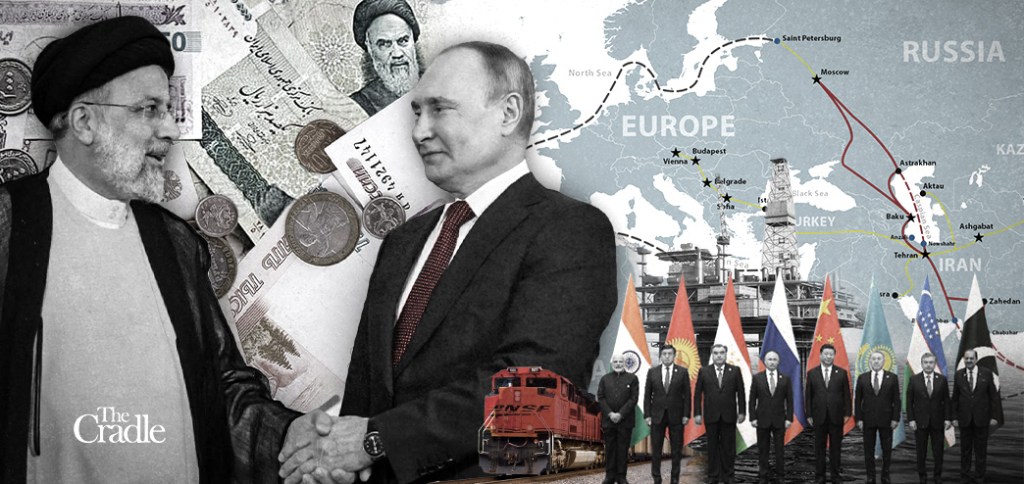
News of Russian banks connecting to Iran’s financial messaging system strengthens the resistance against US-imposed sanctions on both countries and accelerates global de-dollarization.
The agreement between the Central Banks of Russia and Iran formally signed on 29 January connecting their interbank transfer systems is a game-changer in more ways than one.
Technically, from now on 52 Iranian banks already using SEPAM, Iran’s interbank telecom system, are connecting with 106 banks using SPFS, Russia’s equivalent to the western banking messaging system SWIFT.
Less than a week before the deal, State Duma Chairman Vyachslav Volodin was in Tehran overseeing the last-minute details, part of a meeting of the Russia-Iran Inter-Parliamentary Commission on Cooperation: he was adamant both nations should quickly increase trade in their own currencies.
Ruble-rial trade
Confirming that the share of ruble and rial in mutual settlements already exceeds 60 percent, Volodin ratified the success of “joint use of the Mir and Shetab national payment systems.” Not only does this bypass western sanctions, but it is able to “solve issues related to mutually beneficial cooperation, and increasing trade.”
It is quite possible that the ruble will eventually become the main currency in bilateral trade, according to Iran’s ambassador in Moscow, Kazem Jalali: “Now more than 40 percent of trade between our countries is in rubles.”
Jalali also confirmed, crucially, that Tehran is in favor of the ruble as the main currency in all regional integration mechanisms. He was referring particularly to the Russian-led Eurasian Economic Union (EAEU), with which Iran is clinching a free trade deal.
The SEPAM-SPFS agreement starts with a pilot program supervised by Iran’s Shahr Bank and Russia’s VTB Bank. Other lenders will step in once the pilot program gets rid of any possible bugs.
The key advantage is that SEPAM and SPFS are immune to the US and western sanctions ruthlessly imposed on Tehran and Moscow. Once the full deal is up and running, all Iranian and Russian banks can be interconnected.
It is no wonder the Global South is paying very close attention. This is likely to become a landmark case in bypassing Belgium-based SWIFT – which is essentially controlled by Washington, and on a minor scale, the EU. The success of SEPAM-SPFS will certainly encourage other bilateral or even multilateral deals between states.
It’s all about the INSTC
The Central Banks of Iran and Russia are also working to establish a stable coin for foreign trade, replacing the US dollar, the ruble, and the rial. This would be a digital currency backed by gold, to be used mostly in the Special Economic Zone (SEZ) of Astrakhan, in the Caspian Sea, already very busy moving plenty of Iranian cargo.
Astrakhan happens to be the key Russian hub of the International North-South Transportation Corridor (INSTC), a vast network of ship, rail, and road routes which will drastically increase trade from Russia – but also parts of Europe – across Iran to West Asia and South Asia, and vice-versa.
And that reflects the full geoconomic dimension of the SEPAM-SPFS deal. The Russian Central Bank moved early to set up SPFS in 2014, when Washington began threatening Moscow with expulsion from SWIFT. Merging it with the Iranian SEPAM opens up a whole new horizon, especially given Iran’s ratification as a full member of the Shanghai Cooperation Organization (SCO), and now a leading candidate to join the extended BRICS+ club.
Already three months before the SEPAM-SPFS agreement, the Russian Trade Representative in Iran, Rustam Zhiganshin, was hinting that the decision “to create an analog of the SWIFT system” was a done deal.
Tehran had been preparing the infrastructure to join Russia’s Mir payment system since last summer. But after Moscow was hit with extremely harsh western sanctions and Russian banks were cut off from SWIFT, Tehran and Moscow decided, strategically, to focus on creating their own non-SWIFT for cross-border payments.
All that relates to the immensely strategic geoeconomic role of the INSTC, which is a much cheaper and faster trade corridor than the old Suez Canal route.
Russia is Iran’s largest foreign investor
Moreover, Russia has become Iran’s largest foreign investor, according to Iranian Deputy Finance Minister Ali Fekri: this includes “$2.7 billion worth of investment to two petroleum projects in Iran’s western province of Ilam in the past 15 months.” That’s about 45 percent of the total foreign investment in Iran over the October 2021 – January 2023 period.
Of course the whole process is in its initial stages – as Russia-Iran bilateral trade amounts to only US$3 billion annually. But a boom is inevitable, due to the accumulated effect of SEPAM-SPFS, INSTC, and EAEU interactions, and especially further moves to develop Iran’s energy capacity, logistics, and transport networks, via the INSTC.
Russian projects in Iran are multi-faceted: energy, railways, auto manufacturing, and agriculture. In parallel, Iran supplies Russia with food and automotive products.
Ali Shamkhani, the secretary of Iran’s Supreme National Security Council, is fond of reminding anyone that Russia and Iran “play complementary roles in global energy and cargo transit.” The Iran-EAEU free agreement (FTA) is nearly finalized – including zero tariffs for over 7,500 commodities.
In 2022, the EAEU traded more than $800 billion worth of goods. Iran’s full access to the EAEU will be inestimable in terms of providing a market gateway to large swathes of Eurasia – and bypassing US sanctions as a sweet perk. A realistic projection is that Tehran can expect $15 billion annual trade with the five members of the EAEU in five years, as soon as Iran becomes the sixth member.
The legacy of Samarkand
Everything we are tracking now is in many ways a direct consequence of the SCO summit in Samarkand last September, when Russian President Vladimir Putin and his Chinese counterpart Xi Jinping, in person, placed their bet on strengthening the multipolar world as Iran signed a memorandum to join the SCO.
Putin’s private talks with Iranian President Ebrahim Raisi in Samarkand were all about deep strategy.
The INSTC is absolutely crucial in this overall equation. Both Russia and Iran are investing at least $25 billion to boost its capabilities.
Ships sailing the Don and Volga Rivers have always traded energy and agricultural commodities. Now Iran’s Maritime News Agency has confirmed that Russia will grant their ships the right of passage along the inland waterways on the Don and Volga.
Meanwhile, Iran is already established as the third largest importer of Russian grain. From now on, trade on turbines, polymers, medical supplies, and automotive parts will be on a roll.
Tehran and Moscow have signed a contract to build a large cargo vessel for Iran to be used at the Caspian port of Solyanka. And RZD logistics, a subsidiary of Russian railway RZD, operates container cargo trains regularly from Moscow to Iran. The Russian Journal for Economics predicts that just the freight traffic on INTSC could reach 25 million tons by 2030 – no less than a 20-fold increase compared to 2022.
Inside Iran, new terminals are nearly ready for cargo to be rolled off ships to railroads crisscrossing the country from the Caspian to the Persian Gulf. Sergey Katrin, head of Russia’s Chamber of Commerce and Industry, is confident that once the FTA with the EAEU is on, bilateral trade can soon reach $40 billion a year.
Tehran’s plans are extremely ambitious, inserted in an “Eastern Axis” framework that privileges regional states Russia, China, India, and Central Asia.
Geostrategically and geoeconomically, that implies a seamless interconnection of INSTC, EAEU, SCO, and BRICS+. And all of this is coordinated by the one Quad that really matters: Russia, China, India, and Iran.
Of course there will be problems. The intractable Armenia-Azerbaijan conflict might be able to derail the INSTC: but note that Russia-Iran connections via the Caspian can easily bypass Baku if the need arises.
BRICS+ will cement the dollar’s descent
Apart from Russia and Iran, Russia and China have also been trying to interface their banking messaging systems for years now. The Chinese CBIBPS (Cross-Border Inter-Bank Payments System) is considered top class. The problem is that Washington has directly threatened to expel Chinese banks from SWIFT if they interconnect with Russian banks.
The success of SEPAM-SPFS may allow Beijing to go for broke – especially now, after the extremely harsh semiconductor war and the appalling balloon farce. In terms of sovereignty, it is clear that China will not accept US restrictions on how to move its own funds.
In parallel, the BRICS in 2023 will delve deeper into developing their mutual financial payments system and their own reserve currency. There are no less than 13 confirmed candidates eager to join BRICS+ – including Asian middle powers like Iran, Saudi Arabia, and Indonesia.
All eyes will be on whether – and how – the $30 trillion-plus indebted US will threaten to expel BRICS+ from SWIFT.
It’s enlightening to remember that Russia’s debt to GDP ratio stands at only 17 percent. China’s is 77 percent. The current BRICS without Russia are at 78 percent. BRICS+ including Russia may average only 55 percent. Strong productivity ahead will come from a BRICS+ supported by a gold and/or commodities-backed currency and a different payment system that bypasses the US dollar. Strong productivity definitely will not come from the collective west whose economies are entering recessionary times.
Amid so many intertwined developments, and so many challenges, one thing is certain. The SEPAM-SPFS deal between Russia and Iran may be just the first sign of the tectonic plates movement in global banking and payment systems.
Welcome to one, two, one thousand payment messaging systems. And welcome to their unification in a global network. Of course that will take time. But this high-speed financial train has already left the station.
African Union Chairman and Senegal president Macky Sall meeting President Vladimir Putin, June 3, 2022 (Photo:Sputnik/Mikhail Klimentyev/Kremlin via REUTERS)
The U.S. drive to dominate creates self-inflicted wounds and self-imposed crises. It also creates suffering around the world with only the most servile vassal states willing to do what Washington wants.
The United States continues to shoot itself in the foot in its futile effort to damage the Russian economy. It is also asking other nations to do likewise and live with inflation, food scarcity, and rising energy prices. European countries have gone along with the sanctions which cut off their natural gas supplies from Russia when there is no logical alternative source for them. However, the rest of the world has refused to join in U.S. and EU condemnations or accept that they must live with privations caused by the reckless actions of other nations.
Of course, the ongoing state of delusion just continues the fantasy foreign policy decision making in Washington. The Countering Malign Russian Influences in Africa Act, HR 7311 , is just one example. But while the U.S. makes up nonsense as it goes along, the real problems that African nations have with the U.S. and their desire to have good relations with Russia go unaddressed.
Russian president Vladimir Putin recently welcomed Macky Sall, president of Senegal and Chairman of the African Union (AU) to a summit meeting. African countries are particularly hard hit by sanctions against Russia. They depend on Russia and Ukraine for supplies of wheat and other grains. When the sanctions regime removed Russia from the Society for Worldwide Interbank Financial Telecommunication (SWIFT) system, it impeded Africans ability to pay for commodities, including food and fertilizer. In a virtual meeting with the EU, Sall said, “When the SWIFT system is disrupted, it means that even if the products exist, payment becomes complicated, if not impossible.” In other words, Africa has to go hungry because of the U.S. obsession with an impossible mission of breaking up Russia or turning back the clock to the 1990s when compromised Russian leadership allowed their country to be open to international thievery.
African nations are not the only ones who face serious crises because of anti-Russian sanctions. The U.S. expects India and China to give up supplies of Russian oil and cause hardships in those countries. Biden will soon visit Saudi Arabia and ask for an increase in oil production, which of course means that OPEC nations will make less money. Of course, Sall’s visit to Russia could have been a wakeup call to Washington that policy changes were needed, instead they fell back on old strategies, warning African countries not to buy grain from Russia, calling it “stolen ” from Ukraine. At a moment of opportunity, the Biden administration just added insult to injury.
The United States is still the country with the world reserve currency and 800 military bases around the world. This power is never used for the benefit of humanity. The drive to dominate never ends, and people throughout the planet are expected to go along and suffer due to American whims.
That is what the U.S. told the people of Venezuela, who had the gall to elect and re-elect left wing governments. The Trump administration demanded “maximum pressure” against Venezuela, enacting harsh sanctions that killed 50,000 people, cutting off access to foreign markets and even choosing to recognize a phony president.
But a funny thing happened on the way to destroying Russia. The Europeans who go along like good little vassals still need oil, and according to reports the U.S. has decided to allow Venezuela to sell some of its resources to their puppets in their time of need. The U.S. whiplashes from trying to punish one country, to lifting their punishments on another, while telling others they have to starve and just be quiet about it.
While the Congressional Black Caucuses (CBC) takes part in fairy tales about “malign Russian influence,” Africans are taking matters into their own hands and talking directly with Putin. They know they must ignore U.S. dictates if they are to survive. Of course Russia will ultimately create its own payment system with African countries, just as it did with China.
Meanwhile Russian victories in Ukraine continue. The Ukrainian counter attacks that have become a staple of corporate media are mostly imaginary, more grist for the war propaganda mill. Joe Biden undermines himself by blurting out that Ukraine may have to negotiate a settlement, while also announcing that the U.S. will keep sending money and military equipment.
The U.S. is once again undermining itself. An empire in crisis will inevitably behave irrationally. It demands control but creates the circumstances which undo the very systems, such as SWIFT, that it depends upon. But there will be more meetings with Putin, and more countries saying that they will not undermine themselves because Washington asks them to.
The Russian ruble is sitting pretty right now, having regained its pre-sanctions value and set to become a major commodity currency.Photo Credit: The Cradle
Rublegas is the commodity currency du jour and it isn’t nearly as complicated as NATO pretends. If Europe wants gas, all it needs to do is send its Euros to a Russian account inside Russia.
Saddam, Gaddafi, Iran, Venezuela – they all tried but couldn’t do it. But Russia is on a different level altogether.
The beauty of the game-changing, gas-for-rubles, geoeconomic jujitsu applied by Moscow is its stark simplicity.
Russian President Vladimir Putin’s presidential decree on new payment terms for energy products, predictably, was misunderstood by the collective west. The Russian government is not exactly demanding straightforward payment for gas in rubles. What Moscow wants is to be paid at Gazprombank in Russia, in its currency of choice, and not at a Gazprom account in any banking institution in western capitals.
That’s the essence of less-is-more sophistication. Gazprombank will sell the foreign currency – dollars or euros – deposited by their customers on the Moscow Stock Exchange and credit it to different accounts in rubles within Gazprombank.
What this means in practice is that foreign currency should be sent directly to Russia, and not accumulated in a foreign bank – where it can easily be held hostage, or frozen, for that matter.
All these transactions from now on should be transferred to a Russian jurisdiction – thus eliminating the risk of payments being interrupted or outright blocked.
It’s no wonder the subservient European Union (EU) apparatus – actively engaged in destroying their own national economies on behalf of Washington’s interests – is intellectually unequipped to understand the complex matter of exchanging euros into rubles.
Gazprom made things easier this Friday, sending official notifications to its counterparts in the west and Japan.
Putin himself was forced to explain in writing to German Chancellor Olaf Scholz how it all works.
Once again, very simple: Customers open an account with Gazprombank in Russia. Payments are made in foreign currency – dollars or euros – converted into rubles according to the current exchange rate, and transferred to different Gazprom accounts.
Thus it is 100 percent guaranteed that Gazprom will be paid.
That’s in stark contrast to what the United States was forcing the Europeans to do: pay for Russian gas in Gazprom accounts in Europe, which would then be instantly frozen. These accounts would only be unblocked with the end of Operation Z, Russia’s military ops in Ukraine.
Yet the Americans want the war to go on indefinitely, to “bog down” Moscow as if this was Afghanistan in the 1980s, and have strictly forbidden the Ukrainian Comedian in front of a green screen somewhere – certainly not Kiev – to accept any ceasefire or peace deal.
So Gazprom accounts in Europe would continue to be frozen.
As Scholz was still trying to understand the obvious, his economic minions went berserk, floating the idea of nationalizing Gazprom’s subsidiaries – Gazprom Germania and Wingas – in case Russia decides to halt the gas flow.
This is ridiculous. It’s as if Berlin functionaries believe that Gazprom subsidiaries produce natural gas in centrally heated offices across Germany.
The new rubles-for-gas mechanism does not in any way violate existing contracts. Yet, as Putin warned, existing contracts may indeed be stopped: “If such [ruble] payments are not made, we will consider this to be the buyers’ failure to perform commitments with all ensuing implications.”
Kremlin spokesman Dmitri Peskov was adamant that the mechanism will not be reversed under the current, dire circumstances. Still that does not mean that the gas flow would be instantly cut off. Payment in rubles will be expected from ‘The Unfriendlies’ – a list of hostile states that includes mostly the US, Canada, Japan and the EU – in the second half of April and early May.
For the overwhelming majority of the Global South, the overarching Big Picture is crystal clear: an Atlanticist oligarchy is refusing to buy the Russian gas essential to the wellbeing of the population of Europe, while fully engaged in the weaponization of toxic inflation rates against the same population.
Beyond Rublegas
This gas-for-rubles mechanism – call it Rublegas – is just the first concrete building block in the construction of an alternative financial/monetary system, in tandem with many other mechanisms: ruble-rupee trade; the Saudi petroyuan; the Iran-Russia SWIFT- bypassing mechanism; and the most important of all, the China-Eurasia Economic Union (EAEU) design of a comprehensive financial/monetary system, with the first draft to be presented in the next few days.
After the predictable initial stages of denial, the EU – actually, Germany – must face reality. The EU depends on steady supplies of Russian gas (40 percent) and oil (25 percent). The sanction hysteria has already engineered certified blowback.
Natural gas accounts for 50 percent of the needs of Germany’s chemical and pharmaceutical industries. There’s no feasible replacement, be it from Algeria, Norway, Qatar or Turkmenistan. Germany is the EU’s industrial powerhouse. Only Russian gas is capable of keeping the German – and European – industrial base humming and at very affordable prices in case of long-term contracts.
Disrupt this set up and you have horrifying turbulence across the EU and beyond.
The inimitable Andrei Martyanov has summed it up this way: “Only two things define the world: the actual physical economy, and military power, which is its first derivative. Everything else are derivatives but you cannot live on derivatives.”
The American turbo-capitalist casino believes its own derivative “narrative” – which has nothing to do with the real economy. The EU will eventually be forced by reality to move from denial to acceptance. Meanwhile, the Global South will be fast adapting to the new paradigm: the Davos Great Reset has been shattered by the Russian Reset.
So what does President Joe Biden want the sanctions imposed on Russia to do? Think back to the 1990s and what the US-NATO imposed no-fly zone and sanctions did to the people of Iraq? The results were almost 1 million Iraqis dead, according to the website GlobalIssues.org.
Over at truthout.org, Jake Batinga reported that President Joe Biden strongly supported those sanctions as a US senator and recently has turned a blind eye to the humanitarian crisis unfolding in Afghanistan: “Senator Biden strongly supported the sanctions and advocated for even more aggressive policies toward Iraq. Biden was not then, and is not now, known for his humanitarian impulses or dovish foreign policy stances.”
Batinga also notes that: “More Afghans are poised to die from US sanctions over the next few months alone than have died at the hands of the Taliban and US military forces over the last 20 years combined— by a significant margin. Yet, as journalist Murtaza Hussain recently wrote, US establishment politicians and intellectuals who decried the humanitarian crisis during the fall of Kabul are seemingly unbothered by imminent mass starvation, imposed by us.”
The Biden administration— which routinely laments human rights violations perpetrated by China, Iran, Russia, and other adversaries— is ignoring desperate pleas from humanitarian organizations and UN human rights bodies, choosing instead to maintain policies virtually guaranteed to cause mass starvation and death of civilians, especially children. Yet it is important to note, and remember, that as a matter of policy, this is not particularly new; the US has often imposed harsh economic sanctions, causing mass civilian death. A previous imposition of sanctions resulted in one of the worst humanitarian catastrophes, one largely forgotten in mainstream historical memory.
In 1990, the US imposed sanctions on Iraq through the UN following the Iraqi invasion of Kuwait. These sanctions continued for more than a decade after Iraq withdrew from Kuwait, and had horrific humanitarian consequences eerily similar to the imminent mass starvation of Afghan civilians. The sanctions regime against Iraq— which began under President George H.W. Bush but was primarily administered by President Bill Clinton’s administration— froze Iraq’s foreign assets, virtually banned trade, and sharply limited imports. These sanctions crashed the Iraqi economy and blocked the import of humanitarian supplies, medicine, food, and other basic necessities, killing scores of civilians.”
BRIC’s made of straw
The BRIC nations, Brazil, Russia, India and China have been in the news lately and for good reason. There is talk, and talk is cheap of course, of China and Russia creating an alternative payment system to the US dollar dominated international payments system SWIFT.
Already Russia has joined China’s Cross Border Interbank Payment System Payment as an alternative to SWIFT, along with joining China’s UnionPay credit card system which serves as an alternative to Visa and Master Card who, along with dozens of other Western country businesses (Europe, USA plus Japan and South Korea), bolted Russia’s marketplace after its military operation got started in Ukraine in late February.
India apparently is trading with Russia in a rupee, ruble swap but that seems ad hoc, at best. And there is news of Saudi Arabia cutting a deal with China to use the yuan as an exchange currency. Brazil has enough internal problems to deal with: crime, disease, Amazon deforestation.
Chinese leaders must realize that if Russia falters in Ukraine which means it is unable to liberate the Republics of Luhansk and Donetsk, gain international recognition of Crimea—and maintain territorial gains made on the coast of the Black and Azov Sea’s—and/or President Putin is removed from office and Russia destabilizes, the United States will chop up Russia into separate republics, steal its resources and cancel the billions in deals signed with China for oil, gas, and grains
The United States will bring the NATO military alliance to China’s doorstep and likely put on show trials in the International Criminal Court arguing that Putin and his general staff are war criminals, which would be utter nonsense given US policies and actions in Iraq, Afghanistan and Yemen.
China is trying to placate the US because it still fears US economic and military power. Its party officials probably figure that they can keep building up the People’s Liberation Army, Navy, Air Force and Strategic nuclear capability and when there is enough firepower, will be able to challenge US dominance in the Pacific. But how?
The PLA forces have no modern combat experience to speak of and their plan seems to be; well, no plan at all. They are faced with the combined forces of the USA that are building new aircraft carriers, submarines and long distance B-21 bombers, along with upgrading all three legs of its nuclear TRIAD.
Which brings us back to Russia and the economic support it needs so that Biden’s sanctions don’t end up killing a million Russians. Because that is what Biden intends and his track record on supporting sanctions is disturbingly clear. When China looks at what the USA-NATO have done to the Russian economy, they are looking at their own future.
Hypocrisy
Joe Scalice at the World Socialist Website notes the hypocrisy of the USA-NATO and the compliant MSM Western media:
“The wars of aggression of Clinton, Bush, Obama and Trump contained the accumulated evil of the torture in Abu Ghraib and Guantanamo, the drone bombing of children at play, villages leveled by precision missiles and refugees drowned in the Mediterranean. Baghdad crumbled beneath the shock and awe of unstinting US bombing; Fallujah burned with white phosphorus.
The American mass media is complicit in these crimes. They never challenged the government’s assertions, but trumpeted its pretexts. They whipped up a war-frenzy in the public. Pundits who now denounce Putin were ferocious in demanding that the United States bomb civilians.
Thomas Friedman wrote in the New York Times in 1999 of the bombing of Serbia under Clinton, “It should be lights out in Belgrade: every power grid, water pipe, bridge, road and war-related factory has to be targeted… [W]e will set your country back by pulverizing you. You want 1950? We can do 1950. You want 1389? We can do 1389 too.” [Biden supported bombing Belgrade]
Biden labels Putin a war criminal in the midst of a new media hysteria. Never referring to the actions of the United States, never pausing for breath, the media pumps out the fuel for an ever-expanding war. Hubris and hypocrisy stamp every statement from Washington with an audacity perhaps unique in world history. Its hands bathed in blood up to the elbows, US empire gestures at its enemies and cries war crimes.”
Tactics
Indeed, the media have capitulated to the war propaganda narrative of the Biden Administration. The US MSM relies almost exclusively on Ukrainian sources for its error filled reporting. If you are reading the New York Times or the Washington Post, you aren’t getting the full story. Pro-Russia sites like Southfront, Newsfront, War Gonzo and others tell a different story. For example, the Retroville Mall destruction on March 21 was reported in the West as a wanton and random attack on a shopping place. In fact, the below-building parking lot was home to Ukrainian military vehicles clearly shown by a set of photos that appeared on Newsfront. Residential buildings are clearly being used by the Ukrainian forces to hide their weapons or launch anti-tank attacks from apartment building roofs or top floor apartments. That’s a tactic that makes sense. The Russians know that.
You’ve got to look at all the news sources, even the ones you don’t want to view, in order to be informed about this conflict.
So a congregation of NATO’s top brass ensconced in their echo chambers target the Russian Central Bank with sanctions and expect what? Cookies?
What they got instead was Russia’s deterrence forces bumped up to “a special regime of duty” – which means the Northern and Pacific fleets, the Long-Range Aviation Command, strategic bombers, and the entire Russian nuclear apparatus on maximum alert.
One Pentagon general very quickly did the basic math on that, and mere minutes later, a Ukrainian delegation was dispatched to conduct negotiations with Russia in an undisclosed location in Gomel, Belarus.
Meanwhile, in the vassal realms, the German government was busy “setting limits to warmongers like Putin” – quite a rich undertaking considering that Berlin never set any such limits for western warmongers who bombed Yugoslavia, invaded Iraq, or destroyed Libya, in complete violation of international law.
While openly proclaiming their desire to “stop the development of Russian industry,” damage its economy, and “ruin Russia” – echoing American edicts on Iraq, Iran, Syria, Libya, Cuba, Venezuela and others in the Global South – the Germans could not possibly recognize a new categorical imperative.
They were finally liberated from their WWII culpability complex by none other than Russian President Vladimir Putin. Germany is finally free to support and weaponize neo-Nazis out in the open all over again – now of the Ukrainian Azov battalion variety.
To get the hang of how these NATO sanctions will “ruin Russia,” I asked for the succinct analysis of one of the most competent economic minds on the planet, Michael Hudson, author, among others, of a revised edition of the must-read Super-Imperialism: The Economic Strategy of American Empire.
Hudson remarked how he is “simply numbed over the near-atomic escalation of the US.” On the confiscation of Russian foreign reserves and cut-off from SWIFT, the main point is “it will take some time for Russia to put in a new system with China. The result will end dollarization for good, as countries threatened with ‘democracy’ or displaying diplomatic independence will be afraid to use US banks.”
This, Hudson says, leads us to “the great question – whether Europe and the Dollar Bloc can buy Russian raw materials – cobalt, palladium, etc, and whether China will join Russia in a minerals boycott.”
Hudson is adamant that “Russia’s Central Bank, of course, has foreign bank assets in order to intervene in exchange markets to defend its currency from fluctuations. The ruble has plunged. There will be new exchange rates. Yet it’s up to Russia to decide whether to sell its wheat to West Asia, that needs it; or to stop selling gas to Europe via Ukraine, now that the US can grab it.”
About the possible introduction of a new Russia-China payment system – bypassing SWIFT and combining the Russian SPFS (System for Transfer of Financial Messages) with the Chinese CIPS (Cross-Border Interbank Payment System) – Hudson has no doubts, “the Russian-China system will be implemented. The Global South will seek to join and at the same time keep SWIFT – moving their reserves into the new system.”
I’m going to de-dollarize myself
So the US itself, in another massive strategic blunder, will speed up de-dollarization. As the managing director of Bocom International Hong Hao told the Global Times, with energy trade between Europe and Russia de-dollarized, “that will be the beginning of the disintegration of dollar hegemony.”
It’s a refrain the US administration was quietly hearing last week from some of its own largest multinational banks, including notables like JPMorgan and Citigroup.
A Bloomberg article sums up their collective fears:
“Booting Russia from the critical global system – which handles 42 million messages a day and serves as a lifeline to some of the world’s biggest financial institutions – could backfire, sending inflation higher, pushing Russia closer to China, and shielding financial transactions from scrutiny by the west. It might also encourage the development of a SWIFT alternative that could eventually damage the supremacy of the US dollar.”
Those with IQs over 50 in the European Union (EU) must have understood that Russia simply could not be totally excluded from SWIFT, but maybe only a few of its banks: after all, European traders depend on Russian energy.
From Moscow’s point of view, that’s a minor issue. A number of Russian banks are already connected to China’s CIPS system. For instance, if someone wants to buy Russian oil and gas with CIPS, payment must be in the Chinese yuan currency. CIPS is independent of SWIFT.
Additionally, Moscow already linked its SPFS payment system not only to China but also to India and member nations of the Eurasia Economic Union (EAEU). SPFS already links to approximately 400 banks.
With more Russian companies using SPFS and CIPS, even before they merge, and other maneuvers to bypass SWIFT, such as barter trade – largely used by sanctioned Iran – and agent banks, Russia could make up for at least 50 percent in trade losses.
The key fact is that the flight from the US-dominated western financial system is now irreversible across Eurasia and that will proceed in tandem with the internationalization of the yuan.
Russia has its own bag of tricks
Meanwhile, we’re not even talking yet about Russian retaliation for these sanctions. Former President Dmitry Medvedev already gave a hint – everything, from exiting all nuclear arms deals with the US, to freezing the assets of western companies in Russia, is on the table.
So what does the “Empire of Lies” want? – Putin terminology, on Monday’s meeting in Moscow to discuss the response to sanctions.
He outlines the three oligarchies in control of US foreign policy:
First is the military-industrial complex, which Ray McGovern memorably coined as MICIMATT (military industrial Congressional intelligence media academia think tank).
Hudson defines their economy base as “monopoly rent, obtained above all from its arms sales to NATO, to West Asian oil exporters, and to other countries with a balance-of-payments surplus.”
Second is the oil and gas sector, joined by mining (OGAM). Their aim is “to maximize the price of energy and raw materials so as to maximize natural resource rent.
Monopolizing the Dollar Area’s oil market and isolating it from Russian oil and gas has been a major US priority for over a year now, as the Nord Stream 2 pipeline from Russia to Germany threatened to link the western European and Russian economies together.”
Third is the “symbiotic” Finance, Insurance and Real Estate (FIRE) sector, which Hudson defines as “the counterpart to Europe’s old post-feudal landed aristocracy living by land rents.”
As he describes these three rentier sectors that completely dominate post-industrial finance capitalism at the heart of the western system, Hudson notes how “Wall Street always has been closely merged with the oil and gas industry namely, the Citigroup, and Chase Manhattan banking conglomerates.”
Hudson shows how “the most pressing US strategic aim of NATO confrontation with Russia is soaring oil and gas prices. In addition to creating profits and stock market gains for US companies, higher energy prices will take much of the steam out of the German economy.”
He warns how food prices will rise “headed by wheat” – Russia and Ukraine account for 25 percent of world wheat exports. From a Global South perspective, that’s a disaster: “This will squeeze many West Asian and Global South food-deficient countries, worsening their balance of payments, and threatening foreign debt defaults.”
As for blocking Russian raw materials exports, “this threatens to cause breaks in supply chains for key materials, including cobalt, palladium, nickel, aluminum.”
And that leads us, once again, to the heart of the matter – “The long-term dream of the US new Cold Warriors is to break up Russia, or at least to restore its managerial kleptocracy seeking to cash in their privatizations in western stock markets.”
That’s not going to happen. Hudson clearly sees how “the most enormous unintended consequence of US foreign policy has been to drive Russia and China together, along with Iran, Central Asia, and countries along the Belt and Road initiative.”
Let’s confiscate some technology
Now compare all of the above with the perspective of a central European business tycoon with vast interests, east and west, and who treasures his discretion.
In an email exchange, the business tycoon posed serious questions about the Russian Central Bank support for its national currency, the ruble, “which according to US planning is being destroyed by the west through sanctions and currency wolf packs who are exposing themselves by selling rubles short. There is really almost no amount of money that can beat the dollar manipulators against the ruble. A 20 percent interest rate will kill the Russian economy unnecessarily.”
The businessman argues that the chief effect of the rate hike “would be to support imports that should not be imported. The fall of the ruble is thus favorable to Russia in terms of self-sufficiency. As import prices rise, these goods should start to be produced domestically. I would just let the ruble fall to find its own level which will for a while be lower than natural forces would permit as the US will be driving it lower through sanctions and short selling manipulation in this form of economic war against Russia.”
But that seems to tell only part of the story. Arguably, the lethal weapon in Russia’s arsenal of responses has been identified by the head of the Center for Economic Research of the Institute of Globalization and Social Movements (IGSO), Vasily Koltashov – the key is to confiscate technology – as in Russia ceasing to recognize US rights to patents.
In what he qualifies as “liberating American intellectual property,” Koltashov calls for passing a Russian law on “friendly and unfriendly states. If a country turns out to be on the unfriendly list, then we can start copying its technologies in pharmaceuticals, industry, manufacturing, electronics, medicine. It can be anything – from simple details to chemical compositions.” This would require amendments to the Russian constitution.
Koltashov maintains that “one of the foundations of success of American industry was copying of foreign patents for inventions.” Now, Russia could use “China’s extensive know-how with its latest technological production processes for copying western products: the release of American intellectual property will cause damage to the United States to the amount of $10 trillion, only in the first stage. It will be a disaster for them.”
As it stands, the strategic stupidity of the EU beggars belief. China is ready to grab all Russian natural resources with Europe left as a pitiful hostage of the oceans and of wild speculators.
It looks like a total EU-Russia split is ahead – with little trade left and zero diplomacy.
Now listen to the sound of champagne popping all across the MICIMATT.
A nightmare scenario of U.S. geopolitical strategists is coming true: foreign independence from U.S.-centered financial and diplomatic control. China and Russia are investing in neighboring economies on terms that cement Eurasian integration on the basis of financing in their own currencies and favoring their own exports. They also have created the Shanghai Cooperation Organization (SCO) as an alternative military alliance to NATO.[1] And the Asian Infrastructure Investment Bank (AIIB) threatens to replace the IMF and World Bank tandem in which the United States holds unique veto power.
More than just a disparity of voting rights in the IMF and World Bank is at stake. At issue is a philosophy of development. U.S. and other foreign investment in infrastructure (or buyouts and takeovers on credit) adds interest rates and other financial charges to the cost structure, while charging prices as high as the market can bear (think of Carlos Slim’s telephone monopoly in Mexico, or the high costs of America’s health care system), and making their profits and monopoly rents tax-exempt by paying them out as interest.
By contrast, government-owned infrastructure provides basic services at low cost, on a subsidized basis, or freely. That is what has made the United States, Germany and other industrial lead nations so competitive over the past few centuries. But this positive role of government is no longer possible under World Bank/IMF policy. The U.S. promotion of neoliberalism and austerity is a major reason propelling China, Russia and other nations out of the U.S. diplomatic and banking orbit.
On December 3, 2015, Prime Minister Putin proposed that Russia “and other Eurasian Economic Union countries should kick-off consultations with members of the SCO and the Association of Southeast Asian Nations (ASEAN) on a possible economic partnership.”[2] Russia also is seeking to build pipelines to Europe through friendly secular countries instead of Sunni jihadist U.S.-backed countries locked into America’s increasingly confrontational orbit.
Russian finance minister Anton Siluanov points out that when Russia’s 2013 loan to Ukraine was made, at the request of Ukraine’s elected government, Ukraine’s “international reserves were barely enough to cover three months’ imports, and no other creditor was prepared to lend on terms acceptable to Kiev. Yet Russia provided $3 billion of much-needed funding at a 5 per cent interest rate, when Ukraine’s bonds were yielding nearly 12 per cent.”[3]
What especially annoys U.S. financial strategists is that this loan by Russia’s National Wealth Fund was protected by IMF lending practice, which at that time ensured collectability by withholding credit from countries in default of foreign official debts, or at least not bargaining in good faith to pay. To cap matters, the bonds are registered under London’s creditor-oriented rules and courts.
Most worrisome to U.S. strategists is that China and Russia are denominating their trade and investment in their own currencies instead of dollars. After U.S. officials threatened to derange Russia’s banking linkages by cutting it off from the SWIFT interbank clearing system, China accelerated its creation of the alternative China International Payments System (CIPS), and its own credit card system to protect Eurasian economies from the threats made by U.S. unilateralists.
Russia and China are simply doing what the United States has long done: using trade and credit linkages to cement their diplomacy. This tectonic geopolitical shift is a Copernican threat to New Cold War ideology: Instead of the world economy revolving around the United States (the Ptolemaic idea of America as “the indispensible nation”), it may revolve around Eurasia. As long as global financial control remains grounded in Washington at the offices of the IMF and World Bank, such a shift in the center of gravity will be fought with all the power of an American Century (and would-be American Millennium) inquisition.
Any inquisition needs a court system and enforcement vehicles. So does resistance to such a system. That is what today’s global financial, legal and trade maneuvering is all about. And that is why today’s world system is in the process of breaking apart. Differences in economic philosophy call for different institutions.
To U.S. neocons the specter of AIIB government-to-government investment creates fear of nations minting their own money and holding each other’s debt in their international reserves instead of borrowing dollars, paying interest in dollars and subordinating their financial planning to the U.S. Treasury and IMF. Foreign governments would have less need to finance their budget deficits by selling off key infrastructure. And instead of dismantling public spending, a broad Eurasian economic union would do what the United States itself practices, and seek self-sufficiency in banking and monetary policy.
Imagine the following scenario five years from now. China will have spent half a decade building high-speed railroads, ports, power systems and other construction for Asian and African countries, enabling them to grow and export more. These exports will be coming online to repay the infrastructure loans. Also, suppose that Russia has been supplying the oil and gas energy for these projects on credit.
To avert this prospect, suppose an American diplomat makes the following proposal to the leaders of countries in debt to China, Russia and the AIIB: “Now that you’ve got your increased production in place, why repay? We’ll make you rich if you stiff our adversaries and turn back to the West. We and our European allies will support your assigning your nations’ public infrastructure to yourselves and your supporters at insider prices, and then give these assets market value by selling shares in New York and London. Then, you can keep the money and spend it in the West.”
How can China or Russia collect in such a situation? They can sue. But what court in the West will accept their jurisdiction?
That is the kind of scenario U.S. State Department and Treasury officials have been discussing for more than a year. Implementing it became more pressing in light of Ukraine’s $3 billion debt to Russia falling due by December 20, 2015. Ukraine’s U.S.-backed regime has announced its intention to default. To support their position, the IMF has just changed its rules to remove a critical lever on which Russia and other governments have long relied to ensure payment of their loans.
The IMF’s role as enforcer of inter-government debts
When it comes to enforcing nations to pay inter-government debts, the IMF is able to withhold not only its own credit but also that of governments and global bank consortia participating when debtor countries need “stabilization” loans (the neoliberal euphemism for imposing austerity and destabilizing debtor economies, as in Greece this year). Countries that do not privatize their infrastructure and sell it to Western buyers are threatened with sanctions, backed by U.S.-sponsored “regime change” and “democracy promotion” Maidan-style. The Fund’s creditor leverage has been that if a nation is in financial arrears to any government, it cannot qualify for an IMF loan – and hence, for packages involving other governments. That is how the dollarized global financial system has worked for half a century. But until now, the beneficiaries have been U.S. and NATO lenders, not been China or Russia.
The focus on a mixed public/private economy sets the AIIB at odds with the Trans-Pacific Partnership’s aim of relinquishing government planning power to the financial and corporate sector, and the neoliberal aim of blocking governments from creating their own money and implementing their own financial, economic and environmental regulation. Chief Nomura economist Richard Koo, explained the logic of viewing the AIIB as a threat to the U.S.-controlled IMF: “If the IMF’s rival is heavily under China’s influence, countries receiving its support will rebuild their economies under what is effectively Chinese guidance, increasing the likelihood they will fall directly or indirectly under that country’s influence.”[4]
This was the setting on December 8, when Chief IMF Spokesman Gerry Rice announced: “The IMF’s Executive Board met today and agreed to change the current policy on non-toleration of arrears to official creditors.” Russian Finance Minister Anton Siluanov accused the IMF decision of being “hasty and biased.”[5] But it had been discussed all year long, calculating a range of scenarios for a sea change in international law. Anders Aslund, senior fellow at the NATO-oriented Atlantic Council, points out:
The IMF staff started contemplating a rule change in the spring of 2013 because nontraditional creditors, such as China, had started providing developing countries with large loans. One issue was that these loans were issued on conditions out of line with IMF practice. China wasn’t a member of the Paris Club, where loan restructuring is usually discussed, so it was time to update the rules.
The IMF intended to adopt a new policy in the spring of 2016, but the dispute over Russia’s $3 billion loan to Ukraine has accelerated an otherwise slow decision-making process.[6]
The target was not only Russia and its ability to collect on its sovereign loan to Ukraine, but China even more, in its prospective role as creditor to African countries and prospective AIIB borrowers, planning for a New Silk Road to integrate a Eurasian economy independent of U.S. financial and trade control. The Wall Street Journal concurred that the main motive for changing the rules was the threat that China would provide an alternative to IMF lending and its demands for crushing austerity. “IMF-watchers said the fund was originally thinking of ensuring China wouldn’t be able to foil IMF lending to member countries seeking bailouts as Beijing ramped up loans to developing economies around the world.”[7] So U.S. officials walked into the IMF headquarters in Washington with the legal equivalent of suicide vests. Their aim was a last-ditch attempt to block trade and financial agreements organized outside of U.S. control and that of the IMF and World Bank.
The plan is simple enough. Trade follows finance, and the creditor usually calls the tune. That is how the United States has used the Dollar Standard to steer Third World trade and investment since World War II along lines benefiting the U.S. economy. The cement of trade credit and bank lending is the ability of creditors to collect on the international debts being negotiated. That is why the United States and other creditor nations have used the IMF as an intermediary to act as “honest broker” for loan consortia. (“Honest broker” means being subject to U.S. veto power.) To enforce its financial leverage, the IMF has long followed the rule that it will not sponsor any loan agreement or refinancing for governments that are in default of debts owed to other governments. However, as the afore-mentioned Aslund explains, the IMF could easily
change its practice of not lending into [countries in official] arrears … because it is not incorporated into the IMF Articles of Agreement, that is, the IMF statutes. The IMF Executive Board can decide to change this policy with a simple board majority. The IMF has lent to Afghanistan, Georgia, and Iraq in the midst of war, and Russia has no veto right, holding only 2.39 percent of the votes in the IMF. When the IMF has lent to Georgia and Ukraine, the other members of its Executive Board have overruled Russia.[8]
After the rules change, Aslund later noted, “the IMF can continue to give Ukraine loans regardless of what Ukraine does about its credit from Russia, which falls due on December 20.[9]
The IMF rule that no country can borrow if it is in default to a foreign government was created in the post-1945 world. Since then, the U.S. Government, Treasury and/or U.S. bank consortia have been party to nearly every major loan agreement. But inasmuch as Ukraine’s official debt to Russia’s National Wealth Fund was not to the U.S. Government, the IMF announced its rules change simply as a “clarification.” What its rule really meant was that it would not provide credit to countries in arrears to the U.S. government, not that of Russia or China.
It remains up to the IMF board – and in the end, its managing director – whether or not to deem a country creditworthy. The U.S. representative can block any foreign leaders not beholden to the United States. Mikhail Delyagin, Director of the Institute of Globalization Problems, explained the double standard at work: “The Fund will give Kiev a new loan tranche on one condition: that Ukraine should not pay Russia a dollar under its $3 billion debt. … they will oblige Ukraine to pay only to western creditors for political reasons.”[10]
The post-2010 loan packages to Greece are a case in point. The IMF staff saw that Greece could not possibly pay the sums needed to bail out French, German and other foreign banks and bondholders. Many Board members agreed, and have gone public with their whistle blowing. Their protests didn’t matter. President Barack Obama and Treasury Secretary Tim Geithner pointed out that U.S. banks had written credit default swaps betting that Greece could pay, and would lose money if there were a debt writedown). Dominique Strauss-Kahn backed the hard line US- European Central Bank position. So did Christine Lagarde in 2015, overriding staff protests.[11]
Regarding Ukraine, IMF executive board member Otaviano Canuto, representing Brazil, noted that the logic that “conditions on IMF lending to a country that fell behind on payments [was to] make sure it kept negotiating in good faith to reach agreement with creditors.”[12] Dropping this condition, he said, would open the door for other countries to insist on a similar waiver and avoid making serious and sincere efforts to reach payment agreement with creditor governments.
A more binding IMF rule is Article I of its 1944-45 founding charter, prohibiting the Fund from lending to a member state engaged in civil war or at war with another member state, or for military purposes in general. But when IMF head Lagarde made the last loan to Ukraine, in spring 2015, she merely expressed a vapid token hope there might be peace. Withholding IMF credit could have been a lever to force peace and adherence to the Minsk agreements, but U.S. diplomatic pressure led that opportunity to be rejected. President Porochenko immediately announced that he would step up the civil war with the Russian-speaking population in the eastern Donbass region.
The most important IMF condition being violated is that continued warfare with the East prevents a realistic prospect of Ukraine paying back new loans. The Donbas is where most Ukrainian exports were made, mainly to Russia. That market is being lost by the junta’s belligerence toward Russia. This should have blocked Ukraine from receiving IMF aid. Aslund himself points to the internal contradiction at work: Ukraine has achieved budget balance because the inflation and steep currency depreciation has drastically eroded its pension costs. But the resulting decline in the purchasing power of pension benefits has led to growing opposition to Ukraine’s post-Maidan junta. So how can the IMF’s austerity budget be followed without a political backlash? “Leading representatives from President Petro Poroshenko’s Bloc are insisting on massive tax cuts, but no more expenditure cuts; that would cause a vast budget deficit that the IMF assesses at 9-10 percent of GDP, that could not possibly be financed.”[13]
By welcoming and financing Ukraine instead of treating as an outcast, the IMF thus is breaking four of its rules:
Not to lend to a country that has no visible means to pay back the loan. This breaks the “No More Argentinas” rule, adopted after the IMF’s disastrous 2001 loan.
Not to lend to a country that repudiates its debt to official creditors. This goes against the IMF’s role as enforcer for the global creditor cartel.
Not to lend to a borrower at war – and indeed, to one that is destroying its export capacity and hence its balance-of-payments ability to pay back the loan.
Finally, not to lend to a country that is not likely to carry out the IMF’s austerity “conditionalities,” at least without crushing democratic opposition in a totalitarian manner.
The upshot – and new basic guideline for IMF lending – is to split the world into pro-U.S. economies going neoliberal, and economies maintaining public investment in infrastructure n and what used to be viewed as progressive capitalism. Russia and China may lend as much as they want to other governments, but there is no global vehicle to help secure their ability to be paid back under international law. Having refused to roll back its own (and ECB) claims on Greece, the IMF is willing to see countries not on the list approved by U.S. neocons repudiate their official debts to Russia or China. Changing its rules to clear the path for making loans to Ukraine is rightly seen as an escalation of America’s New Cold War against Russia and China.
Timing is everything in such ploys. Georgetown University Law professor and Treasury consultant Anna Gelpern warned that before the “IMF staff and executive board [had] enough time to change the policy on arrears to official creditors,” Russia might use “its notorious debt/GDP clause to accelerate the bonds at any time before December, or simply gum up the process of reforming the IMF’s arrears policy.”[14] According to this clause, if Ukraine’s foreign debt rose above 60 percent of GDP, Russia’s government would have the right to demand immediate payment. But President Putin, no doubt anticipating the bitter fight to come over its attempts to collect on its loan, refrained from exercising this option. He is playing the long game, bending over backward to behave in a way that cannot be criticized as “odious.”
A more immediate reason deterring the United States from pressing earlier to change IMF rules was the need to use the old set of rules against Greece before changing them for Ukraine. A waiver for Ukraine would have provided a precedent for Greece to ask for a similar waiver on paying the “troika” – the European Central Bank (ECB), EU commission and the IMF itself – for the post-2010 loans that have pushed it into a worse depression than the 1930s. Only after Greece capitulated to eurozone austerity was the path clear for U.S. officials to change the IMF rules to isolate Russia. But their victory has come at the cost of changing the IMF’s rules and those of the global financial system irreversibly. Other countries henceforth may reject conditionalities, as Ukraine has done, as well as asking for write-downs on foreign official debts.
That was the great fear of neoliberal U.S. and Eurozone strategists last summer, after all. The reason for smashing Greece’s economy was to deter Podemos in Spain and similar movements in Italy and Portugal from pursuing national prosperity instead of eurozone austerity. “Imagine the Greek government had insisted that EU institutions accept the same haircut as the country’s private creditors,” Russian finance minister Anton Siluanov asked. “The reaction in European capitals would have been frosty. Yet this is the position now taken by Kiev with respect to Ukraine’s $3 billion eurobond held by Russia.”[15]
The consequences of America’s tactics to make a financial hit on Russia while its balance of payments is down (as a result of collapsing oil and gas prices) go far beyond just the IMF. These tactics are driving other countries to defend their own economies in the legal and political spheres, in ways that are breaking apart the post-1945 global order.
Countering Russia’s ability to collect in Britain’s law courts
Over the past year the U.S. Treasury and State Departments have discussed ploys to block Russia from collecting by suing in the London Court of International Arbitration, under whose rules Russia’s bonds issued to Ukraine are registered. Reviewing the excuses Ukraine might use to avoid paying Russia, Prof. Gelpern noted that it might declare the debt “odious,” made under duress or corruptly. In a paper for the Peterson Institute of International Economics (the banking lobby in Washington) she suggested that Britain should deny Russia the use of its courts as a means of reinforcing the financial, energy and trade sanctions passed after Crimea voted to join Russia as protection against the ethnic cleansing from the Right Sector, Azov Battalion and other paramilitary groups descending on the region.[16]
A kindred ploy might be for Ukraine to countersue Russia for reparations for “invading” it and taking Crimea. Such a claim would seem to have little chance of success (without showing the court to be an arm of NATO politics), but it might delay Russia’ ability to collect by tying the loan up in a long nuisance lawsuit. But the British court would lose credibility if it permits frivolous legal claims (called barratry in English) such as President Poroshenko and Prime Minister Yatsenyuk have threatened.
To claim that Ukraine’s debt to Russia was “odious” or otherwise illegitimate, “President Petro Poroshenko said the money was intended to ensure Yanukovych’s loyalty to Moscow, and called the payment a ‘bribe,’ according to an interview with Bloomberg in June this year.”[17] The legal and moral problem with such arguments is that they would apply equally to IMF and U.S. loans. They would open the floodgates for other countries to repudiate debts taken on by dictatorships supported by IMF and U.S. lenders.
As Foreign Minister Sergei Lavrov noted, the IMF’s change of rules, “designed to suit Ukraine only, could plant a time bomb under all other IMF programs.” The new rules showed the extent to which the IMF is subordinate to U.S. aggressive New Cold Warriors: “since Ukraine is politically important – and it is only important because it is opposed to Russia – the IMF is ready to do for Ukraine everything it has not done for anyone else.”[18]
In a similar vein, Andrei Klimov, deputy chairman of the Committee for International Affairs at the Federation Council (the upper house of Russia’s parliament) accused the United States of playing “the role of the main violin in the IMF while the role of the second violin is played by the European Union, [the] two basic sponsors of the Maidan – the … coup d’état in Ukraine in 2014.”[19]
Putin’s counter-strategy and the blowback on U.S.-European relations
Having anticipated that Ukraine would seek excuses to not pay Russia, President Putin refrained from exercising Russia’s right to demand immediate payment when Ukraine’s foreign debt rose above 60 percent of GDP. In November he even offered to defer any payment at all this year, stretching payments out to “$1 billion next year, $1 billion in 2017, and $1 billion in 2018,” if “the United States government, the European Union, or one of the big international financial institutions” guaranteed payment.[20] Based on their assurances “that Ukraine’s solvency will grow,” he added, they should be willing to put their money where their mouth was. If they did not provide guarantees, Putin pointed out, “this means that they do not believe in the Ukrainian economy’s future.”
Implicit was that if the West continued encouraging Ukraine to fight against the East, its government would not be in a position to pay. The Minsk agreement was expiring and Ukraine was receiving new arms support from the United States, Canada and other NATO members to intensify hostilities against Donbas and Crimea.
But the IMF, European Union and United States refused to back up the Fund’s optimistic forecast of Ukraine’s ability to pay in the face of its continued civil war against the East. Foreign Minister Lavrov concluded that, “By having refused to guarantee Ukraine’s debt as part of Russia’s proposal to restructure it, the United States effectively admitted the absence of prospects of restoring its solvency.”[21]
In an exasperated tone, Prime Minister Dmitry Medvedev said on Russian television: “I have a feeling that they won’t give us the money back because they are crooks … and our Western partners not only refuse to help, but they also make it difficult for us.” Accusing that “the international financial system is unjustly structured,” he nonetheless promised to “go to court. We’ll push for default on the loan and we’ll push for default on all Ukrainian debts,” based on the fact that the loan
was a request from the Ukrainian Government to the Russian Government. If two governments reach an agreement this is obviously a sovereign loan…. Surprisingly, however, international financial organisations started saying that this is not exactly a sovereign loan. This is utter bull. Evidently, it’s just an absolutely brazen, cynical lie. … This seriously erodes trust in IMF decisions. I believe that now there will be a lot of pleas from different borrower states to the IMF to grant them the same terms as Ukraine. How will the IMF possibly refuse them?[22]
And there the matter stands. On December 16, 2015, the IMF’s Executive Board ruled that “the bond should be treated as official debt, rather than a commercial bond.”[23] Forbes quipped: “Russia apparently is not always blowing smoke. Sometimes they’re actually telling it like it is.”[24]
Reflecting the degree of hatred fanned by U.S. diplomacy, U.S.-backed Ukrainian Finance Minister Natalie A. Jaresko expressed an arrogant confidence that the IMF would back the Ukrainian cabinet’s announcement on Friday, December 18, of its intention to default on the debt to Russia falling due two days later. “If we were to repay this bond in full, it would mean we failed to meet the terms of the I.M.F. and the obligations we made under our restructuring.”[25]
Adding his own bluster, Prime Minister Arseny Yatsenyuk announced his intention to tie up Russia’s claim for payment by filing a multibillion-dollar counter claim “over Russia’s occupation of Crimea and intervention in east Ukraine.” To cap matters, he added that “several hundred million dollars of debt owed by two state enterprises to Russian banks would also not be paid.”[26] This makes trade between Ukraine and Russia impossible to continue. Evidently Ukraine’s authorities had received assurance from IMF and U.S. officials that no real “good faith” bargaining would be required to gain ongoing support. Ukraine’s Parliament did not even find it necessary to enact the new tax code and budget conditionalities that the IMF loan had demanded.
The world is now at war financially, and all that seems to matter is whether, as U.S. Defense Secretary Donald Rumsfeld had put matters, “you are for us or against us.” As President Putin remarked at the 70th session of the UN General Assembly regarding America’s support of Al Qaeda, Al Nusra and other allegedly “moderate” ISIS allies in Syria: “I cannot help asking those who have caused this situation: Do you realize now what you have done? … I am afraid the question will hang in the air, because policies based on self-confidence and belief in one’s exceptionality and impunity have never been abandoned.”[27]
The blowback
America’s unilateralist geopolitics are tearing up the world’s economic linkages that were put in place in the heady days after World War II, when Europe and other countries were so disillusioned that they believed the United States was acting out of idealism rather than national self-interest. Today the question is how long Western Europe will be willing to forego its trade and investment interests by accepting U.S.-sponsored sanctions against Russia, Iran and other economies. Germany, Italy and France already are feeling the strains.
The oil and pipeline war designed to bypass Russian energy exports is flooding Europe with refugees, as well as spreading terrorism. Although the leading issue in America’s Republican presidential debate on December 15, 2015, was safety from Islamic jihadists, no candidate thought to explain the source of this terrorism in America’s alliance with Wahabist Saudi Arabia and Qatar, and hence with Al Qaeda and ISIS/Daish as a means of destabilizing secular regimes in Libya, Iraq, Syria, and earlier in Afghanistan. Going back to the original sin of CIA hubris – overthrowing the secular Iranian Prime Minister leader Mohammad Mosaddegh in 1953 – U.S. foreign policy has been based on the assumption that secular regimes tend to be nationalist and resist privatization and neoliberal austerity.
Based on this assumption, U.S. Cold Warriors have aligned themselves against democratic regimes seeking to promote their own prosperity and resist neoliberalism in favor of maintaining their own traditional mixed public/private economies. That is the back-story of the U.S. fight to control the rest of the world. Tearing apart the IMF’s rules is only the most recent chapter. Arena by arena, the core values of what used to be American and European social democratic ideology are being uprooted by the tactics being used to hurt Russia, China and their prospective Eurasian allies.
The Enlightenment’s ideals were of secular democracy and the rule of international law applied equally to all nations, classical free market theory (of markets free from unearned income and rent extraction by special interests), and public investment in infrastructure to hold down the cost of living and doing business. These are all now to be sacrificed to a militant U.S. unilateralism. Putting their “indispensable nation” above the rule of law and parity of national interests (the 1648 Westphalia treaty, not to mention the Geneva Convention and Nuremburg laws), U.S. neocons proclaim that America’s destiny is to prevent foreign secular democracy from acting in ways other than in submission to U.S. diplomacy. Behind this lie the special U.S. financial and corporate interests that control American foreign policy.
This is not how the Enlightenment was supposed to turn out. Industrial capitalism a century ago was expected to evolve into an economy of abundance worldwide. Instead, we have American Pentagon capitalism, with financial bubbles deteriorating into a polarized rentier economy and a resurgence of old-fashioned imperialism. If and when a break comes, it will not be marginal but a seismic geopolitical shift.
The Dollar Bloc’s Financial Curtain
By treating Ukraine’s repudiation of its official debt to Russia’s National Wealth Fund as the new norm, the IMF has blessed its default. President Putin and foreign minister Lavrov have said that they will sue in British courts. The open question is whether any court exist in the West not under the thumb of U.S. veto?
America’s New Cold War maneuvering has shown that the two Bretton Woods institutions are unreformable. It is easier to create new institutions such as the AIIB than to retrofit the IMF and World Bank, NATO and behind it, the dollar standard – all burdened with the legacy of their vested interests.
U.S. geostrategists evidently thought that excluding Russia, China and other Eurasian countries from the U.S.-based financial and trade system would isolate them in a similar economic box to Cuba, Iran and other sanctioned adversaries. The idea was to force countries to choose between being impoverished by such exclusion, or acquiescing in U.S. neoliberal drives to financialize their economies under U.S. control.
What is lacking here is the idea of critical mass. The United States may arm-twist Europe to impose trade and financial sanctions on Russia, and may use the IMF and World Bank to exclude countries not under U.S. hegemony from participating in dollarized global trade and finance. But this diplomatic action is producing an equal and opposite reaction. That is the Newtonian law of geopolitics. It is propelling other countries to survive by avoiding demands to impose austerity on their government budgets and labor, by creating their own international financial organization as an alternative to the IMF, and by juxtaposing their own “aid” lending to that of the U.S.-centered World Bank.
This blowback requires an international court to handle disputes free from U.S. arm-twisting. The Eurasian Economic Union accordingly has created its own court to adjudicate disputes. This may provide an alternative to Judge Griesa’s New York federal kangaroo court ruling in favor of vulture funds derailing Argentina’s debt settlements and excluding that country from world financial markets.
The more nakedly self-serving U.S. policy is – from backing radical fundamentalist outgrowths of Al Qaeda throughout the Near East to right-wing nationalists in Ukraine and the Baltics – then the greater the pressure will grow for the Shanghai Cooperation Organization, AIIB and related institutions to break free of the post-1945 Bretton Woods system run by the U.S. State, Defense and Treasury Departments and their NATO superstructure of coercive military bases. As Paul Craig Roberts recently summarized the dynamic, we are back with George Orwell’s 1984 global fracture between Oceania (the United States, Britain and its northern European NATO allies as the sea and air power) vs. Eurasia as the consolidated land power.
Footnotes:
[1] The SCO was created in 2001 in Shanghai by the leaders of China, Russia, Kazakhstan, Kyrgyzstan, Tajikistan, and Uzbekistan. India and Pakistan are scheduled to join, along with Iran, Afghanistan and Belarus as observers, and other east and Central Asian countries as “dialogue partners.”
[2] “Putin Seeks Alliance to Rival TPP,” RT.com (December 04 2015). The Eurasian Economic Union was created in 2014 by Russia, Belarus and Kazakhstan, soon joined by Kyrgyzstan and Armenia. ASEAN was formed in 1967, originally by Indonesia, Malaysia the Philippines, Singapore and Thailand. It subsequently has been expanded. China and the AIIB are reaching out to replace World Bank. The U.S. refused to join the AIIB, opposing it from the outset.
[8] Anders Åslund, “Ukraine Must Not Pay Russia Back,” Atlantic Council, November 2, 2015 (from Johnson’s Russia List, November 3, 2015, #50).
[9] Anders Aslund, “The IMF Outfoxes Putin,” op. cit.
[10] Quoted in Tamara Zamyantina, “IMF’s dilemma: to help or not to help Ukraine, if Kiev defaults,” TASS, translated on Johnson’s Russia List, December 9, 2015, #9.
[11] I provide a narrative of the Greek disaster in Killing the Host (2015).
[15] Anton Siluanov, “Russia wants fair rules on sovereign debt,” Financial Times, op. cit.. He added: “Russia’s financing was not made for commercial gain. Just as America and Britain regularly do, it provided assistance to a country whose policies it supported. The US is now supporting the current Ukrainian government through its USAID guarantee programme.”
“Lavrov: U.S. admits lack of prospects of restoring Ukrainian solvency,” November 7, 2015, translated on Johnson’s Russia List, December 7, 2015, #38.[21]
[24] Kenneth Rapoza, “IMF Says Russia Right About Ukraine $3 Billion Loan,” Forbes.com, December 16, 2015. The article added: “the Russian government confirmed to Euroclear, at the request of the Ukrainian authorities at the time, that the Eurobond was fully owned by the Russian government.”





 After the Crash