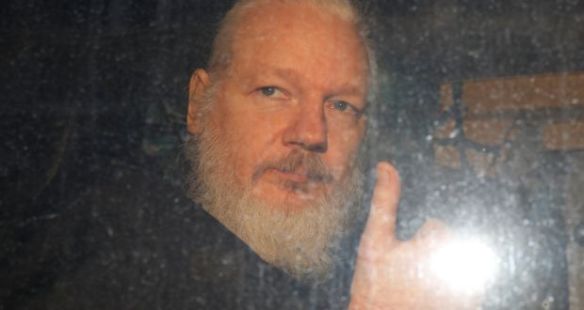
The Seven Years of Lies About Assange won’t Stop Now

By Jonathan Cook

Source: Dissident Voice

For seven years, from the moment Julian Assange first sought refuge in the Ecuadorean embassy in London, they have been telling us we were wrong, that we were paranoid conspiracy theorists. We were told there was no real threat of Assange’s extradition to the United States, that it was all in our fevered imaginations.

For seven years, we have had to listen to a chorus of journalists, politicians and “experts” telling us that Assange was nothing more than a fugitive from justice, and that the British and Swedish legal systems could be relied to handle his case in full accordance with the law. Barely a “mainstream” voice was raised in his defence in all that time.

From the moment he sought asylum, Assange was cast as an outlaw. His work as the founder of Wikileaks – the digital platform that for the first time in history gave ordinary people a glimpse into the darkest recesses of the most secure vaults in the Deepest of Deep States – was erased from the record.

Assange was reduced from one of the few towering figures of our time – a man who will have a central place in history books, if we as a species live long enough to write those books – to nothing more than a sex pest, and a scruffy bail-skipper.

The political and media class crafted a narrative of half-truths about the sex charges Assange was under investigation for in Sweden. They overlooked the fact that Assange had been allowed to leave Sweden by the original investigator, who dropped the charges, only for them to be revived by another investigator with a well-documented political agenda.

They failed to mention that Assange was always willing to be questioned by Swedish prosecutors in London, as had occurred in dozens of other cases involving extradition proceedings to Sweden. It was almost as if Swedish officials did not want to test the evidence they claimed to have in their possession.

The media and political courtiers endlessly emphasised Assange’s bail violation in the UK, ignoring the fact that asylum seekers fleeing legal persecution don’t usually honour bail conditions. That, after all, is why they are seeking asylum.

The political and media establishment ignored the mounting evidence of a secret grand jury in Virginia formulating charges against Assange, and ridiculed Wikileaks’ concerns that the Swedish case might be cover for a more sinister attempt by the US to extradite Assange and lock him away in a high-security prison, as had happened to whistleblower Chelsea Manning.

They belittled the 2016 verdict of a panel of United Nations legal scholars that the UK was “arbitrarily detaining” Assange. The media were more interested in the welfare of his cat.

They ignored the fact that after Ecuador changed presidents – with the new one keen to win favour with Washington – Assange was placed under more and more severe forms of solitary confinement. He was denied access to visitors and basic means of communications, violating both his asylum status and his human rights, and threatening his mental and physical well being.

Equally, they ignored the fact that Assange had been given diplomatic status by Ecuador, as well as Ecuadorean citizenship. Britain was obligated to allow him to leave the embassy, using his diplomatic immunity, to travel unhindered to Ecuador. No “mainstream” journalist or politician thought this significant either.

They turned a blind eye to the news that, after refusing to question Assange in the UK, Swedish prosecutors had decided to quietly drop the case against him in 2015. Sweden had kept the decision under wraps for more than two years.

It was a freedom of information request by an ally of Assange, not a media outlet, that unearthed documents showing that Swedish investigators had, in fact, wanted to drop the case against Assange back in 2013. The UK, however, insisted that they carry on with the charade so that Assange could remain locked up. A British official emailed the Swedes: “Don’t you dare get cold feet!!!”

Most of the other documents relating to these conversations were unavailable. They had been destroyed by the UK’s Crown Prosecution Service in violation of protocol. But no one in the political and media establishment cared, of course.

Similarly, they ignored the fact that Assange was forced to hole up for years in the embassy, under the most intense form of house arrest, even though he no longer had a case to answer in Sweden. They told us – apparently in all seriousness – that he had to be arrested for his bail infraction, something that would normally be dealt with by a fine.

And possibly most egregiously of all, most of the media refused to acknowledge that Assange was a journalist and publisher, even though by failing to do so they have exposed themselves in the future to the use of the same draconian sanctions should they or their publications ever need to be silenced.

This was never about Sweden or bail violations, as anyone who was paying the vaguest attention should have worked out. It was about the US Deep State doing everything in its power to crush Wikileaks and make an example of its founder.

It was about making sure there would never again be a leak like that of Collateral Murder, the military video released by Wikileaks in 2007 that showed US soldiers celebrating as they murdered Iraqi civilians. It was about making sure there would never again be a dump of US diplomatic cables, like those released in 2010 that revealed the secret machinations of the US empire to dominate the planet whatever the cost in human rights violations.

Now the pretense is over. The British police invaded the diplomatic territory of Ecuador – invited in by Ecuador after it had revoked Assange’s diplomatic status – to smuggle him off to jail. Two vassal states cooperating to do the bidding of the US empire. The arrest was not to help two women in Sweden or to enforce a minor bail infraction. The British authorities were acting on an extradition warrant from the US.

Still the media and political class is turning a blind eye. Where is the outrage at the lies we have been served up for these past seven years? Where is the contrition at having been gulled for so long? Where is the fury at the most basic press freedom – the right to publish – being sacrificed to silence Assange? Where is the willingness finally to speak up in Assange’s defence?

It’s not there. There will be no indignation at the BBC, or the Guardian, or CNN. Just curious, impassive reporting of Assange’s fate.

And that is because these journalists, politicians and experts never really believed anything they said. They knew all along that the US wanted to silence Assange and to crush Wikileaks. They knew that all along and they didn’t care. In fact, they happily conspired in paving the way for today’s kidnapping of Assange.

They did so because they are not there to represent the truth, or to stand up for ordinary people, or to protect a free press, or even to enforce the rule of law. They don’t care about any of that. They are there to protect their careers, and the system that rewards them with money and influence. They don’t want an upstart like Assange kicking over their apple cart.

Now they will spin us a whole new set of deceptions and distractions about Assange to keep us anaesthetised, to keep us from being incensed as our rights are whittled away, and to prevent us from realising that Assange’s rights and our own are indivisible. We stand or fall together.

How You Can Be Certain That The US Charge Against Assange Is Fraudulent

By Caitlin Johnstone

Source: CaitlinJohnstone.com

Julian Assange sits in a jail cell today after being betrayed by the Ecuadorian government and his home country of Australia. A British judge named Michael Snow has found the WikiLeaks founder guilty of violating bail conditions, inserting himself into the annals of history by labeling Assange “a narcissist who cannot get beyond his own selfish interest.” So that tells you how much of a fair and impartial legal proceeding we can expect to see from the British judicial process on this matter.

But the real reason that Assange has been surrendered by the Ecuadorian government, imprisoned by the British government, and ignored by the Australian government is not directly related to any of those governments, but to that of the United States of America. An unsealed indictment from the Trump administration’s District Court for the Eastern District of Virginia, accompanied by an extradition request, charges Assange with “conspiracy to commit computer intrusion for agreeing to break a password to a classified U.S. government computer” during Chelsea Manning’s 2010 leak of government documents exposing US war crimes.

This charge is premised on a fraudulent and manipulative distortion of reality, and you may be one hundred percent certain of it. Let me explain.

You can be absolutely certain that this charge is bogus because it isn’t based on any new information. The facts of the case have not changed, the information hasn’t changed, only the narrative has changed. In 2010 the United States opened a secret grand jury in Virginia to investigate whether Assange and WikiLeaks could be prosecuted for the publication of the Manning leaks, and then-Attorney General Eric Holder announced that the Obama administration was conducting “an active, ongoing criminal investigation” into the matter. The Trump administration has not turned up any new evidence that the Obama administration was unable to find in this active, ongoing criminal investigation (US government surveillance has surely acquired some new tricks since 2010, but time travel isn’t one of them), and indeed it does not claim to have turned up any new evidence.

“There’s a huge myth being misreported about today’s indictment of Assange,” journalist Glenn Greenwald tweeted today. “The claim that Assange tried to help Manning circumvent a password to cover her tracks isn’t new. The Obama DOJ knew about it since 2011, but chose not to prosecute him. Story on this soon.”

“Holder chose not to prosecute Assange based on the same info Trump DOJ cited,” Greenwald added.

“The weakness of the US charge against Assange is shocking,” tweeted NSA whistleblower Edward Snowden. “The allegation he tried (and failed?) to help crack a password during their world-famous reporting has been public for nearly a decade: it is the count Obama’s DOJ refused to charge, saying it endangered journalism.”

This is all information that the Obama administration had access to (journalist Tim Shorrock observed that the alleged 2010 correspondence between Assange and Manning “looks like it came straight from NSA surveillance” of the two), yet it chose not to do what the Trump administration is currently doing because it would endanger press freedoms. This means that nothing has changed since that time besides (A) the fact that there is now a more overtly tyrannical administration in place, and (B) the fact that the public has been paced into accepting the prosecution of Assange by years of establishment propaganda.

Last year, after it was revealed that the Trump administration was seeking Assange’s arrest, Greenwald wrote the following:

“The Obama DOJ – despite launching notoriously aggressive attacks on press freedoms – recognized this critical principle when it came to WikiLeaks. It spent years exploring whether it could criminally charge Assange and WikiLeaks for publishing classified information. It ultimately decided it would not do so, and could not do so, consistent with the press freedom guarantee of the First Amendment. After all, the Obama DOJ concluded, such a prosecution would pose a severe threat to press freedom because there would be no way to prosecute Assange for publishing classified documents without also prosecuting the New York Times, the Washington Post, the Guardian and others for doing exactly the same thing.”

Nothing has changed since 2010 apart from a more thoroughly propagandized populace and a more depraved US government, which means that this new charge that the Trump administration issued in December 2017 is based on nothing other than a diminished respect for press freedoms and an increased willingness to crush them. This makes it fraudulent and illegitimate, and the precedent that is being set by it should be rejected and opposed by everyone in the world who claims to support the existence of a free press which is capable of holding power to account.

So what are we left with? We’re left with the US government filing criminal charges against a journalist (and Assange is indisputably a journalist) for protecting his source and encouraging his source to obtain more material, both of which are things that journalists do all the time.

“While the indictment against Julian Assange disclosed today charges a conspiracy to commit computer crimes, the factual allegations against Mr. Assange boil down to encouraging a source to provide him information and taking efforts to protect the identity of that source,” said Assange lawyer Barry J Pollack in a statement today. “Journalists around the world should be deeply troubled by these unprecedented criminal charges.”

“There are parts of the indictment that are clearly designed to criminalize things journalists routinely do,” Greenwald told CNN. “Part of the accusation is that [Assange] encouraged Chelsea Manning to provide him with more documents than the original batch that she gave him, which is something that as a journalist I’ve done many times with my sources, that journalists do every day. They say ‘Oh thanks for this document, maybe you could get me this?’ They also say that he helped her to essentially cover her tracks by giving her advice about how to get this information without being detected. The only thing in the indictment, and it’s very vague, is a suggestion that he tried to help her circumvent a password; it didn’t seem to be successful, but it’s unclear whether that was designed to get documents or to simply help her cover her tracks. But either way it’s clearly a threat to the First Amendment, because it criminalizes core journalistic functions.”

In an article for Rolling Stone titled “Why the Assange Arrest Should Scare Reporters“, journalist Matt Taibbi writes that “The meatier parts of the indictment speak more to normal journalistic practices.”

“Reporters have extremely complicated relationships with sources, especially whistleblower types like Manning, who are often under extreme stress and emotionally vulnerable,” Taibbi writes. “At different times, you might counsel the same person both for and against disclosure. It’s proper to work through all the reasons for action in any direction, including weighing the public’s interest, the effect on the source’s conscience and mental health, and personal and professional consequences. For this reason, placing criminal penalties on a prosecutor’s interpretation of such interactions will likely put a scare into anyone involved with national security reporting going forward.”

The Espionage Act has not at this time been employed to prosecute Assange as many have speculated it might, and the computer crimes he’s been charged with carry a maximum sentence of five years. But this does not mean that further far more serious charges cannot be added once Assange is imprisoned on American soil, especially after his guilt in the Manning leaks has been made official government dogma following the conspiracy conviction.

In my opinion this charging Assange with a lower-level crime (not espionage) is a trick that would allow the UK to extradite him to the US with ‘no threat of capital punishment’ only to have US prosecutors do what they always do: pile on charges,” tweeted Daniel McAdams of the Ron Paul Liberty Report, referring to assurances sought by the UK and Ecuador that Assange would not face the death penalty if extradited to the United States for the conspiracy charge.

Either way, this is a cataclysmic threat to press freedoms, and the time to act is now. The US government’s arbitrarily gifting itself the right to use fraudulent distortions to imprison anyone in the world who publishes facts about it will chill any attempts to do so in the future, and poses a far greater threat to press freedoms than anything we’ve seen in our lives. Anyone who sits idly by while this happens is signing over the sovereign right of every human being on this planet to hold power to account, and anyone calling themselves a journalist who does anything other than unequivocally oppose this move is confessing that they are a state propagandist. This is an intolerable plunge toward Orwellian dystopia, and is an assault on human dignity itself.

It’s time to shake the earth and refuse to let them cross this line. Enough is enough.

Roar, humans. Roar.

https://twitter.com/AssangeMrs/status/1116324906390523905

Here’s Why the Book Julian Assange Was Holding When He Was Arrested is Vitally Important

As he was dragged from the embassy in handcuffs, Julian Assange managed to grab a very important book.

By Matt Agorist

On Thursday, several men in black suits, surrounded by a dozen cops, raided the Ecuadorian embassy in London and kidnapped Julian Assange. Moments later, the Department of Justice released a statement charging Assange with computer hacking “conspiracy” for allegedly working with US Army soldier at the time, Chelsea Manning. Assange was in handcuffs when he was brought out and as he was being dragged from the embassy, he managed to grab the book, Gore Vidal: History of the National Security State. As he was shoved into the van, Assange held the book facing forward so that it could be seen by the camera.

For those who may not know, Gore Vidal was an American author who has studied the actual history of the United States—not the propagandistic chest pumping horse manure taught in schools—but the very real, violent and corrupt history of the United States government.

Vidal was born inside this system, educated in expensive private schools in Washington DC and grew up, quite literally, surrounded by the elite. His father was a high ranking official in the Franklin Roosevelt administration and his grandfather was US senator Thomas Pryor Gore (D-Oklahoma). He was incredibly smart and would eventually become a best-selling author.

In his 30s, after writing a series of mainstream novels, Vidal decided to try his hand at historical fiction. This decision would set him on a path to waking up to the atrocities carried out by the United States dating back to Abraham Lincoln.

Vidal was one of the first public figures to question the motives and wisdom of Lincoln—and he was lambasted for it. Despite bipartisan attacks on all fronts for his critical skepticism of the United States, Vidal’s six-volume “American Chronicle” series of historical novels about the United States became best sellers.

As the years went on, Vidal became outspoken about the rise of the military industrial complex and predicted the very situation we find ourselves in today.

“USA belongs to a handful of men who also control the media. Look at General Electric. It produces nuclear weapons for the Pentagon and also owns the NBC News cable channel, which is a very sophisticated censure apparatus, intrinsic to the system. It’s genius. It’s like an electronic cage around the nation which blocks information from getting through.” ~ Gore Vidal

In the book Assange was pictured holding, Vidal explained how the United States established the “massive military-industrial-security complex” and the “political culture that gave us the ‘Imperial Presidency.’”

The book was written by Vidal and The Real News Network senior editor Paul Jay. In it, the two dissected the apparatus that would eventually facilitate Assange’s arrest. Through propaganda and manipulation, the establishment has tricked the masses into accepting their corrupt order as the norm. Both Vidal and Assange knew this.

“It doesn’t actually make any difference whether the President is Republican or Democrat. The genius of the American ruling class is that it has been able to make the people think that they have had something to do with the electing of presidents for 200 years when they’ve had absolutely nothing to say about the candidates or the policies or the way the country is run.” ~ Gore Vidal

In the book, Vidal explains the false history of the US and how this false history is used to manipulate people into supporting mass murder and corruption.

“I think everybody should take a sober look at the world about us, remember that practically everything that you’re told about other countries is untrue, what we’re told about ourselves and our great strength and how much we are loved – forget it,” wrote Vidal.

“Our strength is there, but it’s the kind of strength that blows off your hand while you hold up the grenade; it’s a suicidal strength as well as a murderous one.”

Although Vidal died before realizing the plight of Julian Assange and the attack on the freedom of the press that it represents, he saw it coming decades in advance.

Sadly, not many people heeded Vidal’s words and we are witnessing a full scale attack on true independent journalism as we know it, and we are seemingly powerless to stop it. This is likely the reason Julian Assange grabbed that book and made sure we saw it as he yelled out through dozens of cops that we “must resist.”

Though Vidal had become somewhat cynical in his final years, his wisdom can help to free us from our self-imposed slavery of worshiping corruption and statism.

Julian Assange is a hero. His actions helped to expose horrifying crimes carried out by the US government, including mowing down innocent journalists with a .50 cal. His persecution by the UK and the US is retaliation and punishment for exposing these crimes and their actions, as Assange said, must be resisted.

If this established behemoth of media, government and tech giants are allowed to persist and snub out the independent press—as they are currently doing—we may soon realize George Orwell’s prediction of a boot stomping on a human face—forever.

Like Vidal, Assange wanted people to know true history as this is the path to peace. “If wars can be started by lies,” Assange so eloquently noted, “they can be stopped with the truth.” 

We must resist.

Assange arrest: The turning point is here—don’t let them win

Will we wait until they come for us because our homes are built atop resources they wish to plunder, because we shared information online they found objectionable, because we dared to question why madmen are in control of our country and much of the world?

By Whitney Webb

Source: Intrepid Report

LONDON—Yesterday morning, the London-based branch of Empire made good on its threat and boldly moved to begin dismantling the vestiges of democracy and press freedom that still remain, vestiges that have allowed people throughout the Western world to pretend that their government and politicians still respect their rights and the rule of law.

Julian Assange, the man who has helped expose a litany of crimes and the in-your-face corruption of the world’s most powerful people and governments, was pulled from the embassy of the country where he not only holds citizenship but had been granted asylum. The dangerous precedents Assange’s arrest has set—not just for journalism, but also for national sovereignty and international law—are staggering.

With Assange now in U.K. custody, his fate will mirror our own, as Assange’s fate and that of journalists around the world, as well as the public itself, are increasingly intertwined. After all, those who are after Assange and seek to rob him of his freedom—the U.S. Empire, the “deep state,” the shadow government, the global elite, etc.—are after our freedom as well.

If we remain silent as they jail, extradite, torture or even kill this man, we may expect a similar fate for ourselves. It will not come tomorrow. It will not come next week. It could be years away. But make no mistake, the global empire, whose core is the U.S. government, will now be empowered to charge and imprison anyone it deems a threat to its operations.

Those operations, including those that Assange helped to expose, often involve the mass murder of innocent civilians—untold numbers of children among them—in order to loot the resources of other sovereign nations. They also often involve the installation of puppet governments by either covert (e.g., election “meddling”) or overt (e.g., regime-change wars) means.

Those responsible for the most egregious violations of international law, for war crimes, for the slaughter of innocent life, are not imprisoned, degraded or tortured—they are rewarded and promoted. As we have seen today—and in recent weeks, particularly following Chelsea Manning’s imprisonment—those who seek to expose these crimes are the ones who are threatened, tortured and punished.

Like it or not, we are all already a part of this war

The world has known for years that Assange would meet this fate. Little was done. Now, the turning point is here. Will we continue to escape into the false realities of television, cinema, video games, and whatever we use to distract us and numb our pain while the actual world in which we live devolves into a technocratic, imperial dictatorship? Will we continue to ignore the obvious threats to our lives and our children’s lives because confronting these threats is uncomfortable and often difficult?

Will we wait until they come for us because our homes are built atop resources they wish to plunder, because we shared information online they found objectionable, because we dared to question why madmen are in control of our country and much of the world?

Such an eventuality may seem laughable to some, but those days are not far away and are already here for many people around the world, even in the West. Assange’s arrest is the first shot of a war to which all of us, like it or not, have already been drafted because it is a war for the very world in which we live—a war for our society, our planet, our livelihood, our right to self-determination. You can try to escape to the ends of the Earth, thousands of miles away from “the West” (as I myself did), only to find that there is no country anywhere in the world that is not currently under siege.

Never before in history has the global oligarchy been more powerful. The concentration of power and wealth in the hands of the few is unprecedented, worse even than in the Gilded Age or the final days of the Roman Empire. These people do not plan to cede any of this power to you. They do not want you to have control over your own lives. To them, we are already slaves. And those who are silent, especially now, are sending a signal to the elites that they embrace that servitude.

The revolution will not be televised and the war will not be won on social media

For too long, actions in defense of Assange, and more broadly in protest of Empire, have been focused in the virtual realm—that is, on the Internet and social media. While the Internet and social media are important tools for sharing information, their use for that end is being suppressed like never before and it will not be long before social media is entirely censored and devoid of dissent. If we wait until that day comes, and put all our eggs in the social media basket, we will have shot ourselves in the foot and it could well be a fatal blow.

We can no longer run from the world, escape into our remaining comforts—particularly those online—while the world burns. Assange may be the first journalist to be arrested and extradited under these circumstances, but he will not be the last. What we do now will determine how far they go.

The U.S. and its allies are prepping for several wars, many of them against countries much larger than Iraq, and such wars could make Iraq and Afghanistan look like skirmishes by comparison. The people behind Assange’s arrest and perpetual imperial wars do not care about your tweets or Facebook posts. They want your focus to remain on the virtual world and away from the real one over which they are consolidating their control.

Now is the time to resist. Now is the time to insist. Now is the time to take to the streets, to talk to your neighbors, family and co-workers of the dangers facing us all. Your voice and your actions matter. The longer we wait, the worse things will become. The turning point is here. Don’t let them win.


Whitney Webb is a MintPress News journalist based in Chile. She has contributed to several independent media outlets including Global Research, EcoWatch, the Ron Paul Institute and 21st Century Wire, among others. She has made several radio and television appearances and is the 2019 winner of the Serena Shim Award for Uncompromised Integrity in Journalism.

Elite Banking at Your Expense: How Secretive Tax Havens are Used to Steal Your Money

By Robert J. Burrowes

Tax havens are locations around the world where wealthy individuals, criminals and terrorists, as well as governments and government agencies (such as the CIA), banks, corporations, hedge funds, international organizations (such as the Vatican) and crime syndicates (such as the Mafia), can stash their money so that they can avoid regulation and oversight and, very often, evade tax. According to Nicholas Shaxson: ‘Tax havens are now at the heart of the global economy.’

Which is why, as he explains it: ‘The term “tax haven” is a bit of a misnomer, because such places aren’t just about tax. What they sell is escape: from the laws, rules and taxes of jurisdictions elsewhere, usually with secrecy as their prime offering.’ See ‘The tax haven in the heart of Britain’. A tax haven (or ‘secrecy jurisdiction’) then is a ‘place that seeks to attract business by offering politically stable facilities to help people or entities get around the rules, laws and regulations of jurisdictions elsewhere’. See Treasure Islands: Tax Havens and the Men Who Stole the World.

Tax havens are a vitally important part of the global infrastructure of corruption and criminality – see ‘Giant Leak of Offshore Financial Records Exposes Global Array of Crime and Corruption’ – that enables privileged individuals and their organizations to legally and illegally steal money from the rest of us, particularly those in developing countries, and to have the services of a vast network of accountants, bankers, lawyers and politicians (often from captured legislatures) to help them do it, and to ensure that they get away with it.

How many tax havens are there? Where are they? How much money do they have? Who uses them? Why? How do they work? Why does all this matter to us? And what can we do about them?

Tax Havens: how many and where are they?

In his book Treasure Islands: Tax Havens and the Men Who Stole the World, author and financial journalist Nicholas Shaxson identified about sixty ‘secrecy jurisdictions’ or ‘offshore groups’ around the world which he divided into four categories, as follows.

The most important category, by far, is those tax havens that form the spider’s network of havens centred on the City of London. It has three main layers: there are two inner rings – Britain’s Crown Dependencies of Jersey, Guernsey (which includes the sub-havens of Sark, Alderney and Brecqhou) and the Isle of Man, and its overseas territories such as the Cayman Islands, Bermuda, the British Virgin Islands and Gibralter – which are substantially controlled by Britain. The third layer is an outer ring with a more diverse array of havens, like Hong Kong, Singapore, the Bahamas, Dubai and Ireland, which are outside Britain’s direct control but have strong historical and current links to that country and the City of London (which I will discuss below). This network controls almost one half of all international bank assets.

The second category of tax havens is those in Europe notably including Switzerland, Luxembourg – see ‘Explore the Documents: Luxembourg Leaks Database’ – the Netherlands, Belgium and Austria, as well as microstates such as Liechtenstein and Monaco. While ‘Geneva bankers had sheltered the secret money of European elites since at least the eighteenth century’, the European havens ‘got going’ during World War I as governments raised taxes sharply to pay for the war.

The third category of tax havens is that focused on the United States. It has three tiers as well. At the federal level, the US government offers a range of tax exemptions, secrecy provisions and laws designed to attract foreign money. This means, for example, that US banks can legally accept proceeds from a range of crimes as long as the crimes are committed overseas. The second tier involves individual US states such as Florida (where Central/South American elites do their banking and the countries adversely impacted are prevented by US secrecy provisions from accessing relevant data, and where much Mob and drugs money is hidden too), Delaware, Nevada and Wyoming, where even terrorist money is protected by secrecy provisions. The third tier of the US network is the overseas satellites such as the American Virgin Islands, the Marshall Islands, Liberia and Panama, with the latter, according to Jeffrey Robinson, being ‘one of the filthiest money laundering sinks in the world’. See The Sink: Terror, Crime and Dirty Money in the Offshore World.

As Shaxson notes: ‘offshore finance has quietly been at the heart of Neoconservative schemes to project US power around the globe for years. Few people have noticed.’

The fourth category of tax havens identified by Shaxson includes those that do not fit in the categories above, such as Somalia and Uganda.

The (incomplete) list of tax havens on the website ‘Tax Havens of the World’ will give you some idea of where these secrecy jurisdictions are located but there are important omissions in this list, notably including the City of London Corporation.

For a brief look at 15 tax havens (again, notably excluding some of the most important) and some of the corporations that use them, see ‘What Are the World’s Best Tax Havens?’

And for a highly instructive and utterly sobering video documentary on British Tax Havens, see ‘The Spider’s Web: Britain’s Second Empire’. This documentary will inform you, among many more important things, that the building housing Her Majesty’s Revenue and Customs, the UK tax office, is owned by an offshore company in Bermuda!

To summarize the central aspect of the development of tax havens following World War II: ‘The British Establishment – an old boys network of privileged elites – had carved out a lucrative vehicle for themselves in the offshore world after the demise of Empire. They transformed themselves from administrators of Empire to financial handlers for the global elite and multinational corporations.’ See ‘The Spider’s Web: Britain’s Second Empire’.

Before concluding this section, it is worth emphasizing that, as Shaxson explains it, ‘the offshore world is not a bunch of independent states exercising their sovereign rights to set their laws and tax systems as they see fit. It is a set of networks of influence controlled by the world’s major powers, notably Britain and the United States. Each network is deeply interconnected with the others.’ He goes on: ‘The world’s most important tax havens are not exotic palm-fringed islands, as many people suppose, but some of the world’s most powerful countries.’ Shaxson quotes Marshall Langer, a prominent supporter of secrecy jurisdictions: ‘It does not surprise anyone when I tell them that the most important tax haven in the world is an island. They are surprised, however, when I tell them that … the island is Manhattan. Moreover, the second most-important tax haven … is located on an island. It is called the City of London.’

The City of London Corporation

What is the City of London Corporation, also known as the ‘Square Mile’? It is ‘a 1.22-square-mile slab of prime central London real estate that stretches from the Thames at Victoria Embankment, clockwise up through Fleet Street, the Barbican Centre, then to Liverpool Street in the north-east, then back down to the Thames just west of the Tower of London.’ See Treasure Islands: Tax Havens and the Men Who Stole the World.

According to Shaxson, the City of London Corporation, the ‘modern period’ of which dates from 1067 (yes, that is not a typing error), is ‘the local-government authority for the 1.2-square-mile slab of prime real estate in central London that is the City of London. The corporation is an ancient, semi-alien entity lodged inside the British nation state; a “prehistoric monster which had mysteriously survived into the modern world”, as a 19th-century would-be City reformer put it.’

Importantly, Shaxson explains, ‘the role of the City of London Corporation as a municipal authority is its least important attribute. This is a hugely resourced international offshore lobbying group pushing for international financial deregulation, tax-cutting and tax havenry around the world.’ Moreover, it is ‘the hub of a global network of tax havens sucking up offshore trillions from around the world and sending it, or the business of handling it, to London’. Notably, so powerful is the City of London that no sovereign or government of Britain in a thousand years has had the courage to seriously take it on and attempt to subject it to British government control. See ‘The tax haven in the heart of Britain’.

How much money is in Tax Havens?

So how much of the world’s wealth is stashed in tax havens around the globe? According to the Tax Justice Network in its 2012 report written by James S. Henry ‘The Price of Offshore Revisited: New Estimates for “Missing” Global Private Wealth, Income, Inequality, and Lost Taxes’: ‘A significant fraction of global private financial wealth – by our estimates, at least $21 to $32 trillion as of 2010 – has been invested virtually tax-free through the world’s still-expanding black hole of more than 80 “offshore” secrecy jurisdictions. We believe this range to be conservative…’ He goes on to emphasize that ‘this is just financial wealth. A big share of the real estate, yachts, racehorses, gold bricks – and many other things that count as non-financial wealth – are also owned via offshore structures where it is impossible to identify the owners’.

Henry also notes that given that Credit Suisse estimated global wealth in 2011 at $231 trillion, the amount of money in secrecy jurisdictions is conservatively estimated at 10% of global wealth.

But other figures do indeed suggest this estimate is low. Shaxson cites compelling evidence that ‘More than half of world trade passes, at least on paper, through tax havens. Over half of all banking assets and a third of foreign direct investment by multinational corporations, are routed offshore.’ Moreover, as long ago as 2008, the US Government Accountability Office reported that 83 of the 100 biggest corporations in the USA had subsidiaries in tax havens and the following year, using a broader definition, the Tax Justice Network discovered that ninety-nine of Europe’s hundred largest companies used offshore subsidiaries. And in each country, ‘the largest user by far was a bank’. See Treasure Islands: Tax Havens and the Men Who Stole the World.

In any case, the most recent estimate by the Tax Justice Network indicates ‘tax losses to profit shifting by multinational companies (a)pplying a methodology developed by researchers at the International Monetary Fund to an improved dataset… of around $500 billion a year’. See ‘New estimates reveal the extent of tax avoidance by multinationals’.

To reiterate then, on the understanding that these estimates are probably quite low, by 2010, between $US21 and $US32 trillion had been taken out of circulation so that it was beyond the laws, financial regulations and taxes that the rest of us cannot escape. But that figure has been added to by half a trillion dollars each year since, by moving more money into tax havens. And don’t forget: this figure does not include non-financial wealth. How many gold bricks, yachts, artworks and racehorses do you own and have stashed away somewhere free of scrutiny?

Who uses Tax Havens? And why?

As I mentioned above, tax havens are used by wealthy individuals (including businesspeople, sports and pop stars), criminals and terrorists, as well as governments (and their agencies), banks, corporations (such as Amazon and Google), international organizations and crime syndicates (such as the Medellin Cartel). While motives vary, in essence the lack of regulation and oversight, as well as tax evasion, are the reasons that individuals and organizations use them.

An individual might want to hide stolen wealth, to evade tax or cheat a divorced spouse out of their share of the family fortune. A bank, corporation, crime syndicate, international or terrorist organization might want to evade scrutiny of the source of their money and/or evade tax on windfall or even ongoing profits (legal and/or otherwise). A government might want to hide the ‘dirty money’ it uses to finance ‘black ops’ (that is, illegal and secret military violence such as that carried out by the CIA). But there are myriad explanations.

In John Christensen’s analysis of over 100 offshore clients of accounting firm Deloitte Touche he studied in Jersey, he found that the clients were engaging in insider trading, market rigging, failure to disclose conflicts of interest, weapons trading, illicit political donations, contract kickbacks, bribery, fraudulent invoicing, trade mispricing and tax evasion. See ‘The Spider’s Web: Britain’s Second Empire’.

Most people have heard of the money stashed away by corrupt dictators like Suharto in Indonesia, Ferdinand Marcos in the Philippines and Mobuto Sese Seko of Zaire (now Democratic Republic of the Congo) each of whom stole from the people of their country. However, they could only do this with the help of western enablers and ongoing elite resistance to developing country attempts to create a more transparent and fairer process for collecting tax on cross-border financial flows. As a result, Alex Cobham of the Tax Justice Network observes, worldwide, developing nations lose in excess of $1trillion per year in ‘capital flight’ and tax evasion to wealthy countries. See ‘The Spider’s Web: Britain’s Second Empire’.

But these more public examples, while terrible, tend to obscure two important facts. The amount stolen from sub-Saharan Africans, for example, between 1970 and 2008 was at least five times the total amount of their foreign debt during that period – see ‘The Spider’s Web: Britain’s Second Empire’ – and, by highlighting these examples, attention is drawn away from even worse and ongoing examples of such criminality by those corrupt/criminal individuals and organizations (including banks, accountancy and legal firms, corporations, international organizations, crime syndicates and governments) committed to using outright theft, fraud, money laundering and other devices to steal wealth from ordinary people all over the world.

So, for example, if one follows the money trails of various lucrative financial operations, some technically legal but immoral and others simply illegal, apart from the world’s major corporations, one quickly comes across the names of the major (and well known) banks and financial institutions (such as the Bank of England, Barclays, Goldman Sachs, JPMorgan Chase…), the ‘big four’ accountancy firms (Deloitte, Ernst & Young (EY), KPMG and PricewaterhouseCoopers), and elite lawyers (such as those in London’s ‘Magic Circle’, like Clifford Chance, Mourant du Feu & Jeune, and Slaughter and May). See, for example, Treasure Islands: Tax Havens and the Men Who Stole the World, ‘New estimates reveal the extent of tax avoidance by multinationals’ and ‘Looting with Putin’.

Apparently, like major corporations and crime syndicates, few banks, accountancy firms and lawyers have ethics policies that require them to follow the law and to exercise ‘due diligence’ (check out a client before signing a contract) so that they can steer clear of handling illegal and immoral profits, especially if they are monstrous.

In fact, according to a US Senate report, ‘virtually every major bank in the world – especially the biggest in North America and Europe – holds accounts for offshore banks and/or banks in suspect jurisdictions’. See The Sink: Terror, Crime and Dirty Money in the Offshore World.

As Eva Joly MEP, vice-chair of the Panama Papers Committee of the European Parliament, succinctly puts it: ‘Ordinary people are paying taxes. Rich people are not.’ See ‘The Spider’s Web: Britain’s Second Empire’.

The Vatican

But perhaps the example which best illustrates the moral depravity of those who use tax havens is the Vatican. In his carefully researched book Operation Gladio: The Unholy Alliance between the Vatican, the CIA and the Mafia author Paul L. Williams recounts the efforts of the CIA, former Nazis, the Sicilian/American Mafia, the Vatican and even Freemasonry to resist an anticipated postwar invasion of western Europe by those ‘Godless communists’ in the Soviet Union by establishing ‘stay-behind units’ (clandestine military and paramilitary units) throughout the countries of Europe (Belgium, Denmark, Italy, Netherlands, Norway, Portugal…) led by former Nazis and composed of ‘die-hard fascist fanatics’.

This alliance to fight the Cold War against the former Soviet Union and the rising tide of progressive governments in Europe and the rest of the world, particularly as the US war on Vietnam gathered pace, led, as Williams chillingly puts it, to ‘the toppling of governments, wholesale slaughter and financial devastation’ around the world. It was also, of course, the forerunner to its equivalent – Operation Condor – to resist, and destroy if possible, the spread of progressive movements, ranging from communism to liberation theology, throughout Central/South America.

While the Vatican played a number of unsavory roles in this alliance, including its facilitation of massive numbers of heroin addictions, its use of counterfeit securities, participation in false flag attacks that killed thousands and strings of gangland slayings, support of military juntas (that massacred tens of thousands) and the ‘purging’ of progressive priests (including Archbishop Óscar Romero of San Salvador and two Jesuit priests denounced by Fr. Jorge Mario Bergoglio, now Pope Francis, in Argentina: see ‘Who is Pope Francis? Jorge Mario Bergoglio and Argentina’s “Dirty War”’) while causing the financial destitution of thousands of families, one of its key ongoing functions, designed to maximize the Vatican’s power while highlighting its moral and spiritual bankruptcy, was to act as ‘God’s banker’ for many of these operations. See Operation Gladio: The Unholy Alliance between the Vatican, the CIA and the Mafia.

It did this, for example, by accepting Mafia/Medellin Cartel-collected drugs money (for a 15-20% cut) into the Vatican Bank (technically: Istituto per le Opere di Religione or Institute for the Works of Religion) and then laundering it through its shell companies – such as Cisalpine Overseas Bank, Astolfine SA, United Trading Corporation, Erin SA, Bellatrix SA, Belrose SA, Starfield SA and Nordeurop Establishment – in tax havens in the Bahamas, Liechtenstein, Luxembourg, Panama and Switzerland.

With the CIA providing services, such as the transport of Mafia/Medellin cocaine to drug dealers in the US, its share of the drug profits (cycled through its own CIA-controlled banks including Continental Illinois, Castle Bank & Trust, and Bank of Credit and Commerce International but eventually involving many of the most prestigious banks in the US, as the money was passed to the Vatican Bank) were used to finance key aspects of Operations Gladio and Condor with weapons also supplied by the CIA from NATO arsenals. But there was plenty of Vatican money in these Operations too.

As an aside, so devastating was the fallout from the ongoing exposure of the many aspects of Vatican corruption that, by the beginning of the twenty-first century, Roman Catholic membership was falling by 400,000 per year in the USA alone but the trend was even stronger in Europe with ‘magnificent churches and cathedrals’ becoming museums visited solely by tourists, parishes being boarded up, seminaries and convents closed, and parochial schools consolidated. And this was before the ‘plague of pedophilia’ had fully hit further decimating the Church’s tattered reputation. To this day, the Vatican Bank remains ‘one of the world’s leading laundries for dirty money’. See Operation Gladio: The Unholy Alliance between the Vatican, the CIA and the Mafia.

How do Tax Havens work?

Each tax haven offers its own unique combination of services. After all, it is a tough market competing for the world’s wealth and so each jurisdiction has developed its own set of services designed to maximize its attractiveness to potential clients. In essence, this means that there is some ongoing ‘competition’ to reduce regulatory and oversight requirements so that each tax haven can attract clientele. This has become so extreme that basic requirements of banking for those who do it legally, such as proof of identity, are not required in the offshore world. In fact, even your true name can be withheld if you wish. It is easier to avoid any risk of embarrassment from exposure this way.

As a result, virtually any jurisdiction will open an account (or as many accounts as you want) in whatever names you specify. Then, usually employing a variety of devices, ranging from secret bank accounts, nominee directors (usually locals who play no part in the organization bar give it their name) and structures such as shell companies (that exist on paper and perhaps a wall plaque somewhere, but nothing else) and trusts (which, unlike the legitimate version, appear to separate responsibility and control from the benefits of ownership but actually do not), to processes such as transfer pricing (a technique by which companies ‘shift paper profits into low-tax countries and costs into high-tax countries’ to minimize – or eliminate – tax payments) and often employing a convoluted process that rapidly shifts monies through several jurisdictions so that it becomes ‘untraceable’ (because authorities must get permission to access each jurisdiction in turn in any effort to trace the money), profits are effectively hidden and any accountability to authorities of any kind utterly eliminated. See Treasure Islands: Tax Havens and the Men Who Stole the World.

For one simple example of such a strategy, employing a technique known as the ‘double Irish, Dutch sandwich’ (which is legal), see Google shifted $23bn to tax haven Bermuda in 2017, filing shows. But you can read other examples here: ‘The tech giants will never pay their fair share of taxes – unless we make them’ and ‘7 Corporate Giants Accused of Evading Billions in Taxes’.

Why does the existence of Tax Havens matter to us?

Well, the simple answer to this question is that just a fraction of the money hidden in tax havens would feed, clothe, house and provide clean water, medical care and educational opportunities to everyone on Earth. It would eliminate the 100,000 deaths by starvation-related diseases each day. It would eliminate poverty and homelessness. And, as one byproduct of having these material needs met, it would facilitate the emergence of an informed, engaged and empowered human population to tackle the vast range of environmental, climate and military threats that currently threaten biosphere collapse and imminent human extinction. See ‘Human Extinction by 2026? A Last Ditch Strategy to Fight for Human Survival’.

As Professor Prem Sikka puts it more simply: Because of the penetration by financial services executives of the British state, including the Treasury ‘It deprives people of opportunities to have healthcare, education, security, justice and, ultimately, a fulfilling life.’ See ‘The Spider’s Web: Britain’s Second Empire’.

Fundamentally, then, tax havens and their secrecy are at the heart of those elite institutions and processes that functionally undermine democracy and give extraordinary power to certain anonymous individuals and their entities without accountability. See ‘The Spider’s Web: Britain’s Second Empire’.

Of course, the elites that control the tax haven networks are not about to let this change. Tax havens are simply too important as part of the global infrastructure for maintaining elite profit, power and privilege and for resisting grassroots efforts to bring peace, justice and ecological sanity to our world. And that is why they are protected by government legislation and legal systems, with an ‘army’ of accountants, auditors, bankers, businesspeople, lawyers and politicians ensuring that they remain protected.

So don’t forget: laws are designed to control and punish you, no matter how trivial your infringement: a parking fine, a littering offence, a petty theft. But if you have enough money, the law simply does not exist. And you can evade taxes legally and in the full knowledge that your vast profits (even from immorally-acquired wealth such as sex trafficking, gun-running, endangered species trafficking, conflict diamonds and drug trafficking) are ‘lawful’ and will escape regulation and oversight of any kind. See ‘The Rule of Law: Unjust and Violent’.

Let me give a personal example. I have been a war tax resister since 1983: I have a conscientious objection to paying taxes to the Australian government to deploy military forces in other countries to kill people in my name. So, instead of paying taxes to kill, for many years I donated the equivalent amount to organizations engaged in peace, development, environment and human rights work, and to ‘pay the rent’ for my use of indigenous land. As some of many outcomes to this conscientious and highly public resistance (garnering national media attention at times), in 1991 I was bankrupted, in 1992 I was convicted of contempt of court (for my conscientious refusal to cooperate with the bankruptcy trustee) and in 1993 my passport was seized. In 1999, I was advised that I will be ‘bankrupt forever’ because of my ongoing conscientious refusal to finance the killing.

In the same period, since 1983, trillions and trillions of dollars of tax have been illegally and secretly evaded as wealthy individuals and corporations, criminals and crime syndicates, international organizations and governments channel their incomes and profits through tax havens. Laws and legal systems throughout the world make this possible and, provided it is done correctly, it is quite straightforward to avoid any penalties for secretly evading payment of taxes or hiding money acquired through criminal activity. But the point, as you can see, is that tax evasion by wealthy individuals and corporations meant that many of these individuals and corporations didn’t pay taxes to kill people either. They just didn’t pay taxes at all.

Of course, their motive was personal gain, their way was legal, they incurred no penalty and, of course, they didn’t pay an equivalent amount to support peace and justice causes. More fundamentally, however, the trillions of dollars they took from the global economy were made by killing and exploiting people and the planet in a significant variety of other ways, ranging from sex trafficking, gun-running, conflict diamonds and trafficking in drugs and endangered species, to simply starving people to death at the rate of 100,000 people each day by managing the global economy, using tax havens as a primary tool, to extract maximum profit.

Richard Brooks documents how this legal exploitation occurs in another way in his book The Great Tax Robbery: How Britain Became a Tax Haven for Fat Cats and Big Business. The vast tax evasion by elites in Britain, including by diverting funds through tax havens, attracts just five prosecutions each year per £1 billion of evasion of direct taxes. In contrast, benefits fraud by those on unemployment and disability pensions attract 9,000 prosecutions each year per £1 billion of fraud. ‘So theft by the poor warrants the full force of the law’. But not theft by elites who write the law and largely control the political and legal processes in relation to it.

Hence, under the guise of ‘relationship taxing’ (that is, building a relationship between tax authorities and corporate executives and ‘tailoring’ tax payments to corporate wishes to the extent the law allows), corporations have long known that ‘If you don’t like the law… we’ll see what we can do’.

As is obvious from this example, attempts at government reform, including to defeat tax havens, in the direction of making elites financially and legally accountable, both nationally and internationally, for the responsibilities which the rest of us cannot escape, are invariably for show and, in any case, achieve zero of substance. For example, the attempt to ‘approve’ a blacklist of tax havens at the G20 gathering in 2009 was resisted by the Chinese premier on behalf of Chinese elites who, like other national elites keen to have political control but ‘judicial separation’ from their offshore centres, opposed the listing of notorious havens Hong Kong and Macau: see Treasure Islands: Tax Havens and the Men Who Stole the World. The global elite is clearly in control with national governments and international organizations powerlessly doing as instructed. So complete is this control, in fact, that Brooks notes that, in Britain, ‘Anti-tax avoidance laws had to be relaxed to accommodate companies’ tax avoidance schemes.’

Brooks concludes that ‘British taxation policy really had been so comprehensively captured by the world’s biggest corporations that screw-the-poor policies… could be written into the statute books at their whim, without a pang of conscience being felt anywhere in Whitehall.’ Clearly, however, his comment can be applied to virtually any government in the world.

So does it matter to you that these tax havens exist and do what they do?

What can be done about Tax Havens?

Authors such as Nicholas Shaxson and Richard Brooks suggest a raft of measures to correct the large number of ‘faults’ that facilitate the secrecy, protection from regulation and tax evasion that individuals, corporations, organizations, criminals and terrorists utilize in tax havens.

For Shaxson, these include financial reforms such as ‘blacklisting’ of tax havens so that their rogue state status is public knowledge; greater transparency, for example, through government sharing of information about the local income and assets of each other’s citizens and by requiring multinational corporate activities in each country to be made visible (rather than hidden behind ‘international’ figures); promoting the needs of developing countries which need their tax bases protected far more than they need aid or debt relief; confronting the British ‘spider’s web’ of tax havens by abolishing the City of London Corporation and submerging it into a unified and fully democratic London; taxing an entire multinational ‘group’ as a single unit and then allocating the appropriate amounts of its income out to the different jurisdictions in which it was earned and allow it to be taxed as each jurisdiction decides; onshore tax reform such as a land value tax (because land cannot be moved offshore and so tax on it must be paid locally), and by a direct distribution of mineral wealth in any country to each of its inhabitants (who can then be taxed); tackling the ‘enablers’ – the accountants, lawyers, individual bankers, businesspeople – and not just the clients, so that they go to jail; rethinking the meaning of ‘corporate responsibility’ (because corporations are given a wealth of capital in public infrastructure, an educated and healthy workforce… with which to work) so that corporations are transparent about their affairs and pay tax as part of their corporate responsibility; re-evaluating the meaning of corruption – insiders abusing the common good in secrecy and getting away with it and so worsening inequality and entrenching vested interests and unaccountable power – so that we see, more clearly, all of the actors and their activities; and changing the culture that fawns over people who abuse the system for personal gain. See Treasure Islands: Tax Havens and the Men Who Stole the World.

And some progress appears to be occurring along lines he suggests. For example, a version of automatic information exchange (AIE), by which governments make sure that essential information is made available to other jurisdictions as a matter of routine, has been discussed by the OECD and, while full of loopholes – see ‘Loophole USA: the vortex-shaped hole in global financial transparency’ – some commitments have been made. For the list of commitments as at November 2018, see ‘AEOI commitments’.

However, the USA has not made this commitment and while Switzerland, for example, finds this objectionable – see ‘The U.S. hasn’t signed the AEoI Agreement: Reciprocity demanded’ – the reality is that it makes little difference. For example, ICO Services, which specializes in the formation of offshore companies and offshore banking, will assist you to get around the AEoI requirement. Their website advertises that ‘asset holders need to start looking for alternative jurisdictions for protecting their assets. There are some reputable jurisdictions that are still outside the AEoI  – e.g. Cyprus  –  but U.S. states of Delaware and some others shouldn’t be dismissed.’

But if you want a more established name to help you take advantage of a tax haven in the USA, you really can’t go past Rothschild & Co. So, to check out what they are offering: ‘Here Is Rothschild’s Primer How To Launder Money In U.S. Real Estate And Avoid “Blacklists”’.

Moreover, the AEoI agreement ‘outlaws’ bank secrecy but not trust secrecy (which dates from the Crusades) on which the British model is based – ‘The Trust lies at the core of the British secrecy model’ – so it does not address the cornerstone of British tax haven secrecy and explains why the British were happy to see the Cayman Islands commit to the AEoI. In short: the British government would be happy to kill off bank secrecy so that they can capture a larger market share (based on Trust secrecy). See ‘The Spider’s Web: Britain’s Second Empire’.

Separately from this initiative, in 2018 the UK parliament enacted a new law requiring its overseas territories – including notorious tax havens like Bermuda, the Cayman Islands and the British Virgin Islands – to start disclosing the owners of corporations they register by 2020. In theory: ‘This could shut down a huge amount of offshore tax evasion and other financial crimes because individuals from anywhere in the world, including the United States, have long been able to set up secret corporations in these tax havens to stash their money.’ See ‘New UK Law May Shut Down the Biggest Tax Havens – Aside from the U.S.’

However, while the report pointed out that the new law obviously does not impact the USA (or, of course, Switzerland or …) and the easy rerouting options available if these havens are effectively (or even actually) shut down, it failed to mention that this initiative does not in any way address the City of London Corporation so the impact of this initiative must be very limited unless it is followed by some pretty drastic initiatives in Westminster, Washington, Bern and elsewhere.

In summary, while one cannot disagree with any of Shaxson’s fine suggestions or be displeased that public pressure has led to some effort being made by the OECD and the UK parliament to address elements of the tax haven scourge, the reality is that the extent of the changes necessary are not going to happen without enormous grassroots pressure, strategically applied, and they are very unlikely to happen as reforms of the existing capitalist system. This is simply because the global elite is solidly in control of the institutions and processes of global capitalism, including its compliant governments and international organizations, and will readily stymie any attempt at serious reform of tax havenry particularly given the number of major reforms needed and the number of nations in which these reforms must be enacted. To state two obvious examples: The City of London Corporation has not existed for 1,000 years because it has no defense. And the changes noted above have only made the US more attractive as a secrecy jurisdiction.

Meanwhile, with the aim of promoting ‘financial innovation’, Switzerland has recently made things easier for smaller financial technology companies thus making tax havenry more attractive to those who might not have otherwise considered it. See ‘Swiss watchdog to propose looser anti-money laundering rules for fintechs’.

So, given that most tax havens are protected by host government legislation and there is no international mechanism to control them, the tax haven industry generally is not under threat of being held to account in any significant way.

And, despite the more elaborate explanation offered above, there is a simple reason for this. Unofficially, of course, illegal money, laundered through tax havens, has become an essential and sometimes stabilizing element of the global financial system. See ‘Drug money saved banks in global crisis, claims UN advisor’.

So what can we do that will make a difference?

Given the deeply entrenched and long-standing nature of this problem, clearly it needs to be addressed at various levels.

Fundamentally, we can nurture our children so that we do not destroy their conscience. See ‘My Promise to Children’. Remember all of those corrupt/criminal accountants, bankers, businesspeople, priests and popes, lawyers and politicians that kept creeping up in the discussion above? The people who maintain the entire infrastructure that allows tax havens to exist and those who manage and profit from it too?

Do they care about you? Do they care about the people in Africa, Asia and Central/South America who starve as a result of the types of policies that allow tax havens to exist and function? Do they care about those driven into poverty and homelessness in modern industrial economies because vast sums are drained out of them and hidden in secrecy jurisdictions? Do they care about the people killed by the military and other violence from which they profit and then hide the proceeds to evade tax? Do they care about the Earth? Fundamentally, do they care about themselves?

Of course not! But this is only because they are extraordinarily psychologically damaged individuals. See ‘The Global Elite is Insane Revisited’ with a more complete explanation in Why Violence? and Fearless Psychology and Fearful Psychology: Principles and Practice.

If we inflict enormous violence on a child throughout their childhood to compel their obedience, how can we expect them to grow up to lead a life of integrity based on their conscience, courage, compassion, empathy and love? Those who use tax havens are truly ‘poor little rich boys’ (and girls). See ‘Love Denied: The Psychology of Materialism, Violence and War’ and ‘Why Set Up a Shell Company in Panama? The Psychology Driving Illicit Financial Flows’.

Beyond tackling the problem at its source however, we can also tackle manifestations of the problem but not by lobbying elites – and their political agents: there are no votes in it, in any case – to control this depravity for which they are well rewarded.

For a start we can boycott all of the major private banks in favor of those smaller or member-owned banks that have a serious commitment to peace, justice and ecological sustainability, or we can seek out equivalent institutions like credit unions. We can also create public banks based on ethical principles. See ‘What are Public Banks and How Do They Operate? An Introduction’.

We can boycott large corporations – like Amazon, Apple, Gap, Google, Ikea, Microsoft and Starbucks – that use tax havens. None of these corporations is a monopoly: there are alternatives which can be investigated and employed, assuming we can’t go without some version of the product or service they offer. Whenever you can, find a locally-owned outlet that offers a local product or service.

We can boycott the Catholic Church. God does not ask that you morally or financially support a corrupt organization that doesn’t understand or represent morality and spirituality. Remember, it was Jesus who threw the moneychangers out of the temple.

If our conscience speaks loudly enough, we can decline employment by any organization that is unethical, such as those that use tax havens.

We can refuse to gamble, refuse to buy the services of a sex worker (who might even be illegally trafficked into the work), refuse to buy the products of endangered species – see, for example, ‘Killing Elephants “for Pet Food” Condemned’ – and refuse to use illicit drugs. These products and services are virtually always offered by industries controlled by criminal organizations so by buying them you are only harming yourself and/or other people or species about whom you could choose to exercise a duty of care while also not contributing to the diversion of financial resources into tax havens.

We can encourage unions, with members who work for organizations using tax havens, to take a stand on the issue.

We can support existing organizations that work on the problem, preferably those that offer grassroots alternatives. The Tax Justice Network, an ‘activist think tank’, and its sister organization, the Global Alliance for Tax Justice, campaign for systemic change.

If we are genuinely ambitious, we can develop comprehensive nonviolent strategies to compel particular individuals and organizations to desist from using tax havens or even compel countries to close down tax havens. See Nonviolent Campaign Strategy. This can easily be part of a larger strategy to transform the global economy into one that satisfies human and ecological needs, particularly given the imminence of biosphere collapse, as noted above. See The Flame Tree Project to Save Life on Earth.

If violence and exploitation in all of their guises concern you, consider signing the online pledge of ‘The People’s Charter to Create a Nonviolent World’.

So here is a final question for you to consider: What might the world look like if all those trillions of dollars were being shared and spent where they are most needed?


Biodata: Robert J. Burrowes has a lifetime commitment to understanding and ending human violence. He has done extensive research since 1966 in an effort to understand why human beings are violent and has been a nonviolent activist since 1981. He is the author of Why Violence? His email address is flametree@riseup.net and his website is here.

Robert J. Burrowes
P.O. Box 68
Daylesford, Victoria 3460
Australia

Email: flametree@riseup.net

Websites:
Nonviolence Charter
Flame Tree Project to Save Life on Earth
‘Why Violence?’
Feelings First
Nonviolent Campaign Strategy
Nonviolent Defense/Liberation Strategy
Anita: Songs of Nonviolence
Robert Burrowes
Global Nonviolence Network

Fuck You, Dying American Empire: Reflections of an Aging Anti-Imperialist

Credit: JOEL PETT

By Jonah Raskin

Source: CounterPunch

Last year at Jamia Millia Islamia Central University in New Delhi, India I met students and teachers who thought that it was cool that I’d written an anti-imperialist book and that it was still in print nearly fifty years after it was first published. It was easy to be an anti-imperialist at Jamia Millia. After all, the students and the teachers were anti-imperialists and all worked-up about U.S. drones, U.S. air strikes and about the Syrians on the ground who had been battered and bombed.

It was also relatively easy to be an anti-imperialist in the late 1960s and early 1970s when anti-imperialism was a red badge of courage in SDS, the Venceremos Brigade, in anti-war circles and even among the Yippies, who were far more internationalist in their outlook than many on the Left assumed. Once upon a time, Jerry Rubin went to Cuba to check out the revolution, and later to Chile with singer and songwriter, Phil Ochs, to see what Salvador Allende was doing.

But here in the U.S. in 2018, is it still possible to be an authentic anti-imperialist, an anti-imperialist in more than name? I thought about that question recently when a former comrade explained that he was still an anti-imperialist and wondered if I was one, too.

It wasn’t the first time that my politics were questioned. In 1980, soon after Reagan was elected president, Professor Edward Said asked me if I was still on the Left and hadn’t drifted to the right like that former radical, David Horowitz, whom Alexander Cockburn dismissed as a “whiner.” A plain “Yes,” or a “No” answer wouldn’t do, nor a “Maybe.”

Am I now and have I ever been an anti- imperialist? It’s really nobody’s business but my own!

I don’t know anyone in my part of northern California who calls himself or herself an anti-imperialist, though friends and neighbors claim to be against racism, sexism, patriarchy and ageism.

U.S. anti-imperialism has a noble lineage. Mark Twain was an anti-imperialist and so was his friend and fellow writer, William Dean Howells. They both belonged to the American Anti-Imperialist League that was founded in 1898 to oppose the U.S. annexation of the Philippines and whose members included an odd assortment of individuals such as Jane Addams, Josephine Shaw Lowell, Henry James, David Starr Jordan, Grover Cleveland and Andrew Carnegie.

The League, which didn’t oppose U.S. entry into World War I, disbanded in 1920 just as U.S. imperialism was flexing its global muscles more than every before, though from its founding the American republic aimed to go West and become a continental empire.

Then, in the twentieth-century, the nation began to shrink the globe big time, to extract labor from peasants and workers in Asia and Africa and export American light bulbs, American Gatling guns, American lingo—“Kilroy Was Here”—and American movies.

Cultural imperialism always bugged me more than any other aspect of imperialism. I hated to see U.S. cultural commodities supplant indigenous cultures. That sight still rankles me, whether I see it in India, Mexico or the American South West. Every time I see and hear about the survival of ancient myths, legends, dances and music I’m ready to cheer.

Membership in an anti-imperialist league or organization makes sense, but to be an anti-imperialist of one in a sea of California anti-intellectualism and provincialism—“We’re number one”—has little or no meaning to me. Why be an anti-imperialist in name only? No, thanks! I don’t mean to live off past glory, though it was a thrill to meet students in India who had studied The Mythology of Imperialism and who told me it was the first book they’d ever read in which they could hear that the author was angry. That was me! I was pissed.

At 77, it’s not possible to be angry with the same intensity that I was angry at 27 when I wrote my anti-imperialist book in-between rioting in the streets, spray painting slogans at Times Square at midnight, going to jail and having the cops kick the shit out of me. I don’t know of any other way to be an anti-imperialist except the way I was an anti-imperialist during the War in Vietnam.

Indeed, it’s no easy feat to be an old anti-imperialist. Che died at 39, Lenin at 53 and Mark Twain at 74. The author of The Adventures of Huckleberry Finn and A Connecticut Yankee in King Arthur’s Court, which takes a big swipe at weapons of mass destruction, noted near the end of his life, “I am always on the side of the revolutionists, because there never was a revolution unless there were some oppressive and intolerable conditions against which to revolute.” Thanks, Mr. Twain. I’m glad you said that.

Today, there are so many oppressive and intolerable conditions the world over, and so many different imperialisms: the Chinese, the Russian, the India, the Israeli, the Brazilian and the U.S. It was comforting in the 1960s and 1970s to recognize that the American Empire was in decline and that the Soviets, the Vietnamese and the Chinese stood up to the Pentagon. Gratifying, too, that crowds in Paris, Rome, and London denounced the U.S. invasion and occupation of Vietnam, Laos and Cambodia.

Now, who stands up to the White House, the Senate, Google, Facebook and Amazon? Precious few citizens! Empires have proliferated and reinvented themselves. The American Empire is still in decline, though as George Lucas noted in 1980 it did “Strike Back” with Reagan, and later with Bush I, Bush II, Clinton and Obama.

An empire in decline—whether Roman, British, or American—isn’t a pretty thing. It can take decades to fall apart. I saw that when I lived in England. An Empire in decline isn’t really anything to cheer about. Indeed, the fall of empire makes life miserable for migrants, serfs, slaves, refugees, prisoners, pensioners and even for aging anti-imperialists. Maybe it’s a cheap shot. I don’t care. I’ll say it here, “Goodbye and Fuck you, American Empire.”

Everyone Has Fallen for the Lies About Venezuela

By Lee Camp

Source: truthdig

There are three things I know for sure in this fanciful, sometimes inglorious experience we call life:

  1. You will never have a safety pin when you need one, and you will have thousands when you don’t need one.
  2. Wild animals are breathtakingly majestic until they’re crawling up your pant leg.
  3. A U.S. presidential administration will never admit that it invaded another country or backed a coup attempt in order to essentially steal the natural resources (oil) of said country.

This is why it was so very shocking last week when members of the Trump administration admitted they were backing a coup attempt in order to essentially steal the natural resources (oil) of another country.

That country is Venezuela. I’ll get back to this in a moment.

Let’s take a second to go over the big three. There are three things that seem to provoke the ornery United States into overthrowing or bringing down a foreign government, no matter how many innocent civilians may die in the process. (If enough die, the perpetrators often get nominated for a Nobel Peace Prize.) If your country has one of these things, the U.S. might screw with you. If your country has two of these things, the U.S. will definitely screw with you. If your country has three of these things, then look behind you, because the U.S. is currently screwing you:

1. Being socialist.

Pretty self-explanatory. If you don’t have the same economic system as we do, we treat it like you have candy and we’re not allowed to have any, so we slip razor blades in yours and tell everyone your candy kills people.

2. Dropping the U.S. dollar.

Iraq dropped the dollar. We invaded.
Syria dropped the dollar. We invaded.
Iran dropped the dollar. We want to invade.
Libya dropped the dollar. We invaded.

Pakistan dropped the dollar in trade with China, and the following day the U.S. added them to the list of countries violating religious freedom. (I guess you could argue they did indeed violate our religion: The dollar.)

Basically, we do NOT take kindly to countries dropping the dollar.

In unrelated news, Venezuela dropped the dollar.

3. Having oil or other natural resources the U.S. needs.

In case you were curious, Venezuela has the largest oil reserves in the known world. (But we haven’t checked northern Wyoming yet, because it’s a long, cold drive with nary a 7-11.)

So these are the three ACTUAL reasons the U.S. has created an attempted coup in Venezuela over the past several weeks. And right now, you are falling into one of two categories. Either you’re saying to yourself, “Of course those are the reasons. Those are the only reasons the U.S. ever tries to bring down governments.” OR you still have some strange, deep-rooted faith in our Pepsi-and-pharmaceutical-owned media outlets, and therefore you’re thinking, “That’s not true. The U.S. supports the opposition in Venezuela because we want to help those poor starving people.” But if that were accurate, we would be tripping over ourselves to help starving and sick people around the world. Instead we (oddly) only seek to help them when they have oil under their feet. And in fact, data has proven this true. A study a few years ago from the Universities of Portsmouth, Warwick and Essex found that foreign intervention in civil conflicts is 100 times more likely if the country has a great deal of oil, versus none.

So who is feeding the average American the idea that our involvement in Venezuela is about helping people? Only EVERY mainstream media channel in America—from MSNBC to Fox News to NPR to Bill fuckin’ Maher. It’s truly mind-numbing to watch so-called “liberals” march in lockstep with the likes of John Bolton, Elliott Abrams, Donald Trump and every neocon not currently in a coma.

These outlets froth at the mouth while presenting segments explaining that the Venezuelan people are starving, but they also purposefully avoid mentioning that a lot of Venezuela’s hardships are due to U.S. sanctions. This isn’t to say Venezuela’s president, Nicolás Maduro, has done an awesome job. But whether he has or not, saying we must sanction them to help them is like if somebody fell through a plate glass window and you said, “Let’s help him! Let’s start cutting the glass shards out of his skin with this rusty flathead screwdriver I found in an abandoned mine! Then we’ll pour Mountain Dew and sewage water in the wounds to help them heal!”

But that’s what our sanctions are designed to do. They’re devised from day one to hurt poor and average people the most, in order to make them angry enough to rebel. Over a year ago, when Rex Tillerson was secretary of state, he publicly said we could tell our sanctions on North Korea were working great because poor fishermen were washing up on the beaches starved to death. (One is perplexed by how difficult it is at times to tell the difference between “helping other countries” and mass murder.)

Sanctions are not smart bombs. They destroy everybody, except the rich—who have enough money to weather the sanctions. Come to think of it, sanctions are kind of like smart bombs. We’re told they’re only going to hit the bad guys, but in fact “smart bombs” kill all kinds of innocent civilians, just like sanctions do.

Furthermore, the U.S. “humanitarian aid” that we claim to be sending is not what it seems. Even NPR took a break from its traditional role as State Department stenographer-in-training to reveal that the “humanitarian aid” is actually meant to create regime change. And McClatchy last week uncovered that the North Carolina-based private freight company 21 Air LLC has made 40 secretive flights to Venezuela from the U.S. in the past month, and the Venezuelan government claimed the flights were filled to the brim with assault weapons and ammunition destined for opposition forces. (Apparently we thought the Venezuelans were going to cook up a fresh pot of bullet stew to ease their hunger pains.) To make matters worse, two executives at the company have ties to an air cargo company that helped the CIA “rendition” supposed terrorists to black sites for “interrogation” (read: torture).

The next piece of propaganda lovingly pedestalled by our mainstream media robot-heads is simply calling Juan Guaidó the “interim president” without mentioning that he was not elected to that position and only 30 out of 200 nations recognize him as such. He just declared himself president. Last I checked, that’s not really how governments work. But if it is—OK, I hereby declare myself governor of … let’s say, Idaho. No one will really notice. I’m pretty sure the current governor is a hedgehog in a bow tie.

There are many other things CNN, MSNBC, Fox News and all the rest don’t want you to know about Juan Guaidó. For example, until he named himselfpresident, 81 percent of Venezuelans didn’t even know who he was, according to a poll conducted by the Venezuela-based firm Hinterlaces. And he only won his own assembly seat with 26% of the vote. In order to win elections in any country, you often need more than 30 percent of the people to have heard of you. Pauly Shore has more name recognition among Venezuelans than Juan Guaidó.

On top of that, Guaidó went to George Washington University. As the Grayzone Project reported, “[In 2007] He moved to Washington, D.C., to enroll in the Governance and Political Management Program at George Washington under the tutelage of Venezuelan economist Luis Enrique Berrizbeitia, one of the top Latin American neoliberal economists. Berrizbeitia is a former executive director of the International Monetary Fund. …”

Guaidó went to GW, trained under Mr. IMF, and then we declared him president of Venezuela. That’s like studying at the WWE, training under Henry Kissinger, and then the U.S. declares you the King of Japan.

But it doesn’t stop there, according to the Grayzone Project:

“Juan Guaidó is the product of a decade-long project overseen by Washington’s elite regime change trainers. While posing as a champion of democracy, he has spent years at the forefront of a violent campaign of destabilization.”

Furthermore, Juan Guaidó has already said he wants to sell Venezuela’s oil to foreign companies and let the IMF back in, which will drown the country in debt.

So he’s an American regime-change pawn who was groomed by the IMF to take over Venezuela and give away their natural resources. What a catch. … But if this is what the Venezuelan people really want, then we should respect their wishes. The corporate media tells us this is what the people want, right?

Except that it’s not.

According to a study conducted in early January 2019 … 86 percent of Venezuelans would disagree with international military intervention,” Grayzone’s Ben Norton reported last month. “And 81 percent oppose the US sanctions that have gravely hurt the nation’s economy.”

So, based on the Hinterlaces poll, most Venezuelans didn’t know Guaidó until recently. Most Venezuelans still support Maduro even if they believe corruption in the government has increased (whether you personally like Maduro or not doesn’t matter), and most Venezuelans don’t want military intervention or U.S. sanctions. Yet CNN and NPR and Fox News and the BBC and every other corporate outlet will have you thinking everyone is starving to death, on their knees begging for America’s democracy bombs to rain down like dollar bills at a strip club.

But maybe I’m wrong. Maybe those people really need our help, and U.S. intervention will work out great—exactly like it did in Syria,
and Yemen,
and Iraq,
and Iran,
and Afghanistan,
and Chile,
and Honduras,
and Haiti,
and Somalia,
and Libya,
and Guatemala,
and Nicaragua,
and Colombia,
and Panama,
and Fraggle Rock,
and those tree forts where the EWOKS LIVED!

Now that we have a general understanding of the situation (and why Anderson Cooper is not keen to remind viewers what happened with Fraggle Rock in the early ’90s), let’s get back to the question of oil.

When I first started writing this, I didn’t have proof the American government wanted Venezuela’s oil; it was just a hunch. Kinda like if you put a balloon in a room with a porcupine, you have a hunch he’ll pop the balloon. But I didn’t have a quote from a top Trump administration official saying, “We’d like to take their oil.”

Then national security adviser and Mustache of Doom John Bolton said, “hold my beer.” While on Fox News he stated clearly, “It will make a big difference to the United States economically if we could have American oil companies invest in and produce the oil capabilities in Venezuela.”

That’s Beltway Speak for “We want their oil.”

For 20 years we’ve been trying to destroy Venezuela, and our government always gives the standard line: “We want to help the people. We care about their democracy. They have a lot of inflation, and that’s why we need to drop our freedom bombs on their heads.” They’ve trotted out that bullshit brigade under Bush, Obama and now Trump. The officials never just say, “Yeah, there’s like, tons of oil there, and we want it.”

Yet, here it is. The disguise of neoliberal world domination has come off. (Ironically, the fake mustache was yanked off to reveal a much larger mustache.)

Also, it’s amazing how monotone and matter-of-fact Bolton is as he speaks. A U.S.-backed coup often ends in terrible violence with tens of thousands of innocent people killed. It’s truly heartbreaking, no matter which side you support. Sometimes it ends up with a brutal military junta taking control. Yet, here is John Bolton discussing it the same way he would analyze whether to have chocolate fudge ice cream or apple pie for dessert. (“Hmmm, possible death of a hundred thousand people? That sounds good—I’ll have that.”)

This is all the more horrifying because these policies are decided by unelected maniacs like Elliot Abrams, Mike Pompeo and John Bolton. Trump just named Abrams special envoy to Venezuela despite the fact the guy has a resume that would make Josef Mengele blush. And what’s even more jaw-dropping is watching the liberati like Rachel Maddow, Bill Maher and nearly every democrat in Congress get in line to support the talking points of right-wing warlords (the belligerati) like Bolton, Abrams, Pompeo, Trump, Hannity and nearly every Republican in Congress. The mountains of propaganda put forward make it hard to breathe (the air is thinner up here).

Worse yet—even the Wall Street Journal stated the U.S. push to oust Maduro is just the first shot in the oligarchy’s plan to reshape Latin America. It turns out sociopathy is addictive. Our American empire knows no bounds to its nation-building (after nation-destroying).

The Venezuelan people deserve self-determination, no matter how you feel about the current government. The absolute last thing they need is to be turned into a neocon / neoliberal parking lot in which America rips all their resources out from under them while calling it “freedom.” Luckily, there are already many signs this U.S.-created attempted coup is failing.

If you think this column is important, please share it. Also you can join Lee Camp’s free email newsletter here.

This column is based on a monologue Lee Camp wrote and performed on his TV show, “Redacted Tonight.”

“The War on Terrorism” is “Fake”: On the Need for Mass Social Mobilizations and Transformative Changes

By Mark Taliano

Source: GlobalResearch.ca

Myriad agencies, funded by Western governments, foundations, and NATO, continue to erect o barriers to freedoms of thought and expression in the West’s post-democratic, New Fascist, societies.

The totalitarianism implicit in these restrictions means that colonial media is monochromatic, tightly framed, and ubiquitous. There is no “free exchange” of ideas, a necessary foundation of democratic societies. Hence, messaging that promotes wars of aggression, and dysfunctional economic ideologies remains ascendant in the public sphere.

The public is led to believe that never-ending criminal wars and vast outflows of public monies to the military industrial complex are normal and necessary. Similarly, publicly bailed-out, predatory, diseconomies are presented as the only viable economic models.  Socially-oriented, (democratic) political economies, we are told, “do not work”.  The public remains unaware that Empire wages criminal economic and “kinetic”, terrorist-supporting warfare, against societies that seek to determine their own political economies.  Socially-oriented political-economies in countries such as Libya, Iraq, Syria, Nicaragua, Venezuela and on and on, are constantly under attack, and not allowed to thrive. Empire targets these countries criminally, aggressively, and perpetually.

The covert barriers which create bounded, framed restrictions on freedoms of expression create a “chilling effect” that promotes self-censorship, and disappears evidence-based truths which would otherwise counter-balance narratives from media conglomerates, all of which are unduly impacted, and subservient to “establishment” pressures from Big Oil, Banking, Military Industrial Complex, Big Pharmaceutical, and other monopolies.

Thought leaders who step outside of the confines of Establishment narratives are targeted. The University of Sydney’s warrantless suspension of best-selling author and Senior lecturer, Prof. Tim Anderson[1], from his teaching duties, is a case in point. Not only does his suspension create a “chilling effect”, and a culture of academic self-censorship, but it also restricts the amount of evidence-based research that reaches the public arena.

Military/Intelligence fronts, such as the Integrity Initiative[2]– well-funded by state agencies and even NATO[3]– add to the oppression, not only by targeting individuals for smear campaigns, but also by guaranteeing a non-stop flow of war propaganda.

Time and again, policymakers use Private Intelligence Contractors (PICS) as sources of fake intelligence that they wrap around previously planned policies, to give an air of credibility to war propaganda. Have we forgotten already the lies used to justify the West’s supremely criminal destruction of Iraq? All of the post-9/11 wars (and beyond) were sold to gullible domestic populations by means of well-planned strategies of deception.

It is an unequal battle, but the broad-based public must first free itself from foundational war lies if we are to make transformative changes. Foremost amongst these lies is “The War On Terrorism”. The public needs to understand that this War on Terror myth is cover for criminal wars of conquest. Our governments and their agencies support the terrorists. Pretending that the West is fighting ISIS and other terrorists (i.e al Qaeda) prolongs the suffering of its victims, past, present, and future. It is not a war against ISIS. It never was. The West and its allies support all of the terrorists in Syria, (and beyond), including ISIS.

If the public can be disabused of the “War on Terrorism” myth, then it will be ready for mass social unrest and mobilizations for fundamental reforms.  Incremental reforms only bolster Establishment positions by providing illusions of democratic policymaking.

For starters, Canada needs to leave NATO, cut its military budget, end its “neoliberal” diseconomy, instate a socially-oriented economy, and regain its sovereignty and democracy.

Given all of the structural barriers that we face, these goals may never be achieved, but we still “win” when we at least struggle for justice.


Note to readers: please click the share buttons. Forward this article to your email lists. Crosspost on your blog site, internet forums. etc.

Mark Taliano is a Research Associate of the Centre for Research on Globalization (CRG) and the author of Voices from Syria, Global Research Publishers, 2017.

Notes

[1] Prof. Tim Anderson, “STEPHEN GARTON’S OVERREACH: INTELLECTUAL FREEDOM AT THE UNIVERSITY OF SYDNEY.” Avant Garde, 12 December, 2018.( https://avantgarde2009.wordpress.com/2018/12/12/stephen-gartons-overreach-intellectual-freedom-at-the-university-of-sydney/?fbclid=IwAR1MpVAZX-F7LcuwbZvSzHAio1mN-L2BemweI7IVMuBrEGrjRjT-sRSRLpc) Accessed 19 December, 2018.

[2] Mohamed Elmaazi and Max Blumenthal, “Inside The Temple Of Covert Propaganda: The Integrity Initiative And The U.K’s Scandalous Information War.” Gray Zone,17 November, 2018. (https://grayzoneproject.com/2018/12/17/inside-the-temple-of-covert-propaganda-the-integrity-initiative-and-the-uks-scandalous-information-war/) Accessed 19 December, 2018.

[3] George Eliason, “A Crisis in Intelligence: Unthinkable Consequences of Outsourcing U.S. Intel. (Part 3)” Consortium News, 18 February, 2018.( https://consortiumnews.com/2018/02/18/a-crisis-in-intelligence-unthinkable-consequences-of-outsourcing-u-s-intel-part-3/?fbclid=IwAR2DKmAtaSMattb28apQZ-gCJ61stFYP3jem97t93PLm-bSpQLGp-0Z_4No) Accessed 18 February, 2018.