People put their faith in the strangest things. Some feel their god will return to cast down judgment on humankind. Others are certain beings from another solar system planted genetic material on Earth to create life. And some believe, or perhaps not, that a flying spaghetti monster lives in the sky. Here’s another one: Folk music history tells us a train called the Southern Pacific Golden Gate Limited ran near Sugar Land prison in Texas, where legendary Blues man Lead Belly heard it passing. He and other inmates believed the train represented some sign of hope that soon they would be set free. Lead Belly later popularized a song about it, called “Midnight Special”, featuring a lyric in which he asks the train to “shine a light on me”. Apart from memorable covers by Harry Belafonte, Bob Dylan, and Credence Clearwater Revival, Lead Belly’s folk song informs the title of writer-director Jeff Nichols’ fourth film, Midnight Special.
People in the film believe some strange things, too. Some of them believe a young boy will grant their way to salvation, while the government believes that same boy is a threat to national security. But more on the specifics later. These belief systems pervade Nichols’ screenplay, a slow-burner infused with soulful character depth and science-fiction underpinnings. Midnight Special has much in common with Nichols’ excellent Take Shelter (2011), about a working-class family plagued by the father’s apocalyptic premonitions. That otherwise grassroots, southern-fried suspenser contains fantastical elements, though really it’s about the extremes people will go to chase what they believe. Nichols has explored similar American spirituality in his other two films, Shotgun Stories (2007) and Mud (2011). Each of his films demonstrates the potential danger inherent to blindly following our beliefs and convictions.
Nichols’ calculated opening demands the audience take time to figure out what’s happening and why, who the good guys are, and in the end, what just came to pass. It’s a picture audiences must feel their way through in the best possible way. An Amber Alert blares across the television screen, a reporter notifying us a young boy named Alton has been kidnapped by a man named Roy. As the shot pulls back, we find ourselves in a motel room with Roy (Michael Shannon, severe as ever) and Alton (Jaeden Lieberher), who, behind an ever-present pair of swimming goggles, reads a comic book by flashlight. Also in the room is a crew-cut man of action, Lucas (Joel Edgerton). They’re waiting until the sun goes down to continue their getaway. Lucas drives fast and without headlights, wearing night vision headgear to see the highway in the pitch dark.
Nichols cross-cuts to things at “The Ranch”—a Texas compound not unlike David Koresh’s Branch Davidians—populated by old-world types in hand-sewn garb. They’re led by a quietly intense organizer named Calvin (Sam Shepard), who wants Alton returned to him. The FBI raids The Ranch and puts everyone on buses to a secure location. They ask questions about Calvin’s people buying guns and about Alton’s kidnapping. A bookish NSA specialist named Sevier (Adam Driver) wants to know about Alton, who came in contact with him, and what they know about the boy’s abilities. And so we must wonder, why so many questions about this boy? The answer: When Alton is exposed to the sun, beams of light shoot from his eyes; he seems to speak in tongues; he can give people visions; in space, satellites meant to detect nuclear explosions spy an energy source emitting from him; he also picks up radio signals in his head.
But what is he? Nichols never answers that question outright. Over time, we learn Roy is Alton’s father, and Lucas is Roy’s friend, and together they’re protecting Alton from The Ranch and the government. All parties concerned feel a great power exists inside the boy and, though they don’t completely understand it, they fearfully pursue and defend him. Soon Alton’s mother (Kirsten Dunst) joins Roy and Lucas, aware of the entire plan. We learn all of Alton’s peculiarities have a hidden encryption, coordinates that point to a certain spot on a specific day. Everything depends on getting him there on time. And gradually, as men from The Ranch get closer to recapturing Alton, and the government goons track down their perceived threat, we get a greater—but not clearer—sense of what might occur if and when Alton arrives at his destination.
Rather than frustrating, that lack of transparency is engrossing, as Nichols drops hints here and there, while he binds us to the often moving, unquestionably engaging proceedings through subtle character work. So what is Alton? He finds great interest reading a Superman comic, so perhaps he’s something like Superman, a powerful alien. Perhaps he’s a messiah sent to protect people at The Ranch. Maybe he’s an advanced form of human with mutant powers, a time traveler, a living weapon, or an inter-dimensional being. Whatever the answer, it’s less important than the real-life descriptions of the humans on Nichols’ journey. His actors carry impressive weight and gravitas, particularly Shannon, who has appeared in each of Nichols’ films. But the entire cast brings substance to their performances, involving the audience in the tense, measured development of the story.
Both narratively and technically, Nichols has used the films of Steven Spielberg and John Carpenter to inform Midnight Special, but not in such a way that it feels distractingly derivative. From the perspective that the film operates as a road movie driving toward some manner of grandiose sci-fi conclusion, the film feels like Close Encounters of the Third Kind; the ending, too, resembles Spielberg’s wondrous 1977 effort. Elsewhere, Starman (1984) comes into play, as everyone who meets Alton gravitates to his kindness, soulful sureness, and power, just as everyone in Carpenter’s film found Jeff Bridges’ alien character a kind of angelic figure. Even the ending seems to combine the finales of these two films, with a touch of E.T.: The Extra-Terrestrial. The film also bears some similarity to Tomorrowland, although the association is undoubtedly unintentional. All the while, Adam Stone’s textured 35mm lensing captures familiar lens flares and widescreen compositions from Carpenter and Spielberg that influenced Nichols.
Questions about what happens in its marvelous climactic scenes aside, Midnight Special shines a light on the audience by offering a unique combination of the realistic and out-of-this-world. Nichols develops thoroughly dimensional characters, even among the not-irredeemable “villains” of the story. The director cares about Roy’s heavy brow and Sevier’s sense of unsure awe; with them, he develops intimate moments that effectively resonate further than the sci-fi gimmick. He never overplays the drama, such as a scene in which Alton tells his father not to worry about him. Roy replies, “I like worrying about you.” The understatedness of Nichols’ drama, the poignancy, renders a picture about how people react to what they believe or do not understand. Some embrace it; some fear it. No matter the reaction, Nichols finds a way to represent that through an engaging metaphor in his profoundly affecting and, in many ways extraordinary thriller.
Winston Smith lives on Airstrip One, a part of Oceania. He resides in a shabby one-room apartment where his movements are monitored by a two-way telescreen. Winston works for the Ministry of Truth, where he rewrites history according to the party line.
Big Brother dominates the lives of Oceania citizens through psychological manipulation via the media. The totalitarian state seems to be in a constant state of war with either Eurasia or Eastasia. Hate rallies are designed to encourage allegiance to Big Brother; dissenters are publicly executed; and natural sexual behavior is forbidden.
Winston defies the authorities when he begins keeping a diary of his feelings. He goes a step further by beginning a love affair with Julia, another rebellious individual. O’Brien, a member of the privileged Inner Party, befriends Winston but later betrays him. The maverick is taken by the Thought Police to the Ministry of Love. Then in the notorious Room 101, O’Brien proceeds to torture and brainwash Winston. His ultimate goal is to replace the man’s love for Julia with love for Big Brother.
This screen version of 1984 is unrelentingly grim and ominous. Airstrip One seems more like a dank and dreary prison than a city. John Hurt is just right as Winston Smith, a stubborn individualist who refuses to reduce his life to a series of reductive slogans. Despite the haggard look, this British actor vividly conveys his character’s inner fire. Suzanna Hamilton plays Julia as flinty outsider who savors sex and sees it as a sacrament. In his final screen performance, Richard Burton plays O’Brien with convincing clout; he is an efficient bureaucrat whose cool demeanor masks an ugly love of raw power.
Although screenplay writer and director Michael Radford (Another Time, Another Place) gives the drama’s ending a twist that goes against the grain of George Orwell’s 1984, this intense film version of the book succeeds very well in depicting the totalitarian tendencies which tend to crop up in societies all over the world. The human spirit is violated when war is made into a vehicle for peace, when truth is twisted into disinformation and language is turned upside down; when loyalty to the state is built upon paranoia and neighbor begins betraying neighbor; and when surveillance takes away personal privacy and makes all dissent a crime. While many refuse to acknowledge the present reality of this Orwellian nightmare, others know that creeping totalitarianism thrives best when it moves quietly in the shadows.
As a young man, I felt that most people conceived of memory differently than I did, believing that failures of memory were errors of playback more than of recording. This idea, that memory works like a vinyl record in which everything we experience has its groove, supposes that it’s just a matter of knowing precisely where to put the needle down to replay the experience. In contrast, my younger self operated with the also erroneous belief that our memories are only hazy recordings of what we have somehow deemed worthy of recalling—that memory is like finding old semi-legible notes to ourselves written in an old notebook and trying to figure out what they mean.
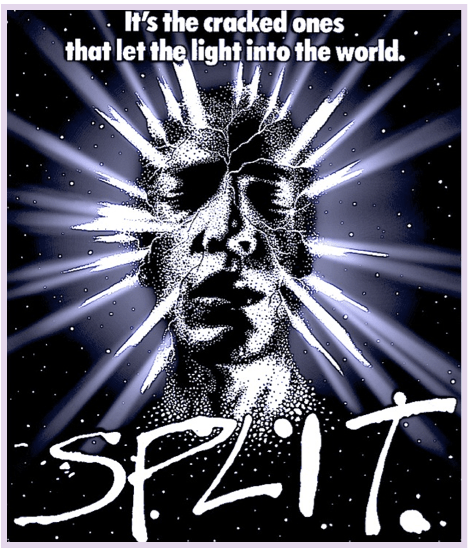
It was with this theory of memory in mind that I had begun to consider Split, a movie that I thought I remembered renting from a video store up the street from my childhood home sometime around 1990. For over a decade, my occasional recollections of the film, often spaced years apart, might prompt a web search with no results, which would then introduce a sense of disorientation: I could not experience the instant gratification of finding some online mention that might confirm that what I remembered was real. Was Split (that was the name, right?) just an Easter Egg written into the script of my past—some sort of Berenstain (sic?) Bears thing? After all, and with all due respect to the films’ creators: if my adolescent mind was going to fabricate a memory, this is the sort of thing it would have come up with.
Originally released theatrically in 1989, and subsequently on VHS in 1991 by Futura Home Video, Split was reissued on DVD in 2018 by Verboden Video and is also available through Alamo Drafthouse’s streaming app, which is how I was able to confirm its existence and watch it again. Spoilers of the film follow, but only insofar as my synopsis is veridical to the plot—a nested disclaimer I wouldn’t need to make if the film were less fractured. Whether its cracked mirror nature is a deliberate mindfuck, the result of freshman filmmaking hamfistedness, or both, is not something I can tell you.
The film opens with Starker, our hero, wandering the streets of San Francisco. His ripped jeans show his bare rear end, and he’s wearing the sort of jagged and discolored false teeth that might have been advertised in old comic books alongside fake vomit and squirting flowers. He walks through a parking lot full of city buses, suddenly looking directly at the camera and yelling, “Stop following me. Leave me alone.” At first, we believe he is addressing us, the viewers, and breaking the fourth wall, but the camera cuts to two men dressed in a mid-‘80s Ivy League casual style—like they just walked out of a JC Penny catalog shoot. One sits at a computer; the other, older and mustachioed, is framed over his right shoulder. The younger man was surveilling Starker, and, as the dialogue reveals, the populace more broadly. He rewinds a recording of Starker’s camera-facing monologue and consults with the older agent, who says Starker is just crazy, but capitulates to the younger agent’s desire for further observation.
They run a face recognition program, presented as a musical montage, in which we see Starker’s head rendered as a 3D model as the camera hops around a black and white grid of similar hairless heads looking for a match. The sequence is still enthralling and somewhat hypnotic after 30 years. This isn’t a real 3D scan of a human head; rather it’s a painstakingly created proof of concept showing us what the technology that would soon become ubiquitous might look like. It dances. We hear pitch-shifted human voices of the sort we might associate with Laurie Anderson’s “O Superman,” and they create a synthetic and escalating harmonic pattern as the facial recognition nears completion.
This is the first of a few similarly rendered and soundtracked scenes that make Split worth more attention than it will ever receive. Analog processes are used to pre-mediate future digital operations, and there is a lo-fi poetry to them. These skies are the color of the ancestors of our flat-screen TVs, their saturations and frequency roll-off the stuff of a time when there really were dead channels, and tuned-in heads bobbed to the tangible yet barely audible click that the phone made just before it rang. Different media have different dispositions, and I explain these in the hope of being descriptive, while mindful of any argument about the veracity of concepts of authenticity.
Jittering a bit and mumbling, Starker heads into a diner and has a seat at a booth. He orders coffee from a waitress we’ll meet again later while speaking in a hybrid of fake European accents. Making a mess while examining a ketchup bottle, then pouring a packet of artificial sweetener onto the table and snorting it up his nose like cocaine, he talks to himself as the surrounding patrons begin to grow nervous. One of them gets up, takes him by the shoulder and leads him outside. At one point the camera lingers for a moment—letting us know that a brightly colored fabric pouch that Starker has left behind means something.
As the film progresses, we watch Starker give the agents surveilling him the slip. After being knocked out and having his jacket tagged with a tracking device, he discovers the device, removes his jacket, and changes clothes to elude his pursuers. To illustrate the process of his being tracked we are treated to a primitive color representation of a 3D vector map of the city. It’s like an isomorphic video game built of an extruded and pastel colored De Stijl painting that says, “Welcome to the control society. Now you’re playing with power.” The whole sequence provides a taste of the ‘90s to come, bringing to mind critiques of the automatic production of space and tactical media projects like the Institute for Applied Autonomy’s iSee and the performances of the Surveillance Camera Players.
Starker retrieves the brightly colored fabric pouch from the trash outside the diner. He dons a new—and more ridiculous—disguise: a stick-on mustache and goatee paired with wire-rimmed glasses, a brown turtleneck, and a beige corduroy sports coat. Setting the scene for an art gallery opening, a lovingly blocked shot of Starker creates the sort of recursion we would associate with a Magritte or Escher through a row of champagne flutes. The camera lingers over a series of paintings reminiscent of Basil Wolverton’s or Erol Otus’s more psychedelic work. Gallery patrons talk trash about the paintings and each other while Starker shoves food in his pockets—John Belushi in Animal House style—as a lovely minimal synth piece by Robert Shaw, the director’s brother and creator of the computer generated effects seen through the film, begins to warble and flutter.
Conversing with the fictional creator of these paintings (in reality those of writer/director Chris Shaw himself), a flat-topped New Waver wearing a mustard yellow dinner jacket over a t-shirt, our ludicrously costumed hero mentions preparing to “wake people up.” As they discuss the artwork hanging on the gallery walls, they stop to look at a storyboard—which we realize is the storyboard of the current scene. As the artist begins to realize the same truth, he becomes enraged. He screams, but none of the patrons seem to notice or care.
The film meanders for a while, if it was not already meandering. We see the junior and senior agents discuss an analysis that reveals no discernible patterns in Starker’s behavior, and they escalate their attempts to find him. Now at the artist’s apartment after the art opening, Starker is coaxed into revealing his plan: “All we have to do is change the program!” he says, later addressing the painter’s skepticism with, “I have the way. The way is here—in my package!” Removing the pouch from an inside coat pocket, Starker then opens it to reveal a white plastic disc approximately the size of his hand. The artist remarks that it resembles a urinal deodorizer.
Starker goes on a tear: “Science is a jealous god.” The mystical “separates us from robots.” “What I am holding is a mutant biological organism.” He almost immediately contradicts himself and says the substance is just a placebo because people require a scientific reason to believe in something and that that is necessary for “the dream” to have power. He explains that he is going to dose the city’s water supply with this substance and then it will spread around the world as people excrete it through their urine. Sort of an Amanita muscaria re-trip meets infrastructural schwerpunkt: The MacGuffin is Elan Vital as urinal cake.
A few meaning-laden but plot-insignificant scenes later, Starker heads back to the diner. After a scuffle in which he startles Susan (the waitress we saw earlier) and she kicks him to the ground, he pressures her to let him hide out at her place. Reasonably viewing him as a crazy and potentially dangerous creep, she declines his offer. But, after following her to her car, he convinces her to relent by claiming that he used to be a veterinarian and that he may be able to explain the lethargy of the cat in a carrier in her back seat. The absurdity of this caged animal suddenly appearing to move the plot along is rendered even more absurd when Susan later explains that she already understood that the cat was lethargic because she had had it sterilized earlier in the day. There is something so metaphorically overt about this detail that I can’t tell if it’s a bad joke or a catastrophic mistake. In any event, Starker seems no less concerned about going home with a woman that left a post-op feline in the back of a car all day than Susan is about bringing home a man who claimed he was being followed and sat in her place of business snorting Sweet and Low through a straw while ranting in a fake French accent.
I will omit a lot of interpersonal awkwardness, strange dialogue, and things that may be significant to alternate interpretations in revealing that Starker crashes at Susan’s place (Pop Tarts and chill). The time they spend together only serves to make her subsequent death at the hands of the Starker’s pursuers insufficiently tragic to motivate his subsequent attempt at revenge. Discovering her murder at the hands of the Izod-clad archons, Starker—now in drag and blackface—follows the agents back to their bosses’ HQ. They enter through a large circular metal door, and Starker, who they don’t realize is following behind, is unable to enter.
Their boss, perhaps too obviously referred to as the “Agency Director” in a film about agency panic, laments his “monstrous” newly installed cybernetic arm. In an abrupt spasm of the plot that seems to indicate that the Director’s body is deteriorating, a lab-coated flunky soothes him by explaining that he has created that ultimate mad-scientist expression of mind-body dualism: a machine that can transfer a mind into another body. The camera cuts to Starker, unseen on the Agency Director’s CCTV, who is loading a pistol. He tries to find a way to open the door while the minions inside hurry to find a body to receive the Agency Director’s mind. The agents open the door and grab Starker, having seemingly no idea that they have apprehended the very person they were relentlessly pursuing earlier. Starker drops his gun in the struggle, and they strap him to a chair and lower a brain transfer apparatus over his head.
“Let me out! It worked!” Starker says, but it’s not clear if the process was successful or if Starker is trying to convince the agents that it was. We’re left to wonder if this Camp Concentration-style mind transfer worked at all. It’s set up as a techgnostic climax that never happens, as if this cyberpunk yacht rock anthem makes it to the guitar solo just as the amp blows. The enraged Agency Director yells and tells his minions to get rid of “her.” They throw Starker out, not seeming to care that this random person just entered their secret bunker, and still not realizing that it was Starker himself.
The final quarter of the film involves agents pursuing Starker while the Agency Director’s body is gradually replaced with a mechanical one. The music is great here and evokes both a sort of period instrumental soft rock call-center hold music and early Chrome. Someone with disposable income should release a proper soundtrack.
Now looking like a lo-fi Robocop or a reject from a Shinya Tsukamoto film, the Agency Director’s cybernetic augmentations (or too on-the-nose self-amputations) have endowed him with new powers. He accesses satellites while issuing abrasively vocoded directives that also appear on a camera-facing screen, perhaps to ensure intelligibility to the audience. Starker’s location is revealed on a map as crescendoing lo-bit sound effects accompany synth pads and drums. “Eradicate!” The Agency Director yells in a Davros-like moment. The camera cuts to Starker hopping over fences and traversing a roadside embankment, while the Agency Director seems to glitch out as he installs one last bionic eye into his head.
Now fully metal-skinned and ambulatory, he walks over to a pool of water inside headquarters. Elsewhere in a meadow, Starker stumbles into a pool himself, grabbing the white disc he revealed earlier. Somehow, both pools have become a sort of fold in space—the Agency Director reaches through and grabs Starker. They struggle, each remaining primarily in their own physical location while their arms bend through each others’ space. Starker breaks free and releases the chemical in the white disc. White dust floats in the air.
The end credits roll (well, melt, actually) and no further explanation is given.
***
Ultimately, outside of the beauty of the graphics and soundtrack, the joy and frustration of Split is that we are confronted with something that we can’t quite classify. Foregrounds and backgrounds of plot and image oscillate and change places, but so do the cues we’d typically use to determine whether or not we approached the material as comic or tragic, accidental or deliberate, high brow or trash stratum.
Watching Split (had I really seen it before?) left me with the distinct feeling that I just missed five minutes of it without leaving my seat. Shaw never really makes it clear what we should focus on, and the director’s commentary on the DVD doesn’t provide much help. There Shaw describes the film as “a dream that doesn’t really explain itself.” He does, however, talk a bit about chaos—not just disorder, but the branch of mathematics we might associate with Lorenz, Mandelbrot, the butterfly effect, and fractals. While history might provide examples of minor perturbations in complex systems causing them to collapse or toggle into alternate states, it seems here that chaos is really just used as a sort of “magic” (in the same way that “science” is used in superhero comics) to attempt to explain how Starker has a capacity for action that exceeds that of the archons that surveil him.
Really thinking about agency as contingent and distributed means something quite different and perhaps far more unsettling. I’d like to tell you that Split reveals a negotiation between ideas of cowboy individualism on one end, and on the other an appreciation of the behavior of complex adaptive systems of which human “individuals” are both composed of and parts of. In reality, the film presents 20th century ideas of autonomy and individuality taken to such an extreme that they become a bit goofy. The film presents an inverse relationship between attachment and individuality. Take, for example, this dialogue between the two primary agents who discover and begin tracking Starker, in which the frustrated junior agent asks:
How can he make it? We all have something: our family, our friends, something, but he… he gets by on nothing. How can he be that free? No human needs, no weaknesses, no feelings, nothing.
As they discuss their pending report to the Agency Director, the senior agent explains that they will just have to tell it like it is:
No recurrent behavior, no attachments, no soft spots: superman.
So, the superman, the “free” man, is the man who cares about no one and has no routine. Attachment to others is presented in the same way that an ascetic might present an attachment to material things, but also as a commodity that the system of surveillance capitalism depicted in the film exploits. In the world of Split, one can either be “free” and thus detached from social forces one can’t actually detach from, or part of some sort of winkingly self-aware Matrix.
Many of the characters, including Susan, the painter, some street crazies, and the pursuing agents, seem to have some awareness that by participating in society they are being had. It’s as if they are wearing the glasses from They Live (1988) but realize that if they call attention to their alien overlords they will just be ignored anyway.
Shaw’s broader argument seems to be that as an “individual” who is truly “free,” Starker exists without a data-body; he’s an Übermensch who cannot be profiled or reduced to his so-called statistical self. As such, Starker stands outside of culture—the infrastructure of shared social and material substrates that both the one and the many call upon to act. But he still has the magic urinal cake, the fulcrum and lever by which he is super empowered.
Like a bad haircut, dosing the water supply with mutagenic hallucinogens seems cool in high school, when we are naive enough to dream that control is simply a matter of centralization and that shocking the dupes out of their somnambulism is something they will high five us for afterwards. But while portrayed as some sort of systems-disrupting black swan herald of a “new age,” maybe Starker—and the film itself—just represents a dance around the collapse of any sort of shared systems of meaning. After all, at the climactic moment when Starker releases the mutagen, the end credits roll. Were not shown what comes next—just the end of the now.
It’s not often that you find a movie that is completely batshit crazy, all the way extra, yet entirely wholesome all in one package. Yet, this is what we have in PG: PSYCHO GOREMAN. Coated with ounces of blood, campy humor, and adolescent sassafras, audiences will be taken through a wackadoo journey that will have their heads spinning. While not quite the type of family film one would put on family night, there is enough family-fun goodness to add this to the list once all members are grown and prepared to have their eyeballs explode. By film’s end, you’ll find yourself unexpectedly wanting the best for everyone, even if it means pure, utter destruction is the end result.
Siblings Mimi (Nita-Josee Hanna) and Luke (Owen Myre) accidentally awaken an ancient alien overlord with no name from a millennia-long prison sentence. Why was this overlord imprisoned you ask? Well, he attempted to destroy the universe after working under an oppressive system that exploited his labor. While the creature has no chill, Mimi is undaunted, especially when it’s discovered that she is in possession of a magical amulet that enables her to force the creature to obey every single command she makes. Every. Single. Command. If you know children well, you know this is an absolutely awful idea.
They decide to give the evil creature the name Psycho Goreman (Matthew Ninaber), which they shorten to PG to keep things easier. PG’s re-appearance, though, triggers attention across the galaxy. There are those who want to destroy him, remembering the destruction he caused eons ago. And there are others who wish to help him, for a price that is. As the galaxy’s creatures start to zero in on this small Earth town, the fate of the galaxy may be up to Mimi and Luke. But first, we get a heavy dose of sitcom-style shenanigans, which sow the seeds of heartwarming payoff that we experience at the film’s end.
Where should anyone really begin when discussing this film? First off, PG: PSYCHO GOREMAN is a practical effects wet-dream. From slowly crawling brain-boys to a suicidal melty zombie police officer to every alien character having their own specific costume that almost reminds of classic Power Rangers episodes mixed with Doctor Who flair, there is so much craft-based love in this film that it made this reviewer positively giddy to see what we’d see next. Knowing the amount of work that went into the effects onscreen, it’s an extraordinarily ambitious undertaking in this day and age. But, in all honesty, it is so worth it to see it come to life onscreen. Forever pro-practical all the way!
With the practical effects aiming to seduce our hearts, we have to keep in mind that this is not all that writer-director Steven Kostanski is bringing to the table for us to consume in PG: PSYCHO GOREMAN. The writing and the delivery of performances from the actors really help to sell the chaos that is taking place onscreen. Matthew Ninaber’s PG’s sinister, almost deadpan delivery contrasts nicely against Nita-Josee Hanna’s manic over-the-top energy she delivers for Mimi. While this reviewer would have loved more levels in Hanna’s performance, the direction and delivery of her character performance still worked well for the over-the-top nature of the film. Adam Brooks is also a notable standout, with his comedic timing and everyman performance providing a much-needed contrast to the adventures of the children onscreen.
The script itself is hilarious and heartwarming, with lines about hunky boys coming out of PG’s mouth that would seem out of place in any other film. Yet, this is a heartwarming, tongue-in-cheek type of film that lends itself to these subtleties, where each character undergoes their own spiritual journey. Just, with wallops of blood, gore, and viscera. These little moments are subtly interwoven in, which maximizes their impact upon arrival due to the black comedy that Kostanski leans into. And, if that isn’t enough for you, the various homages paid to family-style shows in the script really help remind the viewer of the lengths this film will go to remind of what PG: PSYCHO GOREMAN is really about – love and finding your own family. Even if that family consists of a psychotic girl, a mom-turned-administrator of misguided justice, or – even – a bloodthirsty alien warlord.
Overall, PG: PSYCHO GOREMAN is a film that would make an epic Midnighter event at any film festival. It would have been a crowd-pleaser pre-COVID and it certainly will after. This reviewer would argue that it’s the alien warlord version of the little girl paired with bodyguard/former military turned babysitter trope. It’s heartwarming, bloody, incredibly fucked up, and extra as all get out. And, while at times the performances can be more one-note than not, the film just really works. It’s a family film gone wrong, which seems perfectly fitting for the age we’re in now.
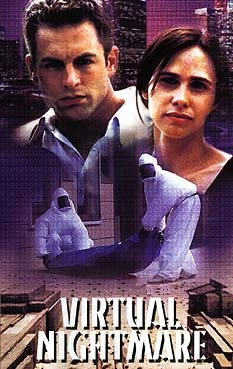
“Virtual Nightmare” (2000) is an Australian television film adaptation of the 1955 science fiction short novel by Frederik Pohl. It was directed by Michael Pattinson and written by Dan Mazur and David Tausik (who two years earlier collaborated for a tv adaptation of Brave New World). Like the stories of Philip K. Dick and the late 90s wave of gnostic films such as Dark City, Fight Club, eXistence, Pleasantville, The Matrix, The Thirteenth Floor, The Truman Show, etc. (some of which were inspired/influenced by PKD), the plot centers on protagonists piercing the veil of a superficial and hegemonic consensus reality.
Astute viewers may also recognize plot elements reminiscent of a couple of other literary works which Pohl’s source novel predates: Eight O’ Clock in the Morning (1963) by Ray Faraday Nelson (a short story adapted into the 1988 film They Live and whose author happened to be a close friend of PKD’s), and The Futurological Congress (1971) by Stanislaw Lem (a satirical dystopian novel loosely adapted for the 2013 film The Congress).
Visually and technically, Virtual Nightmare is comparable to made for television and direct-to-home video sci-fi fare of the late 90s and early 2000s, but where it stands apart is its intelligent and compelling storytelling. It’s a prime example of how limited budget/FX and occasionally subpar acting can be transcended by a narrative addressing eternally relevant questions.
A big shout-out to Tom of Montalk.net for bringing wider attention to this diamond in the rough via random tweet.
"Star Trek: Acid Party." My droogs, this is a most excellent piece of hallucinogenic pop culture mixology: a 40-minute tripification of ST:TNG, featuring 90s electronica, Pink Floyd refs, wild FX, and fart jokes. Smart, funny, disturbing, funky, cosmic. https://t.co/21JgY50AGQpic.twitter.com/43Y38NuIU2
“Dark Star” (1974) is a science fiction comedy directed and produced by John Carpenter and co-written with Dan O’Bannon. The film originated as a USC film project from 1970 to 1972 and expanded to a feature length project in 1974. It plot follows the mentally deteriorating crew of the starship Dark Star, twenty years into their mission to destroy unstable planets that might threaten future colonization of other planets.
Dark Star was the feature directorial debut for Carpenter, who also scored and produced the film. It was also the feature debut for O’Bannon, who also served as editor, production designer, visual effects supervisor and actor.
Blade Runner, and the work of Philip K. Dick, continues to find its way into our cinemas and minds. How did the visions of a paranoid loner become the most relevant science fiction of our time?
You are an unusual man, Mr. Asher,” the cop beside him said. “Crazy or not, whatever it is that has gone wrong with you, you are one of a kind.”– Philip K. Dick, Flow My Tears, The Policeman Said.
“I’ve seen things you people wouldn’t believe…”
— Roy Batty, Blade Runner.
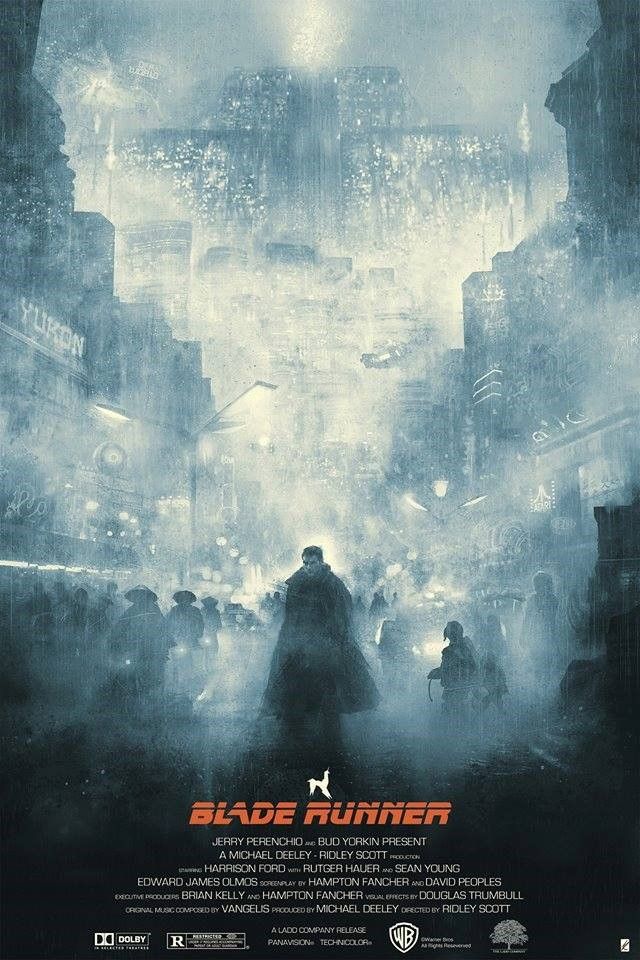
Los Angeles, 2019. The script simply reads: “Ext. Hades – Dusk”. Chemical flame bursts into the perpetual, post-nuclear Los Angeles gloom from skyscraping smokestacks, rising out of an industrial landscape Hieronymus Bosch might have envisaged. Flying cars flit through the darkness like fireflies. The camera moves slowly over impossible architecture with the immensity and decaying grandeur of ancient Egypt; a phantasmagorical megalopolis strung with necklaces of neon. The music rises.
The last war is over and nobody won. The Earth is living on borrowed time. Science has destroyed all boundaries between the real and unreal except those we choose to impose. Policemen are murderers, androids are lovers, nobody can be trusted, and everybody dies. Welcome back to the world of Blade Runner. Every time we return, it becomes more recognisable. Perhaps we never left.
Santa Ana, 1981. By now, Philip K. Dick — author, religious visionary and possible schizophrenic, who once said “You would have to kill me and prop me up in the seat of my car with a smile painted on my face to get me to go near Hollywood” — has read and approved the shooting script for Blade Runner by Hampton Fancher and David Peoples, as well as viewed a test reel of the movie’s groundbreaking special effects. In an effusive letter to Jeff Walker, the man in charge of the film’s marketing. Dick makes his prophetic opinion clear.
“Let me sum it up this way,” he wrote. “Science fiction has slowly and ineluctably settled into a monotonous death: it has become inbred, derivative, stale. Suddenly you people come in, some of the greatest talents currently in existence, and now we have a new life, a new start. As for my own role in the BLADE RUNNER project, I can only say that I did not know that a work of mine or a set of ideas of mine could be escalated into such stunning dimensions. My life and creative work are justified and completed by BLADE RUNNER… It will prove invincible.” (‘Letter to Jeff Walker regarding Blade Runner“ on Philip K Dick.com)
Dick, with a writer’s knack, chose the right words. Blade Runner has survived everything that could be thrown at it, including its initial critical reception, successive unsatisfactory edits, and dilution by both the science fiction genre and the film industry, which would plagiarise its vision with varying degrees of shamelessness for the next three decades. Yet nothing has been able to replicate its unique synthesis of elements, melding equal parts noir, action, romance, cyberpunk, dystopia and a meditation on what it means to be human. Whether praised or disparaged, ignored or overexposed, it has seen off all critics and challengers. Blade Runner‘s invincibility endures.
Unfortunately, the inimitable artistic fortitude of Ridley Scott‘s best work also allowed Hollywood to practice its favourite hobby of missing the point. The novels (or rather, in the film industry netherworld, ‘properties’) of Philip K. Dick — a writer largely unappreciated in his own lifetime who, at his lowest, claimed he he could not afford the late fee for a library book and infamously sustained himself on horse meat from a local pet store — have become highly prized and sought-after by studios eager to import intelligent ideas, rather than go through the hassle of conceiving their own. In the (twisted) spirit of Dick’s short story “We Can Remember It For You Wholesale“, no need for originality, we can develop it for you wholesale.
Question the nature of identity with Colin Farrell’s Douglas Quaid /Hauser as he flees the futuristic gunfire in the remake of Len Wiseman’s Total Recall (2012, an adaptation of an adaptation, as it were). Consider the limitations of free will with Tom Cruise’s Chief John Anderton (a well-known fan of unstable science fiction writers) in Steven Spielberg’s Minority Report (2012) while wondering how short he really is. Watch Jon Woo’s Paycheck (2003) and wonder how much Ben Affleck is actually being paid to appear in this piece of shit.
The names change, but the formula remains the same. Each summer, there must be blockbusters, and to fill the gaps in between the explosions with the barest bones of a Phil Dick story is, to the studio mindset, to buy instant, ready-made philosophical depth and artistic worth. Just add CGI!
Improbably, with 11 films based on his work and more in the pipeline, Dick has become the most adapted science fiction author in cinema history… And I’m not sure that’s a good thing.
“It’s a film about whether or not you can have a meaningful relationship with your toaster.” — Harrison Ford on Blade Runner in an interview with The Washington Post, 11 September 1992
That Scott is a director second only to George Lucas in his determination to tinker with a bygone masterwork until it meets his ultimate, exacting satisfaction (at last count, there are seven different versions of Blade Runner floating around the ether, finally culminating in Scott’s so-called ‘final cut’ in 2007), when a startling new interpretation of the film appeared online this June to wild acclaim, he had nothing to do with it. Instead, it was the work of the artist Anders Ramsell, who painstakingly recreated every frame of the movie’s opening 13 minutes with 3,285 gorgeous, haunting, impressionistic watercolours.
Dick, with a writer’s knack, chose the right words. Blade Runner has survived everything that could be thrown at it, including its initial critical reception, successive unsatisfactory edits, and dilution by both the science fiction genre and the film industry, which would plagiarise its vision with varying degrees of shamelessness for the next three decades. Yet nothing has been able to replicate its unique synthesis of elements, melding equal parts noir, action, romance, cyberpunk, dystopia and a meditation on what it means to be human. Whether praised or disparaged, ignored or overexposed, it has seen off all critics and challengers. Blade Runner‘s invincibility endures.
Unfortunately, the inimitable artistic fortitude of Ridley Scott‘s best work also allowed Hollywood to practice its favourite hobby of missing the point. The novels (or rather, in the film industry netherworld, ‘properties’) of Philip K. Dick — a writer largely unappreciated in his own lifetime who, at his lowest, claimed he he could not afford the late fee for a library book and infamously sustained himself on horse meat from a local pet store — have become highly prized and sought-after by studios eager to import intelligent ideas, rather than go through the hassle of conceiving their own. In the (twisted) spirit of Dick’s short story “We Can Remember It For You Wholesale“, no need for originality, we can develop it for you wholesale.
Question the nature of identity with Colin Farrell’s Douglas Quaid /Hauser as he flees the futuristic gunfire in the remake of Len Wiseman’s Total Recall (2012, an adaptation of an adaptation, as it were). Consider the limitations of free will with Tom Cruise’s Chief John Anderton (a well-known fan of unstable science fiction writers) in Steven Spielberg’s Minority Report (2012) while wondering how short he really is. Watch Jon Woo’s Paycheck (2003) and wonder how much Ben Affleck is actually being paid to appear in this piece of shit.
The names change, but the formula remains the same. Each summer, there must be blockbusters, and to fill the gaps in between the explosions with the barest bones of a Phil Dick story is, to the studio mindset, to buy instant, ready-made philosophical depth and artistic worth. Just add CGI!
Improbably, with 11 films based on his work and more in the pipeline, Dick has become the most adapted science fiction author in cinema history… And I’m not sure that’s a good thing.
“It’s a film about whether or not you can have a meaningful relationship with your toaster.” — Harrison Ford on Blade Runner in an interview with The Washington Post, 11 September 1992
That Scott is a director second only to George Lucas in his determination to tinker with a bygone masterwork until it meets his ultimate, exacting satisfaction (at last count, there are seven different versions of Blade Runner floating around the ether, finally culminating in Scott’s so-called ‘final cut’ in 2007), when a startling new interpretation of the film appeared online this June to wild acclaim, he had nothing to do with it. Instead, it was the work of the artist Anders Ramsell, who painstakingly recreated every frame of the movie’s opening 13 minutes with 3,285 gorgeous, haunting, impressionistic watercolours.
The painting technique employed to create this effect is known as aquarelle, which also acts as a sly commentary on Blade Runner‘s repeatedly-rejiggered legacy: because of its transparency, with aquarelle nothing can be painted over — once a mistake has been made, it has to be lived with. But as I watched what Ramsell called his ‘paraphrase’ of the movie, the familiar scenes and faces and voices emerging from the flickering, sensuous wash of colour, it seemed all the more appropriate. Other than Derek Jarman’s Caravaggio, I can think of no other film that so looks like a painting without paint — a piece of art that evokes other art, and yet remains entirely itself.
This is all a long way of saying that Blade Runner is beautiful, in almost every way possible. This has, ridiculously, sometimes been described as being to its detriment: Roger Ebert, one of the film’s more famous naysayers, wrote in a contemporary review in the Chicago Sun-Times that “It looks fabulous… but it is thin in its human story,” (11 September 1992) an oddly myopic remark to make about a parable on the nature of humanity. True, Blade Runner has an embarrassment of style, but never at the expense of substance, much like the best examples of the Cinema du look movement, which was just emerging in French cinema at the time of Blade Runner‘s release. Indeed, in appearance and atmosphere, Blade Runner is so distinct that it changed the aesthetic of science fiction, and new subgenres have since been invented simply to describe it — ‘future noir’, coined by the critic and filmmaker Paul M. Sammon, being the most enduring.
To those who have yet to experience the film, I wonder what to say that has not been said elsewhere. Based on Philip K. Dick’s 1968 novel Do Androids Dream of Electric Sheep?, Blade Runner somehow manages to be simultaneously the truest adaptation of Dick’s work yet produced — in spirit, if not plot — and also the freest in its interpretation of the material.
The central premise remains in both book and film; Rick Deckard (Harrison Ford), halfway between policeman and bounty hunter, makes his living by tracking and killing androids that are almost entirely indistinguishable from humans, living amongst us under false identities. The supposed test for distinguishing real from unreal humans is that of empathy, but as Deckard methodically adds to his ‘artificial’ bodycount, he begins to question who is really the unemotional machine.
Blade Runner dumps much of the novel’s narrative furniture — Scott justified this to Dick by saying: “You know you’re so dense, mate, that by page 32, there’s about 17 storylines” — in a way that, in almost any other adaptation, would be considered sacrilege. Most noticeably, in the novel, Deckard is trapped in a barely functional marriage, while in the movie, Harrison Ford’s laconic protagonist is the classic bachelor gumshoe.
Also prominent in the book are ‘Mercerism’, the religion based around its followers’ empathy for a man whom others were throwing rocks at, and the ‘Mood Organ’, the household device which stimulates any mood the user wishes to experience, and which much of the population now depends on in order to face another bleak, post-apocalyptic day — two tragicomic creations typical of Dick, but too wry to fit with the Blade Runner‘s overall tone. Despite such changes, Dick’s reading of the screenplay convinced him that this film could express his ideas in a way he had not thought possible.
The production could hardly be called smooth. Even before its release, troubling rumours had begun circulating, and as Paul M Sammon wrote ,”by the time BR (Blade Runner) officially completed principle photography in July on 1981, the gossip has become more specific — BR‘s workload had been horrendous, its shooting conditions miserable, and its director, difficult. Moreover, the whispers went, BR’s moneymen were unhappy, its leading man had clashed with his director, and the crew had been near revolt.” Some of these stories were indeed true, but one should bear in mind that movie moneymen are nearly always unhappy, and Harrison Ford will always be the man who told George Lucas that “you can type this shit, but you sure as hell can’t say it.”
Paranoia Runs Through Blade Runner Like a Knife Edge
When Blade Runner was first released, the reviews ran from lukewarm to underwhelmed to baffled, a fact that many critics have been doing their best to forget in the intervening years, polishing the film’s legend in a frantic effort to make up for missing the boat first time round. Considered today, in our gleaming plastic future of bad credit and worse politics, where we are reliant not on humanised robots but dehumanising gadgets, and where much of the movie’s retro-futurism appears as quaint as it does prescient, what is left to say about Blade Runner?
Should I recite the plaudits that have become ritualistic? Should I point out the Roy Batty’s (Rutger Hauer) ‘tears in rain’ monologue is among the most moving and eloquent ever written or performed? Or that Vangelis revolutionised jazz, electronic music and film scoring simultaneously in one of the best soundtracks ever composed? Is it really necessary to highlight the acting of all involved; Harrison Ford as one of the best soulful detectives to grace noir of any kind, an understated and heartbreaking Sean Young (as Rachael), a dangerous but innocent Daryl Hannah (as Pris), or Rutger Hauer’s mixture of the psychotic and the Shakespearean? Do I need to praise the costumes, the set design, or the script which balances so many themes, so many hidden or implied meanings, with such grace and economy?
Well, yes. You want a criticism of Blade Runner? I would’ve liked more of Edward James Olmos’ Gaff. He’s cool. I also want Deckard’s coat.
But we need to be reminded of these things, every now and again, as each new generation discovers the film afresh, and especially when the next logical question becomes: how did Blade Runner get it so right, more so than any other adaptation of Dick’s work since? What did it understand that they did not? To try and answer that, we have to go back to the source.
“Phil acknowledged that his talk sometimes sounded like “religious nonsense & occult nonsense” — but somewhere in it all was the truth. And he would never find it. God himself had assured him of that.” — Lawrence Sutin, Divine Invasions: A Life of Philip K. Dick.
In 2000, at the one and only Disinfo Con — a friendly gathering of millennial deviants concerning all things ‘counterculture’ — Grant Morrison, a writer who could arguably be counted as one of Dick’s prodigious bastard literary offspring, opened his keynote speech marvelling at the fact he spent his youth reading Robert Anton Wilson and now, all these years later, “we’re standing here, we’re talking about this shit and it’s real.”
Fans of Philip K. Dick have been feeling like that since at least the ’70s, when the dark realities on the other side of the Drug Revolution and the true possibilities of an all-powerful Nixonian surveillance state were becoming painfully apparent. Then as now, we use Dick’s paranoia to express our own.
Dick once commented that, with the making of Blade Runner, what had once been a private world that only he inhabited was now open to all; they would live in its murky depths, just as he did every day. At first, one might think that a paranoid and delusional visionary — and I use the word in its most literal sense — would want nothing more than for others to see and experience what he does. But perhaps Dick didn’t want anyone in his world. Maybe he didn’t think his world should be suffered by anyone else.
The fantastic, tortured mind of Philip K. Dick has been discussed, analysed and treated like an object of supreme curiosity since his death in 1982 (a few months shy of Blade Runner‘s release) and before. He had eked out an impoverished existence writing science fiction since the ’50s, when it was less a genre than a ghetto, and could only make a living by producing at a furious pace which he fuelled with huge amounts of amphetamines, at one point producing 12 novels over the course of two years.
But Dick was ever a seeker of truth, which made him, strangely, something of an oddity in science fiction. Within these novels, beneath the aliens and spaceships, moon colonies and interstellar wars, was arguably the best satire being done in science fiction on American life outside of Kurt Vonnegut‘s oeuvre, the philosophical undertones and untrammelled, often gothic imagination of which called to mind Jorge Luis Borges more than Isaac Asimov. The uniting thread that runs through his work — and, eventually, his life — is the notion that reality, as we know it, is fundamentally untrustworthy.
As the ’60s wore on, Dick’s involvement with the drug culture increased, adding a psychedelic aspect to both his ever-evolving philosophy and his ever-present paranoia. In 1971, Dick experienced a defining moment: his home was broken into, his safe blown open, and many of his personal papers burglerized. He never discovered who was responsible, though he had many suspects — local drug addicts, Black Panthers, the police, the FBI, the Soviets, or any of these, pretending to be one of the others.
The effect it left on Dick was to give him proof, unexplained and terrifying, that his paranoia was somehow justified. There had been comfort in simply telling himself he was crazy. But after years of grappling with his mental health, someone, it seemed, truly was out to get him.
“I mean,” he told the Aquarian magazine in a 1974 interview, “it’s a very frightening thing when the head of a police department tells you that you better leave the county because you have enemies, and you don’t know who these enemies are or why you’ve incurred their wrath.”
When one is peripherally aware of one’s own tenuous psychological condition (which we must be, we tell ourselves, if we have any hope of overcoming it), the uninitiated cannot imagine the sheer anguish, the self-doubt, the fear that follows when you know you cannot trust your own mind, and you cannot trust anyone to help you. The luckiest paranoids are also egotists, or better yet, megalomaniacs; they face the lurking forces of imagined persecution with a defiant roar or a knowing smirk.
Dick, on the other hand, was a sensitive, fragile, frightened soul, as well as a possible undiagnosed schizophrenic. His subsequent religious experiences — a series of hallucinations in which a beam of pink light connected him with a “transcendentally rational mind” — may have been his brain’s attempt to soothe his paranoia, or merely the next stage of his mental instability. In either case, as always, it provided inspiration for another novel.
Critics and biographers often talk about Dick’s paranoia and delusions like they were shocking fashion statements or extreme political opinions — just another interesting aspect to the bizarro image of a literary titan. What they don’t say, although the evidence is all around us, is that Dick’s paranoia is ours, as well. Ours may not have such colourful outlets or dramatic results, but we shall always carry our paranoia with us. It cannot be blotted out. There will forever be dark fears lurking in the deeper pools of our mind about our untrustworthy friends, co-workers, policemen, criminals, the FBI, the CIA, the Communists, the aliens, or God himself… and beyond. Existence will always be open to question, forever taunting us with its uncertainty. We can’t trust reality, but we have to live there.
This paranoia runs through Blade Runner like a knife edge. You cannot trust others, or yourself. You cannot trust your memories, your past, or your future. The entire world may be against you, even if it doesn’t appear to be. Then again, you don’t have to like it.
The heroes and villains of Blade Runner do not like, or accept, the oppression of the paranoid worldview. Deckard fights a series of seemingly impossible battles, even against what he thought was true, and finds romance where it should be impossible. Roy Batty, the leader of the renegade replicants, fights against death itself, seeking to extend and outlive his designer-mandated expiration date. The inhuman fights to become human, so humans must prove their humanity. This is the message at Blade Runner‘s core, and it has never been replicated.
Near the end of Dick’s 1976 novel Radio Free Albemuth, the protagonist, an author surrogate for Dick who also writes pulp science fiction, is faced by a gloating representative of the government conspiracy that the writer has become entangled with, who coolly informs him they will continue to put out books under his name — lurid trash scattered with a few of the author’s trademark concepts to keep it recognisable for his fans, but encoded with non-too-subtle propaganda messages designed to keep its readers afraid and unenlightened.
At our most cynical, it’s sometimes difficult not to think of Hollywood the same way: trading on Dick’s name and style and core ideas, but discarding the message and the mind behind them.
Authors often have to face a string of misfires and misinterpretations before their work gets the cinematic treatment it deserves; Dick, on the other hand, got a masterpiece on the first go. And it remains ours to enjoy: Blade Runner, as Dick wrote, is invincible.
Maybe it’s finally time for Hollywood to leave the legacy of Philip K. Dick at the local bookstore, where it belongs.
“What matters to me is the writing, the act of manufacturing the novel, because while I am doing it, at that particular moment, I am in the world I am writing about. It is real to me, completely and utterly. Then, when I’m finished, and I have to stop, withdraw from that world forever — that destroys me… I promise myself: I will never write another novel. I will never again imagine people from whom I will eventually be cut off. I tell myself this… and, secretly and cautiously, I begin another book.” — Philip K. Dick, “Notes Made Late At Night By A Weary SF Writer”, 1968.







 After the Crash