Saturday Matinee: Shapito Show ( aka Chapiteau Show)

Realist Dreams

Sergei Loban’s Chapiteau-show (Shapito Shou, 2011)

By Moritz Pfeifer

Source: East European Film Bulletin

Chapiteau-show may be the most untypically Russian film to come out in years. It neither resembles one of those spiritually drenched films about characters in the search for the meaning of life; nor is it close of becoming a naturalistic drama about crooked cops and suburban violence. Chapiteau-show is colorful, and chaotic; there are musical interludes, and dances; characters dress up, or go naked. Chapiteau-show is unorthodox. But despite its almost four-hour length, the film is remarkably straightforward. There are four stories entitled love, friendship, respect, and collaboration. Each of these stories is about a young man trying to find more of the category that gives his story a title, but they end up where they began. What they were looking for was an illusion. Each episode closes in the circus called Chapiteau-show, where the protagonists are invited to give a show, and meet again – in a sort of therapeutic ritual – to acknowledge that the world is made up of theatrical tricks, dreams, and fantasies.

In the first part – love – Aleksei (Aleksei Podolsky), a balded gamer, goes on vacation with the beautiful actress Vera (Vera Strokova). Having only met on the internet, they try to get to know each other, but it quickly turns out that they are too different to match. In the second episode – friendship – a deaf baker leaves his deaf friends behind to join a group of boy-scouts. He wants to prove to himself that he can also hang out with people that are not like him. But his new friends have a different idea of “friendship.” Some of them turn out to be lovers, so when his old friends swear true brotherhood he begs on his knees for them to accept him again. The third episode – respect – is about a son’s relationship with his father. The depressed son, Petr Nikolaevich, tries to impress his father by going on a venturous hiking trip with him. But he doesn’t make it all the way, breaking off the trip during a hunt in the woods. A producer is in the midst of the last episode – collaboration. Sergei wants to make money with so-called “ersatz-stars.” But his idea fails when he hires a carpenter to represent Victor Tsoy. In the end the carpenter is hired by the Chapiteau-show, and the producer left off without ideas, stars, or money.

Chapiteau-show shows how people are unable to significantly change the specific environment they live in. The irony of the film is that while in each of the four episode someone sets out to go on a road-trip to find a meaning in life, the only meaning presented to him at end of the trip is right where he left off. The film’s four variations have a clear message. It doesn’t matter who one wants to be. It is who you are that matters. The encounter with the young men’s desires and dreams shows them who they really are. The deaf baker is only forced to think about friendship when he sees how other people behave that also define themselves as friends. But instead of holding on to his dream or destroying the dream of others, he simply appreciates his own reality. It is this notion, that makes Loban’s film so unique. It may have parallel realities as a plot subject, but not as as moral suggestion.

I recently wrote an article on how birch trees, in Russian cinema, represents spiritual longing, the search for truth, peace and harmony. There is one scene that takes place in a birch tree forest in Loban’s film, too. It is when Petr, in the respect episode, decides to abandon his father and his wish to impress him. One could say that the choice of the birch tree forest for this particular scene is ironic. Whereas in most Russian films, like in Zvyagintsev’s The Return, or Federochenko’s Silent Souls, the trees underline the spiritual force of the characters dreams, Loban turns the signification around and makes his character’s dream die in the same setting. But the point is, in my opinion, not to provide an anti-metaphor, or to deconstruct the symbols of Loban’s cultural forefathers. Loban acknowledges the artistic meaning of the trees. He doesn’t deny that dreams for peace and harmony exist. Indeed, the motivation for Petr to impress his father is similar to the narrative of Zvygintsev’s The Return. This film is also about the relationship between two boys and their father, and a voyage the three make into wilderness. Even though Zvyagintsev’s film is far from reconciling, the film lacks Loban’s realism. It has a deep nostalgic feel to it. The distance between father and sons is like a lament, like a a betrayal. Unlike Chapiteau-show, The Return hangs onto the dreams of reconciliation. Even if it there is no space for real harmony in his film, there are the birch trees, and the equilibrium of nature to tell us that harmony is possible and that violence, hatred, and angst are opposed to it.

Dreams are part of reality, they may even shape reality, but the naked, commonplace, boring reality is different. Where one may think that Loban’s characters celebrate their dreams in the performances of the Chapiteau-show circus, they really celebrate their dream’s farewell. Loban follows this plea aesthetically. His film is full of pop-cultural and sophisticated references from Marylin Monroe to the Pirates of the Caribbean; from Levi-Strauss, and Goethe to Kubrik and Lynch. But these citations don’t have a chaotic postmodern feel. They simply show, on an artistic level, what the characters already told us. It is impossible to escape imitation; to be more beautiful, fancy, glorious, and glamorous is part of life. But there is no need to be nostalgic when life still turns out to be the boring, commonplace reality one tried to escape.

Watch Shapito Show: Love & Friendship at Soviet Movies Online here: https://sovietmoviesonline.com/comedy/shapito-shou-lyubov-i-druzhba

Watch Shapito Show: Respect and Cooperation at Soviet Movies Online here: https://sovietmoviesonline.com/comedy/shapito-shou-uvazhenie-i-sotrudnichestvo

Saturday Matinee: Zerograd (aka Zero City, City of Zero)

Review by Movies Unchained

Absurdity can take many different forms, particularly when it comes to artistic expression, with many individuals over the past century making their living from subverting the central tenets of reality. One such artist was Karen Shakhnazarov, whose ambition film Zerograd (Russian: Gorod Zero) holds the distinction of being one of the most bizarre works of cinema produced in the last few decades. A strange, hypnotic voyage into a darker version of the world, this film feels like the perverted offspring of David Lynch and Andrei Tarkovsky (especially if they collaborated on a twisted version of Alice in Wonderland), and I don’t think there is a single moment in this film that I was in complete awe of. Cinema is supposed to be challenging, and it doesn’t get more impenetrable than this, where Shakhnazarov takes us on a voyage that is somehow both hilarious and utterly terrifying, showing us a side of society that isn’t familiar to anything the best of us have experienced ourselves, but still manages to be as captivating as anything else. A deliriously work of experimental dark comedy, Zerograd is quite an achievement – and kudos has to go to Shakhnazarov for managing to construct something so bewildering, yet so deeply brilliant in both how it provokes certain ideas while remaining quite stable and consistent in its message (at least after we actually figure out what this film is attempting to convey), which creates a sensational piece of filmmaking that tests the boundaries of reality and presents the viewer with something so singularly unique, one would be forgiven for believing that Zerograd isn’t actually a film, but a fever-induced bout of delusions – and for all these reasons and more, we can easily proclaim this film as something of a hidden masterpiece, an outrageous, disconcerting surrealist odyssey that is as entertaining as it is wholly disruptive, both to the art form in which it was made and in terms of the broader socio-cultural implications embedded within it.

The film centres on Alexey Varakin (Leonid Filatov), a regular civil engineer who is sent to a small town in the middle of nowhere to meet with the owner of a factory to discuss some of the products they have been supplying. What was supposed to be a brief day-trip turns into what appears to be an eternity, especially when it becomes clear that everything isn’t what it seems in this mysterious countryside hamlet. His visit takes a horrifying turn when Alexey witnesses the suicide of a chef, which not only traumatizes him, but also places him at the centre of a conspiracy that points to him as the chief suspect, especially when the perspective of the event changes from suicide to a murder. What Alexey doesn’t realize is that he is stuck here – it is physically impossible for him to move beyond the borders of the town, since there are certain metaphysical forces keeping him there. This is made clear when he visits a museum, where the crotchety curator (Yevgeny Yevstigneyev) gives him a tour, taking him to subterranean levels and relaying the history of the town, which stretches all the way back to the formative years of the USSR and the rise of communism across the Soviet Union. Despite being a mild-mannered working-class man, Alexey is seen as something of an anomaly in this town, a stranger sent there by some celestial being to disrupt the lives of the residents – but it soon becomes clear that he’s not the one to fear, since a looming sense of foreboding lingers over the town, and causes the protagonist to reevaluate not only his own life, but the entire concept of reality in general, as everything around him is starting to point to the fact that everything Alexey knew to be true is quite possibly false information, and he himself is at risk of losing his identity as a whole if he doesn’t solve the problem before its too late.

Zerograd is a very different kind of film in every conceivable way. It positions itself as something of a mystery film, but one that dares to ask what happens when someone is investigating something and searching for the truth when every clue not only distances him further from the answer, but proves the incredulity of reality as a whole. This is a mystery film that struggles to even ask a coherent question – if anything, the answers are there, if only we knew where to start looking for them. Shakhnazarov masterfully constructs one of the most fascinating films of its era, a hauntingly dark comedy that eviscerates the very idea of plausibility, going beyond the confines of surrealism and becoming something else entirely, a kind of cold-blooded psychological horror that is more terrifying the more we realize how the sense of danger isn’t just constructed for dramatic purposes, but rather a fundamental aspect of the story. Modern audiences tend to equate the concept of surrealism with the idea of weird works that are artistically transgressive and show a lack of logic – and while this is often very true, its a baseline assessment that can’t apply particularly well to a work like Zerograd, which thrives on its ability to deconstruct nearly every sacrosanct truth while still retaining a coherent, concise narrative that goes to some bizarre narrative territory, but only for the sake of supporting its own ambitious ideas. There are many aspects of Zerograd that positively yearn to be discussed – and I’d expect some background knowledge of Soviet-era politics, while not essential in any way, would only enrich the experience, and help add context to a work of unhinged socio-cultural satire that masters the fine art of amusing the audience while gradually dismantling their deep-seated beliefs, to the point where we too get lost in this world, and begin to question our own individual realities.

We never quite know where this film is heading, and like any work of great surrealism, a clear sense of direction is entirely inconsequential. A brief roadmap of ideas is presented at the outset of Zerograd, but for the most part, it functions as a stream-of-consciousness odyssey that launches us into an uncanny world that feels familiar, but where the smallest inconsistencies prevent us from ever being at ease. The character of Alexey is our surrogate, an ordinary man thrown into these strange circumstances, and forced to navigate a side of the world he isn’t only unfamiliar with, but struggles to understand in any meaningful way. There is certainly some strange occurrences that take place throughout this film, with these events ranging from mildly amusing in how offbeat they are, to fully terrifying, especially when they hint at something far more sinister lurking beneath the surface. There’s quite a bit to digest when it comes to this film, where each individual idea can be unpacked – but as should be familiar to any devotee to the school of surrealism, the more you provoke a theme, the less effective it is. Zerograd works most effectively when each individual concept is taken as part of some larger whole, and while the details make for a fascinating film, the brilliance comes in the cumulative power, the gradually-compounding unearthliness that indicates that the eccentricities embedded within this story are not there merely for the sake of perplexing the audience, but rather to manipulate the entire concept of reality and everything it stands for, which is precisely what makes this such a remarkable film. It only makes the actual filmmaking more effective – Shakhnazarov constructs such a magnificent odyssey, where each frame is stunningly detailed, detached from reality in a way that doesn’t confuse us, but still points towards a more haunting alternative. There are some unforgettable images in this film, such as when the main character is served a cake that is modelled after his own head, or the striking final shot where he is finally able to makes his escape – and when taken alongside the brilliant story, we have a truly memorable work of speculative fiction.

Zerograd is a film in which the plot doesn’t revolve around the fact that nothing seems real – this is a film where we know for a fact that absolutely nothing we are seeing makes sense, but yet it is so grounded in some fundamentally realistic ideas, it never feels too far-fetched. There is an eerie sense of foreboding that intermingles with the darkly comic underpinnings to create quite a memorable piece that delves deeply into looking at the themes of identity and freedom, two concepts that are often explored in Soviet-era literature, albeit not in quite as bizarre a way as here. Shakhnazarov is a masterful filmmaker who produced something truly incredible with Zerograd, crafting a surreal odyssey that feels so compelling, even when it is clear that it is not afraid to venture beyond the confines of all known logic. This is the kind of film that people should be referring to when they’re describing the concept of a Kafka-esque story, since everything about Zerograd feels like something the esteemed but troubled author would write – a mysterious setting, a protagonist thrown into a world he doesn’t understand, eccentric characters that are so familiar yet so deeply unsettling, and a general sense of danger that never quite abates, constantly following the protagonist (and by extension, the audience) the further we journey through this strange world. This is a film that should be seen and discussed, even if the most insightful academics would have trouble coming to terms with the ideas Shakhnazarov uses throughout the film. In short, Zerograd is an astounding achievement, a bewildering but truly worthwhile absurdist masterpiece of Russian cinema that traverses reality and comes out of it stranger and more profoundly fascinating than ever before.

Saturday Matinee: Hard To Be A God

Source: Kanopy

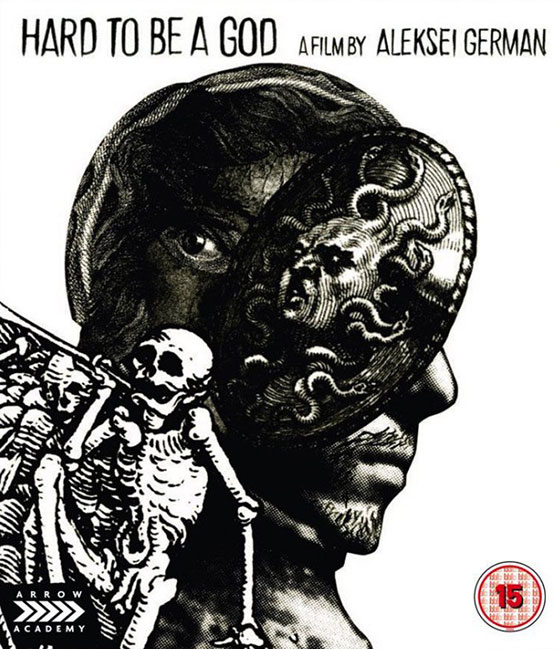
When legendary Russian auteur Aleksei German died in 2013, he left behind this extraordinary final film, a phantasmagoric adaptation of the revered sci-fi novel by the Strugatsky brothers (authors of the source novel for Tarkovsky’s Stalker). Hard to be a God began percolating in German’s consciousness in the mid-1960s, and would actively consume him for the last 15 years of his life.

He brought the film close enough to completion for his wife and son to apply the finishing touches immediately after his passing. Taking place on the planet Arkanar, which is in the midst of its own Middle Ages, the film focuses on Don Rumata (Leonid Yarmolnik), one of a group of Earth scientists who have been sent to Arkanar with the proviso that they must not interfere in the planet’s political or historical development. Treated by the planet’s natives as a kind of divinity, Don Rumata is both godlike and impotent in the face of its chaos and brutality.

Running Time
179 mins
Year
2013
Kanopy ID
1173813
Filmmakers
Aleksei Yuryevich German
Features
Dmitriy Vladimirov, Laura Lauri, Leonid Yarmolnik
Languages
Russian

Watch the full film here.

LEVIATHAN: The end of history has arrived and it is in post-Soviet Russia

leviathan

By Lauren Carroll Harris

Source: Adbusters

Within contemporary Russian film, it seems there is an ability to make the grandest statements from the smallest stories. From the insides of tiny flats, dying towns and treeless bays, directors like Andrey Zvyagintsev are able to tell big morality tales of corruption, futility, class and superstition that are at once national and universal in their scope and ambition. Zvyaginstev’s latest film, Leviathan, offers the newest iteration of these massive themes.

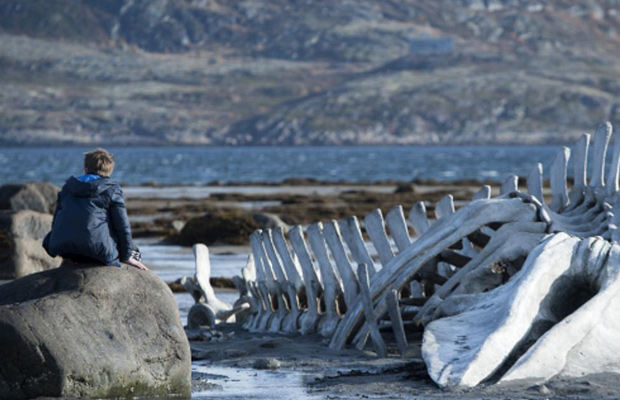
Our ‘Job’, Kolya, is a hotheaded everyman, whose house and land are to be seized, razed and developed by the corrupt major. His old lawyer friend from Moscow, Dmitri, must resort to blackmail to defend him, his second wife Lilya looks on despairingly, and his son Roma is busy learning how to drink in the ruins of a nearby church. Our protagonist is never idealized, nor is his gut reaction – to fight – rendered noble, it is merely taken for granted that he is on the edge of a last chance cliff. This is a story of one man against a terrible system and his fate is sealed from the start. It follows that even Leviathan’s portrayals of beautiful things are heavy with doom: the whale carcass in the film’s poster is the film’s strongest visual statement of political futility.

In all these contemporary Russian films I’ve seen – Zvyaginstev’s third film Elena, last year’s The Fool – concepts of social justice are dismissed as naive. The protagonists inch closer to their foregone conclusions blindly, the humor is black and the philosophical currency is fatalism. As in last year’s Two Days, One Night, there is humanity in the fightback, but unlike that film, Leviathan and its cohort underline the tragedy and futility of the fightback. The tides, the courts, the politicians, the priests – all carry on, undeterred. The end of history may have arrived, but not in post-Soviet Russian cinema, where it is accepted that history merely repeats, and repeats and repeats. What if there’s no march of progress? What if the world is growing flatter? Those questions at Leviathan’s heart are threatening for their antithetical stance to one of capitalism’s most inherent and foundational myths: that progress and growth is happening and will always happen. But what I found the most demoralizing thing about Leviathan is that it forestalls the march of progress because its only vision of post-capitalist political change is backwards – towards Stalinism. In that respect, the film is emblematic of the world’s lack of political imagination of visualizing alternatives to the current neoliberal ways of doing and thinking – in that way it is complementary with capitalism’s ‘end of history’ narrative.

In this respect, Leviathan’s global success – it is perhaps the most critically lauded foreign art-house film of 2015 so far – may speak to the way in which it tells Westerners what they already know and want to hear about Russia. It illuminates the truths about that post-socialist country that those in the West look down upon with the assurance of someone from a self-declared ‘democracy’ and reinforces Russia as blackly enigmatic. Never mind the continued use of torture in the USA, or the flagrant assaults on the human rights of asylum seekers in Australia: to foreign viewers, the idea of Russia as a black-hole for human rights is a seductive myth that distracts from their own societies’ hypocrisies.

Perhaps the most despairing storytelling technique in Leviathan is the visual concealment of key plot points. The film’s grimmest, most violent moments – Lilya’s affair with Dmitri, their altercation in the wilderness, Kolya’s retaliative attack, Dmitri’s beating at the hands of the mayor’s thugs – none of these are shown, just the moments leading up to them and following them. There’s something distinctly anti-Hollywood in Zvyaginstev’s withholding and something more violent. What we imagine is far more brutal, far more sinister and the present state of everything is both unimaginable and bitterly accepted. If Leviathan is a masterpiece, and by all critical consensus it is, it’s a masterpiece of political pessimism. The end of history has arrived and it is in post-Soviet Russia.

—Lauren Carroll Harris is a PhD Candidate and Sydney based writer.