Poisoned Agriculture: Depopulation and Human Extinction

gmo_crops_genfood_735_350-400x190

By Colin Todhunter

Source: RINF

There is a global depopulation agenda. The plan is to remove the ‘undesirables’, ‘the poor’ and others deemed to be ‘unworthy’ and a drain on finite resources. However, according to Rosemary Mason, the plan isn’t going to work because an anthropogenic mass extinction is already underway that will affect all life on the planet and both rich and poor alike. Humans will struggle to survive the phenomenon.

A new paper by Rosemary A Mason in the ‘Journal of Biological Physics and Chemistry’, indicates that a ‘sixth extinction’ is under way (the Holocene extinction, sometimes called the Sixth Extinction, is a name describing the ongoing extinction of species during the present Holocene epoch – since around 10,000 BCE). In her paper, ‘The sixth mass extinction and chemicals in the environment: our environmental deficit is now beyond nature’s ability to regenerate’, she argues that loss of biodiversity is the most urgent of the environmental problems, as biodiversity is critical to ecosystem services and human health. And the main culprit is the modern chemical-intensive industrialised system of food and agriculture.

Mason asserts there is a growing threat from the release of hormone-disrupting chemicals that could even be shifting the human sex ratio and reducing sperm counts. An industrial agricultural revolution has created a technology-dependent global food system, but it has also created serious long-run vulnerabilities, especially in its dependence on stable climates, crop monocultures and industrially produced chemical inputs. In effect, farming is a principal source of global toxification and soil degradation.

Without significant pressure from the public demanding action, Mason argues there could little chance of changing course fast enough to forestall disaster. The ‘free’ market is driving the impending disaster and blind faith in corporate-backed technology will not save us. Indeed, such faith in this technology is actually killing us.

Since the late 1990s, US scientists have written in increasingly desperate tones regarding an unprecedented number of fungal and fungal-like diseases, which have recently caused some of the most severe die-offs and extinctions ever witnessed in wild species and which are jeopardizing food security. Only one paper dared to mention pesticides as being a primary cause, however.

Mason cites a good deal of evidence to show how the widespread use on agricultural crops of the systemic neonicotinoid insecticides and the herbicide glyphosate, both of which cause immune suppression, make species vulnerable to emerging infectious pathogens, driving large-scale wildlife extinctions, including essential pollinators.

Providing evidence to show how human disease patterns correlate remarkably well with the rate of glyphosate usage on corn, soy and wheat crops, which has increased due to ‘Roundup Ready’ crops, Mason goes on to present more sources to show how our over-reliance on chemicals in agriculture is causing irreparable harm to all beings on this planet. Most of these chemicals are known to cause illness, and they have likely been causing illnesses for many years. But until recently, the herbicides have never been sprayed directly on food crops and never in this massive quantity.

The depopulation agenda

Mason discusses how agriculture and genetically modified organisms (GMOs) fit into a wider agenda for depopulating the planet. She notes that on the initiative of Gates, in May 2009 some of the richest people in the US met at the home of Nurse, a British Nobel prize-winning biochemist and President (2003–10) of Rockefeller University in Manhattan, to discuss ways of tackling a ‘disastrous’ environmental, social and industrial threat of overpopulation. The meeting was hosted by David Rockefeller Jr. These same individuals have met several times since to develop a strategy in which population growth would be tackled.

The Rockefeller Foundation (RF) was involved in extensive financing of eugenics research by the National Socialists (Nazis) during and after World War and was in league with some of the US’s most respected scientists from such prestigious universities as Stanford, Yale, Harvard and Princeton. The explicit aim of the eugenics lobby funded by wealthy élite families, such as Rockefeller, Carnegie, Harriman and others since the 1920s, has embodied what they termed ‘negative eugenics’, the systematic killing off of ‘undesired bloodlines’.

RF funded the earliest research on GMOs, which Mason regards as part of the depopulation agenda (of course, apart from the adverse health impacts of GMOs, Monsanto owns the ‘epicyte gene’ which causes sterility in males). The RF funded the earliest research on GMOs in the 1940s and effectively founded the science of molecular biology.

Mason cites Steven Druker to show the fraud behind GMOs and how governments and leading scientific institutions have systematically misrepresented the facts about GMOs and the scientific research that casts doubt on their safety. Druker has shown that GMOs can have severe health impacts, which have been covered up.

The Royal Society is the preeminent scientific body within the UK that advises the government. It has misrepresented the facts about GMOs and has engaged in various highly dubious and deceptive tactics to promote the technology.

Druker wrote an open letter to RS as it has an obligation to the British public to provide a public response and ‘put the record straight’ on GMOs. Although Sir Paul Nurse’s presidency of Rockefeller University terminated in 2010, after he assumed the Royal Society presidency, Mason notes that Nurse is said to have maintained a laboratory on the Rockefeller campus and has an ongoing relationship with the university.

She asks: is that why Sir Paul was unable (or unwilling) even to discuss GMOs with Steven Druker? Was he sent to London by the Rockefeller Foundation to support the UK Government in their attempt to bring in GM crops? The UK Government and the GM industry have after all been shown to be working together to promote GM crops and foods, undermine consumer choice and ignore environmental harm.

Mason then goes on to discuss the impact of glyphosate residues (herbicide-tolerant GM crops are designed to work with glyphosate), which are found in the organs of animals, human urine and human breast milk as well as in the air and rivers. She documents its widespread use and contamination of soil and water and notes that the WHO International Agency for Research on Cancer’s assessment of glyphosate being a 2A carcinogen (probably carcinogenic in humans) is unwelcome news for the agrochemical industry. She also notes that Roundup usage has led to a depletion of biodiversity and that loss of biodiversity is also correlated with neonicotinoids. However, despite the evidence, the blatant disregard concerning the use of these substances by regulatory agencies around the world is apparent.

To provide some insight into the impact on health of the chemical-intensive model of agriculture, Mason shows that in the US increases in Alzheimer’s disease, obesity, breast cancer, oesophageal cancer, congenital anomalies and a growing burden of disability, particularly from mental disorders are all acknowledged.

She claims that plans are under way to depopulate the planet’s seven million plus people to a more manageable level of between 500–2000 million by a combination of means, including the poisoning and contamination of the planet’s food and water supplies via chemical-intensive industrialised agriculture. Mason also notes that health-damaging GMOs are being made available to the masses (under the guise of ‘feeding the poor’), while elites are more prone to eat organic food.

We may be gone before planned depopulation takes hold

Although Mason cites evidence to show that a section of the US elite has a depopulation agenda, given the amount of poisons being pumped into the environment and into humans, the thrust of her argument is that we could all be extinct before this comes to fruition – both rich and poor alike.

In concluding, she states that the global pesticides industry has been allowed to dominate the regulatory agencies and have created chemicals of mass destruction that can no longer be controlled. She has some faith in systems biology coming to the fore and being able to understand the complexity of the whole organism as a system, rather than just studying its parts in a reductionist manner. But Mason believes that ultimately the public must place pressure on governments and hold agribusiness to account.

However, that in itself may not be enough.

It is correct to highlight the poisonous impacts of the Rockefeller-sponsored petrochemical ‘green revolution’. It has uprooted indigenous/traditional agriculture and local economies and has recast them in a model that suits global agribusiness. It is poisoning life and the environment, threatening food security across the globe and is unsustainable. The ‘green revolution’ was ultimately a tool of US foreign policy that has been used in conjunction with various institutions like the IMF, World Bank and World Trade Organisation. GMOs represent more of the same.

In this respect, Mason follows the line of argument in William F Engdahl’s book ‘Seeds of Destruction: The Hidden Agenda of Genetic Manipulation’, which locates the GM issue and the ‘green revolution’ firmly within the context of empire. Engdahl also sees the Rockefeller-Gates hand behind the great GMO project to a sinister eugenicist strategy of depopulation.

Mason’s concerns about depopulation therefore should not be dismissed, particularly given the record of the likes of the Gates and Rockefeller clans, the various covert sterility programmes that have been instituted by the US over the decades and the way agriculture has and continues to be used as a geopolitical tool to further the agendas of rich interests in the US.

To understand the processes that have led to modern farming and the role of entities like Monsanto, we must appreciate the geopolitics of food and agriculture, which benefits an increasingly integrated global cartel of finance, oil, military and agribusiness concerns. This cartel seeks to gain from war, debt bondage and the control of resources, regardless of any notions relating to food security, good health and nutrition, biodiversity, food democracy, etc.

Food and trade policy analyst Devinder Sharma notes the impacts in India:

“India is on fast track to bring agriculture under corporate control… Amending the existing laws on land acquisition, water resources, seed, fertilizer, pesticides and food processing, the government is in overdrive to usher in contract farming and encourage organized retail. This is exactly as per the advice of the World Bank and the International Monetary Fund as well as the international financial institutes.”

In Punjab, India, pesticides have turned the state into a ‘cancer epicentre‘. Moreover, Indian soils are being depleted as a result of the application of ‘green revolution’ ideology and chemical inputs. India is losing 5,334 million tonnes of soil every year due to soil erosion because of the indiscreet and excessive use of fertilisers, insecticides and pesticides. The Indian Council of Agricultural Research reports that soil is become deficient in nutrients and fertility.

And now, there is an attempt to push GM food crops into India in a secretive, non-transparent manner that smacks of regulatory delinquency underpinned by corrupt practices, which suggests officials are working hand in glove with US agribusiness.

As smallholders the world over are being driven from their land and the GMO/chemical-industrial farming model takes over, the problems continue to mount.

The environment, the quality of our food and our health are being sacrificed on the altar of corporate profit and a type of looting based on something we can loosely regard as ‘capitalism’. The solution involves a shift to organic farming and investment in and reaffirmation of indigenous models of agriculture. But ultimately it entails what Daniel Maingi of Growth Partners for Africa says what we must do: “… take capitalism and business out of farming.”

It must also entail, according to Maingi, investing in  “… indigenous knowledge and agroecology, education and infrastructure and stand(ing) in solidarity with the food sovereignty movement.”

In other words, both farmers and consumers must organise to challenge governments, corrupt regulatory bodies and big agribusiness at every available opportunity. If we don’t do this, what Mason outlines may come to pass.


Colin Todhunter is an independent writer : you can support his writing here.

Mark Ruffalo: ‘Monsanto Chief is Horrible’

mark-ruffalo-the-hulk

By Mark Ruffalo

Source: EcoWatch

Monsanto chief is horrible … And I got to tell him that to his face after his interview on CBS This Morning.

Approaching someone like this isn’t really my thing. But being so well behaved all the time doesn’t seem to be helping people. It made me really uncomfortable to do it. But that’s how we change. We must become uncomfortable. We must act out of our comfort zones for things to change. We must call out the people who are doing horrible things when they do them.

Hugh Grant (Monsanto CEO not the actor) must be made to feel uncomfortable for what he allows his company to do in the world. That is why I told him what I did and why I am sharing it with you.

Before a segment I was doing for the movie Spotlight with Mike Rezendes on Dec. 2, I was waiting in the green room watching Grant worm his way through the strong questions he was getting from the CBS team. His handlers clearly have been working very hard with him to give him every slippery non-answer to every question he was asked. I was beside myself watching this guy who is responsible for so much misery and sickness throughout the world slime his way through his interview. I could not hold my tongue. He came through the Green Room door ready to do high fives with his press agent and I simply told him this:

“You are wrong. You are engaged in monopolizing food. You are poisoning people. You are killing small farms. You are killing bees. What you are doing is dead wrong.”

A bead of sweat broke out on his head. “Well, what I think we are doing is good,” Grant replied.

“I am sure you do,” I told him.

When people get paid the kind of money he gets paid their thinking becomes incredibly clouded and the first thing to go is their morality.

He says Monsanto needs to do a better job with their messaging.

Hugh, it’s not your messaging that makes you and your company horrible. It’s the horrible stuff you guys do that makes you and your company horrible. People don’t walk around making horrible stories up about good companies because they got nothing else better to do with their time. People like you and your company are horrible because … you are horrible. No matter how much jumping around you do on morning shows (where no one can really nail you down for the horrible stuff you do), you will still always be horrible and people will always greet you the way I did, when you go around trying to cover up the fact that you are horrible.

Want to know more about the real Monsanto and Hugh Grant? Watch this:

There is a lot more horrible stuff to look at here:

Monsanto’s greatest hit jobs.

In 2003, Monsanto settled a lawsuit for $700 million with 20,000 Anniston, Alabama residents who claimed that a Monsanto plant contaminated local rivers, lakes, soil and air with polychlorinated biphenyls (PCBs). Plaintiffs reported a range of health issues including cancer, birth defects and neurological disorders.

New York Times: $700 Million Settlement in Alabama PCB Lawsuit

CBS News: Toxic Secret: Alabama Town Never Warned of Contamination

In 2012, Monsanto settled a lawsuit with tens of thousands of plaintiffs in West Virginia for $93 million. Residents of Nitro, West Virginia claimed they had been poisoned by decades of contamination from cancer-causing chemicals used in the manufacturing of Agent Orange produced in a Monsanto plant.

The Guardian: Monsanto Settles ‘Agent Orange’ Case with US Victims

In March 2015, the International Agency for Research on Cancer (IARC), an arm of the World Health Organization, concluded in a study that glyphosate, the active ingredient in Monsanto’s widely used weedkilling product Roundup, was “probably carcinogenic to humans.”

Shortly after the IARC’s study was made public, France took steps to limit the sale of Roundup. France has also banned the cultivation of genetically modified crops.

Reuters: Frances Bolsters Ban on Genetically Modified Crops

Newsweek: Frances Bans Sale of Monsanto’s Roundup in Garden Centers After UN Names it Probable Carcinogen

In September 2015, a French appeals court in Lyon upheld a decision that held Monsanto liable for poisoning a French farmer. The grain farmer, Paul Francois, developed neurological damage after inhaling Monsanto’s weedkilling product Lasso.

Reuters: French Court Confirms Monsanto Liable in Chemical Poisoning Case

Le Monde: Monsanto Condamné pour L’Intoxicite d’un Agriculteur Francais

In September 2015, two U.S. farm workers filed suit against Monsanto claiming that exposure to Roundup caused them to develop cancer.

Reuters: U.S. Workers Sue Monsanto Claiming Herbicide Caused Cancer

You can find reports of Monsanto products being linked to cancer and other health issues all over the world, for example:

Argentina is the world’s third largest soy-producing country.

According to Mother Jones, nearly 100 percent of the soy crop is genetically altered and Monsanto’s Roundup is very widely used. As the use of pesticides and herbicides in Argentina has increased, cancer clusters have begun to develop around farming communities. A 2010 study at the University of Buenos Aires also found that injecting glyphosate (the active ingredient in Roundup) into chicken and frog embryos caused the same sort of spinal defects that doctors have found to be increasingly prevalent in communities where farm chemicals are used.

Mother Jones: Argentina is Using More Pesticides than Ever. And Now It Has Cancer Clusters

On Monsanto suing small farmers:

The Guardian: Monsanto Sued Small Farmers to Protect Seed Patents

Vanity Fair: Monsanto’s Harvest of Fear


Related Article: Global Citizens Tribunal to Put Monsanto on Trial at the International People’s Court in The Hague


Hawaii Sees 10 Fold Increase in Birth Defects After Becoming GM Corn Testing Ground

hawaiians_against_gmo_720_375

By Jay Syrmopoulos

Source: The Free Thought Project

Waimea, HI – Doctors are sounding the alarm after noticing a disturbing trend happening in Waimea, on the island of Kauai, Hawaii. Over the past five years, the number of severe heart malformations has risen to more than ten times the national rate, according to an analysis by local physicians.

Pediatrician Carla Nelson, after seeing four of these defects in three years, is extremely concerned with the severe health anomalies manifesting in the local population.

Nelson, as well as a number of other local doctors, find themselves at the center of a growing controversy about whether the substantial increase in severe illness and birth defects in Waimea stem from the main cash crop on four of the six islands, genetically modified corn, which has been altered to resist pesticide.

Hawaii has historically been used as a testing ground for almost all GMO corn grown in the United States. Over 90% of GMO corn grown in the mainland U.S. was first developed in Hawaii, with the island of Kauai having the largest area used.

According to a report in The Guardian:

In Kauai, chemical companies Dow, BASF, Syngenta and DuPont spray 17 times more pesticide per acre (mostly herbicides, along with insecticides and fungicides) than on ordinary cornfields in the US mainland, according to the most detailed study of the sector, by the Center for Food Safety.

That’s because they are precisely testing the strain’s resistance to herbicides that kill other plants. About a fourth of the total are called Restricted Use Pesticides because of their harmfulness. Just in Kauai, 18 tons – mostly atrazine, paraquat (both banned in Europe) and chlorpyrifos – were applied in 2012. The World Health Organization this year announced that glyphosate, sold as Roundup, the most common of the non-restricted herbicides, is “probably carcinogenic in humans”.

Waimea is a small town that lies directly downhill from the 12,000 acres of GMO test fields leased mainly from the state. Spraying takes place often, sometimes every couple of days. Residents have complained that when the wind blows downhill from the fields, the chemicals have caused headaches, vomiting, and stinging eyes.

“Your eyes and lungs hurt, you feel dizzy and nauseous. It’s awful,” local middle school special education teacher Howard Hurst told the Guardian. “Here, 10% of the students get special-ed services, but the state average is 6.3%,” he says. “It’s hard to think the pesticides don’t play a role.”

To add insult to injury, Dow AgraSciences’ main lobbyist in Honolulu, until recently, actually ran the main hospital in town. Although only 1,700ft away from a Syngenta field, the hospital has never done any research into the effects of pesticides on its patients.

Hawaiians have attempted to reign in the industrial chemical/farming machine on four separate occasions over the past two years. On August 9 an estimated 10,000 people marched through Honolulu’s main tourist district to protest the collusion of big business and state putting profits over citizens’ health.

“The turnout and the number of groups marching showed how many people are very frustrated with the situation,” native Hawaiian activist Walter Ritte said.

Hawaiians have also attempted to use a ballot initiative to force a moratorium on the planting of GMO crops, according to The Guardian:

In Maui County, which includes the islands of Maui and Molokai, both with large GMO corn fields, a group of residents calling themselves the Shaka Movement sidestepped the company-friendly council and launched a ballot initiative that called for a moratorium on all GMO farming until a full environmental impact statement is completed there.

The companies, primarily Monsanto, spent $7.2m on the campaign ($327.95 per “no” vote, reported to be the most expensive political campaign in Hawaii history) and still lost.

Again, they sued in federal court, and, a judge found that the Maui County initiative was preempted by federal law. Those rulings are also being appealed.

Even amidst strong public pressure, the chemical companies that grow the GMO corn have continued to refuse to disclose the chemicals they are using, as well as the specific amounts of each chemical being used. The industry and its political cronies have continually insisted that pesticides are safe.

“We have not seen any credible source of statistical health information to support the claims,” said Bennette Misalucha, executive director of Hawaii Crop Improvement Association in a written statement distributed by a publicist.

Nelson pointed out that American Academy of Pediatrics’ report, Pesticide Exposure in Children, found “an association between pesticides and adverse birth outcomes, including physical birth defects,” going on to note that local schools have twice been evacuated and kids sent to the hospital due to pesticide drift. “It’s hard to treat a child when you don’t know which chemical he’s been exposed to.”

Sidney Johnson, a pediatric surgeon at the Kapiolani Medical Center for Women and Children who oversees all children born in Hawaii with major birth defects says he’s noticed that the number of babies born here with their abdominal organs outside. This is a rare condition known as gastroschisis and has grown from three a year in the 1980s to about a dozen now, according to The Guardian.

Johnson and a team of medical students have been studying hospital records to determine if any of the parents of the infants with gastroschisis were residing near fields that were undergoing spraying during conception and early pregnancy.

“We have cleanest water and air in the world,” Johnson said. “You kind of wonder why this wasn’t done before,” he says. “Data from other states show there might be a link, and Hawaii might be the best place to prove it.”

It was recently revealed that these chemical companies, unlike farmers, are allowed to operate under an antiquated decades-old Environmental Protection Agency permit. This permit was grandfathered in from the days of sugar plantations when the amounts and toxicities were significantly lower, and which allowed for toxic chemicals to be discharged into water. Tellingly the state of Hawaii has asked for a federal exemption to allow these companies to continue to not comply with modern standards.

The ominous reality of collusion between these mega-corporations and the political class in Hawaii has seemingly left the citizens of the state with virtually no ability to safeguard their children’s health. We tread dangerously close to corporate fascism when profits are put above the health of the people.


Jay Syrmopoulos is an investigative journalist, free thinker, researcher, and ardent opponent of authoritarianism. He is currently a graduate student at University of Denver pursuing a masters in Global Affairs. Jay’s work has been published on BenSwann’s Truth in Media, Chris Hedges’s Truth-Out, AlterNet, InfoWars, MintPress News and many other sites. You can follow him on Twitter @sirmetropolis, on Facebook at Sir Metropolis and now on tsu.

Columbians Tired of US Planes Dumping Tons of Monsanto’s Roundup on Them to Fight the Drug War

monsanto-columbian-drug-war

By Matt Agorist

Source: Free Thought Project

For over two decades now, US planes have been dumping tons of pesticides over Columbian coca fields. America’s immoral and asinine policy of the War on Drugs has perpetuated the aerial spraying of Monsanto’s Roundup over rural areas of Columbia since 1994.

Originally the Columbian government wholeheartedly supported the ridiculous notion of mass killing all vegetation in attempt to cull the drug trade. However, it is no longer a secret that the health effects of long-term exposure to glyphosate are less than desirable.

Just last month, the World Health Organization was forced to admit that glyphosate is “probably carcinogenic to humans.”

The recent acceptance by the mainstream that Monsanto’s Roundup causes a slew of negative health effects has sparked fear and infighting among the Columbian government.

According to the AFP,

Health Minister Alejandro Gaviria said last week that Colombia should “immediately suspend” spraying — a move vehemently opposed by Defense Minister Juan Carlos Pinzon, who said it would “give criminals the upper hand.”

The row erupted just as US Deputy Secretary of State Antony Blinken paid a visit to Colombia, which the United States sees as one of its closest allies in the region.

The politicians who are fear-mongering about stopping the program are likely scared of losing the hundreds of millions in funds received annually from the US to combat the cultivation of this plant.

Daniel Mejia, the head of Colombia’s Center for Research on Security and Drugs explained why they are worried about the program. “We carried out a study that showed fumigating caused dermatological and respiratory problems and provoked miscarriages,” he said.

Even if dumping massive amount of carcinogenic pesticides from airplanes was a good idea, it’s not effective. According to the United Nations Office on Drugs and Crime, this program has aided Colombia in reducing its coca fields from more than 140,000 hectares (346,000 acres) in 2001 to 48,000 hectares in 2013. However, they conveniently left out the increase seen last year. The amount of land under coca cultivation in Colombia jumped 39 percent in 2014 to 112,000 hectares (about 27,000 acres), according to the Office of National Drug Control Policy.

Cocaine trafficking in Latin American region has caused a slew violence and turmoil, including the Columbian civil war. However, this turmoil is a direct result of prohibition spearheaded by the United States.

Columbia never had a cocaine trafficking problem until the US-funded war on drugs began its destructive path across South America.

During the 1980s, Peru, Bolivia and Colombia were responsible for 65%, 25% and 10% of the world’s coca production respectively. By 2000, however, the US “war on drugs” in neighboring Andean countries had turned Colombia into the world’s largest cocaine producer by far, representing 90% of the total, according to a report from the from the Woodrow Wilson International Center for Scholars.

The coca plant is one of the most beneficial and astonishingly resilient plants in the world. Resistant to drought and disease, coca needs no irrigation and the alkaloids it contains provide a myriad of medicinal uses. From its analgesic effects to digestive aid, coca’s positive influence in medicine is vast.

The plant has played an important role in history dating back to the Pre-Inca period.

According to a study published by Harvard University in 1975, (Nutritional Value of Coca Leaf (Duke, Aulick, Plowman 1975)) chewing 100 grams of coca is enough to satisfy the nutritional needs of an adult for 24 hours. Thanks to the calcium, proteins, vitamins A and E, and other nutrients it contains, the plant offers even better possibilities to the field of human nutrition than it does to that of medicine, where it is commonly used today.

However, the state cares not about the benefit of such a plant, only that it can be turned into a white powdery substance and snorted to stimulate long and often nonsensical conversations. Instead of cultivating the plant for its benefits, the immoral war on drugs drops carcinogens from airplanes to stop its growth.

The president of Columbia, Juan Manuel Santos, is avoiding any stance on the aerial spraying program whatsoever. According to the AFP, his staff said the final authority on the matter is the National Narcotics Council, which falls under the Justice Ministry. In the meantime, however, the spraying continues.

Monsanto Shill Patrick Moore Fails “Glyphosate Challenge”

safe_image.php

France is not without it’s share of free speech issues, but much credit should be given to the Canal+ network and a recent documentary they aired, “Bientôt dans vos assiettes” (Soon on your plate), produced by investigative journalist Paul Moreira. During an interview for the show, corporate green-washer Patrick Moore claims that glyphosate, the key ingredient in Monsanto’s Roundup herbicide, is safe enough to drink (an oft-repeated claim for Monsanto chemicals). Moreira’s response is brilliant: offering Moore an opportunity to drink glyphosate in front of the cameras. This is a transcript of the PR nightmare moment:

Moore: Do not believe that glyphosate in Argentina is causing increases in cancer. You can drink a whole quart of it and it won’t hurt you.

Moreira: You want to drink some? We have some here.

Moore: I’d be happy to actually… Not, not really, but…

Moreira: Not really?

Moore: I know it wouldn’t hurt me.

Moreira: If you say so, I have some glyphosate.

Moore: No, I’m not stupid.

Moreira: OK. So you… So it’s dangerous, right?

Moore: No. People try to commit suicide with it and fail, fairly regularly.

Moreira: Tell the truth. It’s dangerous.

Moore: It’s not dangerous to humans. No, it’s not.

Moreira: So you are ready to drink one glass of glyphosate?

Moore: No, I’m not an idiot.

Moore then abruptly ends the interview losing what little dignity he had left by calling the interviewer “a complete jerk.” This is the man Monsanto and the Biotech industry would have us believe is a suitable science Ambassador for EXPO 2015 whose theme will be “Feeding the planet, energy for life”. Moore has also been vocal on social media in response to the decision of the World Health Organization’s panel of scientists to list glyphosate as a probable carcinogen.

Enjoy the schadenfreude with James Corbett through the following Corbett Report video:

It could only be better had Moore actually drank it.


Roundup of Disturbing Roundup Statistics

74481_1667968857660_1190475812_1810124_6476601_n

Source: Washington’s Blog

Roundup is found in 75% of air and water samples.  Indeed, some farmers drench crops with Roundup right before harvest.

Roundup is linked to a number of diseases.

A study from the Journal of Organic Systems includes the following 12 charts which show the correlation between Roundup (technically known as “glyphosate”) and disease:

Thyroid cancer and GMOs
Renal disease deaths and GMOs

Urinary and bladder cancer and GMO
Hypertension and GMOs

Seralini Republished: Roundup-ready GMO maize causes serious health damage

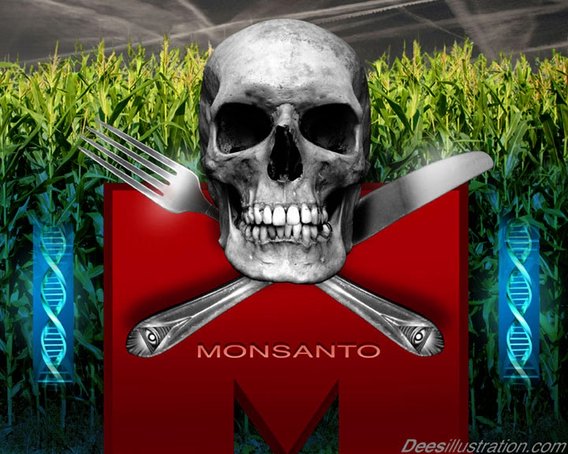
monsantoskull_dees

By Oliver Tickell

Source: The Ecologist

A scientific study that identified serious health impacts on rats fed on ‘Roundup ready’ GMO maize has been republished following its controversial retraction under strong commercial pressure. Now regulators must respond and review GMO and agro-chemical licenses, and licensing procedures.

A highly controversial paper by Prof Gilles-Eric Séralini and colleagues has been republished after a stringent peer review process.

The chronic toxicity study examines the health impacts on rats of eating  a commercialized genetically modified (GM) maize, Monsanto’s NK603 glyphosate-based herbicide Roundup.

The original study, published in Food and Chemical Toxicology (FCT) in September 2012, found severe liver and kidney damage and hormonal disturbances in rats fed the GM maize and low levels of Roundup that are below those permitted in drinking water in the EU.

However it was retracted by the editor-in-chief of the Journal in November 2013 after a sustained campaign of criticism and defamation by pro-GMO scientists.

Toxic effects were found from the GM maize tested alone, as well as from Roundup tested alone and together with the maize. Additional unexpected findings were higher rates of large tumours and mortality in most treatment groups.

Criticisms addressed in the new version

Now the study has been republished by Environmental Sciences Europe. The republished version contains extra material addressing criticisms of the original publication.

The raw data underlying the study’s findings are also published – unlike the raw data for the industry studies that underlie regulatory approvals of Roundup, which are kept secret. However, the new paper presents the same results as before and the conclusions are unchanged.

The republication restores the study to the peer-reviewed literature so that it can be consulted and built upon by other scientists.

The republished study is accompanied by a separate commentary by Prof Séralini’s team (also published on The Ecologist) describing the lobbying efforts of GMO crop supporters to force the editor of FCT to retract the original publication.

The authors explain that the retraction was “a historic example of conflicts of interest in the scientific assessments of products commercialized worldwide.”

“We also show that the decision to retract cannot be rationalized on any discernible scientific or ethical grounds. Censorship of research into health risks undermines the value and the credibility of science; thus, we republish our paper.”

Paper subjected to extraordinary scrutiny and peer review

Claire Robinson, editor of GMOSeralini.org, commented: “This study has now successfully passed no less than three rounds of rigorous peer review.”

First the paper was peer reviewed for its initial publication in Food and Chemical Toxicology, and according to the authors it passed with only minor revisions.

The second review involved a non-transparent examination of Prof Séralini’s raw data by a secret panel of unnamed persons organized by the editor-in-chief of FCT, A. Wallace Hayes, in response to criticisms of the study by pro-GMO scientists.

In a letter to Prof Séralini, Hayes admitted that the anonymous reviewers found nothing incorrect about the results, but argued that the tumour and mortality observations in the paper were “inconclusive”, and this justified his decision to retract the study:

“A more in-depth look at the raw data revealed that no definitive conclusions can be reached with this small sample size regarding the role of either NK603 or glyphosate in regards to overall mortality or tumor incidence. Given the known high incidence of tumors in the Sprague-Dawley rat, normal variability cannot be excluded as the cause of the higher mortality and incidence observed in the treated groups.”

“The rationale given for the retraction was widely criticized by scientists as an act of censorship and a bow to the interests of the GMO industry”, says Robinson.

“Some scientists pointed out that numerous published scientific papers contain inconclusive findings, including Monsanto’s own short (90-day) study on the same GM maize, and have not been retracted. The retraction was even condemned by a former member of the editorial board of FCT.”

Now the study has passed a third peer review arranged by the journal that is republishing the study, Environmental Sciences Europe.

Let the critics carry out their own studies

Dr Michael Antoniou, a molecular geneticist based in London, commented, “Few studies would survive such intensive scrutiny by fellow scientists.

“The republication of the study after three expert reviews is a testament to its rigour, as well as to the integrity of the researchers. If anyone still doubts the quality of this study, they should simply read the republished paper. The science speaks for itself.

“If even then they refuse to accept the results, they should launch their own research study on these two toxic products that have now been in the human food and animal feed chain for many years.”

Dr Jack A Heinemann, Professor of Molecular Biology and Genetics, University of Canterbury New Zealand, said: “I applaud Environmental Sciences Europe for submitting the work to yet another round of rigorous blind peer review and then bravely standing by the process and the recommendations of its reviewers, especially after witnessing the events surrounding the first publication.

“This study has arguably prevailed through the most comprehensive and independent review process to which any scientific study on GMOs has ever been subjected.”

‘Significant biochemical disturbances and physiological failures’

The study examines the health effects on rats of eating Roundup-tolerant NK603 genetically modified (GM) maize (from 11% in the diet), cultivated with or without Roundup application, and Roundup alone (from 0.1 ppb of the full pesticide containing glyphosate and adjuvants) in drinking water. It found:

  • “Biochemical analyses confirmed very significant chronic kidney deficiencies, for all treatments and both sexes; 76% of the altered parameters were kidney-related.
  • “In treated males, liver congestions and necrosis were 2.5 to 5.5 times higher. Marked and severe nephropathies were also generally 1.3 to 2.3 times greater.
  • “In females, all treatment groups showed a two- to threefold increase in mortality, and deaths were earlier.
  • “This difference was also evident in three male groups fed with GM maize.
  • “All results were hormone- and sex-dependent, and the pathological profiles were comparable.
  • “Females developed large mammary tumors more frequently and before controls;
  • “the pituitary was the second most disabled organ;
  • “the sex hormonal balance was modified by consumption of GM maize and Roundup treatments.
  • “Males presented up to four times more large palpable tumors starting 600 days earlier than in the control group, in which only one tumor was noted.
  • “These results may be explained by not only the non-linear endocrine-disrupting effects of Roundup but also by the overexpression of the EPSPS transgene or other mutational effects in the GM maize and their metabolic consequences.
  • “Our findings imply that long-term (2 year) feeding trials need to be conducted to thoroughly evaluate the safety of GM foods and pesticides in their full commercial formulations.”

The paper concludes: “Taken together, the significant biochemical disturbances and physiological failures documented in this work reveal the pathological effects of these GMO and R treatments in both sexes, with different amplitudes.

“They also show that the conclusion of the Monsanto authors that the initial indications of organ toxicity found in their 90-day experiment were not ‘biologically meaningful’ is not justifiable.

“We propose that agricultural edible GMOs and complete pesticide formulations must be evaluated thoroughly in long-term studies to measure their potential toxic effects.”

Regulators must take these results seriously

Dr Heinemann commented: “The work provides important new knowledge that must be taken into account by the community that evaluates and reports upon the risks of genetically modified organisms, indeed upon all sources of pesticide in our food and feed chains.”

According to Patrick Holden, Chief Executive of the Sustainable Food Trust (SFT) the study highlights the inadequacy of current safety testing:

“The most obvious deficiency relates to the fact that the current approval process is based on animal feeding trials of only 90 days, a totally inadequate duration when one considers that chronic diseases in animals and humans do not usually manifest until mid-life.”

A second deficiency, he added, relates to the newly emerging science of epigenetics – which demonstrates that endocrine systems can be seriously disrupted by the presence of chemical residues at concentrations as low as a few parts per billion.

“This turns on its head the logic of an approval process based on MRL (maximum residue levels), since it is becoming increasingly apparent that these chemicals have patterns of non-linear response.”

An ‘urgent review’ of pesticide licensing is needed

Given these concerns, said Holden, “there is a strong case for an urgent review of the regulatory process for licensing both the herbicide Roundup and the neonicotinoid class of insecticides. A fundamental review of the entire process for licensing agricultural chemicals is required to ensure that in future the public interest is better served.”

Professor Pete Myers, Chief Executive of Environmental Health Sciences and scientific advisor to the SFT points out that only “the tiniest fraction of agricultural chemicals” have been studied for health effects by independent scientists:

“Over the last two-decades there has been a revolution in environmental health sciences that suggests the proportion of diseases attributable to chemical exposures is far bigger and more significant than previously understood.

“The tools we have available to us to say what is safe and not safe are deeply flawed. They are not based on two decades of development in the fields of endocrine disruption and epigenetics, but instead on tests developed in the 1950s.

“They do not reflect the complexity of mixtures, or the way in which chemicals interact.”

Related articles:

Monsanto’s Herbicide Linked to Fatal Kidney Disease Epidemic: Could It Topple the Company?

New Study finds Monsanto’s Roundup Herbicide 125 Times More Toxic Than Regulators Say