
The Child That Christmas Forgot: How Would Jesus Fare in the American Police State?

By John W. Whitehead

Source: The Rutherford Institute

“Once upon a midnight clear, there was a child’s cry, a blazing star hung over a stable, and wise men came with birthday gifts. We haven’t forgotten that night down the centuries. We celebrate it with stars on Christmas trees, with the sound of bells, and with gifts… We forget nobody, adult or child. All the stockings are filled, all that is, except one. And we have even forgotten to hang it up. The stocking for the child born in a manger. It’s his birthday we’re celebrating. Don’t let us ever forget that. Let us ask ourselves what He would wish for most. And then, let each put in his share, loving kindness, warm hearts, and a stretched out hand of tolerance. All the shining gifts that make peace on earth.”—The Bishop’s Wife (1947)

The Christmas story of a baby born in a manger is a familiar one.

The Roman Empire, a police state in its own right, had ordered that a census be conducted. Joseph and his pregnant wife Mary traveled to the little town of Bethlehem so that they could be counted. There being no room for the couple at any of the inns, they stayed in a stable (a barn), where Mary gave birth to a baby boy, Jesus. Warned that the government planned to kill the baby, Jesus’ family fled with him to Egypt until it was safe to return to their native land.

Yet what if Jesus had been born 2,000 years later?

What if, instead of being born into the Roman police state, Jesus had been born at this moment in time? What kind of reception would Jesus and his family be given? Would we recognize the Christ child’s humanity, let alone his divinity? Would we treat him any differently than he was treated by the Roman Empire? If his family were forced to flee violence in their native country and sought refuge and asylum within our borders, what sanctuary would we offer them?

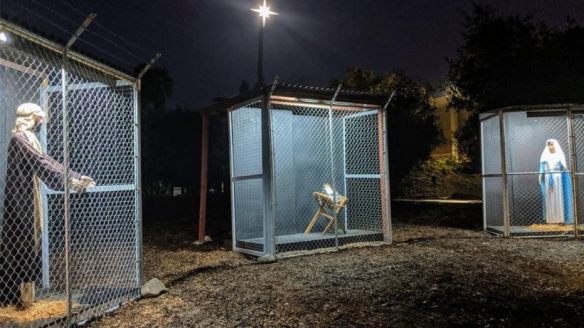
A singular number of churches across the country are asking those very questions, and their conclusions are being depicted with unnerving accuracy by nativity scenes in which Jesus and his family are separated, segregated and caged in individual chain-link pens, topped by barbed wire fencing.

These nativity scenes are a pointed attempt to remind the modern world that the narrative about the birth of Jesus is one that speaks on multiple fronts to a world that has allowed the life, teachings and crucifixion of Jesus to be drowned out by partisan politics, secularism, materialism and war.

The modern-day church has largely shied away from applying Jesus’ teachings to modern problems such as war, poverty, immigration, etc., but thankfully there have been individuals throughout history who ask themselves and the world: what would Jesus do?

What would Jesus—the baby born in Bethlehem who grew into an itinerant preacher and revolutionary activist, who not only died challenging the police state of his day (namely, the Roman Empire) but spent his adult life speaking truth to power, challenging the status quo of his day, and pushing back against the abuses of the Roman Empire—do?

Dietrich Bonhoeffer asked himself what Jesus would have done about the horrors perpetrated by Hitler and his assassins. The answer: Bonhoeffer risked his life to undermine the tyranny at the heart of Nazi Germany.

Aleksandr Solzhenitsyn asked himself what Jesus would have done about the soul-destroying gulags and labor camps of the Soviet Union. The answer: Solzhenitsyn found his voice and used it to speak out about government oppression and brutality.

Martin Luther King Jr. asked himself what Jesus would have done about America’s warmongering. The answer: declaring “my conscience leaves me no other choice,” King risked widespread condemnation when he publicly opposed the Vietnam War on moral and economic grounds.

Even now, despite the popularity of the phrase “What Would Jesus Do?” (WWJD) in Christian circles, there remains a disconnect in the modern church between the teachings of Christ and the suffering of what Jesus in Matthew 25 refers to as the “least of these.”

As the parable states:

“Then the King will say to those on his right, ‘Come, you who are blessed by my Father; take your inheritance, the kingdom prepared for you since the creation of the world. For I was hungry and you gave me something to eat, I was thirsty and you gave me something to drink, I was a stranger and you invited me in, I needed clothes and you clothed me, I was sick and you looked after me, I was in prison and you came to visit me.’ Then the righteous will answer him, ‘Lord, when did we see you hungry and feed you, or thirsty and give you something to drink? When did we see you a stranger and invite you in, or needing clothes and clothe you? When did we see you sick or in prison and go to visit you?’ The King will reply, ‘Truly I tell you, whatever you did for one of the least of these brothers and sisters of mine, you did for me.’ Then he will say to those on his left, ‘Depart from me, you who are cursed, into the eternal fire prepared for the devil and his angels. For I was hungry and you gave me nothing to eat, I was thirsty and you gave me nothing to drink, I was a stranger and you did not invite me in, I needed clothes and you did not clothe me, I was sick and in prison and you did not look after me.’ They also will answer, ‘Lord, when did we see you hungry or thirsty or a stranger or needing clothes or sick or in prison, and did not help you?’ He will reply, ‘Truly I tell you, whatever you did not do for one of the least of these, you did not do for me.’”

This is not a theological gray area: Jesus was unequivocal about his views on many things, not the least of which was charity, compassion, war, tyranny and love.

After all, Jesus—the revered preacher, teacher, radical and prophet—was born into a police state not unlike the growing menace of the American police state. When he grew up, he had powerful, profound things to say, things that would change how we view people, alter government policies and change the world. “Blessed are the merciful,” “Blessed are the peacemakers,” and “Love your enemies” are just a few examples of his most profound and revolutionary teachings.

When confronted by those in authority, Jesus did not shy away from speaking truth to power. Indeed, his teachings undermined the political and religious establishment of his day. It cost him his life. He was eventually crucified as a warning to others not to challenge the powers-that-be.

Can you imagine what Jesus’ life would have been like if, instead of being born into the Roman police state, he had been born and raised in the American police state?

Consider the following if you will.

Had Jesus been born in the era of the America police state, rather than traveling to Bethlehem for a census, Jesus’ parents would have been mailed a 28-page American Community Survey, a mandatory government questionnaire documenting their habits, household inhabitants, work schedule, how many toilets are in your home, etc. The penalty for not responding to this invasive survey can go as high as $5,000.

Instead of being born in a manger, Jesus might have been born at home. Rather than wise men and shepherds bringing gifts, however, the baby’s parents might have been forced to ward off visits from state social workers intent on prosecuting them for the home birth. One couple in Washington had all three of their children removed after social services objected to the two youngest being birthed in an unassisted home delivery.

Had Jesus been born in a hospital, his blood and DNA would have been taken without his parents’ knowledge or consent and entered into a government biobank. While most states require newborn screening, a growing number are holding onto that genetic material long-term for research, analysis and purposes yet to be disclosed.

Then again, had Jesus’ parents been undocumented immigrants, they and the newborn baby might have been shuffled to a profit-driven, private prison for illegals where they first would have been separated from each other, the children detained in make-shift cages, and the parents eventually turned into cheap, forced laborers for corporations such as Starbucks, Microsoft, Walmart, and Victoria’s Secret. There’s quite a lot of money to be made from imprisoning immigrants, especially when taxpayers are footing the bill.

From the time he was old enough to attend school, Jesus would have been drilled in lessons of compliance and obedience to government authorities, while learning little about his own rights. Had he been daring enough to speak out against injustice while still in school, he might have found himself tasered or beaten by a school resource officer, or at the very least suspended under a school zero tolerance policy that punishes minor infractions as harshly as more serious offenses.

Had Jesus disappeared for a few hours let alone days as a 12-year-old, his parents would have been handcuffed, arrested and jailed for parental negligence. Parents across the country have been arrested for far less “offenses” such as allowing their children to walk to the park unaccompanied and play in their front yard alone.

Rather than disappearing from the history books from his early teenaged years to adulthood, Jesus’ movements and personal data—including his biometrics—would have been documented, tracked, monitored and filed by governmental agencies and corporations such as Google and Microsoft. Incredibly, 95 percent of school districts share their student records with outside companies that are contracted to manage data, which they then use to market products to us.

From the moment Jesus made contact with an “extremist” such as John the Baptist, he would have been flagged for surveillance because of his association with a prominent activist, peaceful or otherwise. Since 9/11, the FBI has actively carried out surveillance and intelligence-gathering operations on a broad range of activist groups, from animal rights groups to poverty relief, anti-war groups and other such “extremist” organizations.

Jesus’ anti-government views would certainly have resulted in him being labeled a domestic extremist. Law enforcement agencies are being trained to recognize signs of anti-government extremism during interactions with potential extremists who share a “belief in the approaching collapse of government and the economy.”

While traveling from community to community, Jesus might have been reported to government officials as “suspicious” under the Department of Homeland Security’s “See Something, Say Something” programs. Many states, including New York, are providing individuals with phone apps that allow them to take photos of suspicious activity and report them to their state Intelligence Center, where they are reviewed and forwarded to law-enforcement agencies.

Rather than being permitted to live as an itinerant preacher, Jesus might have found himself threatened with arrest for daring to live off the grid or sleeping outside. In fact, the number of cities that have resorted to criminalizing homelessness by enacting bans on camping, sleeping in vehicles, loitering and begging in public has doubled.

Viewed by the government as a dissident and a potential threat to its power, Jesus might have had government spies planted among his followers to monitor his activities, report on his movements, and entrap him into breaking the law. Such Judases today—called informants—often receive hefty paychecks from the government for their treachery.

Had Jesus used the internet to spread his radical message of peace and love, he might have found his blog posts infiltrated by government spies attempting to undermine his integrity, discredit him or plant incriminating information online about him. At the very least, he would have had his website hacked and his email monitored.

Had Jesus attempted to feed large crowds of people, he would have been threatened with arrest for violating various ordinances prohibiting the distribution of food without a permit. Florida officials arrested a 90-year-old man for feeding the homeless on a public beach.

Had Jesus spoken publicly about his 40 days in the desert and his conversations with the devil, he might have been labeled mentally ill and detained in a psych ward against his will for a mandatory involuntary psychiatric hold with no access to family or friends. One Virginia man was arrested, strip searched, handcuffed to a table, diagnosed as having “mental health issues,” and locked up for five days in a mental health facility against his will apparently because of his slurred speech and unsteady gait.

Without a doubt, had Jesus attempted to overturn tables in a Jewish temple and rage against the materialism of religious institutions, he would have been charged with a hate crime. Currently, 45 states and the federal government have hate crime laws on the books.

Had anyone reported Jesus to the police as being potentially dangerous, he might have found himself confronted—and killed—by police officers for whom any perceived act of non-compliance (a twitch, a question, a frown) can result in them shooting first and asking questions later.

Rather than having armed guards capture Jesus in a public place, government officials would have ordered that a SWAT team carry out a raid on Jesus and his followers, complete with flash-bang grenades and military equipment. There are upwards of 80,000 such SWAT team raids carried out every year, many on unsuspecting Americans who have no defense against such government invaders, even when such raids are done in error.

Instead of being detained by Roman guards, Jesus might have been made to “disappear” into a secret government detention center where he would have been interrogated, tortured and subjected to all manner of abuses. Chicago police have “disappeared” more than 7,000 people into a secret, off-the-books interrogation warehouse at Homan Square.

Charged with treason and labeled a domestic terrorist, Jesus might have been sentenced to a life-term in a private prison where he would have been forced to provide slave labor for corporations or put to death by way of the electric chair or a lethal mixture of drugs.

Indeed, as I show in my book Battlefield America: The War on the American People, given the nature of government then and now, it is painfully evident that whether Jesus had been born in our modern age or his own, he still would have died at the hands of a police state.

Thus, as we draw near to Christmas with its celebrations and gift-giving, we would do well to remember that what happened on that starry night in Bethlehem is only part of the story. That baby in the manger grew up to be a man who did not turn away from evil but instead spoke out against it, and we must do no less.

Jesus Was Born in a Police State

By John W. Whitehead

Source: The Rutherford Institute

“Jesus is too much for us. The church’s later treatment of the gospels is one long effort to rescue Jesus from ‘extremism.’”—author Gary Wills, What Jesus Meant

The Christmas narrative of a baby born in a manger is a familiar one.

The Roman Empire, a police state in its own right, had ordered that a census be conducted. Joseph and his pregnant wife Mary traveled to the little town of Bethlehem so that they could be counted. There being no room for the couple at any of the inns, they stayed in a stable, where Mary gave birth to a baby boy, Jesus.

Unfortunately, Jesus was born into a police state not unlike the growing menace of the American police state. When he grew up, he had powerful, profound things to say—things that would change how we view people, alter government policies and change the world. “Blessed are the merciful,” “Blessed are the peacemakers,” and “Love your enemies” are just a few examples of his most profound and revolutionary teachings.

When confronted by those in authority, Jesus did not shy away from speaking truth to power. Indeed, his teachings undermined the political and religious establishment of his day. It cost him his life. He was eventually crucified as a warning to others not to challenge the powers-that-be.

Yet what if Jesus, the revered preacher, teacher, radical and prophet, had been born 2,000 years later? What if, instead of being born into the Roman police state, he had been born and raised in the American police state?

Consider the following if you will.

Had Jesus been born in the era of the America police state, rather than traveling to Bethlehem for a census, Jesus’ parents would have been mailed a 28-page American Community Survey, a mandatory government questionnaire documenting their habits, household inhabitants, work schedule, how many toilets were in their home, etc. The penalty for not responding to this invasive survey can go as high as $5,000.

Instead of being born in a manger, Jesus might have been born at home. Rather than wise men and shepherds bringing gifts, however, the baby’s parents might have been forced to ward off visits from state social workers intent on prosecuting them for the home birth. One couple in Washington had all three of their children removed after social services objected to the two youngest being birthed in an unassisted home delivery.

Had Jesus been born in a hospital, his blood and DNA would have been taken without his parents’ knowledge or consent and entered into a government biobank. While most states require newborn screening, a growing number are holding onto that genetic material long-term for research, analysis and purposes yet to be disclosed.

Then again, had Jesus’ parents been undocumented immigrants, they and the newborn baby might have been shuffled to a profit-driven, private prison for illegals where they would have been turned into cheap, forced laborers for corporations such as Starbucks, Microsoft, Walmart, and Victoria’s Secret. There’s quite a lot of money to be made from imprisoning immigrants, especially when taxpayers are footing the bill.

From the time he was old enough to attend school, Jesus would have been drilled in lessons of compliance and obedience to government authorities, while learning little about his own rights. Had he been daring enough to speak out against injustice while still in school, he might have found himself tasered or beaten by a school resource officer, or at the very least suspended under a school zero tolerance policy that punishes minor infractions as harshly as more serious offenses.

Had Jesus disappeared for a few hours let alone days as a 12-year-old, his parents would have been handcuffed, arrested and jailed for parental negligence. Parents across the country have been arrested for far less “offenses” such as allowing their children to walk to the park unaccompanied and play in their front yard alone.

Rather than disappearing from the history books from his early teenaged years to adulthood, Jesus’ movements and personal data—including his biometrics—would have been documented, tracked, monitored and filed by governmental agencies and corporations such as Google and Microsoft. Incredibly, 95 percent of school districts share their student records with outside companies that are contracted to manage data, which they then use to market products to us.

From the moment Jesus made contact with an “extremist” such as John the Baptist, he would have been flagged for surveillance because of his association with a prominent activist, peaceful or otherwise. Since 9/11, the FBI has actively carried out surveillance and intelligence-gathering operations on a broad range of activist groups, from animal rights groups to poverty relief, anti-war groups and other such “extremist” organizations.

Jesus’ anti-government views would certainly have resulted in him being labeled a domestic extremist. Law enforcement agencies are being trained to recognize signs of anti-government extremism during interactions with potential extremists who share a “belief in the approaching collapse of government and the economy.”

While traveling from community to community, Jesus might have been reported to government officials as “suspicious” under the Department of Homeland Security’s “See Something, Say Something” programs. Many states, including New York, are providing individuals with phone apps that allow them to take photos of suspicious activity and report them to their state Intelligence Center, where they are reviewed and forwarded to law-enforcement agencies.

Rather than being permitted to live as an itinerant preacher, Jesus might have found himself threatened with arrest for daring to live off the grid or sleeping outside. In fact, the number of cities that have resorted to criminalizing homelessness by enacting bans on camping, sleeping in vehicles, loitering and begging in public has doubled.

Viewed by the government as a dissident and a potential threat to its power, Jesus might have had government spies planted among his followers to monitor his activities, report on his movements, and entrap him into breaking the law. Such Judases today—called informants—often receive hefty paychecks from the government for their treachery.

Had Jesus used the internet to spread his radical message of peace and love, he might have found his blog posts infiltrated by government spies attempting to undermine his integrity, discredit him or plant incriminating information online about him. At the very least, he would have had his website hacked and his email monitored.

Had Jesus attempted to feed large crowds of people, he would have been threatened with arrest for violating various ordinances prohibiting the distribution of food without a permit. Florida officials arrested a 90-year-old man for feeding the homeless on a public beach.

Had Jesus spoken publicly about his 40 days in the desert and his conversations with the devil, he might have been labeled mentally ill and detained in a psych ward against his will for a mandatory involuntary psychiatric hold with no access to family or friends. One Virginia man was arrested, strip searched, handcuffed to a table, diagnosed as having “mental health issues,” and locked up for five days in a mental health facility against his will apparently because of his slurred speech and unsteady gait.

Without a doubt, had Jesus attempted to overturn tables in a Jewish temple and rage against the materialism of religious institutions, he would have been charged with a hate crime. Currently, 45 states and the federal government have hate crime laws on the books.

Had anyone reported Jesus to the police as being potentially dangerous, he might have found himself confronted—and killed—by police officers for whom any perceived act of non-compliance (a twitch, a question, a frown) can result in them shooting first and asking questions later. Daniel Shaver, 26 years old, was crawling on the floor, sobbing and begging for his life, and had just reached down to pull up his shorts when a police officer opened fire on him with an AR-15 rifle. “If you move, we’re going to consider that a threat and we are going to deal with it and you may not survive it,” the cop shouted at Shaver before his partner started shooting.

Rather than having armed guards capture Jesus in a public place, government officials would have ordered that a SWAT team carry out a raid on Jesus and his followers, complete with flash-bang grenades and military equipment. There are upwards of 80,000 such SWAT team raids carried out every year, many on unsuspecting Americans who have no defense against such government invaders, even when such raids are done in error.

Instead of being detained by Roman guards, Jesus might have been made to “disappear” into a secret government detention center where he would have been interrogated, tortured and subjected to all manner of abuses. Chicago police “disappeared” more than 7,000 people into a secret, off-the-books interrogation warehouse at Homan Square.

Charged with treason and labeled a domestic terrorist, Jesus might have been sentenced to a life-term in a private prison where he would have been forced to provide slave labor for corporations or put to death by way of the electric chair or a lethal mixture of drugs.

Either way, whether Jesus had been born in our modern age or his own, he still would have died at the hands of a police state.

Indeed, as I show in my book Battlefield America: The War on the American People, what Jesus and other activists suffered in their day is happening to those who choose to speak truth to power today.

For those who celebrate Christmas as a season of miracles, it is indeed a time for joy and thanksgiving. Yet it should also be a time of reckoning, re-awakening and re-commitment to making this world a better place for all humanity.

Remember, what happened on that starry night in Bethlehem is only part of the story. That baby in the manger grew up to be a man who did not turn away from evil but instead spoke out against it, and we must do no less.

Thus, we are faced with a choice: remain silent in the face of evil or speak out against it. As Nobel Prize-winning author Albert Camus proclaimed:

What the world expects of Christians is that Christians should speak out, loud and clear, and that they should voice their condemnation in such a way that never a doubt, never the slightest doubt, could rise in the heart of the simplest man. That they should get away from abstraction and confront the blood-stained face history has taken on today. The grouping we need is a grouping of men resolved to speak out clearly and to pay up personally.

US fall from virtuous republic to tragic-comic empire described exactly by Roman historians

fascism1

By Carl Herman

Source: The Daily Censored

The ancient Greek historian, Polybius, celebrated the Roman republic of ~ 150 BC under its constitution with balance of powers among the Senate, two elected consuls, and the general citizens:

“Such being the power that each part has of hampering the others or co-operating with them, their union is adequate to all emergencies, so that it is impossible to find a better political system than this.”  – The Histories, Book VI, Section V: On the Roman Constitution at its Prime

Americans and people around the world were equally proud of the United States Constitution as “impossible to find a better political system than this.”

About 100 years after Polybius’ account, Rome’s republic had descended into oligarchic competition for power. Contemporary to Julius Caesar, the Roman historian and government insider Sallust blasted the decline of virtue in government:

“To those who had easily endured toils, dangers, and doubtful and difficult circumstances, ease and wealth, the objects of desire to others, became a burden and a trouble. At first the love of money, and then that of power, began to prevail, and these became, as it were, the sources of every evil. For avarice subverted honesty, integrity, and other honorable principles, and, in their stead, inculcated pride, inhumanity, contempt of religion, and general venality. Ambition prompted many to become deceitful; to keep one thing concealed in the breast, and another ready on the tongue; to estimate friendships and enmities, not by their worth, but according to interest; and to carry rather a specious countenance than an honest heart. These vices at first advanced but slowly, and were sometimes restrained by correction; but afterwards, when their infection had spread like a pestilence, the state was entirely changed, and the government, from being the most equitable and praiseworthy, became rapacious and insupportable.” – Conspiracy of Catiline, The Argument

The most prolific Roman historian, Livy, witnessed Rome’s transition into dictatorial empire with Augustus Caesar as first emperor. In his preface to address 700 years of Roman history:

“I have no doubt that the earliest origins and the immediately succeeding period will give less delight to the majority of readers who are hurrying to these recent times in which the might of a most powerful people has long been destroying itself.

… I shall seek this additional reward for my labor (recounting all Rome’s history) so that I may turn away from the contemplation of the evils that our age has seen for so many years.” – The History of Rome, Preface

Tacitus wrote ~ 100 AD, a century into empire. Emperors proclaimed to the public that their government still upheld the highest ideals of their Republic, claiming expanding empire was only and always in “self-defense.”

Emperor Domitian’s assassination in 96 AD (among ~22 murdered emperors), allowed Tacitus to write The Agricola, a biographical text of his father-in-law contrasting claimed virtue of Roman military and citizenry with the emperor’s utterly corrupt despotism.

Importantly, this text describes the problem of virtuous Romans within a psychopathic government. Tacitus describes Agricola attempting to uphold virtue; but without recognition of any evil in serving an expanding dictatorial empire. Tacitus seems to assume the ideal of mos maiorum, “custom/virtue of Roman forefathers” will eventually triumph over the evil of present “leadership.”

In Agricola’s campaign as military and political leader of Roman Britain to expand the empire to modern Scotland from 78 – 84 AD, Tacitus recorded a speech he attributes to Scottish rebel-leader, Calgacus, to voice how those of virtue characterized Roman empire under corrupt emperors:

“It is no use trying to escape their arrogance by submission or good behavior. Robbers of the world, having by universal plunder exhausted the land, their drive is greed. If the enemy be rich, they are rapacious; if poor, they lust for domination. Neither rule of the East nor West can satisfy them. Alone among men, they crave with equal eagerness poverty and riches. To plunder, slaughter, seize with false pretenses, they give the lying name ‘empire.’ And where nothing remains but a desert, they call that ‘peace.’ ” – Tacitus, The Agricola and the Germania (analyses herehere)

Roman imperialists called Calgacus and those who preferred independence from evil empire a name: barbarus. This is translated today as “barbarian,” but its context for using unconventional warfare to oppose the most powerful military in its day is better translated in today’s language with a different word:

Terrorist.

Indeed, Obama combines these terms to call ISIS “barbaric terrorists.”

American Founders created the US Constitution in light of Roman Republic design (herehere, among dozens), and aware previous republics had always self-destructed from corruption within their own nations. Among many of the Founders’ admonitions, James Madison was clear that citizen responsibility was essential to maintain a republic, no matter how well the Constitution was designed:

“A mere demarcation on parchment of the constitutional limits (of government) is not a sufficient guard against those encroachments which lead to a tyrannical concentration of all the powers of government in the same hands.”  – James Madison, Federalist Paper #48, 1788.

On September 18, 1787, just after signing the US Constitution, Benjamin Franklin met with members of the press. He was asked what kind of government America would have. Franklin warned: “A republic, if you can keep it.” In his speech to the Constitutional Convention, Franklin admonished: “This [U.S. Constitution] is likely to be administered for a course of years and then end in despotism… when the people shall become so corrupted as to need despotic government, being incapable of any other.”  – The Quotable Founding Fathers, pg. 39.

These warnings extend to all social science teachers of the present:

“As educators in the field of history–social science, we want our students to… understand the value, the importance, and the fragility of democratic institutions. We want them to realize that only a small fraction of the world’s population (now or in the past) has been fortunate enough to live under a democratic form of government.” – History-Social Science Framework for California Public Schools, pgs. 2, 7-8

US/UK/Israel today: Current Middle East armed attacks are proclaimed by US/UK/Israel “leaderships” as self-defense, just as Rome claimed. US “leaders” claim to uphold America’s highest ideals of freedom while removing almost all Constitutional Rights, as did Roman emperors. Corruption today, as in Rome, is rampant.

US/UK/Israel wars today are not even close to legal, and based on lies known to be false as they are told. Engaging in unlawful Wars of Aggression is the very opposite of a virtuous republic limited in power under its constitution. This is easy to verify for those with about an hour to look:

Solutions learned from the past applied to the present: Tacitus’ argument was to wait-out tyranny in confidence public virtue of past ideals would triumph.

Tacitus was wrong.

A stronger solution would be critical mass recognition by the public of corruption in an Emperor’s New Clothes analogy, arrests, and a clear forum for whistleblowers to disclose the full extent of corruption.

In today’s world of tragic-comic US/UK/Israel corrupt empire, I propose the solution of:

  • public demand for “leader” arrests. An arrest lawfully stops crimes.
  • Truth & Reconciliation to encourage criminal minions to become whistleblowers so we can best discover the extent of the crimes waged by the .01% upon the 99.99%.
  • With removed criminal oligarchs and corporate media who “covered” these crimes, we’d have honest opportunity for available economic solutions that would transform our beautiful, but historically dominated planet.

**

Note: I make all factual assertions as a National Board Certified Teacher of US Government, Economics, and History, with all economics factual claims receiving zero refutation since I began writing in 2008 among Advanced Placement Macroeconomics teachers on our discussion board, public audiences of these articles, and international conferences. I invite readers to empower their civic voices with the strongest comprehensive facts most important to building a brighter future. I challenge professionals, academics, and citizens to add their voices for the benefit of all Earth’s inhabitants.

**

Carl Herman is a National Board Certified Teacher of US Government, Economics, and History; also credentialed in Mathematics. He worked with both US political parties over 18 years and two UN Summits with the citizen’s lobby, RESULTS, for US domestic and foreign policy to end poverty. He can be reached at Carl_Herman@post.harvard.edu

Note: Examiner.com has blocked public access to my articles on their site (and from other whistleblowers), so some links in my previous work are blocked. If you’d like to search for those articles other sites may have republished, use words from the article title within the blocked link. Or, go to http://archive.org/web/, paste the expired link into the box, click “Browse history,” then click onto the screenshots of that page for each time it was screen-shot and uploaded to webarchive. I’ll update as “hobby time” allows; including my earliest work from 2009 to 2011 (blocked author pages: herehere).