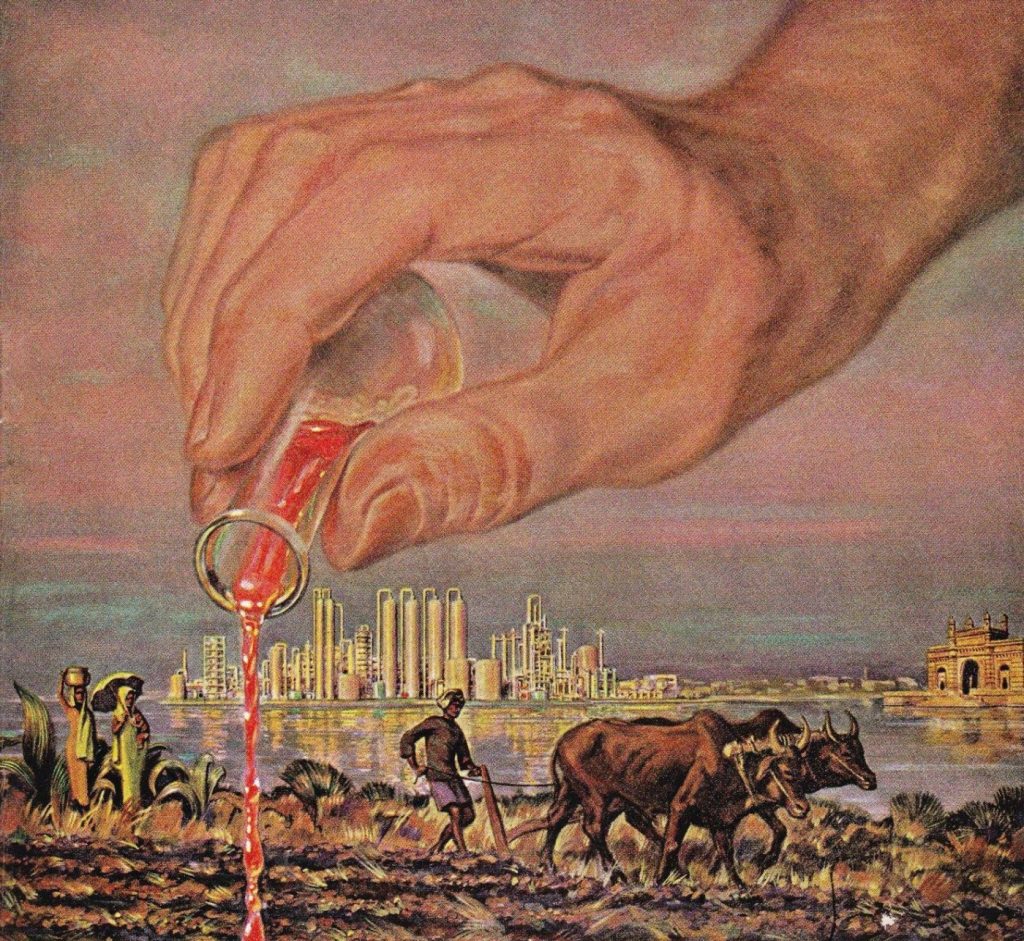
This image is symbolic of everything that is wrong with modern society.
A gas leak from Union Carbide’s pesticide plant in Bhopal in 1984 resulted in around 560,000 injured (respiratory problems, eye irritation, etc.), 4,000 severely disabled and 20,000 dead.
Not only that, but the pesticides produced at the factory and the model of farming promoted has caused well-documented misery for farmers, harm to soil, water sources and the health of the population and a radical transformation of social relations in rural communities. And these issues apply not only to India but also to other countries.
That old advertising brochure dating from around the early 1960s encapsulates the arrogance of billionaires and their companies that think they are the hand of God, that they are the truth and the science, and that we should all be in awe of the technology they produce.
Facilitated by the likes of the Rockefeller Foundation and the Bill and Melinda Gates Foundation, they uproot highly productive traditional agriculture, saying it is deficient. They poison the soil, the food, the waterways and people. But that’s not enough. They pirate, own and genetically engineer the seeds. The chemicals and engineering do not result in more or better food. Quite the opposite. Diets have become narrower, and the nutritional content of many food items has progressively diminished (see McCance and Widdowson’s the Mineral Depletion of Foods). Moreover, food secure regions have become food insecure.
But it goes beyond this.
Consider the amount of killer-chemicals that the likes of Union Carbide’s promised techno-utopian consumer society (Union Carbide produced numerous other similar brochures to the one presented above, promoting the role of science and technology across all sectors) has gifted to humanity in everyday products from shampoos to toys, pans, packaging, sofas and tins.
It is notable that glyphosate, the world’s most used agricultural herbicide, began life as an industrial chelator of minerals in metal pipes to prevent blockages and deterioration. It now ensures mineral depletion/nutrient deficiencies in the human body. Glyphosate affects human soil – the gut microbiome – which directly feeds the major organs. Little wonder we witness a proliferation of illness and disease.
But forget about what has become modernism’s spiralling public health crisis – don’t forget to take that money-spinning experimental booster jab because, remember, they said that they really care about you and your health.
Meanwhile, bioscience parks across the world expand and promise an even more marvellous techno-dystopia than the one already created. They are working on injecting you with nanotechnology to ‘cure’ you of all the diseases that the modernist type of thinking, products and technology created in the first place – or on manipulating your DNA-physiology to hook you up to the internet (of things). The patents are there – this is not speculation.
And as these bioscience parks expand, their success is measured in annual turnover, profits and ‘growth’. They want more and more ‘talent’ to study life sciences and health subjects and to take up positions at the biotech companies. And they call for more public subsidies to facilitate this. More kids to study science so that they can be swept up into the ideology and practices of the self-sustaining paradigm of modern society.
Of course, ‘sustainability’ is the mantra. Sustainability in terms of fake-green, net-zero ideology but, more importantly, sustainable growth and profit.
Meanwhile, across the world, most notably in the Netherlands, these parks demand more land. More land for expansion and more land to house ‘global talent’ to be attracted to work. That means displacing farmers under the notion that they are the major emitters of ‘greenhouse gases’, which, in the Netherlands at least, they are clearly not. Look towards other sectors or even the US military if you require a prime example of a major polluter. But that’s not up for discussion, not least because military-related firms are often intertwined with the much-valued bioscience-business ‘ecosystems’ promoted.
And once the farmers have gone and the farmland is concreted over under the concept (in the Netherlands) of a Tristate City, do not worry – your ‘food’ will be created in a lab courtesy of biosynthetic, nanotechnological, biopharmaceutical, genetically engineered microbes and formulas created at the local bioscience park.
Any carbon-related pollution created by these labs will supposedly be ‘offset’ by a fraudulent carbon credit trading Ponzi scheme – part of which will mean buying up acres in some poor country to plant trees on the land of the newly dispossessed.
This brave new ecomodernism is to be overseen by supranational bodies like the UN and the WHO. National uniparty politicians will not be engaged in policy formation. They will be upholders of the elite-determined status quo – junior ‘stakeholders’ and technocratic overseers of an algorithm/AI-run system, ensuring any necessary tweaks are made.
Of course, not everything that happens under the banner of bioscience should be dismissed out of hand, but science is increasingly the preserve of an increasingly integrated global elite who have created the problems that they now rollout the ‘solutions’ for. It is a highly profitable growth industry – under the banner of ‘innovation’, cleaning up the mess you created.
But the disturbing trend is that the ‘science’ and the technology shall not be questioned. A wealthy financial-digital-corporate elite funds this science, determines what should be studied, how it should be studied and how the findings are disseminated and how the technology produced is to be used.
As we saw with the COVID event, this elite has the power to shut down genuine debate, prevent scrutiny of ‘the science’ and to smear and censor world-renowned scientists and others who even questioned the narrative. And it also pulls the strings of nation states so much so that former New Zealand PM Jacinda Arden said that her government is ‘the truth’. The marriage of science and politics in an Orwellian dystopia.
The prevailing thinking is that the problems of illness, hunger, malnutrition, unemployment, pollution, resource usage and so on are all to be solved down at the bioscience park by what farmer/author Chris Smaje says through technical innovation and further integration into private markets which are structured systematically by centralised power in favour of the wealthy.
The ecomodernist ideology we see embedded within the mindsets of those lobbying for more resources, land and funding have nothing much to say about how humanity got ill, infertile, poor, dispossessed, colonised, depressed, unemployed or marginalised in the first place. Driven by public funding, career progression and profit, they remain blinkered and push ahead with an ideology whose ‘solutions’ only produce more problems that call for more ‘innovation’ and more money.
At the same time, any genuine solutions are too often dismissed as being driven by ideology and ignorance that will lead us all to ruin. A classic case of projection.
As I have written previously, current hegemonic policies prioritise urbanisation, global markets, long supply chains, commodified corporate knowledge, highly processed food and market dependency at the expense of rural communities, independent enterprises and smallholder farms, local markets, short supply chains, indigenous knowledge, diverse agroecological cropping, nutrient-dense diets and food sovereignty.
And this has led us to where we are now.
Trade and agriculture policy specialist Devinder Sharma once said that we need family farms not family doctors. Imagine the reduction in illnesses and all manner of conditions. Imagine thriving local communities centred on smallholder production, nutrient-dense food and healthy people. Instead, we get sprawling bioscience parks centred on economic globalisation, sickness and the manipulation of food and human bodies.
Although a few thousand immensely powerful people are hellbent on marching humanity towards a dystopian ecomodernist future, we can, in finishing, take some inspiration from the words of John Seymour (1912-2004), a pioneer of the self-sufficiency movement.
Seymour was described as a one-man rebellion against modernism by writer and ecologist Herbert Girardet. But as a farmer himself, Seymour regarded himself a ‘crank peasant’ and offered solutions in terms of localism, small-scale economics, a return to the land and organic agriculture.
The tiny amount you and I can do is hardly likely to bring the huge worldwide moloch of plundering industry down? Well, if you and I don’t do it, it will not be done, and the Age of Plunder will terminate in the Age of Chaos. We have to do it – just the two of us – just you and me. There is no ‘them’ – there is nobody else. Just you and me. On our infirm shoulders we must take up this heavy burden now… Tomorrow will be too late.”
Throughout your lifetime, you or someone you trusted has unwittingly given up many aspects of your biometric and other personal data so that your digital identity can be created. Over time, this digital identity is being progressively defined and is replacing your actual physical, intellectual, emotional and spiritual identity. What you are allowed to do, and not do, will increasingly depend on your technological identity rather than your moral character, intellectual and/or physical abilities, your emotional suitability, religious beliefs and the many other attributes that define your unique personality.
Starting with your birth certificate, which identifies your name, birth date and birth location, as well as parenting, an endless series of details about your personal life has been accumulated and stored, sometimes with your knowledge and consent. Far more often it has been done without either.
Do you remember having your photo taken for a student and/or employee identity card, your vehicle license and/or a passport? Do you remember being finger and/or palm-printed, submitting to an iris scan, agreeing to a recording of your voice, offering data for ‘two-factor’ authentication, and requesting an ancestry search by submitting a sample of your DNA? Most often you had no choice: It was ‘legally required’. Other times, you were probably offered something in return, such as admission to an educational institution, ‘secure’ access to an account or information you wanted. But whatever other price you paid, you also paid an ‘identity cost’.
Moreover, none of that information has ceased to exist and there is a lot more interest in it now than there was when you, or someone, innocently agreed to tender it all those years ago. And it is being added to all of the time with information you have surrendered or that has been obtained about you, up until this morning. In addition, it will be added to by information gathered about you tomorrow.
Your bank account(s), academic and employment records, health records (including vaccination record), legal record (including traffic violations), internet search history, and any other information compiled by or submitted to a government authority, corporation or other entity has been recorded, compiled and systematically stored in data banks of which you have never even heard. And they are being used to generate your ‘social credit score’ which, depending on the country in which you live, is already or will be soon, used to determine what you can, and cannot, do.
In addition, facial recognition technology is vastly expanding the capacity of the surveillance state, and those corporations and entities that work with it, to identify and track you. And it is doing this already in the most obvious places such as on the street and in shopping centres. See, for example, ‘Microsoft partners with banks to introduce facial recognition: More invasive technology’.
Beyond that, of course, existing technologies already enable many aspects of your unique identity to be imitated precisely. Think you voice is unique? Not once they clone it so they can present some technological imitation as your voice. See ‘Voice Cloning for Content Creators’.
And you are no doubt well aware of simple ways that photos of you can be replicated. Or altered by ‘photoshopping’, to put you in an entirely different context or location.
Does this matter?
This has all been done, fundamentally, so that one day soon now you can be locked in the technological prison that is being created around you. This technological prison, being promoted under the guise of ‘smart cities’, is being built around you as cities are converted to ‘smart’ by installing 5G and the other technologies necessary for comprehensive surveillance and control. But the Saudis are building a ‘smart city’ in the desert too. You can watch their promotional video here: Neom.
Despite the positive spin endlessly put on these projects by governments and corporations – see ‘Smart cities: The cities of the future’ – the fundamental outcome is that you will require a digital ID to do those particular things that the elite has decided you will be allowed to do. And you won’t be able to do anything else. This is usually called ‘slavery’ except that, in this new technological world, virtually all of the slaves will be transhuman with no independent will of their own.
How has this happened?
In a report published by the World Economic Forum in 2016, the authors wrote ‘Consistent with the World Economic Forum’s mission of applying a multi‐stakeholder approach to address issues of global impact, the creation of this report involved extensive outreach and dialogue with the financial services community, innovation community, technology community, academia and the public sector…. The mandate of this project was to explore digital identity and understand the role that Financial Institutions should play in building a global standard for digital identity. Identity is a critical topic in Financial Services today. Current identity systems are limiting Fintech innovation (as) well as secure and efficient service delivery in Financial Services and society more broadly. Digital identity is widely recognized as the next step in identity systems. However, while many efforts are underway to solve parts of the identity challenge and create true digital identity, there is a need for a concerted and coordinated effort to build a truly transformational digital identity system.’
By 2018, another report by the World Economic Forum was proclaiming ‘Our identity is, literally, who we are, and as the digital technologies of the Fourth Industrial Revolution advance, our identity is increasingly digital. This digital identity determines what products, services and information we can access – or, conversely, what is closed off to us.’
But one primary motivation for their interest in digital identity was reported in a World Economic Forum article in August 2022. Citing research conducted by the consultancy Cebr – see ‘The digital trust index’ – the World Economic Forum noted that ‘our global digital economy can unleash trillions of dollars of opportunities. But if we don’t know for certain who we are interacting with online, we cannot have trust. Digital identity must therefore be the foundational element to our digital economy….’ Moreover, according to the WEF: ‘Consumers also told us they would trust banks and financial services firms the most to create and maintain an identity system.’
Of course, the World Economic Forum is not the only institution planning our digital identity prison. In a 2019 report, the United Nations stated ‘We recommend that by 2030, every adult should have affordable access to digital networks, as well as digitally-enabled financial and health services, as a means to make a substantial contribution to achieving the Sustainable Development Goals.’
In addition, that long-standing bastion of economic exploitation known as the World Bank has had a long-running involvement in digitizing identity, publishing a report on the subject in 2017 which was updated in 2021 and, unsurprisingly, linked to its notion of ‘sustainable development’: ‘Every person has the right to participate fully in their society and economy and to be recognized as a person before the law. Yet, as many as 1 billion people across the world do not have basic proof of identity, which is essential for protecting their rights and enabling access to services and opportunities.’
This report goes on to outline a set of ten principles – universal access, accuracy, security, privacy… – to guide the nature of digital identity, in various categories, that sound wonderful.
But fundamental issues are left unaddressed.
Why the rights to participation in society and the economy, and recognition before the law, suddenly requires ‘basic proof of identity’ and is ‘essential for protecting their rights and enabling access to services and opportunities’ is not explained. Nor is it explained why those same rights enshrined in the Universal Declaration of Human Rights in 1948 – on which the world has so spectacularly failed to deliver since that time (and particularly for those billions of people marginalized by the global capitalist economy) – will now be magically delivered by a digitized identity.
As is often the case, the delusional rhetoric sounds good despite being a vast distance from the truth.
But the World Bank continues its rhetoric in a more recent report: ‘Vulnerable and marginalized groups are often the least likely to have proof of their identity, but also the most in need of the protection and services linked to identification.’
Moreover, according to the World Bank, experience has supposedly ‘shown that there are key actions countries can take to unlock their own paradigm shift towards building digital ID and G2P [government-to-person] payments ecosystems that empower people and support sustainable development outcomes’.
Of course, the documents go on to outline why identity is important to access certain rights and services – banking, voting, owning property, particular transactions… – but do not specify why a digital version of identity is necessary. A sleight of hand made necessary by the complete absence of any genuine reason for moving beyond long-accepted means of establishing identity, where they are appropriately useful.
Beyond international organizations such as these, major Non-Government Organizations including the Bill and Melinda Gates Foundation and Rockefeller Foundation, as well as corporations, are predictably behind the moves to digitize identity for reasons explained in the ID2020 Manifesto. For example, as Peggy Johnson of Microsoft Corporation noted: ‘… it’s exciting to imagine a world where safe and secure digital identities are possible, providing everyone with an essential building block to every right and opportunity they deserve.’
Again, why rights and opportunities, theoretically long-ago enshrined in a multitude of human rights laws, should now somehow be accessed through a digitized identity is, obviously, not explained.
With such a predatory list of sponsors – the World Economic Forum, World Bank, United Nations, major corporations, particular NGOs – clearly endorsing digital identity and the complete absence from any consultation process of those of us who might identify (not digitally, of course) as ‘ordinary’ people, it is obvious why those who understand the rapidly advancing technocratic agenda have issued a multitude of warnings about participating in the ongoing efforts to digitize your identity.
What, precisely, is at stake?
Your identity itself. Your freedom. Your privacy. Your human rights generally, including the right to choose what you eat and how you obtain it. And everything else that matters to you. Gone forever, if this global push is successful.
And while digitizing your identity in this way might appear to be technologically savvy and even more convenient – after all, opening a door without a key is a pretty slick move hey? – the problem is that once your identity is linked to other more important functions, control of your life is soon easily taken from you.
As John Adams noted in a recent interview by Martin North, once you link a microchipped identity with the soon-to-be-introduced Central Bank Digital Currency (CBDC), the Central Bank can simply reprogram your personal chip (or the chips of millions of people) to prevent you from engaging in a particular type of commerce if you do not comply with whatever mandatory requirements are in force at the time. Beyond this, of course, what else will the chip be used to control? Do you know? Watch ‘Australia’s banks want you MICROCHIPPED!’
And what if, as planned, your identity chip is linked to your driver’s licence and your car? How far do you think you will be able to travel from home? To go shopping for food? To travel to work? Will you be allowed to go on holiday?
Beyond these simple examples, what if your digital identity is linked to your health records (including vaccination status), your legal records, and anything else they decide to add – such as carbon credits – so that you can be given a ‘social credit score’? Perhaps you will be deemed unsuitable to be a parent and have your children taken away.
But the answers to these questions, as well as others, are already known and you can watch a fuller explanation of just how securely you are already locked in this digital ID prison in this video presentation by technology expert Aman Jabbi – see ‘Facial Recognition: Digital ID or Digital Dictatorship?’ – who spells it out in gruesome detail.
By the end of 2022, there will be more than twenty billion data collection (not just simple surveillance) cameras (of many types) in the world keeping track of the nearly eight billion people on Earth. As Jabbi observes: Under the guise of privacy, security and convenience, ‘We are being monitored everywhere and all the time’ by the ‘Internet of Eyes and Ears’ linked to artificial intelligence and a vast array of technological devices, such as smart street poles and lights which gather data via facial recognition cameras and environmental sensors, display digital signage, use speakers to instruct the immediate population how to behave, include ‘drone charging stations’ because drones ‘are going to be the new aerial police’ with everything wirelessly connected to each other and the Internet of Things (IoT). This comprehensive network will be used to collect your data and control your behaviour, including by use of LED (light-emitting diode) incapacitators (which Jabbi calls ‘puke guns’) which emit high-intensity beams of different frequencies that can make you vomit or inflict other forms of behavioural control. In short, behavioural compliance will be enforced not by human guards, but by artificial intelligence and electromagnetic weapons.
The digital identity they say is a new chapter in the social contract. It’s a social contract that nobody signed up for and nobody wants. But they are… going to force this on us.
Every entity, person, device and thing is going to have a digital identity and once you sign on to a digital identity, the only way you can access healthcare or your bank finances, ability to travel, ability to access the internet, to go to social platforms or do anything in your life, to buy food, you need a digital identity. And how will that digital identity be authenticated? Through your face. So your face is the key to unlocking access to life.
And this key is going to be linked to a new type of financial system which is going to be a combination of carbon credits, your social credits or social score… ‘reputation capital’, and then of course your status with respect to vaccines and boosters…. And if you don’t have enough carbon score and you don’t have enough social score or you haven’t taken your latest booster, your face will not be able to unlock your digital identity and therefore you cannot access stuff.
You’ll be locked out of the whole new matrix system. And this is what they call central bank digital currencies (CBDCs)….
This is essentially the key to understanding what sort of a new world that is going to be upon us once the final switches are turned on….
Your digital identity is really a digital prison and your face is used to unlock the digital prison if you behave well….
And how are they going to implement this? There is a new protocol called ‘Zero Trust in Cyber Security’… so by default we are going from a world of implicit ‘allow’ to default ‘deny’.
So as an example, when you log into your computer you type in a password… and you have access to your browser, your files, your applications but now this zero trust is about ‘default deny’ which means ‘we don’t trust you and for everything you need to do you’ll be denied initially until you can prove that you’re trustworthy’ and that trust will come from face recognition and from digital identity. (If you want to read more about ‘digital trust’, here is the Callsign report: ‘The digital trust index’.)
Beyond the above, by using ‘geofencing’ (both digitally and geographically), your access to everything, including who you can contact, how you can travel and how far, what media you can access or book you can read… can be controlled through your digital identity. ‘So the goal is to lockdown humanity in these smart cities and not allow them to move anywhere…. So the digital identity is inside the Trojan horse of security and privacy. I can’t stress this enough…. And this will result in total control of humans because people will comply in order to unlock access to life.’ In addition, ‘they can even be monitoring the emotional state of a child and the algorithms can decide whether child abuse is happening at home and then they can come for the children, which they will.’
Jabbi also points out that in late April 2022, the World Economic Forum and the United Nations took over the internet which means that, soon enough, ‘If you don’t accept a digital ID, you cannot get onto the internet and you cannot open your phone’. And he emphasizes that ‘Banning facial recognition means nothing because neither your government, nor your state or local officials are doing facial recognition so banning it is pointless because facial recognition is going to be done in the cloud on Amazon and Google servers with artificial intelligence algorithms, with cameras installed by private companies on public lands which are now owned by private corporations.’
Apart from Aman Jabbi, other scholars have also thoughtfully researched what is happening regarding digital identity and how it relates to other features of the overall elite plan.
As outlined in this primer, and as many of our partners and colleagues have documented, the World Bank and a wider network of global actors are promoting a specific model of digital ID. This model privileges economic identity, is disconnected from legal status, and steers attention away from civil registration. Contrary to the human rights and inclusive development language used to promote this vision of digital ID, this model threatens a range of fundamental rights, from the right to social security to the right to privacy. The purported benefits remain mostly unsubstantiated in the absence of serious baseline studies, cost-benefit and value for money analyses, and impact assessments. Meanwhile, researching and revealing the impacts of these systems has mostly been outsourced to an already overburdened and under-resourced community of human rights organizations, advocates, scholars, journalists, and other civil society actors.
The report includes three recommendations for addressing concerns about digital ID, given the transformational nature of the change intended: 1. detailed investigation and research, consideration (particularly of possible harms and their mitigation), cost-benefit analysis and impact assessments; 2. thorough discussion in democratic fora based on detailed knowledge of plans, actors involved in the scheme and roles played by foreign governments and international organizations; and 3. engagement of all stakeholders, including us, not just ‘technical experts’ in the deliberations.
Researcher Lynn Corey has also written an insightful four-part series of reports which are published on her website and as a book. In the second report – see ‘The Global Landscape on Vaccine ID Passports Part 2: How Your Digital Identity is Moving to The Blockchain for Full Control Over Humans’ – Corey identifies key players driving the long-term plan that is currently being implemented, particularly noting the importance of central banks but also other key elite agencies such as the World Economic Forum and United Nations. Their aim is to institute ‘complete digital control… over the world and all human beings’ and Corey observes that different agents ‘have their areas of expertise when it comes to building the digital identities, which is the key to making this all happen.’
Investigative journalist Jesse Smith bluntly observes:
With the evidence being provided openly, there is little reason to doubt that humanity is being ushered into a new era of surveillance and control through digital ID systems. This effort is being pushed by governments, banks, multinational corporations, and global governance organizations like the World Health Organization, World Trade Organization, and the United Nations.
But digital IDs only represent one aspect of the digital revolution….
A whole world is being created to enslave us in a perpetual digital panopticon including the metaverse, digital currency (CBDCs), mass surveillance, AI and biometrics, and body implants while blockchain technology records everything we do.
Beyond these scholars and organizations, there are other fine analysts who have explained why digital ID promises to inflict great harm on humanity. You can watch, for example, the excellent video report by James Corbett: ‘The Global Digital ID Prison’ and read the critique by Derrick Broze ‘Exposing The “Digital ID Is A Human Right” Scam’.
In addition, we also have the experience of India to consider, as documented in the report ‘Busting the Dangerous Myths of Big ID Programs: Cautionary Lessons From India’ which offers this summary before going on to expose how India’s digital ID system, introduced some years ago, has spectacularly failed to deliver gains for ‘ordinary’ people in twelve key areas, noting that ‘ID systems often promise a technological solution for a political problem’.
Around the world, the quickly expanding ‘Big ID’ industry has driven the adoption of centralized digital identity programs that severely undermine human rights. Governments, companies, and international agencies sell the idea of implementing a Big ID project as the silver bullet for solving a host of problems…. without ever presenting evidence that these tools will actually be effective at meeting people’s needs.… Aadhaar, India’s flagship Big ID project, is a clear example of this approach. Despite all the positive propaganda in its favor, Aadhaar has had a disastrous impact.
Despite the solidly documented negative experiences in relation to digitized identity and the many expert warnings against it, a range of powerful elite agents has a comprehensive program to impose this technocratic nightmare upon us. Consequently, it will require many people resisting strategically if it is to be defeated.
The bottom line is simple: Every time you submit to participation in some technological convenience, you give up some control over your own life. And there is no easy way to reclaim it, assuming that you even can.
This does not mean that we do not face a profound threat. We do. But it means that we cannot rely on reason or thoughtfulness alone to get us out of this mess: You cannot reason with insanity. And because the Global Elite controls international and national political processes, the global economy and legal systems, efforts to seek redress through those channels must fail.
Moreover, if we are going to defeat this long-planned, complex and multifaceted threat, we must defeat its foundational components, not delude ourselves that we can defeat it one threat at a time or even by choosing those threats we think are the worst and addressing those first.
This is because the elite program, whatever its flaws and inconsistencies, as well as its potential for technological failure at times, is deeply integrated so we must direct our efforts at preventing or halting those foundational components of it that make everything else possible. This is why random acts of resistance will achieve nothing. Effective resistance requires the focused exercise of our power. In simple terms, we must be ‘strategic’.
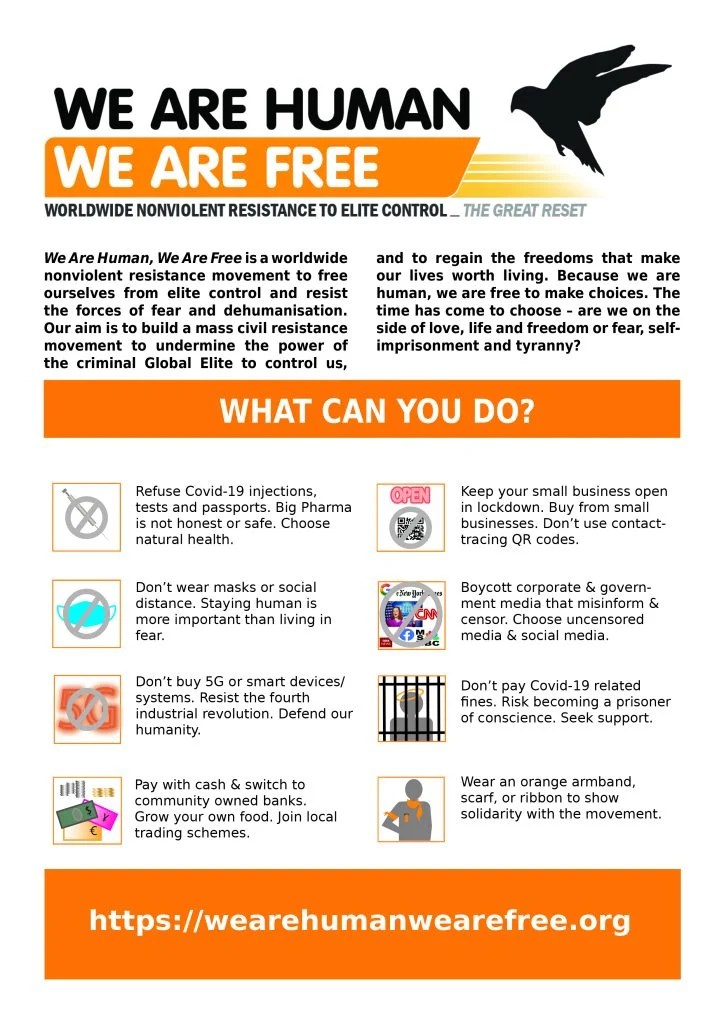
If you are interested in being strategic in your resistance to the ‘Great Reset’ and its related agendas, you are welcome to participate in the ‘We Are Human, We Are Free’ campaign which identifies a list of 30 strategic goals for doing so.
In addition and more simply, you can download a one-page flyer that identifies a short series of crucial nonviolent actions that anyone can take. This flyer, now available in 20 languages (Chinese, Czech, Danish, Dutch, English, Finnish, French, German, Greek, Hebrew, Hungarian, Italian, Japanese, Polish, Portuguese, Romanian, Russian, Serbian, Spanish & Slovak) with several more languages in the pipeline, can be downloaded from here:
If this strategic resistance to the ‘Great Reset’ (and related agendas) appeals to you, consider joining the ‘We Are Human, We Are Free’ Telegram group (with a link accessible from the website).
And if you want to organize a mass mobilization, such as a rally, at least make sure that one or more of any team of organizers and/or speakers is responsible for inviting people to participate in this campaign and that some people at the event are designated to hand out the one-page flyer about the campaign.
If you like, you can also watch, share and/or organize to show, a short video about the campaign here:
Finally, while the timeframe for this to make any difference is now in doubt, if you want to raise children who are powerfully able to investigate, analyze and act, you are welcome to make
Resisting the digitization of your identity is an important element of effective resistance to the Elite’s ‘Great Reset’ program.
While there are some elements of this that are very difficult to avoid, such as facial recognition cameras that are virtually everywhere, it certainly includes not signing up for a digital identity or participating unthinkingly in those programs, such as using a QR code, getting a ‘vaccine passport’ or willingly submitting to efforts to palm-print or microchip you, that are linked to it.
But, as I have already noted, just resisting digitization of your identity is not enough.
We must strategically resist the foundational components of the Elite program.
The alternatives are death or slavery.
Robert J. Burrowes has a lifetime commitment to understanding and ending human violence. He has done extensive research since 1966 in an effort to understand why human beings are violent and has been a nonviolent activist since 1981. He is the author of ‘Why Violence?’ His email address is flametree@riseup.net and his website is here.
Some years ago, the then vice-president of Monsanto Robert T Fraley asked, “Why do people doubt science”. He posed the question partly because he had difficulty in believing that some people had valid concerns about the use of genetically modified organisms (GMOs) in agriculture.
Critics were questioning the science behind GM technology and the impacts of GMOs because they could see how science is used, corrupted and manipulated by powerful corporations to serve their own ends. And it was also because they regard these conglomerates as largely unaccountable and unregulated.
We need look no further than the current coronavirus issue to understand how vested interests are set to profit by spinning the crisis a certain way and how questionable science is being used to pursue policies that are essentially illogical or ‘unscientific’. Politicians refer to ‘science’ and expect the public to defer to the authority of science without questioning the legitimacy of scientific modelling or data.
Although this legitimacy is being questioned on various levels, arguments challenging the official line are being sidelined. Governments, the police and the corporate media have become the arbiters of truth even if ‘the truth’ does not correspond with expert opinion or rational thought which challenges the mainstream narrative.
For instance, testing for coronavirus could be flawed (producing a majority of ‘false positives’) and the processes involved in determining death rates could be inflating the numbers: for example, dying ‘with’ coronavirus’ is different to dying ‘due to’ coronavirus: a serious distinction given that up to 98 per cent of people (according to official sources) who may be dying with it have at least one serious life-threatening condition. Moreover, the case-fatality ratio could be so low as to make the lockdown response appear wholly disproportionate. Yet we are asked to accept statistics at face value – and by implication, the policies based on them.
Indeed, documentary maker and author David Cayley addresses this last point by saying that modern society is hyper-scientific but radically unscientific as it has no standard against which it can measure or assess what it has done: that we must at all costs ‘save lives’ is not questioned, but this makes it very easy to start a stampede. Making an entire country go home and stay home has immense, incalculable costs in terms of well-being and livelihoods. Cayley argues that this itself has created a pervasive sense of panic and crisis and is largely a result of the measures taken against the pandemic and not of the pandemic itself.
He argues that the declaration by the World Health Organization that a pandemic (at the time based on a suspected 150 deaths globally) was now officially in progress did not change anyone’s health status, but it dramatically changed the public atmosphere. Moreover, the measures mandated have involved a remarkable curtailing of civil liberty.
One of the hallmarks of the current situation, he stresses, is that some think that ‘science’ knows more than it does and therefore they – especially politicians – know more than they do. Although certain epidemiologists may say frankly that there is very little sturdy evidence to base policies on, this has not prevented politicians from acting as if everything they say or do is based on solid science.
The current paradigm – with its rhetoric of physical distancing, flattening the curve and saving lives – could be difficult to escape from. Cayley says either we call it off soon and face the possibility that it was all misguided (referring to the policies adopted in Sweden to make his point), or we extend it and create harms that may be worse than the casualties we may have averted.
The lockdown may not be merited if we were to genuinely adopt a knowledge-based approach. For instance, if we look at early projections by Neil Ferguson of Imperial College in the UK, he had grossly overstated the number of possible deaths resulting from the coronavirus and has now backtracked substantially. Ferguson has a chequered track record, which led UK newspaper The Telegraph to run a piece entitled ‘How accurate was the science that led to lockdown?’ The article outlines Ferguson’s previous flawed predictions about infectious diseases and a number of experts raise serious questions about the modelling that led to lockdown in the UK.
It is worth noting that the lockdown policies we now see are remarkably similar to the disturbing Orwellian ‘Lock Step’ future scenario that was set out in 2010 by the Rockefeller Foundation report ‘Scenarios for the Future of Technology and International Development’. The report foresaw a future situation where freedoms are curtailed and draconian high-tech surveillance measures are rolled out under the ongoing pretexts of impending pandemics. Is this the type of technology use we can expect to see as hundreds of millions are marginalized and pushed into joblessness?
Instead of encouraging more diverse, informed and objective opinions in the mainstream, we too often see money and power forcing the issue, not least in the form of Bill Gates who tells the world ‘normality’ may not return for another 18 months – until he and his close associates in the pharmaceuticals industry find a vaccine and we are all vaccinated.
US attorney Robert F Kennedy Jr says that top Trump advisor Stephen Fauci has made the reckless choice to fast track vaccines, partially funded by Gates, without critical animal studies. Gates is so worried about the danger of adverse events that he says vaccines shouldn’t be distributed until governments agree to indemnity against lawsuits.
But this should come as little surprise. Kennedy notes that the Gates Foundation and its global vaccine agenda already has much to answer for. For example, Indian doctors blame the Gates Foundation for paralysing 490,000 children. And in 2009, the Gates Foundation funded tests of experimental vaccines, developed by Glaxo Smith Kline (GSK) and Merck, on 23,000 girls. About 1,200 suffered severe side effects and seven died. Indian government investigations charged that Gates-funded researchers committed pervasive ethical violations.
Bill Gates committed $10 billion to the WHO in 2010. In 2014, Kenya’s Catholic Doctors Association accused the WHO of chemically sterilising millions of unwilling Kenyan women with a ‘tetanus’ vaccine campaign. Independent labs found a sterility formula in every vaccine tested.
Instead of prioritising projects that are proven to curb infectious diseases and improve health — clean water, hygiene, nutrition and economic development — the Gates Foundation spends only about $650 million of its $5 billion budget on these areas.
Despite all of this, Gates appears on prime-time TV news shows in the US and the UK pushing his undemocratic and unaccountable pro-big pharma vaccination and surveillance agendas and is afforded deference by presenters who dare not mention any of what Kennedy outlines. Quite the opposite – he is treated like royalty.
In the meantime, an open Letter from Dr. Sucharit Bhakdi, emeritus professor of medical microbiology at the Johannes Gutenberg University Mainz, to Angela Merkel has called for an urgent reassessment of Germany’s lockdown. Dr Ioannidis, a professor of medicine and professor of epidemiology and population health at Stanford University, argues that we have made such decisions on the basis of unreliable data. In addition, numerous articles have recently appeared online which present the views of dozens of experts who question policies and the data being cited about the coronavirus.
While it is not the intention to dismiss the dangers of Covid-19, responses to those dangers must be proportionate to actual risks. And perspective is everything.
Much of the above is being driven by an inherently predatory economic system and facilitated by those who now say they want to ‘save lives’ by implementing devastating lockdowns. Yet, for the media and the political class, the public’s attention should not be allowed to dwell on such things.
And that has easily been taken care of.
In the UK, the population is constantly subjected via their TV screens to clap for NHS workers, support the NHS and to stay home and save lives on the basis of questionable data and policies. It’s emotive stuff taking place under a ruling Conservative Party that has cut thousands of hospital beds, frozen staff pay and demonised junior doctors.
As people passively accept the stripping of their fundamental rights, Lionel Shriver, writing in The Spectator, says that the supine capitulation to a de facto police state has been one of the most depressing spectacles he has ever witnessed.
It’s a point of view that will resonate with many.
In the meantime, Bill Gates awaits as the saviour of humanity — with a loaded syringe.
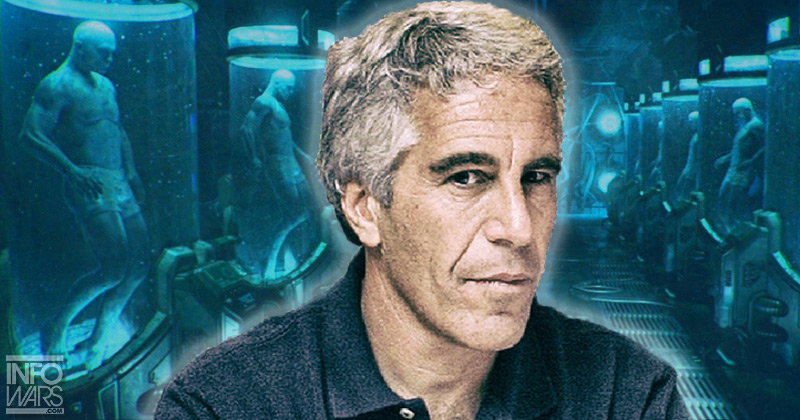
Not only is Jeffrey Epstein a predator of innocent children, he’s also a Malthusian and a transhumanist who wanted to have his head and penis cryogenically preserved.
According to a story published by The New York Times, Epstein wanted to use his compound outside of Santa Fe, New Mexico as an insemination lab.
The pedo predator thought so much of himself that he “hoped to seed the human race with his DNA by impregnating women.”
Mr. Epstein’s vision reflected his longstanding fascination with what has become known as transhumanism: the science of improving the human population through technologies like genetic engineering and artificial intelligence. Critics have likened transhumanism to a modern-day version of eugenics, the discredited field of improving the human race through controlled breeding.
The eugenicists at DARPA in conjunction with Academy of Medical Sciences, British Academy and Royal Academy of Engineering came together this month to discuss the potentials, opportunities and challenges of the melding of man with machine (i.e. transhumanism) under the guise of augmentation technologies.
In addition to funding transhumanist projects at Stanford and other elite institutions, the Pentagon is looking at creating the perfect cybernetic soldier and cop.
The Defense Advanced Research Projects Agency (DARPA) has a $2 billion yearly budget for research into creating a super solider as well as developing a synthetic police force. Working with the human genome, DARPA hopes to manipulate certain gene expressions. In experimentation, DARPA and the military industrial pharmaceutical complex are using natural abilities that are enhanced through genetic engineering.
But it isn’t simply transhumanism that motivated the pervert, Epstein. He also preached the Malthusian doctrine.
At one session at Harvard, Mr. Epstein criticized efforts to reduce starvation and provide health care to the poor because doing so increased the risk of overpopulation, said [cognitive psychologist Steven Pinker], who was there. Mr. Pinker said he had rebutted the argument, citing research showing that high rates of infant mortality simply caused people to have more children. Mr. Epstein seemed annoyed, and a Harvard colleague later told Mr. Pinker that he had been “voted off the island” and was no longer welcome at Mr. Epstein’s gatherings.
Culling the herd is a key concept of the elite Club of Rome and the subject of Rockefeller foundation projects.
Eradicating disease and reducing infant mortality rates are a negative for the global elite. “If I were reincarnated I would wish to be returned to Earth as a killer virus to lower human population levels,” Prince Philip reportedly mused.
The New York Times article reveals Epstein’s alignment with the global elite, of which he considered himself a member. In fact, he is, like so many lower-level water carriers, completely dispensable, especially now that his reckless predatory behavior has exposed the blackmail scheme used by the CIA-Mossad-MI6 to keep the political class and other pawns in line.
There is a global depopulation agenda. The plan is to remove the ‘undesirables’, ‘the poor’ and others deemed to be ‘unworthy’ and a drain on finite resources. However, according to Rosemary Mason, the plan isn’t going to work because an anthropogenic mass extinction is already underway that will affect all life on the planet and both rich and poor alike. Humans will struggle to survive the phenomenon.
A new paper by Rosemary A Mason in the ‘Journal of Biological Physics and Chemistry’, indicates that a ‘sixth extinction’ is under way (the Holocene extinction, sometimes called the Sixth Extinction, is a name describing the ongoing extinction of species during the present Holocene epoch – since around 10,000 BCE). In her paper, ‘The sixth mass extinction and chemicals in the environment: our environmental deficit is now beyond nature’s ability to regenerate’, she argues that loss of biodiversity is the most urgent of the environmental problems, as biodiversity is critical to ecosystem services and human health. And the main culprit is the modern chemical-intensive industrialised system of food and agriculture.
Mason asserts there is a growing threat from the release of hormone-disrupting chemicals that could even be shifting the human sex ratio and reducing sperm counts. An industrial agricultural revolution has created a technology-dependent global food system, but it has also created serious long-run vulnerabilities, especially in its dependence on stable climates, crop monocultures and industrially produced chemical inputs. In effect, farming is a principal source of global toxification and soil degradation.
Without significant pressure from the public demanding action, Mason argues there could little chance of changing course fast enough to forestall disaster. The ‘free’ market is driving the impending disaster and blind faith in corporate-backed technology will not save us. Indeed, such faith in this technology is actually killing us.
Since the late 1990s, US scientists have written in increasingly desperate tones regarding an unprecedented number of fungal and fungal-like diseases, which have recently caused some of the most severe die-offs and extinctions ever witnessed in wild species and which are jeopardizing food security. Only one paper dared to mention pesticides as being a primary cause, however.
Mason cites a good deal of evidence to show how the widespread use on agricultural crops of the systemic neonicotinoid insecticides and the herbicide glyphosate, both of which cause immune suppression, make species vulnerable to emerging infectious pathogens, driving large-scale wildlife extinctions, including essential pollinators.
Providing evidence to show how human disease patterns correlate remarkably well with the rate of glyphosate usage on corn, soy and wheat crops, which has increased due to ‘Roundup Ready’ crops, Mason goes on to present more sources to show how our over-reliance on chemicals in agriculture is causing irreparable harm to all beings on this planet. Most of these chemicals are known to cause illness, and they have likely been causing illnesses for many years. But until recently, the herbicides have never been sprayed directly on food crops and never in this massive quantity.
The depopulation agenda
Mason discusses how agriculture and genetically modified organisms (GMOs) fit into a wider agenda for depopulating the planet. She notes that on the initiative of Gates, in May 2009 some of the richest people in the US met at the home of Nurse, a British Nobel prize-winning biochemist and President (2003–10) of Rockefeller University in Manhattan, to discuss ways of tackling a ‘disastrous’ environmental, social and industrial threat of overpopulation. The meeting was hosted by David Rockefeller Jr. These same individuals have met several times since to develop a strategy in which population growth would be tackled.
The Rockefeller Foundation (RF) was involved in extensive financing of eugenics research by the National Socialists (Nazis) during and after World War and was in league with some of the US’s most respected scientists from such prestigious universities as Stanford, Yale, Harvard and Princeton. The explicit aim of the eugenics lobby funded by wealthy élite families, such as Rockefeller, Carnegie, Harriman and others since the 1920s, has embodied what they termed ‘negative eugenics’, the systematic killing off of ‘undesired bloodlines’.
RF funded the earliest research on GMOs, which Mason regards as part of the depopulation agenda (of course, apart from the adverse health impacts of GMOs, Monsanto owns the ‘epicyte gene’ which causes sterility in males). The RF funded the earliest research on GMOs in the 1940s and effectively founded the science of molecular biology.
Mason cites Steven Druker to show the fraud behind GMOs and how governments and leading scientific institutions have systematically misrepresented the facts about GMOs and the scientific research that casts doubt on their safety. Druker has shown that GMOs can have severe health impacts, which have been covered up.
The Royal Society is the preeminent scientific body within the UK that advises the government. It has misrepresented the facts about GMOs and has engaged in various highly dubious and deceptive tactics to promote the technology.
Druker wrote an open letter to RS as it has an obligation to the British public to provide a public response and ‘put the record straight’ on GMOs. Although Sir Paul Nurse’s presidency of Rockefeller University terminated in 2010, after he assumed the Royal Society presidency, Mason notes that Nurse is said to have maintained a laboratory on the Rockefeller campus and has an ongoing relationship with the university.
She asks: is that why Sir Paul was unable (or unwilling) even to discuss GMOs with Steven Druker? Was he sent to London by the Rockefeller Foundation to support the UK Government in their attempt to bring in GM crops? The UK Government and the GM industry have after all been shown to be working together to promote GM crops and foods, undermine consumer choice and ignore environmental harm.
Mason then goes on to discuss the impact of glyphosate residues (herbicide-tolerant GM crops are designed to work with glyphosate), which are found in the organs of animals, human urine and human breast milk as well as in the air and rivers. She documents its widespread use and contamination of soil and water and notes that the WHO International Agency for Research on Cancer’s assessment of glyphosate being a 2A carcinogen (probably carcinogenic in humans) is unwelcome news for the agrochemical industry. She also notes that Roundup usage has led to a depletion of biodiversity and that loss of biodiversity is also correlated with neonicotinoids. However, despite the evidence, the blatant disregard concerning the use of these substances by regulatory agencies around the world is apparent.
To provide some insight into the impact on health of the chemical-intensive model of agriculture, Mason shows that in the US increases in Alzheimer’s disease, obesity, breast cancer, oesophageal cancer, congenital anomalies and a growing burden of disability, particularly from mental disorders are all acknowledged.
She claims that plans are under way to depopulate the planet’s seven million plus people to a more manageable level of between 500–2000 million by a combination of means, including the poisoning and contamination of the planet’s food and water supplies via chemical-intensive industrialised agriculture. Mason also notes that health-damaging GMOs are being made available to the masses (under the guise of ‘feeding the poor’), while elites are more prone to eat organic food.
We may be gone before planned depopulation takes hold
Although Mason cites evidence to show that a section of the US elite has a depopulation agenda, given the amount of poisons being pumped into the environment and into humans, the thrust of her argument is that we could all be extinct before this comes to fruition – both rich and poor alike.
In concluding, she states that the global pesticides industry has been allowed to dominate the regulatory agencies and have created chemicals of mass destruction that can no longer be controlled. She has some faith in systems biology coming to the fore and being able to understand the complexity of the whole organism as a system, rather than just studying its parts in a reductionist manner. But Mason believes that ultimately the public must place pressure on governments and hold agribusiness to account.
However, that in itself may not be enough.
It is correct to highlight the poisonous impacts of the Rockefeller-sponsored petrochemical ‘green revolution’. It has uprooted indigenous/traditional agriculture and local economies and has recast them in a model that suits global agribusiness. It is poisoning life and the environment, threatening food security across the globe and is unsustainable. The ‘green revolution’ was ultimately a tool of US foreign policy that has been used in conjunction with various institutions like the IMF, World Bank and World Trade Organisation. GMOs represent more of the same.
In this respect, Mason follows the line of argument in William F Engdahl’s book ‘Seeds of Destruction: The Hidden Agenda of Genetic Manipulation’, which locates the GM issue and the ‘green revolution’ firmly within the context of empire. Engdahl also sees the Rockefeller-Gates hand behind the great GMO project to a sinister eugenicist strategy of depopulation.
Mason’s concerns about depopulation therefore should not be dismissed, particularly given the record of the likes of the Gates and Rockefeller clans, the various covert sterility programmes that have been instituted by the US over the decades and the way agriculture has and continues to be used as a geopolitical tool to further the agendas of rich interests in the US.
To understand the processes that have led to modern farming and the role of entities like Monsanto, we must appreciate the geopolitics of food and agriculture, which benefits an increasingly integratedglobal cartel of finance, oil, military and agribusiness concerns. This cartel seeks to gain from war, debt bondage and the control of resources, regardless of any notions relating to food security, good health and nutrition, biodiversity, food democracy, etc.
Food and trade policy analyst Devinder Sharma notes the impacts in India:
“India is on fast track to bring agriculture under corporate control… Amending the existing laws on land acquisition, water resources, seed, fertilizer, pesticides and food processing, the government is in overdrive to usher in contract farming and encourage organized retail. This is exactly as per the advice of the World Bank and the International Monetary Fund as well as the international financial institutes.”
In Punjab, India, pesticides have turned the state into a ‘cancer epicentre‘. Moreover, Indian soils are being depleted as a result of the application of ‘green revolution’ ideology and chemical inputs. India is losing 5,334 million tonnes of soil every year due to soil erosion because of the indiscreet and excessive use of fertilisers, insecticides and pesticides. The Indian Council of Agricultural Research reports that soil is become deficient in nutrients and fertility.
And now, there is an attempt to push GM food crops into India in a secretive, non-transparent manner that smacks of regulatory delinquency underpinned by corrupt practices, which suggests officials are working hand in glove with US agribusiness.
As smallholders the world over are being driven from their land and the GMO/chemical-industrial farming model takes over, the problems continue to mount.
The environment, the quality of our food and our health are being sacrificed on the altar of corporate profit and a type of looting based on something we can loosely regard as ‘capitalism’. The solution involves a shift to organic farming and investment in and reaffirmation of indigenous models of agriculture. But ultimately it entails what Daniel Maingi of Growth Partners for Africa says what we must do: “… take capitalism and business out of farming.”
It must also entail, according to Maingi, investing in “… indigenous knowledge and agroecology, education and infrastructure and stand(ing) in solidarity with the food sovereignty movement.”
In other words, both farmers and consumers must organise to challenge governments, corrupt regulatory bodies and big agribusiness at every available opportunity. If we don’t do this, what Mason outlines may come to pass.
Colin Todhunter is an independent writer : you can support his writing here.




 After the Crash