
By Andy Prisbylla
Source: We Are The Mutants
In our current technocratic society, it’s incredibly rare to meet someone who is genuinely free. The erosion of the Consent Decrees of 1948—which allowed media conglomerates to own and control movie theaters—drastically altered the landscape of film and video production, further destabilizing an already unlevel playing field between corporate interests, content creators, and consumers. The trickle-down economics Reagan touted in his 1981 tax act proved only to favor the affluent, further alienating independent creators who were frozen out of a livelihood through economic blacklisting, a perpetual attack that continues to this day. Bill Clinton’s elimination of the fin-syn rules that required television networks to source 35% of their content from independent producers only helped to continue this trend into the new millennium, and soon the mainstream movie and TV-consuming public was offered a slate of hegemonic programming supplied by a monopoly rule.
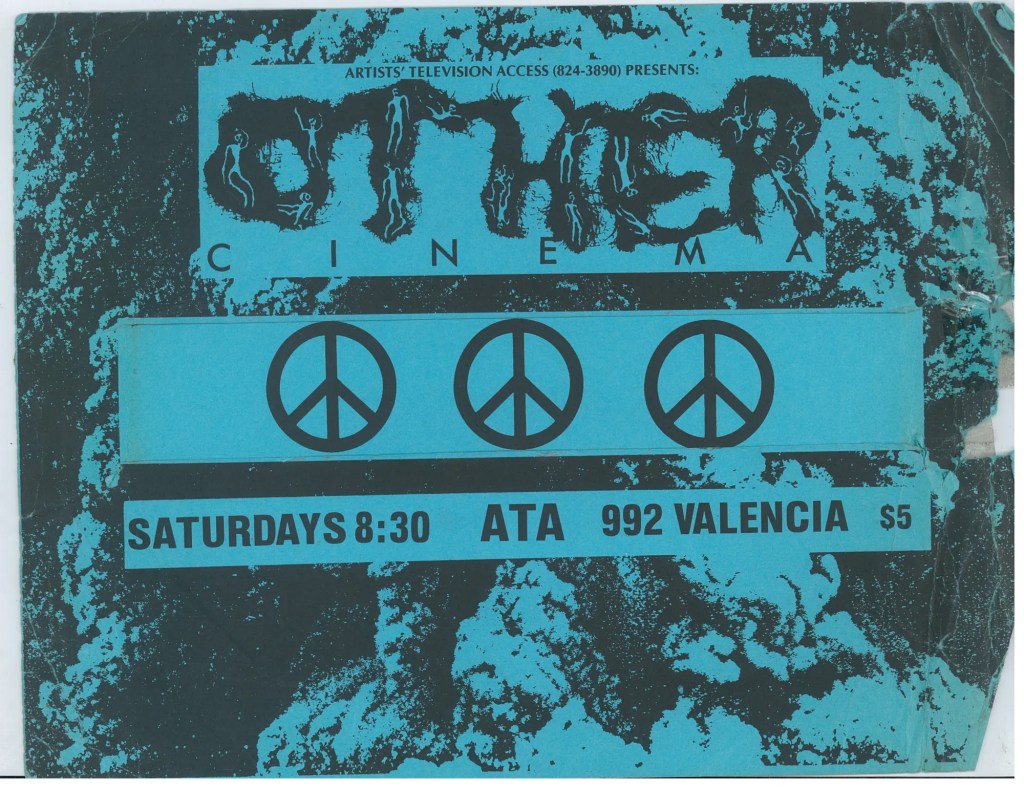
With traditional avenues of information exchange becoming more restricted, pockets of transgressive media resistance—inspired by the countercultural film and video collectives of the ‘60s and ‘70s—gained 501(c)(3) non-profit status in 1980s America. These artist-run community organizations championed alternative educational perspectives on media literacy and performance, such as Artists’ Television Access in the Mission District of San Francisco, California. Operating under the umbrella of this community space exists a cinematic collective with a subversive trajectory: a film screening series and analog archive curated from the margins of mainstream media and acceptable art practice. Under the stewardship of underground filmmaker and curator Craig Baldwin, Other Cinema stands as the vanguard of Baldwin’s personal artistic conviction—what he calls “cinema povera,” an anti-capitalist filmmaking creed where artists only use the materials at their disposal to create art. Combine this practice with an ethos of media archeology and mixed-media collage that predates our current remix culture activities and what’s generated is an exhibition calendar of the modern avant-garde—a thirty-six week screening schedule projecting experimental film and video to the masses. Every Saturday night, cartoons, B movies, and commercials hold equal ground with industrial, educational, documentary, personal essay, and public domain/orphan films, bringing together numerous artists and filmmakers from around the world under one cinematic ceiling for close to 40 years.
Specific details surrounding the origins of Other Cinema are hard to quantify, partially due to the vastly prolific yet oddly cryptic career of founder Craig Baldwin. Born into a self-admitted 1950s middle-class existence in the Sacramento suburb of Carmichael, California, Baldwin spent his teenage years nurturing a ravenous curiosity for subversive cultures and media. During high school, he was often at the local Towne Theater enjoying the latest midnight show of underground programming, absorbing the cinematic combustion of the ‘60s experimental scene led by filmmakers like George Kuchar and Bruce Conner, who as a teacher would later kick Baldwin out of his film class while attending San Francisco State University. In college Baldwin also indulged in subterranean films such as Peter Watkins’s 1966 pseudo-doc The War Game and exploitation flicks like Paul Bartel’s 1975 sci-fi dystopian romp Death Race 2000. Forming a fascination with film exhibition, Baldwin worked as a projectionist at several movie houses throughout the city, navigating the film worlds through an eclecticism of arthouse, exploitation, pornography, and political activism—including contributing programming and film services to El Salvador Film and Video Projects for the Salvadoran solidarity movement of northern California. His early activism with the artistic political action collective the Urban Rats saw him and his cohorts reclaim San Francisco’s urban landscape through adverse possession or “squatter’s rights,” which allowed Baldwin to experiment with expanded cinema performance, such as projecting film in abandoned buildings and other derelict dwellings.
This direct approach towards genre and social action speaks to Baldwin’s personal opposition towards the status quo, an attitude that not only informs Other Cinema’s motion picture programming but also Baldwin’s own filmmaking forays. His early experiments with Super 8 film—such as the prototypical culture jam/situationist prank Stolen Movie—bled into his 16mm attacks on advertising, consumerism, and colonialism in Wild Gunman and RocketKitKongoKit before gaining maximum velocity with his Dexedrine-driven, countermyth conspiracy report Tribulation 99. Making up the pure found footage/collage aesthetic of his filmography until introducing live-action performance into the mix with his films !O No Coronado!, Spectres of the Spectrum, and Mock Up on Mu, these early works draw heavily from Baldwin’s now massive archive of analog film. Housed beneath the Artists’ Television Access property, this subterranean scroll of marginalized media is continuously rescued from the bowels of civilization’s ever evolving technological burden and given new purpose. The shift from film in the 1970s to magnetic tape in the 1980s saw major institutions overhaul their audio/visual collections in favor of more economical video formats, sending reels of celluloid to the dumpsters and landfills. Much like the Dadaists of the early 20th century avant-garde, whose use of appropriation and photomontage expressed anti-bourgeois protest through their art, Baldwin and company salvaged these bastardized works from material obscurity and celebrated their ephemeral nature through collage and remix. These hybrid works of the late 20th century serve as precursor to many of our current 21st century new media innovations, resulting in the continued radicalization of modern artistic folklore, such as the mashups and supercuts of Everything Is Terrible! and the radical anti-authoritarian statements of the sister collective Soda Jerk.
Baldwin and Other Cinema’s defense of the diminished and discarded extends not only to the physical media he interacts with but to the audience he exhibits for. Maintaining a dialectical attitude, Baldwin expresses both respect and disrespect towards film genre and classification by spinning one off the other and forming new categories. Each screening is meant to give equal weight to diverse voices and provoke participation amongst attendees—an ethos Baldwin codified with his underground screening series The RAD, The MAD & The BAD while programming film events for Artists’ Television Access during the organization’s formative years. A protean yet practical film genre grouping system sorted through three major categories stripped of pretense and soaked in punk rock colloquialism, each selection was designated its own time slot on Wednesdays and Saturdays with those represented creating a continuity across each section:
The RAD: showcasing political and social action films
The MAD: mad genius or auteur cinema
The BAD: psychotronic themes of horror/sci-fi/exploitation
Defying the unspoken restraint behind many traditional classification systems that favor a false high-brow aesthetic to an honest low-brow sensibility, The RAD, The MAD & The BAD crossed the cultural demarcation line with an egalitarian stance towards genre representation, allowing for serious discussion about what constitutes a film’s importance and its commodification within society. More importantly, it displayed through example that poor production doesn’t always mean poor quality, and films created on the margins of capital contain a certain cultural influence and accessibility that corporate-backed productions can only hope to afford or inspire.
The authentic response audiences gave towards the weekly film schedule at Artists’ Television Access saw the prestigious San Francisco Cinematheque approach Baldwin to bring his street sensibility to their precocious crowd with Sub-Cinema, a RAD, MAD & BAD-inspired program that ran over the course of 1985. The creation of other pop-up programs like Anti-Films and Eyes of Hell inspired Baldwin to consolidate his film selections under his own programming umbrella, and soon the ethos that fueled The RAD, The MAD & The BAD manifested itself into the physical embodiment of Baldwin’s own psyche and practice with the foundation of Other Cinema.
If the RAD, MAD & BAD helped bring acceptance to the concept of marginalization in film selection and exhibition during the 1980s, the programming behind Other Cinema built upon this provocation by introducing new alternative voices from the microcinema scene of the 1990s. One of the forefronts of this new cinematic experience, Other Cinema became a home for a subculture of film using and reusing old and new technologies to create future underground works, with filmmakers and exhibitors from across the country like Sam Green, Martha Colburn, Greta Snider, Bill Daniel, Orgone Cinema, 3Ton Cinema, and “others” coalescing to this space like the children of Hamelin to the Pied Piper’s whimsical flute. Many of these groups and individuals appear in Baldwin’s upcoming career monograph Avant to Live!, a 500-page treatise detailing his cinematic trajectory in the media arts.
The decline of physical media coupled with our perpetual progression towards a digital state continues to divide us, with some championing the virtual realm and its democratization of new technologies and others questioning its effect on the human experience and how we interact with each other. The popularity of streaming services continues to challenge the economic longevity of physical media, forcing film formats into a wave of obsolescence. Despite this, Craig Baldwin and Other Cinema rise against the tide with an analog assault of expanded cinema every Saturday night. Filmmakers on the fringe and maverick media archeologists with an overwhelming responsibility to film history, yet hamstrung by a lack of resources, congregate at Other Cinema to embrace the struggle in an ever evolving motion picture renaissance. It’s a form of masochism one needs to make it on this side of the art world—the “masochism of the margins,” as Baldwin often says. It takes pain and sacrifice to live here, yet the psychic rewards far outweigh the material loss.
Craig Baldwin: Avant to Live! is a collaborative project between San Francisco Cinematheque and INCITE: Journal of Experimental Media and was released on May 30, 2023.
Andy Prisbylla is an underground filmmaker and exhibitor from the rust belt apocalypse of Steel City, PA. His screening series SUBCINEMA showcases subterranean movies and art through digital programming and live pop-up events. Find out more through Letterboxd and Mastodon.

 After the Crash