Home of the Grave: Rene Daalder’s ‘Population: 1’
By Eve Tushner
Source: We Are The Mutants
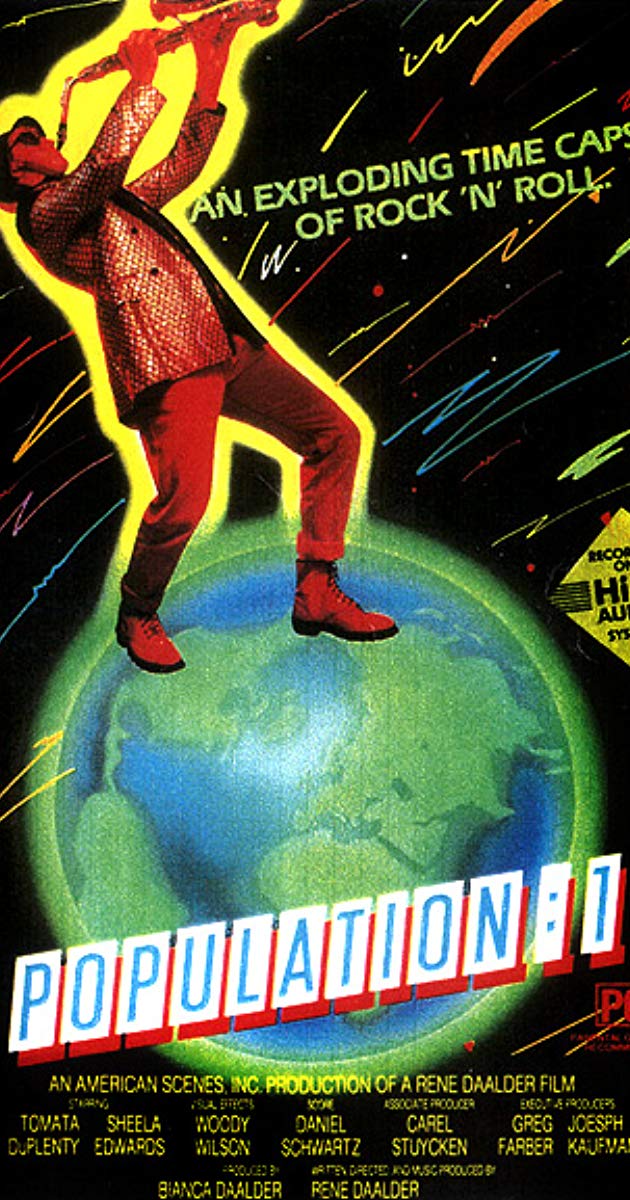
“It is my dubious privilege to confirm the fact that man never invented anything that he didn’t eventually put to use.” That’s how Tomata du Plenty (played by the punk singer of the same name) describes the nuclear apocalypse that has left him the eponymous sole survivor in Dutch writer-director Rene Daalder’s 1986 film Population: 1, and in the scrawny, wiry actor’s voice there’s as much delectation as warning. Population: 1 is a short film that feels sprawling: it clocks in at just over an hour but manages to be a science fiction dystopia, an embittered tour of American history, a series of music videos hitting several points on the art-punk spectrum—and an ironic, ambivalent love letter to the Bomb.
The movie’s atmosphere can be guessed just from the cast list, full of names like Helen Heaven, Gorilla Rose, Tequila Mockingbird, and El Duce. Even the normal-named people include Penelope “Avengers” Houston, Maila “Vampira” Nurmi, and—wait for it—a teenaged Beck. The movie emerged from a collaboration between Daalder and the Los Angeles punk band the Screamers (fronted by Tomata), whose live shows were intended to become a series of music videos. They became this instead.
The film opens in black and white with tape hiss and synth, a half-dressed woman running through debris amid signs reading POST MORTEM and LAST HOPE. This is Sheela (Sheela Edwards, who performed IRL with Tomata), film-Tomata’s love interest. She’s a broken-toothed beauty and a howling chanteuse, screaming “I’m so alone!” just before the atomic sunrise. As Sheela lies abandoned at the edge of a lake, we cut to color film of Tomata in an underground bunker, promising that what we’re about to see will be a “tribute to my country and [its] good, fearless people.” Our hero, scrawny to the point of being skeletal, rattles off a disjointed series of patriotic quotations: “Purple mountains’ majesty… by the dawn’s early light… corn as high as an elephant’s eye.” The music scatters hints of “Star Wars” and “Dixie.” Eagles, flags, vultures circling the prairie schooners—an entire American history course unfurls in self-aggrandizing, performatively dumb couplets like, “The land of the brave/Is now my grave.” All of these elements were chosen to explain how we ended up in this bunker, the last of the Yankees, at home at the end of the world.
There are generational resentments in Tomata’s rant: “But when it was my turn to run the show, they nuked the place and took it away,” the cry of someone who believes he deserved power. He’s not a trustworthy narrator. Population: 1 gets its American history from television: cowboys and Indians, buffalo dying for entertainment. This isn’t exactly a political film. If anything, it’s a spiritual indictment; it’s about “the American character,” and the TV images of naked women on display or a black man carrying a tray on his head are presented purely as symptoms of the spiritual disease of the white American soul. This isn’t Lizzie Borden’s Born in Flames, is what I’m saying. The movie replaces political theory and praxis with global thermonuclear contempt. Its hero is a stand-in for the resentful, defeated viewer: You’re probably just the kind of little cockroach, it says, who’d thrive in the nuclear dawn.
It’s a complicit movie, totally entertaining in its attacks on entertainment. As soon as we see the cameras watching Tomata in his hideout, the marathon dance competition on his TV (as soon as we see the TV, for that matter), we can guess that the film won’t spare arts and entertainment any more than it spares science, history, or consumer culture. Tomata capers around the bunker, chased by his appliances. He’s all alone and yet surrounded: by the people on the TV, by the cameras, by the dancing saxophone and hair dryer and shower head and electric toothbrush that hunt him through the bunker as he sings a paean to that most American ideal, “hard work to make a home sweet home.” This imagery of crowded domestic isolation could only be more contemporary if he addressed his hard-work song to Alexa. It’s a fantasy of servants who aren’t people (“Give your appliances the afternoon off,” he counsels, quoting a 1984 energy-conservation slogan from Southern California Edison). Tomata does his post-apocalyptic laundry in a home filled with “people” who are really projections of his own wants.
Population: 1 depicts America as a country defined by restless and relentless loneliness. This is why Hollywood became the entertainment capital of the world. Imagine Laura Ingalls Wilder as the prequel to 2015’s The Witch. Daalder’s film could’ve just as easily been titled “Little Bunker Under the Prairie.” And the movie enjoys the hell out of this violent, paranoid nation, a country whose laughter sounds like gunshots. There’s a carnivorous pleasure, a willingness to give us the very entertainment it condemns. It’s Savonarola cabaret.
Even the romance that shapes what passes for the movie’s plot is defined by entertainment and loneliness. Edwards is gorgeous in a stray-cat kind of way, and she can smolder as well as she can shriek. She takes her own American history tour through music, hitting the 1920s with a goth avant la lettre song called “Jazz Vampire” and the Depression with Rodgers and Hart’s taxi-dancer anthem “Ten Cents a Dance.” Tomata falls hard for her. “And then an idea struck me,” he reminisces, and the verb choice is apt: “The Punch and Judy show… escapist entertainment in which, for one fleeting moment, it would be me who took a beating from my own woman. I showed men that in weakness there lies strength, and encouraged women to show their teeth. And because of it, became the world’s favorite male role model.”
This whole episode is one of the places where Population: 1 is a lot smarter and twistier than it had to be. Nuclear apocalypse reveals both national and universal character, and here, one of the central human characteristics is a drive for self-immolating ecstasy. Sheela howls, “I wanna hurt!” as her man pleads in a cartoon swain’s voice, “I wanna love.” But their moth/flame romance is interrupted by World War II, and the movie returns to the more cliched tactic of playing “Smoke Gets in Your Eyes” over a montage of soldiers dying in flames. Still, the movie resists any political interpretation—any hope of an alternative—as we return to the devastated future. Tomata stumbles drunk through his bunker, holding a gun in one louche hand, at once underlining and undermining the film’s antiwar statement with slapstick. With the gun to his head, he muses, “But what is a man left alive to do but look himself in the eye and wonder where he got the power for so many things to go wrong?”
Sheela died in the atomic attacks, as we saw at the film’s beginning; Tomata was originally one of many survivors who retreated to an underground world ruled by fetishistic doctors and nurses in ’80s makeup. “We were a people who believed in fun, joy,” Tomata says, “yet here we were, knocked out of commission by a few man-made thunderclaps… We submitted to everything.” (A nice thing about nuclear war is that it makes your problems somebody else’s responsibility.) Tomata declares, “We never gave up on the pursuit of happiness, although the limits were many. For some reason, ecstasy always resulted in defeat and collapse.” He spits out recovery-culture slogans (“Easy Does It! One Day at a Time!”) while a sort of dance-riot plays out behind him. Huge swathes of the pop culture of the ’70s and ’80s tell the same story, of pleasure-seekers who discover that fun is bad. Those stories of chastening are themselves often both pleasurable and haunting, but Population: 1 denies itself the pleasures of being chastened; the defeat of fun is only prelude to the defeat of recovery.
The survivors mutate, of course, but for this movie the purpose of the mutations is to entertain us with their weirdness while also condemning us for being entertained: “They became the audience to their own midnight mutant movie,” Tomata says about his comrades, and about us. Life after war descends into a kind of Orgy on Dr. Moreau’s Island, and somehow Tomata ends up totally alone, “just as life starts with one individual sperm.” (That this isn’t how life starts—typically one does need an egg—is presumably part of the point.) With crazy eyes, in camo shorts and a Western shirt, Tomata declares his fealty to the American dream in lines laden with the movie’s heaviest sarcasm.
And then one last survivor bursts in on him! He isn’t alone! His lady love is dead, but perhaps there’s still companionship outside the television screen… Tomata shoots him. Capering and firing the gun, yelling more catchphrases (“A stitch in time. A tit for a tat. Jumpin’ Jehovah! … Long ago we would’ve been dead”), he shoots at the retreating camera and the rubble of the bunker closes him in. Roll credits.
A 2008 two-disc DVD release by Cult Epics includes an interview with Daalder, the usual trailers and stills, as well as many more music videos from the various performers involved with the movie, including previously unreleased material from the Screamers, Sheela Edwards solo, and Penelope Houston.



 After the Crash