
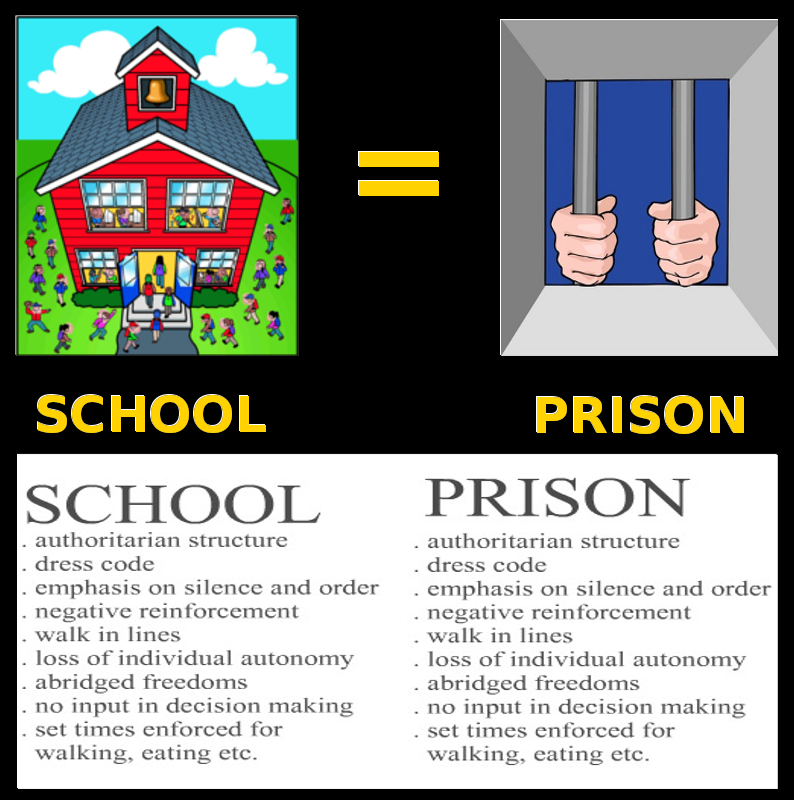
Public School Students Are the New Inmates in the American Police State

school_is_prison_by_twarrior-d4atw5g

By John W. Whitehead

Source: The Rutherford Institute

In the American police state, you’re either a prisoner (shackled, controlled, monitored, ordered about, limited in what you can do and say, your life not your own) or a prison bureaucrat (police officer, judge, jailer, spy, profiteer, etc.).

When you’re a child in the American police state, life is that much worse.

Microcosms of the police state, America’s public schools contain almost every aspect of the militarized, intolerant, senseless, overcriminalized, legalistic, surveillance-riddled, totalitarian landscape that plagues those of us on the “outside.”

From the moment a child enters one of the nation’s 98,000 public schools to the moment she graduates, she will be exposed to a steady diet of draconian zero tolerance policies that criminalize childish behavior, overreaching anti-bullying statutes that criminalize speech, school resource officers (police) tasked with disciplining and/or arresting so-called “disorderly” students, standardized testing that emphasizes rote answers over critical thinking, politically correct mindsets that teach young people to censor themselves and those around them, and extensive biometric and surveillance systems that, coupled with the rest, acclimate young people to a world in which they have no freedom of thought, speech or movement.

If your child is fortunate enough to survive his encounter with the public schools, you should count yourself fortunate.

Most students are not so lucky.

By the time the average young person in America finishes their public school education, nearly one out of every three of them will have been arrested.

More than 3 million students are suspended or expelled from schools every year, often for minor misbehavior, such as “disruptive behavior” or “insubordination.”

For instance, a Virginia sixth grader, the son of two school teachers and a member of the school’s gifted program, was suspended for a year after school officials found a leaf (likely a maple leaf) in his backpack that they suspected was marijuana. Despite the fact that the leaf in question was not marijuana (a fact that officials knew almost immediately), the 11-year-old was still kicked out of school, charged with marijuana possession in juvenile court, enrolled in an alternative school away from his friends, subjected to twice-daily searches for drugs, and forced to be evaluated for substance abuse problems.

Under similarly misguided school zero tolerance policies, students have been suspended for bringing to school household spices such as oregano, breath mints, birth control pills and powdered sugar. Look-alike weapons (toy guns—even Lego-sized ones, hand-drawn pictures of guns, pencils twirled in a “threatening” manner, imaginary bows and arrows, even fingers positioned like guns) can also get a student kicked out.

Acts of kindness, concern or basic manners can also result in suspensions. One 13-year-old was given detention for exposing the school to “liability” by sharing his lunch with a hungry friend. A third grader was suspended for shaving her head in sympathy for a friend who had lost her hair to chemotherapy. And then there was the high school senior who was suspended for saying “bless you” after a fellow classmate sneezed.

Unfortunately, these incidents are indicative of a nationwide phenomenon in which children are treated like suspects and criminals, especially within the public schools.

When you bring the police into the picture, after-school detention and visits to the principal’s office are transformed into punishments such as misdemeanor tickets, juvenile court, handcuffs, tasers and even prison terms.

More and more, police are “stepping in to deal with minor rulebreaking—sagging pants, disrespectful comments, brief physical skirmishes. What previously might have resulted in a detention or a visit to the principal’s office was replaced with excruciating pain and temporary blindness, often followed by a trip to the courthouse.”

Thanks to a combination of media hype, political pandering and financial incentives, the use of armed police officers to patrol school hallways has risen dramatically in the years since the Columbine school shooting.

Funded by government grants, these school resource officers have become de facto wardens in the elementary, middle and high schools, doling out their own brand of justice to the so-called “criminals” in their midst with the help of tasers, pepperspray, batons and brute force.

Now advocates for such harsh police tactics and weaponry will tell you that school safety should be our first priority lest we find ourselves with another Sandy Hook. What they will not tell you is that such shootings are rare. As one congressional report found, the schools are, generally speaking, safe places for children.

In their zeal to crack down on guns and lock down the schools, these cheerleaders for police state tactics in the schools might also fail to mention the lucrative, multi-million dollar deals being cut with military contractors such as Taser International to equip these school cops with tasers, tanks, rifles and $100,000 shooting detection systems.

Indeed, the transformation of hometown police departments into extensions of the military has been mirrored in the public schools, where school police have been gifted with high-powered M16 rifles, MRAP armored vehicles, grenade launchers, and other military gear. One Texas school district even boasts its own 12-member SWAT team.

As if it weren’t bad enough that the nation’s schools have come to resemble prisons—complete with surveillance cameras, metal detectors, drug-sniffing dogs, random locker searches and active shooter drills—the government is also contracting with private prisons to lock up young people for behavior that once would have merited a stern lecture. Nearly 40 percent of those young people who are arrested will serve time in a private prison, where the emphasis is on making profits for large megacorporations above all else.

Young people have become easy targets for the private prison industry. For instance, two Pennsylvania judges made headlines when it was revealed that they had been conspiring with two businessmen in a $2.6 million “kids for cash” scandal that resulted in more than 2500 children being found guilty and jailed in for-profit private prisons.

It has been said that America’s schools are the training ground for future generations. Yet as I point out in my book Battlefield America: The War on the American People, instead of raising up a generation of freedom fighters, however, we seem to be busy churning out newly minted citizens of the American police state who are being taught the hard way what it means to comply, fear and march in lockstep with the government’s dictates.

The lesson is this: you not only get what you pay for, but you reap what you sow.

If you want a nation of criminals, treat the citizenry like criminals.

If you want young people who grow up seeing themselves as prisoners, run the schools like prisons.

But if you want to raise up a generation of freedom fighters, who will actually operate with justice, fairness, accountability and equality towards each other and their government, then run the schools like freedom forums. Remove the metal detectors and surveillance cameras, re-assign the cops elsewhere, and start treating our nation’s young people like citizens of a republic and not inmates in a police state.


Education and the “Progressive” Corporate State

anti_public_education_propaganda_by_8manderz8-d5xz1cj

By Kevin Carson

Source: Center for a Stateless Society

Speaking in Knoxville, Tennessee on January 9 US president Barack Obama unveiled an initiative to provide two years of community college tuition-free, nationwide, to anyone meeting attendance and grade requirements. The idea, inspired by a similar program in Tennessee, aims to make two years of college as universal as high school is now. Obama’s proposal is in keeping, in more ways than one, with traditions going back to the origins of the American corporate state 150 years ago.

Since the mid-19th century, a few hundred large industrial corporations and banks have dominated the American economy. And the American state, functionally, has been closely intertwined with the interests of those corporations. One of its functions is to subsidize the corporate bottom line and artificially prop up the rate of profit by socializing provision of a growing share of inputs — among them the cost of reproducing and training human labor power.

The first statewide public school systems were introduced in New England to meet mill owners’ need for a workforce that was docile, obedient and educated to minimal standards; a function supplemented by education in “100% Americanism” at the turn of the 20th century, and a home economics curriculum in the ’20s and ’30s aimed at processing students into good mass consumers.

As recounted by New Left historian David Noble in America by Design, federal government aid to land grant colleges coincided with the national railroad and industrial corporations’ growing need for trained mechanical and industrial engineers. This trajectory carries through the GI Bill and to Obama’s latest proposal.

These institutional developments were accompanied by the rise of a meritocratic legitimizing ideology which replaced earlier American notions of equality and autonomy. Rather than genuine equality based on widespread economic empowerment and self-employment, the new meritocratic ideology treated step hierarchies of wealth, skill and managerial authority as both normal and necessary, but relied on the ideal of universal education to justify the ideology as “democratic.” With the widespread availability of secondary, higher and technical education, the theory goes, the individual’s rise in the managerial-technical hierarchy is limited only by their own willingness to learn and work. This peculiar American religion combines the existence of deep structural inequalities in wealth and power with the moralistic assumption that everyone gets exactly what they deserve.

The official White House happy talk, predictably, takes the corporate state’s assumptions for granted: “In our growing global economy, Americans need to have more knowledge and more skills to compete — by 2020, an estimated 35 percent of job openings will require at least a bachelor’s degree, and 30 percent will require some college or an associate’s degree.” That it’s the place of the “growing global economy” and the corporate HR departments in it to set the “required” qualifications for labor, and the place of the state’s education system to process people to those standards, goes without saying.

Never mind that globalization, concentration of economic power in the hands of a few giant, capital-intensive corporations, and a wage system that separates labor from both ownership and control of work, are none of them natural or inevitable processes. They all result from the deliberate policies of a state in league with capital.

The real irony is that the system of power Obama’s proposal is designed to serve is doomed to extinction. The revolution in cheap small-scale machine tools means an end to the material rationale for the wage system, and to corporate control of production. Coupled with the rise of open-source or pirated textbooks, free online lectures and syllabi and DIY learning networks, it also means an end to control over access to employment by the unholy alliance of big universities and human resources departments. In an economy where a few months’ wages can purchase a garage factory full of open-source tools and the economy is dominated by commons-based peer production and craft production in self-managed shops, credentialing will be largely stackable and ad hoc, negotiated informally to suit the needs of the groups of people working together.

The days of the educational Cult of Moloch and its human sacrifices are numbered.

Related post: Schools are Becoming Privatized Prisons


Time and the Technological World

321e730d017aeaf2228d3217ae9abd77

Source: The Hipcrime Vocab

Check out this fascinating summary of  How We Got to Now: Six Innovations That Made the Modern World. This particular summary looks at the part of the book that documents how our perception of time has changed, and how that has affected the modern world.

The book talks about something called the “Hummingbird Effect,” which describes the way in which various inventions and technical discoveries change the world in unexpected ways. Some of you may recall James’ Burke’s excellent TV show Connections on BBC/PBS (These used to be available on YouTube, but JamesBurkeWeb appears to have disappeared. Still, some episodes can still be found) which covered the same ground:

Johnson points out that, much like the evolution of bees gave flowers their colors and the evolution of pollen altered the design of the hummingbird’s wings, the most remarkable thing about innovations is the way they precipitate unanticipated changes that reverberate far and wide beyond the field or discipline or problem at the epicenter of the particular innovation. Pointing to the Gutenberg press — itself already an example of the combinatorial nature of creative breakthroughs — Johnson writes:

    “Johannes Gutenberg’s printing press created a surge in demand for spectacles, as the new practice of reading made Europeans across the continent suddenly realize that they were farsighted; the market demand for spectacles encouraged a growing number of people to produce and experiment with lenses, which led to the invention of the microscope, which shortly thereafter enabled us to perceive that our bodies were made up of microscopic cells. You wouldn’t think that printing technology would have anything to do with the expansion of our vision down to the cellular scale, just as you wouldn’t have thought that the evolution of pollen would alter the design of a hummingbird’s wing. But that is the way change happens.”

It starts with Galileo’s observation that a pendulum always swings to-and-fro in a regular amount of time.

“But machines that could keep a reliable beat didn’t exist in Galileo’s age; the metronome wouldn’t be invented for another few centuries. So watching the altar lamp sway back and forth with such regularity planted the seed of an idea in Galileo’s young mind. As is so often the case, however, it would take decades before the seed would blossom into something useful.”

The ability to accurately measure time was a departure from before when:

    “Instead of fifteen minutes, time was described as how long it would take to milk the cow or nail soles to a new pair of shoes. Instead of being paid by the hour, craftsmen were conventionally paid by the piece produced — what was commonly called “taken-work” — and their daily schedules were almost comically unregulated.”

Once the regimentation of the clock was introduced, many things followed from that due to the Hummingbird Effect:

Over the century that followed, the pendulum clock, a hundred times more accurate than any preceding technology, became a staple of European life and forever changed our relationship with time. But the hummingbird’s wings continued to flap — accurate timekeeping became the imperceptible heartbeat beneath all technology of the Industrial Revolution, from scheduling the division of labor in factories to keeping steam-powered locomotives running on time. It was the invisible hand of the clock that first moved the market — a move toward unanticipated innovations in other fields. Without clocks, Johnson argues, the Industrial Revolution may have never taken off — or “at the very least, have taken much longer to reach escape velocity.” He explains:

    “Accurate clocks, thanks to their unrivaled ability to determine longitude at sea, greatly reduced the risks of global shipping networks, which gave the first industrialists a constant supply of raw materials and access to overseas markets. In the late 1600s and early 1700s, the most reliable watches in the world were manufactured in England, which created a pool of expertise with fine-tool manufacture that would prove to be incredibly handy when the demands of industrial innovation arrived, just as the glassmaking expertise producing spectacles opened the door for telescopes and microscopes. The watchmakers were the advance guard of what would become industrial engineering.”

Not mentioned is the introduction of public schools, designed to take farmers used to “cow milking time” and “discipline” them into a workforce able to sit still and obey and punch a clock, a system we are still living with today. Those of us who cannot or will not conform to this ruthless discipline are severely punished:

And yet, as with most innovations, the industrialization of time came with a dark side — one Bertrand Russell so eloquently lamented in the 1920s when he asked: “What will be the good of the conquest of leisure and health, if no one remembers how to use them?” Johnson writes:

    “The natural rhythms of tasks and leisure had to be forcibly replaced with an abstract grid. When you spend your whole life inside that grid, it seems like second nature, but when you are experiencing it for the first time, as the laborers of industrial England did in the second half of the eighteenth century, it arrives as a shock to the system. Timepieces were not just tools to help you coordinate the day’s events, but something more ominous: the “deadly statistical clock,” in Dickens’s Hard Times, “which measured every second with a beat like a rap upon a coffin lid.”

[…]

    “To be a Romantic at the turn of the nineteenth century was in part to break from the growing tyranny of clock time: to sleep late, ramble aimlessly through the city, refuse to live by the “statistical clocks” that governed economic life… The time discipline of the pendulum clock took the informal flow of experience and nailed it to a mathematical grid. If time is a river, the pendulum clock turned it into a canal of evenly spaced locks, engineered for the rhythms of industry.

And as clocks became ever more precise and ubiquitous, things flowed from that – more regimentation, more standardization (village clocks used to be set by the sun’s position, but this introduced inaccuracies in railroad timetables – thus two inventions, one steam-powered and one not, are bound up together), and entirely new scientific discoveries which led to new inventions such as the computers that now rule over our lives:

Johnson goes on to trace the hummingbird flutterings to the emergence of pocket watches, the democratization of time through the implementation of Standard Time, and the invention of the first quartz clock in 1928, which boasted the unprecedented accuracy of losing or gaining only one thousandth of a second per day…But the most groundbreaking effect of the quartz clock — the most unpredictable manifestation of the hummingbird effect in the story of time — was that it gave rise to modern computing and the Information Age. Johnson writes:

    “Computer chips are masters of time discipline… Instead of thousands of operations per minute, the microprocessor is executing billions of calculations per second, while shuffling information in and out of other microchips on the circuit board. Those operations are all coordinated by a master clock, now almost without exception made of quartz… A modern computer is the assemblage of many different technologies and modes of knowledge: the symbolic logic of programming languages, the electrical engineering of the circuit board, the visual language of interface design. But without the microsecond accuracy of a quartz clock, modern computers would be useless.”

And once the computer is invented – note that it becomes the new mega-metaphor taking over from the steam engine – the brain as “neural network” that can be simulated, the economy as a perfect “information processing machine” via the price mechanism and humans as “rational utility maximizers”of Neoliberal economics, and recasting the analog world as binary one of ones and zeros – art, music, literature, etc. that can be simulated through sufficiently complex algorithms. All this flows from our view of the world, which in turn is dictated by our technology.

The Hummingbird Effect: How Galileo Invented Time and Gave Rise to the Modern Tyranny of the Clock (Brain Pickings)

More at the link. It’s worth noting that this entire thesis was laid out by Lewis Mumford as far back in the 1930’s in Technics and Society, and this book looks like it covers much the same ground.

Mumford’s these is that the Industrial Revolution did not spring forth fully-formed from nowhere, but came forth from changes in the human perception of the world and man’s relationship to nature that had been occurring for centuries beforehand. He called this the Eotechnic period, and points out that it needs to be understood to see how the modern world emerged. He classified the subsequent periods as Paleotechnic (centered around the stream engine, iron and coal), and the Neotechnic (centered around electricity and the scientific method). He stressed how much our perception of the natural world and human nature dictate the nature of our science and social organization.

Several intellectual revolutions had to take place in order to get us to the Industrial Revolution. One, as noted above and emphasized by Mumford, was the accurate measurement of time. Another was the increasing control over motive forces exemplified by the windmill and watermill. Another was individual perception, as indicated by the use of perspective in painting. Another was the increasing standardization, political centralization and bureaucracy. Another was the discovery of the New World of which the ancients had no knowledge or precedent. Another was the increasing use of the abstraction of money for trade. But perhaps the biggest one of all was recasting the natural world as a machine that could be analyzed and understood. These changes were all formative to the Industrial Revolution, which could not have come about without them.

Mumford writes extensively about the Medieval period, and how that period increasingly used technology to control the environment but in a genuinely humane way, one designed to enhance human needs and desires rather than control or eliminate them. Think of the medieval clock-making guild as opposed to the deskilled factory worker for example. The decentralized and localized nature of the Medieval period is what allowed technology to be used in this way.

But, beginning in the seventeenth century with the rise of the nation-state and the consolation of Europe’s kingdoms into large, centralized states with standards and bureaucracy (much of it due to the emergence of gunpowder and artillery, against which castles and mounted knights were useless), all that began to to change. Technology became increasingly tyrannical, and man was more and more forced into the “logic of the machine.” Consider the armies that emerged identical uniforms, identical weapons with interchangeable parts and drilled, regimented training designed to turn men into interchangeable parts themselves. Military training was the precursor to the disciplined workforce of the Industrial Revolution, which is why the connection between business and military discipline remains to this day (corporations today are run on the top-down hierarchical military model). Since battles were won by sheer numbers of “citizens” with rifles rather than an aristocratic warrior class who owned horses, the social relations changed, and the common man emerged with more importance. Population growth equaled national strength in the new order. Man’s rationality became celebrated, all other values were discounted. Productivity and technological “progress” became goals in the themselves rather than means to an end. Pursuit of growth and profit became all-consuming, human needs be damned.

In contrast to the Medieval period, today’s technology is dehumanizing, submitting man to centralized control, and seeing him as nothing more than a machine. Mumford envisioned a society where human values could once again take center stage instead of the productivist logic of “the myth of the machine” Thus Mumford was not anti-technology; rather he wanted a world in which technology served profoundly different values than in our present time. The brutal regulation of time, rather than the human time of being in the world – the difference between chronos and kairos, or the subjective and the objective – is one of the best illustrations of this difference. Just because we can measure time down to the nanosecond does not mean we have to be enslaved to it. That is a social choice, as Mumford would quickly remind us.