
Politics as therapy: they want us to be just sick enough not to fight back

freedom-mental-slavery2

By Michael Richmond

Source: Transformation

On 10 October it is World Mental Health Day. I used to be outgoing, but a descent into crushing depression left me housebound. After Occupy I started asking: how does social environment shape our psychology?

I used to buy the Sun newspaper. Not just to fit in with mates at secondary school but right into my first year at university. I knew there was something to be ashamed of in this filthy habit, armed as I was with my oft-deployed excuse: “I only buy it for the crossword and the football transfers.”

This was true. I never read the news. In general, I lived a remarkably apolitical existence. This was some feat considering I have a Jewish communist great grandfather, socialist grandparents, a union lawyer dad and an older brother who went through his Che Guevara phase at around fifteen.

I dropped out of university in early 2007, five months before Northern Rock bank hit the skids. Who knows whether the student experience would have politicised me? Perhaps the process would have been helped along by the backdrop of the approaching financial crisis?

But something else politicised me instead: a crushing, rapid descent into depression, social wilderness and personal crisis.

I experienced anxiety and depression as a hostile takeover of my life and sense of self. I went from being outgoing and sociable to being unable to talk to people or leave the house. This was within the space of a few days. There was no discernible cause.

It was quickly clear that I couldn’t continue at university and so I moved back into my parents’ house, where I have lived ever since.

Several years of isolation, suicidal thoughts and internal struggle followed. I remained unable to escape the confines of my bullying psyche, let alone my house.

Unable to work or study, have friendships, or experience joy, reading became my true love, my source of meaning, my attempt to make sense of what had happened to me. I obsessively read classic literature, history, philosophy, political economy – I had felt a profound sense of loss at not being able to finish university. I became determined that I would instead educate myself.

But an impenetrable sense of terror and despair continued to accompany me through my every waking and sleeping hour. I began to work my way through an impressive list of psychotropic medications and psychotherapies and eventually attended an NHS psychiatric day hospital for six months.

A “service user” within the psychiatric system gains a unique insight and practical education in state discipline as well as the lengths gone to in enforcing normativity. Having grown up white, straight, male and middle class, I was privileged to rarely, if ever, be told that I had to be something other than what I was.

I seldom encountered gross injustice or violence, blatant discrimination or the kind of treatment faced from the earliest ages if you happen to be a person of colour, don’t fit a gender binary or adhere to accepted ideals of sexual behaviour.

Apart from being a non-religious Jew and encountering minimal levels of playground anti-Semitism, this was the first time I found myself in a situation of social and political ostracism (as well as a self-ostracism that proved just as powerful). I discovered for myself that the experience of the personal deeply informs the political.

Leaving the psychiatric day hospital to instead attend the asylum of Occupy the London Stock Exchange at St Paul’s Cathedral was in many ways a descent into further madness. Many “occupiers” were well acquainted with psychiatric services and medications – as well as using drugs not sanctioned by the state, but often taken for similar reasons.

Chaotic, naïve, and ultimately politically problematic and ineffectual, the initial occupied space did nevertheless open up the possibility for social and political interaction that is elsewhere absent from society.

I felt that I was in crisis, but also that the crisis was much bigger than just me. Getting involved in political praxis seemed to be the best way to channel what I was experiencing.

There is a lot to be said for the practice of “politics as therapy.”

The personal account or “journey” format often proves insufficient when attempting to understand what we do and why we do it. An analysis of political subjectivity is crucial. Shifts in capitalist expansion, social environment and class composition, technological development and the onset of crises tend to precipitate political transformation on an individual and collective basis.

The advent of the printing press or the collapse of the automotive industry in mid-west America, for example, are not external factors to people’s lives or isolated moments in history. Indeed, any such upheaval is bound to lead to transformative changes in the lives and political ideation of those experiencing it.

Our social environment shapes our psychology. We must consider how the policy, ideology and debate that surrounds “mental health” or madness is framed.

The individualisation of suffering is key to the prevailing ideology and discourse surrounding mental illness. This will often focus on a supposed misfiring of brain chemicals, a “cure” to which can be found in the form of pharmaceuticals – often prescribed by your GP before any contact with mental health services.

Attention may also turn to an individual’s lack of positive attitude, but this problem can be “fixed” by a six-week course of cognitive behavioural therapy. So much human suffering is pathologised and medicated when it is either “natural” (i.e grief or the general variety of mental experience) or is directly or indirectly linked to social, political and economic factors that remain absent from debate, let alone actively contested on this terrain.

Psychologist and author Bruce E Levine suggests that much of today’s intervention under the auspices of “mental health” is all too political.

“What better way to maintain the status quo,” Levine asks, “than to view inattention, anger, anxiety, and depression as biochemical problems of those who are mentally ill rather than normal reactions to an increasingly authoritarian society?”

He also argues that many potential activists and “natural anti-authoritarians” are prevented from opposing power: “Some activists lament how few anti-authoritarians there appear to be in the US. One reason could be that many natural anti-authoritarians are now psychopathologised and medicated before they achieve political consciousness of society’s most oppressive authorities.”

The historical origins of madness within western culture and how it became increasingly medicalised should not be forgotten. Michel Foucault exposed how the origins of “confinement” of the “insane” in asylums and workhouses were an integral part of the violent replacement of the feudal commons way of life with capitalist work discipline during the 16th and 17th centuries.

This process is in keeping with continual “primitive accumulation” akin to and contemporary with the conquest of the “New World” and the persecution of heretics and witches. Their land and means of reproduction were stolen and appropriated, while authorities continually oppressed and attempted to proletarianise them.

Initially, the “Great Confinement” saw the imprisonment of the old, the unemployed, the “criminal”, the “insane.”

As Foucault explains: “Before having the medical meaning we give it, or that at least we like to suppose it has, confinement was required by something quite different from any concern with curing the sick. What made it necessary was an imperative of labour. Our philanthropy prefers to recognise the signs of a benevolence toward sickness where there is only a condemnation of idleness.”

The conflation of pejoratives like lazy, sick, unemployed, idle are more than familiar to us in today’s discourse surrounding welfare benefits and the imperatives of labour. And it is not just the DWP and Atos who pressure people back into work, NHS psychiatric services also seem to believe that it is work that sets you free.

The capitalist class would like us to be just sick enough not to fight back, but not so sick that we cannot work. The challenge for us is to find ways of organising and helping each other so that we can find adequate levels of social reproduction, care and support to give us a platform to engage in the therapy of class struggle.
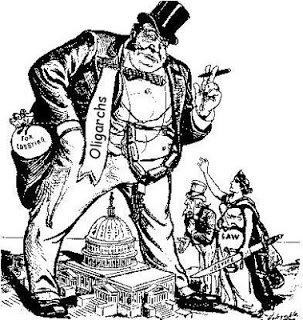

 

Five Studies: The Psychology of the Ultra-Rich, According to the Research

OLIGARCHY

Bernie Sanders says that billionaires have “psychiatric issues.” He’s not entirely incorrect.

By Livia Gershon

Source: Pacific Standard

“Let me tell you about the very rich. They are different from you and me. They possess and enjoy early, and it does something to them, makes them soft where we are hard, and cynical where we are trustful, in a way that, unless you were born rich, it is very difficult to understand. They think, deep in their hearts, that they are better than we are because we had to discover the compensations and refuges of life for ourselves. Even when they enter deep into our world or sink below us, they still think that they are better than we are. They are different.”
—F. Scott Fitzgerald

Bernie Sanders’ unexpectedly popular presidential campaign features a lot of rhetoric that we don’t usually hear in mainstream politics. One striking example is the Vermont senator’s contention that the ultra-rich suffer from “psychiatric issues” that manifest in an addiction to money and a worldview divorced from reality.

When we talk about inequality, we often spend lot of time considering poor people’s attitudes and behaviors, from whether they get married to how they talk to their kids. We’re less likely to stop and look at how the rich are different. But extremely wealthy people play a huge role in increasing inequality. With their heavy political clout, they help shape government economic policies, supporting very different positions from those of average Americans. From their perches on corporate boards and compensation committees they also give direct raises to their fellow oligarchs.

As inequality grows, in the United States and in the world, the shape of the wealthiest classes is also changing. The significance of inherited wealth fell rapidly in the mid-20th century, making way for the “self-made” rich. Now, though, there’s growing evidence that, as Thomas Piketty has famously argued, dynasties are making a comeback.

So there’s good reason to pay at least as much attention to the behaviors and beliefs of the rich as we do to those of the poor. But what does research tell us about the nature of wealth? How does it affect those who have it? Studies suggest the wealthy really do have significant psychological differences from the middle class in how they view money, and how they look at their relationship with society.

1. MONEY BUYS HAPPINESS—KIND OF

Richer people tend to be happier, but not by all that much. And it’s not really right to say money makes them happy. Wealth only makes affluent people more satisfied to the extent that it gives them more control over their own lives, making them feel richer. (Anyone who feels financially and personally stable because they’ve got a steady job, enough money to get them through an emergency, and a nicer house than their neighbor is likely to be happier than the poorest multi-millionaire in a hyper-rich enclave they can’t really afford.) Still, holding everything else equal, people who have more money have more stability. Of course, they also usually know they’re well off. And those two factors make them happier.

—”How Money Buys Happiness: Genetic and Environmental Processes Linking Finances and Life Satisfaction,” Wendy Johnson and Robert F. Krueger, Journal of Personality and Social Psychology, Vol 90(4), Apr 2006

 2. BUT RICH PEOPLE HAVE DIFFERENT CRITERIA FOR HAPPINESS

Asked about what makes people happy, extremely rich Americans, just like average Americans, typically put love first. But the ultra-wealthy are more likely than everyone else to say happiness depends on winning the appreciation and respect of others. They’re also more likely to cite the realization of personal potential as a key to happiness. But they’re much less likely than non-wealthy people to say that physical health is most important. (Perhaps because they’ve never been uninsured?) Rich people are also a bit more likely than the rest of us to say having a lot of money can occasionally present an obstacle to happiness.

—”Happiness of the Very Wealthy,” Ed Diener, Jeff Horwitz, and Robert A. Emmons, Social Indicators Research, April 1985

3. THE WEALTHY ARE MORE AND MORE LIKELY TO IDENTIFY WITH AN INTERNATIONAL ECONOMIC ELITE

Board members of the world’s largest corporations—a significant and influential segment of the ultra-rich—are increasingly likely to serve on the boards of foreign and multinational companies. Even directors who don’t serve on the boards of foreign companies usually interact with others who do. In other words, modern corporate elites are likely to be part of cosmopolitan, global social networks, whereas most poor and middle-class people are more likely to identify with their home populations.

—”Transnationalists and National Networkers in the Global Corporate Elite,” William K. Carroll, Global Networks, June 2009

4. AS A RESULT, THEY’RE NOT GREAT AT EMPATHY

People from higher socioeconomic classes do worse on a test where they’re asked to identify emotions in photographs of human faces. They’re also less accurate at perceiving the emotional states of others in real-life interactions. In fact, researchers can reduce people’s empathy just by prompting them to think of themselves as relatively high-status. Test subjects who are asked to imagine an interaction with someone from a lower social rung get worse at understanding other people’s emotions. The trouble higher-status people have recognizing emotions is tied to the fact that they tend to think about themselves and others in terms of fixed traits (“She’s a nervous person.”) In contrast, people from lower social classes are more likely to use contextual explanations for people’s behavior (“This interview is making her uncomfortable.”)

—”Social Class, Contextualism, and Empathic Accuracy,” Michael W. Kraus, Stéphane Côté, and Dacher Keltner, Psychological Science, October 25, 2010

5. AND THEY THINK DOMESTIC INEQUALITY REPRESENTS JUST DESSERTS

Americans are known for our trust in an ideal of meritocracy. When you ask the general public to assess statements like “most people who want to get ahead can make it if they’re willing to work hard,” well over 70 percent of us agree. But what happens when people see high levels of income inequality in their daily lives? It turns out that low-income Americans are less likely to believe in meritocracy if they live in counties with extreme economic inequality—places where they’re likely to run into much richer people a lot. For high-income people, the effect is exactly the opposite. The study’s authors suggest that rich people could be using a defense mechanism to stave off guilt and justify their relatively privileged position within a visibly unequal system. But, for whatever reason, the more inequality rich people see in their home county, they more likely they are to believe that meritocracy is working.

—”False Consciousness or Class Awareness? Local Income Inequality, Personal Economic Position, and Belief in American Meritocracy,” Benjamin J. Newman, Christopher D. Johnston, and Patrick L. Lown, American Journal of Political Science, April 2015


Wu Wei, Flow States and the Art of Being a Lazy Fuck

hammock

By Mr. Furious

Source: Disinformation

“…It is when we act freely, for the sake of the action itself rather than for ulterior motives, that we learn to become more than what we were.”

“The psychic entropy peculiar to the human condition involves seeing more to do than one can actually accomplish and feeling able to accomplish more than what conditions allow.”

― Mihaly Csikszentmihalyi, Flow: The Psychology of Optimal Experience

I visibly waffled on several occasions when attempting to begin this article. Literally. I sat down on the couch with my laptop, ready to begin the process of typing this stupid, god-forsaken thing, and I physically shuddered. Each time. And, each time, Missus Furious would gaze at me cock-eyed and ask what the fuck my problem was.

“Nothing,” I’d mumble. “Nothing at all.”

“Ok?” She’d say, skeptically. “But why do you keep doing that?”

“Doing what?”

“Having seizures or whatever it is you’re doing over there. Are you alright?”

“I don’t know what you’re talking about.”

“YOU KEEP SHAKING.”

At that point I just shrugged and shook my head as if she were crazy.

This is what it’s like living with someone as mercilessly moronic as myself.

Anyhow, I did have several episodes of trembling. For a couple of reasons.

• • •

One: The thought of having to type Mihaly Csikszentmihaly’s name a half-dozen or so times made me ill. This sounds like such a minor inconvenience that I must be making it up. But I’m not. You’re reading the work of the type of person who, when trying to watch Rey Mysterio highlights on youtube and an ad pops up, and the button in the corner of the ad says “you can skip this ad in 13 seconds,” I usually just close up the entire browser, get off the computer and go make peanut butter sandwiches or something, instead of waiting the 13 seconds.

Two: There are enough subtleties and nuances to both Csikszentmihalyi’s ideas and my own arguments, that I’m worried a fair number of potential readers are going to miss them. And, as a writer, I feel that if people misunderstand and/or don’t fully comprehend what is going on, it’s my fault, not the reader’s. So I spend an inordinate and irrational amount of time in the midsts of a neurotic episode because I’m convinced I’m not a good enough writer (or thinker) to make some of my ideas clear.

Regardless of how I feel—and regardless of my concerns—here I am. And since I’ve already buried the lede this far, let me just come out and tell you what my thesis is for the rest of the article: that so-called “flow” states are much more easily accessed—and most commonly experienced—when one is being a lazy fuck.

• • •

First off, even though Csikszentmihalyi’s concept of Flow is one of the most popular and discussed ideas produced by psychology in the past 50 years or so, not everybody’s familiar with it. So we have to at least touch on what Flow is. Csikszentmihalyi himself describes the experience of flow as consisting of 6 components, which are:

  1. Intense and focused concentration on the present moment
  2. Merging of action and awareness
  3. A loss of reflective self-consciousness
  4. A sense of personal control or agency over the situation or activity
  5. A distortion of temporal experience, one’s subjective experience of time is altered
  6. Experience of the activity as intrinsically rewarding, also referred to as autotelic experience

All of which sounds incredibly reasonable and probably accurate. My issue is really with how Csikszentmihalyi argues we induce flow states, mostly because Csikszentmihalyi spends a good portion of the his book on the topic—inconceivably entitled Flow: The Psychology of Optimal Experiencediscussing his belief that Flow experiences must be stimulated by activities that provide just the right amount of challenge, i.e. not challenging to the point of making one frustrated, but not so devoid of challenge that one finds the activity boring.

Again, this assertion sounds rather reasonable. And it is. But Csikszentmihalyi then expounds on that idea to insist that one cannot be in a passive or lazy mind if one hopes to initiate states of Flow.

He states:

Contrary to what we usually believe, moments like these, the best moments in our lives, are not the passive, receptive, relaxing times—although such experiences can also be enjoyable, if we have worked hard to attain them. The best moments usually occur when a person’s body or mind is stretched to its limits in a voluntary effort to accomplish something difficult and worthwhile.” (emphasis mine)

He gives, as support to this idea, the example of a European woman who is a scholar and business magnate. She constantly travels, owns a number of homes around the world, is ceaselessly attending business meetings or conferences or concerts. She is so busy and opposed to leisure time that she expects her chauffeur to attend the local art museums in whatever town she finds herself in and give her a run-down of sorts on how the art museum was. To me she sounds insufferable and her life sounds exhausting. The importance of discussing this concept of Flow, as even Csikszentmihalyi admits, is that Flow states are supposed to make us happy. The inability to sit still and enjoy life for being life doesn’t sound like happiness to me. It sounds like distraction.

Either way, the philosopher and author Ed Slingerland agrees. In his book, Trying Not to Try, he takes the concept of Flow and expands and—in my opinion—improves on Csikszentmihalyi’s ideas. Slingerland makes the connection between Flow states and the Chinese philosophical concept of Wu Wei. Wu Wei is typically translated (with numerous, but less influential, exceptions) as “non-action,” “non-doing,” or “actionless action.” There is not really an English equivalent. Anyhow, Slingerland makes a rather convincing argument that Flow states are essentially states of Wu Wei.

This is important, because—even though I disagree with a number of assertions in Slingerland’s book—Slingerland is able to recognize that it’s not effort that is necessary to initiate episodes of Flow, it is a lack of effort that activates such states. Hence the title his book, Trying Not to Try.

Slingerland, though, still has his own aversion to coming out and saying that it’s a certain kind of laziness that induces Flow/Wu Wei states. Most writers who attempt to expound on the concept of Wu Wei exhibit this bizarre anxiety.

• • •

I’ve already written a bit about the virtues of laziness, and I want to emphasize that there’s a big difference between boredom and laziness, two concepts which I think a lot of people conflate. I also want to reiterate a major point from that initial essay of mine, which is: that a healthy laziness (as opposed to an unhealthy laziness, which does exist) is merely the spontaneous act of doing whatever seems most enjoyable to a person at a given moment. For example, a few people I know insist that I’m not lazy because I work 50-plus hours each week and yet I still find time to write and work-out and such things. But I genuinely enjoy writing and exercise. And typically when I am engaging in such activities, I am doing so at times when they’re so enjoyable that they are not taking much actual effort to complete. My 50 hours of work each week are really the only parts of my life that take any kind of effort — well, that and when my wife puts me to work doing some kind of tedious work around the house (for me, although many people like DIY projects). The opposite of laziness is “working hard.” But I think work only becomes hard when we’re not interested in doing it. I have to work hard at work because there are literally thousands of other things I’d rather spend my life doing.

This is my definition of laziness: the doing of things that are enjoyable at times when they are enjoyable. There were times when I was in school that writing was not enjoyable and was full of effort. Even in my series of essays for Disinfo, I believe a keen (or maybe not so keen in some instances) eye can spot those essays that weren’t all that enjoyable to write. They’re full of real effort. I’m the rare writer who believes that one should only write when inspired, and the fact that so many writers force themselves to write is why I find so many novels so unreadable.

All of which is sort of besides the point. The main idea here is that a healthy laziness is being spontaneous and doing enjoyable things at times when they are enjoyable. Sometimes activities we find to be enjoyable aren’t going to be enjoyable (for any of a myriad of reasons) and we shouldn’t do those usually enjoyable things at those times.

If we follow this advice, I believe we will find ourselves to be more often in states of Flow/Wu Wei. I know this is true for me when I write when I feel like writing, when I work-out when I feel like working out, when I socialize when I feel like socializing. I have Flow/Wu Wei watering my garden in cool summer evenings. I have felt it drinking green tea under a full moon while sitting on a rocking chair in my backyard. I have felt it on long walks after work with Missus Furious. I have even felt it lying on the couch and staring at the ceiling while daydreaming about being interviewed by Charlie Rose or about being able to eventually, one day, do a one-armed pull-up. And so on.

Most of those activities don’t meet Csikszentmihalyi’s requirement that flow states must present some kind of challenge, nor did I have to work hard to attain any of those states, contrary to his assertions. Believe me, for example, when I say that it literally takes no effort to imagine one’s self explaining pretentiously to Charlie Rose why one’s novel about drunk college kids puking on each other is really an analog for certain aspects of Taoist philosophy.

What those activities did meet, though, were my requirements: activities should be done when they feel enjoyable to do so.

• • •

Both Csikszentmihalyi and Slingerland recognized that Flow/Wu Wei states are instigated when we are doing things for their own sake. When we sew because we like the act of sewing, not because we’re all that interested in making a beautiful dress. When we cook because we enjoy the process of cooking, not because we’re all that interested in the resulting meal. When we play basketball not because we really want to win, but because playing basketball is fun.

The results of such activities may be rewarding too. Creating a beautiful dress, eating a tasty meal, and winning a basketball game certainly feel good. But there’s a difference, say, between Michael Jordan, who played basketball to feed his own ego, and a person who plays basketball because the activity of playing basketball is enjoyable in and of itself, regardless of outcome. Primarily, Michael Jordan’s efforts were effortful, whereas the other person’s was actually an act of spontaneity, or laziness, as I define it. And if you need proof that one form of playing basketball is superior to the other, all you need to do is look at Jordan or, say, Kobe Bryant, and observe how happy or fulfilled those two are, despite their numerous championships and accomplishments in the sport of basketball.

What Slingerland and Csikszentmihalyi neglect, though, is that the only way to do something for its own sake is to not give a shit about it, at least in the traditional ways we give a shit about things. What I’m talking about is being apathetic about results. If we don’t care about winning the basketball game, then our attention is focused only the joys of playing the game itself. If we’re not concerned about results, then we can focus on the joys of the process, which is where we can be lazy and in which we make ourselves available to Flow/Wu-Wei.

Note: It is inherent in the word “Flow” that a process is occurring. A river cannot flow, for example, once it has reached its end result of entering the ocean or of having been dried up. One can flow making a hamburger or eating a hamburger, but one cannot flow when the hamburger is simply sitting on the plate after the process of having been made, or when it is done being consumed. One can flow playing a game of basketball, but not when one has finished playing and has “won” or “lost” the game. One can flow when sewing a dress, but not when the dress is completed. If this is true for sewing and cooking and playing basketball, how much truer is it for the act (the process) of living life itself?

For if we work too hard, place too much effort in a search for results, instead of simply living life for life’s sake, we close ourselves off from opportunities for experiencing Flow/Wu Wei. And when we spend our lives struggling, striving, working, being effortful for some sort of ultimately meaningless result, we miss all that is enjoyable and worth experiencing… except when we’re in the mood to be effortful.

I’ll end this thing with a long-ish quote from Chuang Tzu via Slingerland that sums all of this up–even though Slingerland doesn’t seem to realize the depth and profundity of just what Chuang Tzu was saying, for Slingerland doesn’t quite recognize the connection between “spontaneity” and “laziness.”

Per Chuang Tzu:

When people are asleep, their spirits wander off; when they are awake, their bodies are like an open door, so that everything they touch becomes an entanglement. Day after day they use their minds to stir up trouble; they become boastful, sneaky, secretive. They are consumed with anxiety over trivial matters but remain arrogantly oblivious to the things truly worth fearing. Their words fly from their mouths like crossbow bolts, so sure are they that they know right from wrong. They cling to their positions as though they had sworn an oath, so sure are they of victory. Their gradual decline is like autumn fading into winter—this is how they dwindle day by day. They drown in what they do—you cannot make them turn back. They begin to suffocate, as though sealed up in a box—this is how they decline into senility. And as their minds approach death, nothing can cause them to turn back toward the light.

– See more at: http://disinfo.com/2015/05/wu-wei-flow-states-art-lazy-fuck/#sthash.g96cFrtS.dpuf

Ebola News Gives Me a Guilty Thrill. Am I Crazy?

_76476153_76475767

By

Source: Pacific Standard

What it means to feel a little excited about the prospect of a horrific event.

Folks speak blithely about their guilty pleasures. But if you get a little thrill when you contemplate the worldwide obliteration of society in a horrific Armageddon, have you crossed a line from “person with a guilty pleasure” to “person who is a dangerous psychopath”?

This was a question that wrecked most of one afternoon following a discussion of Ebola with some co-workers. We were brainstorming ideas for stories about the awful pandemic, and the topic of American preparedness came up. Although Ebola seems decently isolated on our shores, public health officials are girding our infrastructure for worst-case scenarios.

I made the following confession: Although obviously the West African Ebola crisis sickens and saddens me, and although I of course don’t want Ebola to run rampant … whenever I hear about the idea of our nation crumbling in an apocalyptic plague, I get an amoral twinge of excitement. It’s a tiny but unavoidable rush, not unlike the burst one feels when a rollercoaster begins to crest a hill, or when Darth Vader flicks on his lightsaber for the climactic battle of The Empire Strikes Back. I feel a similar frisson when it seems like a geopolitical crisis is bringing us to the brink of World War III (all summer, every time I read about ISIS’s march, I felt a jolt). I’m not proud of the way I feel, but it never goes away.

“If it’s not in the hypothetical and you’re seeing the devastation and you’re more excited than distraught, then you’re in the psychopathic range.”

Surely, I thought, at least some of my journalist coworkers could relate. They could not. “Dude,” one muttered to me. “That’s kinda fucked up.” Red-faced, I took to Gchat and iMessage to see if any non-work friends felt a similar electricity when they considered a real-world apocalypse. “Not really,” said one. “I don’t get scared, but I don’t get excited, either,” said another. “I don’t even want to be homeless in America, much less experience The Road,” said one of my dearest pals.

My pondering had turned to mild panic. Was I crazy? Or at least, in the immortal words of Matchbox 20, just a little unwell? I sought journalists’ favorite kind of professional help: I called up some researchers, specifically, in this case, those who had studied humanity’s fixation on end-of-the-world scenarios. I began each interview by asking if I was crazy for having my shameful thrills about apocalyptic news.

“I have that, too!” exclaimed University of Minnesota neuroscientist Shmuel Lissek (to my great relief). The idea of Armageddon “wakens your autonomic nervous system,” he says. “Your heart starts beating faster, you start breathing faster, your sweat glands engage. There’s a certain exhilaration from that idea, and one can enjoy that kind of arousal, especially if there’s a part of you that knows it won’t happen.”

Lissek’s research on the human fear-response suggests that apocalyptic exhilaration is actually the product of useful evolutionary traits. “We’d rather have a false alarm than miss a potential threat,” he says. “Organisms endowed with brain circuitry leading them to take even minor threats”—such as the unlikely prospect of a worldwide Ebola outbreak—”seriously are more likely to pass on their genes.” Plus, he says, “Life gets boring with the in and out routine of our daily lives, so having something like [the apocalypse] be a possibility is exciting.”

Of course, cautions Lissek, some balance is in order here. “When the apocalypse is in the hypothetical, it’s normal for the excitement to be stronger than the fear,” he says. “If it’s not in the hypothetical and you’re seeing the devastation and you’re more excited than distraught, then you’re in the psychopathic range.”

But University of California-San Diego psychologist Nicholas Christenfeld has a slightly different take. He agrees that my feelings were in the normal range for humans, but said that those feelings were the result of an irrational aspect of human cognition.

“If you hear about a horrible tragedy that kills 1,200 people, there’s some part of us that thinks, Just 1,200? But 120,000 would be so much cooler!” Christenfeld says it’s part of a quirky divide in human thought when we experience or hear about any kind of massive event, be it a natural disaster or a well-executed air-show performance from the Blue Angels. On the one hand, we recognize the valence of our emotions—a judgment about whether the thing we’re experiencing is good or bad. But we also recognize the magnitude of the emotion—the degree to which it’s big or rare.

“In humans, to some extent, the valence is secondary,” Christenfeld says. “One could run up the magnitude and make things more exciting and engrossing, regardless of whether the thing you’re thinking about is good or bad.” He compares it to the experience of enjoying a tragic movie in which the protagonists die. “You’ll say, ‘It was so gripping! I wept!’ It’s not that you liked that they died, but you liked the intensity of the emotion,” he says. “These apocalypses are tapping into that same two-factor experience. The vast scale of the destruction would be awesome, in the literal definition of that word.”

Other experts suspected my excitement might have to do with contemplating the world that would come after a society-destroying plague. “We’re so stressed and overloaded, that you can start to think, Wouldn’t life be simpler if things just broke down?” says Jeff Greenberg, a social psychologist at the University of Arizona. “As long as we’re among the survivors, life gets simpler. In a world like ours right now, the idea of being heroic and doing the right thing is so complex that we don’t know what it might even be. But in a post-apocalyptic world, we’d have simpler ways to know what the right thing is.”

Along similar lines, University of California-Davis sociologist John R. Hall drew a parallel between my thinking and people’s endless fascination with the terrorist attacks of September 11, 2001. “When you have a phenomenon like 9/11, it’s literally a disclosure, which is the Greek meaning of the word,” he says. “It unveils an understanding of the world that is beyond what any of us possessed before or could’ve imagined having. Apocalyptic events seriously draw into question people’s taken-for-granted understanding of their worlds.” In other words, the end of the world as we know it can show the world as it always really was, beneath the veneer of stability.

These conversations put me somewhat at ease about my own mental health (at least in this particular matter). And all of the experts I spoke with emphasized that, as long as I don’t have a desire to bring about the end times (I don’t), I pose no threat to society.

But a new question popped up: If humans are predisposed to find apocalyptic scenarios exciting, couldn’t that numb our feelings of urgency about preventing the apocalypse? Even if we don’t want to speed it along, would my (and others’) desire for thrills subconsciously keep me from wanting to avert disaster? None of the experts I spoke with had a conclusive answer, though none of them seemed too worried about it. However, guilty creature that I am, I raced to the website of Doctors Without Borders and made a donation. I, like all sane people, continue to hope the crippling crisis in Liberia, Sierra Leone, and Guinea will come to an end soon.

Speaking of guilt, there’s one last tidbit I should mention. Greenberg, the social psychologist, pointed out that my choice of profession might also predispose me to my extremely guilty pleasure. “You’re in a business where bad news is exciting, right?” he asks. “The apocalypse would give you more stuff to write about.” Touché.

The Wisdom in the Dark Emotions

107287-693x693r2-YinYang7

I recently rediscovered the following article (through Disinfo.com) which seems more applicable to the world today than when it was originally written more than ten years ago. It may help explain certain questions about our culture such as:

  • Why so many are obsessed with youth while topics of aging and death are often avoided.
  • Why the most popular narratives in mass media always have a happy resolution.
  • Why children are regularly taught to suppress dark emotions and are shielded from them in stories and in life.
  • Why some choose to ignore or deny current events.
  • Why more people impulsively need to keep themselves distracted at every waking moment.
  • Why approximately 1 in 10 Americans are now on antidepressant drugs.

These may all be symptoms of a multitude of complex problems, but they’re also examples of the unhealthy ways we cope with them. In my view, being open to and understanding dark emotions are necessary to attain true emotional resiliency to endure life’s challenges. It’s important not just for survival, but to enable us to more effectively act to rectify socio-economic problems which are connected to personal and global problems.

The Wisdom in the Dark Emotions

By Miriam Greenspan

Originally posted at Shambhala Sun

Grief, fear and despair are part of the human condition. Each of these emotions is useful, says psychotherapist Miriam Greenspan, if we know how to listen to them.

I was brought to the practice of mindfulness more than two decades ago by the death of my first child. Aaron died two months after he was born, never having left the hospital. Shortly after that, a friend introduced me to a teacher from whom I learned the basics of Vipassana meditation: how to breathe mindfully and meditate with “choiceless” awareness. I remember attending a dharma talk in a room full of fifty meditators. The teacher spoke about the Four Noble Truths. Life is inherently unsatisfactory, he said. The ego’s restless desires are no sooner fulfilled than they find new objects. Craving and aversion breed suffering. One of his examples was waiting in line for a movie and then not getting in.

I asked: “But what if you’re not suffering because of some trivial attachment? What if it’s about something significant, like death? What if you’re grieving because your baby was born with brain damage and died before he had a chance to live?” I wept openly, expecting that there, of all places, my tears would be accepted.

The teacher asked, “How long has your son been dead?” When I told him it had been two months, his response was swift: “Well then, that’s in the past now, isn’t it? It’s time to let go of the past and live in the present moment.”

I felt reprimanded for feeling sad about my son’s death. The teacher’s response baffled me. Live in the present? My present was suffused with a wrenching sorrow—a hole in my heart that bled daily. But the present moment, as he conceived of it, could be cleanly sliced away from and inured against this messy pain. Divested of grief, an emotionally sanitized “present moment” was served up as an antidote for my tears. However well meaning, the message was clear: Stop grieving. Get over it. Move on.

This is a familiar message. Its unintended emotional intolerance often greets those who grieve, especially if they do so openly. I call this kind of intolerance “emotion-phobia”: a pervasive fear and reflexive avoidance of difficult emotions in oneself and/or others. This is accompanied by a set of unquestioned normative beliefs about the “negativity” of painful feelings.

Emotion-phobia is endemic to our culture and perhaps to patriarchal culture in general. You’ll find it in sub-cultures as different as spiritual retreats, popular self-help books and psychiatric manuals. In fact, my teacher’s supposedly Buddhist response was very much in line with the prevailing psychiatric view of grief. According to the Diagnostic and Statistical Manual IV (the “bible” of psychiatry), the patient who is grieving a death is allotted two months for “symptoms” such as sadness, insomnia and loss of appetite before being diagnosable with a “Major Depressive Disorder.” Grief, perhaps the most inevitable of all human emotions, given the unalterable fact of mortality, is seen as an illness if it goes on too long. But how much is too long? My mother, a Holocaust survivor, grieved actively for the first decade of my life. Was this too long a grief for genocide? Time frames for our emotions are nothing if not arbitrary, but appearing in a diagnostic and statistical manual, they attain the ring of truth. The two month limit is one of many examples of institutional psychiatry’s emotion-phobia.

Emotions like grief, fear and despair are as much a part of the human condition as love, awe and joy. They are our natural and inevitable responses to existence, so long as loss, vulnerability and violence come with the territory of being human. These are the dark emotions, but by dark, I don’t mean that they are bad, unwholesome or pathological. I mean that as a culture we have kept these emotions in the dark—shameful, secret and unseen.

Emotion-phobia dissociates us from the energies of these emotions and tells us they are untrustworthy, dangerous and destructive. Like other traits our culture distrusts and devalues—vulnerability, for instance, and dependence—emotionality is associated with weakness, women and children. We tend to regard these painful emotions as signs of psychological fragility, mental disorder or spiritual defect. We suppress, intellectualize, judge or deny them. We may use our spiritual beliefs or practices to bypass their reality.

Few of us learn how to experience the dark emotions fully—in the body, with awareness—so we end up experiencing their energies in displaced, neurotic or dangerous forms. We act out impulsively. We become addicted to a variety of substances and/or activities. We become depressed, anxious or emotionally numb, and aborted dark emotions are at the root of these characteristic psychological disorders of our time. But it’s not the emotions themselves that are the problem; it’s our inability to bear them mindfully.

Every dark emotion has a value and purpose. There are no negative emotions; there are only negative attitudes towards emotions we don’t like and can’t tolerate, and the negative consequences of denying them. The emotions we call “negative” are energies that get our attention, ask for expression, transmit information and impel action. Grief tells us that we are all interconnected in the web of life, and that what connects us also breaks our hearts. Fear alerts us to protect and sustain life. Despair asks us to grieve our losses, to examine and transform the meaning of our lives, to repair our broken souls. Each of these emotions is purposeful and useful—if we know how to listen to them.

But if grief is barely tolerated in our culture, even less are fear and despair. The fact is we are all afraid and act as if we’re not. We fear the sheer vulnerability of existence; we fear its unpredictability. When we are unable to feel our fear mindfully, we turn it into anger, psychosomatic ailments or a host of “anxiety disorders”—displacements of fears we can’t feel or name.

According to experts, some 50 million people in this country suffer from phobias at some point in their lives, and millions more are diagnosed with other anxiety disorders. One reason is that we’ve lost touch with the actual experience of primal, natural fear. When fear is numbed, we learn little about what it’s for—its inherent usefulness as an alarm system that we ignore at our peril. Benumbed fear is especially dangerous when it becomes an unconscious source of vengeance, violence and other destructive acts. We see this acted out on the world stage as much as in the individual psyche.

As for despair, how many among us have not experienced periods of feeling empty, desolate, hopeless, brooding over the darkness in our world? This is the landscape of despair. Judging from my thirty years of experience as a psychotherapist, I would say that despair is common, yet we don’t speak of despair anymore. We speak of clinical depression, serotonin-deficiency, biochemical disorder and the new selective serotonin-reuptake inhibitors. We treat the “illness” with a host of new medications. In my view, “depression” is the word we use in our highly medicalized culture for a condition of chronic despair—despair that is stuck in the body and toxified by our inability to bear it mindfully. When we think of all despair as a mental disorder or a biochemical illness, we miss the spiritual metamorphosis to which it calls us.

In retrospect, a more helpful answer from my meditation teacher (and one more in line with the Buddha’s teachings) might have been, If you are grieving, do so mindfully. Pay attention to your grief. Stop and listen to it. Befriend it and let it be. The dark emotions are profound but challenging spiritual teachers, like the Zen master who whacks you until you develop patience and spiritual discipline. When grief shattered my heart after Aaron’s death, that brought with it an expansion, the beginning of my experience of a Self larger than my broken ego. Grieving mindfully—without recourse to suppression, intellectualization or religious dogmatism—made me a happier person than I’d ever been.

What I learned by listening closely to grief was a transformational process I call “the alchemy of the dark emotions.” Many years after Aaron’s death, after a second radiantly healthy child and a third who was born with a mysterious neuromotor disorder, I began to write about these alchemies—from grief to gratitude, fear to joy, and despair to faith—that I had experienced in my own life and witnessed countless times in my work as a psychotherapist.

The alchemy of the dark emotions is a process that cannot be forced, but it can be encouraged by cultivating certain basic emotional skills. The three basic skills are attending to, befriending and surrendering to emotions that make us uncomfortable. Attending to our dark emotions is not just noticing a feeling and then distancing ourselves from it. It’s about being mindful of emotions as bodily sensations and experiencing them fully. Befriending emotion is how we extend our emotional attention spans. Once again, this is a body-friendly process—getting into the body, not away from it into our thoughts. At the least, it’s a process of becoming aware of how our thoughts both trigger emotions and take us away from them. Similarly, surrender is not about letting go but about letting be. When you are open to your heart’s pain and to your body’s experience of it, emotions flow in the direction of greater healing, balance and harmony.

Attending to, befriending and surrendering to grief, we are surprised to discover a profound gratitude for life. Attending to, befriending and surrendering to fear, we find the courage to open to our vulnerability and we are released into the joy of knowing that we can live with and use our fear wisely. Attending to, befriending and surrendering to despair, we discover that we can look into the heart of darkness in ourselves and our world, and emerge with a more resilient faith in life.

Because we are all pretty much novices at this process, we need to discipline ourselves to be mindful and tolerant of the dark emotions. This is a chaotic, non-linear process, but I have broken it down to seven basic steps: 1) intention, 2) affirmation, 3) sensation, 4) contextualization, 5) the way of non-action, 6) the way of action and 7) the way of surrender.

Intention is the means by which the mind, heart and spirit are engaged and focused. Transforming the dark emotions begins when we set our intention on using our grief, fear and despair for the purpose of healing. It is helpful to ask yourself: What is my best intention with regard to the grief, fear and despair in my life? What would I want to learn or gain from this suffering?

The second step in using the dark emotions for growth is affirming their wisdom. This means changing the way we think about how we feel, and developing and cultivating a positive attitude toward challenging feelings.

Emotional intelligence is a bodily intelligence, so you have to know how to listen to your body. The step I call “sensation” includes knowing how to sense and name emotions as we experience them in the body. We need to become more familiar and friendly with the actual physical sensations of emotional energy. Meditation, T’ai chi, yoga and other physical practices that cultivate mindfulness are particularly useful. How does your body feel when you are sad, fearful or despairing? What kinds of stories does your mind spin about these emotions? What happens when you simply observe these sensations and stories, without trying to understand, analyze or change anything?

In step four, contextualization, you acquaint yourself with the stories you usually tell yourself about your emotional suffering, and then place them in a broader social, cultural, global or cosmic context. In enlarging your personal story, you connect it to a larger story of grief, fear or despair in the world. This gets us out of the isolation and narcissism of our personal history, and opens us to transforming our suffering into compassion.

Step five, the way of non-action, is the skill that psychologists call “affect tolerance.” This step extends our ability to befriend the pain of the dark emotions in the body. When you can tolerate the pain of grief, fear and despair without acting prematurely to escape it, you are practicing the way of non-action. Again, it is helpful to meditate on your emotions with the intention of really listening to them. What does your grief, fear or despair ask of you? In meditation, listen to the answers that come from your heart, rather than from your analytic mind.

The dark emotions ask us to act in some way. While the way of non-action builds our tolerance for dark emotional energy, step six is about finding an action or set of actions that puts this energy to good use. In the way of action, we act not in order to distract ourselves from emotion but in order to use its energy with the intention of transformation. The dark emotions call us to find the right action, to act with awareness and to observe the transformations that ensue, however subtle. Action can be strong medicine in times of trouble. If you are afraid, help someone who lives in fear. For example, volunteer at a battered women’s shelter. If you’re sad and lonely, work for the homeless. If you’re struggling with despair, volunteer at a hospice. Get your hands dirty with the emotion that scares you. This is one of the best ways to find hope in despair, to find connection in a shared grief and to discover the joy of working to create a less broken world. Finally, step seven, the way of surrender, is the art of conscious emotional flow. Emotional flow is something that happens automatically when you know how to attend to and befriend your emotions. When we are in flow with emotion, the energy becomes transformative, opening us to unexpected vistas.

When we look deeply into the dark emotions in our lives, we find both the universality of suffering and how much suffering is unnecessary, the result of social inequities, oppression, large scale violence and trauma. Our awareness both of the universality of suffering and of its socially created manifestations is critical to the healing journey. Knowing how our grief, fear and despair may be connected to larger emotional currents and social conditions de-pathologizes these emotions, allowing us to accept and tolerate them more fruitfully, and with more compassion for ourselves and others. We begin to see the dark emotions as messengers, information-bearers and teachers, rather than “negative” energies we must subdue, tame or deny. We tend to think of our “negative” emotions as signs that there’s something wrong with us. But the deepest significance of the feelings is simply our shared human vulnerability. When we know this deeply, we begin to heal in a way that connects rather than separates us from the world.

The Right Happiness is Felt on a Genetic Level

Happiness

A new study from UCLA and the University of North Carolina suggests that not all happiness is equal, and different types of happiness have different effects on the expression of inflammatory genes and antibody/antiviral genes. Participants of the study with high levels of hedonic happiness (the type of happiness that comes from consummatory self-gratification)  had high levels of inflammatory gene expression and low levels of antibody/antiviral gene expression. Participants with high levels of eudomonic happiness (the kind you get from working towards a noble goal and searching for meaning in life) had low levels of inflammatory gene expression and high levels of antibody/antiviral gene expression.

According to Steven Cole, UCLA professor of medicine and co-author of the study:

What this study tells us is that doing good and feeling good have very different effects on the human genome, even though they generate similar levels of positive emotion. Apparently, the human genome is much more sensitive to different ways of achieving happiness than are conscious minds.

Lead author Professor Barbara L. Fredrickson of UNC suggests that:

We can make ourselves happy through simple pleasures, but those ‘empty calories’ don’t help us broaden our awareness or build our capacity in ways that benefit us physically. At the cellular level, our bodies appear to respond better to a different kind of well-being, one based on a sense of connectedness and purpose.

…Most people are happy in both ways,” she said. And the secret to long-term good health may depend on keeping the two in balance.

Sources:

http://www.pnas.org/content/110/33/13684

http://www.newsobserver.com/2013/08/02/3079003/unc-researcher-not-all-happiness.html

Our Genes Respond Positively to The Right Kind of Happiness