The Nord Stream-Andromeda Cover Up

U.S. intelligence was too quick to leak information about the German investigation to The New York Times. It raises the distinct impression that the real culprit is nervous about the investigative work of Seymour Hersh. 
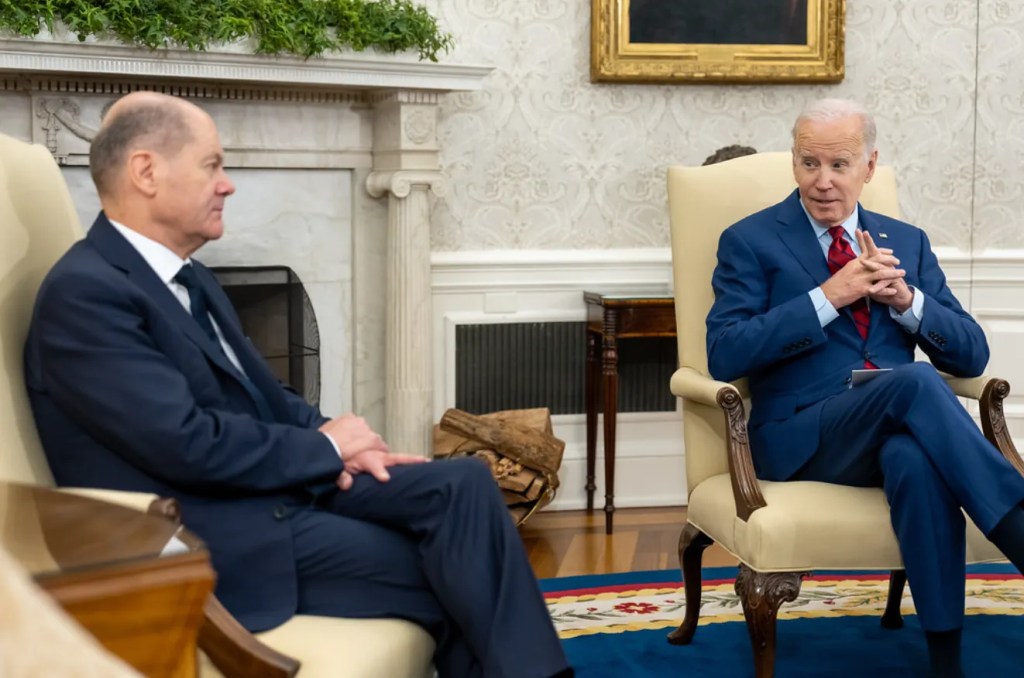
President Joe Biden meeting with German Chancellor Olaf Scholz in the Oval Office, March 3, 2023. (Official White House Photo by Adam Schultz)

By Scott Ritter

Source: Consortium News

Back in 2000, the television series “Andromeda”  premiered, based upon unused material from Gene Roddenberry, the creator of the Star Trek series and franchise. The plot is premised on the notion of a spaceship, “Andromeda,” frozen in time, which is given the opportunity to reverse the clock and undo history.

The series ran five years.

Fast forward to the present.

History has dealt a tough hand to the administration of U.S. President Joe Biden, who openly confessed his intent to “bring an end” to the Nord Stream pipeline system which delivered Russian natural gas to Europe through four pipelines (Nord Stream 1 and Nord Stream 2, consisting of two pipelines each).

Since then, the Biden White House was compelled to deny the president’s stated intent after an explosive report by Pulitzer-Prize winning investigative journalist Seymour Hersh detailed damning information which, if true (and there is no reason to suspect it’s not) casts the responsibility for a series of underwater explosions that took place on Sept. 26, 2022, on Biden himself.

Hersh’s report was ignored by the mainstream media in the United States, with neither The New York Times, for whom Seymour Hersh wrote on national security issues for many years, nor The Washington Post even hinting that the greatest living investigative journalist had broken a blockbuster story.

Enter the “Andromeda” — not the spaceship of the eponymous television series, but rather a Bavaria C50 15-meter (49-foot) yacht based out of the German Baltic port city of Rostock. On March 7 — nearly a month after Hersh self-published his article on Substack — a team of German reporters from the ARD capital studio, Kontraste, Südwestrundfunk (SWR) and Die Zeit collaboratively reported that they had uncovered the existence of “the boat that was allegedly used for the secret operation.”

The boat was “a yacht rented from a company based in Poland, apparently owned by two Ukrainians.” According to the story, “the secret operation at sea was carried out by a team of six people.”

The name of the yacht was “The Andromeda.”

According to the German reporting, the team — five men, consisting of a ship captain, two primary divers, two supporting divers and a female doctor — used the Andromeda to transport the team, along with the explosives used to destroy the pipelines, to the scene of the crime. The boat was returned to Rostock in “an uncleaned condition,” allowing German law enforcement officials, who carried out a search of the vessel between Jan. 8-11, to detect “traces of explosives” on a table in the ship’s cabin.

The same day the German reporting on the new Nord Stream attack narrative broke, The New York Times ran a front-page story entitled “Intelligence Suggests Pro-Ukrainian Group Sabotaged Pipelines, US Officials Say.”

[Related: As Bakhmut Falls, US May Turn From Ukraine, Starting With Pipeline Story]

For the first time, The New York Times referred to Hersh’s reporting, writing, “Last month, the investigative journalist Seymour Hersh published an article on the newsletter platform Substack concluding that the United States carried out the operation at the direction of Mr. Biden,” before closing with “U.S. officials say Mr. Biden and his top aides did not authorize a mission to destroy the Nord Stream pipelines, and they say there was no U.S. involvement.”

As if echoing the Biden White House denials, The New York Times led off with this:

“New intelligence reporting amounts to the first significant known lead about who was responsible for the attack on the Nord Stream pipelines that carried natural gas from Russia to Europe” (emphasis added.)

The New York Times, it seems, was more than happy about proceeding with its own anonymous intelligence sources, while dismissing Hersh’s.

The problem with both the German reporting and that of The New York Times (whose source was clearly referring to the same data reported by the German reporters) is that the Andromeda narrative doesn’t hold water.

Take, for instance, the Tom Clancy-like tale of derring-do that has four allegedly Ukraine-affiliated divers defy physiology by conducting dives that would require the use of a decompression chamber for them to survive an ascent of 240 feet (the depth of the Nord Stream pipelines that were destroyed). A rule of thumb is that decompression takes approximately one day per 100 feet of seawater plus a day.

This means that the team of divers would have required three days of decompression per dive. But to decompress, one needs a decompression chamber. For a dive involving two divers, the Andromeda would have to have been outfitted with either a two-person Class A decompression chamber, or two single-person Class B chambers, as well as the number of large oxygen bottles needed to operate these chambers over time. \

A simple examination of the interior cabin space of the Bavarian C50 yacht would quickly dispossess one of any notion that either option was viable.

Simply put — no decompression chamber, no dive, no story.

‘Traces’ of High Explosives 

There is another aspect of the story to probe. According to the German reporting, law enforcement officials detected “traces” of high explosives on the tables in the cabin of the Andromeda.

According to the Swedish Prosecution Authority, in a statement released on Nov. 19, 2022, Swedish investigators discovered “traces of explosives on several of the foreign objects that were found” at the site of the explosions.

These explosives, according to a Nov. 22, 2022, report issued by Nord Stream AG, the Swiss-based parent company that owned the Nord Stream 1 and 2 pipelines, produced “technogenic [i.e., “of or pertaining to a process or substance created by human technology”] craters with a depth of 3 to 5 meters” separated “by a distance of about 248 meters.”

“The section of the pipe between the craters is destroyed, the radius of pipe fragments dispersion is at least 250 meters,” the report noted.

In a report to the United Nations, both Denmark and Sweden said that the damage done to the Nord Stream pipelines was caused by blasts equivalent to the power of “several hundred kilograms of explosive.”

It should be noted that underwater pipelines like those used in Nord Stream are designed to withstand proximal explosions from devices up to several hundred kilograms in size. Indeed, in locations such as the Baltic Sea, where unexploded military ordnance from multiple world wars abounds, the threat of a drifting device striking a pipeline and detonating is quite real.

Computer modeling shows that a 600-kilogram high explosive charge detonated approximately 5 meters from a 34mm-thick steel pipeline filled with gas would not compromise the structural integrity of the pipeline.

At the location of the explosions, the Nord Stream pipelines consisted of 26.8 mm steel pipes with an addition 33.2 mm of concrete coating, for a total thickness of 60 mm. The weight of a single pipe section was over 11 tons.

In short, a standard high-explosive charge of several hundred kilograms would not be sufficient to cause the destruction that occurred on the Nord Stream pipeline.

Enter Hersh, who reported that the explosives used were “shaped charges.”

With a shaped charge, the energy of the explosion is focused in one direction, usually by creating a concave shape in the explosive that is them lined with a metal sheet, so that it usually achieves an armor- and/or concrete-penetrating effect.

Without getting too technical, the design of an underwater shaped charge that would be sufficient to penetrate concrete-lined steel pipe at a depth of 240 feet is not common knowledge. The charge would have to be prepared by qualified explosives experts and ideally tested prior to being employed operationally to validate the design and functionality of the device.

These are not tasks undertaken by a small ad hoc team of Ukrainian underwater saboteurs, but rather state-sponsored actors with access to military grade explosives and testing facilities.

Strike two for the German reporting.

But the most glaring deficiency in the German reporting deals with the detection of “trace explosive” onboard the Andromeda. This information would identify the precise explosive used. Moreover, when compared and contrasted with the “trace explosive” found by the Swedes at the location of the Nord Stream attacks, it could provide a clear linkage between the Andromeda and the attacks.

But Sweden has sealed the files of its investigation into the Nord Stream attack on national security grounds, meaning that it will not cooperate with Germany to see if the explosive traces found at the scene of the Nord Stream crime match those onboard the Andromeda.

The obvious reason behind this decision: because the two traces won’t match. One — the Swedish sample — points to the culprit. The other — the Andromeda sample — is evidence of a cover up.

Strike three, and you’re out.

The German government’s crude effort to manufacture an alternative narrative regarding who attacked the Nord Stream pipeline fails the smell test — in short, it stinks. The holes in this story are such that even the most gifted screenwriters could not turn this Andromeda tale of changing history into something remotely believable. In short, Gene Roddenberry would not be impressed.

Moreover, the fact that the U.S. intelligence community was quick to leak information about the German investigation to The New York Times appears to be de facto evidence of U.S. complicity in this cover up.

And the reason for this cover up is quite clear: the Germans and Americans both fear the reporting being done by Hersh.

The GATHERING Storm in Ukraine Spells Doom for the West

Photo by by Adam Brummett

By Col. Douglas MacGregor

Source: Information Clearing House

The crisis of American national power has begun. America’s economy is tipping over, and Western financial markets are quietly panicking. Imperiled by rising interest rates, mortgage-backed securities and U.S. Treasuries are losing their value. The market’s proverbial “vibes”—feelings, emotions, beliefs, and psychological penchants—suggest a dark turn is underway inside the American economy.

American national power is measured as much by American military capability as by economic potential and performance. The growing realization that American and European military-industrial capacity cannot keep up with Ukrainian demands for ammunition and equipment is an ominous signal to send during a proxy war that Washington insists its Ukrainian surrogate is winning.

Russian economy-of-force operations in southern Ukraine appear to have successfully ground down attacking Ukrainian forces with the minimal expenditure of Russian lives and resources. While Russia’s implementation of attrition warfare worked brilliantly, Russia mobilized its reserves of men and equipment to field a force that is several magnitudes larger and significantly more lethal than it was a year ago.

Russia’s massive arsenal of artillery systems including rockets, missiles, and drones linked to overhead surveillance platforms converted Ukrainian soldiers fighting to retain the northern edge of the Donbas into pop-up targets. How many Ukrainian soldiers have died is unknown, but one recent estimate wagers between 150,000-200,000 Ukrainians have been killed in action since the war began, while another estimates about 250,000.

Given the glaring weakness of NATO members’ ground, air, and air defense forces, an unwanted war with Russia could easily bring hundreds of thousands of Russian Troops to the Polish border, NATO’s Eastern Frontier. This is not an outcome Washington promised its European allies, but it’s now a real possibility.

In contrast to the Soviet Union’s hamfisted and ideologically driven foreign policymaking and execution, contemporary Russia has skillfully cultivated support for its cause in Latin America, Africa, the Middle East, and South Asia. The fact that the West’s economic sanctions damaged the U.S. and European economies while turning the Russian ruble into one of the international system’s strongest currencies has hardly enhanced Washington’s global standing.

Biden’s policy of forcibly pushing NATO to Russia’s borders forged a strong commonality of security and trade interests between Moscow and Beijing that is attracting strategic partners in South Asia like India, and partners like Brazil in Latin America. The global economic implications for the emerging Russo-Chinese axis and their planned industrial revolution for some 3.9 billion people in the Shanghai Cooperation Organization (SCO) are profound.

In sum, Washington’s military strategy to weaken, isolate, or even destroy Russia is a colossal failure and the failure puts Washington’s proxy war with Russia on a truly dangerous path. To press on, undeterred in the face of Ukraine’s descent into oblivion, ignores three metastasizing threats: 1. Persistently high inflation and rising interest rates that signal economic weakness. (The first American bank failure since 2020 is a reminder of U.S. financial fragility.) 2. The threat to stability and prosperity inside European societies already reeling from several waves of unwanted refugees/migrants. 3. The threat of a wider European war.

Inside presidential administrations, there are always competing factions urging the president to adopt a particular course of action. Observers on the outside seldom know with certainty which faction exerts the most influence, but there are figures in the Biden administration seeking an off-ramp from involvement in Ukraine. Even Secretary of State Antony Blinken, a rabid supporter of the proxy war with Moscow, recognizes that Ukrainian President Volodymyr Zelensky’s demand that the West help him recapture Crimea is a red line for Putin that might lead to a dramatic escalation from Moscow.

Backing down from the Biden administration’s malignant and asinine demands for a humiliating Russian withdrawal from eastern Ukraine before peace talks can convene is a step Washington refuses to take. Yet it must be taken. The higher interest rates rise, and the more Washington spends at home and abroad to prosecute the war in Ukraine, the closer American society moves toward internal political and social turmoil. These are dangerous conditions for any republic.

From all the wreckage and confusion of the last two years, there emerges one undeniable truth. Most Americans are right to be distrustful of and dissatisfied with their government. President Biden comes across as a cardboard cut-out, a stand-in for ideological fanatics in his administration, people that see executive power as the means to silence political opposition and retain permanent control of the federal government.

Americans are not fools. They know that members of Congress flagrantly trade stocks based on inside information, creating conflicts of interest that would land most citizens in jail. They also know that since 1965 Washington led them into a series of failed military interventions that severely weakened American political, economic, and military power.

Far too many Americans believe they have had no real national leadership since January 21, 2021. It is high time the Biden administration found an off-ramp designed to extricate Washington, D.C., from its proxy Ukrainian war against Russia. It will not be easy. Liberal internationalism or, in its modern guise, “moralizing globalism,” makes prudent diplomacy arduous, but now is the time. In Eastern Europe, the spring rains present both Russian and Ukrainian ground forces with a sea of mud that severely impedes movement. But the Russian High Command is preparing to ensure that when the ground dries and Russian ground forces attack, the operations will achieve an unambiguous decision, making it clear that Washington and its supporters have no chance to rescue the dying regime in Kiev. From then on, negotiations will be extremely difficult, if not impossible.

Related Video:

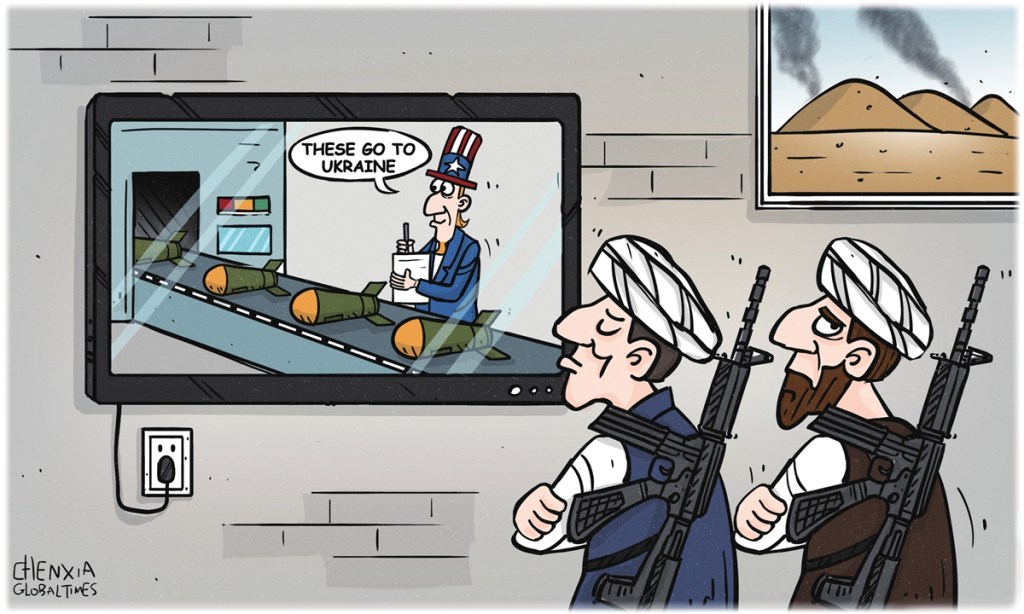
Ukraine is America’s Afghanistan More Than Russia’s

By Peter Van Buren

Source: We Meant Well

The thinking in Washington goes like this: for the “low cost” of Ukrainian lives and some American dollars, the West can end Putin’s strategic threat to the United States. No Americans are dying. It’s not like Iraq or Afghanistan ’01-’21. This is post-modern, something new, a clean great power war, Jackson Pollack for war. Getting a lot of foreign policy mojo at little cost. It’s almost as if we should have though of this sooner.

Um, we did. It didn’t work out past the short run and there’s the message. Welcome to Afghanistan 1980’s edition with the U.S. playing both the American and the Soviet roles.

At first glance it seems all that familiar. Russia invades a neighboring country who was more or less just minding its own business. Russia’s goals are the same, to push out its borders in the face of what it perceives as Western encroachment on the one hand, and world domination on the other. The early Russian battlefield successes break down, and the U.S. sees an opportunity to bleed the Russians at someone else’s bodily expense. “We’ll fight to the last Afghani” is the slogan of the day.

The CIA, via our snake-like “ally” in Pakistan, floods Afghanistan with money and weapons. The tools are different but the effect is the same: supply just enough firepower to keep the bear tied down and bleeding but not enough to kill him and God forbid, end the war which is so profitable — lots of dead Russkies and zero Americans killed (OK, maybe a few, but they are the use-and-forget types of foreign policy, CIA paramilitary and Special Forces, so no fair counting them.) And ironic historical bonus: in both Afghanistan 1980s and Ukraine, some of the money spent is Saudi. See the bothersome thread yet?

Leaving aside some big differences that enabled initial successes in Afghanistan, chief among which is the long supply lines versus Ukraine’s border situation, let’s look at what followed early days.

Though NATO countries and others sent small numbers of troops and material to Afghanistan, the U.S. has gone out of its way to make Ukraine look like a NATO show when it is not. Washington supposedly declared support for Ukraine to preserve and empower NATO (despite the fact that Ukraine was not a member.) Yet, to keep Germany on sides in the Russian-Ukraine war, Washington (allegedly) conducted a covert attack on Germany’s critical civilian infrastructure that will have lasting, negative consequences for the German economy. Seymour Hersh reported the Nord Stream pipeline connecting cheap Russian natural gas to Europe via Germany was sabotaged by the United States. An act of war. The destruction of an ally’s critical infrastructure, and no doubt a brush back pitch carefully communicated to the Germans alongside a stern warning to stay put on sanctions against energy trade with Russia. It’s a helluva thing, blowing up the pipeline to force Germany to color inside the lines NATO (actually the U.S.) laid out. This, in addition to the U.S. treating NATO countries as convenient supply dumps and little more, shows that NATO will emerge from Ukraine broken. One does also wonder if the future of Europe is at stake why the greatest concern is expressed in Washington and not Bonn or Paris.

As with Afghanistan, there are questions if we Americans will ever be able to leave, about whether Colin Powell’s “Pottery Barn” rules applies — you break it, you bought it. President Zelensky, portrayed in the West as a cross between Churchill and Bono, in actuality was a comedian and TV producer who won the 2019 Ukrainian presidential election. Zelensky’s popularity was due in part to his anti-establishment image and promises to fight corruption and improve the economy. He was also aided by his portrayal of a fictional president in a popular TV show, which helped to increase his name recognition and appeal to young voters.

Zelensky was preceded by the Ukrainian Revolution, also known as the Euromaidan Revolution, which began in late 2013 as a series of protests in response to then-President Viktor Yanukovych’s decision to reject an association agreement with the European Union and instead pursue closer ties with Russia. The protests grew in size and intensity, with demonstrators occupying the central Maidan Nezalezhnosti square in Kiev, demanding Yanukovych’s resignation and new elections. In February 2014, the situation escalated when Yanukovych’s security forces cracked down on protesters, resulting in violent clashes that left dozens dead. This led to Yanukovych fleeing the country and a new government being formed in Ukraine. The revolution also sparked tensions with Russia, which subsequently annexed Crimea and supported separatists in eastern Ukraine. None of those problems goes away even if the Russia army retreats to its pre-invasion borders. The notion that there is nothing going on here except a rough land grab by a power-made Putin is shallow and incomplete.

What’s left are concerns about the level of corruption in Ukraine, and the U.S.’s role in addressing it. Despite the U.S. providing significant financial aid to Ukraine, there have been reports of corruption and mismanagement of funds. Some have argued that the U.S. has not done enough to address these issues, and has instead turned a blind eye in order to maintain its strategic interests in the region. America’s history with pouring nearly unlimited arms and money into a developing nation and corruption is not a good one (see either Afghanistan, 1980s or ’01 onward.) Corruption can only get worse.

A great fear in Afghanistan was arms proliferation, weapons moving off the battlefield into the wrong hands. Whether that be a container of rifles or the latest anti-aircraft systems, an awful lot of weapons are loose in Ukraine. In the case of Afghanistan, the real fear was for Stinger missiles, capable of shooting down modern aircraft, ending up in terrorist hands. The U.S. has been chasing these missiles through the world’s arms bazaars ever since, right into the Consulate in Benghazi. It is worse in Ukraine. America’s top-of-the-line air defense tools are being employed against Russian and Iranian air assets. What would those countries pay for the telemetry data of a shoot down, never mind actual hardware to reverse engineer and program against? There are no doubt Russian, Chinese, Iranian and other intelligence agencies on the ground in Ukraine with suitcases full of money trying to buy up what they can. Another cost of war.

It is also hard to see the end game as the demise of Putin. This would mean the strategy is not fight until the last Afghani/Ukrainian but to fight until the last Russian. The plan is for that final straw to break, that last Russian death, to trigger some sort of overthrow of Putin. But by whom? Trading Putin for a Russian-military lead government seems a small gain. Look what happened the last time Russia went through a radical change of government — we got Putin. In Afghanistan, it was the Taliban x 2.

History suggests the U.S. will lose in a variety of ways in Ukraine, with the added question of who will follow Putin and what might make that guy a more copacetic leader towards the United States. As one pundit put it, it is like watching someone play Risk drunk.

‘NATO’s mission’ leaves Ukraine destroyed

“We are carrying out NATO’s mission.” As Ukraine’s defense minister acknowledges the proxy war, NATO proxy warriors disregard the toll.

(Pierre Crom/Getty Images)

By Aaron Maté

Source: Aaron Maté Substack

Unveiling its latest military assistance package to Ukraine – at $3.75 billion, the largest to date — the White House declared that US weapons are intended “to help the Ukrainians resist Russian aggression.”

For their part, Ukrainians on the receiving end see it differently.

“We are carrying out NATO’s mission,” Ukrainian Defense Minister Oleksii Reznikov said in an interview. “They aren’t shedding their blood. We’re shedding ours. That’s why they’re required to supply us with weapons.” Repeating a rationale offered by his US sponsors in previous wars, including the invasion of Iraq, Reznikov added that Ukraine “is defending the entire civilized world.”

Receiving an endless supply of weapons from NATO countries that shed no blood of their own — all to fulfill their “mission” — is an apt description of Ukraine’s role in the US-led proxy war against Russia. And as one of its staunchest champions, Sen. Lindsey Graham, cheerfully predicted in July, that mission is using Ukraine to “fight to the last person.”

For Ukraine, the costs of fulfilling NATO’s mission are spelled out by former US cabinet secretaries Condoleezza Rice and Robert Gates. Today, the pair write, Ukraine’s “economy is in a shambles, millions of its people have fled, its infrastructure is being destroyed, and much of its mineral wealth, industrial capacity and considerable agricultural land are under Russian control. Ukraine’s military capability and economy are now dependent almost entirely on lifelines from the West — primarily, the United States.”

Rather than seeing Ukraine’s war-ravaged, Russian-occupied, Western-dependent condition as a reason to seek a negotiated end, Rice and Gates in fact regard diplomacy as an outcome to avoid.

“Absent another major Ukrainian breakthrough and success against Russian forces, Western pressures on Ukraine to negotiate a cease-fire will grow as months of military stalemate pass,” they warn. This result would be “unacceptable”, Rice and Gates conclude, because “any negotiated cease-fire would leave Russian forces in a strong position to resume their invasion whenever they are ready.” That is one possibility. Another possibility, unmentioned by the authors, is that a negotiated cease-fire leads to a permanent one. This would entail finally addressing the grievances of Ukraine’s ethnic Russian population – the proximate cause of the post-2014 Donbas war that preceded Russia’s invasion — as well as addressing Russia’s longstanding security concerns about NATO expansion and advanced weaponry on its borders.

On the latter issue, the Kremlin is far from the only advocate. “One of the essential points we must address — as President Putin has always said — is the fear that NATO comes right up to its doors, and the deployment of weapons that could threaten Russia,” French President Emmanuel Macron said last month.

Macron’s comments “appeared to go beyond anything the United States has offered” Russia, the New York Times noted. Unstated by the Times is why such an offer has yet to materialize: as defined by multiple senior US officials right up to President Biden, “NATO’s mission” is not to defend Ukraine, but to use it as a proxy to “weaken” or even cause regime change in neighboring Russia.

Accordingly, the prospect of a negotiated cease-fire must be negated. The US and its allies, Rice and Gates argue, must “urgently provide Ukraine with a dramatic increase in military supplies and capability.” A failure to do so, they warn, could lead to a scenario where “more is demanded of the United States and NATO.” For now, this can thankfully be avoided, because the US enjoys “a determined partner in Ukraine that is willing to bear the consequences of war so that we do not have to do so ourselves in the future.” For proxy warriors, there is indeed no better “partner” than one “willing to bear the consequences of war” fueled from afar.

As a gage of their commitment to Ukraine’s sovereignty and well-being, consider the merits of Rice and Gates’ attempts to appeal to international law. The US, they write, “has learned the hard way — in 1914, 1941 and 2001 — that unprovoked aggression and attacks on the rule of law and the international order cannot be ignored.” Apparently, the US did not learn the same lesson from invading dozens of countries since 1914 – including under the Bush administration, where the authors played instrumental roles in multiple acts of unprovoked aggression, such as the invasion of Iraq. Gates, who carried on as Defense Secretary under President Obama, continued this legacy by overseeing the US bombing campaign that helped topple Libya’s government.

Predictably, Ukrainian soldiers that “bear the consequences of war” are facing heavy losses. Speaking to Newsweek, retired U.S. Marine Corps Colonel Andrew Milburn, who has trained and led Ukrainian forces for the private mercenary firm Mozart Group, reports that in the battle for Bakhmut, Ukraine has been “taking extraordinarily high casualties. The numbers you are reading in the media about 70 percent and above casualties being routine are not exaggerated.”

Ukraine is now “taking high casualties on the Bakhmut-Soledar front, quickly depleting the strength of several brigades sent there as reinforcements in the past month,” the Wall Street Journal reports. “Western—and some Ukrainian—officials, soldiers and analysts increasingly worry that Kyiv has allowed itself to be sucked into the battle for Bakhmut on Russian terms, losing the forces it needs for a planned spring offensive as it stubbornly clings to a town of limited strategic relevance.” According to one battlefield Ukrainian commander, “the exchange rate of trading our lives for theirs favors the Russians. If this goes on like this, we could run out.”

The prevailing indifference to Ukraine’s death toll was recently underscored when Ursula von der Leyen, the European Commission president, made the mistake of acknowledging it. In a speech, von der Leyen noted that Ukraine has lost 20,000 civilians and 100,000 troops since Russia’s February invasion. The Ukrainian military responded by complaining that this was “classified information,” prompting von der Leyen’s office to edit out the figure from video of her remarks.

Meanwhile, the prevailing rejection of diplomacy has even led one of its staunchest European advocates to effectively renounce it. In an interview with Germany’s Die Zeit, former German Chancellor Angela Merkel claimed that the 2015 Minsk II accords – the internationally backed framework for ending the post-2014 Donbas civil war, premised on granting limited autonomy to Russia-allied eastern Ukrainians – was a ruse.

Minsk, Merkel explained, “was an attempt to give Ukraine time.” And it did so successfully: Ukraine “used this time to get stronger, as you can see today. The Ukraine of 2014/15 is not the Ukraine of today… And I very much doubt that the NATO countries could have done as much then as they do now to help Ukraine.”

Merkel, whose government helped broker Minsk, was one of the few NATO leaders to develop a cooperative relationship with Russian President Vladimir Putin. Her comments follow a similar admission from the Ukrainian leader who signed Minsk, Petro Porosenko. “We had achieved everything we wanted,” Poroshenko said in May 2022. “Our goal was to, first, stop the threat, or at least to delay the war – to secure eight years to restore economic growth and create powerful armed forces.” (emphasis added)

The claim by Merkel that Minsk was not intended to make peace, but “to give Ukraine” time to “get stronger” for war has been greeted by Putin and his supporters as confirmation that NATO cannot be trusted to uphold its agreements. (A takeaway newly bolstered by Joe Biden’s recent admission that, despite his campaign promises, the Iran nuclear deal is “dead”).

An alternative explanation is that Merkel is disingenuously attempting to appease pro-war hawks in Germany and beyond, as Moon of Alabama argues. Nicolai Petro, author of the indispensable new book “The Tragedy of Ukraine,” concurs with that interpretation, as he told me in a recent interview. The German and France-brokered Minsk process, Petro argues, were “good faith efforts to bring the hostilities to an end, at least to accomplish a ceasefire from which then further negotiations could be pursued.” The main obstacle, in Petro’s view, came from Ukraine’s far-right Ukrainian nationalists and their allies in Washington, “who basically dismissed the Minsk accords as a non-starter,” and unrealistically sought Ukraine’s complete recapture not only of the Donbas but Crimea as well.

Whether Merkel was being sincere or not, her comments reflect the fact that the aims of the Ukrainian far-right and their DC allies now dominate the NATO states, with voices for peace marginalized and diplomacy shunned.

And now, nearly one year into Russia’s invasion, the proxy war’s NATO cheerleaders have no interest in stopping the bloodshed, despite the open recognition that their mission is helping destroy the country that they claim to defend.

Putin’s Sledgehammer

By Mike Whitney

Source: The Unz Review

“The Ukrainians are in bad shape… It won’t be long before the Ukrainians run out of food. It won’t be long before they freeze… They have done all that we can reasonably expect them to do. It’s time to negotiate…. before the offensive begins, because once it begins, there will be no further discussion between Moscow and Kiev until it is over to the satisfaction of the Russians.” Colonel Douglas MacGregor, “War in Ukraine; Quiet Before the Storm”, 15 minute-mark

“Strictly speaking, we haven’t started anything yet.” Russian President Vladimir Putin

The relentless attacks on Ukraine’s electrical grid, fuel-storage units, railway hubs, and Command-and-Control centers mark the beginning of a second and more lethal phase of the war. The increased tempo of the high-precision, long-range missile attacks suggests that Moscow is laying the groundwork for a major winter offensive that will be launched as soon as Russia’s 300,000 reservists join their formations in east Ukraine. Kiev’s refusal to negotiate a settlement that addresses Russia’s core security concerns, has left Russian president Vladimir Putin with no other option but to defeat Ukrainian forces on the battlefield and impose a settlement through force-of-arms. The impending winter offensive is designed to deliver the knock-out punch Russia needs to achieve its strategic objectives and bring the war to swift end. This is from Reuters:

Russian missile strikes have crippled almost half of Ukraine’s energy system, the government said on Friday, and authorities in the capital Kyiv warned that the city could face a “complete shutdown” of the power grid as winter sets in.

With temperatures falling and Kyiv seeing its first snow, officials were working to restore power nationwide after some of the heaviest bombardment of Ukrainian civilian infrastructure in nine months of war.

The United Nations says Ukraine’s electricity and water shortages threaten a humanitarian disaster this winter.

“Unfortunately Russia continues to carry out missile strikes on Ukraine’s civilian and critical infrastructure. Almost half of our energy system is disabled,” Prime Minister Denys Shmyhal said….

“We are preparing for different scenarios, including a complete shutdown,” Mykola Povoroznyk, deputy head of the Kyiv city administration, said in televised comments.” (“Ukraine says half its energy system crippled by Russian attacks, Kyiv could ‘shutdown’”, Reuters)

Until recently, Russia had avoided targets that would dramatically impact civilian activities, but now military leaders have returned to a more conventional approach. Presently, the military is destroying whatever facilities, transformers, storage units, substations, rail yards and energy depots that allow Ukraine to continue to wage war. Clearly –as the bigger and more powerful state — it was always within Russia’s ability to take a sledgehammer to Ukraine and break it into a million pieces, but Putin chose to hold back hoping that Kiev would come to its senses and see the hopelessness of its cause. And –despite the deluge of western propaganda to the contrary– the outcome of this war has never been in doubt. Russia is going to impose a settlement on Kiev and that settlement will require the government to cut all ties with NATO and to sign a treaty declaring its neutrality into perpetuity. Russia is not going to allow a hostile military alliance to place its missile sites and combat troops on its western flank. That won’t happen.

Unfortunately, Russia’s military operation is going to greatly increase the suffering of the Ukrainian people who find themselves locked in a cage-match between the Washington and Moscow. This is from the World Socialist Web Site:

Poverty in Ukraine has increased more than tenfold since the outbreak of the US/NATO-Russia war, according to the latest data from the World Bank (WB). Officially, 25 percent of the country’s population is now poor, up from supposedly just 2 percent before February 2022… With officials predicting that the poverty rate could rise to as much as 60 percent or more next year, levels of deprivation are emerging in Ukraine that have not been witnessed on the European continent since the end of World War II.

Unemployment is now running at 35 percent, and salaries have fallen by as much as 50 percent over the spring and summer for some categories of workers. … according to the International Monetary Fund, Ukraine’s public debt has now soared to 85 percent of GDP…. A recently released joint study by the World Health Organization and Ukraine’s Ministry of Health found that 22 percent of people in Ukraine cannot access essential medicines. For the country’s 6.9 million internally displaced, that number rises to 33 percent.

The medications that are hardest to get—those that treat blood pressure, heart problems and pain, as well as sedatives and antibiotics—reveal a population struggling to cope with decades of poverty-induced ill health and the physical and psychological trauma of war.

While US and NATO officials are able to dispatch massive amounts of firepower to Ukraine’s front lines within a matter of weeks, the delivery of life-saving humanitarian goods is seemingly an impossible logistical challenge.” (“Poverty skyrockets in Ukraine”, World Socialist Web Site)

Washington’s proxy-war on Moscow has inflicted incalculable suffering on the people of Ukraine who now face plunging temperatures, dwindling food supplies, a crashing economy and a growing shortage of essential medications. And despite the chest-thumping bravado over the recapturing of Kherson, the Ukrainian people will now be forced to flee their battered homeland by the millions seeking refuge in Europe which has already slipped into a post-industrial slump brought on by Uncle Sam’s reckless provocations. How many of these working-class Ukrainians would have preferred that their leaders reach an accommodation with Putin (regarding his legitimate security concerns) rather than engaging the Russian army in a pointless war which has cost them their homes, their jobs, their cities, and (for many) their lives? And do the people outside the country who claim to “Stand With Ukraine” realize that they are actually supporting the impoverishment and immiseration of millions of civilians that are caught in a geopolitical crossfire between Washington and Russia? Anyone who genuinely cares about Ukraine should support Ukrainian neutrality and an end to NATO expansion. That is the only way this war is going to end. Russian security will be achieved by-way of a treaty or an iron-fist. The choice is Ukraine’s. This is from an article titled ‘Russia Is Right: The U.S. Is Waging a Proxy War in Ukraine‘:

“The war in Ukraine isn’t just a conflict between Moscow and Kyiv, Russian Foreign Minister Sergei Lavrov recently declared. It is a “proxy war” in which the world’s most powerful military alliance … is using Ukraine as a battering ram against the Russian state … Lavrov is … not wrong. Russia is the target of one of the most ruthlessly effectively proxy wars in modern history.”

The US foreign policy establishment does not care about Ukraine or the Ukrainian people. The country is merely a launching pad for Washington’s war on Russia. That is why the CIA toppled the democratically-elected government in Kiev in 2014 and that is why the CIA armed and trained Ukrainian paramilitaries to fight the Russian military in 2015 (7 years before the invasion!) Here’s some background from a 2015 article at Yahoo News:

“The CIA is overseeing a secret intensive training program in the U.S. for elite Ukrainian special operations forces and other intelligence personnel, according to five former intelligence and national security officials familiar with the initiative. The program, which started in 2015, is based at an undisclosed facility in the Southern U.S., according to some of those officials….

“The United States is training an insurgency,” said a former CIA official, adding that the program has taught the Ukrainians how “to kill Russians.”

…the CIA and other U.S. agencies could support a Ukrainian insurgency, should Russia launch a large-scale incursion.

…“We’ve been training these guys now for eight years. They’re really good fighters. …representatives from both countries also believe that Russia won’t be able to hold on to new territory indefinitely because of stiff resistance from Ukrainian insurgents, according to former officials.

If the Russians launch a new invasion, “there’s going to be people who make their life miserable,” said the former senior intelligence official…

“All that stuff that happened to us in Afghanistan,” said the former senior intelligence official, “they can expect to see that in spades with these guys.” (“CIA-trained Ukrainian paramilitaries may take central role if Russia invades”, Yahoo News)

There it is in black and white. The plan to use Ukraine as a staging-ground for conducting a proxy-war on Russia preceded the invasion by at least 7 years. The Obama administration and their neocon allies set a trap for Russia in order to drag them into an Afghanistan-like quagmire that would deplete their resources and kill as many Russian servicemen as possible. As Defense Secretary Lloyd Austin recently admitted, the US wants to “weaken” Russia so it is unable to project power beyond its borders. Washington seeks unhindered access to Central Asia so it can encircle China with military bases and nuclear missiles. The US intends to control China’s growth while dominating the world’s most populous and prosperous region of the next century, Asia. But first, Washington must crush Russia, collapse its economy, isolate it from the global community, demonize it in its media, and topple its leaders. Ukraine is seen as the first phase in a much broader strategy aimed at regime change (in Moscow) followed by the forced fragmentation of the Russian state. The ultimate objective is the preservation of Washington’s preeminent role in the global order.

Putin’s winter offensive threatens to derail Washington’s plan to drag the conflict out for as long as possible. In the weeks and months ahead, Russia is going to intensify its assault on Ukraine’s critical infrastructure. Most of the country will be plunged into darkness, fuel supplies will dry up, food and water will become scarcer, communications will be cut off, and all rail-traffic will cease. Millions of civilians will flee to Europe while the entire country slowly grinds to a standstill. At the same time that Russian battalions overtake cities and towns east of the Dnieper, the Russian army will block vital supply-lines from Poland cutting off the flow of lethal weaponry and combat troops headed to the front. This, in turn, will lead to widespread capitulation among Ukrainian fighting units operating in the field which will force Zelensky to the negotiating table. Eventually, Russia will prevail and its legitimate security demands will be met. Here’s how Colonel Douglas MacGregor summed it up in a recent interview:

“What’s coming in the future is a very massive offensive... the kind of offensive that I and many other military analysts expected at the beginning; Very decisive operations, multiple operational axes designed to effectively annihilate the enemy on the ground. And that’s what’s coming now, that’s what lies in the future.” (Colonel Douglas MacGregor, “War in Ukraine; Quiet Before the Storm”, you tube)

When the ground freezes, Russia’s offensive will begin.

The endless proxy war, by design

While privately conceding that its ally Ukraine is not “capable of winning the war,” the Biden administration keeps fueling it.

By Aaron Maté

Source: Aaron Maté Substack

Russia’s invasion of Ukraine has presented the White House with a geopolitical crisis that it played a critical role in creating. In February 2014, Victoria Nuland, a current senior State Department official and former Dick Cheney advisor, was caught on tape plotting the installation of a new Ukrainian government – a plan, she stressed, that would involve Biden and his then-top aide, and current National Security Advisor, Jake Sullivan. Weeks later, the democratically elected Ukrainian president Viktor Yanukovych was ousted and replaced by Washington-backed leaders – including a prime minister selected by Nuland.

The regime change in Kiev made Biden the most influential US political figure in Ukraine, as underscored by the lucrative Burisma board seat gifted to his son Hunter. While the Biden family and other well-connected players profited, Ukraine fell into civil war. In the eastern Donbas region, Kremlin-backed Ukrainian rebels took up arms against a fascist-infused coup government that cracked down on Russian culture and countenanced murderous assaults on dissidents. Rather than promote the 2015 Minsk II accords — the agreed-upon formula for ending the Donbas conflict – the US fueled the fight with a weapons and training program that turned Ukraine into a NATO proxy. Influential US politicians left no doubt about their intentions. As the Donbas war raged, lawmakers declared that they were using Ukraine to “fight Russia over there” (Adam Schiff) and vowed to “make Russia pay a heavier price,” (John McCain). In February of this year, Russia invaded to bring the eight-year fight to an end, leaving Ukraine to pay the heaviest price of all.

The Biden administration shunned multiple opportunities to prevent the Russian assault. When Russia submitted draft peace treaties in December 2021, the White House refused to even discuss the Kremlin’s core demands: a pledge of neutrality for Ukraine, and the rollback of NATO military forces in post-1997 member states that neighbor Russia. At the final round of talks on implementing Minsk II in early February, the “key obstacle,” the Washington Post reported, “was Kyiv’s opposition to negotiating with the pro-Russian separatists.” Siding with Ukraine’s far-right, which had threatened to overthrow Volodymyr Zelensky if he signed a peace deal, the US made no effort to encourage diplomacy. Emboldened to escalate its war on the Donbas, the Ukrainian government then massively increased shelling on rebel-held areas in the days immediately preceding Russa’s February 24th invasion.

Looking back at the pre-invasion period, Jack Matlock, the US ambassador to the Soviet Union under Bush I, now concludes that “if Ukraine had been willing to abide by the Minsk agreement, recognize the Donbas as an autonomous entity within Ukraine, avoid NATO military advisors, and pledge not to enter NATO,” then Russia’s war “probably would have been prevented.”

For Washington, preventing the war would have interfered with longstanding objectives. As US policymakers have openly recognized, Ukraine’s historical, geographical, and cultural links to Russia could be used as a tool to achieve regime change in Moscow, or, at minimum, leave it “weakened.”

As Ukraine enters another winter of war, this time facing an intensified Russian assault, the Biden administration is apparently in no mood to end a crisis that it helped start.

Media Lies Fuel Phony Ukraine Narrative

By Patrick Henningsen

Source: Ron Paul Institute

The idea that Ukraine and Zelensky are going to “win the war” is an absolute fantasy. It’s delusional in the extreme. And yet, so many in the West have been conditioned to really believe it.

If you are getting your narrative and information from mainstream media in a NATO nation, then my heart goes out to you. Understand that your externalized reality on this war is nothing more than a testament to the power of western propaganda. We have a state-of-the-art consensus reality machine which would make Goebbels’ head spin, and makes Stalin’s Pravda look like Nickelodeon.

Much closer to the truth is this: Ukraine is not just losing, but they are setting themselves up for a historical downthrow. If Russian Ministry of Defense dailies are even partly true (most of these are backed up by visual evidence as well), then at the current clip of 200-300 per day of Ukraine Armed Forces lost in combat may, very soon, approach the level of US soldier losses in Vietnam. In just 6 months. Mind you, it took the US ten years to lose an estimated 56,000 troops in that fruitless war of attrition.

It is becoming clearer every day that the Ukraine Armed Forces seem to have a policy of either not counting their dead, or counting them as AWOL, so as to avoid a collapse in military morale (and more actual deserters), and the inevitable international and domestic fallout from having to announce that they have 20,000 or 30,000 dead soldiers, many of whom were untrained, under equipped frontline fodder – forced into conscription by a desperate Zelensky regime eager to please his new funding sources in Washington and Brussels. If their true numbers were announced publicly each week, what do you think would happen to US, UK and EU support for Zelensky and his Nazi brigades? And how long would Ukrainians support NATO’s arm’s length proxy meat grinder war? Not long at all. It would be over yesterday.

Like the actor Zelensky, our governments are also selling a packaged fantasy to their public. Support for a losing war would end in a heartbeat should the true state of affairs become the consensus reality in the West.

When the fighting eventually stops, perhaps the smartest men in the room will then be the estimated 5,ooo Ukrainian soldiers who have already surrendered to Russian and DPR forces. Fortunate will be those who walked away from their western puppet’s deteriorating, ego-driven suicidal debacle.

The likely numbers we are looking at here across the board are simply unprecedented in recent modern conflict, and each and every data point confounds each and every fanciful, postmodernist projection coming out of our corrupt, self-reverential western mainstream media and parroting politicians who are quite clearly feeding off their own propaganda entrails now. It’s beyond disgusting. Sorry to be blunt here, but this is fast becoming the biggest propaganda bubble in the history of western military adventurism.

And that’s saying something.

And don’t expect a mea culpa from the gaggle of charlatans we have running foreign and “defense” policy in the US, UK, mutton Europe, and the rest of the supine NATO backwater nations. They will simply double-down and continue attacking any dissenters to their fanatical party line, believing that crushing free speech and debate will somehow help keep their propaganda bubble from deflating faster than it already is.

Sure, it’s an exercise in futility, but it’s one we’ve sadly come to expect from the legion of incompetent globalist bureaucrats and technocrats with a track record of repeated failures whose only real accomplishment has been to blow trillions in public money on systematically wrecking other countries, and always under some contrived moral imperative. By the way, besides being the most corrupt society and government in the western orbit, as it stands now, Ukraine is much, much further from being an independent, sovereign and free “democracy” than Russia is.

The longer the geniuses at NATO and our media continue fueling their proxy war of attrition, the more territory Kiev is going to lose. And whatever they lose, they will never get back. That’s for the simple reason that the people in those regions do not want to live in a wildly corrupt and western controlled, Nazi-ridden sectarian basket case of a failed state.

So the next time to hear someone trumpeting, “I Stand with Ukraine!”, just stop and ask them:

“Where would you draw that line on how many dead Ukrainian soldiers until we call it quits? How much territory will Kiev have to lose before we say that’s enough?”

And don’t let them go until they give you a coherent answer.