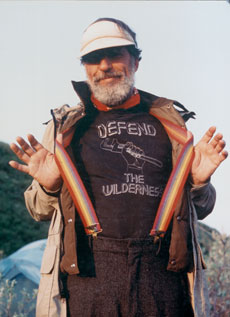
Edward Abbey’s FBI File

ed-abbey

(Editor’s note: in honor of author/activist Edward Abbey, who was born on this day in 1927, you can learn a little more about his life through this overview of the FBI’s file on the courageous iconoclast beginning in his college days followed by a short video essay filmed in Moab.)

By David Gessner

Source: Orion Magazine

THE FILE BEGINS in 1947, when Abbey, just twenty and freshly back from serving in the army in Europe, posts a type-written notice on the bulletin board at the State Teacher’s College in Pennsylvania. The note urges young men to send their draft cards to the president in protest of peacetime conscription, exhorting them to “emancipate themselves.” It is at this point that Abbey becomes “the subject of a communist index card” at the FBI, and from then until the end of his life the Bureau will keep track of where Abbey is residing. They will note when he heads west and when, as acting editor of the University of New Mexico’s literary magazine, The Thunderbird, he decides to print an issue with a cover emblazoned with the words: “Man will not be free until the last king is strangled with the entrails of the last priest!” The quote is from Diderot, but Abbey thinks it funnier to attribute the words to Louisa May Alcott. And so he quickly loses his editorship while the FBI adds a few more pages to his file. Also quoted in full in his files is a letter to the editor of the New Mexico Daily Lobo, in which he writes: “In this day of the cold war, which every day shows signs of becoming warmer, the individual who finds himself opposed to war is apt to feel very much out of step with his fellow citizens.” He then announces the need to form a group to “discuss implications and possibilities of resistance to war.”

The files contain interviews with fellow students and teachers at the University of New Mexico, who talk of Abbey’s “instability and poor judgment,” with one interviewee saying that, as an editor, Abbey showed “a stubborn ego, a taste for shocking the reader, a lack of maturity.” Abbey, according to other colleagues, was “indiscreet in his individualism” and “demonstrated a somewhat radical rebellious quality . . .” Though the interviews are mildly damning, no one questioned the subject’s loyalty to his country.

One wonders how Abbey would have fared these days. Would the FBI, or the NSA, have simply kept tabs on him or actually called him in for questioning? So many of his views, and so much of his personality, match just the sort of profile we have come to associate with our rather broad definition of domestic terrorism. It isn’t just his gun advocacy, or his monkey wrenching. It’s his belief that wilderness is a place where the last free men can retreat when the tyrants take over. He writes:

Democracy has always been a rare and fragile institution. . . . As social conflict tends to become more severe . . . there will inevitably be a tendency on the part of the authoritarian element—always present in our history—to suppress individual freedoms, to utilize the refined techniques of police surveillance (not excluding torture of course) in order to preserve—not wilderness!—but the status quo . . .

It’s a type of sentiment that anticipates our government’s reaction to 9/11. Thoreau said that under a government that unjustly imprisons its own, “the true place for the just man is also a prison.” Prison is exactly where Abbey’s monkey wrenching and FBI record might have landed him in today’s world.

Abbey’s beliefs in freedom and resistance, and his message of aggressive nonconformity, of screw-you freedom, were perfect for the ’60s and ’70s. But it’s hard to imagine that the same message would get a similar reaction today, or to see, at least at first, how his spirit might be adapted to fit our times. For instance, isn’t monkey wrenching dead as a legitimate possibility for the environmental movement? I must admit that in my own grown-up life as a professor and father I don’t blow a lot of things up. For most of us who care about the environment, Wallace Stegner provides a much more sensible model.

But I don’t want to be so quick to toss Abbey on the scrap heap. If the times have changed, Abbey’s ideas about freedom have in some ways never been more relevant. Many of the things that he foresaw have come to pass: we currently live in an age of unprecedented surveillance, where the government regularly reads our letters (now called e-mails) and monitors our movements. Abbey offers resistance to this. Resistance to the worst of our times, the constant encroaching on freedom and wildness. He says to us: Question them, question their authority. Don’t be so quick to give up the things you know are vital no matter what others say.

David Gessner is the author of nine books, including the forthcoming All the Wild That Remains: Edward Abbey, Wallace Stegner, and the American West from which this essay is adapted. He is the founder of the journal Ecotone.


Production notes by Ned Judge:
An eight minute film essay that I co-produced and directed with Ed Abbey in 1985. At the time I was working for a network magazine show. The executive producer took me to lunch one day. He told me that he was having trouble with his son who was 18. The son thought his dad was a corporate whore. He had told his father if he had any balls at all he’d put Ed Abbey on his show. That’s why the EP was talking to me. Would I see if it was possible? I had an acquaintance who knew Ed and he passed the request along. Ed responded that he’d give it a try. He signed the contract and wrote a script. We met in Moab and went out to Arches National Park to shoot some practice sessions with a home video camera. We would review them at the motel in the evening. After a day or two, Ed was feeling pretty comfortable on camera so we scheduled the shoot. We were all happy with the way it went. But then we ran head-on into network reality. Roger Mudd, the show’s host, was extremely negative about putting an “eco-terrorist” on the show. The executive producer had no choice but to cave. So this Abbey essay was put on the shelf and never aired. Abbey died 3 years later in March 1989.
Out of the Wild

london20after20people-jj-001

At Orion Magazine, authors William Cronon and Michael Pollan share a stimulating conversation about how language shapes our world. They cover questions such as “what is wild?”, “what is cultivated?”, and “what can these ideas teach us about our relationship to landscape?”. What I found most compelling was the last part of the conversation where they talk about the power and importance of storytelling:

Bill:  Right. Ecology, storytelling, history—they all render connections visible. We make that which is invisible visible through story, and thereby reveal people’s relationships to other living things.

Michael:  Stories establish canons of beauty, too. There is a role for art in changing cultural norms about what’s worth valuing. One hundred fifty years ago, certain people looked at a farm and saw what you might see if you look today at a nuclear power plant or some other degraded landscape. Part of the reason we tell stories is to create fresh value for certain landscapes, certain relationships.

Bill:  And stories make possible acts of moral recognition that we might not otherwise experience. They help us see our own complicity in things we don’t ordinarily see as connected to ourselves.

Michael:  Yes, exactly. That recognition can help remove the condescension in so much environmental writing by showing us that, look, these things we abhor are done in our name, and we are complicit in them, and we need to take account of them. It was Wendell Berry’s idea that the environmental crisis is a crisis of character. The big problem is the result of all the little problems in our everyday lives. That can be a guilt trip, but it doesn’t have to be. You can tell that story in ways that empower people.

Storytelling can also help us find hopeful solutions. For example, when I was writing Omnivore’s Dilemma and I went to Joel Salatin’s farm in Virginia, I learned how his grazing worked—intensive rotational grazing—and he explained to me what happens under the surface, how every time the ruminants come through and shear that pasture and reduce that leaf mass, a roughly equivalent amount of root mass is broken down and turned into soil. I learned that he takes vast amounts of food off this pastureland, without subtracting anything. To the contrary, the sun is feeding the grass, and the grass is feeding the ruminants; the ruminants are feeding us, and they’re also feeding the soil.

I suddenly saw a whole other way of conceiving our relationship to nature, that there are systems that exist, and could exist, that are non zero sum. There is a free lunch in nature: it’s solar energy, which means it isn’t necessarily true that for us to feed ourselves we have to diminish the world.

When you tell an audience that story, it fills them with hope and a sense of possibility, and that’s a function of storytelling. But, of course, it isn’t always so neat. There are questions of scale, and if you eat meat, there are problems with cattle. But I’m always looking for stories that refresh this narrative about nature that we’re so stuck in.

Bill:  Messy stories invite us into politics. They also invite us to laugh at ourselves. And those things together—the ability to laugh, to experience hope, to be inspired toward action at the personal and political levels—these strike me as the work of engaged storytelling in a world we’re trying to change for the better.

Michael:  I do have a lot of faith in the power of stories to do things. My greatest thrill as a writer is when I see people changed by the work, when people tell me that they’ve changed their behavior in some way because of something they’ve read.

One of the things I’ve fought very hard to do with my editors is to talk about alternatives when I talk about problems. For example, if I’m writing an incredibly dark story about industrial meat production and following a cow through the feedlot and slaughterhouse, I really want three paragraphs on the alternative to this system, which is to say, grass-finished beef. Those three paragraphs have more impact than anything else in the piece. And I still hear from ranchers that it was on the day that an article on that topic came out that we began to see the stirrings of a new market for grass-finished beef. “We no longer send them to the auction barn right away,” they tell me. “We’re finishing on grass now.”

Bill:  That’s a good story about storytelling.

Michael:  You have to pass through the dark wilderness of the feedlot before you can get there, but I think that there’s an appetite for hope that journalists don’t often satisfy.

I’ve met people, in their twenties especially, who really hate the model of the investigative article that tells them how messed up things are and doesn’t point to some alternative. True, the alternative you’re proposing can seem tacked on, and it can be incommensurate with the scale of the evils—but I think people want hope, a course of action they can take. This is something many journalists are missing right now. I think if our writing doesn’t include that dimension in some way, we lose people.

Bill:  It strikes me that you’re pointing to a great tradition in the environmental movement, which is the power of good storytelling, going back to Rachel Carson.

Michael:  She was incredibly effective rhetorically. Silent Spring is a very sophisticated piece of work.

Bill:  It’s stunningly done.

Michael:  It’s stunningly done. And it speaks to the power of fictional ideas like wilderness. Carson understood that, even if you’re writing about science, narrative is important. The trick I learned from her is never to talk about “neurotoxins”; instead, you tell the story of the molecule in the cell. Because there’s a narrative everywhere, even at the level of molecules.

Bill:  Maybe that’s a good note for us to end on, don’t you think? The poet Muriel Rukeyser once said that “the world is made of stories, not of atoms.” When we lose track of the narratives that human beings need to suffuse their lives and the world with meaning, we forget what makes the world worth saving. Telling stories is how we remember.

Read the complete transcript here: http://www.orionmagazine.org/index.php/articles/article/7811