U.S. Threatens Regime Change in Nicaragua

By Margaret Kimberly

Source: Black Agenda Report

Nicaragua has been a target of U.S. aggressions since the 1850s. The Biden administration’s attack on the newly elected government is the latest chapter in a long and sordid history. Eyewitness accounts of the electoral process reveal the manipulations and lies concocted by the U.S. and its corporate media partners in this latest regime change effort.

The United States has continuously carried out acts of aggression against Nicaragua and its people for more than 150 years. Joseph Biden’s effort to undermine that country’s sovereignty is part of a long history of invasions, coups, and support for U.S. puppets. 

The Biden administration declared the recent election fraudulent before it had even taken place. The corporate media repeated lies about an “authoritarian dictatorship” that came straight from the State Department’s script. The United States congress voted overwhelmingly to pass the RENACER Act, a regime change plot featuring the imposition of sanctions meant to create misery for Nicaraguans. Sanctions are war by other means, the modern-day version of sending the marines. 

The U.S. has done just that, occupying the country from 1912 to 1933. But that was not the first time that U.S. forces were sent to undermine Nicaraguan governments. In 1856 an American named William Walker invaded the country with a mercenary army and declared himself president. Walker was supported by the American slavocracy and sought to create new slave holding nations in the region. During his year long reign, he revoked Nicaragua’s abolition law and he was recognized as president by the Franklin Pierce administration.

The next bout of American aggressions began with an occupation by the U.S. marines in 1912 which lasted until 1933. Augusto Cèsar Sandino fought a guerrilla war against the occupation before being executed under orders of Anastasio Somoza. The Somoza family ruled until 1979 and always with the backing of the United States.

The Sandinista movement (which took its name after Sandino) emerged triumphant in 1980 against Somoza’s regime and quickly came under attack from the Ronald Reagan administration. The opposition groups known as “contras” were given millions of dollars and were assisted in fund raising through the sale of cocaine in the United States. The crack cocaine epidemic began as part of a U.S. imperialist plan. The war waged in Nicaragua was also carried out against communities of color in this country too.

President Daniel Ortega was re-elected on November 7, 2021 and Washington once again declared war on his nation. The RENACER Act passed by a vote of 387 to 35 in the House of Representatives, a huge majority indicative of bipartisan support for war by other means. 

The Biden administration acted quickly in denouncing the election before it took place, and repeated their claims of a “pantomime election ” on the day that Nicaraguans went to the polls. They followed up by orchestrating an Organization of American States (OAS) rejection of the Nicaraguan people’s electoral decision.

As a member of the Black Alliance for Peace (BAP) delegation in Nicaragua, this columnist witnessed the determination of Nicaraguans to choose their own government without interference. More than 200 representatives from 27 nations, were designated as acompañantes, companions, to the electoral process.

The BAP delegation travelled to the Caribbean coast city of Blue Fields where African descended Garifunas and Creoles reside with Mestizos and the Miskito, Rama, and Olwas indigenous communities. Voters from all these groups came out to well managed polling places, where all presidential candidates were listed on the ballot. The process was transparent and orderly, unlike the voting process in the United States, where eligible voters can be stricken from the ballot or be forced to wait for hours to cast their votes.

Despite what the white house and the corporate media claimed, opposition parties were able to campaign freely. Their signage and literature were quite visible, and no one can truthfully say that the public were unaware of the variety of electoral choices.

The Frente Sandinista para Liberacion Nacional (FSLN) emerged triumphant because they endeavor to meet popular needs. The Afro-descended citizens of the Caribbean coast were recognized as a group with distinct needs that were enshrined in the FSLN constitution. That region was excluded and quite literally isolated from the rest of the country without access to transportation and lacking basic infrastructure such as electricity and clean water. BAP delegates heard the consistent message that support for the FSLN is a result of concrete improvements in people’s lives. Despite the determination of the U.S. to undermine them, the FSLN now provide free health care and increased educational opportunities throughout the nation.

The 19th century Monroe Doctrine is alive and well in the 21st century. Whoever is in power in Washington considers other nations in this hemisphere to be its “backyard.” Nicaragua’s population of 6.5 million is smaller than that of New York City. Yet those few people are not allowed to exercise their rights to self-determination without raising Uncle Sam’s ire. Nicaraguans are not the first to feel imperialist vengeance. Tiny Grenada was undermined and invaded when it sought to determine democracy for itself. Venezuela is also under the sanctions hammer and Haiti is allowed to do nothing that Washington doesn’t approve.

The corporate media may be under the dictates of the state, but the people have no reason to follow suit. The presence of companion delegations in Nicaragua was an important step in revealing how the hybrid warfare playbook is put into practice.

Nicaraguans are well aware of their history. The lies are intended for a different audience. The United States seeks to fool its own people and thereby gain support for whatever form of aggression that it may choose. The plan is a consistent one which starts with media amplifying narratives that will gain support for interference. Creating falsehoods of human rights abuses is a reliable ruse to keep Americans complacent about their government’s activities.

The collusion between government and media explains why “trolls” are active on social media, attacking anyone who questions what Washington says. Facebook continued its work on behalf of the state by removing accounts expressing any support for Nicaragua’s sovereignty. The marriage of big tech companies and the Democratic party showed itself once again, proving that claims of freedom and democracy in U.S. politics are indeed an elaborate “pantomime.”

It may seem odd that a small nation can be the focus of so much determination to destroy its independence. But it isn’t hard to understand that Nicaragua threatens the U.S. should it be allowed to determine its own fate. The people who think they live in a democracy do not. They do not have access to free health care and are told they cannot expect to ever have it. Nicaragua is an example of what people in the U.S. could have if they were as free as they like to believe.

The drive to subjugate is as old as the republic, with the United States acting as a hegemon around the world, creating conflict and great suffering. The evil commitment to destroy Nicaraguan democracy is not unexpected but it must be vociferously opposed. Doing so is a litmus test which determines who is really on the left and who is not. There can be no compromise on the anti-imperialist stance. The human rights of people around the world must be respected and any United States government effort to violate them must be met with equivalent resolve.

Era of US Domination of Latin America Coming to an End

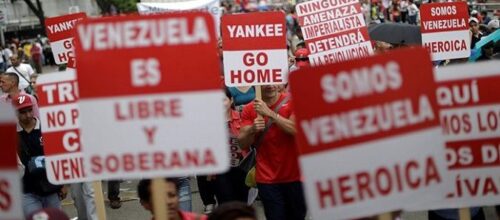
Marcha en Venezuela contra las sanciones de Trump (Reuters)

By Kevin Zeese and Margaret Flowers

Source: Dissident Voice

Despite its failings at home, the United States intervenes in countries across multiple continents seeking to control their governments and resources.

This week, we look at the US’ latest efforts in Nicaragua, Venezuela, and Bolivia to undermine their independence and force them to serve the interests of the US government and transnational corporations.

In all three countries, the US has displayed a lack of understanding of the people and their support for their revolutionary processes, and as a result, is failing. As US empire fades, so might the Monroe Doctrine come to an end.
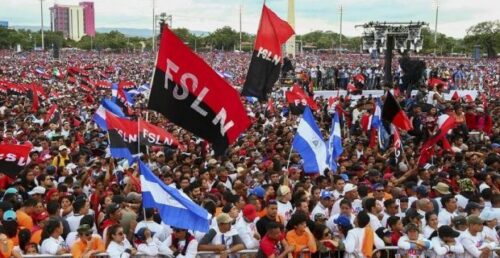
Sandanista- FSLN rally in Nicaragua

Nicaragua: USAID Multi-Year Destabilization Plan Exposed

A US Agency for International Development (USAID) document revealed by reporter William Grigsby describes covert plans to overthrow the democratically-elected Nicaraguan government in the next two years. USAID seeks to hire mercenaries “to take charge of the plan . . . to disrupt public order and carry out other [violent] actions before, during, and/or after the 2021 elections.”

USAID is creating Responsive Assistance In Nicaragua (RAIN), allotting $540,000 in grants to remove the Sandinista government in what it calls “Nicaragua’s transition to democracy.” Daniel Ortega won the 2016 election with 72 percent of the vote in what election observers from the Organization of American States (OAS), a US tool, described as taking “place in a calm, smooth and pacific manner, with no large incidents.”

Brian Willson, who has opposed US efforts to dominate Nicaragua since the 1980s Contra war, concludes the US realizes Ortega will win the 2021 election. In fact, this week, a poll showed support for Ortega’s party, FSLN, at 50% and for the opposition at 10%. One of USAID plans, as they tried in Venezuela in 2018, is for the opposition to boycott the election since they know they will lose, then call it illegitimate and create a political and economic crisis.

The real goal is not a democracy but domination so US transnational corporations can profit from the second poorest country in the hemisphere by putting in place a neoliberal economy to privatize public services, cut social services, and purge all traces of the Sandinistas. USAID also plans to “reestablish” the police and military to enforce their rule. Another goal is to stop Nicaragua from being the “threat of a good example” for its economic growth, reduction of inequality, poverty, illiteracy and crime.

Ben Norton points out in the Grayzone that “the 14-page USAID document employed the word ‘transition’ 102 times” making clear the intent is regime change.  A “sudden transition without elections,” a euphemism for a coup, is one of three possible regime change scenarios.

John Perry writes about “US interference in Nicaragua, going back at least as far as William Walker’s assault on its capital and usurpation of the presidency in 1856.” Since the 1979 Sandinista Revolution, the US has sought to take back control of Nicaragua.

USAID and its National Endowment for Democracy (NED) have been funding the opposition. NED financed 54 projects from 2014-17 to lay the groundwork for a 2018 coup attempt, which  also involved USAIDWiston Lopez writes the US has provided “more than 31 million dollars between the end of 2017 and May 1, 2020.” When the attempted coup in 2018 failed, the US also put in place illegal unilateral coercive measures, known as economic sanctions, supported by both Democrats and Republicans, to try to weaken the country.

The USAID’s RAIN program outlines the usual regime change steps; e.g., remake the police and military as enforcers of the new neoliberal order, move “quickly to dismantle parallel institutions”; i.e., the Sandinista Front, the Sandinista Youth, and other grassroots institutions, and implement “transitional justice measures”; i.e., the prosecution of current government officials and movement leaders.

A new area of attack is a disinformation campaign against Nicaragua’s handling of COVID-19. The opposition misrepresents the government’s response and puts forward false death statistics in an attempt to create chaos. As Wiston López points out, “Since March the US-directed opposition has focused 95% of their actions on attempting to discredit Nicaragua’s prevention, contention, and Covid treatment. However, this only had some success in the international media and is now backfiring since Nicaragua is the country with one of the lowest mortality rates in the continent.”

The US media fails to report on the success of Nicaragua in combating the virus using a community-based health system. Nicaragua has been building its health system for the last 12 years and took rapid action to prepare for the virus. Nicaragua did not impose a lock down because it is a poor country where 80 percent of people are in the informal economy and 40 percent live in rural areas. People must work in order to eat.

Stephen Sefton puts the failure of the United States so far in context. At its root, the US does not understand the people of Nicaragua, their history of fighting US domination, and their ability to overcome right-wing puppets. It also misunderstands what the Sandinista government is doing to better the lives of the people in every sector of the economy. Sefton concludes, “The US government has failed notoriously to meet the needs of its own people during the current pandemic but can still find money to try and destroy a small country whose success makes US social, economic and environmental policy look arbitrary, negligent and criminal.”
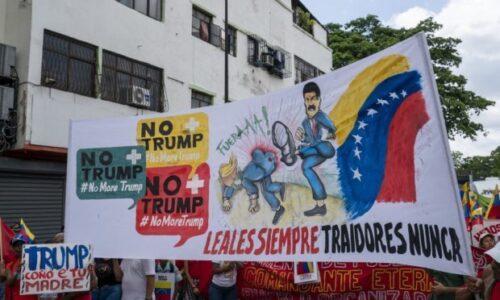
Nicolas Maduro kicks out Donald Trump (Photo by Ben Norton

Venezuela: Bipartisan Failed Regime Change

Ever since the 1998 election of Hugo Chavez, successive US administrations have tried and failed to dominate Venezuela. The bipartisan nature of this policy was on display on August 4, when Elliot Abrams, the notorious coup-monger for multiple presidents, testified in Congress. Not a single Senator criticized the attempt to illegally overthrow a democratically-elected government.

Abrams was criticized by both Democrats and Republicans for his inability to remove President Maduro from power. Senator Chris Murphy (D-CT) was most open about the coup attempt describing it as “a case study in diplomatic malpractice” and claiming Trump botched a winning play in a comedy of errors that strengthened Maduro. After the hearing, Murphy posted a series of Tweets admitting the coup and how it could have been done better.

clip from Murphy’s embarrassing comments was shared widely including by the Venezuelan Vice President Delcy Rodríguez and Foreign Minister Jorge Arreaza. When Vijay Prashad asked Arreaza his reaction, he described the US openly admitting crimes and said the “confessions” of Murphy, Gen. John Kelly, John Bolton, and Elliot Abrams “are priceless evidence for the complaint we raised at the International Criminal Court.”

Elliot Abrams testified that he would continue to work very hard to remove Maduro hopefully by the end of the year.  This echoed a statement by President Trump at SouthCom headquarters in Florida. Sen. Murphy’s comments are consistent with those made by Joe Biden who says he would be more effective at removing Maduro than Trump. Biden described Trump as soft on Maduro because he considered talking to him.

Elliot Abrams announced the US will be starting a media war against Venezuela. The reality is the US has been conducting a media war against Venezuela for more than 20 years.

Venezuela is moving ahead with elections for the National Assembly on December 6, 2020. Unlike 2018, more parties are agreeing to participate including the larger Democratic Action and Justice First parties, as well as a new Communist Party alliance and the hard-right Popular Will party, which was US puppet Juan Guaidó’s former party. There will be 105 political parties contesting for 277 National Assembly seats, 110 more than the current term. Venezuela uses a combination of majority winners and proportional representation. Venezuela also requires half the candidates to be female, and they use electronic voting confirmed by paper ballots with a public citizen audit on Election Day.

Juan Guaidó and others allied with the United States said they would boycott the election. Guaidó cannot risk running because he is likely to be defeated. The US is encouraging a boycott and then will claim the election was not legitimate as it did in the last presidential election. After December, Guaidó will not hold any elected office making his fraudulent claim to the presidency even weaker.

These events come after two major embarrassments for the US in Venezuela. Operation Gideonan attempt by mercenaries to invade Venezuela was foiled on May 4, leading to their arrests and the arrests of their co-conspirators. The State Department abandoned the mercenaries, and this week two former Green Berets were sentenced to 20 years in prison after admitting their guilt. It was evident that Guaidó was heavily involved in this failure adding to his failed presidential takeover and tainting him beyond repair.

The second defeat was Iran and Venezuela working together to deliver oil and equipment for Venezuelan refineries. Five Iranian oil tankers passed by the largest US armada in the Caribbean since the invasion of Panama. Southcom has been repeatedly sending warships into Venezuelan waters. The solidarity of Iran and Venezuela overcame the naval blockade, undermined US sanctions, and sent a shudder through the US by showing other nations they can defy the United States.

Venezuela has a strong history of struggle against imperialism but the US’ economic war is costing their economy hundreds of billions of dollars and leading to the premature death of Venezuelans. In addition, the United Kingdom is refusing to release more than a billion dollars of Venezuelan gold held in the Bank of England that was to be used for food and medicine. The UK court ruled against Venezuela but they are appealing the decision.
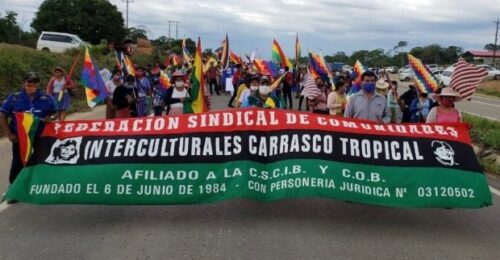
Bolivians protest the postponement of the election

Bolivia: US Dictator Fears Democratic Vote

On November 12 2019, a US-backed coup in Bolivia removed President Evo Morales who had just won re-election. The self-proclaimed President Jeanine Añez, a right-wing Christian, leads a de facto government involved in massacres, persecution and imprisonment of political leaders. It is destroying the social and economic model and achievements of the Movement Towards Socialism (MAS Party) led by Morales.

The OAS played a crucial role in the coup with their false analysis of Morales’ re-election. The western media reported the false OAS analysis without criticism. Now, studies by MIT and the Center for Economic and Policy Analysis have shown that Morales clearly won the election and should have remained in power. For months the Washington Post claimed Morales’ re-election was a fraud, but finally, in March, it acknowledged the election was legitimate. Similarly, the New York Times admitted in July that Morales won the election.

Many have called this a lithium coup because the element is plentiful in Bolivia and critical for batteries. This was made evident when Elon Musk, the head of Tesla, said on Twitter “We will coup whoever we want! Deal with it.” Tesla would benefit from cheap and plentiful lithium for electric car batteries.

The people of Bolivia are struggling to restore democracy. The fraudulent report by the OAS led to a three-week conflict between right-wing Bolivians protesting alleged fraud and pro-government, mostly indigenous, demonstrators defending Morales. The military and police sided with the right-wing coup. The coup government threatened legislators and their families while repressing the people. There were racist attacks against the majority Indigenous population and the Wiphala, the indigenous flag, was burned in the streets. When she took power, Áñez, surrounded by right-wing legislators, held up a large leather bible and declared, “The Bible has returned to the palace.”

The US recognized the coup government, similar to its recognition of the failed coup leader, Juan Guaidó in Venezuela. Añez claimed she’d be transitory until the next election, but at the direction of the US, she is putting in place deep roots and has delayed elections.

The repression has galvanized the MAS party, as well as peasant unions and grassroots organizations who continue their struggle to restore Bolivian democracy. The pressure led to elections being scheduled. Initially, Áñez said she would not run but reversed herself and is now a candidate while she is trying to outlaw the MAS party and its candidates.

Elections were scheduled for May 3, but have been postponed twice allegedly due to the pandemic, but really because this is an ongoing coup.

It is true that the COVID-19 pandemic is hitting Bolivia hard with horror stories about people unable to get medical treatment. Immediately after the coup, the Añez government expelled the Cuban doctors. The coup-government is unable to manage the health system. Corruption is rampant in the purchase of medical equipment. The health ministry has had three ministers during the crisis. The situation is dire with overcrowded hospitals, lack of basic supplies, and corpses in the streets and in their homes with nowhere to be buried.

The coup-government is using the virus to try to delay elections because polls show the MAS candidate, Luis Arce, is far ahead and likely to win in the first round of elections with Áñez coming in a distant third. Áñez has sought to prosecute Arce to keep him from running, so far unsuccessfully.  On July 6, the Attorney General of Bolivia charged Evo Morales with terrorism and financing of terrorism from exile and is seeking preventive detention.

Since mid-July, thousands of Bolivians have been protesting the postponement of elections. They are holding sustained protests throughout the country and blocking many roads. Indigenous and peasant groups, agricultural groups, along with women and unions are joining together calling for elections.  Morales, Arce, and the MAS Party have denounced the delay.
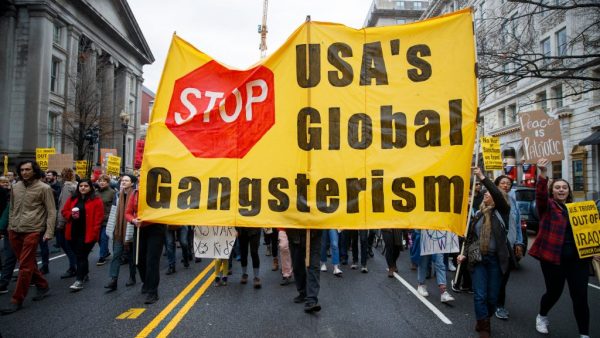
Domination Will Not Reverse Decline

Evo Morales said in a recent interview:

The United States is trying to make Latin America its backyard forever. We know about the hard resistance of the peoples of Cuba, Venezuela, Nicaragua. The struggle of our peoples is very important. The United States wants to divide us in order to plunder our natural resources. The peoples no longer accept domination and plunder. The United States is in decline, and yet it lashes out.

The US is weakening as a global power and its failures in Latin America are both a symptom of this and are causing further decline. The US’ violations of international law are obvious and are being challenged. But the US is an empire and it will not give up the Monroe Doctrine easily.

As citizens of Empire, we have a particular responsibility to demand the US stop its sanctions and illegal interference in Latin America and elsewhere around the world. In this time of multiple global crises, we must demand the US become a cooperative member of the world community and work peacefully to address the pandemic, recession and climate crisis.

Structures to do this exist to help with this such as the global ceasefire and the Paris Climate agreement. And on the anniversary of the US bombing of Hiroshima and Nagasaki, Japan, we must add the Nuclear Ban Treaty as another effort the US must join.

US Again Complicit in an Illegal Coup, This Time in Bolivia

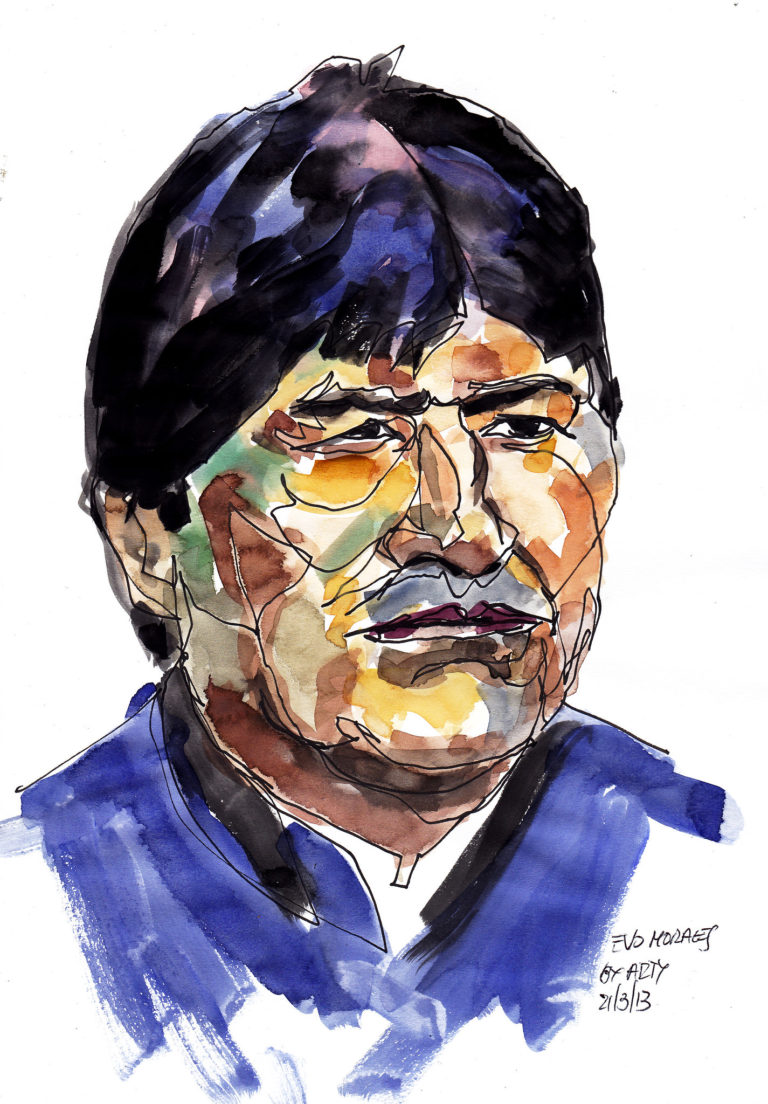
Pen and watercolor of Bolivia’s Evo Morales. (Flickr/Arturo Espinosa)

By Marjorie Cohn

Source: Consortium News

Once again, the United States is complicit in an illegal coup d’état in Latin America, this time in Bolivia. On Nov. 10, a right-wing, anti-indigenous group seized power after the Bolivian military’s removal of President Evo Morales, who had declared victory in the Oct. 20 presidential election.

The United States’ fingerprints are all over the coup. Advisers from the U.S. Southern Command have been stationed on Bolivia’s border with Argentina, Ivanka Trump made a surprising visit to an Argentine province near the Bolivian border in September, the pro-U.S. Organization of American States (OAS) cast unfounded doubt on Morales’s election victory, and the U.S.’s National Endowment for Democracy provided suspicious grants to Bolivia.

At least 32 people have been killed and hundreds injured since the coup began. Sacha Llorenti, Bolivian ambassador to the United Nations, told Democracy Now!, “We are going through not just a coup d’état, but a violent one.” Indeed, it has resulted in “the rise of a far-right regime of terror,” professor Gabriel Hetland wrote in The Washington Post.

Morales — Bolivia’s first indigenous leader in a country where 65 percent of the people are indigenous — received 10 percent more votes than Carlos Mesa, the second-place candidate who has close ties to the U.S. government. Mesa was in regular communication with U.S. officials who were trying to destabilize Morales, U.S. government cables published by WikiLeaks reveal.

The day after the election, the U.S.-funded OAS sought to delegitimize the election results. “The OAS Mission expresses its deep concern and surprise at the drastic and hard-to-explain change in the trend of the preliminary results revealed after the closing of the polls,” it stated.

But the Center for Economic and Policy Research (CEPR) published a comprehensive statistical analysis on Nov. 8 that found no evidence of fraud or irregularities in the election and determined that the results reflected highly similar patterns from past elections. Other research conducted by CELAG (Centro Estratégico Latinoamericano de Geopolítica) confirmed CEPR’s findings and identified insufficient evidence to support the assertions in the OAS statement.

CEPR Co-director Mark Weisbrot noted in an op-ed for Market Watch, “The OAS isn’t all that independent at the moment, with the Trump administration actively promoting this military coup, and Washington having more right-wing allies in the OAS than they did just a few years ago.”

The OAS was established during the Cold War to prevent the proliferation of leftist governments. USAID considers OAS a critical tool in “promot[ing] US interests in the Western hemisphere by countering the influence of anti-US countries” such as Bolivia.

The Nov. 10 military coup led to the forced resignation of Morales, who received asylum in Mexico. Right-wing politician Jeanine Añez declared herself interim president, and Donald Trump immediately recognized her illegitimate claim to the presidency. Añez then issued a decree immunizing the military from criminal liability “for carrying out necessary actions in their legitimate defense while performing their constitutional duties.” Morales supporters accused Añez of giving soldiers “carte blanche” to shoot demonstrators. Bolivia’s human rights ombudsman and reporters have documented widespread injuries and fatalities from gunshots.

U.S. Involvement

During Morales’s nearly 14 years in office, his Movement Towards Socialism (MAS) party reduced poverty by 42 percent and extreme poverty by 60 percent. It cut unemployment by 50 percent and nearly tripled the per-capita G.D.P. “It’s indisputable that Bolivians are healthier, wealthier, better educated, living longer and more equal than at any time in this South American nation’s history,” Anthony Faiola wrote in The Washington Post.

There was discontent about Morales seeking a fourth term among some sectors in Bolivia, who thought there should be space for new leadership. But Morales had a strong record of establishing policies to help the people of Bolivia, which angered the U.S. government, Western corporations and the corporate media, “who function as ideological shock troops against leftist governments in Latin America,” Alan MacLeod wrote at Fairness and Accuracy in Reporting.

The U.S. and Argentine governments helped to engineer the Bolivian coup, Stella Calloni reported in Resumen: Latinoamerico. She cited the presence of advisers from the U.S. Southern Command on the Argentine border with Bolivia.

Calloni also documented “the surprising trip of Ivanka Trump” to the Argentine province of Jujuy near the Bolivian border on Sept. 4-5. Accompanied by 2,500 U.S. agents and Undersecretary of State John Sullivan, Ivanka Trump was ostensibly there to “visit” a small NGO dedicated to furthering women’s rights, and she delivered an “aid” package of $400 million for “road works.” Alicia Canqui Condori, national representative of MAS, said that, “in Jujuy Donald Trump’s daughter had met with Gov. Gerardo Morales to plan what happened in Bolivia.”

Moreover, according to Calloni, Bolivian Gen. Williams Kaliman, who “suggested” that Morales resign after the election, traveled to the United States 72 hours after the coup began and he received $1 million from the U.S. embassy in Bolivia. Like many Latin American strongmen over the years, at least six of the top military leaders involved in the coup, including Kaliman, were trained at the notorious U.S. Army School of the Americas (now called the Western Hemisphere Institute for Security Cooperation) in Fort Benning, Georgia.

Months before the coup, Bolivia concluded a $2.3 billion deal with a Chinese consortium to mine lithium. Bolivia has 70 percent of the world’s supply of lithium, which is used in car batteries, electronic devices and weapons systems. “The idea that there might be a new social compact for the lithium was unacceptable to the main transnational mining companies,” Vijay Prashad wrote. U.S. and Canadian companies sought to make a lithium agreement with Bolivia but they could not meet Morales’s conditions. “Morales himself was a direct impediment to the takeover of the lithium fields by the non-Chinese transnational firms,” according to Prashad. “He had to go.”

Meddling in Latin America

U.S. complicity in the Bolivian coup follows in a sordid tradition of meddling in the political and economic affairs of Latin American countries. “For many years, the US government has provided overt financial support to opposition political parties and civic groups, including to many of the groups that have been engaged in violent insurrections and coup plotting since at least 2008,” Thomas Field wrote in Jacobin.

One key vehicle that the U.S. government uses as a cover for its imperialist policies is the National Endowment for Democracy (NED). After disturbing revelations of covert CIA operations in the second half of the 1970s, NED was established under President Ronald Reagan. “The idea was that the NED would do somewhat overtly what the CIA had been doing covertly for decades, and thus, hopefully, eliminate the stigma associated with CIA covert activities,” William Blum wrote in 2005. NED co-founder Allen Weinstein concurred, stating in 1991, “A lot of what we do today was done covertly 25 years ago by the CIA.” Although ostensibly a private, nonprofit organization, NED is largely funded by the United States. “In effect,” Blum noted, “the CIA has been laundering money through NED.”

Peter Haberfeld, a retired lawyer and labor organizer who has studied the “Pink Tide” governments in Latin America, documented NED grants in Bolivia. He told Truthout that “between 2016 and 2019, NED gave grants to over 30 organizations for ‘democracy promotion’ in Bolivia. The grants total $3,209,887.”

Haberfeld said the grants were officially earmarked for “lofty objectives such as expanding participation by women, youth, media and entrepreneurs in a vibrant political process, particularly in connection with elections,” but cautioned “it is wise to be suspicious.” Haberfeld cited author Neil A. Burron, who wrote in “The New Democracy Wars: The Politics of North American Democracy Promotion in the Americas,” that “democracy promotion is typically formulated to advance commercial, geopolitical and security objectives that conflict with a genuine commitment to democracy development.” Burron noted, “For the U.S., the political manipulation of democracy promotion in support of a North American-led regional order is a continuation of long-standing forms of intervention [that have been] used as a license to meddle in the domestic affairs of others.”

NED was complicit in the Iran-Contra affair in the 1980s, manipulated the 1990 Nicaraguan elections, heavily funded the 2002 failed coup attempt against socialist President Hugo Chavez in Venezuela, and supported the opposition to progressive President Jean-Bertrand Aristide in Haiti in the 1990s. Between 1990 and 1992, NED donated a quarter-million dollars to the Cuban-American National Foundation, the violent anti-Castro group based in Miami.

In 2018, under the guise of “democracy,” “human rights” and “entrepreneurship,” NED funneled more than $23 million to opposition groups in Latin American countries, including Venezuela, Nicaragua, Cuba and Bolivia.

Former National Security Advisor John Bolton called Venezuela, Cuba and Nicaragua the “Troika of Tyranny” in November 2018. A few months later, in April 2019, the U.S. government orchestrated another unsuccessful coup in Venezuela. Juan Guaidó, Washington’s chosen puppet to seize power from President Nicolás Maduro, was funded by NED.

Trump not only took aim at the progress President Barack Obama had made toward normalization of relations with Cuba, he has escalated the U.S. economic war on Cuba and unleashed untold numbers of lawsuits that threaten to destroy the fragile Cuban economy.

The Obama administration, led by former Secretary of State Hillary Clinton, supported the 2009 coup in Honduras. The fraudulent election following the coup was financed by NED and the State Department, ushering in a repressive and militarized regime. Conditions deteriorated, leading to the exodus of thousands of Honduran children fleeing north.

U.S. Complicity Is Illegal

U.S. complicity in the coup in Bolivia is illegal under both U.S. and international law. The United Nations Charter prohibits the use of or threat to use force against the territorial integrity or political independence of another nation. The International Covenant on Civil and Political Rights guarantees the right to self-determination.

The Charter of the Organization of American States, to which the U.S. is a party, forbids any country from intervening in the internal or external affairs of another country. The OAS charter declares that, “Every State has the right to choose, without external interference, its political, economic, and social system and to organize itself in the way best suited to it, and has the duty to abstain from intervening in the affairs of another State.”

The Foreign Assistance Act forbids the United States from assisting a country “whose duly elected head of government is deposed by military coup or decree.”

There has been global condemnation of the coup. Sixty-four organizations of jurists, lawyers, NGOs, social movements and trade unions from around the world, including the International Association of Democratic Lawyers and the National Lawyers Guild, sent a letter to the UN High Commissioner for Human Rights Michelle Bachelet, urging her to strongly condemn the human rights violations resulting from the coup.

Fourteen members of the House of Representatives sent a letter to Secretary of State Mike Pompeo saying they were “deeply concerned” about the contribution of the Trump administration to the “escalating political and human rights crisis” in Bolivia.

Over 800 scholars, activists and public figures published an open letter demanding that the United States and the international community halt all support to the right-wing, anti-indigenous regime that took power after the military coup.

Veterans For Peace condemned the racist coup in Bolivia and demanded an end to U.S. intervention in Latin America:

Veterans For Peace stands in solidarity with the Indigenous majority in Bolivia who are resisting the racist, right-wing takeover of their democracy. We demand that the coup be stopped and democracy restored in Bolivia. As military veterans who have been used and abused in too many unjust wars, we demand an end to 200 years of U.S. intervention in Latin America.

The situation in Bolivia is volatile and there is danger it could devolve into civil war. This is the time to urge senators and Congress members to end all U.S. support for the illegitimate regime, demand free and fair elections with all political parties represented, and insist that fundamental human rights of all Bolivians are protected.

MSM Adamantly Avoids The Word “Coup” In Bolivia Reporting

By Caitlin Johnstone

Source: CaitlinJohnstone.com

There has been a military coup in Bolivia backed by violent right-wing rioters and the US government, but you’d hardly know this from any of the mainstream media headlines.

“Bolivian President Evo Morales steps down following accusations of election fraud” proclaims CNN.

“Bolivia’s Morales resigns amid scathing election report, rising protests” reports The Washington Post.

“Bolivian Leader Evo Morales Steps Down” says The New York Times.

“Bolivian President Evo Morales resigns amid fraud poll protests” declares the BBC.

“President of Bolivia steps down amid allegations of election rigging” we are informed by Telegraph.

“Bolivia’s President Morales resigns after backlash to disputed election” says the Sydney Morning Herald.

So there you have it. The indigenous leader of a socialist South American government which has successfully lifted masses of people out of crushing poverty, which happens to control the world’s largest reserves of lithium (which may one day replace oil as a crucial energy resource due to its use in powering smartphones, laptops, hybrid and electric cars), which has an extensive and well-documented history of being targeted for regime change by the US government, simply stepped down due to some sort of scandal involving a “disputed election”. Nothing to do with the fact that right-wing mobs had been terrorizing this leader’s family, or the fact that the nation’s military literally commanded him to step down and are now currently searching for him to arrest him, leading to ousted government officials being rounded up and held captive by soldiers wearing masks.

All perfectly normal and not suspicious at all.

As is usual, mass media’s reporting on this story is in full alignment with the US State Department, with Secretary of State Mike Pompeo also advancing the “disputed election” line in a tweet shortly before the forced resignation of Morales. Pompeo cited the evidence-free and discredited allegation of suspicious vote tallies during Morales’ re-election last month from the Washington-based Organization of American States (OAS). As Mark Weisbrot of the Center for Economic & Policy Research explains in a recent article for The Nation, the OAS receives 60 percent of its funding from Washington, which gives the US tremendous leverage over the supposedly neutral and international body. This ties in interestingly with what we discussed the other day about Washington’s known history of using its disproportionate financial support for the Organization for the Prohibition of Chemical Weapons as leverage to force that supposedly neutral and international body to comply with US agendas.

The field of narrative management keeps making more and more advances.

The US-centralized empire just keeps throwing coup attempts at unabsorbed governments until they stick. The coup in Venezuela failed in 2002 and again in 2019, but they’ll just keep attempting them until one takes hold. A kickboxer throws strikes in combinations with the understanding that most attacks will miss or do minimal damage against a trained opponent, but eventually one will get through and score the knockout blow. Imperialist regime change agendas employ the same punches-in-bunches philosophy: just keep attacking and undermining at every possible turn, and eventually something will stick.

And the empire can afford to do this. When you have all the power and resources, you can bide your time, knowing that if the current attempt at toppling the government in a sovereign nation fails, there’s always tomorrow.

At a United Nations Security Council meeting last year, President Morales summed up the true nature of America’s role in the world very accurately, and, it turns out, very presciently.

“I would like to say to you, frankly and openly here, that in no way is the United States interested in upholding democracy,” Morales said. “If such were the case it would not have financed coups d’etat and supported dictators. It would not have threatened with military intervention democratically elected governments as it has done with Venezuela. The United States could not care less about human rights or justice. If this were the case, it would have signed the international conventions and treaties that have protected human rights. It would not have threatened the investigation mechanism of the International Criminal Court, nor would it promote the use of torture, nor would it have walked away from the Human Rights Council. And nor would it have separated migrant children from their families, nor put them in cages.”

“The United States is not interested in multilateralism,” Morales continued. “If it were interested in multilateralism it would not have withdrawn from the Paris Agreement or given the cold shoulder to the global compact on migration, it would not have launched unilateral attacks, nor have taken decisions such as illegally declaring Jerusalem to be the capital of Israel. This contempt for multilateralism is motivated by the thirst of the United States for political control and for the seizing of natural resources.”

“Each time that the United States invades nations, launches missiles, or finances regime change, it does so behind a propaganda campaign which incessantly repeats the message that it is acting in the course of justice, freedom and democracy, in the cause of human rights or for humanitarian reasons,” Morales also said.

“The responsibility of our generation is to hand over a fairer and more secure world to the following generation,” Morales concluded. “We will only achieve this dream if we work together to consolidate a multipolar world, a world with common rules that are respected by and defended from all the threats ranged against the United Nations.”

Indeed, the only reason the US is able to wage its endless campaign of regime change agendas against unabsorbed governments is because the unipolar world order it rules has allowed it the power, resources and leisure to do so. A multipolar world would enable the citizenry of this planet to have a say in what happens to them in a way that is not dictated by a few sociopaths in and around Washington, DC. A multipolar world is to democracy as a unipolar world is to monarchy. The citizens of the world should oppose this unipolarity.


A Nonviolent Strategy to Defeat the US Coup Attempt in Venezuela

By Robert J. Burrowes

To the People of Venezuela

Yet again, the United States elite has decided to attempt to impose its will on the people of another nation, in this case, and not for the first time either, your country Venezuela.

On 23 January 2019, following careful secret planning in the preceding weeks and a late night telephone call the previous day from US Vice President Mike Pence – see ‘Pence Pledged U.S. Backing Before Venezuela Opposition Leader’s Move’ and ‘Venezuela – Trump’s Coup Plan Has Big Flaws’ – the US initiated a coup against your President, Nicolás Maduro, and his Government, whom you democratically re-elected to represent you on 20 May 2018. See ‘The Case for the Legitimacy of Maduro’s Second Term’.

By organizing, recognizing and supporting as ‘interim president’ the US puppet trained for the purpose over the past decade – see ‘The Making of Juan Guaidó: How the US Regime Change Laboratory Created Venezuela’s Coup Leader’ – the United States government has simply brought into clearer focus and now precipitated its long-standing plan to seize control of Venezuela’s huge oil, gas, gold, water and other natural resources, with the oil and gas conveniently close to Texan refineries. In relation to gold, for example, see ‘Bank of England refused to return $1.2bn in gold to Venezuela – reports’ and then ‘Bank Of England Urged To Hand Over Venezuela’s Gold To Guaidó’.

Of course, this coup is perfectly consistent with US foreign policy for the past two centuries, the essential focus of which has been to secure control over key geostrategic areas of the world and to steal the resources of foreign nations. For a list of only the ‘most notable U.S. interventions’ in Central/South America over that period, see ‘Before Venezuela: The long history of U.S. intervention in Latin America’. But you can also read a more complete list of US interventions overseas (only since 1945) in William Blum’s ‘Overthrowing other people’s governments: The Master List’.

Needless to say, this latest attempt at ‘regime change’ is in clear violation of international law on so many counts it is difficult to document them concisely. First, the ongoing US intervention over an extended period has always been a violation of international law, including Chapter IV, Article 19 of the Charter of the Organization of American States. Second, sanctions are illegal under so many treaties it is sickening. See ‘Practice Relating to Rule 103. Collective Punishments’. And third, the coup is a violation of Venezuela’s constitution. See ‘The Failure of Guaido’s Constitutional Claim to the Presidency of Venezuela’.

Unfortunately, international law (like domestic law) is simply used as another means to inflict violence on those outside the elite circle and, as casual observation of the record demonstrates, is routinely ignored by elites in the US and elsewhere when their geopolitical, economic and/or other interests ‘require’ it.

As usual, there is no remotely reasonable pretext for this coup, despite the usual alphabet of sycophantic US allies such as Australia, Britain, Canada, France, Germany, Israel…. – see, for example, ‘Australia recognises Juan Guaidó as Venezuela president’ and ‘Emmanuel Macron, Pedro Sanchez, Angela Merkel and Theresa May Have No Right to Issue an Ultimatum to Venezuela’ – as well as the elite-controlled corporate media, lying that there is such pretext. Mind you, given the flagging domestic support for many of these political leaders in light of their obvious incompetence in dealing with issues of critical import to their own constituencies – is this where we mention words like ‘Brexit’ and ‘Yellow Vests’, for example? – it is little wonder that the distraction offered by events elsewhere is also used to provide some relief from the glare focused on their own ineptitude.

Of course, Luis Almagro, the submissive head of the Organization of American States (OAS), recognized Guaidó in violation of both the OAS Charter and a majority vote of that organization – see ‘Message of the OAS Secretary General on Venezuela’ and ‘Caricom to Almagro: “You Don’t Speak For The Entire OAS”’ – and the cowardly European Union (EU), also kneeling in the face of US pressure to ignore international law, simply add to the picture of a global system devoid of moral compass and the rule of law, let alone courage.

It is true, as most of you are well aware, that Venezuela has been experiencing dire economic circumstances but, as most of you also know, these circumstances have been caused by ‘outside intervention, internal sabotage and the decline in oil prices’, particularly including the deepening economic sanctions imposed by the United States in recent years. For solid accounts of what has taken place in Venezuela in recent times, particularly the external factors causing these dire economic circumstances, see the report on behalf of the United Nations Human Rights Council written by Alfred de Zayas ‘Report of the Independent Expert on the promotion of a democratic and equitable international order on his mission to the Bolivarian Republic of Venezuela and Ecuador’ which identified the crisis the US ‘economic warfare’ was precipitating – see ‘Former UN Rapporteur: US Sanctions Against Venezuela Causing Economic and Humanitarian Crisis’ – as well as the research reported in ‘Opposition Protests In Venezuela Rooted In Falsehoods’, ‘Trump’s Sanctions Make Economic Recovery in Venezuela Nearly Impossible’, ‘US Regime Change in Venezuela: The Documented Evidence’ and ‘Venezuela: What Activists Need To Know About The US-Led Coup’.

But lest some people think this US coup is only about resources, geopolitical control is also vital. As noted by Garikai Chengu: ‘America seeks control of Venezuela because it sits atop the strategic intersection of the Caribbean, South and Central American worlds. Control of the nation, has always been a remarkably effective way to project power into these three regions and beyond.’ See ‘Sanctions of Mass Destruction: America’s War on Venezuela’.

Of course, even though the outstanding problems in Venezuela have been primarily caused by the ongoing illegal US inteference, the eminently reasonable government of your country remains willing to engage in dialogue to resolve these problems. See, for example, ‘Venezuela leader Nicolas Maduro seeks talks with Obama’ and ‘Maduro Reaffirms Willingness For Dialogue’. However, this willingness for dialogue does not interest the US elite or its sycophantic western and local (both within Central/South America and within Venezuela) allies who, as noted above, are intent on usurping control from the people of Venezuela and stealing your resources.

In any case, and most importantly, for those of us paying attention to the truth, rather than the garbage reported in the elite-controlled corporate media – see, for example, ‘Can Venezuela Have a Peaceful Transition?’ but outlined more fully in ‘“Resistance” Media Side With Trump to Promote Coup in Venezuela’ – we are well aware of what you all think about this. Because, according to recent polling, you are heavily against US and other outside intervention in any form. See 86% of Venezuelans Oppose Military Intervention, 81% Are Against U.S. Sanctions, Local Polling Shows’.

Fortunately, of course, you have many solidarity allies including countries such as Russia, China, Cuba and Turkey who acknowledge your right to live with the government you elected and do not wish to steal your resources. Moreover, at an ‘emergency’ meeting of the UN Security Council on 26 January 2019, called by the United States to seek authorization for interference in Venezuela, the Council was divided as China, Equatorial Guinea, Russia and South Africa opposed the move, with Côte d’Ivoire and Indonesia abstaining. See ‘UN political chief calls for dialogue to ease tensions in Venezuela; Security Council divided over path to end crisis’.

And there is a vast number of people, including prominent public intellectuals, former diplomats and ordinary people who are solidly on your side as you defend yourselves from the latest bout of western imperialism. For example, Professor Noam Chomsky and other prominent individuals have publicly declared their support – see ‘Open Letter by Over 70 Scholars and Experts Condemns US-Backed Coup Attempt in Venezuela’ – and former UK ambassador Craig Murray has argued that ‘The Coup in Venezuela Must Be Resisted’.

Anyway, given your existing and ongoing resistance to the coup in defense of your elected government, I would like to offer another avenue of support for you to consider. My support, if you like, to plan and implement a comprehensive nonviolent strategy to defeat the coup.

So what is required?

I have explained in detail how to formulate and implement a strategy for defeating coup attempts such as this in the book The Strategy of Nonviolent Defense: A Gandhian Approach.

However, I have also outlined the essential points of this strategy on the website Nonviolent Defense/Liberation Strategy. The pages of this website provide clear guidance on how to easily plan and then implement the twelve components of this strategy.

If you like, you can see a diagrammatic representation of this strategy by looking at the Nonviolent Strategy Wheel.

And on the Strategic Aims page you can see the basic list of 23 strategic goals necessary to defeat a coup of the type you are resisting at the moment. These strategic goals can easily be adopted, modified and/or added to if necessary, in accordance with your precise circumstances as you decide.

If you want to read a straightforward account of how to plan and conduct a nonviolent tactic so that it has strategic impact, you can do so here: ‘Nonviolent Action: Why and How it Works’.

This will require awareness of the difference between ‘The Political Objective and Strategic Goal of Nonviolent Actions’.

And, to ensure that your courage is most powerfully utilized, you are welcome to consider the 20 points designed to ensure that you are ‘Minimizing the Risk of Violent Repression’ whenever you take nonviolent action where repression is a risk. The information is useful for both neutralizing violent provocateurs but also in the event that sections of the police or army defect to support the US puppet Guaidó in the days or weeks ahead, as often happens in contexts such as these.

In essence, your ongoing resistance to the coup is essential if you are to defeat the coupmakers and defend your elected government. But the chances of success are vastly enhanced if your struggle, and that of your solidarity allies around the world, is focused for maximum strategic impact and designed to spread the cost of doing so.

Remember, it is you who will decide the fate of Venezuela. Not the US elite and not even your President and government.

Of course, whether or not you decide to consider and/or adopt my proposed strategy, you have my solidarity.


Biodata: Robert J. Burrowes has a lifetime commitment to understanding and ending human violence. He has done extensive research since 1966 in an effort to understand why human beings are violent and has been a nonviolent activist since 1981. He is the author of Why Violence? His email address is flametree@riseup.net and his website is here.

Robert J. Burrowes
P.O. Box 68
Daylesford, Victoria 3460
Australia

Email: flametree@riseup.net

Websites:
Nonviolence Charter
Flame Tree Project to Save Life on Earth
‘Why Violence?’
Feelings First
Nonviolent Campaign Strategy
Nonviolent Defense/Liberation Strategy
Anita: Songs of Nonviolence
Robert Burrowes
Global Nonviolence Network

Death In Honduras: The Coup, Hillary Clinton And The Killing Of Berta Cáceres

dt.common.streams.StreamServer.cls

By Media Lens

Source: Dissident Voice

On February 28, Hillary Clinton told an audience from the pulpit of a Memphis church: ‘we need more love and kindness in America’. This was something she felt ‘from the bottom of my heart’.

These benevolent sentiments recalled the national ‘purpose’ identified by President George H.W. Bush in 1989, shortly before he flattened Iraq. It was, he said, ‘to make kinder the face of the nation and gentler the face of the world’.

Clinton, of course, meant North America, specifically the United States. But other places in America are short on love and kindness, too. Consider Honduras, for example.

On June 28, 2009, the Honduran President Manuel Zelaya was kidnapped at gunpoint by masked soldiers and forced into exile. Since the ousting, the country ‘has been descending deeper into a human rights and security abyss’ as the military coup ‘threw open the doors to a huge increase in drug trafficking and violence, and… unleashed a continuing wave of state-sponsored repression’. In 2012, Honduras had a murder rate of 90.4 per 100,000 population, then the highest rate in the world. In 2006, three years before the coup, the murder rate had stood at 46.2 per 100,000.

The years since 2009 have seen ‘an explosive growth in environmentally destructive megaprojects that would displace indigenous communities. Almost 30 percent of the country’s land was earmarked for mining concessions, creating a demand for cheap energy to power future mining operations. To meet this need, the government approved hundreds of dam projects around the country, privatizing rivers, land, and uprooting communities.’ In 2015, Global Witness reported that Honduras was ‘the most dangerous country to be an environmental defender’.COPINH

Berta Cáceres, a mother of four children, was co-founder and general coordinator of the COPINH (Consejo Cívico de Organizaciones Populares e Indígenas de Honduras) group opposing this state-corporate exploitation. Last year, Cáceres was awarded the Goldman Environmental Prize, the world’s leading award recognising grassroots environmental activists, for her work opposing a major dam project. Many of COPINH’s leaders have been murdered in recent years. In 2013, Cáceres said:

The army has an assassination list of 18 wanted human rights fighters with my name at the top. I want to live, there are many things I still want to do in this world. I take precautions, but in the end, in this country where there is total impunity I am vulnerable. When they want to kill me, they will do it.

Last week, on the night of March 3, armed men burst through the back door of Cáceres’s house and shot her four times, killing her in her bed. US media watch site Fairness and Accuracy in Reporting (FAIR) commented:

There was widespread outcry and grief over her death, and the story was covered by major media in the United States. But there was a glaring problem with the coverage: Almost none of it mentioned that the brutal regime that likely killed Cáceres came to power in a 2009 coup d’état supported by the United States, under President Barack Obama and then-Secretary of State Hillary.

Confidential – The Embassy Perspective

Following the 2009 coup, the United Nations, the Organization of American States (OAS) and the European Union all condemned Zelaya’s removal as a military coup. A confidential US Embassy cable, later published by Wikileaks, commented:

The Embassy perspective is that there is no doubt that the military, Supreme Court and National Congress conspired on June 28 in what constituted an illegal and unconstitutional coup against the Executive Branch… There is equally no doubt from our perspective that Roberto Micheletti’s assumption of power was illegitimate.

That was behind closed doors. In public, fifteen US House Democrats urged the US regime to ‘fully acknowledge that a military coup has taken place and… follow through with the total suspension of non-humanitarian aid, as required by law’. Writing for the Common Dreams website, Alexander Main supplied some detail:

Ann-Marie Slaughter, then director of Policy Planning at the State Department, sent an email to [Secretary of State] Clinton on August 16 [2009] strongly urging her to “take bold action” and to “find that [the] coup was a ‘military coup’ under U.S. law,” a move that would have immediately triggered the suspension of all non-humanitarian U.S. assistance to Honduras.

This, Hillary Clinton’s State Department refused to do, thus implicitly recognising the military takeover. As FAIR noted, Clinton makes clear in her memoirs that she had no intention of restoring President Zelaya to power:

In the subsequent days [after the coup] I spoke with my counterparts around the hemisphere, including Secretary Espinosa in Mexico. We strategized on a plan to restore order in Honduras and ensure that free and fair elections could be held quickly and legitimately, which would render the question of Zelaya moot.

In September 2009, US State Department officials blocked the OAS from adopting a resolution that would have rejected the legitimacy of Honduran elections carried out under the dictatorship, thus giving the coup the final US seal of approval.

Ousted former president, Manuel Zelaya, said last year:

Secretary Clinton had many contacts with us. She is a very capable woman, intelligent, but she is very weak in the face of pressures from groups that hold power in the United States, the most extremist right-wing sectors of the U.S. government, known as the hawks of Washington. She bowed to those pressures. And that led U.S. policy to Honduras to be ambiguous and mistaken.

Zelaya added:

President Obama has not wanted to hear our peoples. He has turned a deaf ear on the cry of the people. First we protested in the opposition. A few months ago, they physically removed me from the Congress, the National Congress, because our party mounted a peaceful protest. The military removed us, using tear gas in the Congress. They expelled us, beating us with batons, beating us into the street. This is the government that President Obama supports, a government that is repressive, a government that violates human rights, as has been shown by the very Inter-American Commission on Human Rights of the Organization of American States. It has shown this to be the case.

Alexander Main concluded:

A careful reading of the Clinton emails and Wikileaked U.S. diplomatic cables from the beginning of her tenure, expose a Latin America policy that is often guided by efforts to isolate and remove left-wing governments in the region.

An assertion supported by the increase in US military assistance to Honduras even as state-corporate violence has massively escalated. Noam Chomsky explained the logic:

Zelaya was moving somewhat tentatively towards the kinds of social reforms that the United States has always opposed and will try to stop if it can.

A Local Matter – The Media Response

Corporate politics and media, of course, never tire of proclaiming the West’s ‘responsibility to protect’ in places like Iraq, Libya and Syria. So how did these same humanitarians respond to the murder of a compassionate, respected and awesomely courageous activist in Honduras? FAIR commented on the overwhelming evidence of US support for the coup:

One wouldn’t know any of this reading US reports of Cáceres’ death. The coup, and its subsequent purging of environmental, LGBT and indigenous activists, is treated as an entirely local matter… The Washington Post, Guardian, NBC, CNN and NPR didn’t mention the 2009 coup that brought to power Cáceres’ likely murderers, let alone the US’s tacit involvement in the coup.

On the same day FAIR’s report was published, the first and only reference to these hidden truths in the UK press recorded by the Nexis media database was supplied by Jonathan Watts in the Guardian:

But Washington’s role is also controversial because the US backed the current government, which took power after a 2009 coup that ousted the democratically elected president Manuel Zelaya. The US is now providing fund [sic] for the Honduran police force.

Watts quoted International Rivers, an NGO that worked with Cáceres:

We must note that during the 2009 military coup in Honduras, the US government, with Hillary Clinton as secretary of state, worked behind the scenes to keep Honduras’ elected government from being reinstated. Additionally, the US government continues to fund the Honduran military, despite the sharp rise in the homicide rate, political repression, and the murders of political opposition and peasant activists.

While hardly exhaustive, this is the only mention of these issues we have found in the UK corporate press. A more recent piece by the Guardian’s Washington correspondent, David Smith, mentioned the coup but not US involvement. With touching naivety, Smith observed that ‘the US, determined to stop the flow of illegal immigrants from Central America, has been pouring money into Honduras’s security apparatus’.

The Times – so vocal in promoting Western ‘intervention’ to ‘protect’ human rights from Official Enemies – printed 68 words on the killing penned by the Associated Press. The Telegraph gave the story a single mention. In the Independent, Phil Davison wrote of Cáceres:

As if anyone needed reminding, her murder brought back to Honduras the dark days of the 1980s Central American guerrilla wars, in which they and their neighbours fought to rid themselves of dictators backed by the US.

But in stark contrast to the courage of Cáceres and so many others in Honduras, Davison was not able to bring himself to mention that the tyranny in Honduras is today being backed by the region’s great superpower. Also in the Independent, Caroline Mortimer made no mention of US complicity in the coup. Nor, unsurprisingly, did the BBC in two pieces here and here on the killing.

As ever, ‘mainstream’ ‘compassion’ turns out to be rooted in rather more ‘pragmatic’ concerns. If an Official Enemy had been responsible for Cáceres’s death, the cries of outrage, horror and denunciation would have blazed from our corporate front pages and TV screens. Action would have been demanded, perhaps even ‘intervention’. But when the horror is committed by a faithfully corrupt and brutal servant of Empire aided and abetted by the ‘Leader of the Free World’, none of the buttons on the vast, high-tech propaganda machine are pressed and the story is quickly buried along with the victim.

Needless to say, awareness of the kind offered here threatens to jam a spanner in the conditionally ‘compassionate’ propaganda waterworks and must be scrupulously ignored or, at best, ridiculed.


Media Lens is a UK-based media watchdog group headed by David Edwards and David Cromwell. The second Media Lens book, Newspeak: In the 21st Century by David Edwards and David Cromwell, was published in 2009 by Pluto Press. Read other articles by Media Lens, or visit Media Lens’s website.

Related Article: Before Her Assassination, Berta Cáceres Singled Out Hillary Clinton for Backing Honduran Coup (Democracy Now)