End of Nuclearism or the End of the World: Utopian Dreams, Dystopian Nightmares

By Richard Falk

Source: Global Justice in the 21st Century

We are living amid contradictions whether we like it or not, driving expectations about the future toward opposite extremes. Increasingly plausible are fears that the ‘sixth extinction’ will encompass the human species, or at least, throw human society back to a technology of sticks and stones, with a habitat limited to caves and forests. This dark vision is countered by gene editing designer promises of virtual immortality and super-wise beings programming super-intelligent machines, enabling a life of leisure, luxury, and security for all. Whether the reality of such a scientistic future would be also dark is a matter of conjecture, but from a survival perspective, it offers an optimistic scenario.

On political levels, a similar set of polar scenarios are gaining ground in the moral imagination, producing national leaders who seem comfortable embracing an apocalyptic telos without a second thought. The peoples of the world, entrapped in a predatory phase of global capitalism, are using their democratic prerogative to shut down dissent, rationality, and science. On one side, 122 governments pledge a legal commitment to the prohibition of nuclear weapons as an unprecedented prelude to the abolition of the weaponry; on the other side, all nine nuclear weapons states, and their closest allies, oppose the prohibition and opt for modernizing their nuclear weapons arsenals even devising strategic plans for their possible use, prompting an urgent search for counter measures.

John Pilger issues a solemn reminder that Nevile Shute’s On the Beach depicting a post-nuclear human future that is now more resonant than when it was published in 1957. Leaders that could bluff their way to shared catastrophe bellow forth in Washington and Pyongyang, each deluded by the belief that military options even with nuclear weapons are the only geopolitical security blanket worth relying upon, projecting a reckless obliviousness to the risk of losing their balance while engaging in inflammatory rhetorical posturing alarmingly close to the nuclear precipice.

As Pilger also points out, the liberal opposition to this right wing populism in the West is also dangerously disposed toward warmongering. Donald Trump is being pilloried by a bipartisan anti-Russian hysteria that imposes harsh sanctions, seemingly intent on driving Putin’s Kremlin into a corner from which there is no retreat except by way of confrontation, and possibly war.

We read of record heat waves, extreme weather events, extended droughts, and wild fires as common as clouds in the sky without blinking. The newspapers report that climate scientists are ready to push the panic button in reaction to the latest studies of grim global warning trends, while the Trump factor renews coal mining and treats denial a political virtue.

While these alarming realities dim the light of hope for many of us, the American stock market, a barometer of capitalist expectations by the shrewdest investors, achieves record heights. At the same time famine warnings have been officially endorsed for a series of long suffering populations: Syria, Yemen, South Sudan, northern Nigeria, Gaza. The entire Middle East is being turned into a war and conflict zone, with an anti-Iran warmongering coalition pressuring Iran to choose between nuclear deterrence and sectarian warfare inflamed by militarist Israeli/U.S. grand strategy that appears to be motivated by a regional vision of geopolitical pacification.

How best to endure in the face of such fatalistic dualisms? That may be the question of our time, dodged for the sake of sanity by almost all of us, at least most of the time. Business as usual, while living with therapeutic forms of cultural blindness, the opioids of those fortunate enough to live for now in gated communities, whether on the scale of private dwellings or walled off countries.

Recently a lively young woman told me that many of her friends had decided not to have children because they are so fearful of the storm clouds of the future, and refuse to wait around for liberating rainbows. At the other extreme, today’s International Edition of the New York Times contains a front page ad of enticement encouraging attendance at an International Luxury Conference to be held in Brussels, November 13-14, on the demeaning theme of “What’s Next: Luxury in a Turbulent World.” My somewhat impatient response—‘whatever turns out to be next, it will not be and should not be luxury!’ More likely, those grown accustomed to luxury will shift their residences to those underground homes built by Silicon Valley billionaires on vast tracts of lands in the New Zealand countryside as the ultimate hedge against an imminent global catastrophe. It could be that the NYT conference will devote its attention to this form of post-apocalyptic luxury living! Yet that assumes a quite unlikely focus on how the world of luxury is adapting to the unpleasant realities of the Sixth Extinction.
On The Beach 2017

By John Pilger

Source: Axis of Logic

The US submarine captain says, “We’ve all got to die one day, some sooner and some later. The trouble always has been that you’re never ready, because you don’t know when it’s coming. Well, now we do know and there’s nothing to be done about it.”

He says he will be dead by September. It will take about a week to die, though no one can be sure. Animals live the longest.

The war was over in a month. The United States, Russia and China were the protagonists. It is not clear if it was started by accident or mistake. There was no victor. The northern hemisphere is contaminated and lifeless now.

A curtain of radioactivity is moving south towards Australia and New Zealand, southern Africa and South America. By September, the last cities, towns and villages will succumb. As in the north, most buildings will remain untouched, some illuminated by the last flickers of electric light.

This is the way the world ends
Not with a bang but a whimper

These lines from T.S. Eliot’s poem The Hollow Men appear at the beginning of Nevil Shute’s novel On the Beach, which left me close to tears. The endorsements on the cover said the same.

Published in 1957 at the height of the Cold War when too many writers were silent or cowed, it is a masterpiece. At first the language suggests a genteel relic; yet nothing I have read on nuclear war is as unyielding in its warning. No book is more urgent.

Some readers will remember the black and white Hollywood film starring Gregory Peck as the US Navy commander who takes his submarine to Australia to await the silent, formless spectre descending on the last of the living world.

I read On the Beach for the first time the other day, finishing it as the US Congress passed a law to wage economic war on Russia, the world’s second most lethal nuclear power. There was no justification for this insane vote, except the promise of plunder.

The “sanctions” are aimed at Europe, too, mainly Germany, which depends on Russian natural gas and on European companies that do legitimate business with Russia. In what passed for debate on Capitol Hill, the more garrulous senators left no doubt that the embargo was designed to force Europe to import expensive American gas.

Their main aim seems to be war – real war. No provocation as extreme can suggest anything else. They seem to crave it, even though Americans have little idea what war is. The Civil War of 1861-5 was the last on their mainland. War is what the United States does to others.

The only nation to have used nuclear weapons against human beings, they have since destroyed scores of governments, many of them democracies, and laid to waste whole societies – the million deaths in Iraq were a fraction of the carnage in Indo-China, which President Reagan called “a noble cause” and President Obama revised as the tragedy of an “exceptional people”. He was not referring to the Vietnamese.

Filming last year at the Lincoln Memorial in Washington, I overheard a National Parks Service guide lecturing a school party of young teenagers. “Listen up,” he said. “We lost 58,000 young soldiers in Vietnam, and they died defending your freedom.”

At a stroke, the truth was inverted. No freedom was defended. Freedom was destroyed. A peasant country was invaded and millions of its people were killed, maimed, dispossessed, poisoned; 60,000 of the invaders took their own lives. Listen up, indeed.

A lobotomy is performed on each generation. Facts are removed. History is excised and replaced by what Time magazine calls “an eternal present”. Harold Pinter described this as “manipulation of power worldwide, while masquerading as a force for universal good, a brilliant, even witty, highly successful act of hypnosis [which meant] that it never happened. Nothing ever happened. Even while it was happening it wasn’t happening. It didn’t matter. It was of no interest.”

Those who call themselves liberals or tendentiously “the left” are eager participants in this manipulation, and its brainwashing, which today revert to one name: Trump.

Trump is mad, a fascist, a dupe of Russia. He is also a gift for “liberal brains pickled in the formaldehyde of identity politics”, wrote Luciana Bohne memorably. The obsession with Trump the man — not Trump as a symptom and caricature of an enduring system – beckons great danger for all of us.

While they pursue their fossilised anti-Russia agendas, narcissistic media such as the Washington Post, the BBC and the Guardiansuppress the essence of the most important political story of our time as they warmonger on a scale I cannot remember in my lifetime.

On 3 August, in contrast to the acreage the Guardian has given to drivel that the Russians conspired with Trump (reminiscent of the far-right smearing of John Kennedy as a “Soviet agent”), the paper buried, on page 16, news that the President of the United States was forced to sign a Congressional bill declaring economic war on Russia.

Unlike every other Trump signing, this was conducted in virtual secrecy and attached with a caveat from Trump himself that it was “clearly unconstitutional”.

A coup against the man in the White House is under way. This is not because he is an odious human being, but because he has consistently made clear he does not want war with Russia.

This glimpse of sanity, or simple pragmatism, is anathema to the “national security” managers who guard a system based on war, surveillance, armaments, threats and extreme capitalism. Martin Luther King called them “the greatest purveyors of violence in the world today”.

They have encircled Russia and China with missiles and a nuclear arsenal. They have used neo-Nazis to install an unstable, aggressive regime on Russia’s “borderland” – the way through which Hitler invaded, causing the deaths of 27 million people.  Their goal is to dismember the modern Russian Federation.

In response, “partnership” is a word used incessantly by Vladimir Putin — anything, it seems, that might halt an evangelical drive to war in the United States. Incredulity in Russia may have now turned to fear and perhaps a certain resolution. The Russians almost certainly have war-gamed nuclear counter strikes. Air-raid drills are not uncommon. Their history tells them to get ready.

The threat is simultaneous. Russia is first, China is next. The US has just completed a huge military exercise with Australia known as Talisman Sabre. They rehearsed a blockade of the Malacca Straits and the South China Sea, through which pass China’s economic lifelines.

The admiral commanding the US Pacific fleet said that, “if required”, he would nuke China. That he would say such a thing publicly in the current perfidious atmosphere begins to make fact of Nevil Shute’s fiction.

None of this is considered news. No connection is made as the bloodfest of Passchendaele a century ago is remembered. Honest reporting is no longer welcome in much of the media. Windbags, known as pundits, dominate: editors are infotainment or party line managers. Where there was once sub-editing, there is the liberation of axe-grinding clichés. Those journalists who do not comply are defenestrated.

The urgency has plenty of precedents. In my film, The Coming War on China, John Bordne, a member of a US Air Force missile combat crew based in Okinawa, Japan, describes how in 1962 – during the Cuban missile crisis – he and his colleagues were “told to launch all the missiles” from their silos.

Nuclear armed, the missiles were aimed at both China and Russia. A junior officer questioned this, and the order was eventually rescinded – but only after they were issued with service revolvers and ordered to shoot at others in a missile crew if they did not “stand down”.

At the height of the Cold War, the anti-communist hysteria in the United States was such that US officials who were on official business in China were accused of treason and sacked. In 1957 – the year Shute wrote On the Beach – no official in the State Department could speak the language of the world’s most populous nation. Mandarin speakers were purged under strictures now echoed in the Congressional bill that has just passed, aimed at Russia.

The bill was bipartisan. There is no fundamental difference between Democrats and Republicans. The terms “left” and “right” are meaningless.  Most of America’s modern wars were started not by conservatives, but by liberal Democrats.

When Obama left office, he presided over a record seven wars, including America’s longest war and an unprecedented campaign of extrajudicial killings – murder – by drones.

In his last year, according to a Council on Foreign Relations study, Obama, the “reluctant liberal warrior”, dropped 26,171 bombs – three bombs every hour, 24 hours a day.  Having pledged to help “rid the world” of nuclear weapons, the Nobel Peace Laureate built more nuclear warheads than any president since the Cold War.

Trump is a wimp by comparison.  It was Obama – with his secretary of state Hillary Clinton at his side – who destroyed Libya as a modern state and launched the human stampede to Europe. At home, immigration groups knew him as the “deporter-in-chief”.

One of Obama’s last acts as president was to sign a bill that handed a record $618billion to the Pentagon, reflecting the soaring ascendancy of fascist militarism in the governance of the United States. Trump has endorsed this.

Buried in the detail was the establishment of a “Center for Information Analysis and Response”. This is a ministry of truth. It is tasked with providing an “official narrative of facts” that will prepare us for the real possibility of nuclear war – if we allow it.

There’s Only One Rogue Nuclear State, and it’s the USA

It was human nature to walk with their arms out forward to ease the pain of their burnt skin falling off their bodies. Image drawn by a survivor.

By Bruce A. Dixon

Source: Black Agenda Report

This week marks the anniversary of two monstrous war crimes, the nuking of two undefended Japanese cities, Hiroshima and Nagasaki on August 6 and 9, 1945. The fake history I learned as a child in the 50s and 60s was that the bombings saved the lives of a million Japanese and Americans who would have perished in a land invasion of Japan. That was a lie. The US anticipated turning its World War 2 ally the Soviet Union into its postwar enemy, and hoped to scare the scare the Soviets with the terrible carnage its new nuclear weapons would inflict.

The hundreds of thousands murdered at Hiroshima and Nagasaki were the opening acts of the Cold War between the United States and the Soviet Union, the beginning of a US nuclear armed crime wave which has lasted over 70 years and included each and every US president from Harry Truman to Donald Trump. This isn’t hype and it’s not exaggeration. When you rob someone and tell your victim you’ve got a gun, you’re charged with armed robbery whether or not you pull or use the weapon.

By that standard, the US has been a rogue nation on a nuclear armed crime spree now in its eighth decade. A few years ago the American Friends Service Committee compiled a partial list of the times US presidents have openly threatened humanity with nuclear destruction. You can find it by googling “American Friends Service Committee” and “nuclear blackmail.” Here are a few of the dozens of incidents it lists.

In 1946 and 1948 President Harry Truman threatened the Soviets over Iran and Berlin, respectively, and the Chinese in 1950 and 51.

President Eisenhower also threatened the Chinese over Korea in 1953, and again in 1956 over Quemoy and Matsu. He offered the French nukes to use against the Vietnamese at Dienbienphu in 1954.

President Kennedy threatened a nuclear strike at the Soviets over Berlin, and sent nuclear armed missiles to Turkey on the Russian border in 1961. Though these were later wisely withdrawn after the nuclear standoff of the Cuban missile crisis, the US has consistently based its nukes on its fleets and bases in the Pacific, in Europe and Asia, and for decades in South Korea.

Presidents Johnson and Nixon menaced North Korea, Vietnam and the Soviet Union with air and seaborne nukes, and President Gerald Ford ordered nuclear armed bombers from Guam to loiter for an extended time off the coast of North Korea. Jimmy Carter issued the Carter Doctrine, reaffirmed by Ronald Reagan which committed the US to a nuclear response if its vital interests in the Middle East were every threatened. Ronald Reagan terrified the world, though he did briefly consider a lasting arms treaty with the USSR.

Bush 1, Bush 2 and Bill Clinton all menaced North Korea and Iraq, and Obama declared “all options on the table” against Iran.

The AFSC list does not include vital US assistance in developing nuclear weapons technology given to apartheid South Africa which later relinquished its nukes, and apartheid Israel, which currently has missiles aimed at every Arab capital within a thousand miles, and at Iran.

So while Donald Trump’s “fire and destruction” bombast IS criminal and detestable, it’s not new. It’s merely the latest installment in a long running crime wave by the planet’s number one nuclear armed felon, the United States of America.

U-S-A. Let’s make it great again.

Biological Annihilation on Earth Accelerating

By Robert J. Burrowes

Human beings are now waging war against life itself as we continue to destroy not just individual lives, local populations and entire species in vast numbers but also destroy the ecological systems that make life on Earth possible.

By doing this we are now accelerating the sixth mass extinction event in Earth’s history and virtually eliminating any prospect of human survival.

In a recently published scientific study ‘Biological annihilation via the ongoing sixth mass extinction signaled by vertebrate population losses and declines‘ the authors Gerardo Ceballos, Paul R. Ehrlich and Rodolfo Dirzo document the accelerating nature of this problem.

‘Earth’s sixth mass extinction is more severe than perceived when looking exclusively at species extinctions…. That conclusion is based on analyses of the numbers and degrees of range contraction … using a sample of 27,600 vertebrate species, and on a more detailed analysis documenting the population extinctions between 1900 and 2015 in 177 mammal species.’ Their research found that the rate of population loss in terrestrial vertebrates is ‘extremely high’ – even in ‘species of low concern’.

In their sample, comprising nearly half of known vertebrate species, 32% (8,851 out of 27,600) are decreasing; that is, they have decreased in population size and range. In the 177 mammals for which they had detailed data, all had lost 30% or more of their geographic ranges and more than 40% of the species had experienced severe population declines. Their data revealed that ‘beyond global species extinctions Earth is experiencing a huge episode of population declines and extirpations, which will have negative cascading consequences on ecosystem functioning and services vital to sustaining civilization. We describe this as a “biological annihilation” to highlight the current magnitude of Earth’s ongoing sixth major extinction event.’

Illustrating the damage done by dramatically reducing the historic geographic range of a species, consider the lion. Panthera leo ‘was historically distributed over most of Africa, southern Europe, and the Middle East, all the way to northwestern India. It is now confined to scattered populations in sub-Saharan Africa and a remnant population in the Gir forest of India. The vast majority of lion populations are gone.’

Why is this happening? Ceballos, Ehrlich and Dirzo tell us: ‘In the last few decades, habitat loss, overexploitation, invasive organisms, pollution, toxification, and more recently climate disruption, as well as the interactions among these factors, have led to the catastrophic declines in both the numbers and sizes of populations of both common and rare vertebrate species.’

Further, however, the authors warn ‘But the true extent of this mass extinction has been underestimated, because of the emphasis on species extinction.’ This underestimate can be traced to overlooking the accelerating extinction of local populations of a species.

‘Population extinctions today are orders of magnitude more frequent than species extinctions. Population extinctions, however, are a prelude to species extinctions, so Earth’s sixth mass extinction episode has proceeded further than most assume.’ Moreover, and importantly from a narrow human perspective, the massive loss of local populations is already damaging the services ecosystems provide to civilization (which, of course, are given no value by government and corporate economists).

As Ceballos, Ehrlich and Dirzo remind us: ‘When considering this frightening assault on the foundations of human civilization, one must never forget that Earth’s capacity to support life, including human life, has been shaped by life itself.’ When public mention is made of the extinction crisis, it usually focuses on a few (probably iconic) animal species known to have gone extinct, while projecting many more in future. However, a glance at their maps presents a much more realistic picture: as much as 50% of the number of animal individuals that once shared Earth with us are already gone, as are billions of populations.

Furthermore, they claim that their analysis is conservative given the increasing trajectories of those factors that drive extinction together with their synergistic impacts. ‘Future losses easily may amount to a further rapid defaunation of the globe and comparable losses in the diversity of plants, including the local (and eventually global) defaunation-driven coextinction of plants.’

They conclude with the chilling observation: ‘Thus, we emphasize that the sixth mass extinction is already here and the window for effective action is very short.’

Of course, it is too late for those species of plants, birds, animals, fish, amphibians, insects and reptiles that humans have already driven to extinction or will yet drive to extinction in the future. 200 species yesterday. 200 species today. 200 species tomorrow. 200 species the day after…. And, as Ceballos, Ehrlich and Dirzo emphasize, the ongoing daily extinctions of a myriad local populations.

If you think that the above information is bad enough in assessing the prospects for human survival, you will not be encouraged by awareness or deeper consideration of even some of the many variables adversely impacting our prospects that were beyond the scope of the above study.

While Ceballos, Ehrlich and Dirzo, in addition to the problems they noted which are cited above, also identified the problems of human overpopulation and continued population growth, as well as overconsumption (based on ‘the fiction that perpetual growth can occur on a finite planet’) and even the risks posed by nuclear war, there were many variables that were beyond the scope of their research.

For example, in a recent discussion of that branch of ecological science known as ‘Planetary Boundary Science’, Dr Glen Barry identified ‘at least ten global ecological catastrophes which threaten to destroy the global ecological system and portend an end to human beings, and perhaps all life. Ranging from nitrogen deposition to ocean acidification, and including such basics as soil, water, and air; virtually every ecological system upon which life depends is failing’. See ‘The End of Being: Abrupt Climate Change One of Many Ecological Crises Threatening to Collapse the Biosphere‘.

Moreover, apart from the ongoing human death tolls caused by the endless wars and other military violence being conducted across the planet – see, for example, ‘Yemen cholera worst on record & numbers still rising‘ – there is catastrophic environmental damage caused too. For some insight, see The Toxic Remnants of War Project.

In addition, the out-of-control methane releases into the atmosphere that are now occurring – see ‘7,000 underground gas bubbles poised to “explode” in Arctic‘ and ‘Release of Arctic Methane “May Be Apocalyptic,” Study Warns‘ – and the release, each and every day, of 300 tons of radioactive waste from Fukushima into the Pacific Ocean – see ‘Fukushima Radiation Has Contaminated The Entire Pacific Ocean – And It’s Going To Get Worse‘ – are having disastrous consequences that will negatively impact life on Earth indefinitely. And they cannot be reversed in any timeframe that is meaningful for human prospects.

Apart from the above, there is a host of other critical issues – such as destruction of the Earth’s rainforests, destruction of waterways and the ocean habitat and the devastating impact of animal agriculture for meat consumption – that international governmental organizations such as the UN, national governments and multinational corporations will continue to refuse to decisively act upon because they are controlled by the insane global elite. See ‘The Global Elite is Insane‘ with more fully elaborated explanations in ‘Why Violence?‘ and ‘Fearless Psychology and Fearful Psychology: Principles and Practice‘.

So time may be short, the number of issues utterly daunting and the prospects for life grim. But if, like me, you are inclined to fight to the last breath, I invite you to consider making a deliberate choice to take powerful personal action in the fight for our survival.

If you do nothing else, consider participating in the fifteen-year strategy of ‘The Flame Tree Project to Save Life on Earth‘. You can do this as an individual, with family and friends or as a neighbourhood.

If you are involved in (or considering becoming involved in) a local campaign to address a climate issue, end some manifestation of war (or even all war), or to halt any other threat to our environment, I encourage you to consider doing this on a strategic basis. See Nonviolent Campaign Strategy.

And if you would like to join the worldwide movement to end violence in all of its forms, environmental and otherwise, you are also welcome to consider signing the online pledge of ‘The People’s Charter to Create a Nonviolent World‘.

We might be annihilating life on Earth but this is not something about which we have no choice.

In fact, each and every one of us has a choice: we can choose to do nothing, we can wait for (or even lobby) others to act, or we can take powerful action ourselves. But unless you search your heart and make a conscious and deliberate choice to commit yourself to act powerfully, your unconscious choice will effectively be the first one (including that you might take some token measures and delude yourself that these make a difference). And the annihilation of life on Earth will continue, with your complicity.

Extinction beckons. Will you choose powerfully?


Biodata: Robert J. Burrowes has a lifetime commitment to understanding
and ending human violence. He has done extensive research since 1966 in
an effort to understand why human beings are violent and has been a
nonviolent activist since 1981. He is the author of ‘Why Violence?
His email address is flametree@riseup.net
and his website is at http://robertjburrowes.wordpress.com


Robert J. Burrowes
P.O. Box 68
Daylesford
Victoria 3460
Australia
Email: flametree@riseup.net

Websites:
Nonviolence Charter
Flame Tree Project to Save Life on Earth
‘Why Violence?’
Nonviolent Campaign Strategy
Nonviolent Defense/Liberation Strategy
Anita: Songs of Nonviolence
Robert Burrowes
Global Nonviolence Network

Putin, Xi Message To Trump: US Unipolar World Is Over

By Finian Cunningham

Source: Information Clearing House

The US’ strategy has been to isolate Russia internationally. Evidently, it is Washington that is becoming more isolated on the global stage. This week in the run-up to the G20 summit in Germany, the reverse in fortunes could not be more glaring.

While North Korea was openly defying Washington with a breakthrough ballistic missile test, and US President Donald Trump was embroiled in his usual juvenile tweeting antics, Russia and China’s leaders were proudly consolidating their strategic alliance for a new multipolar global order.

Western media won’t acknowledge as much, but the meeting this week in Moscow between Putin and Xi Jinping was of historical importance. We are witnessing a global transition in power. And for the common good.

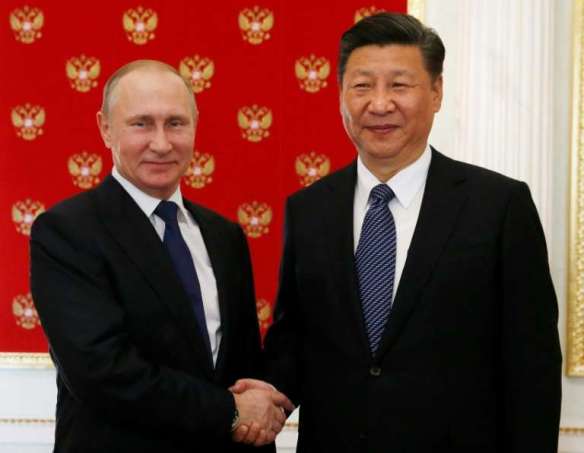
Russian President Vladimir Putin and his Chinese counterpart Xi Jinping bond through an apparent deep sense of mutual respect and wisdom about the political challenges facing today’s world. The two leaders have met on more than 20 occasions over the past four years. President Xi referred to Russia as China’s foremost ally and said that in a topsy-turvy world the friendship between the two was a source of countervailing stability.

On the breaking news of North Korea’s successful test launch of its first Intercontinental Ballistic Missile (ICBM), both Putin and Xi called for calm restraint. By contrast, US President Trump took to Twitter to taunt Kim Jong-Un. “Does this guy not have anything better to do with his life?” said Trump in words that could apply more pertinently to the American president.

Then the US and its South Korea ally also launched their ballistic missiles in a military drill aimed as a show of strength to Pyongyang. Kim Jung-Un responded that the ICBM was a “gift for the American bastards” on their Fourth of July Independence Day holiday and that there would more such gifts on the way.

Rather than escalating tensions, Putin and Xi put forward the eminently reasonable proposal that North Korea should freeze its missile tests and the US should likewise halt its military exercises on the Korean peninsula. All sides must convene in negotiations with a commitment to non-violence and without preconditions to strive for a comprehensive settlement to the decades-old dispute.

The contrast in Putin and Xi’s dignified, intelligent response with that of Trump’s petulance is clear proof of Russia and China showing real global leadership, whereas the Americans are just part of the problem.

But the Korean drama was only one illustration this week of how American ambitions of unipolar dominance have become redundant.

The G20 summit prelude of Putin hosting Xi in Moscow was followed by the Chinese president making a state visit to Germany on Wednesday two days before the gathering in Hamburg. Xi and German Chancellor Angela Merkel reportedly signed new trade deals between the world’s two leading export economies.

“Relations between China and Germany are at their historic best,”said Michael Clauss, Germany’s ambassador to Beijing. “The economic and political dynamic from a German perspective is moving toward the east.”

Of significance too was news this week the European Union is preparing to finalize a major trade pact with Japan.

It is also significant that Japan’s Prime Minister Shinzo Abe called on China and Russia to help mediate the Korean crisis immediately following Pyongyang’s ICMB test launch.

Evidently, Japan, despite being an ally of Washington, is reaching out to a multilateral solution as proposed by Moscow and Beijing.

In so many ways, therefore, whether on matters of security or trade and economy, the world appears to be moving inexorably toward a multipolar format as the most appropriate response to challenges.

Not so from the American point of view, especially under Donald Trump’s leadership. All nations seem to be nothing more than a footstool for the “exceptional” Americans who feel entitled to hector and browbeat everyone else to get what they want.

America’s isolation in the world was glimpsed at the G7 summit earlier this year in May when the other nations awkwardly diverged from Trump on his decision to withdraw the US from the global climate accord. Two months on, the isolation of Washington is even more vivid on the world stage as G20 leaders gather in Hamburg this weekend.

A Bloomberg News headline put it succinctly: ‘Trump risks uniting Cold War allies and foes against him’.

Trump’s quest for “America First” through trade protectionism and his narrow-minded unilateralism toward issues of global security have put America out on a limb as far as the rest of the world is concerned.

Where is the American “team player”, the supposed “leader of the free world”? All the self-proclaimed virtues are being seen for what they always were: overblown, pretentious and vainglorious bombast.

America is seen as nothing more than a selfish, hulking giant. Its trade imbalances with the rest of the world are not because of “rotten deals”, as Trump would have it, but rather because the American economy has ruined itself over many decades. The off-shoring of jobs by American corporations and gutting of American workers with poverty wages are part of it.

When America now talks about upholding international law and security, the rest of the world just laughs with bitter irony. The wars across the Middle East and the sponsoring of terrorism are largely US products of criminal regime-change intrigues. Who is this deluded head-case in Washington?

The same deluded head-case that has “beautiful chocolate cake” with China’s president in a Florida beach resort, and then proceeds to slap sanctions on China and make provocative military incursions on its territory. It’s not just Trump. It’s the whole American political leadership. The American ruling class has become so blinded by hubris that it can’t even see how the world it claims to dominate is collectively shutting the door on it and walking away.

Washington has no answers for today’s world challenges. Because simply put, Washington is the source of many of today’s problems. It has not even the modesty to acknowledge its responsibility. The only thing the US seems capable of is to make current problems fiendishly worse. The Korean crisis is an object lesson.

Presidents Putin and Xi are not scheming to usurp world domination, as Washington would have us believe. Only in Washington would a vision for a multipolar, more democratic global order be construed as something threatening and sinister. That’s because American ambitions of unipolar “full spectrum dominance” are actually threatening and sinister.

The world can be thankful it has genuine leaders in Putin and Xi who are forging ahead to create a multipolar global order. Fortunately, the strategic alliance between Russia and China is underpinned by a formidable military capability. Joint naval exercises this month carried out in the Baltic Sea are a vital insurance policy to back up what Moscow and Beijing are increasingly bold enough to say to the Americans.

That message, as Putin and Xi effectively gave to Trump this week, is that American ambitions of world domination are no longer acceptable and no longer tenable. Washington’s days of bullying the world with its moralizing hypocrisy and military aggression are over.

THE MADNESS OF WAR

By Julian Rose

Source: Waking Times

It is essential to constantly remind ourselves, that war, apart from a very few exceptions, is a symptom of madness. Yet war is a disease which is largely taken for granted; considered ‘normal’ and unless it involves a large swathe of humanity, ignored. How did we allow ourselves to be trapped by such insanity?

In 2017, wars are as prevalent as ever. They are being manifest in the Middle East, in Africa, in South America, and in a lesser form, in almost all countries of the World. They are the result of a failure to recognize that killing another is actually killing one’s self. A failure to grasp that humanity is a collective made up of millions of individuals, all of whom share a common ancestry and, on a subconscious plain, a common aspiration and destiny.

There is no victory in war. War is an admission of defeat. When humans resort to mass killing of each other we see an expression of failure, never success. Not so long ago war was glorified and, for the victor, held up as an expression of supreme national pride. In fact, such an attitude was predominant in the species for thousands of years.

However two World Wars put an end to the hubris. The levels of destruction were so great and so many millions died brutal and ugly deaths, that a kind of ‘war weariness’ set-in amongst the survivors, and a new sense of the futility of it all became integrated into societies which had undergone the experience. The world looked like it might have learned its lesson; people had pounded each other, and the natural environment, into a sickening pulp, and there was no glorious aftermath. Just a sense of what ‘peace’ could actually mean.

There were, and are, still some who find war ‘exciting’, whose own lives are too dull and routine to find any thrill in the act of daily living. They look-on at wars in foreign territories as extensions of their own angst and frustrations. Such individuals find temporary comfort in watching others die.

This condition is more prevalent than many might realize; it is symptomatic of a world crushed by meaningless routine and managed by those lacking any manifest vision of something more deeply fulfilling to awaken starved imaginations.

Of course, a history of war will reveal that whole civilizations were born and dissolved via victory and defeat on the battlefield. It was believed that these blood baths were a price worth paying for the great accumulation of national wealth which followed them, if one was on the winning side. It is sobering to reflect that much of the fine architecture of old Europe is a result of plundered wealth.

War is made no less destructive by the fact that it can now be carried out by people sitting in air-conditioned ‘cockpits’ in Houston. People trained to kill ‘at a distance’. People whose chance of being themselves attacked by those they target, being pretty much nil. This type of killing is one step away from the ‘robotic soldier’, the envisioned battle field of the future and a direct of extension of the war games kids (and adults) play on their electronic gizmos.

But look, it’s still the same underlying disease. It’s still the fascination with the idea of somehow ‘coming out on top’ and having it over ‘an inferior’. It’s still reveling in destruction, on all planes of planetary life.

Children play war games. I used to play ‘Cowboys and Indians’. I was indoctrinated into ‘war thinking’ from a very early age. It was just after World War Two, and life in Britain was steeped in stories of heroism carried out by ‘our boys’ against the Nazis. Toy soldier armies ranged against each other across the sitting room floor as parents looked on with quiet acceptance. We soon graduated on to ‘cap guns’ and staged mock battles around the garden bushes and trees.

But nobody got killed in these ‘war games’ and the ground wasn’t turned into a sea of craters and toxic mud by our childhood antics. Other matters eventually attracted our curiosity and interest, and the guns and bows and arrows were dumped, unlikely to be seen again.

If mankind would only grow up, the same situation would repeat around the world. Adult individuals, blessed with a little responsibility and the slimmest glimmer of wisdom, would ‘move on’ to areas of interest that expressed an eagerness to support the planet, and not destroy it. A wish to explore new horizons of consciousness, and not to regress into thoughtless thuggery. A desire to meet and enjoy the company of other races and nationalities, and not to put a gun to their heads.

How can this madness have gone on so long? How can war still ‘be taken for granted’ in 2017?

Even those who argue vociferously for cutting back excessive CO2 emissions on the planet, don’t call for an end to war and ‘war games’ that are responsible for a large part of these emissions. They fail to realize that here is to be found the single largest transmission of toxic CO2 when set against any other global activity. I’m including a brief summary of the US position in 2013, just to illustrate the point:

“According to its own study, in 2013 the Pentagon consumed fuel equivalent to 90,000,000 barrels of crude oil. This amounts to 80% of the total fuel usage by the federal government. If burned as jet fuel it produces about 38,700,000 metric tons of CO2. And the Pentagon’s figures do not include carbon produced by the thousands of bombs dropped in 2013, or the fires that burned after the jets and drones departed. ” (Counter Punch).

Most environmentalists and climate change campaigners also ‘take war for granted’, it seems. It has been etched into our bones by an endless indoctrination process. A process whose symptoms can also be found in the way we are urged to be ‘aggressive’ and ‘competitive’ in order to make progress within the demands of the status quo. How much of what is called ‘education’ is about bringing out our creative potential instead of our aggressive potential? And how much is about cramming us with the means to ‘succeed’ in the mostly cut throat world of business and indeed, almost all professions?

We see the symptoms of aggression in daily life, and fail to question it. Is it any wonder that we fail to question war?

War is the most favored tool of the controlling powers. It supplies the coffers of the military industrial complex with an endless demand for production of weapons. The state then gets the pay-off and looks for another war to keep the cycle of death going. It is also a valuable diversionary tool for distracting the general public, while unpopular and controversial issues are pushed through the system, with only a few noticing.

Of course a great prize for warmongers in general, is anticipation of the breaking out of mother of all wars. And indeed, the ever looming threat of genocide never seems far off at the hands of those who play with power the way children play with their toy guns and swords, but without any of the child’s creativity. Today, in the USA in particular, megalomania has become wedded with a sort of Russian Roulette approach to who might present the next useful target for a bombing run or drone attack.

Witness how high the stakes get set in this fiendish game. Witness the Russian Federation and President Putin being ever further provoked by the West to take an aggressive step that could trigger a mega war scenario. The vicious taunting, without a shred of evidence to give it credence, is a mark of the madness which all too often grips those in power. Those who are determined to diminish all of life to a poisoned arrow of fabricated fear, which, if ever launched, would take all of humanity with it.

Let us be sure to keep a close eye on those whom we elect to administer our countries. The intoxication which comes with power is a very dangerous addiction, particularly when the play things at such people’s disposal are weapons of mass destruction. We need, more than ever, to be able to recognize the symptoms of megalomania and not confuse it with ‘strong leadership’. It is a major weakness in the delivery of what is called democracy, that so many people are still so easily fooled by those ‘standing for election’.

We are being pushed by ‘anti-life’ forces, some of whose origins are less than human, to see the planet and its people as expendable. To accept lies, deception and crude power-play as something akin to ‘normal’. To feel that it is not in our powers to bring deep change to a washed-out and degraded status quo. To believe that war is an ‘acceptable’ way of shifting around the totems of power.

It’s time we not only woke up, but got out of bed too. The hour is late, and this should add a significant degree of urgency to our endeavors. Mankind is blessed with deep powers of positive potential and these powers are far greater than the force which drives the war mongering anti-life minority. We are close to a tipping point in the growth of conscious awareness amongst caring human beings.

The key will be to channel this awareness into taking measures to regain control of our destinies.

To rid this world of those who hold its fate in their numb, insensitive hands. To act in unison and to defy all efforts to divide and conquer our growing sense of purpose and endeavor.

We can and we will, put an end to the madness of war. We must not wait for war to put an end to us.


Julian Rose is an early pioneer of UK Organic farming, a writer, actor, social entrepreneur and international activist. During the 1970’s he worked in experimental theatre as actor and assistant director, co-founding the The Institute for Creative Development, in Belgium, teaching holistic thinking and dramatic art. In the 1980’s he returned to the UK to take over the family farm and convert it to an organic system. His experience as a leader in reviving rural economies throughout the 1990’s, led him to be invited to join the advisory board of the South East of England Development Agency, and the Country Land Owners Association. He also served on the Oxfordshire Economic Partnership and was founder-chairman of The Association of Rural Businesses in Oxfordshire. In 2,000 he led an innovative project to revive regionally important market towns as centres of vibrant local activity and hubs for rejuvenated local food initiatives.

Julian is a prolific writer and broadcaster, his articles appear in a wide diversity of journals and on-line sites. Visit www.julianrose.info to find out about Julian’s highly diverse life and acclaimed books ‘Changing Course for Life’ and ‘In Defence of Life’.

The Unifying Force of War Abolition

By David Swanson

Source: Let’s Try Democracy

Remarks at United National Antiwar Coalition in Richmond, Virginia, on June 18, 2017.

It’s not unusual for an activist, focused on one of the millions of worthy causes out there, to try to recruit other activists to that particular cause. That’s not exactly what I want to do. For one thing, if we are going to succeed we are going to have to recruit millions of new people into activism who are not now active at all.

Of course I do favor types of activism that eliminate the need for more activism, such as campaigns to make voter registration automatic or to index the minimum wage to the cost of living. But for the most part I want everyone to keep doing what inspires them. Only, I think I know a way to shift our emphases and unite out movements, a way that doesn’t usually occur to us.

It’s not unusual for an activist to think that their particular field is the unifying top priority.

For example:

If we don’t get the money out of politics how can we enact or enforce any laws not favored by money? We’ve legalized bribery for godsake! What else matters until we fix that?

Or:

If we don’t create credible democratic independent media, we can’t communicate. Door knocking can’t defeat television. We only know that Cindy Sheehan went to Crawford or Occupyers went to Wall Street because corporate television chose to tell us. Why have elections if we can’t tell the truth about the candidates?

Or:

Excuse me, the earth is cooking. Our species and many others are losing their habitats. If it’s not already too late, now is the time to decide whether we will have great grandchildren at all. If we don’t have any, what will it matter what kind of elections or television networks they have?

One can go on and on in this vein, as well as in claiming that one societal evil precedes and causes another. Racism or militarism or extreme materialism is the disease and the others are the symptoms.

All of this is also not exactly what I want to do. I want us to work on everything and use every means of unifying. I want us to recognize how each problem contributes to others and vice versa. Hungry scared people can’t end climate change. A culture that puts a trillion dollars a year into mass-killing of distant dark-skinned people can’t build schools or end racism. Unless we redistribute wealth, we cannot redistribute power. We can’t create media unless we have something important to say. We can’t protect the earth’s climate while steadfastly ignoring the top consumer of petroleum on earth because criticizing the military would be inappropriate. But we will go on ignoring it if we don’t create good media. We have to do it all, and there are various ways in which we can become more united, more strategic, and potentially more effective.

The way that I think we don’t pay enough attention to lies in developing a focus on complete and total war abolition, elimination of all weapons and militaries, all bases, all aircraft carriers, missiles, armed drones, generals, colonels, and if necessary all senators from Arizona.

Why war abolition? I’ll give you 10 reasons.

  1. It actually makes sense. The reasonable position of opposing some wars and cheering for others, but cheering for the troops even in the bad wars doesn’t attract a lot of energy because it doesn’t make any sense. Jeremy Corbyn just won votes by pointing out that wars generate terrorism, they are counter-productive on their own terms, endangering us rather than protecting us. They need to be replaced with diplomacy, aid, cooperation, the rule of law, the tools of nonviolence, the skills of de-escalation of conflict. Claiming that wars are sort of good but shouldn’t be overdone makes no sense at all — what is the point of them if not to win them? And if wars make murder OK, why is torture so unacceptable? And if bombs dropped by piloted planes are OK, what’s wrong with drones? And if Anthrax is barbaric, why are White Phosphrous and Napalm civilized? None of it makes any sense, which is one reason the top killer of U.S. troops is suicide. You know how to properly love the troops, end all war and give them life options that don’t make them want to kill themselves.
  2. Nuclear apocalypse is a growing danger on a par with climate chaos and will continue to grow unless war abolition succeeds.
  3. The biggest destroyer of water, air, land, and atmosphere that we have is militarism. It’s war or planet. Time to choose.
  4. War kills first and foremost by removing resources from where they are needed, including from famines and disease epidemics created by war. Any activism that seeks funding for any human or environmental needs has to look to ending war. It is where all the money is, more money every single year than could be taken once and only once from the billionaires.
  5. War creates secrecy, surveillance, classification of public business, warrantless spying on activists, patriotic lying, and illegal actions by secret agencies.
  6. War militarizes local police, making the public into an enemy.
  7. War fuels, just as it is fueled by, racism, sexism, bigotry, hatred, and domestic violence. It teaches people to solve problems by shooting guns.
  8. War divides humanity at a time when we must unite on major projects if we are to survive or prosper.
  9. A movement to abolish all war, all weapons, and all atrocities that flow out of war can unite opponents of the crimes of one government or group with the opponents of the crimes of another. Without equating all crimes with each other, we can unite as opponents of war rather than of each other.
  10. War is the primary thing our society does, it sucks down the majority of federal discretionary spending, its promotion permeates our culture. It is the very foundation of the belief that ends can justify evil means. Taking on the myths that sell us war as necessary or inevitable or glorious is an ideal way of opening our minds to rethinking what we’re doing on this little planet.

So let’s not work for an environmentally sensitive military into which women have the equal right to be drafted against their will. Let’s not oppose the weapons that are wasteful or don’t kill well enough. Let’s build a broad multi-issue movement in which one of the unifying factors is the cause of eliminating in its entirety the institution of organized mass murder.

The Crisis of US Imperial Governance and the Struggle for a New World

By Danny Haiphong

Source: Black Agenda Report

“Economic crisis at home and endless war abroad has placed finance and monopoly capital in political disarray.”

When I was here last year, I spoke a lot about ideology and how the struggle for social transformation in the mainland of imperialism partly depended upon the ideological development of oppressed people trapped within US borders. The 2016 elections were beginning to pick-up momentum, but it was unclear what direction they would go. Fast-forward to the present and, I don’t know about you all, but I am exhausted. The election of Donald Trump has presented both new and old challenges. It has created an almost circus-like political environment with dire consequences for the masses. What precipitated the circus-show is a crisis of governance that has been intentionally misunderstood by US imperialism’s corporately owned media and political elite.

To distort the crisis, a state of anti-Russian madness has been prescribed to medicate political consciousness in rapidly changing times. The rise of China and Russia has exposed the bankruptcy of US imperialism on all fronts. Economic crisis at home and endless war abroad has placed finance and monopoly capital in political disarray. Donald Trump took advantage of the chaos. He spoke about jobs, he spoke about wars, and he spoke to the growing insecurities of white Americans of working and middle class status who no longer can rely on the wages of whiteness for guaranteed prosperity. The duopoly and its capitalist masters had no one to offer, indeed nothing to offer, so Trump rode in on his orange horse to become the head of state of imperialism.

“The rise of China and Russia has exposed the bankruptcy of US imperialism on all fronts.”

The ruling class does not want people in the United States to understand the context of the Trump Presidency. It has reapplied Cold War fears with Russia as the prime target. Russia’s geopolitical moves away from imperialism have been deemed just as criminal as China’s economic supremacy. The US does not depend as much on Russia in the economic sense, but it trembles in fear at the prospect of growing Russian economic activity across Eurasia. Yet, provoking Russia militarily will lead to World War. This is a risk the ruling class appears willing to take as the anti-Russia narrative in the US has only intensified since Hillary Clinton made the erroneous claim of Russian interference in the 2016 elections.

According to the US ruling class and its “intelligence officials,” Russia promotes “fakes news” to assist Donald Trump. Russian President Vladimir Putin lurks in our social media, and is hacking his way through algorithms to smear the US political system. Russia is infecting minds with its Russia Today “propaganda” arm. The Ruskies have no regard for the damage they have caused to so-called US democracy. Putin wants total control of the US and will wield his most talented social media users to get the job done. This is what the corporate media sounds like these days.

“The U.S. trembles in fear at the prospect of growing Russian economic activity across Eurasia.”

Of course, the US ruling class doesn’t want to talk about how US intelligence already collects the numbers, emails, and calls of every single person in the world who uses a cell phone or computer. They don’t want to tell you about how the US has interfered in every election in Russia since the Soviet Union fell, or how it has led bloody proxy wars and coups in over fifty countries in as many years. They don’t want to discuss how Russia has absolutely nothing to do with the millions of incarcerated people in the US or the fact that it is the US monopoly capitalist economy, not the emerging capitalist economy of Russia, which has automated many of the jobs and siphoned much of the wealth that once belonged to a privileged sector of US workers. No, it would rather attention be placed on the Russian boogeyman.

Anti-Russian hysteria doesn’t just distract the broad masses of people from the legitimate causes of the conditions afflicting the working and unemployed. It feeds into an atmosphere of war that strikes the very roots of the US social order. Imperialism is the rule of monopoly and finance capital. This system has run its course. It cannot hold onto political legitimacy any more than it can spur economic development beyond the meager 1 to 2 percent growth calculated year after year. In a sense, war is all the system has left. And war is exactly what the ruling class will get, with or without Trump.

“They don’t want to tell you about how the US has interfered in every election in Russia since the Soviet Union fell, or how it has led bloody proxy wars and coups in over fifty countries in as many years.”

War with Russia is today’s clarion call for “American unity.” In times of crisis, the US imperial state has relied on war to bring political and economic relief from domestic crisis. Every major US-led war has in part been waged for this purpose. What differs now is that war with Russia could bring about the destruction of humanity. Scientists have confirmed that nuclear war could make the planet uninhabitable.

What is also different about this current war drive with Russia is how it marks the historical conclusion of the current stage in the world imperialist order. When the US threatened nuclear war with the atomic bombing of Japan in 1945 and the Cuban missile crisis almost two decades later, the world was in the midst of a transition from Western monopoly capitalism to proletarian socialism. Revolutions in Vietnam, Cuba, and the Soviet Union, to name a few, threatened to undo the very notion of private property. And while US and Western backlash nearly eliminated the socialist bloc by 1991, the imperialist order entered a transition stage of its own that some call “neo-liberalism.”

Neo-liberalism has greatly expanded the reach of capitalism’s tentacles and widened the impact of capitalist crisis since its inception in the late 1970s. Neo-liberalism has unleashed unfettered capitalist production by imposing economic stagnation on participating countries. Meanwhile, China’s socialist model has paved a different path, one marked by unprecedented growth and poverty reduction. China has understandably attracted underdeveloped nations so desperately seeking to escape from the clutches of neo-colonial impoverishment. Russia has grown close to China, providing both countries with much assistance in the way of constructing a multi-polar economic arrangement based on the principles of sovereignty and mutually beneficial cooperation. According to the logic of neo-liberal capital, only war with Russia and China can save the system from itself.

“War with Russia could bring about the destruction of humanity.”

This conclusion stems from the fact that neo-liberal capital is not growing, it is contracting. Eighty-percent of workers are near-poor in the US while six mega billionaires hold ownership of over half of the planet’s wealth. Concentrated profit does not mean that all is well with the ruling class. Internal contradictions are eating the capitalist system alive. Neither finance capital nor its monopoly investors can arrest the resultant decline. The growth of technology to speed up production and profit has left millions stuck in permanent unemployment. A high-tech system of production is an expensive system of production, requiring lower wages and debt to absorb the falling rate of profit. Global overproduction has thus developed alongside mass misery.

Such conditions are at the root of mass incarceration, where millions of mostly Black and poor workers are warehoused in cages because there is nothing on the outside that the system can offer. They are also the root of mass surveillance, as the system must keep tabs on an increasingly restless population and justify infringements on civil liberties as necessary counter-terror measures. The War on Terror and Drugs have been prerequisites toward keeping the population scared and its attention away from the US capitalist overlords who fund and support drug trafficking and terrorism for political gain. And when all else fails, blame Russia.

“The system must keep tabs on an increasingly restless population and justify infringements on civil liberties as necessary counter-terror measures.”

The struggle against neo-liberal capital and anti-Russian hysteria is a struggle to transform and revolutionize society. This struggle requires both practical political organization and ideological development. There will be no revolution without revolutionary thought, and no revolution without revolutionary action. All too often the left is debating which one is the most important for the future success of a revolutionary movement. The answer is both, together.

For most, this explanation is understandably too broad to inform individual political energy. Liberal thought and action thus becomes attractive because it hides behind the cloak of the possible and pragmatic. It is easier to think in terms of electoral politics than in global struggle. It is far more simple to advocate for a cooperative economy or universal basic income without spelling out the broad context that prevents their formation. In order for any material victories to be won on a mass scale, the victors must understand the world in which they fight.

“A movement for social transformation in the US has still yet to be born.”

Conscious struggle has brought about meaningful and deep changes in recent years. Mumia Abu-Jamal is now receiving Hep-C treatment after years of struggle with the State of Pennsylvania. The release of Chelsea Manning and Oscar Rivera Lopez also come to mind. Solidarity with Cuba freed the Cuban 5 and has given the socialist nation more opportunities to develop its economy. But these victories have come in the midst of great cost. A movement for social transformation in the US has still yet to be born, as the presence of dozens of political prisoners and the ongoing US blockade against Cuba reminds us.

Not once did I mention the Democratic or Republican Party. Both parties have done their part to create the crisis before us. A rejection of the two-parties means an embrace of the struggle against imperialism worldwide. It means that the nations with US targets on their backs should be seen as potential allies. Yes, this includes Russia. And Syria. It includes the left movements in Latin America. In the spirit of Malcolm X, the Black liberation movement, and the historic anti-imperialist struggle around the world, the time has come to search for real bonds of solidarity around the world to aid in the struggle against white supremacy, capitalism, and empire in the US and the West. Let no one, not even those who call themselves “the left,” tell you otherwise.


Danny Haiphong is an Asian activist and political analyst in the Boston area. He canbereachedatwakeupriseup1990@gmail.com