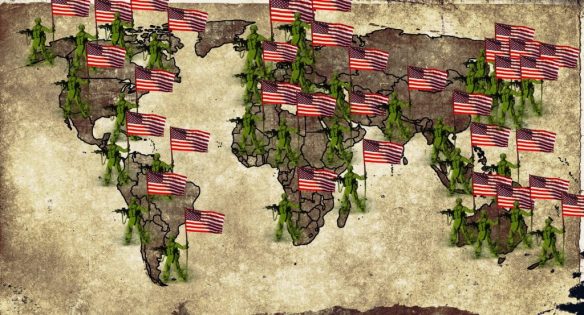
How GMO Seeds and Monsanto/Bayer’s “RoundUp” are Driving US Policy in Venezuela

Hugo Chavez and Luiz Inacio Lula da Silva visit a soy farm in El Tigre in Venezuela’s Anzoategui state, Oct. 30, 2009. Ariana Cubillos | AP

With Juan Guaidó’s parallel government attempting to take power with the backing of the U.S., it is telling that the top political donors of those in the U.S. most fervently pushing regime change in Venezuela have close ties to Monsanto and major financial stakes in Bayer.

By Whitney Webb

Source: MintPress News

As the political crisis in Venezuela has unfolded, much has been said about the Trump administration’s clear interest in the privatization and exploitation of Venezuela’s oil reserves, the largest in the world, by American oil giants like Chevron and ExxonMobil.

Yet the influence of another notorious American company, Monsanto — now a subsidiary of Bayer — has gone largely unmentioned.

While numerous other Latin American nations have become a “free for all” for the biotech company and its affiliates, Venezuela has been one of the few countries to fight Monsanto and other international agrochemical giants and win. However, since that victory — which was won under Chavista rule — the U.S.-backed Venezuelan opposition has been working to undo it.

Now, with Juan Guaidó’s parallel government attempting to take power with the backing of the U.S., it is telling that the top political donors of those in the U.S. most fervently pushing regime change in Venezuela have close ties to Monsanto and major financial stakes in Bayer.

In recent months, Monsanto’s most controversial and notorious product — the pesticide glyphosate, branded as Roundup, and linked to cancer in recent U.S. court rulings — has threatened Bayer’s financial future as never before, with a litany of new court cases barking at Bayer’s door. It appears that many of the forces in the U.S. now seeking to overthrow the Venezuelan government are hoping that a new Guaidó-led government will provide Bayer with a fresh, much-needed market for its agrochemicals and transgenic seeds, particularly those products that now face bans in countries all over the world, including once-defoliated and still-poisoned Vietnam.


U.S.-Backed Venezuelan opposition seeks to reverse Chavista seed law and GMO ban

In 2004, then-president of Venezuela, Hugo Chávez, surprised many when he announced the cancellation of Monsanto’s plans to plant 500,000 acres of Venezuelan agricultural land in genetically modified (GM) soybeans. The cancellation of Monsanto’s Venezuela contract led to what became an ad hoc ban on all GM seeds in the entire country, a move that was praised by local farmer groups and environmental activists. In contrast to anti-GM movements that have sprung up in other countries, Venezuela’s resistance to GM crops was based more on concerns about the country’s food sovereignty and protecting the livelihoods of farmers.

Although the ban has failed to keep GM products out of Venezuela — as Venezuela has long imported a majority of its food, much of it originating in countries that are among the world’s largest producers of genetically modified foods — one clear effect has been preventing companies like Monsanto and other major agrochemical and seed companies from gaining any significant foothold in the Venezuelan market.

In 2013, a new seed law was nearly passed that would have allowed GM seeds to be sold in Venezuela through a legal loophole. That law, which was authored by a member of the Chavista United Socialist Party of Venezuela (PSUV), was widely protested by farmers, indigenous activists, environmentalists, and eco-socialist groups, which led to the law’s transformation into what has been nicknamed the “People’s Seed Law.” That law, passed in 2015, went even farther than the original 2004 ban by banning not just GM seeds but several toxic agrochemicals, while also strengthening heirloom seed varieties through the creation of the National Seed Institute.

Soon after the new seed law was passed in 2015, the U.S.-backed Venezuelan opposition led by the Roundtable of Democratic Unity (MUD) — a group comprised of numerous U.S.-funded political parties, including Guaidó’s Popular Will — took control of the country’s National Assembly. Until Venezuela’s Supreme Court dissolved the assembly in 2017, the MUD-legislature attempted to repeal the seed law on several occasions. Those in favor of the repeal called the seed bill “anti-scientific” and damaging to the economy.

Despite the 2017 Supreme Court decision, the National Assembly has continued to meet, but the body holds no real power in the current Venezuelan government. However, if the current government is overthrown and Guaidó  — the “interim president” who is also president of the dissolved National Assembly — comes to power, it seems almost certain that the “People’s Seed Law” will be one of the first pieces of legislation on the chopping block.


The AEI axis

Some of the key figures and loudest voices supporting the efforts of the Trump administration to overthrow the Venezuelan government in the United States are well-connected to one particular think-tank, the American Enterprise Institute (AEI). For instance, John Bolton — now Trump’s national security advisor and a major player in the administration’s aggressive Venezuela policy — was a senior fellow at AEI until he became Trump’s top national security official. As national security adviser, Bolton advises the president on foreign policy and issues of national security while also advising both the Secretary of State and the Secretary of Defense. As of late, he has been pushing for military action in Venezuela, according to media reports.

Another key figure in Trump’s Venezuela policy — Elliott Abrams, the State Department’s Special Representative for Venezuela — has been regularly featured at AEI summits and as a guest on its panels and podcasts. According to Secretary of State Mike Pompeo, Abrams’ current role gives him the “responsibility for all things related to our efforts to restore democracy” in Venezuela. Other top figures in the administration, including Vice President Mike Pence and Secretary of State Mike Pompeo, were featured guests at the AEI’s “secretive” gathering in early March. As MintPress and other outlets have reported, Guaidó declared himself “interim president” of Venezuela at Pence’s behest. Pompeo is also intimately involved in directing Trump’s Venezuela policy as the president’s main adviser on foreign affairs.

Other connections to the Trump administration include Secretary of Education Betsy DeVos who was previously on AEI’s board of trustees.

AEI has long been a key part of the “neoconservative” establishment and employs well-known neoconservatives such as Fred Kagan — the architect of the Iraq “troop surge” — and Paul Wolfowitz, the architect of the Iraq War. Its connections to the George W. Bush administration were particularly notable and controversial, as more than 20 AEI employees were given top positions under Bush. Several of them, such as Bolton, have enjoyed new prominence in Trump’s administration.

Other key Bush officials joined the AEI soon after leaving their posts in the administration. One such was Roger Noriega, who was the U.S. representative to the Organization of American States (OAS) during the failed, U.S.-backed 2002 coup and went on to be assistant secretary of state for Western Hemisphere affairs from 2003 to 2005, where he was extremely influential in the administration’s policies towards Venezuela and Cuba.

Since leaving the Bush administration and promptly joining the AEI, Noriega has been instrumental in pushing claims that lack evidence but aim to paint Venezuela’s current President Nicolas Maduro-led government as a national security threat, such as claiming that Venezuela is helping Iran acquire nuclear weapons and hosts soldiers from Lebanon’s Hezbollah. He also lobbied Congress to support Venezuelan opposition leader Leopoldo López, Guaidó’s political mentor and leader of his political party, Popular Will.

Not only that, but Noreiga teamed up with Martin Rodil, a Venezuelan exile formerly employed by the IMF, and José Cardenas, who served in the Bush administration, to found Visión Américas, a private risk-assessment and lobbying firm that was hired to “support the efforts of the Honduran private sector to help consolidate the democratic transition in their country” after the U.S.-backed Honduran coup in 2009. In recent months, Noriega and his associates have been very focused on Venezuela, with Cardenas offering Trump public advice about how “to hasten Maduro’s exit,” while Rodil has publicly offered “to get you a deal” if you have dirt on Venezuela’s government.

While the AEI is best known for its hawkishness, it is also a promoter of big agricultural interests. Since 2000, It has hosted several conferences on the promise of “biotechnology” and genetically modified seeds and has heavily promoted the work of former Monsanto lobbyist Jon Entine, who was an AEI visiting fellow for several years. The AEI also has long-time connections to Dow Chemical.

The most likely reason for the AEI’s interest in promoting biotech, however, can be found in its links to Monsanto. In 2013, The Nation acquired a 2009 AEI document, obtained through a filing error and not intended for public disclosure, that revealed the think tank’s top donors. The form, known as the “schedule of contributors,” revealed that the AEI’s top two donors at the time were the Donors Capital Fund and billionaire Paul Singer.

The Donors Capital Fund, which remains a major contributor to the AEI, is linked to Monsanto interests through the vice chairman of its board, Kimberly O. Dennis, who is also currently a member of the AEI’s National Council. According to AEI, the National Council is composed of “business and community leaders from across the country who are committed to AEI’s success and serve as ambassadors for AEI, providing us with advice, insight, and guidance.”

Dennis is the long-time executive chairwoman of the Searle Freedom Trust, which was founded in 1988 by Daniel Searle after he oversaw the sale of his family pharmaceutical company — G.D. Searle and Company — to Monsanto in 1985 for $2.7 billion. The money Searle had made from that merger was used to fund the trust that now funds the AEI and other right-wing think tanks. Searle was also close to Donald Rumsfeld, who led G.D. Searle and Co. for years and was Secretary of Defense under Gerald Ford and George W. Bush. Searle was also a trustee of the Hudson Institute, which once employed Elliott Abrams.

After the family company — which gained notoriety for faking research about the safety of its sweetener, aspartame or NutraSweet — was sold to Monsanto, G.D. Searle executives close to Daniel Searle rose to prominence within the company. Robert Shapiro, who was G.D. Searle’s long-time attorney and head of its NutraSweet division, would go on to become Monsanto’s vice president, president and later CEO. Notably, Daniel Searle’s grandson, D. Gideon Searle, was an AEI trustee until relatively recently.


Why is a top to Marco Rubio increasing his stake in Bayer while others flee?

Yet, it is AEI’s top individual donor noted in the accidental “schedule of contributors” disclosure who is most telling about the private biotech interests guiding the Trump administration’s Venezuela policy. Paul Singer, the controversial billionaire hedge fund manager, has long been a major donor to neoconservative and Zionist causes — helping fund the Foreign Policy Initiative (FPI), the successor to the Project for a New American Century (PNAC); and the neoconservative and islamophobic Foundation for the Defense of Democracies (FDD), in addition to the AEI.

Singer is notably one of the top political donors to Senator Marco Rubio (R-FL) and has been intimately involved in the recent chaos in Venezuela. He has been called one of the architects of the administration’s current regime-change policy, and was the top donor to Rubio’s presidential campaign, as well as a key figure behind the controversial “dossier” on Donald Trump that was compiled by Fusion GPS. Indeed, Singer had been the first person to hire Fusion GPS to do “opposition research” on Trump. However, Singer has largely since evaded much scrutiny for his role in the dossier’s creation, likely because he became a key donor to Trump following his election win in 2016, giving $1 million to Trump’s inauguration fund.

Singer has a storied history in South America, though he has been relatively quiet about Venezuela. However, a long-time manager of Singer’s hedge fund, Jay Newman, recently told Bloomberg that a Guaidó-led government would recognize that foreign creditors “aren’t the enemy,” and hinted that Newman himself was weighing whether to join a growing “list of bond veterans [that have] already begun staking out positions, anticipating a $60 billion debt restructuring once the U.S.-backed Guaidó manages to oust President Nicolas Maduro and take control.” In addition, the Washington Free Beacon, which is largely funded by Singer, has been a vocal advocate for the Trump administration’s regime-change policy in Venezuela.

Beyond that, Singer’s Elliott Management Corporation gave Roger Noriega, the former assistant secretary of state for Western Hemisphere affairs under Bush, $60,000 in 2007 to lobby on the issue of sovereign debt and for “federal advocacy on behalf of U.S. investors in Latin America.” During the time Noriega was on Singer’s payroll, he wrote articles linking Argentina and Venezuela to Iran’s nonexistent nuclear program. At the time, Singer was aggressively pursuing the government of Argentina in an effort to obtain more money from the country’s prior default on its sovereign debt.

While Singer has been mum himself on Venezuela, he has been making business decisions that have raised eyebrows, such as significantly increasing his stake in Bayer. This move seems at odds with Bayer’s financial troubles, a direct result of the slew of court cases regarding the link between Monsanto’s glyphosate and cancer. The first ruling that signaled trouble for Monsanto and its new parent company Bayer took place last August, but Singer increased his stake in the company starting last December, even though it was already clear by then that Bayer’s financial troubles in relation to the glyphosate court cases were only beginning.

Since the year began, Bayer’s problems with the Monsanto merger have only worsened, with Bayer’s CEO recently stating that the lawsuits had “massively affected” the company’s stock prices and financial performance.


Forcing open a new market for RoundUp

Part of Singer’s interest in Bayer may relate to Venezuela, given that Juan Guaido’s “Plan País” to “rescue” the Venezuelan economy includes a focus on the country’s agricultural sector. Notably, prior to and under Chavismo, agricultural productivity and investment in the agricultural sector took a backseat to oil production, resulting in under 25 percent of Venezuelan land being used for agricultural purposes despite the fact that the nation has a wealth of arable land. The result has been that Venezuela needs to import much of its food from abroad, most of which originate in Colombia or the United States.

Under Chávez and his successor, Maduro, there has been a renewed focus on small-scale farming, food sovereignty and organic agriculture. However, if Maduro is ousted and Guaidó moves to implement his “Plan País,” the opposition’s coziness with foreign corporations, the interests of U.S. coup architects in Bayer/Monsanto, and the opposition’s past efforts to overturn the GM seed ban all suggest that a new market for Bayer/Monsanto products — particularly glyphosate — will open up.

South America has long been a key market for Monsanto and — as the company’s problems began to mount prior to the merger with Bayer — it became a lifeline for the company due to less stringent environmental and consumer regulations that many Western countries. In recent years, when South American governments have opened their countries to more “market-friendly” policies in their agricultural sectors, Monsanto has made millions.

For instance, when Brazil sought to expand biotechnology (i.e. GM seed) investment in 2012, Monsanto saw a 21% increase in its sales of GM corn seed alone, generating an additional $1 billion in profits for the company. A similar comeback scenario is needed more than every by Bayer/Monsanto, as Monsanto’s legal troubles saw the company’s profits plunge late last year.

With countries around the world now weighing glyphosate bans as a result of increased litigation over the chemical’s links to cancer, Bayer needs a new market for the chemical to avoid financial ruin. As Singer now has a significant stake in the company, he — along with the politicians and think tanks he funds — may see promise in the end of the anti-GM seed ban that a Guaidó-led government would bring.

Furthermore, given that Guaidó’s top adviser wants the Trump administration to have a direct role in governing Venezuela if Maduro is ousted, it seems likely that Singer would leverage his connections to keep Bayer/Monsanto afloat amid the growing controversy surrounding glyphosate. Such behavior on the part of Singer would hardly be surprising in light of the fact that international financial media have characterized him as a “ruthless opportunist” and “overly aggressive.”

Such an outcome would be in keeping with the increased profit margins for Monsanto and related companies that have followed its expansion into countries following U.S.-backed coups. For instance, after the U.S.-backed coup in Ukraine in 2014, the loans given to Ukraine by the International Monetary Fund and the World Bank forced the country to open up and expand the use of “biotechnology” and GM crops in its agricultural sector, and Monsanto, in particular, made millions as the prior government’s ban on GM seeds and their associated agrochemicals was reversed. If Maduro is ousted, a similar scenario is likely to play out in Venezuela, given that the Guaidó-led government made known its intention to borrow heavily from these institutions just days after Guaidó declared himself “interim president.”


Whitney Webb is a MintPress News journalist based in Chile. She has contributed to several independent media outlets including Global Research, EcoWatch, the Ron Paul Institute and 21st Century Wire, among others. She has made several radio and television appearances and is the 2019 winner of the Serena Shim Award for Uncompromised Integrity in Journalism.

Kieran Barr contributed to the research used in this report.

Coup Attempt in Venezuela: What You’re Not Being Told

By Derrick Broze

Source: The Conscious Resistance

As self-proclaimed “Interim President” Juan Guaidó attempted to stage a military coup in Venezuela, the country’s U.N. ambassador declared President Nicolas Maduro victorious and called the United States a “rogue nation.”

The turbulent situation that has been unfolding in Venezuela for the last few years reached new heights on Tuesday as opposition leader and self-declared “Interim President” Juan Guaidó attempted to wrangle power away from Venezuelan President Nicolas Maduro, in what many are calling an attempted coup. Early Tuesday morning, Guaidó gave a press conference declaring that he has the support of the Venezuelan people and military, and demanded that Maduro step down. Guaidó also called on Venezuelans to take to the streets and call for an end to Maduro’s reign as president.

During the day’s events, cameras caught armored vehicles, reportedly belonging to the Bolivian military, running into crowds of protesters. Human Rights Watch (HRW) tweeted that 25 peopled were detained and dozens were wounded. HRW also noted that Venezuelan authorities shut down two international television channels and censored one radio station. “The regime should know that it will be held accountable for these abuses,” tweeted José Miguel Vivanco, Executive Director of HRW’s America Division.

Meanwhile, Venezuela’s U.N. ambassador Samuel Moncada held a press conference stating that President Maduro has “defeated” opposition leader Juan Guaidó and his supporters. Moncada stated “the country is right now in a situation of perfect normality.” Moncada criticized U.N. Secretary-General Antonio Guterres for not supporting Maduro’s government against Guaidó.

Moncada also attacked the United States for what he said was another example of their interventionist policies, singling out President Trump and Vice President Mike Pence for their support of Guaidó. “This is one of the most strange and weird situations we are in now, which the superpower of the world is the main rogue state going around, without care, destroying countries, invading countries, and threatening with the use of force,” Moncada stated.

The Ambassador to the UN also noted that the United States’ use of sanctions amounts to an act of war and only hurts the Venezuelan people. “Sanctions kill, as simple as that. Sanctions are criminal sanctions, are weapons of mass destruction. You don’t see the smoke, but you see the effect, you see the deleterious effect of killing and suffering,” Moncada said. “The sanctions use banks sanction, sanctions use ships, sanctions use insurance companies, and financial blockades. They cannot just say that they are concerned about liberty or freedom or the children in Venezuela, and then exercise a ghastly, nasty policy of calculated cruelty. They are acting like torturers, it is a collective punishment.”

Indeed, the Washington D.C.-based Center for Economic Policy Research published a reportlast week which determined that U.S. sanctions against Venezuela were likely responsible for 40,000 deaths in 2017-2018.

The harsh reality is that Maduro is by no means a perfect leader and his support of censoring media, use of the military to suppress protests (whether engineered or authentic), his suppression of the opposition, and other despicable acts do need to be called out. However, Ambassador Moncada is also correct that the United States does act as an imperialist “rogue” nation, using force on any nation that does not follow the Western Imperialist agenda. Unfortunately, it seems that the Venezuelan people are caught between a leader who is unpopular in some circles and an even more unpopular self-proclaimed “Interim President” with multiple connections to the Western Empire.

Of course, if our readers are unaware of these connections, it is because the corporate media (CNNWaPoThe Hill, and others) have been running non-stop coverage of why Guaidó should be accepted as the leader of Venezuela while ignoring any bit of evidence that the “uprising” might be less than genuine.

Despite the round the clock support of Guaidó, on April 13 the Grayzone exclusively reportedthat a who’s who of Trump advisors, right-wing Latin American officials, and Venezuelan opposition figures met to discuss “Assessing the Use of Military Force in Venezuela.” The meeting was hosted on April 10 at the Center for Strategic and International Studies (CSIS), a Washington-based think tank. This meeting included current and former State Department, National Intelligence Council, and National Security Council officials, along with Admiral Kurt Tidd, who was until recently the commander of the US Naval Forces Southern Command, overseeing operations in Central and South America.

The truth is that the Western Empire has been attempting to use Guaidó to install a puppet government in Venezuela. There is also evidence that the U.S. government and its intelligence agencies have attempted to take advantage of electricity blackouts in order to dethrone Maduro. In addition, there are a number of corporations and special interests who stand to benefit from the overthrow of Maduro and the crowning of Guaidó.

Although the American media has failed to report any of the above conflicts, there are still some Americans who are standing against the Venezuelan coup. A group calling itself the Embassy Protection Collective was invited by Venezuela’s government to protect the Venezuelan Embassy in Washington D.C. from illegal seizure by the U.S. government or opposition supporters. The group—which includes members of CODEPINK, Popular Resistance, the Answer Coalition, MintPress News and more—has been working to raise awareness on the attempts by the Western oligarchy to install another puppet government in Venezuela.

The reality of the situation in Venezuela is much more complicated than the likes of CNNwould have the American people believe. Only by dissecting the lies from the American media, the Maduro government, and the Guaidó contingent can we hope to get to the truth and support the people who really matter: The Venezuelan People.

The Triumph of Evil

(Museum of the Revolution, León, Nicaragua)

By Paul Craig Roberts

Source: PaulCraigRoberts.org

Today (April 17) I heard a NPR “news” report that described the democratically elected president of Venezuela as “the Venezuelan dictator Maduro.” By repeating over and over that a democratically elected president is a dictator, the presstitutes create that image of Maduro in the minds of vast numbers of peoples who know nothing about Venezuela and had never heard of Maduro until he is dropped on them as “dictator.”

Nicolas Maduro Moros was elected president of Venezuela in 2013 and again in 2018. Previously he served as vice president and foreign minister, and he was elected to the National Assembly in 2000. Despite Washington’s propaganda campaign against him and Washington’s attempt to instigate violent street protests and Maduro’s overthrow by the Venezuelan military, whose leaders have been offered large sums of money, Maduro has the overwhelming support of the people, and the military has not moved against him.

What is going on is that American oil companies want to recover their control over the revenue streams from Venezuela’s vast oil reserves. Under the Bolivarian Revolution of Chavez, continued by Maduro, the oil revenues instead of departing the country have been used to reduce poverty and raise literacy inside Venezuela.

The opposition to Maduro inside Venezuela comes from the elites who have been traditionally allied with Washington in the looting of the country. These corrupt elites, with the CIA’s help, temporarily overthrew Chavez, but the people and the Venezuelan military secured his release and return to the presidency.

Washington has a long record of refusing to accept any reformist governments in Latin America. Reformers get in the way of North America’s exploitation of Latin American countries and are overthrown.

With the exceptions of Venezuela, Bolivia, Cuba, and Nicaragua, Latin America consists of Washington’s vassal states. In recent years Washington destroyed reform governments in Honduras, Argentina and Brazil and put gangsters in charge.

According to US national security adviser John Bolton, a neoconservative war monger, the governments in Venezuela, Cuba, and Nicaragua will soon be overthrown. New sanctions have now been placed on the three countries. Washington in the typical display of its pettiness targeted sanctions against the son of the Nicaraguan president Daniel Ortega. https://www.rt.com/news/456841-bolton-russia-venezuela-threat/

Ortega has been the leader of Nicaragua since for 40 years. He was president 1985-1990 and has been elected and reelected as president since 2006.

Ortega was the opponent of Somoza, Washington’s dictator in Nicaragua. Consequently he and his movement were attacked by the neoconservative operation known as Iran-Contra during the Reagan years. Ortega was a reformer. His government focused on literacy, land reform, and nationalization, which was at the expense of the wealthy ruling class. He was labeled a “Marxist-Leninist,” and Washington attempted to discredit his reforms as controversial leftist policies.

Somehow Castro and Ortega survived Washington’s plots against them. By the skin of his teeth so did Chavez unless you believe it was the CIA that gave him cancer. Castro and Chavez are dead. Ortega is 74. Maduro is in trouble, because Washington has stolen Venezuela’s bank deposits and cut Venezuela off the international financial system, and the British have stolen Venezuela’s gold. This makes it hard for Venezuela to pay its debts.

The Trump regime has branded the democratically twice-elected Maduro an “illegitimate” president. Washington has found a willing puppet, Juan Guaido, to take Maduro’s place and has announced that the puppet is now the president of Venezuela. No one among the Western presstitutes or among the vassals of Washington’s empire finds it strange that an elected president is illegitimate but one picked by Washington is not.

Russia and China have given Maduro diplomatic support. Both have substantial investments in Venezuela that would be lost if Washington seizes the country. Russia’s support for Maduro was declared by Bolton today to be a provocation that is a threat to international peace and security. Bolton said his sanctions should be seen by Russia as a warning against providing any help for the Venezuelan government.

Secretary of state Mike Pompeo and vice president Pence have added their big mouths to the propaganda against the few independent governments in Latin America. Where is the shame when the highest American government officials stand up in front of the world and openly proclaim that it is official US government policy to overthrow democratically elected governments simply because those governments don’t let Americans plunder their countries?

How is it possible that Pompeo can announce that the “days are numbered” of the elected president of Nicaragua, who has been elected president 3 or 4 times, and the world not see the US as a rogue state that must be isolated and shunned? How can Pompeo describe Washington’s overthrow of an elected government as “setting the Nicaraguan people free?”

The top officials of the US government have announced that they intend to overthrow the governments of 3 countries and this is not seen as “a threat to international peace and security?”

How much peace and security did Washington’s overthrow of governments in Iraq, Libya, Ukraine, and the attempted overthrow of Syria bring?

Washington is once again openly violating international law and the rest of the world has nothing to say?

There is only one way to describe this: The Triumph of Evil.

“The blood-dimmed tide is loosed, and everywhere the ceremony of innocence is drowned; the best lack all conviction, while the worst are full of passionate intensity.” — William Butler Yeats

US Regime Change Blueprint Proposed Venezuelan Electricity Blackouts as ‘Watershed Event’ for ‘Galvanizing Public Unrest’

The US-funded CANVAS organization that trained Juan Guaido and his allies produced a 2010 memo on exploiting electricity outages and urged the opposition “to take advantage of the situation…towards their needs”

By Max Blumenthal

Source: Grayzone

A September 2010 memo by a US-funded soft power organization that helped train Venezuelan coup leader Juan Guaido and his allies identifies the potential collapse of the country’s electrical sector as “a watershed event” that “would likely have the impact of galvanizing public unrest in a way that no opposition group could ever hope to generate.”

The memo has special relevance today as Guaido moves to exploit nationwide blackouts caused by a major failure at the Simon Bolivar Hydroelectric Plant at Guri dam – a crisis that Venezuela’s government blames on US sabotage.

It was authored by Srdja Popovic of the Center for Applied Non-Violent Action and Strategies (CANVAS), a Belgrade-based “democracy promotion” organization funded by the US government that has trained thousands of US-aligned youth activists in countries where the West seeks regime change.

This group reportedly hosted Guaido and the key leaders of his Popular Will party for a series of training sessions, fashioning them into a “Generation 2007” determined to foment resistance to then-President Hugo Chavez and sabotage his plans to implement “21st century socialism” in Venezuela.

In the 2010 memo, CANVAS’s Popovic declared, “A key to Chavez’s current weakness is the decline in the electricity sector.” Popovic explicitly identified the Simon Bolivar Hydroelectric Plant as a friction point, emphasizing that “water levels at the Guri dam are dropping, and Chavez has been unable to reduce consumption sufficiently to compensate for the deteriorating industry.”

Speculating on a “grave possibility that some 70 percent of the country’s electricity grid could go dark as soon as April 2010,” the CANVAS leader stated that “an opposition group would be best served to take advantage of the situation and spin it against Chavez and towards their needs.”

Flash forward to March 2019, and the scenario outlined by Popovic is playing out almost exactly as he had imagined.

On March 7, just days after Guaido’s return from Colombia, where he participated in the failed and demonstrably violent February 23 attempt to ram a shipment of US aid across the Venezuelan border, the Simon Bolivar Hydroelectric Plant experienced a major and still unexplained collapse.

Days later, electricity remains sporadic across the country. Meanwhile, Guaido has done everything he can “to take advantage of the situation and spin it” against President Nicolas Maduro – just as his allies were urged to do over eight years before by CANVAS.

Rubio vows “a period of suffering” for Venezuela hours before the blackout

The Venezuelan government has placed the blame squarely on Washington, accusing it of sabotage through a cyber-attack on its electrical infrastructure. Key players in the US-directed coup attempt have done little to dispel the accusation.

In a tweet on March 8, Secretary of State Mike Pompeo framed the electricity outage as a pivotal stage in US plans for regime change:

At noon on March 7, during a hearing on Venezuela at the Senate Foreign Relations Subcommittee, Sen. Marco Rubio explicitly called for the US to stir “widespread unrest,” declaring that it “needs to happen” in order to achieve regime change.

“Venezuela is going to enter a period of suffering no nation in our hemisphere has confronted in modern history,” Rubio proclaimed.

Around 5 PM, the Simon Bolivar Hydroelectric Plant experienced a total and still unexplained collapse. Residents of Caracas and throughout Venezuela were immediately plunged into darkness.

At 5:18 PM, a clearly excited Rubio took to Twitter to announce the blackout and claim that “backup generators have failed.” It was unclear how Rubio had obtained such specific information so soon after the outage occurred. According to Jorge Rodriguez, the communications minister of Venezuela, local authorities did not know if backup generators had failed at the time of Rubio’s tweet.

Back in Caracas, Guaido immediately set out to exploit the situation, just as his CANVAS trainers had advised over eight years before. Taking to Twitter just over an hour after Rubio, Guaido declared, “the light will return when the usurpation [of Maduro] ends.” Like Pompeo, the self-declared president framed the blackouts as part of a regime change strategy, not an accident or error.

Two days later, Guaido was at the center of opposition rally he convened in affluent eastern Caracas, bellowing into a megaphone: “Article 187 when the time comes. We need to be in the streets, mobilized. It depends on us, not on anybody else.”

Article 187 establishes the right of the National Assembly “to authorize the use of Venezuelan military missions abroad or foreign in the country.”

Upon his mention of the constitutional article, Guaido’s supporters responded, “Intervention! Intervention!”

Exploiting crisis to “get back into a position of power”

As Dan Cohen and I reported here at the Grayzone, Guaido’s rise to prominence – and the coup plot that he has been appointed to oversee – is the product of a decade-long project overseen by the Belgrade-based CANVAS outfit.

CANVAS is a spinoff of Otpor, a Serbian protest group founded by Srdja Popovic in 1998 at the University of Belgrade. Otpor, which means “resistance” in Serbian, was the student group that worked alongside US soft power organizations to mobilize the protests that eventually toppled the late Serbian President Slobodan Milosevic.

CANVAS has been funded largely through the National Endowment for Democracy, a CIA cut-out that functions as the US government’s main arm of promoting regime change.  According to leaked internal emails from Stratfor, an intelligence firm known as the “shadow CIA,” CANVAS “may have also received CIA funding and training during the 1999/2000 anti-Milosevic struggle.”

A leaked email from a Stratfor staffer noted that after they ousted Milosevic, “the kids who ran OTPOR grew up, got suits and designed CANVAS… or in other words a ‘export-a-revolution’ group that sowed the seeds for a NUMBER of color revolutions. They are still hooked into U.S. funding and basically go around the world trying to topple dictators and autocratic governments (ones that U.S. does not like ;).”

Stratfor subsequently revealed that CANVAS “turned its attention to Venezuela” in 2005, after training opposition movements that led pro-NATO regime change operations across Eastern Europe.

In September 2010, as Venezuela headed for a parliamentary election, CANVAS produced a series of memos outlining the plans they had hatched with “non-formal actors” like Guaido and his cadre of student activists to bring down Chavez. “This is the first opportunity for the opposition to get back into a position of power,” Popovic wrote at the time.

In his memo on electricity outages, Popovic highlighted the importance of the Venezuelan military in achieving regime change. “Alliances with the military could be critical because in such a situation of massive public unrest and rejection of the presidency,” the CANVAS founder wrote, “malcontent sectors of the military will likely decide to intervene, but only if they believe they have sufficient support.”

While the scenario Popovic envisioned failed to materialize in 2010, it perfectly describes the situation gripping Venezuela today as an opposition leader cultivated by CANVAS seeks to spin the crisis against Maduro while calling on the military to break ranks.

Since the Grayzone exposed the deep ties between CANVAS and Guaido’s Popular Will party, Popovic has attempted to publicly distance himself from his record of training Venezuela’s opposition.

Today, however, Popovic’s 2010 memo on exploiting electricity outages reads like a blueprint for the strategy that Guaido and his patrons in Washington have actively implemented. Whether or not the blackout is the result of external sabotage, it represents the “watershed event” that CANVAS has prepared its Venezuelan cadres for.

Oceania, Eurasia and Eastasia Merger: Global Empire of Dystopia?

By Gilbert Mercier

Source: News Junkie Post

The nature of reality in times of universal confusion

The world and our interpretation of it are often at best an idea and, at worse, a figment of our imagination. In our full-blown Orwellian construct, the truths of some are the fake news of others. Invisible forces and undisclosed interests rule the world and its so-called leaders, who are mostly actor-puppets directed from scripted narratives. They largely live in an alternate universe where, if you repeat outlandish lies often and loudly enough, the disinformation becomes the unquestionable reality for countless people. Reality has become stranger than fiction because the conflicting narratives about what is supposed to be real are, by and large, fictional. They are cleverly crafted propaganda that manipulate by maximizing confusion. The masters of this craft have gutted familiar words of all meaning.

For example, at the heart of Oceania, the white-orange clown emperor, obsessed with walls to protect his subjects from southern brown invaders, told his adoring patrons and sycophants, “we renew our resolve that Oceania shall never be socialist!” The aging patricians gathered for the obligatory annual feast gave him a standing ovation, and loudly chanted “Oceania, Oceania, Oceania!…” This enthusiastic chanting from Oceania’s Patricians, except for the more dignified Supreme Elders and Commanders of the Praetorian Guard, repeated itself on cue at least four of five times, to celebrate the great universal superiority of the invincible mighty empire of the free and the brave! The egotistical emperor’s writers must have laughed as he served up their outstanding fictions to the empire’s docile subjects!

Schopenhauer’s relevant pessimism

In his essential book, The World as Will and Idea, the German philosopher Arthur Schopenhauer (1788-1860) contested the rationalist notion that reason alone gave humans the universal key to an infinitely complex, and often irrational, reality. He took the assessments Immanuel Kant had made in his Critique of Pure Reason a step further by adding the fundamental notion of sufficient reason. This was a less absolute concept of the relation of cause to effect, which he anchored in what he deemed to be four categories of human knowledge: science, morality, logic, and metaphysics. Schopenhauer’s work was in part a reaction to the overly optimistic vision of the rationalists, with Rene Descartes in the lead.

In his inherent pessimism, Schopenhauer turned out to be more realistic about the limitations of humans to grasp, not only the full elusive scope of reality, but also their own frailty and insignificance as a self. In these gloomy times of uncertainty and of a general dumbing-down effect in our impoverished global culture, Schopenhauer’s work helps to explain why most aspects of our existence, including our relationship with nature, are beyond most people’s comprehension. For most humans, the absolute reality is an extremely fragmented knowledge filtered through the prism of their perceptions.

Global empire of dystopia?

In other words, whether one lives in Oceania, Eurasia, or Eastasia, the definitions of reality and information have been tailored in these different places to different needs, but almost all the narratives fulfill opaque agendas whose main objectives are to keep people on edge and in despair. The brainwashing from most media makes nearly everybody thoroughly dazed and confused. The goal is to break the will of populations and beat their souls into submission. For this to work, dissent must be eradicated. Let’s face it, if we stay on course, Oceania, Eurasia and Eastasia could soon merge into the global Empire of Dystopia where 2+2=5. For example, Oceania claims that, with its satellite-vassals, the empire defeated ISIS, which it had worked to create, although it is the leader of sovereign Syria (with the help of Eurasia and the former empire of Persia) who defeated both Oceania and ISIS after seven years of war.

From one manufactured crisis to another, always in what my esteemed colleague Dady Chery calls “other people’s countries,” the mad circus goes on and on like a merry-go-round. And it works, so long as the big lies are salted with a little truth for seasoning. As world citizens, we are tasked with dismantling this monstrous global Orwellian Empire of many faces that is tightening its grip everywhere.

Empires of the past and present, which are in flux, have always extended their powers through satellite provinces and spheres of influence. Empires dislike dissent from within, as well as nearby states that are eager to stay independent and sovereign. During the simpler times of the Cold War when the United States and USSR tried to divide the world in two, some independently minded head of states, such as Tito, Nasser and Castro, refused to submit to this bipolarity and initiated the nonaligned movement. This notion must be urgently revisited, for the sake of the little that is left of smaller nations’ sovereignty.

Of course, Orwell’s cartography of the three entities of Oceania, Eurasia and Eastasia no longer reflects the geopolitical reality, but his principle of mass indoctrination is at play on a global scale. The narratives appear to be in conflict, but the nitty-gritty mechanics below the radar are similar. Under the surface, and despite the veneers of ideological or religious clashes, a global scheme of wealth and power concentration has been unleashed. Worldwide, the super-rich, and the corporate entities they control, are getting richer while the middle-class is vanishing and the poor are becoming enslaved. Merciless capitalism is the true god of the Orwellian Empire’s three subdivisions. Capitalism demands daily sacrifices of sweat, tears and blood. The system’s blatant contradictions do not trouble its ruling class. On one hand, pseudo nationalist-populists are the servants of a supra-national corporatism, and on the other, the so-called liberals and neoliberals can, on short notice, adopt the worst methods of authoritarian repression.

Two examples of this are unfolding that serve as valuable case studies. First, there is Oceania’s effort to grab a critical piece of what it views as its birthright continent. This is, of course, Venezuela. Secondly, in La Macronie, an eastern asset of Oceania that used to be an empire in its own right, there is the intent to create an authoritarian neoliberal regime with a metrosexual humanitarian touch, to curtail widespread popular protests.

Venezuela: Revolution is imperialism

Oceania has in its crosshair the sovereign state of Venezuela, founded by Simon Bolivar. All empires have precepts or doctrines that conveniently serve to expand their territories and influence by various means, including military invasions, organization of coups and, lately, severe economic sanctions to engineer failed states that become ripe for orchestrated revolutions. The nervous system of Oceania, in Washington DC, views Venezuela as a natural appendage, based on one of the oldest formative tenets of the empire: the Monroe Doctrine, concocted in 1823. It came about using the seemingly altruistic but false notion that the newly independent countries of Central and South America had to be protected from their old colonial masters. In time, it became a claim to all the Americas as the United States’ domain and backyard.

To topple the legitimately elected Venezuelan President, Nicolas Maduro, whom Washington does not like, the empire is again trying to manufacture a revolution led by someone it handpicked and groomed. The name of the man who currently aspires to be Oceania’s Governor in Venezuela hardly matters. Through the years, the strategy of fake revolution following economic sanctions has had mixed results: it failed in Iran in 2009; it worked against Qaddafi in Libya, combined with a small military intervention; it partially worked in Ukraine until Eurasia stepped in; it failed entirely in Syria, where Bashar al-Assad remains in power. With Venezuela’s military still firmly on his side, this strategy is unlikely to work with the heir of Hugo Chavez.

So far the aggression against Venezuela has served as a thorough head count of Oceania’s vassals and enemies. In the Americas, Bolivia, Cuba, Mexico, Nicaragua, and Uruguay have defied the with-or-against-us litmus test. The rest, including Canada, have aligned themselves with the imperial diktat that Maduro must go. It is the same with most of the European imperial colonies of Oceania, except for Italy and Greece. This is a clear demonstration that the leaders of most states in the European Union lack a foreign policy independent from Oceania and operate largely as governors for Oceania rather than heads of state.

Indeed, according to Mr. Temir Porras, who has worked as Nicolas Maduro’s chief-of-staff and a foreign-policy advisor to Hugo Chavez, the position of most EU countries in supporting Guaido reeks of “neocolonialist interference.” The eight-day “ultimatum to hold presidential elections before recognizing Juan Guaido is a schizophrenic and incomprehensible position.” Porras elaborates that it is “absurd to say that Juan Guaido represents a consensus with Maduro’s opposition in Venezuela,” and that Guaido from the far-right populist party, Voluntad Popular, was almost unknown in Venezuela two weeks ago.

On the opposite side, to go back to Orwell’s cartography lexicon, those that claim so far that “Maduro must stay,” besides the four Latin American countries named above, involve an interesting alliance of Eurasia, Eastasia, and the former Persian and Ottoman empires.

Gilets Jaunes: rays of sunshine on a bleak horizon

Meanwhile, in La Macronie, a beautiful land with a soil rich in its bounty of bread, wine and revolution, a real revolution is brewing from the streets. A little light flickers at the end of the tunnel of our gloomy path, it is like countless little rays of sunshine that try to brighten our dark days, it is the Gilets Jaunes movement. The little governor for Oceania, an arrogant and imperious man who might have liked to be king in a parallel universe, is trying to stop the flow of a tempestuous Gilets Jaunes river with rubber-bullet guns, riot-police shields, and repressive legislation. The disparity between his actions and his almost humanitarian discourse have lost him all credibility. In La Macronie, the governor, by curtailing the freedom to protest and freedom of the press, is testing a brand new form of oppression. It is a young elegant authoritarian regime, with a smile, that caters to the global elite of murderous capitalism. This is an important test, and many worldwide are counting on the Gilets Jaunes to prevail.


Editor’s Notes: Gilbert Mercier is the author of The Orwellian Empire. Photographs one, five, six, seven and eight from the archives of Jakob Reimann; two from the archive of Wackystuff; three from the archive of Philip Pacemaker; four by Daryn Moffitt; nine by Nicholas J. Potter; ten and eleven by Joka Madruga; and fourteen by Urban Nauth.

It’s back to the future with Venezuelan ‘Contras,’ the neocons, and the CIA

By Wayne Madsen

Source: Intrepid Report

Donald Trump displayed his full neocon colors on February 18 during a speech at Florida International University in Miami. With convicted Iran-contra felon Elliott Abrams now acting as his “special envoy” in charge of overthrowing the Venezuelan government of President Nicolas Maduro, Trump urged Venezuelan military officers to rise up in a coup d’état and oust Maduro, who Trump called a “Cuban puppet.”

Trump’s call for a coup in Venezuela is ironic when his most loyal supporter in the U.S. Senate, Lindsey Graham (R-SC), claimed that senior Justice Department officials who were discussing legally invoking the 25th Amendment to remove Trump from office in early 2017 were trying to stage a “coup” against Trump. Coups are unconstitutional in any form, while the removal of a president under the 25th Amendment is following the U.S. Constitution to the letter.

As protesters, who carried signs with “No U.S. Coup in Venezuela” and “Hands Off Venezuela,” staged a demonstration on campus and Trump rattled sabers against Venezuela in his speech on the Modesto A. Maidique Campus, covert U.S. operators were busy at Florida airports shipping arms to Venezuelan paramilitary units in Colombia.

At the same time as Trump was threatening Venezuela with a coup, the Haitian government of President Jovenel Moise and Prime Minister Jean-Henry Céant—one of a half dozen remaining allies of the Maduro government in the Western Hemisphere—was faced with an attempted U.S.-led insurrection in his impoverished nation. It is no coincidence that Moise, who was financially buoyed with $2 billion in fuel subsidies and other financial assistance from Venezuela’s state-run PetroCaribe Fund, has faced protests in his country that appear to have been prompted by U.S. “regime change” operatives. Planted in the Haitian media were reports that the Venezuelan fuel assistance funds had been pocketed by Moise and members of his government. That prompted violent protests on the streets of Port-au-Prince, Cap Haïtien, Jeremie, Gonaïves, and Jacmel that have been raging since February 7. More suspicious is that the U.S. State Department ordered all non-essential personnel out of the country following the outbreak of the protests.

On February 17, Haitian police arrested a group of eight heavily-armed men traveling in two cars in the capital of Port-au-Prince. Among the group were five Americans and a Russian, Serbian, and Haitian. The Russian and Serbian may hold permanent residency status in the United States. The Haitian newspaper Le Nouvelliste reported that police discovered in the foreigners’ cars automatic rifles, 45-caliber and Glock pistols, a large amount of ammunition, drones, and satellite phones. Also found in the vehicles were a telescope, backpacks, bullet-proof vests, and various documents, including a list of names of Haitian citizens. The vehicles bore no license plates and the suspects’ passports had no Haitian visa entry stamps. The passports did show extensive travel to other countries prior to being in Haiti. Five Haitian license plates were found in the vehicles.

When arrested by police, the eight men refused to provide identification, insisting that they were on some sort of “government mission.” They did not identify the “government” for whom they were working but insisted that they did not have to talk to the police. One of the arresting police officers said one of those arrested told him, “Our boss would call your boss.” After the eight men were arrested, another vehicle pulled up with a man, who spoke French to the police. He was also arrested. There are unconfirmed reports that the eight men arrested had earlier masqueraded as Haitian National Police officers.

The U.S. corporate media has largely refrained from identifying the arrested Americans and the others. WMR is not bound by protocols with the U.S.

Intelligence Community. The men arrested in Port-au-Prince are:

  • Kent Leland KROEKER, born February 14, 1967, USA partner and chief operating officer of Kroeker Partners, a private security firm. Kroeker is a Marine Corps officer veteran who flew missions in Iraq and Afghanistan
  • Christopher Mark McKINLEY, born September 26, 1969, USA
  • Danilo BAJAVIC, Serbian national, born Belgrade, born May 19, 1982, visa stamp for Karasovici, Croatia, dated July 21, 2017
  • Vlade JANKOVIC, Russian national, born October 9, 1978, Russia
  • Talon R. BURTON, U.S. national, born April 9, 1967, USA
  • Christopher M. OSMAN, U.S. national
  • Dustin Daniel PORTE, U.S. national, born February 12, 1976, USA
  • Michael ESTERA, Haitian national, born October 28, 1980, Haiti

In addition to Kroeker, all of the arrested Americans have U.S. military backgrounds. Estera may be a foreign national employee of the U.S. embassy in Port-au-Prince. It is also noteworthy that Blackwater founder Erik Prince, under investigation for conspiring with Russian, Saudi, and Emirati officials on behalf of the 2016 Trump presidential campaign, employs Serbian and Russian ex-military members in his Reflex Responses (R2) mercenary firm, based in Abu Dhabi. Prince’s sister, Betsy DeVos, is education secretary in the Trump administration.

Haitian police chief Michel-Ange Gedeon told reporters that the men would be charged with violation of weapons laws and criminal conspiracy. The U.S. State Department had no comment on whether the arrested Americans had received U.S. consular assistance, to which they are entitled. The Central Directorate of the Judicial Police (DCPJ) is in charge of the investigation of the foreigners.

The 1980s Contra wars of the Ronald Reagan administration were known for the heavy involvement of U.S. mercenaries, who operated in Central America with a “wink and a nod” from the Central Intelligence Agency and a covert coordination team in the basement of the White House, as well as the Pentagon, and State Department. The mercenaries received their orders from National Security Adviser John Poindexter, Marine Lieutenant Colonel Oliver North, and Elliott Abrams, now Trump’s regime change coordinator for Venezuela. As the Reagan team attempted to overthrow the Sandinista government of Nicaragua, they were also waging a brutal death squad campaign against leftists in El Salvador and Guatemala. In a repetition of history, the Trump administration has authorized a covert campaign to destabilize the government of Nicaragua, while assisting right-wing governments in Guatemala and Honduras to assassinate leftist journalists, activists, and indigenous leaders. Just as during the 1980s, El Salvador is due to become a staging post for a pro-U.S. rightist government under president-elect Nayib Bukele. Bukele replaces the administration led by the leftist Farabundo Marti National Liberation Front (FMLN), which was targeted by the Reagan administration during the 1980s with death squads and paramilitary teams.

At the same time the U.S. mercenaries were arrested in Haiti, Venezuelan authorities seized a Boeing 767 jet, operated by 21Air LLC, said to have been carrying arms to U.S.-backed rebels in Venezuela. The Boeing 767 took off on February 3 from Miami, the same city where Trump, championed by right-wing Cuban-Americans and exiled oligarchs from Venezuela, vowed to overthrow Maduro and “socialism” throughout the hemisphere.

The Boeing’s cargo was seized by Venezuelan authorities at Valencia airport. Included in the secret cargo manifest were 9 assault weapons, including AR-15 rifles, a Micro Draco semi-automatic pistol, and a Colt 7.62 rifle with telescopic sights, in addition to 118 ammunition cartridges and military radio antennas. 21Air LLC’s chairman is Adolfo Moreno, who, according to McClatchy News, is linked to Gemini Air Cargo, an airline involved with the CIA’s “extraordinary rendition” program during the George W. Bush administration and identified as such in a report made by the Council of Europe. The Boeing seized by Venezuela has been busy the last few months, making runs from Miami International Airport to Valencia and Caracas, Venezuela, and Bogota and Medellin, Colombia. 21Air claimed to McClatchy that the Boeing 767 had been chartered by another firm called GPS-Air. 21Air operates a sister firm, 21Cargo, formerly called Solar Cargo C.A.

Moreno is listed in Florida corporation records as also owning South Eastern Aviation LLC of Doral, Florida, Conaire LLC of Miramar, Florida, JW Aviation LLC of Doral; Apple Aviation LLC of Doral; Reliable Transport Logistics LLC of Hialeah, Florida; Freighter 23801 LLC of Hialeah, Freighter 23803 of Doral; Direct Warehouse LLC of Doral; Dynamic Travel LLC of Doral; Enduring Ventures LLC of Miami; and Florida Franchise Development LLC of Miramar. Florida Franchise Development was incorporated by Moreno in 2001 as a subsidiary of Gemini Air Cargo. That firm, along with Airline Management Group, incorporated in 1987, and Gemini Cargo Logistics Inc., the latter a subsidiary of Gemini Air Cargo, all had the same business address of 1750 NW 66th Ave., Miami. According to McClatchy, that address is currently used by Avianca, the Colombian national air carrier. When Trump called for the overthrow of the Venezuelan government, he did so in the midst of dozens of CIA front companies that specialize in carrying out coups, murder, and mayhem.

21Air LLC was incorporated in 2014 and is based in Greensboro, North Carolina, but operates out of Miami International Airport. North Carolina was the location of other CIA proprietary airline front companies involved in the agency’s kidnapping program. These included Air Serv International; Aero Contractors Limited, operating out of Johnston County Regional Airport and the Kinston Regional Jetport; Assembly Pointe Aviation, Inc.; and Water Above Mountain Holdings, LLC of Burlington, North Carolina.

Prior to January, when Maduro was sworn in for a second presidential term, the Boeing 767 had been traveling between Miami, Philadelphia, and other continental U.S. cities.

The smuggling of U.S. weapons to Venezuelan rebels has evoked memories of Elliott Abrams’s antics during the Iran-Contra scandal in the 1980s. CIA contract airlines, including Southern Air Transport, were busy illegally flying U.S. weapons to Honduras and, via air drop, over Nicaragua, for use by the U.S.-backed Nicaraguan Contra guerrillas. One thing about neocons like Abrams and Trump National Security Adviser John Bolton is that they rarely divert from their standard playbooks. Neocons, not being very bright to begin with, find it difficult to “think outside the box,” therefore they repeat the same failed policies and maneuvering over and over again. And that is the clinical diagnosis of insanity.


Wayne Madsen is a Washington, DC-based investigative journalist and nationally-distributed columnist. He is the editor and publisher of the Wayne Madsen Report (subscription required).

Everyone Has Fallen for the Lies About Venezuela

By Lee Camp

Source: truthdig

There are three things I know for sure in this fanciful, sometimes inglorious experience we call life:

  1. You will never have a safety pin when you need one, and you will have thousands when you don’t need one.
  2. Wild animals are breathtakingly majestic until they’re crawling up your pant leg.
  3. A U.S. presidential administration will never admit that it invaded another country or backed a coup attempt in order to essentially steal the natural resources (oil) of said country.

This is why it was so very shocking last week when members of the Trump administration admitted they were backing a coup attempt in order to essentially steal the natural resources (oil) of another country.

That country is Venezuela. I’ll get back to this in a moment.

Let’s take a second to go over the big three. There are three things that seem to provoke the ornery United States into overthrowing or bringing down a foreign government, no matter how many innocent civilians may die in the process. (If enough die, the perpetrators often get nominated for a Nobel Peace Prize.) If your country has one of these things, the U.S. might screw with you. If your country has two of these things, the U.S. will definitely screw with you. If your country has three of these things, then look behind you, because the U.S. is currently screwing you:

1. Being socialist.

Pretty self-explanatory. If you don’t have the same economic system as we do, we treat it like you have candy and we’re not allowed to have any, so we slip razor blades in yours and tell everyone your candy kills people.

2. Dropping the U.S. dollar.

Iraq dropped the dollar. We invaded.
Syria dropped the dollar. We invaded.
Iran dropped the dollar. We want to invade.
Libya dropped the dollar. We invaded.

Pakistan dropped the dollar in trade with China, and the following day the U.S. added them to the list of countries violating religious freedom. (I guess you could argue they did indeed violate our religion: The dollar.)

Basically, we do NOT take kindly to countries dropping the dollar.

In unrelated news, Venezuela dropped the dollar.

3. Having oil or other natural resources the U.S. needs.

In case you were curious, Venezuela has the largest oil reserves in the known world. (But we haven’t checked northern Wyoming yet, because it’s a long, cold drive with nary a 7-11.)

So these are the three ACTUAL reasons the U.S. has created an attempted coup in Venezuela over the past several weeks. And right now, you are falling into one of two categories. Either you’re saying to yourself, “Of course those are the reasons. Those are the only reasons the U.S. ever tries to bring down governments.” OR you still have some strange, deep-rooted faith in our Pepsi-and-pharmaceutical-owned media outlets, and therefore you’re thinking, “That’s not true. The U.S. supports the opposition in Venezuela because we want to help those poor starving people.” But if that were accurate, we would be tripping over ourselves to help starving and sick people around the world. Instead we (oddly) only seek to help them when they have oil under their feet. And in fact, data has proven this true. A study a few years ago from the Universities of Portsmouth, Warwick and Essex found that foreign intervention in civil conflicts is 100 times more likely if the country has a great deal of oil, versus none.

So who is feeding the average American the idea that our involvement in Venezuela is about helping people? Only EVERY mainstream media channel in America—from MSNBC to Fox News to NPR to Bill fuckin’ Maher. It’s truly mind-numbing to watch so-called “liberals” march in lockstep with the likes of John Bolton, Elliott Abrams, Donald Trump and every neocon not currently in a coma.

These outlets froth at the mouth while presenting segments explaining that the Venezuelan people are starving, but they also purposefully avoid mentioning that a lot of Venezuela’s hardships are due to U.S. sanctions. This isn’t to say Venezuela’s president, Nicolás Maduro, has done an awesome job. But whether he has or not, saying we must sanction them to help them is like if somebody fell through a plate glass window and you said, “Let’s help him! Let’s start cutting the glass shards out of his skin with this rusty flathead screwdriver I found in an abandoned mine! Then we’ll pour Mountain Dew and sewage water in the wounds to help them heal!”

But that’s what our sanctions are designed to do. They’re devised from day one to hurt poor and average people the most, in order to make them angry enough to rebel. Over a year ago, when Rex Tillerson was secretary of state, he publicly said we could tell our sanctions on North Korea were working great because poor fishermen were washing up on the beaches starved to death. (One is perplexed by how difficult it is at times to tell the difference between “helping other countries” and mass murder.)

Sanctions are not smart bombs. They destroy everybody, except the rich—who have enough money to weather the sanctions. Come to think of it, sanctions are kind of like smart bombs. We’re told they’re only going to hit the bad guys, but in fact “smart bombs” kill all kinds of innocent civilians, just like sanctions do.

Furthermore, the U.S. “humanitarian aid” that we claim to be sending is not what it seems. Even NPR took a break from its traditional role as State Department stenographer-in-training to reveal that the “humanitarian aid” is actually meant to create regime change. And McClatchy last week uncovered that the North Carolina-based private freight company 21 Air LLC has made 40 secretive flights to Venezuela from the U.S. in the past month, and the Venezuelan government claimed the flights were filled to the brim with assault weapons and ammunition destined for opposition forces. (Apparently we thought the Venezuelans were going to cook up a fresh pot of bullet stew to ease their hunger pains.) To make matters worse, two executives at the company have ties to an air cargo company that helped the CIA “rendition” supposed terrorists to black sites for “interrogation” (read: torture).

The next piece of propaganda lovingly pedestalled by our mainstream media robot-heads is simply calling Juan Guaidó the “interim president” without mentioning that he was not elected to that position and only 30 out of 200 nations recognize him as such. He just declared himself president. Last I checked, that’s not really how governments work. But if it is—OK, I hereby declare myself governor of … let’s say, Idaho. No one will really notice. I’m pretty sure the current governor is a hedgehog in a bow tie.

There are many other things CNN, MSNBC, Fox News and all the rest don’t want you to know about Juan Guaidó. For example, until he named himselfpresident, 81 percent of Venezuelans didn’t even know who he was, according to a poll conducted by the Venezuela-based firm Hinterlaces. And he only won his own assembly seat with 26% of the vote. In order to win elections in any country, you often need more than 30 percent of the people to have heard of you. Pauly Shore has more name recognition among Venezuelans than Juan Guaidó.

On top of that, Guaidó went to George Washington University. As the Grayzone Project reported, “[In 2007] He moved to Washington, D.C., to enroll in the Governance and Political Management Program at George Washington under the tutelage of Venezuelan economist Luis Enrique Berrizbeitia, one of the top Latin American neoliberal economists. Berrizbeitia is a former executive director of the International Monetary Fund. …”

Guaidó went to GW, trained under Mr. IMF, and then we declared him president of Venezuela. That’s like studying at the WWE, training under Henry Kissinger, and then the U.S. declares you the King of Japan.

But it doesn’t stop there, according to the Grayzone Project:

“Juan Guaidó is the product of a decade-long project overseen by Washington’s elite regime change trainers. While posing as a champion of democracy, he has spent years at the forefront of a violent campaign of destabilization.”

Furthermore, Juan Guaidó has already said he wants to sell Venezuela’s oil to foreign companies and let the IMF back in, which will drown the country in debt.

So he’s an American regime-change pawn who was groomed by the IMF to take over Venezuela and give away their natural resources. What a catch. … But if this is what the Venezuelan people really want, then we should respect their wishes. The corporate media tells us this is what the people want, right?

Except that it’s not.

According to a study conducted in early January 2019 … 86 percent of Venezuelans would disagree with international military intervention,” Grayzone’s Ben Norton reported last month. “And 81 percent oppose the US sanctions that have gravely hurt the nation’s economy.”

So, based on the Hinterlaces poll, most Venezuelans didn’t know Guaidó until recently. Most Venezuelans still support Maduro even if they believe corruption in the government has increased (whether you personally like Maduro or not doesn’t matter), and most Venezuelans don’t want military intervention or U.S. sanctions. Yet CNN and NPR and Fox News and the BBC and every other corporate outlet will have you thinking everyone is starving to death, on their knees begging for America’s democracy bombs to rain down like dollar bills at a strip club.

But maybe I’m wrong. Maybe those people really need our help, and U.S. intervention will work out great—exactly like it did in Syria,
and Yemen,
and Iraq,
and Iran,
and Afghanistan,
and Chile,
and Honduras,
and Haiti,
and Somalia,
and Libya,
and Guatemala,
and Nicaragua,
and Colombia,
and Panama,
and Fraggle Rock,
and those tree forts where the EWOKS LIVED!

Now that we have a general understanding of the situation (and why Anderson Cooper is not keen to remind viewers what happened with Fraggle Rock in the early ’90s), let’s get back to the question of oil.

When I first started writing this, I didn’t have proof the American government wanted Venezuela’s oil; it was just a hunch. Kinda like if you put a balloon in a room with a porcupine, you have a hunch he’ll pop the balloon. But I didn’t have a quote from a top Trump administration official saying, “We’d like to take their oil.”

Then national security adviser and Mustache of Doom John Bolton said, “hold my beer.” While on Fox News he stated clearly, “It will make a big difference to the United States economically if we could have American oil companies invest in and produce the oil capabilities in Venezuela.”

That’s Beltway Speak for “We want their oil.”

For 20 years we’ve been trying to destroy Venezuela, and our government always gives the standard line: “We want to help the people. We care about their democracy. They have a lot of inflation, and that’s why we need to drop our freedom bombs on their heads.” They’ve trotted out that bullshit brigade under Bush, Obama and now Trump. The officials never just say, “Yeah, there’s like, tons of oil there, and we want it.”

Yet, here it is. The disguise of neoliberal world domination has come off. (Ironically, the fake mustache was yanked off to reveal a much larger mustache.)

Also, it’s amazing how monotone and matter-of-fact Bolton is as he speaks. A U.S.-backed coup often ends in terrible violence with tens of thousands of innocent people killed. It’s truly heartbreaking, no matter which side you support. Sometimes it ends up with a brutal military junta taking control. Yet, here is John Bolton discussing it the same way he would analyze whether to have chocolate fudge ice cream or apple pie for dessert. (“Hmmm, possible death of a hundred thousand people? That sounds good—I’ll have that.”)

This is all the more horrifying because these policies are decided by unelected maniacs like Elliot Abrams, Mike Pompeo and John Bolton. Trump just named Abrams special envoy to Venezuela despite the fact the guy has a resume that would make Josef Mengele blush. And what’s even more jaw-dropping is watching the liberati like Rachel Maddow, Bill Maher and nearly every democrat in Congress get in line to support the talking points of right-wing warlords (the belligerati) like Bolton, Abrams, Pompeo, Trump, Hannity and nearly every Republican in Congress. The mountains of propaganda put forward make it hard to breathe (the air is thinner up here).

Worse yet—even the Wall Street Journal stated the U.S. push to oust Maduro is just the first shot in the oligarchy’s plan to reshape Latin America. It turns out sociopathy is addictive. Our American empire knows no bounds to its nation-building (after nation-destroying).

The Venezuelan people deserve self-determination, no matter how you feel about the current government. The absolute last thing they need is to be turned into a neocon / neoliberal parking lot in which America rips all their resources out from under them while calling it “freedom.” Luckily, there are already many signs this U.S.-created attempted coup is failing.

If you think this column is important, please share it. Also you can join Lee Camp’s free email newsletter here.

This column is based on a monologue Lee Camp wrote and performed on his TV show, “Redacted Tonight.”

Can Venezuela and its neighbours survive the coming war?

Venezuela’s President Nicolas Maduro (C), speaks to a crowd of supporters to announce his is breaking off diplomatic ties with the United States, during a gathering in Caracas on January 23, 2019.  (Photo by Luis ROBAYO / AFP)

The crisis which is destabilising Venezuela, like those which are beginning in Nicaragua and Haïti, needs to be analysed in order to enable us to address it. Thierry Meyssan reminds us of three interpretative hypotheses and argues in favour of one of them. He evokes the US strategy and the ways in which it may be countered.

By Thierry Meyssan

Source: Voltairenet.org

Today, Venezuela is divided between two legitimacies – that of Constitutional President Nicolas Maduro and that of the President of the National Assembly, Juan Guaidó.

Guaido nominated himself as interim President, allegedly by virtue of articles 223 and 233 of the Constitution. We only need to read these articles to see that they in no way apply to his case, and that he can not claim from them any legitimacy for the post he seeks to usurp. Despite that, he has been accredited by the United States, the Lima Group and part of the European Union.

Some of Nicolas Maduro’s supporters claim that Washington is reproducing the overthrow of a leftist government, just as it did against Salvadore Allende in 1973, during the mandate of President Richard Nixon.

Others, reacting to the revelations of Max Blumenthal and Dan Cohen about the career path of Juan Guaidó [1], believe on the contrary that this is a colour revolution similar to those we saw under the presidency of George W. Bush.

Facing an aggression by an enemy who is far stronger than oneself, it is crucial to identify its objectives and understand its methods. Only those who are capable of anticipating the attacks they are about to suffer will have any chance of surviving.

Three dominant hypotheses

It is perfectly logical for Latin-Americans to compare what they are presently experiencing to what they have already known, like the Chilean coup d’etat of 1973. But it would be risky for Washington to reproduce the same scenario 46 years later – it would be an error, because today, everyone is familiar with the details of this deception.

Furthermore, the revelation concerning Juan Guaidó’s connections to the National Endowment for Democracy and Gene Sharp’s team reminds us even more of a colour revolution, since Venezuela has already experienced such an event, which failed in 2007. Specifically, it would be dangerous for Washington, 12 years later, to attempt to reprise a plan which has already backfired.

In order to understand Washington’s intentions, we must first familiarise ourselves with its battle plan.

On 29 October 2001, just one and a half months after the attacks on New York and the Pentagon, US Secretary for Defense Donald Rumsfeld created the Office of Force Transformation, whose mission was to revolutionise the US armed forces, to change their mentality in order to respond to the radically new objective of confirming US supremacy world-wide. He handed this job to Admiral Arthur Cebrowski, who had already accomplished the networking of US military units, and had participated, in the 1990’s, with the elaboration of a doctrine of digital warfare (Network-centric warfare) [2].

Cebrowski arrived with a pre-planned strategy which he presented not only to the Pentagon, but to military academies all over the place. Although it was very important, his work within the armed forces was not covered by the media until the publication of an article in Vanity Fair. Thereafter, his explanations were published by his assistant Thomas Barnett [3]. It goes without saying that these documents were not necessarily faithful to the Pentagon’s ideas, which they make no attempt to explain, but to justify. Nonetheless, the main idea is that the United States seize control of the natural resources of half of the world, not to use them for themselves, but to decide who would be allowed to use them. In order to do so, they would have to deprive these areas of any political power other than their own, and therefore destroy all the state structures present in the region.

Officially, this strategy has never been implemented. Nonetheless, what we have been witnessing for the last twenty years corresponds exactly to Barnett’s book. First of all, in the 1980’s and 1990’s, there was the destruction of the region of the « African Great Lakes ». We mostly remember the Rwandan genocide and its 900,000 dead, but the entire region was devastated by a long series of wars which caused the death of six million people. What is truly astonishing is that twenty years later, many states have not recovered sovereignty over all their territory. This episode pre-dates the Rumsfeld-Cebrowski doctrine. We do not know if the Pentagon had planned what happened, or if it was while they were destroying these states that they conceived of their plan. Later on, in the years between 2000 and 2010, we witnessed the destruction of the « Greater Middle East », this time according to the Rumsfeld-Cebrowski doctrine. Of course, we may choose to believe that all this was just a succession of « democratic » interventions, civil wars and revolutions. But apart from the fact that the populations concerned contest the dominant narrative of these events, we note that in these cases also, the state structures were destroyed and peace did not return with the end of military operations. As of now, the Pentagon is evacuating the « Greater Middle East » and is preparing its deployment in the « Caribbean Basin ».

Many elements indicate that our previous understanding of the wars of George W. Bush and Barack Obama was mistaken, while they corresponded perfectly to the Rumsfeld-Cebrowski doctrine. This reading of the events is therefore not the fruit of a coincidence with Barnett’s thesis, and forces us to rethink what we witnessed.

If we adopt this method of thought, we have to consider that the process of destruction of the Caribbean Basin began with the decree by President Barack Obama, on 9 March 2015, according to which Venezuela is a threat to the national security of the United States of America [4]. This may seem rather old, but in reality it is not. For example, President George W. Bush signed the Syrian Accountability Act in 2003, but military operations in Syria only began eight years later, in 2011. This interval was necessary for Washington to create the conditions for the troubles.

The attacks against the left before 2015

If this analysis is accurate, we have to consider that the events prior to 2015 (the coup d’etat against President Hugo Chávez in 2002, the attempt at a colour revolution in 2007, Operation Jericho in February 2015, and the first demonstrations by the guarimbas) corresponded to a different logic, while those that occurred afterwards (guarimbas terrorism in 2017) are part of the plan.

My logic is based also on my understanding of these elements.

Thus, in 2002, I published an analysis of the coup d’etat which revealed the role of the United States behind the Fedecamaras (Venezuelan company management) [5]. President Hugo Chávez wanted to check my information, and sent two emissaries to Paris. One of them has since become a General, and the other is currently one of the most senior personalities in the country. My work was used by prosecutor Danilo Anderson for his investigation. He was assassinated by the CIA in 2004.

In 2007, a number of Trotskyite students began a movement to protest the non-renewal of the licence of the Caracas radio-television company RCTV. We know today, thanks to Blumenthal and Cohen, that Juan Guaidó was already implicated, and that he had received training by disciples of the non-violence theorist, Gene Sharp. Rather than repressing the excesses of the movement, President Hugo Chávez, on the occasion of the ceremony of the signature of the ALBA agreement (Bolivarian Alliance for the Peoples of Our America) on 3 June, read for twenty minutes from an old article that I had written about Gene Sharp and his conception of non-violence in the service of NATO and the CIA [6]. Realising the manipulation to which they had been submitted, a large number of demonstrators withdrew from the combat. Clumsily denying the facts, Sharp wrote to the President and then to myself. This initiative created confusion amongst the US left wing, for whom Sharp was a respectable personality with no links to the US government. Professor Stephen Zunes took his defence, but when faced with proof, Sharp closed his institute, leaving his place to Otpor (Resistance) and Canvas (Centre for Applied Non-Violent Action and Strategies). [7].

Let’s return to the present period. Of course, the recent attempt to assassinate President Nicolas Maduro reminds us of the way in which President Salvadore Allende was pushed to suicide. Of course, the demonstrations convened by the President of the National Assembly, Juan Guaidó, reminds us of a colour revolution. But this is not at all contradictory to my analysis. Let’s note that an attempt to assassinate Mouamar Kadhafi closely preceded military operations against Libya. And when the disciples of Gene Sharp supervised the first demonstrations against President Hosni Moubarak in Egypt, they even distributed an Arab version of their booklet, which had already been used in other countries [8]. But as further events were to show, it was neither a coup d’etat or a colour revolution.

Preparing for war

If my analysis is correct – and for the moment, everything seems to confirm it – we have to prepare for a war not only in Venezuela, but throughout the Caribbean Basin. Nicaragua and Haïti are already destabilised.

This war will be imposed from the exterior. Its aim will no longer be to overthrow leftist governments for the profit of right wing parties, even if appearances will at first be confusing. The logic of events will make no distinction between one side or another. Little by little, the whole society will be threatened, without the distinction of ideology or social class. Identically, it will become impossible for other states in the region to shelter from the storm. Even those who believe that they can protect themselves by serving as a rear base for military operations will be partially destroyed. For example, even though the Press hardly ever mentioned it, entire cities were wiped out in the region of Qatif, in Saudi Arabia, even though this country was Washington’s main ally in the « Greater Middle East ».

Based on the conflicts of the African Great Lakes and the Greater Middle East, this war should unfold by stages.

- First of all, the destruction of symbols of the modern state, by attacking the statues and museums dedicated to Hugo Chávez. This should not cause any victims, but would destabilise the mental representations of the population. Then the supply of arms and remuneration for the combatants in order to organise demonstrations which will degenerate.
- The Press will supply – after the fact – unverifiable explanations of the crimes blamed on the government and against which allegedly peaceful demonstrators had allegedly revolted. It is important that the police believe that they had been the targets of shots fired from the crowd, and that the crowd believe that they had been the targets of shots fired by the police, because the aim of the operation is to sow division.
- The third stage will be to organise bloody attacks all over the country. Very few men will be necessary to implement this stage, it will suffice that two or three teams move around the region.
- It will only be at this point that it will become useful to send in foreign mercenaries. During the last war, the United States sent at least 130,000 foreigners to Iraq and Syria, to which were added 120,000 local combatants. These armies were numerous, but poorly taught and trained.

It is, however, possible to defend oneself, since Syria managed to do so. Several initiatives will have to be taken urgently :

- Already, on the initiative of General Jacinto Perez Arcay and the President of the Constituent Assembly, Diosdado Cabello, the senior officers of the Venezuelan armies are studying new forms of combat (4th generation warfare). But military delegations will have to visit Syria to see for themselves how the events occurred. This is very important, since these wars are unlike any previous conflicts. For example, in Damascus, the major part of the city is intact, as if nothing had happened, but several neighbourhoods are totally devastated, like Stalingrad after the Nazi invasion. This supposes the use of particular combat techniques.
- It is essential to establish the national union of all patriots. The President must become the ally of his opposition, and include certain of its leaders in his government. The problem is not to know whether or not we appreciate President Maduro – it is essential to fight under his command to save the country.
- The army must form a popular militia. There is already such a force in Venezuela, numbering close to two million men, but they are mostly untrained. On principle, military men do not like to hand guns to civilians, but only civilians are capable of defending their own neighbourhood, since they know the area and everyone who lives there.
- Major work must be done to secure state, army and hospital buildings.

All this must be done as quickly as possible. These measures take a long time to implement, and the enemy is almost ready.


Translation: Pete Kimberley