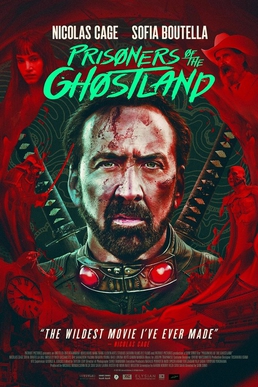
Saturday Matinee: Prisoners of the Ghostland

PRISONERS OF THE GHOSTLAND, Leave Sanity at the Door

Nicolas Cage. Sofia Boutella. Sono Sion. Need we say more? Yes.

By Eric Ortiz Garcia

Source: Screen Anarchy

More than 30 years after his first film, Sono Sion has established himself as a brilliant, prolific and chameleonic director.

In the past decade alone, you can find some of his best work: a hilarious tribute to guerrilla filmmaking and 35mm, with yakuzas, samurais and martial arts, Why Don’t You Play in Hell?; brutally violent and sordid films, Cold Fish and Guilty of Romance; dramas alluding to the nuclear disaster in Fukushima, Himizu and The Land of Hope; a crazy hip hop musical, Tokyo Tribe; and an emotional kaiju and Christmas film with catchy rock songs, Love & Peace.

On the other hand, Nicolas Cage became one of the most prolific Hollywood actors, finding in recent years memorable roles in genre cinema that, beyond subversive, are absolutely delirious. Mandy and Color Out of Space are enough to forget his abundant jobs-for-hire.

Considering that, Prisoners of the Ghostland, Sono’s highly anticipated English-language debut starring Cage, is insane. Truly insane.

Sono has excelled in building his own worlds. When I interviewed him in 2015 about Tokyo Tribe, he revealed that he wasn’t interested in using real locations in that city, because he wanted to “make up a whole fake world.” Prisoners of the Ghostland, one of his productions with the biggest budget, isn’t contained in that regard. Its two main universes – or rather, prisons – come to life and are wonderful madness.

Prisoners of the Ghostland is Sono’s Western and his return to samurai cinema, two genres that he feels affection for like his contemporaries: Miike Takashi (Sukiyaki Western Django) and Quentin Tarantino (Kill BillDjango Unchained). A group that shares influences: Sergio Leone, Ennio Morricone, Sergio Corbucci, Bruce Lee, Fukasaku Kinji, Fujita Toshiya, among many others.

In Sono’s “Old West”, West and East coexist, the mystique of the cowboy and the samurai. In fact, it’s set in “Samurai Town.” The iconic sheriff is an obese, long-haired Japanese cowboy, an Elvis Presley fan. The town’s true “boss”, the Governor (Bill Moseley, in a performance to remember), is a “gringo” with a Southern accent who runs a geisha place. He’s accompanied by his favorite heavy: the skilled samurai Yasujiro, played by Sakaguchi Tak himself, “Bruce Lee” in Why Don’t You Play in Hell? and more recently the protagonist of Crazy Samurai Musashi, the exciting and bloody one-take sequence based on an idea by Sono.

The hybrid and extravagant iconography extends to the town, practically an alternate universe where all kinds of people live together regardless of age (there’s a good number of children). It’s a clash between the traditional and the modern: a classic Western/Oriental town adorned with electronic signs, with interiors worthy of a stylized futuristic movie. Well, the Governor travels in a modern car! It’s the cinema of cool at its most striking expression.

Who better to lead the cast than an actor with a perfect understanding of this type of cinema? Is there a better vehicle for Cage than a film where his character is described as “so cool, so badass”?

The actor has been enjoying himself big time. “Personally I find his stylish performances extremely enternaining,” said Richard Stanley when I interviewed him about the Lovecraftian Color Out of Space, “they say it’s campy and over-the-top, that how can you make a serious but pretty fun movie. That’s just what I love about Nic, he’s capable of being funny and serious at the same time.”

Cage maintains that style in Prisoners of the Ghostland, bringing the classic unnamed antihero to life, although unlike those almost silent figures in the Spaghetti Western – Kurosawa Akira’s samurais were a big influence for Leone– Nic held nothing back. The movie is full of hilariously absurd dialogue and moments. It’s a territory that Sono dominates: just remember the hilarious yakuza leader secretly in love with the daughter of his rival, famous for a jingle that the criminal continues to dance, in Why Don’t You Play in Hell?

The plot of Prisoners of the Ghostland is quite simple: the Governor’s “granddaughter”, Bernice (Sofia Boutella), has disappeared; she’s actually a prostitute who managed to escape from her “prison.” The man with no name is imprisoned in Samurai Town and could regain his freedom if he fulfills the mission of bringing Bernice back.

The sequence that exposes the conflict is an extremely enjoyable display of the iconography around Cage’s character. The best example? The high-tech suit that threatens to blow the antihero to pieces if he treats Bernice badly (a comment from Sono about the supposed “misogyny” of his cinema?), or if he doesn’t fulfill the mission in the allotted time by the Governor.

Ok, maybe that doesn’t sound that crazy, how about adding a couple of explosives to the protagonist’s testicles? And we know that Sono wouldn’t add that detail if it wasn’t going to… explode at any moment!

Prisoners of the Ghostland is Sono’s Mad Maxian post-apocalyptic film. A world in ruins with old mannequins everywhere, a recurring figure in Sono’s filmography, as in Exte: Hair Extensions and in that twisted crime scene in Guilty of Romance. At the center of the stage is a crumbling tower topped by an immense clock, owned by a defunct nuclear empire.

After the Fukishima nuclear disaster in 2011, Sono hasn’t stopped showing concern about it in his cinema. There’s Himizu with its characters who lost everything and went on to live in destitute circumstances. In The Land of Hope, the director imagines that an earthquake and a tsunami cause a new nuclear catastrophe in another area of Japan. It’s a harsh criticism of the actions of the government and of the population with little memory, who forget the pain of ordinary people whose life will never be the same again.

In The Land of Hope, Sono thought of the threat of radiation as inherent in his country. Then, in Love & Peace, he used the frenzy for the imminent Tokyo 2020 Olympics (which haven’t happened yet, of course) as a reflection of a country that has forgotten Hiroshima, Nagasaki and Fukushima. Not for nothing the filmmaker continues to insist: the mythology of Prisoners of the Ghostland, explained in a stylized dreamlike sequence, is another comment on this topic.

Prisoners of the Ghostland is made up of a lot of elements. This post-apocalyptic world, and its background, is a hybrid. To avoid exploding into pieces, Cage’s character must enter a mythical land of ghosts, inhabited by figures distinguished by their distinctive samurai armor; they wander among men dressed in prison clothes, whose leader is a monstrous type, antagonist halfway between horror and exploitation.

The fate of those who cross the road of ghosts is the nuclear ruins. There’s no way out of this place, where an extravagant but well-meaning tribe lives. Some of these characters –like the charismatic Rat Man, a fanatic of vehicles and fuel-gatherer– might very well inhabit a fantastic adventure in a galaxy far, far away. In Prisoners of the Ghostland, Sono again turns his attention to the outcast; to children who have grown up without water or clean air, to ghosts that end up representing the aftermath of worldly horror, nuclear horror.

Prisoners of the Ghostland was filmed in Japan because Sono suffered a heart attack during its pre-production and, although the Japanese auteur doesn’t appear among the writers, the theme of reincarnation and redemption drives the film. Cage’s character is initially painted as a criminal of the worst kind, worthy of the Wild West of Corbucci. One of the ghosts that haunt him is an innocent Japanese boy, who had the misfortune of witnessing a disastrous bank robbery in which many of the characters and elements present in the story participated.

Prisoners of the Ghostland follows the man with no name until he earns the right to appear as a “hero” in the end credits. It’s an always insane absurdly entertaining redemption. Cage doesn’t stop, not even when he has to give the motivational speech as the “chosen one” that will make the impossible possible.

This is a quite violent film, although without reaching the most brutal, horrifying and controversial Sono of Cold Fish; there are stylized duels, sword thrusts, bullets and, of course, blood spurts. Prisoners of the Ghostland is absolutely bonkers and one of the most satisfying efforts by the great Sono Sion.

——————-

Watch Prisoners of the Ghostland on tubi here: https://tubitv.com/movies/100041245/prisoners-of-the-ghostland
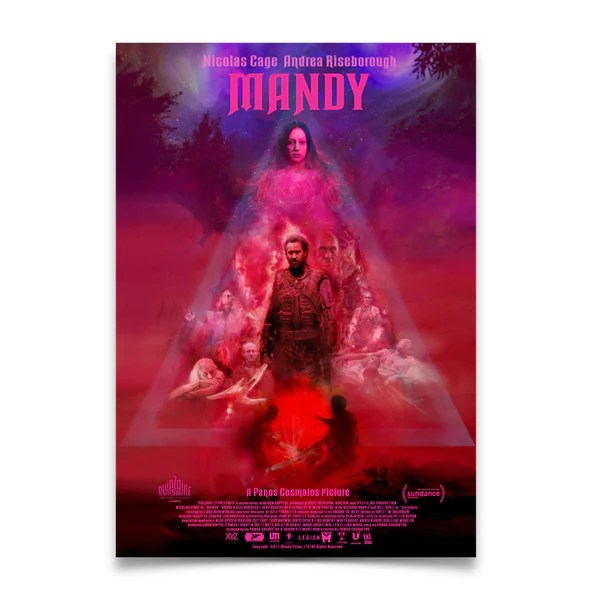
Saturday Matinee: Mandy

By Brian Tallerico

Source: RogerEbert.com

More than most movies, it’s hard to know where to begin with an appreciation or critique of Panos Cosmatos’ “Mandy.” It’s a really difficult film to capture tonally and even narratively in a review, largely because it is such a stylish, visceral experience that it demands you give yourself over to it actively instead of passively analyzing it. On the one hand, it’s a thriller, of sorts, a vengeance piece about a man killing those who destroyed his life. But, man, does that not really capture the experience of this movie. Some have compared it to an ‘80s heavy metal album cover sprung to life, but that’s only part of “Mandy,” and doesn’t convey the emotional depth that saturates every frame. And then there’s the fact that “Mandy” is kind of two movies in one, a slow-burn journey into hell in the first hour and a blood-soaked climb out of it in the second. Did I mention the chainsaw fight yet?

Nicolas Cage stars in “Mandy” as Red Miller, a lumberjack who lives a quiet life in the woods with his girlfriend Mandy, played by Andrea Riseborough. One day, Mandy catches the eye of a cult leader named Jeremiah Sand (Linus Roache), who proceeds to conjure motorcycle-riding demons to steal the girl and make her one of their own. In the process, Red is tortured and nearly killed. The first half of “Mandy” is filled with long, color-saturated takes of impending doom. Even casual behavior like quiet scenes between Mandy and Red have a foreboding nature, and then the film peaks in the middle with a waking nightmare as Red sees something no one should ever see happen to the love of his life. Deeply traumatized, Red is destroyed, and there’s a sequence in which Cage drinks an entire bottle of booze (well he ingests the stuff that isn’t poured on his wounds) while in his underwear, howling like an injured animal. It’s going to be GIF-ed and mocked, but it’s actually a great bit of acting, conveying a man not just mourning or in grief but literally destroyed.

Like a character in a Queensrÿche concept album, Red emerges from this destruction with his plans for vengeance. With a title card that divides the film in half, “Mandy” then becomes the movie that most people will remember in that it’s about Red working his way through both the demons that Jeremiah conjured and, inevitably, the gang itself. The heavy metal comparison is apt not just because the genre often included figures like the nightmarish creations that Jeremiah brought to life but in the very structure of “Mandy,” which unfolds in a very untraditional manner in both halves. Scenes play out like songs on an album, episodically cast in extreme color palettes that amplify the trippy, surreal natures of the entire experience. “Mandy” is a fascinating genre exercise in that it is as untraditional a horror movie as you’ll see this year but also relies on so many classics of the form. It is, at its core, a downright biblical tale of evil and vengeance.

It’s also pretty bad-ass when it comes to stand-out moments, particularly an already-acclaimed fight with two men wielding chainsaws like they’re swords. It’s a perfect blend of the old and new in “Mandy” and a distillation of what the film does well in how it takes a familiar good vs. evil sequence and twists it to fit Cosmatos’ vision.

Having said that, there are times when I felt the length of said vision. “Mandy” runs over two hours, and a little of its style goes a long way. I think there’s a masterful version of this movie that runs notably shorter, but that doesn’t mean there’s not an unforgettable one the way it is right now. 

One more thing before you go on this journey with Nicolas Cage: the incredible Johann Johannsson (“Sicario,” “Arrival“) does the best of his career in this, his final film composition. The score here is another character, a series of screeching, violent noises that add to the tone of the film in ways that can’t be overstated. The film simply doesn’t work without it. And, as much as I like other parts of the movie, Johannson’s work alone justifies a viewing. It reminds us how much we lost by his early passing.

Watch Mandy on Hoopla here: https://www.hoopladigital.com/title/12253438

Saturday Matinee: Valley Girl

80S BITS: VALLEY GIRL

By Richard Grey

Source: TheRealBits.com

With the release of a fourth American Pie film this year, one that largely looks back at the highs and lows of the 1999 original, it is tough to imagine a time when teen sex comedies weren’t a dime a dozen. When reflecting on Martha Coolidge’s 1983 hit film Valley Girl, what makes it stand out is just how much hasn’t changed in the last three decades. Some of the fashions might have altered, the music is now retro and valley girls have been parodied in everything from Frank Zappa music to Buffy the Vampire Slayer. Yet there remains a central familiarity that this film set the tone for in many ways.

In fair California, where we lay our scene, Julie Richman (Deborah Foreman) is a rich valley girl who has everything a young lady could dream of: cool parents, money, a gaggle of friends and the hottest boyfriend in town. After hanging out with her valley friends Loryn (Elizabeth Daily), Stacey (Heidi Holicker), and Suzi (Michelle Meyrink), she decides that Tommy (Michael Bowen) doesn’t respect her anymore and unceremoniously dumps him. When she meets Hollywood punk Randy (Nicolas Cage) at a party, the pair share an instant connection, and Randy falls in love hard, showing her a world she never knew existed. Yet Julie’s friends don’t approve, and she must decided whether to go with Randy or cave to peer pressure and reconcile with Tommy.

The disparity between rich and poor, and the class war it created, was a major theme in the films of the 1980s, proving to be the Romeo and Juliet stumbling block that stopped couples from uniting in Pretty in Pink and Some Kind of Wonderful to name but a few. Just as the decade of decadence was getting underway, the familiar trope is pulled out here not so much as a cheap cash grab, but rather as a parody of the popular youth culture of the 1980s. More so than any other film that has lampooned or been set in the 1980s since, Valley Girl captures the era perfectly, from the plastic image-focused girls of the valley, to the New Wave punks of Hollywood, just as caught in the scene as the sex-obsessed girls.

Where most teen comedies are the fantasies of the middle-aged, who vicariously live out deflowering fantasies that they missed out in their own formative years, female filmmaker Martha Coolidge creates a world inhabited with real kids. Much of the film cleverly sits back and observes conversations, adopting an almost documentary approach to exposition. Refreshingly, this means that catching girls out in the nude or obtaining a pair of panties as a trophy are not the ultimate goals in the film, nor is there a contest to be the first past the cherry-popping post. These young characters are sexual active, aware of their own bodies but in contrast conflicted over the dichotomy between their feelings and social status. Through the mere act of listening, we find out their fears and their desires. Who knew that girls talk about sex almost as much, if not more than, boys?

Valley Girl is fuelled by a terrific New Wave soundtrack, making liberal use of  The Plimsouls and Josie Cotton, who both appear in the film. Peppered with minor hits of the 1982-83 charts, “I Melt with You” by Modern English serves as an unofficial theme song for the film. The film originally had a lot more on the soundtrack, with the music rights costing $250,000 on top of the film’s original $350,000 budget. However, while The Clash, Culture Club, Bananarama, and The Jam all originally appeared in the credits to the film, none of their songs can be found in the actual picture thanks to an inability to secure the rights. Frank Zappa, whose satirical 1982 song “Valley Girl” served as the basis for the film, unsuccessfully attempted to sue the film’s makers for capitalising on his song’s name.

Trivia fans will know that this was the first film in which a young Nicolas Coppola first used his more famous stage name of Nicolas Cage, but the legacy of the film goes well beyond beginning the career that launched a thousand hairpieces. Apart from popularising the highly imitable “Valspeak”, Valley Girl opened the door for frank and open explorations of youth anxiety and sex, far more than the Porky’s films ever did. Indeed, a direct line can be traced between Valley Girl‘s star-crossed lovers and the Jane Austen-inspired Clueless. Like, totally for sure.


Watch the full film for free here: https://youtu.be/9VbyTLnRXCs


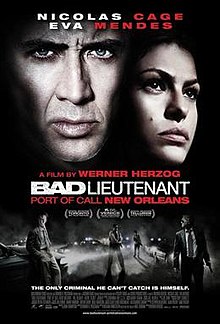
Saturday Matinee: Bad Lieutenant: Port of Call New Orleans

Review: Bad Lieutenant: Port of Call New Orleans

By Jessica Winter

Source: Film Comment

When is the audience allowed to laugh at a serious movie? How do you gauge whether the laughter expresses surprise, shock, nervousness, disdain, feigned superiority, genuine mirth, or some combination thereof? Take Werner Herzog’s films with his best fiend, Klaus Kinski: at a New York repertory screening of the deranged-conquistador saga Aguirre, Wrath of God a few years back, the patrons might as well have been watching The Hangover. Were they wrong? Or how about Abel Ferrara’s 1992 hell trip Bad Lieutenant: is it wildly inappropriate to laugh when Harvey Keitel’s depraved cop screams “You ratfucker!” at a church lady he mistakes for Jesus Christ? Is it wildly inappropriate not to laugh?

Herzog’s not-a-remake, Bad Lieutenant: Port of Call New Orleans, tacitly addresses this dilemma. Like much of the Herzog-Kinski catalogue, it’s a case study in bug-eyed monomania, and like Ferrara’s original, it’s a descent into the swamplands of the human soul with a drug-addled, quasi-righteous, borderline-insane cop as your tour guide. Unlike either, the reboot appears to be a comedy, or something close to it. BL:POCNO has comedy props: singing iguanas, a “magic crack pipe,” Val Kilmer. It has comic refrains that become funnier with each iteration, including Nicolas Cage’s emphysematic laugh and—for reasons that are tough to explain concisely—the letter “G.” It has punch lines. (“Everything I take is prescription. Except for the heroin.”) It has, for lack of a better term, a Gator Cam. Best of all, it has Cage, a walking sight gag who throws out his back early and spends the rest of the film bathed in a cold sweat of cocaine and Vicodin, lumbering around the post-Katrina landscape like he’s got a jumbo-sized T-square surgically jammed between his shoulder blades.

Cage’s Terence McDonagh comes off as part Kinski-style holy fool, part standard-issue Rogue Cop Who Gets Results. He shuttles crookedly between his adorable coke-whore sweetheart (Eva Mendes), his alcoholic father (Tom Bower), Dad’s beery girlfriend (Jennifer Coolidge, impressively frowsy), and his 24-7 mission pursuing local crack kingpin Big Fate (Alvin “Xzibit” Joiner), who’s possibly the most affable and credulous drug lord in cinema history. (This ambitious lad is happy to show new friend McDonagh the would-be flagship of a future real-estate empire: “waterfront condos” sited on some godforsaken loading dock, where Big Fate’s henchmen currently dump the bodies of their victims.)

But BL:POCNO’s shaggy police procedural (the screenwriter is NYPD Blue and Law & Order alumnus William Finkelstein) is almost an afterthought, always secondary to the Passion of the Cage: stations include a pharmacy meltdown worthy of Julianne Moore in Magnolia, a scary-funny parking-lot shakedown of two club kids out on Daddy’s credit cards, and above all, a feat of witness intimidation involving an electric shaver and a nice old lady’s nasal cannula. Pawing absently at his face, sniffing at bags of evidence (usually pocketing them for later), and huffing crack with anyone who’s holding, McDonagh is a mass of primitive, unexamined desires. In the grip of both addiction and workaholism, he has an appetite but not a will, a brain but not a mind. He is, perhaps, reptile brain incarnate—hence those singing iguanas and surveillance-camera-eyed alligators, not to mention the lone little fish swimming sad circles in a glass in a dead boy’s room.

The Herzog version almost entirely eschews the religious iconography of BL 1.0, but McDonagh does occasionally experience the kind of ecstatic self-forgetting that saints and drug addicts have in common. The dopey bliss that washes over Cage’s face when he glimpses a break-dancing ghost or regales his starry-eyed girlfriend with childhood tales of “buried treasure” is the happiest gift this erratic actor has given us in a long time. Shot in New Orleans largely for the tax break, labeled Bad Lieutenant largely because the producers had rights to the brand name, and starring an actor who, not to put too fine a point on it, makes a lot of crap, Herzog’s movie has expedience and exploitation written all over it. But it’s too weird and unhinged and endearing—and, for all its sordid details, too ingenuous—to be anything but a labor of love.


Watch the film on Hoopla here: https://www.hoopladigital.com/title/12197641

Saturday Matinee: Color Out of Space

By Peter Sobczynski

Source: RogerEbert.com

According to IMDb, the seemingly inexhaustible Nicolas Cage has no fewer than six additional movies in various stages of production that are currently scheduled for release in 2020, ranging from high-profile studio outings to the kind of demented head-scratchers that he somehow manages to sniff out in the manner of a pig finding truffles. And yet, none of these films may be able to top his latest effort, “Color Out of Space,” in terms of sheer nuttiness. Considering that the film takes its inspiration from one of the most famous short stories by the legendarily weird H.P. Lovecraft, and was directed and co-written by Richard Stanley (making his first stab at narrative filmmaking since being fired from his remake of “The Island of Dr. Moreau” after only a few days of shooting), there was very little chance that it was every going to be just another run-of-the-mill project. However, the addition of Cage to the already heady cinematic brew definitively puts it over the top, making it the kind of cult movie nirvana that was its apparent destiny from the moment the cameras started rolling.

The film centers on the Gardner family, who have recently left the hustle and bustle of the city for a more bucolic life in a remote house near a lake in the deep woods of Massachusetts. While father Nathan (Cage) is gung-ho about becoming a farmer and raising alpacas (“the animal of the future”) despite no discernible talent for either, wife Theresa (Joely Richardson) is preoccupied with recovering from a recent mastectomy, eldest son Benny (Brendan Meyer) is off getting stoned most of the time, teen daughter Lavinia (Madeline Arthur) vents her annoyance at the move by dabbling in the black arts with her paperback copy of “The Necronomicon” and young son Jack (Julian Hilliard) more often than not simply gets lost in the shuffle. The Gardners are not crazy or hostile in any way, but it also becomes quickly obvious that their isolation has begun to drive them all a bit batty. 

That weirdness escalates one night when the sky turns an almost indescribable shade of fuchsia, and a meteorite crashes into their front yard. Although the meteorite itself soon crumbles away, strange things begin happening in its wake. A batch of new and heretofore unseen flowers begin blooming while Nathan’s tomato crop comes in weeks ahead of schedule; the family’s phones, computers, and televisions are constantly being distorted by waves of static that render them all but useless. The Gardners themselves begin exhibiting signs of strange behavior as well: Nathan begins acting daffier than usual, flying off into rages at the drop of the hat; a seemingly dazed Theresa chops off the tops of a couple of her fingers while cutting carrots; Jack is constantly staring and whistling at a well that he claims contains a “friend.” Before long, everything in the area begins mutating in indescribable ways, and while Benny and Lavinia recognize what is happening around them, even they appear to be powerless to escape the grip of whatever is behind everything.

The stories of H.P. Lovecraft have inspired, directly or otherwise, any number of films over the years but with very few exceptions (chiefly Stuart Gordon’s cult classics “Re-Animator” and “From Beyond”), most of them have not been especially good. In most cases, the problem is that Lovecraft’s stories tended to focus on indescribable horrors and much of the impact for the reader came from taking the vague hints that he did parcel out and then picturing it in their own minds, where their imaginations had no limitations or budgetary restrictions. To successfully adapt one of his works, a filmmaker needs either an unlimited budget to try to bring his horrors fully to life, or the kind of unlimited imagination that allows them to take Lovecraft’s suggestions and go off in their own unusual directions. When these requirements are missing, the results can be fairly dire, as anyone who saw “The Curse,” a dire low-budget 1987 adaptation of Color of Outer Space, can attest.

In this case, the film works because it is clear that Stanley is not only working on the same wavelength as Lovecraft was when he wrote the original story, but has managed to transform the author’s decidedly purple prose into cinematic terms. Take the titular color, for example. In the original story, it is never properly described to us other than being of a shade never before seen on the typical color spectrum. That sort of non-description description can work on the page but isn’t especially helpful as a guide for someone who has to bring it to life. Stanley proves himself to be up to the challenge, and hits upon a wild color scheme that honors Lovecraft’s intentions by bathing everything in a genuinely otherworldly tinge. Not content to rest there, he builds upon that weirdness with an equally vivid soundscape, including a creepily effective score by Colin Stetson. Stetson’s score shifts levels of reality in aural terms and conjure up the kind of terrors that are even harder to shake than the numerous and undeniably eye-popping physical mutations on display.

Stanley also manages to work the film’s additional otherworldly element—Cage’s performance—organically into the material, without losing any of its total strangeness in the process. For fans of oddball cinema, a Cage-Stanley collaboration is the stuff dreams are made of. In that respect, it does not disappoint. Obviously, once things go crazy in the second half, Cage brings out the weirdness full force (even randomly employing the wheeling vocal tic that he used decades earlier in “Vampire’s Kiss”). But what is interesting is that, instead of making Nathan into a completely normal guy who does an immediate 180 as a result of the strange occurrences, he and Stanley instead see him as a guy who is already a bit off right from the start, albeit in endearingly oddball ways. As a result of his work in these early scenes, there is an unexpected degree of poignance that he brings to the proceedings later on even as things go fully gonzo.

The chief problem with “Color Out of Space” is that, at nearly two full hours, it is a little too much of a good thing at times, with some plot elements—chiefly one involving potentially shady dealings by the town’s mayor (Q’orianka Kilcher)—that could have easily been jettisoned. For the most part, however, the film is the kind of audacious and deliriously messed-up work that fans of Stanley, Cage, and cult cinema have been rooting for ever since the existence of the project became known. Both as an effective cinematic translation of Lovecraft’s particular literary skills, and as a freakout of the first order with sights and sounds that will not be easily forgotten, this is one of those films that I suspect is going to grow in significance and popularity in due time. Hopefully it will serve as just the first of many collaborations between Stanley and Cage, two decidedly kindred artistic spirits.

Watch Color Out of Space on Hoopla here: https://www.hoopladigital.com/title/13038495

Saturday Matinee: Bringing Out the Dead

“Bringing Out the Dead” (1999) is the fourth collaboration between director Martin Scorsese and screenwriter Paul Schrader (and their most underrated). Based on a novel by Joe Connelly, the plot follows New York paramedic Frank Pierce (Nicolas Cage), who’s on the verge of a nervous breakdown as he struggles to save a steady stream of victims of a heroin plague in the early 90s. As could be expected, the film is full of grim and harrowing situations but is punctuated by darkly humorous moments as well. Given the current wave of opiate overdoses caused primarily by the drug war and big pharma, Bringing Out the Dead is unfortunately more topical than ever.

Watch the full film here.