Puppet Pete Says Revolution And The Status Quo Aren’t Mutually Exclusive

By Caitlin Johnstone

Source: CaitlinJohnstone.com

The world’s first laboratory-grown presidential candidate Pete Buttigieg met with boos and chants of “Wall Street Pete” at a recent Democratic Party event in New Hampshire for taking a dig at the revolution-minded rhetoric favored by Bernie Sanders and his supporters.

“We cannot risk dividing Americans’ future further, saying that you must either be for a revolution or you must be for the status quo,” Buttigieg said. “Let’s make room for everybody in this movement.”

This is a talking point that the tightly scripted and focus group-tested Buttigieg has been repeatedly regurgitating all month, so it’s worth taking a look at.

https://twitter.com/CANCEL_SAM/status/1226342356242378757

Claiming that it isn’t necessary to choose between revolution and the status quo is claiming that you can change the status quo without any kind of revolution. You are saying that the establishment which has created and reinforced the status quo can now suddenly, for some strange and mysterious reason, be counted upon to change it. That the status quo will change the status quo.

Anyone who has paid attention to US politics for more than a few years already knows that this is objectively false. From administration to administration, regardless of who sits in the Oval Office or who controls the House or the Senate, the status quo has been adamantly enforced along a rigid trajectory toward ever-increasing military expansionism, exploitative neoliberal economic policies, income and wealth inequality, police militarization, mass-scale imprisonment, Orwellian surveillance programs and increasing restrictions on journalism and free speech.

Change is not going to come from those institutions, it’s going to come from the people using the power of their numbers to force important changes that those institutions do not want to make. And Pete Buttigieg knows this. And so do the spooks and oligarchs who are backing him.

It is very appropriate that a military intelligence officer with ties to the CIA, who is beloved by intelligence/defense agency insiders and who appears to have been groomed by national security mandarins from the very beginning of his career, should be actively working to kill a revolutionary zeitgeist. After all, backing counter-revolutionaries is a favorite CIA activity.

https://twitter.com/KaeySonPoint/status/1226368369533865985

Progressives already got suckered into forfeiting their revolutionary spirit in exchange for flowery prose and empty rhetoric the last time they elected Pete Buttigieg for president, back when Pete Buttigieg was named Barack Obama. It was literally the exact same script they’re trying to recycle with Puppet Pete: a plucky young underdog with a knack for sparkly verbiage overcomes the frontrunner in Iowa in a stunning upset, then rides the momentum from that initial victory on to the Democratic nomination.

And now we’re seeing the Democratic Party officially award Buttigieg the largest delegate count in Iowa, after a massive scandal and despite countless unresolved discrepancies in the numbers, and establishment narrative managers are now preparing their heartwarming David-and-Goliath stories about the small town mayor knocking out the big bad socialist frontrunner for a second consecutive time in New Hampshire in defiance of the odds and polling expectations. If that falls through they’ve got Nevada, where shit really started to get crazy in 2016, and where they’re preparing to implement a brand new caucus app which they keep trying to say is not an app but a “tool” made for iPads (which is the thing that an app is).

All this to install a man who has managed to pack an astonishing amount of corruption and scandal into a relatively brief, small-scale political career.

That’s what not choosing between revolution and the status quo looks like. It looks like continuing the status quo.

Which is why it’s so dumb when Buttigieg says “Let’s make room for everybody in this movement.” Movement? What movement? You don’t get to call it a “movement” when its entire agenda is to prevent any movement. Use a different word. “Let’s make room for everybody in this inertia,” or “Let’s make room for everybody in this stasis” or something.

As I’ve said many times before, I’m interested in this presidential election not because I am under the delusion that presidential elections tend to change things, but because the attempts to manipulate it, and the public’s response to those manipulations, could shake something loose that actually might. If enough people in the world’s most powerful nation wake up to the fact that they don’t have the kind of political system they were taught about in school, if they realize that everything they’ve been told about how their government operates is a lie, if they realize their lives have been made so unnecessarily difficult by a ruling oligarchic class with a vested interest in keeping them impoverished and distracted, well, then we’re looking at an actual transformative force.

Then we’re looking at the possibility of a real revolution. Not a violent revolution; those always result in a continuation of the same ills under a different system, and there’s nothing revolutionary about that.

I’m talking about a real revolution. One where people begin to open their eyes to the reality that their entire understanding of what’s going on in the world has been the result of mass psychological manipulation throughout their entire lives at the hands of the school system, the billionaire-controlled news media, and the political establishment. One where people open their eyes so wide to the power of narrative control that they become impossible to propagandize. One where people begin weaving their own narratives. Their own understandings of the world. Built not for the benefit of the powerful, but for the benefit of the people.

We’re seeing a lot of movement already in 2020, and it’s just getting started. I see the potential for a lot of light to reach a lot of new areas between the cracks which open up in that movement. And I see the guardians of the status quo having a harder and harder time maintaining the state of stasis. Their increasingly ham-fisted manipulations, such as installing a jarringly phony puppet like Pete Buttigieg, say a lot about their desperation.

Find ways of forcing them to overextend themselves and overplay their hand. Let’s show everyone what they’re hiding behind the puppet theater.

Neoliberal Economics Destroyed the Economy and the Middle Class

By Paul Craig Roberts

Source: PaulCraigRoberts.com

According to official US government economic data, the US economy has been growing for 10.5 years since June of 2009. The reason that the US government can produce this false conclusion is that costs that are subtrahends from GDP are not included in the measure. Instead, many costs are counted not as subtractions from growth but as additions to growth. For example, the penalty interest on a person’s credit card balance that results when a person falls behind his payments is counted as an increase in “financial services” and as an increase in Gross Domestic Product. The economic world is stood on its head.

It is aggregate demand that drives the economy. Payments made on a rise in interest rates on credit card balances from 19% to a 29% penalty rate reduce consumers’ ability to contribute to aggregate demand by purchasing goods and the services of doctors, lawyers, plumbers, electricians, and carpenters. Contrary to logic, the fee is magically counted in the “financial services” category as a contributor to GDP growth. The extortion of a fee that reduces aggregate demand lowers GDP, but builds paper wealth in the financial services sector.

GDP growth is also artificially inflated by counting as GDP abstract concepts that do not produce income streams. For example, for homeowners the US Department of Commerce estimates the rental values of owner-occupied housing, that is, the amount owners would be paying if they rented instead of owned their homes, and counts this imputed rent as GDP.

These and other absurdities have caused economist Michael Hudson to conclude correctly that the “financial reality of how the U.S. economy works is no longer captured in GDP statistics.”
https://michael-hudson.com/2019/10/asset-price-inflation-and-rent-seeking/

Today we have two economies. One is the real economy of production and consumption. The other is the financialized economy of paper wealth. The former is doing poorly, and the latter is doing well. The financialized economy is growing much faster than the real economy. Indeed, the real economy might not be growing at all.

Michael Hudson describes the difference. The stock market is at all time highs that have created massive wealth in financial assets for stock and bond owners. In the real economy the situation is totally different: “The Federal Reserve’s Report on the Economic Well-Being of U.S. Households in 2018 reports that 39% of Americans do not have $400 cash available for a medical or other emergency, and that a quarter of adults skipped medical care in 2018 because they could not afford it ( https://www.federalreserve.gov/publications/files/2018-report-economic-well-being-us-households-201905.pdf ). The latest estimates by the U.S. Government Accountability Office (GAO) report that nearly half (48 percent) of households headed by someone 55 and older lack any retirement savings or pension benefits ( https://www.aarp.org/retirement/retirement-savings/info-2019/no-retirement-money-saved.html ). Even in what the press calls an economic boom, most Americans feel stressed and many are chronically angry and worried. According to a 2015 survey by the American Psychological Association, financial worry is the “number one cause of stress in America today” ( https://www.apa.org/news/press/releases/2015/02/money-stress ).

The data is completely clear. The rich are becoming much richer, and the rest are becoming poorer. Michael Hudson explains:

“The creation and trading of property and financial assets at rising prices has been fueled by rising debt levels owed to the financial sector. This sector’s returns therefore are best seen not as real wealth on the asset side of the balance sheet, but as overhead on the liabilities side. And the process is multi-layered: income accruing to the financial wealth owned by the top 10 Percent is paid mainly by the bottom 90 percent in the form of rising debt service and other returns to financial and other property.

“In the textbook models of industrial capitalism’s mass production and consumption, an asset’s price is determined by its cost of production. If the price rises above this level, competitors will offer it cheaper. But in the financialized economy an asset’s price is determined by how much credit buyers can borrow to buy it, not by its cost of production. A home is worth as much as a bank will lend to a bidder.

“The engine of industrial capitalism and its consumer society is a positive feedback loop in which widely shared income growth, expanding consumption and markets generated yet more investment and growth. By contrast, the feedback loop of financial capitalism is an exponential growth of credit-driven debt, driving up asset prices and hence requiring yet more borrowing to buy homes, retirement income and other assets. Corporate management and investment today is mainly about obtaining capital gains for real estate, stocks and bonds than about earning income.

“We illustrate this by charting the flow of income and capital gains in the real estate sector to show the dominance of asset-price gains over net rental income – and how rental income is used up paying interest in our financialized economy. Likewise, corporate income is spent (and new debt taken on) largely for stock buybacks to raise share prices. The resulting dynamic is exponential and destabilizing.”

This dynamic is destabilizing, because as more of consumers’ discretionary income is drawn off to service mortgage, credit card, automobile and student debt and for compulsory health insurance, less is left to purchase the goods and services in the real economy. Consequently, credit-driven debt grows faster than the income that services it, and this impoverishes the 90%. However, for the 10%, money creation by the Federal Reserve in order to protect the balance sheets of the “banks too big to fail or jail” drives up the values of financial assets. As a result the distribution of income and wealth becomes hightly polarized.

Think about the many Americans who meet their living expenses by making only the minimum payment on their credit card balance. At 19% interest their debt grows monthly. Eventually they hit a credit card debt cap and can no longer use the card to cover their living expenses. But they have the burden of a large debt balance to service without an income stream capable of servicing it.

Think about the corporation that decapitalizes itself in order to produce short to intermediate term capital gains for shareholders and executives by indebting the firm in order to buy back the firm’s shares. The end result is that all income goes for debt service.

In a financialized economy, the only possible outcomes are debt forgiveness or collapse.

As Michael Hudson makes clear, the combination of nonsensical categories in the National Income and Product Accounts and a financialized economy means we have no accurate picture of the economy’s condition. Michael Hudson has a proposal for correcting these problems and making GDP accounting more accurate, but as ecological economists such as Herman Daly have made clear, GDP measurement also omits the external costs of production. This means that we do not know whether GDP is growing or declining. It is entirely possible that the ecological and social costs of an increase in GDP (as currently measured) are greater than the value of the increased output. (See Paul Craig Roberts, The Failure of Laissez-Faire Capitalism, https://www.amazon.com/Failure-Laissez-Faire-Capitalism/dp/0986036250/ref=sr_1_2?crid=16NHZEQ9G3JRW&keywords=paul+craig+roberts+books&qid=1576440032&s=books&sprefix=Paul+Craig%2Caps%2C173&sr=1-2 )

Perhaps the major way in which GDP is overstated is the exclusion of external or social costs. External or social costs are costs of producing a product that the producer does not incur but imposes on third parties or on the environment. For example, untreated sewage dumped into a stream imposes costs on people downstream. Runoff of chemical fertilizers from commercial farming produces dead zones in the Gulf of Mexico and toxic algal blooms such as Red Tide that result in massive fish kills, make seafood unsafe, cause human ailments and adversely impact the tourist trade of beach areas. The result is lost incomes, ruined vacations, health expenses, and none of these costs are born by the commercial farmers.

Real estate development produces massive external costs. Scenic views from existing properties are blocked, thus reducing their values. Construction noise and congestion impose costs on existing residents and reduces the quality of their lives. Water runoff problems are often created. Infrastructure has to be provided, such as larger highways to provide evacuation from hurricane-impacted areas, usually financed by taxpayers. If the global warming case is correct, the external cost of human economic activity can be the life of the planet.

Lakshmi Sarah in the May/June, 2019, issue of the Sierra Club magazine provides an excellent detailed account of the external costs of coal-fired power plants being built in India by the Indian conglomerate Tata with a loan from the International Finance Corporation, a branch of the World Bank. The ground water in the area has been ruined and is no longer drinkable. Farmers are no longer able to grow crops on half of the area farmland. Heated wastewater that is dumped into the Gulf of Kutch is destroying fishing. The ecology and the livelihoods of the population are essentially destroyed. None of these costs are born by the private power companies.

Tired of being doormats for capitalists and the World Bank, the residents of the affected provinces rebelled. They have succeeded in getting their case before the US Supreme Court. It seems that the International Finance Corporation is so accustomed to financing projects that produce large external costs that it overlooked its obligation to examine the environmental impact of the projects it finances. This oversight resulted in Indian farmers and fishermen getting their case before the US Supreme Court. The International Finance Corporation’s lawyers argued that the World Bank lending agency had “absolute immunity.” The Supreme Court said no and remanded the case to the circuit court to rule on the damages.

Perhaps the most surprising thing about this apparent victory for ordinary faraway little people in an American court against the World Bank, a principle instrument of American imperialism, is that the Trump administration appeared in court as a friend of the Indian farmers and fishermen. The US Solicitor General, represented by Jonathan Ellis, rejected the notion that international orgnizations have absolute immunity. The Establishment exists on its immunity. Here we see the ultimate reason that the ruling Establishment wants rid of Trump.

Already the senior staff of the International Finance Corporation have come to the realization that they have other responsibilities than just to shuffle money out the lending shute. If the Indian farmers and fishermen succeed in protecting themselves from ruination by external costs, perhaps Americans who suffer external costs will follow their lead.

Perhaps economists will also come to the realization that they owe us accurate GDP accounting and not fanciful accounts that serve elite wealth in the financialized economy.

This holiday season, American workers have little to celebrate

By Danny Haiphong

Source: Intrepid Report

Every year, much of the U.S. population celebrates Thanksgiving and Christmas to show appreciation for their families and friends. Thanksgiving normalizes the colonial origins of the United States and erases the brutality of the English settlers who massacred indigenous people to prepare the land for capitalist accumulation. Christmas is the annual holiday of big business. On no other day are workers more encouraged to spend their wages on the latest consumer product to gift to their loved ones. The holidays bring with them a deep pressure to be merry. Yet on this holiday season, workers have little to celebrate.

A new study by Brookings Institution provides a snapshot into the devastation wrought on the working class by American capitalism. Forty-four percent of all workers between the ages of 18-64 are employed in low-wage sectors and earn an average of $16 or less per hour. The study excluded workers who logged over 98 hours per week over the last year as well as certain sections of the college-educated population such as those living in dormitories and attending graduate school. Had these groups of workers been counted, the percentage of low-wage workers out of the total population would likely be even higher. This verifies prior datasets which proved that around half of the U.S. population makes less $30,000 per year.

The growing poverty of the American worker is a major contributor to the growth of toxic stress and mental illness. Half of all U.S. adults will develop a mental illness over the course of their life. Serious mental health conditions afflict nearly ten million people in the United States and over a quarter of these individuals live below the official poverty line. Suicide rates are at a thirty-year high. An obvious connection exists between rising poverty and the worsening mental health of the American worker.

Workers in the United States see no future under the current stage of capitalism. They struggle to afford rent in a nation where the federal minimum wage cannot pay for a two-bedroom apartment anywhere in the country. They indebt themselves in the trillions to attend college and obtain healthcare. They work in redundant, service sector jobs where hours are long and mistreatment, abuse, and injury are all too common. The American worker is increasingly alienated from themselves and each other. Union density rates in the U.S. have fallen to just ten percent of all workers since World War II.

The shrinking labor movement has followed a larger trend in U.S. society. Privatization has decimated the public sector. Workers have few places to socially convene independent of the machinations of consumer capitalism. Workers are competing for fewer jobs, most of which are not worth competing for at all. Homelessness, mass incarceration, and endless war remind workers that they can easily be turned into cannon fodder if they step out of line. In such an environment, addiction and self-destruction is encouraged while organizing for justice is discouraged.

Economic insecurity and alienation place more pressure on families to make up for stagnant wages and exorbitant amounts of debt. More young workers are living with their parents than at any other time in the last one hundred years. Older workers are not only forestalling retirement but also finding themselves without family or community support as siblings and adult children chase the highest paying jobs and the lowest rents and property values. Couples feel compelled to remain in toxic relationships for economic reasons. A strong link exists between domestic violence and poverty.

Contrary to the messages in Hallmark cards or the corporate media, the holidays are far from a time of celebration. Many workers view the holiday season as a harsh reminder of the loss, alienation, and despair that they’ve experienced over the course of their lives. Holidays place added pressure on workers to dismiss the ills of capitalism and the personal stressors associated with them. It should come as no surprise that most workers already struggling with mental health conditions report that the holidays only worsen their symptoms. Instead of embracing humanity, the holidays encourage workers to embrace rampant commercialism and the nuclear family.

To break from a culture steeped in the profit motive, workers will need to create their own traditions based upon solidarity and social transformation. Not everything about the holidays needs to be thrown out in the process. Spending time with family and friends during a day off from work can and should be rewarding to the psyche and to society. The conditions of capitalism prevent the holidays from serving a social purpose. Holidays under capitalism breed despair but brand themselves as moments of pure joy.

While workers may have little to celebrate this holiday season, there are reasons for the working class to be optimistic in the years to come. Teachers in cities such as Chicago and Los Angeles have won key gains in 2019 by using the most powerful weapon at the disposal of organized labor: the strike. At the beginning of the year, the Los Angeles Teachers won smaller class sizes and more support staff. The Chicago Teachers Union massively increased the number of nurses in the school district by forcing the city to hire nurses rather than continue the inefficient and harmful practice of hiring private contractors. The UAW’s strike of General Motors (GM) earlier this Fall made global headlines even if it was unable to win every demand that the workers put forth. These strikes reflect a growth of class consciousness in the United States. The continued growth of class consciousness will be critical toward building the kind of struggle capable of bringing about massive political and economic change for the working class.

Furthermore, workers around the world are leading the way in the struggle against class inequality and foreign-sponsored wars. Massive protests in Haiti, Chile, Honduras, and Algeria are just a few of many occurring around the globe. The protests have mainly targeted repressive U.S.-backed governments and their neoliberal economic agenda. China is leading the world in poverty reduction. Cuba is the most sustainably developed nation in the world. A vast majority of workers around the world want to see an end of the miseries imposed by global capital and are actively fighting to make their demands a reality.

The question is whether workers in the United States can decisively break from the despair, the racism, and the extreme alienation shaping their current condition. Being determines consciousness. At this moment, the neoliberal race to the bottom has rendered most workers too fearful, disorganized, and full of self-blame to fight back. However, millions of workers have rallied behind the political campaign of Bernie Sanders. Labor unrest is likely to continue as neither political party appears interested in implementing Bernie Sanders’ social democratic agenda. Workers in the United States are in desperate need of a revived labor movement to quench their thirst for a better life. Putting our energies into building this movement will go a long way toward shaking the Holiday Blues and giving workers something to really celebrate: a society run by workers, in the interests of workers.

Agents of Empire

By Michael Krieger

Source: Liberty Blitzkrieg

The corporate revolution will collapse if we refuse to buy what they are selling – their ideas, their version of history, their wars, their weapons, their notion of inevitability.

– Arundhati Roy

Last week, Hillary Clinton called Tulsi Gabbard (and Jill Stein) Russian assets on a podcast. More specifically:

“I’m not making any predictions, but I think they’ve got their eye on someone who’s currently in the Democratic primary and are grooming her to be the third-party candidate. She’s the favorite of the Russians,” said Clinton, apparently referring to Rep. Gabbard, who’s been accused of receiving support from Russian bots and the Russian news media. “They have a bunch of sites and bots and other ways of supporting her so far.” She added: “That’s assuming Jill Stein will give it up, which she might not because she’s also a Russian asset. Yeah, she’s a Russian asset—I mean, totally. They know they can’t win without a third-party candidate. So I don’t know who it’s going to be, but I will guarantee you they will have a vigorous third-party challenge in the key states that they most needed.”

Tulsi subsequently responded to this slanderous accusation with a series of devastating blows.

Her tweets set off a firestorm, and even if you’re as disillusioned by presidential politics as myself, you couldn’t help but cheer wildly that someone with a major political platform finally stated without any hint of fear or hesitation exactly what so many Americans across the ideological spectrum feel.

Of course, this has far wider implications than a high profile feud between these two. The “let’s blame Russia for Hillary’s loss” epidemic of calculated stupidity driven by Ellen-Democrats and their mouthpieces across corporate mass media began immediately after the election. I know about it on a personal level because this website was an early target of the neoliberal-led new McCarthyism courtesy of a ridiculous and libelous smear in the Washington Post over Thanksgiving weekend 2016 (see: Liberty Blitzkrieg Included on Washington Post Highlighted Hit List of “Russian Propaganda” Websites).

This is when it became clear it wasn’t just political operatives pushing fake news about Russian influence, but that “respected” mass media would be leading the charge for them. The rest is pretty much history. MSNBC, CNN, The Washington Post, etc have been spewing outlandish Russiagate nonsense for three years straight, and despite the complete failure of special counsel Robert Mueller to find any evidence of Trump-Russia collusion, these agents of empire refuse to stop. The whole charade seems more akin to an intelligence operation than journalism, which shouldn’t be surprising given the proliferation of former intelligence agents throughout mass media in the Trump era.

Here’s a small sampling via Politico’s 2018 article: The Spies Who Came in to the TV Studio

Former CIA Director John Brennan (2013-17) is the latest superspook to be reborn as a TV newsie. He just cashed in at NBC News as a “senior national security and intelligence analyst” and served his first expert views on last Sunday’s edition of Meet the Press. The Brennan acquisition seeks to elevate NBC to spook parity with CNN, which employs former Director of National Intelligence James Clapper and former CIA Director Michael Hayden in a similar capacity. Other, lesser-known national security veterans thrive under TV’s grow lights. Almost too numerous to list, they include Chuck Rosenberg, former acting DEA administrator, chief of staff for FBI Director James B. Comey, and counselor to former FBI Director Robert S. Mueller III; Frank Figliuzzi, former chief of FBI counterintelligence; Juan Zarate, deputy national security adviser under Bush, at NBC; and Fran Townsend, homeland security adviser under Bush, at CBS News. CNN’s bulging roster also includes former FBI agent Asha Rangappa; former FBI agent James Gagliano; Obama’s former deputy national security adviser Tony Blinken; former House Intelligence Committee Chairman Mike Rogers; senior adviser to the National Security Council during the Obama administration Samantha Vinograd; retired CIA operations officer Steven L. Hall; and Philip Mudd, also retired from the CIA.

Americans like to sneer at more transparently unfree societies around the world, but when you think about the disturbing implications of former spooks delivering news to the public, one can’t help but conclude that mass media in 2019 looks like a gigantic propaganda campaign targeting U.S. citizens. Moreover, as can be seen by the recent attacks by Clinton and her allies in the media on Gabbard, they aren’t easing up.

Which brings us to the crux of the issue. Why are they doing this? Why is Clinton, with zero evidence whatsoever, falsely calling a sitting U.S. Congresswoman, a veteran with two tours in Iraq, and someone polling at only 2% in the Democratic primary a “Russian asset.” Why are they so afraid of Tulsi Gabbard?

It’s partly personal. Tulsi was one of only a handful of congressional Democrats to set aside fears of the Clintons and their mafia-like network to endorse Bernie Sanders early in 2016. In fact, she stepped down from her position as vice-chairman of the Democratic National Committee to do so. This is the sort of thing a petty narcissist like Hillary Clinton could never forgive, but it goes further.

Tulsi’s mere presence on stage during recent debates has proven devastating for the Ellen Degeneres wing of the Democratic party. She effectively ended neoliberal darling Kamala Harris’ chances by simply telling the truth about her horrible record, something no one else in the race had the guts to do.

In other words, Tulsi demolished Kamala Harris and put an end to her primary chances by simply telling the truth about her on national television. This is how powerful the truth can be when somebody’s actually willing to stand up and say it. It’s why the agents of empire — in charge of virtually all major institutions — go out of their way to ensure the American public is exposed to as little truth as possible. It’s also why they lie and scream “Russia” instead of debating the actual issues.

But this goes well beyond Tulsi Gabbard. Empire requires constant meddling abroad as well as periodic regime change wars to ensure compliant puppets are firmly in control of any country with any geopolitical significance. The 21st century has been littered with a series of disastrous U.S. interventions abroad, while the country back home continues to descend deeper into a neo-feudal oligarchy with a hunger games style economy. As such, an increasing number of Americans have begun to question the entire premise of imperial foreign policy.

To the agents of empire, dominant throughout mainstream politics, mega corporations, think-tanks and of course mass media, this sort of thought crime is entirely unacceptable. In case you haven’t noticed, empire is a third-rail of U.S. politics. If you dare touch the issue, you’ll be ruthlessly smeared, without any evidence, as a Russian agent or asset. There’s nothing logical about this, but then again there typically isn’t much logic when it comes to psychological operations. They depend on manipulation and triggering specific emotional responses.

There’s a reason people like Hillary Clinton and her minions just yell “Russia” whenever an individual with a platform criticizes empire and endless war. They know they can’t win an argument if they debate the actual issues, so a conscious choice was made to simply avoid debate entirely. As such, they’ve decided to craft and spread a disingenuous narrative in which anyone critical of establishment neocon/neoliberal foreign policy is a Russia asset/agent/bot. This is literally all they’ve got. These people are telling you 2+2=5 and if you don’t accept it, you’re a traitorous, Putin-loving nazi with a pee pee tape. And these same people call themselves “liberal.”

Importantly, it isn’t just a few trollish kooks doing this. It’s being spread by some of the most powerful people and institutions in the country, including of course mass media.

For example:

https://twitter.com/ibrahimpols/status/1185571046738579456

This inane verbal vomit is considered “liberal” news in modern America, a word which has now lost all meaning. Above, we witness a collection of television mannequins questioning the loyalty of a U.S. veteran who continues to serve in both Congress and the national guard simply because she dared call out America’s perpetually failing foreign policy establishment.

To conclude, it’s now clear dissent is only permitted so long as it doesn’t become too popular. By polling at 2% in the primary, it appears Gabbard became too popular, but the truth is she’s just a vessel. What’s really got the agents of empire concerned is we may be on the verge of a tipping point within the broader U.S. population regarding regime change wars and empire. This is why debate needs to be shut down and shut down now. A critical mass of citizens openly questioning establishment foreign policy cannot be permitted. Those on the fence need to be bullied and manipulated into thinking dissent is equivalent to being a traitor. The national security state doesn’t want the public to even think about such topics, let alone debate them.

Ultimately, if you give up your capacity for reason, for free-thought and for the courage to say what you think about issues of national significance, you’ve lost everything. This is what these manipulators want you to do. They want you to shut-up, to listen to the “experts” who destroy everything they touch, and to be a compliant subject as opposed to an active, empowered citizen. The answer to such a tactic is to be more bold, more informed and more ethical. They fear truth and empowered individuals more than anything else. Stand up tall and speak your mind. Pandering to bullies never works.

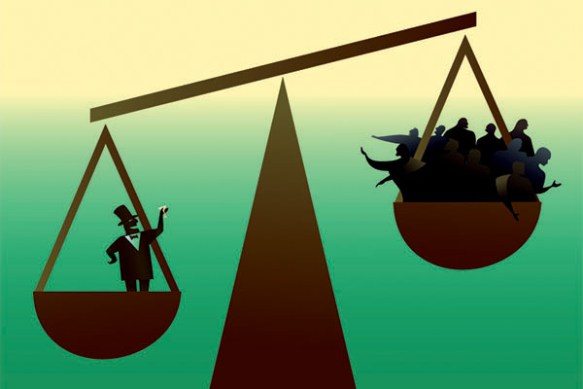
Billionaires are a Sign of Economic Failure

Inherited wealth and crony capitalism have created an aristocratic class that undermines social mobility and democracy

By Max Lawson

Source: Inequality.org

The New York Times published an editorial comment on its front page in January 2019, provocatively entitled “abolish billionaires.” The editorial raised a serious question: what if instead of being a sign of economic success, billionaires are a sign of economic failure?  In what ways can the boom in billionaires, and the dramatic increase in extreme wealth generally, be harmful?

To answer this question, we need to understand the origins of billionaire wealth, and to understand how that wealth is used once it is gained.  The answer to both these questions I think rightly casts doubt on the value of the super-rich in our society.

Approximately one third of billionaire wealth comes from inheritance. It is very hard to make the case for the economic utility of inherited wealth, and instead there is a strong case for the fact that it undermines social mobility and economic progress. It creates instead a new aristocracy who are rich simply because their parents were rich which is hard to see as a good thing.

Whether inherited or secured in other ways, extreme wealth takes on a momentum of its own.  The super-rich have the money to spend on the best investment advice, and billionaire wealth has increased since 2009 by an average of 11 percent a year, far higher than rates ordinary savers can obtain.

Bill Gates is worth nearly $100 billion dollars in 2019, almost twice what he was worth when he stepped down as head of Microsoft.  This is despite his admirable commitment to giving his money away.  As Thomas Piketty said in his book Capital in the 21st Century, “No matter how justified inequalities of wealth may be initially, fortunes can grow beyond any rational justification in terms of social utility.”

My Oxfam colleague Didier Jacobs calculated a few years ago that another third of billionaire wealth comes from crony connections to government and monopoly.  This could be for example when billionaires secure concessions to provide services exclusively from government, using crony connections and corruption.  The Economist has developed a similar measure of crony capitalism with similar findings. What is clear it seems to me is that corruption and crony connections to governments are behind a significant proportion of billionaire wealth.

Almost all sectors of our global economy are also now characterized by monopoly power, as is detailed by Nick Shaxson in his great new book, the Finance Curse. Whether food, pharmaceuticals, media, finance, or technology, each sector is characterized by a handful of huge corporations.

Decades of largely unquestioned mergers and acquisitions, where corporations have bought up competitors, have led to this.  Historically, and especially in the United States in the early part of the 20th century, monopoly power was rightly viewed as a serious threat to the economy and to society, and steps were taken to break up monopolies.  It was President Franklin Roosevelt who famously said that “government by organized money is just as dangerous as government by organized mob.” However, in recent decades, neoliberal economics has led a much more benign view of monopoly power, and very little action is now taken to dismantle them. I think this is a key distinction between neoliberalism and classical liberal economics.  These monopolies impose hidden monopoly taxes on every consumer, as it enables these companies, and their wealthy shareholders, to extract excessive profits from the market, directly fueling the growth in extreme wealth at the expense of ordinary citizens.

The actions of corporations, including the move towards monopoly, are driven by a relentless focus on ever-increasing returns to shareholders — shareholders who are primarily the very same extremely wealthy people.  Our new Oxfam paper on the “Seven Deadly Sins” of the G7, released this week, shows how returns to shareholders have increased dramatically whilst real wages have barely increased.

Behind corporate power and corporate actions is increasingly the power of super-rich shareholders.

Once billionaire wealth is accumulated, the way it is used also casts doubt on how useful it is to have billionaires.  The super-rich use their wealth to pay as little tax as possible, making active use of a secretive global network of tax havens, as revealed by the Panama Papers and other exposes.

One ground-breaking study that made use of this leaked information showed that the super-rich are paying as much as 30 percent less tax than they should, denying governments billions in lost tax revenue, that could have been spent on schools or on hospitals.  The super-rich are supported in this by the Society of Trust and Estate Practitioners (STEP), a secretive organization of over 20,000 wealth managers that actively pressures governments to reduce taxes on the richest.

Billions are not just used to ensure lower taxes. They can also be used to buy impunity from justice, to buy politicians, or to buy a pliant media.  The use of “dark” money to influence elections and public policy is a growing problem all over the world. The Koch brothers — Charles and the recently deceased David — two of the richest men in the world, have had a huge influence over conservative politics in the United States.

Another recent Oxfam study  showed the many ways in which politics has been captured by the very rich in Latin America.  Many of today’s new breed of nationalist, racist leaders have substantial financial backing.

This active political influencing by the super-rich directly drives greater inequality, by constructing reinforcing feedback loops, in which the winners of the game get even more resources to win even bigger next time.

For all these reasons, I think there is a strong case to be made that rather than being celebrated, as one U.S. commentator recently said, “every billionaire is a policy failure,” and that in particular if we are to end poverty and build fairer societies, we need to bring an end to extreme wealth.

Nuclear War: Just Another Day


By Colin Todhunter

Source: OffGuardian

Catastrophic events that send the world into turmoil happen on ‘just another day’. The atom bomb that exploded over Hiroshima took place while thousands of ordinary folk were just going about their everyday business on ‘just another day’.

A missile attack on a neighbourhood in Gaza or a drone attack on unsuspecting civilians in Afghanistan: death and destruction come like a bolt from the blue as people shop at the local market or take their kids to school on ‘just another day’.

Will it be ‘just another day’ when the next nuclear bomb is exploded in anger, an ordinary day when people are just going about their daily business? By then it might be too late to do anything, too late to act to try to prevent an unfolding global catastrophe on a scale never before witnessed by humans.

Yet so many appear too apathetic and wrapped up in a world of gadgets, technology, shopping malls, millionaire sports players and big-time sports events to think that such a thing could be imminent.

Are they so preoccupied with the machinations of their own lives in cotton-wool cocooned societies to think that what is happening in Syria or Iraq is just too boring to follow or that it doesn’t really concern them or it is ‘not my problem’?

Do they think they are untouchable, that only death, war and violence happens in faraway places?

Could any of us even contemplate that on some not-too-distant day a series of European cities could be laid waste within a matter of minutes? It isn’t worth thinking about. Or is it.

The US (and the West’s) foreign policy is being driven on the basis of fake morality and duplicity. Millions lie dead in Iraq, Afghanistan, Syria and Libya as a result of US-led imperialism, and nuclear-armed Russia is constantly demonised simply because it will not acquiesce to Washington and serve as a vassal state.

And now, as the US continues to stir up tensions with Iran and as China warns neighbouring countries about allowing US nuclear missiles aimed at it on their territories, much of the Western public and media remain oblivious to the dangers of conflict escalation and the biggest immediate threat to all life on Earth: nuclear war.

The threat of mass murder

Some fell to the ground and their stomachs already expanded full, burst and organs fell out. Others had skin falling off them and others still were carrying limbs. And one in particular was carrying their eyeballs in their hand.”

The above extract comes from an account by a Hiroshima survivor talking about the fate of her schoolmates. In 2016, it was read out in the British parliament by Scottish National Party MP Chris Law during a debate about Britain’s nuclear arsenal.

In response to a question from MP George Kereven, the then British PM Theresa May said without hesitation that, if necessary, she would authorise the use of a nuclear weapon that would kill hundreds of thousands of innocent men, women and children. May also implied that those wishing to scrap Britain’s nuclear weapons are siding with the nation’s enemies.

Politicians like May read from a script devised by elite interests. This transnational capitalist class dictates global economic policies and decides on who lives and who dies and which wars are fought and inflicted on which people.

The mainstream narrative tends to depict individuals who belong to this class as ‘wealth creators’. In reality, however, these ‘high flyers’ have stolen ordinary people’s wealth, stashed it away in tax havens, bankrupted economies and have imposed a form of globalisation that results in devastating destruction and war for those who attempt to remain independent or structurally adjusted violence via privatisation and economic neo-liberalism for millions in countries that have acquiesced.

While ordinary folk across the world have been subjected to policies that have resulted in oppression, poverty and conflict, this is all passed off by politicians and the mainstream media as the way things must be.

The agritech sector poisons our food and agriculture. Madelaine Albright says it was worth it to have killed half a million kids in Iraq to secure energy resources for rich corporations and extend the wider geopolitical goals of ‘corporate America’. The welfare state is dismantled and austerity is imposed on millions. The rich increase their already enormous wealth.

Powerful corporations corrupt government machinery and colonise every aspect of life for profit. Environmental destruction and ecological devastation continue apace.

And nuclear weapons hang over humanity like the sword of Damocles.

The public is supposed to back this status quo in support of what? Austerity, powerlessness, imperialism, propping up the US dollar and a moribund system. For whom? Occidental Petroleum, Soros, Murdoch, Rothschild, BP, JP Morgan, Boeing and the rest of the elite and their corporations whose policies are devised in think tanks and handed to politicians to sell to a largely ignorant public: those who swallow the lie about some ‘war on terror’ or Washington as the world’s policeman, protecting life and liberty.

Rejecting hegemonic thought

Many believe nuclear weapons are a necessary evil and fall into line with hegemonic thinking about humanity being inherently conflictual, competitive and war-like.

Such tendencies do of course exist, but they do not exist in a vacuum. They are fuelled by capitalism and imperialism and played upon by politicians, the media and elite interests who seek to scare the population into accepting a ‘necessary’ status quo.

Co-operation and equality are as much a part of any arbitrary aspect of ‘human nature’ as any other defined characteristic. These values are, however, sidelined by a system of capitalism that is inherently conflict-ridden and expansionist.

Much of humanity has been convinced to accept the potential for instant nuclear Armageddon hanging over its collective head as a given, as a ‘deterrent’. However, the reality is that these weapons exist to protect elite, imperialist interests or to pressure others to cave into their demands.

If the 20th century has shown us anything, it is these interests are adept at gathering the masses under notions of flag, god and country to justify their slaughter.

To prevent us all shuddering with the fear of the threat of instant nuclear destruction on a daily basis, it’s a case of don’t worry, be happy, forget about it and watch TV.

It was the late academic Rick Roderick who highlighted that modern society trivialises issues that are of ultimate importance: they eventually become banal or ‘matter of fact’ to the population.

People are spun the notion that nuclear-backed militarism and neoliberalism and its structural violence are necessary for securing peace, defeating terror, creating prosperity or promoting ‘growth’. The ultimate banality is to accept this pack of lies and to believe there is no alternative, to acquiesce or just switch off to it all.

Instead of acquiescing and accepting it as ‘normal’, we should listen to writer and campaigner Robert J Burrowes:

Many people evade responsibility, of course, simply by believing and acting as if someone else, perhaps even ‘the government’, is ‘properly’ responsible. Undoubtedly, however, the most widespread ways of evading responsibility are to deny any responsibility for military violence while paying the taxes to finance it, denying any responsibility for adverse environmental and climate impacts while making no effort to reduce consumption, denying any responsibility for the exploitation of other people while buying the cheap products produced by their exploited (and sometimes slave) labour, denying any responsibility for the exploitation of animals despite eating and/or otherwise consuming a range of animal products, and denying any part in inflicting violence, especially on children, without understanding the many forms this violence can take.”

Burrowes concludes by saying that ultimately, we evade responsibility by ignoring the existence of a problem. The evasion of responsibility, acquiescence and acceptance are, of course, part of the conditioning process.

The ‘problem’ encompasses not only ongoing militarism, but the structural violence of neoliberal capitalism, aided and abetted by the World Bank, IMF and the WTO. It’s a type of violence that is steady, lingering and a daily fact of life under globalised capitalism.

Of course, oppression and conflict have been a feature throughout history and have taken place under various economic and political systems. Indeed, in his various articles, Burrowes goes deep into the psychology and causes of violence.

But there is potentially a different path for humanity.

In 1990, the late British MP Tony Benn gave a speech in parliament (above) that indicated the kind of values that such a route might look like.

Benn spoke about having been on a crowded train, where people had been tapping away on calculators and not interacting or making eye contact with one another. It represented what Britain had apparently become under Thatcherism: excessively individualistic, materialistic, narcissistic and atomised.

The train broke down. As time went by, people began to talk with one another, offer snacks and share stories. Benn said it wasn’t too long before that train had been turned into a socialist train of self-help, communality and comradeship.

Despite the damaging policies and ideology of Thatcherism, these features had survived her tenure, were deeply embedded and never too far from the surface.

For Tony Benn, what had been witnessed aboard that train was an aspect of ‘human nature’ that is too often suppressed, devalued and, when used as a basis for political change, regarded as a threat to ruling interests.

It is an aspect that draws on notions of unity, solidarity, common purpose, self-help and finds its ultimate expression in the vibrancy of community, the collective ownership of productive resources and co-operation.

The type of values far removed from the destructive, divisive ones of imperialism and capitalism which key politicians and the corporate media protect and promote.


What globalism did was to transfer the US economy to China

By Paul Craig Roberts

Source: Intrepid Report

The main problem with the US economy is that globalism has been deconstructing it. The offshoring of US jobs has reduced US manufacturing and industrial capability and associated innovation, research, development, supply chains, consumer purchasing power, and tax base of state and local governments. Corporations have increased short-term profits at the expense of these long-term costs. In effect, the US economy is being moved out of the First World into the Third World.

Tariffs are not a solution. The Trump administration says that the tariffs are paid by China, but unless Apple, Nike, Levi, and all of the offshoring companies got an exemption from the tariffs, the tariffs fall on the offshored production of US firms that are sold to US consumers. The tariffs will either reduce the profits of the US firms or be paid by US purchasers of the products in higher prices. The tariffs will hurt China only by reducing Chinese employment in the production of US goods for US markets.

The financial media is full of dire predictions of the consequences of a US/China “trade war.” There is no trade war. A trade war is when countries try to protect their industries by placing tariff barriers on the import of cheaper products from foreign countries. But half or more of the imports from China are imports from US companies. Trump’s tariffs, or a large part of them, fall on US corporations or US consumers.

One has to wonder that there is not a single economist anywhere in the Trump administration, the Federal Reserve, or anywhere else in Washington capable of comprehending the situation and conveying an understanding to President Trump.

One consequence of Washington’s universal economic ignorance is that the financial media has concocted the story that “Trump’s tariffs” are not only driving Americans into recession but also the entire world. Somehow tariffs on Apple computers and iPhones, Nike footwear, and Levi jeans are sending the world into recession or worse. This is an extraordinary economic conclusion, but the capacity for thought has pretty much disappeared in the United States.

In the financial media the question is: Will the Trump tariffs cause a US/world recession that costs Trump his reelection? This is a very stupid question. The US has been in a recession for two or more decades as its manufacturing/industrial/engineering capability has been transferred abroad. The US recession has been very good for the Asian part of the world. Indeed, China owes its faster than expected rise as a world power to the transfer of American jobs, capital, technology, and business know-how to China simply in order that US shareholders could receive capital gains and US executives could receive bonus pay for producing them by lowering labor costs.

Apparently, neoliberal economists, an oxymoron, cannot comprehend that if US corporations produce the goods and services offshore that they market to Americans, it is the offshore locations that benefit from the economic activity.

Offshore production started in earnest with the Soviet collapse as India and China opened their economies to the West. Globalism means that US corporations can make more money by abandoning their American work force. But what is true for the individual company is not true for the aggregate. Why? The answer is that when many corporations move their production for US markets offshore, Americans, unemployed or employed in lower paying jobs, lose the power to purchase the offshored goods.

I have reported for years that US jobs are no longer middle-class jobs. The jobs have been declining for years in terms of value-added and pay. With this decline, aggregate demand declines. We have proof of this in the fact that for years US corporations have been using their profits not for investment in new plant and equipment, but to buy back their own shares. Any economist worthy of the name should instantly recognize that when corporations repurchase their shares rather than invest, they see no demand for increased output. Therefore, they loot their corporations for bonuses, decapitalizing the companies in the process. There is perfect knowledge that this is what is going on, and it is totally inconsistent with a growing economy.

As is the labor force participation rate. Normally, economic growth results in a rising labor force participation rate as people enter the work force to take advantage of the jobs. But throughout the alleged economic boom, the participation rate has been falling, because there are no jobs to be had.

In the 21st century, the US has been decapitalized and living standards have declined. For a while the process was kept going by the expansion of debt, but consumer income has not kept place and consumer debt expansion has reached its limits.

The Fed/Treasury “plunge protection team” can keep the stock market up by purchasing S&P futures. The Fed can pump out more money to drive up financial asset prices. But the money doesn’t drive up production, because the jobs and the economic activity that jobs represent have been sent abroad. What globalism did was to transfer the US economy to China.

Real statistical analysis, as contrasted with the official propaganda, shows that the happy picture of a booming economy is an illusion created by statistical deception. Inflation is undermeasured, so when nominal GDP is deflated, the result is to count higher prices as an increase in real output, that is, inflation becomes real economic growth. Unemployment is not counted. If you have not searched for a job in the past 4 weeks, you are officially not a part of the work force and your unemployment is not counted. The way the government counts unemployment is so extraordinary that I am surpised the US does not have a zero rate of unemployment.

How does a country recover when it has given its economy away to a foreign country that it now demonizes as an enemy? What better example is there of a ruling class that is totally incompetent than one that gives its economy bound and gagged to an enemy so that its corporate friends can pocket short-term riches?

We can’t blame this on Trump. He inherited the problem, and he has no advisers who can help him understand the problem and find a solution. No such advisers exist among neoliberal economists. I can only think of four economists who could help Trump, and one of them is a Russian.

The conclusion is that the United States is locked on a path that leads directly to the Third World of 60 years ago. President Trump is helpless to do anything about it.

Offering Choice but Delivering Tyranny: The Corporate Capture of Agriculture

By Colin Todhunter

Source: Off-Guardian

Many lobbyists talk a lot about critics of genetic engineering technology denying choice to farmers. They say that farmers should have access to a range of tools and technologies to maximise choice and options.

At the same time, somewhat ironically, they decry organic agriculture and proven agroecological approaches, presumably because these practices have no need for the proprietary inputs of the global agrochemical/agritech corporations they are in bed with.

And presumably because agroecology represents liberation from the tyranny of these profiteering, environment-damaging global conglomerates.

It is fine to talk about ‘choice’ but we do not want to end up offering a false choice (rolling out technologies that have little value and only serve to benefit those who control the technology), to unleash an innovation that has an adverse impact on others or to manipulate a situation whereby only one option is available because other options have been deliberately removed. And we would certainly not wish to roll out a technology that traps farmers on a treadmill that they find difficult to get off.

Surely, a responsible approach for rolling out important (potentially transformative) technologies would have to consider associated risks, including social, economic and health impacts.

Take the impact of the Green Revolution in India, for instance. Sold on the promise that hybrid seeds and associated chemical inputs would enhance food security on the basis of higher productivity, agriculture was transformed, especially in Punjab. But to gain access to seeds and chemicals many farmers had to take out loans and debt became (and remains) a constant worry.

Many became impoverished and social relations within rural communities were radically altered: previously, farmers would save and exchange seeds but now they became dependent on unscrupulous money lenders, banks and seed manufacturers and suppliers. Vandana Shiva in The Violence of the Green Revolution (1989) describes the social marginalisation and violence that accompanied the process.

On a macro level, the Green Revolution conveniently became tied to an international (neo-colonial) system of trade based on chemical-dependent agro-export mono-cropping linked to loans, sovereign debt repayment and World Bank/IMF structural adjustment (privatisation/deregulation) directives.

Many countries in the Global South were deliberately turned into food deficit regions, dependent on (US) agricultural imports and strings-attached aid.

The process led to the massive displacement of the peasantry and, according to the academics Eric Holt-Giménez et al, (Food rebellions: Crisis and the hunger for Justice, 2009), the consolidation of the global agri-food oligopolies and a shift in the global flow of food: developing countries produced a billion-dollar yearly surplus in the 1970s; they were importing $11 billion a year by 2004.

And it’s not as though the Green Revolution delivered on its promises.

In India, it merely led to more wheat in the diet, while food productivity per capita showed no increased or even actually decreased (see New Histories of the Green Revolution by Glenn Stone). And, as described by Bhaskar Save in his open letter (2006) to officials, it had dire consequences for diets, the environment, farming, health and rural communities.

The ethics of the Green Revolution – at least it was rolled out with little consideration for these impacts – leave much to be desired.

As the push to drive GM crops into India’s fields continues (the second coming of the green revolution – the gene revolution), we should therefore take heed. To date, the track record of GMOs is unimpressive, but the adverse effects on many smallholder farmers are already apparent (see Hybrid Bt cotton: a stranglehold on subsistence farmers in India by A P Gutierrez).

Aside from looking at the consequences of technology roll outs, we should, when discussing choice, also account for the procedures and decisions that were made which resulted in technologies coming to market in the first place.

Steven Druker, in his book Altered Genes, Twisted Truth, argues that the decision to commercialise GM seeds and food in the US amounted to a subversion of processes put in place to serve the public interest.

The result has been a technology roll out which could result (is resulting) in fundamental changes to the genetic core of the world’s food. This decision ultimately benefited Monsanto’s bottom line and helped the US gain further leverage over global agriculture.

We must therefore put glib talk of the denial of technology by critics to one side if we are to engage in a proper discussion of choice. Any such discussion would account for the nature of the global food system and the dynamics and policies that shape it. This would include looking at how global corporations have captured the policy agenda for agriculture, including key national and international policy-making bodies, and the role of the WTO and World Bank.

Choice is also about the options that could be made available, but which have been closed off or are not even considered. In Ethiopia, for example, agroecology has been scaled up across the entire Tigray region, partly due to enlightened political leaders and the commitment of key institutions.

However, in places where global agribusiness/agritech corporations have leveraged themselves into strategic positions, their interests prevail. From the false narrative that industrial agriculture is necessary to feed the world to providing lavish research grants and the capture of important policy-making institutions, these firms have secured a thick legitimacy within policymakers’ mindsets and mainstream discourse.

As a result, agroecological approaches are marginalised and receive scant attention and support.

Monsanto had a leading role in drafting the WTO Agreement on Trade-Related Aspects of Intellectual Property Rights to create seed monopolies. The global food processing industry wrote the WTO Agreement on the Application of Sanitary and Phytosanitary Measures.

Whether it involves Codex or the US-India Knowledge Initiative on Agriculture aimed at restructuring (destroying) Indian agriculture, the powerful agribusiness/food lobby has secured privileged access to policy makers and sets the policy agenda.

From the World Bank’s ‘enabling the business of agriculture’ to the Gates Foundation’s role in opening up African agriculture to global food and agribusiness oligopolies, democratic procedures at sovereign state levels are being bypassed to impose seed monopolies and proprietary inputs on farmers and to incorporate them into a global supply chain dominated by powerful corporations.

We have the destruction of indigenous farming in Africa as well as the ongoing dismantling of Indian agriculture and the deliberate impoverishment of Indian farmers at the behest of transnational agribusiness. Where is the democratic ‘choice’?

It has been usurped by corporate-driven Word Bank bondage (India is its biggest debtor in the bank’s history) and by a trade deal with the US that sacrificed Indian farmers for the sake of developing its nuclear sector.

Similarly, ‘aid’ packages for Ukraine – on the back of a US-supported coup – are contingent on Western corporations taking over strategic aspects of the economy. And agribusiness interests are at the forefront. Something which neoliberal apologists are silent on as they propagandise about choice, and democracy.

Ukraine’s agriculture sector is being opened up to Monsanto/Bayer. Iraq’s seed laws were changed to facilitate the entry of Monsanto.

India’s edible oils sector was undermined to facilitate the entry of Cargill. And Bayer’s hand is possibly behind the ongoing strategy to commercialise GM mustard in India. Whether on the back of militarism, secretive trade deals or strings-attached loans, global food and agribusiness conglomerates secure their interests and have scant regard for choice or democracy.

The ongoing aim is to displace localised, indigenous methods of food production and allow transnational companies to take over, tying farmers and regions to a system of globalised production and supply chains dominated by large agribusiness and retail interests. Global corporations with the backing of their host states, are taking over food and agriculture nation by nation.

Many government officials, the media and opinion leaders take this process as a given. They also accept that (corrupt) profit-driven transnational corporations have a legitimate claim to be owners and custodians of natural assets (the ‘commons’).

There is the premise that water, seeds, food, soil and agriculture should be handed over to these conglomerates to milk for profit, under the pretence these entities are somehow serving the needs of humanity.

Ripping land from peasants and displacing highly diverse and productive smallholder agriculture, rolling out very profitable but damaging technologies, externalising the huge social, environmental and health costs of the prevailing neoliberal food system and entire nations being subjected to the policies outlined above: how is any of it serving the needs of humanity?

It is not. Food is becoming denutrified, unhealthy and poisoned with chemicals and diets are becoming less diverse. There is a loss of plant and insect diversity, which threatens food security, soils are being degraded, water tables polluted and depleted and millions of smallholder farmers, so vital to global food production, are being pushed into debt in places like India and squeezed off their land and out of farming.

It is time to place natural assets under local ownership and to develop them in the public interest according to agroecological principles. This involves looking beyond the industrial yield-output paradigm and adopting a systems approach to food and agriculture that accounts for local food security and sovereignty, cropping patterns to ensure diverse nutrition production per acre, water table stability and good soil structure. It also involves pushing back against the large corporations that hold sway over the global food system and more generally challenging the leverage that private capital has over all our lives.

That’s how you ensure liberation from tyranny and support genuine choice.


Colin Todhunter is an independent journalist who writes on development, environmental issues, politics, food and agriculture. He was named in August 2018 by Transcend Media Services as one of 400 Living Peace and Justice Leaders and Models in recognition of his journalism.