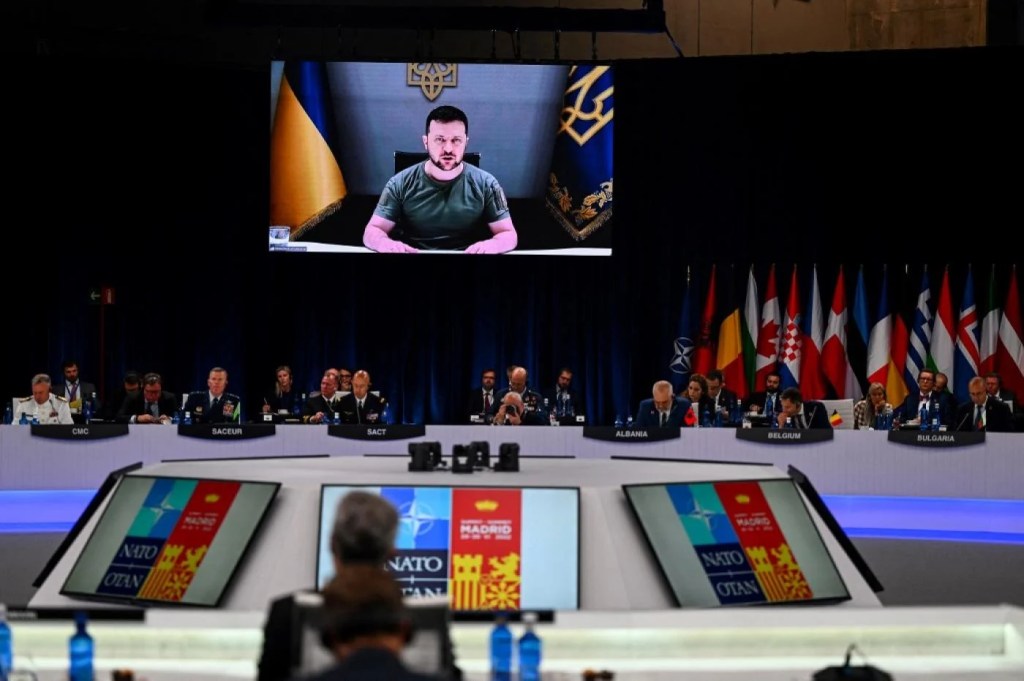
HOW THE WESTERN MEDIA HELPED BUILD THE CASE FOR GENOCIDE IN GAZA

From obscuring the West’s role in starving Gaza to sensationalised accounts of mass rape by Hamas, journalists are playing the role of propagandists, not reporters.
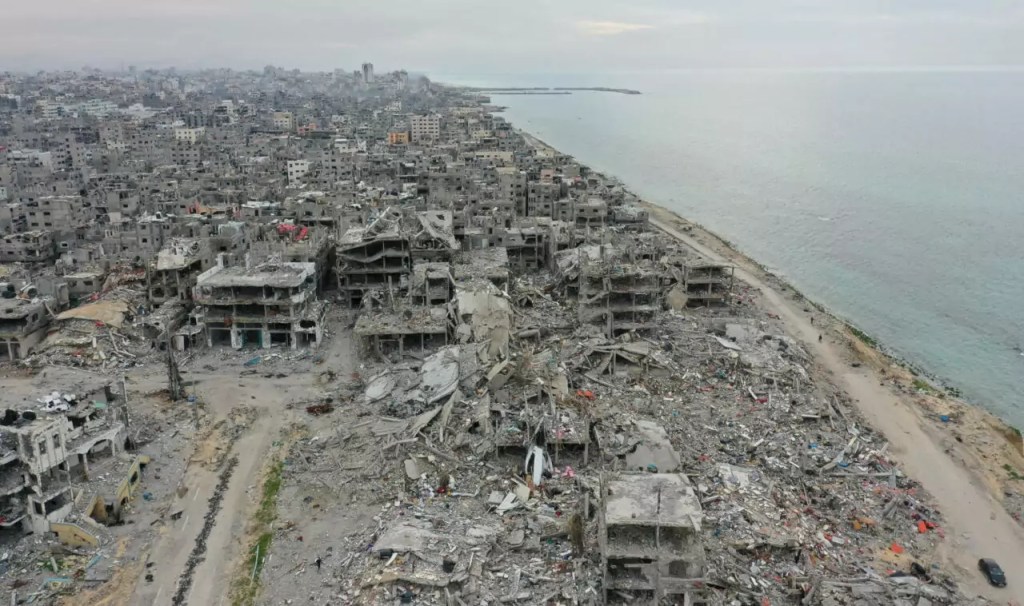
Israel has reduced Gaza to ruins. (Photo: UNRWA)

By Jonathan Cook

Source: Declassified UK

The past five months have been clarifying. What was supposed to be hidden has been thrust into the light. What was supposed to be obscured has come sharply into focus.

Liberal democracy is not what it seems.

It has always defined itself in contrast to what it says it is not. Where other regimes are savage, it is humanitarian. Where others are authoritarian, it is open and tolerant. Where others are criminal, it is law-abiding. When others are belligerent, it seeks peace. Or so the manuals of liberal democracy argue.

But how to keep the faith when the world’s leading liberal democracies – invariably referred to as “the West” – are complicit in the crime of crimes: genocide?

Not just law-breaking or a misdemeanour, but the extermination of a people. And not just quickly, before the mind has time to absorb and weigh the gravity and extent of the crime, but in slow motion, day after day, week after week, month after month.

What kind of system of values can allow for five months the crushing of children under rubble, the detonation of fragile bodies, the wasting away of babies, while still claiming to be humanitarian, tolerant, peace-seeking?

And not just allow all this, but actively assist in it. Supply the bombs that blow those children to pieces or bring houses down on them, and sever ties to the only aid agency that can hope to keep them alive.

The answer, it seems, is the West’s system of values.

The mask has not just slipped, it has been ripped off. What lies beneath is ugly indeed.

Depravity on show

The West is desperately trying to cope. When Western depravity is fully on show, the public’s gaze has to be firmly directed elsewhere: to the truly evil ones.

They are given a name. It is Russia. It is Al Qaeda, and Islamic State. It is China. And right now, it is Hamas.

There must be an enemy. But this time, the West’s own evil is so hard to disguise, and the enemy so paltry – a few thousand fighters underground inside a prison besieged for 17 years – that the asymmetry is difficult to ignore. The excuses are hard to swallow.

Is Hamas really so evil, so cunning, so much of a threat that it requires mass slaughter? Does the West really believe that the attack of 7 October warrants the killing, maiming and orphaning of many, many tens of thousands of children as a response?

To stamp out such thoughts, Western elites have had to do two things. First, they have tried to persuade their publics that the acts they collude in are not as bad as they look. And then that the evil perpetrated by the enemy is so exceptional, so unconscionable it justifies a response in kind.

Which is exactly the role Western media has played over the past five months.

Starved by Israel

To understand how Western publics are being manipulated, just look to the coverage – especially from those outlets most closely aligned not with the right but with supposedly liberal values.

How have the media dealt with the 2.3 million Palestinians of Gaza being gradually starved to death by an Israeli aid blockade, an action that lacks any obvious military purpose beyond inflicting a savage vengeance on Palestinian civilians? After all, Hamas fighters will outlast the young, the sick and the elderly in any mediaeval-style, attritional war denying Gaza food, water and medicines.

headline in the New York Times, for example, told readers last month, “Starvation is stalking Gaza’s children”, as if this were a famine in Africa – a natural disaster, or an unexpected humanitarian catastrophe – rather than a policy declared in advance and carefully orchestrated by Israel’s top echelons.

The Financial Times offered the same perverse framing: “Starvation stalks children of northern Gaza”.

But starvation is not an actor in Gaza. Israel is. Israel is choosing to starve Gaza’s children. It renews that policy each day afresh, fully aware of the terrible price being inflicted on the population.

As the head of Medical Aid for Palestinians warned of developments in Gaza: “Children are being starved at the fastest rate the world has ever seen.”

Last week Unicef, the United Nations children’s emergency fund, declared that a third of children aged under two in northern Gaza were acutely malnourished. Its executive director, Catherine Russell, was clear: “An immediate humanitarian cease-fire continues to provide the only chance to save children’s lives and end their suffering.”

Were it really starvation doing the stalking, rather than Israel imposing starvation, the West’s powerlessness would be more understandable. Which is what the media presumably want their readers to infer.

But the West isn’t powerless. It is enabling this crime against humanity – day after day, week after week – by refusing to exert its power to punish Israel, or even to threaten to punish it, for blocking aid. 

Not only that, but the US and Europe have helped Israel starve Gaza’s children by denying funding to the UN refugee agency, UNRWA, the main humanitarian lifeline in the enclave. 

All of this is obscured – meant to be obscured – by headlines that transfer the agency for starving children to an abstract noun rather than a country with a large, vengeful army.

Attack on aid convoy

Such misdirection is everywhere – and it is entirely intentional. It is a playbook being used by every single Western media outlet. It was all too visible when an aid convoy last month reached Gaza City, where levels of Israeli-induced famine are most extreme.

In what has come to be known by Palestinians as the “Flour Massacre”, Israel shot into large crowds desperately trying to get food parcels from a rare aid convoy to feed their starving families. More than 100 Palestinians were killed by the gunfire, or crushed by Israeli tanks or hit by trucks fleeing the scene. Many hundreds more were seriously wounded.

It was an Israeli war crime – shooting on civilians – that came on top of an Israeli crime against humanity – starving two million civilians to death.

“The Israeli attack on those waiting for aid was not a one-off”

The Israeli attack on those waiting for aid was not a one-off. It has been repeated several times, though you would barely know it, given the paucity of coverage.

The depravity of using aid convoys as traps to lure Palestinians to their deaths is almost too much to grasp.

But that is not the reason the headlines that greeted this horrifying incident so uniformly obscured or soft-soaped Israel’s crime.  

For any journalist, the headline should have written itself: “Israel accused of killing over 100 as crowd waits for Gaza aid.” Or: “Israel fires into food aid crowd. Hundreds killed and injured”

But that would have accurately transferred agency to Israel – Gaza’s occupier for more than half a century, and its besieger for the last 17 years – in the deaths of those it has been occupying and besieging. Something inconceivable for the Western media.

So the focus had to be shifted elsewhere.

BBC contortions

The Guardian’s contortions were particularly spectacular: “Biden says Gaza food aid-related deaths complicate ceasefire talks”. 

The massacre by Israel was disappeared as mysterious “food aid-related deaths”, which in turn became secondary to the Guardian’s focus on the diplomatic fallout.

Readers were steered by the headline into assuming that the true victims were not the hundreds of Palestinians killed and maimed by Israel but the Israeli hostages whose chances of being freed had been “complicated” by “food aid-related deaths”.

The headline on a BBC analysis of the same war crime – now reframed as an author-less “tragedy” – repeated the New York Times’ trick: “Aid convoy tragedy shows fear of starvation haunts Gaza”.

Another favourite manoeuvre, again pioneered by the Guardian, was to cloud responsibility for a clear-cut war crime. Its front-page headline read: “More than 100 Palestinians die in chaos surrounding Gaza aid convoy”. 

Once again, Israel was removed from the crime scene. In fact, worse, the crime scene was removed too. Palestinians “died” apparently because of poor aid management. Maybe UNRWA was to blame.

Chaos and confusion became useful refrains for media outlets keener to shroud culpability. The Washington Post declared: “Chaotic aid delivery turns deadly as Israeli, Gazan officials trade blame”. CNN took the same line, downgrading a war crime to a “chaotic incident”. 

But even these failings were better than the media’s rapidly waning interest as Israel’s massacres of Palestinians seeking aid became routine – and therefore harder to mystify.

A few days after the Flour Massacre, an Israeli air strike on an aid truck in Deir al-Balah killed at least nine Palestinians, while last week more than 20 hungry Palestinians were killed by Israeli helicopter gunfire as they waited for aid. 

“Food aid-related” massacres – which had quickly become as normalised as Israel’s invasions of hospitals – no longer merited serious attention. A search suggests the BBC managed to avoid giving significant coverage to either incident online.

Food-drop theatrics

Meanwhile, the media has ably assisted Washington in its various deflections from the collaborative crime against humanity of Israel imposing a famine on Gaza compounded by the US and Europe de-funding UNRWA, the only agency that could mitigate that famine.

British and US broadcasters excitedly joined air crews as their militaries flew big-bellied planes over Gaza’s beaches, at great expense, to drop one-off ready-made meals to a few of the starving Palestinians below.

Given that many hundreds of truckloads of aid a day are needed just to stop Gaza sliding deeper into famine, the drops were no more than theatrics. Each delivered at best a solitary truckload of aid – and then only if the palettes didn’t end up falling into the sea, or killing the Palestinians they were meant to benefit.

The operation deserved little more than ridicule.

Instead, dramatic visuals of heroic airmen, interspersed with expressions of concern about the difficulties of addressing the “humanitarian crisis” in Gaza, usefully distracted viewers’ attention not only from the operations’ futility but from the fact that, were the West really determined to help, it could strong-arm Israel into letting in far more plentiful aid by land at a moment’s notice.

The media were equally swept up by the Biden administration’s second, even more outlandish scheme to help starving Palestinians. The US is to build a temporary floating pier off Gaza’s coast so that aid shipments can be delivered from Cyprus.

The plot holes were gaping. The pier will take two months or more to construct, when the aid is needed now. In Cyprus, as at the land crossings into Gaza, Israel will be in charge of inspections – the main cause of hold-ups.

And if the US now thinks Gaza needs a port, why not also get to work on a more permanent one?

The answer, of course, might remind audiences of the situation before 7 October, when Gaza was under a stifling 17-year siege by Israel – the context for Hamas’ attack that the Western media never quite finds the space to mention.

For decades, Israel has denied Gaza any connections to the outside world it cannot control, including preventing a sea port from being built and bombing the enclave’s only airport way back in 2001, shortly after it was opened.

And yet, at the same time, Israel’s insistence that it no longer occupies Gaza – just because it has done so at arm’s length since 2005 – is accepted unquestioningly in media coverage.

Again, the US has decisive leverage over Israel, its client state, should it decide to exercise it – not least billions in aid and the diplomatic veto it wields so regularly on Israel’s behalf.

The question that needs asking by the media on every piece about “starvation stalking Gaza” is why is the US not using that leverage.

In a typical breathless piece titled “How the US military plans to construct a pier and get food into Gaza”, the BBC ignored the big picture to drill down enthusiastically on the details of “huge logistical” and “security challenges” facing Biden’s project. 

The article revisited precedents from disaster relief operations in Somalia and Haiti to the D-Day Normandy landings in the Second World War. 

Credulous journalists

In support of these diversionary tactics, the media have also had to accentuate the atrocities of Hamas’ 7 October attack – and the need to condemn the group at every turn – to contrast those crimes from what might otherwise appear even worse atrocities committed by Israel on the Palestinians. 

That has required an unusually large dose of credulousness from journalists who more usually present as hard-bitten sceptics.

Babies being beheaded, or put in ovens, or hung out on clothes lines. No invented outrage by Hamas has been too improbable to have been denied front-page treatment, only to be quietly dropped later when each has turned out to be just as fabricated as it should have sounded to any reporter familiar with the way propagandists exploit the fog of war. 

Similarly, the entire Western press corps has studiously ignored months of Israeli media revelations that have gradually shifted responsibility for some of the the most gruesome incidents of 7 October – such as the burning of hundreds of bodies – off Hamas’ shoulders and on to Israel’s.

Though Western media outlets failed to note the significance of his remarks, Israeli spokesman Mark Regev admitted that Israel’s numbering of its dead from 7 October had to be reduced by 200 because many of the badly charred remains turned out to be Hamas fighters. 

Testimonies from Israeli commanders and officials show that, blindsided by the Hamas attack, Israeli forces struck out wildly with tank shells and Hellfire missiles, incinerating Hamas fighters and their Israeli captives indiscriminately. The burnt cars piled up as a visual signifier of Hamas’ sadism are, in fact, evidence of, at best, Israel’s incompetence and, at worst, its savagery.

The secret military protocol that directed Israel’s scorched-earth policy on 7 October – the notorious Hannibal procedure to stop any Israeli being taken captive – appears not to have merited mention by either the Guardian or the BBC in their acres of 7 October coverage.

Despite their endless revisiting of the 7 October events, neither has seen fit to report on the growing demands from Israeli families for an investigation into whether their loved ones were killed under Israel’s Hannibal procedure. 

Nor have either the BBC or the Guardian reported on the comments of the Israeli military’s ethics chief, Prof Asa Kasher, bewailing the army’s resort to the Hannibal procedure on 7 October as “horrifying” and “unlawful”. 

Claims of bestiality

Instead, liberal Western media outlets have repeatedly revisited claims that they have seen evidence – evidence they seem unwilling to share – that Hamas ordered rape to be used systematically by its fighters as a weapon of war. The barely veiled implication is that such depths of depravity explain, and possibly justify, the scale and savagery of Israel’s response.

Note that this claim is quite different from the argument that there may have been instances of rape on 7 October.

That is for good reason: There are plenty of indications that Israeli soldiers regularly use rape and sexual violence against Palestinians. A UN report in February addressing allegations that Israeli solders and officials had weaponised sexual violence against Palestinian women and girls since 7 October elicited none of the headlines and outrage from the Western media directed at Hamas. 

To make a plausible case that Hamas changed the rules of war that day, much greater deviance and sinfulness has been required. And the liberal Western media have willingly played their part by recycling claims of mass, systematic rape by Hamas, combined with lurid claims of necrophilic perversions – while suggesting anyone who asks for evidence is condoning such bestiality.

But the liberal media’s claims of Hamas “mass rapes” – initiated by an agenda-setting piece by the New York Times and closely echoed by the Guardian weeks later – have crumbled on closer inspection.

Independent outlets such as Mondoweiss, Electronic Intifada, the Grayzone and others have gradually pulled apart the Hamas mass rape narrative.

But perhaps most damaging of all has been an investigation by the Intercept that revealed it was senior Times editors who recruited a novice Israeli journalist – a former Israeli intelligence official with a history of supporting genocidal statements against the people of Gaza – to do the field work.

More shocking still, it was the paper’s editors who then pressured her to find the story. In violation of investigative norms, the narrative was reverse engineered: imposed from the top, not found through on-the-ground reporting.

‘Conspiracy of silence’

The New York Times’ story appeared in late December under the headline “‘Screams Without Words’: How Hamas Weaponized Sexual Violence on Oct. 7”. The Guardian’s follow-up in mid-January draws so closely on the Times’ reporting that the paper has been accused of plagiarism. Its headline was: “Evidence points to systematic use of rape and sexual violence by Hamas in 7 October attacks”. 

However, under questioning from the Intercept, a spokesperson for the New York Times readily walked back the paper’s original certainty, conceding instead that “there may have been systematic use of sexual assault.” [emphasis added] Even that appears too strong a conclusion.

Holes in the Times’ reporting quickly proved so glaring that its popular daily podcast pulled the plug on an episode dedicated to the story after its own fact check.

The rookie reporter assigned to the task, Anat Schwartz, has admitted that despite scouring the relevant institutions in Israel – from medical institutions to rape crisis centres – she found no one who could confirm a single example of sexual assault that day. She was also unable to find any forensic corroboration.

She later told a podcast with Israel’s Channel 12 that she viewed the lack of evidence to be proof of “a conspiracy of silence”.

Instead, Schwartz’s reporting relied on a handful of testimonies from witnesses whose other easily disprovable assertions should have called into question their credibility. Worse, their accounts of instances of sexual assault failed to tally with the known facts.

One paramedic, for example, claimed two teenage girls had been raped and killed at Kibbutz Nahal Oz. When it became clear nobody fitted the description there, he changed the crime scene to Kibbutz Beeri. None of the dead there fitted the description either.

Nonetheless, Schwartz believed she finally had her story. She told Channel 12: “One person saw it happen in Be’eri, so it can’t be just one person, because it’s two girls. It’s sisters. It’s in the room. Something about it is systematic, something about it feels to me that it’s not random.”

Schwartz got further confirmation from Zaka, a private ultra-Orthodox rescue organisation, whose officials were already known to have fabricated Hamas atrocities on 7 October, including the various claims of depraved acts against babies.

No forensic evidence

Interestingly, though the main claims of Hamas rape have focused on the Nova music festival attacked by Hamas, Schwartz was initially sceptical – and for good reason – that it was the site of any sexual violence.

As Israeli reporting has revealed, the festival quickly turned into a battlefield, with Israeli security guards and Hamas exchanging gunfire and Israeli attack helicopters circling overhead firing at anything that moved.

Schwartz concluded: “Everyone I spoke to among the survivors told me about a chase, a race, like, about moving from place to place. How would they [have had the time] to mess with a woman, like – it is impossible. Either you hide, or you – or you die. Also it’s public, the Nova … such an open space.”

But Schwartz dropped her scepticism as soon as Raz Cohen, a veteran of Israel’s special forces, agreed to speak to her. He had already claimed in earlier interviews a few days after 7 October that he had witnessed multiple rapes at Nova, including corpses being raped.

But when he spoke to Schwartz he could only recall one incident – a horrific attack that involved raping a woman and then knifing her to death. Undermining the New York Times’ central claim, he attributed the rape not to Hamas but to five civilians, Palestinians who poured into Israel after Hamas fighters broke through the fence around Gaza.

Notably, Schwartz admitted to Channel 12 that none of the other four people hiding in the bush with Cohen saw the attack. “Everyone else is looking in a different direction,” she said.

And yet in the Times’ story, Cohen’s account is corroborated by Shoam Gueta, a friend who has since deployed to Gaza where, as the Intercept notes, he has been posting videos of himself rummaging through destroyed Palestinian homes.

Another witness, identified only as Sapir, is quoted by Schwartz as witnessing a woman being raped at Nova at the same time as her breast is amputated with a box cutter. That account became central to the Guardian’s follow-up report in January.

Yet, no forensic evidence has been produced to support this account.

Story invented

But the most damning criticism of the Times’ reporting came from the family of Gal Abdush, the headline victim in the “Screams without Words” story. Her parents and brother accused the New York Times of inventing the story that she had been raped at the Nova festival.

Moments before she was killed by a grenade, Abdush had messaged her family and made no mention of a rape or even a direct attack on her group. The family had heard no suggestion that rape was a factor in Abdush’s death.

A woman who had given the paper access to photos and video of Abdush taken that day said Schwartz had pressured her to do so on the grounds it would help “Israeli hasbara” – a term meaning propaganda designed to sway foreign audiences.

Schwartz cited the Israeli welfare ministry as claiming there were four survivors of sexual assault from 7 October, though no more details have been forthcoming from the ministry.

Back in early December, before the Times story, Israeli officials promised they had “gathered ‘tens of thousands’ of testimonies of sexual violence committed by Hamas”. None of those testimonies has materialised.

None ever will, according to Schwartz’s conversation with Channel 12. “There is nothing. There was no collection of evidence from the scene,” she said.

Nonetheless, Israeli officials continue to use the reports by the New York Times, the Guardian and others to try to bully major human rights bodies into agreeing that Hamas used sexual violence systematically.

Which may explain why the media eagerly seized on the chance to resurrect its threadbare narrative when UN official Pramila Patten, its special representative on sexual violence in conflict, echoed some of their discredited claims in a report published this month. 

The media happily ignored the fact that Patten had no investigative mandate and that she heads what is in effect an advocacy group inside the UN. While Israel has obstructed UN bodies that do have such investigative powers, it welcomed Patten, presumably on the assumption that she would be more pliable. 

In fact, she did little more than repeat the same unevidenced claims from Israel that formed the basis of the Times and Guardian’s discredited reporting.

Statements retracted

Even so, Patten included important caveats in the small print of her report that the media were keen to overlook.

At a press conference, she reiterated that she had seen no evidence of a pattern of behaviour by Hamas, or of the use of rape as a weapon of war – the very claims the Western media had been stressing for weeks.

She concluded in the report that she was unable to “establish the prevalence of sexual violence”. And further, she conceded it was not clear if any sexual violence occurring on 7 October was the responsibility of Hamas, or other groups or individuals.

All of that was ignored by the media. In typical fashion, a Guardian article on her report asserted wrongly in its headline: “UN finds ‘convincing information’ that Hamas raped and tortured Israeli hostages”. 

Patten’s primary source of information, she conceded, were Israeli “national institutions” – state officials who had every incentive to mislead her in the furtherance of the country’s war aims, as they had earlier done with a compliant media.  

As the US Jewish scholar Normal Finkelstein has pointed out, Patten also relied on open-source material: 5,000 photos and 50 hours of video footage from bodycams, dashcams, cellphones, CCTV and traffic surveillance cameras. And yet that visual evidence yielded not a single image of sexual violence. Or as Patten phrased it: “No tangible indications of rape could be identified.”

She admitted she had seen no forensic evidence of sexual violence, and had not met a single survivor of rape or sexual assault.

And she noted that the witnesses and sources her team spoke to – the same individuals the media had relied on – proved unreliable. They “adopted over time an increasingly cautious and circumspect approach regarding past accounts, including in some cases retracting statements made previously”.

Collusion in genocide

If anything has been found to be systematic, it is the failings in the Western media’s coverage of a plausible genocide unfolding in Gaza.

Last week a computational analysis of the New York Times’ reporting revealed it continued to focus heavily on Israeli perspectives, even as the death-toll ratio showed that 30 times as many Palestinians had been killed by Israel in Gaza than Hamas had killed Israelis on 7 October. 

The paper quoted Israelis and Americans many times more regularly than they did Palestinians, and when Palestinians were referred to it was invariably in the passive voice. 

In Britain, the Muslim Council of Britain’s Centre for Media Monitoring has analysed nearly 177,000 clips from TV broadcasts covering the first month after the 7 October attack. It found Israeli perspectives were three times more common than Palestinian ones.

A similar study by the Glasgow Media Group found that journalists regularly used condemnatory language for the killing of Israelis – “murderous”, “mass murder”, “brutal murder” and “merciless murder” – but never when Palestinians were being killed by Israel. “Massacres”, “atrocities” and “slaughter” were only ever carried out against Israelis, not against Palestinians.

Faced with a plausible case of genocide – one being televised for months on end – even the liberal elements of the Western media have shown they have no serious commitment to the liberal democratic values they are supposedly there to uphold.  

They are not a watchdog on power, either the power of the Israeli military or Western states colluding in Israel’s slaughter. Rather the media are central to making the collusion possible. They are there to disguise and whitewash it, to make it look acceptable.

Indeed, the truth is that, without that help, Israel’s allies would long ago have been shamed into action, into stopping the slaughter and starvation. The Western media’s hands are stained in Gaza’s blood.

Net Zero, the Digital Panopticon and the Future of Food 

By Colin Todhunter

Source: Off-Guardian

The food transition, the energy transition, net-zero ideology, programmable central bank digital currencies, the censorship of free speech and clampdowns on protest. What’s it all about? To understand these processes, we need to first locate what is essentially a social and economic reset within the context of a collapsing financial system.

Writer Ted Reece notes that the general rate of profit has trended downwards from an estimated 43% in the 1870s to 17% in the 2000s. By late 2019, many companies could not generate enough profit. Falling turnover, squeezed margins, limited cashflows and highly leveraged balance sheets were prevalent.

Professor Fabio Vighi of Cardiff University has described how closing down the global economy in early 2020 under the guise of fighting a supposedly new and novel pathogen allowed the US Federal Reserve to flood collapsing financial markets (COVID relief) with freshly printed money without causing hyperinflation. Lockdowns curtailed economic activity, thereby removing demand for the newly printed money (credit) in the physical economy and preventing ‘contagion’.

According to investigative journalist Michael Byrant, €1.5 trillion was needed to deal with the crisis in Europe alone. The financial collapse staring European central bankers in the face came to a head in 2019. The appearance of a ‘novel virus’ provided a convenient cover story.

The European Central Bank agreed to a €1.31 trillion bailout of banks followed by the EU agreeing to a €750 billion recovery fund for European states and corporations. This package of long-term, ultra-cheap credit to hundreds of banks was sold to the public as a necessary programme to cushion the impact of the pandemic on businesses and workers.

In response to a collapsing neoliberalism, we are now seeing the rollout of an authoritarian great reset — an agenda that intends to reshape the economy and change how we live.

SHIFT TO AUTHORITARIANISM

The new economy is to be dominated by a handful of tech giants, global conglomerates and e-commerce platforms, and new markets will also be created through the financialisation of nature, which is to be colonised, commodified and traded under the notion of protecting the environment.

In recent years, we have witnessed an overaccumulation of capital, and the creation of such markets will provide fresh investment opportunities (including dodgy carbon offsetting Ponzi schemes)  for the super-rich to park their wealth and prosper.

This great reset envisages a transformation of Western societies, resulting in permanent restrictions on fundamental liberties and mass surveillance. Being rolled out under the benign term of a ‘Fourth Industrial Revolution’, the World Economic Forum (WEF) says the public will eventually ‘rent’ everything they require (remember the WEF video ‘you will own nothing and be happy’?): stripping the right of ownership under the guise of a ‘green economy’ and underpinned by the rhetoric of ‘sustainable consumption’ and ‘climate emergency’.

Climate alarmism and the mantra of sustainability are about promoting money-making schemes. But they also serve another purpose: social control.

Neoliberalism has run its course, resulting in the impoverishment of large sections of the population. But to dampen dissent and lower expectations, the levels of personal freedom we have been used to will not be tolerated. This means that the wider population will be subjected to the discipline of an emerging surveillance state.

To push back against any dissent, ordinary people are being told that they must sacrifice personal liberty in order to protect public health, societal security (those terrible Russians, Islamic extremists or that Sunak-designated bogeyman George Galloway) or the climate. Unlike in the old normal of neoliberalism, an ideological shift is occurring whereby personal freedoms are increasingly depicted as being dangerous because they run counter to the collective good.

The real reason for this ideological shift is to ensure that the masses get used to lower living standards and accept them. Consider, for instance, the Bank of England’s chief economist Huw Pill saying that people should ‘accept’ being poorer. And then there is Rob Kapito of the world’s biggest asset management firm BlackRock, who says that a “very entitled” generation must deal with scarcity for the first time in their lives.

At the same time, to muddy the waters, the message is that lower living standards are the result of the conflict in Ukraine and supply shocks that both the war and ‘the virus’ have caused.

The net-zero carbon emissions agenda will help legitimise lower living standards (reducing your carbon footprint) while reinforcing the notion that our rights must be sacrificed for the greater good. You will own nothing, not because the rich and their neoliberal agenda made you poor but because you will be instructed to stop being irresponsible and must act to protect the planet.

NET-ZERO AGENDA

But what of this shift towards net-zero greenhouse gas emissions and the plan to slash our carbon footprints? Is it even feasible or necessary?

Gordon Hughes, a former World Bank economist and current professor of economics at the University of Edinburgh, says in a new report that current UK and European net-zero policies will likely lead to further economic ruin.

Apparently, the only viable way to raise the cash for sufficient new capital expenditure (on wind and solar infrastructure) would be a two decades-long reduction in private consumption of up to 10 per cent. Such a shock has never occurred in the last century outside war; even then, never for more than a decade.

But this agenda will also cause serious environmental degradation. So says Andrew Nikiforuk in the article The Rising Chorus of Renewable Energy Skeptics, which outlines how the green techno-dream is vastly destructive.

He lists the devastating environmental impacts of an even more mineral-intensive system based on renewables and warns:

“The whole process of replacing a declining system with a more complex mining-based enterprise is now supposed to take place with a fragile banking system, dysfunctional democracies, broken supply chains, critical mineral shortages and hostile geopolitics.”

All of this assumes that global warming is real and anthropogenic. Not everyone agrees. In the article Global warming and the confrontation between the West and the rest of the world, journalist Thierry Meyssan argues that net zero is based on political ideology rather than science. But to state such things has become heresy in the Western countries and shouted down with accusations of ‘climate science denial’.

Regardless of such concerns, the march towards net zero continues, and key to this is the United Nations Agenda 2030 for Sustainable Development Goals.

Today, almost every business or corporate report, website or brochure includes a multitude of references to ‘carbon footprints’, ‘sustainability’, ‘net zero’ or ‘climate neutrality’ and how a company or organisation intends to achieve its sustainability targets. Green profiling, green bonds and green investments go hand in hand with displaying ‘green’ credentials and ambitions wherever and whenever possible.

It seems anyone and everyone in business is planting their corporate flag on the summit of sustainability. Take Sainsbury’s, for instance. It is one of the ‘big six’ food retail supermarkets in the UK and has a vision for the future of food that it published in 2019.

Here’s a quote from it:

“Personalised Optimisation is a trend that could see people chipped and connected like never before. A significant step on from wearable tech used today, the advent of personal microchips and neural laces has the potential to see all of our genetic, health and situational data recorded, stored and analysed by algorithms which could work out exactly what we need to support us at a particular time in our life. Retailers, such as Sainsbury’s could play a critical role to support this, arranging delivery of the needed food within thirty minutes — perhaps by drone.”

Tracked, traced and chipped — for your own benefit. Corporations accessing all of our personal data, right down to our DNA. The report is littered with references to sustainability and the climate or environment, and it is difficult not to get the impression that it is written so as to leave the reader awestruck by the technological possibilities.

However, the promotion of a brave new world of technological innovation that has nothing to say about power — who determines policies that have led to massive inequalities, poverty, malnutrition, food insecurity and hunger and who is responsible for the degradation of the environment in the first place — is nothing new.

The essence of power is conveniently glossed over, not least because those behind the prevailing food regime are also shaping the techno-utopian fairytale where everyone lives happily ever after eating bugs and synthetic food while living in a digital panopticon.

FAKE GREEN

The type of ‘green’ agenda being pushed is a multi-trillion market opportunity for lining the pockets of rich investors and subsidy-sucking green infrastructure firms and also part of a strategy required to secure compliance required for the ‘new normal’.

It is, furthermore, a type of green that plans to cover much of the countryside with wind farms and solar panels with most farmers no longer farming. A recipe for food insecurity.

Those investing in the ‘green’ agenda care first and foremost about profit. The supremely influential BlackRock invests in the current food system that is responsible for polluted waterways, degraded soils, the displacement of smallholder farmers, a spiralling public health crisis, malnutrition and much more.

It also invests in healthcare — an industry that thrives on the illnesses and conditions created by eating the substandard food that the current system produces. Did Larry Fink, the top man at BlackRock, suddenly develop a conscience and become an environmentalist who cares about the planet and ordinary people? Of course not.

Any serious deliberations on the future of food would surely consider issues like food sovereignty, the role of agroecology and the strengthening of family farms — the backbone of current global food production.

The aforementioned article by Andrew Nikiforuk concludes that, if we are really serious about our impacts on the environment, we must scale back our needs and simplify society.

In terms of food, the solution rests on a low-input approach that strengthens rural communities and local markets and prioritises smallholder farms and small independent enterprises and retailers, localised democratic food systems and a concept of food sovereignty based on self-sufficiency, agroecological principles and regenerative agriculture.

It would involve facilitating the right to culturally appropriate food that is nutritionally dense due to diverse cropping patterns and free from toxic chemicals while ensuring local ownership and stewardship of common resources like land, water, soil and seeds.

That’s where genuine environmentalism and the future of food begins.

U.S. Interventionism in Latin America is to Blame for Ecuadorian Civil War

Deteriorating social conditions, dollarization and lack of punishment for criminals have been key aspects of Ecuadorian politics since the U.S.-led regime change in the country.

By Lucas Leiroz

Source: Strategic Culture Foundation

In South America, a new scenario of hostilities is emerging. A civil war began in Ecuador, with the local government declaring martial law and a state of “internal armed conflict” in response to several terrorist attacks carried out by drug trafficking groups. At first, this seems like a simple domestic security issue, with no major geopolitical relevance. However, analyzing the case in depth, it is possible to see that the conflict situation is a direct result of U.S. interventionist actions in Latin America.

Ecuador has been going through an extremely turbulent political and economic period over the last seven years. In 2017, Lenin Moreno was elected president in the country as an ally of Rafael Correa. Combining elements of the socialist left with Catholic conservatism, Correa was the leader of the so-called “Citizen Revolution”, having promoted important social reforms over ten years, making the country one of the most prosperous and safe in South America.

Moreno was elected with the promise of continuing Correa’s legacy, having broad popular approval due to the endorsement given to him by his predecessor. However, once coming to power, Moreno undid the legacy of the Citizen Revolution, breaking with Correa and launching a radical neoliberal wave strongly supported by the U.S. Not only that, Moreno was also a key factor in consolidating a reactionary wave across South America, having even sent weapons and war equipment to Bolivia in 2019 in order to support Jeanine Añez’s coup d’état.

The neoliberal shock policy implemented by Moreno and his successor Guillermo Lasso had a brutal social impact in Ecuador. In addition to poverty, unemployment, inflation and other problems in the economic sphere, neoliberal measures also brought with them an exponential increase in crime. The country’s safety indexes quickly dropped. The number of homicides jumped from 970 in 2017 to 4800 in 2022. The country went from being the safest in South America to becoming the most dangerous one, consolidating a drastic social change with catastrophic impacts.

During his years in government, Rafael Correa had implemented both economic measures to reduce social inequalities and strong punitive actions against criminals, halting the growth of the organized crime in the country. He, however, failed to reverse Ecuador’s economic dollarization, which had been implemented before his rise to power. Correa had plans to change Ecuador’s monetary policy, but Moreno’s “soft coup d’état” prevented such a project from being advanced.

It is known that dollarized economies are preferred by drug trafficking cartels and criminal organizations since the absence of exchange mechanisms makes it easier for illegal money to circulate in society, mainly through money laundering schemes. In this sense, since dollarization in 2000, the Ecuadorian authorities have had many difficulties in controlling the illegal economic flow in the country, and this has only gotten worse as criminal networks have gained even more power in the country since Moreno’s neoliberal shock.

Regarding the criminal scenario, Ecuador is known for being a region disputed by Colombian and Mexican cartels. Several gangs operate in Ecuador as proxies for foreign cartels. The country’s location is strategic for the drug market in the southern direction of the continent, which is why Mexican and Colombian traffickers (who control the illegal Latin American market) compete for Ecuadorian territory and back local armed militias to achieve their objectives. In addition, Ecuador is located between Peru and Colombia, which are the two largest global producers of cocaine, further increasing the strategic interest of the Ecuadorian territory for drug trafficking.

Neoliberalism in Ecuador has made the state incapable of controlling the activities of foreign groups in the country, as well as preventing local citizens – increasingly poor and vulnerable – from being co-opted by illegal networks. The result was the emergence of a brutal conflict, with the authorities completely losing control of the situation.

The current outbreak of violence began after the state reacted to the escape from prison of Adolfo Macías — known as “El Fito” — leader of the “Los Choneros” gang. The government declared a state of emergency and tried to impose a siege on the criminals, but suffered several brutal retaliations, with members of Fito’s gang capturing the University of Guayaquil, invading a live TV studio, and even bombing hospitals and public facilities. Furthermore, prisons were captured by criminals, with officers being held hostage, tortured and even hanged. The barbaric scenario led President Daniel Noboa to declare war on the “domestic enemy”, calling on the armed forces to act.

Currently, the streets of Ecuador are the scene of brutal urban warfare, with soldiers facing heavily armed narco-terrorists in intense attrition. The power acquired by criminal groups in the country is impressive, which shows how the impotence of a neoliberal state can have devastating consequences for national security.

It is important to emphasize that U.S.-born Daniel Noboa does not appear to be a skilled politician to reverse this situation completely. He came to power in a tense electoral scenario, in which gangs actively participated in political disputes, even being involved in the murder of a candidate. Noboa is a liberal politician who is extremely aligned with the U.S., and is not interested in resuming Correa’s policies, in addition to suffering a lot of pressure from criminal groups – which have a broad institutional infiltration.

However, it is desirable that at least the public situation in the country returns to normal in some way. The use of military force is the correct way to neutralize gang violence, but it is not the key to solving the drug trafficking problem. To truly undermine the power of criminal networks, it is necessary to implement illiberal policies that reduce poverty, removing ordinary citizens from the sphere of influence of drug trafficking in the country’s periphery. Furthermore, it is necessary to de-dollarize the economy and establish a sovereign currency and exchange rate policy, which make the work of drug trafficking more difficult through strict control of financial flows.

Noboa will certainly not be able to end the drug trafficking problem, as he is not willing to follow the illiberal path, but there is hope that, with the use of force, he will be able to return to normality at some point in the future. After suffering losses on the battlefield, gangs may agree to secretly negotiate a peace agreement with the government to end hostilities on both sides. This will have a positive aspect, as it will put an end to fighting, but it will also have a catastrophic characteristic, as it will definitely turn Ecuador into a Narco-State, where criminal gangs negotiate with the government and act in an institutional manner.

If the U.S. had not intervened in Correa’s Citizen Revolution, perhaps the situation in Ecuador would be different today. But, with neoliberalism and dollarization, the only possible result is a scenario like the current one.

“Humanitarian Imperialism Created the Libyan Nightmare.”

NATO’s military intervention in Libya in 2011, which overthrew the regime of Muammar Gaddafi, resulted in a chaotic and murderous failed state. Libyans pay a horrific price for this catastrophe.

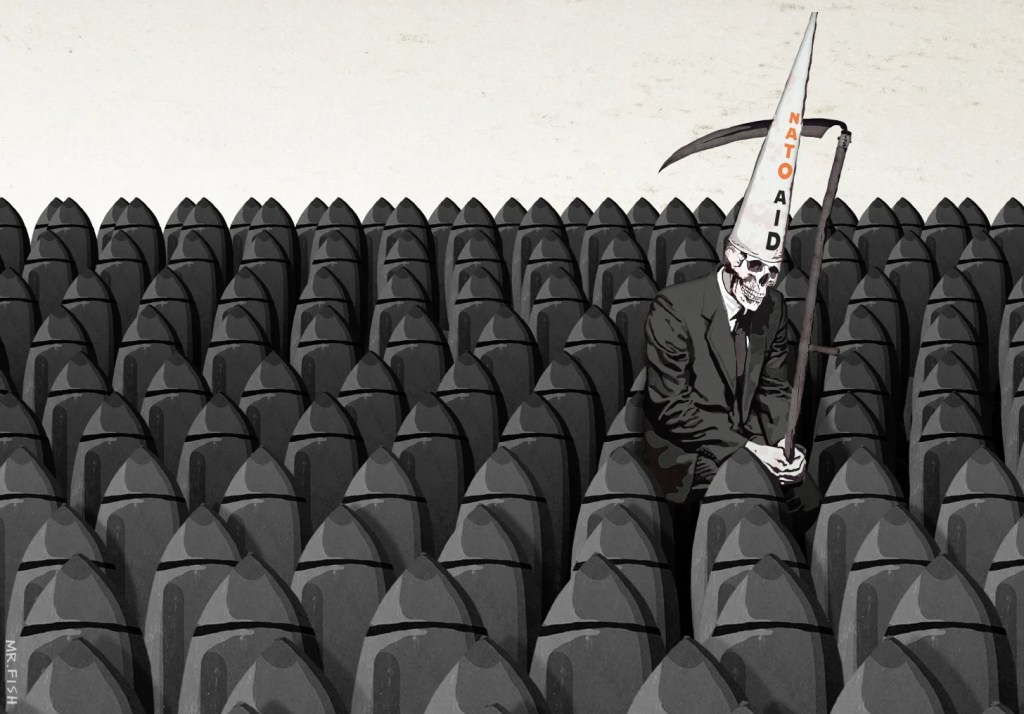
Business is Booming – by Mr. Fish

By Chris Hedges

Source: The Chris Hedges Report

“We came, we saw, he died,” Hillary Clinton famously quipped when Muammar Gaddafi, after seven months of U.S. and NATO bombing, was overthrown in 2011 and killed by a mob who sodomized him with a bayonet. But Gaddafi would not be the only one to die.  Libya, once the most prosperous and one of the most stable countries in Africa, a country with free healthcare and education, the right for all citizens to a home, subsidized electricity, water and gasoline, along with the lowest infant mortality rate and highest life expectancy on the continent, along with one of the highest literacy rates, swiftly fragmented into warring factions. There are currently two rival regimes battling for control in Libya, along with an array of rogue militias. 

The chaos that followed Western intervention saw weapons from the country’s arsenals flood the black market, with many snatched up by groups such as the Islamic State. Civil society ceased to function. Journalists captured images of migrants from NigeriaSenegal and Eritrea being beaten and sold as slaves to work in fields or on construction sites. Libya’s infrastructure, including its electrical grids, aquifers, oil fields and dams, fell into disrepair. And when the torrential rains from Storm Daniel —  the climate crisis being another gift to Africa from the industrialized world — overwhelmed two decrepit dams, walls of water 20 feet high raced down to flood the port of Derna and Benghazi, leaving up to 20,000 dead according to Abdulmenam Al-Gaiti, Mayor of Derna, and some 10,000 missing. 

“The fragmentation of the country’s disaster management and disaster response mechanisms, as well as deteriorating infrastructure, exacerbated the enormity of the challenges. The political situation is a driver of risk,” said Professor Petteri Taalas, Secretary General of the World Meteorological Organization.

Taalas told reporters last Thursday that “most of the human casualties” would have been avoided if there had been a “normally operating meteorological service” which “would have issued the [necessary] warnings and also the emergency management of this would have been able to carry out evacuations of the people.”

Western regime-change, carried out in the name of human rights under the doctrine of R2P (Responsibility to Protect), destroyed Libya – as it did Iraq – as a unified and stable nation. The flood victims are part of the tens of thousands of Libyan dead resulting from our “humanitarian intervention,” which rendered disaster relief non-existent. We bear responsibility for Libya’s prolonged suffering. But once we wreak havoc on a country in the name of saving its persecuted — regardless of whether they are being persecuted or not — we forget they exist. 

Karl Popper in “The Open Society and Its Enemies” warned against utopian engineering, massive social transformations, almost always implanted by force, and led by those who believe they are endowed with a revealed truth. These utopian engineers carry out the wholesale destruction of systems, institutions and social and cultural structures in a vain effort to achieve their vision. In the process, they dismantle the self-correcting mechanisms of incremental and piecemeal reform that are impediments to that grand vision. History is replete with murderous utopian social engineering — the Jacobins, the communists, the fascists and now, in our own age, the globalists, or neoliberal imperialists.

Libya, like Iraq and Afghanistan, fell victim to the self-delusions peddled by humanitarian interventionists — Barack Obama, Hillary Clinton, Ben Rhodes, Samantha Power and Susan Rice. The Obama administration armed and backed an insurgent force that they believed would do the bidding of the U.S.  Obama in a recent post urged people to support aid agencies to alleviate the suffering of the people of Libya, a plea that ignited an understandable backlash on social media.

There is no official tally of the casualties in Libya that have resulted directly and indirectly from the violence in Libya over the last 12 years. This is exacerbated by the fact that NATO failed to investigate casualties resulting from its seven month bombardment of the country in 2011. But the total figure of those killed and injured is likely in the tens of thousands. Action on Armed Violence recorded “8,518 deaths and injuries from explosive violence in Libya” from 2011 to 2020,  6,027 of which were civilian casualties.

In 2020, a statement published by seven U.N. agencies reported that “Close to 400,000 Libyans have been displaced since the start of the conflict nine years ago — around half of them within the past year, since the attack on the capital, Tripoli, [by Field Marshal Khalifa Belqasim Haftar’s forces] started.”

“The Libyan economy has been battered by the [civil war], the COVID-19 pandemic, and Russia’s invasion of Ukraine,” the World Bank reported in April of this year. “The country’s fragility is having far-reaching economic and social impact. GDP per capita declined by 50 percent between 2011 and 2020 while it could have increased by 68 percent if the economy had followed its pre-conflict trend,” the report says. “This suggests that Libya’s income per capita could have been 118 percent higher without the conflict. Economic growth in 2022 remained low and volatile due to conflict-related disruptions in oil production.”

Amnesty International’s 2022 Libya report also makes for grim reading. “Militias, armed groups and security forces continued to arbitrarily detain thousands of people,” it says. “Scores of protesters, lawyers, journalists, critics and activists were rounded up and subjected to torture and other ill-treatment, enforced disappearances and forced ‘confessions’ on camera.” Amnesty describes a country where militias operate with impunity, human rights abuses, including kidnappings and sexual violence, are widespread. It adds that “EU-backed Libyan coastguards and the Stability Support Authority militia intercepted thousands of refugees and migrants at sea and forcibly returned them to detention in Libya. Detained migrants and refugees were subjected to torture, unlawful killings, sexual violence and forced labour.”

Reports by the U.N. Support Mission to Libya (UNSMIL) are no less dire.

Stockpiles of weapons and ammunition — estimated to be between 150,000 and 200,000 tons — were looted from Libya with many being trafficked to neighboring states. In Mali, weapons from Libya fuelled a dormant insurgency by the Tuareg, destabilizing the country. It ultimately led to a military coup and a jihadist insurgency which supplanted the Tuareg, as well as a protracted war between the Malian government and jihadists.  This triggered another French military intervention and led to 400,000 people being displaced. Weapons and ammunition from Libya also made their way into other parts of the Sahel including Chad, Niger, Nigeria and Burkina Faso. 

The misery and carnage, which rippled out from a dismembered Libya, was unleashed in the name of democratization, nation-building, promoting the rule of law and human rights. 

The pretext for the assault was that Gaddafi was about to launch a military operation to massacre civilians in Benghazi where rebellious forces had seized power. It had as much substance as the charge that Saddam Hussein had weapons of mass destruction, another example of utopian social engineering that left over a million Iraqi dead and millions more driven from their homes. 

Gaddafi — who I interviewed for two hours in April 1995 near the gutted remains of his home that was bombed by U.S. warplanes in 1986 — and Hussein were targeted not because of what they did to their own people, although both could be brutal. They were targeted because their nations had large oil reserves and were independent of Western control. They renegotiated more favorable contracts for their nations with Western oil producers and awarded oil contracts to China and Russia. Gaddafi also gave the Russian fleet access to the port of Benghazi.

Hillary Clinton’s emails, obtained via a freedom of information request and published by WikiLeaks, also expose France’s concerns about Gaddafi’s efforts to “provide Francophone African Countries with an alternative to the French Fran (CFA).” Sidney Blumenthal, a longtime adviser to Clinton, reported on his conversations with French intelligence officers about the motivations of French President Nicholas Sarkozy, the chief architect of the attack on Libya. Blumenthal writes that the French president seeks “a greater share of Libyan oil”, increased French influence in the region, an improvement in his domestic political standing, a reassertion of French military power and an end to Gaddafi’s attempts to supplant French influence in “Francophone Africa.”

Sarkozy, who has been convicted on two separate cases of corruption and breach of campaign finance laws, faces a historic trial in 2025 for allegedly receiving millions of euros in secret illegal campaign contributions from Gadaffi, to assist with his successful 2007 presidential bid.            

These were the real “crimes” in Libya. But the real crimes always remain hidden, papered over by florid rhetoric about democracy and human rights. 

The American experiment, built on slavery, began with a genocidal campaign against Native Americans that was exported to the Philippines and, later, nations such as Vietnam. The narratives we tell ourselves about World War II, largely to justify our right to intervene around the globe, are a lie. It was the Soviet Union that destroyed the German army long before we landed at Normandy. We firebombed cities in Germany and Japan killing hundreds of thousands of civilians.  The war in the South Pacific, where one of my uncles fought, was bestial, characterized by rabid racism, mutilation, torture and the routine execution of prisoners. The atomic bombings of Hiroshima and Nagasaki were egregious war crimes. The U.S. routinely destroys democracies that nationalize U.S. and European corporations as in Chile, Iran and Guatemala, replacing them with repressive military regimes. Washington supported the genocides in Guatemala and East Timor. It embraces the crime of preemptive war. There is little in our history to justify the claim of unique American virtues. 

The nightmares we orchestrated in Iraq, Afghanistan and Libya are minimized or ignored by the press while the benefits are exaggerated or fabricated. And since the U.S. does not recognize the International Criminal Court, there is no chance of any American leader being held accountable for their crimes.

Human rights advocates have become a vital cog in the imperial project. The extension of U.S. power, they argue, is a force for good. This is the thesis of Samantha Power’s book “A Problem from Hell: America and the Age of Genocide.” They champion the R2P doctrine, unanimously adopted in 2005 at the U.N. World Summit. Under this doctrine, states are required to respect the human rights of their citizens. When these rights are violated, then sovereignty is nullified. Outside forces are permitted to intervene. Miguel d’Escoto Brockmann, the former president of the U.N. General Assembly, warned in 2009 that R2P could be misused “to justify arbitrary and selective interventions against the weakest states.” 

“Since the end of the Cold War, the idea of human rights has been made into a justification for intervention by the world’s leading economic and military powers, above all, the United States, in countries that are vulnerable to their attacks,” writes Jean Bricmont in “Humanitarian Imperialism: Using Human Rights to Sell War.”  “Until the U.S. invasion of Iraq, [a] large part of the left was often complicit in this ideology of intervention, discovering new ‘Hitlers’ as the need arose, and denouncing antiwar arguments as appeasement on the model of Munich in 1938.” 

The creed of humanitarian intervention is selective. Compassion is extended to “worthy” victims while “unworthy” victims are ignored. Military intervention is good for Iraqis, Afghans or Libyans, but not for Palestinians or Yeminis. Human rights are supposedly sacrosanct when discussing Cuba, Venezuela and Iran, but irrelevant in our offshore penal colonies, the world’s largest open air prison in Gaza or our drone-infested war zones. The persecution of dissidents and journalists is a crime in China or Russia, but not when the targets are Julian Assange and Edward Snowden.

Utopian social engineering is always catastrophic. It creates power vacuums that augment the suffering of those the utopianists claim to protect. The moral bankruptcy of the liberal class, which I chronicle in “Death of the Liberal Class,” is complete. Liberals have prostituted their supposed values to the Empire. Incapable of taking responsibility for the carnage they inflict, they clamor for more destruction and death to save the world.

The Government Slaughter in Lahaina: Maui Revisited!

By Gary D. Barnett

Source: GaryDBarnett.com

“Whoever lays his hand on me to govern me is a usurper and tyrant, and I declare him my enemy.”

~ Pierre-Joseph Proudhon

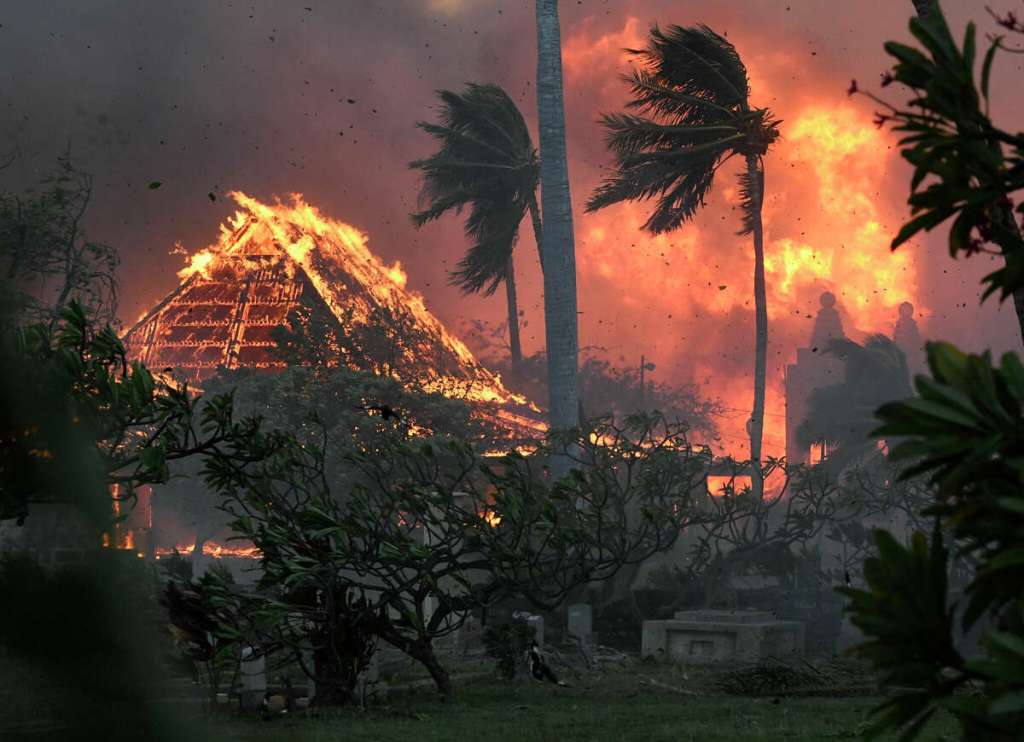
We are in the midst of a heinous crime in what is falsely referred to as the ‘American’ State of Hawaii, so vile and evil, that it should sicken all who have any remote possibility of exhibiting mental acquaintance with truth, compassion, or empathy. The State’s attack on the people of Maui was in my studied opinion, premeditated, brutal, murderous beyond explanation, and targeted to achieve a preconceived agenda which was the total destruction of Lahaina by extreme property devastation and mass death of much of the local population. This was necessary in the mind of the State in order to steal the land and rebuild based on the World Economic Forum and U.N. plan for captured cities, as evidenced by the evil piece of garbage governor, Josh Green, who immediately claimed he wanted to acquire by theft the purposely destroyed land and property for the State, while smoldering embers still burned, and bodies had not been found.

Today, I went to the ten top mainstream news sites searching all news stories, and did not find a single story about the Lahaina fires, except one showing the slimy Biden sleeping while at a meeting with Maui victims; this after offering these victims $700 per family after they had lost everything, including many of their family members. In other words, this story has been purposely scrubbed from view, not different than what happened after the intentional chemical fire devastated East Palestine, Ohio, and left that town and many others with deadly pollutants. A tall black fence was actually built around the town of Lahaina, at taxpayer cost of course, and a no fly zone order was given to hide the gruesome murder scene from any view and scrutiny.

What is insanely troubling about the reporting concerning this horrific crime in Maui by all mainstream outlets, and even many alternative sites, is that most continue to call this a ‘wild fire,’ while the evidence of such nonsense does not exist. The anomalies and reactions to this so-called ‘natural’ event, are staggering beyond recognition, and reek of the stench of total corruption at the highest levels. This was a land grab of epoch proportion, but it was much worse than that, as high death counts were pursued by the State thugs, as they locked the residents of Lahaina inside the rings of deadly fire likely caused by directed energy and microwave attacks; creating fires that were strategically targeted, with heat that was in some cases double that of any wild fire. This was clearly evident given the melting of aluminum and steel, and also the melting of automobile windshields which requires heat at or above 2,500 degrees. Cars were melted where no evidence of a fire was even present, and the scene looked eerily similar, almost exact, as to what happened in New York on September 11, 2001. This is not coincidental, it is apparent, and telling of a pre-planned slaughter and mass destruction.

The fires in Maui that were said to have been caused ‘naturally,’ a brazen lie, were almost identical to the fires in Paradise, California as well; fires that were targeted, burning homes to white ash without burning trees or plastic, and in areas desired by the State criminals for rebuilding so-called “smart cities.” In Lahaina, homes of the very rich were magically spared, as were certain state buildings, grand hotels, and other areas of State favor. But the homes and families of the local residents were attacked head on, with absolutely no regard for the lives or property of these innocent people. The ‘crime’ supposedly committed, as seen by the State, was not bowing down, and giving up their homes and lives voluntarily, so a direct false flag action of slaughter and murder was created to complete the State’s agenda of land theft. To hell with the people and their property was the private battle cry of these State politicians and their murderous enforcers called police.

No sirens were turned on even though there were 80 active sirens on Maui. All water was turned off so fires could not be fought. Wi-fi was turned off, as was most all electric power. Roads out were closed, and police roadblocks were manned to forcibly keep all the residents inside the fire perimeter, causing purposeful mass death. Schools were shut down, so that children were home alone when these intentional fires raged through Lahaina, and many burned to death without help from any State service. The real numbers of deaths are still being hidden as far as I can tell. In addition. before and after the fire, speculators were attempting to buy these properties, and while bodies were still unfound, the government announced its intentions to buy up this land. None of these are coincidences, but the State and its complicit media would have you believe that all of these, and many, many, more impossibilities are all coincidental. How could anyone with two brain cells to rub together, buy into the propagandized narratives being presented by the evil State?

I fully realize, especially considering the nearly complete lack of any ability to think critically by the masses, that what I am presenting here will be ignored by a very large swath of the population. The long-term dumbing down of individuals, and the now digitally-manipulated population, has embraced indifference to such an extent, as to have escaped all reality. In fact, common sense, logic, and reason appear to be nearly non-existent generally speaking. It is much easier for the collective herd to believe the State narratives than to do the work necessary to ferret out fact and truth. Unfortunately, the ruling class understands this weak and apathetic trait that seems to have captured the very large percentage of dead men walking among us. How much more obvious corruption, lies, and murder at the hands of the State will have to take place before any majority comes to terms with the reality that this world is ending in favor of mass slavery and depopulation? Will the flock ever fight back?

The forced annexation of Hawaii, the staged Pearl Harbor attack, the world wars, Operation Northwoods, MK Ultra, the Cuban missile crisis, the JFK assassination, Operation Gladio, U.S. aggressive invasion after invasion, Desert Storm, 9/11, the Patriot Act, the War of Terror, the fake ‘covid pandemic,’ bogus ‘climate change, intentional chemical spills, and weather geo-engineering; these just a few of the major false flag events, and government terror operations that have taken place. Now there are deliberately set fires in Canada, all over the U.S., Hawaii, Australia, Turkey, Greece, China, and many other areas, and the sheep continue to hide their proverbial heads in the sand.

Everything happening is planned, and being done intentionally in order to achieve a particular agenda. This has been outlined, discussed openly, warned about, written about in policy journals at the WEF, WHO, U.N., and most everywhere else I might add. The big picture has been discussed for decades, and the agenda being sought is a one-world governing order, where the ‘elite’ rule all, and the rest of us are slaves of the State. This agenda is as clear as day, so why cannot the lowly collective herd see that the way to achieve this evil goal is for the State to destroy the current system in favor of a system that will allow the control of everyone? Each planned event, whether fire, weather, war, geo-engineering, bio-weapon production and use, fake ‘viruses,’ and every so-called emergency, are staged only to create fear and panic through economic devastation, property theft, (land grabs) monetary and transaction digitization, mass surveillance, and total censorship.

Will the blind ever see, will the deaf ever hear, will the dumb ever speak, or will the bulk of this dependent and lazy population, simply sit back locked inside their cell phones and ‘social media’ absurdity, waiting for the end of times?

No one should forget or ignore what happened, and is happening in Maui. Your neighborhood could be next, and what chance will you have given the advanced weapon systems being used against us by the military industrial complex, and its controllers? The government controls nothing, as all politicians and their enforcers are fully controlled themselves, and act on orders from the real ruling class. Denounce them, abandon them and eliminate them, so that the real rulers will have no cover!

“I have certain rules I live by. My first rule: I don’t believe anything the government tells me. Nothing. Zero.”

~ George Carlin

Meet the New Normal, Same as the Old Normal: You Are Still the Enemy Within

By Colin Todhunter

Source: Off-Guardian

Today, we are witnessing the nudging (manipulation) of the population to accept a ‘new normal’ based on a climate emergency narrative, restrictions on movement and travel, programmable digital money, ‘pandemic preparedness’ courtesy of the World Health Organization’s tyrannical pandemic treaty, unaccountable AI and synthetic ‘food’.

Whether it involves a ‘food transition’, an ‘energy transition’, 15-minute cities or some other benign-sounding term, all this is to be determined by a supranational ‘stakeholder’ elite with ordinary people sidelined in the process. An undemocratic agenda designed to place restrictions on individual liberty, marking a dramatic shift towards authoritarianism.

In the 1980s, to help legitimise the deregulation-privatisation neoliberal globalisation agenda, government and media instigated an ideological onslaught, driving home the primacy of ‘free enterprise’, individual rights and responsibility and emphasising a shift away from the role of the state, trade unions and the collective in society.

We are currently seeing another ideological shift: individual rights and freedoms are said to undermine the wider needs of society and the planet – in a stark turnaround – personal freedom is now said to pose a threat to national security, public health or the climate.

As in the 1980s, this messaging is being driven by an economic impulse. This time, the collapsing neoliberal project.

In the UK, poverty is increasing in two-thirds of communities, food banks are now a necessary part of life for millions of people and living standards are plummeting. Indeed, the poorest families are enduring a ‘frightening’ collapse in living standards, resulting in life-changing and life-limiting poverty).

In the US, around 30 million low-income people are on the edge of a ‘hunger cliff’ as a portion of their federal food assistance is taken away. In 2021, it was estimated that one in eight children were going hungry in the US. Small businesses are filing for bankruptcy in the US at a record rate.

The Bank of England’s chief economist, Huw Pill, says that people should ‘accept’ being poorer. This is similar to the response of Rob Kapito, co-founder of the world’s biggest asset management firm, BlackRock. In 2022, the unimaginably rich and entitled Kapito said that a “very entitled” generation of (ordinary working) people who have never had to sacrifice would soon have to face shortages for the first time in their lives.

While business as usual prevails in Kapito’s world of privilege and that of major armsenergypharmaceuticals and food companies, whose megarich owners continue to rake in massive profits, Kapito and Pill tell ordinary people to get used to poverty and the ‘new normal’ as if we are ‘all in it together’ – billionaires and working class alike. They conveniently use COVID and the situation in Ukraine as cover for the collapsing neoliberalism.

But this is part of the hegemonic agenda that seeks to ensure that the establishment’s world view is the accepted cultural norm. And anyone who challenges this world view – whether it involves, for instance, questioning climate alarmism, the ‘new normal’, the nature of the economic crisis, the mainstream COVID narrative or the official stance on Ukraine and Russia – is regarded as a spreader of misinformation and the ‘enemy within’.

Although the term ‘enemy within’ was popularised by Margaret Thatcher during the miners’ strike in 1984-85 to describe the striking miners, it is a notion with which that Britain’s rulers have regarded protest movements and uprisings down the centuries. From the Peasants’ Revolt in 1381 to the Levellers and Diggers in the 17th century, it is a concept associated with anyone or any group that challenges the existing social order and the interests of the ruling class.

John Ball, a radical priest, addressed the Peasants’ Revolt rebels with the following words:

Good friends, matters cannot go well in England until all things be held in common; when there shall be neither vassals nor lords; when the lords shall be no more masters than ourselves.”

The revolt was suppressed. John Ball was captured and hung, drawn and quartered. Part of the blood-soaked history of the British ruling class.

Later on, the 17th-century Diggers movement wanted to create small, egalitarian rural communities and farm on common land that had been privatised by enclosures.

The 1975 song ‘The world Turned Upside Down’ by Leon Rosselson commemorates the Diggers. His lyrics describe the aims and plight of the movement. In Rosselson’s words, the Diggers were dispossessed via theft and murder but reclaimed what was theirs only to be violently put down.

Little surprise then that, in the 1980s, Margaret Thatcher used the state machinery to defeat the country’s most powerful and trade union and the shock troops of the labour movement, the National Union of Mineworkers – ‘the enemy within’. She needed to do this to open the gates for capital to profit from the subsequent deindustrialisation of much of the UK and the dismantling of large parts of the welfare state.

And the result?

A hollowed-out, debt-bloated economy, the destruction of the social fabric of entire communities and the great financial Ponzi scheme – the ‘miracle’ of deregulated finance – that now teeters on the brink of collapse, leading the likes of Kapito and Pill to tell the public to get ready to become poor.

And now, in 2023, the latest version of the ‘enemy within’ disseminates ‘misinformation’ – anything that challenges the official state-corporate narrative. So, this time, one goal is to have a fully controlled (censored) internet.

For instance, US Special Operations Command (USSOCOM) recently awarded Accrete a contract for Argus to detect disinformation threats from social media. Argus is AI software that analyses social media data to predict emergent narratives and generate intelligence reports at a speed and scale to help neutralise viral disinformation threats.

Accrete AI is a leading dual-use enterprise AI company. It deployed its AI Argus software for open-source threat detection with the US Department of Defense in 2022.

In a recent press release, Prashant Bhuyan, founder and CEO of Accrete, boasts:

Social media is widely recognised as an unregulated environment where adversaries routinely exploit reasoning vulnerabilities and manipulate behaviour through the intentional spread of disinformation. USSOCOM is at the tip of the spear in recognising the critical need to identify and analytically predict social media narratives at an embryonic stage before those narratives evolve and gain traction. Accrete is proud to support USSOCOM’s mission.”

‍This is about predicting wrong think on social media. But control over the internet is just part of a wider programme of establishment domination, surveillance and dealing with protest and dissent.

The recent online article ‘How the Government Weaponizes Surveillance to Silence Its Critics’ notes that, on any given day, the average person in the US is monitored, spied on and tracked in more than 20 different ways.

The authors of the article ask us to consider some of the ways the US government is weaponizing its surveillance technologies to flag citizens as a threat to national security, whether or not they have done anything wrong – from flagging citizens as a danger based on their feelings, phone and movements to their spending activities, social media activities, political views and correspondence.

The elite has determined that the existential threat is you. The article ‘Costs of War: Peterloo’, written by UK Veterans for Peace member Aly Renwick, details the history of the brutal suppression of protesters by Britain’s rulers. He also strips away any notion that some may have of a benign, present-day ruling elite with democratic leanings. The leopard has not changed its spots.

As we saw during COVID, the thinking is that hard-won rights must be curtailed, freedom of association is reckless, free thinking is dangerous, dissent is to be stamped on, impartial science is a threat and free speech is deadly. Government is ‘the truth’, Fauci (or some similar figure) is ‘the science’ and censorship is for your own good.

None of this was justified. It only begins to make sense if we regard the COVID restrictions in terms of trying to deal with an economic crisis by closing down the global economy under cover of a public health crisis (see the online articles ‘What Was Covid Really About? Triggering a Multi-Trillion Dollar Global Debt Crisis’ and ‘Italy 2020: Inside Covid’s Ground Zero’ which outline how COVID policies can be explained by economic factors not health concerns).

The economic crisis is making many people poorer, so they must be controlled, monitored and subjugated.

The transitions mentioned at the start of this article along with the surveillance agenda (together known as the ‘Great Reset’) are being accelerated at this time of economic crisis when countless millions across the West are being impoverished. The collapsing financial system is resulting in an interrelated global debt, inflation and ‘austerity’ crisis and the biggest transfer of wealth to the rich in history.

As a result, the powers that be fear that the masses might once again pick up their pitchforks and revolt. They are adamant that the peasants must know their place.

But the flame of protest and dissent from centuries past still inspires and burns bright. So, with that in mind, let’s finish with Leon Rosselson’s lyrics in reference to the Diggers movement (Billy Bragg’s version of the song can be found on YouTube):

In sixteen forty-nine
To St. George’s Hill
A ragged band they called the Diggers
Came to show the people’s will
They defied the landlords
They defied the laws
They were the dispossessed reclaiming what was theirs

We come in peace they said
To dig and sow
We come to work the lands in common
And to make the waste grounds grow
This earth divided
We will makе whole
So it will be
A common treasury for all

Thе sin of property
We do disdain
No man has any right to buy and sell
The earth for private gain
By theft and murder
They took the land
Now everywhere the walls
Spring up at their command

They make the laws
To chain us well
The clergy dazzle us with heaven
Or they damn us into hell
We will not worship
The God they serve
The God of greed who feed the rich
While poor man starve

We work we eat together
We need no swords
We will not bow to masters
Or pay rent to the lords
We are free men
Though we are poor
You Diggers all stand up for glory
Stand up now

From the men of property
The orders came
They sent the hired men and troopers
To wipe out the Diggers’ claim
Tear down their cottages
Destroy their corn
They were dispersed
Only the vision lingers on

You poor take courage
You rich take care
The earth was made a common treasury
For everyone to share
All things in common
All people one
We come in peace
The order came to cut them down
We come in peace
The order came to cut them down

From Burkina Faso to Niger to Gabon, Western Hegemony Dying in Africa

By Harun Elbinawi

Source: Covert Geopolitics

Berlin Conference of 1884-1885 was undeniably one of the biggest evil summits in modern history. Greedy and racist European colonialists sat down in the German city and divided Africans as if they were sharing bread on a breakfast table.

The conference was organized by Otto von Bismarck, the first chancellor of Germany at the request of King Leopold II of Belgium, the Western genocidal barbarian that murdered more than 10 million innocent Africans in Congo.

Most Africans are not even aware of this genocide in Congo perpetrated by the Belgium colonialists because it is not in our history books written by the white colonialists.

European colonialism in Africa lasted more than a century with only the ancient Kingdom of Ethiopia spared because they defeated the Italian colonialists on the battlefield.

Trillions and trillions of dollars were stolen from Africa, millions of Africans were murdered by the European colonialists and Africans were massively brainwashed that they had no history before European colonialism.

The wave of ‘independence’ in Africa from the 1950s and 1960s did not represent true independence. What actually happened was that colonialism was cleverly replaced with neocolonialism by the genocidal imperialist barbarians of the West.

The massive looting of rich resources in Africa continued under Western puppet leadership. The courageous African leaders who refused to dance to the tune of the European colonialists were eliminated.

This was what happened to African heroes, Patrick Lumumba of Congo and Thomas Sankara of Burkina Faso. Congo has all mineral resources except for crude oil.

The uranium used by the US regime to make the atomic bombs unleashed on Hiroshima and Nagasaki was mined in Congo.

French greed in Africa

Among the European colonialists, French colonialism was more brutal and exploitative.

France killed more than 1.5 million civilians in Algeria alone. They murdered tens of thousands of civilians in other African countries.

One of the Modus Operandi of the French colonialists was to assemble Islamic scholars in a hall and exterminate all of them. They did this in Algeria, Chad, Mali and Senegal.

And the greed of their neocolonialism is extreme. Even after independence, France is still controlling the wealth of its former colonies in Africa.

The rich resources of French nations are still controlled by France and they continue to pay colonial tax to France.

French goods and services dominate their markets. The domineering presence of France in these countries has been excruciating and devastating for local populations.

Niger Republic does not know the quantity of uranium France was taking from there, which is worst than slavery.

No evil lasts forever

There is a popular saying that “No evil lasts forever”.

France’s neocolonialism in Africa will not last forever. Popular military coups against puppets of France imperialism have started and are gathering momentum.

The recent military coup in the West African state of Niger Republic does not stand in isolation but follows similar upheavals in the neighboring countries of Mali, Burkina Faso, and Guinea in recent years.

Mali is facing insurgency that is backed by Western hegemony. Mali expelled French troops because they were actively aiding the insurgents to justify its military presence in the African country.

Now, on Wednesday, we woke up with the news of another puppet of the Western hegemonic barbarians in Gabon overthrown by the military. Ali Bango inherited the Gabon presidency from his corrupt Father, Omar Bongo.

Early on Wednesday, some military personnel appeared on state TV and announced that they were seizing power and dislodging a family that has ruled the country for 56 years.

The military officers introduced themselves as members of the Committee of Transition and the Restoration of Institutions.

“Today the country is undergoing a severe institutional, political, economic, and social crisis,” the officers said in a statement, dubbing the recent election illegitimate.

“In the name of the Gabonese people … we have decided to defend the peace by putting an end to the current regime.”

Pertinently, Gabon’s former president had 70 bank accounts, 39 apartments, 2 Ferraris, 6 Mercedes Benz cars, 3 Porsches and a Bugatti in France. He ruled for 42 years (from 1967 to 2009). French leaders loved Bongo because he was loyal to them.

His son, Ali Bongo has been the president for 14 years (2009 – 2023). He has just been overthrown in a  coup.

Failure of Western liberal democracy

The fact is that the Western liberal democracy has not only failed in Africa but has failed woefully.

Democracy in Africa has become a tool for the corrupt ruling elites to steal the wealth of their respective countries and transfer it to Western financial institutions while the populations remain in abject poverty and hunger.

Democracy is just another system of government hijacked by the Western hegemonic barbarians, the biggest enemies of the human race. Democracy is now an imperialist tool of Western hegemony in Africa. This is a bitter and undeniable fact.

The people of Gabon will definitely celebrate this military coup as it marks the end of French interference and looting in their country. Another setback for the French leaders.

Africa must rise again

The most noticeable current in Mali, Burkina Faso, Guinea, Niger Republic and Gabon is that the change of governments all have popular support as the people of those countries are tired of France’s imperialism, arrogance and terrorism.

Today France has the 4th largest gold reserves in the world and there is no single gold mine in France.

These gold mines are all in Mali, Niger Republic and other African countries. The France neocolonialism in Africa must end. Its time has come.

‘Give War a Chance’ – A ‘War That Even Pacifists Can Get Behind’

By Alastair Crooke

Source: Strategic Culture Foundation

The West is now waking up to the reality of the emerging, polycentric and fluid global order, Alastair Crooke writes.

More than a year into Russia’s Special Operation, the initial burst of European excitement at western push-back on Russia has dissipated. The mood instead has turned to “existential dread, a nagging suspicion that [western] civilisation may destroy itself”, Professor Helen Thompson writes.

For an instant, a euphoria had coalesced around the putative projection of the EU as a world power; as a key actor, about to compete on a world scale. Initially, events seemed to play to Europe’s conviction of its market powers: Europe was going to bring down a major power – Russia – by financial coup d’état alone. The EU felt ‘six feet tall’.

It seemed at the time a galvanising moment: “The war re-forged a long-dormant Manichaean framing of existential conflict between Russia and the West, assuming ontological, apocalyptic dimensions. In the spiritual fires of the war, the myth of the ‘West’ was rebaptised”, Arta Moeini suggests.

After the initial disappointment at the lack of a ‘quick kill’, the hope persisted – that if only the sanctions were given more time, and made more all-embracing, then Russia surely would ultimately collapse. That hope has turned to dust. And the reality of what Europe has done to itself has begun to dawn – hence Professor Thomson’s dire warning:

“Those who assume that the political world can be reconstructed by the efforts of human Will, have never before had to bet so heavily on technology over [fossil] energy – as the driver of our material advancement”.

For the Euro-Atlanticists however, what Ukraine seemed to offer – finally – was validation for their yearning to centralise power in the EU, sufficiently, to merit a place at the ‘top table’ with the U.S., as partners in playing the Great Game.

Ukraine, for better or worse, underlined Europe’s profound military dependence on Washington – and on NATO.

More particularly, the Ukraine conflict seemed to open the prospect for consolidating the strange metamorphosis of NATO from military alliance to an enlightened, Progressive, peace alliance! As Timothy Garton Ash effused in the Guardian in 2002, “NATO has become a European peace movement” where one could watch “John Lennon meet George Bush”.

The Ukraine war is portrayed, in this vein, as the “war­ that even former pacifists can get behind. All its proponents seemed to be singing is “Give War a Chance””.

Lily Lynch, a Belgrade-based writer, argues that,

“…especially in the past 12 months, telegenic female leaders such as the Finnish Prime Minister, Sanna Marin, German Foreign Minister, Annalena Baerbock, and Estonian Prime Minister, Kaja Kallas, have increasingly served as the spokespersons of enlightened militarism in Europe … ”

“No political party in Europe better exemplifies the shift from militant pacifism to ardent pro-war Atlanticism than the German Greens. Most of the original Greens had been radicals during the student protests of 1968 … But as the founding members entered middle age, fissures began to appear in the party – that would one day tear it apart”.

“Kosovo then changed everything: The 78-day NATO bombing of what remained of Yugoslavia in 1999, ostensibly to halt war crimes committed by Serbian security forces in Kosovo, would forever transform the German Greens. NATO for the Greens became an active military compact concerned with spreading and defending values such as human rights, democracy, peace, and freedom – well beyond the borders of its member states”.

A few years later, in 2002, an EU functionary (Robert Cooper) could envisage Europe as a new ‘liberal imperialism’. The ‘new’ was that Europe eschewed hard military power, in favour of weaponising both a controlled ‘narrative’ and controlled participation in its market. He advocated for ‘a new age of empire’, in which Western powers no longer would have to follow international law in their dealings with ‘old fashioned’ states; they could use military force independently of the United Nations; and could impose protectorates to replace regimes which ‘misgovern’.

The German Greens’ Foreign Minister, Annalena Baerbock, has continued with this metamorphosis, scolding countries with traditions of military neutrality, and imploring them to join NATO. She has invoked Archbishop Desmond Tutu’s line: “If you are neutral in situations of injustice, you have chosen the side of the oppressor”. And the European Left has been utterly captivated. Major parties have abandoned military neutrality and opposition to war – and now champion NATO. It is a stunning reversal.

All this may have been music to the ears of the Euro-élites anxious for the EU to rise to Great Power status, but this soft-power European Leviathan was wholly underpinned by the unstated (but essential) assumption that NATO ‘had Europe’s back’. This naturally implied that the EU had to tie itself ever closer to NATO – and therefore to the U.S. which controls NATO.

But the flip-side to this Atlanticist aspiration – as President Emmanuel Macron noted – is its inexorable logic that Europeans simply end by becoming American vassals. Macron was trying rather, to rally Europe towards the coming ‘age of empires’,hoping to position Europe as a ‘third pole’ in a concert of empires.

The Atlanticists were duly enraged by Macron’s remarks (which nonetheless drew support of other EU states). It could even seem (to furious Atlanticists) that Macron actually was channelling General de Gaulle who had called NATO a “false pretence” designed to “disguise America’s chokehold over Europe”.

There are however, two related schisms that flowed out from this ‘re-imagined’ NATO: Firstly, it exposed the reality of internal European rivalries and divergent interests, precisely because the NATO lead in the Ukraine conflict sets the interests of the Central East European hawks wanting ‘more America, and more war on Russia’ up and against that of the original EU western axis which wants wanting strategic autonomy (i.e. less ‘America’, and a quick end to the conflict).

Secondly, it would be predominantly the western economies that would have to bankroll the costs and divert their manufacturing capacity towards military logistic chains. The economic price, non-military de-industrialisation and high inflation, potentially, could be enough to break Europe – economically.

The prospect of a pan-European cohesive identity might be both ontologically appealing – and be seen to be an ‘appropriate accessory’ to an aspiring ‘world actor’ – yet such identity becomes caricature when mosaic Europe is transformed into an abstract de-territorialised identity that reduces people to their most abstract.

Paradoxically, the Ukraine war – far from consolidating the EU ‘identity’, as first imagined – has fractured it under the stresses of the concerted effort to weaken and collapse Russia.

Secondly, as Arta Moeini, the director of the Institute for Peace and Diplomacy, has observed:

“The American push for NATO expansion since 1991 has enlarged the alliance by adding a host of faultline states from Central and Eastern Europe. The strategy, which began with the Clinton administration but was fully championed by the George W. Bush administration, was to create a decidedly pro-American pillar on the continent, centred on Warsaw – which would force an eastward shift in the alliance’s centre of gravity away from the traditional Franco-German axis”.

“By using NATO enlargement to weaken the old power centres in Europe that might have occasionally stood up to [Washington] such as in the run-up to the invasion of Iraq, Washington ensured a more compliant Europe in the short-term. The upshot, however, was the formation of a 31-member behemoth with deep asymmetries of power and low compatibility of interests” – that is much weaker and more vulnerable – than it believes itself to be”.

Here is the key: “the EU is much weaker than it believes it to be”. The outset of the conflict was defined by a cast of mind entranced by the notion of Europe as a ‘mover and shaker’ in world affairs, and mesmerised by Europe’s post-war prosperity.

EU leaders convinced themselves that this prosperity had bequeathed it the clout and the economic depth to contemplate war – and to weather its reversals – with panglossian sanguinity. It has produced rather, the converse: It has put its project in jeopardy.

In John Raply and Peter Heather’s The Imperial Life Cycle, the authors explain the cycle:

“Empires grow rich and powerful and attain supremacy through the economic exploitation of their colonial periphery. But in the process, they inadvertently spur the economic development of that same periphery, until it can roll back and ultimately displace its overlord”.

Europe’s prosperity in this post-war era, thus was not so much one of its own making, but drew benefit from the tail-end of accumulations hewn from an earlier cycle – now reversed.

“The fastest-growing economies in the world are now all in the old periphery; the worst-performing economies are disproportionately in the West. These are the economic trends that have created our present landscape of superpower conflict — most saliently between America and China”.

America may think of itself as exempt from the European colonial mould, yet fundamentally, its model is

“an updated cultural-political glue that we might call “neoliberalism, NATO and denim”, which follows in the timeless imperial mould: The great wave of decolonisation that followed WW2 was meant to end that. But the Bretton Woods system, which created a trading regime that favoured industrial over primary producers and enshrined the dollar as the global reserve currency – ensured that the net flow of financial resources continued to move from developing countries to developed ones. Even when the economies of the newly-independent states grew, those of the G7 economies and their partners grew more”.

A once-mighty empire is now challenged and feels embattled. Taken aback by the refusal of so many developing countries to join with isolating Russia, the West is now waking up to the reality of the emerging, polycentric and fluid global order. These trends are set to continue. The danger is that economically weakened and in crisis, western countries attempt to re-appropriate western triumphalism, yet lack the economic strength and depth, so to do:

“In the Roman Empire, peripheral states developed the political and military capacity to end Roman domination by force… The Roman Empire might have survived – had it not weakened itself with wars of choice – on its ascendant Persian rival”.

The final ‘transgressive’ thought goes to Tom Luongo: “Allowing the West to keep thinking they can win – is the ultimate form of grinding out a superior opponent”.

Interesting!