The Wickedness of [US] Foreign Policy

us-imperialism-nepal-south-asia-revolution

By Sheldon Richman

Source: Center for a Stateless Society

If you want to see how inhumane people can be, just watch those who make and execute foreign policy. We could spend all day discussing the cruelties that politicians and bureaucrats commit against people who live inside the United States. Think how many are caged like wild animals because they manufacture, sell, or consume disapproved substances; gamble where government has forbade it; traded sexual services for money; possessed a gun they weren’t “supposed” to possess; etc. ad infinitum. Naturally, America leads the world in locking up people.

But at least the policy of mass imprisonment gets increasing attention. Subject to far less scrutiny is how America’s (mis)leaders, (mis)representatives and public (self-)servants treat foreigners, especially those with dark skins and a still-unfamiliar religion. When we talk about foreign policy, how easy it is to get wrapped up in abstractions like empire,intervention, nonintervention, and kinetic military action. These are important concepts to understand, of course, but foreign-policy conversations often become sterile examinations of “policy,” when what we need is a full awareness of the harm to individual human beings, the destruction of their families, homes, communities, and societies. These persons are the victims of our rulers’ geopolitical stratagems, which seemly outrank all other considerations. Yet each victim has a story embodying unique relationships and aspirations, a story that is permanently changed by an American cluster bomb, drone-launched missile, or special-ops mission.

The best that can be said of the perpetrators of this carnage and social devastation is that they are guilty of gross negligence. Many of their acts, however, cross into the territory of premeditated murder and the infliction of mayhem with malice aforethought.

One need not look hard for the most egregious examples taking place right at this moment. In Yemen the Obama administration gives indispensable material support to Saudi Arabia’s barbaric war — war ought not to require a qualifier like barbaric, but it seems necessary these days — on the poorest population in the region. The U.S.-facilitated starvation blockade and cluster-bombing take an untold number of Yemeni lives while devastating the social order. Policymakers — a euphemism for the architects of devastation — can rationalize this cruelty in geopolitical terms — the Houthis, who incidentally are fighting al-Qaeda-affiliated jihadis, are (falsely) said to be instruments of Iran — but the fact remains that individual persons who did no harm to anyone are being slaughtered and starved with the help of American politicians and military bureaucrats.

Or how about Syria? U.S. conduct carries out a seemingly incoherent policy of simultaneously targeting the regime of President Bashar al-Assad and one of his chief adversaries, the Islamic State, while helping another Islamist group, al-Nusra Front, that has pledged allegiance to Ayman al-Zawahiri, Osama bin Laden’s successor as head of al-Qaeda, perpetrators of the 9/11 attacks. Estimates of the death total in Syria’s civil war reach as high as 340,000, a number that represents the toll at the hands of both government and rebel forces. (The total is sometimes invidiously attributed to Assad’s military alone.) The injured and refugees are probably uncountable.

What must be understood is that most of these deaths, injuries, and dispossessions would probably not have occurred had the Obama administration — most especially Secretary of State Hillary Clinton — not early on intensified the civil war by declaring Assad’s regime “illegitimate,” demanding that he “go” (i.e., die), and overseeing the transfer weapons and jihadi fighters from Benghazi, Libya. While doing all this, the Obama administration was thwarting promising efforts toward a negotiated settlement, which might have stopped or at least reduced the killing of innocent persons. For details see these three articles by the excellent investigate journalist Jonathan Marshall.

And then there’s Libya itself, which Clinton boasts is an example of “smart power at its best.” In 2011 she had egg on her face because she was on the wrong side of the Arab Spring, having defended Egypt’s military dictator, Hosni Mubarak, as a family friend and trusted world leader to the bitter end while throngs of aggrieved Egyptians were in the streets demanding his exit. Needing to clean up her image (perhaps in preparation for her quest for the presidency), she along with administration national-security VIPs Samantha Power and Susan Rice persuaded a reluctant Obama that the residents of Benghazi had to be saved from Col. Muammar Gaddafi’s alleged genocidal designs. The only problem was that Gaddafi had no genocidal designs. (Also see this and this.) And in a classic exhibition of mission-creep, the U.S.-led NATO air campaign went from protecting Benghazi to changing the regime in Tripoli, prompting Clinton to gloated, “We came. We saw. He died.” (Gaddafi was killed extrajudicially, reportedly in a most gruesome manner.)

Since the U.S. intervention, Libya has been wracked by sectarian civil war — even the Islamic State now holds territory there — prompting many Libyans to flee to Europe, which now has to contend with a growing refugee crisis. As noted, the Libyan power vacuum, featuring the unlocking of Gaddafi’s arsenal of heavy weapons, helped to boost the Islamist rebel militias in Syria, to the delight of U.S. allies Turkey (which fears the Kurds) and Saudi Arabia (which fears Iran and the Shi’ites). After the nightmare in Iraq, one has to wonder what Clinton was thinking. The closest thing we have to an answer is from then-Secretary of War Robert Gates, an opponent of the intervention, who said, “We were playing it by ear.” (And let’s not forget: destabilization itself can be an objective.)

Of course we could point to Iraq, George W. Bush’s invasion of which in 2003 set most of the aforementioned mayhem in motion, and Afghanistan, but the story is largely the same: innocent lives are sacrificed to the politicians’ grand agenda. Little people living small lives can’t be allowed to stand in the way.

War, Repression and International Gangsterism: U.S. State Policy From Benghazi to Baltimore

Baltimore-Riots.jpg_23790e32da49a4d09d45db82b7634b69

By Ajamu Baraka

Source: CounterPunch.org

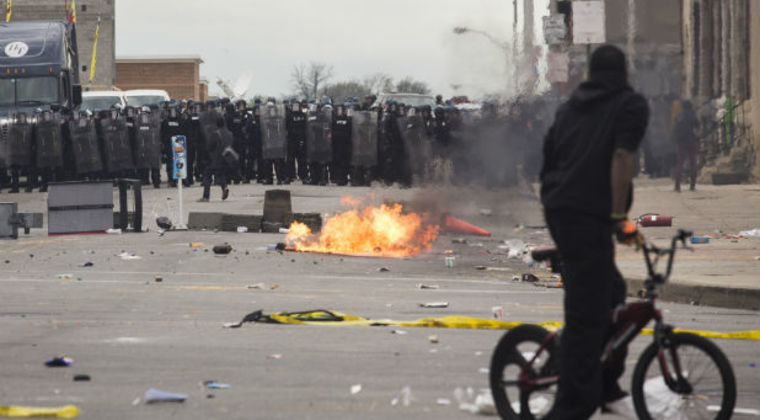
A mere two months after clashes between black youth and police in Baltimore following the murder of Freddie Gray while in police custody, President Obama’s Department of Justice (DOJ) announced the indictment of twenty-four year old Raymon Carter for his alleged involvement in the torching of a CVS pharmacy. The national government’s intervention into the case had an unmistakable message – if you engage in “unauthorized” forms of resistance – in this case, crimes against property – expect to confront the full power of the national government.

U.S. Attorney Rod J. Rosenstein made it even clearer: “Anyone in the future who participates in a ‘riot’ should know that police, prosecutors and citizens will track them down and send them to prison.”

This aggressive and speedy move on the part of the DOJ to criminalize poor, black kids in Baltimore differed sharply from the DOJ approach to high government officials, armed servants of the state at the local level and the big banks and investment firms. For the officials involved in torture under the Bush Administration, the financial gangsters who engineered the 2008 economic crisis, and the killer cops across the country who have yet to experience one indictment from Obama’s DOJ after months of “investigations,” DOJ-granted impunity has been the operative principle in practice.

But Obama’s DOJ has not been the only state institution involved in providing cover and impunity for repression and criminality in the service of the capitalist oligarchy.

Impunity for State Terrorism: the Real Story of Benghazi

What might seem oppositional and important in the game of U.S. politics is usually insignificant and diversionary. Hillary Clinton’s appearance before the House Select Committee, ostensibly established to conduct a bi-partisan investigation into the events that led to the death of Christopher Stevens and three other U.S. citizens on September 11, 2012, was a case in point.

Despite the supposed acrimony between the two ruling class parties in Congress, an ideological consensus exists around the overall strategic commitment to maintain U.S. global dominance. On that ultimate objective both corporate parties share an interest in shifting public attention away from state policies and actions that demonstrate the state’s absolute commitment to the principle of “by any means necessary” for maintaining and advancing the interests of the White supremacist, patriarchal, colonial/capitalist order.

For example, initially the Republican majority’s decision to launch another investigation into the events of 2012 was met with a considerable amount of consternation on the part of some democrats who saw the investigation as just another effort to sabotage Clinton’s run for the Presidency. However, when the republicans settled on the issue of Clinton’s emails the democrats were concerned that Clinton’s use of a private server might cause some embarrassment for her candidacy, but it was also clear that the hearings were going to be rigged and the real questions related to Benghazi would never be raised.

If the House Committee had really been committed to public accountability and surfacing the truth, there were a number of questions that could have been raised such as: 1) what was the role of the facility that was attacked? Was it a U.S. Consulate, a CIA facility or some other entity? 2) Why were those facilities set up so quickly even before a stable government was established in the aftermath of the destruction of the Libyan state? 3 ) Why were there estimated to be more than twenty CIA personnel on the ground in Benghazi just miles from the facility on the night of the attack and what was the mission of those CIA personnel? And 4) Why did the U.S. government contract with an organization to provide security for the facility that had clear ties to Jihadist groups that the U.S. considered as part of the international terrorist networks?

These kinds of questions that would have delved into U.S. involvement in Libya were not raised for two reasons: 1) The Syrian issue – Congress didn’t want the public to focus too much attention on the question of the timeline of U.S. involvement. Although many right-wing republicans were upset that the Obama administration was not more aggressive with more open and direct support for its regime change strategy, everyone in Congress knows that the narrative of reluctant and recent involvement on the part of the Obama administration in the events in Syria is pure fiction. And 2) elements in congress and the Obama administration, with the full collaboration of the corporate press, have suppressed the facts around the mission of the CIA and the role of the State Department in Libya during the period leading to the attack on the two compounds because those activities contravened both U.S. and international law.

Investigative journalist Seymore Hersh revealed that a classified annex to a report prepared by the Senate Intelligence Committee on Benghazi that was not made public, discussed a secret agreement made in early 2012 between the Obama and Erdogan administration in Turkey to run an arms supply line from Libya using arms secured with the overthrow of the Libya state to the so-called rebel forces in Syria. The operation was run by CIA director David Petraeus, and the elements that received support included jihadist groups, including the Al Nusrah Front, al-Qaeda’s official Syrian affiliate.

So even though information on the real role of the U.S. in the war in Syria is getting more coverage, the elites in Congress and the Administration were still not interested in calling too much attention to the fact that the U.S. provided material support to groups that it defined as terrorists which technically under U.S. law should have made that assistance prosecutable.

Vice President Joe Biden even stated publically that governments allied with the U.S. and their nationals were supplying arms to elements that they knew were terrorists and U.S. officials knew it:

“They poured hundreds of millions of dollars and thousands of tons of weapons into anyone who would fight against Assad. Except that the people who were being supplied were al-Nusra and al-Qaeda and the extremist elements of jihadist coming from other parts of the world. “

Yet not one of these individuals or government officials, many who travel on a regular basis to the U.S. and other Western nations have been charged or had sanctions applied to them. In fact, in a pathetic and disingenuous comment, Biden claims that even though it was pointed out to those states by U.S. officials that their support was going to extremist jihadists forces – “We could not convince our colleagues to stop supplying them.”

Obviously for the Obama Administration charging them, freezing their bank accounts, slapping sanctions on the government as was done with the governments and individuals in Iran and Russia was out of the question.

This is why for anyone whose vision is not distorted by the myopia of white supremacist, capitalist ideology, the crude class politics of the DOJ’s decision to prosecute the young resisters in Baltimore is so outrageous.

Benghazi is only a symptom of a pattern of criminal activity on the part of U.S. officials from both parties. From the illegal attacks on Iraq and Libya, subversion in Syria and Venezuela, surveillance, police state repression and mass incarceration domestically, coups in Honduras and Haiti, support for genocide in Yemen, and the continued occupation of Palestine, it is clear that what unites the elites of both parties is their unshakable commitment to maintaining the power of the U.S./EU/NATO axis of domination as the institutional expressions of concentrated white power for as long as possible.

In the meantime, Raymon Carter is facing years in prison because the state claims it has a right to hunt down and prosecute who it defines as criminals.

But the social world is not static and the balance of forces is shifting. One day using that same logic but informed by an alternative ethical framework that centers real justice, the people will be in a position to hunt down and bring to justice the international colonial gangsters who destroy our earth, torture, exploit and bring death to countless millions.

Ajamu Baraka is a human rights activist, organizer and geo-political analyst. Baraka is an Associate Fellow at the Institute for Policy Studies (IPS) in Washington, D.C. and editor and contributing columnist for the Black Agenda Report. He is a contributor to “Killing Trayvons: An Anthology of American Violence” (CounterPunch Books, 2014). He can be reached atwww.AjamuBaraka.com

Time Is Running Out For Pax Americana’s Apologists

aa-American-Empire-statue-of-liberty-and-military

By Rostisla Ischenko

Source: Dissident Voice

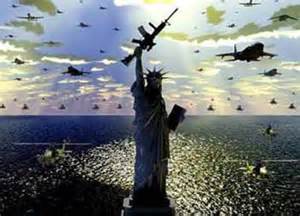
The paradox of the current global crisis is that for the last five years, all relatively responsible and independent nations have made tremendous efforts to save the United States from the financial, economic, military, and political disaster that looms ahead. And this is all despite Washington’s equally systematic moves to destabilize the world order, rightly known as the Pax Americana (“American peace”).

Since policy is not a zero-sum game; i.e., one participant’s loss does not necessarily entail a gain for another, this paradox has a logical explanation. A crisis erupts within any system when there is a discrepancy between its internal structure and the sum total of available resources (that is, those resources will eventually prove inadequate for the system to function normally and in the usual way).

There are at least three basic options for addressing this situation:

  1. Through reform, in which the system’s internal structure evolves in such a way as to better correspond to the available resources.
  2. Through the system’s collapse, in which the same result is achieved via revolution.
  3. Through preservation, in which the inputs threatening the system are eliminated by force, and the relationships within the system are carefully preserved on an inequitable relationship basis (whether between classes, social strata, castes, or nations).

The preservation method was attempted by the Ming and Qing dynasties in China, as well as the Tokugawa Shogunate in Japan. It was utilized successfully (in the 19th century) prior to the era of capitalist globalization. But neither of those Eastern civilizations (although fairly robust internally) survived their collision with the technologically more advanced (and hence more militarily and politically powerful) European civilization. Japan found its answer on the path of modernization (reform) back in the second half of the 19th century, China spent a century immersed in the quagmire of semi-colonial dependence and bloody civil wars, until the new leadership of Deng Xiaoping was able to articulate its own vision of modernizing reforms.

This point leads us to the conclusion that a system can be preserved only if it is safeguarded from any unwanted external influences; i.e., if it controls the globalized world.

The contradiction between the concept of escaping the crisis, which has been adopted by the US elite, and the alternative concept – proposed by Russia and backed by China, then by the BRICS nations and now a large part of the world – lay in the fact that the politicians in Washington were working from the premise that they are able to fully control the globalized world and guide its development in the direction they wish. Therefore, faced with dwindling resources to sustain the mechanisms that perpetuate their global hegemony, they tried to resolve the problem by forcefully suppressing potential opponents in order to reallocate global resources in their favor.

If successful, the United States would be able to re-enact the events of the late 1980s – early 1990s, when the collapse of the Soviet Union and the global socialist system under its control allowed the West to escape its crisis. At this new stage, it has become a question of no longer simply reallocating resources in favor of the West as a collective whole, but solely in favor of the United States. This move offered the system a respite that could be used to create a regime for preserving inequitable relationships, during which the American elite’s definitive control over the resources of power, raw materials, finance, and industrial resources safeguarded them from the danger of the system’s internal implosion, while the elimination of alternative power centers shielded the system from external breaches, rendering it eternal (at least for a historically foreseeable period of time).

The alternative approach postulated that the system’s total resources might be depleted before the United States can manage to generate the mechanisms to perpetuate its global hegemony. In turn, this will lead to strain (and overstrain) on the forces that ensure the imperial suppression of those nations existing on the global periphery, all in the interests of the Washington-based center, which will later bring about the inevitable collapse of the system.

Two hundred, or even one hundred years ago, politicians would have acted on the principle of “what is falling, that one should also push” and prepared to divvy up the legacy of yet another crumbling empire. However, the globalization of not only the world’s industry and trade (that was achieved by the end of the 19th century), but also global finance, caused the collapse of the American empire through a policy that was extremely dangerous and costly for the whole world. To put it bluntly, the United States could bury civilization under its own wreckage.

Consequently, the Russian-Chinese approach has made a point of offering Washington a compromise option that endorses the gradual, evolutionary erosion of American hegemony, plus the incremental reform of international financial, economic, military, and political relations on the basis of the existing system of international law.

America’s elite have been offered a “soft landing” that would preserve much of their influence and assets, while gradually adapting the system to better correspond to the present facts of life (bringing it into line with the available reserve of resources), taking into account the interests of humanity, and not only of its “top echelon” as exemplified by the “300 families” who are actually dwindling to no more than thirty.

In the end, it is always better to negotiate than to build a new world upon the ashes of the old. Especially since there has been a global precedent for similar agreements.

Up until 2015, America’s elite (or at least the ones who determine US policy) had been assured that they possessed sufficient financial, economic, military, and political strength to cripple the rest of the world, while still preserving Washington’s hegemony by depriving everyone, including (at the final stage) even the American people of any real political sovereignty or economic rights. European bureaucrats were important allies for that elite; i.e., the cosmopolitan, comprador-bourgeoisie sector of the EU elite, whose welfare hinged on the further integration of transatlantic (i.e., under US control) EU entities (in which the premise of Atlantic solidarity has become geopolitical dogma) and NATO, although this is in conflict with the interests of the EU member states.

However, the crisis in Ukraine, which has dragged on much longer than originally planned, Russia’s impressive surge of military and political energy as it moved to resolve the Syrian crisis (something for which the US did not have an appropriate response) and, most important, the progressive creation of alternative financial and economic entities that call into question the dollar’s position as the de facto world currency, have forced a sector of America’s elite that is amenable to compromise to rouse itself (over the last 15 years that elite has been effectively excluded from participation in any strategic decisions).

The latest statements by Kerry and Obama which seesaw from a willingness to consider a mutually acceptable compromise on all contentious issues (even Kiev was given instructions “to implement Minsk“) to a determination to continue the policy of confrontation – are evidence of the escalating battle being fought within the Washington establishment.

It is impossible to predict the outcome of this struggle – too many high-status politicians and influential families have tied their futures to an agenda that preserves imperial domination for that to be renounced painlessly. In reality, multibillion-dollar positions and entire political dynasties are at stake.

However, we can say with absolute certainty that there is a certain window of opportunity during which any decision can be made. And a window of opportunity is closing that would allow the US to make a soft landing with a few trade-offs. The Washington elite cannot escape the fact that they are up against far more serious problems than those of 10-15 years ago. Right now the big question is about how they are going to land, and although that landing will already be harder than it would have been and will come with costs, the situation is not yet a disaster.

But the US needs to think fast. Their resources are shrinking much faster than the authors of the plan for imperial preservation had expected. To their loss of control over the BRICS countries can be added the incipient, but still fairly rapid loss of control over EU policy as well as the onset of geopolitical maneuvering among the monarchies of the Middle East. The financial and economic entities created and set in motion by the BRICS nations are developing in accordance with their own logic, and Moscow and Beijing are not able to delay their development overlong while waiting for the US to suddenly discover a capacity to negotiate.

The point of no return will pass once and for all sometime in 2016, and America’s elite will no longer be able to choose between the provisions of compromise and collapse. The only thing that they will then be able to do is to slam the door loudly, trying to drag the rest of the world after them into the abyss.

Rostislav Ischenko is the President of Centre for System Analysis and Forecasting (Kiev) currently living in Moscow. Read other articles by Rostisla.

Turkey-NATO Crisis Sets The Scene For New European ‘EU Army’

nato-1

By Patrick Henningsen

Source: 21st Century Wire

They say there are no coincidences in politics and foreign affairs.

Less than 72 hours after Turkey shot down a Russian fighter inside of Syrian airspace, moves are already afoot to increase the role of Europe in Syria.

Germany has now joined the party this week by revealing its intention to deploy ground troops in the fight against ISIS. Angela Merkel’s government announced its plan to send 100 Bundeswehr Special Forces into Northern Iraq to support of the Kurdish Peshmerga forces.

Britain is not far behind either, as David Cameron intensifies his lobbying efforts to get his country into the war in Syria.

Is this part of a defacto NATO action now, or NATO by fiat? If only it were that simple…

There is much more going on here than meets the eye. With Germany now entering the fray, this brings a total of at least FIVE major NATO member states who are either actively involved in the fight, or about to enter the combat theater. The most important point here is that each and every one of these countries is in the conflict in clear violation of international law. Neither has the backing of the UN Security Council, or has an invitation from the legal and internationally recognized (including by the UN) government in Damascus. In addition, none of these actors is acting under NATO Article 5, in other words, none has been attacked by another internationally recognized nation-state of entity (although it’s curious why the western governments have insisted on referring to a brutal terrorist group as a “State”, unless of course, they recognize it as such, which somehow gives them the color of law in Article 5).

For all intents and purposes, NATO is already in. Here are the FIVE major NATO members, all of whom appear to be operating under highly dubious mandates in and around Syria:

France

Following the Paris Attacks on Friday the 13th, and still without any real evidence presented to the public that ISIS itself was responsible for the Paris Attacks – almost immediately, France deployed the full-force of its military supposedly to hit ISIS targets in the alleged Islamic State “stronghold” of Raqqa, Syria. Coincidentally, even mainstream reports questioned what the objective of France’s airstrikes were (all target data was supplied by the US), with some claiming that the French move was purely for show and that they could not confirm any actual ISIS militants were killed. Note that France had already been caught announcing its move of the aircraft carrier Charles de Gaulle to Syria on Nov 5th – a full week before the Paris attacks. Of course, no mention of this in the media.

Aside from giving the state license to unleash a new level of domestic Police State at home, more importantly, the Paris Attacks gave France an immediate “official” entry into the Syria War. Undoubtedly, this was a huge game-changer.

United States

When the ‘Islamic State Caliphate’ crisis public relations campaign was officially launched by the US-UK Government-Media Complex in June 2014 (before that, there was scant if little mention of this branded terror organization by western politicians and media outlets), it took some time before the US announced its grand ‘Anti-ISIS Coalition’. Perhaps ISIS needed more time to get organized, and to release a series of shocking internet videos of which the western media fed off – – and which were mostly proven as fakes and digital forgeries. Something was not right about the ISIS Crisis by US media outlets who were so enthralled with the sensational propaganda videos that no one dared question the lack of authenticity of what was eventually exposed as fake ISIS beheading video productions (the CIA has previously admitted staging such videos) or the ISIS narrative itself. Oddly, the western media treated anything coming out of ISIS HQ as sacred and unimpeachable in media terms. It wasn’t until Iranian and Hezbollah ground forces entered the fight against ISIS that US President Barack Obama finally decided it was time to move in August 2014 by waging airstrikes in Northern Iraq. Over the next few months, the US began assembling its ‘Anti-ISIS (ISIL) Coalition’, although it was hard to spot anyone else in the ‘Coalition’ other than the US.

It should be noted that on the first day of US airstrikes inside Syria (Sept 23, 2014), it was pretty clear that the US had actually bombed a series of empty buildings in Raqqa, Syria (somehow ISIS was tipped off before hand, weeks in advance, in fact). Not a good start to the “big push”. At that point, our suspicions were confirmed – that the US had no intention of actually rooting out ISIS, and that secretly Washington was actually hoping that ISIS and other terrorist brigades on the ground could do what their previous proxy ground force, the Free Syria Army, could not do – which was to overthrow the government in Damascus, which Washington and its allies refer to (just in like Iraq in 2003) the ‘Assad regime’.

Great Britain

It’s no surprise that the British Tory government has been chomping at the bit to get into the Syrian War. In August 2013, they nearly got their mandate, but lost in a Parliamentary vote. Some Tory ministers had public temper tantrums. As it turns out, the pretext for their entire push for war, ‘WMDs’, aka chemical weapons (Sarin) allegedly deployed by Syrian government forces – was exposed as a false flag attack and the US-UK’s attempt to blame Syrian President Bashar al Assad was a media fiction (just in like Iraq in 2003), a chemical attack launched by the US-led Coalition’s ‘Moderate Rebels” in order to blame the government of Syria and trigger a western intervention. The plan was a complete failure, so bad in fact, it caused the US to back off their own war vote a month later in September 2013.

It seems that the Paris Attacks have also given David Cameron some wind in his war sails too, and yesterday we discovered that the French government is now lobbying for Britain’s Royal Air Force to join in the scrum, with London stating that it, “will soon be working side by side with their French counterparts” in taking military action in Syria. In order to help sell this new leg of the war, the French were provided the use of famed ‘liberal’ British newspaper  The Guardian to openly lobby for British involvement by claiming it would “put additional and extreme pressure on the ISIS terror network”. The article goes on to describe the work Britain is already doing as part of the ‘Coalition’:

“The RAF has significant capabilities for precision airstrikes, aerial reconnaissance and air-to-air refuelling support,” he says. “On a daily basis, its Tornado aircrafts and unmanned drones are causing very severe damage to Isis in Iraq. The use of these capabilities over Syria would put additional and extreme pressure on the Isis terror network.”

So what’s Cameron’s rush to get deeper into the Syrian side of the conflict? It appears as if the Paris Attacks have given Cameron a new life-line on the Syria War vote, one he’s long been pursuing. The shock and horror of Paris will certainly help his case pass muster with public opinion in accepting his long-term agenda to deploy British military assets in Syria. One reason is to showcase British hardware to the world’s lucrative arms sales market, something Cameron is no stranger to after performing the role as sales closer for BAE Systems and other firms landing billion dollar contracts in the Gulf in recent years. Currently, Cameron is desperate to rescue those contracts which threaten to be scrapped over an ‘inconvenient’ human rights row between Westminster’s political left and the Kingdom over Saudi’s plan to behead and crucify a 17 old boy – the son of a Shia activist. Covering Saudi Arabia’s ghastly human rights record in favor of turning a few quid (tens of billions for 100 Typhoon jets and a prison contract) has always been an obsession of Westminster. Coupled with the Syria issue, this last row has prompted some of most amazing double speak and spin ever seen coming out of the Foreign Office, as evidenced by this humdinger about “The World’s Most Misunderstood Feudal Kingdom: Saudi Arabia”, seemingly straight out of the Office of Information Dispersal:

“One well-placed Whitehall source said: “It appears that the Saudis believe that they are being treated like a political football and had enough. It was only after the personal intervention of the Prime Minister that the situation has temporarily cooled but the Saudis want assurances.”

It gets worse, as Westminster is trying to sell the idea that somehow Saudi Arabia has ‘absolutely nothing to do’ with ISIS. Seriously…

“In the week that Andrew Parker, the head of MI5, warned that Britain is facing mass casualty attacks from Isil terrorists, Number 10 is desperate to ensure that it maintains good relations with Saudi Arabia, its most important ally in the Middle East. There were fears that the increased tensions between the two countries might result in the Saudis scaling down their vital intelligence-sharing arrangement with British intelligence, as well as jeopardising future lucrative arms deals with British firms such as BAE Systems.”

And we wonder why the public is mostly clueless as to what’s happening in Syria. They hardly stand a chance against such a relentless propaganda oracle.

Germany

This week, German Defense Minister Ursula von der Leyen, Foreign Minister Frank-Walter Steinmeier, Interior Minister Thomas de Maizière and Justice Minister Heiko Maas, drafted a plan for military intervention and held a secret meeting on Thursday – to discuss exactly how this would be managed in terms of public relations, Bild newspaper reported. There are some historic considerations regarding Germany in this story, too. RT adds here:

“The cabinet is set to discuss the bill that may raise the question of a constitutional change on December 17. German Basic Law has strict limits on military involvement since the end of World War II, originally destined to prevent a revival of Nazi crimes.”

Considering how Turkey’s recent dangerous provocation ‘stunt’ was no accident, and how NATO members are beginning to back away from Turkey slightly (albeit temporarily, at least), the international focus is finally shifting towards Turkey’s obvious and direct role in facilitating and even supporting the rise of ISIS and al Nusra (al Qaeda in Syria), and many other Islamic militant fighting groups active in Syria.

Turkey

Turkey is guilty on potentially two international war crimes according to the Geneva Conventions – shooting down an aircraft in Syrian airspace (it’s becoming clearer from multiple reports that the Turkish F16 air-to-air missile may have fired in Turkish airspace, but the missile hit the Russian fighter in Syrian airspace, a clear war crime), and also the fact that Turkey is providing direct support to the same jihadi Turkmen insurgents who then shot and killed a Russian pilot while he was parachuting in the air, another war crime. In fact, one of the NATO-backed ‘moderate’ terrorists who boasted of killing the downed pilot is actually a Turkish citizen with links to both elected officials and a ultra-nationalist group, the Grey Wolves, based in Turkey.

This is only the beginning of Turkey’s problems. President Recep Tayyip Erdogan has been accused of harboring a Sultan Complex – hoping to lead Turkey’s restoration to its former seat at the head of the Islamic world, in an Ottoman Caliphate redux. Add to this fresh allegations of his son Bilal’s business links to ISIS, and we can see how this mafia state may have too many crimes to answer for when it’s all said and done. If Turkey becomes an international pariah for its increasingly obvious collusion with ISIS and the wider terrorist conclave gallivanting freely through Syria and Turkey – then there could be calls for NATO to dump the rogue state and bad actor in the Syrian conflict.

Consider the Hegelian Dialectic as in, problem, reaction, solution. Problem: Turkey has ‘gone rogue’. Reaction: Turkey must leave NATO. Solution: the formation of a new, well-funded European-based multilateral military organization.What would that look like? Perhaps something like this…

‘New Model Army’ For Europe

If a major NATO player like Turkey is dumped from NATO, then this means that western central planners no longer have a multilateral ‘beach head’ positioned at the historic crossroads of Europe, Middle East and Asia.

Back in March 2015, 21WIRE reported something which many may have missed at the time, but what we thought was significant. European Commission President Jean-Claude Juncker announced that the European Union (EU) now needs a new standing army, or an “EU Army” – supposedly to “defend its values” from the sudden existential threats. He was not referring to ISIS, but to Russia. Two months later, Junker called for it again while saying, “Such an army would also help us to form common foreign and security policies and allow Europe to take on responsibility in the world.” Clearly this is no fluke, and it’s been brewing under our noses for a few years now. Back in Dec 2013, during a “heated” summit debate, Speaker of the European Parliament Martin Schulz called for the creation of a EU Army. The Telegraph reported:

“If we wish to defend our values and interests, if we wish to maintain the security of our citizens, then a majority of MEPs consider that we need a headquarters for civil and military missions in Brussels and deployable troops.” Geoffrey Van Orden MEP, the Conservative spokesman on European defence, said that the prime minister had “turned the tide on an EU army”. “It’s been a long haul to get to this position,” he said.

On the surface, one might read that NATO would be unhappy with a call from Brussels for a new EU Army, but Jucker’s call was only an opening salvo in a larger transatlantic political shift taking place right now. To prove our point, we can show our readers that right on cue this week, we see mainstream media propaganda being ramped-up to make the public used to the idea of an EU Army. Holding the baton on this story is ‘liberal’ newspaper The Independent:

“The British public is broadly supportive of the creation of a standing army for the European Union, a new poll suggests. The YouGov survey found that 36 per cent actively supported a permanent multi-national  force drawn from all the bloc’s nations, compared to only 29 per cent who opposed such a move.”

Anyone who has actually been paying attention to the declining state of the British military will know that it’s almost down to a level where it cannot possibly function autonomously. Soon, all that will remain are a few shiny set-pieces like the Trident nuclear submarine fleet, but more importantly – the key remaining component: a rapid reaction, special forces capability which will slot into the new EU Army matrix. Anything which is not fulfilling a role within the larger infrastructure will be scrapped.

Not convinced? Consider this little known fact, revealed in early 2011 in an investigation by the UK Column into David Cameron’s 50 year ‘Defence Pact’ with France – plan that was hatched behind closed doors through the front organization called the Franco British Council, a charity supposedly set up to foster good relations between Britain and France. This was one of many quiet moves engineered to nudge Britain’s military into an eventual EU Army.

For any remaining doubters that an EU Army is not only in the cards, but is in its final stages of planning between Germany, France and Britain and others, note how just two months ago, Angela Merkel was seen openly ‘horse trading’ with David Cameron – asking him to drop his (public) opposition to an EU Army… in exchange for Germany supporting Britain’s “renegotiation” of EU membership, presumably on issues of welfare spending and immigration. The Telegraph states:

“The German chancellor will ask Britain to stand aside as she promotes an ambitious blueprint to integrate continental Europe’s armed forces.”

“While there is no expectation or obligation for Britain to take part in steeper integration, the creation of an EU army could marginalise Britain within Nato and result in the United States downgrading the special relationship with Britain in favour of Paris and Berlin, experts warn.”

“The Telegraph has seen an unpublished position paper drawn up by Europe and Defence policy committees of Mrs Merkel’s party, the CDU, that sets out a detailed 10-point plan for military co-operation in Europe. It is understood to closely reflect her thinking, and calls for a permanent EU military HQ, combined weapons procurement and a shared military doctrine.”

“The paper says it is “urgent” to integrate armed forces “in the face of multifaceted crises”.

In other words, it’s more or less a done deal.

So regarding Syria, Turkey, Russia and NATO, as the elite adage goes, “Never let a good crisis go to waste”. There are 5 main points to consider right now:

1. Eurozone Crisis. The Greek economic meltdown, followed by Spain, Portugal, Cyprus and Ireland’s economic struggles means that the European Union’s Eurozone economic integrity is under threat – and by extension, so is their physical shape should any member state eventually want to leave the European Super State. US-led economic sanctions against Russia over the downing of MH17 in 2014 (a likely false flag event of  which the US accused Russia of being ‘responsible’.)

2. EU Crisis. Add to this the recent ‘Migrant Crisis’, and you have a public perception that European borders are under threat, too. In addition, Great Britain has seen a loud clamor to “leave the EU”, led recently by the ruling Tory Party, even though David Cameron has remained a committed Europhile his entire career. Many people viewed the Tory ‘Exit’ Campaign as mere play acting to win-over some available UKIP nationalist votes in the last general election. Ditto with Spain, who was recently blackmailed by Brussels over the prospect of a newly independent Catalonia. No surprise that Spain is set to play a key role in a new EU Army.

3. Migrant Crisis. The current ‘Migrant Crisis’ provides a perfect pretext to call for a new centralized, ‘federal’ EU Border Control Agency. This is a perfect fit with the EU Army. Funny how the entire Migrant Crisis has been unmasked as one of the most engineered and stage-managed crisis events in recent history. A perfect example of how a crisis is used to strengthen an EU Federal State framework. Then comes the killer: in October, Brussels offers Turkey its first step towards ‘normalization with Europe’, or soft membership into the EU. Brussels offered cash and visas to Turkey if it would ‘promise’ to help stop the flow of migrants into the EU. The terms of this latest deal were almost unbelievable. With most of the new ISIS recruits now coming from Turkey,  this new plan will give legal access into Europe for many Syria and Turkey-based ISIS and al Nusra Front terrorists. So Turkey could be out of NATO, but into the EU? Wow.

4. Terrorism Crisis. The Paris Attacks were important in order to join together the Syrian Conflict, the Migrant Crisis and the War on Terror (rebranded now to the ‘War on Radicalization’). From this one event grew a raft of emergency policies, decrees and military actions. For the security state – it was a grand slam. The Paris Attacks also triggered calls for a new EU ‘FBI’ agency to “help combat terror”. Add to this, other calls for an EU ‘CIA’ too. That’s right, all the trappings of a Federal Super State. Still, no one bothered to question the premise of the grand slam, in this case, a planted, fake Syrian passport which magically appeared at the scene of the alleged ISIS suicide bomb attack in Paris on Nov 13th. Forensically speaking, there is no actual proof that ISIS carried out the Paris Attacks. Still, everyone it seems, is assuming it’s ISIS and that it’s connected to Syria. Again, more power flowing to an EU Federal State framework.

4. NATO Crisis. The reality is that the North Atlantic Treaty Organization (NATO) is a Cold War relic that’s way outside the bounds of its original mandate, and has no real practical application in the 21st century. NATO used to have some air of moral mandate around the world but that’s fading quickly. By encircling Russia with missile batteries, signing-up Russia’s neighbors, NATO has become more of an offensive entity, rather than a defensive one. The real dirt on NATO’s hands comes with its dark partnership with NeoNazi factions to help achieve its military objectives in the Ukraine. We also learned this week how NATO has opened up a new proxy war front in Crimea, as western-backed NeoNazis carried out terrorist attacks against Crimean infrastructure, and perhaps the most disturbing report we’ve seen here – what looks like CIA support of Islamic Chechen militants brought into east Ukraine.

There’s another fundamental problem with NATO: funding. The US supplies NATO with approximately 75% of its funding which guarantees that NATO is always under Washington’s control, but the US needs to have real stakeholders in order to have a real ‘alliance’. Few have paid attention to NATO’s ongoing weakening of its military assets, mostly due to a lack of spending by the majority of its member states. Every NATO member state is expected to spend at least 2% of its annual GDP on defense spending. That’s not happening anymore, and there is absolutely nothing the Brussels HQ can do about it outside of the US giving money away to those in financial need. Weapons Welfare? That’s not happening either.

NATO’s days are numbered. All the tea leaves point to its schedule for decommissioning. All NATO needs is a good crisis to hasten that inevitability. Maybe Turkey has delivered the pretext Brussels needs. This does not necessarily mean that NATO would be winded-down, but that it would give way to another military structure – like an EU Army.

You’d expect Washington to be averse to a NATO downgrade, down to a second tier international organization. After all, the US has used NATO as a multilateral trojan horse of sorts – an alternative flag it could fly in order to bypass any due process or Constitutional restrictions in waging war around the globe. In other words, Washington has used NATO to cheat its own laws, and expand its geopolitical hegemony, and to drag along its European partners where possible to help make it look like a ‘team effort’, and a unilateral action. The truth is, regarding international affairs, the US has long-since replaced its NATO widget with the “Coalition” widget, and will wage war as and when. At home, it has replaced the near redundant Constitutional Declaration of War with the more fluid and flexible ‘Authorization of Military Force‘ (AUMF), and the National Defense Authorization Act (NDAA) – which essentially means that, on paper at least (through color of law, and not actual law), that the US is always under emergency war footing.

There is visible US-EU split, one which became evident during the planning of Washington’s coup d’etat in the Ukraine in 2013-2014, when the US Sate Department’s assistant secretary for European affairs, Victoria Nuland was caught on tape telling her colleague Ambassador Geoffrey Pyatt to, “F*ck the EU!”, as they argued over which US-backed puppet leader would be installed in Kiev.

What Washington really wants (and needs) now is a big Coalition partner, preferable one which is not directly governed by a local representative democracy, but governed by a remote, mostly unelected bureaucratic system. In this context, a new European multinational force would be the perfect ‘Coalition’ partner for Washington.

This is where this complex confluence of events is taking us – from Brussels, Paris, Syria, Ukraine, and Russia, all roads lead to an EU Army.


Follow the Money: From Paris to ISIS to Paris

By James Corbett

Source: The Corbett Report

Let us for one moment accept the whole Paris attacks narrative hook, line and sinker.

That the French government could not possibly have foreseen an attack.

That a multi-site emergency exercise planned for the same day just happened to be simulating an armed group committing attacks around the city just hours before that very scenario unfolded.

That the “mastermind” of the attacks just happens to be the latest in a string of terrorist boogeymen who manage to escape capture time and time again.

OK, fine. The question that the French people should STILL be asking themselves, even if they believe all of that, is this: How does the Islamic State, a ragtag band of jihadis who are supposedly at war with the combined military might of the US, Turkey, the Saudis, the Russians, the Iraqis, the Iranians and many others (including, of course, the Syrians) manage to fund and coordinate spectacular international terror attacks, including not only the Paris attack, but also (apparently) bombings in Turkey and Lebanon, and the take down of Russian airliners? How is it that governments can flag and track the “suspicious” financial transactions of anyone withdrawing or transferring over $10,000 from their own bank account, but can’t seem to find a way to restrict cash flows, arms and munitions to a geographically isolated enemy who are dependent on oil sales for their financial survival?

Good question. Just don’t ask the US State Department spokesman those questions, because he doesn’t have the answers. When asked earlier this week by RT’s Gayane Chichakyan “whether the US has sanctioned any banks suspected of carrying out transactions for ISIL,” department spokesman Mark Toner responded with a resounding: “I’d have to look into that. I don’t have the answer in front of me.”

Apparently the question of how ISIS is financing its operations is of so little interest to the State Department that they haven’t bothered to look into it. So in the interest of helping them out with their homework, let’s connect a few dots, shall we?

Earlier this year it was revealed that French President François Hollande had authorized illegal shipments of arms to the Syrian terrorists in 2012. The deliveries–including cannons, machine guns, rocket launchers and anti-tank missiles–were in direct contravention of an EU embargo that was in place at the time.

In late 2012 it was revealed that one of the most prominent backers of the Syrian terrorists was the French government, who in addition to their illegal arms shipments were also delivering money directly to the terrorist opposition leaders.

Last year the French arms export industry enjoyed its best sales in 15 years, with revenues up 18%. The reason for the Merchant of Death bonanza? A spike in sales to Saudi Arabia and Qatar, two of the main funders and supporters of ISIS.

Of course, not all of the blame for the fostering, funding, arming, equipping and training of ISIS belongs to France. Much of it belongs to the United States, its Gulf allies, Turkey and Israel, as well as assorted other NATO members. But there is a line to be drawn from the arms and funds that France supplied to the “moderate” terrorists in Syria and the seeming international operational abilities of this seemingly unstoppable terrorist boogeyman group.

France is a nation in mourning. But perhaps the French people can reserve at least some of their outrage for the government which has used their own tax money to fund, supply and support the terrorists they are now at war with.


Related Video:

The Suspicious Downing of Russia’s Metrojet Airbus A321-200. “The ISIS is a Creation of the CIA”

151101114659-02-russia-plane-crash-1101-large-169

By Larry Chin

Source: Global Research

The explosion and crash of Russian Metrojet Airbus A321-200 over Egypt’s Sinai peninsula raises ominous new questions. There are going to be numerous theories bandied about in the course of another long international “investigation”, accompanied with endless political spin from all sides.

We hear numerous variations that boil down to two basic theories: catastrophic mechanical failure or bomb.

Many officials have already ruled out a missile strike because there was no evidence of a missile launch nor an engine burn. US satellites detected heat around the plane before the explosion, but the cause of the heat is unknown. In an Associated Press account, US aviation analyst Paul Beaver stated, “It doesn’t tell us if it was a bomb, or if someone had a fight in the airplane with a gun—there is a whole raft of things that could happen in this regard.” Adding to the mystery, Beaver also noted that in the event of a fuel tank or engine explosion, “engines are designed so that if something malfunctions or breaks off, it is contained within the engine”. The plane broke up at high altitude.

Most recently, British officials have more strongly suggested that a bomb was the cause. And now, US intelligence officials are coming forward to embrace the idea of a bomb.

Looking past the political smoke, one scenario deserves scrutiny.

The Islamic State (IS) has taken responsibility for the incident. In a manifesto, the IS claimed to have brought down the Russian plane in retaliation for Russian military intervention in Syria.

Egyptian officials immediately derided the claim as propaganda that damages the image of Egypt. But at the same time, the authenticity of the IS propaganda has not been debunked. The nature of the propaganda was in keeping with previous manifestos; CIA standard procedure. There is “insufficient evidence” to support the claim, but there never is sufficient evidence. By design.

Given the amply documented fact that the IS (ISIS, ISIL, etc.) is a creation of US intelligence, and function as assets and military-intelligence fronts of the CIA and Washington—financed, recruited and trained by the US and its allies— why shouldn’t the claims of responsibility be taken at face value?

In an era in which false flag atrocities and deception have constituted US foreign policy, it is in no way inconceivable that forces aligned with Washington committed yet another act of terrorism, another act of war, to send a message of warning and/or provocation to Moscow.

This is by no means the first time that the downing of a plane has been exploited for political purpose, aimed at Russia. The false flag shootdown of MH-17 and the cover-up and propaganda that followed offers a ghastly example. The history of American covert operations is rife with atrocities involving planes.

The CIA is opportunistic, flexible, and selective with its work. In this conveniently-timed case, Washington can deny terrorism, warn about terrorism, poo-pooh the jihadist rhetoric (sourced to their own propaganda machine), and express sympathy, all at the same time that a brutal political message is sent to Moscow.

This scenario is not merely “conspiracy theory” when viewed against current big picture realities, and the fact that a superpower war is underway. As chronicled by Michel Chossudovsky:

While the media narrative acknowledges that Russia has endorsed the counter-terrorism campaign, in practice Russia is (indirectly) fighting the US-NATO coalition by supporting the Syrian government against the terrorists, who happen to be the foot soldiers of the Western military alliance, with Western mercenaries and military advisers within their ranks. In practice, what Russia is doing is fighting terrorists who are supported by the US.

The forbidden truth is that by providing military aid to both Syria and Iraq, Russia is (indirectly) confronting America.

Moscow will be supporting both countries in their proxy war against the ISIL which is supported by the US and its allies.

Russia is now directly involved in the counter-terrorism campaign in coordination with the Syrian and Iraqi governments.

In fact, as written in Tru Publica, the war in Syria is not about the Islamic State.

In fact,

“the countries involved in this war are now from all four hemispheres of the planet who are now represented and engaged in a conflict that will definitely be a fight to the very end.”

We can even go beyond this measured view. From Ukraine to Syria, to hot spots across the Middle East and North Africa, we are witnessing an increasingly open war between Washington and Russia, no different than the Cold War (Vietnam, etc.) but with stakes even higher, engulfing far more of the planet. Add to this the increasing tensions between the United States and China, and the map of the global conflict is literally worldwide. What cannot be argued is that the war between the superpowers is intensifying, perhaps past the brink.

The downing of a Russian passenger plane and the death of hundreds of Russians would mean nothing to the war criminals with grand aspirations of conquest for the geography and resources of the most resource-rich chunks of the Earth.

Russia has openly and resolutely waged effective military counter-terrorism operations against the terror fronts of the US and NATO—all jihadist terrorist armies, including ISIS, ISIL, Al-Qaeda, and Al-Nusra, which are all US and CIA fronts. What Moscow has done is call Washington’s bluff and upping the ante.

Put simplistically, Moscow said:

“If you (US-NATO) truly wish to combat terrorism throughout the region, then we will ‘help you’, by actually doing it.”

These operations were followed by agonized and flummoxed whines from Washington, as more and more of the Anglo-American empire’s terror assets have been hampered from their massive attempt to topple the Assad regime. The Vienna-Geneva Peace Talks are a charade that buys time for Washington to counter the Russian actions.

Moscow, acting as the actual “good guys”, have “ruined everything”; ripped the “false good guy” mask off of Washington’s massive criminal operation. This embarrassment to the empire had to be met with a desperate reply.

Was Metrojet Airbus A321-200 part of this response? The message from the Islamic State (aka the CIA) clearly was.

The message was received: Russian President Vladimir Putin’s spokesman Dmitri Peskov quickly rejected any connection between the crash and the Russian military operation in Syria, while Putin himself has vowed that nothing will succeed in scaring them off.

Obama Accuses Russia of Going After America’s “Good Guy Terrorists”

obama_on_isis_10-1-2015_8-50-53_am

By Prof Michel Chossudovsky

Source: Global Research

Amply documented but rarely mentioned in news reports, the ISIS is a creation of US intelligence, recruited, trained and financed by the US and its allies including Britain, France, Saudi Arabia, Qatar, Turkey, Israel and Jordan.  

Until recently, the ISIS was known as Al Qaeda in Iraq (AQI). In 2014, it was renamed the Islamic State (Islamic State of Iraq and Syria, Islamic State of Iraq and the Levant).

Russia is Now Involved in the War on Terrorism

A major turning point in the dynamics of the Syria-Iraq war is unfolding. Russia is now directly involved in the counter-terrorism campaign in coordination with the Syrian and Iraqi governments.

While Washington has acknowledged Moscow’s resolve, Obama is now complaining that the Russians are targeting the “good guy terrorists” who are supported by Washington.

From the Horse’s Mouth

According to the Wall Street Journal:

Russian Airstrike in Syria Targeted CIA-Backed Rebels, U.S. Officials Say

One area hit was location primarily held by rebels receiving funding, arms, training from CIA and allies

One important piece of unspoken information conveyed in this WSJ report is that the CIA is supporting terrorists as a means to triggering “regime change” in Syria, implying the conduct of covert intelligence operations within Syrian territory:

“The U.S. spy agency has been arming and training rebels in Syria since 2013 to fight the Assad regime  (WSJ, September 30, 2015 emphasis added, author’s note: covert support to the terrorists was provided from the outset of the war in March 2011)

The above statement is something which is known and documented but which has barely been acknowledged by the mainstream media.

Al Nusra: “Good Guy Terrorists”

While the Pentagon now candidly acknowledges that the CIA is supporting Al Qaeda affiliated groups inside Syria, including Al Nusra, it nonetheless deplores the fact that Russia is allegedly targeting the “good guy terrorists”, who are supported by Washington:

One of the [Russian] airstrikes hit an area primarily held by rebels backed by the Central Intelligence Agency and allied spy services, U.S. officials said, …

Among seven areas that Syrian state media listed as targets of Russian strikes, only one—an area east of the town of Salamiyah in Hama province—has a known presence of Islamic State fighters. The other areas listed are largely dominated by moderate rebel factions or Islamist groups such as Ahrar al-Sham and the al Qaeda-affiliated Nusra Front.  (WSJ, September 30, 2015 emphasis added)

Affiliated to Al Qaeda, Al Nusra is a US sponsored  ”jihadist” terrorist organization which has been responsible for countless atrocities. Since 2012, AQI and Al Nusra — both supported by US intelligence– have been working hand in glove in various terrorist undertakings within Syria.

In recent developments, the Syrian government has identified its own priority areas for the Russian counter-terrorism air campaign, which consists essentially in targeting Al Nusra.  Al Nusra is described as the terrorist arm of the Free Syrian Army (FSA).

While Washington has categorized Al Nusra as a terrorist organization (early 2012), it nonetheless provides support to both Al Nusra and it’s so-called “moderate rebels” in the form of weapons, training, logistical support, recruitment, etc. This support is channeled by America’s Persian Gulf allies, including Qatar and Saudi Arabia as well as through Turkey and Israel.

Ironically, The UN Security Council in a May 2012 decision “blacklisted Syria’s al-Nusra Front as an alias of al-Qaeda in Iraq”, namely the ISIL:

a decision that will subject the group to sanctions including an arms embargo, travel ban and assets freeze, diplomats said.

The US mission to the United Nations said none of the 15 council members objected to adding al-Nusra as an alias of al-Qaeda in Iraq on Thursday.

Al-Nusra, one of the most effective forces fighting President Bashar al-Assad, last month pledged allegiance to al-Qaeda leader Ayman al-Zawahri. (Al Jazeera, May 2012)

And now Russia is being blamed for targeting a terrorist entity which is not only on the UN Security Council blacklist but which has ties to the Islamic State (ISIS).

What is the significance of these accusations?

While the media narrative acknowledges that Russia has endorsed the counter-terrorism campaign, in practice Russia is (indirectly) fighting the US-NATO coalition  by supporting the Syrian government against the terrorists, who happen to be the foot soldiers of the Western military alliance, with Western mercenaries and military advisers within their ranks. In practice, what Russia is doing is fighting terrorists who are supported by the US.

The forbidden truth is that by providing military aid to both Syria and Iraq, Russia is (indirectly) confronting America. 

Moscow will be supporting both countries in their proxy war against the ISIL which is supported by the US and its allies.

Putin’s Blitz Leaves Washington Rankled and Confused

putin-obama-620x350

By Mike Whitney

Source: Counterpunch

On Monday, Russian President Vladimir Putin delivered a blistering critique of US foreign policy to the UN General Assembly.

On Tuesday, Barack Obama shoved a knife in Putin’s back. This is from Reuters:

“France will discuss with its partners in the coming days a proposal by Turkey and members of the Syrian opposition for a no-fly zone in northern Syria, French President Francois Hollande said on Monday…

French Foreign Minister Laurent Fabius “in the coming days will look at what the demarcation would be, how this zone could be secured and what our partners think,” Hollande told reporters on the sidelines of the annual United Nations General Assembly…

Hollande said such a proposal could eventually be rubber-stamped with a U.N. Security Council resolution that “would give international legitimacy to what’s happening in this zone.”…(France, partners to discuss northern Syria ‘safe zone’: Hollande, Reuters)

Hollande is a liar and a puppet. He knows the Security Council will never approve a no-fly zone. Russia and China have already said so. And they’ve explained why they are opposed to it, too. It’s because they don’t want another failed state on their hands like Libya, which is what happened last time the US and NATO imposed a no-fly zone.

But that’s beside the point. The real reason the no-fly zone issue has resurfaced is because it was one of the concessions Obama made to Turkish President Recep Tayyip Erdogan for the use of Incirlik airbase.  Washington has kept the terms of that deal secret, but Hollande has let the cat out of the bag.

So who put sock-puppet Hollande up to this no-fly zone nonsense?

Why the Obama administration, of course. Does anyone seriously believe that Hollande is conducting his own independent policy in Syria?  Of course not.  Hollande is just doing what he’s been told to do, just like he did when he was told to scotch the Mistral deal that cost France a whopping $1.2 billion. Washington and NATO didn’t like the idea that France was selling state-of-the-art helicopter carriers to arch-rival Putin, so they ordered Hollande to put the kibosh on the deal. Which he did, because that’s what puppets do; they obey their masters.  Now he’s providing cover for Obama so the real details of the Incirlik agreement remain off the public’s radar. That’s why we say,  Obama shoved a knife in Putin’s back, because, ultimately, the no-fly zone damages Russia’s interests in Syria.

The significance of the Reuters article cannot be overstated. It suggests that there was a quid pro quo for the use of Incirlik, and that Turkey’s demands were accepted. Why is that important?

Because Turkey had three demands:

1–Safe zones in north Syria (which means that Turkey would basically annex a good portion of Syrian sovereign territory.)
2–A no-fly zone (which would allow either Turkish troops, US Special Forces or US-backed jihadi militants to conduct their military operations with the support of US air cover.)
3–A commitment from the US that it will help Turkey remove Assad.

Did Obama agree to all three of these demands before Erdogan agreed to let the USAF use Incirlik?

Yes, at least I think he did, which is why I think we are at the beginning of Phase 2 of the US aggression against Syria. Incirlik changes everything. US bombers, drones and fighters can enter Syrian airspace in just 15 minutes instead of 3 to 4 hours from Bahrain. That means more sorties, more surveillance drones, and more air-cover for US-backed militias and Special Forces on the ground.  It means the US can impose a de facto no-fly zone over most of Syria that will expose and weaken Syrian forces tipping the odds decisively in favor of Obama’s jihadi army. Incirlik is a game-changer, the cornerstone of US policy in Syria.  With access to Incirlik, victory is within Washington’s reach. That’s how important Incirlik is.

And that’s why the normally-cautious Putin decided to deploy his warplanes, troops and weaponry so soon after the Incirlik deal was signed. He could see the handwriting on the wall. He knew he had to either act fast and turn the tide or accept the fact that the US and Turkey were going to topple Assad sometime after Turkey’s snap elections on November 1. That was his timeline for action. So he did the right thing and joined the fighting.

But what does Putin do now?

On Wednesday, just two days after Putin announced to the UN General Assembly:  “We can no longer tolerate the current state of affairs in the world,” Putin ordered the bombing of targets in Homs, an ISIS stronghold in West Syria. The attacks, which were unanimously approved by the Russian parliament earlier in the day, and which are entirely legal under international law (Putin was invited by Syria’s sitting president, Assad, to carry out the airstrikes), have put US policy in a tailspin. While the Russian military is maintaining an open channel to the Pentagon and reporting when-and-where it is carrying out its airstrikes, U.S. State Department spokesman John Kirby said that the US plans to “continue to fly missions over Iraq and Syria” increasing the possibility of an unintended clash that could lead to a confrontation between the US and Russia.

Is that what Washington wants, a violent incident that pits one nuclear-armed adversary against the other?

Let’s consider one probable scenario: Let’s say an F-16 is shot down over Syria while providing air cover for Obama’s militants on the ground. Now that Russia is conducting air raids over Syria, there’s a good chance that Putin would be blamed for the incident like he was when the Malaysian airliner was downed over East Ukraine.

So what happens next?

Judging by similar incidents in the past,  the media would swing into full-propaganda mode exhorting the administration to launch retaliatory attacks on Russian military sites while calling for a broader US-NATO mobilization. That, in turn, would force Putin to either fight back and up-the-ante or back-down and face disgrace.  Either way, Putin loses and the US gets one step closer to its objective of toppling Bashar al Assad.

Putin knows all this. He understands the risks of military involvement which is why he has only reluctantly committed to the present campaign. That said; we should expect him to act in much the same way as he did when Georgian troops invaded South Ossetia in 2007. Putin immediately deployed the tanks to push the invading troops back over the border into Georgia and then quickly ended the hostilities. He was lambasted by critics on the right for not invading Georgia and removing their leader, Mikheil Saakashvili, in the Capital. But as it turned out, Putin’s restraint spared Russia the unnecessary hardship of occupation which can drain resources and erode public support. Putin was right and his critics were wrong.

Will his actions in Syria mirror those in South Ossetia?

It’s hard to say, but it’s clear that the Obama crew is thunderstruck by the speed of the intervention. Check this out from the UK Guardian:  “Back at the White House, spokesperson Josh Earnest suggests that Vladimir Putin did not give Barack Obama warning about his intentions to begin air strikes in Syria.

“We have long said we would welcome constructive Russian coordination,” Earnest says, before qualifying that the talks between US and Russian militaries will be purely tactical: “to ensure that our military activities and the military activities of coalition partners would be safely conducted.” (The Guardian)

What does Earnest’s statement mean?  It means the entire US political class was caught off-guard by Putin’s  blitz and has not yet settled on an appropriate response. They know that Putin is undoing years of work by rolling up proxy-units that were supposed to achieve US objectives, but there is no agreement among ruling elites about what should be done. And making a decision of that magnitude could take time, which means that Putin should be able to obliterate a fair number of the terrorist hideouts and restore control of large parts of the country to Assad before the US ever agrees to a strategy. In fact, if he moves fast, he might even be able to force the US and their Gulf allies to the bargaining table where a political solution could be reached.

It’s a long-shot, but it’s a much better option then waiting around for the US to impose a no-fly zone that would collapse the central government and reduce Syria to Libya-type anarchy. There’s no future in that at all.

MIKE WHITNEY lives in Washington state. He is a contributor to Hopeless: Barack Obama and the Politics of Illusion (AK Press). Hopeless is also available in a Kindle edition. He can be reached at fergiewhitney@msn.com.

isis_russia_10-1-2015_8-21-13_am