Follow the Money – How Russia Will Bypass Western Economic Warfare

By Pepe Escobar

Source: OpEdNews.com

So a congregation of NATO’s top brass ensconced in their echo chambers target the Russian Central Bank with sanctions and expect what? Cookies?

What they got instead was Russia’s deterrence forces bumped up to “a special regime of duty” – which means the Northern and Pacific fleets, the Long-Range Aviation Command, strategic bombers, and the entire Russian nuclear apparatus on maximum alert.

One Pentagon general very quickly did the basic math on that, and mere minutes later, a Ukrainian delegation was dispatched to conduct negotiations with Russia in an undisclosed location in Gomel, Belarus.

Meanwhile, in the vassal realms, the German government was busy “setting limits to warmongers like Putin” – quite a rich undertaking considering that Berlin never set any such limits for western warmongers who bombed Yugoslavia, invaded Iraq, or destroyed Libya, in complete violation of international law.

While openly proclaiming their desire to “stop the development of Russian industry,” damage its economy, and “ruin Russia” – echoing American edicts on Iraq, Iran, Syria, Libya, Cuba, Venezuela and others in the Global South – the Germans could not possibly recognize a new categorical imperative.

They were finally liberated from their WWII culpability complex by none other than Russian President Vladimir Putin. Germany is finally free to support and weaponize neo-Nazis out in the open all over again – now of the Ukrainian Azov battalion variety.

To get the hang of how these NATO sanctions will “ruin Russia,” I asked for the succinct analysis of one of the most competent economic minds on the planet, Michael Hudson, author, among others, of a revised edition of the must-read Super-Imperialism: The Economic Strategy of American Empire.

Hudson remarked how he is “simply numbed over the near-atomic escalation of the US.” On the confiscation of Russian foreign reserves and cut-off from SWIFT, the main point is “it will take some time for Russia to put in a new system with China. The result will end dollarization for good, as countries threatened with ‘democracy’ or displaying diplomatic independence will be afraid to use US banks.”

This, Hudson says, leads us to “the great question – whether Europe and the Dollar Bloc can buy Russian raw materials – cobalt, palladium, etc, and whether China will join Russia in a minerals boycott.”

Hudson is adamant that “Russia’s Central Bank, of course, has foreign bank assets in order to intervene in exchange markets to defend its currency from fluctuations. The ruble has plunged. There will be new exchange rates. Yet it’s up to Russia to decide whether to sell its wheat to West Asia, that needs it; or to stop selling gas to Europe via Ukraine, now that the US can grab it.”

About the possible introduction of a new Russia-China payment system – bypassing SWIFT and combining the Russian SPFS (System for Transfer of Financial Messages) with the Chinese CIPS (Cross-Border Interbank Payment System) – Hudson has no doubts, “the Russian-China system will be implemented. The Global South will seek to join and at the same time keep SWIFT – moving their reserves into the new system.”

I’m going to de-dollarize myself

So the US itself, in another massive strategic blunder, will speed up de-dollarization. As the managing director of Bocom International Hong Hao told the Global Times, with energy trade between Europe and Russia de-dollarized, “that will be the beginning of the disintegration of dollar hegemony.”

It’s a refrain the US administration was quietly hearing last week from some of its own largest multinational banks, including notables like JPMorgan and Citigroup.

Bloomberg article sums up their collective fears:

“Booting Russia from the critical global system – which handles 42 million messages a day and serves as a lifeline to some of the world’s biggest financial institutions – could backfire, sending inflation higher, pushing Russia closer to China, and shielding financial transactions from scrutiny by the west. It might also encourage the development of a SWIFT alternative that could eventually damage the supremacy of the US dollar.”

Those with IQs over 50 in the European Union (EU) must have understood that Russia simply could not be totally excluded from SWIFT, but maybe only a few of its banks: after all, European traders depend on Russian energy.

From Moscow’s point of view, that’s a minor issue. A number of Russian banks are already connected to China’s CIPS system. For instance, if someone wants to buy Russian oil and gas with CIPS, payment must be in the Chinese yuan currency. CIPS is independent of SWIFT.

Additionally, Moscow already linked its SPFS payment system not only to China but also to India and member nations of the Eurasia Economic Union (EAEU). SPFS already links to approximately 400 banks.

With more Russian companies using SPFS and CIPS, even before they merge, and other maneuvers to bypass SWIFT, such as barter trade – largely used by sanctioned Iran – and agent banks, Russia could make up for at least 50 percent in trade losses.

The key fact is that the flight from the US-dominated western financial system is now irreversible across Eurasia and that will proceed in tandem with the internationalization of the yuan.

Russia has its own bag of tricks

Meanwhile, we’re not even talking yet about Russian retaliation for these sanctions. Former President Dmitry Medvedev already gave a hint – everything, from exiting all nuclear arms deals with the US, to freezing the assets of western companies in Russia, is on the table.

So what does the “Empire of Lies” want? – Putin terminology, on Monday’s meeting in Moscow to discuss the response to sanctions.

In an essay published this morning, deliciously titled America Defeats Germany for the Third Time in a Century: the MIC, OGAM and FIRE conquer NATO, Michael Hudson makes a series of crucial points, starting with how “NATO has become Europe’s foreign policy-making body, even to the point of dominating domestic economic interests.”

He outlines the three oligarchies in control of US foreign policy:

First is the military-industrial complex, which Ray McGovern memorably coined as MICIMATT (military industrial Congressional intelligence media academia think tank).

Hudson defines their economy base as “monopoly rent, obtained above all from its arms sales to NATO, to West Asian oil exporters, and to other countries with a balance-of-payments surplus.”

Second is the oil and gas sector, joined by mining (OGAM). Their aim is “to maximize the price of energy and raw materials so as to maximize natural resource rent.

Monopolizing the Dollar Area’s oil market and isolating it from Russian oil and gas has been a major US priority for over a year now, as the Nord Stream 2 pipeline from Russia to Germany threatened to link the western European and Russian economies together.”

Third is the “symbiotic” Finance, Insurance and Real Estate (FIRE) sector, which Hudson defines as “the counterpart to Europe’s old post-feudal landed aristocracy living by land rents.”

As he describes these three rentier sectors that completely dominate post-industrial finance capitalism at the heart of the western system, Hudson notes how “Wall Street always has been closely merged with the oil and gas industry namely, the Citigroup, and Chase Manhattan banking conglomerates.”

Hudson shows how “the most pressing US strategic aim of NATO confrontation with Russia is soaring oil and gas prices. In addition to creating profits and stock market gains for US companies, higher energy prices will take much of the steam out of the German economy.”

He warns how food prices will rise “headed by wheat” – Russia and Ukraine account for 25 percent of world wheat exports. From a Global South perspective, that’s a disaster: “This will squeeze many West Asian and Global South food-deficient countries, worsening their balance of payments, and threatening foreign debt defaults.”

As for blocking Russian raw materials exports, “this threatens to cause breaks in supply chains for key materials, including cobalt, palladium, nickel, aluminum.”

And that leads us, once again, to the heart of the matter – “The long-term dream of the US new Cold Warriors is to break up Russia, or at least to restore its managerial kleptocracy seeking to cash in their privatizations in western stock markets.”

That’s not going to happen. Hudson clearly sees how “the most enormous unintended consequence of US foreign policy has been to drive Russia and China together, along with Iran, Central Asia, and countries along the Belt and Road initiative.”

Let’s confiscate some technology

Now compare all of the above with the perspective of a central European business tycoon with vast interests, east and west, and who treasures his discretion.

In an email exchange, the business tycoon posed serious questions about the Russian Central Bank support for its national currency, the ruble, “which according to US planning is being destroyed by the west through sanctions and currency wolf packs who are exposing themselves by selling rubles short. There is really almost no amount of money that can beat the dollar manipulators against the ruble. A 20 percent interest rate will kill the Russian economy unnecessarily.”

The businessman argues that the chief effect of the rate hike “would be to support imports that should not be imported. The fall of the ruble is thus favorable to Russia in terms of self-sufficiency. As import prices rise, these goods should start to be produced domestically. I would just let the ruble fall to find its own level which will for a while be lower than natural forces would permit as the US will be driving it lower through sanctions and short selling manipulation in this form of economic war against Russia.”

But that seems to tell only part of the story. Arguably, the lethal weapon in Russia’s arsenal of responses has been identified by the head of the Center for Economic Research of the Institute of Globalization and Social Movements (IGSO), Vasily Koltashov – the key is to confiscate technology – as in Russia ceasing to recognize US rights to patents.

In what he qualifies as “liberating American intellectual property,” Koltashov calls for passing a Russian law on “friendly and unfriendly states. If a country turns out to be on the unfriendly list, then we can start copying its technologies in pharmaceuticals, industry, manufacturing, electronics, medicine. It can be anything – from simple details to chemical compositions.” This would require amendments to the Russian constitution.

Koltashov maintains that “one of the foundations of success of American industry was copying of foreign patents for inventions.” Now, Russia could use “China’s extensive know-how with its latest technological production processes for copying western products: the release of American intellectual property will cause damage to the United States to the amount of $10 trillion, only in the first stage. It will be a disaster for them.”

As it stands, the strategic stupidity of the EU beggars belief. China is ready to grab all Russian natural resources with Europe left as a pitiful hostage of the oceans and of wild speculators.

It looks like a total EU-Russia split is ahead – with little trade left and zero diplomacy.

Now listen to the sound of champagne popping all across the MICIMATT.

Creating New Enemies

SHANGHAI, CHINA – MAY 20: Russian President Vladimir Putin (L) and Chinese President Xi Jingping (R) attend a welcoming ceremony on May 20, 2014 in Shanghai, China. Putin is on a two day visit to China (Photo by Sasha Mordovets/Getty Images)

By Philip Giraldi

Source: The Unz Review

It should come as no surprise that many observers, from various political perspectives, are beginning to note that there is something seriously disconnected in the fumbling foreign policy of the United States. The evacuation failure in Afghanistan shattered the already waning self-confidence of the American political elite and the continuing on-again off-again negotiations that were by design intended to go nowhere with Iran and Russia provide no evidence that anyone in the White House is really focused on protecting American interests. Now we have an actual shooting war in Ukraine as a result, a conflict that might easily escalate if Washington continues to send the wrong signals to Moscow.

To cite only one example of how outside influences distort policy, in a phone call on February 9th, Israeli Prime Minister Naftali Bennett advised President Joe Biden not to enter into any non-proliferation agreement with Iran. Biden was non-committal even though it is an actual American interest to come to an agreement, but instead he indicated that as far as the US is concerned, Israel could exercise “freedom of action” when dealing with the Iranians. With that concession has ended in all probability the only possible diplomatic success that the Administration might have been able to point to.

The Biden Administration’s by default global security policy is currently reduced to what some critics have described as “encirclement and containment.” That is why an overstretched US military is being tasked with creating ever more bases worldwide in an effort to counter perceived “enemies” who often are only exercising their own national sovereignty and right to security within their own zones of influence. Ironically, when nations balk at submitting to Washington’s control, they are frequently described as “aggressors” and “anti-democratic,” the language that has most particularly been used relating to Russia. The Biden policy, such as it actually exists, appears to be a throwback to the playing field in 1991-2 when the Soviet empire collapsed. It is all about maintaining the old American dream of complete global dominance coupled with liberal interventionism, but this time around the US lacks both the resources and the national will to continue in the effort. Hopefully the White House will understand that to do nothing is better than to make empty threats.

Meanwhile, as the situation continues to erode, it is becoming more and more obvious that the twin crises that have been developing over Ukraine and Taiwan are “Made in Washington” and are somewhat inexplicable as the US does not have a compelling national interest that would justify threats to “leave on the table” military options as a possible response. The Administration has yet again responded to Russian moves by initiating devastating sanctions. But Russia also has unconventional weapons in its arsenal. It can, for starters, shift focus away from Ukraine by intervening much more actively in support of Syria and Iran in the Middle East, disrupting feeble American attempts to manage that region to benefit Israel.

According to economists, Russia has also been effectively sanction-proofing its economy and is capable of selective reverse-sanctioning of countries that support an American initiative with any enthusiasm. Such a response would likely hurt the Europeans much more than it would damage the leadership in the Kremlin. Barring Russian gas from Europe by shutting down Nord Stream 2 would, for example, permit increased sales to China and elsewhere in Asia and would inflict more pain on the Europeans than on Moscow. Shipping US supplied liquid gas to Europe would, for example, cost more than twice the going rate being offered by the Kremlin and would also be less reliable. The European NATO members are clearly nervous and not fully behind the US agenda on Ukraine, largely because there is the legitimate concern that any and possibly all options being considered by Washington could easily produce missteps that would escalate into a nuclear exchange that would be catastrophic for all parties involved.

Apart from the real immediate danger to be derived from the fighting currently taking place in Ukraine, the real long-term damage is strategic. The Joe Biden Administration has adroitly maneuvered itself into a corner while America’s two principal adversaries Russia and China have drawn closer together to form something like a defensive as well as economic relationship that will be dedicated to reducing and eventually eliminating Washington’s assumed role as the global hegemon and rules enforcer.

In a recent article in the New Yorker foreign affairs commentator Robin Wright, who might reasonably described as a “hawk,” declares the new development to be “Russia and China Unveil[ing] a Pact Against America and the West.” And she is not alone in ringing the alarm bell, with former Donald Trump National Security Council (NSC) Russia watcher Anita Hill warning that the Kremlin’s intention is to force the United States out of Europe while former NSC Ukrainian expert Alexander Vindman is advising that military force be used to deter Russia now before it is too late.

Wright provides the most serious analysis of the new developments. She argues that “Vladimir Putin and Xi Jinping, the two most powerful autocrats, challenge the current political and military order.” She describes how, in a meeting between the two leaders before the Beijing Olympics, they cited an “agreement that also challenges the United States as a global power, NATO as a cornerstone of international security, and liberal democracy as a model for the world.” They pledged that there would be “No ‘forbidden’ areas of cooperation” and a written statement that was subsequently produced declared that “Russia and China stand against attempts by external forces to undermine security and stability in their common adjacent regions, intend to counter interference by outside forces in the internal affairs of sovereign countries under any pretext, oppose color revolutions, and will increase cooperation.” Wright notes that there is considerable strength behind the agreement, “As two nuclear-armed countries that span Europe and Asia, the more muscular alignment between Russia and China could be a game changer militarily and diplomatically.” One might add that China now has the world’s largest economy and Russia has a highly developed military deploying new hypersonic missiles that would give it the advantage in any conflict with NATO and the US. Both Russia and China, if attacked, would also benefit because they would be fighting close to their bases on interior lines.

And, of course, not everyone agrees that nudging the United States out of its self-proclaimed hegemonic role would be a bad thing. Former British diplomat Alastair Crooke argues that there will be perpetual state of crisis in the international order until a new system emerges from the status quo that ended the Cold War, and it would be minus the United States as the semi-official transnational rules maker and arbiter. He observes that “The crux of Russia’s complaints about its eroding security have little to do with Ukraine per se but are rooted in the Washington hawks’ obsession with Russia, and their desire to cut Putin (and Russia) down to size – an aim which has been the hallmark of US policy since the Yeltsin years. The Victoria Nuland clique could never accept Russia rising to become a significant power in Europe – possibly eclipsing the US control over Europe.”

What is happening in Europe and Asia should all come down to a very simple realization about the limits of power: America has no business in risking a nuclear war with Russia over Ukraine or with China over Taiwan. The United States has been fighting much of the world for over two decades, impoverishing itself and killing millions in avoidable wars starting with Iraq and Afghanistan. The US government is cynically exploiting memories of old Cold War enemy Russia to create a false narrative that goes something like this: “If we don’t stop them over there, they will be in New Jersey next week.” It is all nonsense. And besides, who made the US the sole arbiter of international relations? It is past time Americans started asking what kind of international order is it that lets the United States determine what other nations can and cannot do.

Worst of all, the bloodshed in Ukraine has all been unnecessary. A little real diplomacy with honest negotiators weighing up real interests could easily have come to acceptable solutions for all parties involved. It is indeed ironic that the burning desire to go to war with Russia demonstrated in the New York Times and Washington Post as well as on Capitol Hill has in fact created a real formidable enemy, tying Russia and China together in an alliance due to their frustration at dealing with a Biden Administration that never seems to know what it is doing or where it wants to go.

U.S./NATO is in the Grip of a Daemonic Death-Wish and the Entire World is Threatened

By Edward Curtin

Source: Behind the Curtain

Not wanting to sound hyperbolic, but I am starting to conclude that the nuclear madmen running the U.S./NATO New Cold War they started decades ago are itching to start a nuclear war with Russia.  Their hypocrisy and nihilistic thirst for death and destruction are so extreme that it boggles my mind.  They accuse Russia of starting a New Cold War when they did so decades ago and have been pushing the envelope ever since.  Now they act shocked that Russia, after many years of patience, has struck back in Ukraine.

In 2017, Oliver Stone released his four part interviews with Russian President Vladimir Putin.  The Putin Interviews were conducted between 2015, the year after the U.S. engineered the coup d’état in Ukraine installing Nazis to power in that country bordering Russia, and 2017.  Stone was of course bashed for daring to respectfully ask questions and receive answers from the Russian leader who the American media has always cast, like all the mythic bogeymen, as the new Hitler intent on conquering the world, when it is the United States, not Russia, that has over 750 military bases throughout the world and has attacked Afghanistan, Iraq, Libya, Syria – the list is endless.

In his Putin interviews, Oliver Stone, a man of truth and honor, lets viewers catch a glimpse of the real Vladimir Putin and the matters that concern him as the leader of Russia.  In 2018, I wrote of those interviews:

 . . .  he [Putin] makes factual points that should ring loud and clear to anyone conversant with facts. One: that the U.S. needs an external enemy (“I know that, I feel that.”). Two: the U.S.A. engineered the coup d’état in the Ukraine on Russia’s border. Three: the U.S. has surrounded Russia with US/NATO troops and bases armed with anti-ballistic missiles that can, as Putin rightly says to Stone, be converted in hours to regular offensive nuclear missile aimed at Russia. This is a factual and true statement that should make any fair-minded person stand up in horror. If Russia had such missiles encircling the United States from Cuba, Mexico, and Canada, what American would find it tolerable? What would CNN and The New York Times have to say? Yet these same people readily find it impossible to see the legitimacy in Russia’s position, resorting to name calling and illogical rhetoric. Russia is surrounded with U.S/NATO troops and missiles and yet Russia is the aggressor.

In the years since those interviews, U.S./NATO has consistently tightened the noose around Russia, including fueling the Ukrainian attacks on the Donbass, killing thousands, all the while pleading innocent and expecting no reply. Now the reply has come.

Although I have no inside information, I get the sense that the Western Empire is planning/initiating counter-measures far more extreme than the highly publicized economic sanctions.  While it is true, as many commentators such as Ray McGovern and Pepe Escobar have pointed out, that a paradigm shift is underway and the once dominant U.S./NATO bully boys must now contend with the Sino-Russian alliance that has ushered in a dramatic change, nevertheless, as in the past decades, the so-called leaders of the U.S. are a dumb bunch driven by unquenchable demons.  As McGovern says:

Yet, there remain unsettling indications coming from Under Secretary of State for Political Affairs Victoria Nuland, Antony Blinken, and Jake Sullivan that senior administration ‘dolts’ (copyright North Korean leader Kim Jong Un) in the Washington Swamp still don’t get it.

I’m afraid they don’t and never will.  That is what frightens me.  While it seems counterintuitive and totally irrational that these people would be planning to use some type of nuclear weapon in this current situation, I am not so sure.  They obviously pushed Russia to have no alternative but to attack Ukraine, and now that they have accomplished that goal, it seems to me that they will up the ante.  Diplomacy is not their way; violence is.

Pepe Escobar has just written:

This is what happens when a bunch of ragged hyenas, jackals and tiny rodents poke The Bear: a new geopolitical order is born at breathtaking speed.

From a dramatic meeting of the Russian Security Council to a UN history lesson delivered by Russian President Vladimir Putin and the subsequent birth of the Baby Twins – the People’s Republics of Donetsk and Luhansk – all the way to the breakaway republics’ appeal to Putin to intervene militarily to expel the NATO-backed Ukrainian bombing-and-shelling forces from Donbass, it was a seamless process, executed at warp speed.

The (nuclear) straw that (nearly) broke the Bear’s back – and forced it to pounce – was Comedian/Ukrainian President Volodymy Zelensky, back from the Russophobia-drenched Munich Security Conference where he was hailed like a Messiah, saying that the 1994 Budapest memorandum should be revised and Ukraine should be nuclear-rearmed.

As usual, his analysis is correct, but it may fail to grasp the unspeakable nature of the madness that drives desperadoes.  If those running U.S. foreign policy feel that a new geo-political order is being born “at breathtaking speed” as a result of Russia’s move into Ukraine, then they are capable of extreme acts. And they have all the mainstream western media behind them, barking out their non-stop propaganda.

We are inexorably moving toward a global war that will become nuclear if an international movement doesn’t quickly arise to stop it.  Most people bemoan the thought of such a war to end all wars, but refuse to analyze the factors leading to it. It seems so unimaginable, but It happens step-by-step, and many steps have already been taken with more coming soon.  It’s so obvious that most can’t see it, or don’t want to.  The corporate main stream media are clearly part of the continuation of the CIA’s Operation Mockingbird, and those who still rely on them for the truth are beyond reach.  We need to use all alternative means to raise the alarm and make sure the ultimate nightmare never occurs.

Perhaps hyperbole is the only way to do so, for it may be closer to the truth than we want to believe.

AS WAR DRUMS BEAT FOR UKRAINE, REMEMBER, LIES AND PROPAGANDA STARTED NEARLY EVERY WAR IN US HISTORY

By Don Via Jr,

Source: Waking Times

War is one of the most primitive and senseless manifestations of the human experience, so naturally, most sane people with families, ambitions and kind hearts want nothing to do with such things. Unfortunately, as we are seeing with the Ukraine / Russia escalation, governments thrive on war, as it gives them a pressing excuse to grab more power and take extrajudicial measures—both at home and abroad.

To get around the obstacle of public opinion, governments have an extensive history of lying their way into war. This is hard to believe for people who think that government has their best interest in mind, but it is something that rulers have been doing since the beginning of time. In the modern United States, people are led to believe that the establishment accidentally flounders its way into war with the good intentions of protecting the country from harm or liberating an ally in distress.

This strategy of deception was illustrated by the Nazi propagandist Herman Goering, who famously said:

“Of course the people don’t want war. Why should some poor slob on a farm want to risk his life in a war when the best he can get out of it is to come back to his farm in one piece? Naturally, the common people don’t want war neither in Russia, nor in England, nor for that matter in Germany. That is understood. But, after all, it is the leaders of the country who determine the policy and it is always a simple matter to drag the people along, whether it is a democracy, or a fascist dictatorship, or a parliament, or a communist dictatorship. Voice or no voice, the people can always be brought to the bidding of the leaders. That is easy. All you have to do is tell them they are being attacked, and denounce the peacemakers for lack of patriotism and exposing the country to danger. It works the same in any country.

Of course, the Nazi regime is notorious for their brutality and deceit, so this admission is not as stunning as it would be from an American general, but make no mistake that these are the types of thoughts that American generals and politicians have—they are just not brazen enough to say it out loud.

Believe it or not, using deceptive tactics to sway public opinion in favor of war is actually an official part of the US military’s playbook. According to Wikileaks, the U.S. Army’s publication “Special Forces Foreign Internal Defense Tactics Techniques and Procedures for Special Forces” recommends funding terrorists for regime change operations and using false flag attacks to destabilize regimes that were unfriendly to western interests.

This is nothing new though, this is a part of American history, as nearly every war that the U.S. has ever been involved in was built upon lies. Below are some of the most well-documented examples of wars that were started because of lies and government propaganda.

Spanish-American War – 1898

In January 1898, President William McKinley ordered the USS Maine to port in Havana, Cuba, despite years of conflict between Cuban rebels and the Spanish government. The move was intended to be a show of force against the Spanish government, in line with the Monroe doctrine, to establish U.S. dominance in the Western hemisphere.

At 9:40 p.m., on February 15, 1898, The USS Maine exploded with a crew of 354 men on board, killing 266. While the Spanish government insisted the explosion was caused by a fire in a coal bunker that ignited the forward magazines, politicians in the U.S. were quick to blame Spain because they wanted an excuse to wage a war of conquest for territory in Mexico, the Caribbean, and the Pacific.

Although President McKinley had previously voiced his opposition to a military conflict, on April 25, the U.S. declared war on Spain.

The “Ten-Week War” resulted in not only the defeat of the last remnants of the Spanish empire but in a new era of U.S. “expansionism” as the United States took control of Puerto Rico, Guam, and the Philippine islands.

In 1976, a team of naval explosive experts examined the evidence and corroborated Spanish claims that the USS Maine’s sinking was caused by an internal explosion from ammunition being stored on board.

World War 1 – 1915

The first world war was opposed by most Americans from the start, as they rightly saw it as a power struggle between European aristocrats that they had no business in. This was a problem for the British military, led by Winston Churchill, as they were desperate to get the United States behind them in the war.

The U.S. did finally enter the war in 1915, when a U.S. ship called the Lusitania was sent through hostile waters as bait, filled with more than a thousand civilians and an unusually large amount of ammunition. The ship was hit by a German torpedo and exploded instantly due to all of the ammunition onboard, killing more than half of the passengers and crew.

A week before the sinking of Lusitania, Churchill wrote to Walter Runciman, the President of the Board of Trade, stating that it is “most important to attract neutral shipping to our shores, in the hope especially of embroiling the United States with Germany.”

After investigating the tragedy, former British naval intelligence officer Patrick Beesly said, “unless and until fresh information comes to light, I am reluctantly driven to the conclusion that there was a conspiracy deliberately to put Lusitania at risk in the hope that even an abortive attack on her would bring the United States into the war. Such a conspiracy could not have been put into effect without Winston Churchill’s express permission and approval.”

In addition to this treacherous military maneuver, there was a relentless campaign in the U.S. to dehumanize Germans and to paint them as monsters. In some propaganda that was peddled to U.S. citizens, German soldiers were depicted killing babies and sometimes eating them. There were even false reports of crucifixions.

World War 2 – 1941

The history books suggest that Pearl Harbor was an unprovoked attack, killing thousands of Americans and “forcing” the government to enter a war that was extremely unpopular at the time. However, the U.S. government was enacting strict sanctions on both Japan and Germany, hoping that either country would make the first move and give them an excuse to enter the war. Not only was the attack provoked, but President Roosevelt and the U.S. military knew the attack was coming and moved their most expensive aircraft to other locations while leaving thousands of people as sacrificial pawns.

The history books also sell the war against the Nazis as a humanitarian war to save people from the Holocaust, but the U.S. denied safe passage to Jewish refugees, and UK intelligence even planned to blow up refugee ships, in a plot called Operation Embarrass.

Many American businesses and politicians worked very closely with the Nazis even after the two countries were at war with each other. The Holocaust had already claimed the lives of millions of German people by that point, and a police state had long since been established, so whoever was doing business with the Nazis knew exactly who they were getting involved with.

Prior to the Americans getting involved in the war, there were corners of the political arena that were actually big supporters of the Nazi party—both for business purposes and common interests such as eugenics.

The most prominent American politician to work with the Nazis was actually George W. Bush’s grandfather, Prescott Bush. There is no doubt that he was funding and working with the Nazis because his company’s assets were seized in 1942 by the United States government under the “trading with the enemy” act. He worked at the head of a financial firm called Brown Brothers Harriman, which acted as a U.S. base for the Nazi business interests.

Brown Brothers Harriman was one of the biggest international investment firms in the 1930s and they sent millions of dollars in gold overseas to rebuild the German army and fund the Nazi party. This racket was finally exposed on July 30, 1942, when the New York Herald Tribune posted an article titled, “Hitler’s Angel Has three million dollars in US Bank.” This article raised suspicion about the bank being a “secret nest” for Nazi elites and eventually sparked the investigation that took down the operation.

Korean War – 1950

The propaganda of war has led many to believe that the North Korean government launched an unprovoked attack on South Korea, on behalf of the larger communist powers of Russia and China. Yet, once again, this was another case where the U.S. was propping up one dictator to fight another, in an attempt to gain control of an entire continent—all the while, lying to the people back home about the true motivations for war.

As historian Mark E. Caprio, professor of history at Rikkyo University in Tokyo points out:

“On February 8, 1949, the South Korean president met with Ambassador John Muccio and Secretary of the Army Kenneth C. Royall in Seoul. Here the Korean president listed the following as justifications for initiating a war with the North: the South Korean military could easily be increased by 100,000 if it drew from the 150,000 to 200,000 Koreans who had recently fought with the Japanese or the Nationalist Chinese. Moreover, the morale of the South Korean military was greater than that of the North Koreans. If war broke out he expected mass defections from the enemy. Finally, the United Nations’ recognition of South Korea legitimized its rule over the entire peninsula (as stipulated in its constitution). Thus, he concluded, there was “nothing [to be] gained by waiting.”

Vietnam War – 1964

Information released in 2005 by the National Security Agency showed that the Gulf of Tonkin incident on August 1964 was deliberately falsified to make it appear that North Vietnamese gunboats attacked an American destroyer patrolling in international waters when in reality, they did not. This was the event that the U.S. military used as an excuse to go to war in Vietnam and it was surrounded by mystery and controversy until decades later when the official facts were released.

It has now been 49 years since the U.S. withdrew the last of its combat troops from Vietnam and the last prisoners of war that were held in North Vietnam returned to U.S. soil. According to estimates, more than 2 million civilians, 1.1 million North Vietnamese and Viet Cong fighters, 250,000 South Vietnamese fighters, and nearly 58,000 U.S. military members were killed in Vietnam during the war—all because of lies that were used to create propaganda that made American fear for their safety.

Libya – 1984 (then 2015)

Former Mossad agent Victor Ostrovsky admitted that the Mossad planted a radio transmitter in Libyan Prime Minister Muammar Gaddafi’s compound in Tripoli, which broadcast fake terrorist transmissions that were recorded by Mossad and used to frame Gaddafi as a terrorist supporter. President Reagan bombed Libya immediately after the false reports, but this was not the first or last time the U.S. would involve itself in Libya.

As The Free Thought Project has reported, 3,000 emails from former Secretary of State Hillary Clinton released by the State Department contained damning evidence of Western nations using NATO as a tool to overthrow Gaddafi.

The NATO overthrow was not for the protection of the people, but instead, it was to thwart Gaddafi’s attempt to create a gold-backed African currency to compete with the Western central banking monopoly. As per usual, the U.S. and its Western counterparts left the country to its own devices after slashing the once-thriving nation to the ground.

“Today there is no government of Libya. It’s simply mobs that patrol the streets and kill one another,” Virginia State Senator Richard Black told RT of the mess left behind.

Despite certain issues in Libya before the coup, “Libyans had an incredibly high standard of living, the highest in Africa,” international lawyer Francis Boyle told RT. “When I first went to Libya in 1986, I was amazed by the empowerment of women. What I saw in Libya was that women could do anything they wanted to do.”

Iraq – 1990

At the onset of Operation Desert Storm in 1990, a public relations firm by the name of Hill and Knowlton spent millions of dollars on the U.S. government’s behalf, constructing news pieces that would sell the war to the American public. One of the most moving hoaxes to come from this push to war was the testimony of a 15-year-old Kuwaiti girl, known only by her first name of Nayirah.

In a videotaped testimony that was later distributed to the media, she claimed that Iraqi soldiers killed babies in incubators at a hospital.

I volunteered at the al-Addan hospital, While I was there, I saw the Iraqi soldiers come into the hospital with guns, and go into the room where… babies were in incubators,” Nayirah said. “They took the babies out of the incubators, took the incubators, and left the babies on the cold floor to die.”

Sounds horrible, right? Well, luckily it never happened. This was a fabricated event designed to dehumanize the Iraqi people in the eyes of the American public. The whole thing was exposed when journalists discovered that the witness, Nayirah was actually the daughter of a U.S. ambassador, who was being coaxed by military psychological operations specialists.

In addition to this false testimony, the U.S. government also showed Saudi Arabia fake satellite images that depicted Iraqi troops massing on their border.

Iraq – 2003-Present

Emails that were declassified in 2015 paint a much different picture of the Bush administration’s invasion of Iraq than they led the public to believe. A memo drafted by the U.S. embassy in London revealed how the Bush administration used “spies” in the British Labor Party to help shape British public opinion in favor of the war, prior to U.S. invasion.

In the weeks leading up to the invasion of Iraq, the Bush administration inundated American airwaves with assertions ranging from Saddam Hussein’s connections to Al-Qaeda, to Colin Powell’s ‘badly flawed’ claims that Iraq had weapons of mass destruction.

After invading a sovereign foreign nation, President George W. Bush blatantly lied to the American public and when news came to light that there were, in fact, no weapons of mass destruction, he simply accused anyone who criticized him of attempting to “revise history.” 

During his presidency, while giving a speech about that very issue, Bush saidThis nation acted to a threat from the dictator of Iraq. Now there are some who would like to rewrite history—revisionist historians is what I like to call them.

War on Terror – 2001-Present

Now the United States military and its allies are exporting their wars of terror across the globe, in the name of fighting terrorism, and most of these wars are also justified with propaganda and lies.

In the early days of the “War on Terror,” the Macedonian government was caught staging a fake terror attack in an attempt to get funding from western forces. Six innocent Pakistani immigrants were accused of being terrorists and killed in the incident.

In 2001, U.S. media spent weeks circulating the idea that anthrax attacks were being carried out by Arabs connected with Afghanistan, when in reality it was a government scientist behind the attacks.

In 2005, former Department of Justice lawyer John Yoo suggested that the U.S. should create a false terrorist organization to give the military an excuse to attack places where they believed real terrorists might be hiding:

“Our intelligence agencies create a false terrorist organization,” Yoo said. “It could have its own websites, recruitment centers, training camps, and fundraising operations. It could launch fake terrorist operations and claim credit for real terrorist strikes, helping to sow confusion within al-Qaeda’s ranks, causing operatives to doubt others’ identities and to question the validity of communications.”

In 2005, Israeli soldiers admitted to throwing stones at other Israeli soldiers so they could blame it on Palestinians to justify using violent force against protesters. Israel also has a deep history of using lies and false attacks to justify military action.

In an incident that came to be known as The Lavon Affair in 1954, undercover Israeli agents set off bombs against U.S. and Brittish targets, hoping that the attack would be blamed on local rebels. Luckily, they were caught and the plot was exposed.

This long track record of deception is important to consider as the U.S. military is beating the war drum again, this time in Iran, where there has also been a long list of false attacks at the hands of western powers.

Starting all the way back in 1957, politicians in the U.S. and UK developed a plot to train Islamic extremists to carry out false flag attacks to push for regime change in Iran. Now, decades later, history is repeating itself in the same part of the world, as regime change in Iran is back on the agenda, and the western powers are following the same playbook.

Current Push For A Proxy War Against Russia In Ukraine — 2022

As this report has demonstrated, the use of falsified evidence, propaganda, disinformation, and even outright false flag attacks, has been common practice within the military industrial complex handbook of expanding US imperialism and the neo-liberal world order.

This latest push to essentially turn the Ukraine into Syria 2.0, a convoluted dirty war among proxy States/ groups to maintain American hegemony — and potentially bring the world to the brink of annihilation in the process — is no different.

While it is of course pertinent to recognize that the reality for the Ukrainian people on the ground is a complex one rooted in nearly a century of culture and history weaving its own tensions among the local populations;  A number of facts clearly demonstrate the reality of the driving forces behind today’s conflict.

In 2010, diplomatic cables released by WikiLeaks show correspondence between American and French officials that paint plainly the intentions of Western policymakers to absorb Ukraine into NATO. Being in direct violation of the agreements made between the United States and former Soviet leader Mikhail Gorbachev in 1990.

Fast forward four years and we see the beginning stages US/ NATO’s aggressive expansionism eastward come to fruition.

Following Ukrainian President Viktor Yanukovych’s rejection of joining NATO, small anti-corruption protests that had already been ongoing were co-opted by Western agent provocateurs and shifted into a regime change color revolution.

What was touted in the western media as an organic people’s uprising to overthrow their communist leader, was really a carefully crafted coup d’état.

We know this due to a leaked phone call from then US Assistant Secretary of State Victoria Nuland. In it, she can be heard discussing with U.S. Ambassador to Ukraine Geoffrey Pyatt the key figures which should be installed in a post-Yanukovych government.

Showing that not only were the protests not organic, but the US was directly involved in the government overthrow.

In 2022, Victoria Nuland is now acting as the Under Secretary of State. The call also acknowledged the cooperation of then-and-current National Security Advisor Jake Sullivan, and Vice President at the time now President Joe Biden. It’s no wonder things are developing the way they are when these figures have been maneuvered into such crucial positions.

But to make matters worse, in 2014 as the coup was in full swing, the United States took to facilitating the most repugnant of individuals to install their new puppet regime. Providing armaments, funding, and training to openly admitted Neo-Nazi paramilitary forces.

Years later, it seems maintaining a fascist state in Ukraine has essentially become an openly accepted part of America’s policy in the region. In December of 2021, the United Nations brought forth its annual resolution to condemn Nazism, urging nations to work together to prevent the spread of ultra-nationalist and racist ideologies. It should have been a common sense resolution for everyone to agree on.

Yet out of all members of the United Nations, the United States and Ukraine were the only two to vote against it. Sadly, this has become tradition. Both Nations have regularly voted against the resolution since 2014.

In line with this, Western media is still permeated with propaganda distorting the facts driving the conflict. As elaborated in this brilliant piece by Mintpress News’ Alan Macleod, the US has spent upwards of 22 million dollars sowing the seeds of discontent to favor an anti-russian, pro-US and NATO expansionist agenda.

No one here is claiming that Vladimir Putin or Russia is a saint. As is the case with all governments they are surely just as vile and corrupt in their own ways. But the facts contradict the narrative. The idea that Russia is acting as the aggressor “threatening freedom and democracy” and “endangering the innocent” is a farce.

Even on international corporate media, the true attitudes and intentions for the crisis are openly admitted.

On the February 20th, 2022, episode of Al jazeera’s Inside Story hosting a panel of three experts regarding the Minsk agreements; Ukrainian Associate Professor of Sociology, National University of Kyiv-Mohyla Academy, Mychailo Wynnyckyj, while first claiming that Ukrainians are interested in de-escalation, closed the segment by stating brazenly —

“Looking at peaceful solutions, of course. But at the end of the day I think Ukrainians understand today that the existential threat that Russia presents to Ukraine is long-term, and we will have to deal with that long-term. It’s not something that’s going to go away tomorrow, or as long as the Putin regime remains in the Kremlin.

Openly admitting the desire for regime change. This is the prevailing attitude of elitist powers. And as mentioned earlier while it may also in part be fostered by generations of uneasy ongoings, it is also certainly augmented and exacerbated by the west’s geostrategic activities.

If the Russians were to have an organization similar to NATO, aligning themselves with China, North Korea, Iran, Venezuela, and any of the other nations America considers its adversaries; and proceeded to push its military up to our borders of Canada and Mexico. Bullying, threatening, and cajoling other nations into compliance. Openly demanding a chamge in our government. You can be damn certain we wouldn’t stand for it.

Why should any less be expected when the shoe is on the other foot, and the globalist power that is the American Empire and its allies — having a demonstrable history of flagrant war crimes and abuse — saunter its way up to Russian borders after expressing it’s desire for regime-change?

Saturday Matinee: Ukraine on Fire – The Real Story

[Originally posted on 2/24/18]

https://vimeo.com/332524840

A Documentary You’ll Likely Never See

By James DiEugenio

Source: Consortium News

It is not very often that a documentary film can set a new paradigm about a recent event, let alone, one that is still in progress. But the new film Ukraine on Fire has the potential to do so – assuming that many people get to see it.

Usually, documentaries — even good ones — repackage familiar information in a different aesthetic form. If that form is skillfully done, then the information can move us in a different way than just reading about it.

A good example of this would be Peter Davis’s powerful documentary about U.S. involvement in Vietnam, Hearts and Minds. By 1974, most Americans understood just how bad the Vietnam War was, but through the combination of sounds and images, which could only have been done through film, that documentary created a sensation, which removed the last obstacles to America leaving Indochina.

Ukraine on Fire has the same potential and could make a contribution that even goes beyond what the Davis film did because there was very little new information in Hearts and Minds. Especially for American and Western European audiences, Ukraine on Fire could be revelatory in that it offers a historical explanation for the deep divisions within Ukraine and presents information about the current crisis that challenges the mainstream media’s paradigm, which blames the conflict almost exclusively on Russia.

Key people in the film’s production are director Igor Lopatonok, editor Alex Chavez, and writer Vanessa Dean, whose screenplay contains a large amount of historical as well as current material exploring how Ukraine became such a cauldron of violence and hate. Oliver Stone served as executive producer and conducted some high-profile interviews with Russian President Vladimir Putin and ousted Ukrainian President Viktor Yanukovych.

The film begins with gripping images of the violence that ripped through the capital city of Kiev during both the 2004 Orange Revolution and the 2014 removal of Yanukovich. It then travels back in time to provide a perspective that has been missing from mainstream versions of these events and even in many alternative media renditions.

A Longtime Pawn

Historically, Ukraine has been treated as a pawn since the late Seventeenth Century. In 1918, Ukraine was made a German protectorate by the Treaty of Brest Litovsk. Ukraine was also a part of the Molotov-Ribbentrop Pact of 1939 signed between Germany and Russia, but violated by Adolf Hitler when the Nazis invaded the Soviet Union in the summer of 1941.

The reaction of many in Ukraine to Hitler’s aggression was not the same as it was in the rest of the Soviet Union. Some Ukrainians welcomed the Nazis. The most significant Ukrainian nationalist group, Organization of Ukrainian Nationalists (OUN), had been established in 1929. Many of its members cooperated with the Nazis, some even enlisted in the Waffen SS and Ukrainian nationalists participated in the massacre of more than 33,000 Jews at Babi Yar ravine in Kiev in September 1941. According to scholar Pers Anders Rudling, the number of Ukrainian nationalists involved in the slaughter outnumbered the Germans by a factor of 4 to 1.

But it wasn’t just the Jews that the Ukrainian nationalists slaughtered. They also participated in massacres of Poles in the western Ukrainian region of Galicia from March 1943 until the end of 1944. Again, the main perpetrators were not Germans, but Ukrainians.

According to author Ryazard Szawlowksi, the Ukrainian nationalists first lulled the Poles into thinking they were their friends, then turned on them with a barbarity and ferocity that not even the Nazis could match, torturing their victims with saws and axes. The documentary places the number of dead at 36,750, but Szawlowski estimates it may be two or three times higher.

OUN members participated in these slaughters for the purpose of ethnic cleansing, wanting Ukraine to be preserved for what OUN regarded as native Ukrainians. They also expected Ukraine to be independent by the end of the war, free from both German and Russian domination. The two main leaders in OUN who participated in the Nazi collaboration were Stepan Bandera and Mykola Lebed. Bandera was a virulent anti-Semite, and Lebed was rabidly against the Poles, participating in their slaughter.

After the war, both Bandera and Lebed were protected by American intelligence, which spared them from the Nuremburg tribunals. The immediate antecedent of the CIA, Central Intelligence Group, wanted to use both men for information gathering and operations against the Soviet Union. England’s MI6 used Bandera even more than the CIA did, but the KGB eventually hunted down Bandera and assassinated him in Munich in 1959. Lebed was brought to America and addressed anti-communist Ukrainian organizations in the U.S. and Canada. The CIA protected him from immigration authorities who might otherwise have deported him as a war criminal.

The history of the Cold War was never too far in the background of Ukrainian politics, including within the diaspora that fled to the West after the Red Army defeated the Nazis and many of their Ukrainian collaborators emigrated to the United States and Canada. In the West, they formed a fierce anti-communist lobby that gained greater influence after Ronald Reagan was elected in 1980.

Important History

This history is an important part of Dean’s prologue to the main body of Ukraine on Fire and is essential for anyone trying to understand what has happened there since the collapse of the Soviet Union in 1991. For instance, the U.S.-backed candidate for president of Ukraine in 2004 — Viktor Yushchenko — decreed both Bandera and his military assistant Roman Shukhevych, who was also involved in atrocitites, were both named national heroes by Yushchenko.

Bandera, in particular, has become an icon for post-World War II Ukrainian nationalists. One of his followers was Dmytro Dontsov, who called for the birth of a “new man” who would mercilessly destroy Ukraine’s ethnic enemies.

Bandera’s movement was also kept alive by Yaroslav Stetsko, Bandera’s premier in exile. Stetsko fully endorsed Bandera’s anti-Semitism and also the Nazi attempt to exterminate the Jews of Europe. Stetsko, too, was used by the CIA during the Cold War and was honored by Yushchenko, who placed a plaque in his honor at the home where he died in Munich in 1986. Stetsko’s wife, Slava, returned to Ukraine in 1991 and ran for parliament in 2002 on the slate of Yushchenko’s Our Ukraine party.

Stetsko’s book, entitled Two Revolutions, has become the ideological cornerstone for the modern Ukrainian political party Svoboda, founded by Oleh Tyahnybok, who is pictured in the film calling Jews “kikes” in public, which is one reason the Simon Wiesenthal Center has ranked him as one of the most dangerous anti-Semites in the world.

Another follower of Bandera is Dymytro Yarosh, who reputedly leads the paramilitary arm of an even more powerful political organization in Ukraine called Right Sektor. Yarosh once said he controls a paramilitary force of about 7,000 men who were reportedly used in both the overthrow of Yanukovych in Kiev in February 2014 and the suppression of the rebellion in Odessa a few months later, which are both fully depicted in the film.

This historical prelude and its merging with the current civil war is eye-opening background that has been largely hidden by the mainstream Western media, which has downplayed or ignored the troubling links between these racist Ukrainian nationalists and the U.S.-backed political forces that vied for power after Ukraine became independent in 1991.

The Rise of a Violent Right

That same year, Tyahnybok formed Svoboda. Three years later, Yarosh founded Trident, an offshoot of Svoboda that eventually evolved into Right Sektor. In other words, the followers of Bandera and Lebed began organizing themselves immediately after the Soviet collapse.

In this time period, Ukraine had two Russian-oriented leaders who were elected in 1991 and 1994, Leonid Kravchuk, and Leonid Kuchma. But the hasty transition to a “free-market” economy didn’t go well for most Ukrainians or Russians as well-connected oligarchs seized much of the wealth and came to dominate the political process through massive corruption and purchase of news media outlets. However, for average citizens, living standards went down drastically, opening the door for the far-right parties and for foreign meddling.

In 2004, Viktor Yanukovych, whose political base was strongest among ethnic Russians in the east and south, won the presidential election by three percentage points over the U.S.-favored Viktor Yushchenko, whose base was asmostly in the country’s west where the Ukrainian nationalists are strongest.

Immediately, Yushchenko’s backers claimed fraud citing exit polls that had been organized by a group of eight Western nations and four non-governmental organizations or NGOs, including the Renaissance Foundation founded by billionaire financial speculator George Soros. Dick Morris, former President Bill Clinton’s political adviser, clandestinely met with Yushchenko’s team and advised them that the exit polls would not just help in accusations of fraud, but would bring protesters out into the streets. (Cambridge Review of International Affairs, Vol. 19, Number 1, p. 26)

Freedom House, another prominent NGO that receives substantial financing from the U.S.-government-funded National Endowment for Democracy (NED), provided training to young activists who then rallied protesters in what became known as the Orange Revolution, one of the so-called “color revolutions” that the West’s mainstream media fell in love with. It forced an election rerun that Yushchenko won.

But Yushchenko’s presidency failed to do much to improve the lot of the Ukrainian people and he grew increasingly unpopular. In 2010, Yushchenko failed to make it out of the first round of balloting and his rival Yanukovych was elected president in balloting that outside observers judged free and fair.

Big-Power Games

If this all had occurred due to indigenous factors within Ukraine, it could have been glossed over as a young nation going through some painful growing pains. But as the film points out, this was not the case. Ukraine continued to be a pawn in big-power games with many Western officials hoping to draw the country away from Russian influence and into the orbit of NATO and the European Union.

In one of the interviews in Ukraine on Fire, journalist and author Robert Parry explains how the National Endowment for Democracy and many subsidized political NGOs emerged in the 1980s to replace or supplement what the CIA had traditionally done in terms of influencing the direction of targeted countries.

During the investigations of the Church Committee in the 1970s, the CIA’s “political action” apparatus for removing foreign leaders was exposed. So, to disguise these efforts, CIA Director William Casey, Reagan’s White House and allies in Congress created the NED to finance an array of political and media NGOs.

As Parry noted in the documentary, many traditional NGOs do valuable work in helping impoverished and developing countries, but this activist/propaganda breed of NGOs promoted U.S. geopolitical objectives abroad – and NED funded scores of such projects inside Ukraine in the run-up to the 2014 crisis.

Ukraine on Fire goes into high gear when it chronicles the events that occurred in 2014, resulting in the violent overthrow of President Yanukovych and sparking the civil war that still rages. In the 2010 election, when Yushchenko couldn’t even tally in the double-digits, Yanukovych faced off against and defeated Yulia Tymoshenko, a wealthy oligarch who had served as Yushchenko’s prime minister.

After his election, Yanukovych repealed Bandera’s title as a national hero. However, because of festering economic problems, the new president began to search for an economic partner who could provide a large loan. He first negotiated with the European Union, but these negotiations bogged down due to the usual draconian demands made by the International Monetary Fund.

So, in November 2013, Yanukovych began to negotiate with Russian President Putin who offered more generous terms. But Yanukovych’s decision to delay the association agreement with the E.U. provoked street protests in Kiev especially from the people of western Ukraine.

As Ukraine on Fire points out, other unusual occurrences also occurred, including the emergence of three new TV channels – Spilno TV, Espreso TV, and Hromadske TV – going on the air between Nov. 21 and 24, with partial funding from the U.S. Embassy and George Soros.

Pro-E.U. protests in the Maidan square in central Kiev also grew more violent as ultra-nationalist street fighters from Lviv and other western areas began to pour in and engage in provocations, many of which were sponsored by Yarosh’s Right Sektor. The attacks escalated from torch marches similar to Nazi days to hurling Molotov cocktails at police to driving large tractors into police lines – all visually depicted in the film. As Yanukovich tells Stone, when this escalation happened, it made it impossible for him to negotiate with the Maidan crowd.

One of the film’s most interesting interviews is with Vitaliy Zakharchenko, who was Minister of the Interior at the time responsible for law enforcement and the conduct of the police. He traces the escalation of the attacks from Nov. 24 to 30, culminating with a clash between police and protesters over the transport of a giant Christmas tree into the Maidan. Zakharchenko said he now believes this confrontation was secretly approved by Serhiy Lyovochkin, a close friend of U.S. Ambassador Geoffrey Pyatt, as a pretext to escalate the violence.

At this point, the film addresses the direct involvement of U.S. politicians and diplomats. Throughout the crisis, American politicians visited Maidan, as both Republicans and Democrats, such as Senators John McCain, R-Arizona, and Chris Murphy, D-Connecticut. stirred up the crowds. Yanukovych also said he was in phone contact with Vice President Joe Biden, who he claims was misleading him about how to handle the crisis.

The film points out that the real center of American influence in the Kiev demonstrations was with Ambassador Pyatt and Assistant Secretary of State for European Affairs Victoria Nuland. As Parry points out, although Nuland was serving under President Obama, her allegiances were really with the neoconservative movement, most associated with the Republican Party.

Her husband is Robert Kagan, who worked as a State Department propagandist on the Central American wars in the 1980s and was the co-founder of the Project for the New American Century in the 1990s, the group that organized political and media pressure for the U.S. invasion of Iraq in 2003. Kagan also was McCain’s foreign policy adviser in the 2008 presidential election (although he threw his support behind Hillary Clinton in the 2016 race).

Adept Manipulators

As Parry explained, the neoconservatives have become quite adept at disguising their true aims and have powerful allies in the mainstream press. This combination has allowed them to push the foreign policy debate to such extremes that, when anyone objects, they can be branded a Putin or Yanukovych “apologist.”

Thus, Pyatt’s frequent meetings with the demonstrators in the embassy and Nuland’s handing out cookies to protesters in the Maidan were not criticized as American interference in a sovereign state, but were praised as “promoting democracy” abroad. However, as the Maidan crisis escalated, Ukrainian ultra-nationalists moved to the front, intensifying their attacks on police. Many of these extremists were disciples of Bandera and Lebed. By February 2014, they were armed with shotguns and rapid-fire handguns.

On Feb. 20, 2014, a mysterious sniper, apparently firing from a building controlled by the Right Sektor, shot both police and protesters, touching off a day of violence that left about 14 police and some 70 protesters dead.

With Kiev slipping out of control, Yanukovich was forced to negotiate with representatives from France, Poland and Germany. On Feb. 21, he agreed to schedule early elections and to accept reduced powers. At the urging of Vice President Biden, Yanukovych also pulled back the police.

But the agreement – though guaranteed by the European nations – was quickly negated by renewed attacks from the Right Sektor and its street fighters who seized government buildings. Russian intelligence services got word that an assassination plot was in the works against Yanukovych, who fled for his life.

On Feb. 24, Yanukovych asked permission to enter Russia for his safety and the Ukrainian parliament (or Rada), effectively under the control of the armed extremists, voted to remove Yanukovych from office in an unconstitutional manner because the courts were not involved and the vote to impeach him did not reach the mandatory threshold. Despite these irregularities, the U.S. and its European allies quickly recognized the new government as “legitimate.”

Calling a Coup a Coup

But the ouster of Yanukovych had all the earmarks of a coup. An intercepted phone call, apparently in early February, between Nuland and Pyatt revealed that they were directly involved in displacing Yanukovych and choosing his successor. The pair reviewed the field of candidates with Nuland favoring Arseniy Yatsenyuk, declaring “Yats is the guy” and discussing with Pyatt how to “glue this thing.” Pyatt wondered about how to “midwife this thing.” They sounded like Gilded Age millionaires in New York deciding who should become the next U.S. president. On Feb. 27, Yatsenyuk became Prime Minister of Ukraine.

Not everyone in Ukraine agreed with the new regime, however. Crimea, which had voted heavily for Yanukovych, decided to hold a referendum on whether to split from Ukraine and become a part of Russia. The results of the referendum were overwhelming. Some 96 percent of Crimeans voted to unite with Russia. Russian troops – previously stationed in Crimea under the Sevastopol naval base agreement – provided security against Right Sektor and other Ukrainian forces moving against the Crimean secession, but there was no evidence of Russian troops intimidating voters or controlling the elections. The Russian government then accepted the reunification with Crimea, which had historically been part of Russia dating back hundreds of years.

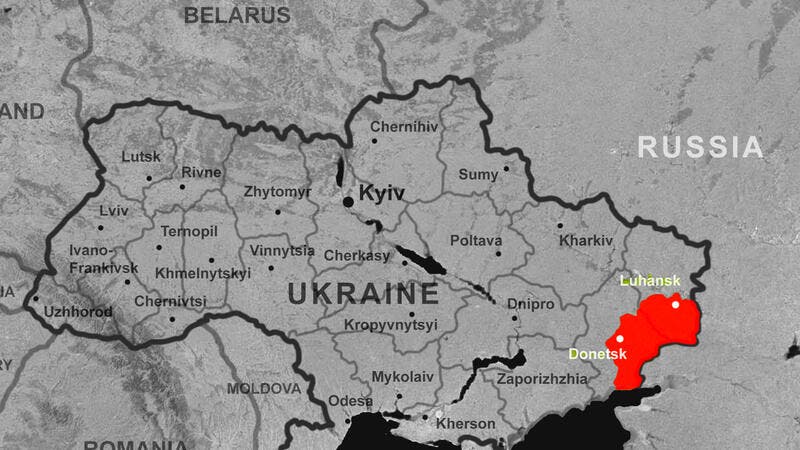
Two eastern provinces, Donetsk and Lugansk, also wanted to split off from Ukraine and also conducted a referendum in support of that move. But Putin would not agree to the request from the two provinces, which instead declared their own independence, a move that the new government in Kiev denounced as illegal. The Kiev regime also deemed the insurgents “terrorists” and launched an “anti-terrorism operation” to crush the resistance. Ultra-nationalist and even neo-Nazi militias, such as the Azov Battalion, took the lead in the bloody fighting.

Anti-coup demonstrations also broke out in the city of Odessa to the south. Ukrainian nationalist leader Andrei Parubiy went to Odessa, and two days later, on May 2, 2014, his street fighters attacked the demonstrators, driving them into the Trade Union building, which was then set on fire. Forty-two people were killed, some of whom jumped to their deaths.

‘Other Side of the Story’

If the film just got across this “other side of the story,” it would provide a valuable contribution since most of this information has been ignored or distorted by the West’s mainstream media, which simply blames the Ukraine crisis on Vladimir Putin. But in addition to the fine work by scenarist Vanessa Dean, the direction by Igor Lopatonok and the editing by Alexis Chavez are extraordinarily skillful and supple.

The 15-minute prologue, where the information about the Nazi collaboration by Bandera and Lebed is introduced, is an exceptional piece of filmmaking. It moves at a quick pace, utilizing rapid cutting and also split screens to depict photographs and statistics simultaneously. Lopatonok also uses interactive graphics throughout to transmit information in a visual and demonstrative manner.

Stone’s interviews with Putin and Yanukovych are also quite newsworthy, presenting a side of these demonized foreign leaders that has been absent in the propagandistic Western media.

Though about two hours long, the picture has a headlong tempo to it. If anything, it needed to slow down at points since such a large amount of information is being communicated. On the other hand, it’s a pleasure to watch a documentary that is so intelligently written, and yet so remarkably well made.

When the film ends, the enduring message is similar to those posed by the American interventions in Vietnam and Iraq. How could the State Department know so little about what it was about to unleash, given Ukraine’s deep historical divisions and the risk of an escalating conflict with nuclear-armed Russia?

In Vietnam, Americans knew little about the country’s decades-long struggle of the peasantry to be free from French and Japanese colonialism. Somehow, America was going to win their hearts and minds and create a Western-style “democracy” when many Vietnamese simply saw the extension of foreign imperialism.

In Iraq, President George W. Bush and his coterie of neocons was going to oust Saddam Hussein and create a Western-style democracy in the Middle East, except that Bush didn’t know the difference between Sunni and Shiite Moslems and how Iraq was likely to split over sectarian rivalries and screw up his expectations.

Similarly, the message of Ukraine on Fire is that short-sighted, ambitious and ideological officials – unchecked by their superiors – created something even worse than what existed. While high-level corruption persists today in Ukraine and may be even worse than before, the conditions of average Ukrainians have deteriorated.

And, the Ukraine conflict has reignited the Cold War by moving Western geopolitical forces onto Russia’s most sensitive frontier, which, as scholar Joshua Shifrinson has noted, violates a pledge made by Secretary of State James Baker in February 1990 as the Soviet Union peacefully accepted the collapse of its military influence in East Germany and eastern Europe. (Los Angeles Times, 5/30/ 2016)

This film also reminds us that what happened in Ukraine was a bipartisan effort. It was begun under George W. Bush and completed under Barack Obama. As Oliver Stone noted in the discussion that followed the film’s premiere in Los Angeles, the U.S. painfully needs some new leadership reminiscent of Franklin Roosevelt and John Kennedy, people who understand how America’s geopolitical ambitions must be tempered by on-the-ground realities and the broader needs of humanity to be freed from the dangers of all-out war.

James DiEugenio is a researcher and writer on the assassination of President John F. Kennedy and other mysteries of that era. His most recent book is Reclaiming Parkland.

Why the Russian Federation Recognized the Independence Movements in the Donbas

Recognition of the Donetsk and Luhansk People’s Republics is a direct result of U.S. efforts to contain Russian economically and militarily.

By Ajamu Baraka

Source: Black Agenda Report

“Minsk, Minsk, Minsk,” they cried after Russia recognized Donetsk and Luhansk. But those Western diplomats and pundits did not hear those of us in the anti-war, pro-peace and anti-imperialist movements who insisted that Minsk II was the only conceivable way out of the crisis!  

There will be reams of words attempting to provide a coherent analysis of the manufactured crisis dramatically unfolding in Ukraine, which took another unanticipated turn when Russia extended recognition to the Peoples’ Republics of Donetsk and Luhansk in the territory referred to as the Donbas in Eastern Ukraine. 

I will not add to that mountain of ink because, for me, the story is relatively simple. I have argued since 2015 that it was greed informed by miscalculations that drove the U.S. — with the support of European capital salivating from prospect of profits generated by gaining full control of the Ukrainian economy through the European Association agreement — to decide to overthrow the government of Viktor Yanukovych when he turned to Russia instead of surrendering Ukrainian sovereignty to U.S. and European capital. 

This was the genesis of the crisis. For U.S. policymakers it did not matter that the coup government was made up of literal neo-Nazis and extremist white supremacists and antisemitic ultra-nationalists from the neo-Nazi Svoboda party — the National Socialist Party of Ukraine. 

Nor was there any concern that one of the former commanders of the Azov Battalion, a violent right-wing gang that was merged into the Ukrainian National Guard and is now being trained by the British, said that Ukraine’s mission is to “lead in a final crusade … against the Semite-led Untermenschen” (sub-humans). 

No concern because aligning with rightist elements in order to advance the economic and geostrategic interests of the U.S. state and capitalist class behind the backs of the U.S. public is nothing new. That is why it is so ironic, or perhaps contradictory, that while Democratic Party activists are mobilized to struggle against the far-right in the U.S., Biden’s Ukrainian policies are affirming once again that the neoliberal right does not mind aligning with naked fascism to advance the imperial interests of capital.  

From rightist Islamic forces to right-wing apartheid state of Israel, to anti-democratic monarchs of Saudi Arabia and the Gulf Cooperation Council (GCC), there is usually never a state too odious for the U.S. to deal with as long as there was the possibility of a buck to be made. 

That is why it is almost surreal to read U.S. propaganda messages that still frame U.S. intentions in themes that suggest a benevolent character to U.S. behavior — and getting away with it! And even among African/Black radicals who should know better, instead of educating Africans on what was in play in Ukraine with the expansion of the white supremacist NATO structure, the gangster move being made on Ukraine in order for U.S. capital to continue to assert control over the European market, and the crude attempt to divert attention away from the failures of Biden’s domestic policies — some Africans, along with elements of the white left, were more interested in having abstract discussions on the class nature of the Russian state and economy — as if there was anything to debate there! 

Like other subversive actions by the U.S. state, the destabilization and then capturing of the Ukrainian state, and the installation of a puppet government had nothing to do with any concerns for democracy. It is impossible for the U.S. to be concerned about democracy when it is the principal state undermining democracy around the world. If the U.S. were committed to upholding democratic processes, it would not have overthrown a democratically elected government in Ukraine. 

And U.S. policy certainly did not reflect any concern for human rights in Ukraine. The war that was sparked after the coup government decided to attack its own citizens in the Donbas who rejected its legitimacy resulted in thousands of Ukrainians losing their lives.

The U.S. was not concerned with the territorial integrity of Ukraine either, because it was the coup government, backed by their bosses in Washington, that forced the separation of the Donbas from Ukraine by defining them as non-Ukrainians. Ukrainian citizens in Donbas became “pro-Russia separatists and terrorists,” which made them eligible for massive human rights violations, including murder as foreign entities. 

Yet, with all of that, up until February 21, 2022, the 57th anniversary of the assassination of Black internationalist revolutionary Malcolm X, a route to a peaceful resolution to the crisis existed — the Minsk II agreement.  It was the Minsk II agreement, put in place after the independent republics fought the Ukrainian neo-fascists to a military stand-still, along with provisions for a ceasefire, that provided a path to peaceful resolution. The agreement would have provided political autonomy for the Donbas within the Ukrainian state, thus preserving the existing borders of Ukraine before the coup of 2014. 

Unfortunately, with the election of Joe Biden, who was the Obama administration’s point person on Ukraine, the Democrats immediately picked-up where U.S. policy left off in 2016 and started to encourage the Ukrainian government to ignore the Minsk II agreement and to consider taking back the Donbas by force. 

Today, after the U.S. flooded Ukraine with weapons, including long-range artillery that was introduced into the conflict area in violation of the Minsk ceasefire deal, the deployment of 150,000 Ukrainian troops positioned along the contact line between Ukraine and Donbas, and the shelling from the Ukrainian forces right during the period that the U.S. predicted that Russia would invade, the Minsk agreement has become another casualty of war. 

On February 18, 2022, Russian foreign minister Sergei Lavrov stated that he was “alarmed ” by a reported spike in Ukrainian artillery attacks against rebels in the eastern region of Donbas with weapons prohibited by the Minsk agreement. Reports from the Organization for Security and Cooperation in Europe (OSCE), which was tasked with the responsibility, since 2015, to monitor and report on violations of the agreement, indicated that in Donetsk, between February 18 and February 20, 2022, there were 591 ceasefire violations, and in Luhansk it recorded 975 ceasefire violations, including 860 explosions.  

What was the response from the Ukraine government? The government claims that OSCE is biased because the data it is gathering seems to indicate that it is the Ukrainian forces that are responsible for the increase in military actions.  

But that controversy and debate over that data failed to find itself in the daily coverage of the situation by the Western press, even though the empirical data clearly showed that Ukrainian forces were responsible for escalating the military engagement.  

Ukraine is just the symptom; the Disease is U.S. Doctrine of “Full Spectrum Dominance”

The U.S. has its pretext to move the Europeans to impose economic sanctions against Russia, even though it is clear to many in Europe that the Biden administration’s policies are no more than the “liberal” version of “America First” as it relates to Europe. 

European capital, especially the Germans, are expected to take another hit for the team like it did during the first round of sanctions against Russia and the money they all lost with the Trump administration’s abrogation of the Joint Comprehensive Plan of Action (the Iran Nuclear Deal). 

The capitalist oligarchy that is the base of Putin’s governing coalition may understand something that U.S. policymakers in their arrogance are underestimating, namely, that European capital is getting closer to a breaking point with the U.S., especially when money can be made in a context of relative stability in Europe as opposed to the destabilizing effects of conflict. 

They also know that the world is changing and that multipolarity is rapidly becoming the new reality and that European capital will have to make careful choices.

China is the number one trade and investment partner with the European Union states, the Chinese inspired “Regional Comprehensive Economic Partnership (RCEP) ” is the largest “free trade” agreement on the planet constituting one third of humanity and one third of global GDP. Russia is sitting on top of the Eurasia Economic Union that, in terms of land, is the largest trade union on the planet, and of course the Belt and Road Initiative (BRI). 

The Russian recognition of the republics of Donbas was no more than the open acknowledgment of the dismembering of Ukraine. A process that started with the U.S. coup and the imposition of a government that completely turned over Ukrainian sovereignty to U.S. and European capital. 

The lesson for the colonized, working classes and nationally oppressed? Authentic national liberation, people(s)-centered human rights, and self-determination for peoples and nations are impossible in a world in which capitalist competition and war are the defining characteristics of global relations. 

We must, as we say in the Black is Back Coalition and the Black Alliance for Peace, turn imperialist wars into wars against imperialism! That is our task and responsibility. To do otherwise is to fail the historical mission of our generation. 

Russian bear wants justice

By Batko Milacic for the Saker Blog

Source: The Saker

Despite possible sanctions and their hard-hitting economic consequences, the hunted Russian bear has got out of the den and is going after the hunters. Until recently, Russians, Ukrainians, and Europeans believed that there would be no war. What we see now, however, is a full-scale Russian intervention and quite a successful one too. Where are the Russian troops going, and most importantly, why? And where will they stop?

Strengthened since the breakup of the Soviet Union, Russia was quite content with its new status of a leading regional power, and only verbally recalled its glorious imperial past. During the early 2000s, Russia even mulled the possibility of integrating into NATO and the EU, only to see its natural and legitimate interests repeatedly and shamelessly ignored. Millions of Russian-speakers living in the post-Soviet republics were deprived of their right to use their native language, while the Baltic countries and Ukraine profited from the transit of gas, oil, and raw materials. There was even a new “policy of gas pipelines,” when Russia was pressured into make concessions in exchange for being allowed to build a gas pipeline or simply put a stop to the syphoning off of its pipeline gas.

In fact, a resurgent Russia was gradually being presented as a “potential enemy” for the sake of reiterating NATO’s role as a defender against the imagined Russian threat. All this resulted in the 2013 events in Ukraine where nationalists came to power not without outside help, flatly refusing to safeguard the interests of the country’s Russian-speaking population, primarily in eastern Ukraine. Facing the risk of losing its naval base in Sevastopol (existing there since the 18th century) and wishing to protect the Russian-speaking people living in Ukraine, Russia, with the full support of the local population, re-absorbed Crimea and supported the separatists of Donbass. This was followed by Kiev’s ban on the use of the Russian language in the country (not entirely successful, though, since it was the main spoken language of Ukraine) and police persecution of those who advocated a dialogue with Moscow. In its effort to support Ukraine, the West introduced a series of anti-Russian sanctions, which seriously damaged the Russian economy. Still, for the past eight years, Russia was ready for dialogue. In exchange for autonomy for Russian-speakers and guarantees of non-deployment of a NATO infrastructure in eastern Ukraine, Moscow was prepared to roll back its support for the separatists and, possibly, even hold a new referendum in Crimea on its reunification with Russia.

However, during all these eight years, people continued to die along the disengagement line in Donbass, separating Kiev’s armed forces and the separatists (at the rate of more than 100 a year). Meanwhile, Russia was officially branded by Kiev as an “aggressor,” and those in power in Ukraine started to busily prepare for a big war, demanding military and financial assistance from the EU and Washington. And while President Zelensky’s predecessor, the millionaire Petro Poroshenko, was still able to maintain a dialogue with Moscow with the help of the oligarchs, the current president, who came to power on the strength of promises to seek peace and reconciliation, was trying hard to enter NATO and was threatening Russia with missiles deployed near Chernigov (750 km from Moscow). As for the Kremlin, it has spent the past six months trying to negotiate with Brussels, Washington and Zelensky himself. All that Putin was asking for were security guarantees for Russia. In fact, Moscow never really threatened Ukraine but was still being systematically pushed towards a military solution.

It should be noted that prior to the intervention, Putin explained in great detail to his compatriots what was going on, recalling how the borders of the Soviet republics had been cut and how Russian-speaking territories had been handed over to Ukraine. He also made it clear that one cannot talk about a violation of international law after the invasion of Iraq, the bombing of Serbia, the recognition of Kosovo and NATO’s move to the Russian borders.

Let’s be honest: a bear sleeping peacefully in its den was smoked out of there by being poked with a stick, and now they are wondering why it is chasing those who did that. Moscow has been pushed into a corner and is now demonstrating its strength and standing up for its interests. Now Putin will at best be satisfied with a change of guard in Kiev, and at worst, Ukraine as a state will disappear from the map of Europe. Is it possible to justify an aggression that has been provoked for a long time? This is a matter of a lengthy discussion. One thing is clear: 20 years ago, Russia could and wanted to join NATO and united Europe. However, the latter chose to make Russia an enemy…

Related Articles:

From the Black Sea to the East Med, Don’t Poke the Russian Bear – By Pepe Escobar

Scholz Caves on Nord Stream While Putin Throws Donbass a Lifeline – By Mike Whitney

Sino-Russia Energy Deals to Defeat US/NATO Expansionism

By Salman Rafi Sheikh

Source: New Eastern Outlook

While the recent meeting between Russia’s Vladimir Putin and China’s Xi in Beijing may not in itself be an extra-ordinary event, its significance against the backdrop of the on-going tussle between Russia and the US/NATO is quite unmistakable – not only for Russia itself, but for the US/NATO as well. Even though Russia does not really need China’s help to defend its sovereignty militarily or otherwise, it remains that China’s open support for Russia’s stance against the US plan to push NATO into Ukraine as a geo-political tool does debunk the US propaganda of Russian “isolation.” More than anything else, China’s growing strategic alliance allows Russia a great opportunity to withstand possible Western sanctions, or European decision to reduce its supply of gas from Russia. But co-operation in one field is often not possible without co-operation in other fields. That’s why the long joint statement issued after the meeting laid a lot of stress on jointly opposing Western plans to destabilise regions adjacent to mainland China and Russia i.e., Ukraine, Taiwan, and Hong Kong. As the sides reiterated:

“The sides oppose further enlargement of NATO and call on the North Atlantic Alliance to abandon its ideologized cold war approaches, to respect the sovereignty, security and interests of other countries, the diversity of their civilizational, cultural and historical backgrounds, and to exercise a fair and objective attitude towards the peaceful development of other States.”

While the fact that both Russia and China oppose Western expansionism both via NATO or anti-China AUKUS (Australia, United Kingdom and United States) treaty has already unsettled Western echelons of power, it is the growing co-operation between Russia and China in the energy sector that is most likely to defeat US designs vis-à-vis forcing Russia to submit. This is particularly significant given that the US is particularly interested in hurting Russia’s gas and oil sales. US President Biden recently said this, while standing next to his German counterpart, without mincing any words only recently on February 7:

“What everybody forgets here is Russia needs to be able to sell that gas and sell that oil.  Russia relies — a significant part of Russia’s budget — it’s the only thing they really have to export.  And if, in fact, it’s cut off, then they’re going to be hurt very badly, as well.  And it’s of consequence to them as well.  This is not just a one-way street.”

Moscow is, obviously, not unaware of this design. When Putin visited Beijing, he did not just attend the Winter Olympics; in fact, Putin signed a billion dollar oil and gas deal with Beijing. “Our oilmen have prepared very good new solutions on hydrocarbon supplies to the People’s Republic of China,” Putin said in Beijing. Besides the new deal, China also promised to ramp up Russia’s Far East exports. A new 30-year contract to supply 10 billion cubic meters (bcm) per year to China from Russia’s Far East was signed. With China supporting Russia’s stance on Ukraine, China’s increasing purchase of Russian oil and gas sent a powerful signal to the world that both superpowers will be taking care of each other’s interests against the combined strength of predatory western alliance, making their claims of punishing Russia hollow.

The announcement also comes against the backdrop of US claims that they – US and its allies – have a wide range of “tools” at their disposal to punish any state, including China, if they try to “backfill US exports controls” imposed on Russia. As Ned Price of the White House recently claimed in his press briefing:

“Putin knows that this would be of massive consequence to his country and to his economy. This – a closer relationship with the PRC, a closer relationship between Russia and the PRC – is not going to make up for that; it is not going to account for that. One final point. We have – and when I say we I mean collectively, the United States and our allies and partners – we have an array of tools that we can deploy if we see foreign companies, including those in China, doing their best to backfill U.S. export control actions, to evade them, to get around them.”

China’s deal, therefore, very clearly defies US threats, showing how the politics of sanctions – which is Washington’s favourite geo-political “tool” – cannot really deter states like China and Russia, who, too, posses enough “tools” to stage a counter-attack. The oil & gas deals are a manifestation of that counter-attack.

Even as many political pundits in the West have highlighted, the US plan against Russia cannot work unless Washington can first wean China away. The fact that Washington’s ties with Beijing are as bad as with Moscow means that Washington does not have enough geo-political capacity to dictate policies and decisions by really isolating Russia. Although it might still impose sanctions, China is unlikely to be bothered by them, thus defeating Washington’s plan to inflict an unacceptable level of damage on Russia, which also already has US$640 billion in foreign exchange reserves to withstand western sanctions.

But, as mentioned above, the real factor bothering the West is not what Russia can or might do in the wake of a conflict around Ukraine; the real factor is the almost absolute convergence between Russia and China on almost all issues of global politics – a fact duly highlighted via the said joint statement. This statement is not about their bi-lateral relations; in fact, it is an elaborate commentary on the challenges they are facing from the West and how these very challenges have transformed and elevated their ties to a level not known in the contemporary era.

Therefore, in the wake of US/European pressure on Russia and Moscow’s massive new deals with China means the Biden administration will now have to come up with a new plan to defeat Russia, or altogether drop its project. With Russia now clearly able to diversify its oil and gas deals away from Europe, the question is: can Europe itself do without Russia and without facing any economic backlash? It was only last week the UK government announced a whooping 54 per cent increase in domestic energy bills, causing a political outcry against the Johnson administration. The unnecessary war in Russia is already starting to bite back the war-wagers themselves.