“Drop a Nuclear Bomb on Gaza”: Israeli Minister Says Using Nukes on Gaza an Option

By Timothy Alexander Guzman

Source: Silent Crow News

Amichai Eliyahu, an Israeli Heritage Minister has admitted to the world that Israel has nuclear weapons ready to be used on the Palestinians.  The Times of Israel reported that “Heritage Minister Amichai Eliyahu said Sunday that one of Israel’s options in the war against Hamas was to drop a nuclear bomb on the Gaza Strip, in comments that were quickly disavowed by Prime Minister Benjamin Netanyahu, who also suspended the minister from cabinet meetings.” 

Surely, Netanyahu is angry with Eliyahu’s comments since the Israeli government never confirmed nor denied that they have nuclear weapons, so Eliyahu got himself suspended.

Eliyahu was asked in an interview with Radio Kol Berama “whether an atomic bomb should be dropped on the enclave” and he responded with “This is one of the possibilities.”

Eliyahu is a far-right politician who rejects humanitarian aid into Gaza by saying that “we wouldn’t hand the Nazis humanitarian aid,” and that “there is no such thing as uninvolved civilians in Gaza.”  He also advocates efforts to retake the Gaza Strip and rebuild Israeli settlements before his government decided to unilaterally withdrew in 2005. Eliyahu was also asked about what would happen to the Palestinian population in the aftermath and he said that “They can go to Ireland or deserts; the monsters in Gaza should find a solution by themselves.”

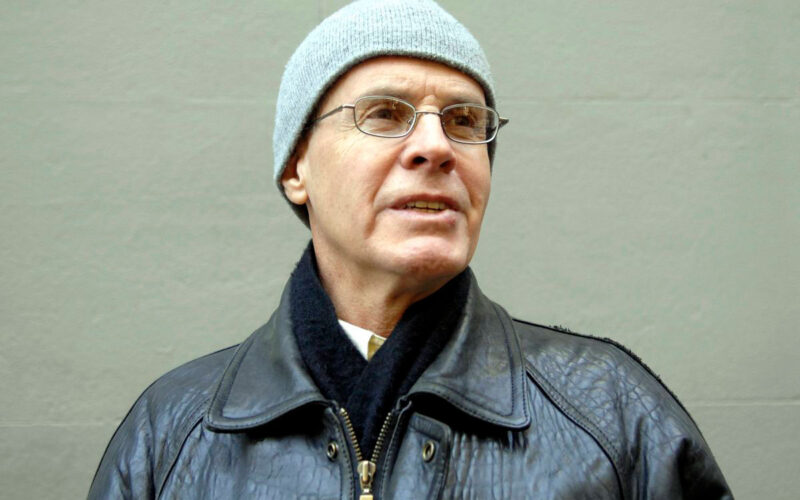
Whistleblower Mordechai Vanunu, a Moroccan-born Israeli citizen, a former nuclear technician exposed Israel’s nuclear weapons factory located in the Negev Desert, not far from the city of Dimona to The Sunday Times of London in 1986.  Vanunu was drugged and kidnapped by Mossad agents while in Rome and spent more than 11 years out of 18-year prison sentence in solitary confinement in an Israeli prison.

In 2005, The Institute for Policy Studies (IPS) published ‘The Release of Mordechai Vanunu and U.S. Complicity in the Development of Israel’s Nuclear Arsenal’ which revealed an important fact that Vanunu’s revelations about how Israel’s nuclear program is “offensive in nature”:

A former strategic analyst at the Rand Corporation observed that Vanunu’s revelations about Israel ’s nuclear program demonstrated that: “Its scale and nature was clearly designed for threatening and if necessary, launching first-use of nuclear weapons against conventional forces.” Prior to Vanunu’s revelations, many suspected that Israel ’s nuclear program was limited to tactical nuclear artillery and naval shells

Mordechai Vanunu exposed Israel’s nuclear weapons program so he is considered a traitor but to Vanunu’s own observation, he sees it differently, “Five million Jews are regarding me as a traitor, but six billion people around the world think me as a hero and a good man who bring the message to all the human beings that we should survive and prevent the use of nuclear weapons and to prevent the nuclear preparations and to prevent nuclear war in the future.” 

Israel says that Iran is building a nuclear weapons program which Tehran has repeatedly denied, but it is Israel who has been exposed for having an arsenal of nuclear weapons ready to be used against the Muslim world. 

The Pulitzer Prize winning journalist, Seymour M. Hersch wrote, ‘The Sampson Option; Israel’s Nuclear Arsenal and America’s Foreign Policy’ and concluded that “America’s policy toward the Israeli arsenal, as we have seen in this book, was not just one of benign neglect: it was a conscious policy of ignoring reality.”   Hersch warned about Israel’s nuclear capabilities including the production of low-yield neutron warheads to exporting nuclear technology:

By the mid-1980s, the technicians at Dimona had manufactured hundreds of low-yield neutron warheads capable of destroying large numbers of enemy troops with minimal property damage. The size and sophistication of Israel’s arsenal allows men such as Ariel Sharon to dream of redrawing the map of the Middle East aided by the implicit threat of nuclear force. Israel also has been an exporter of nuclear technology and has collaborated on nuclear weapons research with other nations, including South Africa.

In September 1988, Israel launched its first satellite into orbit, bringing it a huge step closer to intercontinental missiles and a satellite intelligence capability—no more Jonathan Pollards would be needed to steal America’s secrets. Scientists at Z Division concluded that the rocket booster that launched the Israeli satellite produced enough thrust to deliver a small nuclear war- head to a target more than six thousand miles away.  Israeli physicists are still at the cutting edge in weapons technology and involved, as are their American and Soviet counterparts, in intensive research into nuclear bomb-pumped X-ray lasers, hydrodynamics, and radiation transport—the next generation of weaponry.

None of this has ever been discussed in the open in Israel, or in the Knesset. Meanwhile, Israeli field commanders have accepted nuclear artillery shells and land mines as battlefield necessities: another means to an end

So, would the Israelis be willing to drop a nuclear bomb on Iran? There is no doubt that Russia and other world powers including China would not allow Israel to hit Iran with a nuclear bomb.  

If Israel decided to use a nuclear weapon anywhere in the Middle East, it would unite all Muslims against Israel and that is something Tel Aviv and Washington is not prepared for.      

Hersch concluded that “the basic target of Israel’s nuclear arsenal has been and will continue to be its Arab neighbors. Should war break out in the Middle East again and should the Syrians and the Egyptians break through again as they did in 1973 or should any Arab nation fire missiles again at Israel, as Iraq did, a nuclear escalation, once unthinkable except as a last resort, would now be a strong probability. Never again. The Samson Option is no longer the only nuclear option available to Israel.” 

Unraveling the Epstein-Chomsky Relationship

Recent revelations that the renowned linguist and political activist met with Jeffrey Epstein several times have surprised and confused many. Why was Epstein interested in meeting with Noam Chomsky? And why did Chomsky agree to meet him despite his past? The answer may surprise you.

By Whitney Webb

Source: Unlimited Hangout

On Sunday, the Wall Street Journal published a report detailing information contained within a “trove” of previously unreported documents of the deceased sex trafficker Jeffrey Epstein. Those documents, which have not been publicly released and appear to have been passed solely to the Journal, included Epstein’s private calendar and meeting schedules. The documents, per the Journal, contain “thousands of pages of emails and schedules from 2013 to 2017” and – as the report notes – detail Epstein’s dealings with several prominent individuals whose names were not on his flight logs or his infamous “little black book” of contacts. One of these individuals is the renowned linguist, political commentator and critic of capitalism and empire, Noam Chomsky.

Chomsky, who has previously discussed the Epstein case in interviews and who has maintained that Epstein’s ties to intelligence agencies should be considered a “conspiracy theory,” had not previously disclosed these meetings. Chomsky, when confronted by Journal reporters, was evasive, but ultimately admitted to meeting and knowing Jeffrey Epstein. 

Many, largely on the left, have expressed dismay and confusion as to why someone with the political views of Chomsky would willingly meet, not once but several times, with someone like Jeffrey Epstein, particularly well after Epstein’s notoriety as a sex trafficker and pedophile. As this report will show, Epstein appeared to view Chomsky as another intellectual who could help guide his decisions when it came to his scientific obsessions – namely, transhumanism and eugenics. What Chomsky gained in return from meeting with Epstein isn’t as clear.

Why Did Chomsky Meet with Epstein?

According to the Journal, Chomsky’s meetings with Epstein took place during the years 2015 and 2016, while Chomsky taught at the Massachusetts Institute of Technology, or MIT. Chomsky told the Journal that he met with Epstein to discuss topics like neuroscience with other academics, like Harvard’s Martin Nowak (who was heavily funded by Epstein). On a separate occasion, Chomsky again met with Epstein alongside former Israeli Prime Minister, Ehud Barak, allegedly to discuss “Israel’s policies with regard to Palestinian issues and the international arena.” A separate date saw Chomsky and his wife invited by Epstein to have dinner with him, Woody Allen and Allen’s wife Soon-Yi Previn. When asked about the dinner date with Woody Allen and Epstein, Chomsky referred to the occasion as “an evening spent with a great artist.”

When confronted with this evidence, Chomsky initially told the Journal that his meetings and relationship with Epstein were “none of your business. Or anyone’s.” He then added that “I knew him [Epstein] and we met occasionally.”

Before continuing further, it is important to note that aside from Epstein, both Ehud Barak and Woody Allen have been accused of having inappropriate sexual relationships with minors. For instance, Barak was a frequent visitor to Epstein’s residences in New York, so often that The Daily Beast reported that numerous residents of an apartment building linked to Epstein “had seen Barak in the building multiple times over the last few years, and nearly half a dozen more described running into his security detail,” adding that “the building is majority-owned by Epstein’s younger brother, Mark, and has been tied to the financier’s alleged New York trafficking ring.”

Specifically, several apartments in the building were “being used to house underage girls from South America, Europe and the former Soviet Union,” according to a former bookkeeper employed by one of Epstein’s main procurers of underage girls, Jean Luc Brunel. Barak is also known to have spent the night at one of Epstein’s residences at least once, was photographed leaving Epstein’s residence as recently as 2016, and has admitted to visiting Epstein’s island, which has sported nicknames including “Pedo Island,” “Lolita Island” and “Orgy Island.” In 2004, Barak received $2.5 million from Leslie Wexner’s Wexner Foundation, where Epstein was a trustee as well as one of the foundation’s top donors, officially for unspecified “consulting services” and “research” on the foundation’s behalf. Several years later, Barak put Harvey Weinstein in contact with the Israeli private intelligence outfit Black Cube, which employs former Mossad agents and Israeli military intelligence operatives, as Weinstein sought to intimidate the women who had accused him of sexual assault and sexual harassment.

In addition, Barak previously chaired and invested in Carbyne911, a controversial Israeli emergency services start-up that has expanded around the world and has become particularly entrenched in the United States. Barak had directed Epstein to invest $1 million into that company, which has been criticized as a potential tool for warrantless mass surveillance. Leslie Wexner also invested millions in the company.

In Woody Allen’s case, he has been accused of sexually assaulting his adopted daughter Dylan Farrow when she was 7 years old. That abuse claim has been corroborated by witnesses and other evidence. Furthermore, Allen refused to take a polygraph administered by state police in connection with the investigation and lost four exhaustive court battles related to child custody and his abuse of Dylan Farrow. One of the judge’s in the case described Allen’s behavior towards Dylan as “grossly inappropriate and that measures must be taken to protect her.” Actress Mia Farrow, Dylan’s mother, alleged in court that Allen took a sexual interest in her adopted daughter when she was between the ages of two and three years old.

Allen subsequently “seduced” and later married another adopted daughter of Farrow’s, Soon-Yi Previn, whom Allen first met when Previn was a child. However, Previn has stated that her first “friendly” interaction with Allen took place when she was a teenager. In 1992, Mia Farrow found nude photos of Previn in Allen’s home and has stated that this was her motive for ending her relationship with Allen.

In the case of Allen and Epstein, and potentially Barak as well, their sexual proclivities and scandals were well known by the time Chomsky met with these men, making a strong suggestion that this type of behavior was not seen by Chomsky as taboo or as a barrier to socialization. It is more likely than not that there was some other major draw that led Chomsky to overlook this type of horrendous behavior toward vulnerable minors.

In terms of reaching a deeper understanding about why Epstein would have been interested in Chomsky – and vice versa, it is important to review – not just the information recently reported by the Wall Street Journal, but also what Epstein himself said of Chomsky before his 2019 death. According to an interview conducted in 2017, but later published in 2019 when Epstein was a major news topic, Epstein openly stated that he had invited Chomsky to his townhouse and he also explicitly stated why he had done so. Oddly, this early acknowledgement of Epstein’s regarding his relationship with Chomsky was left out of the Journal’s recent report.

In that interview, which was conducted by Jeffrey Mervis and later published in Science, Epstein stated that following about Chomsky:

[…] Epstein readily admitted to asking prominent members of the scientific establishment to assess the potential contribution of these so-called outcasts [i.e. MIT students Epstein described as being “on the spectrum”].

“So, I had Jim Watson to the house, and I asked Watson, what does he think about this idea,” a proposal to study how the cellular mechanisms of plants might be relevant to human cancer. Watson is a Nobel laureate and co-discoverer of the structure of DNA. “Likewise with [Noam] Chomsky on artificial intelligence,” he said, referring to one of the pioneers in the field.

In fact, Epstein expressed great respect for the opinions of these elder statesmen. “It’s funny to watch Noam Chomsky rip apart these young boys who talk about having a thinking machine,” Epstein noted. “He takes out a dagger and slices them, very kindly, into little shreds.”

Thus, per Epstein, his interest in inviting Chomsky to his house was explicitly related to the “artificial intelligence,” which was a major scientific interest of Epstein’s. This also provides a major clue as to how Chomsky and Epstein might have first been introduced.

Chomsky, Epstein and MIT

Chomsky is most widely viewed as a famous linguist, political commentator and critic of modern capitalism and imperialism. So, why did Epstein seek to meet with him instead on Artificial Intelligence matters?

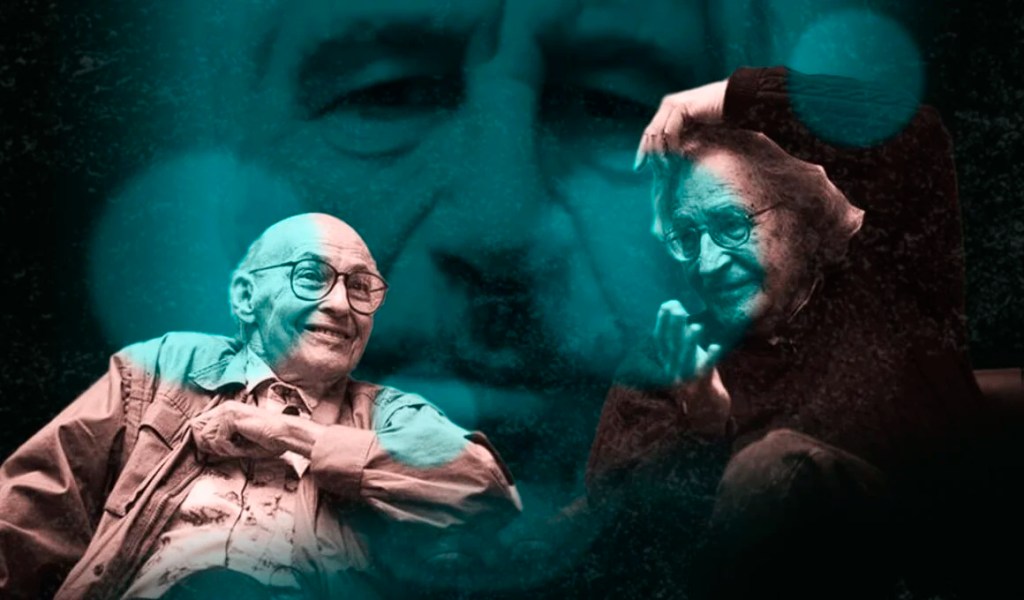
Well, an admitted “friend” of both Chomsky’s and Epstein’s was the AI pioneer Marvin Minsky. Like Chomsky, Minsky was a long-time professor and academic at MIT. It is very possible that Minsky connected the two men, especially considering the fact that Epstein was a major donor to MIT. Epstein described himself as being “very close” to Minsky, who died in 2016, roughly a year after Epstein began meeting with Chomsky. Epstein also financed some of Minsky’s projects and Minsky, like Ehud Barak, was accused of sexually abusing the minors Epstein trafficked.

Chomsky’s views on linguistics and cognition, for those who don’t know, is based very much on evolutionary biology. Chomsky was also a pioneer in cognitive science, described as “a field aimed at uncovering the mental representations and rules that underlie our perceptual and cognitive abilities.” Some have described Chomsky’s concept of language as based on “the complexity of internal representation, encoded in the genome, and their maturation in light of the right data into a sophisticated computational system, one that cannot be usefully broken down into a set of associations.” A person’s “language faculty”, per Chomsky, should be seen as “part of the organism’s genetic endowment, much like the visual system, the immune system and the circulatory system, and we ought to approach it just as we approach these other more down-to-earth biological systems.”

Despite their friendship, Minsky greatly diverged with Chomsky in this view, with Minsky describing Chomsky’s views on linguistics and cognition as largely superficial and irrelevant. Chomsky later criticized the widely used approach with AI that focuses on statistical learning techniques to mine and predict data, which Chomsky argued was “unlikely to yield general principles about the nature of intelligent beings or about cognition.”

However, Chomsky’s views linking evolutionary biology/genetics with linguistics/cognition were notably praised by the aforementioned Martin Nowak, who had attended one of the meetings Epstein had with Chomsky. Nowak, a professor of biology and mathematics and head of the Program for Evolutionary Dynamics at Harvard, later stated that he had “once broke out a blackboard during dinner with Epstein and, for two hours, gave a mathematical description of how language works,” further revealing that Epstein was interested in aspects of linguistics. It is unclear if this particular meeting was the same that Chomsky had attended alongside Nowak to discuss “neuroscience” and other topics.

However, given the importance of evolutionary biology and genetics to Chomsky’s theories, it is hardly surprising that Jeffrey Epstein would have gravitated more towards his views on AI than those of Minsky. Epstein was fascinated by genetics and, even per mainstream sources, was also deeply interested eugenics. Take for example the following from an article published in The Guardian in 2019:

Epstein was apparently fixated on “transhumanism”, the belief that the human species can be deliberately advanced through technological breakthroughs, such as genetic engineering and artificial intelligence.

At its most benign, transhumanism is a belief that humanity’s problems can be improved, upgraded even, through such technology as cybernetics and artificial intelligence – at its most malignant though, transhumanism lines up uncomfortably well with eugenics.


Thus, Epstein’s interest in AI, genetics, and more was tied into his documented obsession with “transhumanism,” which – as several Unlimited Hangout reports have noted – is essentially a rebranding of eugenics. Indeed, the term transhumanism itself was first coined by Julian Huxley, the former president of the British Eugenics Society and the first head of UNESCO who called to make “the unthinkable thinkable again” with regards to eugenics.

Aside from transhumanism, Epstein also had an avowed interest in “strengthening” the human gene pool, in part by impregnating as many women as possible with his “seed” in order to widely disperse his genes. These views may also explain Epstein’s interest in associating himself with people like James (Jim) Watson. As noted earlier in this article, Epstein stated in 2017 that he had invited both Watson and Chomsky to his home on separate occasions.

Watson has been a controversial figures for years, particularly after he openly stated that people of African descent are genetically inferior and less intelligent than their European counterparts. He also previously promoted the idea that women should abort babies that carried a “gay gene,” were such a gene ever discovered. He also felt that gene editing should be used to make all women “prettier” and to eradicate “stupidity”. Notably, Watson made all of these comments well before Epstein invited him to his home.

Watson was also praised, controversially, after these same comments by another Epstein-funded scientist, Eric Lander. Lander, who was recently Biden’s top science advisor, was forced to resign from that post last year after being accused of harassing those who worked under him in the Biden administration’s Office of Science and Technology. Prior to joining the Biden administration, Lander had collaborated with Watson on the Human Genome Project and later ran the Broad Institute, a non-profit born out of collaboration between MIT and Harvard.

Returning to Chomsky, though he may not have been aware of Epstein’s interests in eugenics and transhumanism, it has since become clear that Epstein’s main interest in Artificial Intelligence – his stated purpose for courting Chomsky – was intimately tied to these controversial disciplines. However, Chomsky did know of Epstein’s past, and likely also knew of Woody Allen’s similar past before meeting him as well. He turned a blind eye on those matters, telling the Journal that Epstein had “served his sentence” and, as a result, had been granted a “clean slate”. In saying this, Chomsky is apparently unaware of Epstein’s controversial “sweetheart deal” that resulted in an extremely lenient sentence and non-prosecution agreement. That “deal” was signed off on by then-US Attorney Alex Acosta because Acosta was told to “back off” Epstein because Epstein “belonged to intelligence.” Chomsky had previously told several people, including an Unlimited Hangout reader, that an Epstein-intelligence agency connection is a “conspiracy theory.”

Given Chomsky’s odd views on Epstein’s past and the fact that Epstein frequently discussed transhumanism and eugenics around other prominent scientists, it is possible, though unproven, that Chomsky may have known more about Epstein’s true interests in AI and genetics.

Would Chomsky have been willing to overlook these ethical conundrums? Given his political views on capitalism and foreign policy, many would likely say that he would not. However, finding ways to circumvent these ethical conundrums with respect to AI may have been one of Epstein’s main reasons for heavily funding MIT, particularly its Media Lab. Epstein, in addition to his own donations, also funneled millions of dollars from Bill Gates and Leon Black to the Media Lab.

According to former Media Lab employee Rodrigo Ochigame, writing in The Intercept, Joi Ito of MIT’s Media Lab – who took lots of donations from Epstein and attempted to hide Epstein’s name on official records – was focused on developing “ethics” for AI that were “aligned strategically with a Silicon Valley effort seeking to avoid legally enforceable restrictions of controversial technologies.” Ito later resigned his post at the Media Lab due to fallout from the Epstein scandal.

Ochigame writes:

A key group behind this effort, with the lab as a member, made policy recommendations in California that contradicted the conclusions of research I conducted with several lab colleagues, research that led us to oppose the use of computer algorithms in deciding whether to jail people pending trial. Ito himself would eventually complain, in private meetings with financial and tech executives, that the group’s recommendations amounted to “whitewashing” a thorny ethical issue. “They water down stuff we try to say to prevent the use of algorithms that don’t seem to work well” in detention decisions, he confided to one billionaire.

I also watched MIT help the U.S. military brush aside the moral complexities of drone warfare, hosting a superficial talk on AI and ethics by Henry Kissinger, the former secretary of state and notorious war criminal, and giving input on the U.S. Department of Defense’s “AI Ethics Principles” for warfare, which embraced “permissibly biased” algorithms and which avoided using the word “fairness” because the Pentagon believes “that fights should not be fair.”

Ochigame also cites Media Lab colleagues who say that Marvin Minsky, who worked with the Lab before his death, was known to say that “an ethicist is someone who has a problem with whatever you have in your mind.” Also troubling is the fact that Ito, and by extension the Media Lab, played a role in shaping White House policy with respect to AI. For instance, Obama called Ito an “expert” on AI and ethics during an interview with him in 2016. Ito, on his conversation with Obama, said the following: “[…] the role of the Media Lab is to be a connective tissue between computer science, and the social sciences, and the lawyers, and the philosophers […] What’s cool is that President Obama gets that.”

If you are Jeffrey Epstein, with a history of illegal and criminal activity, and interested in avoiding the regulation of controversial technologies you feel are necessary to advance your vision of transhumanism/eugenics, financing groups that greatly influence “ethics” policies that helps limit the regulation of those technologies would obviously benefit you.

Ochigame goes on to write:

Thus, Silicon Valley’s vigorous promotion of “ethical AI” has constituted a strategic lobbying effort, one that has enrolled academia to legitimize itself. Ito played a key role in this corporate-academic fraternizing, meeting regularly with tech executives. The MIT-Harvard fund’s initial director was the former “global public policy lead” for AI at Google. Through the fund, Ito and his associates sponsored many projects, including the creation of a prominent conference on “Fairness, Accountability, and Transparency” in computer science; other sponsors of the conference included Google, Facebook, and Microsoft.

Notably, Epstein was tied into these same circles. He was very, very close, not just with Bill Gates, but with several other top Microsoft executives and was also known to have a close relationship with Google’s Sergey Brin, who has recently been subpoenaed in the Epstein-JPMorgan case, as well as Facebook/Meta’s Mark Zuckerberg. Notably, many of these same companies are currently pioneering transhumanist technologies, particularly in healthcare, and are deeply tied to either the military or intelligence, if not both.

The MIT-AI-Military Connection

Chomsky is just one of several prominent academics and intellectuals who were courted by Epstein in an attempt to supercharge the development of technologies that could help bring his controversial obsessions to fruition. Notably, many of these characters, including Chomsky, have had their work – at one point or another – funded by the U.S. military, which has itself long been a major driver of AI research.

For example, Minsky and Danny Hillis, a close associate of Epstein’s in his own right, co-created a DARPA contractor and supercomputer firm called Thinking Machines, which was aimed at creating a “truly intelligent machine. One that can see and hear and speak. A machine that will be proud of us,” according to one company brochure. Minsky was Hillis’ mentor at MIT and the pair sought out Sheryl Handler, who worked for a genetic-engineering start-up at Harvard called the Genetics Institute, to help them create their supercomputer firm.

Thinking Machines, which made poor business decisions routinely from the beginning, was only able to function for as long as it did due to multi-million dollar contracts it had secured from the Pentagon’s DARPA. With the close of Cold War, DARPA sought to use its clout with Thinking Machines to push the company to develop a product that could deal with things like modeling the global climate, mapping the human genome and predicting earthquakes. Subsequent reporting from the Wall Street Journal showed that the agency had been “playing favorites” and Thinking Machine’s “gravy train” abruptly ended due to the bad publicity, subsequently leading to the collapse of the company.

Hillis, around this time, met Jeffrey Epstein. The introduction may have been brokered by former Microsoft’s Chief Technology Officer Nathan Myhrvold, a friend of Hillis’ who grew close to Epstein in the 1990s and even took Epstein on an official Microsoft trip to Russia. Myhrvold, who was also named as an abuser of the minors Epstein trafficked, was one of the other top Microsoft officials who was close to Epstein beginning in the 1990s. Another was Linda Stone, who later connected Jeffrey Epstein to Joi Ito of MIT’s Media Lab. As previously mentioned, Epstein would later direct the long-time head of Microsoft, Bill Gates, to donate millions to the Media Lab.

Chomsky’s own history at MIT brought him into contact with the military. For instance, during the early 1960s, Chomsky received funding from the Air Force, which aimed to program a computer with Chomsky’s insights about grammar in an attempt to endow it “with the ability to recognize instructions imparted to it in perfectly ordinary English, thereby eliminating a necessity for highly specialized languages that intervene between a man and a computer.” Chomsky later stated of the military funding of his early career that “I was in a military lab. If you take a look at my early publications, they all say something about Air Force, Navy, and so on, because I was in a military lab, the Research Lab for Electronics.”

Chomsky has since denied that military funding shaped his linguistics work in any significant way and has claimed that the military is used by the government “as a kind of a funnel by which taxpayer money was being used to create the hi-tech economy of the future.” However, reports have noted that this particular project was very much tied to military applications. In addition, the man who first recruited Chomsky to MIT in the mid-1950s, Jerome Wiesner, went on to be Chomsky’s boss at MIT for over 20 years as well as “America’s most powerful military scientist.”

To Chomsky’s credit, after this program ended, he became fully, and publicly, committed to anti-war activism. This activism led him, at one point, to consider resigning from MIT, which he declined to do – likely because he was rather quickly granted professorship. As Chris Knight writes, “this meant that instead of resigning, Chomsky’s choice was to launch himself as an outspoken anti-militarist activist even while remaining in one of the US’s most prestigious military labs.”

By staying at MIT, Chomsky chose to maintain his career, in relative proximity to the centers of power he would later become an icon for denouncing. However, it shows that Chomsky, from this time onward, began to make some choices that undermined his radicalism to an extent. Chomsky may have rationalized his decision to stay at MIT in the 1960s because it gave him a better platform from which to espouse his political and anti-war views. It is not unheard of for prominent public figures to make such compromises. However, in light of the recent Epstein revelations and what they appear to signal, it seems that Chomsky, particularly in his later years, may have become too comfortable and too willing to make these types of compromises – ones that a much younger Chomsky would have surely rejected.

The US-Nazi Connection since World War II: From Inspiring the Third Reich to Supporting the Neo-Nazis of Ukraine

By Timothy Alexander Guzman

Source: Silent Crow News

The mafia in Washington, London, Brussels and Tel Aviv would do anything to keep their “Unipolar World Order” project in place, in fact, there are getting desperate to hold on to whatever remaining powers they have left even if it means collaborating with its worst enemies. There is a well-known ancient proverb “The enemy of my enemy is my friend” that rings true today especially since Washington, the CIA, the Military-Industrial Complex, along with Mossad and NATO have supported well-known terrorists including the Islamic State (ISIS), Al Qaeda, and other groups to overthrow governments they don’t approve of especially in the Middle East. However, their support of terrorists who were their enemies at one time or another did not start with their regime change wars against Syria or Libya, the idea of supporting its enemies began during and after World War II when the US government recruited Ukrainian Nazis to counter their new enemy, the Soviet Union. What a strange turn of events knowing that the Soviets who fought the Nazis with their American and European allies during the war were seen as a new threat. Washington and the rest of their mafia cohorts used the Nazis back then as they are now using jihadi terrorists today in their war for world domination no matter what the costs are in the long-term.

So who were the Nazis and why was Washington interested in recruiting them in the first place? For starters, the Nazis had members involved in several scientific and technological disciplines that the US government was interested in and would later utilize them to produce all sorts of weapons of war and psychological operations for its future military operations, but we will get into further details shortly. However, the Nazis did follow a far-right fascist ideology that was authoritarian that coincided with ultranationalist principals that rejected anarchy, communism, democracy, republicanism, socialism and other forms of government that was seen as a threat to their rising power. And as insane as this sounds, the Nazis also used scientific racism, or what we can call eugenics to manipulate human gene pools by separating certain groups of people between those who are considered inferior to advancing those who were deemed superior.  Then there is the element of antisemitism that was prevalent within the Third Reich. Nazism has led to genocide, torture, forced sterilizations, imprisonment of its opposition, deportations and other atrocities among those who did not fit the profile of being an ultra-nationalist especially if you did not have the racial qualities that they demanded for their movement. 

If we look back into the history of fascism, its roots were based in Europe as historians have claimed that Louis-Napoléon Bonaparte ‘aka’ Napoleon III who ruled France with an iron fist from 1848 to 1852 had the elements of a fascist/Nazi state. 

America’s Extermination of Red Savages was Adolf Hitler’s Inspiration 

Adolf Hitler, Germany’s new chancellor took the lead in imposing fascist policies in his country when he came to power. Hitler’s allies also known as the Axis Alliance, Benito Mussolini of Italy and Hirohito of Imperial Japan had similar policies.   

So, what inspired this sort of ideology?  Where did the Nazis get their inspiration from?  It’s a known fact that Adolf Hitler admired America’s ways of dealing with certain groups in their short history from the Jim Crow laws against African Americans to the indigenous populations who were sent to prison camps during the American Indian wars.  John Toland’s ‘Adolf Hitler: The Definitive Biography’ states that “Hitler’s concept of concentration camps as well as the practicality of genocide owed much, so he claimed, to his studies of English and United States history,” and that “He admired the camps for Boer prisoners in South Africa and for the Indians in the wild west; and often praised to his inner circle the efficiency of America’s extermination—by starvation and uneven combat—of the red savages who could not be tamed by captivity.”  So, when did the idea of a ‘concentration camp’ came into effect? It was under US President and Democrat, Andrew Jackson who introduced “emigration depots” as part of his Indian Removal Act of 1830 where tens of thousands of Indigenous peoples who were forced into what was called ‘prison camps’ and they included the Seminoles, Cherokee, Choctaw, Muscogee, and other tribal nations mainly in the Southern part of the United States and that included Alabama and Tennessee. 

One other element of how the US model of governance that influenced Nazi Germany was the Jim Crow Laws.  James Q. Whitman, a legal scholar and author of ‘Hitler’s American Model: The United States and the Making of Nazi Race Law’ wrote an introduction on how the Nazis viewed American race laws:

In the opening minutes, Justice Minister Gurtner presented a memo on American race law, which had been carefully prepared by officials of the ministry for purposes of the gathering; and the participants returned repeatedly to the American models of racist legislation in the course of their discussions.  It is particularly startling to discover that the most radical Nazis present were the most ardent champions of the lessons that American approaches held for Germany.  Not, as we shall see, in this transcript the only record of Nazi engagement with American race law.  In the late 1920’s and early 1930’s many Nazis, not least Hitler himself, took a serious in the racist legislation of the United States.  Indeed in Mein Kampf Hitler praised America as nothing less than “the one state” that had made progress toward the creation of a healthy racist order of the kind the Nuremberg Laws were intended to establish. 

My purpose is to chronicle this neglected history of Nazi efforts to mine American race law for inspiration during the making of the Nuremberg Laws, and to ask what it tells us about Nazi Germany, about the modern history of racism, and especially about America     

The Nazis saw US race laws as a suitable policy that they can implement on various groups such as the Jews who were a wealthy and powerful class of people which many Germans despised at the time, became non-citizens.  Native Americans, Filipinos, African Americans, and others were also considered non-citizens even if they lived in the US or its colonized territories.  But there was one aspect of US race laws that interested the Nazis and that was the anti-miscegenation laws that prohibited interracial marriages in about 30 US states where those who broke the law in the US received a severe criminal punishment.  US-inspired race laws were imposed on German society with the establishment of the Nuremberg laws that was passed on September 15th, 1935.  

Operation Paperclip: Why the US Government Recruited Nazis After WWII

The rumor of a nuclear war is more prevalent today more than ever before since Russia’s invasion of Ukraine has taken place.  Ukraine’s actor, oh, excuse me, I meant President, Volodymyr Zelensky has called for “preventive strikes” to deter Russia from using nuclear weapons although he backtracked the claims shortly after, but he did call for for the West to hit Russia with nuclear weapons for preventative measures which was extremely dangerous rhetoric coming out of his mouth.  Speaking of nuclear weapons, do you know who originally proposed the idea of placing nuclear bombs on ballistic missiles in the first place?  It was an idea that was derived from Nazi rocket scientists who was hired by the US government during World War II.  The original program was called Uranprojekt or the “Uranium Project” for the purpose of developing nuclear technology to build weapons and reactors.  

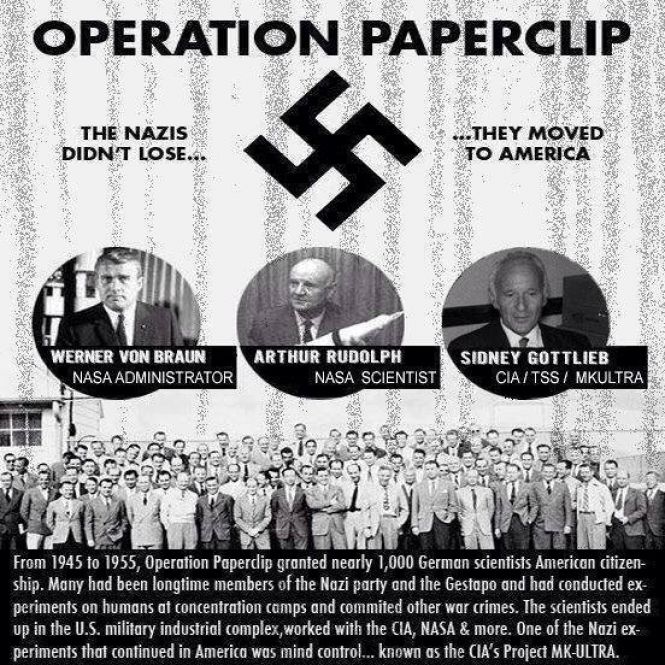
In the last years of World War II, US intelligence agencies and the Military-Industrial Complex secretly transferred more than 1,600 Nazi scientists and their families from Germany who were experts in various fields that included rocket science, aerodynamics, chemical weapons, and medicine in what was called Operation Paperclip.  There were Nazis working for the US military who also prepared intelligence briefs creating fear and panic that the Soviets were going to take over the world which was over-exaggerated.  But what the US government feared most was that the Soviet Union under Operation Osoaviakhim with more than 2,500 former Nazi scientists and engineers who were recruited in the Soviet occupation zone of Germany (SBZ) and the Soviet sector of Berlin would be one step ahead of the US government in weapons development and other areas. 

One important historical fact about America’s Nazi Scientists was the recruitment of Wernher von Braun or known by his full name as Wernher Magnus Maximilian Freiherr von Braun who was a member of the Nazi Party and the Allgemeine SS or the “General SS” which was a major branch of Nazi Germany’s paramilitary forces.  Wernher von Braun was also the head of developing rocket technology who is considered the pioneer of rocket and space technology in the US.  He was also the chief architect of the Saturn V super heavy-lift launch vehicle that allegedly helped launch the Apollo spacecraft to the Moon.  

Nazi scientists also helped the US government and the CIA develop chemical and biological weapons programs that included the use of sarin gas and other dangerous weapons of war including VX (nerve agent) and of course, the most used biological weapon during the Vietnam war, Agent Orange.  So, in other words, the US government hired Nazi scientists for their knowledge of creating weapons of mass destruction that has inflicted damage on various populations around the world since then.  During the Vietnam war, the US military unleashed Agent Orange on the Vietnamese population causing more than 3 million people to develop birth defects and other health related problems to this day.  The Nazi scientists were indeed evil geniuses when it came to developing advanced weapons of war and that was something that the US military and the intelligence community were solely interested in and that was and still is a scary thought.      

America’s Frankenstein: The Neo-Nazis of Ukraine

As we know from the valuable lessons of history that the US government and the CIA had supported and trained Ukrainian Nazis since 1946.  The CIA had organized “Stay Behind” operations with the OUN-B (neo-Nazi Organization of Ukrainian Nationalists) in Eastern Europe and other areas to assist Ukrainian nationalist who were sent to destabilize Soviet Ukraine with covert operations such as using commandos to assassinate Soviet officials, to sabotage infrastructure and to commit acts of terrorism. 

The history of the US government and its CIA operatives shows that it supported Ukrainian war criminal Stephan Bandera to advance the Ukrainian underground movement to destabilize Soviet Ukraine, so the CIA and their Office of Policy Coordination (OPC) and the Office of Special Operations (OSO) planned covert operations with the OUN-B and provided support to the anti-Soviet Ukraine Insurgent Army (UPA) for psychological warfare within the Soviet sphere of influence.   The CIA declassified their historical account of their association with Ukrainian Nationalists who collaborated with the Nazis during the Cold War in ‘Cold War Allies: The Origins of CIA’s Relationship with Ukrainian Nationalists’ by Kevin C Ruffner detailed how the “CIA reestablished and expanded its contacts with the Ukrainians and others for covert action against the Communists and as wartime assets to be used behind Red Army lines as guerrillas, saboteurs, and resistance leaders.”  The historical account went further and stated that “The sometimes brutal war record of many emigre groups became blurred as they became more critical to the CIA.”

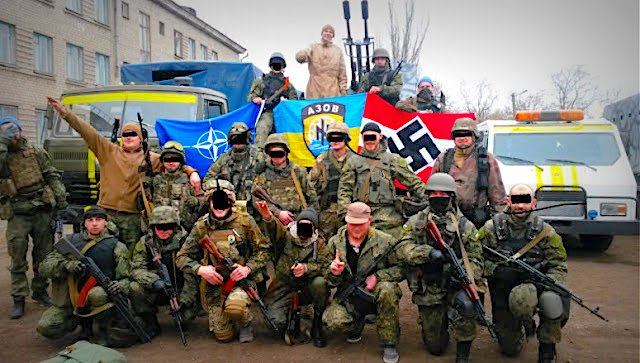
Fast forward to November 2013 were there were large-scale protests which was known as the Euromaidan against the policies of President Victor Yanukovych who made the decision to have closer ties with Russia and the Eurasian Economic Union instead of proceeding with the idea of having a political and economic relationship with the European Union by rejecting their free-trade agreement.  Then in February 2014, what is known as the Maidan Revolution took place that ended up in violent clashes between the protesters and the government’s security forces in the Ukrainian capital, Kyiv which led to a coup against the democratically elected president, Viktor Yanukovych.  Soon after, the Russo-Ukrainian war began and the birth of the Neo-Nazi inspired Azov Battalion was established as they became the resistance against basically, anything Russian.   

On January 22nd of this year, Yahoo News who is part of the mainstream media published an article titled CIA-trained Ukrainian paramilitaries may take central role if Russia invades basically admitted that the CIA was secretly training Ukrainian forces since 2015:

While the covert program, run by paramilitaries working for the CIA’s Ground Branch — now officially known as Ground Department — was established by the Obama administration after Russia’s invasion and annexation of Crimea in 2014, and expanded under the Trump administration, the Biden administration has further augmented it, said a former senior intelligence official in touch with colleagues in government

According to Yahoo News, an unnamed former senior intelligence official said that “If the Russians invade, those [graduates of the CIA programs] are going to be your militia, your insurgent leaders,” and that “we’ve been training these guys now for eight years. They’re really good fighters. That’s where the agency’s program could have a serious impact.”  One must wonder how many were actually radicalized neo-Nazis. 

In 2018, Reuters published a commentary by Josh Cohen ‘Ukraine’s neo-Nazi problem’ that explains Ukraine’s problem with the Nazis filling the ranks of its National Militia.  Cohen said that in “a January 28 demonstration, in Kiev, by 600 members of the so-called “National Militia,” a newly-formed ultranationalist group that vows “to use force to establish order,” illustrates this threat.”  Cohen added that the National Militia has recruited members from the Nazi-affiliated Azov Battalion:

Many of the National Militia’s members come from the Azov movement, one of the 30-odd privately-funded “volunteer battalions” that, in the early days of the war, helped the regular army to defend Ukrainian territory against Russia’s separatist proxies. Although Azov uses Nazi-era symbolism and recruits neo-Nazis into its ranks, a recent article in Foreign Affairs downplayed any risks the group might pose, pointing out that, like other volunteer militias, Azov has been “reined in” through its integration into Ukraine’s armed forces. While it’s true that private militias no longer rule the battlefront, it’s the home front that Kiev needs to worry about now

Cohen obviously is following the mainstream media narrative when he said that Putin seized Crimea which in fact, it was the Russian-speaking Crimean people who voted in a referendum to reunite with the Russian federation.  But to his credit, Cohen does mention the fact that the Azov Battalion and the Right Sector are held in high-regards since they fought Russian-backed separatists.  Cohen also mentioned the Azov battalion’s children’s training camps:   

When Russian President Vladimir Putin’s seizure of Crimea four years ago first exposed the decrepit condition of Ukraine’s armed forces, right-wing militias such as Azov and Right Sector stepped into the breach, fending off the Russian-backed separatists while Ukraine’s regular military regrouped. Though, as a result, many Ukrainians continue to regard the militias with gratitude and admiration, the more extreme among these groups promote an intolerant and illiberal ideology that will endanger Ukraine in the long term. Since the Crimean crisis, the militias have been formally integrated into Ukraine’s armed forces, but some have resisted full integration: Azov, for example, runs its own children’s training camp, and the careers section instructs recruits who wish to transfer to Azov from a regular military unit

Although Cohen’s claims expose Ukraine’s Neo-Nazis, he also follows the Western establishment and the mainstream media’s narrative that “the Kremlin’s claims that Ukraine is a hornets’ nest of fascists are false: far-right parties performed poorly in Ukraine’s last parliamentary elections, and Ukrainians reacted with alarm to the National Militia’s demonstration in Kiev” which are all lies.  Cohen’s statement is false, in fact, it’s a contradiction when he wrote at the beginning of his article that the “National Militia’s members were recruited from the Azov movement” but not to worry because “Azov has been “reined in” through its integration into Ukraine’s armed forces” at least according to Cohen who sourced his misinformation from Foreign Affairs magazine which is a publication owned by the Council of Foreign Relations, a favorite of of the US political establishment. 

So, does the US government, the Military-Industrial Complex, and the CIA support Ukrainian Neo-Nazis in their ongoing war efforts against Russia today?  Well, the answer to that question should be obvious by now.     

Wherefore Art Thou Ghislaine Maxwell? And who are your friends?

By Philip Giraldi

Source: The Unz Review

It is now going on a year and a half since “financier” and pedophile Jeffrey Epstein died, allegedly by hanging himself in a New York City prison. Since that time it has surfaced that there were a number of “administrative” errors in the jail, meaning that Epstein was not being observed or on suicide watch even though he had reportedly attempted to kill himself previously. The suspicion that Epstein was working for Israel’s external intelligence agency Mossad or for its military intelligence counterpart also seemed confirmed through both Israeli and American sources. A recent book Epstein: Dead Men Tell No Tales written by Ari Ben-Menashe the former Israeli intelligence officer who actually ran the Epstein operation, described inter alia how Epstein was blackmailing prominent politicians on behalf of Israeli intelligence. Epstein had been working directly for the Israeli government since the 1980’s and his operation, which was funded by Israel and also by prominent American Jews, was a classic “honey-trap” which used underage girls as bait to attract well-known politicians from around the world, a list that included Prince Andrew and Bill Clinton. The politicians would be photographed and video recorded when they were in bed with the girls. Afterwards, they would be approached and asked to do favors for Israel.

It doesn’t take much to pull what is already known together and ask the question “Who among the celebrities and top-level politicians that Epstein cultivated were actually Israeli spies?” And of course there is a subplot. Assuming that Epstein was in fact involved in recruiting and/or running high level American agents in an “influence operation” that may have involved blackmail it is possible to come to the conclusion that he was killed in prison and that the suicide story was just a convenient cover-up. The Epstein case remains “open” and under investigation though it doesn’t seem that anything is actually happening, the sure sign that someone powerful in the Establishment is making sure that nothing incriminating surfaces. Indeed, there already exists some evidence that Epstein was being protected when he was convicted in Florida of sex crimes in 2008 and was given a sentence that was little more than a slap on the wrist. After the fact, the U.S. Attorney for Miami Alexander Acosta involved in the case reported that the arrest and sentencing were above his pay grade, that he had been told that Epstein “’belonged to intelligence’, and to leave it alone” a comment that apparently has never been pursued by investigators.

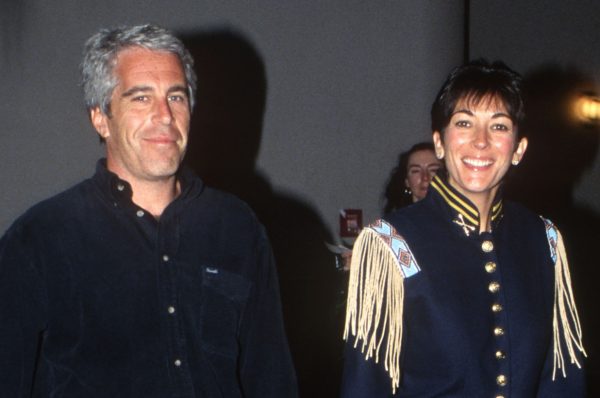
That the Epstein investigation appears to be in reverse gear suggests that one or more powerful Americans are still not implicated in the case but are concerned that that might change, but there remains an accessory to what went on at the Epstein mansion in Manhattan and on his private island in the Caribbean. That would be Ghislaine Maxwell, who is currently in prison in the Metropolitan Detention Center in Brooklyn and will be tried in July. Like the Epstein story in general, she has largely dropped off the media screen and one has to wonder what “get out of jail free” card she might be holding.

It has long been assumed that Epstein video recorded the sexual encounters with the underage girls that he used in his intelligence activity to blackmail prominent politicians among others. It has been suspected that Ghislaine has at least some of those tapes hidden in a secret location and may be using them to cut a deal with investigators and prosecutors. It now appears that she briefly discussed the tapes with CBS News 60 Minutes producer Ira Rosen, also making clear that there were tapes of both Bill Clinton and Donald Trump. The conversation took place in 2016 and she reportedly told Rosen that, given Trump’s involvement in the upcoming election, she would not release any information derived from the tapes relating to Clinton until after the election and she would only do so while also exposing Trump. Up until now, she has done neither.

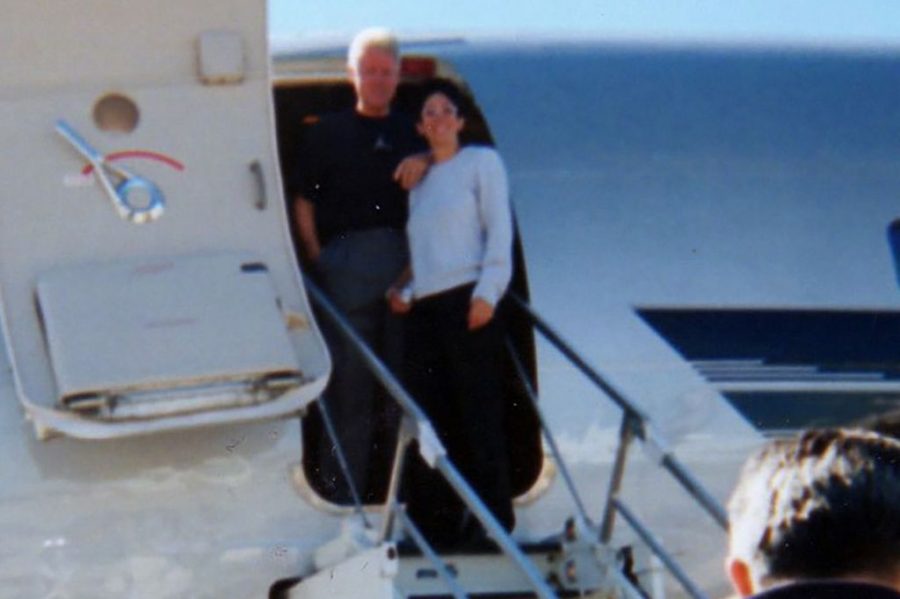
It has long been known that Epstein knew both the ex-and future presidents, though both have denied knowing the sex offender well for obvious reasons. Clinton, for example, flew on Epstein’s Lolita Express private 727 at least 26 times and his presence at Epstein’s island refuge has also been well documented. Trump clearly knew Epstein but has denied having any contact with him after his registration as a sex offender in 2008.

Ghislaine, for her part, was allegedly recruited young girls for Epstein to exploit and was a partner in his activity, though she has denied any guilt. Numerous victims say otherwise. Her lawyers have tried a number of ploys to free her, including claims that she had been abused by prison staff and that the jury being selected to try her will be “too white.” Her brother Ian claimed last week that she is enduring “brutal and degrading treatment” in prison with four guards watching her at all times. He added that she has lost 20 pounds and “ability to concentrate.”

Ghislaine also offered to post a $28.5 million bail or a $5 million bond for home arrest in which she would wear an ankle monitor, but the judge decided that given her extensive resources she constitutes a considerable flight risk even if she turns in her American, British and French passports. She would also be able to flee to Israel based on her father Robert’s religion and service to that country and Israel does not normally extradite.

The most interesting aspect of the arrest, imprisonment and trial of Ghislaine Maxwell is what it does not do. She basically is being tried on whether it can be confirmed that she was a “pimp” for Jeffrey Epstein. Her father was an Israeli intelligence asset and it is believed that he made the connection between Epstein and the Jewish state’s military intelligence. But no one in that New York court room in July will be asking that. Nor will there be any revelations about Epstein’s “intelligence connection” nor of the possibility that the Israelis had their hooks in both a former and a future American president. None of that will be on the table and meanwhile Ghislaine might have those possibly incriminating tapes squirreled away somewhere. That is the really important stuff that I would like to have the answers to. The fact that the answers are not forthcoming sounds a bit like a cover-up, doesn’t it?

How Israel deployed an intelligence deception to justify killing scientist Mohsen Fakhrizadeh

By Gareth Porter

Source: The Grayzone

Israel’s Mossad has spent years on a propaganda campaign aimed at convincing the world Iran possessed a nuclear weapons program – and legitimizing its assassinations of Iranian academics.

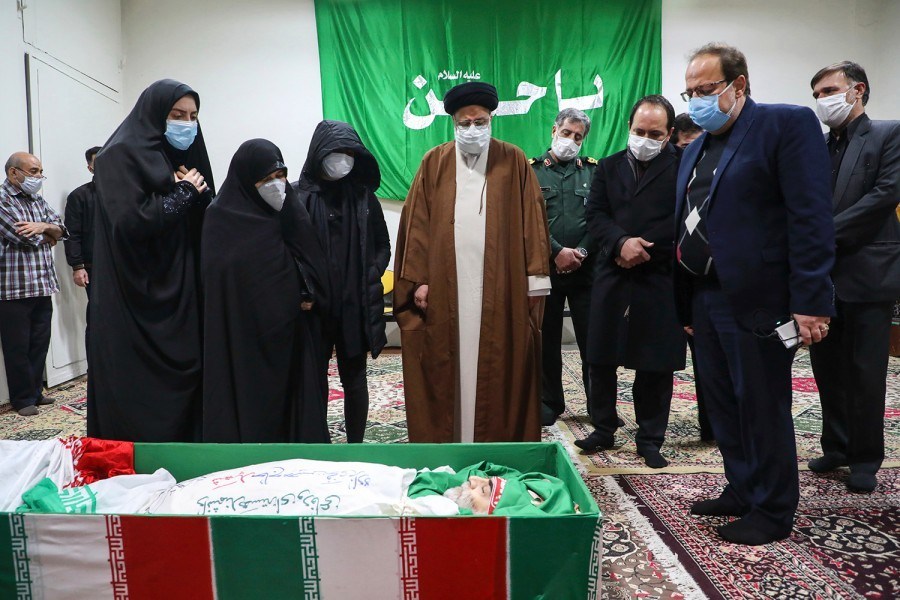
The Israeli assassination of Iranian defense official Mohsen Fakhrizadeh is being treated as a triumph of Israeli intelligence, with ubiquitous references in the New York Times and other major media outlets to the killing of “Iran’s top nuclear scientist”. In fact, Israel’s Mossad intelligence agency eliminated Fakhrizadeh, a defense official, despite the knowledge that its public depiction of him as the key architect of an Iranian nuclear weapons program was a deception.

For years, US media outlets have portrayed Fakhrizadeh as Iran’s equivalent to J. Robert Oppenheimer, marketing him to the public as the mastermind behind an Iranian version of the Manhattan Project. This image was developed primarily through a carefully constructed Israeli disinformation operation based on documents that displayed signs of fabrication.

Birth of a Mossad propaganda operation

The origin of the Mossad propaganda operation on Fakhrizadeh lies in the early 1990’s, when the US and Israel first developed suspicions of Iranian ambitions to develop a nuclear weapon. U.S., British, German and Israeli intelligence analysts had intercepted telexes from Sharif University about various “dual use” technologies — those that could be exploited in a nuclear program but also be applied for non-nuclear use.

Many of the telexes contained the number of an organization called Physics Research Center that operated under the watch of Iran’s Defense Ministry. The CIA and its allied intelligence agencies interpreted those intercepts as evidence that the Iranian military was running its own nuclear program, and thus that Iran was covertly seeking a nuclear weapons capability.

During the first term of the George W. Bush administration, the notorious militarist and Likud ally John Bolton took charge of Iran policy, prompting the CIA to issue an estimate concluding for the first time that Iran had initiated a nuclear weapons program. Israel’s Mossad apparently saw Washington’s new posture as a green light to set into motion a black propaganda campaign to dramatize and personalize the secret Iranian nuclear weapons program that was presumed to exist.

Between 2003 and 2004, Mossad produced a large cache of alleged Iranian documents depicting efforts to mate a nuclear weapon with Iran’s Shahab-3 missile and a bench system to convert uranium.

The Mossad files contained multiple tell-tale signs of forgery. For example, the reentry vehicle depicted in the drawings had already been abandoned by 2002 – before these drawings were supposedly created, according to the documents themselves – in favor of a design that looked entirely different and which was first shown in an August 2004 test. So whoever was responsible for the drawings was clearly unaware of the single most important Defense Ministry decision affecting the future of Iran’s missile deterrent.

The CIA never revealed who spirited the documents out of Iran or how. However, former senior German Foreign Office official Karsten Voigt explained to this reporter in 2013 that the German intelligence agency, the BND, had been furnished with the collection by an occasional source whom the intel chiefs considered less than credible.

And who was this source? According to Voigt, he belonged to the Mujahedeen e-Khalq (MEK), the exile Iranian cult which had fought for Saddam’s Iraqi forces against Iran during the eight-year war and by the early 1990s was passing information and propaganda that Mossad did not want to have attributed to itself.

Painting Fakrhizadeh as nuclear mastermind

Those Mossad documents identified Mohsen Fakhrizadeh as the manager of a supposedly top-secret Iranian project called the “AMAD Plan.” In reality, Fakhrizadeh was an Islamic Revolutionary Guard Corps officer and official in the Ministry of Defense Armed Forces Logistics (MODAFL), who also taught Physics at Imam Hussein University in Tehran.

To implicate him as a nuclear project mastermind, the collection of Mossad documents featured a directive supposedly signed by Fakhrizadeh. But since no one outside Iran had ever seen the previously obscure official’s signature, and given the lack of effort to show any official government markings on the documents, there was little to prevent Mossad from forging it.

In their 2012 history of Israel’s intelligence service, “Mossad: The Greatest Missions of the Israeli Secret Service”, Michael Bar-Zohar and Nisham Mishal pointed to Mossad as the culprit behind the appearance of the supposed Iranian nuclear documents. The writers recounted how Mossad gathered the personal information on Fakhrizadeh that was later released to the public through the MEK, including his passport number and his home telephone number.

“This abundance of detail and means of transmission,” Bar-Zohar and Mishal wrote, “leads one to believe that… ‘a certain secret service’ ever suspected by the West of pursuing its own agenda, painstakingly collected these facts and figures about the Iranian scientist and passed them on to the Iranian resistance [MEK].”

The documents also fingered Fakhrizadeh as the former head of the Physics Research Centre, thus deceptively linking him to the procurement efforts for “dual use” nuclear items in 1990-91 that were well known to CIA and other intelligence agencies. That accusation was reflected in the 2006 United Nations Security Council Resolution 1747 listing Iranian officials responsible for nuclear and missile proliferation in Iran. In the UN resolution, Fakhrizadeh was identified as a “[s]enior MODAFL scientist and former head of the Physics Research Centre (PHRC).”

But the Israeli identification of Fakhrizadeh as the head of the PHRC was proven to be a lie. Iran turned over extensive documentation to the IAEA in late 2004 or early 2005 on the PHRC and the procurement telexes, and the documents — which the IAEA did not challenge — showing that a professor at Sharif University of Technology in Tehran named Sayyed Abbas Shahmoradi-Zavari had headed the PHRC from its inception in 1989 until it closed in 1998.

Further, the documents provided to the IAEA revealed that the dual-use technology that Shahmoradi-Zavari helped the university procure through his PHRC connections was actually intended for the university faculty’s own teaching and research. In at least one case, the IAEA personnel found one “dual-use” item had been procured by the university.

These facts should have put an end to the Mossad-created myth of Fakrizadeh as the head of a vast underground nuclear weapons program. But the IAEA never revealed Shamoradi-Zavari’s name, and therefore avoided having to acknowledge that the documents the agency had embraced as genuine had misled the world about Fakhrizadeh.

It was not until 2012 that David Albright, the director of Washington-based Institute for Science and International Security, acknowledged that Shahmoradi-Zavari — not Fakhrizadeh — had been the head of the Physics Research Center – although he avoided admitting that the IAEA had relied on documents that turned out be false.

Revving up the propaganda 

The Mossad got busy again after the CIA’s November 2007 assessment that Iran had ceased work on nuclear weapons. Determined to neutralize the political impact of that finding, the Israelis apparently began work on a new batch of Iranian top secret documents. This time, however, the Israelis provided the documents directly to the IAEA in late 2009, as then-IAEA Director General Mohamed ElBaradei revealed in his memoirs.

The documents supposedly revealed Iranian defense ministry activities related to nuclear weapons after the cessation of such work that the CIA. One of those documents, leaked to the London Times in December 2009, purported to be a 2007 letter from Fakhrizadeh as the chairman of an organization presiding over nuclear weapons work. But as ElBaradei recalled, the IAEA’s technical experts “raised numerous questions about the documents’ authenticity….”

Even the CIA and some European intelligence analysts were skeptical about the authenticity of the Fakhrizadeh document. Although it had been circulating among the intelligence agencies for months, even the normally unquestioning New York Times reported that the CIA had not authenticated it.  Former CIA counterterrorism official Philip Giraldi, who had maintained contacts with active agency personnel, told this reporter CIA analysts regarded the document as a forgery.

A pattern of assassinations justified by disinformation

The killing of Fakhrizadeh was not the first time Mossad bumped off an Iranian it had baselessly accused of playing a leading role in a weapons program. In July 2011, someone working for Mossad — apparently an MEK member — gunned down a 35-year old engineering student named Darioush Rezaeinejad and wounded his wife in front of a kindergarten in Tehran.

The young man was targeted on the basis of nothing more than the research he had conducted on high-voltage switches and his publication of a scholarly paper about his scholarship. The abstract of the professional paper Rezaienejad had published made it clear that his work involved what is called “explosive pulsed power” involved in high-power lasers, high-power microwave sources and other commercial applications.

A few days after the assassination of Rezaienejad, however, an official of an unnamed “member state” provided Associated Press reporter George Jahn the abstract of Rezaienejad’s paper, successfully persuading Jahn that it “appeared to back” the claim that he had been “working on a key component in setting off the explosives needed to trigger a nuclear warhead.”

Then, in September 2011, the Israelis provided Jahn with an “intelligence summary” advancing the ludicrous claim that Rezaeinejad was not an electrical engineering specialist at all, but rather a “physicist” who had worked for the Ministry of Defense on various aspects of nuclear weapons.

The deployment of absurd assertions backed by paper-thin evidence to justify the cold-blooded murder of a young electrical engineer with no record of nuclear weapons involvement illuminated a Mossad modus operandi that has reappeared in the case of Fakhrizadeh: Israeli intelligence simply gins up a narrative centered around fictional ties to a nonexistent nuclear weapons program. It then watches as the Western press uncritically disseminates the propaganda to the public, establishing the political space for cold-blooded assassinations in broad daylight.

The Maxwell Family Business: Espionage

Ghislaine Maxwell is hardly the only Maxwell sibling to continue their father’s controversial work for intelligence, with other siblings carrying the torch specifically for Robert Maxwell’s sizable role in the PROMIS software scandal and subsequent yet related hi-tech espionage operations.

By Whitney Webb

Source: Unlimited Hangout

Many were surprised to learn earlier this month that the key co-conspirator in Jeffrey Epstein’s intelligence-linked sexual blackmail operation, Ghislaine Maxwell, had been in hiding in New England since Epstein’s arrest and subsequent “suicide” last summer. Her recent arrest, of course, has returned attention to the Epstein scandal and to Ghislaine’s ties to the entire operation, in which she played a central and crucial role, arguably more so than Epstein himself.

Ghislaine was first reported to be living in New England at the mansion of her alleged boyfriend Scott Borgeson on August 14th of last year. Though Maxwell is believed to have stayed there until purchasing the nearby New Hampshire home where she was arrested, attention from her presence on the East Coast was immediately and sensationally re-directed to the West Coast when, a day later on August 15ththe New York Post published a picture allegedly depicting Maxwell reading a book on “CIA operatives” at an In-N-Out Burger in Los Angeles, California. The photo was later revealed to have been photoshopped and a fake, but ultimately served its purpose in distracting from her actual location in New England.

While the media frenziedly covered the fake In-N-Out Burger photo, the appearance of an unexpected visitor nearby Borgeson’s mansion succeeded in largely slipping under the radar. On August 18th, Ghislaine’s sister Christine was spotted “packing up a number of bags” into a SUV just a few miles from Borgeson’s “secluded beachfront” home. Christine, who currently lives and works in Dallas, Texas, declined to comment on why she was visiting the exact area where Ghislaine was allegedly hiding at the time.

Out of the seven Maxwell siblings, Ghislaine Maxwell has undoubtedly received the bulk of media scrutiny both in recent years and arguably ever since the suspected homicide of the family patriarch, Robert Maxwell, in 1991. In the years since his death, Robert Maxwell’s close ties to Israeli intelligence and links to other intelligence agencies have been documented by respected journalists and investigators including Seymour Hersh and Gordon Thomas, among others.

While Ghislaine’s own ties to intelligence have since come to light in relation to her critical role in facilitating the Jeffrey Epstein sexual blackmail operation. Little, if any attention, has been paid to her siblings, particularly Christine and her twin sister Isabel, despite them having held senior roles at the Israeli intelligence front company that facilitated their father’s greatest act of espionage on Israel’s behalf, the sale of the bugged PROMIS software to the U.S. national laboratories at the heart of the country’s nuclear weapons system.

Not only that, but Christine and Isabel later became directly involved with technology-based business ventures that directly involved Ghislaine during the very period she worked with Epstein on behalf of Israeli and U.S. intelligence to ensnare powerful U.S. political and public figures in a sexual blackmail scheme involving minors. At the time, Ghislaine described her profession to a number of newspapers as “an internet operator.” Then, after this venture’s multi-million dollar sale to a competitor, Christine and Isabel became involved with successors to the PROMIS software scandal that were closely tied to U.S. intelligence and Israeli intelligence, respectively.

Ghislaine herself also became involved in these affairs, as did Jeffrey Epstein following his first arrest, as they began courting the biggest names in the U.S. tech scene, from Silicon Valley’s most powerful venture capital firms to its most well-known titans. This also dovetailed with Epstein’s investments in Israeli intelligence-linked tech firms and his claims of having troves of blackmail on prominent tech company CEOs during this same period.

With Ghislaine’s name and her ties to intelligence now inking their way back into the media sphere, detailing the decades-long course of these technology-focused espionage operations and their persistent ties to the Maxwell sisters demands the attention it deserves, as the need to air out the real Maxwell family business – espionage – is now greater than ever before.

Trap doors and Treason

One of the most brazen and successful operations conducted by Israeli intelligence on a global scale is undeniably its sale of a bugged software program to governments, corporations and major financial and scientific institutions around the world. That software program, known as the Prosecutor’s Information Management System or by its acronym PROMIS, was orginally created and marketed by Inslaw Inc., a company created by former NSA official Bill Hamilton and his wife Nancy.

In 1982, Inslaw leased its revolutionary PROMIS software to the U.S. Justice Department, then headed by arch neocon Edwin Meese III, Ronald Reagan’s most trusted advisor and who would later go on to advise Donald Trump following the 2016 election. The success of the software, which allowed integration of separate databases and information analysis on a previously unimaginable scale, eventually caught the attention of Rafi Eitan, the notorious and legendary Israeli spymaster and handler of the “most damaging spy” in American history, Jonathan Pollard. Eitan, at the time, was serving as the then-head of the now defunct Israel intelligence service known as Lekem, which focused specifically on espionage related to scientific and technical information and discoveries.

Eitan had first learned of PROMIS from Earl Brian. Brian was a long-time associate of Ronald Reagan who had previously worked for the CIA in covert operations and had been in charge of Reagan’s healthcare program when Reagan was governor of California. Brian often bragged of the nickname he had acquired in overseeing that health care initiative – “the man who walked over the dead.” In 1982, however, Brian was attempting to build a business empire, in which then-AG Ed Meese’s wife was a major investor, and he had first met Eitan while attempting to sell a healthcare system in Iran.

Brian divulged the efficacy of PROMIS, but – instead of praising its revolutionary approach to data analysis – expressed his frustration that the software enabled U.S. federal investigators to successfully track and target money laundering and other financial crimes. He also expressed frustration that he had been left out of the profits on PROMIS, the development of which he had followed closely for several years.

As their conversation wore on, Eitan and Brian hatched a plan to install a “trapdoor”, today more often referred to as a back door, into the software. They would then market PROMIS throughout the world, providing Israeli intelligence and allied elements of U.S. intelligence with a direct window into the operations of its enemies and allies while also netting Eitan and Brian massive profits for the sale of the software. Brian, of course, would also be able to use PROMIS to circumvent authorities investigating financial crimes.

According to the testimony of ex-Mossad official Ari Ben-Menashe, after a copy of PROMIS was obtained by Israeli military intelligence (via direct collusion with the U.S. Department of Justice), Ben-Menashe contacted an Israeli American programmer living in California on Eitan’s orders. That programmer then planted a “trapdoor” or back door into the software that would allow Lekem covert access to any database connected to a device on which the software was installed.

Once the back door was present, Brian attempted to use his company Hadron Inc to market the bugged PROMIS software around the world, though he first had tried to buy out Inslaw to do so. Unsuccessful, Brian turned to his close friend, then-Attorney General Ed Meese, and the Justice Department then abruptly refused to make the payments to Inslaw that had been stipulated by the contract, essentially using the software for free, which Inslaw claimed to be theft.

Meese’s actions would force Inslaw into bankruptcy and Inslaw subsequently sued the Justice Department, with a US court later finding that the Meese-led department “took, converted, stole” the software through “trickery, fraud and deceit.” With Inslaw out of the way, Brian sold the bugged software to Jordan’s and Iraq’s intelligence services, a major boon for Israel, and to a handful of companies. Despite this, Eitan was unsatisfied with Brian and Hadron and he quickly turned to the person he thought could most effectively market and sell PROMIS to governments of interest all over the world, Robert Maxwell.

First recruited as an asset of Israeli intelligence in the early 1960s, Maxwell’s standing with Israeli intelligence would strengthen considerably beginning in the early 1980s, when he purchased a web of Israeli companies, many of which were official “service providers” for the Mossad. One of these companies, a computer firm called Degem, had been used for years to provide cover to Mossad assassins that conducted kidnappings and murders in Latin America and Africa.

Through Degem and other Maxwell-owned companies based in Israel and elsewhere, Maxwell marketed PROMIS so successfully that Israeli intelligence soon had access to the innermost workings of innumerable governments, corporations, banks and intelligence services around the world. Many of Maxwell’s biggest successes came in selling PROMIS to dictators in Eastern Europe, Africa and Latin America. Following the sale and after Maxwell collected a handsome paycheck, PROMIS’ unparalleled ability to track and surveil anything – from cash flows to human movement – were used by these governments to commit financial crimes with greater finesse and used to hunt down and disappear dissidents. Israeli intelligence, of course, watched it all play out in real time.

In Latin America, for instance, Maxwell sold PROMIS to military dictatorships in Chile and Argentina, which were used to facilitate the mass murder that characterized Operation Condor as the friends and families of dissidents and so-called subversives were easily identified using PROMIS. PROMIS was so effective for this purpose that, just days after Maxwell sold the software to Guatemala, its US-backed dictatorship rounded up 20,000 “subversives” who were never heard from again. Of course, thanks to the back door in PROMIS, Israeli intelligence knew the identities of Guatemala’s disappeared before the victim’s own families. Israel was also intimately involved in the arming and training of many of the same Latin American dictatorships that had been sold the bugged PROMIS software.

Though Israeli intelligence found obvious use for the steady stream of sensitive and classified information, their biggest prize was yet to come – top secret government laboratories in the United States. Eitan tasked Maxwell with selling PROMIS to US labs in the Los Alamos complex, including Sandia National Laboratory, which was and is at the core of the US nuclear weapons system. Notably, the eventual sale of PROMIS to these laboratories by Maxwell occurred during the same period in 1984 when Eitan tasked one of Israel’s top experts in nuclear targeting with supervising Jonathan Pollard’s espionage of U.S. nuclear secrets on Israel’s behalf.

In order to plot how he would accomplish such a feat, Maxwell would meet with none other than Henry Kissinger, who told him that – in order to sell PROMIS to these sensitive laboratories – he needed to enlist the services of then-Senator for Texas John Tower, who was the head of the Senates’ Armed Services Committee at the time. Maxwell quickly struck a deal with Tower and then, using Mossad money, paid Tower $200,000 for his services, which included opening doors – not just to the Los Alamos complex, but also to the Reagan White House. Tower would arrange a trip for Maxwell to travel to Sandia National Laboratory, where he would market PROMIS. Unlike most other PROMIS sales, this one would not be handled by Degem, but a US-based company called Information on Demand.

It is worth noting that, despite Tower’s obvious and treasonous actions with respect to U.S. national security, another long-time “source” of Robert Maxwell, George H.W. Bush, would attempt to nominate Tower to serve as U.S. Secretary of Defense. When the Senate refused to confirm Tower, only then did Bush nominate Dick Cheney, who would then head the Pentagon and oversee the U.S.’ role in the First Gulf War. Not long after his failure to secure the nomination as Pentagon chief, Tower died in a suspicious plane crash soon after the equally suspicious death of Robert Maxwell.

Front Companies and FBI Cover-ups

Robert Maxwell purchased Information on Demand from its founder, Sue Rugge – a former librarian, through the Pergamon Group in 1982 – the very year plans were made by Rafi Eitan and Earl Brian to subvert PROMIS. Its offices were just a few doors down from the home of Isabel Maxwell and her first husband Dale Djerassi, son of the scientist credited with creating the birth control pill.

According to FBI files obtained by Inslaw Inc. via a FOIA request in the 1990s, San Francisco’s FBI opened an investigation into Information on Demand a year later in October 1983 and subsequently interviewed Rugge about the business and its activities. She told the FBI that the company’s sources “include over 250 computer data bases” and that company uses these to “locate single facts as well as provide answers to complex questions dealing with such areas as comprehensive marketing research, custom data summaries, sophisticated literature searching, current awareness service and global information capability.

One of these databases included Lockheed’s Dialog database and “the Defense Technical Center which is connected to the Department of Defense (DOD) which contains classified information. ” She asserted, however, that the company “has no password for access and further no need for access.” Elsewhere in the document, it notes that Information on Demand claimed not have any access to classified information “to the best of their knowledge” and “includes information concerning government and various available means of tapping government information databases.”

The FBI asked Rugge about one client of the company in particular, whose name and identifying information is redacted in its entirety, but notes that this mysterious client had worked with Information on Demand since at least 1973. Subsequent efforts by Inslaw Inc. and others to learn the identity of the redacted client have been unsuccessful since 1994.

Notably, just one month before the FBI opened an investigation into Information on Demand and interviewed Sue Rugge, another related Maxwell-owned firm, Pergamon International Information Corporation, had sent a letter to then-CIA Director Bill Casey, offering to provide the agency with access to patent databases. The only redacted portion of the letter is the identity of PIIC’s Executive Vice President, who had written the letter to Casey.

After Rugge had been interviewed, FBI interest in Information on Demand peaked soon after in June 1984, when a formal investigation was opened. This took place after two employees of Sandia National Laboratory who worked in technology transfer approached the Bureau over Information on Demand’s efforts to sell PROMIS to the laboratory. Those employees were compelled to contact the FBI after obtaining information from employees of the National Security Agency (NSA) regarding “the purchase of Information on Demand Inc. by one Robert Maxwell, the owner of Pergamon International.” The specific information on this purchase from the NSA is included in the report but redacted in its entirety. Two months later, one of the Sandia employees followed up with the Bureau, suggesting that the NSA and FBI jointly investigate Information on Demand, but was essentially stonewalled and told to take it up with FBI headquarters.

The FBI case file is coded as a foreign counter-intelligence investigation specifically, suggesting that the case was opened because the FBI was made aware of the alleged involvement of a foreign intelligence service in some aspect of Information on Demand’s activities that related specifically to the “dissemination, marketing or sale of computer software systems, including but not limited to the PROMIS computer software product.” It also noted that Maxwell himself had previously been the subject of a “security investigation” conducted by the FBI from 1953 until 1961, the year Maxwell was formally recruited as an Israeli intelligence asset.

In early August 1984, FBI headquarters and other higher-ups in the Ed Meese-led Department of Justice, which itself was complicit in the whole sordid PROMIS affair, ordered the New Mexico office to halt its investigation into Information on Demand, Maxwell and PROMIS. The cover-up, oddly enough, continues today, with the FBI still refusing to release documents pertaining to Robert Maxwell and his role in the PROMIS scandal.

Several months following the shuttering of the FBI investigation into Information on Demand, Robert Maxwell again returned to Sandia National Laboratories in February 1985, signing the contract for the sale of PROMIS and listing himself as President and CEO of Information on Demand. A few months later, he passed that role on to his daughter Christine, who served as the company’s president and CEO up until her father’s death in 1991, according to her résumé. Upon the collapse of his business empire shortly after his demise, which also resulted in the closure of Information on Demand, Christine created a company called Research on Demand that offered similar services and specialized “in Internet- and Big Data analytics-related market studies for companies in the Telecoms.”

In addition, Isabel Maxwell, who lived in close proximity to the company’s offices in Berkely, CA, told Haaretz that she had also worked for Information on Demand, which she refers to as “her sister’s company,” following her 1989 divorce from Dale Djerassi.

Recreating their Father’s Legacy

After the death of Robert Maxwell, in what most of his family and many of his biographers regard as a murder conducted by Israeli intelligence, his children began to pick up the pieces and sought to rebuild their father’s empire. Of his seven children, five took on different aspects of their father’s vast portfolio.

Kevin and Ian Maxwell took over much of his businesses (and the associated fall-out) and his murky network of interlocking companies, trusts and foundations spread throughout the world. Ghislaine, having already positioned herself in New York at her father’s behest to anchor his efforts to expand his empire and operations into Manhattan, began a sexual blackmail operation on behalf of Israeli intelligence alongside Jeffrey Epstein. Christine and Isabel, however, would take off where Maxwell’s intelligence-linked work with PROMIS and in technology had left off by cashing in on a new revolutionary technology, the Internet.

“We literally were trying to think about how to restart this whole business” that had collapsed after their father’s death, Christine Maxwell would later say of her decision to found, along with her husband Roger Malina, Isabel and Isabel’s then-husband David Hayden, their internet services company – the McKinley Group – in January 1992. Isabel would remember the decision similarly, telling Wired in 1999, that she and her sister had “wanted to circle the wagons and rebuild,” seeing McKinley as “a chance to recreate a bit of their father’s legacy.” In 2000, Isabel would tell The Guardian that her father would “love it [the internet] if he was still here.” “He was very prescient….He’d be in his element, he’d be having a blast, I’m sure he’d be thrilled to know what I’m doing now,” she told the UK-based publication while “throwing back her head and laughing loudly.” Notably, at that time, Isabel was leading Israeli software company with ties to Israeli military intelligence and powerful Israeli political players, including some who had previously worked directly under her father.

It’s not hard to see why Christine and Isabel saw the internet as their chance to expand upon and rebuild upon Robert Maxwell’s “legacy.” As previously mentioned, Christine, right up until her father’s death, had been president and CEO of the Robert Maxwell-owned Israeli intelligence front company, Information on Demand, where Isabel had also worked. Upon his death, Christine had founded a related company called Research on Demand, which specialized in “internet and big data analytics” for telecommunications firms, and would later overlap with the McKinley Group’s work. McKinley began as a directory with a rating system for websites, later transitioning into the Magellan search engine, all of which Isabel Maxwell told Cnet in 1997 were all Christine’s idea.

McKinley created what became known as the Magellan online directory, remembered as “the first site to publish lengthy reviews and ratings of websites.” Magellan’s “value-added content” approach attracted several large corporations, resulting in “major alliances” with AT&T, Time Warner, IBM, Netcom and the Microsoft Network [MSN] that were negotiated by Isabel Maxwell. Microsoft’s major alliance with McKinley came in late 1995, when Microsoft announced that Magellan would power the search option for the company’s MSN service. Time Warner first chose Magellan for its early web portal called Pathfinder and Magellan was on the homepage of the internet browser Netscape for much of the 1990s.

However, McKinley’s fortunes were troubled as its efforts to be the first search engine to go public fell through, igniting a stand-off between Christine Maxwell and Isabel’s husband that also resulted in the company’s essentially falling behind other market leaders both missing the window for a second IPO attempt and lagging behind in adding ad revenue to their business model. Excite, which was later acquired by AskJeeves, ultimately bought the McKinley Group and Magellan for 1.2 million shares of Excite stock in 1996, which was then valued at $18 million. It was allegedly Isabel Maxwell who made the deal possible, with Excite’s CEO at the time, George Bell, claiming she alone salvaged their purchase of McKinley.

Despite the company’s lackluster end, the Maxwell sisters and other stakeholders in the company, Ghislaine Maxwell among them, not only obtained a multi-million dollar payout from the deal, but also forged close connections with Silicon Valley high-rollers. Upon McKinley/Magellan’s sale, the overt ties of Christine and Isabel Maxwell to intelligence in both the U.S. and Israel would grow considerably.

A Family Affair

While the company is often framed as being a venture between Christine and Isabel Maxwell, McKinley Group and Magellan were much more than just the twin sisters’ business. For instance, a November 2003 article in The Evening Standard notes that Christine and Isabel launched the company with considerable help from their brother, Kevin Maxwell who the article described as being “consumed by an overwhelming desire to be his ‘dad reincorporated’” according to confidants. Another Evening Standard article from March 2001 cited report that “Kevin played a major role” in the company’s affairs.

In addition, at the time, The Sunday Times noted in November 2000 that Ghislaine Maxwell “had a substantial interest in Magellan” and netted a considerable sum following its sale to Excite in 1996. It also noted that Ghislaine, throughout the 1990s, had “been discreetly building up a business empire as opaque as her father’s” and that “she is secretive to the point of paranoia and her business affairs are deeply mysterious.” However, she would nonetheless describe “herself as an ‘internet operator’” even though “her office in Manhattan refuses to confirm even the name or the nature of her business.” A separate article in The Scotsman from 2001 also notes that Ghislaine “is extremely secretive about her affairs and describes herself as an internet operator.”

Exactly how involved Ghislaine Maxwell was involved in the McKinley Group and Magellan is unclear, though her decision to describe herself as an “internet operator” and her documented “substantial interest” in the company suggest that it was more than superficial. What is notable, however, is that Ghislaine’s time as an “internet operator” and her business interests in Magellan overlap directly with her time working alongside Jeffrey Epstein in an Israeli intelligence-linked sexual blackmail operation.

During this period of time, Ghislaine Maxwell and Jeffrey Epstein frequently had considerable overlap in their finances, with press reports from the time often asking whether Ghislaine’s expenses were paid by Epstein or through her access to the “lost Maxwell millions” that had been hidden in a web of murky, untraceable financial entities and allegedly “disappeared” following his 1991 death.

The latter is certainly a possibility as it was Ghislaine who was the first to walk into her late father’s office on the Lady Ghislaine following his death, where she “shredded all incriminating documents onboard,” according to journalist John Jackson who witnessed the scene. This would likely mean that she was quickly able to distinguish which documents were “incriminating” and was intimately aware of his more unsavory business activities. In addition, prior to his death, Robert Maxwell had provided Ghislaine with a “tailor-made” New York corporation called Maxwell Corporate Gifts, of which little is known. The corporation was reportedly intended to aid her in establishing a foothold in New York’s power base for Robert Maxwell’s planned expansion into New York society, a plan first set into motion following his purchase of the New York Daily News.

Notably, an article from The Evening Standard in 2001 makes an odd comment about a major source of income from Epstein during the 1990s, stating that “has made many millions out of his business links with the likes of Bill Gates, Donald Trump and Ohio billionaire Leslie Wexner, whose trust he runs.”  In addition, Epstein victim Maria Farmer noted in an interview that she overheard Ghislaine and Epstein discuss Bill Gates as though they knew him well in 1995. However, these mentions of Bill Gates here defies the official narrative about the Epstein-Gates relationship, which claims they first met in 2011.Given the “major alliance” between McKinley/Magellan and Microsoft that was forged in 1995-1996, it is certainly possible that Epstein’s pre-2001 “business links” with Bill Gates were, in fact, related to Ghislaine’s involvement and stake in Magellan. This is also supported by the fact that, as will be shown in Part 2 of this report, Magellan co-founder Isabel Maxwell had a personal relationship with Bill Gates and that he put her subsequent company, Israel-based CommTouch, “on the map” after a major investment that had been brokered between Gates and Isabel personally. Part 2 will also show how both Isabel and Christine’s overt involvement, with Israeli and U.S. intelligence, respectively, deepened after Magellan was sold to Excite in 1996.

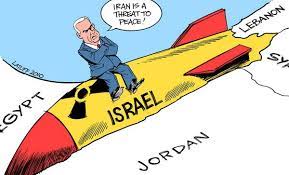
Alleged Salas Family Assailant Previously Worked for US/Israeli Intelligence-Linked Firm

The alleged gunmen who killed the son of Esther Salas, the judge recently assigned to the Epstein-Deutsche Bank case, worked for a company of corporate spies and mercenaries with ties to intelligence and also to Deutsche Bank.

By Whitney Webb

Source: Unlimited Hangout

The news of the shooting of the husband and son of Esther Salas, the judge recently assigned to oversee the Jeffrey Epstein – Deutsche Bank case, caused shock and confusion while also bringing renewed scrutiny to the Epstein scandal just a week after Epstein’s main co-conspirator, Ghislaine Maxwell, was denied bail in a separate case.

The case Salas is set to oversee is a class action lawsuit brought by Deutsche Bank investors who allege that Deutsche Bank “failed to properly monitor customers that the Bank itself deemed to be high risk, including, among others, the convicted sex offender Jeffrey Epstein.” The case came after the New York state Department of Financial Services had settled with Deutsche Bank over the bank’s failure to cut ties with Epstein-linked accounts, resulting in Deutsche Bank paying a $150 million fine. Deutsche Bank, unlike other financial institutions, failed to close all of its accounts linked to Epstein until less than a month prior to his arrest last year, even though the bank had identified him as “high risk” years before.

Beyond the tragedy of Sunday’s shooting, which claimed the life of Salas’ only child, the quick discovery of the death of the main suspect, Roy Den Hollander, of a “self-inflicted” gunshot to the head before he could be arrested or questioned by authorities has led to speculation that there is more to the official narrative of the crime than meets the eye.

With law enforcement sources now claiming that Esther Salas was not the intended target of the attack and some media reports now suggesting that Den Hollander’s motive was related to his dislike of feminism, it appears there are efforts underway to distance Sunday’s tragic shooting from Salas’ recent assignment to the Epstein case, which occurred just four days before the tragic shooting.

The most likely reason for any such “damage control” effort lies in the fact that both U.S. law enforcement investigations and mainstream media reports have consistently downplayed the connections of Jeffrey Epstein’s sexual trafficking and financial crimes to intelligence agencies in the U.S. and Israel. Similarly, Roy Den Hollander previously worked for a New York firm has been described as a “private CIA” with ties to those countries’ intelligence agencies and, also, ties to Deutsche Bank.

A Private CIA

According to his website, Den Hollander once worked for Kroll Associates Moscow Office, where he “managed and upgraded Kroll’s delivery of intelligence and security in the former Soviet Union” from 1999 to 2000. A few years prior, Kroll had won a considerable bid from the Russian government to locate money allegedly “spirited out of the country by the directors of state enterprises when they realized that privatization was inevitable.” The Kroll executives in charge of the Russian portfolio prior to Den Hollander were E. Norbett Garrett, a former CIA station chief in Cairo and Kuwait, and Joseph Rosetti, former chief of security for IBM. During that period and prior to his hiring at Kroll, Den Hollender worked as a lawyer in Russia regarding “legal and business issues, including international financing and marketing” and married a Russian woman he met during his time there that he subsequently claimed was part of the “Russian mafia.”

Founded by Jules Kroll in 1972, Kroll Associates would later become known as the “CIA of Wall Street” and “Wall Street’s Private Eye” and was alleged to be an actual front for the CIA by French intelligence agencies, according to theWashington Post. Part of the reason for this nickname, which was once a boasting point for top Kroll executives, owes to the fact that the firm frequently hired former CIA and FBI officers, as well as former members of MI6 and Mossad. K2 Intelligence, the successor to Kroll Associates founded by Jules Kroll and his son Jeremy in 2009, has similar hiring practices, counting former FBI and NSA officials among its ranks alongside former high-ranking members of the Israel Defense Forces (IDF) and Shin Bet, Israel’s domestic intelligence agency. Kroll also boasted ties to the Bush family, with Jonathan Bush (George Bush Sr.’s brother) serving on its corporate advisory board, and Kroll was also employed by Bill Clinton’s first presidential campaign.

Though it is mainly involved in corporate security and investigations, Kroll has also frequently investigated targets of Washington foreign policy, including Saddam Hussein, and was also the company tapped to “reorganize” Enron in 2002. Kroll Associates also has long been a subject of scrutiny for those that question the official narrative on the attacks of September 11, 2001, given that the company was put in charge of security for the World Trade Center complex from 1993 bombing up through the 2001 attacks and has no shortage of ties to companies and individuals that profited from the attacks. Kroll itself experienced a “surge in business” following the events of 9/11, a day when its top executives all avoided going to work despite ostensibly providing security for the complex.

A similar “surge in business” for Kroll followed the 2003 U.S. invasion of Iraq after the company’s investigations into Saddam Hussein’s and the Bath Party’s finances had been used as partial justification for the military incursion. Kroll became a major provider of mercenaries along with companies like Blackwater and DynCorp to the U.S. invasion and subsequent occupation through its subsidiary Kroll Security International. Its clients included the United States Agency for International Development (USAID), which has long fronted for the CIA, and also provided mercenaries for the war in Afghanistan.

Kroll executives over the years have commented to the press on their reputation as a “private CIA” and have also noted the advantages of being a “private” as opposed to “public” intelligence agency. For instance, E. Norbett Garrett, the former CIA official turned Kroll executive, told The New Yorker in 2009 the following:

“Garrett explained the disparity between what Kroll could do and what the C.I.A. could in a place like Sudan. “They have to rely on public and covert sources,” he said. “But we can go straight to Salah Idris. He’s our client, after all. We can go straight to his friends. We can be manipulated, of course, shown incomplete information, and sometimes we have to walk away from a case if we don’t trust somebody. But we definitely have some advantages.”

Kroll Associates and the Epstein Network

Aside from Kroll Associates’ own role as a private intelligence firm, it is also worth pointing out that Jules Kroll had an odd meeting with Robert Maxwell, Ghislaine Maxwell’s father, shortly before his death, alleged by most Maxwell biographers and his family to have been a homicide. Roughly two weeks before his death, Kroll met with Maxwell at New York’s Helmsley Palace Hotel. According to a 1992 article in Vanity Fair, “Maxwell had ushered Kroll and two other men out onto the patio so that their conversation could not be overheard or bugged,” with Maxwell allegedly seeking to hire Kroll to uncover “people out to get him, to destroy his empire, to cripple him financially, and to destroy his life and business in any way they could.”

The article further notes that “the meeting broke up with Maxwell’s promising that he would send Kroll what he called “a memorandum of suspicions and unexplained events.” “Maxwell was working on this compendium,” said the  [anonymous] participant [in the meeting], “when he met his death.” Kroll Associates was never formally hired.”

Much more recently Kroll came under scrutiny after being hired by disgraced media mogul Harvey Weinstein alongside the “private Mossad for hire” firm Black Cube. Weinstein had been instructed to hire Black Cube by Ehud Barak, the former Israeli military intelligence head and Israeli Prime Minister with close ties to Jeffrey Epstein and a frequent visitor of Epstein’s residences. Weinstein hired Kroll to harass and cyberstalk women who had accused him of sexual assault. Weinstein was a one-time business partner of Jeffrey Epstein’s and the testimony of Epstein victim Maria Farmer strongly implies that Ghislaine Maxwell and Epstein “shared” women, and potentially underage girls, with the film producer. The Daily Beast later reported that Epstein had used his ties to Weinstein to impress and recruit potential victims and at least one of those victims landed a role in a film produced by a Weinstein-owned company due to Epstein’s ties to Weinstein.

In addition, Kroll’s long-time executive Vice President for Operations, James Bucknam, was previously chief adviser to former FBI director Louis Freeh and is now CEO of the Freeh Group. Freeh has since become notorious for having been hired by Epstein associate, lawyer Alan Dershowitz, to “investigate” the Epstein scandal, and was also involved in the cover-up of the Penn State child molestation and abuse scandal. Freeh was also director of the FBI when the Bureau declined to investigate accusations regarding Leslie Wexner, Ghislaine Maxwell and Jeffrey Epstein and their involvement in the sex trafficking of minors, first reported to the FBI in 1996 by Maria Farmer.

The Kroll – Deutsche Bank “Revolving Door”

After “retiring” from Kroll associates, Jules Kroll created a credit-rating agency, a field he had called just years earlier “a heck of a racket.” Named the Kroll Bond Rating Agency (KBRA), the firm was envisioned by Kroll as a “credit-rating agency on steroids,” but has failed to make a dent in the market shares of the so-called “Big Three” credit-rating agencies: Standard & Poor’s, Moody’s Investors Service, and Fitch Ratings.

Though it hasn’t managed to become a dominant force in credit ratings, KBRA has managed to be profitable and to have produced something of a “revolving door” between its senior management and Deutsche Bank executives. For instance, KBRA’s top executive in Europe, Mauricio Noé, had previously been a Managing Director of Deutsche Bank’s London branch. In another example, Vice President for Credit Structuring at Deutsche Bank in New York, Ian Ross, was previously employed by KBRA and Yee Cent Wong, managing director of KBRA for CMBS, was previously Vice President of the Credit Solutions Group at Deutsche Bank Securities. Another managing director of KBRA, Bill Baneky, had previously served as Deutsche Bank’s Vice President and National Relationship Manager. One of KBRA’s senior managing directors, Rosemary Kelley, is also a former Deutsche Bank Vice President, while another, Ken Kockenmeister, was Deutsche Bank’s Director for Large Loan Securitization and Underwriting.

While they may not be the “biggest” credit-rating agency, KBRA analysts and executives frequently speak to media outlets where they comment on the state of various businesses, Deutsche Bank among them. Given the amount of overlap between Deutsche Bank and KBRA, it is unsurprising that KBRA has lobbied in the press on Deutsche’s behalf. For instance, KBRA analyst Christopher Whalen told Business Insider in 2016 that “The problem with Deutsche Bank may be the end of Merkel’s career,” adding that “The question is does she want to be remembered for doing the right thing — which is to provide support for the bank and diffuse the situation — or does she want to be remembered for standing by when one of the largest banks in Europe failed?”

Jeffrey Epstein’s ties to Deutsche Bank go back decades, and potentially earlier. After working for Bear Stearns earlier in his career and then as a so-called “financial bounty hunter” with ties to intelligence-linked arms dealers and Wall Street, Epstein set up a Ponzi scheme with Steve Hoffenberg called Tower Financial, which collapsed in 1993 and subsequently landed Hoffenberg 20 years in prison. Epstein’s name, despite being a clear co-conspiractor, was suspiciously dropped from the case during the trial. Hoffenberg subsequently alleged that Epstein used his ill-gotten gains from Tower Financial alongside a series of suspect loans from Deutsche Bank to create his investment company.

Hoffenberg subsequently told The Observer the following:

“His lead bank is Deutsche Bank, Germany, that runs the lead on his financial trust company. They run the platform in the trading of the currencies for Epstein and with Epstein. He’s never disclosed to the investors that provide the money to Deutsche Bank his true legacy, that’s securities fraud.”

Following that point, Epstein’s financial activities, aside from his Deutsche Bank-enabled investment vehicle, were publicly conducted through Bear Stearns (until its 2008 collapse) and J.P. Morgan. When J.P. Morgan dropped Epstein as a client, he again turned to Deutsche Bank in 2013, becoming a client of the bank’s private wealth division in New York. Anti-money laundering compliance officers at the bank’s branches in New York and Florida subsequently flaggedEpstein’s accounts in 2015, in 2016 and again in 2019, creating suspicious activity reports regarding the movements of large amounts of funds tied to Epstein-linked accounts outside of the U.S.

However, the bank did not fully terminate their relationship with Epstein until June 2019, just a few weeks prior to his arrest last year. Epstein was believed to have dozens of accounts with the bank at one point and those accounts were shut down slowly over a period of several months beginning in late 2018.

Ties that Bind

The narrative emerging that Den Hollander was motivated to kill Esther Salas’ husband and sons due to his hatred of feminism is a rapid attempt to explain away a story that clearly warrants further investigation, albeit into avenues that mainstream media and powerful individuals in the public and private sectors prefer remain untouched.

As the heinous act targeting the Salas family has shown, individuals with a lot to lose are willing to go to the farthest extremes to keep the ties of Epstein to the financial sector and to intelligence out of sight and out of mind. Indeed, just last December, Epstein’s personal banker at Deutsche Bank, Thomas Bowers, the chief of Deutsche Bank’s Private Wealth Management division in New York from 2012 to 2015, was found dead in his home. His death was quickly ruled a suicide by hanging. Bowers had also signed off on “unorthodox” loans, not just for Epstein, but Donald Trump, who has his own ties to the Epstein scandal.

While some have been quick to point out that Trump (as well as his son-in-law Jared Kushner) could stand to lose from potential revelations in the Epstein-Deutsche Bank trial, there are other key power-brokers tied to both Epstein and Deutsche Bank who could also be feeling the heat. For instance, Lynn Forester de Rothschild, who became close to Epstein in the early 1990s and subsequently connected him to the Clinton White House and later to Alan Dershowitz, is intimately involved in the Deutsche Bank Microfinance Consortium.

Aside from Epstein’s use of the money, Deutsche Bank has been notorious for years as a cesspool of money launderingfor organized crime networks, paying $14.5 billion in fines in just seven years for official action taken against the bank by several governments. It is highly likely that the brutality of what happened outside the Salas family home on Sunday is more related to Deutsche Bank than Epstein, as numerous powerful individuals have ties to the embattled bank.

Even the recent move by Attorney General William Barr to remove SDNY District Attorney Geoffrey Berman from his post appears to be more related to Berman’s efforts to investigate Deutsche Bank than the Epstein scandal, as some have alleged. This is because Barr’s new pick for Berman’s old job counts Deutsche Bank among his former clients and notably defended the bank in a recent anti-money laundering probe, whereas Berman was investigating the bank (albeit for political reasons that took aim at the bank’s dealings with Trump).

While Epstein’s egregious and criminal actions targeting minors have now become public knowledge, in role in facilitating white collar crime, money laundering and financial frauds on behalf of corporations, governments and oligarchs remains sorely under-covered, despite his role in such activities preceding and continuing after his involvement in an intelligence-linked sexual blackmail operation.

It arguably remains one of the key components of the Epstein scandal, yet the most poorly understood and most under-investigated. If anything, the tragic events at the Salas family home on Sunday, and what appears to be a rapid yet shoddy cover-up of the shooter’s ties to Kroll Associates and actual motives, reveal that Epstein’s financial ties are more frightening to certain powerful individuals and institutions than his trove of sexual blackmail.

The ‘Great Game’ is afoot: Killing Soleimani reflects US desperation in the Middle East

Source: Intrepid Report

By killing top Iranian military commander Qasem Soleimani, American and Israeli leaders demonstrated the idiom ‘out of the frying pan into the fire.’

US President Donald Trump and Israeli Prime Minister Benjamin Netanyahu are both politically and legally embattled—the former has just been impeached and the latter is dogged by an attorney general indictment and investigation into major corruption cases.

Despairing, out of options and united by a common cause, both leaders were on the lookout for a major disruption—that would situate them in a positive light within their countries’ respective media—and they found it.

The assassination of the Iranian major general in the Islamic Revolutionary Guard Corps and commander of its Quds Force, Soleimani, on January 3, along with several Iranian military leaders, by a US drone was a testament to the degree of that US and Israeli desperation.

Although there has been no official confirmation or denial of the Israeli role in the US operation, it is only logical to assume indirect or even direct Israeli involvement in the assassination.

Over the last few months, the possibility of a war against Iran has once more gained momentum, topping the agenda of Israel’s foreign policy makers. Politically beleaguered Netanyahu has repeatedly and tirelessly asked his friends in Washington to increase pressure on Teheran.

“Iran is increasing its aggression as we speak,” Netanyahu claimed on December 4, during a meeting with US Secretary of State Mike Pompeo. “We are actively engaging in countering that aggression.”

One can only assume what “active engagement” from the overtly militant Israeli point of view can possibly mean in this context.

Moreover, the fingerprints of Israeli intelligence, the Mossad, are unmistakably present in the assassination. It is plausible that the attack at Soleimani’s convoy near the Baghdad International airport was a joint CIA-Mossad operation.

It is well-known that Israel has more experience in targeted assassinations in the region than all Middle Eastern countries combined. It has killed hundreds of Palestinian and Arab activists this way. The assassination of Hezbollah’s top military leader—the movement’s second in command— Imad Mughniyah in February 2008, in Syria, was only one of numerous such killings.

It is no secret that Israel is itching for a war against Iran. Yet all of Tel Aviv’s efforts have failed to bring about US-led war similar to the Iraq invasion in 2003. The most that Netanyahu could achieve in terms of US support in that regard was a decision by the Trump administration to renege on the US commitment to the international community by withdrawing from the Iran Nuclear Treaty in May 2018.

That coveted Israeli war seemed assured when Iran, after various provocations and the slapping by Washington of yet more sanctions, shot down a US unmanned aerial vehicle that, as Iran maintained, violated the country’s airspace, on June 20, 2019.

Even then, the US response fell short of achieving the all-out war that Netanyahu has been so frantically seeking.

But much has happened since then, including a repeat of  Netanyahu’s failure to win a decisive election, thus securing another term in office, compounding the Israeli prime minister’s fully justified fear that he could eventually find himself behind bars for operating a massive racket of bribes and misuse of power.

Trump, too, has his own political woes, thus his own reasons to act erratically and irresponsibly. His official impeachment by the US House of Representatives on December 18 was the last of such bad news. He too needed to up the political ante.

If there is one thing that many Democratic and Republican lawmakers have in common is their desire for more Middle East military interventions and to maintain a stronger military presence in the oil and gas-rich region. This was reflected in the near-celebratory tone that  US officials, generals, and media commentators have used following the assassination of the Iranian commander in Baghdad.

Israeli officials too were visibly excited. Immediately following the killing of General Soleimani, Israeli leaders and officials issued statements and tweets in support of the US action.

For his part, Netanyahu declared that “Israel has the right to defend itself. The US has the same right exactly.” “Soleimani,” he added, “is responsible for the deaths of innocent US citizens and many others. He was planning further attacks.”

The last statement in particular, “he was planning further attacks,” points to the obvious joint intelligence and information sharing between Washington and Tel Aviv.

Benny Gantz, mistakenly celebrated for being a “centrist”, was no less militant in his views. When it comes to matters of national security, “there is no coalition and opposition,” he stated.

“The killing of Soleimani is a message to all the head of global terror: on your own heads be it,” the Israeli general, responsible for the death of thousands of innocent Palestinians in Gaza and elsewhere, also added.

Iran will certainly respond, not only against American targets but Israeli targets as well, for Teheran is convinced that Israel has played a major role in the operation. The pressing questions are more about the nature and the timing of the Iranian response: How far will Iran go to send even a stronger message back to Washington and Tel Aviv? and could Teheran communicate a decisive message without granting Netanyahu his wish of an all-out war between Iran and the United States?

Recent events in Iraq—the mass protests and attempt by unarmed protesters to storm the US embassy in Baghdad on December 31—were, to some extent, a game changer. Initially, they were understood as an angry response to US airstrikes on an Iranian-backed militia group on Sunday, but the protests had unintended consequences as well, particularly dangerous from a US military and strategic perspective. For the first time since the phony US ‘withdrawal’ from Iraq under the previous administration of Barack Obama in 2012, a new collective understanding began maturing among ordinary Iraqis and their representatives that the US must leave the country for good.

Acting quickly, the US, with palpable Israeli giddiness, assassinated Soleimani to send a clear message to Iraq and Iran that demanding or expecting an American withdrawal is a red line that cannot be crossed—and to the whole Middle East that the evident US retreat from the region will not be duplicated in Iraq.

Soleimani’s assassination was followed by yet more US airstrikes on Iran’s allies in Iraq, as to also emphasize the level of US seriousness and willingness to seek violent confrontation as a matter of course.

While Iran is now weighing in its responses, it must also be aware of the geostrategic consequences of its decisions. An Iranian move against US-Israeli interests would have to be convincing from the point of view of Iran and its allies, yet, again, without engaging in an all-out war.

Either way, Iran’s next move will define the Iranian-US-Israeli relations in the region for years to come and will further intensify the ongoing regional and international “Great Game,” on full display throughout the Middle East.

Soleimani’s assassination could also be understood as a clear message to both Russia and China as well, that the US is prepared to set the whole region on fire, if necessary, in order to maintain its strategic presence and to serve its economic interests—which mostly lie in Iraqi and Arab oil and gas.

This comes at the heel of a joint Russian, Chinese and Iranian naval drill in the Indian Ocean and the Gulf of Oman, starting on December 27. The news of the military exercises must have been particularly alarming to the Pentagon, as Iran, which was meant to be isolated and browbeaten, is increasingly becoming a regional access point to the emergent and resurfacing Chinese and Russian military powers respectively.

Soleimani was an Iranian commander, but his massive network and military alliances in the region and beyond made his assassination a powerful message sent by Washington and Tel Aviv that they are ready and unafraid to up their game.

The ball is now in the court of Iran and its allies.

Judging by past experiences, it is likely that Washington will regret assassinating the Iranian general for many years to come.


Ramzy Baroud is a journalist and the Editor of The Palestine Chronicle. He is the author of five books. His latest is “These Chains Will Be Broken: Palestinian Stories of Struggle and Defiance in Israeli Prisons” (Clarity Press, Atlanta). Dr. Baroud is a Non-resident Senior Research Fellow at the Center for Islam and Global Affairs (CIGA), Istanbul Zaim University (IZU). His website is www.ramzybaroud.net

Romana Rubeo is an Italian writer, translator and an editor at The Palestine Chronicle. Rubeo holds a Master’s Degree in Foreign Languages and Literature and specializes in Audio-Visual and Journalism Translation.