From our fields to our forks, huge corporations have an overwhelming amount of power over our food supply every step of the way. Right now there are more than 313 million people living in the United States, and the job of feeding all of those people is almost entirely in the hands of just a few dozen monolithic companies. If you do not like how our food is produced or you don’t believe that it is healthy enough, it isn’t very hard to figure out who is to blame. These mammoth corporations are not in business to look out for the best interests of the American people. Rather, the purpose of these corporations is to maximize wealth for their shareholders. So the American people end up eating billions of pounds of extremely unhealthy food that is loaded with chemicals and additives each year, and we just keep getting sicker and sicker as a society. But these big corporations are raking in big profits, so they don’t really care.
If we did actually have a capitalist system in this country, we would have a high level of competition in the food industry. But instead, the U.S. food industry has become increasingly concentrated with each passing year. Just consider the following numbers about the U.S. agricultural sector…
The U.S. agricultural sector suffers from abnormally high levels of concentration. Most economic sectors have concentration ratios around 40%, meaning that the top four firms in the industry control 40% of the market. If the concentration ratio is above 40%, experts believe competition can be threatened and market abuses are more likely to occur: the higher the number, the bigger the threat.
The concentration ratios in the agricultural sector are shocking.
-Four companies own 83.5% of the beef market.
-The top four firms own 66% of the hog industry.
-The top four firms control 58.5% of the broiler chicken industry.
-In the seed industry, four companies control 50% of the proprietary seed market and 43% of the commercial seed market worldwide.
-When it comes to genetically engineered (GE) crops, just one company, Monsanto, boasts control of over 85% of U.S. corn acreage and 91% of U.S. soybean acreage.
When so much power is concentrated in so few hands, it creates some tremendous dangers.
Because farmers rely on both buyers and sellers for their business, concentrated markets squeeze them at both ends. Sellers with high market power can inflate the prices of machinery, seeds, fertilizers and other goods that farmers need for their farms, while powerful buyers, such as processors, suppress the prices farmers are paid. The razor-thin profit margins on which farmers are forced to operate often push them to “get big or get out”—expanding into mega-operations or exiting the business altogether.
Of course the control that big corporations have over our food supply does not end at the farms.
The distribution of our food is also very highly concentrated. The graphic shared below was created by Oxfam International, and it shows how just 10 gigantic corporations control almost everything that we buy at the grocery store…
And these food distributors are often not very good citizens either.
Among the windmills and creosote bushes of San Gorgonio Pass, a nondescript beige building stands flanked by water tanks. A sign at the entrance displays the logo of Arrowhead 100% Mountain Spring Water, with water flowing from a snowy mountain. Semi-trucks rumble in and out through the gates, carrying load after load of bottled water.
The plant, located on the Morongo Band of Mission Indians’ reservation, has been drawing water from wells alongside a spring in Millard Canyon for more than a decade. But as California’s drought deepens, some people in the area question how much water the plant is bottling and whether it’s right to sell water for profit in a desert region where springs are rare and underground aquifers have been declining.
Nestle doesn’t stop to ask whether it is right or wrong to bottle water in the middle of the worst drought in the recorded history of the state of California.
They have the legal right to do it and they are making large profits doing it, and so they are just going to keep on doing it.
Perhaps you are thinking that you can avoid all of these corporations by eating organic and by shopping at natural food stores.
Over the past 20 years, Whole Foods Market has acquired its competition, including Wellspring Grocery, Bread of Life, Bread & Circus, Food for Thought, Fresh Fields, Wild Oats Markets and others. Today the chain dominates the market because it has no national competitor. Over the past five years its gross sales have increased by half (47 percent) to $11.7 billion, and its net profit quadrupled to $465.6 million. One of the ways it has achieved this profitability is by selling conventional foods under the false illusion that they are better than products sold at a regular grocery store. Consumers falsely conclude that these products have been screened and are better, and they are willing to pay a higher price.
The distribution of organic foods is also extremely concentrated. A little-known company, United Natural Foods, Inc. (UNFI) now controls the distribution of organic and natural products. Publically traded, the company has a contract with Whole Foods and it is the major source of these products for the remaining independent natural food stores. This relationship has resulted in increasingly high prices for these foods. Small manufacturers are dependent on contracts with UNFI to get their products to market and conversely, small retailers often have to pay a premium price for products because of their dependence on this major distributor. Over the past five years, UNFI’s net sales increased by more than half (55.6 percent) $5.2. billion. Its net profit margin increased by 88 percent to $91 million.
Everywhere you look, the corporations are in control.
And this is especially true when you look at big food retailers such as Wal-Mart.
Right now, grocery sales account for about half of all business at Wal-Mart, and approximately one out of every three dollars spent on groceries in the United States is spent at Wal-Mart.
That is absolutely astounding, and it obviously gives Wal-Mart an immense amount of power.
In fact, if you can believe it, Wal-Mart actually purchases a billion pounds of beef every single year.
So the next time someone asks you where the beef is, you can tell them that it is at Wal-Mart.
On the restaurant side, the ten largest fast food corporations account for 47 percent of all fast food sales, and the love affair that Americans have with fast food does not appear to be in danger of ending any time soon.
Personally, if you do not like how these corporate giants are behaving, you can always complain.
But you are just one person among 313 million, and most of these big corporations are not going to consider the ramblings of one person to be of any significance whatsoever.
Collectively, however, we have great power. And the way that we are going to get these big corporations to change is by voting with our wallets.
Unfortunately, the vast majority of Americans seem quite satisfied with the status quo. So the population as a whole is likely going to continue to get sicker, fatter and less healthy with each passing year, and the big food corporations are going to keep becoming even more powerful.
A scientific study that identified serious health impacts on rats fed on ‘Roundup ready’ GMO maize has been republished following its controversial retraction under strong commercial pressure. Now regulators must respond and review GMO and agro-chemical licenses, and licensing procedures.
A highly controversial paper by Prof Gilles-Eric Séralini and colleagues has been republished after a stringent peer review process.
The chronic toxicity study examines the health impacts on rats of eating a commercialized genetically modified (GM) maize, Monsanto’s NK603 glyphosate-based herbicide Roundup.
The original study, published in Food and Chemical Toxicology (FCT) in September 2012, found severe liver and kidney damage and hormonal disturbances in rats fed the GM maize and low levels of Roundup that are below those permitted in drinking water in the EU.
However it was retracted by the editor-in-chief of the Journal in November 2013 after a sustained campaign of criticism and defamation by pro-GMO scientists.
Toxic effects were found from the GM maize tested alone, as well as from Roundup tested alone and together with the maize. Additional unexpected findings were higher rates of large tumours and mortality in most treatment groups.
Criticisms addressed in the new version
Now the study has been republished by Environmental Sciences Europe. The republished version contains extra material addressing criticisms of the original publication.
The raw data underlying the study’s findings are also published – unlike the raw data for the industry studies that underlie regulatory approvals of Roundup, which are kept secret. However, the new paper presents the same results as before and the conclusions are unchanged.
The republication restores the study to the peer-reviewed literature so that it can be consulted and built upon by other scientists.
The authors explain that the retraction was “a historic example of conflicts of interest in the scientific assessments of products commercialized worldwide.”
“We also show that the decision to retract cannot be rationalized on any discernible scientific or ethical grounds. Censorship of research into health risks undermines the value and the credibility of science; thus, we republish our paper.”
Paper subjected to extraordinary scrutiny and peer review
Claire Robinson, editor of GMOSeralini.org, commented: “This study has now successfully passed no less than three rounds of rigorous peer review.”
First the paper was peer reviewed for its initial publication in Food and Chemical Toxicology, and according to the authors it passed with only minor revisions.
The second review involved a non-transparent examination of Prof Séralini’s raw data by a secret panel of unnamed persons organized by the editor-in-chief of FCT, A. Wallace Hayes, in response to criticisms of the study by pro-GMO scientists.
In a letter to Prof Séralini, Hayes admitted that the anonymous reviewers found nothing incorrect about the results, but argued that the tumour and mortality observations in the paper were “inconclusive”, and this justified his decision to retract the study:
“A more in-depth look at the raw data revealed that no definitive conclusions can be reached with this small sample size regarding the role of either NK603 or glyphosate in regards to overall mortality or tumor incidence. Given the known high incidence of tumors in the Sprague-Dawley rat, normal variability cannot be excluded as the cause of the higher mortality and incidence observed in the treated groups.”
“The rationale given for the retraction was widely criticized by scientists as an act of censorship and a bow to the interests of the GMO industry”, says Robinson.
“Some scientists pointed out that numerous published scientific papers contain inconclusive findings, including Monsanto’s own short (90-day) study on the same GM maize, and have not been retracted. The retraction was even condemned by a former member of the editorial board of FCT.”
Now the study has passed a third peer review arranged by the journal that is republishing the study, Environmental Sciences Europe.
Let the critics carry out their own studies
Dr Michael Antoniou, a molecular geneticist based in London, commented, “Few studies would survive such intensive scrutiny by fellow scientists.
“The republication of the study after three expert reviews is a testament to its rigour, as well as to the integrity of the researchers. If anyone still doubts the quality of this study, they should simply read the republished paper. The science speaks for itself.
“If even then they refuse to accept the results, they should launch their own research study on these two toxic products that have now been in the human food and animal feed chain for many years.”
Dr Jack A Heinemann, Professor of Molecular Biology and Genetics, University of Canterbury New Zealand, said: “I applaud Environmental Sciences Europe for submitting the work to yet another round of rigorous blind peer review and then bravely standing by the process and the recommendations of its reviewers, especially after witnessing the events surrounding the first publication.
“This study has arguably prevailed through the most comprehensive and independent review process to which any scientific study on GMOs has ever been subjected.”
‘Significant biochemical disturbances and physiological failures’
The study examines the health effects on rats of eating Roundup-tolerant NK603 genetically modified (GM) maize (from 11% in the diet), cultivated with or without Roundup application, and Roundup alone (from 0.1 ppb of the full pesticide containing glyphosate and adjuvants) in drinking water. It found:
“Biochemical analyses confirmed very significant chronic kidney deficiencies, for all treatments and both sexes; 76% of the altered parameters were kidney-related.
“In treated males, liver congestions and necrosis were 2.5 to 5.5 times higher. Marked and severe nephropathies were also generally 1.3 to 2.3 times greater.
“In females, all treatment groups showed a two- to threefold increase in mortality, and deaths were earlier.
“This difference was also evident in three male groups fed with GM maize.
“All results were hormone- and sex-dependent, and the pathological profiles were comparable.
“Females developed large mammary tumors more frequently and before controls;
“the pituitary was the second most disabled organ;
“the sex hormonal balance was modified by consumption of GM maize and Roundup treatments.
“Males presented up to four times more large palpable tumors starting 600 days earlier than in the control group, in which only one tumor was noted.
“These results may be explained by not only the non-linear endocrine-disrupting effects of Roundup but also by the overexpression of the EPSPS transgene or other mutational effects in the GM maize and their metabolic consequences.
“Our findings imply that long-term (2 year) feeding trials need to be conducted to thoroughly evaluate the safety of GM foods and pesticides in their full commercial formulations.”
The paper concludes: “Taken together, the significant biochemical disturbances and physiological failures documented in this work reveal the pathological effects of these GMO and R treatments in both sexes, with different amplitudes.
“They also show that the conclusion of the Monsanto authors that the initial indications of organ toxicity found in their 90-day experiment were not ‘biologically meaningful’ is not justifiable.
“We propose that agricultural edible GMOs and complete pesticide formulations must be evaluated thoroughly in long-term studies to measure their potential toxic effects.”
Regulators must take these results seriously
Dr Heinemann commented: “The work provides important new knowledge that must be taken into account by the community that evaluates and reports upon the risks of genetically modified organisms, indeed upon all sources of pesticide in our food and feed chains.”
According to Patrick Holden, Chief Executive of the Sustainable Food Trust (SFT) the study highlights the inadequacy of current safety testing:
“The most obvious deficiency relates to the fact that the current approval process is based on animal feeding trials of only 90 days, a totally inadequate duration when one considers that chronic diseases in animals and humans do not usually manifest until mid-life.”
A second deficiency, he added, relates to the newly emerging science of epigenetics – which demonstrates that endocrine systems can be seriously disrupted by the presence of chemical residues at concentrations as low as a few parts per billion.
“This turns on its head the logic of an approval process based on MRL (maximum residue levels), since it is becoming increasingly apparent that these chemicals have patterns of non-linear response.”
An ‘urgent review’ of pesticide licensing is needed
Given these concerns, said Holden, “there is a strong case for an urgent review of the regulatory process for licensing both the herbicide Roundup and the neonicotinoid class of insecticides. A fundamental review of the entire process for licensing agricultural chemicals is required to ensure that in future the public interest is better served.”
Professor Pete Myers, Chief Executive of Environmental Health Sciences and scientific advisor to the SFT points out that only “the tiniest fraction of agricultural chemicals” have been studied for health effects by independent scientists:
“Over the last two-decades there has been a revolution in environmental health sciences that suggests the proportion of diseases attributable to chemical exposures is far bigger and more significant than previously understood.
“The tools we have available to us to say what is safe and not safe are deeply flawed. They are not based on two decades of development in the fields of endocrine disruption and epigenetics, but instead on tests developed in the 1950s.
“They do not reflect the complexity of mixtures, or the way in which chemicals interact.”
Campaigners for the labeling of GMOs in food are winning their battle against corporate America, writes Ralph Nader. No wonder the corporations are fighting back with lawsuits and scare stories … they’re on the back foot, and they know it.
Let us celebrate today the latest initiatives of our nation’s growing food safety movement.
Across the country, consumers are demanding the right to know what is in their food, and labeling of genetically engineered food.
It’s a vibrant and diverse coalition: mothers and grandmothers, health libertarians, progressives, foodies, environmentalists, main street conservatives and supporters of free-market economics.
Last year, a New York Timespoll found that a near-unanimous 93% of Americans support such labeling.
FDA: GMO food not proven safe
This is no surprise. Genetically engineered food has yet to be proven safe. In 1998, the US Food and Drug Administration (FDA) admitted in court that it had reached “no dispositive scientific findings” about the risks of genetically engineered foods.
There is no scientific consensus about the risks of eating genetically engineered food, according to a statement last year signed by nearly 300 scientists.
The scientists agree that “Concerns about risks are well-founded” and that a “substantial number” of “animal feeding studies and reviews of such studies … found toxic effects and signs of toxicity” in animals fed genetically engineered food, compared with controls. “Some of the studies give serious cause for concern.”
For example, a review of 19 studies on mammals, published in Environmental Sciences Europe, found that the “data appear to indicate liver and kidney problems” arising from diets of genetically engineered food.
According to Consumers Union senior scientist Michael Hansen PhD, the ability of genetically engineered crops to induce allergic reactions is “a major food safety concern.”
GMO risks – many questions, few answers
When it comes to genetically engineered food, there are questions about risks, but no convincing answers. There is no mandatory pre-market safety testing for genetically engineered food.
These questions of risks and safety have festered for years because the big agrichemical companies use their intellectual property rights to deny independent scientists the ability to test genetically engineered crops, or to report their results.
Scientific American called these restrictions on free inquiry “dangerous”. “In a number of cases”, the magazine reports, “experiments that had the implicit go-ahead from the seed company were later blocked from publication because the results were not flattering.”
When scientists do publish studies adverse to the interests of the big agrichemical companies, they are met with vicious attacks on their credibility, their science and even in their personal lives.
Sixty-four nations have already required labeling of genetically engineered food, including the members of the European Union, Australia, Brazil, Turkey, South Africa, even Russia and China.
Nestlé: it’s no longer business as usual
The food industry is feeling the pressure. Paul Bulcke, CEO of Nestle, the world’s largest food and beverage company, said that“It is not business as usual anymore. Pressure is mounting from all sides and angles.”
Despite the overwhelming popularity of labeling, Congress refused to act, so citizens took up the cause in their own states.
Under heavy corporate lobbying and deceptive TV ads, ballot initiatives for labeling of genetically engineered food were narrowly defeated by 51% – 49% in both California and Washington State. In May, legislation in the California Senate led 19-16, but failed without the 21 vote majority needed for passage.
Finally, on May 8, in a major victory, Vermont approved the first unconditional statewide labeling law for genetically engineered food.“Vermonters take our food and how it is produced seriously, and we believe we have a right to know what’s in the food we buy”, said Gov. Peter Shumlin.
Since then, the food and agrichemical industries have escalated to a full panic. On June 13, the Grocery Manufacturers Association and three other trade associations – the heart of the junk food industry – filed a lawsuit in federal court to block the new Vermont labeling law.
The good news is that people are rushing to Vermont’s defense, including Ben & Jerry’s ice cream, which will re-name one of its flavors ‘Food Fight! Fudge Brownie’ to help fund a vigorous legal defense of Vermont’s new labeling law.
No, GMO labeling will not increase food prices
Elsewhere, industry is spending lavishly against the food movement. In New York State, the Daily Newsreported that “Trade organizations, farm groups and corporate giants such as Coca-Cola and Kraft have spent millions of dollars on lobbyists and campaign contributions to defeat” labeling of genetically engineered food.
The food industry is quick to scare consumers with the canard that labeling of genetically engineered food will raise food prices. But manufacturers change their labels often, so their claim doesn’t make sense.
It has been debunked in an study by Joanna Shepherd Bailey, a professor at Emory University School of Law, who found that“consumers will likely see no increases in prices” as a result of labeling genetically engineered food.
In Congress, US Rep Mike Pompeo (R-KS) introduced a bill at the behest of the Grocery Manufacturers Association – dubbed by its consumer opponents the ‘Deny Americans the Right-to-Know (DARK) Act’ – to block any federal or state action for labeling of genetically engineered food.
Sometimes, politics is drearily predictable: Can you guess Rep. Pompeo’s largest campaign contributor? You got it: Koch Industries.
Left and Right united can defat the corporate lobbies
But the shame is fully bipartisan: sleazy Democratic lobbyists like former US Senator Blanche Lincoln and Steve Elmendorf are plying their trade for Monsanto and the Grocery Manufacturers Association to keep you from knowing what’s in your food.
Meanwhile, the food disclosure movement is going full speed ahead with ballot initiatives for GMO labeling in Oregon and Colorado, as well aslegislative efforts in many other states.
Food labeling is hardly a radical idea. Conservative economists are quick to point out that the free exchange of information about products is crucial to the proper functioning of a free market.
Even Monsanto supported labeling of genetically engineered food in Britain. But it spends millions to oppose labeling here in America. Such is corporate patriotism in the 21st Century: St. Louis-based Monsanto believes the British deserve more consumer rights than Americans do.
Not worried? You ought to be …
There are other reasons to be concerned about genetically engineered crops.
Genetically engineered crops have led to increased use of pesticides. For example, a study by Professor Chuck Benbrook of Washington State University found that between 1996 and 2011, genetically engineered crops have brought an increased use of more than 400 million pounds of pesticides.
Perhaps most alarming is the corporate control of agriculture in the hands of the world’s largest agrichemical companies – Monsanto, DuPont, Syngenta, Dow, Bayer and BASF.
“The Big 6 chemical and seed companies are working diligently to monopolize the food system at the expense of consumers, farmers and smaller seed companies”, said Philip H. Howard, an associate professor at Michigan State University.
Food is love
These companies may be meeting their match in the mothers and grandmothers who have powered the movement for labeling of genetically engineered food. Like Pamm Larry, the pioneering grandmother who came up with the spreading idea reflected by the California ballot initiative for labeling.
Mothers know that food is love. Certainly, my mother did. She taught me early and often about how important it is to eat healthy food. She even wrote about these values in the book, It Happened in the Kitchen.
I’d like to think that she’d feel right at home with the mothers and grandmothers of today’s food movement. I sure do. In some ways, that’s the point: a movement that makes you feel at home, no wonder it is so popular.
Today I’m featuring two classic political documentaries, both more than a decade old (from 2003) yet still equally topical and among the best films on their respective subject matters.
The first is Mark Achbar and Jennifer Abbott’s “The Corporation”, a comprehensive and well-researched film exploring the history of corporations, how they operate and how they’ve come to attain so much political power. Related topics they cover include the 1933 attempted corporate coup exposed by General Smedley Butler, the Fox news coverup of the dangers of Monsanto’s Bovine Growth Hormone, and the mass protests in Bolivia sparked by the attempted privatization of their water supply in 2000.
“Orwell Rolls in His Grave” directed by Robert Kane Pappas is possibly the best dissection of contemporary mass media propaganda yet, with a focus on corporate media consolidation and the role of corporate media in the controversial US presidential election of 2000. The film features interviews with Mark Crispin Miller, Bernie Sanders and Danny Schechter among others.
Ecological economists such as Herman Daly write that the more full the world becomes, the higher are the social or external costs of production.
Social or external costs are costs of production that are not captured in the price of the products. For example, dead zones in the Gulf of Mexico that result from chemicals used in agriculture are not included as costs in agricultural production. The price of food does not include the damage to the Gulf.
Food production is a source of large social costs. Indeed, it seems that the more food producers are able to lower the measured cost of food production, the higher the social costs imposed on society.
Consider the factory farming of animals. The density of operations results in a concentration of germs and in animals being fed antibiotics. Lowering the cost of food in this way contributes to the rise of antibiotic resistant superbugs that will impose costs on society that will more than offset the savings from lower food prices.
Monsanto has reduced the measured cost of food production by producing genetically modified seeds that result in plants that are pest and herbicide resistant. The result is increased yields and lower measured costs of production. However, there is evidence that the social or external costs of this approach to farming more than offsets the lower measured cost. For example, there are toxic affects on microorganisms in the soil, a decline in soil fertility and nutritional value of food, and animal and human infertility.
When Purdue University plant pathologist and soil microbiologist Don Huber pointed out these unintended consequences of GMOs, other scientists were hesitant to support him, because their careers are dependent on research grants from agribusiness. In other words, Monsanto essentially controls the research on its own products.
In his book, Genetic Roulette, Jeffrey M. Smith writes: “Genetically modified (GM) foods are inherently unsafe, and current safety assessments are not competent to protect us from or even identify most dangers.” The evidence is piling up against such foods; yet the US government is so totally owned by Monsanto that labeling cannot be required.
Pesticides damage birds and bees. Some years ago we learned that ingestion of pesticides by birds was bringing some species near to extinction. If we lose bees, we lose honey and the most important pollinating agent. The rapid decline in bee populations have several causes. Among them are the pesticides sulfoxaflor and thiamethoxam produced by Dow and Syngenta. Dow is lobbying the Environmental Protection Agency to permit sulfoxaflor residues on food, and Syngenta wants to be able to spray alfalfa with many times the currently allowed amount of thiamethoxam.
As the regulators are more or less in the industry’s pocket, the companies will likely succeed in their efforts to further contaminate the food of people and animals.
The profits of Monsanto, Dow, and Syngenta are higher, because many of the costs associated with the production and use of their products are imposed on third parties and on life itself.
Many countries have put restrictions on GMO foods. Lawmakers in Russia equate genetically engineered foods to terrorist acts and want to impose criminal penalties.
The French parliament has approved a ban on GMO cultivation in France. However, Washington lobbies foreign governments on behalf of its agribusiness and chemical donors. Dick Cheney used his two terms as vice president to staff up the environmental agencies with corporate friendly executives. Just as the political appointees at the SEC would not let SEC prosecutors bring cases against the big banks, environmental regulators have a difficult time protecting the environment and food supply from contamination. The way Washington works is that the regulators protect those they are supposed to regulate in exchange for big jobs when they leave government. The economist, George Stigler, made this clear several decades ago.
The public favors labeling of genetically engineered food, but Monsanto and the Grocery Manufacturers Association have so far been successful in preventing it. On May 8 the governor of Vermont signed a bill passed by the state legislature that requires labeling. Monsanto’s response is to sue the state of Vermont.
The opposition to labeling by agribusiness is suspicious. It creates the impression of hiding information from the public. Normally, this is not good public relations. Currently, foods are mislabeled when genetically engineered food is labeled “natural.”
Breakthroughs in science and technology allow mere humans to play God with insufficient information. The downsides of genetic engineering are unknown, and the costs could exceed the benefits. What economists term “low cost production” might turn out to be very high cost.
Neoclassical economists do not lose sleep over external costs, because they think that there is always a solution. They think that the way to deal with pollution is to price it so that the entity that most needs to pollute ends up with the right. Somehow this is thought to solve the problem of pollution. Neoclassical economists think that it is impossible to run out of resources, because they believe man-made capital is a substitute for nature’s capital. It is a fantasy world in which we become ever more productive and better off and never run out of anything.
Ecological economists see the world differently. Nature’s capital, such as mineral resources and fisheries, are being depleted, and the disposal sinks for wastes are filling up, with land, air, and water being polluted. Every act of production produces useful products and wastes. As external costs and the depletion of nature’s capital are not measured, we have no way of knowing whether an increase in output is economic or uneconomic. All we can tell is whether the costs that are measured are covered by the price of the product.
What this means is that in a full world, neoclassical economics becomes less meaningful and is less able to contribute to our understanding of problems. It cannot even tell us whether GDP is rising or falling as we do not have a measure of the full cost of production.
For further information on these issues, see my book, The Failure Of Laissez Faire Capitalism And Economic Dissolution Of The West, and the website: http://steadystate.org
Two Oregon Counties Vote to Ban Genetically Engineered Crops Despite Massive Contributions by Monsanto and Corporate Agribusiness
Wins for Community Rights in Jackson and Josephine Counties a Sign of Growing Momentum for Anti-GMO Movement
FINLAND, Minn. – On Wednesday, May 20, voters in two counties in Oregon passed ballot initiatives to ban the growing of genetically engineered crops.
Jackson County’s Measure 15-119 passed overwhelmingly, by 66 percent to 34 percent. Proponents of the ban raised only $375,000 compared with a record nearly $1 million raised by the opposition, which included agribusiness giants Monsanto, Syngenta and DuPont Pioneer.
Voters in Josephine County passed Measure 17-58 by a vote of 58 percent to 42 percent. However, the ban will be tested in court because the state passed a controversial law in October 2013, stripping counties of the right to pass GMO bans. The Jackson County measure is exempt from the state law because it had already qualified for the ballot prior to the passage of S.B. 863.
Ronnie Cummins, national director of the Organic Consumers Association (OCA), and the Organic Consumers Fund which mobilized its members and donated $50,000 to the Oregon campaigns, issued this statement today:
“The passing of these two GMO bans in Jackson and Josephine Counties should send a clear signal to politicians that citizens not only reject unregulated and hazardous GMOs, but are willing to defy the indentured politicians who pass laws, like Oregon’s S.B. 863, that take away county rights to ban GMOs and obliterate a 100-year tradition of home rule and balance of powers between counties and the state.
“This is a tremendous victory for the citizens of these two counties, and for the farmers who are determined to fight the threat of unwanted contamination by GMO crops. It is also a victory for the national anti-GMO movement as it builds momentum for similar bans in counties in other states.
“The margins of victory for these two measures also bode well for passing Oregon’s Ballot Initiative #44 in November 2014, a statewide ballot measure to require mandatory labeling of GMO foods and foods containing GMO ingredients, sold at retail.
“And finally, these victories make it clear to agribusiness giants like Monsanto and Dow that the day has come when they can no longer buy and lie their way to victory. By using the tools of democracy, such as ballot initiatives, citizens can overcome corporate and government corruption through honest campaigns, built on a foundation of truth, science and fair play.
“The OCA looks forward to helping the citizens of Josephine County defend their right to ban GMOs when they go to court to test the state’s new law, S.B. 863, and to helping the Oregon Right to Know campaign pass a strong GMO labeling law in November.”
The Organic Consumers Association (OCA) is an online and grassroots non-profit 501(c)3 public interest organization campaigning for health, justice, and sustainability. The Organic Consumers Fund is a 501(c)4 allied organization of the Organic Consumers Association, focused on grassroots lobbying and legislative action.
Just in case you’ve been living under a rock (or absorbing the limited range of carefully selected and controlled news reports from the corporate media), Monsanto is a sinister multinational with headquarters in Creve Coeur, Missouri, and it’s engaged in the production of seriously harmful chemicals and agricultural biotechnology.
It’s the largest manufacturer of products which include genetically engineered seed and herbicide glyphosate.
Apart from the genetically produced seed, they have also been known to produce chemicals such as DDT, PCBs, Agent Orange and bovine growth hormone among others. It has been given the name merchant of death by many groups that inform the sleepwalking masses about the dangers of using Monsanto products.
So let’s take a look at just 6 ways Monsanto are destroying humanity:
They produce genetically engineered seeds which are used to grow corn which is fed to cows with the intention of increasing their mass. GMO’s are harmful since they have been known to cause cancer therefore Monsanto has become a promoter of cancer.
Poisonous pesticides and other farm chemicals
They produce chemicals which are harmful and are sprayed on plants which eventually find their way on the tables of many families. These chemicals poison our body organs which eventually lead to death.
Promoters of Deforestation and desertification
Monsanto clears huge tracts of forest in order to set up their farms. This means they promote deforestation which eventually leads to desertification. As years go by with this kind of practice there will be no land to produce food which will lead to hunger and finally death.
They produce synthetic nitrogen fertilizer which when sprayed in their farms is absorbed by the soil making its way to the water table. This has poisoned over two thirds of US drinking water with nitrate poisoning. Apart from poisoning drinking water, the chemicals make their way to the oceans which has led to oceanic dead zones. Examples include the Gulf of Mexico and Chesapeake bay among others.
Wetland and Rainforest Destroyers
Monsanto model of draining wetlands and cutting down rainforests is a big promoter of destructive green house gases. Argentina is one of the victims of Monsanto’s rainforest destruction where they have planted genetically engineered soy. The destruction of the forest has led to destruction of animal and plant life that depend on the forest.
Generating new animal and human diseases
Glyphosate, one of the chemicals produced by Monsanto with the intention of killing pests has found to be a contributor to new diseases in both humans and animals. The chemical when sprayed on plants kills the useful bacteria and leads to formation of virulent pathogens which are introduced in the body when one consumes the food. These pathogens have led to infertility and miscarriages in animals and soon humans.
Russia has some of the most precious uncontaminated top soil on the planet and if it is rigorously controlled to stay GMO-free and free from chemicals its productivity would increase as Europe declines, geopolitical analyst William Engdahl told RT.
Russian PMs have pondered a draft bill outlawing GMOs. A draft bill submitted to the Russian parliament likens GMO production and distribution to terrorism. After entering the World Trade Organization, Russia was expected to allow GM food production and distribution within its market. However, in March Russia’s President Putin said the country would stay GM-free without violating its obligations to the WTO.
RT:What do you think about this latest bill in Russia’s parliament, which equates GM producers who flout the rules with terrorists. Is that a bit over the top?
William Engdahl: The language on Russian media blogs is [that] punishment for knowingly introducing GMO crops into Russia illegally should have a punishment comparable to that given to terrorists for knowingly hurting people. The direction of this is anything that stops, and puts the genie back in the bottle called genetic manipulation of plants and organisms is to the good for the future of the mankind. The comment about 20 percent of harvest increase in some GMOs is absolute rubbish. There is no long-term harvest gain that has been proven for GMO crops anywhere in the world because they are not modified to get harvest increases. So this is just soap bubbles that Monsanto, Syngenta and GMO giants are putting out to loll the public into thinking it is something good.
RT:Will this measure, if adopted, reduce the number of GM products on the market?
WE: I hope it does. I haven’t got access to the paragraphs of legislation but I think the direction that Prime Minister Medvedev indicated two-three months ago in terms of making this U-turn against GMO that seemed to have a green light after WTO. A year ago it was looking like GMO was a common thing in Russia which would be a catastrophe. I think the point is Russia has some of the most precious non-destroyed top soil on this planet and the richness of this top soil, if it is rigorously controlled to be GMO-free, to be free from chemicals, from Roundup or Atrazyne which is Syngenta’s favorite poison, and is marketed on the world markets as certified organic. Russia has a huge export market in Germany, in Western Europe, the European Union and elsewhere because there is a tremendous lack of it. So anything that Russia does to block GMO, keep in mind, the EU has not certified for commercial planting any GMO for years. There is such a great popular opposition in the EU that Monsanto, despite all the proclivities of the corrupt European Commission in Brussels to go with it, or even some people in the German government. The population is absolutely adamant here, they do not want this in their food.
RT:How can consumers be better protected from inadvertently buying genetically modified food?
WE: They can quite easily. First of all, they can do what the State of California tried, and Monsanto spent millions of dollars to block it and will try again. The State of Washington tried it and the same thing with Monsanto spending millions of dollars to create false lobbying campaigns [ensued]. The State of Vermont tried and succeeded in getting labeling on products that contain above 0.9 percent of GMO, which is similar to the EU. That is labeled on the shelves, when you buy this box of Kellogg’s Cornflakes you make sure to look and see if this is not GMO corn in my Cornflakes that my child is going to eat or is it this GMO garbage that Kellogg’s would so lovingly like to get rid of. That is one step. The other thing is for people to become informed about what we eat. Support local farmers, it is not against technology. I have seen it directly in Germany and elsewhere in Europe that properly done organic farming creates greater harvest yields than industrialized agriculture. The productivity is better, the quality is finer. The animals that are range fed, grass fed cows, chickens, they are real cows and chickens, they are not these synthetic pseudo-meat that we buy on the supermarket shelves in the big chains in Europe and in the US. So that is something that Russia has a great positive contribution to make.
William Engdahl is an award-winning geopolitical analyst and strategic risk consultant whose internationally best-selling books have been translated into thirteen foreign languages.
Last week, Representative Mike Pompeo (R-KS) introduced the “Safe and Accurate Food Labeling Act of 2014” (HR 4432), a brainchild of the Grocery Manufacturers Association (GMA) that would serve as a real road block to the thousands of people who have been fighting for the right to know what’s in their food. This piece of legislation would make voluntary (not mandatory) labeling for genetically engineered foods the national standard, ensure that GMOs can be ambiguously labeled as “natural,” create its own rules for non-GMO labeling and, most heinously, preempt all state efforts to require labeling of GMO foods.
We have been aware of the GMA’s plot to move into the GMO labeling policy world since Politico leaked its proposed bill language in January and then the GMA launched its “Safe and Affordable Food Coalition” in February. Unsurprisingly, the GMA found a sponsor who would support all of its original intended language in the bill, resulting in an extremely industry-friendly final version.
So, what is the GMA and why is it so powerful that congressmen do its bidding? Well, this massive trade organization represents 300 of the world’s biggest food and beverage companies as well as agribusinesses like Monsanto, Dow AgroSciences and Syngenta. The GMA and its member companies have poured over $50 million into political action committees to help block GMO labeling ballot initiatives in California and Washington state over the past two years. To illustrate the type of political power GMA is wielding with its big pockets, here’s a paragraph from Food & Water Watch’s new profile on the GMA:
“Between 2001 and 2012, the GMA political action committee donated more than $1 million to federal candidates, political parties and other campaign committees. But it is a much bigger presence roaming the halls of Congress. From 2004 to 2013, the GMA spent $38.9 million lobbying the U.S. Congress and federal officials. In 2013 alone, the GMA spent $14.3 million lobbying on food labeling, country-of-origin labeling, labeling foods with genetically engineered ingredients (commonly known as GMO labeling), food marketing to children and other regulations affecting the food and beverage industry.”
This kind of spending activity on the GMA’s part makes the food movement’s state-level efforts that much more significant. Not only does it show that grassroots organizing is working to hold elected officials accountable on food issues, but it also shows how work in the states is truly bothering the industry and impacting national policy. It gives us even more reason to keep pressuring our lawmakers to protect consumers because they want the right to know if GMOs are in their food. What consumers definitely don’t want is a voluntary labeling policy created by the very companies who have kept that information from them for 20 years.
Now is the time to stop the GMA from getting its way and fueling its own profit-driven interests. Food & Water Watch will continue to work with the grassroots movement to fight for GMO labeling around the country. You can take action by telling your members of Congress not to pass Monsanto’s dream bill. For more information on the GMA, you can view our industry profile, here.
Morgellons fibers embedded in skin. PHOTO: PLOS ONE
Influential singer/songwriter Joni Mitchell just turned 70 last Thursday. In a retrospective piece about her career published by U-T San Diego, this particular line caught my attention:
She no longer performs because she has a rare medical condition, Morgellons syndrome, and because decades of chain-smoking have ravaged her once-angelic voice.
It’s a huge tragedy that someone of her talent can no longer sing, but what was truly surprising to me was the revelation that she has Morgellons syndrome. It’s truly courageous for someone as well-known and widely respected as Mitchell to go public about it because people suffering from Morgellons have often been dismissed by the medical establishment as being “delusional”. The issue is clouded by the fact that reported physical symptoms of Morgellons syndrome are indeed similar to delusional parasitosis and in some cases it may also have neurological symptoms (though in most reported cases the symptoms include brain fog, fear, depression, decreased coordination and personality changes rather than delusions).
Joni Mitchell related her personal experience with Morgellons in this excerpt from a 2010 LA Times interview:
LAT: You’ve come out in the media as a sufferer of a controversial condition known as Morgellons. How is your health currently?
JM: I have this weird, incurable disease that seems like it’s from outer space, but my health’s the best it’s been in a while, Two nights ago, I went out for the first time since Dec. 23: I don’t look so bad under incandescent light, but I look scary under daylight. Garbo and Dietrich hid away just because people became so upset watching them age, but this is worse. Fibers in a variety of colors protrude out of my skin like mushrooms after a rainstorm: they cannot be forensically identified as animal, vegetable or mineral. Morgellons is a slow, unpredictable killer — a terrorist disease: it will blow up one of your organs, leaving you in bed for a year. But I have a tremendous will to live: I’ve been through another pandemic — I’m a polio survivor, so I know how conservative the medical body can be. In America, the Morgellons is always diagnosed as “delusion of parasites,” and they send you to a psychiatrist. I’m actually trying to get out of the music business to battle for Morgellons sufferers to receive the credibility that’s owed to them.
As disturbing as symptoms of Morgellons Syndrome are, just as frightening is the fact that we know so little about what it is, what causes it, hows it’s transmitted, and how to cure people who have it. However, in this article recently reposted at GlobalResearch, they uncovered the following information linking Morgellons to GMOs:
In the Sept. 15-21 issue of New Scientist magazine, Daniel Elkan describes a patient he calls “Steve Jackson,” who “for years” has “been finding tiny blue, red and black fibers growing in intensely itchy lesions on his skin.” He quotes Jackson as saying, “The fibers are like pliable plastic and can be several millimeters long. Under the skin, some are folded in a zigzag pattern. These can be as fine as spider silk, yet strong enough to distend the skin when you pull them, as if you were pulling on a hair.”
Doctors say that this type of disease could only be caused by a parasite, but anti-parasitic medications do not help. Psychologists insist that this is a new version of the well-known syndrome known as “delusional parasitosis.” While this is a “real” disease, it is not a physically-caused one.
But now there is physical evidence that Morgellons is NOT just psychological. When pharmacologist Randy Wymore offered to study some of these fibers if people sent them to him, he discovered that “fibers from different people looked remarkably similar to each other and yet seem to match no common environmental fibers.”
When they took them to a police forensic team, they said they were not from clothing, carpets or bedding. They have no idea what they are.
Researcher Ahmed Kilani says he was able to break down two fiber samples and extract their DNA. He found that they belonged to a fungus.
An even more provocative finding is that biochemist Vitaly Citovsky discovered that the fibers contain a substance called “Agrobacterium,” which, according to New Scientist, is “used commercially to produce genetically-modified plants.” Could GM plants be “causing a new human disease?”
As ballots in Washington state are still being counted, current results show that No votes for Ballot Initiative 522 (which would requiring labeling of foods containing GMOs) are leading the Yes votes 54.8% to 45.2%. Though at this point it’s still too close to call, no matter what the outcome there’s important lessons we can learn from the campaign.
Despite increasing awareness of the real dangers of GMOs, thanks largely to independent media and grass-roots organizations, huge influxes of corporate cash can cloud the issue and sway public opinion in an incredibly short period of time. As reported by Al Jazeera:
…in Washington, where television ads of varying levels of accuracy have been running since early September, pro-labeling sentiment has dropped roughly 41 percent in less than 60 days.
Obviously, biotech and processed food companies are extremely alarmed by the notion of people knowing what foods contain GMOs. They must realize there’s enough awareness of the dangers of GMOs for a significant percentage of the population to act on such information and hurt their profits. Why else would they spend a record amount of money in Washington state elections (over $21 million) to defeat I-522? The average donation against I-522 was more than 20,000 times larger than the average donation in support of it. Not surprisingly, the largest percentage was spent by Monsanto. Emma Goldman famously said: “If voting changed anything, they’d make it illegal”. There’s definitely some truth to that, but on the other hand if voting did nothing, corporations like Monsanto wouldn’t spend so much money to influence the outcome.
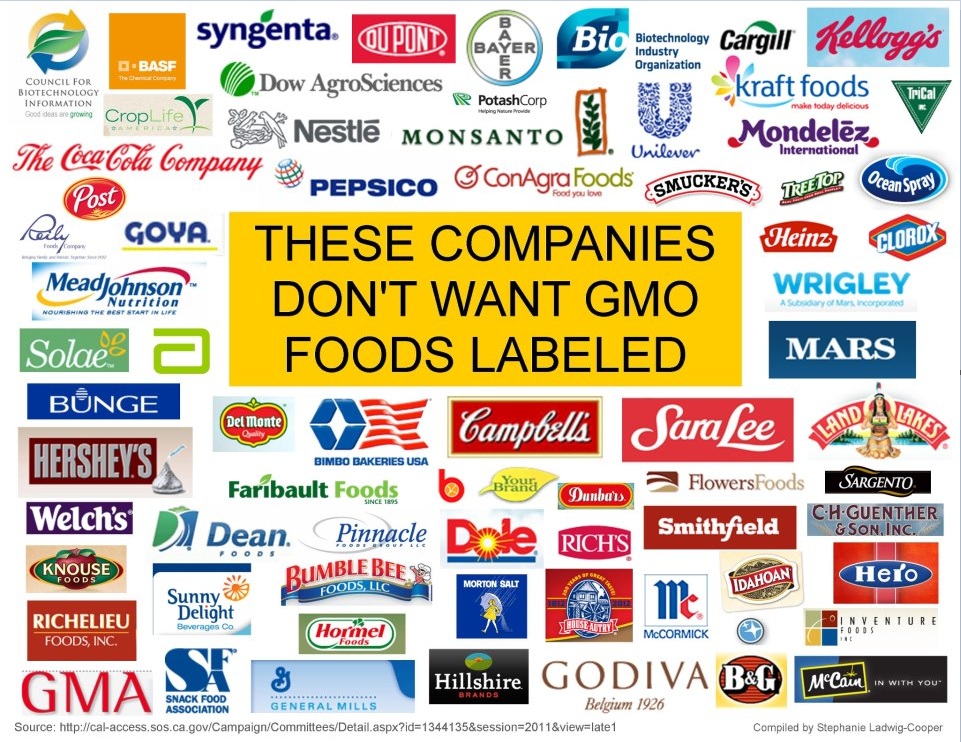
Not only do they not want the public to know what’s in their foods, they don’t want the public to know who’s spending the money to keep them in the dark. The Grocery Manufacturer’s Association refused to reveal the names of their anti-GMO labeling corporate donors until they were forced to by a lawsuit from the WA State Attorney General. Storylink.com published the following list with respective donation amounts and contact information links:
As can be deduced from this list, there’s probably a lot more GMOs in supermarkets than most people realize. With or without GMO labeling, if one is concerned for personal and planetary health it’d be best to get into the practice of avoiding all processed foods as much as possible and look specifically for foods labeled as “non-GMO”.
On the lighter side, this should come as no surprise to anyone, but corporate assholes apparently don’t know how to throw a party. While they should’ve been celebrating last night, this is what Seattle’s weekly alternative paper The Stranger reported:
·
MONSANTO DOES NOT KNOW HOW TO THROW A PARTY
8:16 PM
The No on GMO labeling campaign is supposedly hosting a party at the Westin Hotel. They have burned some serious bucks opposing Initiative 522, almost all of it coming from out of state. As for the party? No one is here. There is bottled water, Coca Cola, and cookies on a table. No real food. Seriously, three people in the room—one from Seattle Times. It’s all very strange.
THE MONSANTO MORGUE
8:58 PM
This is what it must feel like to be in a conference room in the Death Star. No one has anything to do. No one is around. But those checking names at the door have to wait and wait like something might happen. Power functions with no one. Power does not need people. People are democracy.







 After the Crash