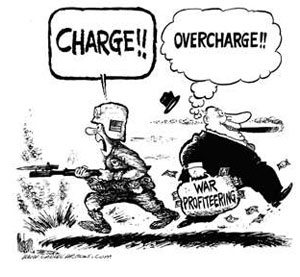
$850 Billion Chicken Comes Home to Roost.

War Reveals U.S. Military’s Longtime Disinterest in War.

Signe’s second toon du jour SIGN17e Military

By Andrew Cockburn

Source: Spoils of War

Watching a recent video of Ukrainian troops scrambling out of a U.S.-supplied Bradley armored fighting vehicle just after it hit a mine, I remembered how hard the U.S. Army bureaucrats and contractors who developed the weapon had fought to keep this vehicle a death trap for anyone riding inside. As originally designed, Bradleys promptly burst into flame when hit with anything much more powerful than a BB pellet, incinerating anyone riding inside. The armor bureaucrats were well aware of this defect, but pausing development for a redesign might have hurt their budget, so they delayed and cheated on tests to keep the program on track. Prior to one test, they covertly substituted water-tanks for the ammunition that would otherwise explode. Only when Jim Burton, a courageous air force lieutenant colonel from the Pentagon’s testing office, enlisted Congress to mandate a proper live fire test were the army’s malign subterfuges exposed and corrected. His principled stand cost him his career, but the Bradley was redesigned, rendering it less potentially lethal for passengers. Hence, forty years on, the survival of those lucky Ukrainians.

This largely forgotten episode serves as a vivid example of an essential truth about our military machine: it is not interested in war.

How else to understand the lack of concern for the lives of troops, or producing a functioning weapon system? As Burton observed in his instructive 1993 memoir Pentagon Wars, the U.S. defense system is “a corrupt business — ethically and morally corrupt from top to bottom.”

Nothing has happened in the intervening years to contradict this assessment, with potentially grim consequences for men and women on the front line. Today, for example, the U.S. Air Force is abandoning its traditional role of protecting and coordinating with troops on the ground, otherwise known as Close Air Support, or CAS. Given its time-honored record of bombing campaigns that had little or no effect on the course of wars, CAS has probably been the only useful function (grudgingly) performed by the service.

The Air Force has always resented the close support mission, accepting the role only because handing it to the Army would entail losing budget share. Thus the A-10 “Warthog” aircraft, specifically dedicated to CAS, was developed by the air force only to ward off a threat from the Army to steal the mission with a new helicopter. As it turned out, the A-10, thanks to the dedicated genius of its creators, notably the late Pierre Sprey, was supremely suited to the mission. But its successful record cuts no ice with the air force, which has worked with might and main to get rid of the A-10 ever since the threat of an army competitor in the eternal battle for budget share had been eliminated.

That campaign is now entering its final stages. The air force is not only getting rid of its remaining fleet of A-10s, it is also eliminating the capability to perform the close air support mission by phasing out the training for pilots and ground controllers essential for this highly specialized task. True, the service claims that the infamously deficient F-35 “fighter” can and will undertake the mission, but that is a laughable notion for many reasons, including the fact that the plane’s 25 mm cannon cannot shoot straight. The consequences for American troops on the ground in future wars will be dire, but their fate apparently carries little weight when set against the unquenchable urge of the air force to assert its independence from the messy realities of ground combat, where wars are won or lost. Thus its hopes and budget plans are focussed on costly systems of dubious relevance to warfare such as the new B-21 bomber, the new Sentinel ICBM, and the Next Generation Air Dominance fighter, none of which will fly for years to come, except in the form of cash out of our pockets.

Pentagon spending this year is projected to nudge $850 billion. (The total national security bill is already way past a trillion, but that’s another story.) Yet, even when endowed with such a gigantic pile of cash, the system is apparently incapable of furnishing the wherewithal for even a limited war, such as the one currently underway in Ukraine. The conflict has been marked by successive announcements that progressively more potent weapon systems are being shipped to the Ukrainians -Javelins anti-tank missiles, 155 mm Howitzers, HIMARS precision long range missiles, Patriots air defense missiles, Abrams tanks, with F-16 fighters in the offing. A U.S. military intelligence officer pointed out to me recently the actual basis on which these systems are selected: “when we run out of the last system we were sending.”

Now Biden has generated global outrage by promising to send cluster bombs, known for their ability to kill and maim children fifty years after the relevant war has ended, as any Laotian farmer could tell you. The military rationale for their use is their supposed utility against “soft” targets such as dismounted infantry, radars, and wheeled vehicles. However, a former armor officer and veteran of the 1991 Gulf war recalled to me that “we disliked them intensely and pleaded with the artillery and Air Force not to employ them. They simply damaged support elements and wheels that followed us into action. After the war we treated numerous people wounded by them including our own soldiers, as well as civilians (children).”

Biden has admitted that these devices are being sent only because the U.S. is running out of the artillery ammunition that the Ukrainians actually require. “This is a war relating to munitions. And they’re running out of that ammunition, and we’re low on it,” he told a TV interviewer. So off go the cluster bombs, their passage lubricated by crocodile tears from administration officials: “I’m not going to stand up here and say it was easy…It’s a decision that required a real hard look at the potential harm to civilians” National Security Adviser Jake Sullivan told reporters. (Back when it was reported that the Russians were using cluster bombs in Ukraine, then-White House Press Secretary Jen Psaki denounced such action as “a war crime.”)

So, the richest war machine in history, having scraped its cupboard bare, is now reduced to fielding a device of dubious military utility deemed illegal by over a hundred countries. That’s what we get for our $850 billion.

House Passes $886 Billion National Defense Authorization Act

The bill narrowly passed in a vote of 219-210 due to a partisan divide over amendments included by Republicans

By Dave DeCamp

Source: AntiWar.com

The House on Friday passed its version 2024 National Defense Authorization Act in a vote of 219-210, which largely fell along partisan lines due to amendments added by Republicans relating to social policies in the military.

The Republican amendments covered abortion, transgender surgery, and diversity initiatives. Only four Democrats voted in favor of the bill, and four Republicans voted against it. The four Republicans who opposed the NDAA are Reps. Thomas Massie (KY), Eli Crane (AZ), Andy Biggs (AZ), and Ken Buck (CO).

The Senate still needs to pass its version of the NDAA, then the two chambers will negotiate the final version that will go to President Biden’s desk. The Republican amendments packed into the House version will set up a fight between the two chambers as Senate Majority Leader Chuck Schumer (D-NY) and other Democrats will reject them.

The 2024 NDAA is for a record $886 billion, the same amount President Biden requested. The debt ceiling deal reached between House Republicans in the White House did not limit military spending and put no caps on emergency supplemental funds, which is how the US has been spending on the war in Ukraine.

As the House was debating the NDAA, several amendments introduced by Republicans looking to rein in US support for Ukraine were voted down. One amendment sponsored by Rep. Warren Davidson (R-OH) would have required the Biden administration to develop a strategy for the war in Ukraine. It was rejected in a vote of 129-301, with only Republicans supporting it.

One amendment introduced by Rep. Marjorie Taylor Greene would have cut $300 million in military aid for Ukraine that’s packed into the NDAA, but it failed in a vote of 89-341. Rep. Matt Gaetz (R-FL) put forward an amendment to cut off all military assistance for Ukraine, which failed in a vote of 70-358. Only Republicans supported the two amendments.

Greene sponsored another amendment that would have prohibited the transfer of cluster munitions to Ukraine, although US cluster bombs have already arrived in the country. The effort failed in a vote of 147-276. It received support from 98 Republicans and 49 Democrats.

The Ultimate All-American Slush Fund

How A New Budget Loophole Could Send Pentagon Spending Soaring Even Higher

By Julia Gledhill and William D. Hartung

Source: TomDispatch

On June 3rd, President Joe Biden signed a bill into law that lifted the government’s debt ceiling and capped some categories of government spending. The big winner was — surprise, surprise! — the Pentagon.

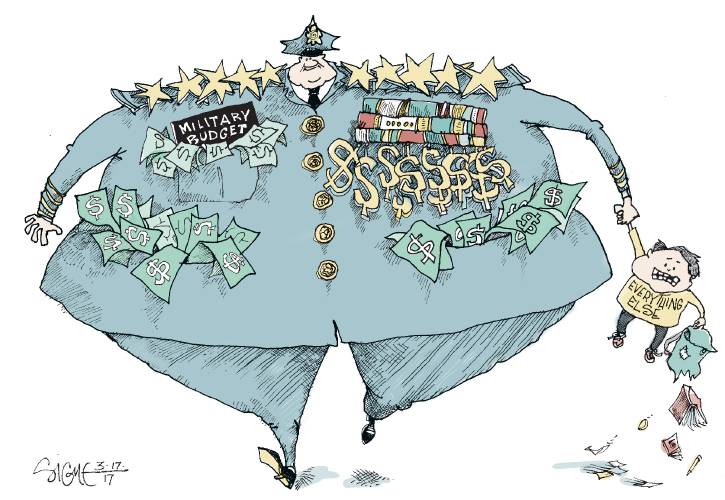
Congress spared military-related programs any cuts while freezing all other categories of discretionary spending at the fiscal year 2023 level (except support for veterans). Indeed, lawmakers set the budget for the Pentagon and for other national security programs like nuclear-related work developing nuclear warheads at the Department of Energy at the level requested in the administration’s Fiscal Year 2024 budget proposal — a 3.3% increase in military spending to a whopping total of $886 billion. Consider that preferential treatment of the first order and, mind you, for the only government agency that’s failed to pass a single financial audit! 

Even so, that $886 billion hike in Pentagon and related spending is likely to prove just a floor, not a ceiling, on what will be allocated for “national defense” next year. An analysis of the deal by the Wall Street Journal found that spending on the Pentagon and veterans’ care — neither of which is frozen in the agreement — is likely to pass $1 trillion next year.

Compare that to the $637 billion left for the rest of the government’s discretionary budget. In other words, public health, environmental protection, housing, transportation, and almost everything else the government undertakes will have to make do with not even 45% of the federal government’s discretionary budget, less than what would be needed to keep up with inflation. (Forget addressing unmet needs in this country.)

And count on one thing: national security spending is likely to increase even more, thanks to a huge (if little-noticed) loophole in that budget deal, one that hawks in Congress are already salivating over how best to exploit. Yes, that loophole is easy to miss, given the bureaucratese used to explain it, but its potential impact on soaring military budgets couldn’t be clearer. In its analysis of the budget deal, the Congressional Budget Office noted that “funding designated as an emergency requirement or for overseas contingency operations would not be constrained” by anything the senators and House congressional representatives had agreed to.

As we should have learned from the 20 years of all-American wars in Afghanistan and Iraq, the term “overseas contingency” can be stretched to cover almost anything the Pentagon wants to spend your tax dollars on. In fact, there was even an “Overseas Contingency Operations” (OCO) account supposedly reserved for funding this country’s seemingly never-ending post-9/11 wars. And it certainly was used to fund them, but hundreds of billions of dollars of Pentagon projects that had nothing to do with the conflicts in Iraq or Afghanistan were funded that way as well. The critics of Pentagon overspending quickly dubbed it that department’s “slush fund.”

So, prepare yourself for “Slush Fund II” (coming soon to a theater near you). This time the vehicle for padding the Pentagon budget is likely to be the next military aid package for Ukraine, which will likely be put forward as an emergency bill later this year.  Expect that package to include not only aid to help Ukraine fend off Russia’s ongoing brutal invasion but tens of billions of dollars more to — yes, of course! — pump up the Pentagon’s already bloated budget.

Senator Lindsey Graham (R-SC) made just such a point in talking with reporters shortly after the debt-ceiling deal was passed by Congress. “There will be a day before too long,” he told them, “where we’ll have to deal with the Ukrainian situation. And that will create an opportunity for me and others to fill in the deficiencies that exist from this budget deal.”

Senate Majority Leader Chuck Schumer (D-NY) made a similar point in a statement on the Senate floor during the debate over that deal. “The debt ceiling deal,” he said, “does nothing to limit the Senate’s ability to appropriate emergency/supplemental funds to ensure our military capabilities are sufficient to deter China, Russia, and our other adversaries and respond to ongoing and growing national security threats.”

One potential (and surprising) snag in the future plans of those Pentagon budget boosters in both parties may be the position of House Speaker Kevin McCarthy (R-CA). He has, in fact, described efforts to increase Pentagon spending beyond the level set in the recent budget deal as “part of the problem.” For the moment at least, he openly opposes producing an emergency package to increase the Pentagon budget, saying:

“The last five audits the Department of Defense [have] failed. So there’s a lot of places for reform [where] we can have a lot of savings. We’ve plussed it up. This is the most money we’ve ever spent on defense — this is the most money anyone in the world has ever spent on defense. So I don’t think the first answer is to do a supplemental.”

The Massive Overfunding of the Pentagon

The Department of Defense is, of course, already massively overfunded. That $886 billion figure is among the highest ever — hundreds of billions of dollars more than at the peak of the Korean or Vietnam wars or during the most intensely combative years of the Cold War. It’s higher than the combined military budgets of the next 10 countries combined, most of whom are, in any case, U.S. allies. And it’s estimated to be three times what the Chinese military, the Pentagon’s “pacing threat,” receives annually. Consider it an irony that actually “keeping pace” with China would involve a massive cut in military spending, not an increase in the Pentagon’s bloated budget.

It also should go without saying that preparations to effectively defend the United States and its allies could be achieved for so much less than is currently lavished on the Pentagon.  A new approach could easily save significantly more than $100 billion in fiscal year 2024as proposed by Representatives Barbara Lee (D-CA) and Mark Pocan (D-WI) in the People Over Pentagon Act, the preeminent budget-cut proposal in Congress. An illustrative report released by the Congressional Budget Office (CBO) in late 2021 sketched out three scenarios, all involving a less interventionist, more restrained approach to defense that would include greater reliance on allies. Each option would reduce America’s 1.3-million-strong active military force (by up to one-fifth in one scenario). Total savings from the CBO’s proposed changes would, over a decade, be $1 trillion.

And a more comprehensive approach that shifted away from the current “cover the globe” strategy of being able to fight (though, as the history of this century shows, not always win) wars virtually anywhere on Earth on short notice — without allies, if necessary — could save hundreds of billions more over the next decade. Cutting bureaucracy and making other changes in defense policy could also yield yet more savings. To cite just two examples, reducing the Pentagon’s cohort of more than half-a-million private contract employees and scaling back its nuclear weapons “modernization” program would save significantly more than $300 billion extra over a decade.

But none of this is even remotely likely without concerted public pressure to, as a start, keep members of Congress from adding tens of billions of dollars in spending on parochial military projects that channel funding into their states or districts. And it would also mean pushing back against the propaganda of Pentagon contractors who claim they need ever more money to provide adequate tools to defend the country.

Contractors Crying Wolf

While demanding ever more of our tax dollars, the giant military-industrial corporations are spending all too much of their time simply stuffing the pockets of their shareholders rather than investing in the tools needed to actually defend this country. A recent Department of Defense report found that, from 2010-2019, such companies increased by 73% over the previous decade what they paid their shareholders. Meanwhile, their investment in research, development, and capital assets declined significantly. Still, such corporations claim that, without further Pentagon funding, they can’t afford to invest enough in their businesses to meet future national security challenges, which include ramping up weapons production to provide arms for Ukraine.

In reality, however, the financial data suggests that they simply chose to reward their shareholders over everything and everyone else, even as they experienced steadily improving profit margins and cash generation. In fact, the report pointed out that those companies “generate substantial amounts of cash beyond their needs for operations or capital investment.” So instead of investing further in their businesses, they choose to eat their “seed corn” by prioritizing short-term gains over long-term investments and by “investing” additional profits in their shareholders. And when you eat your seed corn, you have nothing left to plant next year.

Never fear, though, since Congress seems eternally prepared to bail them out. Their businesses, in fact, continue to thrive because Congress authorizes funding for the Pentagon to repeatedly grant them massive contracts, no matter their performance or lack of internal investment. No other industry could get away with such maximalist thinking.

Military contractors outperform similarly sized companies in non-defense industries in eight out of nine key financial metrics — including higher total returns to shareholders (a category where they leave much of the rest of the S&P 500 in the dust). They financially outshine their commercial counterparts for two obvious reasons: first, the government subsidizes so many of their costs; second, the weapons industry is so concentrated that its major firms have little or no competition.

Adding insult to injury, contractors are overcharging the government for the basic weaponry they produce while they rake in cash to enrich their shareholders. In the past 15 years, the Pentagon’s internal watchdog has exposed price gouging by contractors ranging from Boeing and Lockheed Martin to lesser-known companies like TransDigm Group. In 2011, Boeing made about $13 million in excess profits by overcharging the Army for 18 spare parts used in Apache and Chinook helicopters. To put that in perspective, the Army paid $1,678.61 each for a tiny helicopter part that the Pentagon already had in stock at its own warehouse for only $7.71.

The Pentagon found Lockheed Martin and Boeing price gouging together in 2015. They overcharged the military by “hundreds of millions of dollars” for missiles. TransDigm similarly made $16 million by overcharging for spare parts between 2015 and 2017 and even more in the following two years, generating nearly $21 million in excess profits. If you can believe it, there is no legal requirement for such companies to refund the government if they’re exposed for price gouging.

Of course, there’s nothing new about such corporate price gouging, nor is it unique to the arms industry. But it’s especially egregious there, given how heavily the major military contractors depend on the government’s business. Lockheed Martin, the biggest of them, got a staggering 73% of its $66 billion in net sales from the government in 2022. Boeing, which does far more commercial business, still generated 40% of its revenue from the government that year. (Down from 51% in 2020.)

Despite their reliance on government contracts, companies like Boeing seem to be doubling down on practices that often lead to price gouging. According to Bloomberg News, between 2020 and 2021, Boeing refused to provide the Pentagon with certified cost and pricing data for nearly 11,000 spare parts on a single Air Force contract. Senator Elizabeth Warren (D-MA) and Representative John Garamendi (D-CA) have demanded that the Pentagon investigate since, without such information, the department will continue to be hard-pressed to ensure that it’s paying anything like a fair price, whatever its purchases.

Curbing the Special Interest Politics of “Defense”

Reining in rip-offs and corruption on the part of weapons contractors large and small could save the American taxpayer untold billions of dollars. And curbing special-interest politics on the part of the denizens of the military-industrial-congressional complex (MICC) could help open the way towards the development of a truly defensive global military strategy rather than the current interventionist approach that has embroiled the United States in the devastating and counterproductive wars of this century.

One modest step towards reining in the power of the arms lobby would be to revamp the campaign finance system by providing federal matching funds, thereby diluting the influential nature of the tens of millions in campaign contributions the arms industry makes every election cycle. In addition, prohibiting retiring top military officers from going to work for arms-making companies — or, at least, extending the cooling off period to at least four years before they can do so, as proposed by Senator Warren — would also help reduce the undue influence exerted by the MICC.

Last but not least, steps could be taken to prevent the military services from giving Congress their annual wish lists — officially known as “unfunded priorities lists” — of items they want added to the Pentagon budget. After all, those are but another tool allowing members of Congress to add billions more than what the Pentagon has even asked for to that department’s budget.

Whether such reforms alone, if adopted, would be enough to truly roll back excess Pentagon spending remains to be seen. Without them, however, count on one thing: the department’s budget will almost certainly continue to soar, undoubtedly reaching $1 trillion or more annually within just the next few years.  Americans can’t afford to let that happen.

A War Like No Other in Ukraine

By Peter Van Buren

Source: WeMeantWell.com

Joe Biden created for the U.S. a war like no other, one where others die and the U.S. simply sits back and pays the bills on a gargantuan scale. No attempts are made at diplomacy by the Americans, and the diplomatic efforts of others like the Chinese are dismissed as evil attempts to gain influence in the area (similar for Chinese diplomatic work in the Yemen war.) Biden is coming close to achieving 1984‘s goal of perpetual warfare while only putting a handful of American lives at risk. He has learned lessons from the Cold War, and already put them into play. Can we call it the Biden Doctrine yet?

Biden’s strategy is clear enough now after well more than a year of conflict; what he has been sending to Ukraine jumped from helmets and uniforms to F-16s in only 15 months and shows no signs of stopping. The problem is U.S. weapons are never enough for victory and always “just enough” to allow the battle to go on until then next round. If the Ukrainians think they are playing the U.S. for suckers for free arms they best check who is really paying for everything, in blood.

Putin is playing this game himself in a way, careful not to introduce anything too powerful, such as strategic bombers, and upset the balance and offer Biden the chance to intervene in the war directly (one can hear old man Biden on TV now, explaining American airstrikes are needed to prevent a genocide, the go-to excuse he learned at Obama’s knee.) That’s what the current escalation holds, airpower. Ukraine will find even with the promise of the F-16 it can’t acquire aircraft and train up pilots fast enough (minimum training time is 18-24 months), and next will be begging the U.S. to serve as its air force. As it is the planes are likely to be based out of Poland and Romania, suggesting NATO will pick up the high-skilled tasks of maintaining and repairing them. Left unclear is the NATO role in required aerial refueling to keep the planes over the battlefield. F-16s aside, a spin off bonus to all these weapons gifts is that the vast majority of transfers to date have been “presidential drawdowns.” This means the U.S. sends used or older weapons to Ukraine, after which the Pentagon can use the Congressionally-authorized funds to replenish their stocks by purchasing new arms. The irony that war machines once in Iraq are now on the ground in Ukraine can’t be missed.

The U.S. strategy seems based on creating a ghastly tie of sorts, two sides lined up across a field shooting at each other until one side called it quits for the day. Same as in 1865, same as in 1914, but the new factor is today those armies face off across those fields with 21st-century HIMARS artillery, machine guns, and other tools of killing far more effective than a musket. It is unsustainable, literally chewing up men, albeit not Americans. The question meanwhile of how many more Ukrainians have to die is answered privately by Joe Biden as “potentially all of them.” Anything else requires you to cynically believe Biden thinks he can simply purchase victory,

Up until now this has all been the Cold War playbook. Fighting to the last Afghan was a strategy perfected in Soviet-held Afghanistan in the 1980s. Yet what is different is the scale — since Russia invaded Ukraine, the United States sent over $37 billion worth of military aid to support Kiev’s war effort, the single largest arms transfer in U.S. history and one with no signs of stopping. A single F-16 costs up to $350 million a copy if bought with weapons, maintenance equipment, and spare parts kits.

Yet despite the similarities to Cold War Strategy 101, some lessons have been learned over the intervening years. One of America’s fail-points throughout the Cold War and the War on Terror was the use of puppet governments largely imposed or direly supported by American money and muscle. Because these governments lacked the support of the people (see Vietnam, Iraq, and Afghanistan) they were non-starters with the lifespan of fruit flies. Ukraine is different; the puppet government is the government, beholden to the U.S. for its very survival but more or less supported directly by the people for now.

The other lesson learned has to do with nation building, or rebuilding or reconstruction, whatever the vast post-war expenditures will be called in this conflict. No more straight-up governmental efforts as in Vietnam, Iraq, and Afghanistan. This time it will be all private enterprise. “It is obvious that American business can become the locomotive that will once again push forward global economic growth,” President Zelensky said, boasting that BlackRock, JP Morgan, and Goldman Sachs, and others “have already become part of our Ukrainian way.”

The NYT calls Ukraine “the world’s largest construction site” and predicts projects there in the multi-billions, as high in some estimates as $750 billion. It will be, says the Times, a “gold rush: the reconstruction of Ukraine once the war is over. Russia is stepping up its offensive heading into the second year of the war, but already the staggering rebuilding task is evident. Hundreds of thousands of homes, schools, hospitals and factories have been obliterated along with critical energy facilities and miles of roads, rail tracks and seaports. The profound human tragedy is unavoidably also a huge economic opportunity.” Earlier this year JP Morgan and Zelensky signed a memorandum of understanding stipulating Morgan would assist Ukraine in its reconstruction.

And maybe those large American companies have learned the lessons of Iraq and Afghanistan. Of the billions spent, much money was wasted on dead ends and much was siphoned off due to corruption. But success or failure, the contractors always got paid in our Wars of Terror. With that in mind, more than 300 companies from 22 countries signed up for a Rebuild Ukraine exhibition and conference in Warsaw. At the World Economic Forum in Davos, Switzerland, a standing-room-only crowd packed Ukraine House to discuss investment opportunities.

The eventual gold rush in rebuilding makes for an interesting addendum to the Biden strategy of fighting to the last Ukrainian. The more that is destroyed the more that needs to be rebuilt, and the potential for more money to pour into U.S. companies smart enough to wait by the trough for the killing to subside. But why wait? Drones operated by Danish companies have already mapped every bombed-out structure in the Mykolaiv Oblast region, with an eye toward using the data to help decide what reconstruction contracts should be issued.

So let’s put some lipstick on this pig of a strategy and call it the Biden Doctrine. Part I is to limit direct U.S. combat involvement while fanning the flames for others. Part II is to provide massive amounts of arms to enable a fight to the last local person. Part III is to transform the home government into a puppet instead of creating an unpopular one afresh. Part IV is to turn the reconstruction process into a profit center for American companies. How long the war lasts and how many die are cynically not part of the strategy. The off ramp in Ukraine, a diplomatic outcome that resets the map to pre-invasion 2022 levels, is clear enough to Washington. The Biden administration seems content, shamefully, not to call forcefully for diplomatic efforts but instead to bleed out the Russians as if this was Afghanistan 1980, albeit in the heart of Europe.

The patriotism of killing and being killed

Why are patriotism and war so intertwined in U.S. media and politics?

By Norman Solomon

Source: Nation of Change

The Fourth of July—the ultimate patriotic holiday—is approaching again. Politicians orate, American Flags proliferate and, even more than usual, many windows on the world are tinted red, white and blue. But an important question remains unasked: Why are patriotism and war so intertwined in U.S. media and politics?

The highest accolades often go to those who died for their country. But when a war is based on deception with horrific results, as became clear during the massive bloodshed in Vietnam, realism and cynicism are apt to undermine credulity. “War’s good business so give your son,” said a Jefferson Airplane song in 1967. “And I’d rather have my country die for me.”

Government leaders often assert that participating in war is the most laudable of patriotic services rendered. And even if the fighters don’t know what they’re fighting for, the pretense from leadership is that they do. When President Lyndon Johnson delivered a speech to U.S. troops at Cam Ranh Bay in South Vietnam, he proclaimed that “you know what you are doing, and you know why you are doing it—and you are doing it.”

Five decades later, long after sending U.S. troops to invade Panama in 1989 and fight the 1991 Gulf War, former President George H.W. Bush tweeted that he was “forever grateful not only to those patriots who made the ultimate sacrifice for our Nation—but also the Gold Star families whose heritage is imbued with their honor and heroism.” Such lofty rhetoric is routine.

Official flattery elevates the warriors and the war, no matter how terrible the consequences. In March 2010, making his first presidential visit to Afghanistan, Barack Obama told the assembled troops at Bagram Air Base that they “represent the virtues and the values that America so desperately needs right now: sacrifice and selflessness, honor and decency.”

From there, Obama went on to a theme of patriotic glory in death: “I’ve been humbled by your sacrifice in the solemn homecoming of flag-draped coffins at Dover, to the headstones in section 60 at Arlington, where the fallen from this war rest in peace alongside the fellow heroes of America’s story.” Implicit in such oratory is the assumption that “America’s story” is most heroic and patriotic on military battlefields.

A notable lack of civic imagination seems to assume that there is no higher calling for patriotism than to kill and be killed. It would be an extremely dubious notion even if U.S. wars from Vietnam to Afghanistan and Iraq had not been based on deception—underscoring just how destructive the conflation of patriotism and war can be.

From Vietnam to Iraq and beyond, the patriotism of U.S. troops—and their loved ones as well as the general public back home—has been exploited and manipulated by what outgoing President Dwight Eisenhower called the “military-industrial complex.” Whether illuminated by the Pentagon Papers in 1971 or the absence of the proclaimed Iraqi weapons of mass destruction three decades later, the falsehoods provided by the White House, State Department and Pentagon have been lethal forms of bait-and-switch.

Often lured by genuine love of country and eagerness to defend the United States of America, many young people have been drawn into oiling the gears of a war machine—vastly profitable for Pentagon contractors and vastly harmful to human beings trapped in warfare.

Yet, according to top officials in Washington and compliant media, fighting and dying in U.S. wars are the utmost proof of great patriotism.

We’re encouraged to closely associate America’s wars with American patriotism in large part because of elite interest in glorifying militarism as central to U.S. foreign policy. Given the destructiveness of that militarism, a strong argument can be made that true patriotism involves preventing and stopping wars instead of starting and continuing them.

If such patriotism can ever prevail, the Fourth of July will truly be a holiday to celebrate.

PRIGOZHIN’S FOLLY

By Seymour Hersh

Source: Mint Press News

The Biden administration had a glorious few days last weekend. The ongoing disaster in Ukraine slipped from the headlines to be replaced by the “revolt,” as a New York Times headline put it, of Yevgeny Prigozhin, chief of the mercenary Wagner Group.
The focus slipped from Ukraine’s failing counter-offensive to Prigozhin’s threat to Putin’s control. As one headline in the Times put it, “Revolt Raises Searing Question: Could Putin Lose Power?” Washington Post columnist David Ignatius posed this assessment: “Putin looked into the abyss Saturday—and blinked.”

Secretary of State Antony Blinken—the administration’s go-to wartime flack, who weeks ago spoke proudly of his commitment not to seek a ceasefire in Ukraine—appeared on CBS’s Face the Nation with his own version of reality: “Sixteen months ago, Russian forces were . . . thinking they would erase Ukraine from the map as an independent country,” Blinken said. “Now, over the weekend they’ve had to defend Moscow, Russia’s capital, against mercenaries of Putin’s own making. . . . It was a direct challenge to Putin’s authority. . . . It shows real cracks.”

Blinken, unchallenged by his interviewer, Margaret Brennan, as he knew he would not be—why else would he appear on the show?—went on to suggest that the defection of the crazed Wagner leader would be a boon for Ukraine’s forces, whose slaughter by Russian troops was ongoing as he spoke. “To the extent that it presents a real distraction for Putin, and for Russian authorities, that they have to look at—sort of mind their rear as they’re trying to deal with the counter offensive in Ukraine, I think that creates even greater openings for the Ukrainians to do well on the ground.”

At this point was Blinken speaking for Joe Biden? Are we to understand that this is what the man in charge believes?

We now know that the chronically unstable Prigozhin’s revolt fizzled out within a day, as he fled to Belarus, with a no-prosecution guarantee, and his mercenary army was mingled into the Russian army. There was no march on Moscow, nor was there a significant threat to Putin’s rule.

Pity the Washington columnists and national security correspondents who seem to rely heavily on official backgrounders with White House and State Department officials. Given the published results of such briefings, those officials seem unable to look at the reality of the past few weeks, or the total disaster that has befallen the Ukraine military’s counter-offensive.

So, below is a look at what is really going that was provided to me by a knowledgeable source in the American intelligence community:

“I thought I might clear some of the smoke. First and most importantly, Putin is now in a much stronger position. We realized as early as January of 2023 that a showdown between the generals, backed by Putin, and Prigo, backed by anti-Russian extremists, was inevitable. The age-old conflict between the ‘special’ war fighters and a large, slow, clumsy, unimaginative regular army. The army always wins because they own the peripheral assets that make victory, either offensive or defensive, possible. Most importantly, they control logistics. special forces see themselves as the premier offensive asset. When the overall strategy is offensive, big army tolerates their hubris and public chest thumping because SF are willing to take high risk and pay a high price. Successful offense requires a large expenditure of men and equipment. Successful defense, on the other hand, requires husbanding these assets.

“Wagner members were the spearhead of the original Russian Ukraine offensive. They were the ‘little green men’. When the offensive grew into an all-out attack by the regular army, Wagner continued to assist but reluctantly had to take a back seat in the period of instability and readjustment that followed. Prigo, no shy violet, took the initiative to grow his forces and stabilize his sector.

“The regular army welcomed the help. Prigo and Wagner, as is the wont of special forces, took the limelight and took the credit for stopping the hated Ukrainians. The press gobbled it up. Meanwhile, the big army and Putin slowly changed their strategy from offensive conquest of greater Ukraine to defense of what they already had. Prigo refused to accept the change and continued on the offensive against Bakhmut. Therein lies the rub. Rather than create a public crisis and court-martial the asshole [Prigozhin], Moscow simply withheld the resources and let Prigo use up his manpower and firepower reserves, dooming him to a stand-down. He is, after all, no matter how cunning financially, an ex-hot dog cart owner with no political or military accomplishments.

“What we never heard is three months ago Wagner was cycled out of the Bakhmut front and sent to an abandoned barracks north of Rostov-on-Don [in southern Russia] for demobilization. The heavy equipment was mostly redistributed, and the force was reduced to about 8,000, 2,000 of which left for Rostov escorted by local police.

“Putin fully backed the army who let Prigo make a fool of himself and now disappear into ignominy. All without raising a sweat militarily or causing Putin to face a political standoff with the fundamentalists, who were ardent Prigo admirers. Pretty shrewd.”

There is an enormous gap between the way the professionals in the American intelligence community assess the situation and what the White House and the supine Washington press project to the public by uncritically reproducing the statements of Blinken and his hawkish cohorts.

The current battlefield statistics that were shared with me suggest that the Biden administration’s overall foreign policy may be at risk in Ukraine. They also raise questions about the involvement of the NATO alliance, which has been providing the Ukrainian forces with training and weapons for the current lagging counter-offensive. I learned that in the first two weeks of the operation, the Ukraine military seized only 44 square miles of territory previously held by the Russian army, much of it open land. In contrast, Russia is now in control of 40,000 square miles of Ukrainian territory. I have been told that in the past ten days Ukrainian forces have not fought their way through the Russian defenses in any significant way. They have recovered only two more square miles of Russian-seized territory. At that pace, one informed official said, waggishly, it would take Zelensky’s military 117 years to rid the country. of Russian occupation.

The Washington press in recent days seems to be slowly coming to grips with the enormity of the disaster, but there is no public evidence that President Biden and his senior aides in the White House and State Department aides understand the situation.

Putin now has within his grasp total control, or close to it, of the four Ukrainian oblasts—Donetsk, Kherson, Lubansk, Zaporizhzhia—that he publicly annexed on September 30, 2022, seven months after he began the war. The next step, assuming there is no miracle on the battlefield, will be up to Putin. He could simply stop where he is, and see if the military reality will be accepted by the White House and whether a ceasefire will be sought, with formal end-of-war talks initiated. There will be a presidential election next April in Ukraine, and the Russian leader may stay put and wait for that—if it takes place. President Volodymyr Zelensky of Ukraine has said there will be no elections while the country is under martial law.

Biden’s political problems, in terms of next year’s presidential election, are acute—and obvious. On June 20 the Washington Post published an article based on a Gallup poll under the headline “Biden Shouldn’t Be as Unpopular as Trump—but He Is.” The article accompanying the poll by Perry Bacon, Jr., said that Biden has “almost universal support within his own party, virtually none from the opposition party and terrible numbers among independents.” Biden, like previous Democratic presidents, Bacon wrote, struggles “to connect with younger and less engaged voters.” Bacon had nothing to say about Biden’s support for the Ukraine war because the poll apparently asked no questions about the administration’s foreign policy.

The looming disaster in Ukraine, and its political implications, should be a wake-up call for those Democratic members of Congress who support the president but disagree with his willingness to throw many billions of good money after bad in Ukraine in the hope of a miracle that will not arrive. Democratic support for the war is another example of the party’s growing disengagement from the working class. It’s their children who have been fighting the wars of the recent past and may be fighting in any future war. These voters have turned away in increasing numbers as the Democrats move closer to the intellectual and moneyed classes.

If there is any doubt about the continuing seismic shift in current politics, I recommend a good dose of Thomas Frank, the acclaimed author of the 2004 best-seller What’s the Matter with Kansas? How Conservatives Won the Heart of America, a book that explained why the voters of that state turned away from the Democratic party and voted against their economic interests. Frank did it again in 2016 in his book Listen, Liberal: Or, Whatever Happened to the Party of the People? In an afterword to the paperback edition he depicted how Hillary Clinton and the Democratic Party repeated—make that amplified—the mistakes made in Kansas en route to losing a sure-thing election to Donald Trump.

It may be prudent for Joe Biden to talk straight about the war, and its various problems for America—and to explain why the estimated more than $150 billion that his administration has put up thus far turned out to be a very bad investment.

America At War-Provoking The Consequences

By Christopher Black

Source: New Eastern Outlook

The United States of America is at war with Russia. There is not much point in using terms such as “proxy war” to describe the situation. If a belligerent in a war is acting as a proxy for another power and that power is not engaged directly in the war, the term can be useful. But when the power, for which the “proxy” engages in the war, is directly involved in the war itself, then it is a co-belligerent, a party to the war directly, not simply by proxy.

The issue is whether each state is pursuing its own interests and has its own independent means of doing so, or whether the interests and forces of the allied powers are subordinate to the interests and forces of a leader.  In such a case, the enemy being attacked can regard all its opponents as a single entity.

In this regard, Clausewitz said that, “if you can vanquish all your enemies by defeating one of them, that defeat must be the main objective of the war. In this one enemy, we strike at the centre of gravity of the entire conflict.”

If we analyse the war in the Ukraine theatre of operations in these terms, it becomes clear that the Ukrainian military forces are in fact forces of the United States of America. They have been created, armed, trained, supplied, financed, and are directed and commanded by the Americans, for American interests. The government for whom they nominally fight is a puppet state, installed in power by the United States and its NATO allies in a coup d’etat in 2014. It has no independent interests outside of American ones, and no control over the war or the forces nominally under its command.

The United States of America is the leader of a hostile military alliance, the purpose of which, since its inception, has been to isolate, threaten, attack and destroy Russia, has conspired with its alliance for years to achieve this end, has spent vast resources to prepare the attack, and has, with malice and determination, sabotaged any proposals for peace.  It insists on war.  It is the centre of gravity of the entire conflict.

The American government claims that it is not engaged even in a proxy war with Russia, that they are merely assisting an independent nation suffering aggression from another, that this does not put them at war with Russia, a war which, they claim, they are trying to avoid despite their actions and daily propaganda.

But, like the British, and the rest, the truth is the United States of America is a party to the war directly, according to all accepted criteria under international law. It supplies money to conduct the war, tanks, armoured vehicles, aircraft, arms, ammunition, military provisions and other war materials, engages its own military forces-military advisors and combatants, provides military intelligence, obtained on a real-time basis from its spy networks, satellite observations and electronic data collection, engages in an intense propaganda war against Russia, has attempted, through “sanctions,” to impose a blockade on Russia and its economy and people, blew up the Nord Stream gas pipeline, sends, on a regular basis, senior government and military officials, including the American President, Congressional bigwigs and the leaders of other members of the military alliance, to meet with and direct the actions of their lieutenant Zelensky, and conducts constant military exercises further threatening attacks against Russia. The NATO Air Defender military exercises begin in Europe on June 12, the day I write this, involving hundreds of NATO aircraft.

Make no mistake. The United States of America is at war with Russia. No amount of rhetoric can hide that fact and what the consequences for the United States will be. To quote Clausewitz again,

 “Danger is part of the friction of war. Without an accurate conception of danger, we cannot understand war.”

The problem is that the neither the Americans nor the other members of its unholy alliance, seem to realise the danger they are in, neither their leaders nor their citizens. Like the British, they suffer from the delusion that they are insulated from the consequences of their war, that they are invulnerable, that Russia will not dare to respond to the attacks upon its territory and people by attacking their territories. This shared delusion makes them ever more dangerous, since they think, they can keep escalating their actions in the war without any limits.  They cannot-not without consequences.

On June 8th Tass reported, following the statement by the former head of NATO, Fogh Rasmussen, that NATO countries may send their forces into the conflict directly, that Dmitry Medvedev stated,

“Fogh Rasmussen wasn’t a very smart man before. And now he has sunk into a doctrinaire’s dementia. In an interview with The Guardian, he stated that even if Banderavite Ukraine doesn’t receive an invitation to join NATO in Vilnius, the countries of the alliance will be able to send their troops there. Sort of on their own.”

“Well, have the people of these countries been asked? Who among them wants war with Russia? Do they really want hypersonic strikes on Europe? And what does Uncle Sam think about this? It would affect him too, wouldn’t it?”

Again, on June 1, TASS reported that Dmitry Medvedev stated, in connection with the attack on Russians in the Belgorod region by NATO-Ukrainian forces,

“The aim was simple – to cause damage, to harm to the civilian population somehow, And the fact that our enemy is already behaving as a terrorist characterizes in a very specific way both the Ukrainian regime and those who are behind it – first of all the Americans and the Europeans, who, in fact, have got on the warpath with us. Terrorist acts must entail the harshest retaliation possible.”

Medvedev’s views have been stated by other members of the government, by members of the Duma and by President Putin when he referred to Russian strikes on command and decision centres wherever they may be.

The Americans can whistle in the dark, lie to their people, try to fool the world, but what matters is what the Russian government thinks and knows, and it thinks, because it knows, that the United States of America is at war with Russia and seeks Russia’s complete defeat and subjugation. The campaign in Ukraine is just a phase of this war, is the current geographical space for this war, so for the United States and its allies to assume that they can carry out attacks on Russia and not suffer being dealt with in kind or worse, that war cannot be waged on their territories, is a serious mistake.

Indeed, on May 31, Dmitry Medvedev stated with respect to Britain,

“London is, in fact, waging an undeclared war on Moscow, which means that any British official can be viewed as a legitimate military target.

“Today, Great Britain is acting as an ally of Ukraine, by providing it with equipment and personnel as military assistance, that is de facto waging an undeclared war against Russia. Therefore, any of its officials, both military and civilian ones, who are making a contribution to the war effort, can be viewed as a legitimate military target,”

Medvedev was commenting on a remark by British Foreign Secretary James Cleverly who had justified the drone attacks on Moscow, saying that Ukraine had the right to attack targets on Russian territory for self-defense.

He added,

“Foolish officials in the UK, our eternal enemy, should remember that under universally recognized international law governing the conduct of war in modern conditions, including the Hague and Geneva Conventions with their additional protocols, their situation can also be qualified as being at war.”

The same analysis applies in spades to the United States of America.

An interesting comment in this regard was made by the Kremlin spokesman Dmitry Peskov on June 3rd when, according to Tass, he stated in an interview on the Rossiya-1 TV channel, that,

“Ukraine has simply become a tool of the West’s ‘hybrid war’ against Russia, and therefore it is futile to deal with it in resolving the conflict. Now, Ukraine is actually a tool of conflict. The conflict has indeed become broader, as the collective West is waging a hybrid war against our country. It is futile to deal with this tool in order to resolve the conflict, and this must be understood too.”

All the rhetoric from NATO about whether or not Ukraine can become a member of NATO is just a smokescreen to hide from their people the fact that Ukraine is already de facto part of NATO.  Whether or not the formalities of signing pieces of paper, of getting the approval of NATO states is followed through, is irrelevant.

Remember that on March 26, 2022, in Warsaw, President Biden stated,

“We have a sacred obligation under Article 5 to defend each and every inch of NATO territory with the full force of our collective power.”

He was referring not only to Poland but to Ukraine as well. What Russia feared is now the reality. Ukraine is de facto a NATO state.  And all the rhetoric from the West and commentators about whether or not NATO will invoke Article 5 is another smokescreen designed to mask what is really happening, for NATO has already activated Article 5 of the NATO Treaty.

The talk about invoking it in the future is an attempt to hide NATO’s weakness, its defeats on the military, economic and political fronts, even as they throw one weapon system after another at Russia, and inject NATO forces into the fighting only to have their equipment and forces destroyed.

 They have nothing left to throw at Russia that can defeat it.  So, they pretend NATO is not yet really engaged. But these facts make the USA even more dangerous as it becomes clear that the combined West cannot defeat Russia, a nuclear power, using conventional means.

Remember also that the United States has a first strike nuclear arms policy, and they have already placed, in Romania and Poland, land-based versions of the Aegis Air Defence System, which can be used to launch nuclear-armed missiles at Russia. These systems have been tested.  The one in Poland is reported to be fully operational as of June 30.  The danger to Russia is immediate and existential. Those systems are one of the reasons Russia activated its military operations.  Russia has further responded to this, and to the attacks on Russia, clearly planned and ordered by the US and UK, by placing tactical nuclear weapons in Belarus which are to be made operational after July 7, when the facilities to store and use them will be completed.

Those tactical nuclear weapons are designed for battlefield use. We hope it never comes to that, but Russia faces a direct threat from people bent on its destruction that think they are untouchable. So, Russia faces very difficult choices on what to do and how to prevent an escalation to all our nuclear war while ensuring its own security.

On May 23, during his visit to Laos, Deputy Head of the Russian Security Council Dmitry Medvedev issued a warning on the day Russian security forces destroyed the Ukrainian raiding force that attacked civilians in the Belgorod region.

“The North Atlantic alliance does not take the threat of nuclear war seriously enough, thus making a big mistake. NATO is not serious about this scenario. Otherwise, NATO would not have supplied such dangerous weapons to the Ukrainian regime. Apparently, they think that a nuclear conflict, or a nuclear apocalypse, is never ever possible. NATO is wrong, and at some point, events may take a completely unpredictable turn. The responsibility will be placed squarely on the North Atlantic Alliance,”

Medvedev pointed out that no one knows whether the point of no return has been passed,

“No one knows this. This is the main danger. Because as soon as they provide something, they say: let’s supply this, too. Long-range missiles or planes. Everything will be all right. But nothing will be fine. We will be able to cope with it. But only more and more serious types of weapons will be used. That’s what the current trend is.”

So, we come back to Clausewitz. The American government and people cannot understand the war they are engaged in unless they understand the danger, they are in.  They have to understand their country is the centre of gravity in this war, whose defeat will mean the defeat of all its minions in NATO. The Russian people know the danger they are in. The Americans, through NATO, through their NATO puppets in Ukraine, have attacked Russians in Russia. It is logical to expect that Russia will decide to bring home to the Americans what war means, what danger they are in, and they do not need to use nuclear weapons to achieve this.

Russia can strike using its conventional hypersonic weapons as well, against which the USA has no defence whatsoever, as has been established with the destruction of the Patriot Air defence complexes in Ukraine which could not stop Russian missiles. They have no other air defence systems operational in the United States territory or on its naval forces that can stop them either.  Russia has not decided to take this step yet. But it can and the Americans can do nothing about it except bluster about using nuclear weapons against Russia, But Russia took that possibility into account when the special military operation began.

The American people have not directly experienced war in their own territory for a long time. They have no idea what it is. They have no idea of the danger they are in so long as their government continues its aggressive policies, not only against Russia, but China as well.  The American people, misled and misinformed, have no conception of the dangers of this war anymore than the British people and the peoples of the other NATO countries do. The American people must be warned.  The United States of America is at war, and no amount of bluffing and lying can protect them from the consequences their government is provoking. To repeat what I said in my warning to the people of Britain, the consequences are predictable and they will be catastrophic.

Clinging Bitterly to Guns and Religion

The End Stage of American Empire

By William J. Astore

Source: TomDispatch.com

All around us things are falling apart. Collectively, Americans are experiencing national and imperial decline. Can America save itself? Is this country, as presently constituted, even worth saving?

For me, that last question is radical indeed. From my early years, I believed deeply in the idea of America. I knew this country wasn’t perfect, of course, not even close. Long before the 1619 Project, I was aware of the “original sin” of slavery and how central it was to our history. I also knew about the genocide of Native Americans. (As a teenager, my favorite movie — and so it remains — was Little Big Man, which pulled no punches when it came to the white man and his insatiably murderous greed.)

Nevertheless, America still promised much, or so I believed in the 1970s and 1980s. Life here was simply better, hands down, than in places like the Soviet Union and Mao Zedong’s China. That’s why we had to “contain” communism — to keep them over there, so they could never invade our country and extinguish our lamp of liberty. And that’s why I joined America’s Cold War military, serving in the Air Force from the presidency of Ronald Reagan to that of George W. Bush and Dick Cheney. And believe me, it proved quite a ride. It taught this retired lieutenant colonel that the sky’s anything but the limit.

In the end, 20 years in the Air Force led me to turn away from empire, militarism, and nationalism. I found myself seeking instead some antidote to the mainstream media’s celebrations of American exceptionalism and the exaggerated version of victory culture that went with it (long after victory itself was in short supply). I started writing against the empire and its disastrous wars and found likeminded people at TomDispatch — former imperial operatives turned incisive critics like Chalmers Johnson and Andrew Bacevich, along with sharp-eyed journalist Nick Turse and, of course, the irreplaceable Tom Engelhardt, the founder of those “tomgrams” meant to alert America and the world to the dangerous folly of repeated U.S. global military interventions.

But this isn’t a plug for TomDispatch. It’s a plug for freeing your mind as much as possible from the thoroughly militarized matrix that pervades America. That matrix drives imperialism, waste, war, and global instability to the point where, in the context of the conflict in Ukraine, the risk of nuclear Armageddon could imaginably approach that of the 1962 Cuban Missile Crisis. As wars — proxy or otherwise — continue, America’s global network of 750-odd military bases never seems to decline. Despite upcoming cuts to domestic spending, just about no one in Washington imagines Pentagon budgets doing anything but growing, even soaring toward the trillion-dollar level, with militarized programs accounting for 62% of federal discretionary spending in 2023.

Indeed, an engorged Pentagon — its budget for 2024 is expected to rise to $886 billion in the bipartisan debt-ceiling deal reached by President Joe Biden and House Speaker Kevin McCarthy — guarantees one thing: a speedier fall for the American empire. Chalmers Johnson predicted it; Andrew Bacevich analyzed it. The biggest reason is simple enough: incessant, repetitive, disastrous wars and costly preparations for more of the same have been sapping America’s physical and mental reserves, as past wars did the reserves of previous empires throughout history. (Think of the short-lived Napoleonic empire, for example.)

Known as “the arsenal of democracy” during World War II, America has now simply become an arsenal, with a military-industrial-congressional complex intent on forging and feeding wars rather than seeking to starve and stop them. The result: a precipitous decline in the country’s standing globally, while at home Americans pay a steep price of accelerating violence (2023 will easily set a record for mass shootings) and “carnage” (Donald Trump’s word) in a once proud but now much-bloodied “homeland.”

Lessons from History on Imperial Decline

I’m a historian, so please allow me to share a few basic lessons I’ve learned. When I taught World War I to cadets at the Air Force Academy, I would explain how the horrific costs of that war contributed to the collapse of four empires: Czarist Russia, the German Second Reich, the Ottoman empire, and the Austro-Hungarian empire of the Habsburgs. Yet even the “winners,” like the French and British empires, were also weakened by the enormity of what was, above all, a brutal European civil war, even if it spilled over into Africa, Asia, and indeed the Americas.

And yet after that war ended in 1918, peace proved elusive indeed, despite the Treaty of Versailles, among other abortive agreements. There was too much unfinished business, too much belief in the power of militarism, especially in an emergent Third Reich in Germany and in Japan, which had embraced ruthless European military methods to create its own Asiatic sphere of dominance. Scores needed to be settled, so the Germans and Japanese believed, and military offensives were the way to do it.

As a result, civil war in Europe continued with World War II, even as Japan showed that Asiatic powers could similarly embrace and deploy the unwisdom of unchecked militarism and war. The result: 75 million dead and more empires shattered, including Mussolini’s “New Rome,” a “thousand-year” German Reich that barely lasted 12 of them before being utterly destroyed, and an Imperial Japan that was starved, burnt out, and finally nuked. China, devastated by war with Japan, also found itself ripped apart by internal struggles between nationalists and communists.

As with its prequel, even most of the “winners” of World War II emerged in a weakened state. In defeating Nazi Germany, the Soviet Union had lost 25 to 30 million people. Its response was to erect, in Winston Churchill’s phrase, an “Iron Curtain” behind which it could exploit the peoples of Eastern Europe in a militarized empire that ultimately collapsed due to its wars and its own internal divisions. Yet the USSR lasted longer than the post-war French and British empires. France, humiliated by its rapid capitulation to the Germans in 1940, fought to reclaim wealth and glory in “French” Indochina, only to be severely humbled at Dien Bien Phu. Great Britain, exhausted from its victory, quickly lost India, that “jewel” in its imperial crown, and then Egypt in the Suez debacle.

There was, in fact, only one country, one empire, that truly “won” World War II: the United States, which had been the least touched (Pearl Harbor aside) by war and all its horrors. That seemingly never-ending European civil war from 1914 to 1945, along with Japan’s immolation and China’s implosion, left the U.S. virtually unchallenged globally. America emerged from those wars as a superpower precisely because its government had astutely backed the winning side twice, tipping the scales in the process, while paying a relatively low price in blood and treasure compared to allies like the Soviet Union, France, and Britain.

History’s lesson for America’s leaders should have been all too clear: when you wage war long, especially when you devote significant parts of your resources — financial, material, and especially personal — to it, you wage it wrong. Not for nothing is war depicted in the Bible as one of the four horsemen of the apocalypse. France had lost its empire in World War II; it just took later military catastrophes in Algeria and Indochina to make it obvious. That was similarly true of Britain’s humiliations in India, Egypt, and elsewhere, while the Soviet Union, which had lost much of its imperial vigor in that war, would take decades of slow rot and overstretch in places like Afghanistan to implode.

Meanwhile, the United States hummed along, denying it was an empire at all, even as it adopted so many of the trappings of one. In fact, in the wake of the implosion of the Soviet Union in 1991, Washington’s leaders would declare America the exceptional “superpower,” a new and far more enlightened Rome and “the indispensable nation” on planet Earth. In the wake of the 9/11 attacks, its leaders would confidently launch what they termed a Global War on Terror and begin waging wars in Afghanistan, Iraq, and elsewhere, as in the previous century they had in Vietnam. (No learning curve there, it seems.) In the process, its leaders imagined a country that would remain untouched by war’s ravages, which was we now know — or do we? — the height of imperial hubris and folly.

For whether you call it fascism, as with Nazi Germany, communism, as with Stalin’s Soviet Union, or democracy, as with the United States, empires built on dominance achieved through a powerful, expansionist military necessarily become ever more authoritarian, corrupt, and dysfunctional. Ultimately, they are fated to fail. No surprise there, since whatever else such empires may serve, they don’t serve their own people. Their operatives protect themselves at any cost, while attacking efforts at retrenchment or demilitarization as dangerously misguided, if not seditiously disloyal.

That’s why those like Chelsea ManningEdward Snowden, and Daniel Hale, who shined a light on the empire’s militarized crimes and corruption, found themselves imprisoned, forced into exile, or otherwise silenced. Even foreign journalists like Julian Assange can be caught up in the empire’s dragnet and imprisoned if they dare expose its war crimes. The empire knows how to strike back and will readily betray its own justice system (most notably in the case of Assange), including the hallowed principles of free speech and the press, to do so.

Perhaps he will eventually be freed, likely as not when the empire judges he’s approaching death’s door. His jailing and torture have already served their purpose. Journalists know that to expose America’s bloodied tools of empire brings only harsh punishment, not plush rewards. Best to look away or mince one’s words rather than risk prison — or worse.

Yet you can’t fully hide the reality that this country’s failed wars have added trillions of dollars to its national debt, even as military spending continues to explode in the most wasteful ways imaginable, while the social infrastructure crumbles.

Clinging Bitterly to Guns and Religion

Today, America clings ever more bitterly to guns and religion. If that phrase sounds familiar, it might be because Barack Obama used it in the 2008 presidential campaign to describe the reactionary conservatism of mostly rural voters in Pennsylvania. Disillusioned by politics, betrayed by their putative betters, those voters, claimed the then-presidential candidate, clung to their guns and religion for solace. I lived in rural Pennsylvania at the time and recall a response from a fellow resident who basically agreed with Obama, for what else was there left to cling to in an empire that had abandoned its own rural working-class citizens?

Something similar is true of America writ large today. As an imperial power, we cling bitterly to guns and religion. By “guns,” I mean all the weaponry America’s merchants of death sell to the Pentagon and across the world. Indeed, weaponry is perhaps this country’s most influential global export, devastatingly so. From 2018 to 2022, the U.S. alone accounted for 40% of global arms exports, a figure that’s only risen dramatically with military aid to Ukraine. And by “religion,” I mean a persistent belief in American exceptionalism (despite all evidence to the contrary), which increasingly draws sustenance from a militant Christianity that denies the very spirit of Christ and His teachings.

Yet history appears to confirm that empires, in their dying stages, do exactly that: they exalt violence, continue to pursue war, and insist on their own greatness until their fall can neither be denied nor reversed. It’s a tragic reality that the journalist Chris Hedges has written about with considerable urgency.

The problem suggests its own solution (not that any powerful figure in Washington is likely to pursue it). America must stop clinging bitterly to its guns — and here I don’t even mean the nearly 400 million weapons in private hands in this country, including all those AR-15 semi-automatic rifles. By “guns,” I mean all the militarized trappings of empire, including America’s vast structure of overseas military bases and its staggering commitments to weaponry of all sorts, including world-ending nuclear ones. As for clinging bitterly to religion — and by “religion” I mean the belief in America’s own righteousness, regardless of the millions of people it’s killed globally from the Vietnam era to the present moment — that, too, would have to stop.

History’s lessons can be brutal. Empires rarely die well. After it became an empire, Rome never returned to being a republic and eventually fell to barbarian invasions. The collapse of Germany’s Second Reich bred a third one of greater virulence, even if it was of shorter duration. Only its utter defeat in 1945 finally convinced Germans that God didn’t march with their soldiers into battle.

What will it take to convince Americans to turn their backs on empire and war before it’s too late? When will we conclude that Christ wasn’t joking when He blessed the peacemakers rather than the warmongers?

As an iron curtain descends on a failing American imperial state, one thing we won’t be able to say is that we weren’t warned.