
The Ultimate All-American Slush Fund

How A New Budget Loophole Could Send Pentagon Spending Soaring Even Higher
By Julia Gledhill and William D. Hartung

Source: TomDispatch

On June 3rd, President Joe Biden signed a bill into law that lifted the government’s debt ceiling and capped some categories of government spending. The big winner was — surprise, surprise! — the Pentagon.

Congress spared military-related programs any cuts while freezing all other categories of discretionary spending at the fiscal year 2023 level (except support for veterans). Indeed, lawmakers set the budget for the Pentagon and for other national security programs like nuclear-related work developing nuclear warheads at the Department of Energy at the level requested in the administration’s Fiscal Year 2024 budget proposal — a 3.3% increase in military spending to a whopping total of $886 billion. Consider that preferential treatment of the first order and, mind you, for the only government agency that’s failed to pass a single financial audit! 

Even so, that $886 billion hike in Pentagon and related spending is likely to prove just a floor, not a ceiling, on what will be allocated for “national defense” next year. An analysis of the deal by the Wall Street Journal found that spending on the Pentagon and veterans’ care — neither of which is frozen in the agreement — is likely to pass $1 trillion next year.

Compare that to the $637 billion left for the rest of the government’s discretionary budget. In other words, public health, environmental protection, housing, transportation, and almost everything else the government undertakes will have to make do with not even 45% of the federal government’s discretionary budget, less than what would be needed to keep up with inflation. (Forget addressing unmet needs in this country.)

And count on one thing: national security spending is likely to increase even more, thanks to a huge (if little-noticed) loophole in that budget deal, one that hawks in Congress are already salivating over how best to exploit. Yes, that loophole is easy to miss, given the bureaucratese used to explain it, but its potential impact on soaring military budgets couldn’t be clearer. In its analysis of the budget deal, the Congressional Budget Office noted that “funding designated as an emergency requirement or for overseas contingency operations would not be constrained” by anything the senators and House congressional representatives had agreed to.

As we should have learned from the 20 years of all-American wars in Afghanistan and Iraq, the term “overseas contingency” can be stretched to cover almost anything the Pentagon wants to spend your tax dollars on. In fact, there was even an “Overseas Contingency Operations” (OCO) account supposedly reserved for funding this country’s seemingly never-ending post-9/11 wars. And it certainly was used to fund them, but hundreds of billions of dollars of Pentagon projects that had nothing to do with the conflicts in Iraq or Afghanistan were funded that way as well. The critics of Pentagon overspending quickly dubbed it that department’s “slush fund.”

So, prepare yourself for “Slush Fund II” (coming soon to a theater near you). This time the vehicle for padding the Pentagon budget is likely to be the next military aid package for Ukraine, which will likely be put forward as an emergency bill later this year.  Expect that package to include not only aid to help Ukraine fend off Russia’s ongoing brutal invasion but tens of billions of dollars more to — yes, of course! — pump up the Pentagon’s already bloated budget.

Senator Lindsey Graham (R-SC) made just such a point in talking with reporters shortly after the debt-ceiling deal was passed by Congress. “There will be a day before too long,” he told them, “where we’ll have to deal with the Ukrainian situation. And that will create an opportunity for me and others to fill in the deficiencies that exist from this budget deal.”

Senate Majority Leader Chuck Schumer (D-NY) made a similar point in a statement on the Senate floor during the debate over that deal. “The debt ceiling deal,” he said, “does nothing to limit the Senate’s ability to appropriate emergency/supplemental funds to ensure our military capabilities are sufficient to deter China, Russia, and our other adversaries and respond to ongoing and growing national security threats.”

One potential (and surprising) snag in the future plans of those Pentagon budget boosters in both parties may be the position of House Speaker Kevin McCarthy (R-CA). He has, in fact, described efforts to increase Pentagon spending beyond the level set in the recent budget deal as “part of the problem.” For the moment at least, he openly opposes producing an emergency package to increase the Pentagon budget, saying:

“The last five audits the Department of Defense [have] failed. So there’s a lot of places for reform [where] we can have a lot of savings. We’ve plussed it up. This is the most money we’ve ever spent on defense — this is the most money anyone in the world has ever spent on defense. So I don’t think the first answer is to do a supplemental.”

The Massive Overfunding of the Pentagon

The Department of Defense is, of course, already massively overfunded. That $886 billion figure is among the highest ever — hundreds of billions of dollars more than at the peak of the Korean or Vietnam wars or during the most intensely combative years of the Cold War. It’s higher than the combined military budgets of the next 10 countries combined, most of whom are, in any case, U.S. allies. And it’s estimated to be three times what the Chinese military, the Pentagon’s “pacing threat,” receives annually. Consider it an irony that actually “keeping pace” with China would involve a massive cut in military spending, not an increase in the Pentagon’s bloated budget.

It also should go without saying that preparations to effectively defend the United States and its allies could be achieved for so much less than is currently lavished on the Pentagon.  A new approach could easily save significantly more than $100 billion in fiscal year 2024as proposed by Representatives Barbara Lee (D-CA) and Mark Pocan (D-WI) in the People Over Pentagon Act, the preeminent budget-cut proposal in Congress. An illustrative report released by the Congressional Budget Office (CBO) in late 2021 sketched out three scenarios, all involving a less interventionist, more restrained approach to defense that would include greater reliance on allies. Each option would reduce America’s 1.3-million-strong active military force (by up to one-fifth in one scenario). Total savings from the CBO’s proposed changes would, over a decade, be $1 trillion.

And a more comprehensive approach that shifted away from the current “cover the globe” strategy of being able to fight (though, as the history of this century shows, not always win) wars virtually anywhere on Earth on short notice — without allies, if necessary — could save hundreds of billions more over the next decade. Cutting bureaucracy and making other changes in defense policy could also yield yet more savings. To cite just two examples, reducing the Pentagon’s cohort of more than half-a-million private contract employees and scaling back its nuclear weapons “modernization” program would save significantly more than $300 billion extra over a decade.

But none of this is even remotely likely without concerted public pressure to, as a start, keep members of Congress from adding tens of billions of dollars in spending on parochial military projects that channel funding into their states or districts. And it would also mean pushing back against the propaganda of Pentagon contractors who claim they need ever more money to provide adequate tools to defend the country.

Contractors Crying Wolf

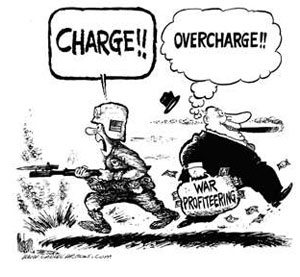
While demanding ever more of our tax dollars, the giant military-industrial corporations are spending all too much of their time simply stuffing the pockets of their shareholders rather than investing in the tools needed to actually defend this country. A recent Department of Defense report found that, from 2010-2019, such companies increased by 73% over the previous decade what they paid their shareholders. Meanwhile, their investment in research, development, and capital assets declined significantly. Still, such corporations claim that, without further Pentagon funding, they can’t afford to invest enough in their businesses to meet future national security challenges, which include ramping up weapons production to provide arms for Ukraine.

In reality, however, the financial data suggests that they simply chose to reward their shareholders over everything and everyone else, even as they experienced steadily improving profit margins and cash generation. In fact, the report pointed out that those companies “generate substantial amounts of cash beyond their needs for operations or capital investment.” So instead of investing further in their businesses, they choose to eat their “seed corn” by prioritizing short-term gains over long-term investments and by “investing” additional profits in their shareholders. And when you eat your seed corn, you have nothing left to plant next year.

Never fear, though, since Congress seems eternally prepared to bail them out. Their businesses, in fact, continue to thrive because Congress authorizes funding for the Pentagon to repeatedly grant them massive contracts, no matter their performance or lack of internal investment. No other industry could get away with such maximalist thinking.

Military contractors outperform similarly sized companies in non-defense industries in eight out of nine key financial metrics — including higher total returns to shareholders (a category where they leave much of the rest of the S&P 500 in the dust). They financially outshine their commercial counterparts for two obvious reasons: first, the government subsidizes so many of their costs; second, the weapons industry is so concentrated that its major firms have little or no competition.

Adding insult to injury, contractors are overcharging the government for the basic weaponry they produce while they rake in cash to enrich their shareholders. In the past 15 years, the Pentagon’s internal watchdog has exposed price gouging by contractors ranging from Boeing and Lockheed Martin to lesser-known companies like TransDigm Group. In 2011, Boeing made about $13 million in excess profits by overcharging the Army for 18 spare parts used in Apache and Chinook helicopters. To put that in perspective, the Army paid $1,678.61 each for a tiny helicopter part that the Pentagon already had in stock at its own warehouse for only $7.71.

The Pentagon found Lockheed Martin and Boeing price gouging together in 2015. They overcharged the military by “hundreds of millions of dollars” for missiles. TransDigm similarly made $16 million by overcharging for spare parts between 2015 and 2017 and even more in the following two years, generating nearly $21 million in excess profits. If you can believe it, there is no legal requirement for such companies to refund the government if they’re exposed for price gouging.

Of course, there’s nothing new about such corporate price gouging, nor is it unique to the arms industry. But it’s especially egregious there, given how heavily the major military contractors depend on the government’s business. Lockheed Martin, the biggest of them, got a staggering 73% of its $66 billion in net sales from the government in 2022. Boeing, which does far more commercial business, still generated 40% of its revenue from the government that year. (Down from 51% in 2020.)

Despite their reliance on government contracts, companies like Boeing seem to be doubling down on practices that often lead to price gouging. According to Bloomberg News, between 2020 and 2021, Boeing refused to provide the Pentagon with certified cost and pricing data for nearly 11,000 spare parts on a single Air Force contract. Senator Elizabeth Warren (D-MA) and Representative John Garamendi (D-CA) have demanded that the Pentagon investigate since, without such information, the department will continue to be hard-pressed to ensure that it’s paying anything like a fair price, whatever its purchases.

Curbing the Special Interest Politics of “Defense”

Reining in rip-offs and corruption on the part of weapons contractors large and small could save the American taxpayer untold billions of dollars. And curbing special-interest politics on the part of the denizens of the military-industrial-congressional complex (MICC) could help open the way towards the development of a truly defensive global military strategy rather than the current interventionist approach that has embroiled the United States in the devastating and counterproductive wars of this century.

One modest step towards reining in the power of the arms lobby would be to revamp the campaign finance system by providing federal matching funds, thereby diluting the influential nature of the tens of millions in campaign contributions the arms industry makes every election cycle. In addition, prohibiting retiring top military officers from going to work for arms-making companies — or, at least, extending the cooling off period to at least four years before they can do so, as proposed by Senator Warren — would also help reduce the undue influence exerted by the MICC.

Last but not least, steps could be taken to prevent the military services from giving Congress their annual wish lists — officially known as “unfunded priorities lists” — of items they want added to the Pentagon budget. After all, those are but another tool allowing members of Congress to add billions more than what the Pentagon has even asked for to that department’s budget.

Whether such reforms alone, if adopted, would be enough to truly roll back excess Pentagon spending remains to be seen. Without them, however, count on one thing: the department’s budget will almost certainly continue to soar, undoubtedly reaching $1 trillion or more annually within just the next few years.  Americans can’t afford to let that happen.
‘NATO’s mission’ leaves Ukraine destroyed

“We are carrying out NATO’s mission.” As Ukraine’s defense minister acknowledges the proxy war, NATO proxy warriors disregard the toll.

(Pierre Crom/Getty Images)

By Aaron Maté

Source: Aaron Maté Substack

Unveiling its latest military assistance package to Ukraine – at $3.75 billion, the largest to date — the White House declared that US weapons are intended “to help the Ukrainians resist Russian aggression.”

For their part, Ukrainians on the receiving end see it differently.

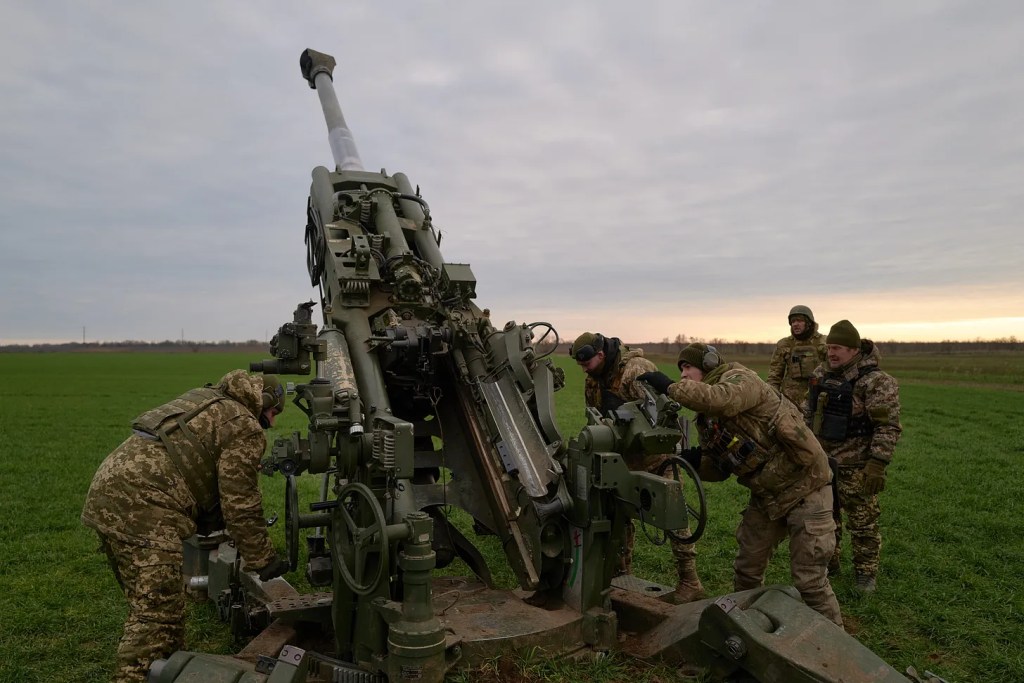
“We are carrying out NATO’s mission,” Ukrainian Defense Minister Oleksii Reznikov said in an interview. “They aren’t shedding their blood. We’re shedding ours. That’s why they’re required to supply us with weapons.” Repeating a rationale offered by his US sponsors in previous wars, including the invasion of Iraq, Reznikov added that Ukraine “is defending the entire civilized world.”

Receiving an endless supply of weapons from NATO countries that shed no blood of their own — all to fulfill their “mission” — is an apt description of Ukraine’s role in the US-led proxy war against Russia. And as one of its staunchest champions, Sen. Lindsey Graham, cheerfully predicted in July, that mission is using Ukraine to “fight to the last person.”

For Ukraine, the costs of fulfilling NATO’s mission are spelled out by former US cabinet secretaries Condoleezza Rice and Robert Gates. Today, the pair write, Ukraine’s “economy is in a shambles, millions of its people have fled, its infrastructure is being destroyed, and much of its mineral wealth, industrial capacity and considerable agricultural land are under Russian control. Ukraine’s military capability and economy are now dependent almost entirely on lifelines from the West — primarily, the United States.”

Rather than seeing Ukraine’s war-ravaged, Russian-occupied, Western-dependent condition as a reason to seek a negotiated end, Rice and Gates in fact regard diplomacy as an outcome to avoid.

“Absent another major Ukrainian breakthrough and success against Russian forces, Western pressures on Ukraine to negotiate a cease-fire will grow as months of military stalemate pass,” they warn. This result would be “unacceptable”, Rice and Gates conclude, because “any negotiated cease-fire would leave Russian forces in a strong position to resume their invasion whenever they are ready.” That is one possibility. Another possibility, unmentioned by the authors, is that a negotiated cease-fire leads to a permanent one. This would entail finally addressing the grievances of Ukraine’s ethnic Russian population – the proximate cause of the post-2014 Donbas war that preceded Russia’s invasion — as well as addressing Russia’s longstanding security concerns about NATO expansion and advanced weaponry on its borders.

On the latter issue, the Kremlin is far from the only advocate. “One of the essential points we must address — as President Putin has always said — is the fear that NATO comes right up to its doors, and the deployment of weapons that could threaten Russia,” French President Emmanuel Macron said last month.

Macron’s comments “appeared to go beyond anything the United States has offered” Russia, the New York Times noted. Unstated by the Times is why such an offer has yet to materialize: as defined by multiple senior US officials right up to President Biden, “NATO’s mission” is not to defend Ukraine, but to use it as a proxy to “weaken” or even cause regime change in neighboring Russia.

Accordingly, the prospect of a negotiated cease-fire must be negated. The US and its allies, Rice and Gates argue, must “urgently provide Ukraine with a dramatic increase in military supplies and capability.” A failure to do so, they warn, could lead to a scenario where “more is demanded of the United States and NATO.” For now, this can thankfully be avoided, because the US enjoys “a determined partner in Ukraine that is willing to bear the consequences of war so that we do not have to do so ourselves in the future.” For proxy warriors, there is indeed no better “partner” than one “willing to bear the consequences of war” fueled from afar.

As a gage of their commitment to Ukraine’s sovereignty and well-being, consider the merits of Rice and Gates’ attempts to appeal to international law. The US, they write, “has learned the hard way — in 1914, 1941 and 2001 — that unprovoked aggression and attacks on the rule of law and the international order cannot be ignored.” Apparently, the US did not learn the same lesson from invading dozens of countries since 1914 – including under the Bush administration, where the authors played instrumental roles in multiple acts of unprovoked aggression, such as the invasion of Iraq. Gates, who carried on as Defense Secretary under President Obama, continued this legacy by overseeing the US bombing campaign that helped topple Libya’s government.

Predictably, Ukrainian soldiers that “bear the consequences of war” are facing heavy losses. Speaking to Newsweek, retired U.S. Marine Corps Colonel Andrew Milburn, who has trained and led Ukrainian forces for the private mercenary firm Mozart Group, reports that in the battle for Bakhmut, Ukraine has been “taking extraordinarily high casualties. The numbers you are reading in the media about 70 percent and above casualties being routine are not exaggerated.”

Ukraine is now “taking high casualties on the Bakhmut-Soledar front, quickly depleting the strength of several brigades sent there as reinforcements in the past month,” the Wall Street Journal reports. “Western—and some Ukrainian—officials, soldiers and analysts increasingly worry that Kyiv has allowed itself to be sucked into the battle for Bakhmut on Russian terms, losing the forces it needs for a planned spring offensive as it stubbornly clings to a town of limited strategic relevance.” According to one battlefield Ukrainian commander, “the exchange rate of trading our lives for theirs favors the Russians. If this goes on like this, we could run out.”

The prevailing indifference to Ukraine’s death toll was recently underscored when Ursula von der Leyen, the European Commission president, made the mistake of acknowledging it. In a speech, von der Leyen noted that Ukraine has lost 20,000 civilians and 100,000 troops since Russia’s February invasion. The Ukrainian military responded by complaining that this was “classified information,” prompting von der Leyen’s office to edit out the figure from video of her remarks.

Meanwhile, the prevailing rejection of diplomacy has even led one of its staunchest European advocates to effectively renounce it. In an interview with Germany’s Die Zeit, former German Chancellor Angela Merkel claimed that the 2015 Minsk II accords – the internationally backed framework for ending the post-2014 Donbas civil war, premised on granting limited autonomy to Russia-allied eastern Ukrainians – was a ruse.

Minsk, Merkel explained, “was an attempt to give Ukraine time.” And it did so successfully: Ukraine “used this time to get stronger, as you can see today. The Ukraine of 2014/15 is not the Ukraine of today… And I very much doubt that the NATO countries could have done as much then as they do now to help Ukraine.”

Merkel, whose government helped broker Minsk, was one of the few NATO leaders to develop a cooperative relationship with Russian President Vladimir Putin. Her comments follow a similar admission from the Ukrainian leader who signed Minsk, Petro Porosenko. “We had achieved everything we wanted,” Poroshenko said in May 2022. “Our goal was to, first, stop the threat, or at least to delay the war – to secure eight years to restore economic growth and create powerful armed forces.” (emphasis added)

The claim by Merkel that Minsk was not intended to make peace, but “to give Ukraine” time to “get stronger” for war has been greeted by Putin and his supporters as confirmation that NATO cannot be trusted to uphold its agreements. (A takeaway newly bolstered by Joe Biden’s recent admission that, despite his campaign promises, the Iran nuclear deal is “dead”).

An alternative explanation is that Merkel is disingenuously attempting to appease pro-war hawks in Germany and beyond, as Moon of Alabama argues. Nicolai Petro, author of the indispensable new book “The Tragedy of Ukraine,” concurs with that interpretation, as he told me in a recent interview. The German and France-brokered Minsk process, Petro argues, were “good faith efforts to bring the hostilities to an end, at least to accomplish a ceasefire from which then further negotiations could be pursued.” The main obstacle, in Petro’s view, came from Ukraine’s far-right Ukrainian nationalists and their allies in Washington, “who basically dismissed the Minsk accords as a non-starter,” and unrealistically sought Ukraine’s complete recapture not only of the Donbas but Crimea as well.

Whether Merkel was being sincere or not, her comments reflect the fact that the aims of the Ukrainian far-right and their DC allies now dominate the NATO states, with voices for peace marginalized and diplomacy shunned.

And now, nearly one year into Russia’s invasion, the proxy war’s NATO cheerleaders have no interest in stopping the bloodshed, despite the open recognition that their mission is helping destroy the country that they claim to defend.

NATO prolongs the Ukraine proxy war, and global havoc

With diplomacy thwarted, the US and its allies plan for “open-ended” military and economic warfare against Russia, no matter the costs at home and abroad.

(US Dept. of Defense)

By Aaron Maté

Source: Aaron Mate Substack

Russia has announced plans to mobilize an additional 300,000 troops for the war in Ukraine. In his speech unveiling the expanded war effort, Vladimir Putin vowed to achieve his main goal of the “liberation of Donbas,” and issued a thinly veiled nuclear threat in the process. The move comes days ahead of planned referendums in breakaway Ukrainian areas to formalize Russian annexation.

Russia’s escalation ensures that the fighting is entering an even more dangerous phase. While Russia bears legal and moral responsibility for its invasion, recent developments underscore that NATO leaders have shunned opportunities to prevent further catastrophe and chosen instead to fuel it.

Putin’s announcement comes just after the Ukrainian military’s routing of Russian forces from Kharkiv, which relied extensively on US planning, weaponry and intelligence, sparked triumphant declarations that the tide has turned.

According to The Atlantic’s Anne Applebaum, “Americans and Europeans need to prepare for a Ukrainian victory,” one so overwhelming that it may well bring “about the end of Putin’s regime.”

Beyond the chorus of emboldened neoconservatives, Western officials are less sanguine.

“Certainly it’s a military setback” for Russia, a US official said of the Kharkiv retreat to the Washington Post. “I don’t know if I could call it a major strategic loss at this point.” Germany’s defense chief, General Eberhard Zorn, said that while Ukraine “can win back places or individual areas of the frontlines,” overall, its forces can “not push Russia back over a broad front.”

Whether or not it marked a major strategic loss for Russia, the battle in Kharkiv is already a major victory for NATO leaders seeking to prolong their proxy war in Ukraine and economic warfare next door.

Ukraine’s expulsion of Russian forces in the northeast, the New York Times reports, has “amplified voices in the West demanding that more weapons be sent to Ukraine so that it could win.”

“Despite Ukrainian forces’ startling gains in the war against Russia,” the Washington Post adds, “the Biden administration anticipates months of intense fighting with wins and losses for each side, spurring U.S. plans for an open-ended campaign with no prospect for a negotiated end in sight.”

As has been apparent since the Ukraine crisis erupted, US planning for open-ended proxy warfare against Russia has led it to sabotage any prospect of a negotiated end.

The US rejection of diplomacy around Ukraine has been newly substantiated by former White House Russia expert Fiona Hill. Citing “multiple former senior U.S. officials,” Hill reports that in April of this year “Russian and Ukrainian negotiators appeared to have tentatively agreed on the outlines of a negotiated interim settlement.” Under this framework, Russia would withdraw to its pre-invasion position, while Ukraine would pledge not to join NATO “and instead receive security guarantees from a number of countries.”

In confirming that US officials were aware of this tentative agreement, Hill bolsters previous news that Washington’s junior partner in London was enlisted to thwart it. As Ukrainian media reported, citing sources close to Ukrainian President Volodymyr Zelensky, UK Prime Minister Boris Johnson traveled to Kiev in April and relayed the message that Russia “should be pressured, not negotiated with.” Johnson also informed Zelensky that “even if Ukraine is ready to sign some agreements on [security] guarantees with Putin,” his Western patrons “are not.” The talks promptly collapsed.

In his speech announcing the expanded war effort, Putin invoked this episode. After the invasion began, he said, Ukrainian officials “reacted very positively to our proposals… After certain compromises were reached, Kyiv was actually given a direct order to disrupt all agreements.”

Having undermined the prospect of a negotiated peace in the war’s early weeks, proxy warriors in Washington are openly celebrating their success.

“I like the structural path we’re on here,” Republican Senator Lindsey Graham recently declared. “As long as we help Ukraine with the weapons they need and the economic support, they will fight to the last person.”

Graham’s avowed willingness to expend every “last person” in Ukraine to fight Russia is in line with a broader US strategy that views the entire world as subordinate to its war aims. As the Washington Post reported in June, the White House is willing to “countenance even a global recession and mounting hunger” in order to hand Russia a costly defeat. In Ukraine, this now means also countenancing the threat of nuclear disaster, as the crisis surrounding the Zaporizhzhia nuclear power plant has laid bare.

The prevailing willingness to sacrifice civilian well-being extends to the US public, as National Security Advisor Jake Sullivan has newly made clear. Appearing at the Aspen Security Conference, Sullivan was asked if he is worried about the “American people’s staying power” on the Ukraine proxy war, amid “criticism that we’re spending billions and billions to support Ukraine, and not spending it here.”

 “Fundamentally not,” Sullivan responded. “It’s very important for Putin to understand what exactly he’s up against from the point of view of the United States’ staying power.” That staying power, Sullivan explained, was cemented in the $40 billion war funding measure overwhelmingly approved by Congress (including every self-identified progressive Democrat) in May.

“That can go on, just on the basis of what we have already had allocated to us and resources for a considerable period of time,” Sullivan vowed. “And then, I strongly believe that there will be bipartisan support in the Congress to re-up those resources should it become necessary.”

To policymakers like Sullivan, there is not only an endless pool of money to “re-up” the war, but a “fundamentally” indifferent posture toward the taxpayers footing the bill.

Despite Biden’s reported scolding of Defense Secretary Lloyd Austin for admitting that the US goal in Ukraine is to leave Russia “weakened,” Sullivan – speaking before a friendly Beltway crowd — also forgot to stick to the script.

The US “strategic objective” in Ukraine, Sullivan explained, is to “ensure that Russia’s invasion of Ukraine… is a strategic failure for Putin,” and that “Russia pay a longer-term price in terms of the elements of its national power.” This would teach a “lesson,” he added, “to would-be aggressors elsewhere.”

By “would-be aggressors elsewhere”, Sullivan naturally precludes the US and its allies, whose aggression is not only permitted but promoted under the US-led “rules-based international order.”

President Biden has made that clear by abandoning his pledge to make Saudi Arabia a “pariah” state, notwithstanding its murderous (US-backed) aggression in Yemen. The regular aggression by US ally Israel against Gaza and Syria also continues unabated. The United Nations just reported that an Israeli strike on the Damascus international airport in June – one of hundreds of Israeli bombings on Syria that go largely ignored — “led to considerable damage to infrastructure” and “meant the suspension of U.N. deliveries of humanitarian assistance” to Syrians in need for nearly two weeks. As of this writing, the latest Israeli strike killed five Syrian soldiers, eliciting no Western media and political protest. It is more accurate to describe Israeli aggression on Syria as a joint Israeli-US effort, given that the US reviews and approves the strikes.

Allied NATO leaders are also vocally countenancing the Ukraine proxy war’s costs on their domestic populations. In response to the European sanctions, Russia has now halted gas deliveries to the EU via the key Nord Stream 1 pipeline. Having previously relied on Russia for close to 40 percent of its gas needs, European industries are facing layoffs, factory closures, and higher energy bills that “are pushing consumers to near poverty,” the Financial Times reports.

“People want to end the war because they cannot bear the consequences, the costs,” the EU’s Josep Borell observed this month. While ending the war might appeal to some, it does not interest the EU’s top diplomat. “This mentality must be overcome,” Borell declared. “The offensive on the northeastern front helps with that.”

Europe, NATO chief Jens Stoltenberg recently wrote, may even face “civil unrest,” as economies contract and temperatures drop, but “for Ukraine’s future and for ours, we must prepare for the winter war and stay the course.”

“No matter what my German voters think, I want to deliver to the people of Ukraine,” Germany’s Foreign Minister Annalena Baerbock told a conference in Prague last month. During the upcoming winter, Baerbock acknowledged, “we will be challenged as democratic politicians. People will go in the street and say ‘We cannot pay our energy prices’.” While pledging to help people “with social measures,” Baerbock insisted that the European Union’s sanctions on Russia will remain. “The sanctions will stay also in wintertime, even if it gets really tough for politicians,” she said.

Whereas Western leaders appear confident they can manage civil unrest at home, they face additional resistance abroad. In Africa, a leaked report from the European Union’s envoy to the continent warns that African nations are blaming the EU’s Russia sanctions for food shortages. The report also cautions that “the EU is seen as fueling the conflict,” in Ukraine, “not as a peace facilitator.”

Rather than address these African concerns, the envoy’s office proposes a “more transactional… approach” in which the EU makes “clear” that its “willingness” to “maintain higher levels” of foreign aid “will depend on working based on common values and a joint vision,” – in short, on Africa falling in line.

That is undoubtedly the US policy, as UN Ambassador Linda Thomas-Greenfield made clear last month. After promising a “listening tour,” Thomas-Greenfield instead came to Africa with a dictate and an outright threat. “Countries can buy Russian agricultural products, including fertilizer and wheat,” she decreed. But “if a country decides to engage with Russia” and break US sanctions, “they stand the chance of having actions taken against them.” That Africa faces a food security crisis, with hundreds of millions going hungry, is apparently of lower importance.

While Western sanctions on Russia wreak havoc worldwide, the architects in Washington seem only perturbed by their failure, so far, to inflict the intended levels of suffering on Russian civilians. “We were expecting” that US sanctions “would totally crater the Russian economy” by now, a disappointed senior US official told CNN.

Other US officials are leaving room for hope. “There’s going to be long-term damage done to the Russian economy and to generations of Russians as a result of this,” CIA Director William Burns told a cybersecurity conference this month. Burns’ long-term forecast of harming “generations of Russians” is based on extensive planning. As one US official explained it to CNN, when the sanctions were designed, Biden officials not only “wanted to keep pressure on Russia over the long term as it waged war on Ukraine,” but also “wanted to degrade Russia’s economic and industrial capabilities.” Accordingly, “we’ve always seen this as a long-term game.”

The “long-term game” of trying to destroy Russia’s economy and immiserate “generations” of its citizens is accompanied by increasing plans for a long-term fight. The Biden administration plans to formally name the US military mission in Ukraine – such as in prior campaigns like Operation Desert Storm — while also appointing a general to oversee the effort. The naming, the Wall Street Journal observes, is “significant bureaucratically, as it typically entails long-term, dedicated funding.”

The US plan for a long-term military and economic campaign against Russia is being implemented despite the awareness that Ukraine could face far worse.

“Some American officials express concern that the most dangerous moments are yet to come,” the New York Times reports. To date, “Putin has avoided escalating the war in ways that have, at times, baffled Western officials.” Unlike US military campaigns in Iraq, Russia “has made only limited attempts to destroy critical infrastructure or to target Ukrainian government buildings.”

“The current moment draws attention to a tension that underlies America’s strategy for the war,” the Washington Post observes, “as officials channel massive military support to Ukraine, fueling a war with global consequences, while attempting to remain agnostic about when and how Kyiv might strike a deal to end it.”

These rare admissions not only contradict the typical portrayal of a genocidal Russia that is used to justify the proxy war, but capture the underlying policy driving it. More than six months in, US officials are aware that Russia has “avoided escalating the war” and targeting “critical infrastructure,” – to the point where these same officials are “baffled” by Russian restraint. Despite this, their policy centers on “fueling” this same war, while remaining “agnostic” about ending it.

War being fluid – and US-led military support for Ukraine ever-expanding – it is of course possible that Ukraine will continue to defy expectations and drive out the invading Russian forces.

What the latest developments on and off the battlefield make undoubtedly clear is that NATO states are willing to use Ukraine for as long as it takes to achieve the stated aim of leaving Russia “weakened” or even achieving regime change, no matter the damage knowingly inflicted on Ukrainians, Russians, the Global South, and their own citizens.

Endless War Has Been Normalized And Everyone Is Crazy

By Caitlin Johnstone

Source: CaitlinJohnstone.com

Since I last wrote about the bipartisan shrieking, hysterical reaction to Trump’s planned military withdrawal from Syria the other day, it hasn’t gotten better, it’s gotten worse. I’m having a hard time even picking out individual bits of the collective freakout from the political/media class to point at, because doing so would diminish the frenetic white noise of the paranoid, conspiratorial, fearmongering establishment reaction to the possibility of a few thousands troops being pulled back from a territory they were illegally occupying.

Endless war and military expansionism has become so normalized in establishment thought that even a slight scale-down is treated as something abnormal and shocking. The talking heads of the corporate state media had been almost entirely ignoring the buildup of US troops in Syria and the operations they’ve been carrying out there, but as soon as the possibility of those troops leaving emerged, all the alarm bells started ringing. Endless war was considered so normal that nobody ever talked about it, then Trump tweeted he’s bringing the troops home, and now every armchair liberal in America who had no idea what a Kurd was until five minutes ago is suddenly an expert on Erdoğan and the YPG. Lindsey Graham, who has never met an unaccountable US military occupation he didn’t like, is now suddenly cheerleading for congressional oversight: not for sending troops into wars, but for pulling them out.

“I would urge my colleagues in the Senate and the House, call people from the administration and explain this policy,” Graham recently told reporters on Capitol Hill. “This is the role of the Congress, to make administrations explain their policy, not in a tweet, but before Congress answering questions.”

“It is imperative Congress hold hearings on withdrawal decision in Syria — and potentially Afghanistan — to understand implications to our national security,” Graham tweeted today.

In an even marginally sane world, the fact that a nation’s armed forces are engaged in daily military violence would be cause for shock and alarm, and pulling those forces out of that situation would be viewed as a return to normalcy. Instead we are seeing the exact opposite. In an even marginally sane world, congressional oversight would be required to send the US military to invade countries and commit acts of war, because that act, not withdrawing them, is what’s abnormal. Instead we are seeing the exact opposite.

A hypothetical space alien observing our civilization for the first time would conclude that we are insane, and that hypothetical space alien would be absolutely correct. Have some Reese’s Pieces, hypothetical space alien.

It is absolutely bat shit crazy that we feel normal about the most powerful military force in the history of civilization running around the world invading and occupying and bombing and killing, yet are made to feel weird about the possibility of any part of that ending. It is absolutely bat shit crazy that endless war is normalized while the possibility of peace and respecting national sovereignty to any extent is aggressively abnormalized. In a sane world the exact opposite would be true, but in our world this self-evident fact has been obscured. In a sane world anyone who tried to convince you that war is normal would be rejected and shunned, but in our world those people make six million dollars a year reading from a teleprompter on MSNBC.

How did this happen to us? How did we get so crazy and confused?

I sometimes hear the analogy of sleepwalking used; people are sleepwalking through life, so they believe the things the TV tells them to believe, and this turns them into a bunch of mindless zombies marching to the beat of CIA/CNN narratives and consenting to unlimited military bloodbaths around the world. I don’t think this is necessarily a useful way of thinking about our situation and our fellow citizens. I think a much more useful way of looking at our plight is to retrace our steps and think about how everyone got to where they’re at as individuals.

We come into this world screaming and clueless, and it doesn’t generally get much better from there. We look around and we see a bunch of grownups moving confidently around us, and they sure look like they know what’s going on. So we listen real attentively to what they’re telling us about our world and how it works, not realizing that they’re just repeating the same things grownups told them when they were little, and not realizing that if any of those grownups were really honest with themselves they’re just moving learned concepts around inside a headspace that’s just as clueless about life’s big questions as the day it was born.

And that’s just early childhood. Once you move out of that and start learning about politics, philosophy, religion etc as you get bigger, you run into a whole bunch of clever faces who’ve figured out how to use your cluelessness about life to their advantage. You stumble toward adulthood without knowing what’s going on, and then confident-sounding people show up and say “Oh hey I know what’s going on. Follow me.” And before you know it you’re donating ten percent of your income to some church, addicted to drugs, in an abusive relationship, building your life around ideas from old books which were promoted by dead kings to the advantage of the powerful, or getting your information about the world from Fox News.

For most people life is like stumbling around in a dark room you have no idea how you got into, without even knowing what you’re looking for. Then as you’re reaching around in the darkness your hand is grasped by someone else’s hand, and it says in a confident-sounding voice, “I know where to go. Come with me.” The owner of the other hand doesn’t know any more about the room than you do really, they just know how to feign confidence. And it just so happens that most of those hands in the darkness are actually leading you in the service of the powerful.

That’s all mainstream narratives are: hands reaching out in the darkness of a confusing world, speaking in confident-sounding voices and guiding you in a direction which benefits the powerful. The largest voices belong to the rich and the powerful, which means those are the hands you’re most likely to encounter when stumbling around in the darkness. You go to school which is designed to indoctrinate you into mainstream narratives, you consume media which is designed to do the same, and most people find themselves led from hand to hand in this way all the way to the grave.

That’s really all everyone’s doing here, reaching out in the darkness of a confusing world and trying to find our way to the truth. It’s messy as hell and there are so many confident-sounding voices calling out to us giving us false directions about where to go, and lots of people get lost to the grabbing hands of power-serving narratives. But the more of us who learn to see through the dominant narratives and discover the underlying truths, the more hands there are to guide others away from the interests of the powerful and toward a sane society. A society in which people abhor war and embrace peace, in which people collaborate with each other and their environment, in which people overcome the challenges facing our species and create a beautiful world together.

People aren’t sleepwalking, they are being duped. Duped into insanity in a confusing, abrasive world where it’s hard enough just to get your legs underneath you and figure out which way’s up, let alone come to a conscious truth-based understanding of what’s really going on in the world. But the people doing the duping are having a hard time holding onto everyone’s hand, and their grip is slipping. We’ll find our way out of this dark room yet.