I just finished watching the much-acclaimed series “Narcos” on Netflix. What a fantastic program. And what an excellent depiction of the futility and corruption of the war on drugs.
The series is a true-life account of Pablo Escobar, a Colombian drug lord who headed up the Medellin drug cartel, a black-market drug group that smuggled hundreds of tons of cocaine into the United States in the 1970s and 1980s. Smuggling an estimated 80 percent of the cocaine into the United States, Escobar became known as called the “King of Cocaine,” attaining in the process a net worth of $30 billion by the early 1990s. According to Wikipedia, Escobar was the wealthiest criminal in history.
Amidst much acclaim and publicity, the U.S. government and the Colombian government, working together, targeted Escobar with arrest or killing. Escobar retaliated by effectively declaring war on the government, a war that consisted of assassinations and bombings. Every time the DEA (which was operating in Colombia, along with the U.S. military and the CIA) and Colombian officials tightened the noose on Escobar’s operation, Escobar responded with bullets and bombs, killing a multitude of government officials and private citizens.
The logic of the drug-war crackdown was clear: By eradicating Escobar, officials thought they would be eradicating 80 percent of the cocaine being shipped into the United States. So, all the death and destruction resulting from the crackdown on Escobar was considered worth it in the long run.
But that’s not what happened. The more they tightened the noose around Escobar, the more his cocaine competitors—that is, the ones who were supplying the 20 percent, expanded their operations, gaining them a larger market share. Among the principal beneficiaries of the crackdown on Escobar was the Cali Cartel, which, not surprisingly, became the next big target of the U.S. and Colombian drug warriors, with similar results—the more they cracked down on the Cali Cartel, the more their competitors stepped into the breach and gained a larger market share.
In 1993, they finally caught up to Escobar and killed him in a shootout. You can imagine how U.S. and Colombian officials trumpeted that drug-war victory. Another “milestone” in the war on drugs, the term they have used for decades whenever they kill or capture some big drug lord.
But of course it was all to no avail. Even though they killed Escobar and ultimately smashed the Medellin and Cali cartels, amidst great fanfare and publicity, other suppliers quickly took their places and continued providing cocaine users in the United States with their drug.
In other words, all those people who lost their lives in the drug war on Escobar died for nothing. Absolutely nothing.
There is something else to consider: what the drug war against Escobar did to law-enforcement agents, both American and Colombian. It corrupted them to the core. Frustrated over all the death and destruction that Escobar was wreaking across the country and over their inability to apprehend him, officials began employing brutal and illegal tactics in return, such as torturing prisoners for information and then murdering them so that they couldn’t talk about what the officials had done to them.
Of course, there was also widespread bribery that was taking place within the Colombian police. In fact, that was one of the reasons they had such a hard time catching up to Escobar—his informants within the police and Colombian military would alert him to whatever was going on.
The pathetic thing about all this death, destruction, mayhem, and corruption is that there was a much simpler way to have put Escobar, the Cali Cartel, and all the other black-market drug suppliers out of business, a way that would not have involved assassinations, bombings, torture, and corruption. All that the U.S. and Colombian governments had to do was legalize drugs.
If they had done that, Escobar and the rest of the black-market suppliers would have been put out of business instantaneously. That’s because of the difference between legal markets and black markets.
In legal markets, suppliers compete against each other by providing better goods and services to their customers. Think CVS, Walgreen, and other pharmacies. Notice that they are not out bombing and assassinating each other and other people.
It’s totally different in black or illegal markets. Competitors in these markets deal with each other through violent turf wars that involve murder, kidnapping, bombing, and mayhem. While people like Escobar are able to thrive in a black market, they inevitably go out of business in a legal market because they lack the skills that are necessary in legal markets.
A good example of this phenomenon is alcohol. We don’t see alcohol dealers killing each other to get a larger share of the market. That’s because booze is legal.
But it wasn’t that way when booze was illegal. During Prohibition, there were people like Al Capone involved in the sale and distribution of alcohol, along with killing, mayhem, and corruption.
This same principle, of course, applies today. Notwithstanding all the hoopla to which all of us are subjected when the feds or state drug warriors make a drug bust, the result is no different than it was 20–30 years ago with Escobar. The minute they make the bust, the supplier is replaced by someone else.
There is only one way to eradicate drug lords and illicit drug dealers, along with all the death, destruction, and corruption that comes with them: End the war on drugs by legalizing drugs.
Jacob G. Hornberger is founder and president of The Future of Freedom Foundation.
On Monday, protesters — reacting to the violence in Charlottesville over the weekend — brought a ladder and some rope to North Carolina and tore down a near century old statue of a Confederate soldier. Unsurprisingly, nothing changed. However, the Durham Police Department and the Durham County Sheriff’s Office announced that they will be seeking criminal charges for those involved in the destruction of the statue.
Watching people wage violence against their fellow human in the name of protecting or tearing down some arbitrary government artifact is as disheartening as it is frustrating. The future cannot be changed by attempting to erase the past.
A statue holds no magical power to make people racists. If anything, the monuments to former racists serve as reminders that the state can and always will be open to the influence of bigotry — and only the state has the power to enforce racism.
An ignorant racist is exactly that — however, if society grants that ignorant racist a political position or a badge and a gun, this ignorant racist now has power over you. Removing or keeping a piece of concrete will never change this.
Jim Crow laws weren’t overturned because people went around town tearing down statues.
Racist government laws were brought to an end because people refused to obey them. Had Rosa Parks used her time and energy lobbying to take down a statue instead of disobeying a racist law, rest assured Browder v. Gayle, which ruled that segregated buses were unconstitutional, would’ve never happened.
Had the Civil Rights Movement in the 1950s not organized the Montgomery Bus Boycott, rest assured, desegregation would’ve taken much longer.
Society has the amazing ability to force positive change through nonviolent and nondestructive means. However, all too often, we let emotions rule our thoughts and take to yelling and fighting in the streets and destroying property. This only serves to create more divide and empower the ranks of the racists.
If we really want to put the brakes on a racist system, fighting with other citizens (even if they are devout racists) will never work.
Boycotts, refusal of service, shaming, exposing — these are the tools we as citizens have against other citizens who are spreading hate and racism.
One amazing private solution to racism actually just happened on Tuesday in Washington. Richard Spencer, the ostensible leader of the white supremacists, was forced to hold his press conference in his own house because businesses refused to allow him to rent their hotels. This campaign of public shaming and refusal of service is far more effective than tearing down a statue or attempting to use the government to ban hate speech.
But what do we do when the state is perpetuating a racist system and prolonging the suffering of minorities? Again, the answer to that question is not to tear down a statue, but to realize where the power of this racism rests.
In America, the area of government that is most responsible for maintaining a racist system, allowing racist actors to oppress their targets with impunity, and perpetuating the suffering and plight of millions through the persecution of morally innocent individuals — is the war on drugs.
The drug war, from the police departments to the court systems, unequivocally targets and punishes minorities harder for the same victimless crimes for which their white counterparts receive slaps on the wrist.
As TFTP reported last year, a scathing report in Harper’s Magazine, written by Dan Baum set the record straight and relieved all doubt over the intentions of the drug war. John Daniel Ehrlichman, counsel and domestic policy chief to President Richard Nixon, came clean on the real reason behind the war on drugs — to criminalize blacks and hippies.
According to Baum, he tracked down Ehrlichman in 1994 at his engineering firm in Atlanta, Georgia.
“You want to know what this was really all about?” Ehrlichman bluntly asked Baum of the war on drugs. “The Nixon campaign in 1968, and the Nixon White House after that, had two enemies: the antiwar left and black people. You understand what I’m saying? We knew we couldn’t make it illegal to be either against the war or black, but by getting the public to associate the hippies with marijuana and blacks with heroin, and then criminalizing both heavily, we could disrupt those communities. We could arrest their leaders, raid their homes, break up their meetings, and vilify them night after night on the evening news. Did we know we were lying about the drugs? Of course we did.”
To this day, the racist intentions behind the war on drugs serve to further oppress black communities. The war on drugs is still creating criminals out of otherwise innocent individuals who’re caught in possession of arbitrary substances, removing their opportunity for employment by giving them criminal records, and guaranteeing a difficult future within the working class.
It is no coincidence that the ACLU refers to the drug war as the new Jim Crow.
The war on drugs subjects the United States to much of the same harm, with much of the same economic and ideological underpinnings, as slavery itself. Just as Jim Crow responded to emancipation by rolling back many of the newly gained rights of African-Americans, the drug war is again replicating the institutions and repressions of the plantation. And like slavery and Jim Crow, the drug war garners appalling levels of support. Each has its own rhetoric, each its own claims to unassailable legitimacy. The brutality of slavery was justified on economic and paternalistic grounds. Jim Crow pretended that separate but equal treatment sufficed, even as blacks faced daily lynchings and every form of overt discrimination. The drug war claims morality and protection of children as its goals, while turning a blind eye to the racial injustice it promotes. And with all three systems of oppression, much of society sits idly by, accepting the rhetoric that later will seem so unbelievably corrupt. We will one day understand that the war on drugs was a war on people and communities.
If we really want to deal a blow to this racist system we must strike the root. The drug war is one such root. Until we eliminate the cause of this strife, tearing down all the statues in the world will do nothing. Until we realize that we are financing our own oppression and refuse to support the government programs that keep us in the days of Jim Crow, the tyranny will remain.
It is high time we realize this real solution to this real problem before the entire country is so divided that we enter a new American civil war.
As more and more people drop prescription drugs for medical cannabis, reports like this explain why Big Pharma is scrambling to keep prohibition in place. It also explains why the DEA has such close ties to the pharmaceutical industry.
The question of why cannabis remains illegal becomes more unavoidable by the day, as scientific evidence mounts for its medicinal powers and states continue to decriminalize the plant. The legal drugs of alcohol and nicotine kill hundreds of thousands every year and have little to no medical value – but the ingestion of cannabis kills no one, and heals many.
The war on drugs itself is an utter failure by the metrics it was supposed to address – drug availability, drug prices and drug use. With the absence of any rational basis for prohibition, it begs the question of what actually sustains it.
We know the State profits immensely from the drug war, acquiring wealth and power by arbitrarily naming certain substances “illicit.” In the modern-day corporatocracy, certain industries profit as well, most notably prisons and various entities involved in State oppression.
In the area of cannabis, perhaps the biggest beneficiary to prohibition is the pharmaceutical industry. Big Pharma tried and mostly failed to defeat the groundswell movement of cannabis legalization in many states. But it seems to have a friend in the federal Drug Enforcement Administration (DEA), which against all reason decided to keep cannabis a Schedule 1 Controlled Substance.
Big Pharma admitted that legal cannabis poses a threat to its profit, and that reality is underscored in a new analysis from New Frontier Data. If medical cannabis were adopted in all 50 states, it would siphon about $4.5 billion a year from the pharma industry.
“New Frontier Data identified nine conditions in particular to assess the impact of the legalization of cannabis would have on prescription drug use.
Among those, spending on treatments for chronic pain and post-traumatic stress disorder (PTSD) represented about 60% of the total. Overall in 2016, it was estimated that patients spent nearly $14.3 billion and $10.6 billion, respectively, to treat chronic pain and PTSD. The costs to treat sleep disorders, anxiety, epilepsy, nerve pain, chemotherapy-induced nausea and vomiting (CINV), Tourette syndrome, and glaucoma collectively accounted for the other 40% dedicated toward treatments.
There is significant savings to be realized in the health care system both to consumers and the U.S. government. It is estimated that cannabis and related products can replace between $4.4 billion and $4.9 billion of current annual spending on those existing treatments.”
In a press release, New Frontier CEO Aguirre De Carcer said, “Looking at these numbers, it would appear that medical cannabis would be a drop in the bucket when it comes to impacting the total pharmaceutical industry. However, when you start to break down the numbers by specific sectors of the industry, like chronic pain or symptoms associated with chemotherapy, which are very lucrative markets for pharmaceutical companies, you will certainly see cannabis have a major impact.”
They referenced a July 2016 study which found that, on average, about 11 percent of patients in legal weed states are successfully replacing prescription drugs with medical cannabis. This, along with other studies, prompted New Frontier Data to look further into the dynamic of medical cannabis and pharmaceutical drugs.
A National Academies of Science study identified nine specific conditions where medical cannabis can have a beneficial role – including chronic pain and post-traumatic stress disorder (PTSD) – which were used by New Frontier Data for their analysis. Another report showed that taxpayers could save $1.1 billion on Medicaid prescriptions annually if medical cannabis were legalized nationwide.
“Any opportunity for alternatives that could result in reduced pharmaceutical drug use might present a compelling point of discussion from a public policy standpoint,” said John Kagia, executive vice president of industry analytics at New Frontier.
The problem is, public policy is largely controlled by interests that have no desire to reduce profits by reducing prescription drug consumption, and have no desire to relinquish power by decriminalizing a medicinal plant that harms no one.
Judging by DEA chief Chuck Rosenberg, his agency will continue taking the lead in government’s war on people. Only a few days ago Rosenberg reminded us of the staggering, willful ignorance that guides the drug war, stating, “Marijuana is not medicine.”
We are told that the “War on Drugs” is being waged, on our behalf, by our governments and their armed bureaucracies and police forces, to save us from ourselves. “Potential for abuse and harm” are supposed to be the criteria by which the use of drugs is suppressed—the greater a drug’s potential for abuse and harm, the greater and more vigorous the degree of suppression, and the more draconian the penalties applied against its users.
In line with this scheme drugs are typically ranked into a hierarchy: Schedules I, II, and III in the US, Classes A, B, and C in the UK, and so on and so forth all around the world. Thus, to be arrested for possession of a Schedule I or Class A drug results in heavier penalties than possession of a Schedule III or Class C drug. Generally if a drug is deemed to have some currently accepted medical use it is likely to be placed in a lower schedule than if it has none, notwithstanding the fact that it may have potential for abuse or harm. In the absence of any recognized therapeutic effects, drugs that are highly addictive, such as heroin or crack cocaine, or drugs that are profoundly psychotropic, including hallucinogens such as LSD, psilocybin, or DMT, are almost universally placed in the highest schedules and their use attracts the heaviest penalties.
The notable exceptions to this system of ranking according to perceived “harms” are, of course, alcohol and tobacco, both highly addictive and harmful drugs—far more so than cannabis or psilocybin, for example—but yet socially accepted on the grounds of long customary use and thus not placed in any schedule at all.
The Failed War
When we look at the history of the “War on Drugs” over approximately the last 40 years, it must be asked whether the criminalization of the use of any of the prohibited substances has in any way been effective in terms of the stated goals that this “war” was supposedly mounted to achieve. Specifically, has there been a marked reduction in the use of illegal drugs over the past 40 years—as one would expect with billions of dollars of taxpayers’ money having been spent over such a long period on their suppression—and has there been a reduction in the harms that these drugs supposedly cause to the individual and to society?
It is unnecessary here to set down screeds of statistics, facts, and figures readily available from published sources to assert that in terms of its own stated objectives the “War on Drugs” has been an abject failure and a shameful and scandalous waste of public money. Indeed, it is well known, and not disputed, that the very societies that attempt most vigorously to suppress various drugs, and in which users are subject to the most stringent penalties, have seen a vast and continuous increase in the per capita consumption of these drugs. This is tacitly admitted by the vast armed bureaucracies set up to persecute drug users in our societies, which every year demand more and more public money to fund their suppressive activities; if the suppression were working, one would expect their budgets to go down, not up.
Inventory of Harm
Such matters are only the beginning of the long inventory of harm caused by the “War on Drugs.”
Western industrial societies, and all those cultures around the globe that increasingly seek to emulate them, teach us to venerate above all else the alert, problem-solving state of consciousness that is particularly appropriate to the conduct of science, business, war, and logical inquiry, and to such activities as driving cars, operating machinery, performing surgery, doing accounts, drawing up plans, accumulating wealth, etc., etc., etc. But there are many other states of consciousness that the amazing and mysterious human brain is capable of embracing, and it appears to be a natural human urge, as deep-rooted as our urges for food, sex, and nurturing relationships, to seek out and explore such “altered states of consciousness.” A surprisingly wide range of methods and techniques (from breathing exercises, to meditation, to fasting, to hypnosis, to rhythmic music, to extended periods of vigorous dancing, etc.) is available to help us to achieve this goal, but there is no doubt that the consumption of those plants and substances called “drugs” in our societies is amongst the most effective and efficient means available to mankind to explore these profoundly altered states of consciousness.
The result is that people naturally seek out drugs and the temporary alterations in consciousness that they produce. Not all people in every society will do this, perhaps not even a majority, but certainly a very substantial minority—for example the 2 million Britons who are known to take illegal drugs each month3 or those 20 million people in the US who have been arrested for marijuana possession since 1965. And these of course are only the tip of the iceberg of the much larger population of American marijuana users, running into many more tens of millions, who have, by luck or care, not yet fallen foul of the law and are thus not reflected in the arrest statistics.
Needless to say, it is of course exactly the same urge to alter consciousness that also impels even larger numbers of people to use legal (and often extremely harmful) drugs such as alcohol and tobacco—which, though they may not alter consciousness as dramatically as, say, LSD, are nevertheless undoubtedly used and sought out for the limited alterations of consciousness that they do produce.
For the hundreds of millions of people around the world whose need to experience altered states is not and cannot be satisfied by drunken oblivion or the stimulant effects of tobacco, it is therefore completely natural to turn to “drugs”—and, since the “War on Drugs” means that there is no legal source of supply of these substances, the inevitable result is that those who wish to use them must resort to illegal sources of supply.
Herein lies great and enduring harm. For it is obvious, and we may all see the effects everywhere, that the criminalization of drug use has empowered and enriched a vast and truly horrible global criminal underworld by guaranteeing that it is the only source of supply of these drugs. We have, in effect, delivered our youth—the sector within our societies that most strongly feels the need to experience altered states of consciousness— into the hands of the very worst mobsters and sleazeballs on the planet. To buy drugs our sons and daughters have no choice but to approach and associate with violent and greedy criminals. And because the proceeds from illegal drug sales are so enormous, we are all caught up in the inevitable consequences of turf wars and murders amongst the gangs and cartels competing in this blackest of black markets.
Instead the powers that be continue to pursue the same harsh and cruel policies that they have been wedded to from the outset, ever seeking to strengthen and reinforce them rather than to replace them with something better. Indeed the only “change” that the large, armed bureaucracies that enforce these policies has ever sought since the “War on Drugs” began has, year on year, been to demand even more money, even more arms, and even more draconian legislative powers to break into homes, to confiscate property, and to deprive otherwise law-abiding citizens of liberty and wreck their lives. In the process we have seen our once free and upstanding societies— which used to respect individual choice and freedom of conscience above all else—slide remorselessly down the slippery slope that leads to the police state. And all this is being done in our name, with our money, by our own governments, to “save us from ourselves”!
Freedom of Consciousness
What is Western civilization all about? What are its greatest achievements and highest aspirations?
It’s my guess that most people’s replies to these questions would touch—before all the other splendid achievements of science, literature, technology, and the economy—on the nurture and growth of freedom.
Individual freedom.
Including, but not limited to freedom from the unruly power of monarchs, freedom from the unwarranted intrusions of the state and its agents into our personal lives, freedom from the tyranny of the Church and its Inquisition, freedom from hunger and want, freedom from slavery and servitude, freedom of conscience, freedom of religion, freedom of thought and speech, freedom of assembly, freedom to elect our own leaders, freedom to be homosexual—and so on and so forth.
The list of freedoms we enjoy today that were not enjoyed by our ancestors is indeed a long and impressive one. It is therefore exceedingly strange that Western civilization in the twenty- first century enjoys no real freedom of consciousness.
There can be no more intimate and elemental part of the individual than his or her own consciousness. At the deepest level, our consciousness is what we are—to the extent that if we are not sovereign over our own consciousness then we cannot in any meaningful sense be sovereign over anything else either. So it has to be highly significant that, far from encouraging freedom of consciousness, our societies in fact violently deny our right to sovereignty in this intensely personal area, and have effectively outlawed all states of consciousness other than those on a very narrowly defined and officially approved list. The “War on Drugs” has thus unexpectedly succeeded in engineering a stark reversal of the true direction of Western history by empowering faceless bureaucratic authorities to send armed agents to break into our homes, arrest us, throw us into prison, and deprive us of our income and reputation simply because we wish to explore the sometimes radical, though always temporary, alterations in our own consciousness that drugs facilitate.
The reason the anti-marijuana campaigns have failed is that millions of users know from their own direct, long-term experience that marijuana does not do them any great harm and (with reference to the most recent anti-marijuana propaganda) most definitely does not drive them mad.
Other than being against arbitrary rules that the state has imposed on us, personal drug use by adults is not a “crime” in any true moral or ethical sense and usually takes place in the privacy of our own homes, where it cannot possibly do any harm to others. For some it is a simple lifestyle choice. For others, particularly where the hallucinogens such as LSD, psilocybin, and DMT are concerned, it is a means to make contact with alternate realms and parallel dimensions, and perhaps even with the divine. For some, drugs are an aid to creativity and focussed mental effort. For others they are a means to tune out for a while from everyday cares and worries. But in all cases it seems probable that the drive to alter consciousness, from which all drug use stems, has deep genetic roots.
Other adult lifestyle choices with deep genetic roots also used to be violently persecuted by our societies.
A notable example is homosexuality, once punishable by death or long periods of imprisonment, which is now entirely legal between consenting adults—and fully recognized as being none of the state’s business—in all Western cultures. (Although approximately thirteen US states have “anti-sodomy” laws outlawing homosexuality, these statutes have rarely been enforced in recent years, and in 2003 the US Supreme Court invalidated those laws.) The legalization of homosexuality lifted a huge burden of human misery, secretiveness, paranoia, and genuine fear from our societies, and at the same time not a single one of the homophobic lobby’s fire-and-brimstone predictions about the end of Western civilization came true.
Likewise, it was not so long ago that natural seers, mediums, and healers who felt the calling to become “witches” were burned at the stake for “crimes” that we now look back on as harmless eccentricities at worst.
At the deepest level, our consciousness is what we are—to the extent that if we are not sovereign over our own consciousness then we cannot in any meaningful sense be sovereign over anything else either.
Perhaps it will be the same with drugs? Perhaps in a century or two, if we have not destroyed human civilization by then, our descendants will look back with disgust on the barbaric laws of our time that punished a minority so harshly (with imprisonment, financial ruin, and worse) for responsibly, quietly, and in the privacy of their own homes seeking alterations in their own consciousness through the use of drugs. Perhaps we will even end up looking back on the persecution of drug users with the same sense of shame and horror that we now view the persecution of gays and lesbians, the burning of “witches,” and the imposition of slavery on others.
Meanwhile it’s no accident that the “War on Drugs” has been accompanied by an unprecedented expansion of governmental power into the previously inviolable inner sanctum of individual consciousness. On the contrary, it seems to me that the state’s urge to power has all along been the real reason for this “war”—not an honest desire on the part of the authorities to rescue society and the individual from the harms caused by drugs, but the thin of a wedge intended to legitimize increasing bureaucratic control and intervention in almost every other area of our lives as well.
This is the way freedom is hijacked—not all at once, out in the open, but stealthily, little by little, behind closed doors, and with our own agreement. How will we be able to resist when so many of us have already willingly handed over the keys to our own consciousness to the state and accepted without protest that it is OK to be told what we may and may not do, what we may and may not explore, even what we may and may not experience, with this most precious, sapient, unique, and individual part of ourselves?
If we are willing to accept that then we can be persuaded to accept anything.
Back in the 1930s, the arguments to criminalize cannabis were bizarre and openly racist. The anti-pot crusader Harry Anslinger made all sorts of over-the-top claims, such as, “Marihuana is a short cut to the insane asylum. Smoke marihuana cigarettes for a month and what was once your brain will be nothing but a storehouse of horrid specters.”
Nowadays more than 100 million Americans say they’ve smoke pot, millions use cannabis regularly to treat illnesses and it is as legal as alcohol in two U.S. states. However, it remains illegal under federal law largely due to scare tactics ingrained in our society, which date back even prior to Anslinger.
Today, pot legalization opponents try a little harder to sound reasonable, but their claims don’t do much better than Anslinger’s under scrutiny. Recent studies have picked apart the justifications for criminalizing marijuana. Here are five of the most popular arguments against cannabis legalization that are easily undermined by objective data.
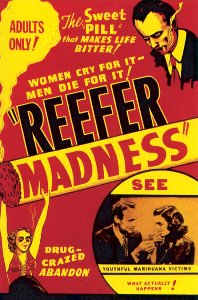
1. Pot leads to crime. If alcohol prohibition taught us anything it’s that prohibition itself leads to crime, not what is prohibited. While cannabis has shaken the psychotic Reefer Madness reputation over the years, the association between weed and crime is still alive and well in certain realms of the media, which are happy to present data without appropriate statistical caveats.
As for the studies that carefully and objectively examine their data, they find no association between cannabis and crime. A recent study in the journal PLOS One found that in states that legalized medical marijuana between 1990 and 2006 the crime rate either remained the same or decreased.
Another study looked at the Lambeth borough of London, which depenalized cannabis for 13 months in 2001-2002. The study found that this actually reduced other types of crime, because Lambeth police could focus their energy elsewhere.
These results fit with common sense. Cannabis has a range of effects on mood and behavior, but they don’t include violence, impulsivity or other traits that would turn otherwise law-abiding citizens into criminals.
2. The gateway theory. The gateway theory has long been the stock response of marijuana opponents to the notion that cannabis itself isn’t that bad for you. They falsely claim it leads to harder stuff, and insist that what starts with a joint ends with a heroin needle.
While it’s true that most users of hard drugs used marijuana and alcohol first, that doesn’t prove that cannabis use leads to harder drugs. Correlation does not equal causality—most heroin users have worn jeans at some point in their lives, but it’s unlikely that one leads to another.
But is it at least plausible that cannabis use creates a bridge to experimenting with more dangerous chemicals? The research says no.
A RAND Institute study using data collected from 1982-1994 found that drug use patterns in American youths can be explained without resorting to a gateway effect. People who are interested in mind-altering substances are likely to have tried pot, as it is the most popular and available illicit drug. This and other circumstantial factors related to drug availability and how old someone was when they first used cannabis were sufficient to explain drug use patterns. Since then, numerous peer-reviewed studies have been published, supporting RAND’s basic conclusions.
Holland provides a good natural experiment in the effects of cannabis use, as marijuana has been legal there for citizens since 1976. A RAND Corporation study from 2011, titled What Can We Learn From The Dutch Coffee Shop Experience? found no causal relationship between using cannabis and harder drugs. In fact, because legalization meant that people went to a coffee shop, not a dealer, to get high, RAND found that legal cannabis likely reduced rates of harder drug use.
3. Cannabis has no medicinal purpose. Even though it has been slain many times over at this point, this idea is worth mentioning because cannabis is still listed as a Schedule I substance by the U.S. government, which implies that the official federal stance is that it has no medical use and is “dangerous.” However, just the opposite is true according to the actual facts. Almost half the states in the U.S. already have some kind of medical marijuana law (20 plus Washington D.C.) and many more are likely to legalize medical marijuana in this year’s elections.
This is all well known and well documented, and yet cannabis remains a Schedule I drug. While it’s hard to find anyone who will still defend this policy, it remains the law of the land, and a major stumbling block on the path to reform.
4. Marijuana is addictive. The addiction claim has been contained over time, but never fully eradicated. Cannabis faces some guilt by association. How could alcohol, tobacco, heroin and cocaine all be clearly addictive and yet weed somehow isn’t?
Furthermore, with words like stoner and pothead in the lexicon, our culture has a firm grasp of the weed-dependent stereotype. When we think of marijuana addiction, an image comes to mind. He (usually a he), smokes pot and eats all day, is smelly and unshaven, watches too much TV and/or plays too many video games, and has a crappy job if he has a job at all. And sure, a lot of people actually do know someone like that, but the research show that, that someone is probably choosing their lifestyle rather than trapped in it by an actual addiction.
Regardless of how the addiction myth has stuck around, it is just that: a myth. The most commonly cited study on cannabis dependence declared that 4% of Americans 15-54 are dependent on cannabis. That’s compared to 24% who are dependent on tobacco and 14% on alcohol. Among users, they found that 9% of cannabis users who try it get hooked, as compared to 32% for tobacco and 15% for alcohol.
So cannabis seems to show some propensity for dependence, but for every dependent user, there are 10 who don’t develop that sort of issue, and this rate is better than that of popular legal drugs.
Furthermore, even the 9% figure is likely inflated. A subject in the oft-cited study was deemed “dependent” if they answered yes to at least three of seven questions. The survey included questions that would take a very different meaning with legal drugs than illegal, such as if “a great deal of time was spent in activities necessary to get the substance, taking the substance, or recovering from its effects.”
This study was conducted in the 1990s, before any state had recognized the medical use of cannabis, and acquiring it regularly involved considerable effort. Because of this, it’s not hard to imagine that users would experience “important social, occupational, or recreational activities given up or reduced because of use,” which was another criterion for dependence. It is quite possible the survey mistook habitual use for dependence in some cases.
We can be sure that cannabis is significantly less habit-forming than alcohol, and especially tobacco, and the degree to which people become dependent is probably overstated.
5. Pot makes users lazy. This idea is the most persistent: we rarely question the cultural belief that getting high saps one’s motivation. If there is any truth to that, it has been difficult to find in studies. What seems to be going on instead is that about 5-6% of the population has “amotivational syndrome,” and there is no significant difference in this between cannabis users and everyone else. One study looked at daily pot smokers and compared them to people who never touch pot. This found no significant difference between the two groups. There was a small difference in “subjective well-being” (how happy the subject says he or she is) favoring non-smokers, but the study authors ascribed much of this to medical conditions some of the subjects were taking cannabis to mitigate.
More than anything, the idea that stoners are lazy seems to be confirmation bias. We shrug off the examples that contradict that notion as special cases and nod sagely when our suspicions are confirmed. Furthermore, we fail to group unmotivated non-users with unmotivated users.
***
As the stigma against cannabis research has disappeared and more good data has been made available, the arguments against legalization have fallen. If cannabis is a plant with legitimate medical uses, does not lead to crime or harder drugs, is not addictive and doesn’t make you lazy, what argument for prohibition remains?
If there are still legitimate reasons to keep cannabis criminalized, let’s talk about them, but if not, let’s cut out a major revenue stream of Mexico’s vicious drug cartels, grant easy access to medicine for people who need it, provide a major boost to our economy, and legalize already.
Owen Poindexter is a freelance writer. See his work at owenpoindexter.com and follow him @owenpoindexter.
Fancy yourself a connoisseur of all things weed? Then see whether this trip from ancient China to modern Alaska takes you anywhere unexpected.
What do Sarah Palin, Barack Obama, Justin Bieber, Maya Angelou and well over 100 million Americans all have in common? They’ve all smoked pot. Throughout its history, marijuana has attracted plenty of unexpected users and proponents. And much of the history of greenery is now familiar to us—thanks to History Channel specials, the burgeoning legalization movement and the popularity of anti-pot propaganda films like Reefer Madness. But even if you’re intimately familiar with the plant in all its forms, we’re willing to wager that some of these facts will surprise you.
1. The first known potheads lived in ancient China, circa 2,727 BC. Emperor Shen Nung helpfully compiled an encyclopedic list of drugs and their uses, which includes “ma,” or cannabis. But ancient Chinese weed consumption is indicated by more than just written records: Six years ago, archaeologists on a dig in the Gobi Desert found the world’s oldest pot stash in the grave of a shaman of the Gushi tribe. The purpose of the cannabis was easily identified because the male plant parts, which are less psychoactive, had been removed.
The Chinese certainly weren’t the only ancient culture to enjoy toking. The Greeks and Romans used marijuana, as did the citizens of the Islamic empires. In 1545, Spanish conquistadors introduced it to the New World when they began planting cannabis seed in Chile to be used for fiber.
2. You probably heard that a bunch of the Founding Fathers grew weed, but did you know the details? Technically, you can’t really classify them as pot farmers because they were growing hemp, which is not the same cannabis variety that you’ll find in a joint. Hemp and pot are the same species—cannabis sativa—but the hemp variety has a lower THC content and was useful instead as a source of fiber for those distinguished dudes’ duds.
But debate continues about whether the Founding Fathers actually smoked cannabis in addition to growing it. While many traditional sources say there’s no evidence of it, other, less buttoned-down ones—including, predictably, High Times—contend that there is.
One factor that muddies the water and the Internet is an oft-repeated Thomas Jefferson “quote” that experts agree is not legit. Although he was a hemp farmer, Thomas Jefferson never said: “Some of my finest hours have been spent sitting on my back veranda, smoking hemp and observing as far as my eye can see.”
Admittedly, that’s a pretty difficult image to forget.
3. Hashish, which is a compressed or purified form of pot resin, became faddish in the mid-1800s, as a result of its prominence in popular novels of the era, including two classics: The Count of Monte Cristo and Arabian Nights, an early English translation of One Thousand and One Nights.
In one scene fit to make any DARE instructor shudder, the Count of Monte Cristo virtually coerces another character into a mind-bending hashish adventure, urging, “Taste the hashish, guest, taste the hashish!”
Arabian Nights meanwhile contains multiple references to hashish, including the story “The Tale of the Hashish Eater.” Both Monte Cristo and Arabian Nights found wide audiences due to their exotic settings, foreign cultures and adventure plots that heightened the allure of the drug described on the pages. Contemporary readers who would never had the opportunity to go Persia could at least cop a little bit of Persia off seafaring vessels from foreign ports.
4. Pot’s reputation began to go south when the first English-language newspaper started in Mexico in the 1890s. Sensationalized stories of marijuana-induced violence gave the drug a bad rap, although pot didn’t really hit the US until after the Mexican Revolution in 1910, when a flood of Mexican immigrants moved north, bringing their favorite weed.
US groups began spreading stories of violence induced by the drug, playing on anti-immigrant sentiment, and referring to the drug by the Mexican-sounding name “marijuana.” This highly racialized propaganda led to widespread fear of the drug, which grew into a panic in the early 1930s when government research “determined” that marijuana-induced criminal acts were “primarily committed by ‘racially inferior’ or underclass communities.”
Interestingly, some of the accounts of violence and crime may not have been entirely fabricated. Just as the myth of the unicorn may have been based on early and inaccurate descriptions of the rhinoceros, the tales may have partly been the result of some confusion regarding plant names. Some media stories of the era conflated marijuana with locoweed, a type of poisonous plant. So it’s just possible that some of the horror stories held a grain of truth—relating to a completely different plant.
5. There is no consensus about where the word “marijuana” came from. The word sounds like a Spanish language cognate, but some etymologists trace its origins to China or India. The plant itself originated in Central Asia, and China and India were the first two regions to begin cultivating it.
One theory is that Chinese immigrants brought the phrase ma ren hua—which translates more or less as “hemp seed flowers”—to Mexico, where it became Spanishized into “marijuana.” Another theory is that Angolan slaves brought the Bantu word for cannabis—ma’kaña—to the Americas via Brazil and Spanish-speakers later adapted it. Yet another theory traces the word back to the Semitic root mrr.
Whatever its origins, there is some agreement that the first recorded use of a similar term was in a feature called “The American Congo” published in Scribner’s Magazine in 1894. In the article, author John G. Burke used the word “mariguan” to refer to a species of plant included in his description of the flora on the banks of the Rio Grande River between Texas and Mexico.
6. But we do know that the term “pot” entered the lexicon in the 1930s as a shortened form of the Spanish potiguaya, an alcoholic drink in which cannabis buds have been steeped. A literal translation of potiguaya or potacion de guaya is “the drink of grief.”
Other terms are also far easier than “marijuana” to trace. “Ganja,” for example, likely entered the English lexicon in the 1800s when it was borrowed from a similar Hindi word. While words like pot and ganja endured, other terms for cannabis—such as “gage” (17th-century word for a pipe) and “muggles” (used in the 1920s by the New Orleans jazz crowd)—have sadly fallen by the wayside.
7. Henry Ford experimented with the invention of a car that was possibly partially made of hemp. Some pro-pot sites claim that Ford actually developed a hemp-based automobile, but the evidence suggests that they are blowing smoke.
In the early 1940s, Ford developed a plastic car intended to be a lighter, stronger and more affordable alternative to traditional metal vehicles. Newspaperarticles stated that the new car was a combination of resin binder and cellulose fiber supposedly drawn from pine fiber, hemp, soybean and ramie. However, The Henry Ford, a museum in Michigan, says that the exact ingredients for the car’s recipe have been lost, so they can’t confirm that hemp was in the mix.
Whether or not Ford’s car contained hemp, current scientists have apparently drawn inspiration from the concept as they work to develop cars made of plant fibers such as hemp and elephant grass.
8. Marijuana was initially criminalized by the federal government in an indirect, de facto way: a 1937 tax act. The act set such high taxes on the purchase of weed that it discouraged people from going through the proper legal channels. And because arrest was the penalty for non-compliance, the tax act essentially criminalized marijuana possession.
In 1969, the act was ruled unconstitutional because paying the federal tax required admitting to the possession of something already made illegal by some state laws—and thus violated the right against self-incrimination spelled out in the Fifth Amendment. The following year the law was repealed and replaced with a measure that fully criminalized marijuana. Prior to the federal bans, though, many states had adopted the Uniform Narcotics Drug Act in the early 1930s, which made pot and other drugs illegal under state law.
Today, in a reversal of that situation, marijuana remains illegal on a federal level but two states—Colorado and Washington—legalized recreational use in 2012. More are likely to follow soon.
9. Popular urban legend has it that the term “420” is a reference to a 1970s police code, but in fact a group of high school kids coined the term. In 1971, five California high school students heard about a plot of pot plants whose owner could no longer tend them. Eager to find the green, sticky treasure, the students agreed to meet outside the school at 4:20 pm to look for the plants until they found them. They never did, even after weeks of hunting.
But their fruitless search would be immortalized. Because their school was in Marin County, a counterculture hotspot, and because the treasure hunters had an indirect contact with Grateful Dead member Phil Lesh, the term 420 gradually became a part of drug culture throughout California and then the country.
10. Alaska effectively legalized marijuana 39 years ago. You might have thought otherwise—especially considering the viral video of Alaskan reporter Charlo Greene quitting on-air last month in order to campaign for marijuana legalization. And policy wonks would insist that pot is technically decriminalized, rather than legalized, in the state. But marijuana in Alaska occupies an interesting legal gray area.
In 1975, the Alaska Supreme Court decided that the state’s constitutional right to privacy protects the right of adults to use and possess small amounts of marijuana in their own homes. However, Alaskan criminal law currently bans the possession of even small amounts of pot. As a result, Alaskans can be charged with possession for having pot in their homes—but technically courts should throw out the charges for amounts under four ounces.
This confusing state of affairs may be cleared up very soon, though: Next month, Alaskans go to the polls to vote on an initiative to officially legalize marijuana for recreational use.
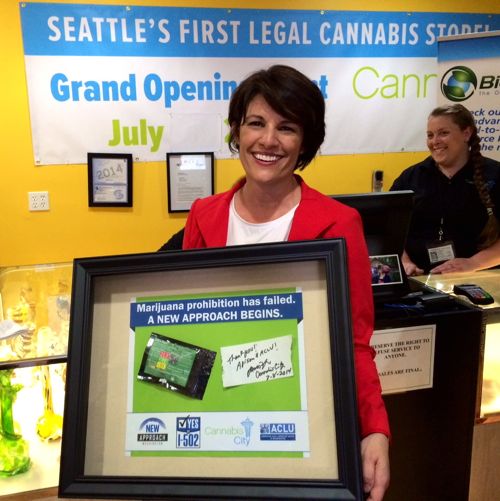
I bought a bag of marijuana today at Cannabis City, Seattle’s first legal retail pot store, just after they opened at noon. (Surprisingly for a pot store, they opened on time.) It was a different experience from every other time I’ve bought pot—and I’ve bought a lot of pot before—not just because there were dozens of TV crews swarming outside. What legalization provides, prohibition never could: explicit certainty about what I purchased, what it contains, what it doesn’t contain, where it came from, where the money goes, and the promise that every time I purchase this product it will be essentially the same.
Here’s the excellent pot, the bag, a receipt, and a very detailed label:
$40 gets you two grams of pot and more information about your stash than you’ve ever had before.
Consumers will decide whether all that certainty is worth the price; the two-gram bag was $40, including $10 in tax, which is generally higher than street prices.
Some people already say it’s not worth it. Standing beyond the media frenzy was John Stuart, 24, who was wearing a pair of pot-leaf-print shorts and a Marilyn Manson t-shirt. His friend had a white pit bull on a rope. Were they waiting to buy pot inside? “No, because I got a medical-marijuana card and it’s way too expensive at Cannabis City,” said Stuart. “You could go to Westlake Park and get it for $10 a gram. That’s a lot cheaper than going to the store.”
But the pot Stuart can buy in a dispensary or in a park will never be like this. The glut of information on that label represents something between government overreach and a pot-lover’s dream come true.
The largest typeface on the label details the precise composition of the drug. This strain is called OG’s Pearl, which contains exactly 21.5 percent THC (the predominant set of psychoactive chemicals in cannabis). The label then lists the CBD, a more narcotic chemical found in marijuana, and the nonpsychoactive CBG. The label goes on: These buds are 80 percent indica-type cannabis (as opposed to the more stimulating sativa, which presumably makes up the other 20 percent). It lists the moisture content (6.25 percent), the day it was harvested (June 2), the day it was tested (June 23), where it was grown (Kitsap County), how it was grown (indoors), and who grew it (Nine Point Growth Industries).
If I like this product, I can buy it again and it will reliably be the same thing. If the product changes—how or where it’s grown, whether there are shifts in chemical composition at the next harvest—it will be right there on the label.
This chunk of vegetation, like all the pot legally sold in Washington, was tracked from the time it was a baby clone to a full-grown plant, then tracked from harvest and into this package. And because it’s so closely tracked, consumers have unprecedented certainty that it’s not tainted with contaminants (other drugs, sketchy fertilizers, tobacco juice, mold, soap, etc.).
It’s also a guaranteed weight—you’re not going to get shorted on your deal—and you know your money is paying for legit, in-state jobs, not funding some murderous interstate cartel.
But if Mr. Stuart buys pot in the park, it’s all but certain he’ll have no idea what he’s really getting (or where his money goes). Even dispensaries will lie through their teeth about what they’re selling—I know because it was once my job to tell that lie.
In my 20s, I worked briefly as an assistant manager in a marijuana dispensary in California. Each morning, growers would deliver massive sacks of weed to the back door, and we’d haul them to an upstairs office for inventory purposes. It turns out, one of my jobs there was to name the strains. People talk a lot about pot strains like they’re of hallowed pedigree, and some of them are legit examples of growers developing a unique variety (classics like White Widow or Blueberry, or newer strains like Jack Herer). But a lot of strain names? They’re totally fabricated. There’s always pothead lore about how one strain is stronger, how it makes you happy, how it’s got a “really mellow vibe,” or it’s “good for sleep.” But most of that is bullcrap. At the dispensary I worked for, part of my job was to fabricate names as a marketing ploy. I’d just make ’em up. I called them Einstein, Alligator, Beethoven, Plato—any name I’d think could sell. And if the name was marketable and we’d run out of that type of pot? We’d find another type of pot and call it the same name. Long story short: Under prohibition, the name’s meaningless. The place you bought it didn’t guarantee its provenance. You never knew what you were getting from one bag to the next.
With the standards we have in Washington, we don’t have punk-ass kids (like me) making up stuff about your weed and you don’t have to guess what you’re smoking. The question is: Do we have enough legal pot to keep this system running?
ALISON HOLCOMB: Beaming for bud.
Alison Holcomb, who sponsored the initiative that legalized marijuana, bought a bag of pot herself today. She acknowledged the shortages of ready-to-use marijuana, as we wrote about over here, and said the first day was not as critical as the state being able to license enough growers to maintain a supply chain: “It is critical that we can sustain stores, instead of seeing them going under due to lack of product to sell to customers.”
But she added that the stores we have are better than what she expected. “When we drafted the initiative [in 2011], we were thinking of the state-run liquor stores,” said Holcomb. But unlike the austere state booze outlets, which were nixed by voters, the Cannabis City showroom has hardwood floors, wooden paneling, and illuminated display cases. “This is warmer and more inviting than what we envisioned,” said Holcomb. (It’s also a helluva lot nicer than buying pot in an alley or at some chatty dealer’s apartment.)
Cannabis City owner James Lathrop was beside himself with self-satisfaction. “I declare this war over,” he told the crowd. (Good for him, but tell that to people in the other 48 states.)
However, Lathrop, Holcomb, and others also provided something with legal pot you’ll never see from a street dealer: a level-headed warning in writing.
Every customer was handed an informational “consumer’s guide” pamphlet with “what you should know” about pot use in a Washington State. It warns about the potency of edibles (which aren’t in stores yet), the law about driving stoned (don’t do it), and the rules about where you can consume it (in private places, but not in hotels that ban smoking).
That pamphlet—free of fear-mongering—represents a tiny but critical revolution in drug education: It’s produced by the Washington State Liquor Control Board, a state agency, but it’s sponsored by and features the logos of the ACLU, the National Organization for the Reform of Marijuana Laws, and the Marijuana Business Association. This pamphlet is evidence of government critics co-opting government.
This is the end of “Just Say No” in our state. That was an era of the government lying about the harms of pot and promising you that one toke led to a lifetime of addiction, while pro-pot forces generally exaggerated the benefits and downplayed the risks. More and more, both sides are settling on the facts and providing all the information—sometimes more than you know what to do with, right on the label—for users make up their own minds. You know you’re buying local.
So if it costs a few bucks more per gram, it’s worth it.
Editor’s note: while I agree with much of the author’s arguments, there is something to be said for supporting blackmarket pot as well. In cases where you and the dealer develop friendship and trust you can get comparable consistency of quality. Though it may not always be the exact same strain, it can be a pleasant surprise to try something new. You may also have an opportunity to experience other illegal substances if you choose (but always do the research first). If/when cannabis becomes as commercialized as foods and tobacco, you may not be able to trust the labels on the package anyway. And why not show loyalty towards those who have provided quality service through the dark days of prohibition at the risk of their freedom and security?
Ten sentences in to New York Times, columnist Maureen Dowd’s piece about trying marijuana edibles in Colorado (while admittedly cackling out loud), my sense of responsibility as a journalist and cannabis connoisseur kicked in. This was the sentence that triggered it: “I barely made it from the desk to the bed, where I lay curled up in a hallucinatory state for the next eight hours.”
Whoah! This is not as it should be, and barely even makes sense. If someone gave you an unknown glass of alcohol and told you to down it sans questions, would you? And when they revealed that it was Everclear while you coughed your lungs out, would you write an editorial about how people should be more clear about telling you what you’re drinking, even if you don’t ask? Dowd expands the conversation beyond her personal observations, and goes on to discuss the epidemic of suicides, murders and emergency room visits prompted by folks misusing edible marijuana treats in states like Colorado and Washington.
From my perspective, before we get into strategies for creating labels for pot edibles – Dowd suggests “maybe a stoned skull and bones?” – let’s start with something a bit more practical.
Here’s my step-by-step guide to eating weed edibles:
1. Don’t buy or eat an edible if it doesn’t clearly state how much THC is inside. If it’s a candy bar, it should be divided into partitions (a la a Hershey bar), and you should do the math to determine the amount of THC is in each partition.
2. If you don’t use weed regularly, start with five mg of THC. If you’re the adventurous type, try 10 mg. But no more. Then wait 30-45 minutes. How do you feel? If you feel groovy, try moving up by five mg increments – waiting a half-hour in between – but do not exceed a total of 15 mg of THC. That’s basically the equivalent of smoking a small joint of middle-grade weed on your own. That should do. 20 mg could get you into Dowd Meltdown territory.
3. If you’re a regular weed user, start with 10 mg of THC. Wait 30-45 minutes. Monitor your stoned-ness, and try moving up by 5-10 mg of THC, but don’t go past 25-30 mg of THC. If you’re approaching 40 mg of THC and you haven’t reached the orbit level you’re used to, you might just have a problem.
At the end of the article, the owner of a pot edible company makes the following observation about why warnings might not solve this weed edible overdose problem: “My kids put rocks and batteries in their mouths.”
Be an adult about edibles. If you know how much chardonnay to drink, figure out how much weed to eat. If you don’t, it’s kind of on you if you end up in the fetal position in your hotel shower.





 After the Crash