Saturday Matinee: Cops vs. Thugs

Cops Vs. Thugs — No Honour Among Thieves (or Cops)

By Ben Warnock

Source: Ben Warnock Blog

“Yakuza and cops are just the same. We respect the law instead of a code. We’re the dropouts who couldn’t get good jobs.”

“We too are the dropouts of society. We all are!”

Kinji Fukasaku’s yakuza films are perhaps best described as being surrounded by an almost impenetrable, bleak aura of despair and nihilism. The cops who are supposed to be the protectors of the people are corrupt to the core, Fukasaku basically presents them as a mercenary force — one that can be bought if the bid is high enough. Government officials often use the police to do their bidding and much like their underlings are as corrupt as they come. This damning indictment of these systems does not mean that the director sides with the yakuza — often portraying them as morally reprehensible criminals — whilst their code may be one of honour, post-war Japan has created a society that allows for greedy capitalists to gain power simply at the expense of sullying their morals and code. Those who stick to a code of honour become the dead that litters the senseless gang wars that follow. Corruption is a recurring theme throughout Fukasaku’s yakuza films and Cops Vs. Thugs is perhaps his most interesting example of this outside of his famous Battles Without Honour and Humanity series.

Much like the aforementioned series of films, Fukasaku looks to highlight the corrupting nature of power and that those who seek power are often those who are corrupted the easiest. The police of the film are split between those who are corrupt but perhaps honourable in their own, twisted way — as characterised by Bunta Sugawara’s Kuno whose corruption is described as a way of keeping the peace — and the new faction led by Kaida who is vehemently against collaboration with the yakuza. However, Kaida’s allegiances should not be mistaken as honourability as Fukasaku is certain to illustrate. Kaida’s behaviour humiliates his co-workers in public spectacles — including repeatedly using his judo skills on an elderly police officer — where his power is cemented amongst the other police officers. This damning indictment of the police is nothing new to the films of Fukasaku but here, the director highlights that those who seek the position of a police officer are those who are power-hungry and susceptible to corruption from many outside forces. As Sugawara’s Kuno states when asked why he became a cop:

“I wanted to carry a gun. After the war only cops and narcotic agents could carry guns….we were short of food…every time we tried to buy rice on the black market, the cops snatched it away. So I decided to be a snatcher”.

Unlike the famous notion that power corrupts, Fukasaku’s films prove that it is not power that corrupts but it is in the nature of those who seek positions of power in a patriarchal, capitalist system to become corrupt. It is the damaged system’s cyclical nature that corrupts individuals.

The fates of those characters who have a shred of honour — Kuno and Kawamoto — ultimately end in tragedy. Kuno’s honour and trust in his friend Hirotani ultimately leads to his escape attempt and forces Kuno’s hand in killing Hirotani. Violence begets violence and Kuno — after being demoted and transferred as a reward for saving Kaida’s life — is killed by the remaining members of Hirotani’s gang. The yakuza honour forces them to avenge the death of their leader. Kawamoto, on the other hand, attempts to save his friend’s life by getting them to surrender and is gunned down by the very friend he tried to save. The honour and trust showcased have no place within the world of the police and the yakuza. Corrupt institutions whose original purposes have become eroded and replaced by pawns of the capitalist society they inherit. This ever-changing, impermeable alliance between characters is highlighted by Fukasaku’s camera. Battles devolve into a sweeping landscape of betrayal with snitches followed by the judging eye of the camera and gunfights where the action can barely be contained within the confines of the screen. Fukasaku’s frantic kineticism within these scenes is indicative of the disorientating landscape of unknown allegiances which these characters inhabit and thrive.

The world which is represented in Cops Vs. Thugs is one that is inherently damaged from its systems of government to its criminals whose honour and code have become meaningless in the current political landscape. The real threat presented to the governing officials is not the yakuza who seek to exploit the corrupted system but a change in ideology that would bring the system crashing down. Fukasaku even highlights this own threat with the police officer whose entire character consists of his hatred of communists even ahead of the very criminals that are terrorising the streets he is meant to protect. Fukasaku’s (literal) red herring of communism here is one that rewards those who buy into the paranoia. The anti-communist officer is inexplicably a member of Kaida’s team and Fukasaku ensures that he is the first officer seen to be arresting the yakuza once they surrender. This perhaps explains that Kaida’s corruption does not lie with the yakuza but the capitalist government which seeks to strengthen its own resolve within society. The film’s epilogue showing the demotion and untimely fate of Kuno also highlights that Kaida is now a leading figure in Nikko Oil — a company that was mentioned to be corrupt as well. Hiding behind a facade of friendly exercising with his co-workers — Fukasaku pulls out from a close-up to a wide shot allowing the audience to realise that this corrupt institution is just one of many within the industrial landscape. Corruption does not just lie with the police working with the yakuza but also — and more dangerously so — lies with the police collaborating with the government.

Watch Cops vs. Thugs on Kanopy here: https://www.kanopy.com/product/cops-vs-thugs-0
Saturday Matinee: Battle Royale 2

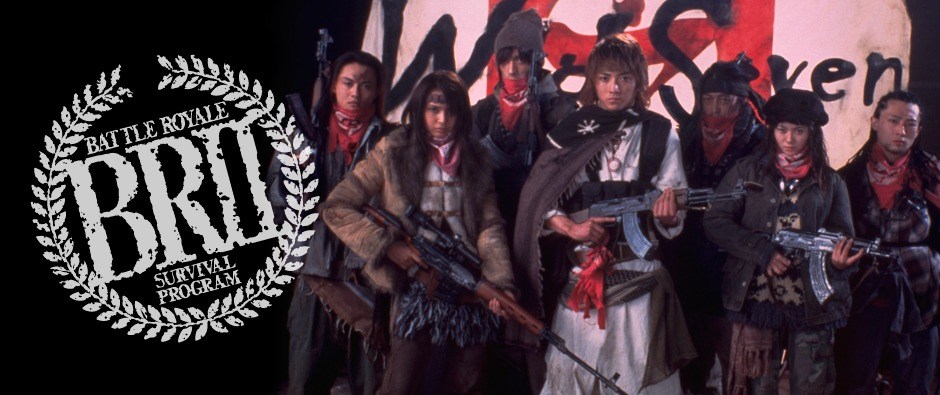
“Battle Royale 2: Requiem” (2003) is an under-appreciated yet boldly provocative sequel taking place three years after the events of the first Battle Royale. The protagonists of the previous film have joined other survivors of past Battle Royales to form a terror cell known as Wild 7. After a major bomb attack, a new class of high-schoolers kidnapped by the government are forced to raid Wild 7’s island hideout and assassinate the group within 72 hours. Battle Royale 2 was director Kinji Fukasaku’s final project, who died of cancer shortly after filming began. The majority of the the film was directed by his son Kenta Fukasaku who wrote the screenplays for both films.
Watch the film with English subtitles here.

Saturday Matinee: Star Wars Knock-Off Double Feature

150px-MfsusaStarcrash_1979_film_poster

Media hype surrounding the release of the latest Star Wars film is similar to the release of the previous films in the series except for the fact that prior to the release of the first installment, few outside the sci-fi community predicted it’d be such a success. Though it’s too early to tell how much of an enduring cultural impact The Force Awakens will have, in hindsight the impact of A New Hope has been substantial. It definitely raised the bar for effects-laden “event” films and marked a transition point for Hollywood from releasing films with a more gritty pessimistic tone and European-influenced aesthetic of the early and mid seventies to films with larger budgets and more optimistic “retro” sensibilities of the late seventies and beyond.

Star Wars also upped the ante for the potential boon to be had not just for studios but from merchandising partnerships, multimedia spin-offs expanding the franchise universe and countless opportunists attempting to cash in. Kids growing up in the post-Star Wars era had no shortage of Star Wars toys and products to choose from (or Star Wars-like toys and products) which helped boost a generation’s interest in sci-fi, space and technology. On television kids and adults could get their sci-fi fix through such shows as Battlestar Galactica, Buck Rogers, Quark, and an anime from 1974 repackaged as Star Blazers for American audiences. Meanwhile Hollywood was diving head-first into the sci-fi/fantasy resurgence with Disney’s The Black Hole, a space-bound James Bond in Moonraker, new versions of Superman, Star Trek and Flash Gordon, Ridley Scott’s Alien, and Jimmy Murakami (When the Wind Blows) and Roger Corman’s Battle Beyond the Stars among others.

Movie producers around the world also jumped on the bandwagon with films as diverse as Os Trapalhões (The Dabblers) from Brazil and Dünyayı Kurtaran Adam (The Man Who Saved the World), also known as “Turkish Star Wars” due to the filmmaker’s liberal use of Star Wars footage for spliced in effects shots and backdrops. As many horrible examples of this subgenre of world cinema as there are, there’s at least two I’ve found to be charming and enjoyable in their own ways: Message From Space (Japan, 1978) and Starcrash (Italy, 1979). Both feature eclectic casts with hammy performances (eg Vic Morrow and Sonny Chiba in Message From Space and Caroline Munro, Christopher Plummer and David Hasselhoff in Starcrash), both have low-budget yet creative production design, and like Star Wars, they also make a decent attempt at recombining various mythological and cinematic tropes to create new fantasy worlds. Message From Space also had the benefit of having Kinji Fukasaku in charge, the auteur who also directed Black Lizard, Battles Without Honor and Humanity, and Battle Royale.

Message From Space (Full Movie)

Saturday Matinee: Battle Royale

battleroyale_spotlight-e1293591661834

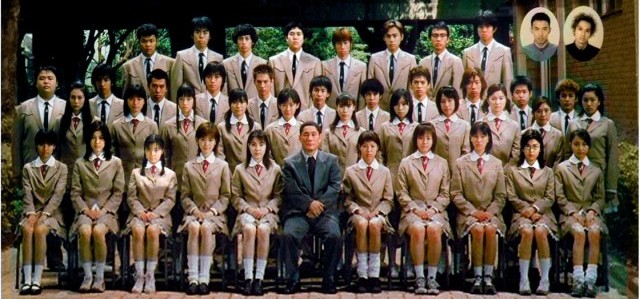
With the recent release of the Hunger Games sequel, it seems fitting to feature a cult classic that may have been the inspiration for that series: “Battle Royale”. Released in 2000, it was Kinji Fukasaku’s final film, a director previously best known for his “Battles Without Honor and Humanity” series of Yakuza films. Kinji died of cancer shortly after filming the first scene of the sequel, “Battle Royale 2: Requiem”, which was completed by his son Kenta in 2003. Battle Royale takes place in a dystopian society whose government regularly forces a class of high school students to participate in a deathmatch on a small island until just one survivor is left.  Each student is given a bag containing food, water, a compass, a map of the island, and a randomly selected weapon. The students are also outfitted with surveillance collars that can track their movements and detonate if they wander into “danger zones” or refuse to cooperate.

Though the film is at times physically and emotionally brutal, it works effectively as a parable for the way youth are cynically manipulated by society and the different approaches people take dealing with tyranny. When Kinji Fukasaku first read the novel his film was based on, it resonated with him because of traumatic personal experiences. As he related in a Director’s statement for Battle Royale:

I immediately identified with the 9th graders in the novel, Battle Royale. I was fifteen when World War II came to an end. By then, my class had been drafted and was working in a munitions factory.

In July 1945, we were caught up in artillery fire. Up until then, the attacks had been air raids and you had a chance of escaping from those. But with artillery, there was no way out. It was impossible to run or hide from the shells that rained down. We survived by diving for cover under our friends.

After the attacks, my class had to dispose of the corpses. It was the first time in my life I’d seen so many dead bodies. As I lifted severed arms and legs, I had a fundamental awakening … everything we’d been taught in school about how Japan was fighting the war to win world peace, was a pack of lies. Adults could not be trusted.

The emotions I experienced then–an irrational hatred for the unseen forces that drove us into those circumstances, a poisonous hostility towards adults, and a gentle sentimentality for my friends–were a starting point for everything since. This is why, when I hear reports about recent outbreaks of teenage violence and crimes, I cannot easily judge or dismiss them.

This is the point of departure for all my films. Lots of people die in my films. They die terrible deaths. But I make them this way because I don’t believe anyone would ever love or trust the films I make, any other way.

BATTLE ROYALE, my 60th film, returns irrevocably to my own adolescence. I had a great deal of fun working with the 42 teenagers making this film, even though it recalled my own teenage battleground.

Watch the full film here.