
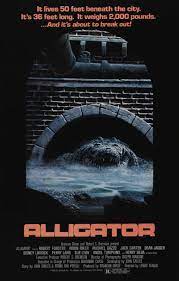
Saturday Matinee: Alligator

By Mike Brooks

Source: Mana Pop

The urban legends surrounding the idea of alligators living in the sewer date back to the late 1920s and early 1930s, which makes it rather surprising that it took until 1980 for such an ideal subject matter to make its way into a horror movie. We got giant ants in the sewers back in 1954 for Christ’s sake why not alligators? It took screenwriter John Sayles to finally pen such an urban epic, but his gator wouldn’t simply be large it would be super-sized!

After the success of Jaws, the rip-offs of Spielberg’s summer blockbuster almost become a genre unto themselves, sadly, most of them were terrible and without any artistic merit but with Lewis Teague’s Alligator we got a truly excellent “man against nature” monster movie, one that turned out better than it had any right to be. While there are plot and character elements similar to what appears in the Spielberg shark film, with the main protagonist being a police officer who is helped by an animal expert, and there is a professional hunter who dies similar to that of Quint in Jaws, but he’s more villainous antagonist rather than part of the camaraderie trio in that film, but what John Sayles brought to the story was an environmental slant with the creatures immense size being due to the dumping of the bodies of dead animals that had been subjected to an experimental growth formula and then being eaten by the sewer-dwelling alligator, thus the cause of its increased size.

The basic plot of Alligator follows the actions of a PTSD-suffering homicide detective named David Madison (Robert Forster), who lost his previous partner under less-than-ideal circumstances, and it’s his investigations of body parts showing up in the local sewer that brings him into contact with a pet shop owner (Sidney Lassick) who has been stealing dogs and selling them to a Slade Pharmaceuticals for growth experiments. And just how evil is this company? Well, not only does scientist Arthur Helms (James Ingersol) cut the larynxes of his subjects to keep them quiet he demands that the pet shop owner only bring him puppies. It’s safe to say this guy will not be around when the end credits roll, in fact, the film’s big smorgasbord of action takes place at Arthur’s wedding, where he is to be married to his boss’s daughter.  It is at the wedding where he and his boss (Dean Jagger), as well as the crooked Mayor (Jack Carter), all meet their untimely ends, which begs the question “Did the alligator get a copy of the script, so it knew where the villains were and who it had to eat?”

Filling in the role of consulting oceanographer Matt Hooper from Jaws we have herpetologist Marisa Kendall (Robin Riker), who doesn’t believe that Madison’s latest deceased partner (Perry Lang) could have been eaten by a sewer-dwelling alligator, stating that a creature that size would have starved in a week and that the toxic gasses found in a sewer are not conducive to a healthy life. Even his boss Chief Clark (Michael Gazzo) doesn’t believe him and wants David to take a much-needed vacation, but lucky for Madison, a yellow journalist (Bart Braverman), who is one of the reporters that have suggested that Madison may have been responsible for the death of his first partner, is killed by the alligator and was kind enough to leave photographic evidence of the creature’s existence. This results in a failed sewer dragnet that causes the Mayor to sideline Madison and bring in big game hunter, Colonel Brock (Henry Silva), to track and kill the beast, this would be the film’s Quint analog, unfortunately, Henry Silva is never given a cool monologue about being aboard the U.S.S. Indianapolis and is just eaten in a dark alleyway.

Stray Observations:

• The alligator’s first victim is a sewer worker named Edward Norton which is an obvious nod to the character played by Art Carney on The Honeymooners.
• That the alligator in question was flushed into the sewers by Marisa’s father, twelve years ago when she was a child and I’m surprised that her dad didn’t get an ironic death in this film.
• The idea of a victim’s camera taking snapshots of the monster during the attack was also used in Jaws 2 (1978).
• Madison gets fired because of his investigation of Slade Pharmaceuticals, whose owner is friends with the mayor, but no actual grounds are given for his dismissal and any Policeman’s Union would be down on this situation like a ton of bricks.
• Henry Silva’s big game hunter hiring three black youths to be his “native bearers” is as brilliant as it is racist and makes his death even more appealing.
• The two men working the gate at the wedding don’t seem to notice that people are being eaten by a giant alligator a few feet away, then again, this is Chicago so maybe that’s normal.

This may have started off as a simple Jaws rip-off but with Lewis Teague’s deft hand at the helm, and the wonderfully tongue-in-cheek script by John Sayles, they were able to produce a film of admirable quality and a lot of this has to do with such a great cast of character actors, a group that is more than aptly lead by the great Robert Forster, who really nails the whole world-weary cop who is “Too old for this shit” to perfection. It should also be noted that Teague did run into the same problem that Spielberg had concerning his mechanical shark, as the mechanical Alligator did not function all that well or often, but the use of a baby alligator on a miniature set worked surprisingly well.

Lewis Teague’s Alligator is easily one of the better examples of the genre, one that has brought the world such “classics” as Grizzly and Orca, but John Sayles elevated things by weaving in some nice social commentary – the creature did seem to eat its way up the social-economic food chain – and the movie even had the balls to have the alligator brutally eat a small child. If this “Man against Nature” film has somehow escaped your notice do yourself a favour and track this one down, you won’t be disappointed.

____________________

Watch Alligator on tubi here: https://tubitv.com/movies/100006257/alligator

Saturday Matinee: The Secret of Roan Inish

By Roger Ebert

Source: RogerEbert.com

One day, many years ago, an ancestor of Fiona spied a beautiful creature sunning by the sea. She was both woman and seal. We would call her a mermaid, but on that western coast of Ireland such creatures were well-known as Selkies.

The ancestor trapped the creature and married her, and they had children together and lived happily, although she seemed to long for the sea. One day she learned where her husband had hidden her sealskin, up under the roof, and she put it back on, and returned to the sea.

Fiona (Jeni Courtney), who is 12 or 13 years old, is told this story by a relative. It is not told as a “fairy tale” but as an account of family history, to be taken quite seriously. And well might Fiona believe it, because ever since there have been dark-haired children in her family who were said to throw back to the Selkie, and whose eyes turned yearningly to the sea.

The year is about 1946. Fiona’s mother has died, and her father can barely be budged from his mourning in the pub. She is sent to live with her grandparents, on a sea coast across from the island of Roan Inish, where the whole family once lived. There she learns the story of her little brother Jamie, whose cradle was carried off by the waves. And there, with her grandparents and her cousin Eamon (Richard Sheridan), she first explores Roan Inish, which means, in Gaelic, “island of the seals.” The secret of John Sayles‘ “The Secret of Roan Inish” is that it tells of this young girl with perfect seriousness. This is not a children’s movie, not a fantasy, not cute, not fanciful. It is the exhilarating account of the way Fiona rediscovers her family’s history and reclaims their island. If by any chance you do not believe in Selkies, please at least keep an open mind, because in this film Selkies exist in the real world, just like you and me.

On Roan Inish, the girl sees a child’s footprint. Then she sees the child – Jamie! – running on the sand. She calls to him, but he gets back into his cradle, which is borne out to sea by friendly seals. Of course it is hard to convince grownups of what she has seen.

In the meantime, her grandparents face eviction from their cottage, which is to be sold to rich folks from the city. They may have to move inland. “To move off of Roan Inish was bad enough,” Fiona’s grandmother says, “but to move out of sight of the sea . . .” She shakes her head, making it clear that it would kill the grandfather, who thinks of the city as “nothing but noise and dirt and people that’s lost their senses!” Can Fiona and Eamon, her young cousin, restore the family’s old cottages on Roan Inish? Can she reclaim Jamie from the sea? I found myself actually caring. John Sayles and Haskell Wexler, who has photographed this movie with great beauty and precision, have ennobled the material. There is a scene where a person numbed by the cold sea is warmed between two cows, and we feel close to the earth, and protected.

One can easily guess how this legend could have been simplified and jollied up in other hands – how it could have been about cute little Selkies. But legends are, after all, told by adults, not children, and usually they record something essential to the culture that produces them. What this legend says, I think, is that the people who tell it live on the land but live from the sea, so that their loyalties are forever divided.

Of course this is a wonderful “family film,” if that term has not been corrupted to mean simpleminded and shallow. Children deserve not lesser films but greater ones, because their imaginations can take in larger truths and bigger ideas. “The Secret of Roan Inish” is a film for children and teenagers like Fiona, who can envision changing their family’s fate. It is also for adults, of course, except for those who think they do not want to see a film about anything so preposterous as a seal-woman, and who will get what they deserve.

Saturday Matinee: Matewan

From Wikipedia:

Matewan (/ˈmeɪtwɒn/) is a 1987 American drama film written and directed by John Sayles [b. 9/28/50], and starring Chris Cooper (in his film debut), James Earl Jones, Mary McDonnell and Will Oldham, with David Strathairn, Kevin Tighe and Gordon Clapp in supporting roles.

The film dramatizes the events of the Battle of Matewan, a coal miners’ strike in 1920 in Matewan, a small town in the hills of West Virginia. The film was nominated for the Academy Award for Best Cinematography.

Saturday Matinee: The Brother From Another Planet

220px-Brofromotherplanet

“The Brother From Another Planet” (1984) is a thinly veiled sci-fi race allegory from writer/director/editor/actor John Sayles. Joe Morton plays “the Brother” a mute alien slave who crash lands near Harlem while trying to evade his alien oppressors. The Brother looks similar to a human black man but has three toes and telekinetic abilities. The aliens in pursuit are similar in appearance to white government agents (one of whom is played by John Sayles). Though dated and low budget, the film is recommended for its great lead performance from Joe Morton and an intelligently humorous script.

Saturday Matinee: Gridlock’d

627

“Gridlock’d” (1997) is a film most people remember for featuring one of Tupac Shakur’s last starring roles (he was murdered in a shooting just two months after its completion). While Tupac’s performance as Spoon, a level-headed but drug-addicted jazz musician, is impressive and possibly his best, often overlooked are contributions of co-star Tim Roth and actor/writer/first-time director Vondie Curtis Hall. Roth stars as Stretch, Spoon’s impulsive and slightly deranged partner in addiction and music. Both Shakur and Roth inhabit their roles with a sense of authenticity, humanity, and charisma, giving their potentially pathetic characters believable chemistry and a likeable comic edge. The film kicks off when the third member of their jazz combo, Cookie, played by Thandie Newton, has an overdose, compelling the others to go on a quixotic quest seeking treatment for their addiction. Unfortunately for our protagonists the Detroit healthcare system is a bureaucratic maze seemingly designed to thwart their efforts. Odds of their success are decreased further when they’re targeted by cops and gangsters.

Detroit-born Vondie Curtis Hall does an excellent job balancing the script’s gritty realism and dark outlook with comedy and wit. Visually, the film is stylish without looking too glamorous or grim, and he keeps moments of humor and suspense well-paced. Hall is also suitably menacing as gangster D-Reper. Director John Sayles, who previously worked with Hall on the film “Passion Fish”, makes a cameo appearance as one of the cops. Hall hasn’t yet made another film on par with the quality of Gridlock’d, but he continues to do much acting and directing work for television.

As strong as Hall’s directorial debut is, it wouldn’t be as emotionally involving and memorable were it not for Tupac Shakur’s presence. Like his character in Gridlock’d, Tupac was at the time seeking a new beginning; a new creative direction. The fact that his life was tragically cut short can’t help but add a sense of poignancy and dramatic weight to his role and the entire film.