Saturday Matinee: The Elephant Man

RIP David Lynch (January 20, 1946 – January 16, 2025) 

The Elephant Man (1980) is not often considered one of David Lynch’s masterpieces, though it’s one of his most critically acclaimed films, having been nominated for eight Academy Awards and winning a BAFTA Award for Best Film. It also happens to be a film of great personal significance because it was my first David Lynch film experience.

Though only six, I still remember seeing a daytime screening with my mom and being disturbed yet fascinated by the stark black and white imagery and lead character (played by John Hurt and loosely based on Joseph Merrick). Though I may have been too young to follow the plot, the film’s emotional journey and compassionate message left a lasting impression.

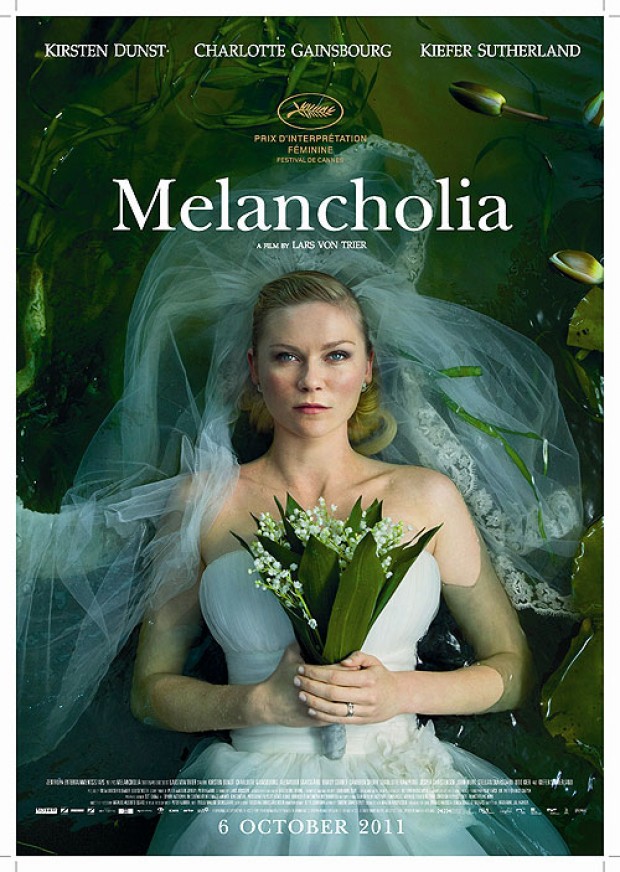
Saturday Matinee: Melancholia

Melancholia Review

By Ewan Gleadow

Source: Cult Following

Uncomfortable productions are the forte of director Lars von Trier. The allusions to and disquieting effect of his features and their focus is something to be realised in the prime of his works. What that area is can be debated and pulled at, but Melancholia appears to be the poetry in motion Trier fans so often praise the director for. Musical accompaniments to still shots of paintings that slowly peel and ripple. It’s a delightful piece for those that love the artisan qualities of a world falling apart and the destruction that comes from character sleights. The immovable nothing that comes from it touches deeper and deeper as Melancholia, the finest Trier work, rages on.

That much comes from the absolute beauty of its structure, of its characters. Shaped and informed by destruction, moving paintings that take place on strange canvases that display torment and passion, family and love. Melancholia has all the time in the world for its visual chemistry and the representations it can bring. There is no tiring effect brought by Trier, who trusts in his lengthy segments of two worlds, quite literally, colliding. Audiences are placed right at the end and know what is to come, what fate the characters meet and how it all comes to a crashing bit of destruction. In identifying the hopelessness, Trier brings himself to the inevitable edge that comes from discussing finality. It feels a bit like what The Fountain tried and failed to comment on, but with much, much more scope than the Hugh Jackman-led piece.

Within Melancholia is the profound beauty of visual meaning. It is a piece that relies more on the slower motions and relationships told in flutters rather than a full-on narrative that demands and desires strict following of the story. There is a fast and loose layer to Trier’s work, where his direction provides beauty and colour with that fear. Kirsten Dunst delivers a phenomenal catalyst for life. It gives the happiest moments of life and the cursed afterthoughts. Trier mixes the palette well, he provides that to the cast and relies on them so frequently to engage with the emotion, rather than dialogue. It is the choreography, and the appeal of his directing style, that makes Melancholia such an intoxicating watch.

Senseless destruction with poetic twists and turns at their finest, Melancholia is a touching and spiritually charged look at the useless tirades and meaninglessness of it all. With Melancholia exposing itself to the raw elements, it does often focus on its imagery more than its characters. Trier’s style, the unfocused extremes of the close-up shot, the shot-reverse-shot simplicity, it all has its place but where that is can come across as unfounded. His fly-on-the-wall appeal has its moments throughout this piece, with a triple threat of Charlotte Rampling, John Hurt and Stellan Skarsgård making the most of that. There is no harm in stacking the cast so high, it adds texture and richness to an already broad-in-scope feature. Melancholia feels right at home biting off more than it can chew, both narratively and emotionally.

____________________

Watch Melancholia on Kanopy here: https://www.kanopy.com/de/product/69665

Saturday Matinee: 1984

A scary reminder of how easily totalitarian ideas and ideals crop up in societies and take fierce hold.

Film Review by Frederic and Mary Ann Brussat

Source: Spirituality & Practice

Winston Smith lives on Airstrip One, a part of Oceania. He resides in a shabby one-room apartment where his movements are monitored by a two-way telescreen. Winston works for the Ministry of Truth, where he rewrites history according to the party line.

Big Brother dominates the lives of Oceania citizens through psychological manipulation via the media. The totalitarian state seems to be in a constant state of war with either Eurasia or Eastasia. Hate rallies are designed to encourage allegiance to Big Brother; dissenters are publicly executed; and natural sexual behavior is forbidden.

Winston defies the authorities when he begins keeping a diary of his feelings. He goes a step further by beginning a love affair with Julia, another rebellious individual. O’Brien, a member of the privileged Inner Party, befriends Winston but later betrays him. The maverick is taken by the Thought Police to the Ministry of Love. Then in the notorious Room 101, O’Brien proceeds to torture and brainwash Winston. His ultimate goal is to replace the man’s love for Julia with love for Big Brother.

This screen version of 1984 is unrelentingly grim and ominous. Airstrip One seems more like a dank and dreary prison than a city. John Hurt is just right as Winston Smith, a stubborn individualist who refuses to reduce his life to a series of reductive slogans. Despite the haggard look, this British actor vividly conveys his character’s inner fire. Suzanna Hamilton plays Julia as flinty outsider who savors sex and sees it as a sacrament. In his final screen performance, Richard Burton plays O’Brien with convincing clout; he is an efficient bureaucrat whose cool demeanor masks an ugly love of raw power.

Although screenplay writer and director Michael Radford (Another Time, Another Place) gives the drama’s ending a twist that goes against the grain of George Orwell’s 1984, this intense film version of the book succeeds very well in depicting the totalitarian tendencies which tend to crop up in societies all over the world. The human spirit is violated when war is made into a vehicle for peace, when truth is twisted into disinformation and language is turned upside down; when loyalty to the state is built upon paranoia and neighbor begins betraying neighbor; and when surveillance takes away personal privacy and makes all dissent a crime. While many refuse to acknowledge the present reality of this Orwellian nightmare, others know that creeping totalitarianism thrives best when it moves quietly in the shadows.

Watch 1984 on Hoopla here: https://www.hoopladigital.com/title/11080278

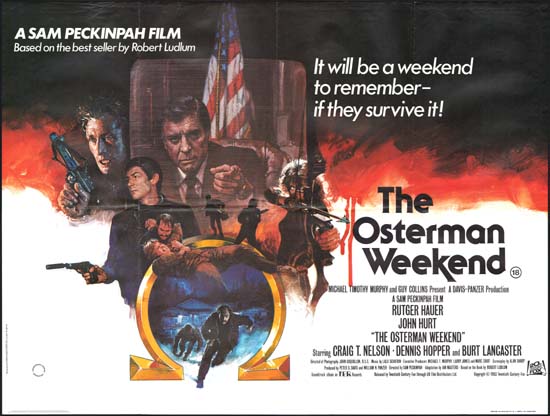
Saturday Matinee: The Osterman Weekend

Ahead of its time – brilliant, entertaining, insightful

Review By nfaust1

Source: IMDB

When this movie originally came out, five years after CONVOY (a muddled, but in many ways spectacular entertainment), many critics moaned that Peckinpah had yet again displayed his diminished talent. A Ludlum spy thriller, pulp material, given the Peckinpah stamp was not to be taken seriously, period. What nonsense. To begin with, all of Peckinpah’s films spring from pulp, and all of them, even the least successful ones, buck and spin with the way Sam applies his vision to the genre conventions he’s messing with.

In simple terms, a Peckinpah movie always illustrates the world according to Sam; like a novelist writing in first person, Sam’s point of view is the movie’s. And that’s why they endure today. In THE OSTERMAN WEEKEND, Peckinpah focuses Ludlum’s cold war spy antics into a exploration of urban paranoia and governmental abuse. Video as a means to manipulate perception is one of the themes he exploits here, but that’s not his main thrust. A group of affluent characters come together for a weekend that turns into a surreal nightmare. The trappings of success that surround this group are not in any way secure enough to withstand the violent, reckless games played on them by a rouge CIA agent (played by John Hurt) who’s motive is personal revenge. And that motive, the revenge that fuels his need, in actual fact, has absolutely nothing to do with the affluent group he’s playing with. Like the gods in Greek tragedy, the Hurt character uses the Osterman Weekend and its players as pawns, stepping stones, as a way to get at his real goal, the head of the CIA. This notion obviously strikes a chord in Peckinpah; the vision is certainly domestic, but the idea is epic: in the privacy of our homes a kind of virus colors our perceptions and poisons friendships, creates anarchy, and causes death. And the virus – where does it come from? Our own back yard – the CIA.

The film is charged with a constant underlying tension that holds and holds until all hell breaks loose and the affluent house becomes a battle ground. Visually, the movie is stunning. But then, so was CONVOY, but this time Peckinpah has harnessed what he shows and what he wants to say in a simple, tightly wound spy thriller package, Watching the movie today, it’s hard to believe that some of the notions that seemed more like the paranoiac mechanics of a potboiler in 1983 have actually come true and don’t seem quite as far fetched. By all accounts, Sam Peckinpah was a terribly difficult man, but he was also a visionary film maker who’s work gets better and better as the years pass. THE OSTERMAN WEEKEND is not the bad film critics at the time bitched about, and it’s not the sad conclusion to a career that started out brimming with possibility. It’s a splendid, brilliant – better than brilliant – work of American art by a true American artist: a giant. The world according to Sam is a world that will be looked at a hundred years from now; it will inspire debate, continual analysis, and be ranked with the major artist of the entire 20th century. By 1983,Peckinpah’s health may have diminished, but as a film maker he was still powerful and strong as hell.


Watch the full film on Hoopla at: https://www.hoopladigital.com/title/11049252

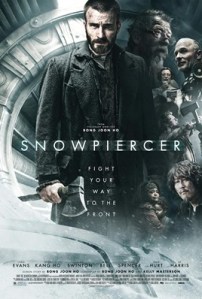
Saturday Matinee: Snowpiercer

Snowpiercer_poster

Snowpiercer (2013) is a film adaptation of French graphic novel Le Transperceneige by Jacques Lob and Jean-Marc Rochette directed by Bong Joon-ho (The Host, Mother, Haemoo). The majority of the movie takes place on a perpetually globe-spanning train containing the last surviving members of the human race after a geoengineering scheme creates an apocalyptic ice-age. Though the film has its share of plot holes (which become more apparent with repeat viewings), it remains the best cinematic metaphor for today’s dominant political/economic system. Snowpiercer also features outstanding performances from Chris Evans, Song Kang-ho, Tilda Swinton, Octavia Spencer, John Hurt, and Ed Harris among others.

Watch the full film here.

(Note: annoying pop-up ad windows may need to be closed after clicking the “play” button.)

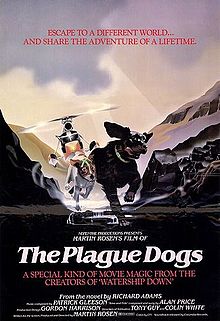
Saturday Matinee: The Plague Dogs

220px-Plaguedogsposter

Many of us may have read the Richard Adams book “Watership Down” or have seen the film adaptation, but less known is the film version of his even darker follow-up, “The Plague Dogs” (1982). Like a Disney film, it features anthropomorphized animals and lessons about friendship and courage, but less like Disney, it also has lessons about scientific cruelty, mass media hype, mental illness and mortality. Never in a Disney film would the protagonists be hunted by humans after narrowly escaping vivisection and possibly being exposed to bubonic plague, as happens to Rowf and Snitter, the main characters of The Plague Dogs. It’s an undeniably harrowing and sad story, but it’s also emotionally engaging, intelligent, unsentimental, and an underrated animated masterpiece.

Though The Plague Dogs may be suitable for some kids, it’s also for all film lovers because the artwork is beautiful and the voice acting is subtle yet emotive (especially the voice of John Hurt, who played Winston Smith two years later in a film version of “1984”). It even features a great theme song by Alan Price, former keyboardist for The Animals and best known by cult movie fans as the lead singer of the band featured in Lindsay Anderson’s “O Lucky Man”. Most importantly, The Plague Dog’s message of empathy and arguments for ethical considerations in science are as timely as ever.

If you’re interested in learning more about The Plague Dogs, I recommend this detailed review by the Film Walrus (though it’d be best to read only after watching the film as it reveals spoilers): http://www.filmwalrus.com/2008/08/review-of-plague-dogs.html