The Eurasian Big Bang

0-6-brics-staaten-wollen-in-ufa-engere-partnerschaft-vereinbaren.bffa6cfe

How China and Russia Are Running Rings Around Washington

By Pepe Escobar

Source: TomDispatch.com

The several hundred Republicans who have thrown their hats into the ring for the 2016 presidential race and the war hawks in Congress (mainly but hardly only Republicans) have already been in full howl about the Vienna nuclear deal with Iran. Jeb Bush took about two seconds to label it “appeasement,” instantly summoning up the image of British Prime Minister Neville Chamberlain giving in to Hitler before World War II; former Arkansas Governor Mike Huckabee spared no metaphor in labeling the agreement “a deal that empowers an evil Iranian regime to carry out its threat to ‘wipe Israel off the map’ and bring ‘death to America’”; Senator Lindsey Graham called it a “possible death sentence for Israel”; this year’s leading billionaire candidate, Donald Trump, summed up his opinion of the deal in one you’re-fired-style word, “ridiculous”; Senator John McCain described Secretary of State John Kerry, who negotiated the deal, as “delusional”; and Senator… I mean, Israeli Prime Minister Benjamin Netanyahu mockingly turned Chamberlain’s infamous “peace in our time” into “peace at any price,” dismissed the deal as a catastrophe filled with “absurdities,” and then appeared on every American media venue imaginable to denounce it.  And that’s just to start down the usual list of suspects. Even Senator Rand Paul swore he would vote against the agreement (though his father called it “to the benefit of world peace”), while Wisconsin Governor Scott Walker was typical of Republican presidential candidates in swearing that he would personally scuttle the deal on his first day in the Oval Office.

This, in short, is the mad version of international policy that makes Washington a claustrophobic echo chamber.  After all, the choice isn’t actually between Iran having no nuclear “breakout” capacity or regaining that capacity 15 years from now (as the present deal seems to offer); the choice is between an agreement for 15 verifiably non-weaponized years and a guarantee of nothing whatsoever.  And if you’ve just checked off that nothing-whatsoever column, the alternative is to somehow crush the Iranians, to force them into submission.  It is, in other words, some version of war.  Two questions on that: How successful has war in the Greater Middle East been as an American policy weapon these last 13 years?  And what makes anyone think that, when even Dick Cheney and crew couldn’t bring themselves to pull the trigger on Iran, Jeb B. or any of the other candidates will be likely to do so in an ISIS-enriched world in 2017?

When you’ve satisfied yourself on those two questions, consider the seldom-discussed larger context within which twenty-first-century nuclear politics has taken place.  In these last years, the Pakistanis, the Indians, the Russians, and the Americans, to name just four nuclear powers, have either been expanding or “modernizing” their nuclear stockpiles in significant ways.  And god knows what the Israelis were doing with their super-secret, never officially acknowledged, but potentially civilization-busting atomic arsenal of 80 or more weapons, while the North Koreans were turning themselves into a nuclear mini-power.  Nonetheless, the focus of nuclear attention and the question of “disarmament” has remained almost exclusively on a country that had no such weapons, has officially disavowed them, and at this point, at least, doesn’t even have a weapons program.  And note that no one who is anyone in Washington considers any of this the least bit strange.

In this context, that irrepressible TomDispatch regular Pepe Escobar offers another kind of lens-widening exercise when it comes to the Iranian deal.  He focuses on a subject that Washington has yet to fully absorb: changing relations in Eurasia.  Few here have noticed, but while the Vienna deal was being negotiated, Russia and China, countries the Pentagon has just officially labeled as “threats,” have been moving mountains (quite literally in some cases) to integrate ever larger parts of that crucial land mass, that “world island,” into a vast economic zone that, if all goes as they wish, will be beyond Washington’s power and control.  This is a remarkable development that, despite the coming two months of sound and fury about Iran, won’t be at the top of any news report, which is why you need a website like TomDispatch to keep up with the times. Tom

The Eurasian Big Bang 
How China and Russia Are Running Rings Around Washington
By Pepe Escobar

Let’s start with the geopolitical Big Bang you know nothing about, the one that occurred just two weeks ago. Here are its results: from now on, any possible future attack on Iran threatened by the Pentagon (in conjunction with NATO) would essentially be an assault on the planning of an interlocking set of organizations — the BRICS nations (Brazil, Russia, India, China, and South Africa), the SCO (Shanghai Cooperation Organization), the EEU (Eurasian Economic Union), the AIIB (the new Chinese-founded Asian Infrastructure Investment Bank), and the NDB (the BRICS’ New Development Bank) — whose acronyms you’re unlikely to recognize either.  Still, they represent an emerging new order in Eurasia.

Tehran, Beijing, Moscow, Islamabad, and New Delhi have been actively establishing interlocking security guarantees. They have been simultaneously calling the Atlanticist bluff when it comes to the endless drumbeat of attention given to the flimsy meme of Iran’s “nuclear weapons program.”  And a few days before the Vienna nuclear negotiations finally culminated in an agreement, all of this came together at a twin BRICS/SCO summit in Ufa, Russia — a place you’ve undoubtedly never heard of and a meeting that got next to no attention in the U.S.  And yet sooner or later, these developments will ensure that the War Party in Washington and assorted neocons (as well as neoliberalcons) already breathing hard over the Iran deal will sweat bullets as their narratives about how the world works crumble.

The Eurasian Silk Road

With the Vienna deal, whose interminable build-up I had the dubious pleasure of following closely, Iranian Foreign Minister Javad Zarif and his diplomatic team have pulled the near-impossible out of an extremely crumpled magician’s hat: an agreement that might actually end sanctions against their country from an asymmetric, largely manufactured conflict.

Think of that meeting in Ufa, the capital of Russia’s Bashkortostan, as a preamble to the long-delayed agreement in Vienna. It caught the new dynamics of the Eurasian continent and signaled the future geopolitical Big Bangness of it all. At Ufa, from July 8th to 10th, the 7th BRICS summit and the 15th Shanghai Cooperation Organization summit overlapped just as a possible Vienna deal was devouring one deadline after another.

Consider it a diplomatic masterstroke of Vladmir Putin’s Russia to have merged those two summits with an informal meeting of the Eurasian Economic Union (EEU). Call it a soft power declaration of war against Washington’s imperial logic, one that would highlight the breadth and depth of an evolving Sino-Russian strategic partnership. Putting all those heads of state attending each of the meetings under one roof, Moscow offered a vision of an emerging, coordinated geopolitical structure anchored in Eurasian integration. Thus, the importance of Iran: no matter what happens post-Vienna, Iran will be a vital hub/node/crossroads in Eurasia for this new structure.

If you read the declaration that came out of the BRICS summit, one detail should strike you: the austerity-ridden European Union (EU) is barely mentioned. And that’s not an oversight. From the point of view of the leaders of key BRICS nations, they are offering a new approach to Eurasia, the very opposite of the language of sanctions.

Here are just a few examples of the dizzying activity that took place at Ufa, all of it ignored by the American mainstream media. In their meetings, President Putin, China’s President Xi Jinping, and Indian Prime Minister Narendra Modi worked in a practical way to advance what is essentially a Chinese vision of a future Eurasia knit together by a series of interlocking “new Silk Roads.” Modi approved more Chinese investment in his country, while Xi and Modi together pledged to work to solve the joint border issues that have dogged their countries and, in at least one case, led to war.

The NDB, the BRICS’ response to the World Bank, was officially launched with $50 billion in start-up capital. Focused on funding major infrastructure projects in the BRICS nations, it is capable of accumulating as much as $400 billion in capital, according to its president, Kundapur Vaman Kamath. Later, it plans to focus on funding such ventures in other developing nations across the Global South — all in their own currencies, which means bypassing the U.S. dollar.  Given its membership, the NDB’s money will clearly be closely linked to the new Silk Roads. As Brazilian Development Bank President Luciano Coutinhostressed, in the near future it may also assist European non-EU member states like Serbia and Macedonia. Think of this as the NDB’s attempt to break a Brussels monopoly on Greater Europe. Kamath even advanced the possibility of someday aidingin the reconstruction of Syria.

You won’t be surprised to learn that both the new Asian Infrastructure Investment Bank and the NDB are headquartered in China and will work to complement each other’s efforts. At the same time, Russia’s foreign investment arm, the Direct Investment Fund (RDIF), signed a memorandum of understanding with funds from other BRICS countries and so launched an informal investment consortium in which China’s Silk Road Fund and India’s Infrastructure Development Finance Company will be key partners.

Full Spectrum Transportation Dominance

On the ground level, this should be thought of as part of the New Great Game in Eurasia. Its flip side is the Trans-Pacific Partnership in the Pacific and the Atlantic version of the same, the Transatlantic Trade and Investment Partnership, both of which Washington is trying to advance to maintain U.S. global economic dominance. The question these conflicting plans raise is how to integrate trade and commerce across that vast region. From the Chinese and Russian perspectives, Eurasia is to be integrated via a complex network of superhighways, high-speed rail lines, ports, airports, pipelines, and fiber optic cables. By land, sea, and air, the resulting New Silk Roads are meant to create an economic version of the Pentagon’s doctrine of “Full Spectrum Dominance” — a vision that already has Chinese corporate executives crisscrossing Eurasia sealing infrastructure deals.

For Beijing — back to a 7% growth rate in the second quarter of 2015 despite a recent near-panic on the country’s stock markets — it makes perfect economic sense: as labor costs rise, production will be relocated from the country’s Eastern seaboard to its cheaper Western reaches, while the natural outlets for the production of just about everything will be those parallel and interlocking “belts” of the new Silk Roads.

Meanwhile, Russia is pushing to modernize and diversify its energy-exploitation-dependent economy. Among other things, its leaders hope that the mix of those developing Silk Roads and the tying together of the Eurasian Economic Union — Russia, Armenia, Belarus, Kazakhstan, and Kyrgyzstan — will translate into myriad transportation and construction projects for which the country’s industrial and engineering know-how will prove crucial.

As the EEU has begun establishing free trade zones with India, Iran, Vietnam, Egypt, and Latin America’s Mercosur bloc (Argentina, Brazil, Paraguay, Uruguay, and Venezuela), the initial stages of this integration process already reach beyond Eurasia. Meanwhile, the SCO, which began as little more than a security forum, is expanding and moving into the field of economic cooperation.  Its countries, especially four Central Asian “stans” (Kazakhstan, Kyrgyzstan, Uzbekistan, and Tajikistan) will rely ever more on the Chinese-driven Asia Infrastructure Investment Bank (AIIB) and the NDB. At Ufa, India and Pakistan finalized an upgrading process in which they have moved from observers to members of the SCO. This makes it an alternative G8.

In the meantime, when it comes to embattled Afghanistan, the BRICS nations and the SCO have now called upon “the armed opposition to disarm, accept the Constitution of Afghanistan, and cut ties with Al-Qaeda, ISIS, and other terrorist organizations.” Translation: within the framework of Afghan national unity, the organization would accept the Taliban as part of a future government. Their hopes, with the integration of the region in mind, would be for a future stable Afghanistan able to absorb more Chinese, Russian, Indian, and Iranian investment, and the construction — finally! — of a long-planned, $10 billion, 1,420-kilometer-long Turkmenistan-Afghanistan-Pakistan-India (TAPI) gas pipeline that would benefit those energy-hungry new SCO members, Pakistan and India. (They would each receive 42% of the gas, the remaining 16% going to Afghanistan.)

Central Asia is, at the moment, geographic ground zero for the convergence of the economic urges of China, Russia, and India. It was no happenstance that, on his way to Ufa, Prime Minister Modi stopped off in Central Asia.  Like the Chinese leadership in Beijing, Moscow looks forward (as a recent document puts it) to the “interpenetration and integration of the EEU and the Silk Road Economic Belt” into a “Greater Eurasia” and a “steady, developing, safe common neighborhood” for both Russia and China.

And don’t forget Iran. In early 2016, once economic sanctions are fully lifted, it is expected to join the SCO, turning it into a G9. As its foreign minister, Javad Zarif, made clear recently to Russia’s Channel 1 television, Tehran considers the two countries strategic partners. “Russia,” he said, “has been the most important participant in Iran’s nuclear program and it will continue under the current agreement to be Iran’s major nuclear partner.” The same will, he added, be true when it comes to “oil and gas cooperation,” given the shared interest of those two energy-rich nations in “maintaining stability in global market prices.”

Got Corridor, Will Travel

Across Eurasia, BRICS nations are moving on integration projects. A developing Bangladesh-China-India-Myanmar economic corridor is a typical example. It is now being reconfigured as a multilane highway between India and China. Meanwhile, Iran and Russia are developing a transportation corridor from the Persian Gulf and the Gulf of Oman to the Caspian Sea and the Volga River. Azerbaijan will be connected to the Caspian part of this corridor, while India is planning to use Iran’s southern ports to improve its access to Russia and Central Asia. Now, add in a maritime corridor that will stretch from the Indian city of Mumbai to the Iranian port of Bandar Abbas and then on to the southern Russian city of Astrakhan. And this just scratches the surface of the planning underway.

Years ago, Vladimir Putin suggested that there could be a “Greater Europe” stretching from Lisbon, Portugal, on the Atlantic to the Russian city of Vladivostok on the Pacific. The EU, under Washington’s thumb, ignored him. Then the Chinese started dreaming about and planning new Silk Roads that would, in reverse Marco Polo fashion, extend from Shanghai to Venice (and then on to Berlin).

Thanks to a set of cross-pollinating political institutions, investment funds, development banks, financial systems, and infrastructure projects that, to date, remain largely under Washington’s radar, a free-trade Eurasian heartland is being born. It will someday link China and Russia to Europe, Southwest Asia, and even Africa. It promises to be an astounding development. Keep your eyes, if you can, on the accumulating facts on the ground, even if they are rarely covered in the American media. They represent the New Great — emphasis on that word — Game in Eurasia.

Location, Location, Location

Tehran is now deeply invested in strengthening its connections to this new Eurasia and the man to watch on this score is Ali Akbar Velayati. He is the head of Iran’s Center for Strategic Research and senior foreign policy adviser to Supreme Leader Ayatollah Khamenei. Velayati stresses that security in Asia, the Middle East, North Africa, Central Asia, and the Caucasus hinges on the further enhancement of a Beijing-Moscow-Tehran triple entente.

As he knows, geo-strategically Iran is all about location, location, location. That country offers the best access to open seas in the region apart from Russia and is the only obvious east-west/north-south crossroads for trade from the Central Asian “stans.” Little wonder then that Iran will soon be an SCO member, even as its “partnership” with Russia is certain to evolve. Its energy resources are already crucial to and considered a matter of national security for China and, in the thinking of that country’s leadership, Iran also fulfills a key role as a hub in those Silk Roads they are planning.

That growing web of literal roads, rail lines, and energy pipelines, asTomDispatch has previously reported, represents Beijing’s response to the Obama administration’s announced “pivot to Asia” and the U.S. Navy’s urge to meddle in the South China Sea. Beijing is choosing to project power via a vast set of infrastructure projects, especially high-speed rail lines that will reach from its eastern seaboard deep into Eurasia. In this fashion, the Chinese-built railway from Urumqi in Xinjiang Province to Almaty in Kazakhstan will undoubtedly someday be extended to Iran and traverse that country on its way to the Persian Gulf.

A New World for Pentagon Planners

At the St. Petersburg International Economic Forum last month, Vladimir Putin told PBS’s Charlie Rose that Moscow and Beijing had always wanted a genuine partnership with the United States, but were spurned by Washington. Hats off, then, to the “leadership” of the Obama administration. Somehow, it has managed to bring together two former geopolitical rivals, while solidifying their pan-Eurasian grand strategy.

Even the recent deal with Iran in Vienna is unlikely — especially given the war hawks in Congress — to truly end Washington’s 36-year-long Great Wall of Mistrust with Iran. Instead, the odds are that Iran, freed from sanctions, will indeed be absorbed into the Sino-Russian project to integrate Eurasia, which leads us to the spectacle of Washington’s warriors, unable to act effectively, yet screaming like banshees.

NATO’s supreme commander Dr. Strangelove, sorry, American General Philip Breedlove, insists that the West must create a rapid-reaction force — online — to counteract Russia’s “false narratives.” Secretary of Defense Ashton Carter claims to be seriously considering unilaterally redeploying nuclear-capable missiles in Europe. The nominee to head the Joint Chiefs of Staff, Marine Commandant Joseph Dunford, recently directly labeled Russia America’s true “existential threat”; Air Force General Paul Selva, nominated to be the new vice chairman of the Joint Chiefs, seconded that assessment, using the same phrase and putting Russia, China and Iran, in that order, as more threatening than the Islamic State (ISIS). In the meantime, Republican presidential candidates and a bevy of congressional war hawks simply shout and fume when it comes to both the Iranian deal and the Russians.

In response to the Ukrainian situation and the “threat” of a resurgent Russia (behind which stands a resurgent China), a Washington-centric militarization of Europe is proceeding apace. NATO is now reportedly obsessed with what’s being called “strategy rethink” — as in drawing up detailed futuristic war scenarios on European soil. As economist Michael Hudson has pointed out, even financial politics are becoming militarized and linked to NATO’s new Cold War 2.0.

In its latest National Military Strategy, the Pentagon suggests that the risk of an American war with another nation (as opposed to terror outfits), while low, is “growing” and identifies four nations as “threats”: North Korea, a case apart, and predictably the three nations that form the new Eurasian core: Russia, China, and Iran. They are depicted in the document as “revisionist states,” openly defying what the Pentagon identifies as “international security and stability”; that is, the distinctly un-level playing field created by globalized, exclusionary, turbo-charged casino capitalism and Washington’s brand of militarism.

The Pentagon, of course, does not do diplomacy. Seemingly unaware of the Vienna negotiations, it continued to accuse Iran of pursuing nuclear weapons. And that “military option” against Iran is never off the table.

So consider it the Mother of All Blockbusters to watch how the Pentagon and the war hawks in Congress will react to the post-Vienna and — though it was barely noticed in Washington — the post-Ufa environment, especially under a new White House tenant in 2017.

It will be a spectacle.  Count on it.  Will the next version of Washington try to make it up to “lost” Russia or send in the troops? Will it contain China or the “caliphate” of ISIS? Will it work with Iran to fight ISIS or spurn it? Will it truly pivot to Asia for good and ditch the Middle East or vice-versa? Or might it try to contain Russia, China, and Iran simultaneously or find some way to play them against each other?

In the end, whatever Washington may do, it will certainly reflect a fear of the increasing strategic depth Russia and China are developing economically, a reality now becoming visible across Eurasia. At Ufa, Putin told Xi on the record: “Combining efforts, no doubt we [Russia and China] will overcome all the problems before us.”

Read “efforts” as new Silk Roads, that Eurasian Economic Union, the growing BRICS block, the expanding Shanghai Cooperation Organization, those China-based banks, and all the rest of what adds up to the beginning of a new integration of significant parts of the Eurasian land mass. As for Washington, fly like an eagle? Try instead: scream like a banshee.

Pepe Escobar is the roving correspondent for Asia Times, an analyst for RTand Sputnik, and a TomDispatch regular. His latest book is Empire of Chaos. Follow him on Facebook by clicking here.

The Mess that Nuland Made

nolan

By Robert Parry

Source: Consortium News

As the Ukrainian army squares off against ultra-right and neo-Nazi militias in the west and violence against ethnic Russians continues in the east, the obvious folly of the Obama administration’s Ukraine policy has come into focus even for many who tried to ignore the facts, or what you might call “the mess that Victoria Nuland made.”

Assistant Secretary of State for European Affairs “Toria” Nuland was the “mastermind” behind the Feb. 22, 2014 “regime change” in Ukraine, plotting the overthrow of the democratically elected government of President Viktor Yanukovych while convincing the ever-gullible U.S. mainstream media that the coup wasn’t really a coup but a victory for “democracy.”

To sell this latest neocon-driven “regime change” to the American people, the ugliness of the coup-makers had to be systematically airbrushed, particularly the key role of neo-Nazis and other ultra-nationalists from the Right Sektor. For the U.S.-organized propaganda campaign to work, the coup-makers had to wear white hats, not brown shirts.

So, for nearly a year and a half, the West’s mainstream media, especially The New York Times and The Washington Post, twisted their reporting into all kinds of contortions to avoid telling their readers that the new regime in Kiev was permeated by and dependent on neo-Nazi fighters and Ukrainian ultra-nationalists who wanted a pure-blood Ukraine, without ethnic Russians.

Any mention of that sordid reality was deemed “Russian propaganda” and anyone who spoke this inconvenient truth was a “stooge of Moscow.” It wasn’t until July 7 that the Times admitted the importance of the neo-Nazis and other ultra-nationalists in waging war against ethnic Russian rebels in the east. The Times also reported that these far-right forces had been joined by Islamic militants. Some of those jihadists have been called “brothers” of the hyper-brutal Islamic State.

Though the Times sought to spin this remarkable military alliance – neo-Nazi militias and Islamic jihadists – as a positive, the reality had to be jarring for readers who had bought into the Western propaganda about noble “pro-democracy” forces resisting evil “Russian aggression.”

Perhaps the Times sensed that it could no longer keep the lid on the troubling truth in Ukraine. For weeks, the Right Sektor militias and the neo-Nazi Azov battalion have been warning the civilian government in Kiev that they might turn on it and create a new order more to their liking.

Clashes in the West

Then, on Saturday, violent clashes broke out in the western Ukrainian town of Mukachevo, allegedly over the control of cigarette-smuggling routes. Right Sektor paramilitaries sprayed police officers with bullets from a belt-fed machinegun, and police – backed by Ukrainian government troops – returned fire. Several deaths and multiple injuries were reported.

Tensions escalated on Monday with President Petro Poroshenko ordering national security forces to disarm “armed cells” of political movements. Meanwhile, the Right Sektor dispatched reinforcements to the area while other militiamen converged on the capital of Kiev.

While President Poroshenko and Right Sektor leader Dmitry Yarosh may succeed in tamping down this latest flare-up of hostilities, they may be only postponing the inevitable: a conflict between the U.S.-backed authorities in Kiev and the neo-Nazis and other right-wing fighters who spearheaded last year’s coup and have been at the front lines of the fighting against ethnic Russian rebels in the east.

The Ukrainian right-wing extremists feel they have carried the heaviest burden in the war against the ethnic Russians and resent the politicians living in the relative safety and comfort of Kiev. In March, Poroshenko also fired thuggish oligarch Igor Kolomoisky as governor of the southeastern province of Dnipropetrovsk Oblast. Kolomoisky had been the primary benefactor of the Right Sektor militias.

So, as has become apparent across Europe and even in Washington, the Ukraine crisis is spinning out of control, making the State Department’s preferred narrative of the conflict – that it’s all Russian President Vladimir Putin’s fault – harder and harder to sell.

How Ukraine is supposed to pull itself out of what looks like a death spiral – a possible two-front war in the east and the west along with a crashing economy – is hard to comprehend. The European Union, confronting budgetary crises over Greece and other EU members, has little money or patience for Ukraine, its neo-Nazis and its socio-political chaos.

America’s neocons at The Washington Post and elsewhere still rant about the need for the Obama administration to sink more billions upon billions of dollars into post-coup Ukraine because it “shares our values.” But that argument, too, is collapsing as Americans see the heart of a racist nationalism beating inside Ukraine’s new order.

Another Neocon ‘Regime Change’

Much of what has happened, of course, was predictable and indeed was predicted, but neocon Nuland couldn’t resist the temptation to pull off a “regime change” that she could call her own.

Her husband (and arch-neocon) Robert Kagan had co-founded the Project for the New American Century in 1998 around a demand for “regime change” in Iraq, a project that was accomplished in 2003 with President George W. Bush’s invasion.

As with Nuland in Ukraine, Kagan and his fellow neocons thought they could engineer an easy invasion of Iraq, oust Saddam Hussein and install some hand-picked client – in Iraq, Ahmed Chalabi was to be “the guy.” But they failed to take into account the harsh realities of Iraq, such as the fissures between Sunnis and Shiites, exposed by the U.S.-led invasion and occupation.

In Ukraine, Nuland and her neocon and liberal-interventionist friends saw the chance to poke Putin in the eye by encouraging violent protests to overthrow Russia-friendly President Yanukovych and put in place a new regime hostile to Moscow.

Carl Gershman, the neocon president of the U.S.-taxpayer-funded National Endowment for Democracy, explained the plan in a Post op-ed on Sept. 26, 2013. Gershman called Ukraine “the biggest prize” and an important interim step toward toppling Putin, who “may find himself on the losing end not just in the near abroad but within Russia itself.”

For her part, Nuland passed out cookies to anti-Yanukovych demonstrators at the Maidan square, reminded Ukrainian business leaders that the U.S. had invested $5 billion in their “European aspirations,” declared “fuck the EU” for its less aggressive approach, and discussed with U.S. Ambassador Geoffrey Pyatt who the new leaders of Ukraine should be. “Yats is the guy,” she said, referring to Arseniy Yatsenyuk.

Nuland saw her big chance on Feb. 20, 2014, when a mysterious sniper – apparently firing from a building controlled by the Right Sektor – shot and killed both police and protesters, escalating the crisis. On Feb. 21, in a desperate bid to avert more violence, Yanukovych agreed to a European-guaranteed plan in which he accepted reduced powers and called for early elections so he could be voted out of office.

But that wasn’t enough for the anti-Yanukovych forces who – led by Right Sektor and neo-Nazi militias – overran government buildings on Feb. 22, forcing Yanukovych and many of his officials to flee for their lives. With armed thugs patrolling the corridors of power, the final path to “regime change” was clear.

Instead of trying to salvage the Feb. 21 agreement, Nuland and European officials arranged for an unconstitutional procedure to strip Yanukovych of the presidency and declared the new regime “legitimate.” Nuland’s “guy” – Yatsenyuk – became prime minister.

While Nuland and her neocon cohorts celebrated, their “regime change” prompted an obvious reaction from Putin, who recognized the strategic threat that this hostile new regime posed to the historic Russian naval base at Sevastopol in Crimea. On Feb. 23, he began to take steps to protect those Russian interests.

Ethnic Hatreds

What the coup also did was revive long pent-up antagonisms between the ethnic Ukrainians in the west, including elements that had supported Adolf Hitler’s invasion of the Soviet Union during World War Two, and ethnic Russians in the south and east who feared the anti-Russian sentiments emanating from Kiev.

First, in Crimea and then in the so-called Donbas region, these ethnic Russians, who had been Yanukovych’s political base, resisted what they viewed as the illegitimate overthrow of their elected president. Both areas held referenda seeking separation from Ukraine, a move that Russia accepted in Crimea but resisted with the Donbas.

However, when the Kiev regime announced an “anti-terrorism operation” against the Donbas and dispatched neo-Nazi and other extremist militias to be the tip of the spear, Moscow began quietly assisting the embattled ethnic Russian rebels, a move that Nuland, the Obama administration and the mainstream news media called “Russian aggression.”

Amid the Western hysteria over Russia’s supposedly “imperial designs” and the thorough demonizing of Putin, President Barack Obama essentially authorized a new Cold War against Russia, reflected now in new U.S. strategic planning that could cost the U.S. taxpayers trillions of dollars and risk a possible nuclear confrontation.

Yet, despite the extraordinary costs and dangers, Nuland failed to appreciate the practical on-the-ground realities, much as her husband and other neocons did in Iraq. While Nuland got her hand-picked client Yatsenyuk installed and he did oversee a U.S.-demanded “neo-liberal” economic plan – slashing pensions, heating assistance and other social programs – the chaos that her “regime change” unleashed transformed Ukraine into a financial black hole.

With few prospects for a clear-cut victory over the ethnic Russian resistance in the east – and with the neo-Nazi/Islamist militias increasingly restless over the stalemate – the chances to restore any meaningful sense of order in the country appear remote. Unemployment is soaring and the government is essentially bankrupt.

The last best hope for some stability may have been the Minsk-2 agreement in February 2015, calling for a federalized system to give the Donbas more autonomy, but Nuland’s Prime Minister Yatsenyuk sabotaged the deal in March by inserting a poison pill that essentially demanded that the ethnic Russian rebels first surrender.

Now, the Ukraine chaos threatens to spiral even further out of control with the neo-Nazis and other right-wing militias – supplied with a bounty weapons to kill ethnic Russians in the east – turning on the political leadership in Kiev.

In other words, the neocons have struck again, dreaming up a “regime change” scheme that ignored practical realities, such as ethnic and religious fissures. Then, as the blood flowed and the suffering worsened, the neocons just sought out someone else to blame.

Thus, it seems unlikely that Nuland, regarded by some in Washington as the new “star” in U.S. foreign policy, will be fired for her dangerous incompetence, just as most neocons who authored the Iraq disaster remain “respected” experts employed by major think tanks, given prized space on op-ed pages, and consulted at the highest levels of the U.S. government.


[For more on these topics, see Consortiumnews.com’s “Obama’s True Foreign Policy Weakness” and “A Family Business of Perpetual War.”]

Investigative reporter Robert Parry broke many of the Iran-Contra stories for The Associated Press and Newsweek in the 1980s. You can buy his latest book, America’s Stolen Narrative, either in print here or as an e-book (from Amazon and barnesandnoble.com). You also can order Robert Parry’s trilogy on the Bush Family and its connections to various right-wing operatives for only $34. The trilogy includes America’s Stolen Narrative. For details on this offer, click here.


Hillary Clinton: The International Neocon Warmonger

06

By Webster G. Tarpley

Source: Voltaire.net

Hillary Clinton has announced her candidacy for President of the United States. While the European press showers her with praise without thinking, Webster G. Tarpley recalls her balance sheet: in all circumstances, she supported war and corporate interests.

As the National Journal reported in 2014, even the pathetically weak anti-war left is not ready to reconcile with Hillary given her warmongering as Secretary of State. And with good reason. Scratching just lightly beneath the surface of Hillary Clinton’s career reveals the empirical evidence of her historic support for aggressive interventions around the globe.

Beginning with Africa, Hillary defended the 1998 cruise missile strike on the El Shifa pharmaceutical plant in the Sudanese capital of Khartoum, destroying the largest producer of cheap medications for treating malaria and tuberculosis and provided over 60% of available medicine in Sudan. In 2006 she supported sending United Nations troops to Darfur with logistical and technical support provided by NATO forces. Libyan leader Moammar Qaddafi was outspoken in his condemnation of this intervention, claiming it was not committed out of concern for Sudanese people but “…for oil and for the return of colonialism to the African continent.”

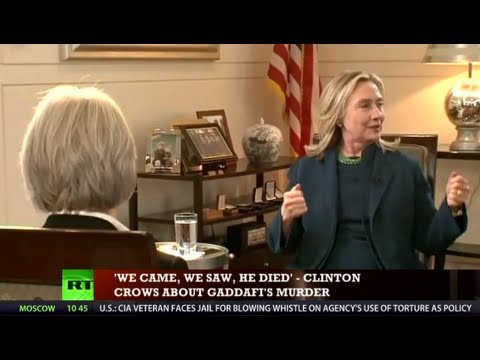
This is the same leader who was murdered in the aftermath of the 2011 NATO bombing of Libya; an attack promoted and facilitated with the eager support of Mrs. Clinton. In an infamous CBS news interview, said regarding this international crime: “We came, we saw, he died.” As Time magazine pointed out in 2011, the administration understood removing Qaddafi from power would allow the terrorist cells active in Libya to run rampant in the vacuum left behind. Just last month the New York Times reported that Libya has indeed become a terrorist safe haven and failed state— conducive for exporting radicals through “ratlines” to the conflict against Assad in Syria.

Hillary made prompt use of the ratlines for conflicts in the Middle East. In the summer of 2012, Clinton privately worked with then CIA director and subversive bonapartist David Petraeus on a proposal for providing arms and training to death squads to be used to topple Syria just as in Libya. This proposal was ultimately struck down by Obama, reported the New York Times in 2013, but constituted one of the earliest attempts at open military support for the Syrian death squads.

Her voting record on intervening in Afghanistan and Iraq is well known and she also has consistently called for attacking Iran. She even told Fareed Zakaria the State Department was involved “behind the scenes” in Iran’s failed 2009 Green Revolution. More recently in Foreign Policy magazine David Rothkopf wrote on the subject of the Lausanne nuclear accord, predicting a “snap-back” in policy by the winner of the 2016 election to the foreign policy in place since the 1980s. The title of this article? “Hillary Clinton is the Real Iran Snap-Back.” This makes Hillary the prime suspect for a return to the madcap Iranian policies that routinely threaten the world with a World War 3 scenario.

Hillary Clinton is not only actively aggressing against Africa and the Middle East. She was one of the loudest proponents against her husband’s hesitancy over the bombing of Kosovo, telling Lucina Frank: “I urged him to bomb,” even if it was a unilateral action.

While no Clinton spokesperson responded to a request by the Washington Free Beacon regarding her stance on Ukraine, in paid speeches she mentioned “putting more financial support into the Ukrainian government”. When Crimea decided to choose the Russian Federation over Poroshenko’s proto-fascist rump state, Hillary anachronistically called President Putin’s actions like “what Hitler did in the ‘30s.” As a leader of the bumbled ”reset” policy towards Russia, Hillary undoubtedly harbors some animus against Putin and will continue the destabilization project ongoing in Ukraine.

Not content with engaging in debacles in Eastern Europe, she has vocally argued for a more aggressive response to what she called the “rollback of democratic development and economic openness in parts of Latin America.” This indicates her willingness to allow the continuation of CIA sponsored efforts at South American destabilization in the countries of Venezuela, Bolivia, Ecuador, Argentina and Brazil.

It is one of the proud prerogatives of the Tax Wall Street Party to push out into the light the Wall Street and foundation-funded Democrats. The final blow to Hillary’s clumsy façade comes directly from arch-neocon Robert Kagan. Kagan worked as a foreign policy advisor to Hillary along with his wife, Ukraine madwoman Victoria Nuland, during Hillary’s term as Secretary of State. He claimed in the New York Times that his view of American foreign policy is best represented in the “mainstream” by the foreign policy of Hillary Clinton; a foreign policy he obviously manipulated or outright crafted. Kagan stated: “If she pursues a policy which we think she will pursue…it’s something that might have been called neocon, but clearly her supporters are not going to call it that; they are going to call it something else.” What further reason could any sane person need to refute Hillary? A vote for Hillary is a vote for the irrational return to war.

The “Giant Sucking Sound”: Clinton Gave US NAFTA and Other Free Trade Sellouts

“There is no success story for workers to be found in North America 20 years after NAFTA,” states AFL-CIO president Richard Trumka. Unlike other failures of his Presidency, Bill Clinton can not run from NAFTA. It was Vice President Al Gore, not a veto-proof Republican congress, who lobbied to remove trade barriers with low-wage Mexico.

The record of free trade is clear. Multinational corporations and Wall Street speculators realize incredible profits, wages remain stagnant in the US, poverty persists in the developing world, and the remaining industrial corporations in America and Canada are increasingly owned by Chinese, Indian and other foreign interests.

America’s free trade policy is upside down. Besides Canada, Australia and Korea, most of our “free” trade partners are low-wage sweatshop paradises like Mexico, Chile, Panama, Guatemala, Bahrain and Oman. The US does in fact apply tariffs on most goods and on most nations of origin – rates are set by the US International Trade Commission (USTIC), a quasi-public federal agency.

Since a German- or Japanese-made automobile would under USITC’s schedule be taxed 10% upon importation, Volkswagen and Toyota can circumvent taxation by simply building their auto assembly plants for the US market in Mexico. In Detroit, an auto assembly worker is paid between $14 and $28/hour, ($29,120-$58,240/yr); hard work for modest pay. In Mexico, the rate varies from $2-5/hour.

In China, all automobile imports regardless of origin are tariffed as high as 25%. This allows the Chinese to attract joint ventures with Volkswagen and Toyota, and to paraphrase Abraham Lincoln, “keep the jobs, the cars and the money.”

NAFTA-related job loss is not a question of productivity, currency manipulation, “fair trade,” environmental standards, etc. While these issues are not trivial, free trade – as Lincoln’s advisor Henry C. Carey proved – is a matter of simple accounting. Can an American family survive on $4,160/year ($2/hr)? If not, cars and their components will be built in Mexico. If we want cars built in the United States, the only solution is a general tariff (import tax) reflecting the difference between those wage standards, like the very tariffs repealed by Bill Clinton.

In the United States the “runaway shop” under NAFTA and CAFTA has sent trade deficits and unemployment soaring while wages drop relative to the cost of living. Yet Mexico and other “partners” receive no benefit either. Many manufacturing sectors in Mexico pay wages lower than the equivalent sector in China. Mexico is now the world leader in illegal narcotics exportation and weapons importation. The poverty level between 1994 and 2009 remained virtually identical. (52.4% – 52.3%). The shipping of raw materials to Mexico comprise the majority of so called American “exports”. The finished products from these exports are assembled and sold back to the United States at slave labor prices.

Don’t expect Hillary to behave differently with the coming “Trans-Pacific Partnership,” which seeks to replace an ascendant China with less-developed Vietnam and Malaysia. Vietnam would overtake India-allied Bangladesh in the global apparel trade, and Malaysia has a high-tech manufacturing sector poised to rival China’s. With America’s manufacturing economy in shambles, the Clinton machine can now be redirected to geopolitical maneuvers.


US War on ISIS a Trojan Horse

obama-isis-cia

In America’s coming war, don’t be surprised if everything in Syria is destroyed except ISIS.

By Ulson Gunnar

Source: Land Destroyer Report

In August of 2013, even as the words came out of US President Barack Obama’s mouth regarding an “impending” US military strike against the Syrian state, the impotence of American foreign policy loomed over him and those who wrote his speech for him like an insurmountable wall.  So absurd was America’s attempt to once again use the canard of “weapons of mass destruction” to justify yet another military intervention, that many believed America’s proxy war in Syria had finally reached its end.

The counterstroke by Russia included Syria’s immediate and unconditional surrendering of its chemical weapons arsenal, and with that, so evaporated America’s casus belli.

Few would believe if one told them then, that in 2015, that same discredited US would be routinely bombing Syrian territory and poised to justify the raising of an entire army of terrorists to wage war within Syria’s borders, yet that is precisely what is happening. President Obama has announced plans to formally increase military force in Iraq and Syria “against ISIS,” but of course includes building up huge armies of “rebels” who by all other accounts are as bad as ISIS itself (not to mention prone to joining ISIS’ ranks by the thousands).

All it took for this miraculous turn in fortune was the creation of “ISIS,” and serial provocations committed by these Hollywood-style villains seemingly engineered to reinvigorate America’s justification to militarily intervene more directly in a war it itself started in Syria beginning in 2011.

ISIS could not be a more effective part of America’s plans to overthrow the Syrian government and destroy the Syrian state if it had an office at the Pentagon.

Having failed to achieve any of its objectives in Syria, it inexplicably “invaded” Iraq, affording the US military a means of “easing into” the conflict by first confronting ISIS in Iraq, then following them back across the border into Syria. When this scheme began to lose its impact on public perception, ISIS first started executing Western hostages including several Americans. When the US needed the French on board, ISIS executed a Frenchman. When the US needed greater support in Asia, two Japanese were beheaded. And just ahead of President Obama’s recent attempt to formally authorize the use of military force against “ISIS,” a Jordanian pilot was apparently burned to death in a cage in an unprecedented act of barbarity that shocked even the most apathetic.

The theatrics of ISIS parallel those seen in a Hollywood production. This doesn’t mean ISIS didn’t really burn to death a Jordanian pilot or behead scores of hostages. But it does mean that a tremendous amount of resources and planning were put into each murder, except apparently, the effect it would have of rallying the world behind the US and its otherwise hopelessly stalled efforts to overturn the government of Syria.

Could ISIS have built a set specifically to capture dramatic shots like a flame trail passing the camera on its way to the doomed Jordanian pilot, planned crane shots, provided matching uniforms for all the extras on their diabolical movie set, but failed to consider the target audience and how they would react to their production? Could they have, just by coincidence, given exactly what the United States needed to continue its war on Syria in 2015 when it otherwise had effectively failed in 2013?

The answer is obviously no. ISIS’s theatrics were designed specifically to accomplish this. ISIS itself is a fictional creation. In reality the legions of terrorists fighting across the Arab World under the flag of “ISIS” are the same Al Qaeda militants the US, Saudi Arabia and others in an utterly unholy axis have been backing, arming and exploiting in a variety of ways for decades.

Just as the “Islamic State” in Iraq was exposed as a fictional cover for what was also essentially Al Qaeda (as reported by the NYT in their article, “Leader of Al Qaeda group in Iraq was fictional, U.S. military says“), ISIS too is just the latest and greatest re-visioning yet.

The fighters are real. Their atrocities are real. The notion that they’ve sprung out of the dunes of Syria and Iraq, picked their weapons from local date trees and have managed to wage war regionally against several collective armies is entirely fantasy. Required to maintain ISIS’ ranks would be billions in constant support. These are billions ISIS simply cannot account for from hostage ransoms and black market oil alone. The only source that could prop ISIS up for as long as it has allegedly existed and to the extent it allegedly exists, is a state or collection of states intentionally sponsoring the terrorist enterprise.

Those states are of course the chief benefactors of ISIS’ atrocities, and we can clearly see those benefactors are the US and its partners both in Europe and in the Middle East. The US would claim that the threat of ISIS necessitates them to intervene militarily in Syria (when lies about WMDs were flatly rejected by the American and international public). Of course, before the serial headline atrocities ISIS committed, the US attempted to sell this same lie but without affect. Now that sufficient blood has been split and the public sufficiently riled, the US is once again trying to move forward its agenda.

Don’t be surprised, if the US manages to succeed, that everything in Syria is left destroyed except for ISIS. A Hollywood villain this popular and effective is surely destined for a sequel in neighboring Iran or southern Russia, coincidentally where the US would like to create strife and carnage the most.

Ulson Gunnar, a New York-based geopolitical analyst and writer especially for the online magazine “New Eastern Outlook”.

The Matrix Is Real and How It Will Change All Of Our Lives

M3_Hugo_Weaving_003

By Paul Craig Roberts

Source: King World News

Americans are the most manipulated people in history. Since 2008, the economy has been manipulated for the benefit of a few oversized banks “too big to fail.” US foreign policy has been manipulated to serve the hegemonic agenda of a handful of neoconservatives. These manipulations have undercut the consumer basis of the US economy and have pushed the American people into a conflict situation with Russia and China.

Lies, US Economic Collapse And Nuclear War

US economic collapse and nuclear war are the two most likely outcomes of Washington’s manipulations of the American people. Time and again, the American public has fallen for transparent lies and orchestrated events. 2015 is a decisive year. Will a credulous people cast off their gullibility, or will they be swept away by economic collapse and war?

There are reasons to believe that the government’s manipulations have overreached and are crossing the point of believability, even on the part of credulous Americans. Let’s review some of these manipulations — first, economic, and then foreign policy.

Unemployment Number Is Meaningless

On January 9, the US government told Americans that the unemployment rate had fallen to a comforting 5.6 percent, an indication that the Federal Reserve’s policy of Quantitative Easing was successful in restoring the US economy. A 5.6 percent rate of unemployment suggests that Americans have a reasonable chance of finding a job. Yet we know there are millions of discouraged workers who have given up looking for a job.

The explanation of this paradox is that the 5.6 percent unemployment rate (U.3) does not include unemployed people who have not looked for a job in the previous four weeks. These unemployed are called “discouraged workers.” If they have been discouraged for less than one year, they are counted in a seldom-reported measure of unemployment (U.6). This rate stands at 11.2 percent, twice as high as the unemployment rate stressed by government and financial media.

The 11.2 percent rate is an official measure, but it is not publicized because it indicates a dismal employment outlook 5.5 years after the 2008 recession was declared over, in June 2009. What kind of recovery is it when the unemployment rate remains at 11.2 percent years after the recession has officially ended?

The Great Lie Exposed

The story worsens. The 11.2 percent rate does not include the millions of unemployed long-term discouraged workers (those discouraged for more than one year). Prior to 1994, the US Bureau of Labor Statistics counted the long-term discouraged as unemployed, and the government of Canada still does. John Williams (shadowstats.com) continues to include the long-term discouraged. When the long- term discouraged are added to the U.6 measure, the rate of unemployment again doubles, to 23 percent.

In other words, the actual unemployment rate is actually four times higher than the comforting figure released January 9.

Inflation Rate Also Falls Victim

The government engages in similar deception with the inflation rate. If the price of an item in the index rises, a lower-priced item is substituted, thus eliminating inflation by substitution. Inflation also is eliminated by redefining a price rise as a quality improvement.

By undercounting inflation, the government reports price increases as real economic growth, denies cost-of-living increases to Social Security recipients, and justifies paying savers negative real interest rates. These manipulations provide banks with free money, thus boosting bank profits while encouraging the stock market with “good news.”

Americans who search for jobs without success know other Americans in the same situation. As time passes, they learn from experience that the unemployment rate cannot be low and falling when jobs are harder to find. People who shop for food and pay utility bills know inflation is far higher than the government reports. Experience and the passage of time make the government’s numbers less and less believable.

Global Financial Markets Manipulated

The financial markets also are manipulated. To protect the dollar from declining in value due to its overproduction, the Federal Reserve’s bullion bank agents drive down the price of gold and silver by dumping uncovered shorts in the futures market. Since 2011, we have had the extraordinary situation in which the prices of gold and silver have been driven down despite strong demand and constraints on supply — a result that can be achieved only by manipulation in the futures market.

The dollar’s value also is manipulated by foreign central banks in cooperation with Washington. The Japanese and European central banks print yen and euros to protect the dollar’s exchange value. If all major currencies also are being printed, the dollar cannot decline.

The government’s Plunge Protection Team can prevent major stock-market corrections by stepping in and purchasing S&P futures, thus preventing the market’s overvaluation from bursting the bubble.

These manipulations are apparent to experienced investors. Sooner or later, attentive Americans will realize that the government’s deceit is not limited to the marketplace, but extends into foreign policy.

Fooled Over And Over Into War

Ever since the Clinton regime’s demonizations of Yugoslavia and Serbia, Americans have been deceived into supporting expensive wars and foreign-policy positions that are not in their interest. Washington’s demonizations of the Taliban, Osama bin Laden, Saddam Hussein, Gaddafi, Assad, Iran and of Muslims generally have resulted in 14 years of wars in which seven or eight countries have been invaded, bombed and attacked with drones. Increasingly, people at home and abroad understand these wars and bombings are based on lies and deceptions.

The destruction of countries and the massive human hurt happened because the US government lied and deceived.

There were no weapons of mass destruction in Iraq. Assad did not use chemical weapons in Syria. Gaddafi did not issue Viagra to his troops to assist in the rape of Libyan women. Iran does not have a nuclear- weapons program.

Millions of Muslims have been killed, maimed and dislocated by these wars, and tens of thousands of American soldiers have been killed and physically or psychologically maimed. The destruction of countries and the massive human hurt happened because the US government lied and deceived.

The most extraordinary aspect of the Charlie Hebdo event is that the French cartoonists are being championed in the name of free speech. Yet the Anglo-American world does not have free speech. Free speech, if it involves criticism or exposure of the government, is being redefined as “domestic extremism.” Criticism of Washington now implies that the critic is hostile to the public, a possible extremist who must be deterred before he inflicts harm on innocents. As Glenn Greenwald noted, try satirizing Israelis in the manner that Charlie Hebdo satirized Muslims, and you will find out how little free speech there is. http://bit.ly/1xYF93V Free speech is used to demonize Washington’s hand-picked enemies. That’s about as far as it goes.

Washington Demonizing Russia

As 2014 drew to a close, Washington was at work demonizing Russia and its president. Russia no more invaded Ukraine than Saddam Hussein had weapons of mass destruction. But despite years of experience with the government’s foreign-policy lies, polls show that more than 60 percent of the US population has fallen for Washington’s demonization of Russia.

We now have two decades of evidence that Washington uses demonization as a prelude to war. Russia and China, recognizing Washington’s intent to destabilize, have formed a strategic alliance. War with Russia and China would not be like war with Iraq and Libya, or drone attacks on Yemen and Pakistan. Unlike Saddam Hussein and Iran, Russia and China do have weapons of mass destruction — plenty of them.

Whereas Americans are not subject to any meaningful retaliation from Washington’s wars against Muslims, Washington’s aggressive warlike policy toward Russia and China, ringing both countries with military bases while demonizing both with false charges, threatens the life of every American and every person on earth. A threat of this magnitude could pull Americans out of their insouciance and force them to confront the government over its dangerous manipulations of public opinion.

Governments successful with their deceptions end up overreaching. The Charlie Hebdo affair possibly is an overreach. The Paris shootings have many characteristics of a false-flag operation. The attack on the cartoonists’ office was a disciplined professional attack associated with special forces; yet the suspects later corralled and killed seemed bumbling and unprofessional. It is like they were two different sets of people.

Is This Really The Official Story?

Muslim terrorists are usually prepared to die in the attack; yet the two professionals who hit Charlie Hebdo so hard escaped. Their identities were established by the unprofessional and unlikely act of leaving their identification in the getaway car. This reminds me of the undamaged passport miraculously found among the ruins of the two World Trade Center towers. The incriminating passport was the only undamaged item in the entire ruins and was the basis for identifying the 9/11 alleged hijackers.

It is a plausible inference that the ID left in the getaway car was the ID of one of the two brothers later killed by police, from whom we will never hear anything, and not the ID of the professionals who attacked Charlie Hebdo. An important fact that supports this inference is the report that the third suspect in the attack, Hamyd Mourad, the alleged driver of the getaway car, when seeing his name circulating on social media as a suspect, realized the danger he was in and quickly turned himself in to police for protection against being murdered by security forces as a terrorist.

Hamyd Mourad says he has an ironclad alibi. If so, this makes him the despoiler of a false-flag attack. If that is the case, he is likely to be coerced or tortured into some sort of confession to support the official story. http://bit.ly/1Aai8pJ

Mainstream Media Clueless

The American and European media have ignored this important story. I googled Hamyd Mourad and all I found (January 12) was the main US and European media reporting that the third suspect had turned himself in. The news was reported in a fashion that gave credence to the accusation that the suspect who turned himself in was part of the attack. Not a single US mainstream media source reported that the alleged suspect turned himself in because he had an ironclad alibi. The list of sources that reported Mourad’s turning himself in to police report in a way that can be read as confirmation of his guilt.

Some merely reported it in a headline with no coverage in the report. The list of those I googled includes:

• The Washington Post (January 7, by Griff Witte and Anthony Faiola)

• Die Welt (Germany), “One suspect has turned himself in to police in connection with Wednesday’s massacre at the offices of Parisian satirical magazine, Charlie Hebdo”

• ABC News (January 7), “Youngest suspect in Charlie Hebdo Attack turns himself in”

• CNN (January 8), “Citing sources, the Agence France Presse news agency reported that an 18-year- old suspect in the attack had surrendered to police.”

High-Ranking Police Official Suddenly Commits Suicide?

Another puzzle in the official story that remains unreported, according to my 6 p.m. Google search on January 12, is the alleged suicide of a high-ranking member of the French Judicial Police who had a lead role in the Charlie Hebdo investigation. For unknown reasons, a police official involved in the most important investigation of a lifetime decided to kill himself in his police office in the middle of the night while writing his report on his investigation. The alternative media reports it: http://bit.ly/1xc8W1W So did the UK Telegraph. But no suspicion is seen in the police official’s death, and as far as the US “presstitute” media is concerned, it did not happen. There are no reports, domestic or foreign, at the time of writing, about his death and whether his report has disappeared.

Media Cloaks The Lies And Crimes Of Government

As Gerald Celente has pointed out for years and as Patrick L. Smith writes in CounterPunch (Vol. 21, No. 10, 2014), the media serve as presstitutes. The media justify withholding information from the public on the basis of patriotism. Patriotism requires the media to support the government, not the truth. Patrick Smith quotes former New York Times editor Jill Abramson, who says in defense of the New York Times misleading the American people: “Journalists are Americans, too. I consider myself to be a patriot.” Of course, journalists lie to us because their careers are controlled by government and corporations dependent on government. Patriotism has little to do with it, but it serves as a cover. Patriotism is like “national security,” a cloak for the lies and crimes of government.

Life In The Matrix

Here we have it. The media lie to us because they are patriots. We believe the lies because we are patriots. More likely, the fact of the matter might be that both the media and the people are morally and spiritually corrupt.

In other words, we willfully live in The Matrix and are our own worst enemy.

The Victory of ‘Perception Management’

wpid-facebook_-1640825551

By Robert Parry

Source: Consortium News

To understand how the American people find themselves trapped in today’s Orwellian dystopia of endless warfare against an ever-shifting collection of “evil” enemies, you have to think back to the Vietnam War and the shock to the ruling elite caused by an unprecedented popular uprising against that war.

While on the surface Official Washington pretended that the mass protests didn’t change policy, a panicky reality existed behind the scenes, a recognition that a major investment in domestic propaganda would be needed to ensure that future imperial adventures would have the public’s eager support or at least its confused acquiescence.

This commitment to what the insiders called “perception management” began in earnest with the Reagan administration in the 1980s but it would come to be the accepted practice of all subsequent administrations, including the present one of President Barack Obama.

In that sense, propaganda in pursuit of foreign policy goals would trump the democratic ideal of an informed electorate. The point would be not to honestly inform the American people about events around the world but to manage their perceptions by ramping up fear in some cases and defusing outrage in others – depending on the U.S. government’s needs.

Thus, you have the current hysteria over Russia’s supposed “aggression” in Ukraine when the crisis was actually provoked by the West, including by U.S. neocons who helped create today’s humanitarian crisis in eastern Ukraine that they now cynically blame on Russian President Vladimir Putin.

Yet, many of these same U.S. foreign policy operatives – outraged over Russia’s limited intervention to protect ethic Russians in eastern Ukraine – are demanding that President Obama launch an air war against the Syrian military as a “humanitarian” intervention there.

In other words, if the Russians act to shield ethnic Russians on their border who are being bombarded by a coup regime in Kiev that was installed with U.S. support, the Russians are the villains blamed for the thousands of civilian deaths, even though the vast majority of the casualties have been inflicted by the Kiev regime from indiscriminate bombing and from dispatching neo-Nazi militias to do the street fighting.

In Ukraine, the exigent circumstances don’t matter, including the violent overthrow of the constitutionally elected president last February. It’s all about white hats for the current Kiev regime and black hats for the ethnic Russians and especially for Putin.

But an entirely different set of standards has applied to Syria where a U.S.-backed rebellion, which included violent Sunni jihadists from the start, wore the white hats and the relatively secular Syrian government, which has responded with excessive violence of its own, wears the black hats. But a problem to that neat dichotomy arose when one of the major Sunni rebel forces, the Islamic State, started seizing Iraqi territory and beheading Westerners.

Faced with those grisly scenes, President Obama authorized bombing the Islamic State forces in both Iraq and Syria, but neocons and other U.S. hardliners have been hectoring Obama to go after their preferred target, Syria’s President Bashar al-Assad, despite the risk that destroying the Syrian military could open the gates of Damascus to the Islamic State or al-Qaeda’s Nusra Front.

Lost on the Dark Side

You might think that the American public would begin to rebel against these messy entangling alliances with the 1984-like demonizing of one new “enemy” after another. Not only have these endless wars drained trillions of dollars from the U.S. taxpayers, they have led to the deaths of thousands of U.S. troops and to the tarnishing of America’s image from the attendant evils of war, including a lengthy detour into the “dark side” of torture, assassinations and “collateral” killings of children and other innocents.

But that is where the history of “perception management” comes in, the need to keep the American people compliant and confused. In the 1980s, the Reagan administration was determined to “kick the Vietnam Syndrome,” the revulsion that many Americans felt for warfare after all those years in the blood-soaked jungles of Vietnam and all the lies that clumsily justified the war.

So, the challenge for the U.S. government became: how to present the actions of “enemies” always in the darkest light while bathing the behavior of the U.S. “side” in a rosy glow. You also had to stage this propaganda theater in an ostensibly “free country” with a supposedly “independent press.”

From documents declassified or leaked over the past several decades, including an unpublished draft chapter of the congressional Iran-Contra investigation, we now know a great deal about how this remarkable project was undertaken and who the key players were.

Perhaps not surprisingly much of the initiative came from the Central Intelligence Agency, which housed the expertise for manipulating target populations through propaganda and disinformation. The only difference this time would be that the American people would be the target population.

For this project, Ronald Reagan’s CIA Director William J. Casey sent his top propaganda specialist Walter Raymond Jr. to the National Security Council staff to manage the inter-agency task forces that would brainstorm and coordinate this “public diplomacy” strategy.

Many of the old intelligence operatives, including Casey and Raymond, are now dead, but other influential Washington figures who were deeply involved by these strategies remain, such as neocon stalwart Robert Kagan, whose first major job in Washington was as chief of Reagan’s State Department Office of Public Diplomacy for Latin America.

Now a fellow at the Brookings Institution and a columnist at the Washington Post, Kagan remains an expert in presenting foreign policy initiatives within the “good guy/bad guy” frames that he learned in the 1980s. He is also the husband of Assistant Secretary of State for European Affairs Victoria Nuland, who oversaw the overthrow of Ukraine’s elected President Viktor Yanukovych last February amid a very effective U.S. propaganda strategy.

During the Reagan years, Kagan worked closely on propaganda schemes with Elliott Abrams, then the Assistant Secretary of State for Latin America. After getting convicted and then pardoned in the Iran-Contra scandal, Abrams reemerged on President George W. Bush’s National Security Council handling Middle East issues, including the Iraq War, and later “global democracy strategy.” Abrams is now a senior fellow at the Council on Foreign Relations.

These and other neocons were among the most diligent students learning the art of “perception management” from the likes of Raymond and Casey, but those propaganda skills have spread much more widely as “public diplomacy” and “information warfare” have now become an integral part of every U.S. foreign policy initiative.

A Propaganda Bureaucracy

Declassified documents now reveal how extensive Reagan’s propaganda project became with inter-agency task forces assigned to develop “themes” that would push American “hot buttons.” Scores of documents came out during the Iran-Contra scandal in 1987 and hundreds more are now available at the Reagan presidential library in Simi Valley, California.

What the documents reveal is that at the start of the Reagan administration, CIA Director Casey faced a daunting challenge in trying to rally public opinion behind aggressive U.S. interventions, especially in Central America. Bitter memories of the Vietnam War were still fresh and many Americans were horrified at the brutality of right-wing regimes in Guatemala and El Salvador, where Salvadoran soldiers raped and murdered four American churchwomen in December 1980.

The new leftist Sandinista government in Nicaragua also was not viewed with much alarm. After all, Nicaragua was an impoverished country of only about three million people who had just cast off the brutal dictatorship of Anastasio Somoza.

So, Reagan’s initial strategy of bolstering the Salvadoran and Guatemalan armies required defusing the negative publicity about them and somehow rallying the American people into supporting a covert CIA intervention inside Nicaragua via a counterrevolutionary force known as the Contras led by Somoza’s ex-National Guard officers.

Reagan’s task was made tougher by the fact that the Cold War’s anti-communist arguments had so recently been discredited in Vietnam. As deputy assistant secretary to the Air Force, J. Michael Kelly, put it, “the most critical special operations mission we have … is to persuade the American people that the communists are out to get us.”

At the same time, the White House worked to weed out American reporters who uncovered facts that undercut the desired public images. As part of that effort, the administration attacked New York Times correspondent Raymond Bonner for disclosing the Salvadoran regime’s massacre of about 800 men, women and children in the village of El Mozote in northeast El Salvador in December 1981. Accuracy in Media and conservative news organizations, such as The Wall Street Journal’s editorial page, joined in pummeling Bonner, who was soon ousted from his job.

But these were largely ad hoc efforts. A more comprehensive “public diplomacy” operation took shape beginning in 1982 when Raymond, a 30-year veteran of CIA clandestine services, was transferred to the NSC.

A slight, soft-spoken New Yorker who reminded some of a character from a John le Carré spy novel, Raymond was an intelligence officer who “easily fades into the woodwork,” according to one acquaintance. But Raymond would become the sparkplug for this high-powered propaganda network, according to a draft chapter of the Iran-Contra report.

Though the draft chapter didn’t use Raymond’s name in its opening pages, apparently because some of the information came from classified depositions, Raymond’s name was used later in the chapter and the earlier citations matched Raymond’s known role. According to the draft report, the CIA officer who was recruited for the NSC job had served as Director of the Covert Action Staff at the CIA from 1978 to 1982 and was a “specialist in propaganda and disinformation.”

“The CIA official [Raymond] discussed the transfer with [CIA Director] Casey and NSC Advisor William Clark that he be assigned to the NSC as [Donald] Gregg’s successor [as coordinator of intelligence operations in June 1982] and received approval for his involvement in setting up the public diplomacy program along with his intelligence responsibilities,” the chapter said.

“In the early part of 1983, documents obtained by the Select [Iran-Contra] Committees indicate that the Director of the Intelligence Staff of the NSC [Raymond] successfully recommended the establishment of an inter-governmental network to promote and manage a public diplomacy plan designed to create support for Reagan Administration policies at home and abroad.”

During his Iran-Contra deposition, Raymond explained the need for this propaganda structure, saying: “We were not configured effectively to deal with the war of ideas.”

One reason for this shortcoming was that federal law forbade taxpayers’ money from being spent on domestic propaganda or grassroots lobbying to pressure congressional representatives. Of course, every president and his team had vast resources to make their case in public, but by tradition and law, they were restricted to speeches, testimony and one-on-one persuasion of lawmakers.

But things were about to change. In a Jan. 13, 1983, memo, NSC Advisor Clark foresaw the need for non-governmental money to advance this cause. “We will develop a scenario for obtaining private funding,” Clark wrote. (Just five days later, President Reagan personally welcomed media magnate Rupert Murdoch into the Oval Office for a private meeting, according to records on file at the Reagan library.)

As administration officials reached out to wealthy supporters, lines against domestic propaganda soon were crossed as the operation took aim not only at foreign audiences but at U.S. public opinion, the press and congressional Democrats who opposed funding the Nicaraguan Contras.

At the time, the Contras were earning a gruesome reputation as human rights violators and terrorists. To change this negative perception of the Contras as well as of the U.S.-backed regimes in El Salvador and Guatemala, the Reagan administration created a full-blown, clandestine propaganda network.

In January 1983, President Reagan took the first formal step to create this unprecedented peacetime propaganda bureaucracy by signing National Security Decision Directive 77, entitled “Management of Public Diplomacy Relative to National Security.” Reagan deemed it “necessary to strengthen the organization, planning and coordination of the various aspects of public diplomacy of the United States Government.”

Reagan ordered the creation of a special planning group within the National Security Council to direct these “public diplomacy” campaigns. The planning group would be headed by the CIA’s Walter Raymond Jr. and one of its principal arms would be a new Office of Public Diplomacy for Latin America, housed at the State Department but under the control of the NSC.

CIA Taint

Worried about the legal prohibition barring the CIA from engaging in domestic propaganda, Raymond formally resigned from the CIA in April 1983, so, he said, “there would be no question whatsoever of any contamination of this.” But Raymond continued to act toward the U.S. public much like a CIA officer would in directing a propaganda operation in a hostile foreign country.

Raymond fretted, too, about the legality of Casey’s ongoing involvement. Raymond confided in one memo that it was important “to get [Casey] out of the loop,” but Casey never backed off and Raymond continued to send progress reports to his old boss well into 1986. It was “the kind of thing which [Casey] had a broad catholic interest in,” Raymond shrugged during his Iran-Contra deposition. He then offered the excuse that Casey undertook this apparently illegal interference in domestic politics “not so much in his CIA hat, but in his adviser to the president hat.”

As a result of Reagan’s decision directive, “an elaborate system of inter-agency committees was eventually formed and charged with the task of working closely with private groups and individuals involved in fundraising, lobbying campaigns and propagandistic activities aimed at influencing public opinion and governmental action,” the draft Iran-Contra chapter said. “This effort resulted in the creation of the Office of Public Diplomacy for Latin America and the Caribbean in the Department of State (S/LPD), headed by Otto Reich,” a right-wing Cuban exile from Miami.

Though Secretary of State George Shultz wanted the office under his control, President Reagan insisted that Reich “report directly to the NSC,” where Raymond oversaw the operations as a special assistant to the President and the NSC’s director of international communications, the chapter said.

“Reich relied heavily on Raymond to secure personnel transfers from other government agencies to beef up the limited resources made available to S/LPD by the Department of State,” the chapter said. “Personnel made available to the new office included intelligence specialists from the U.S. Air Force and the U.S. Army. On one occasion, five intelligence experts from the Army’s 4th Psychological Operations Group at Fort Bragg, North Carolina, were assigned to work with Reich’s fast-growing operation.”

A “public diplomacy strategy paper,” dated May 5, 1983, summed up the administration’s problem. “As far as our Central American policy is concerned, the press perceives that: the USG [U.S. government] is placing too much emphasis on a military solution, as well as being allied with inept, right-wing governments and groups. …The focus on Nicaragua [is] on the alleged U.S.-backed ‘covert’ war against the Sandinistas. Moreover, the opposition … is widely perceived as being led by former Somozistas.”

The administration’s difficulty with most of these press perceptions was that they were correct. But the strategy paper recommended ways to influence various groups of Americans to “correct” the impressions anyway, removing what another planning document called “perceptional obstacles.”

“Themes will obviously have to be tailored to the target audience,” the strategy paper said.

Casey’s Hand

As the Reagan administration struggled to manage public perceptions, CIA Director Casey kept his personal hand in the effort. On one muggy day in August 1983, Casey convened a meeting of Reagan administration officials and five leading ad executives at the Old Executive Office Building next to the White House to come up with ideas for selling Reagan’s Central American policies to the American people.

Earlier that day, a national security aide had warmed the P.R. men to their task with dire predictions that leftist governments would send waves of refugees into the United States and cynically flood America with drugs. The P.R. executives jotted down some thoughts over lunch and then pitched their ideas to the CIA director in the afternoon as he sat hunched behind a desk taking notes.

“Casey was kind of spearheading a recommendation” for better public relations for Reagan’s Central America policies, recalled William I. Greener Jr., one of the ad men. Two top proposals arising from the meeting were for a high-powered communications operation inside the White House and private money for an outreach program to build support for U.S. intervention.

The results from the discussions were summed up in an Aug. 9, 1983, memo written by Raymond who described Casey’s participation in the meeting to brainstorm how “to sell a ‘new product’ – Central America – by generating interest across-the-spectrum.”

In the memo to then-U.S. Information Agency director Charles Wick, Raymond also noted that “via Murdock [sic] may be able to draw down added funds” to support pro-Reagan initiatives. Raymond’s reference to Rupert Murdoch possibly drawing down “added funds” suggests that the right-wing media mogul had been recruited to be part of the covert propaganda operation. During this period, Wick arranged at least two face-to-face meetings between Murdoch and Reagan.

In line with the clandestine nature of the operation, Raymond also suggested routing the “funding via Freedom House or some other structure that has credibility in the political center.” (Freedom House would later emerge as a principal beneficiary of funding from the National Endowment for Democracy, which was also created under the umbrella of Raymond’s operation.)

As the Reagan administration pushed the envelope on domestic propaganda, Raymond continued to worry about Casey’s involvement. In an Aug. 29, 1983, memo, Raymond recounted a call from Casey pushing his P.R. ideas. Alarmed at a CIA director participating so brazenly in domestic propaganda, Raymond wrote that “I philosophized a bit with Bill Casey (in an effort to get him out of the loop)” but with little success.

Meanwhile, Reich’s Office of Public Diplomacy for Latin America (S/LPD) proved extremely effective in selecting “hot buttons” that would anger Americans about the Sandinistas. He also browbeat news correspondents who produced stories that conflicted with the administration’s “themes.” Reich’s basic M.O. was to dispatch his propaganda teams to lobby news executives to remove or punish out-of-step reporters – with a disturbing degree of success. Reich once bragged that his office “did not give the critics of the policy any quarter in the debate.”

Another part of the office’s job was to plant “white propaganda” in the news media through op-eds secretly financed by the government. In one memo, Jonathan Miller, a senior public diplomacy official, informed White House aide Patrick Buchanan about success placing an anti-Sandinista piece in The Wall Street Journal’s friendly pages. “Officially, this office had no role in its preparation,” Miller wrote.

Other times, the administration put out “black propaganda,” outright falsehoods. In 1983, one such theme was designed to anger American Jews by portraying the Sandinistas as anti-Semitic because much of Nicaragua’s small Jewish community fled after the revolution in 1979.

However, the U.S. embassy in Managua investigated the charges and “found no verifiable ground on which to accuse the GRN [the Sandinista government] of anti-Semitism,” according to a July 28, 1983, cable. But the administration kept the cable secret and pushed the “hot button” anyway.

Black Hats/White Hats

Repeatedly, Raymond lectured his subordinates on the chief goal of the operation: “in the specific case of Nica[ragua], concentrate on gluing black hats on the Sandinistas and white hats on UNO [the Contras’ United Nicaraguan Opposition].” So Reagan’s speechwriters dutifully penned descriptions of Sandinista-ruled Nicaragua as a “totalitarian dungeon” and the Contras as the “moral equivalent of the Founding Fathers.”

As one NSC official told me, the campaign was modeled after CIA covert operations abroad where a political goal is more important than the truth. “They were trying to manipulate [U.S.] public opinion … using the tools of Walt Raymond’s trade craft which he learned from his career in the CIA covert operation shop,” the official admitted.

Another administration official gave a similar description to The Miami Herald’s Alfonso Chardy. “If you look at it as a whole, the Office of Public Diplomacy was carrying out a huge psychological operation, the kind the military conduct to influence the population in denied or enemy territory,” that official explained. [For more details, see Parry’s Lost History.]

Another important figure in the pro-Contra propaganda was NSC staffer Oliver North, who spent a great deal of his time on the Nicaraguan public diplomacy operation even though he is better known for arranging secret arms shipments to the Contras and to Iran’s radical Islamic government, leading to the Iran-Contra scandal.

The draft Iran-Contra chapter depicted a Byzantine network of contract and private operatives who handled details of the domestic propaganda while concealing the hand of the White House and the CIA. “Richard R. Miller, former head of public affairs at AID, and Francis D. Gomez, former public affairs specialist at the State Department and USIA, were hired by S/LPD through sole-source, no-bid contracts to carry out a variety of activities on behalf of the Reagan administration policies in Central America,” the chapter said.

“Supported by the State Department and White House, Miller and Gomez became the outside managers of [North operative] Spitz Channel’s fundraising and lobbying activities. They also served as the managers of Central American political figures, defectors, Nicaraguan opposition leaders and Sandinista atrocity victims who were made available to the press, the Congress and private groups, to tell the story of the Contra cause.”

Miller and Gomez facilitated transfers of money to Swiss and offshore banks at North’s direction, as they “became the key link between the State Department and the Reagan White House with the private groups and individuals engaged in a myriad of endeavors aimed at influencing the Congress, the media and public opinion,” the chapter said.

The Iran-Contra draft chapter also cited a March 10, 1985, memo from North describing his assistance to CIA Director Casey in timing disclosures of pro-Contra news “aimed at securing Congressional approval for renewed support to the Nicaraguan Resistance Forces.”

The chapter added: “Casey’s involvement in the public diplomacy effort apparently continued throughout the period under investigation by the Committees,” including a 1985 role in pressuring Congress to renew Contra aid and a 1986 hand in further shielding the Office of Public Diplomacy for Latin America from the oversight of Secretary Shultz.

A Raymond-authored memo to Casey in August 1986 described the shift of the S/LPD office – where Robert Kagan had replaced Reich – to the control of the Bureau of Inter-American Affairs, which was headed by Assistant Secretary of State Elliott Abrams, who had tapped Kagan for the public diplomacy job.

Even after the Iran-Contra scandal unraveled in 1986-87 and Casey died of brain cancer on May 6, 1987, the Republicans fought to keep secret the remarkable story of the public diplomacy apparatus. As part of a deal to get three moderate Republican senators to join Democrats in signing the Iran-Contra majority report, Democratic leaders agreed to drop the draft chapter detailing the CIA’s domestic propaganda role (although a few references were included in the executive summary). But other Republicans, including Rep. Dick Cheney, still issued a minority report defending broad presidential powers in foreign affairs.

Thus, the American people were spared the chapter’s troubling conclusion: that a secret propaganda apparatus had existed, run by “one of the CIA’s most senior specialists, sent to the NSC by Bill Casey, to create and coordinate an inter-agency public-diplomacy mechanism [which] did what a covert CIA operation in a foreign country might do. [It] attempted to manipulate the media, the Congress and public opinion to support the Reagan administration’s policies.”

Kicking the Vietnam Syndrome

The ultimate success of Reagan’s propaganda strategy was affirmed during the tenure of his successor, George H.W. Bush, when Bush ordered a 100-hour ground war on Feb. 23, 1991, to oust Iraqi troops from Kuwait, which had been invaded the previous August.

Though Iraqi dictator Saddam Hussein had long been signaling a readiness to withdraw – and Soviet President Mikhail Gorbachev had negotiated a withdrawal arrangement that even had the blessings of top U.S. commanders in the field – President Bush insisted on pressing ahead with the ground attack.

Bush’s chief reason was that he – and his Defense Secretary Dick Cheney – saw the assault against Iraq’s already decimated forces as an easy victory, one that would demonstrate America’s new military capacity for high-tech warfare and would cap the process begun a decade earlier to erase the Vietnam Syndrome from the minds of average Americans.

Those strategic aspects of Bush’s grand plan for a “new world order” began to emerge after the U.S.-led coalition started pummeling Iraq with air strikes in mid-January 1991. The bombings inflicted severe damage on Iraq’s military and civilian infrastructure and slaughtered a large number of non-combatants, including the incineration of some 400 women and children in a Baghdad bomb shelter on Feb. 13. [For details, see Consortiumnews.com’s “Recalling the Slaughter of Innocents.”]

The air war’s damage was so severe that some world leaders looked for a way to end the carnage and arrange Iraq’s departure from Kuwait. Even senior U.S. military field commanders, such as Gen. Norman Schwarzkopf, looked favorably on proposals for sparing lives.

But Bush was fixated on a ground war. Though secret from the American people at that time, Bush had long determined that a peaceful Iraqi withdrawal from Kuwait would not be allowed. Indeed, Bush was privately fearful that the Iraqis might capitulate before the United States could attack.

At the time, conservative columnists Rowland Evans and Robert Novak were among the few outsiders who described Bush’s obsession with exorcising the Vietnam Syndrome. On Feb. 25, 1991, they wrote that the Gorbachev initiative brokering Iraq’s surrender of Kuwait “stirred fears” among Bush’s advisers that the Vietnam Syndrome might survive the Gulf War.

“There was considerable relief, therefore, when the President … made clear he was having nothing to do with the deal that would enable Saddam Hussein to bring his troops out of Kuwait with flags flying,” Evans and Novak wrote. “Fear of a peace deal at the Bush White House had less to do with oil, Israel or Iraqi expansionism than with the bitter legacy of a lost war. ‘This is the chance to get rid of the Vietnam Syndrome,’ one senior aide told us.”

In the 1999 book, Shadow, author Bob Woodward confirmed that Bush was adamant about fighting a war, even as the White House pretended it would be satisfied with an unconditional Iraqi withdrawal. “We have to have a war,” Bush told his inner circle of Secretary of State James Baker, national security adviser Brent Scowcroft and Gen. Colin Powell, according to Woodward.

“Scowcroft was aware that this understanding could never be stated publicly or be permitted to leak out. An American president who declared the necessity of war would probably be thrown out of office. Americans were peacemakers, not warmongers,” Woodward wrote.

The Ground War

However, the “fear of a peace deal” resurfaced in the wake of the U.S.-led bombing campaign. Soviet diplomats met with Iraqi leaders who let it be known that they were prepared to withdraw their troops from Kuwait unconditionally.

Learning of Gorbachev’s proposed settlement, Schwarzkopf also saw little reason for U.S. soldiers to die if the Iraqis were prepared to withdraw and leave their heavy weapons behind. There was also the prospect of chemical warfare that the Iraqis might use against advancing American troops. Schwarzkopf saw the possibility of heavy U.S. casualties.

But Gorbachev’s plan was running into trouble with President Bush and his political subordinates who wanted a ground war to crown the U.S. victory. Schwarzkopf reached out to Gen. Powell, chairman of the Joint Chiefs of Staff, to make the case for peace with the President.

On Feb. 21, 1991, the two generals hammered out a cease-fire proposal for presentation to the NSC. The peace deal would give Iraqi forces one week to march out of Kuwait while leaving their armor and heavy equipment behind. Schwarzkopf thought he had Powell’s commitment to pitch the plan at the White House.

But Powell found himself caught in the middle. He wanted to please Bush while still representing the concerns of the field commanders. When Powell arrived at the White House late on the evening of Feb. 21, he found Bush angry about the Soviet peace initiative. Still, according to Woodward’s Shadow, Powell reiterated that he and Schwarzkopf “would rather see the Iraqis walk out than be driven out.”

In My American Journey, Powell expressed sympathy for Bush’s predicament. “The President’s problem was how to say no to Gorbachev without appearing to throw away a chance for peace,” Powell wrote. “I could hear the President’s growing distress in his voice. ‘I don’t want to take this deal,’ he said. ‘But I don’t want to stiff Gorbachev, not after he’s come this far with us. We’ve got to find a way out’.”

Powell sought Bush’s attention. “I raised a finger,” Powell wrote. “The President turned to me. ‘Got something, Colin?’,” Bush asked. But Powell did not outline Schwarzkopf’s one-week cease-fire plan. Instead, Powell offered a different idea intended to make the ground offensive inevitable.

“We don’t stiff Gorbachev,” Powell explained. “Let’s put a deadline on Gorby’s proposal. We say, great idea, as long as they’re completely on their way out by, say, noon Saturday,” Feb. 23, less than two days away.

Powell understood that the two-day deadline would not give the Iraqis enough time to act, especially with their command-and-control systems severely damaged by the air war. The plan was a public-relations strategy to guarantee that the White House got its ground war. “If, as I suspect, they don’t move, then the flogging begins,” Powell told a gratified president.

The next day, at 10:30 a.m., a Friday, Bush announced his ultimatum. There would be a Saturday noon deadline for the Iraqi withdrawal, as Powell had recommended. Schwarzkopf and his field commanders in Saudi Arabia watched Bush on television and immediately grasped its meaning.

“We all knew by then which it would be,” Schwarzkopf wrote. “We were marching toward a Sunday morning attack.”

When the Iraqis predictably missed the deadline, American and allied forces launched the ground offensive at 0400 on Feb. 24, Persian Gulf time.

Though Iraqi forces were soon in full retreat, the allies pursued and slaughtered tens of thousands of Iraqi soldiers in the 100-hour war. U.S. casualties were light, 147 killed in combat and another 236 killed in accidents or from other causes. “Small losses as military statistics go,” wrote Powell, “but a tragedy for each family.”

On Feb. 28, the day the war ended, Bush celebrated the victory. “By God, we’ve kicked the Vietnam Syndrome once and for all,” the President exulted, speaking to a group at the White House. [For more details, see Robert Parry’s Secrecy & Privilege.]

So as not to put a damper on the post-war happy feelings, the U.S. news media decided not to show many of the grisliest photos, such as charred Iraqi soldiers ghoulishly still seated in their burned-out trucks where they had been incinerated while trying to flee. By that point, U.S. journalists knew it wasn’t smart for their careers to present a reality that didn’t make the war look good.

Enduring Legacy

Though Reagan’s creation of a domestic propaganda bureaucracy began more than three decades ago – and Bush’s vanquishing of the Vietnam Syndrome was more than two decades ago – the legacy of those actions continue to reverberate today in how the perceptions of the American people are now routinely managed. That was true during last decade’s Iraq War and this decade’s conflicts in Libya, Syria and Ukraine as well as the economic sanctions against Iran and Russia.

Indeed, while the older generation that pioneered these domestic propaganda techniques has passed from the scene, many of their protégés are still around along with some of the same organizations. The National Endowment for Democracy, which was formed in 1983 under the supervision of Walter Raymond’s NSC operation, is still run by the same neocon, Carl Gershman, and has an even bigger budget, now exceeding $100 million a year.

Gershman and his NED played important behind-the-scenes roles in instigating the Ukraine crisis by financing activists, journalists and other operatives who supported the coup against elected President Yanukovych. The NED-backed Freedom House also beat the propaganda drums. [See Consortiumnews.com’s “A Shadow Foreign Policy.”]

Two other Reagan-era veterans, Elliott Abrams and Robert Kagan, have both provided important intellectual support for continuing U.S. interventionism around the world. Earlier this year, Kagan’s article for The New Republic, entitled “Superpowers Don’t Get to Retire,” touched such a raw nerve with President Obama that he hosted Kagan at a White House lunch and crafted the presidential commencement speech at West Point to deflect some of Kagan’s criticism of Obama’s hesitancy to use military force.

A New York Times article about Kagan’s influence over Obama reported that Kagan’s wife, Assistant Secretary of State Victoria Nuland, apparently had a hand in crafting the attack on her ostensible boss, President Obama.

According to the Times article, the husband-and-wife team share both a common world view and professional ambitions, Nuland editing Kagan’s articles and Kagan “not permitted to use any official information he overhears or picks up around the house” – a suggestion that Kagan’s thinking at least may be informed by foreign policy secrets passed on by his wife.

Though Nuland wouldn’t comment specifically on Kagan’s attack on President Obama, she indicated that she holds similar views. “But suffice to say,” Nuland said, “that nothing goes out of the house that I don’t think is worthy of his talents. Let’s put it that way.”

Misguided Media

In the three decades since Reagan’s propaganda machine was launched, the American press corps also has fallen more and more into line with an aggressive U.S. government’s foreign policy strategies. Those of us in the mainstream media who resisted the propaganda pressures mostly saw our careers suffer while those who played along moved steadily up the ranks into positions of more money and more status.

Even after the Iraq War debacle when nearly the entire mainstream media went with the pro-invasion flow, there was almost no accountability for that historic journalistic failure. Indeed, the neocon influence at major newspapers, such as the Washington Post and the New York Times, only has solidified since.

Today’s coverage of the Syrian civil war or the Ukraine crisis is so firmly in line with the State Department’s propaganda “themes” that it would put smiles on the faces of William Casey and Walter Raymond if they were around today to see how seamlessly the “perception management” now works. There’s no need any more to send out “public diplomacy” teams to bully editors and news executives. Everyone is already onboard.

Rupert Murdoch’s media empire is bigger than ever, but his neocon messaging barely stands out as distinctive, given how the neocons also have gained control of the editorial and foreign-reporting sections of the Washington Post, the New York Times and virtually every other major news outlet. For instance, the demonizing of Russian President Putin is now so total that no honest person could look at those articles and see anything approaching objective or evenhanded journalism. Yet, no one loses a job over this lack of professionalism.

The Reagan administration’s dreams of harnessing private foundations and non-governmental organizations have also come true. The Orwellian circle has been completed with many American “anti-war” groups advocating for “humanitarian” wars in Syria and other countries targeted by U.S. propaganda. [See Consortiumnews.com’s “Selling ‘Peace Groups’ on US-Led Wars.”]

Much as Reagan’s “public diplomacy” apparatus once sent around “defectors” to lambaste Nicaragua’s Sandinistas by citing hyped-up human rights violations now the work is done by NGOs with barely perceptible threads back to the U.S. government. Just as Freedom House had “credibility” in the 1980s because of its earlier reputation as a human rights group, now other groups carrying the “human rights” tag, such as Human Rights Watch, are in the forefront of urging U.S. military interventions based on murky or propagandistic claims. [See Consortiumnews.com’s “The Collapsing Syria-Sarin Case.”]

At this advanced stage of America’s quiet surrender to “perception management,” it is even hard to envision how one could retrace the many steps that would lead back to the concept of a democratic Republic based on an informed electorate. Many on the American Right remain entranced by the old propaganda theme about the “liberal media” and still embrace Reagan as their beloved icon. Meanwhile, many liberals can’t break away from their own wistful trust in the New York Times and their empty hope that the media really is “liberal.”

To confront the hard truth is not easy. Indeed, in this case, it can cause despair because there are so few voices to trust and they are easily drowned out by floods of disinformation that can come from any angle – right, left or center. Yet, for the American democratic Republic to reset its goal toward an informed electorate, there is no option other than to build institutions that are determinedly committed to the truth.

Investigative reporter Robert Parry broke many of the Iran-Contra stories for The Associated Press and Newsweek in the 1980s. You can buy his latest book, America’s Stolen Narrative, either in print here or as an e-book (from Amazon and barnesandnoble.com). You also can order Robert Parry’s trilogy on the Bush Family and its connections to various right-wing operatives for only $34. The trilogy includes America’s Stolen Narrative. For details on this offer, click here.

A Gloomy Summary of the Outgoing Year

index

By Vladimir Mashin

Source: New Eastern Outlook

The outgoing 2014 is destined, apparently, to go down in the annals of history as a special year given its share of iconic dates (note, for example, 100 years since WWI and 75 years since WWII, 25 years since the fall of the Berlin Wall), and due to abundance of events having worldwide significance.

Today the mankind is on the verge of epochal changes in its history, which will determine the course of the world development for decades to come. 2014 was a turning point in international relations, sharply denoting the main trend of our time – the reconfiguration of the entire world system, reformatting of global structures, the shift from a unipolar to a polycentric world in which decisions on key issues should be based on cooperation and agreements between states and their associations, relying on equal participation and consideration of the interests of the whole mankind. And the contours of this world are now visible.

On the surface, these processes take the form of a deep civilizational and geopolitical fault.

There is a weakening of the position of the United States and the West in general as the center of gravity of the world. Many European political scientists and world known academics speak explicitly about the decline of the Western civilization. European nations are homogeneous, and the continual rise of immigration in recent decades has in fact already changed the ethnic composition of the Old World. Europe found itself unable to integrate the Muslim minority, which is already more than 30 million people, but it is also unable, due to the declining population and its aging, to maintain the current standard of living and the rate of production growth without an influx of the young foreign workforce.

The European sub-ethnic group has entered the phase of obscuration and is on the verge of (according to the criteria of historical time) being absorbed by new, emerging and already prominently visible types (of sub-ethnic groups). This is the Asian sub-ethnic group – a synthesis of several types of cultures and religions. By 2020, experts anticipate a rise of the African sub-ethnic group. In the Western Hemisphere the Hispanic sub-ethnic group is being created on the basis of a huge diversity of ethnic groups and beliefs.

These processes are to a large extent objective: for example, the outgoing year marked the emergence of China as an economic leader (China surpassed the United States in its purchasing power parity in 2014).

If the current trend continues, the “third world”, which today by population surpasses the West five times, by 2050 will surpass it ten-fold.

The reformatting of international relations will further continue. China proposed the following definition for this process: construction of a new non-American world.

In 2014 the US administration, giving itself the status of a self-proclaimed “exceptional nation” entitled to lead world processes, in fact launched a war for the world domination using the NATO military force in conjunction with new methods of disinformation and media control. (This has already occurred in history three-quarters of a century ago, when Germany tried to become a superpower promoting the “Aryan supremacy” with a reliance on military force and Goebbels propaganda). This manifested itself in successive waves of the NATO expansion, contrary to assurances given at the highest level, and in violation of a solemn declaration on the establishment of an equal and indivisible security system in the Euro-Atlantic area. By this logic, the Anschluss of 2014 is a large-scale operation by the US State Department to subjugate the European Union, and then, with combined forces, to launch an attack on the East – stubborn, but temptingly rich with its natural resources and human potential.

The Ukrainian crisis was the result of the policy pursued by the United States and Western countries during the last quarter-century of controlled expansion of their geopolitical space, strengthening their own security at the expense of others. Washington took a line on the separation of Ukraine from Russia and dragging it into the NATO. With the support of the United States and some European countries an armed anti-constitutional coup was carried out in Ukraine. Radical nationalists put the country on the brink of a schism and pushed it into a civil war that has taken thousands of lives and led to the horrible devastation turning into a tragedy for hundreds of thousands of civilians.

In a way, the EU is solving its own problems by capturing Ukrainian markets in order to prevent the collapse of its own integration scheme which had failed the test posed by the protracted economic crisis, since Ukraine, with its 46 million people, black earth, metallurgy and engineering, can reanimate Europe going through a systemic crisis.

The Ukrainian crisis is not a simple episode – it reflects a deep civilizational fault, which has ripped across all continents. The already complex and tense situation is further aggravated, poisoned by provocative, negatively charged statements of certain Western officials.

The Western attempt to tear Ukraine away from Russia and drag it to its side has only further exacerbated the general systemic crisis of international relations.

There is a growing discrepancy between the global ambitions of the US administration and their actual capabilities. America remains the leading economic and military power; however, Washington has no real power, and especially no moral right to lecture everyone else on democracy and proper behavior. Normal people’s hair stands on end from what they see on TV and read in the detailed reports and presentations about the tortures by CIA “experts” of so-called terrorists whose guilt has not been proven. And that’s not to mention the evidence submitted by Snowden about the United States espionage around the world.

In 2014, the Western media coined the “hybrid war” term. It applies to, first of all, the United States and the American war strategy – it is truly hybrid and focused on the military defeat of the enemy, and simultaneously regime change in states pursuing policies objectionable to Washington. Financial and economic pressure is used as well as information attacks, increasing pressure by proxy along the borders of the respective state, and, of course, informational and ideological influence by relying on externally funded non-governmental organizations. Is this not what is called a war?

In 2014, the flares of the “Arab Spring”, seemingly so encouraging at the initial stages, proceeded to incinerate the Middle East which by its degree of ‘flashpoint’ tension – right now twelve different scale armed conflicts are blazing there – has moved to the forefront of world events. The main reason is the US military invasion of Iraq in 2003. The transition of control in Baghdad from the Sunnis who had been in power traditionally to the Shiite majority, with the direct complicity of the United States, has led to a breach in the balance of power in the Persian Gulf, which had existed for decades and was the basis for maintaining stability. This resultant bias towards the growing influence of Shiites and indirectly Iran immediately caused an explosion of discontent and fear within the Sunni minority in Iraq and Sunni communities as a whole in the region.

Open intervention by Western powers in the Iraqi drama, into the affairs of Libya and Syria, seriously complicates the situation and leads to the increased activity of Islamist extremists. At the core of the “Arab Spring” events was the struggle for social justice, for a way out of the vicious circle of underdevelopment and injustice – it was an arising national identity, the movement against Westernization, the desire for self-assertion and defining a decent place for Arabs in the international community. The US and some European countries have tried to turn to their advantage the rise of revolutionary action and in its wake the ascent of Islamic parties to the levers of power in a number of Arab countries. To do this, proven methods were used, such as incitement to religious and ethnic strife, the tacit support of extremist organizations. The activation of al-Qaeda, Boko Haram, the Taliban and the establishment of the Islamic Caliphate in Syria and Iraq is a direct result of the policy of the United States and other Western powers.

There is a real disintegration of state, social and civilizational structures going on in the Middle East region. ISIS terrorists have laid claim to their statehood status, and are beginning to develop the territories, setting up governmental authorities there, that are quasi-state, but, nonetheless, perform administrative functions. We cannot exclude the possibility that the actions of Islamist terrorists can also spread beyond the region.

Throughout 2014, new centers of the extremist activity in Africa (Libya, Mali, Sinai, Nigeria, Somalia, etc.) have appeared and the centers of radicalism in Afghanistan and Pakistan are expanding on the map.

Some Western leaders are still thinking in terms of the Cold War, not fully grasping the possible catastrophic consequences of current trends. But the development of some of them raises the question of the preservation of life on our planet: for example, the fact that nine states have 16,300 nuclear warheads at their disposal, which is enough to kill all life on the Earth many times over.

In the 20th century, the world repeatedly faced with the risk of weapons of mass destruction being used (UN official sources indicated thirteen such situations after 1962). In 2002, the world was in danger of the Indo-Pakistani War (note that Pakistan has the fastest growing nuclear program in the world). According to Al-Arabiya website of December 10, 2014, Israel offered to sell a nuclear bomb to the apartheid regime in South Africa. And the 2003 UN Security Council resolution number 687 declared as its goal “making the Middle East a zone free of weapons of mass destruction and missiles capable of delivering these weapons” (The Conference for the implementation of this task was scheduled for 2012, but is still delayed to this day).

The civilizational fault in today’s globalized, but very fragile world is becoming one of the forms of many contradictions. And, at their base is the question of values. Western powers are moving away from their once traditional postulates and are trying to return their former hegemony by force. This is a very painful process, because the West does not want to accept the fact of its diminishing influence and loss of ability to manage global processes. Now there is an increasingly growing tendency towards asserting the unconditional right of every civilization to choose, without pressure and pointers from the outside, a system of government, relevant government institutions, ethnic, ethical and cultural paradigms.

There is a genuine war going on between sound conservatism – for the preservation of ethical moral principles developed by the mankind over centuries of Homo sapiens’ evolvement, and rampant liberalism, the accession to power of instincts, which means degradation, offensive barbarism, leading eventually to the extinction of the human race. Our outstanding scientists – Vernadsky, Moiseev, Rauschenbach – warned us about this.

Russia consistently and firmly acts from its belief in the cultural and civilizational diversity of the modern world, where each state has the right to its own path of development and should be able to freely and independently determine its foreign policy in the framework of the goals and principles of the UN Charter. Attempts to impose a different value system, interference in the internal affairs of other countries are fraught with the danger of sliding towards chaos and unmanageability of international affairs.

Brzezinski’s famous political thriller – “The Grand Chessboard: American Primacy and Its Geostrategic Imperatives” – clearly defines the objectives of the chess game: to provide the US world domination euphemistically called “leadership”. Besides, it directly and bluntly asserts that in the twenty-first century “the chief geopolitical prize for America is Eurasia.”

And now, when the center of global processes has suddenly moved to Ukraine, where a real opposition front opened up, the United States and Western Europe have lined up openly against Russia.

Linking together the events in Ukraine, the Middle East, Southwest Asia and the Caucasus, it is possible to see strategic plans of globalists. The situation is extremely fluctuant, the balance vacillates, and there is a reason to believe that the historical time for containing Russia by the combined West has been lost.

Russia, with its unique natural resources, economic and, most importantly, human potential, a fusion of many peoples and cultures, is geographically and historically a unique independent world civilization, able to withstand the challenges of the coming epoch.

Russian President Vladimir Putin in his recent speech said that no one in history has ever been able to subjugate Russia to his will. It’s not even an assessment, but a statement of fact. Although such attempts have been made by the West for the sake of quenching its thirst for expanding the geopolitical space under its control.

The obvious fact now is that the vast majority of the states with which Russia continues its dialogue appreciate the independent role of the Russian Federation in the international arena.

American professor Samuel Huntington, a historian so often quoted recently while praising the power of the United States, nonetheless admitted that “the West conquered the world not by the superiority of its ideas, moral values or religion (few other civilizations were converted to it) but rather as a result of superiority in the use of organized violence.” In the West, this fact has been forgotten, but in the East – it will never be. The US invasion to Iraq, which in fact laid the groundwork for a chain of collisions – tragic for the peoples and endless to this day – national, ethnic, religious, economic, and social, at the same time has sucked the US deeply into the quagmire of a perpetual conflict with the Islamic world. Since the Roman Empire there has never been a situation where the tentacles of one nation’s claims stretched so far from its borders.

Ultimately, humanity can survive if it realizes that there is no real alternative to cooperation. We have so many global and regional issues, and the world is becoming so fragile that there is simply no other way out. (For example, Secretary of State Kerry, for nine long months made unilateral shuttle trips in an attempt to reach a peaceful political settlement between Israel and the Palestinians. But unilateral American efforts proved ineffective. Moreover, there has been a new outbreak of bloody clashes in Jerusalem, and tension in Israeli-Palestinian affairs is growing. Meanwhile, in another situation on the Syrian track, when Russia and the United States worked together with China, we were able to prevent a major war in the region, eliminate chemical weapons in Syria and convene the Geneva Conference).

Unfortunately, in today’s world the number of terrorist attacks and conflict situations is on the rise again. New dividing lines or the construction of new walls will not lead to the resolution of these problems.

To cope with these and other pending challenges, we can only work together on the basis of equal and mutually respectful cooperation.

Vladimir Mashin, Ph.D. in History, a political commentator, exclusively for the online magazine “New Eastern Outlook”.

The US and Global Wars: Empire or Vampire?

GIF by WhatReallyHappened.com

GIF by WhatReallyHappened.com

By James Petras

Source: Axis of Logic

Introduction

To the growing army of critics of US military intervention, who also reject the mendacious claims by American officials and their apologists of ‘world leadership’, Washington is engaged in ‘empire-building”.

But the notion that the US is building an empire, by engaging in wars to exploit and plunder countries’ markets, resources and labor, defies the realities of the past two decades. US wars, including invasions, bombings, occupations, sanctions, coups and clandestine operations have not resulted in the expansion of markets, greater control and exploitation of resources or the ability to exploit cheap labor. Instead US wars have destroyed enterprises, reduced access to raw materials, killed, wounded or displaced productive workers around the world, and limited access to lucrative investment sites and markets via sanctions.

In other words, US global military interventions and wars have done the exact opposite of what all previous empires have pursued: Washington has exploited (and depleted) the domestic economy to expand militarily abroad instead of enriching it.

Why and how the US global wars differ from those of previous empires requires us to examine (1) the forces driving overseas expansion; (2) the political conceptions accompanying the conquest, the displacement of incumbent rulers and the seizure of power and; (3) the reorganization of the conquered states and the accompanying economic and social structures to sustain long-term neo-colonial relations.

Empire Building: The Past

Europe built durable, profitable and extensive empires, which enriched the ‘mother country’, stimulated local industry, reduced unemployment and ‘trickled down’ wealth in the form of better wages to privileged sectors of the working class. Imperial military expeditions were preceded by the entry of major trade enterprises (British East India Company) and followed by large-scale manufacturing, banking and commercial firms. Military invasions and political takeovers were driven by competition with economic rivals in Europe, and later, by the US and Japan.

The goal of military interventions was to monopolize control over the most lucrative economic resources and markets in the colonized regions. Imperial repression was directed at creating a docile low wage labor force and buttressing subordinate local collaborators or client-rulers who facilitated the flow of profits, debt payments, taxes and export revenues back to the empire.

Imperial wars were the beginning, not the end, of ‘empire building’. What followed these wars of conquest was the incorporation of pre-existing elites into subordinate positions in the administration of the empire. The ‘sharing of revenues’, between the imperial economic enterprises and pre-existing elites, was a crucial part of ‘empire building’. The imperial powers sought to ‘instrumentalize’ existing religious, political, and economic elites’ and harness them to the new imperial-centered division of labor. Pre-existing economic activity, including local manufacturers and agricultural producers, which competed with imperial industrial exporters, were destroyed and replaced by malleable local traders and importers (compradors). In summary, the military dimensions of empire building were informed by economic interests in the mother country. The occupation was pre-eminently concerned with preserving local collaborative powers and, above all, restoring and expanding the intensive and extensive exploitation of local resources and labor, as well as the capture and saturation of local markets with goods from the imperial center.

“Empire-building” Today

The results of contemporary US military interventions and invasions stand in stark contrast with those of past imperial powers. The targets of military aggression are selected on the basis of ideological and political criteria. Military action does not follow the lead of ‘pioneer’ economic entrepreneurs – like the British East India Company. Military action is not accompanied by large-scale, long-term capitalist enterprises. Multi-national construction companies of the empire, which build great military bases are a drain on the imperial treasury.

Contemporary US intervention does not seek to secure and take over the existing military and civilian state apparatus; instead the invaders fragment the conquered state, decimate its cadres, professionals and experts at all levels, thus providing an entry for the most retrograde ethno-religious, regional, tribal and clan leaders to engage in intra-ethnic, sectarian wars against each other, in other words – chaos. Even the Nazis, in their expansion phase, chose to rule through local collaborator elites and maintained established administrative structures at all levels.

With US invasions, entire existing socio-economic structures are undermined, not ‘taken over’: all productive activity is subject to the military priorities of leaders bent on permanently crippling the conquered state and its advanced economic, administrative, educational, cultural and social sectors. While this is militarily successful in the short-run, the medium and long-term results are non-functioning states, not a sustained inflow of plunder and expanding market for an empire. Instead what we have is a chain of US military bases surrounded by a sea of hostile, largely unemployed populations and warring ethno-religious groups in decimated economies.

The US claims to ‘world leadership’ is based exclusively on failed-state empire building. Nevertheless, the dynamic for continuing to expand into new regions, to militarily and politically intervene and establish new client entities continues. And, most importantly, this expansionist dynamic further undermines domestic economic interests, which, theoretically and historically, form the basis for empire. We, therefore, have imperialism without empire, a vampire state preying on the vulnerable and devouring its own in the process.

Empire or Vampire: The Results of US Global Warfare

Empires, throughout history, have violently seized political power and exploited the riches and resources (both material and human) of the targeted regions. Over time, they would consolidate a ‘working relation’, insuring the ever-increasing flow of wealth into the mother country and the expanding presence of imperial enterprises in the colony. Contemporary US military interventions have had the opposite effect after every recent major military conquest and occupation.

Iraq: Vampires Pillage

Under Saddam Hussein, the Republic of Iraq was a major oil producer and profitable partner for major US oil companies, as well as a lucrative market for US exports. It was a stable, unified secular state. The first Gulf War in the 1990s led to the first phase of its fragmentation with the de facto establishment of a Kurdish mini-state in the north under US protection. The US withdrew its military forces but imposed brutal economic sanctions limiting economic reconstruction from the devastation of the first Gulf War. The second US-led invasion and full-scale occupation in 2003 devastated the economy and dismantled the state dismissing tens of thousands of experienced civil servants, teachers and police. This led to utter social collapse and fomented ethno-religious warfare leading to the killing, wounding or displacement of millions of Iraqis. The result of GW Bush’s conquest of Baghdad was a ‘failed state’. US oil and energy companies lost billions of dollars in trade and investment and the US economy was pushed into recession.

Afghanistan: Endless Wars, Endless Losses

The US war against Afghanistan began with the arming, financing and political support of Islamist jihadi-fundamentalists in 1979. They succeeded in destroying and dismantling a secular, national government. With the decision to invade Afghanistan in October 2001 the US became an occupier in Southwest Asia. For the next thirteen years, the US-puppet regime of Hamad Karzai and the ‘NATO coalition’ occupation forces proved incapable of defeating the Taliban guerrilla army. Billions of dollars were spent devastating the economy and impoverishing the vast majority of Afghans. Only the opium trade flourished. The effort to create an army loyal to the puppet regime failed. The forced retreat of US armed forces beginning in 2014 signals the bitter demise of US ‘empire building’ in Southwest Asia.

Libya: From Lucrative Trading Partner to Failed State

Libya, under President Gadhafi, was evolving into a major US and European trading partner and influential power in Africa. The regime signed large-scale, long-term contracts with major international oil companies that were backed by a stable secular government. The relationship with the US and EU was profitable. The US opted to impose a ‘regime change’ through massive US-EU missile and bombing strikes and the arming of a motley collection of Islamist terrorists, ex-pat neo-liberals and tribal militias. While these attacks succeeded in killing President Gadhafi and most of his family (including many of his grandchildren) and dismantling the secular Libyan government and administrative infrastructure, the country was ripped apart by tribal war-lord conflicts, political disintegration and the utter destruction of the economy. Oil investors fled. Over one million Libyans and immigrant workers were displaced. The US and EU ‘partners-in-regime-change’ have even fled their own embassies in Tripoli – while the Libyan ‘parliament’ operates off-shore from a casino boat. None of this devastation would have been possible under President Gadhafi. The US vampire bled its new prize, Libya, but certainly could not incorporate it into a profitable ‘empire’. Not only were its oil resources denied to the empire, but even oil exports disappeared. Not even an imperial military base has been secured in North Africa!

Syria: Wars on Behalf of Terrorists not Empire

Washington and its EU allies backed an armed uprising in Syria hoping to install a puppet regime and bring Damascus into their “empire”. The mercenary assaults have caused the deaths of nearly 200,000 Syrians, the displacement of over 30% of the population and the seizure of the Syrian oil fields by the Sunni extremist army, ISIS. ISIS has decimated the pro-US mercenary army, recruiting and arming thousands of terrorists from around the world It invaded neighboring Iraq conquering the northern third of that country. This was the ultimate result of the deliberate US dismantling of the Iraqi state in 2003.

The US strategy, once again, is to arm Islamist extremists to overthrow the secular Bashar Assad regime in Damascus and then to discard them for a more pliable client. The strategy ‘boomeranged’ on Washington. ISIS devastated the ineffective Iraqi armed forces of the Maliki regime in Baghdad and America’s much over-rated Peshmerga proxy ‘fighters’ in Iraqi ‘Kurdistan’. Washington’s mercenary war in Syria didn’t expand the ‘empire’; indeed it undermined existing imperial outposts.

The Ukrainian Power Grab, Russian Sanctions and Empire Building

In the aftermath of the collapse of the USSR, the US and EU incorporated the Baltic, Eastern European and Balkan ex-communist countries into their orbit. This clearly violated major agreements with Russia, by incorporating most of the neo-liberal regimes into NATO and bringing NATO forces to the very border of Russia. During the corrupt regime of Boris Yeltsin, the ‘West’ absolutely looted the Russian economy in co-operation with local gangster – oligarchs, who took up EU or Israeli citizenship to recycle their pillaged wealth. The demise of the vassal Yeltsin regime and the ascent and recovery of Russia under Vladimir Putin led the US and EU to formulate a strategy to deepen and extend its ‘empire’ by seizing power in the Caucuses and the Ukraine. A power and land grab by the puppet regime in Georgia attacking Russian forces in Ossetia in 2012 was decisively beaten back. This was a mere dress rehearsal for the coup in Kiev. In late 2013-early 2014, the US financed a violent rightwing putsch ousting the elected government and imposing a hand-picked pro-NATO client to assume power in Kiev.

The new pro-US regime moved quickly to purge all independent, democratic, federalist, bilingual and anti-NATO voices especially among the bi-lingual citizens concentrated in the South-Eastern Ukraine. The coup and the subsequent purge provoked a major armed uprising in the southeast, which successfully resisted the invading NATO-backed neo-fascist armed forces and private armies of the oligarchs. The failure of the Kiev regime to subdue the resistance fighters of the Donbass region resulted in a multi-pronged US-EU intervention designed to isolate, weaken and undermine the resistance. First and foremost they attempted to pressure Russia to close its borders on the eastern front where hundreds of thousands of Ukrainian civilians eventually fled the bombardment. Secondly, the US and EU applied economic sanctions on Russia to abandon its political support for the southeast region’s democratic and federalist demands. Thirdly, it sought to use the Ukraine conflict as a pretext for a major military build-up on Russia’s borders, expanding NATO missile sites and organizing an elite rapid interventionist military force capable of bolstering a faltering puppet regime or backing a future NATO sponsored putsch against any adversary.

The Kiev regime is economically bankrupt. Its war against its own civilians in the southeast has devastated Ukraine’s economy. Hundreds of thousands of skilled professionals, workers and their families have fled to Russia. Kiev’s embrace of the EU has resulted in the breakdown of vital gas and oil agreements with Russia, undermining the Ukraine’s principle source of energy and heating with winter only months away. Kiev cannot pay its debts and faces default. The rivalries between neo-fascists and neo-liberals in Kiev will further erode the regime. In sum, the US-EU power grab in the Ukraine has not led to the effective ‘expansion of empire’; rather it has ushered in the total destruction of an emerging economy and precipitated a sharp reversal of financial, trade and investment relations with Russia and Ukraine. The economic sanctions against Russia exacerbate the EU current economic crisis. The belligerent posture of military confrontation toward Russia will result in an increase in military spending among the EU states and further divert scarce economic resources form job creation and social programs. The loss by significant sectors of the EU of agricultural export markets, as well as the loss of several billion-dollar military-industrial contracts with Russia, certainly weakens, rather than expands, the ‘empire’ as an economic force

Iran: 100 Billion Dollar Punitive Sanctions Don’t Build Empires

The US-EU sanctions on Iran carry a very high political, economic and political price tag. They do not strengthen empire, if we understand ‘empire’ to mean the expansion of multi-national corporations, and increasing access to oil and gas resources to ensure stable, cheap energy for strategic economic sectors within the imperial center.

The economic war on Iran has been at the behest of US allies, including the Gulf Monarchies and especially Israel. These are dubious ‘allies’ for US ‘empire’ . . . widely reviled potentates and a racist regime which manage to exact tribute from the imperial center!

In Afghanistan, Iraq and elsewhere, Iran has demonstrated its willingness to co-operate in power sharing agreements with US global interest. However, Iran is a regional power, which will not submit to becoming a vassal state of the US. The sanctions policy has not provoked an uprising among the Iranian masses nor has it led to regime change. Sanctions have not weakened Iran to the extent of making it an easy military target. While sanctions have weakened Iran’s economy, they has also worked against any kind of long-range empire building strategy, because Iran has strengthened its economic and diplomatic ties with the US’ rivals, Russia and China.

Conclusion

As this brief survey indicates, US-EU wars have not been instruments of empire-building in the conventional or historical sense. At most they have destroyed some adversaries of empire. But these have been pyrrhic victories. Along with the overthrow of a target regime, the systematic break-up of the state has unleashed powerful chaotic forces, which have doomed any possibility of creating stable neo-colonial regimes capable of controlling their societies and securing opportunities for imperialist enrichment via economic exploitation.

At most the US overseas wars have secured military outposts, foreign islands in seas of desperate and hostile populations. Imperial wars have provoked continuous underground resistance movements, ethnic civil wars and violent terrorist organizations that threaten ‘blowback’ on the imperial center.

The US and EU’s easy annexations of the ex-communist countries, usually via the stage-managed ballot-box or ‘color revolutions’, led to the take-over of great national wealth and skilled labor. However, Euro-American empires bloody campaigns to invade and conquer the Middle East, South Asia, North Africa and the Caucuses have created nightmarish ‘failed states’ – continuously draining imperial coffers and leading to a state of permanent occupation and warfare.

The bloodless takeover of the Eastern European satellites with their accommodating, corrupt elites has ended. The 21st century reliance on militarist strategies contrasts sharply with the successful multi-pronged colonial expansions of the 19th–20th century, where economic penetration and large scale economic development accompanied military intervention and political change. Today’s imperial wars cause economic decay and misery within the domestic economy, as well as perpetual wars abroad, an unsustainable drain.

The current US/EU military expansion into Ukraine, the encirclement of Russia, NATO missiles aimed at the very heart of a major nuclear power and the economic sanctions may lead to a global nuclear war, which may indeed put an end to militarist empire-building… and the rest of humanity.