Hillary Clinton’s Email Absolution: Two Parties, One Criminal Regime

1015636467

By Eric Draitser

Source: StopImperialism.org

What was your reaction when you heard FBI Director James Comey announce to the world that the Bureau would not be recommending that charges be filed against Hillary Clinton over her handling of emails while she was Secretary of State?  Did you do a humorous spit take with your coffee like some modern day Danny Thomas?  Were you frozen in place like Americans were on November 22, 1963?  Did your jaw hit the floor with your tongue rolling out like a flabbergasted cartoon character?

Chances are you weren’t the least bit surprised that no charges were recommended.  But what does that tell you about our political system?

That millions of Americans weren’t remotely caught off guard by the exculpation of Hillary Clinton is less a commentary about American attitudes than it is a clear indication of the all-pervasive criminality that is at the heart of America’s political ruling class.  And the fact that such criminality is seen as par for the course demonstrates once again that the rule of law is more a rhetorical veneer than a juridical reality.

But consider further what the developments of recent days tell us both about the US and, perhaps even more importantly, the perception of the US internationally. For while Washington consistently wields as weapons political abstractions such as transparency, corruption, and freedom, it is unwilling to apply to itself those same cornerstones of America’s collective self-conception. Hypocrisy is perhaps not strong enough a word.

Not Even Hiding It Anymore…    

Remember the good old days when corrupt politicians committed their crimes in smoke-filled rooms, making handshake deals in quiet corners of luxury hotel suites or over lobster at five star restaurants? Those things certainly still happen, but the transgressions, like all things, seem to have lost a bit of their classiness. It may not be the Plaza Hotel, but the Phoenix airport was no less a scene of wanton lawlessness and impropriety when former President, and soon to be First Gentleman, Bill Clinton met privately with Attorney General Loretta Lynch.

The meeting, which only came to light thanks to the work of local ABC15 morning anchor Christopher Sign, has been widely criticized by pundits and legal experts from both sides of the political spectrum.  Naturally, questions about impropriety, and potential illegal tampering in a federal investigation, were immediately raised once the meeting was made public.  Of course, nothing was done to alleviate any of those concerns, calling into question the very impartiality of the investigation.

But the larger story has to do with symbolic message being sent by the meeting.  Specifically, there is one set of laws for American citizens, and an entirely different set of laws for political elites like the Clintons.

Moreover, there’s more to it than just criminality.  There is the air of superiority which oozes from every action taken by the Clintons who have made hundreds of millions of dollars unscrupulously pandering to, and serving the interests of, the financial elite of Wall Street and the corporate oligarchy.  That feeling of invincibility is what drives someone like Bill Clinton to demand that the FBI surrounding him at the Phoenix airport dictate to bystanders that there are to be “no photos, no pictures, no cell phones.”  To make such a demand is to see oneself as above the law, above the First Amendment, above the plebs, as it were.

And this sort of behavior is what we’ve come to expect from the Clintons.  Who can forget the seemingly endless rap sheet that the dynamic Democrat duo has earned over the decades?  The Whitewater Scandal, in many ways a template for the Clinton email scandal, involved shady business practices and political insider dealing by the Clintons and their real estate developer cronies.  And, like the email scandal, Whitewater was an example of the Clintons deliberately destroying records that likely implicate them in very serious crimes.

As the New York Times reported in 1992, “The Clintons and Mr. McDougal disagree about what happened to Whitewater’s records. Mr. McDougal says that at Mr. Clinton’s request they were delivered to the Governor’s mansion. The Clintons say many of them have disappeared. Many questions about the enterprise cannot be fully answered without the records.”

So it seems the Clintons have this nasty habit of committing crimes and then destroying the records of those crimes and claiming complete ignorance about what happened.  For you and me, such a flimsy excuse would go over like a lead balloon, likely leading to jail time.  For the Clintons, the controversy quietly fades away and slips down the memory hole.

And then of course there’s the mysterious death of Deputy White House Counsel Vince Foster, the man who filed three years of delinquent Whitewater corporate tax returns, and then was subsequently found dead a month later.  While his death was officially ruled a suicide, the serendipitous development for the Clintons led to speculation that Foster was killed on the order of the Clintons in order to silence a potentially damning source of information about Clinton misdeeds.

Indeed, some claim that evidence exists that Foster was in fact murdered, including the statements from one of the lead prosecutors investigating the death, Miguel Rodriguez, who claims that photos showed a gunshot wound on Foster’s neck, a wound that was not mentioned in the official report.  Whether true or not, the speculation about the Clintons’ involvement in a political assassination has only grown.

But of course there are so many more scandals it’s hard to keep count.  From appointments of Clinton Foundation donors to key State Department positions in a sort of “pay for play” scheme, to the salaries paid to people like Hillary’s Deputy Chief of Staff Huma Abedin who, while working for the State Department, alsoworked for Teneo, a consulting firm run by another close Clinton crony.  And who could forget the Clinton Foundation and the myriad conflict of interest issues, lack of transparency, and outright criminality associated with it?

This article would go on for tens of thousands more words were it to chronicle all of Clinton’s scandals.  But the true focus here is not even simply on Clinton crimes, but rather on the culture of corruption and lawlessness that exists unfettered in Washington; it is the endemic corruption that the Clintons represent, perhaps better than anyone.

Corruption and Malfeasance: As American as Apple Pie

It is difficult to encapsulate in a few short paragraphs the multi-layered forms of corruption that are embedded in the very fabric of America’s political culture. Perhaps it could be best separated into three distinct, though interrelated, categories: the open door, the closed door, and the revolving door.

The open door of corruption and criminality represents the kind of wrongdoing that takes place out in the open, in full view of the public, but which is treated as anything but criminal.  Whether it be lying the US into wars of aggression – the Iraq War was based on lies about weapons of mass destruction, the war on Libya was sold on the pretext of lies about civilians being murdered by the government – or simply the obviously corrupt form of campaign financing that allows Wall Street and the corporate elites to bankroll the alleged “democracy” that the US so proudly proselytizes the world over; these forms of corruption and criminality are in many ways the bedrock of American politics.

As the International Military Tribunal at Nuremberg famously stated, “To initiate a war of aggression…is not only an international crime; it is the supreme international crime, differing only from other war crimes in that it contains within itself the accumulated evil of the whole.” By this very definition, every political leader in the US going back decades is guilty of war crimes.

Going further, one can draw on the legacy of Franklin Roosevelt who, in a now legendary speech at Madison Square Garden in 1936, unequivocally proclaimed:

We had to struggle with the old enemies of peace–business and financial monopoly, speculation, reckless banking, class antagonism, sectionalism, war profiteering. They had begun to consider the Government of the United States as a mere appendage to their own affairs. We know now that Government by organized money is just as dangerous as Government by organized mob. Never before in all our history have these forces been so united against one candidate as they stand today. They are unanimous in their hate for me–and I welcome their hatred.

But today, rather than welcoming the hatred of Wall Street and the corporate oligarchy, America’s politicians pander to them, grovel before them, kiss their rings in hopes of securing for themselves a financially and professionally lucrative future. So deep is the rot that most Americans passively accept this as business as usual, failing to understand that it is anything but acceptable.

The closed door forms of criminality are often completely concealed from public view, and what does become known is only thanks to courageous actions by reporters and whistleblowers.  Take for instance the activities of the CIA, only a fraction of which were exposed by the Church and Pike Committees, which included obviously criminal activities ranging from the overthrow of governments to assassination of political leaders to domestic spying and propaganda, all of which being blatantly illegal.

But the closed door also conceals the activities of prominent political figures such as Hillary Clinton, whosesecret lobbying for things like right wing coup governments in Honduras, shows the degree to which politicians literally conspire in secret.  Clinton, like so many of her colleagues, also grovels at the feet of Wall Street financiers, including taking massive payoffs for speeches with the tacit wink-wink-nudge-nudge that goes along with them.

Finally, the revolving door is one of the shining examples of America’s political corruption, or perhaps better put, complete subservience to the corporate oligarchy.  When key government officials leave public life and head to that oft-lionized “private sector,” what they are actually providing is access – access to government for corporations and capital.

When the head of the Centers for Disease Control (CDC) leaves her government post and takes a job as President of Merck & Co. Inc’s vaccine division, no one bats an eye.

When the architect of Obamacare, who before working on the health plan was an executive at one of the nation’s largest health insurance providers, leaves her government job and takes a position with Johnson & Johnson’s government affairs and policy group, it garners barely a passing comment.

When Wall Street executives take positions at head of the Treasury Department – Tim Geithner and Hank Paulsen both worked for Goldman Sachs, as just one example – it is simply “the way things are.”  This revolving door form of political corruption may not be anything new, but it is so rarely defined as corruption.  But that’s exactly what it is.

However, none of this prevents Washington from publicly admonishing other countries for their corruption problems.  Russia? Zimbabwe? Venezuela? China? Nigeria? All corrupt.  United States? Well, er, ummm…Democracy! Freedom!  This is the sort of reflexive hypocrisy that typifies American exceptionalism or, as the rest of the world might call it, the arrogance of empire.


Related Podcast:

Progressive Commentary Hour – 7.19.16

Washington’s Military Addiction

bloody_us_flag_sized__large

And The Ruins Still to Come

By Tom Engelhardt

Source: TomDispatch.com

There are the news stories that genuinely surprise you, and then there are the ones that you could write in your sleep before they happen. Let me concoct an example for you:

“Top American and European military leaders are weighing options to step up the fight against the Islamic State in the Mideast, including possibly sending more U.S. forces into Iraq, Syria, and Libya, just as Washington confirmed the second American combat casualty in Iraq in as many months.”

Oh wait, that was actually the lead sentence in a May 3rd Washington Times piece by Carlo Muñoz.  Honestly, though, it could have been written anytime in the last few months by just about anyone paying any attention whatsoever, and it surely will prove reusable in the months to come (with casualty figures altered, of course).  The sad truth is that across the Greater Middle East and expanding parts of Africa, a similar set of lines could be written ahead of time about the use of Special Operations forces, drones, advisers, whatever, as could the sorry results of making such moves in [add the name of your country of choice here].

Put another way, in a Washington that seems incapable of doing anything but worshiping at the temple of the U.S. military, global policymaking has become a remarkably mindless military-first process of repetition.  It’s as if, as problems built up in your life, you looked in the closet marked “solutions” and the only thing you could ever see was one hulking, over-armed soldier, whom you obsessively let loose, causing yet more damage.

How Much, How Many, How Often, and How Destructively 

In Iraq and Syria, it’s been mission creep all the way.  The B-52s barely made it to the battle zone for the first time and were almost instantaneously in the air, attacking Islamic State militants.  U.S. firebases are built ever closer to the front lines.  The number of special ops forces continues to edge up.  American weapons flow in (ending up in god knows whose hands).  American trainers and advisers follow in ever increasing numbers, and those numbers are repeatedly fiddled with to deemphasize how many of them are actually there.  The private contractors begin to arrive in numbers never to be counted.  The local forces being trained or retrained have their usual problems in battle.  American troops and advisers who were never, never going to be “in combat” or “boots on the ground” themselves now have their boots distinctly on the ground in combat situations.  The first American casualties are dribbling in.  Meanwhile, conditions in tottering Iraq and the former nation of Syria grow ever murkier, more chaotic, and less amenable by the week to any solution American officials might care for.

And the response to all this in present-day Washington?

You know perfectly well what the sole imaginable response can be: sending in yet more weapons, boots, air power, special ops types, trainers, advisers, private contractors, drones, and funds to increasingly chaotic conflict zones across significant swaths of the planet.  Above all, there can be no serious thought, discussion, or debate about how such a militarized approach to our world might have contributed to, and continues to contribute to, the very problems it was meant to solve. Not in our nation’s capital, anyway.

The only questions to be argued about are how much, how many, how often, and how destructively.  In other words, the only “antiwar” position imaginable in Washington, where accusations of weakness or wimpishness are a dime a dozen and considered lethal to a political career, is how much less of more we can afford, militarily speaking, or how much more of somewhat less we can settle for when it comes to militarized death and destruction.  Never, of course, is a genuine version of less or a none-at-all option really on that “table” where, it’s said, all policy options are kept.

Think of this as Washington’s military addiction in action.  We’ve been watching it for almost 15 years without drawing any of the obvious conclusions.  And lest you imagine that “addiction” is just a figure of speech, it isn’t.  Washington’s attachment — financial, tactical, and strategic — to the U.S. military and its supposed solutions to more or less all problems in what used to be called “foreign policy” should by now be categorized as addictive.  Otherwise, how can you explain the last decade and a half in which no military action from Afghanistan to Iraq, Yemen to Libya worked out half-well in the long run (or even, often enough, in the short run), and yet the U.S. military remains the option of first, not last, resort in just about any imaginable situation?  All this in a vast region in which failed states are piling up, nations are disintegrating, terror insurgencies are spreading, humongous population upheavals are becoming the norm, and there are refugee flows of a sort not seen since significant parts of the planet were destroyed during World War II.

Either we’re talking addictive behavior or failure is the new success.

Keep in mind, for instance, that the president who came into office swearing he would end a disastrous war and occupation in Iraq is now overseeing a new war in an even wider region that includes Iraq, a country that is no longer quite a country, and Syria, a country that is now officially kaput.  Meanwhile, in the other war he inherited, Barack Obama almost immediately launched a military-backed “surge” of U.S. forces, the only real argument being over whether 40,000 (or even as many as 80,000) new U.S. troops would be sent into Afghanistan or, as the “antiwar” president finally decided, a mere 30,000 (which made him an absolute wimp to his opponents).  That was 2009.  Part of that surge involved an announcement that the withdrawal of American combat forces would begin in 2011.  Seven years later, that withdrawal has once again been halted in favor of what the military has taken to privately calling a “generational approach” — that is, U.S. forces remaining in Afghanistan into at least the 2020s.

The military term “withdrawal” may, however, still be appropriate even if the troops are staying in place.  After all, as with addicts of any sort, the military ones in Washington can’t go cold turkey without experiencing painful symptoms of withdrawal.  In American political culture, these manifest themselves in charges of “weakness” when it comes to “national security” that could prove devastating in the next election.  That’s why those running for office compete with one another in over-the-top descriptions of what they will do to enemies and terrorists (from acts of torture to carpet-bombing) and in even more over-the-top promises of “rebuilding” or “strengthening” what’s already the largest, most expensive military on the planet, a force better funded at present than those of at least the next seven nations combined.

Such promises, the bigger the better, are now a necessity if you happen to be a Republican candidate for president.  The Democrats have a lesser but similar set of options available, which is why even Bernie Sanders only calls for holding the Pentagon budget at its present staggering level or for the most modest of cuts, not for reducing it significantly.  And even when, for instance, the urge to rein in military expenses did sweep Washington as part of an overall urge to cut back government expenses, it only resulted in a half-secret slush fund or “war budget” that kept the goodies flowing in.

These should all be taken as symptoms of Washington’s military addiction and of what happens when the slightest signs of withdrawal set in.  The U.S. military is visibly the drug of choice in the American political arena and, as is only appropriate for the force that has, since 2002, funded, armed, and propped up the planet’s largest supplier of opium, once you’re hooked, there’s no shaking it.

Hawkish Washington

Recently, in the New York Times Magazine, journalist Mark Landler offered a political portrait entitled “How Hillary Clinton Became a Hawk.”  He laid out just how the senator and later secretary of state remade herself as, essentially, a military groupie, fawning over commanders or former commanders ranging from then-General David Petraeus to Fox analyst and retired general Jack Keane; how, that is, she became a figure, even on the present political landscape, notable for her “appetite for military engagement abroad” (and as a consequence, well-defended against Republican charges of “weakness”).

There’s no reason, however, to pin the war-lover or “last true hawk” label on her alone, not in present-day Washington.  After all, just about everyone there wants a piece of the action.  During their primary season debates, for instance, a number of the Republican candidates spoke repeatedly about building up the U.S. Sixth Fleet in the Mediterranean, while making that already growing force sound like a set of decrepit barges.

To offer another example, no presidential candidate these days could afford to reject the White House-run drone assassination program.  To be assassin-in-chief is now considered as much a part of the presidential job description as commander-in-chief, even though the drone program, like so many other militarized foreign policy operations these days, shows little sign of reining in terrorism despite the number of “bad guys” and terror “leaders” it kills (along with significant numbers of civilian bystanders).  To take Bernie Sanders as an example — because he’s as close to an antiwar candidate as you’ll find in the present election season — he recently put something like his stamp of approval on the White House drone assassination project and the “kill list” that goes with it.

Mind you, there is simply no compelling evidence that the usual military solutions have worked or are likely to work in any imaginable sense in the present conflicts across the Greater Middle East and Africa.  They have clearly, in fact, played a major role in the creation of the present disaster, and yet there is no place at all in our political system for genuinely antiwar figures (as there was in the Vietnam era, when a massive antiwar movement created space for such politics).  Antiwar opinions and activities have now been driven to the peripheries of the political system along with a word like, say, “peace,” which you will be hard-pressed to find, even rhetorically, in the language of “wartime” Washington.

The Look of “Victory”

If a history were to be written of how the U.S. military became Washington’s drug of choice, it would undoubtedly have to begin in the Cold War era.  It was, however, in the prolonged moment of triumphalism that followed the Soviet Union’s implosion in 1991 that the military gained its present position of unquestioned dominance.

In those days, people were still speculating about whether the country would reap a “peace dividend” from the end of the Cold War. If there was ever a moment when the diversion of money from the U.S. military and the national security state to domestic concerns might have seemed like a no-brainer, that was it.  After all, except for a couple of rickety “rogue states” like North Korea or Saddam Hussein’s Iraq, where exactly were this country’s enemies to be found?  And why should such a muscle-bound military continue to gobble up tax dollars at such a staggering rate in a reasonably peaceable world?

In the decade or so that followed, however, Washington’s dreams turned out to run in a very different direction — toward a “war dividend” at a moment when the U.S. had, by more or less universal agreement, become the planet’s “sole superpower.”  The crew who entered the White House with George W. Bush in a deeply contested election in 2000 had already been mainlining the military drug for years.  To them, this seemed a planet ripe for the taking.  When 9/11 hit, it loosed their dreams of conquest and control, and their faith in a military that they believed to be unstoppable.  Of course, given the previous century of successful anti-imperial and national independence movements, anyone should have known that, no matter the armaments at hand, resistance was an inescapable reality on Planet Earth.

Thanks to such predictable resistance, the drug-induced imperial dreamscape of the Busheviks would prove a fantasy of the first order, even if, in that post-9/11 moment, it passed for bedrock (neo)realism.  If you remember, the U.S. was to “take the gloves off” and release a military machine so beyond compare that nothing would be capable of standing in its path.  So the dream went, so the drug spoke.  Don’t forget that the greatest military blunder (and crime) of this century, the invasion of Iraq, wasn’t supposed to be the end of something, but merely its beginning.  With Iraq in hand and garrisoned, Washington was to take down Iran and sweep up what Russian property from the Cold War era still remained in the Middle East.  (Think: Syria.)

A decade and a half later, those dreams have been shattered, and yet the drug still courses through the bloodstream, the military bands play on, and the march to… well, who knows where… continues.  In a way, of course, we do know where (to the extent that we humans, with our limited sense of the future, can know anything).  In a way, we’ve already been shown a spectacle of what “victory” might look like once the Greater Middle East is finally “liberated” from the Islamic State.

The descriptions of one widely hailed victory over that brutal crew in Iraq — the liberation of the city of Ramadi by a U.S.-trained elite Iraqi counterterrorism force backed by artillery and American air power — are devastating.  Aided and abetted by Islamic State militants igniting or demolishing whole neighborhoods of that city, the look of Ramadi retaken should give us a grim sense of where the region is heading. Here’s how the Associated Press recently described the scene, four months after the city fell:

“This is what victory looks like…: in the once thriving Haji Ziad Square, not a single structure still stands. Turning in every direction yields a picture of devastation. A building that housed a pool hall and ice cream shops — reduced to rubble. A row of money changers and motorcycle repair garages — obliterated, a giant bomb crater in its place. The square’s Haji Ziad Restaurant, beloved for years by Ramadi residents for its grilled meats — flattened. The restaurant was so popular its owner built a larger, fancier branch across the street three years ago. That, too, is now a pile of concrete and twisted iron rods.

“The destruction extends to nearly every part of Ramadi, once home to 1 million people and now virtually empty.”

Keep in mind that, with oil prices still deeply depressed, Iraq essentially has no money to rebuild Ramadi or anyplace else. Now imagine, as such “victories” multiply, versions of similar devastation spreading across the region.

In other words, one likely end result of the thoroughly militarized process that began with the invasion of Iraq (if not of Afghanistan) is already visible: a region shattered and in ruins, filled with uprooted and impoverished people.  In such circumstances, it may not even matter if the Islamic State is defeated.  Just imagine what Mosul, Iraq’s second largest city and still in the Islamic State’s hands, will be like if, someday, the long-promised offensive to liberate it is ever truly launched.  Now, try to imagine that movement itself destroyed, with its “capital,” Raqqa, turned into another set of ruins, and remind me: What exactly is likely to emerge from such a future nightmare?  Nothing, I suspect, that is likely to cheer up anyone in Washington.

And what should be done about all this?  You already know Washington’s solution — more of the same — and breaking such a cycle of addiction is difficult even under the best of circumstances.  Unfortunately, at the moment there is no force, no movement on the American scene that could open up space for such a possibility.  No matter who is elected president, you already know more or less what American “policy” is going to be.

But don’t bother to blame the politicians and national security nabobs in Washington for this.  They’re addicts.  They can’t help themselves.  What they need is rehab.  Instead, they continue to run our world.  Be suitably scared for the ruins still to come.


Tom Engelhardt is a co-founder of the American Empire Project and the author of The United States of Fear as well as a history of the Cold War, The End of Victory Culture. He is a fellow of the Nation Institute and runs TomDispatch.com. His latest book is Shadow Government: Surveillance, Secret Wars, and a Global Security State in a Single-Superpower World.

CIA: The Corrupt and Ignorant Agency

CIA-corruption-300x227

By Wayne Madsen

Source: Strategic Culture Foundation

The American taxpayers have been fleeced for almost seventy years by a so-called «intelligence» agency that has systematically violated the US Constitution, broken practically every federal law on the books, and penetrated virtually every facet of American life. The Central Intelligence Agency’s creation was bemoaned by its creator, President Harry S Truman, who, in a fit of personal angst following the 1963 assassination of President John F Kennedy, wrote in a newspaper column, «I never had any thought that when I set up the CIA that it would be injected into peacetime cloak and dagger operations… I, therefore, would like to see the CIA be restored to its original assignment… and that its operational duties be terminated or properly used elsewhere».

During a presidential election year, two of the three remaining major candidates – Hillary Clinton and Donald Trump – have given no indication that they will heed the words of President Truman. For example, Trump has indicated he will give the CIA authority to torture that even the CIA considers illegal.

As for Mrs Clinton, her zeal in supporting the violent overthrow and assassination of Libyan leader Muammar Gaddafi in 2011 only gives added impetus to the out-of-control players inside the CIA to commit similar actions in a Clinton administration. Only Democratic candidate Bernie Sanders appears to channel the beliefs of Truman when it comes to reining in the CIA.

It is not known whether Trump, who has made favorable noises to interventionist neo-conservatives within the Republican Party, will stand by his comments that the war in Libya was a mistake. But Trump was one of the cheerleaders urging US intervention in 2011. He said, «Gaddafi in Libya is killing thousands of people, nobody knows how bad it is, and we’re sitting around. We have soldiers all over the Middle East and not bringing them to stop this horrible carnage… We don’t want to get involved and you’re going to end up with something like you’ve never seen before».

Trump, Mrs Clinton, and Obama were wrong about Libya and Gaddafi on all counts. Gaddafi was not killing «thousands of people». That was being done by the jihadist rebels supported by the CIA. The late US ambassador/weapons smuggler in Libya, Christopher Stevens, who was ironically killed by the very same jihadists with whom he was brokering deals to ship Libyan weapons to Syria, ensured that the latest NATO weaponry ended up in radical Islamist hands in Libya. It was these weapons that killed «thousands of people» – Libyan and African guest workers and their families – in a country wracked by a civil war manufactured by Mrs Clinton and CIA director General David Petraeus.

The CIA, in particular, had for decades, fantasized about overthrowing Gaddafi. Never did this most incompetent of US government agencies contemplate the effects of Gaddafi’s ouster: the spread of Saudi-financed jihadist terrorism across the Sahel region of Africa. The CIA’s fanciful notions that Gaddafi’s days were numbered were highlighted in a formerly Secret CIA report titled, «Libya: Will the Revolution Outlast Gaddafi?» Issued in June 1988, the report was obviously intended to bolster those within the Reagan administration who argued for a US military attack on Libya by taking advantage of what the CIA perceived was a weakened Gaddafi government at the end of the 1980s. The CIA, as usual, was extremely off-base in its assessment of Gaddafi’s staying power.

The CIA report states: «Gaddafi’s revolution has largely run its course, and he must rely on coercion to perpetuate his revolutionary vision». In fact, Libyans had the highest standard of living on the African continent with oil revenues being shared with the entire population. The CIA’s erroneous assessment of Libya in 1988 continued: «Just as Libya in 1969 was ripe for a change to a more nationalistic and activist regime, we believe it now ripe for a return to normality». The call for «regime change» by the CIA in 1988 was, in fact, a call for the return to the status quo ante of 1968: a Libya governed by a corrupt oligarchy led by a feeble monarch. Today, a motley crew of United Nations-selected Libyan gangsters governs the country as a «paper tiger» entity called the «Government of National Accord». Meanwhile, jihadists of Ansar al-Sharia govern Benghazi while the Islamic State of Iraq and the Levant (ISIL) governs Sirte, Derna, and a swath of territory southeast of Tripoli, the Libyan capital.

Just as the destruction of Saddam Hussein’s Ba’ath Party and military infrastructures in Iraq following the US invasion and occupation led to the complete collapse of the Iraqi nation-state, the destruction of the four key institutions that united Libya under Gaddafi led to «failed state» status for the country. The CIA cited these key institutions in its 1988 report but no effort was made to preserve them after Gaddafi’s assassination by CIA-supported forces.

The four key institutions in Libya were, according to the CIA, the tribally-based security battalions, the regular Armed Forces, the Military Intelligence service, and the revolutionary committees. These institutions were wiped out in order that the CIA’s wish in 1988 could be realized: that Libya would return to the «normality» of 1968: government by a restored monarchy led by a pretender to the al-Senussi family’s throne once occupied by King Idris I. However, Libya became a polyglot of warring tribes and jihadists, many of the latter imported from conflict zones abroad.

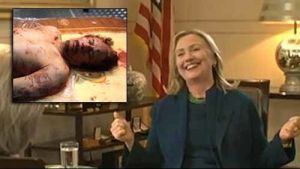
Whether governed by a restored monarchy or a military-dominated successor regime, the CIA saw a post-Gaddafi government desiring «a more constructive relationship with the United States and the West». The CIA added, «Libyan successors probably would turn first to Western Europe for better economic relations and some arms. They also would be likely to seek greater US participation in the Libyan economy». However, after Gaddafi agreed to abandon his so-called «weapons of mass destruction» chemical and nuclear programs, the United States and Western Europe had a more constructive relationship with Libya and the country was wide open for Western economic investment. After Mrs Clinton, Petraeus, Obama, Britain’s David Cameron, and other Western leaders had their way with Libya, it is now a wasteland. The infrastructures of irrigation, road and air transport, social welfare, public education, health care, and employment for African guest workers lie in ruins. The clearly demented Mrs Clinton’s private e-mails show that she and her cabal of interventionists were clearly overjoyed by the misery that befell Libya and its people. When she was informed of Gaddafi’s brutal assassination, one that involved his sodomization, Clinton uttered the preamble to what may be called the «Hillary Doctrine» – «We came, we saw, he died!» She followed her declaration with her signature hideous cackling laughter.

The 1988 CIA report does not seem to care much for Gaddafi’s style of governance through some 2000 local «people’s congresses», described by the CIA as «a hybrid of a New England town meeting and a Bedouin tribal gathering». This demonstration of the «people’s will» in the Libyan «Jamahiriya» was anathema to the CIA’s goals for Libya, even Libya’s emulation of New England-style direct democracy.

A system of direct democracy in an Arab Muslim nation defied the CIA’s wish for the region, which was and remains an alliance of pro-US theocratic states governed by corrupt elites that wield power through US-equipped armed forces. The CIA report on Libya admits that initially, Gaddafi’s system of direct democracy and the exercising of the people’s will «actually worked». Only in the jaundiced view of the United States was such a system of government a threat, not only to US interests and goals, but to those of Israel, Saudi Arabia, Qatar, Kuwait, Morocco, and other corrupt and theocratic US client states in the region.

Hillary Clinton’s war crimes are unforgivable. No real progressive could ever support her.

clinton-kissinger-2-article-header

By Zach Cartwright

Source: U.S. Uncut

Hillary Clinton made headlines with a speech in San Diego casting Donald Trump as unfit for the presidency due to the damage his incendiary rhetoric could cause. Simultaneously, the former Secretary of State sought to convince the California audience that she was the safer choice in foreign policy matters.

But when taking a closer look at US foreign policy under her leadership as the nation’s top diplomat, it’s obvious that Clinton could potentially be as disastrous as Trump if given the position of Commander-in-Chief.

Here are a few examples of countries where conditions are tremendously worse as a result of Hillary Clinton’s policies.

Hillary Clinton made Libya a failed state

In an April interview with Fox News, President Barack Obama, reflecting on his 7 years as Commander-in-Chief, admitted that ousting Libyan dictator Muammar Gaddafi was the biggest mistake of his presidency. While Obama took responsibility for the failure of Libya in that interview, he relied on the input of Hillary Clinton, his Secretary of State at the time.

In March of 2011, Clinton met with Mahmoud Jibril, who was leading the opposition to Gaddafi. As the New York Times reported, Clinton asked Jibril a series of questions about how his coalition planned to fill the power vacuum that would be created by Gaddafi’s ouster. And in the end, it was Clinton who convinced the White House that deposing Gaddafi was the right thing to do:

Her conviction would be critical in persuading Mr. Obama to join allies in bombing Colonel Qaddafi’s forces. In fact, Mr. Obama’s defense secretary, Robert M. Gates, would later say that in a “51-49” decision, it was Mrs. Clinton’s support that put the ambivalent president over the line.

The 2011 NATO-led invasion of Libya that took place after Clinton’s visit has since allowed extremist groups to seize power in an unprecedented takeover of much of the country over the last five years.

In 2014, the US State Department shut down the US embassy in Libya and issued a travel warning urging all Americans to stay away from the country. Roughly one year ago, Libya’s central bank, the last remaining institution in the failed state, was forced to flee to a city in the Eastern region of the country due to rebel forces encroaching on the bank’s facility in Tripoli, the capital. Libya is now a haven for terrorists, with thousands of ISIS soldiers using the country as a staging ground.

In an interview on CBS, Clinton laughed about Gaddafi’s slaying, proudly exclaiming, “We came, we saw, he died.”

Hillary Clinton deserves credit for poverty and instability in Haiti

In Haiti, the first state ever founded by freed black slaves, citizens are still fighting for political and economic freedom today, largely due to the influence of Bill and Hillary Clinton.

In 2011, Wikileaks published US State Department cables from 2008 and 2009 confirming that State Department officials were meeting behind closed doors with Haitian business leaders, plotting on how to stop the Haitian government from implementing a 37-cent hike in the minimum wage from $0.24 an hour to $0.61 cents an hour.

While Haitian President René Préval was initially neutral on the proposal of raising the minimum wage, he went on the record opposing the wage hike after consistent efforts from within the US Embassy in Haiti and the Haitian business lobby by July of 2009. Politifact rated the claim that Clinton’s State Department tried to suppress the wage hike as half-true, since there’s no link proving that Clinton directly played a role.

However, Clinton’s influence on Haiti didn’t stop there. As US Uncut previously reported, the former Secretary of State took an active role in swinging Haitian’s presidential elections in favor of corporate special interests. In the first round of Haiti’s presidential elections, thousands of citizens took to the streets demanding an annulment of election results, alleging that then-Haitian president Michel Martelly committed election fraud.

Martelly, who succeeded René Préval, is a close confidant of the Clinton family. In 2011, Martelly appointed Bill Clinton to an advisory board whose stated goal was to court foreign investors.

And in one of Hillary Clinton’s State Department emails made public, Clinton’s chief of staff received an email from another staffer openly boasting about using connections within the Haitian business elite to lobby for the withdrawal of Jude Célestin, Martelly’s political rival, from an upcoming runoff election. The aide, Kenneth Merten, predicted the news of the US interfering in election results would create widespread protests, and said he had called Martelly, asking him to plead with Haitians “to not pillage.”

While Martelly is no longer in power, his hand-picked successor, Jovenel Moïse, won the most recent election. However, watchdogs are calling the results fraudulent and demanding a new election. Ricardo Seitenfus, who has served as representative of the Organization of American States (OAS) for the last eight years, admitted that Haiti’s government is essentially a puppet of US interests, saying the Haitian election schedule is “subject to the U.S. schedule.” Hillary Clinton deserves to be closely scrutinized when touting her diplomacy record, as Haiti’s political instability is a result of her policies.

Honduras’ downfall resulted from a coup Clinton supported

In 2009, shortly after Obama took office and appointed Hillary Clinton as his Secretary of State, Honduran president Manuel Zelaya was arrested at gunpoint by the military and forced onto a plane to Costa Rica while a new government took power. While the US State Department didn’t directly oust Zelaya, it refused to call his ouster a coup, despite calls from the U.S. ambassador to Honduras and from Congress to do so. In her interview with the New York Daily News editorial board, Clinton defended her decision to keep sending aid to Honduras despite the violent overthrow of Zelaya:

I think, in retrospect, we managed a very difficult situation, without bloodshed, without a civil war, that led to a new election. And I think that was better for the Honduran people. But we have a lot of work to do to try to help stabilize that and deal with corruption, deal with the violence and the gangs and so much else.

However, the result of the coup was a massive amount of bloodshed, as gangs and drug cartels began to take more power in the absence of a stable government. In the year following the coup, Clinton’s State Department published a list of human rights abuses prevalent in Honduras:

“…unlawful killings by police and government agents, which the government took some steps to prosecute; arbitrary and summary killings committed by vigilantes and former members of the security forces; harsh prison conditions; violence against detainees; corruption and impunity within the security forces; lengthy pretrial detention and failure to provide due process of law; politicization, corruption, and institutional weakness of the judiciary; corruption in the legislative and executive branches; government restrictions on the recognition of some civil society groups; violence and discrimination against women; child prostitution and abuse; trafficking in persons; discrimination against indigenous communities; violence and discrimination against persons based on sexual orientation; ineffective enforcement of labor laws; and child labor.”

The horrific conditions in Honduras triggered a mass exodus of migrants to the US. As Telesur reported, approximately 9,000 child refugees fled Honduras in 2015. Also in 2015, Clinton defended the deportation of children back to the Central American countries they’re fleeing in order “send a message.” However, Clinton has since walked back that statement as her Democratic presidential primary battle with Bernie Sanders became more competitive.

Honduras-Activists-Berta-Cáceres-and-Nelson-Garcia-Assassinated-Called-Out-Hillary-Clinton-for-Backing-Honduran-Coup

This March, the violence in Honduras became a subject of international scrutiny when 44-year-old environmental activist Berta Caceres was assassinated in her home. Caceres had been an outspoken opponent of a proposed hydroelectric plant on indigenous land, and had recently gotten in an altercation with soldiers, police, and employees of a private power company while protesting the project just weeks before she was killed.

Clinton is responsible for the fall of Iraq and Syria (and the rise of ISIS)

In late 2011, after months of sustained anti-government protests inspired by the “Arab Spring” movement, Hillary Clinton called for the resignation of Syrian president Bashar al-Assad. Then, in April 2012, Clinton gave a speech in Turkey more forcefully calling specifically for regime change, saying, “Assad must go.” Those three words created the policies that led to both the rise of ISIS in Syria and the European refugee crisis of 2015.

One of Clinton’s last actions as Secretary of State was to call for the arming of Syrian rebels fighting Assad. As the London Telegraph reported, Clinton’s plan to give weapons to Assad’s enemies was backed by not only former Defense Secretary Leon Panetta, but also by former CIA director David Petraeus and General Martin Dempsey, chairman of the Joint Chiefs of Staff. While Obama initially rejected his Secretary of State’s plan, he eventually agreed to arm Syrian rebels in the goal of ousting Assad.

However, as ISIS began to get a foothold into Syria and Iraq, the “moderates” that received weapons from the US were eventually overtaken by ISIS fighters, who suddenly found themselves in the possession of military-grade weapons paid for with US tax dollars. In a study conducted by Conflict Armament Research, which tracks the movement of arms in war-torn regions, researchers found that ISIS has weapons and ammunition not just from the US, but also from coalition forces that are funded by the US government. The access to advanced weaponry was likely the reason for ISIS’ rapid expansion into Libya, Egypt, and elsewhere.

The consequences of destabilizing Syria and Iraq are apparent. Over one million refugees, largely from countries where the US intervened militarily, fled to Europe between 2015 and 2016, creating the world’s largest refugee crisis since World War II. In this chart compiled by Eurostat, the top three countries people are fleeing are Syria, Afghanistan, and Iraq:

refugeechart

Yemeni blood is on Hillary Clinton’s hands

Saudi Arabia’s invasion of Yemen, which started in 2015 and continues today, was made possible with arms purchased by the US government. Since Obama’s presidency, the US has sold approximately $46 billion in arms to the Saudis, with many of those weapons sales greenlighted by Hillary Clinton’s State Department. As US Uncut reported in April, Clinton was particularly focused on making sure the US came through for Saudi Arabia in a 2011 weapons deal. David Sirota of the International Business Times reported that Clinton argued the arms deal was “in the national interest.”

At press conferences in Washington to announce the department’s approval, an assistant secretary of state, Andrew Shapiro, declared that the deal had been “a top priority” for Clinton personally. Shapiro, a longtime aide to Clinton since her Senate days, added that the “U.S. Air Force and U.S. Army have excellent relationships in Saudi Arabia.”

Saudi Arabia is very likely using the weapons acquired from that 2011 exchange to wage brutal bombing campaigns in Yemen. In March, Foreign Policy magazine accused the US and its allies of complicity in war crimes by funding and arming the Saudi regime:

Hundreds of civilians have been killed in airstrikes while asleep in their homes, when going about their daily activities, or in the very places where they had sought refuge from the conflict. The United States, Britain, and others, meanwhile, have continued to supply a steady stream of weaponry and logistical support to Saudi Arabia and its coalition.

This week, the United Nations added the Saudi-led coalition to a blacklist of states and armed groups that violate children’s human rights during conflicts, with UN Secretary General Ban Ki-moon personally slamming the coalition for killing and maiming Yemeni children.

Hillary Clinton is completely right that Donald Trump is woefully unprepared to take on the responsibilities of Commander-in-Chief. But voters should also be leery of Clinton, who, despite having met with more world leaders than any presidential candidate in US history, is responsible for some of the worst foreign policy blunders of the 21st century.


Zach Cartwright is an activist and author from Richmond, Virginia. He enjoys writing about politics, government, and the media. Send him an email: zachcartwright88@gmail.com. 

Keep Fear Alive

DHSFEAR3

The bald-eagle boondoggle of the terror wars

By Kade Crockford

Source: The Baffler

“If you’re submitting budget proposals for a law enforcement agency, for an intelligence agency, you’re not going to submit the proposal that ‘We won the war on terror and everything’s great,’ cuz the first thing that’s gonna happen is your budget’s gonna be cut in half. You know, it’s my opposite of Jesse Jackson’s ‘Keep Hope Alive’—it’s ‘Keep Fear Alive.’ Keep it alive.”

—Thomas Fuentes, former assistant director, FBI Office of International Operations

Can we imagine a free and peaceful country? A civil society that recognizes rights and security as complementary forces, rather than polar opposites? Terrorist attacks frighten us, as they are designed to. But when terrorism strikes the United States, we’re never urged to ponder the most enduring fallout from any such attack: our own government’s prosecution of the Terror Wars.

This failure generates all sorts of accompanying moral confusion. We cast ourselves as good, but our actions show that we are not. We rack up a numbing litany of decidedly uncivil abuses of basic human rights: global kidnapping and torture operations, gulags in which teenagers have grown into adulthood under “indefinite detention,” the overthrow of the Iraqi and Libyan governments, borderless execution-by-drone campaigns, discriminatory domestic police practices, dragnet surveillance, and countless other acts of state impunity.

The way we process the potential cognitive dissonance between our professed ideals and our actual behavior under the banner of freedom’s supposed defense is simply to ignore things as they really are. They hate us for our freedom, screech the bald-eagle memes, and so we must solemnly fight on. But what, beneath the official rhetoric of permanent fear, explains the collective inability of the national security overlords to imagine a future of peace?

Incentives, for one thing. In a perverse but now familiar pattern, what we have come to call “intelligence failures” produce zero humility, and no promise of future remedies, among those charged with guarding us. Instead, a new array of national security demands circulate, which are always rapidly met. In America, the gray-haired representatives of the permanent security state say their number one responsibility is to protect us, but when they fail to do so, they go on television and growl. To take but one recent example, former defense secretary Donald Rumsfeld appeared before the morally bankrupt pundit panel on MSNBC’s Morning Joe to explain that intractable ethnic, tribal, and religious conflict has riven the Middle East for more than a century—the United States, and the West at large, were mere hapless bystanders in this long-running saga of civilizational decay. This sniveling performance came, mind you, just days after Politico reported that, while choreographing the run-up to the 2003 invasion of Iraq, Rumsfeld had quietly buried a report from the Joint Chiefs of Staff indicating that military intelligence officials had almost no persuasive evidence that Saddam Hussein was maintaining a serious WMD program. Even after being forced to resign in embarrassment over the botched Iraq invasion a decade ago, Rumsfeld continues to cast himself as an earnestly outmanned casualty of Oriental cunning and backbiting while an indulgent clutch of cable talking heads nods just as earnestly along.

And the same refrain echoes throughout the echelons of the national security state. Self-assured and aloof as the affluenza boy, the FBI, CIA, and NSA fuck up, and then immediately apply for a frenzied transfer of ever more money, power, and data in order to do more of what they’re already doing. Nearly fifteen years after the “Global War on Terror” began, the national security state is a trillion-dollar business. And with the latest, greatest, worst-ever terrorist threat always on the horizon, business is sure to keep booming.

The paradox produces a deep-state ouroboros: Successful terrorist attacks against the West do not provoke accountability reviews or congressional investigations designed to truly understand or correct the errors of the secret state. On the contrary, arrogant spies and fearful politicians exploit the attacks to cement and expand their authority. This permits them, in turn, to continue encroaching on the liberties they profess to defend. We hear solemn pledges to collect yet more information, to develop “back doors” to decrypt private communications, to keep better track of Muslims on visas, send more weapons to unnamed “rebel groups,” drop more cluster bombs. Habeas corpus, due process, equal protection, freedom of speech, and human rights be damned. And nearly all the leaders in both major political parties play along, like obliging extras on a Morning Joe panel. The only real disagreement between Republican and Democratic politicians on the national stage is how quickly we should dispose of our civil liberties. Do we torch the Bill of Rights à la Donald Trump and Dick Cheney, or apply a scalpel, Obama-style?

Safety Last

Both Democrats and Republicans justify Terror War abuses by telling the public, either directly or indirectly, that our national security hangs in the balance. But national security is not the same as public safety. And more: the things the government has done in the name of preserving national security—from invading Iraq to putting every man named Mohammed on a special list—actually undermine our public safety.

That’s because, as David Talbot demonstrates in The Devil’s Chessboard, his revelatory Allen Dulles biography and devastating portrait of a CIA run amok, national security centers on “national interests,” which translates, in the brand of Cold War realpolitik that Dulles pioneered, into the preferred policy agendas of powerful corporations.

Public safety, on the other hand, is concerned with whether you live or die, and how. Any serious effort at public safety requires a harm-reduction approach acknowledging straight out that no government program can foreclose the possibility of terroristic violence. The national security apparatus, by contrast, grows powerful in direct proportion to the perceived strength of the terrorist (or in yesterday’s language, the Communist) threat—and requires that you fear this threat so hysterically that you release your grip on reason. Reason tells you government cannot protect us from every bad thing that happens. But the endlessly repeated national security meme pretends otherwise, though the world consistently proves it wrong.

When it comes to state action, the most important distinction between what’s good for public safety (i.e., your health) and what’s good for national security (i.e., the health of the empire, markets, and prominent corporations) resides in the concept of the criminal predicate. This means, simply, that an agent of the government must have some reasonable cause to believe you are involved with a crime before launching an investigation into your life. When the criminal predicate forms the basis for state action, police and spies are required to focus on people they have reason to believe are up to no good. Without the criminal predicate, police and spies are free to monitor whomever they want. Police action that bypasses criminal predicates focuses on threats to people and communities that threaten power—regardless of whether those threats to power are fully legal and legitimate.

Nearly fifteen years after the “Global War on Terror” began, the national security state is a trillion-dollar business.

We can see the results of this neglect everywhere the national security state has set up shop. Across the United States right now, government actors and private contractors paid with public funds are monitoring the activities of dissidents organizing to end police brutality and the war on drugs, Israeli apartheid and colonization in Palestine, U.S. wars in the Middle East, and Big Oil’s assault on our physical environment. In the name of fighting terrorism, Congress created the Department of Homeland Security, which gave state and local law enforcement billions of dollars to integrate police departments into the national intelligence architecture. As a result, we now have nearly a million cops acting as surrogates for the FBI. But as countless studies have shown, the “fusion centers” and intelligence operations that have metastasized under post-9/11 authorities do nothing to avert the terror threat. Instead, they’ve targeted dissidents for surveillance, obsessive documentation, and even covert infiltration. When government actors charged with protecting us use their substantial power and resources to track and disrupt Black Lives Matter and Earth First! activists, they are not securing our liberties; they’re putting them in mortal peril.

Things weren’t always like this. Once upon a time, America’s power structure was stripped naked. When the nation saw the grotesque security cancer that had besieged the body politic in the decades after World War II (just as Harry Truman had warned it would) the country’s elected leadership reasserted control, placing handcuffs on the wrists of the security agencies. This democratic counterattack on the national security state not only erected a set of explicit protocols to shield Americans from unconstitutional domestic political policing, but also advanced public safety.

Mission Creeps

As late as the 1970s, the FBI was still universally thought to be a reputable organization in mainstream America. The dominant narrative held that J. Edgar Hoover’s capable agents, who had to meet his strict height, weight, and dress code requirements, were clean-cut, straight-laced men who followed the rules. Of course, anyone involved with the social movements of that age—anti-war, Communist, Black Power, American Indian, Puerto Rican Independence—knew a very different FBI, but they had no evidence to prove what they could see and feel all around them. And since this was the madcap 1970s, the disparity between the FBI’s glossy reputation as honest crusaders and its actual dirty fixation on criminalizing the exercise of domestic liberties drove a Pennsylvania college physics professor and anti-war activist named William Davidon to take an extraordinary action. On the night of the Muhammad Ali vs. Joe Frazier fight of March 8, 1971, Davidon and some friends broke into an FBI office in Media, Pennsylvania. They stole every paper file they could get their hands on. In communiqués to the press, to which they attached some of the most explosive of the Hoover files, they called themselves the Citizens’ Commission to Investigate the FBI.

Not one of the costly post-9/11 surveillance programs based on suspicionless, warrantless monitoring stopped Tsarnaev from blowing up the marathon.

When Davidon and his merry band of robbers broke into the FBI office, they blew the lid off of decades of secret—and sometimes deadly—police activity that targeted Black and Brown liberation organizers in the name of fighting the Soviet red menace. According to Noam Chomsky, the Citizens’ Commission concluded that the vast majority of the files at the FBI’s Media, Pennsylvania, office concerned political spying rather than criminal matters. Of the investigative files, only 16 percent dealt with crimes. The rest described FBI surveillance of political organizations and activists—overwhelmingly of the left-leaning variety—and Vietnam War draft resisters. As Chomsky wrote, “in the case of a secret terrorist organization such as the FBI,” it was impossible to know whether these Pennsylvania figures were representative of the FBI’s national mandate. But for Bill Davidon and millions of Americans—including many in Congress who were none too pleased with the disclosures—these files shattered Hoover’s image as a just-the-facts G-man. They proved that the FBI was not a decent organization dedicated to upholding the rule of law and protecting the United States from foreign communist threats, but rather a domestic political police primarily concerned with preserving the racist, sexist, imperialist status quo.

In a cascade of subsequent transparency efforts, journalists, activists, and members of Congress all probed the darker areas of the national security state, uncovering assassination plots against foreign leaders, dragnet surveillance programs, and political espionage targeting American dissidents under the secret counterintelligence program known as COINTELPRO. Not since the birth of the U.S. deep state, with the 1947 passage of the National Security Act, had the activities of the CIA, FBI, or NSA been so publicly or thoroughly examined and contested.

Subsequent reforms included the implementation of new attorney general’s guidelines for domestic investigations, which, for the first time in U.S. history, required FBI agents to suspect someone of a crime before investigating them. Under the 1976 Levi guidelines, named for their author, Nixon attorney general Edward Levi, the FBI could open a full domestic security investigation against someone only if its agents had “specific and articulable facts giving reason to believe that an individual or group is or may be engaged in activities which involve the use of force or violence.” The criminal predicate was now engraved in the foundations of the American security state—and the Levi rules prompted a democratic revolution in law enforcement and intelligence circles. It would take decades and three thousand dead Americans for the spies to win back their old Hoover-era sense of indomitable mission—and their investigative MO of boundless impunity.

False Flags

In the years following the 9/11 attacks, the Bush administration began Hoovering up our private records in powerful, secret dragnets. When we finally learned about the warrantless wiretapping program in 2005, it was a national scandal. But just as important, and much less discussed, was the abolition of Levi’s assertion of the criminal predicate. So-called domestic terrorism investigations would be treated principally as intelligence or espionage cases—not criminal ones. This shift has had profound, if almost universally ignored, implications.

Michael German, an FBI agent for sixteen years working undercover in white supremacist organizations to identify and arrest terrorists, saw firsthand what the undoing of the 1970s intelligence reforms meant for the FBI. And German argues, persuasively, that the eradication of the criminal predicate didn’t just put Americans at risk of COINTELPRO 2.0. It also threatened public safety. The First and Fourth Amendments, which protect, respectively, our rights to speech and association and our right to privacy, don’t just create the conditions for political freedom; they also help law enforcement focus, laser-like, on people who have the intent, the means, and the plans to harm the rest of us.

Think of it like this, German told me: You’re an FBI agent tasked with infiltrating a radical organization that promotes violence as a means of achieving its political goals—the Ku Klux Klan, for example. KKK members say horrible and disgusting things. But saying disgusting things isn’t against the law; nor, as numerous studies have shown, is it a reliable predictor of whether the speaker will commit an act of political violence. When surrounded by white supremacists constantly spouting hate speech, a law enforcement officer has to block it out. If he investigates people based on their rhetoric, his investigations will lead nowhere. After all, almost no white supremacist seriously intending to carry out a terrorist attack is all that likely to broadcast that intent in public. (Besides, have you noticed how many Americans routinely say disgusting things?)

Today, more than a decade after it shrugged off the Levi guidelines, the FBI conducts mass surveillance directed at the domestic population. But dragnet surveillance, however much it protects “national security,” doesn’t increase public safety, as two blue-ribbon presidential studies have in recent years concluded. Indeed, the Boston bombings, the Paris attacks, and the San Bernardino and Planned Parenthood shootings have all made the same basic point in the cold language of death. The national security state has an eye on everyone, including the people FBI director James Comey refers to as “the bad guys.” But despite its seeming omniscience, the Bureau does not stop those people from killing the rest of us in places where we are vulnerable.

The curious case of Boston Marathon bomber Tamerlan Tsarnaev demonstrates the strange consequences of sidelining criminal investigations for national security needs. In 2011, about eighteen months before the bombings, Tsarnaev’s best friend and two other men were murdered in a grisly suburban scene in Waltham, Massachusetts—their throats slashed, marijuana sprinkled on their mutilated corpses. These murders were never solved. But days after the marathon bombings, law enforcement leaked that they had forensic and cellphone location evidence tying Tamerlan Tsarnaev to those unsolved crimes. Not one of the costly post-9/11 surveillance programs based on suspicionless, warrantless monitoring stopped Tsarnaev from blowing up the marathon. But if the police leaks were correct in assigning him responsibility for the 2011 murders, plain old detective work likely would have.

If security agencies truly want to stop terrorism, they should eliminate all domestic monitoring that targets people who are not suspected of crimes. This would allow agents to redirect space and resources now devoted to targeting Muslims and dissidents into serious investigations of people actually known to be dangerous. It’s the only reasonable answer to the befuddling question: Why is it that so many of these terrorists succeed in killing people even though their names are on government lists of dangerous men?

After the terrorist attacks in November, the French government obtained greater emergency powers in the name of protecting a fearful public. Besides using those powers to round up hundreds of Muslims without evidence or judicial oversight, French authorities also put at least twenty-four climate activists on house arrest ahead of the Paris Climate Change Conference—an approach to squashing dissent that didn’t exactly scream liberté, and had nothing to do with political violence. As with the Boston Marathon and countless other attacks on Western targets, the men who attacked the Bataclan were known to intelligence agencies. In May 2015, months before the attacks in Paris, French authorities gained sweeping new surveillance powers authorizing them to monitor the private communications of suspected terrorists without judicial approval. The expanded surveillance didn’t protect the people of Paris. In France, as in the United States, the devolution of democratic law enforcement practice has opened up space that’s filled with political spying and methods of dragnet monitoring that enable social and political control. This is not only a boondoggle for unaccountable administrators of mass surveillance; it also obstructs the kind of painstaking detective work that might have prevented the attacks on the Bataclan and the marathon.

Our imperial government won’t ever admit this, but we must recognize that the best method for stopping terrorism before it strikes is to stop engaging in it on a grand scale. Terrorist attacks are the price we pay for maintaining a global empire—for killing a million Iraqis in a war based on lies, for which we have never apologized or made reparations, and for continuing to flood the Middle East with weapons. No biometrics program, no database, no algorithm, no airport security system will protect us from ourselves.

Yes, Hillary Clinton Is a Neocon

shutterstock_405351559

By Robert Parry

Source: Consortium News

If there were any doubts that Hillary Clinton favors a neoconservative foreign policy, her performance at Thursday’s debate should have laid them to rest. In every meaningful sense, she is a neocon and – if she becomes President – Americans should expect more global tensions and conflicts in pursuit of the neocons’ signature goal of “regime change” in countries that get in their way.

Beyond sharing this neocon “regime change” obsession, former Secretary of State Clinton also talks like a neocon. One of their trademark skills is to use propaganda or “perception management” to demonize their targets and to romanticize their allies, what is called “gluing white hats” on their side and “gluing black hats” on the other.

So, in defending her role in the Libyan “regime change,” Clinton called the slain Libyan leader Muammar Gaddafi “genocidal” though that is a gross exaggeration of Gaddafi’s efforts to beat back Islamic militants in 2011. But her approach fits with what the neocons do. They realize that almost no one will dare challenge such a characterization because to do so opens you to accusations of being a “Gaddafi apologist.”

Similarly, before the Iraq War, the neocons knew that they could level pretty much any charge against Saddam Hussein no matter how false or absurd, knowing that it would go uncontested in mainstream political and media circles. No one wanted to be a “Saddam apologist.”

Clinton, like the neocons, also shows selective humanitarian outrage. For instance, she laments the suffering of Israelis under crude (almost never lethal) rocket fire from Gaza but shows next to no sympathy for Palestinians being slaughtered by sophisticated (highly lethal) Israeli missiles and bombs.

She talks about the need for “safe zones” or “no-fly zones” for Syrians opposed to another demonized enemy, Syria’s President Bashar al-Assad, but not for the people of Gaza who face the wrath of Israeli Prime Minister Benjamin Netanyahu.

“Yes, I do still support a no-fly zone [in Syria] because I think we need to put in safe havens for those poor Syrians who are fleeing both Assad and ISIS and have some place that they can be safe,” Clinton said. But she showed no such empathy for Palestinians defenseless against Israel’s “mowing the grass” operations against men, women and children trapped in Gaza.

In Clinton’s (and the neocons’) worldview, the Israelis are the aggrieved victims and the Palestinians the heartless aggressors. Referring to the Gaza rocket fire, she said: “I can tell you right now I have been there with Israeli officials going back more than 25 years that they do not seek this kind of attacks. They do not invite the rockets raining down on their towns and villages. They do not believe that there should be a constant incitement by Hamas aided and abetted by Iran against Israel. …

“So, I don’t know how you run a country when you are under constant threat, terrorist attack, rockets coming at you. You have a right to defend yourself.”

Ignoring History

Clinton ignored the history of the Israeli-Palestinian conflict, which dates back to the 1940s when Israeli terrorist organizations engaged in massacres to drive Palestinians from their ancestral lands and murdered British officials who were responsible for governing the territory. Israeli encroachment on Palestinian lands has continued to the present day.

But Clinton framed the conflict entirely along the propaganda lines of the Israeli government: “Remember, Israel left Gaza. They took out all the Israelis. They turned the keys over to the Palestinian people. And what happened? Hamas took over Gaza. So instead of having a thriving economy with the kind of opportunities that the children of the Palestinians deserve, we have a terrorist haven that is getting more and more rockets shipped in from Iran and elsewhere.”

So, Clinton made clear – both at the debate and in her recent AIPAC speech – that she is fully in line with the neocon reverence for Israel and eager to take out any government or group that Israel puts on its enemies list. While waxing rhapsodic about the U.S.-Israeli relationship – promising to take it “to the next level” – Clinton vows to challenge Syria, Iran, Russia and other countries that have resisted or obstructed the neocon/Israeli “wish list” for “regime change.”

In response to Clinton’s Israel-pandering, Sen. Bernie Sanders, who once worked on an Israeli kibbutz as a young man, did the unthinkable in American politics. He called out Clinton for her double standards on Israel-Palestine and suggested that Netanyahu may not be the greatest man on earth.

“You gave a major speech to AIPAC,” Sanders said, “and you barely mentioned the Palestinians. … All that I am saying is we cannot continue to be one-sided. There are two sides to the issue. … There comes a time when if we pursue justice and peace, we are going to have to say that Netanyahu is not right all of the time.”

But in Hillary Clinton’s mind, the Israeli-Palestinian dispute is essentially one-sided. During her speech to the American Israel Public Affairs Committee last month, she depicted Israel as entirely an innocent victim in the Mideast conflicts.

“As we gather here, three evolving threats — Iran’s continued aggression, a rising tide of extremism across a wide arc of instability, and the growing effort to de-legitimize Israel on the world stage — are converging to make the U.S.-Israel alliance more indispensable than ever,” she declared.

“The United States and Israel must be closer than ever, stronger than ever and more determined than ever to prevail against our common adversaries and to advance our shared values. … This is especially true at a time when Israel faces brutal terrorist stabbings, shootings and vehicle attacks at home. Parents worry about letting their children walk down the street. Families live in fear.”

Yet, Clinton made no reference to Palestinian parents who worry about their children walking down the street or playing on a beach and facing the possibility of sudden death from an Israeli drone or warplane. Instead, she scolded Palestinian adults. “Palestinian leaders need to stop inciting violence, stop celebrating terrorists as martyrs and stop paying rewards to their families,” she said.

Then, Clinton promised to put her future administration at the service of the Israeli government. Clinton said, “One of the first things I’ll do in office is invite the Israeli prime minister to visit the White House. And I will send a delegation from the Pentagon and the Joint Chiefs to Israel for early consultations. Let’s also expand our collaboration beyond security.”

Pleasing Phrases

In selling her neocon policies to the American public, Clinton puts the military aspects in pleasing phrases, like “safe zones” and “no-fly zones.” Yet, what she means by that is that as President she will invade Syria and push “regime change,” following much the same course that she used to persuade a reluctant President Obama to invade Libya in 2011.

The Libyan operation was sold as a “humanitarian” mission to protect innocent civilians though Gaddafi was targeting Islamic militants much as he claimed at the time and was not engaging in any mass slaughter of civilians. Clinton also knew that the European allies, such as France, had less than noble motives in wanting to take out Gaddafi.

As Clinton confidant Sidney Blumenthal explained to her, the French were concerned that Gaddafi was working to develop a pan-African currency which would have given Francophone African countries greater freedom from their former colonial master and would undermine French economic dominance of those ex-colonies.

In an April 2, 2011 email, Blumenthal informed Clinton that sources close to one of Gaddafi sons reported that Gaddafi’s government had accumulated 143 tons of gold and a similar amount of silver that “was intended to be used to establish a pan-African currency” that would be an alternative to the French franc.

Blumenthal added that “this was one of the factors that influenced President Nicolas Sarkozy’s decision to commit France to the attack on Libya.” Sarkozy also wanted a greater share of Libya’s oil production and to increase French influence in North Africa, Blumenthal wrote.

But few Americans would rally to a war fought to keep North Africa under France’s thumb. So, the winning approach was to demonize Gaddafi with salacious rumors about him giving Viagra to his troops so they could rape more, a ludicrous allegation that was raised by then-U.S. Ambassador to the United Nations Susan Rice, who also claimed that Gaddafi’s snipers were intentionally shooting children.

With Americans fed a steady diet of such crude propaganda, there was little serious debate about the wisdom of Clinton’s Libyan “regime change.” Meanwhile, other emails show that Clinton’s advisers were contemplating how to exploit Gaddafi’s overthrow as the dramatic moment to declare a “Clinton Doctrine” built on using “smart power.”

On Oct. 20, 2011, when U.S.-backed rebels captured Gaddafi, sodomized him with a knife and then murdered him, Secretary of State Clinton couldn’t contain her glee. Paraphrasing a famous Julius Caesar quote, she declared about Gaddafi, “we came, we saw, he died.”

But this U.S.-organized “regime change” quickly turned sour as old tribal rivalries, which Gaddafi had contained, were unleashed. Plus, it turned out that Gaddafi’s warnings that many of the rebels were Islamic militants turned out to be true. On Sept. 11, 2012, one extremist militia overran the U.S. consulate in Benghazi killing U.S. Ambassador Christopher Stevens and three other Americans.

Soon, Libya slid into anarchy and Western nations abandoned their embassies in Tripoli. President Obama now terms the Libyan fiasco the biggest mistake of his presidency. But Clinton refuses to be chastened by the debacle, much as she appeared to learn nothing from her support for the Iraq invasion in 2003.

The Libyan Mirage

During Thursday’s debate – instead of joining Obama in recognition of the Libyan failure – Clinton acted as if she had overseen some glowing success:Well, let me say I think we did a great deal to help the Libyan people after Gaddafi’s demise. … We helped them hold two successful elections, something that is not easy, which they did very well because they had a pent-up desire to try to chart their own future after 42 years of dictatorship. I was very proud of that. …

“We also worked to help them set up their government. We sent a lot of American experts there. We offered to help them secure their borders, to train a new military. They, at the end, when it came to security issues, … did not want troops from any other country, not just us, European or other countries, in Libya.

“And so we were caught in a very difficult position. They could not provide security on their own, which we could see and we told them that, but they didn’t want to have others helping to provide that security. And the result has been a clash between different parts of the country, terrorists taking up some locations in the country.”

But that is exactly the point. Like the earlier neocon-driven “regime change” in Iraq, the “regime change” obsession blinds the neocons from recognizing that not only are these operations violations of basic international law regarding sovereignty of other nations but the invasions unleash powerful internal rivalries that neocons, who know little about the inner workings of these countries, soon find they can’t control.

Yet, America’s neocons are so arrogant and so influential that they simply move from one catastrophe to the next like a swarm of locust spreading chaos and death around the globe. They also adapt readily to changes in the political climate.

That’s why some savvy neocons, such as the Brookings Institution’s Robert Kagan, have endorsed Clinton, who The New York Times reported has become “the vessel into which many interventionists are pouring their hopes.”

Kagan told the Times, “I feel comfortable with her on foreign policy. If she pursues a policy which we think she will pursue it’s something that might have been called neocon, but clearly her supporters are not going to call it that; they are going to call it something else.”

Now with Clinton’s election seemingly within reach, the neocons are even more excited about how they can get back to work achieving Syrian “regime change,” overturning Obama’s nuclear deal with Iran, and – what is becoming their ultimate goal – destabilizing nuclear-armed Russia and seeking “regime change” in Moscow.

After all, by helping Assad bring some stability to Syria and assisting Obama in securing the Iranian nuclear deal, Russian President Vladimir Putin has become what the neocons view as the linchpin of resistance to their “regime change” goals. Pull Putin down, the thinking goes, and the neocons can resume checking off their to-do list of Israel’s adversaries: Syria, Iran, Hezbollah, Hamas, etc.

And what could possibly go wrong by destabilizing nuclear-armed Russia and forcing some disruptive “regime change”?

By making Russia’s economy scream and instigating a Maidan-style revolt in Moscow’s Red Square, the neocons see their geopolitical path being cleared, but what they don’t take into account is that the likely successor to Putin would not be some malleable drunk like the late Russian President Boris Yeltsin but, far more likely, a hardline nationalist who might be a lot more careless with the nuclear codes than Putin.

But, hey, when has a neocon “regime change” scheme veered off into a dangerous and unanticipated direction?

A Neocon True-Believer

In Thursday’s debate, Hillary Clinton showed how much she has become a neocon true-believer. Despite the catastrophic “regime changes” in Iraq and Libya, she vowed to invade Syria, although she dresses up that reality in pretty phrases like “safe zones” and “no-fly zones.” She also revived the idea of increasing the flow of weapons to “moderate” rebels although they, in reality, mostly fight under the command umbrella of Al Qaeda’s Nusra Front.

Clinton also suggested that the Syria mess can be blamed on President Obama’s rejection of her recommendations in 2011 to authorize a more direct U.S. military intervention.Nobody stood up to Assad and removed him,” Clinton said, “and we have had a far greater disaster in Syria than we are currently dealing with right now in Libya.”

In other words, Clinton still harbors the “regime change” goal in Syria. But the problem always was that the anti-Assad forces were penetrated by Al Qaeda and what is now called the Islamic State. The more likely result from Clinton’s goal of removing Assad would be the collapse of the Syrian security forces and a victory for Al Qaeda’s Nusra Front and/or the Islamic State.

If that were to happen, the horrific situation in Syria would become cataclysmic. Millions of Syrians – Alawites, Shiites, Christians, secularists and other “infidels” – would have to flee the beheading swords of these terror groups. That might well force a full-scale U.S. and European invasion of Syria with the bloody outcome probably similar to the disastrous Iraq War.

The only reasonable hope for Syria is for the Assad regime and the less radical Sunni oppositionists to work out some power-sharing agreement, stabilize most of the country, neutralize to some degree the jihadists, and then hold elections, letting the Syrian people decide whether “Assad must go!” – not the U.S. government. But that’s not what Clinton wants.

Perhaps even more dangerous, Clinton’s bellicose rhetoric suggests that she would eagerly move into a dangerous Cold War confrontation with Russia under the upside-down propaganda theme blaming tensions in Eastern Europe on “Russian aggression,” not NATO’s expansion up to Russia’s borders and the U.S.-backed coup in Ukraine in 2014 which ousted an elected president and touched off a civil war.

That coup, which followed neocon fury at Putin for his helping Obama avert U.S. bombing campaigns against Syria and Iran, was largely orchestrated by neocons associated with the U.S. government, including Assistant Secretary of State for European Affairs Victoria Nuland (Robert Kagan’s wife), Sen. John McCain and National Endowment for Democracy President Carl Gershman.

After the violent coup, when the people of Crimea voted by 96 percent to secede from Ukraine and rejoin Russia, the U.S. government and Western media deemed that a “Russian invasion” and when ethnic Russians in eastern Ukraine rose up in resistance to the new authorities in Kiev that became “Russian aggression.”

NATO on the Move

Though President Obama should know better – and I’m told that he does know better – he has succumbed this time to pressure to go along with what he calls the Washington “playbook” of saber-rattling and militarism. NATO is moving more and more combat troops up to the Russian border while Washington has organized punishing economic sanctions aimed at disrupting the Russian economy.

Hillary Clinton appears fully onboard with the neocon goal of grabbing the Big Enchilada, “regime change” in Moscow. Rather than seeing the world as it is, she continues to look through the wrong end of the telescope in line with all the anti-Russian propaganda and the demonization of Putin, whom Clinton has compared to Hitler.

Supporting NATO’s military buildup on Russia’s border, Clinton said, “With Russia being more aggressive, making all kinds of intimidating moves toward the Baltic countries, we’ve seen what they’ve done in eastern Ukraine, we know how they want to rewrite the map of Europe, it is not in our interests [to reduce U.S. support for NATO]. Think of how much it would cost if Russia’s aggression were not deterred because NATO was there on the front lines making it clear they could not move forward.”

Though Clinton’s anti-Russian delusions are shared by many powerful people in Official Washington, they are no more accurate than the other claims about Iraq’s WMD, Gaddafi passing out Viagra to his troops, the humanitarian need to invade Syria, the craziness about Iran being the principal source of terrorism (when it is the Saudis, the Qataris, the Turks and other Sunni powers that have bred Al Qaeda and the Islamic State), and the notion that the Palestinians are the ones picking on the Israelis, not the other way around.

However, Clinton’s buying into the neocon propaganda about Russia may be the most dangerous – arguably existential – threat that a Clinton presidency would present to the world. Yes, she may launch U.S. military strikes against the Syrian government (which could open the gates of Damascus to Al Qaeda and the Islamic State); yes, she might push Iran into renouncing the nuclear agreement (and putting the Israeli/neocon goal to bomb-bomb-bomb-Iran back on the table); yes, she might make Obama’s progressive critics long for his more temperate presidency.

But Clinton’s potential escalation of the new Cold War with Russia could be both the most costly and conceivably the most suicidal feature of a Clinton-45 presidency. Unlike her times as Secretary of State, when Obama could block her militaristic schemes, there will be no one to stop her if she is elected President, surrounded by likeminded neocon advisers.


[For more on this topic, see Consortiumnews.com’s “Would a Clinton Win Mean More Wars?’]

Investigative reporter Robert Parry broke many of the Iran-Contra stories for The Associated Press and Newsweek in the 1980s. You can buy his latest book, America’s Stolen Narrative, either in print here or as an e-book (from Amazon and barnesandnoble.com).


Related Video:

Exposing the Libyan Agenda: A Closer Look at Hillary’s Emails

hilary_clinton_laughs_gaddafi_

By Ellen Brown

Source: Web of Debt

Critics have long questioned why violent intervention was necessary in Libya. Hillary Clinton’s recently published emails confirm that it was less about protecting the people from a dictator than about money, banking, and preventing African economic sovereignty.

The brief visit of then-Secretary of State Hillary Clinton to Libya in October 2011 was referred to by the media as a “victory lap.” “We came, we saw, he died!” she crowed in a CBS video interview on hearing of the capture and brutal murder of Libyan leader Muammar el-Qaddafi.

But the victory lap, write Scott Shane and Jo Becker in the New York Times, was premature. Libya was relegated to the back burner by the State Department, “as the country dissolved into chaos, leading to a civil war that would destabilize the region, fueling the refugee crisis in Europe and allowing the Islamic State to establish a Libyan haven that the United States is now desperately trying to contain.”

US-NATO intervention was allegedly undertaken on humanitarian grounds, after reports of mass atrocities; but human rights organizations questioned the claims after finding a lack of evidence. Today, however, verifiable atrocities are occurring. As Dan Kovalik wrote in the Huffington Post, “the human rights situation in Libya is a disaster, as ‘thousands of detainees [including children] languish in prisons without proper judicial review,’ and ‘kidnappings and targeted killings are rampant’.”

Before 2011, Libya had achieved economic independence, with its own water, its own food, its own oil, its own money, and its own state-owned bank. It had arisen under Qaddafi from one of the poorest of countries to the richest in Africa. Education and medical treatment were free; having a home was considered a human right; and Libyans participated in an original system of local democracy. The country boasted the world’s largest irrigation system, the Great Man-made River project, which brought water from the desert to the cities and coastal areas; and Qaddafi was embarking on a program to spread this model throughout Africa.

But that was before US-NATO forces bombed the irrigation system and wreaked havoc on the country. Today the situation is so dire that President Obama has asked his advisors to draw up options including a new military front in Libya, and the Defense Department is reportedly standing ready with “the full spectrum of military operations required.”

The Secretary of State’s victory lap was indeed premature, if what we’re talking about is the officially stated goal of humanitarian intervention. But her newly-released emails reveal another agenda behind the Libyan war; and this one, it seems, was achieved.

Mission Accomplished?

Of the 3,000 emails released from Hillary Clinton’s private email server in late December 2015, nearly a third were from her close confidante Sidney Blumenthal, the Clinton aide who gained notoriety when he testified against Monica Lewinsky. One of these emails, dated April 2, 2011, reads in part:

Qaddafi’s government holds 143 tons of gold, and a similar amount in silver . . . . This gold was accumulated prior to the current rebellion and was intended to be used to establish a pan-African currency based on the Libyan golden Dinar. This plan was designed to provide the Francophone African Countries with an alternative to the French franc (CFA).

In a “source comment,” the original declassified email adds:

According to knowledgeable individuals this quantity of gold and silver is valued at more than $7 billion. French intelligence officers discovered this plan shortly after the current rebellion began, and this was one of the factors that influenced President Nicolas Sarkozy’s decision to commit France to the attack on Libya. According to these individuals Sarkozy’s plans are driven by the following issues:

  1. A desire to gain a greater share of Libya oil production,
  2. Increase French influence in North Africa,
  3. Improve his internal political situation in France,
  4. Provide the French military with an opportunity to reassert its position in the world,
  5. Address the concern of his advisors over Qaddafi’s long term plans to supplant France as the dominant power in Francophone Africa

Conspicuously absent is any mention of humanitarian concerns. The objectives are money, power and oil.

Other explosive confirmations in the newly-published emails are detailed by investigative journalist Robert Parry. They include admissions of rebel war crimes, of special ops trainers inside Libya from nearly the start of protests, and of Al Qaeda embedded in the US-backed opposition. Key propaganda themes for violent intervention are acknowledged to be mere rumors. Parry suggests they may have originated with Blumenthal himself. They include the bizarre claim that Qaddafi had a “rape policy” involving passing Viagra out to his troops, a charge later raised by UN Ambassador Susan Rice in a UN presentation. Parry asks rhetorically:

So do you think it would it be easier for the Obama administration to rally American support behind this “regime change” by explaining how the French wanted to steal Libya’s wealth and maintain French neocolonial influence over Africa – or would Americans respond better to propaganda themes about Gaddafi passing out Viagra to his troops so they could rape more women while his snipers targeted innocent children? Bingo!

Toppling the Global Financial Scheme

Qaddafi’s threatened attempt to establish an independent African currency was not taken lightly by Western interests. In 2011, Sarkozy reportedly called the Libyan leader a threat to the financial security of the world. How could this tiny country of six million people pose such a threat? First some background.

It is banks, not governments, that create most of the money in Western economies, as the Bank of England recently acknowledged. This has been going on for centuries, through the process called “fractional reserve” lending. Originally, the reserves were in gold.  In 1933, President Franklin Roosevelt replaced gold domestically with central bank-created reserves, but gold remained the reserve currency internationally.

In 1944, the International Monetary Fund and the World Bank were created in Bretton Woods, New Hampshire, to unify this bank-created money system globally. An IMF ruling said that no paper money could have gold backing. A money supply created privately as debt at interest requires a continual supply of debtors; and over the next half century, most developing countries wound up in debt to the IMF. The loans came with strings attached, including “structural adjustment” policies involving austerity measures and privatization of public assets.

After 1944, the US dollar traded interchangeably with gold as global reserve currency. When the US was no longer able to maintain the dollar’s gold backing, in the 1970s it made a deal with OPEC to “back” the dollar with oil, creating the “petro-dollar.”  Oil would be sold only in US dollars, which would be deposited in Wall Street and other international banks.

In 2001, dissatisfied with the shrinking value of the dollars that OPEC was getting for its oil, Iraq’s Saddam Hussein broke the pact and sold oil in euros. Regime change swiftly followed, accompanied by widespread destruction of the country.

In Libya, Qaddafi also broke the pact; but he did more than just sell his oil in another currency.

As these developments are detailed by blogger Denise Rhyne:

For decades, Libya and other African countries had been attempting to create a pan-African gold standard.  Libya’s al-Qadhafi and other heads of African States had wanted an independent, pan-African, “hard currency.”

Under al-Qadhafi’s leadership, African nations had convened at least twice for monetary unification.  The countries discussed the possibility of using the Libyan dinar and the silver dirham as the only possible money to buy African oil.

Until the recent US/NATO invasion, the gold dinar was issued by the Central Bank of Libya (CBL).  The Libyan bank was 100% state owned and independent.  Foreigners had to go through the CBL to do business with Libya.  The Central Bank of Libya issued the dinar, using the country’s 143.8 tons of gold.

Libya’s Qadhafi (African Union 2009 Chair) conceived and financed a plan to unify the sovereign States of Africa with one gold currency (United States of Africa).  In 2004, a pan-African Parliament (53 nations) laid plans for the African Economic Community – with a single gold currency by 2023.

African oil-producing nations were planning to abandon the petro-dollar, and demand gold payment for oil/gas.

Showing What Is Possible

Qaddafi had done more than organize an African monetary coup. He had demonstrated that financial independence could be achieved. His greatest infrastructure project, the Great Man-made River, was turning arid regions into a breadbasket for Libya; and the $33 billion project was being funded interest-free without foreign debt, through Libya’s own state-owned bank.

That could explain why this critical piece of infrastructure was destroyed in 2011. NATO not only bombed the pipeline but finished off the project by bombing the factory producing the pipes necessary to repair it. Crippling a civilian irrigation system serving up to 70% of the population hardly looks like humanitarian intervention. Rather, as Canadian Professor Maximilian Forte put it in his heavily researched book Slouching Towards Sirte: NATO’s War on Libya and Africa:

[T]he goal of US military intervention was to disrupt an emerging pattern of independence and a network of collaboration within Africa that would facilitate increased African self-reliance. This is at odds with the geostrategic and political economic ambitions of extra-continental European powers, namely the US.

Mystery Solved

Hillary Clinton’s emails shed light on another enigma remarked on by early commentators. Why, within weeks of initiating fighting, did the rebels set up their own central bank? Robert Wenzel wrote in The Economic Policy Journal in 2011:

This suggests we have a bit more than a rag tag bunch of rebels running around and that there are some pretty sophisticated influences. I have never before heard of a central bank being created in just a matter of weeks out of a popular uprising.

It was all highly suspicious, but as Alex Newman concluded in a November 2011 article:

Whether salvaging central banking and the corrupt global monetary system were truly among the reasons for Gadhafi’s overthrow . . . may never be known for certain – at least not publicly.

There the matter would have remained – suspicious but unverified like so many stories of fraud and corruption – but for the publication of Hillary Clinton’s emails after an FBI probe. They add substantial weight to Newman’s suspicions: violent intervention was not chiefly about the security of the people. It was about the security of global banking, money and oil.

Errata: Sidney Blumenthal is not an attorney, as originally stated in this article. When he earned notoriety as Bill Clinton’s defender against Monica Lewinsky, it was as special adviser for the Clintons.

__________________

Ellen Brown is an attorney and author of twelve books, including the best-selling Web of Debt. Her latest book, The Public Bank Solution, explores successful public banking models historically and globally. Her 300+ blog articles are at EllenBrown.com. Listen to “It’s Our Money with Ellen Brown” on PRN.FM.


Related Podcast:  Progressive Commentary Hour – 03.15.16 James and Joanne Moriarty on the real motives behind the 2011 invasion of Libya.

Hillary Clinton Breaks the Irony Meter

By Kevin Carson

Source: Center for a Stateless Society

At the March 9 Democratic debate, Hillary Clinton had this to say about competitor Bernie Sanders’s favorable comments on Castro’s Cuba and the Sandinista regime in the ’80s:  “if the values are that you oppress people, you disappear people, imprison people or even kill people for expressing their opinions…, that is not the kind of revolution of values that I ever want to see anywhere.” This, coming from a former Secretary of State who backed a right-wing coup in Honduras and proudly name-drops Henry Kissinger — Henry Kissinger! — as a close friend and mentor, is the kind of thing the Onion can’t compete with.

If Kissinger was known for anything in his years as National Security Adviser and Secretary of State, it was installing dictators who oppressed, disappeared and imprisoned people. He oversaw a wave of coups that swept South America in the late ’60s and ’70s, installing right-wing military regimes that tortured, murdered or disappeared dissidents by the thousands, and where a common fate for labor and peasant activists was to be found in a ditch with their faces hacked off. Under Kissinger the U.S. actively supported Operation Condor — the program by which these South American dictators used torture and murder to suppress opposition — with military aid and technical assistance. He gave the green light to Indonesia’s genocidal invasion of East Timor.

Clinton has a long history of close personal friendship with this monster, and indeed touts herself as something of a protege. According to both Hillary and Bill, Kissinger praised her for running the State Department better than anybody in decades. And well might he praise her, because she’s followed in his footsteps in many ways. As Secretary of State, she oversaw the sale of millions of dollars worth of arms to despotic regimes that oppressed, disappeared and imprisoned people for expressing their opinions — many of which regimes were also large donors to the Clinton Foundation. And while we’re on the subject of people being murdered and disappeared, how about Berta Caceres — an activist murdered by the right-wing Honduran regime whose seizure of power Clinton backed in 2009?

As senator, Clinton voted to authorize George Bush’s criminal war of aggression on Iraq, which has resulted in hundreds of thousands of Iraqi deaths since 2003. She says now it was “a mistake.” It was a mistake all right. She mistakenly believed the vote would make her more viable as a future presidential candidate. She mistakenly predicted the way the political winds would be blowing when she decided to run for president.

And don’t forget Clinton’s support for the Obama administration’s indiscriminate use of drones for extrajudicial killing. Many of the victims were civilians, and hundreds of them were actually children.

If you add it all up, Hillary Clinton still isn’t quite the war criminal her old friend and mentor Henry Kissinger is. Those are some big, bloody shoes to fill. But if she’s elected she’ll grow into them.