
IN 2023, THE WEST HAS PROVEN WEAKER THAN EVER

By Lucas Leiroz

Source: South Front

In 2023, the West was unable to contain the advance of multipolarity. Despite continuing to finance aggression against Russia and fomenting chaos in several regions to avoid the geopolitical transition process, the US and its allies are weakened in the current world scenario and have not been able to make their projects successful.

On the Russian-Ukrainian battlefield, Kiev was unable to achieve any significant victory throughout the entire year. Since late 2022, the neo-Nazi regime has been betting on the possibility of launching a major “counteroffensive” in the spring-summer season of 2023. According to Western media, this counterattack would be strong enough to retake all the territories claimed by Kiev, including Crimea.

However, the Ukrainian measures have absolutely failed. Neo-Nazi forces were unable to inflict damage on the strong Russian defense lines and thus failed to achieve territorial gains. The Ukrainians’ focus then shifted from the battlefield to the media, with the launch of a series of terrorist attacks on demilitarized Russian territory with the aim of showing Western public opinion that at least some harm was being inflicted on the Russians – thus justifying continued military support.

Russian strong defense capabilities and high-precision strikes, however, disrupted Ukrainian plans once again and neutralized all terrorist incursions. In the end, the Ukrainians had no more arguments to disguise their failures and publicly admitted that the counteroffensive was not successful. As a result, the situation on the front lines became even more disadvantageous for NATO’s proxy forces. With more than half a million Ukrainians dead – tens of thousands of them in the failed “counteroffensive” alone – and with increasingly greater territorial losses, Ukraine already appears to be a “lost battle” in the West, having a growing critical opinion regarding the support for the regime.

Some other relevant military events also took place in 2023, such as a new war in the Nagorno-Karabakh region. In September, Azerbaijani forces launched a series of attacks against the Armenian resistance in the former separatist republic and achieved a quick military victory, gaining complete territorial control over the region. Without support from Armenia or sufficient military force to resist Azerbaijani aggression, the separatist government declared the extinction of the Republic of Artsakh, formally handing over the territory to Baku.

Since 2018, Armenia has been governed by a pro-Western regime that has moved it away from Russia and closer to the US and EU. Local politicians were led to believe that with such an approach it would be possible to contain the Azerbaijani advance, but indeed they got precisely the contrary. NATO is interested in generating as much instability as possible in the Russian [and Iranian] strategic environment and therefore encourages the worsening of crises in the Caucasus.

The scenario in the region now is one in which on one side there are Azerbaijani forces supported by the Turks and on the other Americans and Europeans backing Armenia. Both sides share common anti-Russian interests and want to make the region a NATO occupation zone. In this scenario, Moscow only tries to avoid new conflicts and works diplomatically so that peace between the parties is achieved as quickly as possible.

However, it was in the Middle East that the biggest “geopolitical news” of the year emerged. In October, Hamas-led Palestinian Resistance’s forces launched a military incursion into areas illegally occupied by Israel. Called “Al Aqsa Flood Operation“, the action was successful in causing real damage to the Israeli armed forces and settlers, but it prompted a brutal response from Tel Aviv, with Netanyahu declaring war on the Palestinians and launching a series of bombings that already killed thousands of innocent civilians.

Israeli brutality, however, was not enough to give Israel victory. On the contrary, on the battlefield there is a complicated scenario in which Zionist troops are suffering to obtain gains. There are many difficulties on the ground, mainly due to the fact that Hamas maintains a complex network of underground tunnels and knows the local terrain much better than the Israelis. Furthermore, Israel’s tanks are not able to circulate easily due to the amount of debris from bombed buildings, making frictions more favorable to Palestinian guerrillas.

Suffering heavy military losses and simultaneously killing thousands of civilians, the Zionist government is in a situation of serious crisis, both domestically and diplomatically. Globally, Israel is isolated, gaining support from only a few Western countries. Internally, the pressure for his impeachment is great, with part of his armed forces and the intelligence sector joining the opposition.

In this regional context, the Yemeni Houthi government showed solidarity with the Palestinians through a declaration of war on Israel. The Houthis have been conducting operations in the Red Sea, hindering naval flow and severely damaging the Israeli economy. The US tried to neutralize Yemen by launching a multinational naval operation, but the coalition collapsed before it even started fighting, with European countries refusing to participate.

It is also important to note how Iran has acted in this crisis scenario in the Middle East. Tehran’s proxies in the so-called “Axis of Resistance” are acting in deep support of Palestine, as can be seen, for example, in the role of Hezbollah. The Lebanese militia has launched multiple attacks against Israeli positions, severely damaging the Zionist intelligence system.

In practice, it is possible to say that the crisis in the Middle East harmed American war plans. Until recently, the US had a clear strategy to avoid the multipolarization of the world order. The plan consisted of waging a proxy war against Russia and a direct conflict with China. It was expected to defeat China and wear down Russia, but none of that happened.

Ukraine proved inefficient in causing damage to Moscow, and the West was unable to generate more conflicts in the region. Attempts at regime change to radicalize anti-Russian positions have failed – as in Georgia -, preventing the emergence of new flanks. The US has also tried to provoke a proxy war against the Russians in Africa, financing terrorist groups against the revolutionary governments of the former “Françafrique”. But this is also failing because, in partnership with the Russian PMC Wagner Group, local governments have achieved several victories against Western-backed gangs.

In the same sense, China did not “take the bait” and continued to act only diplomatically and economically, without engaging in any conflict. And, in the meantime, the Palestinians – with Iranian support – launched a military operation that forced Washington to ignore its previous plans and focus on supporting Israel. With a strong Zionist lobby in the US, there is pressure for total support for Israel, even if it means an end of the aid to Ukraine or anti-China plans.

Until October, the US was preparing to fight on the two fronts. Now, with the emergence of a third flank, the situation has become much more complicated. Washington does not seem to have enough strength to fight being involved in the three conflicts at the same time. Faced with this situation, it remains to be seen whether there will be diplomatic willingness or whether the US will irrationally opt for total war. But, in any case, what is clear is that in 2023 the West proved to be weaker than ever.
The Global Pivot Away From America

By Graham Vanbergen

Source: TruePublica

There was a day when the world realised they’d had enough of America. It wasn’t when America turned it back on the Herculean effort to sign the world up to the Paris Climate Agreement or TTIP or America’s continuous support for Israel’s murderous actions in Gaza or various other deals that took years to iron out and negotiate that have since been trashed. It was a moment we knew was going to happen but least expected to prove so important.

This was a deal that took the combined effort of the European Union, the United Kingdom, Germany, France, China and Russia. It took twelve years to negotiate. America was a key player and the deal signed, sealed and delivered on October 18th 2015. It was the Iran nuclear deal.

That landmark agreement stopped the escalation of nuclear weapons programs, not just in Iran, but actually in the Mid-East more widely.

With no evidence from any source of Iran breaching its nuclear deal, Iran now has many trading partners. However, America was not one of them. Rightly, the Iranians did not trust their old foe. And so it came to pass that Donald Trump withdrew from the deal, as expected last month.

Palpable European anger to protect the deal and keep it on track spawned a completely new global confidence to move in the same direction. The EU had prepared banking and trading systems to support EU companies doing business with Iran. China was committed having signed a huge joint oil pipeline deal and then launched the petroyuan. Russia has many reasons to protect this deal – obviously and also trades not USDs but Rubles and through a bartering system. Then India announced a few days ago a trade deal with Iran, again bypassing USDs. Then EU diplomats, working on a collaborative agreement in Cuba since 2016 announce that deal to be done and dusted just a few days ago. Last week, 14 African countries announced their intention to switch from USDs to China’s Yuan. All have dumped trading predominantly in US dollars for one reason or another.

On the 10th May, the EU declared that America had just become Europe’s number one threat to its economy.

The EU Commissioner for Economic Affairs, Pierre Moscovici warned Trump’s protectionism represented a “dangerous nexus.”

To that end, the European Union continues to retract from the USA. EuActiv reports that: “The EU and China announced on Friday (1 June) that they would expand trade and investment cooperation amid the global trade dispute triggered by US tariffs.”

Wang Yi, state councillor and minister of foreign affairs of China confirms: “In the context of growing uncertainties in the world, it is even more important for China and the EU to deepen our strategic partnership.”

What has really happened here is a global pivot. Leaders are striking whilst ‘the iron is hot’. Wang’s visit to Brussels, in the framework of the annual EU-China high-level strategic dialogue, came hot on the heels of US President Donald Trump’s confirmation of additional tariffs against Europe and other nations’ steel and aluminium exports. Trump has, to all intents, ended up galvanising other world leaders into real action.

This pivotal moment may take some time to be made fully functional, maybe decades.

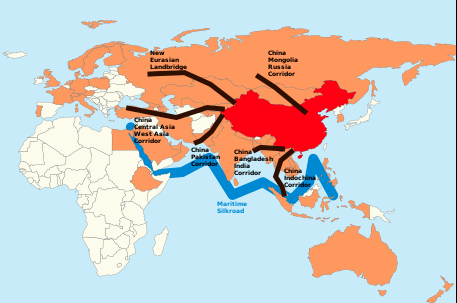
In the meantime, China’s One Belt One Road or Belt Road Initiative (BRI) costing nearly $1trillion is well underway and cannot be ignored. A modern Silk Road that links China, Russia, Europe and Africa in trading routes across land and sea.

Foreign minister Wang Yi has described the initiative as a “symphony of all relevant parties”.

Beijing believes it will kick start “a new era of globalisation”.

One party not included in this symphony is America.

According to the global consultancy McKinsey, the BRI has the potential to massively overshadow the US’ post-war Marshall reconstruction plan, involving about 65% of the world’s population, one-third of its GDP and helping to move about a quarter of all its goods and services.

The ‘belt’ is a series of overland corridors connecting China with Europe, via Central Asia and the Middle East.

One year ago last May, China hoped to put some meat on the bones at an international forum in Beijing but the initiative was greeted with a mix of excitement and suspicion. Beijing saw 28 heads of state and government leaders but German Chancellor Angela Merkel turned down an invitation as did US president Donald Trump.

Today, that initiative now looks like a go. Europe has all but given China the green light. Merkel included.

America has just proven itself to be the new bogeyman on the international geopolitical block. It is headed up by an unstable administration whose warped worldview, beset with paranoia sees nothing but enemies hiding in the dark. It wants a destabilised world because that’s what America does best and profits from most. In the meantime, everyone else just wants to trade, get on and make some money.

25 Signs That The Global Elite’s Ship Is About To Sink

225473091_Rats_300x231_xlarge

By Lance Schuttler

Source: The Mind Unleashed

Make no mistake about it. The tide has turned on the global elite and there will be no going back. A new day is rising for humanity as those who have planned for complete control are now being exposed, cornered and investigated from many different angles. There is no need to buy into the fear-based propaganda the major media and even several alternative media outlets dispense. Very good things are happening and even better things are coming. Let’s take a look at some of the major stories that have occurred in the last 8 weeks alone. Piecing the puzzle together, we see that the jig is up and the events surrounding it are growing in size and speed.

1. 57 Nations approved as founding members of the China-led Asian Infrastructure Investment Bank. Notable countries who signed on June 29th, 2015 include Russia, India, Iran, Switzerland, Germany, France, Saudi Arabia, Australia, Indonesia, the UK, Italy and Austria. Notables who did not join are the U.S. and Japan.

2. May 12th, 2015: Russia asks Greece to join the BRICS Alliance. Notice the BRICS trend in the stories to follow.

3. May 24th, 2015: The Pentagon released documents to Judicial Watch, a government watchdog law firm,
proving that the US Government played a central role in creating ISIL. Interestingly, the mainstream media failed to cover this story. A few weeks later, ex US Intelligence officials confirm the report.

4. May 31st, 2015: Greece’s Prime Minister Alexis Tsipras writes an open letter, warns European leaders they are “making a grave mistake,” and suggests they re-read Hemingways’s “For Whom The Bell Tolls.”

5. June 2nd, 2015: The U.S. Federal Government was hacked as the personal data of 4 million current, former and prospective employees believed to have been breached. 3 weeks later FBI Director James Comey told US Senators the actual number could be 18 million. Some believe the hack was coordinated to gather further evidence
of crimes by certain government officials. More on that further down.

6. June 2nd, 2015: Kentucky Senator Rand Paul calls for the U.S. Government to declassify 28 pages in the 9/11 attack report that the Bush Administration blacked out.

7. June 3rd, 2015: Famous musician Akon announces his Solar Academy will bring solar power to over 600 million people in Africa. A major victory for clean energy and humanity.

8. June 4th, 2015: Whistle-blower Edward Snowden says a “profound difference” had occurred since releasing the NSA documents and that the balance of power has shifted in our world.  Is he referring to the BRICS Alliance?

9. June 5th, 2015: “There Will Be A Reset of The Financial Industry.” The International Monetary Fund says the Chinese yuan is no longer undervalued. This sets the stage for the yuan to be recognized as a global reserve currency, something the U.S. Dollar (which is backed by war and oil) does not like.

10. June 7, 2015: Deutsche Bank, one of the world’s largest banks, co-CEO’s Jain and Fitschen resign. Two days later, German prosecutors raided the Bank’s headquarters in a criminal tax-fraud probe.

11. June 15, 2015: China says the G-7 Summit in Germany was a “gathering of debtors.” They mean this literally as the Bretton Woods western financial system is based on debt. And in fact, the entire western financial system has been running illegally and is technically bankrupt. For more on the real history of Bretton Woods and its connection to JFK, The Global Collateral Accounts and the gold standard, read here.

12. June 17th, 2015 is quite the day with the next four stories all being reported at that time. First, JP Morgan’s number 2, the Vice Chairman Jimmy Lee, suddenly and unexpectedly passes over. Since late 2013, the list of high-level banking officials to have passed over has grown to 70. Clearly, something is happening.

13. June 17, 2015: Russia and China announced that all natural gas and crude oil sales between
the two countries will now be done in Chinese yuan( formerly the U.S. Dollar) and will be convertible into Russian Rubles. The U.S. Dollar hegemony is waning.

14. June 17, 2015: The State of Texas has signed a bill that calls for the repatriation of their gold from the Federal Government. When asked what would happen if the government tried to steal back the gold, State Representative Giovanni Capriglione said this: There is a motto in the office of almost every state legislator in Texas, and it’s a flag that we have [from the Texas Revolution], it’s below a cannon and what the motto says is, “Come and Take it.”

15. June 17, 2015: Greece’s Hellenic Parliament’s Debt Truth Committee released a report stating that the debt Greece “owes” is illegal, illegitimate and odious, according to international law. Further, they stated the IMF and ECB ( European Central Bank) having illegally and knowingly imposed these illegitimate debts upon Greece and other nations. A direct call out to the global banking cartel.

16. June 18th, 2015: Baron David de Rothschild has been indicted by a French court over financial fraud. French police have been ordered by the court to track down Baron. The Rothschild family has long been viewed as the family sitting atop the global financial ponzi scheme. Lawyer Antonio Flores told reporters, ” it’s a real breakthrough moment for everyone involved.”

17. June 18, 2015: In a 2-1 ruling, the 2nd Circuit U.S. Court of Appeals says Bush era officials can be held liable for detaining innocent people after the 9/11 attack. Will this lead to some major arrests?

18. June 19, 2015: While European leaders try to save face on the debt crisis, Greek PM Alexis Tsipras was in Russia and gave a speech at the St. Petersburg Economic Forum, stating that “the economic center of the planet has already shifted” and that new powers are playing an “important role on an economic and geopolitical level.” * Reread story header number 8…BRICS, anyone? Oh, and Greece and Russia signed a €2 billion gas pipeline deal that day too…a strategic economic and geopolitical game-changer.

19. July 5th, 2015: Greece votes “NO” to the creditors’ bailout offer. This is a massive stance for humanity that Greece just took against the banking elite. As of this writing, a “deal” has been reached but is expected to fall apart in the coming days. Kicking the can down the road does not solve the issue, but rather speeds up the revolution mindset of many frustrated Greek citizens. September/October is when many financial experts are saying that some fireworks are to be expected. 

20. July 7th, 2015: The BRICS Bank officially opens for business.

21. July 8th, 2015: On this day, several strange events occurred. The NYSE was taken down for multiple hours, the Wall Street Journal was taken offline just after the stock exchange went down, United Airlines was forced to ground all of its flights nationwide due to computer “issues,” and 2,500 people losing power in Washington D.C. This whistle-blower journalist just wrote that his Pentagon sources said the Pentagon/BRICS Alliance took it down as a “dry run.”

22. July 7th, 2015: Backing up one day we see that the hacking group Anonymous tweeted this on the evening prior to the stock exchange hack: Wonder if tomorrow is going to be bad for Wall Street….we can only hope. 
David Wilcock has previously written a detailed document stating that Anonymous is working with certain patriotic US Military forces to legally take down the banking elite.. This aligns nicely with what the whistle-blower journalist, Benjamin Fulford, just wrote this week about the Pentagon and BRICS Alliance in the previous story.

23. July 14th, 2015: Iran, China, Russia, France, Germany, the U.K. and the U.S. reach a historic deal on Iran’s nuclear program. Entire books could be written on the geopolitical, financial and technological implications of this move. There are also reports that the reality of this situation is that Iran has free energy technology and will be using this to help bring down the banking/political/oil industry elite. This would make sense as the strongest opponents to this deal have been Israel and its Prime Minister and several American politicians like the Bushes, Marco Rubio and Ted Cruz. 

24. July 15th, 2015: Santa Cruz County votes to stop doing business with 5 major banks, including JP Morgan Chase, Barclays, Citigroup, Royal Bank of Scotland and UBS. Watch this set off a chain reaction in those who will follow suit.

25. Now: You are here on the planet at this time to make a wonderful contribution. Please continue playing your role for the benefit of us all.

It is clear that something big is happening. Use this information to move forward with optimism and hope. Share with your friends. Discuss with your friends. Continue to search and dig for the truth. Two people I strongly suggest the reader looking into are Benjamin Fulford, the whistleblower who was the Asia Pacific Bureau Chief for Forbes Magazine and is listed in stories number 21 and 22, and Neil Keenan, who is working with many well connected sources to open up the global collateral accounts. These accounts are what President Kennedy was assassinated over and are what the banking elite does not want the public to know exists. This revolution WILL NOT be televised.