
Big Media: Selling the Narrative and Crushing Dissent for Fun and Profit

By Charles Hugh Smith

Source: Of Two Minds

The profit-maximizing Big Tech / Big Media Totalitarian regime hasn’t just strangled free speech and civil liberties; it’s also strangled democracy.

The U.S. has entered an extremely dangerous time, and the danger has nothing to do with the Covid virus. Indeed, the danger long preceded the pandemic, which has served to highlight how far down the road to ruin we have come.

The danger we are ill-prepared to deal with is the consolidation of the private-sector media and its unification of content into one Approved Narrative which is for sale to the highest bidders. This is the perfection of for-profit Totalitarianism in which dissent is crushed, dissenters punished and billions of dollars are reaped in managing the data and content flow of the one Approved Narrative.

So don’t post content containing the words (censored), (censored) or (censored), or you’ll be banned, shadow-banned, demonetized, demonized and marginalized. Your voice will be erased from public access via the Big Media platforms and you will effectively be disappeared but without any visible mess or evidence–or recourse in the courts.

That’s the competitive advantage of for-profit Totalitarianism–no legal recourse against the suppression of free speech and dissent. And if you’re shadow-banned as I was, you won’t even know just how severely your free speech has been suppressed because the Big Tech platforms are black boxesno one outside the profit-maximizing corporation knows what its algorithms and filters actually do or exactly what happens to the disappeared / shadow-banned.

Shadow-banning is an invisible toxin to free speech: if you’re shadow-banned, you won’t even know that the audience for your posts, tweets, etc. has plummeted to near-zero and others can no longer retweet your content. You only see your post is online as usual, because this is the whole point of shadow-banning: you assume your speech is still free even as its been strangled to death by Big Tech black box platforms.

Since Andy Grove’s dictum only the paranoid survive is my Prime Directive, I’ve paid a bit more to have access to server traffic data. So I can pinpoint precisely when I was shadow-banned: my overall traffic fell off a cliff and the number of readers visiting from links on Big Tech platforms fell from thousands to near-zero.

The new consolidated Big Media Totalitarians play an interesting game of circular sources: in the traditional, now-obsolete / suppressed form of journalism, a reporter would be required to identify a minimum of three different sources for the story, and make at least a desultory effort to present two sides of the issue.

That model is out the window in the USSA’s Big Media Totalitarian regime. Now reporters only have to use a completely bogus, fabricated source in another Big Media story. Just being in another Big Media platform / publication is now “proof” that the source is legitimate.

In other words, investigative journalism is nothing but a Potemkin Village of circular sources conjured out of thin air by Big Media. Here’s an example from my own experience of being shadow-banned.

1. A completely bogus organization pops up out of nowhere and doesn’t bother identifying its owners, managers or sources.

2. This complete travesty of a mockery of a sham fabrication then issues a list of websites which it claims, with zero evidence, are stooges / outlets of Russian propaganda.

3. With zero investigation of this slanderous, evidence-free “source,” the venerable Washington Post (owned by Jeff Bezos) publishes an evidence-free hit piece glorifying this fabrication on Page One.

4. The other Big Media giants then amplify the bogus slander because it came from a “legitimate source,” the Washington Post.

Do you understand how circular sourcing works now? Once a flagrantly bogus bit of propaganda is embraced by one Big Media giant as part of the Approved Narrative, then every other Big Media / Big Tech corporation promotes the fabrication as “real news” even as it is obviously the acme of “fake news”, a complete fabrication.

The fake “source” was called PropOrNot, and the list included dozens of well-respected independent websites, all slandered with a completely fake accusation for one reason: each site had published some content that cast a skeptical eye on the crowning of Hillary Clinton in 2016 and the crushing of Bernie Sanders’ campaign by Big Media’s Approved Narrative.

As long as you post videos of kittens and kids dancing, you’re OK because your content (owned and controlled by the platform you posted it on–read the terms of Service) is free to the platforms and they use your content to “engage” users which generates billions in profits.

But if you question the Approved Narrative, you put a big day-glo target on your back. Now if you’re a multi-millionaire, you know, a top 0.1% per-center, you can afford to keep posting dissenting views even after you’ve been demonetized and your income falls to near-zero.

The rest of us aren’t quite so privileged. This is another of the toxic elements in Big Media / Big Tech’s consolidated control of what was once known as free speech: They don’t have to ban your content outright, which might cause a few ripples of tame protest; all they have to do is starve you into submission by strangling your source of income.

Thanks to watertight terms of service, even a multi-millionaire is legally powerless against the USSA’s Big Media Totalitarian regime. By posting content, you already gave away all your rights. So you can go solo and post content on some obscure corner of the web that no one knows exist, but that’s the functional equivalent of being banned and demonetized.

So go right ahead and enter a sound-proof box and scream your head off; nobody can hear you. Welcome to the totally privately owned, legally untouchable Big Tech / Big Media Totalitarian regime that will let you know what’s in the Approved Narrative because that’s all you’re allowed to see.

Gordon Long and I cover these topics and many more in our latest video Buying the Narrative (35:41) Since I’d like the video to actually be viewed more than 11 times, I avoided using the terms (censored), (censored) or (censored), and that’s the final fatal poison delivered by our profit-maximizing Big Tech / Big Media Totalitarian regime: self censorship. You know what you can’t say, so don’t say it. Stick with the kitten videos and you’ll be just fine.

You’ll be just fine but you no longer live in a functioning democracy. The profit-maximizing Big Tech / Big Media Totalitarian regime hasn’t just strangled free speech and civil liberties; it’s also strangled democracy.

It’s all fun and games until the pendulum of Totalitarian Consolidation and its Approved Narrative reaches an extreme (like, say, right now) and the pendulum swings back to an equal extreme at the other end of the spectrum. Keep in mind that hubris and money are no match for history: the more powerful you claim to be, the greater your fall. The way of the Tao is reversal.

Welcome to the U.S.S.A.’s Banquet of Consequences (December 8, 2020)
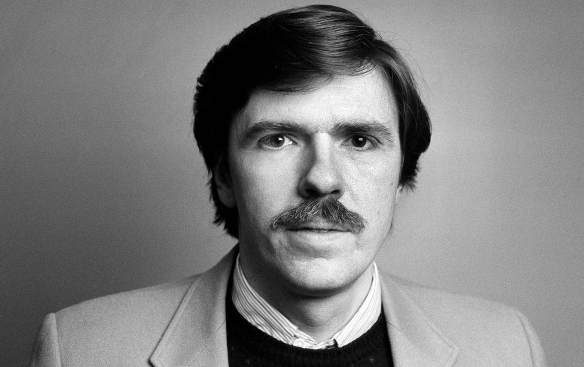
Remembering Investigative Journalist Robert Parry

Robert Parry in Washington, D.C. (AP, February 1987)

By Norman Soloman

Source: TheRealNews.com

After Robert Parry died on January 27, I asked another great investigative journalist, Seymour Hersh, for some words. “I ran into Bob more than three decades ago when he was the first to warn of the Iran/Contra affair, to little avail,” Hersh replied. “He was widely seen over the next years as a critic of the mainstream media in America. That was not so. He was a critic of lousy reporting, be it in Pravda or The New York Times. He wanted every journalist, everywhere, to do the research and the interviewing that it takes to get beyond the accepted headline.”

What made Bob Parry a trailblazer for independent journalism also made him a bridge burner with the media establishment. He refused to take on faith the official story, whether from governments or news outlets. After winning acclaim, including a Polk Award, as an Associated Press reporter who broke many big stories on deadly US policies in Central America, he spent three years at Newsweek—where he saw top editors collaborating with officials of the George H.W. Bush administration on what should be shared or withheld from the public. Bob left the magazine in 1990, and soon his relations with mainstream media had a whistle-blower quality. His 1992 book Fooling America: How Washington Insiders Twist the Truth and Manufacture the Conventional Wisdom named names and pulled no punches.

Midway through the decade, Bob did a stint as director of the Nation Institute’s investigative unit. His writing for The Nation during 1996 included pieces about the CIA and drug trafficking by the Nicaraguan contras, the bankrolled power of right-wing foundations, and a seven-page expose that is chilling to read more than 30 years later—an investigative report on the Koch brothers.

In 1995, Parry launched a unique journalistic space, Consortiumnews.com, where he worked intensely as publisher, editor, and writer. For the next 22 years, Parry oversaw the website’s scrutiny of elite wisdom. His work, which included authoring six books, won the I.F. Stone Medal for Journalistic Independence from Harvard’s Nieman Foundation in 2015 and, last year, the Martha Gellhorn Prize for Journalism.

I got to see Bob at work up close, in 1996, when we co-wrote a series on a media darling: “Behind Colin Powell’s Legend.” During interviews, Bob was politely unrelenting. He had a methodical zest for plowing through documents, determined to “master the material.” And he was professionally generous; I wrote just a small proportion of the articles, but he insisted that I share the byline on every one.

Bob was notably non-ideological. What propelled him was a moral core and determination to follow the facts. That devotion led him to expose the lethal deceptions and machinations of Reagan-era figures like Oliver North, Elliott Abrams, and Caspar Weinberger. Three decades later, the same resolve to separate fact from spun fiction put him on a collision course with the conventional wisdom of “Russiagate.”

No one knew better than Bob Parry how intelligence agencies and major media outlets can create a cascading frenzy. Beginning in late 2016, Bob was prolific as he debunked the torrent of hyperbolic claims about Russia that became an ever-present flood across the US media landscape. Some progressive sites went from often posting his articles in 2016 to rarely or never posting them in 2017.

“For years, the mainstream, establishment media have, by their malpractices in covering US-Russian relations from Ukraine to ‘Russiagate,’ been deeply complicit in the unfolding of this new Cold War and its unprecedented dangers,” said Russia scholar Stephen F. Cohen, a contributing editor at The Nation. “Bob Parry, very often alone, exposed those malpractices, especially those committed by the powerful New York Times and Washington Post, misreported story by misreported story, sometimes daily. For this, he was ostracized, slurred, certainly ignored by mainstream media.”

At the end of December, a week after his first stroke left him with badly blurred eyesight, Bob somehow was able to write what turned out to be his final article, brilliant and transcendent, a kind of cri de coeur that is a stunning last testament to “the journalistic principles of skepticism and evenhandedness.” Western journalists, he wrote, “now apparently see it as their patriotic duty to hide key facts that otherwise would undermine the demonizing of Putin and Russia. Ironically, many ‘liberals’ who cut their teeth on skepticism about the Cold War and the bogus justifications for the Vietnam War now insist that we must all accept whatever the US intelligence community feeds us, even if we’re told to accept the assertions on faith.”

At the close of a lengthy tribute that appeared the day after his father’s death, Nat Parry wrote that, “ultimately, Bob was motivated by a concern over the future of life on Earth. As someone who grew up at the height of the Cold War, he understood the dangers of allowing tensions and hysteria to spiral out of control, especially in a world such as ours with enough nuclear weapons to wipe out all life on the planet many times over.”

Robert Parry carried the lantern high. Now others will need to carry it on.


Read Robert Parry’s final article (posted 12/31/17) at https://consortiumnews.com/2017/12/31/an-apology-and-explanation/

Who’s Afraid of Conspiracy Theory?

By Tim Hayward

Source: Tim Hayward’s Blog

‘Conspiracy theory’ is frequently used as a derogatory term, a term of disdain and implicit criticism. An effect of this is to discourage certain kinds of legitimate critical inquiry. But surely, in a world where conspiracies happen, we need good theories of what exactly is happening. The only people who really have anything to worry about from conspiracy theories are conspirators who stand to be exposed by them. For the rest of us, if someone proposes a far-fetched theory, we are instinctively sceptical; if they propose a theory that accounts for some otherwise unaccountable occurrences, they may be helping us learn something.

Of course, people can sometimes be misled by conspiracy theories, but people are misled by the beliefs that conspiracy theories challenge too. This betokens a need for careful scrutiny of controversial contentions quite generally. Obviously, a conspiracy theory is only a theory unless there is also proof. But it is one thing to demand the truth of a theory be proven; it is quite another to pronounce that such a theory can never be accepted as true. Unfortunately, even academic critics fail to observe that clear distinction, with some of them going so far as to condemn conspiracy theories in general, pre-emptively.[1]

Yet what are denigrated as ‘conspiracy theories’ are quite often legitimate lines of inquiry pursued in a spirit of critical citizenship, with the aim of holding to account those who exercise otherwise unaccountable power and influence over our lives, including in ways we are not all always aware of.

My argument, then, is that a kind of inquiry that can be intellectually respectable and socially necessary is far too readily sidelined with the categorisation of it as ‘conspiracy theory’. However, since the name has stuck, I propose we should embrace the designation and push back from the sideline to show how it is possible to engage in conspiracy theory using credible methods of research.

The problem that concerns critics, in fact, is a kind of extravagantly speculative activity that involves believing untested hypotheses. This can appropriately be called conspiracism.[2] Conspiracism designates a fallacious mode of reasoning that reduces questions of explanation to posited conspiracies, without properly investigating the evidence. Conspiracists are prone to see conspiracies everywhere, and to believe what they think they see, without giving sufficient consideration to alternative explanations. What is wrong with conspiracism, though, can be specified by reference to standards of inquiry set by good conspiracy theory. So the two things could hardly be more different.

It is especially important to be aware of the difference, given how it has been effaced in public discussions. Early ideas about a ‘conspiracist mindset’, from Harold Lasswell and Franz Neumann, informed Richard Hofstadter’s influential study of the political pathologies of the ‘paranoid style’ in the 1960s. This association of conspiracy suspicions with irrationality and paranoia was then actively promoted in the United States, especially, and as Lance deHaven Smith notes, ‘the conspiracy-theory label was popularized as a pejorative term by the Central Intelligence Agency (CIA) in a propaganda program initiated in 1967.’[3]  The program, created as a response to critical citizens’ questions about the assassination of J F Kennedy, ‘called on media corporations and journalists to criticize “conspiracy theorists” and raise questions about their motives and judgments.’ Its reach has extended greatly since.

Professor Peter Knight of Manchester University, who heads a major international interdisciplinary research network, funded by the European Union, to provide a comprehensive understanding of conspiracy theories, takes it to be a now generally accepted fact that ‘some of the labelling of particular views as “conspiracy theories” is a technique of governmentality.’[4]

So who’s afraid of conspiracy theorists? Is it possible that certain governments want us all to be?

It is interesting to note that Professor Knight thinks that if serious conspiracy theories can sometimes be on the right track, then perhaps what they are finding should not be thought of as conspiracies. For instance, he writes, ‘it is possible that different parts of the labyrinthine U.S. intelligence agencies were involved with some of the 9/11 attackers in contradictory and ambiguous ways that fall short of an actual conspiracy, but which nonetheless undermine the notion of complete American innocence.’ The point is, those contradictions and ambiguities merit study, whatever they are called. Knight’s tantalizing idea of an ‘involvement’ that ‘falls short of an actual conspiracy’ brings me in mind of analogous definitional questions that were raised about Bill Clinton’s descriptions of his  ‘involvement’ with a White House intern. Good sense suggests that what people are interested to know is what happened, not what someone calls it. Ultimately, the serious conspiracy theorist – or theorist of conspiracies, as Knight puts it – wants to know what is going on, and hypotheses about ‘involvements’ of all kinds can figure in the inquiry.[5]

We should bear in mind too, that the very name of this field was bestowed upon it by those who sought to pre-empt its development. Its actual practitioners might think their activities could be more aptly designated in one or more of a number of other, albeit less catchy, ways, such as, for instance, critical civic investigation, intellectual due diligence, investigative journalism, critical social epistemology, or critical social theory.

Which brings me to my main reason for speaking out in defence of the activity: as citizens we find ourselves increasingly struck by anomalies and inconsistencies in official and mainstream accounts of public affairs, not to mention in matters of foreign policy. But whenever we try to share our concerns in a public forum, there seem to be people there ready to harangue us with put-downs about being crazy conspiracy theorists. The reason why they do this is something I shall reflect on another time.[6] My point for now is that we have been drawn to conspiracy theory for reasons that are very far from crazy.


Notes

[1] There is a marked tendency in certain literatures to take this generalized approach to conspiracy theories. Several philosophers – including David Coady, Charles Pigden, Kurtis Hagen, and Lee Basham – have commented critically on it, with Matthew Dentith, in particular, criticizing the failure of such approaches to consider the possibility of finding merits in particular conspiracy theories. He provides examples of ‘generalist positions which take the beliefs or behaviours of some conspiracy theorists as being indicative of what belief in conspiracy theories generally entails.’ (Matthew Dentith,  ‘The Problem of Conspiracism’, Argumenta, [forthcoming in 2017]) An example is Douglas and Sutton who state that ‘in the main conspiracy theories are unproven, often rather fanciful alternatives to mainstream accounts’; they also argue that conspiracy theorists are likely to believe conspiracy theories because they are more likely to sympathise with conspirators. (Karen Douglas and Robbie M. Sutton, (2011) Does it take one to know one? Endorsement of conspiracy theories is influenced by personal willingness to conspire’, Psychology, 50(3), 2011: 544-552.)

[2] On this, I endorse the recent exposition offered by Matthew Dentith (ibid): ‘recent philosophical work has challenged the view that belief in conspiracy theories should be considered as typically irrational. By performing an intra-group analysis of those people we call “conspiracy theorists”, we find that the problematic traits commonly ascribed to the general group of conspiracy theorists turn out to be merely a set of stereotypical behaviours and thought patterns associated with a purported subset of that group. If we understand that the supposed problem of belief in conspiracy theories is centred on the beliefs of this purported subset – the conspiracists – then we can reconcile the recent philosophical contributions to the wider academic debate on the rationality of belief in conspiracy theories.’  He identifies the challenge I am arguing we need to take on: ‘Typically, when we think of conspiracy theorists we do not think of people who theorised about the existence of some particular conspiracy – and went on to support that theory with evidence – like John Dewey (who helped expose the conspiracy behind the Moscow Trials of the 1930s), or Bob Woodward and Carl Bernstein (who uncovered the conspiracy behind who broke in to the Democratic National Committee Headquarters at the Watergate office complex in the 1970s). Instead, we think of the advocates and proponents of weird and wacky conspiracy theories … .’

[3] Lance deHaven Smith, Conspiracy Theory in America, University of Texas Press, 2013: p.21; see also Chapter 4 passim.

[4] Peter Knight, ‘Plotting Future Directions in Conspiracy Theory Research’, in Michael Butter and Maurus Reinkowski, eds, Conspiracy Theories in the Middle East and the United States, Berlin: De Gruyter, 2014: p.347.

[5] ‘Involvements’ amongst people can include any of the typical elements of conspiracy such as collusion, collaboration, conniving, tacitly understanding, secretly agreeing, jointly planning, acquiescing, turning a blind eye, covering up for, bribing, intimidating, blackmailing, misdirecting or silencing, and many other more nuanced kinds of arrangement.

[6] In a third blog of this series I shall be asking ‘Do we face a conspiracy to curtail freedom of expression?’ Meanwhile, the second will be a discussion of ‘Conspiracy theory as civic responsibility’. A full academic paper comprising extended versions of each of these will be available shortly. (And yes, for afficionados who are wondering, there will be a full response to proposals of ‘cognitive infiltration’ to ‘cure’ us. I may even suspend my reputed politeness…)

Hastings Suspected Car Tampering

“Just because you’re paranoid don’t mean they’re not after you.”

-Kurt Cobain (paraphrasing  Joseph Heller)

Via: La Weekly:

He came to believe his Mercedes was being tampered with. “Nothing I could say could console him,” Thigpen says.

One night in June, he came to Thigpen’s apartment after midnight and urgently asked to borrow her Volvo. He said he was afraid to drive his own car. She declined, telling him her car was having mechanical problems.

“He was scared, and he wanted to leave town,” she says.

The next day, around 11:15 a.m., she got a call from her landlord, who told her Hastings had died early that morning. His car had crashed into a palm tree at 75 mph and exploded in a ball of fire.

Read the full story here: http://www.laweekly.com/2013-08-22/news/michael-hastings-crash/